







Abstract
This article introduces the concept of communities of interest (CoIs) as a lens to explore the developing collaborative practice. A shared philosophy between companies offers a means of understanding the behaviour of individuals within a community context. This context is an important element within a developing economy, because this shared experience enables organizations to develop and learn together. The article draws on a study within the Welsh organic food sector to illustrate the way that the CoI concept provides an informative framework to explore interaction. The concept of a shared philosophy providing a distinct community identity is one that can be transposed to a number of sectors and offers a creative lens for developing economies as network connections are seen as integral aspects of how companies are able to grow.
Introduction
The drive to explore and enable greater interaction between organizations so enhancing performance has become a central concern within management literature (Starkey and Tempest, 2004) and can offer powerful examples to businesses within developing economies (Dahl and Sorenson, 2012). At the heart of this discussion is an agreement that the sharing of knowledge and resources, among other things, is to the benefit of the companies’ performance and thus competitive advantage. Yet, involvement acknowledges that risks and difficulties are associated with establishing and maintaining these links. The aim of this article is to introduce the concept of communities of interest (CoIs) as a means to explore and enable the effective development of collaborative activity among companies, offering an example from predominantly rural businesses. The article uses a study of Welsh organic food companies to illustrate the way that a ‘shared interest’ can act as an enabler to promote collaborative behaviour in a developing economy.
Organic production provides the community link within this example but is one of a number of interests that can bind people to work collectively. The organic food supply chain exhibits many of the challenges of a developing economy given the position it holds within the wider mass food sector and shaped by the boundaries of accreditation that define its niche characteristics. Thus, a CoI offers a potentially valuable lens for entrepreneurial practice in developing economies as network ties play a significant part in economic growth (Danis et al., 2011). Furthermore, the food industry is a constant in economies across the world, whether the balance is favoured towards production or processing, and therefore provides a relevant context for those in developing economies to understand the collaborative practice discussed in this article.
The concept of a CoI draws on the established areas of social capital (Putnam, 1995) and communities of practice (CoP; Lave and Wenger, 1991), as illustrated in Figure 1.
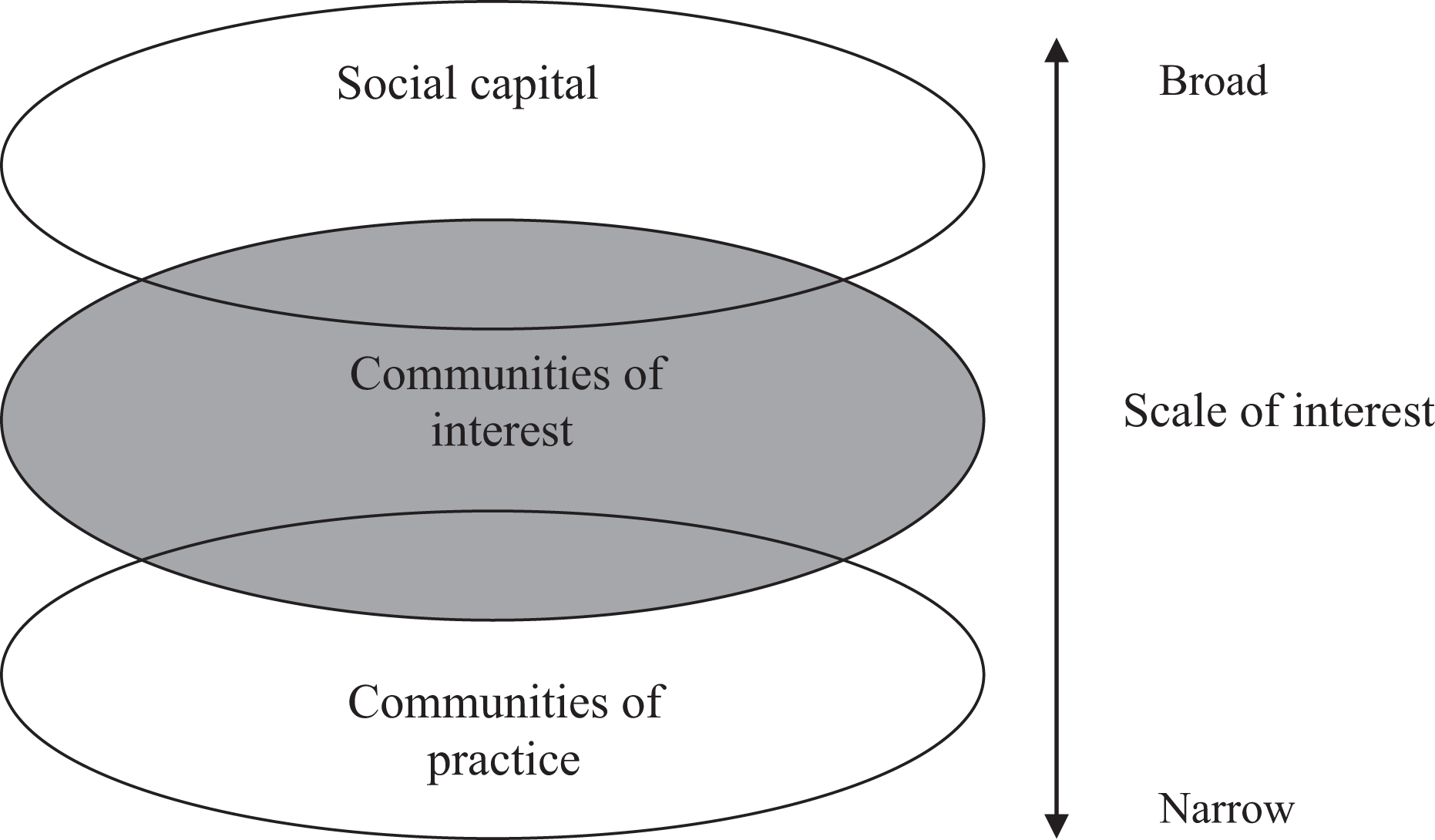
Spatial frameworks informing a CoI. CoI: communities of interest.
The phrase CoI has been used in areas, such as computing (Cox et al., 2003) and local government (Department for Business Innovation & Skills, 2012) but normally to denote a specific project. This article identifies the ‘shared interest’ as an illuminating aspect to explore as this defines the motivation for activity and so can be considered a fundamental part of the decision to collaborate with others. The practice focus of the CoP literature has proved a fertile means of examining learning and knowledge sharing through collaborative activity (Wenger, 1998) but is defined by the specific activity that is bonding behaviour. However, it is not only a specific activity that links interaction. Therefore, expanding the range of the ‘shared something’ to bring in a wider range of activities is of relevance as it includes relationships that go beyond a distinct practice and open up greater resonance for activities within developing economies. In essence, a community can be defined by a discrete interest; the organic food sector provides the example for this article. The main elements of a CoI are explored in this article to illustrate the way that the shared philosophy of a distinct community can provide a means to understanding the motivation for behaviour. Furthermore, the potential advantages available from establishing a shared value through aligning practice are discussed, thereby examining how the concept of CoI can enhance the performance of emerging and developing economies.
As the article is based on a particular study, the methodology section will clarify the nature of the research and the organic example that is being used. The discussion provides key ideas that emerge from the research in order to articulate the way in which a CoI can provide a lens for entrepreneurial practice. This lens is further considered in the conclusion to explore the way that the concept offers a fertile avenue for adoption in developing economies where network connections provide an essential framework (Khayesi et al., 2014). The belief is that this embryonic concept can be further expanded by future studies in a range of sectors and within both emerging and developed economies.
Literature review
At the heart of a CoI are the themes of community and collaboration. Thus, the literature review starts with an outline of what constitutes community before exploring the origins of the CoI concept. The existence of community ties can enable collaborative behaviour, so this is explored in the latter part of the literature review. Finally, the idea of trust is examined as collaborative behaviour is based on human interaction, that is, between the community members.
Community
The idea of community, sitting at the heart of CoI thinking, is widely referred to within a number of varied contexts of human interaction (Cohen, 1985; Portes, 1998) and can be seen as a normative term denoting values and a sense of idealism (Abercrombie et al., 2000). However, a starting point for the discussion is valuable, and this article builds on Fosfuri et al.’s definition of community ‘as any social group in which perceived membership offers a sense of identity to the individuals who see themselves as part of that community’ (2011: 223). Importantly, in this position is the highlighting of perception and identity of the individual and thus the establishment of community as a frame of reference that informs and defines social interaction (Simpson and Macy, 2004). Furthermore, this view of community requires an understanding of boundaries and meaning, and these are important aspects of the CoI.
Origins of the CoI concept
The CoP idea provides a foundational basis for developing CoI thinking as the shared practice in CoP offers a clear method in which to understand and enable the way people interact (Wenger, 1998). Central to the concept is how the understanding of learning as a social activity changes the way that knowledge is developed (Denscombe, 2008). From this comes the identification of a shared practice that links actors together (Wenger, 1998). Significantly, the desire to improve the ability to undertake specified activities is realized through the interaction with others in the developing of knowledge via the experiences and reflections of the community members (Wenger, 1998; Wenger et al., 2002). The domain of interest provides the inevitable focus for the community and essentially identifies a boundary for shaping what is relevant to be communicated and thus learned (Barton and Tusting, 2005). The central consideration is the ‘shared’; therefore, does it have to be a specific practice?
Awareness of relationships and the way that they can facilitate improvement is also an essential aspect of the social capital concept (Boyd and Nowell, 2014). Consequently, the improvement is considered as stronger social ties and better knowledge exchange (Khayesi et al., 2014; Starkey and Tempest, 2004). The opportunity afforded by bodies and groups within an environment, such as trade bodies and regional associations, are simple examples of the structures that inform and enable interaction between related individuals taking the guise of formal networks as well as face-to-face contact (Adler and Kwon, 2002; Danis et al., 2011). However, the social bonds can be irreconcilably broken if the wrong forms of language are used or the required narrative is not understood (Putnam, 1995). Thus, relationships are live and therefore need to be understood and managed.
Collaboration
An increasingly examined aspect of modern business practice (Grey, 2007), collaboration can be seen to have a strong strategic imperative for developing business practice in enabling more adaptive ways to achieve competitive advantage (Inkpen and Tsang, 2005; Skandrani et al., 2011). The potential to work with someone to achieve a goal rather than seeking to work in isolation is a core of interaction and one that lies at the heart of communities, notably an important component of rural network relationships (Freire-Gibb and Nielsen, 2014). In a sense, the community provides a fertile environment for collaborative ideas to grow and bear fruit.
Collaboration encompasses a range of behaviours that are deliberate choices by actors to interact with others, both in a formal and informal manner. The importance of more informal networks in emerging economies is amplified by the relative lack of structures and regulatory systems that are available to entrepreneurial growth in developing economies (Danis et al., 2011). Thus, the ability to strengthen the value that can be derived from existing networks is an important area to develop. Within an ‘organic’ food CoI, the nature of companies’ interaction can be seen along a supply chain, that is, producer to retailer to consumer, as illustrated in Figure 2.

Traditional supply chain.
However, there is also a peer-to-peer aspect to members’ interaction that results in a range of ways in which companies engage with each other (Pisano and Verganti, 2008). Thus, the forms of interaction can be placed on a continuum (Reck and Long, 1988) illustrated in Figure 3.
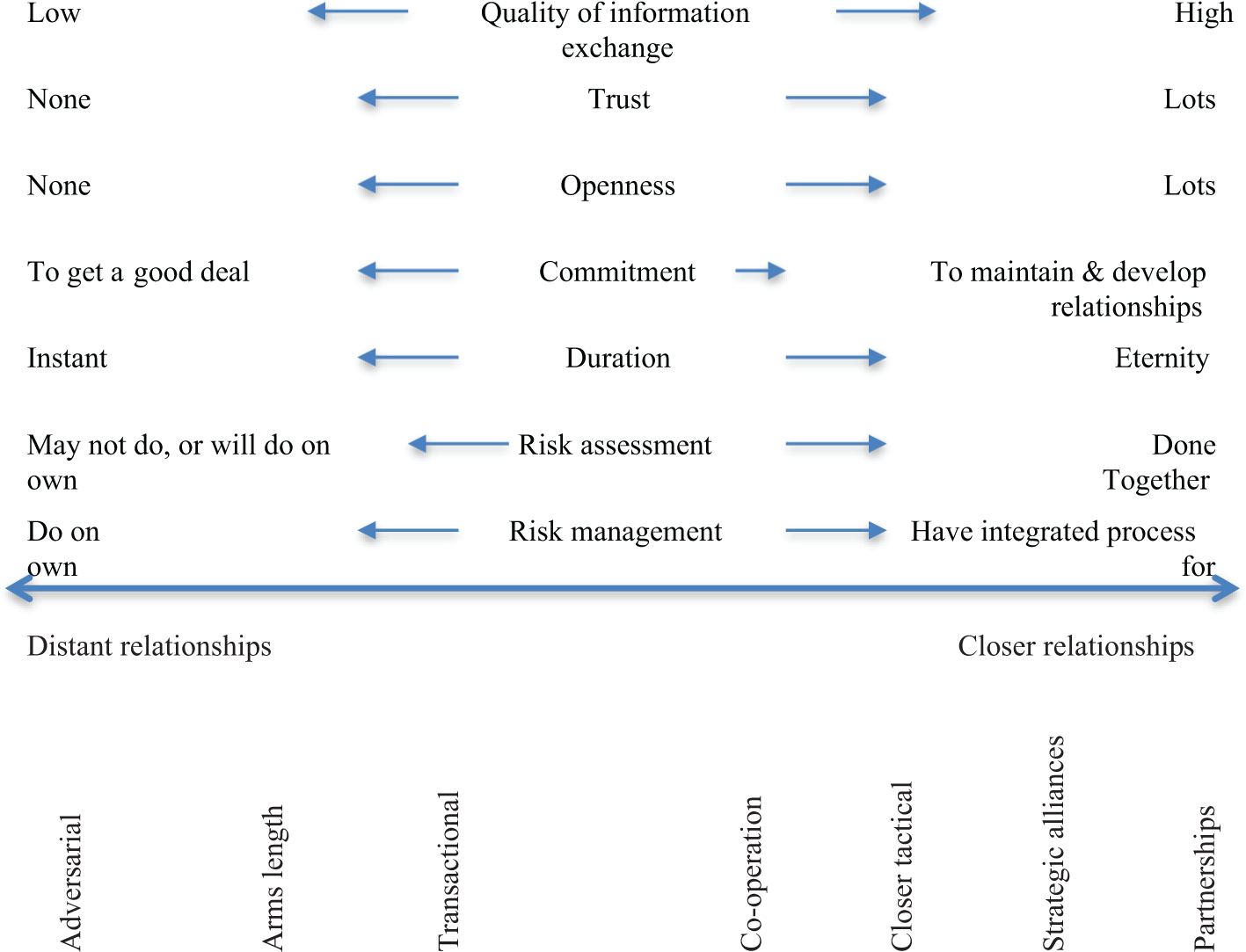
Relationship spectrum. Adapted from: CIPS (2011) and Reck and Long (1988).
The two ends of the continuum bookend a range of options available to companies with distant relationships typified by the traditional supply chain power dynamic (Cooper and Ellram, 1993; Ferrer et al., 2010) where the episodic nature of interaction is driven by the simple necessity of individual gain and is perceived as a power struggle (Subedi, 2013). There is no consideration of companies looking at each other in anything other than conflictual ways as the terms ‘adversarial’ and ‘arms-length’ signify (Cooper and Ellram, 1993). Further along the continuum are increasingly collaborative methods. In essence, any form of collaboration must satisfy a relational need and be based on a shared understanding (He et al., 2012). Notions of community offer an attractive means of exploring such interconnections and can provide the context that enables a cocreated notion of value (Prahalad and Ramaswamy, 2004). Although the initial focus of cocreation examined a consumer/business relationship, the focus on NGOs and the way that they can work with business (Brugman and Prahalad, 2007) is of relevance to developing economies. Indeed, the shared interest that drives the opportunity for cocreation supports the use of CoI as a lens for exploring collaborative opportunity.
Trust
Trust is an inherent aspect of community relationships, as it will inform the degree to which actors are willing and able to enter into collaborative activity (Nooteboom, 2007; Schilke and Cook, 2013). If a level of trust exists, then the threat of risk is minimized (Bachmann, 2001; Grudinschi et al., 2014), where risk is defined as the potential for unwanted, adverse consequences (Maguire and Hardy, 2013). Therefore, a sliding scale between the two elements can be considered; as one increases or decreases, the level of the other is affected in an equivalent manner (Fawcett et al., 2012). In effect, trust can be perceived as the pulse of the community. A reason that social capital and CoP have become attractive concepts for organizations to exploit is to be found in the way that the social bonds strengthened by trust can be utilized for competitive advantage (Sodano et al., 2008).
In the overarching context of collaboration, trust plays an important role as it is embodied in systems and structures that can provide a frame of reference, supporting decision-making (Nooteboom, 2007; Six et al., 2010). Here, there is a distinction being drawn between systems trust and personal trust (Giddens, 1984; Luhman, 1979) as mechanisms to help evaluate risk. Systems trust is embodied in the structures that are relied on by individuals and therefore presupposes a degree of trust from the individual (Seal et al., 2004), that is they believe that it is less of a risk to engage with the system (Adler and Heckscher, 2006). In essence, the constitution of systems, such as professional bodies and trade associations, is founded on the trustworthy behaviour of those that are part of the system; therefore, they are to be trusted by individuals (Bachmann, 2001; Giddens, 1984). The risk is militated as the system displays the relational dimensions required for confidence in the value of engagement by the individual (Nahapiet and Ghoshal, 1998). Thus, a community offers a frame in which collaboration is enabled through the trust that underpins its relationships.
Methodology
‘Organic’ production and products are well-established elements of the food industry (Paul and Rana, 2012) utilizing a distinct ethos friendly to the environment and animal welfare (Soil Association, 2014). A strong, coherent identity is evident in the adoption of the label from a company or consumer perspective (Essoussi and Zahaf, 2008; Paul and Rana, 2012; Schosler et al., 2013) that makes it an interesting focus for the study. Furthermore, organic production provides a strong aspect of economic activity within the agriculture and rural economies in Wales so providing an effective example for developing economies (Welsh Government, 2014). Indeed, the amount of land farmed organically in Wales is three times that of Scotland and twice that of England (DEFRA, 2014), demonstrating the importance of the sector within the Welsh context. The economic value of the organic food sector in Wales is estimated to be between £100–140 million with over half of the companies involved expecting growth in their sales (Organic Centre Wales, 2015). Alongside the production aspect of organic activity, there is an acknowledgement that organic methods play an important role in contributing to European Union (EU) priorities for rural development (Welsh Government, 2014). Thus, an organic CoI provides an illuminating example to understand ways in which collaborative practice can be enabled and promoted within a developing economy.
The desire to discuss the way that companies interact with varied aspects of the ‘organic’ community was felt to be enhanced if there were contributions from a variety of echelons in the food sector supply chain, reflecting a purposeful sampling approach (Arber, 2001). Thus, companies that occupied positions within the producer, processor and retailer roles were looked for, informed by a traditional idea of a supply chain illustrated in Figure 2. Inevitably, some companies occupied more than one position, for example, a farmer will also be a processor or retailer, and this further deepens the perspective of interaction between ‘organic’ community members, adding to the richness of the reflections. The degree to which levels of collaboration take place and the reflections by members about who they interact with is the focus of the interviews, so a multiplicity of member roles strengthens the phenomenon being explored.
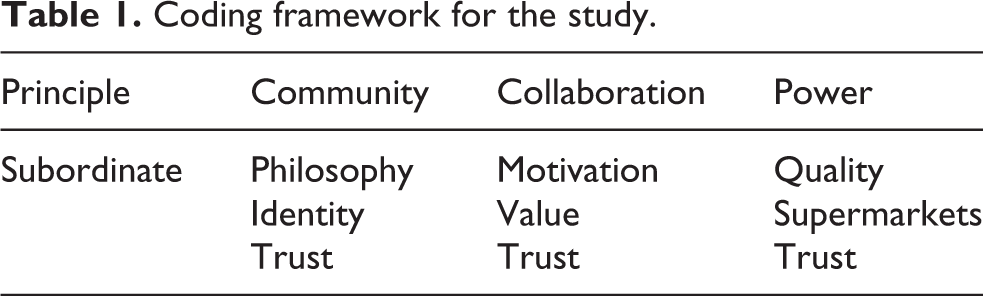
A thematic analysis approach (Braun and Clarke, 2006; Guest et al., 2012) was utilized to structure the data gathering and analysis as it provided a coherent way for the perceptions of the community members to be understood. The nature of the work is inductive as it is seeking to explore the social construction of the community (Gergen, 2001), and therefore, the thematic analysis provides a framework to ensure the rigour of the research. Central to the data analysis in a qualitative study is the coding frame that enables the themes to be identified and developed. Table 1 illustrates the codes that were used within the study. The principle themes identified core aspects of how collaboration within the organic CoI is shaped. Subordinate themes provide the depth of the social construction and emerged from the reflections of the interviewees. Importantly, aspects of identity and the shared philosophy of organic producers indicate the ability for interaction between members, and this is explored in greater depth in ‘Analysis’ section to follow.
Coding framework for the study.
In total, 16 companies were included in the study, with 18 interviewees (labelled interviewee A–R), providing a coherent range of activities within the ‘organic’ community and a strong basis for the study. The companies included dairy and meat farmers, cheese producers, pie producers and retailers, illustrating the variety of organic businesses that contributed to the research. Thus, the study is based on interviews with a cross section of businesses at different stages of food production/processing/retailing, and so a broader perception of the community is realized. All of the companies involved in the study fit the definitions of an Small Medium Size Enterprise (SME) with the majority categorized as mini or small businesses (European Commission, 2015), reflecting the nature of predominantly rural business that comprises the sector (Organic Centre Wales, 2015).
Of the methods available to a qualitative study, the use of interviews proved to be the most effective. As the companies were spread across Wales, the opportunity to utilize focus groups was felt to be impractical as the community members were giving up valuable time to be involved in the research. Similarly, observation would have required a greater intrusion on the companies involved in the research. Furthermore, the use of a semistructured interview style enabled room for the conversation to breath (Ardley, 2005; Bryman and Bell, 2011) and provided the interviewee with the space to develop the depth of their reflection (Ardley, 2005). Thus, the thematic analysis and interview method created a sound framework for a rigorous and reliable study.
Analysis/discussion
We are humans, we are designed to live in communities. (Interviewee E)
The existence of a community that draws on a shared interest in organic production is developed in this discussion to illustrate the relevance of the CoI concept in understanding and developing interaction. Furthermore, the way in which collaborative activity can be enabled is explored with key examples from the community members. I think organics gives you a different label or a different tag and the people that are in organic, you know, it gives you an immediate tag and a sort of sense of, maybe comradeship with another organic producer definitely. (Interviewee O)
‘We piggy back with other companies and try to help other companies’ (Interviewee Q). As illustrated by Interviewee Q, two strong motivators for action emerge. An economic driver is an unsurprising motivator for working with other community members. Value in this commercial motivation is founded mainly around cost and resource saving. If we could consolidate their orders with our orders on the same palette as we are going to Tesco or Sainsbury or whatever, we would be very happy because it would mean we would charge a sensible transportation rate, we would reduce our transportation rate, they would even reduce theirs, there would be a real virtuous circle but it would have to be worth us doing it. If we only earn £50 a week out of it and do a load more work it wouldn’t be worth it. That’s the difficulty. (Interviewee D)
Several examples emerged from the interviewees where collaboration has been managed or where the potential is being explored, displaying the desire for collaborative activity to be enabled. Indeed, the examples cover both formal and informal activities, as illustrated in Table 2, supporting the more integrated examples of interaction in Figure 3. The combination of type of example provides a framework for cocreation and is informed by the shared philosophy of organic practice. However, it would be simplistic and naive to proclaim that collaborative activity is purely the preserve of a CoI. The economic driver for collaborative endeavour exists in many business scenarios and has been examined in much literature (Cooper and Ellram, 1993). The example of the community members looking to collaborate on production and delivery logistics does not have to display anything other than a purely economic imperative to seek the best outcome for the individual business. The two are simply engaged in ‘organic’ operations and so share factors that mean they can benefit each other by combining elements of the business. Nevertheless, there is a softer, friendlier tone to the language used in describing scenarios that would not be expected in a purely commercial transaction. ‘It’s probably more friendly though. People will help each other out and will share information. There is a lot of that because there is a common goal so there is that’ (Interviewee D). If nothing else, this suggests a social capital relationship formed due to the shared practice that ties the two companies together (Starkey and Tempest, 2004); a sense of community bond cognizant of the relational dimensions informing behaviour. Thus, there is an alignment to the right-hand frame in the relationship spectrum, as illustrated in Figure 3.
Examples of collaborative activity within the CoI.
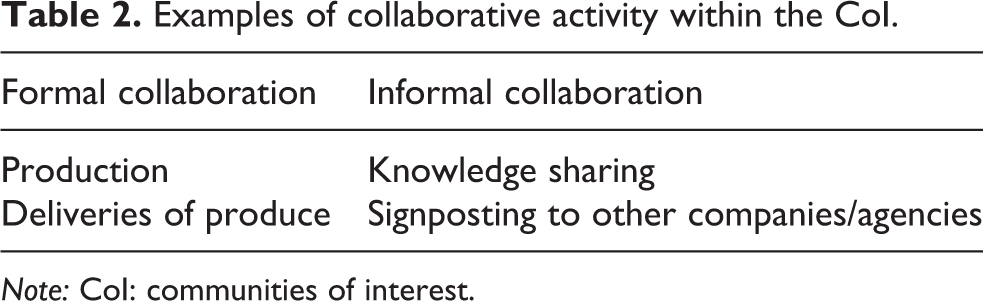
Note: CoI: communities of interest.
A second motivation also appears; the promotion of ‘organic’ itself through the success of partners and as an important way of producing a quality product that represents distinct values. Here, a stronger sense of the philosophy linking the members is evident and a more powerful proponent for a communal identity beyond just the individual (Cohen, 1985). For some of the community members interviewed, this imperative appears to be stronger than the economic rationale of cost saving and logistics. There’s a whole community, I suppose, who all believe in the same thing and we all want to see each other succeed and so I think it’s important for us to work together because it makes it a stronger, not organic as a stronger presence I suppose, but we’re all together and that basically working together. (Interviewee C) We share similar values I think so I would say very high terms of people operating organic businesses are in it for sort of value based reasons. Yes, I think a high percentage of them are in it for slightly more personal reasons than they are business reasons. But they are all good business people, don’t get me wrong, and they can see that their business has got to make a profit to survive. (Interviewee H)
The ‘organic’ example that forms the philosophical base of the community studied in this work provides a coherent shared interest and is clearly understood as a distinct form of community (Cohen, 1985) by the members interviewed. Although some variety exists to the strength of the community, the overwhelming responses show a clear identification and awareness of a community that links ‘organic’ members. Importantly, it is the ‘organic’ principle that is the binding component that brings together more disparate practices. I can’t see that it would have happened outside of the organic sector but maybe that’s because I’m too involved in the organic sector to have had to see outside of that. Could it have worked? No that’s not true. It could have worked with a conventional distributor of dairy. Yes, there’s no reason why it couldn’t have worked. I think that because. I think it’s probably worked more easily because we both work in the organic sector because we have a shared basis, I suppose, for our beliefs. (Interviewee R)
Conclusion
Consciously drawing on the CoP literature that has been developed over the last 20 years (Cox, 2005; Wenger, 1998; Wenger et al., 2002), and increasingly entered the management discourse, the phrase CoI is not coined in this study. However, in this work, the range and potential of the term have been expanded and framed around the shared philosophical base of the community and therefore become a coherent concept to be used in improving the understanding and development of collaborative activity. Here, the ‘shared interests’ provide a lens through which collaborative practice can be examined and understood to develop future activity. The ‘organic’ example presented in this article is just one way in which the ‘shared interest’ is of relevance to developing economies. Thus, the essence of interaction and member involvement that is at the core of CoP thinking is extended to a broader field of vision. As illustrated in Figure 1, the positioning of CoI between the existing concepts of social capital and CoP adds to both theoretical development and practice. Here, a similar flexibility to CoP is evident and enables the concept to be applied in varied contexts with potential value to understanding the networks that exist in emerging economies.
The ability to ascertain where integrative motivation is possible must lie at the base of collaborative activity and draw on the social capital ties that are present within networks at the heart of developing economies (Khayesi et al, 2014). In this way, trust becomes less of a dangerous consideration as the ‘systems’ trust evident in the community structure is providing a comfort and supports face-to-face ‘personal’ trust. Potentially, this scenario can appear a little ‘rose-tinted’ as the collaborative behaviour is flowing from more positive views of individual motivation and desire which may lead to flawed perceptions of real intentions. Yet, this reading misses two important aspects. First, there is space for the positive consideration of collaborative behaviour and the sense of more supportive mechanisms that need to be in place for them to work. Hence, the spectrum of relationships moves from the isolated to the collaborative and provides the cocreating framework that the CoI lens makes sense of. Second, people seek to belong to communities and identify the ‘shared interest’ that can bind them together. The example of ‘organic’ food production in this article is simply one incident and itself can be replicated in developing economies. A plethora of interests can offer the ‘shared’ focus that may define an example of community identity and will reflect the varied characteristics of a particular region or activity. Indeed, this is an area for future study in order to fully determine the way that CoIs exist within developing economies.
The importance of networks to overcome infrastructure limitations in emerging economies would lend credence to the value that the CoI can play in enabling stronger practice that benefits the community members. This doesn’t have to mean a naive faith in the spirit of fellow humans; rather awareness that there exists potential for the growth of collaborative networks in whatever form they take. Therefore, there is value in utilizing the idea of the ‘shared interest’ that can unite varied practices that are bound by a linking philosophy. Thus, the lens can be applied across the range of interests that sustain communities, offering a flexible means of exploring collaborative activity to inform stronger practice.
Footnotes
Declaration of conflicting interests
The author(s) declared no potential conflicts of interest with respect to the research, authorship and/or publication of this article.
Funding
The author(s) received no financial support for the research, authorship and/or publication of this article.