







Abstract
Small and medium-sized enterprises (SME) are tasked with driving economic recovery globally, in terms of contribution to economic growth. Understanding the determinants of SME innovation is essential in clarifying this phenomena. This study investigates the link between SME strategies and intention to undertake future innovation, using Federation of Small Businesses data. The analysis employs the novel N-State Classification and Ranking Belief Simplex (NCaRBS) technique, investigating relationships between changes in SME strategies, including staffing levels, importing/exporting and client base, and future (including uncertain) innovation intentions. NCaRBS can analyse an incomplete data set, with missing values in the considered characteristic variables, without the need to manage their presence. NCaRBS can also generate results providing insights into SME behaviour regarding strategy and innovation, while also increasing learning about potential reasons behind SMEs uncertainty regarding innovation intention. The study provides novel perspectives into how SMEs develop innovation intentions and the strategies required to support/exploit such intentions, of value to academia, enterprise support agencies and policymakers.
Introduction
Small and medium-sized enterprises (SMEs) are increasingly tasked with driving economic recovery globally (Arshed et al., 2016; Beynon et al., 2016), particularly through knowledge diffusion (Braunerhjelm et al., 2010). Here, innovation is defined ‘as the implementation of a new or significantly improved product (good or service), or process, a new marketing method, or a new organisational method in business practices, workplace organisation or external relations’ (Eurostat, 2018). Innovation is regarded as critical in enabling growth and improving performance (Harris et al., 2013; Keizer et al., 2002). Consequently, government policymakers strive to encourage innovation activity to benefit their economies (Hausman, 2005). Understanding SME innovation determinants is therefore essential.
SMEs are also required to demonstrate technological sophistication in competitive markets (Dibrell et al., 2008). Keizer et al. (2002) claim SMEs need to be innovative to overcome relatively limited resources, vulnerability to uncertainty, turbulence in business environments and extensive customer and supplier power. However, there is often uncertainty surrounding potential future SME innovation activity (Sawyer et al., 2003), to design future innovation policies. Foreman-Peck et al. (2006) find a positive relationship between innovative orientation and growth, but also that limited financial or management resources could lead innovation activity to deprive other business activities of required resources (Heimonen, 2012; Hewitt-Dundas, 2006).
This highlights the importance of investigating SME characteristics, both internal and environmental, of relevance in driving innovation activity (O’Regan et al., 2006). In this study, the technique is used to investigate the relationship between planned changes in potentially relevant strategic-based characteristics (identified in the literature), including staffing levels, importing/exporting and client base, and whether they intend to undertake future innovation. Such nuanced understanding of innovation intention behaviour within the SME sector is currently absent from the extant literature and is offered here as a contribution.
Unsworth et al. (2012) also identify factors such as environmental uncertainty as important in determining innovation adoption. If an SME provides a Don’t Know (DK) response to innovation intention, there is often an assumption that the SME is, in reality, more inclined to be more ‘No’ to such intended innovation, Gilljam and Granberg (1993) using the term ‘easy out’. In terms of analysing uncertainty, Francis and Busch (1975) suggest, however, that respondents with non-substantive responses, such as DK, should not generally be excluded from analysis, arguing such responses are not random, exclusion introducing bias in any undertaken analysis. Turner and Michael (1996) argue a DK is not always a sign of knowledge deficit (i.e. uncertainty or ambivalence), the business context also needs to be considered (in our analysis whether an SME manager would want to admit to saying No to intended innovation – preferring instead to say DK in their response).
This study investigates the relationship between SME development strategy-based characteristics and enterprise intention to undertake future innovation. The analysis technique used, crucially, permits the inclusion of ignorance in the development strategy-based characteristics of SMEs, and allowance for uncertainty in the innovation intentions of SMEs (inclusive of DK responses), employing an analysis technique called N-State Classification and Ranking Belief Simplex (NCaRBS). Introduced in Beynon and Kitchener (2006) and Beynon et al. (2015a, 2015b), NCaRBS is a development from the original CaRBS (Beynon, 2005a, 2005b; Beynon et al., 2014). As a novel analysis technique, it, or versions of it, has been employed in a range of research areas including credit rating analysis (Beynon, 2005b), organizational strategy theory (Beynon et al., 2015a) and SME training satisfaction (Jones et al., 2013), among others.
The NCaRBS technique has the unique ability to analyse incomplete data sets, with missing values in the characteristic variables included, without needing to manage their missingness. Further, it allows inclusion of responses from SMEs, which answered DK to their innovation intention, and graphical exposition of such results.
The analysis uses data from the Federation of Small Businesses (FSB) 2010 survey. The FSB is the United Kingdom’s largest campaigning pressure group promoting the interests of the self-employed and owner/managers of SMEs with over 200,000 members. The FSB biannually surveys a wide range of SME behaviour and attitudes, and is the largest representative survey of UK firms available for academic research purposes (Beynon et al., 2015b). The survey was sent out to the entire membership, garnering 11,367 SME responses. The paper authors were granted access to use the data for academic research purposes after representation to the FSB, with 8420 responses being usable for the research. Because the research uses secondary data from a pre-existing survey, however, it does produce limitations (in terms of the variables created) in the strategies that can be assessed in relation to innovation intention.
The study uses data from the same FSB data set used in Beynon et al. (2015b) and, as with that study, uses the NCaRBS technique to explore innovation intention and uncertainty. However, while Beynon et al. (2015b) focused on demonstrating the usefulness of NCaRBS as a technique, using general SME characteristic variables (such as firm age, firm size, firm growth, owner education, etc.) this study focuses on the strategic orientation of the firm, providing pertinent additional evidence towards a number of debates. First analysis offers insights into SME behaviour in terms of firm strategy and its relationship with innovation intention, as well as the specific strategies most closely related to SME uncertainty about innovation intention, adding to limited literature in this area highlighted by McAdam et al. (2004). It also addresses Love and Roper’s (2015) argument that evidence evaluating SMEs is limited and characterized by small sample sizes and simplistic econometric analysis, providing relevant evidence to the ongoing debate regarding how government programmes and policies can support innovation-orientated entrepreneurship (Mason and Brown, 2013).
The structure of the rest of the article is as follows: A brief literature review discusses the variables directly of relevance to the study. The methodology is then presented, including a brief elucidation of the NCaRBS technique, the incomplete FSB-innovation data set described and research problem articulated. Results generated using NCaRBS, level of classification fit and contribution of characteristic variables are then identified, followed by a discussion of inferences that can be drawn in respect to SME innovation and business analytics, including the results related to innovation uncertainty. Finally, conclusions are given and the research contribution identified.
Literature: Innovation, potential drivers and the role of uncertainty
While Lee et al. (2010) claim SMEs have the capacity for innovation, lack of technology competencies for new product development, cost-effectiveness, operational efficiency, emerging market niches and process innovation are often seen to affect SME ability to innovate (Appiah-Adu and Singh, 1998). Van de Vrande et al. (2009) note SMEs often lack the resources and key business capabilities required to transform inventions into products or processes. Keskin (2006) suggests, when considering SME’s innovativeness potential, one must also consider environmental uncertainty, Edwards et al. (2005) identify SME flexibility and specificity as advantageous in accelerating innovation. Overall, however, there remains uncertainty regarding drivers of innovation activity within SMEs and further evidence is required (Love and Roper, 2015).
This debate can also be seen as relevant in the context of SME intentions, an issue previously researched in terms of internationalization (Kundu and Katz, 2003), information communication technology (ICT) (Daniel and Wilson, 2002; Sin Tan et al., 2010), strategic alliances (Lohrke et al., 2006), growth (Morrison et al., 2003) and adoption of externally sourced innovations (Lin and Ho, 2008). While there is an established innovation literature on the determinants of firms’ actual innovation activities, there has, however, been minimal prior research on SME intention to innovate, and specifically what might drive a firm to be uncertain regarding its future commitment. Such knowledge is useful in understanding how SMEs can be encouraged to embrace innovation as a driver of future growth.
In terms of potential characteristic/explanatory variables which may drive/inhibit innovation or cause uncertainty about it, these can be categorized into several groupings. This study broadly adopts the Edwards et al. (2005) view of innovation intention, specifically in terms of overlapping, constraining and enabling, aspects of the firm’s existing dispositions towards relevant internal resources, as well as strategic orientations including those related to uncertainty and novelty, and relations with customers.
As with all businesses, SMEs require resources, knowledge and skills to enhance the efficiency and effectiveness of their operations. Dollinger’s (1995) typology classified these resources as financial capital, human capital, social capital, technological resources, reputational capital and organizational resources, identifying a range of resource-related strategies of potential relevance to innovation intentions.
Research and development
Love and Roper (2015) suggest in-house research and development (R&D), unsurprisingly, is critical to firm ability to generate the knowledge base for proprietary intellectual property and innovation (see also Griffith et al., 2003). Raymond and St-Pierre (2010) also identify a linkage between R&D and product innovation, while R&D investment is argued by Baldwin and Hanel (2003) to be a key mechanism, along with development of knowledge and competencies, in determining overall levels of innovation in a sector/industry. Conversely, Laforet’s (2008) literature review highlights the link between R&D and innovation but also identifies that SMEs cannot always convert their R&D into successful innovation; Hall et al. (2009) suggest innovation often occurs without the presence of formal R&D activity, the lack of such formal activity often prevalent within SMEs.
Investment in staff training
Jones et al. (2013), summarizing, note that staff training positively influences performance and capabilities, through enhanced productivity, firm survival rates, quality, labour turnover, financial results and potential growth. Antonioli and Della Torre (2016) argue technological innovations are linked to increased external training activities, while organizational innovation adoption (job rotation, multitasking and decentralization) is linked to increases in internal training activities. Garcıa-Morales et al. (2007) also suggest a firm committed to learning increases its innovation capability and is less likely to miss opportunities. MacDonald et al. (2007) identify, therefore, that government policy links training policy as a means to improve innovation outcomes, while Muscio (2007) illustrates that training assists in developing SMEs’ human capital absorptive capacity, of crucial importance in innovation application.
Evidence, however, remains inconclusive and contradictory (Aragón-Sánchez et al., 2003; Jayawarna et al., 2007), potentially discouraging policymakers and SMEs from investing in training provision as a way of encouraging innovation activity. MacDonald et al.’s (2007) study, for example, failed to establish a positive association between training and innovation; De Saá-Pérez et al. (2012) also note that investment in training alone does not provide greater levels of innovation capacity for SMEs, only when training interacts with firm knowledge does its effect become highly significant, highlighting the potential importance of R&D.
Investment in equipment and machinery
An obvious capital of relevance to a firm is productive capital, in the form of equipment and machinery. Pellegrino et al. (2012) identify that investment in new machinery and equipment can be classified as embodying technological change; their study of innovative SMEs found that such investment was vital in generating innovative outputs. Love and Roper (2015) also argue that updating firm production technology via such capital investment may help innovative SMEs overcome internal resource limitations. Given the potential for such SMEs to be resource constrained, however, it is also possible that investment in equipment and capital may also be a substituting activity with innovation, the outcomes from investment and innovation suffering from uncertainty created by further technological advance and competitive pressures, as found by Skuras et al. (2008). This suggests, therefore, that there is uncertainty over whether both can be undertaken simultaneously, while reduced investment in these areas may imply greater general resource constraint again making innovation activity more unlikely or at least more uncertain.
In terms of strategic orientation more broadly, within the literature, the most obviously relevant orientation relates to firm growth aspirations (Uhlaner et al., 2013). Prior studies suggest that rapid growth can occur in labour- and knowledge-intensive industries, manufacturing and service industries (Davidsson and Delmar, 1997), in SMEs of all ages (Smallbone et al., 2002), high growth competency being related to higher levels of innovativeness (Akgün et al., 2007; Allen and Stearns, 2004).
An outstanding question remains, however, regarding what metrics effectively measure growth aspirations (Hudson et al., 2001), impacting variables including employment (Hoffman et al., 1998), turnover (Moreno and Casillas, 2007), market share (O’Gorman, 2001) and profits (Jayawarna et al., 2007). Other measures that proxy for such growth aspirations include SME size as measured by the numbers of outlets, customer base and so on. (Dobbs and Hamilton, 2007). The analysis below discusses the three most obviously associated growth aspirations that are also available in the FSB survey.
Staffing levels
Hoffman et al. (1998) suggest SMEs ability to attract, develop and retain employees impacts upon their capability to effectively pursue growth. Roper (1997) and Sheehan et al. (2014) also suggest SME staffing levels, innovation and productivity are positively associated. Thus, SMEs need to effectively manage their staffing levels (Thakur, 1999) to pursue innovative activity, as well as being a measure of firm growth in its own right. Bougrain and Haudeville (2002) further identify that research and production managers are essential to the innovation process, sales managers also enhancing firm ability to respond to the market.
Number of premises/branches
The literature on the influence of firm size towards innovative capacity is inconclusive. Schumpeter (1942) and Laforet (2008) suggest large businesses possess advantages over SMEs due to superior financial capabilities allowing them to be more effective innovators. Contrastingly, Bertschek and Entorf (1996) and Cohen and Klepper (1996) note that large firms are inhibited by excessive complexity and bureaucracy, impacting negatively upon creativity and flexibility in contrast to SMEs, suggesting that firms with greater numbers of premises or branches may be adversely affected by such problems. Pla-Barber and Alegre (2007) found that firm size is not a determinant for innovation.
Client base
Expanding the client base can be regarded as a direct measure of growth. Prior literature also recognizes the importance of managing the client base effectively to establish professional relationships (Ceci and Iubatti, 2012). Professional interactions between firms generate interdependent capabilities and routines regarding production, logistics and quality management, facilitating effective coordination and resources allocation to improve productivity (Petersen et al., 2003). De Propris’s (2002) UK SMEs study also found a positive relationship between firms engaging in such cooperation with client firms and suppliers and product innovation. Tomlinson and Fai (2013), however, identify the need for further research to explore the nature and intensity of cooperative ties and their impact over innovation activity. The expansion of the client base, while being a measure of growth, may also introduce uncertainty for the firm in terms of its innovation, or at least less effective relationships while the relationships are being built.
The final set of strategy variables considered are also more externally focused, and often related to the exploitation of innovation.
Importing and exporting
Kocak and Abimbola (2009) found firms deemed to be innovative sought to gain enhanced competitive performance from the application of knowledge-based resources to marketing their outputs in several countries. Higón and Driffield’s (2011) study also found product innovation impacting positively on the decision to export, and Pickernell et al. (2016) found innovation focus consistently and positively linked to exporting for SMEs. Conversely, Salomon and Shaver (2005) postulated that exporting allowed access to knowledge not available in the domestic market, promoting learning that can foster increased innovation, their results finding that exporting is associated with innovation. Girma et al. (2008) also found that previous exporting experience enhances innovative capability. The literature suggests both that a possible relationship exists and that it could be bidirectional in nature, therefore requiring further study.
Online presence
Pickernell et al. (2013) confirmed a significant positive relationship between SME online presence and innovation. Simpson and Docherty (2004) also suggest innovation and online presence adoption are positively related, while Simmons et al. (2011) claim online presence represents an enabling mechanism for SME innovation activity, improving efficiency of processes, enhancing communication, and revolutionizing existing business models, increasing competitiveness and improving performance.
Examples of highly innovative SMEs prepared to adopt higher levels of online presence (Loebbecke and Schäfer, 2001), and change their business operations are also apparent. Lazoi et al. (2011), for example, found a link between SMEs in the aerospace sector adopting higher levels of online activity (ICT) and innovation through the supply chain, via enabling enhanced networking effects. Higón (2012) also found website development, in particular, demonstrated the potential to create competitive advantage through product innovation. Online presence adoption in SMEs remains an under-researched topic, especially with regard to recognizing the antecedents to successful deployment (Eggers et al., 2017; Fink and Disterer, 2006).
Investment in marketing/advertising
According to Simmonds (1986), marketing itself can be viewed as an innovation activity. Marketing also interacts with other functional departments, such as R&D, significantly impacts new product success, marketing and R&D seemingly having equivalent influence on new product decisions (Atuahene–Gima and Li, 2000). Investment in reputational capital through marketing (Morris and Paul, 1987) is also important in making the firm more able to exploit innovation. Actually bringing innovation to market is a key activity involving marketing and market research (Galindo and Méndez, 2014). Investment in marketing can therefore be seen as part of the innovation ‘pipeline’ (McCarthy et al., 2014).
Methodology
Background
The FSB survey (including data from previous versions of the survey) has already been utilized to analyse a wide range of small business issues, see for example, Mason et al. (2006, 2011), Carter et al. (2009), Pickernell et al. (2011a, 2011b, 2013, 2016), Jones et al. (2013) and Beynon et al. (2015b). The FSB (2010) survey was an evolution of prior FSB surveys developed in consultation with FSB members. The survey data collection process was managed by a private sector consultancy, the paper authors were granted access to the data for academic research purposes after representation to the FSB.
Survey instrument
Individual SMEs were considered the unit of analysis, and owner/managers were asked to complete the questionnaire. The 2010 survey was sent to the FSB’s entire UK membership of approximately 200,000 SMEs. Of the 11,367 SMEs that responded, 8420 provided responses usable for the research discussed in this article (for reasons discussed further below, usable respondents have to contain a response to the outcome variable and at least one of the considered characteristic variables). Analysis of background data for the 8420 respondents identified showed the median and mode age range of respondents was 45–54, two-thirds of whom were male, 35% having a degree or higher, with the median number of employees for firms being four.
Three perspectives on future SME innovation intention are considered in this study, see Figure 1. In Figure 1(a), the survey question of SME innovation intention in the next 12 months is presented, including the three response perspectives of Yes, No and DK able to be chosen (as given in the FSB questionnaire). In Figure 1(b), the same three perspectives are shown, this time across a simplex plot, demonstrating how the substantive (Yes and No) and non-substantive (DK) responses can be represented on the same domain (used in the NCaRBS analysis undertaken).
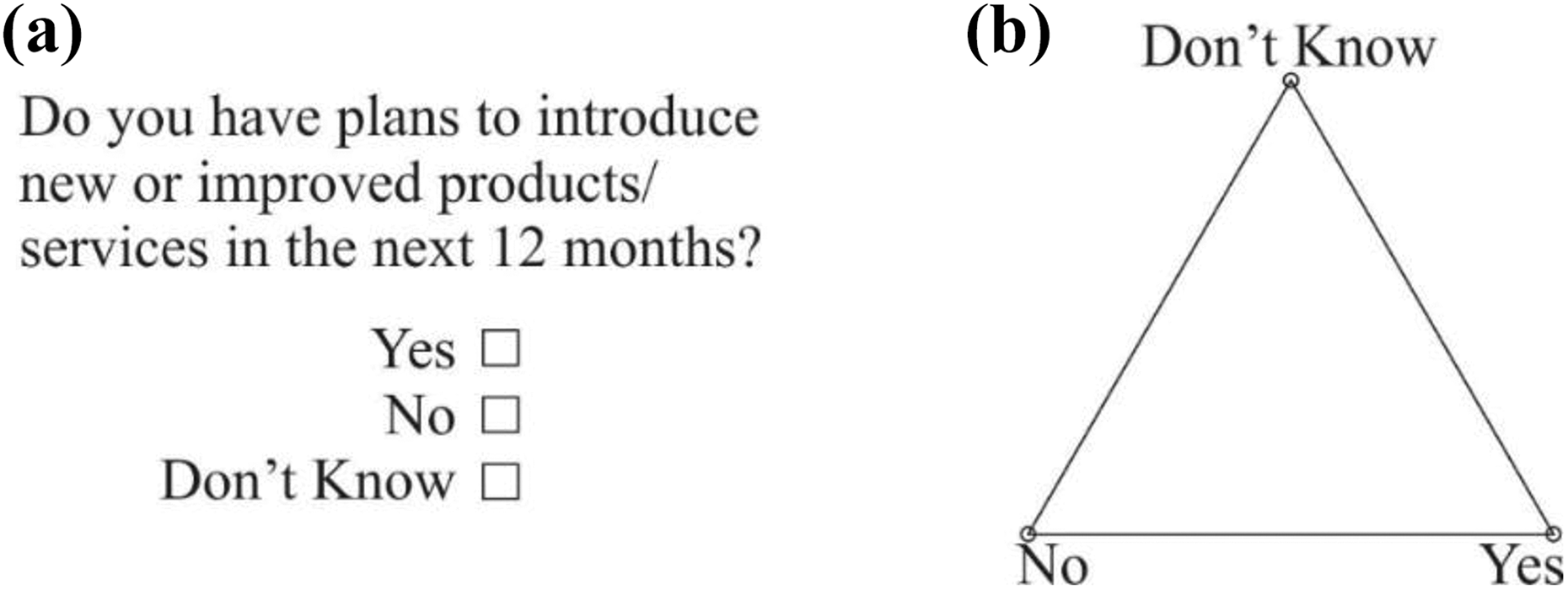
Innovation intention question with response options (a) and response representation in simplex plot domain (b).
Beyond the SME viewpoint on innovation intention, their respective views on characteristics of their future strategy were also taken from the FSB survey, as described in the previous section, see Figure 2.
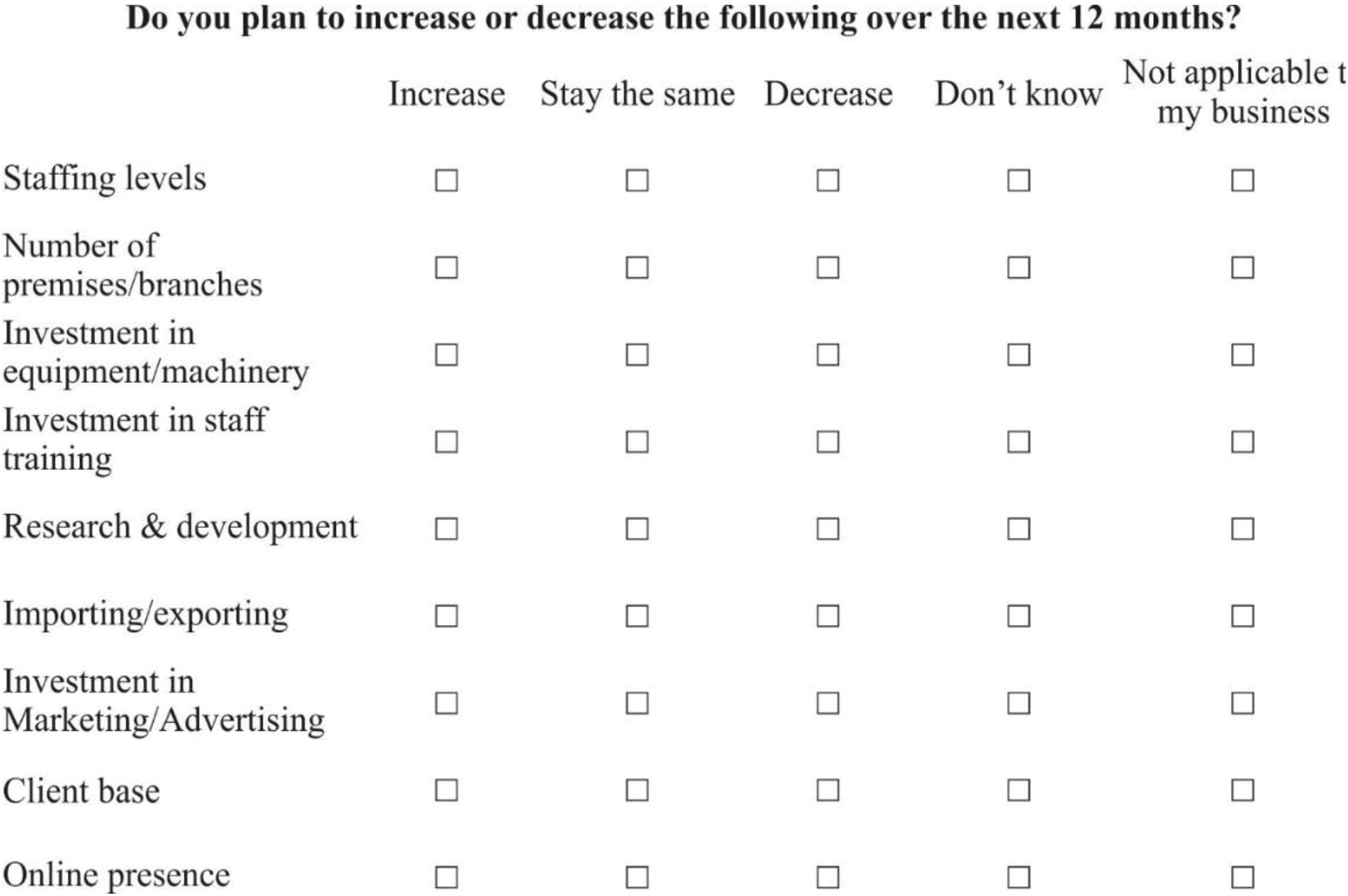
Development strategy questions with response options.
In Figure 2, nine SME-based characteristics of development strategy are considered, namely, staffing levels (Stff_Levl), number of premises/branches (Prms_Brch), investment in equipment/machinery (Eqpt_Mchn), investment in staff training (Stff_Trng), R&D (Rsch_Dvlp), importing/exporting (Impt_Expt), investment in marketing/advertising (Mrkt_Advt), client base (Clnt_Base) and online presence (Onln_Prsn). Consideration of these strategies is also over the next 12 months, the same as innovation intention. The nine presented facets of strategies cover a range of issues, Stff_Levl, Prms_Brch and Clnt_Base can all be seen as growth-related variables, four measures relating to SME investment in resources, namely Eqpt_Mchn, Stff_Trng, Rsch_Dvlp and Mrkt_Advt, with Impt_Expt and Onln_Prsn seen as variables related to widening potential markets/potential resource sources.
Coding of variables
In the development strategy questions, inspection of Figure 2 shows three substantive responses, namely ‘Increase’, ‘Stay the same’ and ‘Decrease’. There are also two available responses which are not directly substantive. First, ‘DK’ is a well-known non-substantive response. Second, ‘Not applicable to my business’ by definition does not offer any substantive information towards specific evidence to development strategy.
Beyond these two non-substantive responses, there is another version of response to be considered, that is non-response, where for one or more of the described development strategy variables given, none of the five presented response options was selected. Termed a missing value, the presence of a missing value here means no evidence is given on that specific strategy.
These three responses, ‘DK’, ‘Not applicable to my business’ and ‘No response’, offer no substantive evidence towards development strategy. Instead, for different reasons offer only ignorance in terms of evidence. Ignorance here simply means there is no substantive evidence being offered towards a development strategy. A breakdown of the presence of each response type is next considered, from the 8420 finally considered SMEs, see Table 1.
Frequency of responses to nine development strategy survey questions (for 8420 considered SMEs).
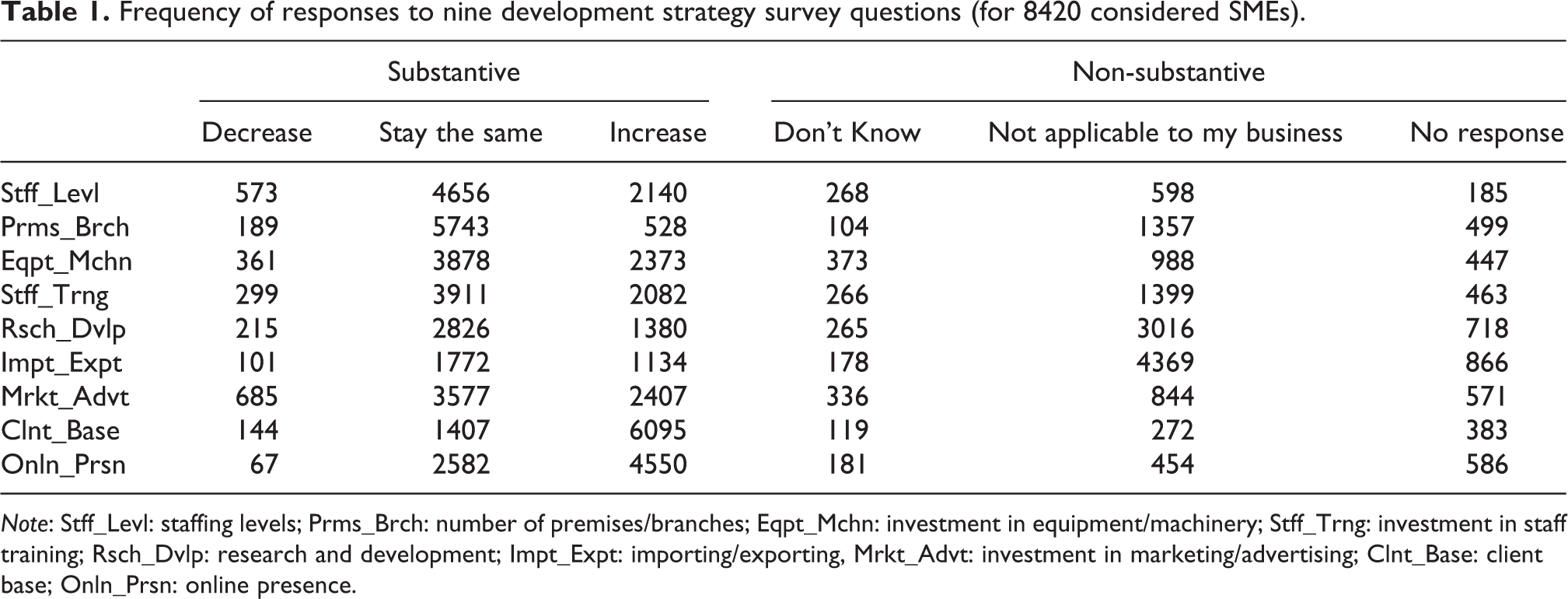
Note: Stff_Levl: staffing levels; Prms_Brch: number of premises/branches; Eqpt_Mchn: investment in equipment/machinery; Stff_Trng: investment in staff training; Rsch_Dvlp: research and development; Impt_Expt: importing/exporting, Mrkt_Advt: investment in marketing/advertising; Clnt_Base: client base; Onln_Prsn: online presence.
In Table 1, the number of responses of each type possible are given for each development strategy variable considered. Of particular note here is the frequency of responses to each of the non-substantive responses ‘DK’, ‘Not applicable to my business’ and ‘No response’. The percentages of non-substantive responses for each development strategy variable are Stff_Levl – 12.482%, Prms_Brch – 23.278%, Eqpt_Mchn – 21.473%, Stff_Trng – 25.273%, Rsch_Dvlp – 47.494%, Impt_Expt – 64.287%, Mrkt_Advt – 20.796%, Clnt_Base – 9.192% and Onln_Prsn – 14.501%.
These non-substantive percentage totals also indicate how much information (evidence) is available among the considered respondents across the different development strategy variables. A noticeable case is for Impt_Expt, where there is 64.287% of non-substantive respondents, but this is mostly due to the fact that this strategy variable is not applicable to the responding SME (51.888% of respondents). When all development strategy variables are considered together, the total number of respondents with at least one non-substantive response among its strategy responses was 6484 (77.007%) which in a traditional analysis, such as using regression, would all be removed from the data set.
The substantive and non-substantive frequency breakdown results presented here represent an often encountered problem of data quality. However, the notion of data quality is heavily dependent on what standard of data is required for the intended analysis, specifically the analysis technique intended to be employed. The NCaRBS technique employed here is able to analyse incomplete data without the need to manage the missing values present. Here, importantly, all 8420 SME respondents are retained in the analysis (many with non-substantive responses among their development strategy variable values).
NCaRBS analysis
This section presents results from the NCaRBS analysis of the defined FSB strategy-innovation data set. Summary details of the NCaRBS technique are given below, for further elucidation the reader is directed to Beynon et al. (2015a, 2015b).
Fundamental in this analysis is the intention, using NCaRBS, to undertake regression type fit analysis, whereby the development strategy variables (Stff_Levl, Prms_Brch, etc.) are used to best fit respondent (SME) responses to their known innovation intention (Yes, No, DK – in one analysis). Within NCaRBS, each response value to a strategy question is transformed into a body of evidence (BOE), a triplet of values, mass values (mi , j, h (·)) to be specific, associating its evidence towards certain subsets of the limits of the outcome variable, here innovation intention, with limits Yes, No and DK (see Figure 1(b) for representation of this domain view). These mass values offer levels of belief towards respondents association to the subsets of the Yes, No and DK responses. To consider the results, and enable the opportunity to fit the analysis, the mass value-based structure is evolved to a probability type form of values (pignistic probability (BetP i (·)), which give evidence specific to the individual limits of response, Yes, No and DK (see Beynon et al., 2015a, 2015b – for further detail). The results presented include the ability to have fitted respondents based on their responses to the development strategy questions and their outcome-based innovation intention response.
Strategic characteristic-innovation fit
The fit results presented here come from the system configuration process within the NCaRBS analysis (see Beynon et al., 2015b). The optimization necessary to configure a NCaRBS system is based on minimizing the error between each respondent’s actual innovation intention response and their predicted response, here measured by OBNCaRBS, w . The OBNCaRBS, w fit is dependent on the respective triplet of BetP i (·) values, BetP i (Ys), BetP i (No) and BetP i (DK), associating each respondent to the three outcome responses of Yes, No and DK, respectively.
In this study, following Beynon et al. (2015a, 2015b), five runs were undertaken, the run with best fit chosen to further consider. In Beynon et al. (2015b), resampling results showed fit and subsequent variable contributions were robust (relatively insensitive) across the different runs. Since the sum of these triplets of BetP i (·) values for each respondent total to one, they can also be represented as points in a simplex plot (as previously shown in Figure 1(b)). In the analysis of the 8420 SMEs, Figure 3 shows the predicted outcome classifications of the individual SMEs, to the three outcome responses, No, Yes and DK.
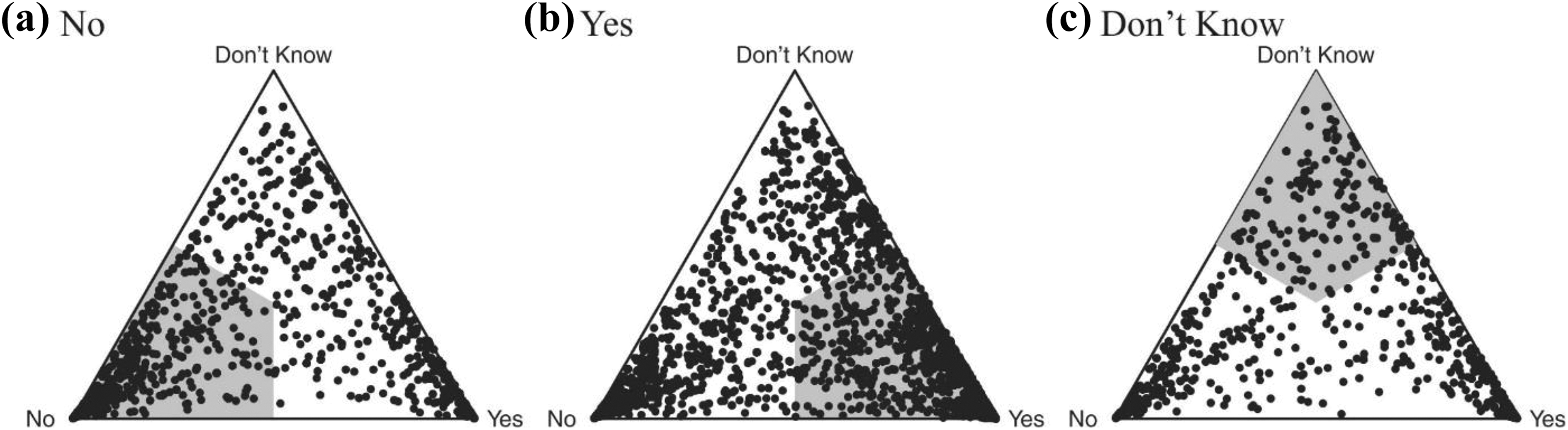
Simplex plot-based representation of predicted outcome variable, innovation intention.
In Figure 3, the three simplex plots shown describe separately the predicted outcomes of those SMEs originally known to be associated with the outcome response, 1969 No (Figure 3(a)), 5338 Yes (Figure 3(b)) and 1113 DK (Figure 3(c)). Each point represents a respondent, and specifically their triplet of BetP i (·), in vector form [BetP i (Ys), BetP i (No), BetP i (DK)]. 1
From the description of the NCaRBS analysis, the variation in the numbers of SMEs associated with each outcome was taken into account, allowing each group of SMEs equal weighting in achieving their correct classification (see description around description of OBNCARBS,w objective function). The grey shaded regions in each simplex plot (triangle) indicate where there is majority association to the correct classification (e.g. in Figure 3(a), for known respondents responding No to innovation intention, the grey shaded region indicates those points for which BetP i (No) > BetP i (Ys) and BetP i (No) > BetP i (DK).
A numerical breakdown of the correct/incorrect classification of SMEs is given in Table 2, the actual and predicted classifications of the 8420 SMEs provided, for each group of SMEs the spread of these across the three possible outcome responses given. From this table, the overall level of correct classification is found to be 4906 out of 8420 (58.266%) SMEs.
Confusion matrix of classification results.
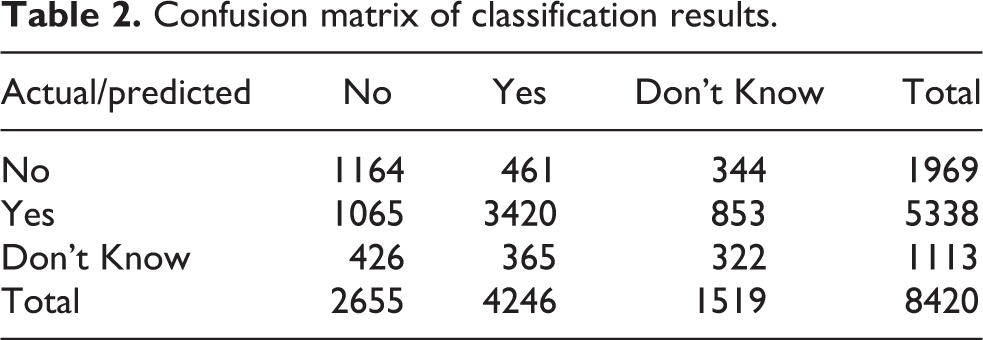
One comment worth mentioning here is in relation to the level of incorrect classification of the respondents with actual DK outcome responses (only 322 (28.931%) correctly classified). Within Table 2, it is noted 426 (38.275%) of DK respondents to innovation intention were predicted as being No to this question, indicating some evidence of the ‘easy out’ sentiment in regard to the role played by DK responses (supporting the view of Groothuis and Whitehead, 2002).
Development strategy characteristic contribution
Beyond the described classification fit, this subsection considers the contribution of the individual characteristics; variables used to fit respondents to their innovation intention response (see Beynon et al., 2015b – for technical details). For a specific development strategy variable, a variable BOE can be constructed, through combining the evidence in the constituent BOEs, mi , j, h (·) h = 1,…n D, termed a variable BOE, defined mi , j,- (·). As for the final object BOEs found, the respective pignistic probability form of the mi , j,- (·) h = 1,…n D can be found. Since they sum to one, they can also be described within a simplex plot domain, see Figure 4.
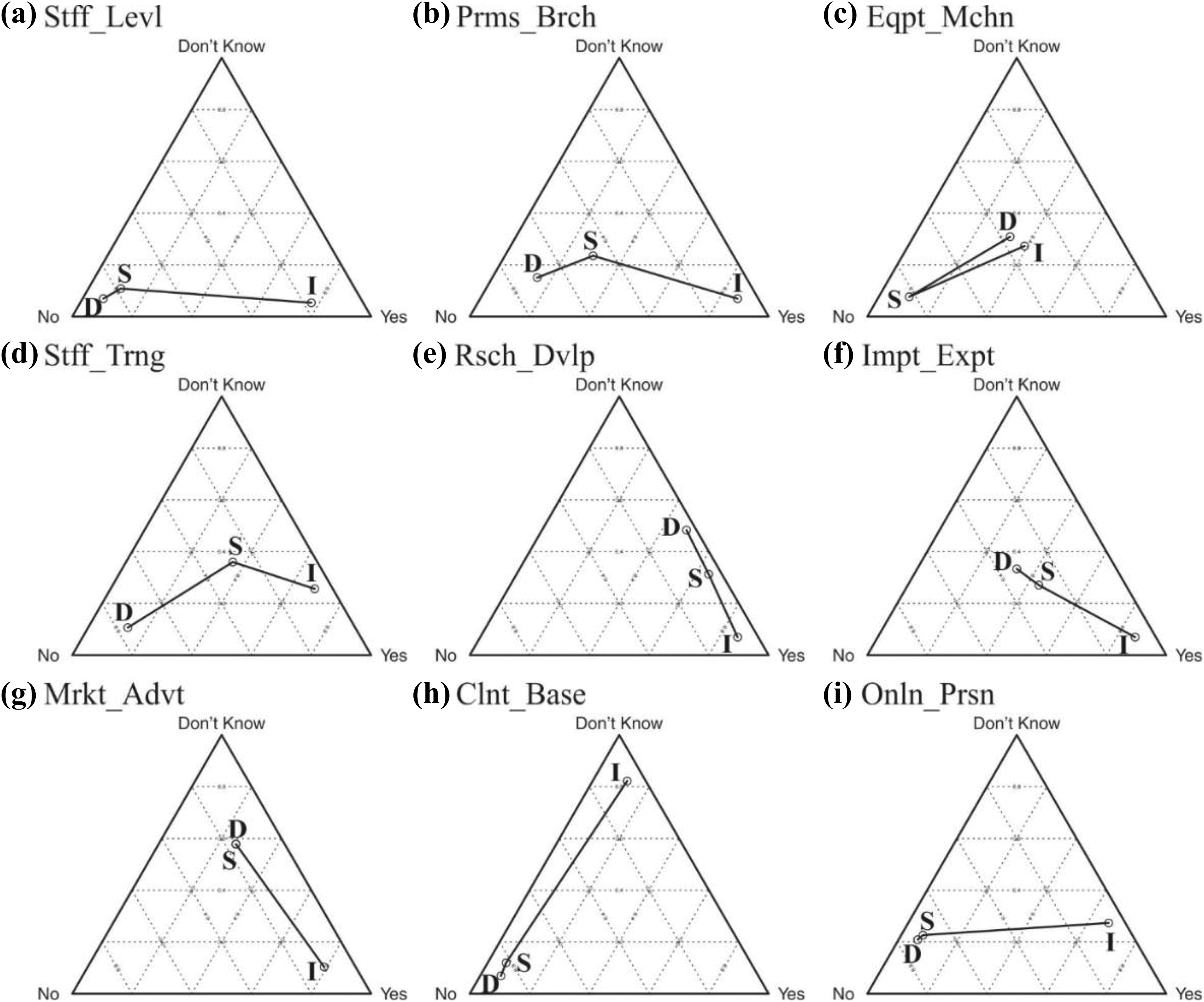
Simplex plot-based contribution of SME development strategy characteristics (responses Decreasing – D, Stay the same – S and Increasing – I) in regard to future innovation intention.
Discussion
Strategic orientation: Growth-related variables
Stff_Levl (staffing levels)
From the simplex plot contribution graph for a response of decreasing or staying the same in terms of staffing levels there is close association with No to future innovation intention, there is then a noticeable change to Yes to innovation intention where the strategy is to increase staffing levels in the next 12 months (Figure 4(a)). This confirms Roper (1997) and Sheehan et al. (2014) studies suggesting an association between SME staffing levels and innovation.
Prms_Brch (numbers of premises/branches)
The simplex plot shows a similar result for branch premises as for staffing levels (Figure 4(a)), decreasing or staying the same in terms of numbers of premises/branches closely associated with No to future innovation intention, with a notable change to Yes for future intended innovation as the strategy to increase premises/branches in the next 12 months is suggested (Figure 4(b)). This conflicts with Pla-Barber and Alegre (2007) study suggesting firm size was not associated with innovation.
Clnt_Base (client base)
From the simplex plot contribution graph for a response of decreasing or staying the same in terms of client base there is close association with No to intended innovation (Figure 4(h)). There is then a very noticeable change to DK to innovation intention as the strategy to increase client base in the next 12 months is suggested. This finding is consistent with De Propris (2002), potentially related to the likelihood that new client relationships take time to develop into innovation enhancing ones.
The evidence from these three growth-related variables highlights strategies that require an internal growth focus, namely staffing levels and branch premises, being positively related to innovation while the externally focused client base variable is more linked to uncertainty over innovation intention. This may suggest that SMEs are more confident with managing their internal business environment with regard to developing innovation intention but are more risk adverse in relation to the more uncertain outcomes possible in the external environment impacting on innovation intention, potentially through impacts upon resources.
Strategic orientation: Widening potential markets/potential resource sources variables
Impt_Expt (importing/exporting)
The simplex plot shows, interestingly, that decreasing or staying the same in terms of importing/exporting activity is more related to an ambiguous outcome for innovation, while there is a strong relationship between investing in importing/exporting activity and Yes to innovation intention, potentially indicating a reluctance for respondents to say No (Figure 4(f)). Conversely, it may also be the case that only a clear increasing international exposure-related strategy fits with a clear innovation strategy, static or reduced international exposure being symptomatic of a more uncertain strategic direction which is consistent with Pickernell et al. (2016).
Onln_Prsc (online presence)
For online presence (Figure 4(i)), there is clearly a strong relationship between static or decreasing online presence being related to No for innovation intention and increased online presence linked to a Yes for intended innovation, consistent with Pickernell et al. (2013).
Mrkt_Advt (investment in marketing/advertising)
In the case of investing in the reputational capital of the SME through marketing/advertising, there is found to be a strong relationship between increasing intended investment in these activities and Yes to innovation intention, with decreasing or static levels more related to an ambiguous/DK response to innovation intention (Figure 4(g)).
While these three variables therefore show differences in the relationships between static or decreasing support for these activities and the relationship with innovation intention, increased activities in these areas are all strongly linked to a Yes for intended innovation. Conversely, decreasing or static marketing and international activity are more strongly linked with uncertainty over innovation, while for online activity there is a more certain (negative) link between static or declining activity. This suggests therefore that firm strategy with regard to online activity has a more direct relationship with innovation intention, while non-positive marketing and international activity create more uncertainty for innovation, which again may be indicative of a more uncertain external environment.
Resource-related variables
Rsch_Dvlp (R&D)
For R&D (Figure 4 (e)), there is, unsurprisingly, a clear relationship between intending to increase these activities and Yes for future innovation intention as previously mooted by Love and Roper (2015) and Griffith et al. (2003). Staying the same or decreasing R&D activity is, however, increasingly more related to DK for innovation intention.
Eqpt_Mchn (investment in equipment/machinery)
From the simplex plot contribution graph for a response of decreasing investment in equipment/machinery there is much more ambiguity (No, Yes or DK) in intended innovation (Figure 4(c)). Where investment stays the same there is clear association to No as the intended innovation outcome, then for increasing investment there is a return to ambiguity on the intended innovation. 2 So here there is minimal discernible evidence to associate investment in equipment/machinery with increased innovation intention which is a notable finding.
Stff_Trng (investment in staff training)
In the case of staff training (investment in human capital; Figure 4(d)), decreasing intended training is more strongly associated with No to innovation intention, with static intended staff training more closely linked to an ambiguous response to intended innovation and increased staff training more closely linked with Yes to innovation intention supporting Roper’s (1997) and Sheehan et al.’s (2014) prior evidence.
Overall, this suggests that increased intended investment in R&D, but also increased staff training are positively associated with increased innovation intention (Galindo and Méndez, 2014). These strategic activities can be seen as at the very least complementary with innovation, in terms of supporting and facilitating it (R&D and staff training) or exploiting it (marketing). Conversely, proposed changes to investment in equipment and/or machinery seem to suggest greater uncertainty over innovation, which may be linked to the less obvious direct link between this and innovation.
Conclusions
The study offers a novel perspective into SMEs innovation focus, specific strategies related to this, and their role in uncertainty around strategic direction in relation to innovation. For example, staffing levels, number of premises and branches and online presence have unambiguous relationships with innovation intention, reduced levels of these variables are associated with a lower likelihood of innovation, and higher levels associated with higher likelihood in a linear relationship. Increasing R&D, staff training, importing/exporting and marketing and advertising are also associated with positive innovation intention but also reduced uncertainty over innovation intention.
More broadly, evidence here suggests SMEs are more certain about embracing innovation in relation to internal environment-focused strategies and issues within their immediate control. This might suggest an external environment risk adverse SME mindset with greater reluctance to invest resources in innovation where there may be less guarantee of return on investment. This might support the argument that innovation is more attainable for larger SMEs (Ettlie and Rubenstein, 1987; Laforet, 2008); further research is required to explore this phenomenon.
The simplex plot domain shown in Figure 1(b), and in later NCaRBS results, could also be used to facilitate future analysis of more ‘uncertain’ response from SMEs on future innovation intention. Respondents could be asked to judge their SME’s future innovation intention by placing a mark (cross) inside the simplex plot (innovation intention domain), allowing the inclusion of ambiguity between Yes and No and also the potential to self-acknowledge a level of uncertainty in their position (signified by how near to the DK vertex their mark may be). This potentially innovative way of representing SME respondents’ ambiguous/uncertain perspectives on a subject may have new enlightening impacts on this important research issue.
This study provides enhanced understanding of strategies and resource investments most closely related to unambiguous innovation intention within SMEs. In terms of implications for policy and practice, this study is of value to academia, enterprise support agencies and policymakers supporting SMEs achieve economically sustainable growth. For example, the above results potentially allow greater prioritization of policy resources, particularly regarding how government can look to effectively promote SME innovation both directly and indirectly (Simpson and Docherty, 2004), depending on whether the aim is increasing innovation or assisting SMEs reduce their own uncertainty over this strategy. For enterprise support agencies, the evidence here suggests greater prioritization is placed on encouraging SME investment in R&D and training and internationalization activity to enable further development of innovation cultures. This evidence regarding the nuanced behaviour of SMEs towards innovation further informs academic debate and understanding. For SMEs, innovation must be regarded as a process to enable change and growth. This requires SME owner/managers to adopt a strategic orientation with regard to a range of issues such as technology adoption, training and seeking entry into international markets.
In terms of limitations, this study recognizes that this analysis has considered specific variables and alternatives could be substituted or extended in further studies. In addition, there is a lack of comparison between NCaRBS and alternative, more traditional methods of handling such data, which is again a potential avenue for further research. Further quantitative studies are required to supplement this evidence evaluating a range of SME behaviours in different national and industry contexts.
Footnotes
Declaration of conflicting interests
The authors declared no potential conflicts of interest with respect to the research, authorship and/or publication of this article.
Funding
The authors received no financial support for the research, authorship and/or publication of this article.
