







Abstract
Drawing upon social cognitive and learning theories and social embeddedness perspective, we develop a conceptual framework for exploring the impact of immigrant founder chief executive officers on firm performance through firm innovation. We propose that immigrant founder chief executive officers are more likely to lead their firm with an innovative mentality due to their biculturalism, thus enhancing firm innovation and performance. We suggest that the impact of immigrant founder chief executive officers on firm innovation is moderated by cultural distance such that moderate cultural distance results in greater innovation, and ultimately, performance. We also indicate that top management team and board members’ local social capital, as well as immigrant founder chief executive officers’ foreign social capital, enhance the proposed relationships. A discussion of the relationships, limitations, and future research directions is provided.
Keywords
Introduction
The rate at which international migrants are migrating has been steadily increasing over the past decades According to a recent report by the United Nations Department of Economic and Social Affairs (DESA, 2019), the number of international migrants worldwide has proliferated in recent years, reaching 272 million in 2019 from 220 million in 2010 and 173 million in 2000. Moreover, the United States has been the largest host of international migrants with 51 million, which is equal to 19% of the world's total (DESA, 2019). With immigrants coming from all over the world, leaving their country of origin, and residing in a new host country, the interest in immigrant-related research and implications has never reached such a peak (Dheer, 2018; Hernandez and Kulchina, 2020; Mata and Alves, 2018; Nee and Drouhot, 2020; Wadhwa et al., 2007). One topic in such area involves the effects of immigrant entrepreneurs on firm-related outcomes (Abebe et al., 2020; Allen and Busse, 2016; Dabić et al., 2020; Efendic et al., 2016; Riva and Lucchini, 2015; Tata and Prasad, 2015).
Despite the rapid increase in the number of articles investigating such effects over the past three decades, some gaps in the literature should be addressed to enhance our knowledge on immigrant entrepreneurship (Dabić et al., 2020; Dheer, 2018). First, the literature has not sufficiently examined the role of cultural integration and biculturalism in predicting the behavior and success of immigrant owners (Dheer, 2018). Being raised in a country that is culturally different from the host country, immigrant entrepreneurs might be able to develop cultural frames associated with both cultures (LaFromboise et al., 1993). Thus, they might be able to identify with both the host and the country of origin through integrating the values, beliefs, and identities of both cultures. A recent article by Dheer and Lenartowicz (2018) found that identifying with multiple cultures impact bicultural individuals’ intentions to start a new venture. Therefore, Dheer (2018) calls for further research to investigate how cultural integration shapes immigrant entrepreneurs’ firm strategy and performance.
Second, according to learning theorists, cognitive dissonance, which happens when an individual holds two or more cognitions that are contradictory, has a positive effect on learning and cognitive development (Festinger, 1957; Kim, 1988). As immigrant entrepreneurs often experience cognitive dissonance during their integration process into the host country, cognitive consonance may influence their entrepreneurial behavior and outcomes (Harmon-Jones et al., 2009; Hinojosa et al., 2017). While a number of studies have explored the impact of cognitive dissonance on entrepreneurial outcomes, such as entrepreneurs’ opportunity identification and learning (e.g. Bolívar-Cruz et al., 2014; Kautto, 2019), few studies have explored such impact on immigrant entrepreneurs’ innovation and performance. Thus, there is a lack of theoretical explanations regarding the relationship between immigrant entrepreneurs’ cognitive dissonance and their firms’ innovation and performance.
Third, according to the mixed embeddedness theory (Kloosterman et al., 1999), immigrant entrepreneurs have both advantages and disadvantages in terms of social support and resource acquisition. Specifically, on one hand, they can rely on their co-ethnic communities for support and resources and often have connections with their home country; on the other hand, they lack of strong social embeddedness in their host country, constraining their ability to acquire resources and support (Crick and Jones, 2000; Kim and Hurh, 1985; Kloosterman et al., 1998; Portes and Jensen, 1989). While many studies have examined the effect of social embeddedness on immigrant entrepreneurs, little research has investigated how immigrant entrepreneurs take advantage of their favorable social embeddedness and overcome their unfavorable one in forming and growing their ventures (Dabić et al., 2020).
Our paper aims to address the above gaps by developing a conceptual model for investigating the impact of immigrant founder chief executive officers (CEOs) on innovation and performance in high-growth ventures in the United States, and how such relationships are moderated by cultural distance, top management team (TMT) and board local social capital, and immigrant founder CEO foreign social capital. We define immigrant founder CEOs as those raised in a country other than the United States but arrived there later on in their lives to pursue their career by starting and managing their own business. In order to develop the model, we draw upon social cognitive and learning theories (Bandura, 1986; Piaget, 1955). As immigrant founder CEOs spent their childhood in their country of origin, they inherited their home culture's values, beliefs, and attitudes (Hinojosa et al., 2017; Kautto, 2019). Therefore, once they arrive in the host country, they experience a negative state of cognitive dissonance caused by the differences in the values, beliefs, and attitudes (i.e. cognitive schemas) of the host country's culture (Festinger, 1957; Hinojosa et al., 2017; Hoshino-Browne et al., 2005). Their cognitive dissonance triggers their learning process, alternating their cognitive schema to fit the host country's cultural context. As a result, they may become bicultural and, therefore, enhance their cultural competence, adaptability, and creativity (LaFromboise et al., 1993). Thus, we posit that immigrant entrepreneurs positively impact their firms’ innovation and performance. Moreover, we argue that the level of cultural distance between the home country and the host country will influence the extent to which the immigrant founder CEO develops cognitive complexity that, in turn, enhances firm innovation (Berry et al., 1987; Tadmor and Tetlock, 2006; Tetlock, 1986).
We also draw on the insights from social embeddedness perspective to explain the moderating effect of TMT and board local social capital as well as immigrant founder CEO foreign social capital on the innovation and performance in firms led by immigrant founder CEOs (Kloosterman et al., 1999; Lin, 1999, 2002; Portes, 1998). We argue that TMT and board members who have extensive local social capital can help immigrant founder CEOs to gain access to valuable local resources (e.g. low financing cost and local talents) vital for their firms’ growth (Neville et al., 2014; Portes, 1998), whereas immigrant founder CEOs can provide cross-border connections and knowledge (e.g. market knowledge of the home country, cultural, economic, and institutional bridging between the host and home counties; Li et al., 2018). Therefore, we suggest that such access to local as well as foreign social networks will enhance the innovation and performance of firms led by immigrant founder CEOs. Our conceptual model can be depicted in Figure 1.
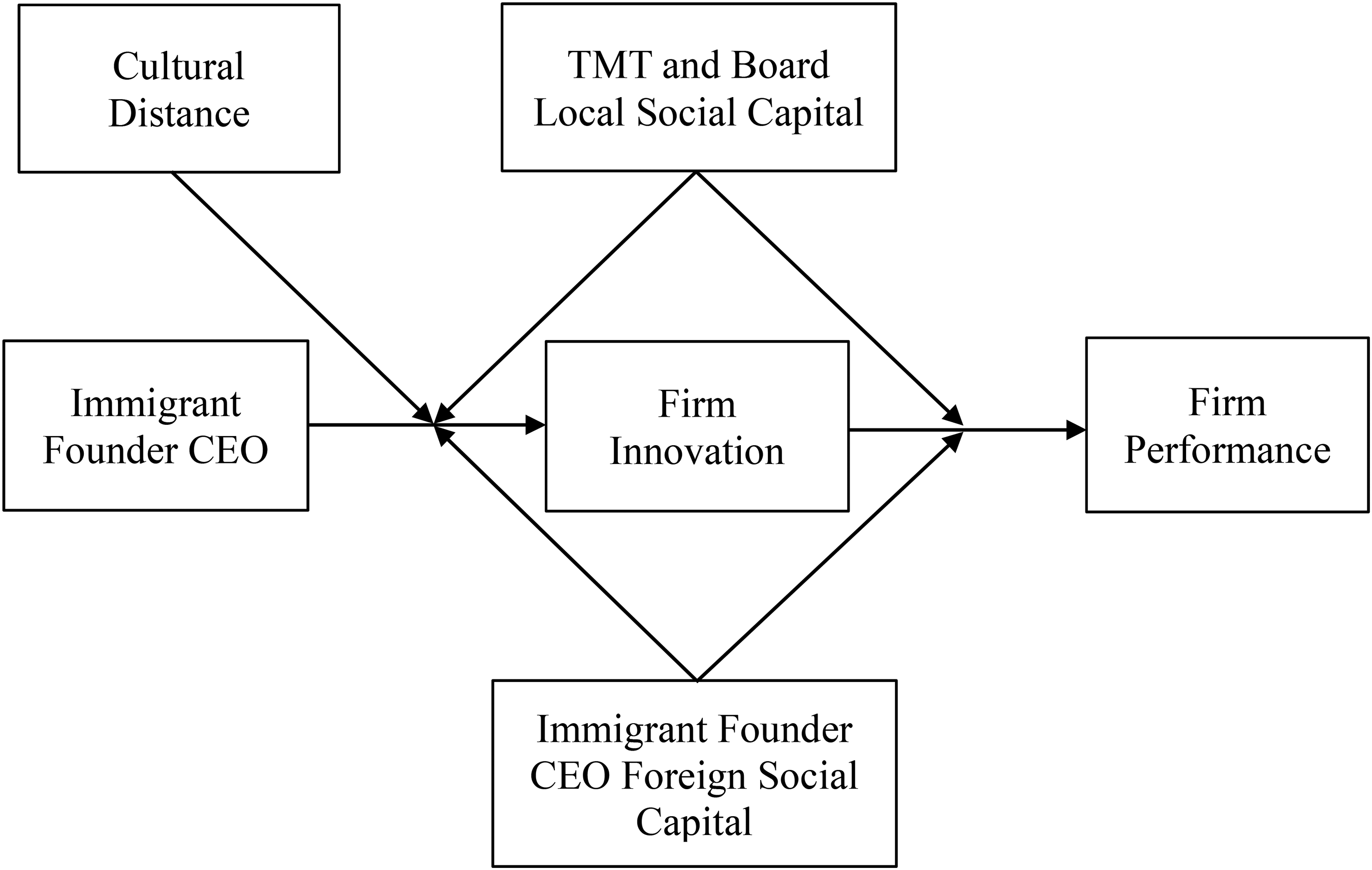
The conceptual model of the impact of immigrant founder chief executive officers (CEOs) on innovation and performance.
Our paper offers several contributions. First, we contribute to immigrant entrepreneurship research by explaining the impact of immigrant founder CEOs on firm innovation and performance (e.g. Dheer, 2018; Lin, 2002). Second, we contribute to the literature regarding the impact of biculturalism (e.g. LaFromboise et al., 1993) and cultural distance (Hinojosa et al., 2017) as we provide the theoretical argument regarding the moderating effect of cultural distance on the relationship between immigrant founder CEOs and firm innovation and performance. Lastly, we contribute to the social embeddedness literature (e.g. Kloosterman et al., 1999; Portes, 1998) by arguing for the moderating role of TMT and board members’ local social capital as well as immigrant founder CEOs’ foreign social capital in enhancing the impact on innovation and performance in firms led by immigrant founder CEOs.
Theoretical background
Immigrant founder CEOs and firm innovation
We conceptualize immigrant founder CEOs as individuals who spent their formative years in a country other than the host country and arrived later on in their lives to pursue their career by starting and managing their own business. Drawing upon social cognitive theory (Bandura, 1986) and learning theory (Piaget, 1955), we argue that such individuals tend to be innovation oriented given their unique cognitive ability and lack of social networks in the host country. The social cognitive theory states that there is a triadic reciprocal determinism between an individual's behaviors, cognitive/personal attributes, and the environment (Bandura, 1986, 1989). Individuals’ cognitive/personal attributes encompass their expectations, beliefs, emotions, intentions, thoughts, and even biological factors such as the physical structure and neural system (Bandura, 1986; Bower, 1975; Neisser, 1976). On the other hand, environmental influences can be conceptualized as social pressures, norms, culture, social status, and parenting instructions (Bandura, 1986, 1989). According to the theory, one of the paths through which an individual's behavior can be altered is through the influence of the environment on the personal/cognitive attributes, which in turn influence how an individual behaves (Bandura, 1986, 1989). For instance, living in a culture that emphasizes collectivism rather than individualism will develop or modify individuals’ expectations, beliefs, and intentions to prioritize harmony and agreeableness above freedom of speech and independence, resulting in behaviors that meet such expectations (Bandura, 1986, 1989; Cairns, 1979; Lewis and Rosenblum, 1974). Consequently, an immigrant founder CEO who lived the majority of his/her childhood outside of the host country is expected to have a mental schema or a set of expectations, beliefs, and intentions that is different from that of the local residents.
Once an individual arrives in the host country, s/he will start to experience what is known as cognitive dissonance. Cognitive dissonance is a feeling of unease that is experienced when an individual holds two or more cognitions that are contradictory; s/he will feel an unpleasant state—dissonance—until they are able to resolve the conflict by adjusting their cognitions (Festinger, 1957; Hinojosa et al., 2017; Kim, 1988). For instance, an East Asian individual who moves to live in America will notice how personal achievements play a bigger role than being a member of a specific social group, which might contradict his/her existing mental schema based on the prior culture (Tadmor and Tetlock, 2006; Triandis et al., 1988). Cognitive dissonance occurs in four steps: the occurrence of the cognitive discrepancy, the experience of psychological discomfort as a result, the increased motivation to resolve the cognitive discrepancy, and the engagement in the alleviating behavior (Festinger, 1957; Hinojosa et al., 2017).
According to the learning theory by Piaget (1936, 1955), individuals tend to be motivated to learn in order to resolve cognitive dissonance and reach a state of equilibrium (a state of ease as we can produce meaning for the occurrence of external events). Piaget (1955) posits that learning can occur in two ways: assimilation (confirming existing schemas or adding new schemas to the existing cognitive structure) and accommodation (changing the existing cognitive structure).While assimilation increases the breath of one's cognitive structure, accommodation enhance one's cognitive complexity. When cognitive dissonance is low, individuals tend to learn through assimilation process by choosing one mental schema over the other to make sense of the cultural stimulus (Mills, 1999). On the other hand, when cognitive dissonance is high, individuals tend to use accommodation process as their current cognitive structure is unable to make sense of the cultural stimulus, forcing them to change their cognitive structure (Tadmor and Tetlock, 2006). Immigrating to a different country than the country of origin will impose a strain on the immigrants as they struggle between adapting to the new culture that alter their existing mental schema or not adapting and risking their success and legitimacy in the new culture. The alleviation of the strain through accommodation process enhances immigrants’ cognitive ability (Green et al., 2000; Tetlock, 1986; Tetlock et al., 1996).
In the case of immigrant founder CEOs, we argue that they tend to have developed a mental schema in their country of origin or where they were raised. Therefore, upon arriving in the new environment in which they start their own business, they are more likely to go through not only assimilation but also accommodation process, due to the differences in beliefs, attitudes, and expectations between the two cultures that cannot be understood based on their existing knowledge (Piaget, 1955). As a result, they tend to adjust their cognitive structure to internalize the new culture and develop biculturalism (Tadmor and Tetlock, 2006). Such integration or biculturalism means that the immigrant founder CEOs can maintain their cultural heritage while developing a new cultural frame, resulting in two cultural frames or perspectives. As immigrant founder CEOs can alternate between the two perspectives, they tend to be flexible, resilient, and creative (Koburtay et al., 2020; Ogbu and Matute-Bianchi, 1986; Tadmor and Tetlock, 2006). Furthermore, they are more likely to develop cognitive complexity, which defined as an individual difference that measures the degree of differentiation, articulation, and abstraction within a cognitive system, due to the multiple perspectives they can draw meaning from (Benet-Martínez et al., 2006; Burleson and Caplan, 1998). Thus, we argue that immigrant founder CEOs will be characterized with cognitive flexibility and complexity that enable them to alternate and interconnect ideas and pieces of information in unique ways that challenge the limitations of “bounded rationality” resulting in more innovative decisions and outcomes.
Moreover, immigrant founder CEOs lack social embeddedness in the host country as they are considered newcomers or “recent settlers” (Neville et al., 2014). As social embeddedness requires prior economic and cultural investments (Bourdieu, 1985; Portes, 1998), it is impossible for immigrants to gain the level of social embeddedness that native people have. Thus, immigrant entrepreneurs are at a disadvantage accessing resources and support for their new ventures. In order to succeed in the host country, they have to rely on strategies that can help them overcome this disadvantage. Innovation can be one of such strategies. Thus, we argue that immigrant founder CEOs are likely to rely on innovation as a means to overcoming their lack of social capital in the host country.
The upper echelons perspective proposed by Hambrick and Mason (1984) states that managerial background characteristics partially predict strategic choice and firm performance. The authors illustrate that executives have their own cognitive base and a set of values, which guide them to make particular strategic choices (Hambrick and Mason, 1984). Therefore, an executive, who is bicultural, is likely to have a unique influence on firm outcomes, which is different from that of a monocultural executive. For instance, due to their high cognitive flexibility and complexity, bicultural immigrant founder CEOs are more likely to integrate their firm's resources in ways or for purposes that are different from what local founder CEOs do; they are also more likely to utilize different combinations and types of resources to provide unique/innovative products or services (Galunic and Rodan, 1998). In sum, we argue that because immigrant founder CEOs tend to lack local social networks and possess a bicultural mental schema and, therefore, high cognitive flexibility and complexity, they are likely to focus on innovation as a means to succeeding in business in the host country. Therefore, we offer the following proposition:
The moderating role of cultural distance
We have argued that immigrant founder CEOs are more likely to develop biculturalism, and thus, high cognitive flexibility and complexity. However, we also posit that such cognitive development is heterogeneous and contingent on the cultural distance between the culture of their country of origin and the host country's culture. Cultural distance is defined as the extent to which two cultures are different or similar in terms of values (Hofstede, 1980, 2001; Shenkar, 2001; Tihanyi et al., 2005). Such values include power distance, uncertainty avoidance, individualism/collectivism, masculinity, and long-term orientation (Hofstede, 1980, 2001). When the two cultures are similar, immigrants are not likely to engage in the accommodation process as their cognitive dissonance is not strong enough to trigger changes in their cognitive structures; instead, they either rely on their own existing cognitive structure or engage in the assimilation process to add new cognitions to their existing cognitive structures (Tetlock, 1986). On the other hand, when the two cultures are too distant, immigrants will find the accommodation process too difficult and complex due to excessive stress and cognitive dissonance resulting from overwhelmingly contradictory cultural values. In this case, they tend to avoid or reject the new culture (Berry et al., 1987; Eagly and Chaiken, 1993; Smither, 1982; Tetlock et al., 1996). Therefore, we argue that immigrant founder CEOs will effectively develop biculturalism and high cognitive complexity and flexibility, and therefore innovative capabilities, when the culture of their country of origin and the host country's culture are not too culturally distant (i.e. moderate levels). Thus, we propose the following:
The mediating role of firm innovation
In order for a firm to succeed and have superior performance in an industry, it has to distinguish itself by having a sustainable competitive advantage (Albaum and Tse, 2001; Newbert, 2008; Saeidi et al., 2015). A sustainable competitive advantage is defined as the implementation of a value-creating strategy that is not simultaneously being implemented by current or potential competitors, and the efforts to duplicate it have been ceased (Barney, 1991; Lippman and Rumelt, 1982; Rumelt, 1984). According to the resource-based view, a firm can gain a sustainable competitive advantage if it has valuable, rare, inimitable, and imperfectly substitutable resources (Barney, 1991; Peteraf, 1993). Firm resources include anything from “the assets, capabilities, organizational processes, firm attributes, information, and knowledge of the firm” (Barney, 1991: 101). Numerous empirical studies have supported the effect of firm resources on sustainable competitive advantage and firm performance (e.g. Hatch and Dyer, 2004; Li and Liu, 2014; Lin and Wu, 2014; Mehra, 1996).
Firm innovation is considered to be an important aspect of any firm as it provides the firm with a competitive advantage against its competitors through the creation of new, unique products and services (Abrishamkar et al., 2020; Dougherty and Hardy, 1996), resulting in increased firm performance (Srinivasan and Hanssens, 2009; Tellis et al., 2009). Firm innovation is defined as “a firm's tendency to engage in and support new ideas, novelty, experimentation, and creative processes that may result in new products, services, or technological processes” (Lumpkin and Dess, 1996: 142). In other words, an innovative firm is more likely to launch products and services that are valuable and rare granting the firm at least a temporary competitive advantage, or even a sustainable competitive advantage if the resources are also inimitable and imperfectly substitutable (Hitt et al., 2017).
Following the same line of thought, we argue that immigrant founder CEOs will positively influence firm performance due to their tendency to increase firm innovation. The increased cognitive dissonance experienced by immigrant founder CEOs upon arriving in the host country will drive them to accommodate the new culture in order to alleviate the stress and be successful in that culture (Festinger, 1957; Hinojosa et al., 2017). Therefore, they tend to develop biculturalism, allowing them to have increased cognitive flexibility and complexity (Benet-Martínez et al., 2006; Burleson and Caplan, 1998; Ogbu and Matute-Bianchi, 1986; Tadmor and Tetlock, 2006). Consequently, executives who are bicultural will have a different impact on their organization's strategic decisions and outcomes than their local or monocultural counterparts. This is because they can draw insights from different perspectives and create complex interconnections in their mental schema (Galunic and Rodan, 1998; Hambrick and Mason, 1984). We argue that immigrant founder CEOs with such a mentality will guide their firm towards coming up with novel, unique products and services or achieving a high level of innovation compared to other firms in the industry. Furthermore, we argue that such an increase in firm innovation will create a competitive advantage against the other firms in the industry, resulting in above-average returns and increased firm performance (Hitt et al., 2017). Thus, we propose the following:
Building upon Propositions 2 and 3, we also extend the moderating role of cultural distance to the indirect relationship between the presence of immigrant founder CEOs and firm performance through firm innovation. As previously argued, having moderate levels of cultural distance is more likely to result in higher levels of firm innovation by immigrant founder CEOs due to experiencing reasonable levels of cognitive dissonance, thereby resulting in biculturalism. Furthermore, increased levels of firm innovation are more likely to result in increased levels of firm performance due to the unique, novel resources being generated. Thus, we propose the following:
The moderating role of TMT and board social capital
Although the firm's CEO has a strong influence on the firm, TMT members and the board of directors also play an important role in shaping the firm's success. Usually, the TMT consists of the CEO of the firm and other senior executives (e.g. Chief Financial Officer, Chief Information Officer, Chief Operating Officer, etc.). TMT members are “individuals who play a key role in the strategic and practical orientation of the firm” (Carmeli and Halevi, 2009; Castanias and Helfat, 1991; Hambrick and Mason, 1984). Their objective is to effectively manage the firm's resource portfolio, sustain an effective organizational culture, and emphasize ethical practices to ensure that their firm obtains superior performance (Hitt et al., 2017). On the other hand, the board of directors is a group of directors formed to supervise the activities of the firm to ensure that the shareholders’ needs are met (Hitt et al., 2017). The board of directors has multiple functions, including monitoring the strategic actions of the TMT members (Eisenhardt, 1989; Fama, 1980; Fama and Jensen, 1983a, 1983b; Hitt et al., 2017) as well as providing strategic advice and counseling (Carpenter and Westphal, 2001). In other words, both the TMT and board of directors play a significant role in influencing the CEOs’ decisions and outcomes (Child, 1972; Hambrick and Mason, 1984; Hayward and Hambrick, 1997; Ranft and O’Neill, 2001).
According to the social embeddedness and capital theories (Coleman, 1988; Kloosterman et al., 1999; Lin, 1999, 2002; Portes, 1998), social capital helps executives access valuable resources that otherwise would not have been readily available (Borgatti and Halgin, 2011; Dawson et al., 2011; Schumpeter, 1942; Soda et al., 2019). An individual's social capital is defined as “the aggregate of the actual or potential resources which are linked to possession of a durable network of more or less institutionalized relationships of mutual acquaintance or recognition” (Bourdieu, 1985: 248). According to Portes (1998), social capital is not naturally given, and the individual has to strategically invest both economic and cultural resources in institutionalizing a group of relations.
One way that social capital is established is through bounded solidarity, or common fate, which implies that “being thrown together in a common situation, workers learn to identify with each other and support each other's initiatives” (Portes, 1998: 7). Having social capital is essential as it provides access to information, influence, social credentials (perceived added value by others), and self-identity reinforcement (Lin, 1999). Therefore, having TMT and board members who have high levels of local social capital can be a source of valuable information and support due to them being socially embedded in the host country through bounded solidarity (Portes, 1998). Furthermore, we argue that immigrant founder CEOs tend to have the “liability of foreignness” due to the lack of local social capital as they grew up in a different country (Zaheer, 1995). That being said, we argue that having a TMT or a board of directors that has high levels of local social capital will help immigrant-led firms better access local social networks providing invaluable local support and resources. Such TMT and board members can help immigrant founder CEOs to successfully facilitate and commercialize their firm innovation, thus, enhancing firm performance. For instance, TMT members and/or board members with local social capital can facilitate the process of introducing local potential partners or suppliers to assist in producing, distributing, or marketing the new products, resulting in better achievement and utilization of firm innovation, and thus increasing firm performance. We, therefore, propose the following:
Although immigrant founder CEOs are expected to lack social capital in the host country given their recent arrival to the host country, they can have their unique social capital in the form of foreign social capital from their home country (Li et al., 2018). This includes, but is not limited to, access to the home country market (i.e. knowledge of the customers’ demands, institutional procedures, suppliers, and distributors), language skills, and cultural knowledge (Chung and Tung, 2013; Hernandez, 2014; Wang, 2014). Therefore, when the immigrant founder CEO starts their business in the host country, they can utilize their foreign social capital and match it with that of the host country to identify profitable entrepreneurial opportunities overseas, expand the target market, and engage in cross-border agreements (Karra et al., 2006; Vaaler, 2011; Zaheer et al., 2009). While the native TMT and board members can provide the firm with the needed local social capital and legitimacy to establish itself and better function in the host country more notably at the early stages of the firm (Florin et al., 2003), the immigrant founder CEO can provide the firm with the international social capital needed to further utilize the firms’ products and services in international markets at the early and later stages of the firm (Maurer and Ebers, 2006). Such knowledge spillover is likely to enhance the achievement and utilization of the firm's innovations and, as a result, its performance through identification of alternative sources of capital, alternative supply chain arrangements, and market expansion for its products/services (Dubini and Aldrich, 1991; Neville et al., 2014). Thus, we propose the following:
Discussion
This conceptual paper provides a model for explaining the relationship between immigrant entrepreneurs, innovation, and firm performance. Drawing upon the social cognitive theory (Bandura, 1986) and learning theory (Piaget, 1955), we posit that cognitive dissonance can be viewed from a constructive perspective as a motive to improve one's self by adapting to a new set of values, beliefs, or contexts, especially at moderate levels (Ogbu and Matute-Bianchi, 1986; Tadmor and Tetlock, 2006). Individuals who experience cognitive dissonance are more likely to explore new ways and perspectives to alleviate such unease, which results in them developing cognitive flexibility and complexity through adopting new ideologies (Green et al., 2000; Piaget, 1955; Tetlock, 1986; Tetlock et al., 1996). Consequently, being able to choose from and integrate different cognitive frames, helps immigrant founder CEOs counteract bounded rationality, enhancing their creativity and innovation (Benet-Martínez et al., 2006; Burleson and Caplan, 1998), and ultimately, firm performance. Furthermore, such impact on firm innovation and performance can be enhanced when (a) the firm has TMT and board members who are locally embedded and/or (b) the immigrant founder CEO has high levels of foreign social capital, resulting in increased firm performance through the achievement and utilization of the firm's innovative capability.
Theoretical contributions
Our paper offers a number of theoretical contributions. First, it contributes to immigrant entrepreneurship research by explaining the impact of immigrant founder CEOs on firm innovation and performance (e.g. Dheer, 2018; Lin, 2002). Specifically, we explore the role of cultural integration in shaping immigrant entrepreneurs’ behaviors and performance (Dheer, 2018) by proposing a model that explains why immigrant founder CEOs tend to be more innovative. Although multiculturalism literature has established that immigrants, especially those who are bicultural, tend to have enhanced cognitive ability due to their cultural integration process (Benet-Martínez et al., 2006; Burleson and Caplan, 1998), little research on immigrant entrepreneurship has investigated the relationship between immigrant entrepreneurs and innovation and performance. Based on learning theories, we suggest that immigrant entrepreneurs rely on innovation to compete because of their cognitive complexity. Relatedly, drawing upon social embeddedness theory, we propose that immigrant entrepreneurs rely on innovation as their entrepreneurial strategy because they are disadvantageous in terms of social embeddedness in their host country.
Second, our paper extends the literature regarding the role of cultural distance and cognitive dissonance in the cultural integration and learning of immigrants (Chand and Ghorbani, 2011; Frederking, 2004; Morris and Schindehutte, 2005). Drawing upon learning theories, specifically the notion of cognitive dissonance (Bandura, 1986; Piaget, 1955), we posit that the low and high levels of cultural distance between the home and the host country hinder learning as they engender either too low or too high levels of cognitive dissonance. Low levels of cognitive dissonance do not trigger learning, while high levels of cognitive dissonance are too overwhelming for immigrants to try to resolve and learn from the process. We therefore theorize that the moderate levels of cognitive dissonance motivate immigrants to resolve their cognitive conflicts, resulting in higher levels of learning. Unlike previous studies (e.g. Hinojosa et al., 2017), which often focus on either the negative or positive effect of cultural distance, our study considers both of those effects and indicate that moderate cultural distance is the most beneficial for cultural integration and learning.
Third, this paper signifies the important role of TMT and board members’ local social capital and immigrant founder CEOs’ foreign social capital in enhancing innovation and performance (Kloosterman et al., 1999; Neville et al., 2014). The mixed social embeddedness perspective (Kloosterman et al., 1999) suggests that social embeddedness can both facilitate and constrain entrepreneurial activities. As immigrant entrepreneurs came from different countries, they lack social embeddedness and therefore legitimacy and social support (Portes, 1998). Early immigrant entrepreneurship studies indicate that immigrants tend to do business within their co-ethnic communities to overcome their lack of social embeddedness in the broader society of their host country (e.g. Portes, 1988). In this paper, we extend the literature by pointing out that immigrant entrepreneurs, especially those who compete in the mainstream market of the host country, can overcome their social disadvantages by collaborating with TMT and board members with substantial local social capital. These TMT and board members can help immigrant entrepreneurs to access resources necessary to commercialize their new products/services, enhancing firm performance. Some studies (e.g. Neville et al., 2014) indicate that immigrant-led firms outperform nonimmigrant-led firms when their firms focus on exporting due to their connections with foreign countries. Our study contributes to this line of research by proposing that immigrant entrepreneurs’ foreign social capital is beneficial regardless of their firm's internationalization. Specifically, immigrant can tap into resources and collaboration from their home country to implement their innovation and grow their firm in their host country. In sum, our paper shed light on the role of both TMT and board members’ local social capital and immigrant founder CEOs’ foreign social capital in enhancing innovation and firm performance.
Practical implications
Our paper offers some practical implications for immigrant entrepreneurs, shareholders, and policymakers. First, as immigrant entrepreneurs tend to focus on innovation, investors and policymakers should encourage and support immigrants to engage in entrepreneurial activities, especially in innovation-oriented industries. Second, immigrants from countries that have moderate cultural distance from that of the host country can better integrate into the host country and develop biculturalism and complex cognitive ability. Firms founded by such immigrant entrepreneurs are likely to be more innovative and successful. Finally, immigrant entrepreneurs should team up with TMT and board members with extensive local social capital in order to overcome their disadvantages due to their lack of social embeddedness. They also should tap into their foreign social capital to mobilize resources and develop working relationships and strategic alliances from other countries.
Limitations and future directions
Our paper has some limitations which can be mitigated by future research. First, we develop our model and relationships based on theoretical arguments. Future research can empirically test the proposed relationships to validate them. Second, our paper assumes that immigrant entrepreneurs tend to adapt to the host country's culture if they experience moderate levels of cognitive dissonance, thus developing cognitive complexity and creativity. According to a review by LaFromboise et al. (1993), an individual can react to a new culture in multiple ways: assimilation, acculturation, alternation, multicultural, and fusion. For instance, some individuals might completely absorb the host country's culture and forget the culture of his/her origin, as in the case of assimilation. Therefore, future research can investigate the different types of cultural adaptations and their influence on biculturalism in order to better understand when biculturalism is more likely to occur based on the individuals’ reactivity to new cultures.
Another research avenue involves investigating the temporal effects of the proposed relationships. For instance, does the age of an immigrant entrepreneur by the time s/he came to the host country affect cultural adaption and, therefore, cognitive ability? Does the length of time an immigrant entrepreneur has lived in the host country affect their cognitive complexity? Future research should also investigate immigrant entrepreneurs’ sensitivity to cognitive dissonance as some individuals might be more tolerant of cognitive dissonance than others. It is interesting to know the relationships between different types of personalities and cognitive dissonance tolerance. This will shed light on which types of individuals are more tolerant of cognitive dissonance, thereby benefitting from adapting to a new culture that is highly distant from that of their home country.
Next, we suggest that future research should also investigate whether the proposed conceptual model will hold for different types of immigrant entrepreneurs, such as opportunity- versus necessity-driven (Dheer, 2018; Fairlie and Fossen, 2018; Shinnar and Young, 2008). Whereas opportunity-driven immigrant entrepreneurs tend to proactively pursue opportunities by establishing high-growth ventures in the mainstream market, necessity-driven immigrant entrepreneurs tend to pursue small businesses in ethnically oriented sectors to fulfill their financial needs. Such difference in motivation may influence the proposed relationships, and thereby, is interesting to investigate.
Finally, future research should explore the impact of local TMT and board social capital as well as immigrant founder CEO foreign social capital in different stages of a firm's business cycle. A firm's need for different kinds of resources is not the same across its business life cycle stages. Specifically, it is interesting to investigate the relative importance of local versus foreign social capital for immigrant founder-led ventures in their early versus later stages.
Footnotes
Declaration of conflicting interests
The authors declared no potential conflicts of interest with respect to the research, authorship, and/or publication of this article.
Funding
The authors received no financial support for the research, authorship, and/or publication of this article.
