






Abstract
Today, enterprises are devoting a burgeoning interest in fostering team innovative behaviour at the workplace. Therefore, the purpose of this study was to bring together two lines of engagement enquiry (individual and team), leaning on similar theoretical veins and ontologies; however, exploring the interrelationship between these two constructs has received scant attention. Towards that end, a survey questionnaire was developed to collect data from 547 employees working for SMEs operating in Jordan. The findings revealed that team engagement mediates individual engagement and team innovative behaviour. Further, the findings indicated a positive moderating effect of the variation in team's relationship-oriented traits on the individual-team engagement association. Interestingly, the hypothesis proposing a moderating influence of the variation in the team's task-oriented traits was not statistically supported. This study provides an unprecedented progress to the scholarly conversation revolving around the neoteric influence of employee engagement and team innovative behaviour. The newfangled theoretical model links employee engagement theory with team innovative behaviours through the moderation effects of team personality compositions.
Keywords
Introduction
Over the past decade, SMEs have been witnessing unprecedented economic, social, political, and environmental challenges (Taghizadeh et al., 2022; Xu et al., 2022). Therefore, SMEs are compelled to, urgently, jump on the change bandwagon and devote greater emphasis on adjusting their strategies and operations in manners that precipitate flexibility and adaptability essential to survive and succeed in the current hypercompetitive business environment (Kafetzopoulos, 2020; Zighan et al., 2022). SMEs are urged to create engaging environments, where the likelihoods of displaying innovative behaviours are fostered (Ababneh, 2020; Chabbouh and Boujelbene, 2022). Therefore, the research discourse that links resilience to innovative behaviour has magnified tremendously. Accordingly, several scholars (e.g., Ababneh, 2022; Cho and Song, 2021; Huang et al., 2019; Zighan et al., 2022) have started to examine the associations between various attitudinal constructs (e.g., job involvement, job satisfaction, organizational citizenship behaviour, and organizational commitment) and employee innovative behaviours. Despite the pertinence of investigating these attitudinal constructs and the prevalence of their findings relatively, employee engagement is evoked in the behavioural literature to comprise ample connotations of innovative behaviours (Ababneh, 2022). Engaged employees are touted to be more environmentally conscious, vigilant, dedicated, proactive, and persistent during turbulence (Taghavi, 2019). Thus, the engagement construct is acknowledged to offer a wealth of beneficial organizational, including innovative and adaptable behaviours (Ababneh, 2022).
Despite the increasing indispensability of the engagement construct and the persuasiveness of the studies conducted on this domain of knowledge, the modern business environment is complex and purulent to the degree it can be suspected that the prevailing individual-innovative endeavours are enough to guarantee making successful decisions and taking effective actions (Kleinaltenkamp et al., 2019). Therefore, it is sound to believe that the business environment has created a complex conundrum that imposes collaborative efforts at various levels of the organization (Ababneh et al., 2021; Chabbouh and Boujelbene, 2022). That is to say, the vast majority of studies have examined employees’ innovative behaviours at the individual level and little attention has been devoted to investigating teams’ innovative behaviours. More precisely, treating engagement as an individual property might not account for the collective dynamics of group behaviours (Kleinaltenkamp et al., 2019). Therefore, the notion of higher-order level of interaction between various organizational variables (e.g., social and psychological resources) can expand our understanding of the nuanced underlying social and psychological dynamics responsible for creating resilient SMEs (Fletcher, 2017). Thus, this multi-level approach would be intriguing to pinpoint the attention to team engagement, as the latter should be a key part of the discourse on organizational effectiveness and efficiency amid turbulent business environments.
Team engagement borrows the same veins of individual engagement and linking these two constructs together seems a thought-provoking juxtaposition. In this essence, individual employee engagement may evolve into collective engagement behaviours (Kleinaltenkamp et al., 2019). Groups’ manifestation of engagement depends on the social interactions, subsequent reactions and enthusiasm of each member. Thus, we evoke individual engagement to serve as an antecedent of team engagement, whiles the latter is expected to foster team innovative behaviour.
Nevertheless, team engagement is not simply a perfunctory bundle combining individual engagement qualities and dispositions. In a sharp contrast to this perspective, team engagement results from a discontinuous compilation of synergetic factors that interact collectively (Kozlowski and Klein, 2000). That is to say, the interconnection is with a cross-disciplinary nature that requires a deep understanding of the implicit and nonlinear mechanisms. Here, it is worth invoking that multilevel theorists (e.g., Moynihan and Peterson, 2001; Neuman et al., 1999) have stated that team personality composition may have a confounding effect on how team members interact. This idea is stemmed from the ‘configuration perspective’ (the magnitude of the constellation of values and attitudes that are shared within team members, Humphrey et al., 2007), which, in turn, calls for a deep investigation of the group internal forces and underlying dynamics including team personality homogeneity/heterogeneity effects (Chiu et al., 2021). Nevertheless, most of the existing models that examine the personality-engagement linkage have used a single-trait approach collecting scores on the Big Five personality traits individually (e.g., Ababneh, 2021; Handa and Gulati, 2014; Muizu, 2017), but the aggregate team personality has received scant attention. More specifically, the team's personality convergence in relationship-orientation (interpersonal interactions are manifested by extroversion, agreeableness, and emotional stability personality traits, Halfhill et al., 2005) is expected to enhance positive social communication amongst team members than a task-oriented team's personality composition (the completion of tasks is manifested by conscientiousness and openness to experience personality traits, Halfhill et al., 2005). The essence of this view is due to the inclination of relationship-oriented team members to promote stronger emphasis on achieving a mutual understanding and awareness within team members (Zhou, 2016). Thus, it can be postulated that teams’ task-oriented and relationship-oriented personality compositions may have varying effects on the association between individual engagement and team engagement.
Taking all the above together, the contribution of this study is threefold. Firstly, extent literature is predominantly inattentive for acknowledging the impact group-level forces have on innovativeness. More specifically, this study contributes to the innovation literature by providing a novel advancement to the scholarly discourse via investigating the perpetual influence of employee engagement on team innovative behaviours amid epidemics. Secondly, this study examines a newfangled theoretical model that spans employee engagement theory with team innovative behaviours through the moderation effects of team personality compositions. This expanded recognition of employee engagement is thought to assist in understanding the engagement-innovation dynamics from a wider theoretical perspective. Further, the study contributes to the expanding literature on SMEs performance in the time of setbacks by patronizing managers and policymakers with insight and practical implications on how to engage their workforce and promote innovative behaviours that assist SMEs to survive and compete in such a turbulent business environment. The theoretical models are displayed in Figure 1.
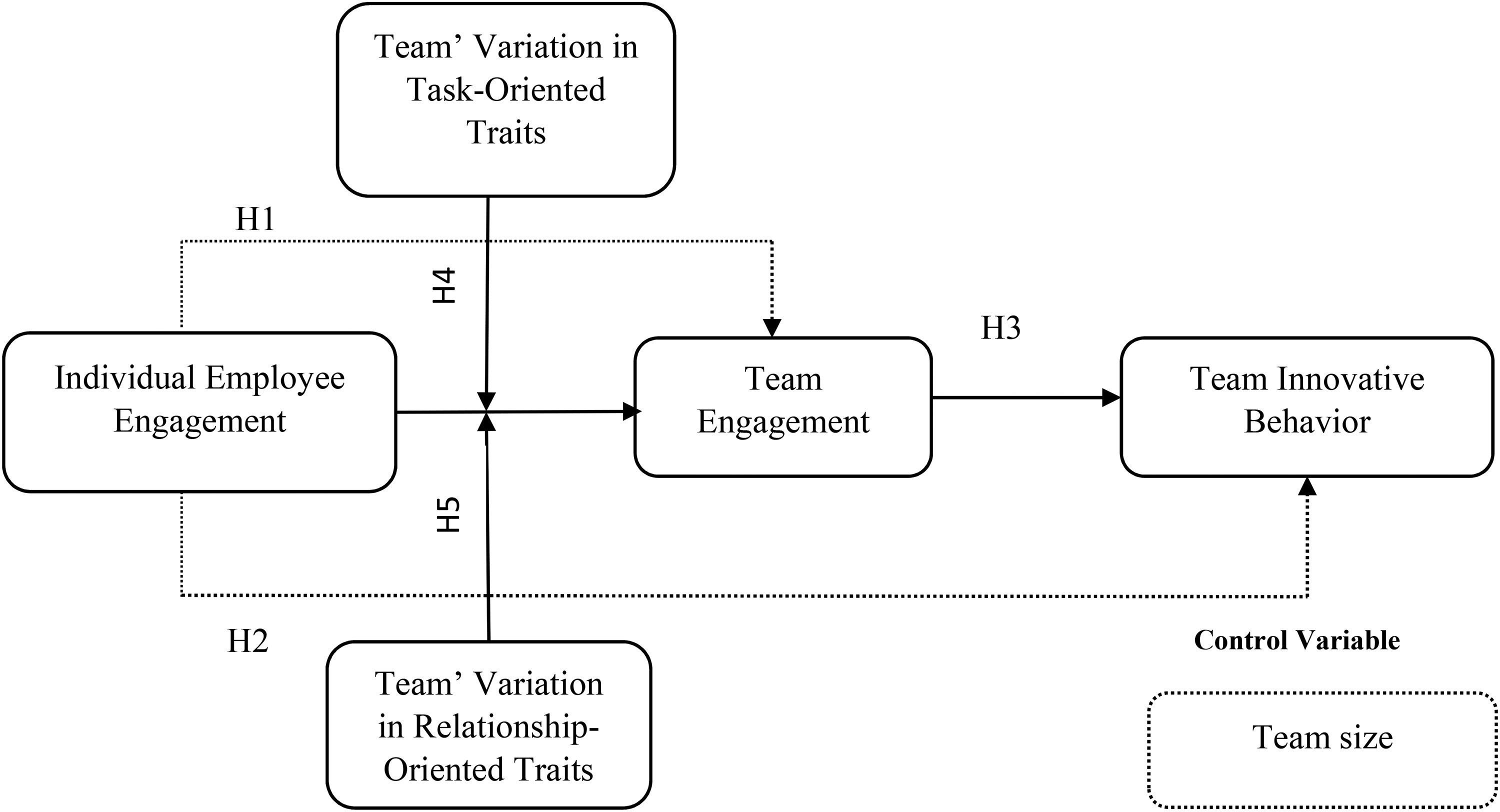
The theoretical model.
Theoretical background and hypotheses development
The mediation of team engagement between individual engagement and team innovative behaviour
In the recent 20 years, it can be noted that the engagement literature provides a wealth of research studies that have crafted and acknowledged several conceptualizations and theoretical models of individual employee engagement (Ababneh, 2021). For instance, Kahn (1990) defined the engagement construct through the lens of the psychological states of meaningfulness, safety, and resources availability. Along similar theoretical underpinnings, Schaufeli et al. (2002) crafted a seminal work conceptualizing and measuring work engagement as vigor frame of mind (the individual's tendency to elicit capacity, liveliness, and cognitive resilience at work), absorption (the individual's state of being engrossed and focussed at work), and dedication (the extent to which an individual strongly puts him/herself with job). Further, Ababneh et al. (2019) introduced an operational definition adding two additional factors (task performance and goal orientation) to the engagement construct. Taking all the above together, it can be noted that the existing conceptualizations of the engagement construct have originally revolved around the three key components of cognition, emotions, and behaviour (Ababneh, 2022; Taghavi, 2019).
Previous studies have reported that originations that devote additional attention towards enhancing employee engagement at the workplace will reap numerous benefits and advantages (Ababneh, 2021; Song et al., 2022; Taghavi, 2019). Indeed, employee engagement is thought to have a positive effect on the organizations’ endeavours towards reaching the competitive edge, achieving customer satisfaction, enhancing work quality, and boosting employee innovative behaviour (Ababneh, 2020; Presbitero, 2017). However, the increased popularity of individual employee engagement does not detract from the rationality of examining the engagement phenomenon at the group level. In fact, several studies (e.g., Barsade, 2002; González-Romá et al., 2000) have collected empirical evidence on how employees working together in teams can display similar cognitive and behavioural archetypes; hence, they sense mutual emotions and share collective efficacy, beliefs, and experiences.
Following the same theoretical vein of individual engagement, cognitive team engagement refers to the tendencies of team members to collectively display mutual attention when performing their assigned tasks and duties. Team members are strongly engrossed to the degree they find it hard to disconnect with their mutual activities, to get disturbed by the surrounding distractions, and/or detach from discussing how to perform their task even during informal settings (Kleinaltenkamp et al., 2019). Emotional team engagement can be witnessed when team members display mutual sense of passion, inspiration, exuberance, significance, and positivity when involve in task accomplishment (Costa et al., 2014). Accordingly, the behavioural team engagement can be observed in the members’ tendencies to display dedication, vigilance, and persistence while performing their tasks or attempting to solve job related obstacles (Kleinaltenkamp et al., 2019). That is to say, the team's collective emotions, cognition, and behaviours are stemmed from each member's level of individual engagement (Costa et al., 2014), when he/she displays certain engagement qualities and connotations such as absorption, enthusiasm, exuberance, passion, dedication, and persistence (Ababneh, 2021). This entails that a minimum level of individual engagement is a key ingredient essential for the emanation of collective team engagement. In other words, team engagement is an aggregate construct and a phenomenon that is ingrained in an abundance of individuals who show and share positive attitudes and behaviours during team work (Costa et al., 2014).
The association between employee individual engagement and team engagement can be viewed through the lens of several psychological and social theoretical underpinnings. More specifically, we evoke emotional contagion and social exchange theory (SET) as the conceptual basis that explains how team engagement mediates the association between employee individual engagement and team innovative behaviour. Indeed, it is common in social psychology to acknowledge the arousal of shared cognitive, attitudinal, and behavioural patterns among individuals who belong to the same team (González-Romá et al., 2000; Rutishauser and Sender, 2019). The essence of this collective perspective, as explained by “emotional contagion”, is that team members’ moods and attitudes are implicitly affected by the general climate surrounding the team (Ilies et al., 2007). This is caused by the instinctive nature of emotions, as emotion exposure and synchrony are expected to occur during social interactions (Fletcher, 2017; Herrando and Constantinides, 2021). That is, individuals’ innately tend to cope with the affectional status of the interacting social entity/group. This alignment is expressed by displaying comparable neurophysiological and neurological responses that enhance the establishment of affective, attitudinal, and behavioural coevality amongst group members (Hatfield et al., 1992). Further, positive collective attitudes and emotions can motivate team members to share knowledge and experience, display collective efficacy, and elicit energy and exuberance to the surrounding team climate (Barsade, 2002; González-Romá et al., 2000). More specifically, an engaged individual tends to express magnified degrees of vitality, absorption, persistence, exuberance, and devotion during team's task accomplishment (Fletcher, 2017). This arousal of engagement qualities is expected, according to ‘emotional contagion’, to evoke isomorphic traits and states amongst other team members (Kleinaltenkamp et al., 2019).
Furthermore, the phenomenon of team engagement can be explained in the furtherance of social exchange theory. Despite the inconsistencies that can be noted in the existing conceptualizations of social exchange relationships and the variation in defining their relative scope and context, there is a memorable consensus amongst social theorists on the obligatory aspect regulated by the series of interactions amid the social entity (Rutishauser and Sender, 2019). From a microeconomics perspective, individuals set patterns of exchange based on the possibilities of maximizing their own shares and wins (Cook and Rice, 2006). However, from the neoclassical economists’ perspective, the magnitude of social exchange is wider in scope and should not be limited to a direct quantitative form of exchange. That is, social exchange includes communication and connections within individuals, involve exchanging mutual acceptance, trust and flexibility, and scarcely encompass outright bargaining (Rutishauser and Sender, 2019; Waight and Edwards, 2020). Thus, this psychological perspective of self-interest in the exchange process is not negative; indeed, it can be an internal force guiding towards the establishment of interconnection between interactive parties, hence it helps promoting reciprocal control and enhancing each party’ self-interest (Roloff, 1981). Accordingly, self-interest is achieved based on the mutual effort made by all parties to perform the integral tasks and responsibilities (Cook and Rice, 2006; Rutishauser and Sender, 2019). Taking all the above together, each team member feels obligated to exert effort similar to that elicited by other teammates. That is to say, an individual's tendency to exchange and reciprocate is hinging on the behaviour displayed by others (Ababneh, 2022). Thus, while employees are working on achieving mutual work goals, employees display reciprocal attitude towards the socioemotional (e.g., trust, support, sharing knowledge and innermost feelings) economic resources (e.g., self-gain and goal achievement) receive from their team colleagues. Thus, their perceptions of meaningfulness (Kahn, 1990) will be enhanced; hence, they tend to exert high levels of engagement qualities including energy, collaboration, exuberance, and dedication (Taghavi, 2019). Further, when an engaged individual persists through challenges, displays creative thinking, and tries to find innovative solutions, his/her co-workers feel obligated to show reciprocal engagement characteristics (Ababneh, 2020). Yet, teams’ innovative behaviours are expected emerge based on the amount of knowledge sharing, exchanging resources, collaboration, autonomy, support, and exuberance, and passion spread amongst the team (De Spiegelaere et al., 2014).
Despite the pertinence of associating individual employee engagement with innovative behaviour, it is can be argued that the current perplexing environment requires an aggregate endeavour of all team members. Innovations require mental and physical demands. Further, the paucity of job resources might cause stressful demands that hamper employees’ excretion of constant energy, display persistence, and show innovative behaviour (Salanova and Schaufeli, 2008). Thus, sharing physical and socioemotional job resources (e.g., learning and development, autonomy, trust, social bonds, support, clarity of goals, and organizational processes, rules, and benefits) is expected to reduce strain and stress caused by job demands (Ababneh, 2022). Hence, this helps fostering positive emotions amongst team members who feel obligated to reciprocate innovative behaviour (Waight and Edwards, 2020). Further, this exchange is expected to encourage team members to elicit extra cognitive effort when working on unprecedented tasks and issues (Rutishauser and Sender, 2019). This collective cognitive engagement of team members is essential for revisiting the traditional work structures, tweaking new ideas, producing non-conventional solutions, and constantly seeking learning and development (Kleinaltenkamp et al., 2019). Drawing on the above, the following hypotheses are proposed:
The moderation role of team personality composition on the individual-team engagement association
Conceptualizing the engagement construct through the lens of employees’ individual traits reflects clear connotations of the linkage between employee engagement and personality attributes (Ababneh and Macky, 2015; Macey and Schneider, 2008). For instance, Kahn (1990) in the seminal work of personal engagement posited that an individual's self-harnessing with the surrounding environment would enhance the occurrence of the engagement conditions (meaningfulness, safety, and availability). More explicitly, Macey and Schneider (2008) and Ababneh and Macky (2015) inferred that trait-engagement (the tendency of employees to display varying engagement qualities based on their personality traits) is a major component that needs to be considered in any conceptualization of the engagement construct. For instance, COVID-19 epidemic has provided people with chances to lead, handle crises, propose ideas and solutions and share responsibility (Sobaih et al., 2021). Thus, team engagement is influenced by team members’ ability to establish a trusting environment, social cohesion and a meaningful environment that meets their individual and group values and purposes (Waight and Edwards, 2020). Employee uneasiness can be affected by team members’ high emotional intensity. Therefore, the opportunity of multiple team members to exert influence on each other is expected to help in reaching consensus, exchanging knowledge, and engaging in commencing change and implementing innovative ideas during crises (Adam and Alarifi, 2021). Thus, it sounds rational to apply the notion of trait engagement on team engagement. That is, team personality propositions are thought to strengthen/weaken the association between employee individual engagement and team collective engagement. Moreover, it is prevailing in the team literature to link team personality composition to multi-level analysis of group states and performance (Humphrey et al., 2011). However, the existing studies (e.g., Bell, 2007; Prewett et al., 2016; Radovic et al., 2020) have been confined to the liner vision of only examining the direct association between team performance and team personality composition. This, however, does not provide a robust answer for the how question related to the processes and underlined mechanisms thought to alter these direct associations. Therefore, we draw on the person–environment model of fit to explore the expected moderating effect of team personality composition on the association between individual employee engagement and team engagement.
In their person–environment typology, Muchinsky and Monahan (1987) proposed two opposing perspectives on the impact of the homogeneity and heterogeneity of team members on team performance. Supplementary fit refers to the need for increase homogeneity between team members, where an elevation of a certain personality trait is greatly coveted to exist amongst team members. Along opposing theoretical lines, complementary fit indicates the desire of increased heterogeneity (variation) of a certain attribute amongst team members. Due to its popularity, the Big Five Model of personality is prevailing in the current discourse on team-personality composition. Despite the fact that several researchers (e.g., Bell, 2007; Prewett et al., 2016; Radovic et al., 2020) have found this typology appealing, growing interceptions do exist on the approaches used to aggregate these team-level trait scores (Zhou, 2016). More specifically, the isomorphic-based approach on team composition failed to gain the satisfaction of some scholars (e.g., Kozlowski and Klein, 2000; Mohammed and Angell, 2003). The concern revolves around the overreliance on calculating the average level of commonality or difference of team members on a single trait. The personality traits of team members are expected to be influenced by the ‘composition effect’, where certain patterns of associations are expected to occur amongst all these attributes (McGrath, 1998). Therefore, this study draws on Halfhill et al.'s (2005) dichotomous framework of relationship-orientation and task-orientation clusters of traits to explore the moderating influence of team personality compositions on the individual-team engagement association.
Task-oriented cluster of traits consists of two personality attributes (openness to experience and conscientiousness) that reflect individuals’ high emphasis on task accomplishment and goal achievement. Individuals high in conscientiousness personality are touted as precise, methodical, detail oriented, determined, dependable, and goal oriented. High levels of openness to experience reflect individuals’ tendency to be intellectually curious, attentive, imaginative and variety oriented (Costa and McCrae, 1992). Therefore, the low variation on task-oriented traits amongst team members is expected to have a probable effect on the individual-team engagement association. One key rationale that can explain this moderation effect relates to the extent to which team members can establish a mutual shared target. More precisely, team members who are high in conscientiousness are expected to capture the goal-orientation aspect of team's assignment; hence, they take the initiative towards reaching a mutual understanding of the team's collective goals. Consequently, this collective awareness aligns with the ‘meaningfulness’ notion of employee engagement; employees’ perceptions of the clarity, value, expectations, performance objectives, and performance outcomes will trigger the attentive sensor of their cognitive processors, which in turn will lead to an acceleration of engagement facets (e.g., absorption, persistence, reliance, and assertiveness) amongst team members. Another key rationale of proposing the moderating role of task-oriented personality is based on the notion stating that individuals who are high in openness to experience display intellectual curiosity (Costa and McCrae, 1992) essential to handle unfamiliar experiences and challenges and show variety-orientation behaviours (escapade). This, in turn aligns with the absorption aspect of employee engagement, where individuals become fully attentive to external stimuli and remain focussed when unpredicted challenges and obstacles occur (Glisky et al., 1991). Taken together, teams that are high in task-oriented traits are expected to score high in team engagement, where higher levels of agreement and clarity on the distribution of duties and endeavours amongst team members are fostered (Zhou, 2016).
Similarly, the relationship-oriented personality cluster, which refers to the emotional stability and the interpersonal traits of extroversion and agreeableness, is purportedly expected to moderate the individual-team engagement association. Emotionally stable individuals tend to remain positive and balanced to withstand hardships and unprecedented contingencies (Costa and McCrae, 1992). This will help spreading positive emotions and vibes in the surrounding climate essential for generating productive thoughts and handling diversity amongst team members. Similarly, extroverts (the individual's susceptibility to be amicable, gregarious, excitable, assertive, and expressive; Costa and McCrae, 1992) scrutinize opportunities where they can engage with others, exert their energy and express their thoughts assertively. Therefore, they are expected to highly engage with other team members by employing their energy, exuberance and positive attitudes towards establishing common grounds with other team members. Along similar lines, agreeable individuals are characterized of being attuned to the benefit of the collective team, tactful, optimistic, warm, affective, cooperative, trustworthy and contagious to exchange reciprocal altruism (Costa and McCrae, 1992). These facets of agreeableness are expected to promote a collaborative teamwork environment, foster agreement on team's shared purpose, and evoke social integration (Chiu et al., 2021). However, individuals with high levels of introversion and low levels of agreeableness are conservative and cautious when handling new issues. They look for depth over breadth and rummage deeply in causes and consequences of the matter (Neuman et al., 1999). Due to the complexity of the current business environment, this tendency to remain reasonable and vigilant assist the team to develop realistic objectives, make rational decisions, take planned actions and wisely consume resources (Zhou, 2016).
Taking all the above together, the variation in relationship-orientation traits is foreseeable to heighten the interrelation between engaged individuals and team engagement by originating the likelihoods of interpersonal exchange of thoughts, communicating visions, and sharing core task-relevant information amongst team members. This, therefore, will affect how group members perceive the meaningfulness and relevance of their collective goals and tasks. Hence, they engage with team activities by disseminating higher levels of energy, positive emotions, vigilance, exuberance, persistence, absorption and dedication (Ababneh, 2021). Thus, the following hypotheses are proposed:
Method
Sample and procedure
A cross-sectional design was used to investigate the mediating role of team engagement between individual employee engagement and team innovative behaviour, along with the moderating role of team traits composition (task-oriented and relationship-oriented traits compositions). The study was conducted from April 2021 to November 2021 in three major cities of Jordan: Irbid, Zarqa, and Amman. Small-and medium enterprises (SMEs) of the respective regions served as the targeted population. The choice of SMEs was due to the nature of their industry, as their core business depends on teamwork. This, in turn, aligns with the focus of the current study, such that the variables of the study revolve around team compositions, attitudes and innovative behaviours.
Initially, scrapping the report of the Social Security Corporation (2015) yielded 43,091 SMEs that had been actively operating in Jordan for more than 2 years. Based on a systematic random sampling, 217 SMEs from these cities were selected and the majority of them were located in Amman (84%). Accordingly, invitation emails were disseminated to all listed companies and phone calls were made to follow up with those who did not respond to our emails. The invitation letter encouraged the targeted firms to take part in the study and highlighted the significance of their participation. Further, the invitation letter included a link that lad participants to Google forms, where they could complete the questionnaire. The survey included a question asking participants to name their teams and firms in order to be able to aggregate their responses based on their relevant teams. However, their personal identity remained anonymous. Here, it is worth mentioning that the approval of a human subjects’ ethics committee was not sought, as the study adopted well-established scales in data collection. Further, the adopted scales include items that do not require confidential information nor they cause cognitive stress to the participants (Schrag, 2011). In total, 104 firms (47.9%) expressed their willingness to participate in the study; hence, 592 responses (comprising 148 teams) were compiled. However, 11 responses displayed missing cases that exceed the 15% accepted threshold of missing data (Leong and Austin, 2006); hence, the decision was made to exclude those responses. Further, seventeen teams consisted of two members each were excluded from the data set, as it is not possible to calculate diversity amongst a team consisted only from two members. Thus, the final number of usable responses was 547 participants representing 131 teams (team size ranged from 3 to 6 participants).
Tables 1 and 2 provide information about the demographic characteristics of the participating firms and employees. The majority of the firms reported 6–10 years of organizational tenure (44.2%) with a firm size ranging from 6–10 employees (36.5%); whilst the majority of them were privately owned (77.9). The majority of the participants were male (84.3%) and 45.6% of employees aged from 28 to 37 years. The majority of the participants reported 3 to 10 years (48.1%) tenure, with 62.6% holding a bachelor degree.
The demographic profile for the participating firms.

Note. Firm's age is calculated in years.
The demographic profile for the participating employees.

Note. Participants’ age, and participants’ tenure are calculated in years.
Instruments
In the current study, a survey questionnaire was developed consisting from previously well-established scales. The selection criterion was set to compile scales that report strong reliability and validity. Table 3 provides a detailed description of the adopted measures, including sample items, whilst item loadings are illustrated in the Appendix. The rating scale for all instruments ranged from ‘strongly disagree (1) to strongly agree (5)’.
Description of the adopted measures.

However, since the objective of this study was to assess the variations in task-oriented and relationship-oriented traits composition using an additive approach (aggregating the variation score of each personality traits), the associations were measured using the standard deviations (Barrick et al., 1998). Standard deviations of conscientiousness and openness to experience were integrated to calculate the variation score in task-oriented traits composition at the team level. Similarly, the variation score of relationship-oriented traits composition at the team level was calculated by combining the standard deviations of extroversion, neuroticism and agreeableness.
Control variable
Some researchers argued that team size might have a confounding effect on how team members execute tasks and fulfil roles collectively. In this essence, it is thought to have a curvilinear association with the team's performance and its related aspects, including work cohesion, learning and sharing knowledge, cooperation, and innovation tendency (Kirkman and Rosen, 1999; Lepine et al., 2008). Thus, in this study, we controlled for team size (ranging from 3 to 6 team members), which was measured by asking about the authentic number of team members.
Data analysis
In the current study, AMOS 26.0 was used to examine the reliability, validity, common method variance (CMV). AMOS-SEM is influential in instances where the research objective underlines confirming conceptually assumed associations. Further, the increased popularity of using AMOS-SEM amongst scholars is due to its features that enable testing complex models with a large number of items (Hair et al., 2017b). For assessing the reliability and convergent validity of the used scales, the value of Cronbach's alpha and composite reliability should be more than 0.70 for each variable, whilst the average variances extracted (AVE) of the factors should be greater than 0.50 threshold (Hair et al., 2017a). Furthermore, the discriminant validity of the used measures is assessed the heterotrait-monotrait ratio of correlations (HTMT). However, mediated and moderated hierarchical regressions were used to examine the mediation and moderation associations of the proposed conceptual model.
Results
Common method bias
The CFA marker-variable technique for detecting method variance (Boso et al., 2013) was utilized, where the proposed model is compared to other contentious models. Hence, a series of CFAs, using AMOS 26, were conducted with maximum likelihood estimation. Initially, when all indicators of the used variables were obligated to load on a single factor comprising ‘method-only’ model, the clusters of fit indices reflected a poor model fit (see Table 4). Consequently, the ‘trait-only’ model, with permitting all indicators to load on their congruent factors, showed a good model fit. The final model combined the trait and method models together, where a common latent variable was inserted and linked to all items included in the model. The test yielded that the third model achieves the best possible readings of model fit, whilst the ‘trait-only’ model sharply displays a better model fit than ‘method-only’ model. Thus, as displayed in Table 4, the trivial variance between the fit indices of model three and ‘trait-only’ model elucidates that CMV is not an issue in the current data set; hence, it is not expected to contaminate the authentic predispositions of participants against the substantive associations.
CFA marker-variable test for common method variance.

N = 547; ***p < 0.001.
Cut-offs for the fit indices: Root Mean Square Error of Approximation (RMSEA < 0.08, Marsh et al., 2004); Incremental Fit Index (IFI > 0.90, Bentler, 1990); Comparative Fit Index (CFI > 0.90, Bentler, 1990); Tucker–Lewis Index (TLI closer to 1 (Bentler, 1990); AGFI closer to 1 (Mulaik et al., 1989); The relative chi-square (Χ2/df < 5, Schumacker and Lomax, 2004).
Measurement model
Table 5 presents the statistical inferences used to evaluate the measurement model used in the current study. The readings of Composite Reliability test in the measurement model positions between 0.859 (Team Innovative Behaviour) and 0.955 (Individual Employee Engagement). As for the Average Variance Extracted, the test provides readings ranging between 0.501 (Team Engagement) and 0.579 (Task-Oriented Conscientiousness). Drawing on these readings, the adequacy of the measurement model in terms of CR and AVE can be claimed; hence, the measurement model reports satisfactory convergent validity.
Convergent validity.

One widely used approach for inspecting the discriminant validity of the measurement model is Fornell and Larcker's (1981) criterion, where the square root of each AVE is compared to the correlation coefficients for each construct in the relevant columns and rows. As illustrated in Table 6, the squared AVE value of each construct (diagonally) exceeded its correlation coefficients (off-diagonally) with other constructs, lending support to the discriminant validity of the measurement model. However, there are indeed some concerns revolving around the applicability of Fornell and Larcker's (1981) criterion due to its overestimation on item loadings (Henseler et al., 2015). Thus, testing the discriminant validity with another approach (Heterotrait-monotrait (HTMT) criterion) that gains stronger support is with a paramount significance. As illustrated in Table 7, the HTMT results do not show any concerns regarding discriminant validity, as the values were satisfactorily below the HTMT threshold value of 0.90 (Gold et al., 2001). Taken together, the overall discriminant validity is accepted for the measurement model of the current study.
Discriminant validity: Fornell and Larcker's (1981) criterion.

Note. The diagonal in parentheses values indicates the squared roots of AVE.
The inter-correlation between the study variables is indicated in off-diagonal values
Discriminant validity: heterotrait-monotrait (HTMT) criterion.

Measurement aggregation
It is a common practice in team traits composition research to aggregate individual scores to calculate the team level score. This, in turn, requires providing statistical evidence about the viability and appropriateness of aggregating individual values to construct accumulative group ones (James et al., 1984). Towards that end, we draw on James et al.'s (1984) technique to calculate the agreement index (rwg (j)) to justify the aggregation of these individual variables. The ‘rwg (j)’ values for relationship-oriented personality traits (extroversion, agreeableness, and neuroticism) were sharply above 0.70, lending support to analyzing these variables at the team level.
However, the average values of task-oriented personality traits (Conscientiousness and openness to experience) were slightly below the 0.70 threshold (0.57 and 0.62, respectively). These small values of ‘rwg (j)’ implies that conservation and vigilance are needed when interpreting the result yielded from the analysis of these variables (George, 1990).
Mediation analysis
Towards collecting statistical evidence about the indirect effect estimation of individual engagement on team innovative behaviour via the mediation of team engagement, we adhered to Baron and Kenny's (1986) conditions using mediated hierarchical regression. Initially, the method requires testing the direct associations between the independent variable (individual employee engagement) with the intervening variable (team engagement) and with the dependent variable (team innovative behaviour). Consequently, we examined the prediction effect of the independent variable (individual employee engagement) together with intervening variable (team engagement) on the dependent variable (team innovative behaviour). As displayed in Table 8, the direct associations between individual employee engagement and team innovative behaviour (β = 0.37, P < 0.01), individual employee engagement and team engagement (β = 0.35, P < 0.01) were found statistically significant, supporting H1 and H2. When the intervening variable (team engagement) was inserted in the mediation path, the direct association between the independent variable (individual employee engagement) and the dependent variable (team innovative behaviour) remains significant with a decreased value of path coefficient (β = 0.18, P < 0.05). Furthermore, the ‘bootstrapping’ technique of Hayes (2013) was conducted to estimate standard error of the indirect path analysis. Using 2000 ‘bootstrapping’, the mediation path remains statistically significant (P < 0.05). Further, no significant explanatory power of the control variable (team size) on the proposed hypothesis was found in the current data set (see Table 8). Thus, the diminution of the coefficient value between individual employee engagement and team behaviour, along with reporting significant direct and indirect associations, indicates that team engagement has a partial mediating effect on the association between these two variables; hence, it lends support to H3.
Hierarchical regression for testing the mediating role of team engagement.

Note. β = standardised path coefficient; N = 131 teams; n.s. = not significant; *p < 0.1, **p < 0.05.
Moderation analysis
The subsequent hypotheses (H4 and H5) suggest that a moderation role can be played by task-orientation and relationship-oriented traits compositions on the individual-team engagement association. As mentioned earlier, the additive approach (aggregating the variation score of each personality traits) requires using the standard deviation scores when evaluating the variation amongst these traits compositions. More specifically, the standard deviations of conscientiousness and openness to experience were merged to calculate the variation score in task-oriented traits composition at the team level. Likewise, the standard deviations of extroversion, neuroticism and agreeableness were combined to calculate the variation score of relationship-oriented traits composition at the team level.
Initially, the main paths (the direct association between the variables) indicated significant relationships between team engagement and the antecedent variables of individual engagement and task-oriented variation, with β values = 0.17 and 0.33, respectively. Thereupon, two product terms, ‘individual engagement*task-oriented variation’ and ‘individual engagement*relationship-oriented variation’ were created and included in the analysis of the variables including the original variables of task-oriented and relationship-oriented traits compositions. Interestingly, the analysis yielded that the newly created term ‘individual engagement*task-oriented variation’ was found statistically insignificant (P ˃0.05); hence, H4 failed to generate statistical support. Similarly, the main paths (the direct association between the variables) indicated significant relationships between team engagement and the antecedent variables of individual engagement and relationship-oriented variation, with β values = 0.32 and 0.31 respectively. However, the analysis disclosed that the interactive term ‘individual engagement*relationship-oriented variation’ was found statistically significant (β = 0.16, P < 0.05), providing support to H5. The values of path coefficient and significance level are illustrated in Tables 9 and 10.
The interaction effect of task-oriented traits variation on team engagement.

Note. n.s. = not significant; *p < 0.01, **p < 0.05.
The interaction effect of relationship-oriented traits variation on team engagement.

Note. N = 131 teams; n.s. = not significant; *p < 0.01, **p < 0.05.
Guided by Aiken and West (1991), a test of simple slopes was executed to further examine the nature of the interactive influence of relationship-oriented variation and employee individual engagement on team engagement. Towards that end, the low value of intervening moderator (relationship-oriented variation) was set as −1 SD below the mean, whilst, the high value was set as 1 SD above the mean. As depicted in Figure 2, the influence of employee individual engagement on team engagement gets stronger when relationship-oriented traits variation is at a high level. However, the effect employee individual engagement on team engagement becomes weaker as the relationship-oriented traits variation reaches lower levels.
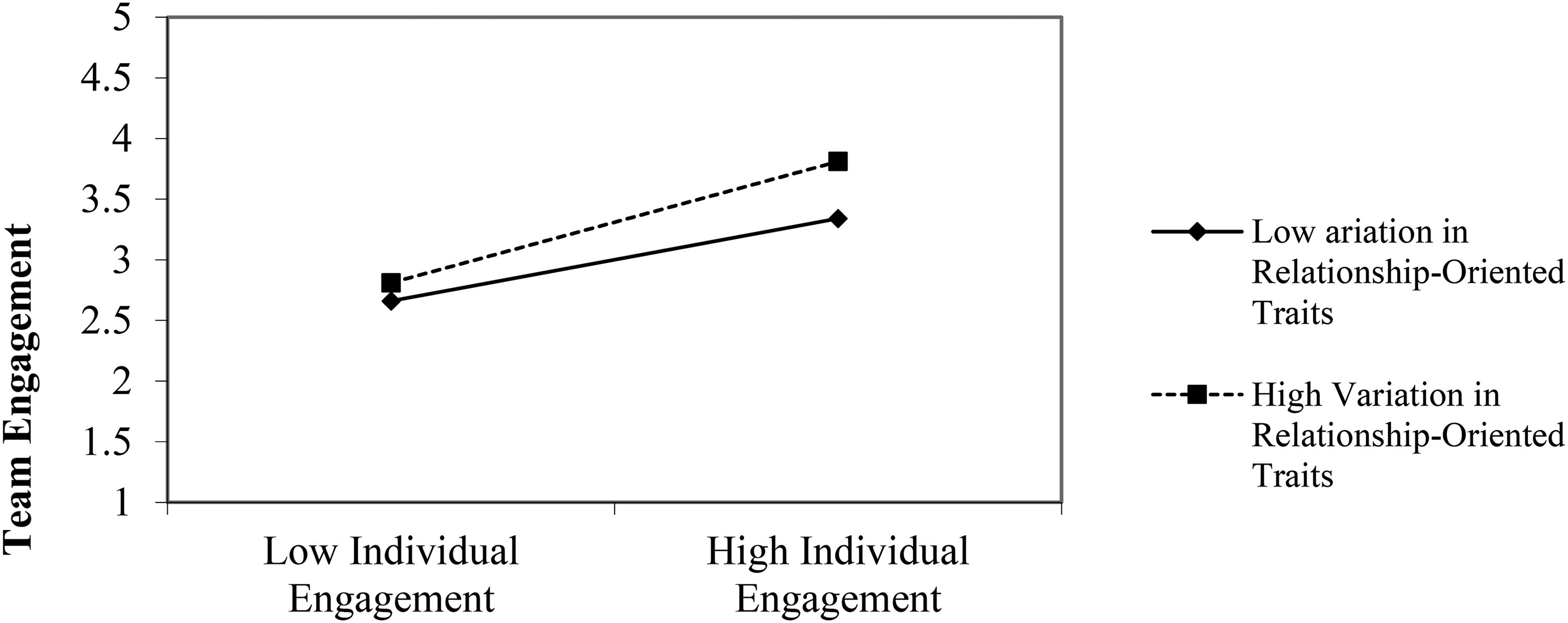
The interactive effect of relationship-oriented traits variation.
Summary of the results
In response to the complexity and perplexity depicting the current business environment, this study provides a multi-level research attempt that investigates the underlying dynamics responsible for fostering team innovative behaviour. Towards that end, team engagement, as an additive-level phenomenon, was evoked to provide a more vigorous and nuanced explanation on how employee individual engagement functions in promoting innovative behaviour at the group level. Further, the moderation effect of team personality composition on the individual-team engagement association was also investigated.
As illustrated in Table 11, the direct paths between individual employee engagement, team engagement, and employee innovative behaviour were found significant, lending support to H1 and H2. Further, the results disclosed that team engagement partially mediates the association between individual engagement and team innovative behaviour. This entails that the individual engagement-team outcomes (innovative behaviour in this context) association might not be unpretentious nor straightforward as presumed in the behavioural literature (Kleinaltenkamp et al., 2019). That is to say, there are collective dynamic forces that shape and influence the tendencies of individual employees to display engagement behaviours. The current findings illustrate how individual engagement can be a focal force that constitutes collective-oriented systems. That is, the semblance and consequence of employee engagement are conspicuously reflected at the individual and group levels. Thus, this research endeavour on engagement can be considered as a gainful foundation for future discourse on multilevel integration of workforce related attitudes and behaviours. Furthermore, the results failed to generate statistical support for H4 stating that the variation in the team's task-orientation traits moderates the association between individual employee engagement and team engagement. However, H5, proposing that the variation in the team's relationship-oriented traits moderates the association between individual employee engagement and team engagement, was found statistically significant. This implies that personality attributes might have varying effects on employee engagement at the aggregate level in comparison to their influence at the individual level (Ababneh, 2021). The interpretation of these results is further illustrated in the following section.
Summary of the tested hypotheses.

Discussion
Theoretical implications
A key theoretical implication for the current research is shedding the light on the collective affective status of a group. The emotional dimension has been a trademark for the individual level analysis. Guided by emotional contagion, the findings of the current research provide empirical evidence on how affective states can stimulate comparable emotional reactions amongst other team members (Kleinaltenkamp et al., 2019). This relates to the instinctive nature of affect, as the arousal of certain emotional stimuli in the surrounding climate will most likely create emotional synchrony between the interactive parties (Herrando and Constantinides, 2021; Patel et al., 2017; Waight and Edwards, 2020). Therefore, the collective view of engagement in the current study creates a conceptual viaduct between emotional contagion and exchange theories, where the dynamics of different levels and directive institutional interactions, including individual employees and work teams, cane be meaningfully understood. Hence, comprehension is thought to offer an affection-consolidated model guiding institutional interventions to acknowledge engagement like qualities, traits and states at the workforce (Waight and Edwards, 2020).
Furthermore, as mentioned earlier in the introductory section, there is a noticeable paucity of research attempts that acknowledge the impact of group-level variables on organization's innovativeness, including innovative attitudes and behaviours in the SMEs context. This study, then, offers a new-fangled theoretical model that spans employee engagement theory with team innovative behaviours through the inclusion of collective engagement variables (collective emotions, cognition, and behaviours). This expanded recognition of employee engagement is thought to assist in understanding the engagement-innovation dynamics from a wider theoretical perspective. Further, this research has implicit connotations to invite organizational culture and climate to jump on the change bandwagon on employee innovative behaviour. From the emotional and cognitive perspectives of team engagement, employees’ perceptions, attitudes and emotional responses are strongly affected by the nature and quality of interaction established by the institutional arrangements and initiatives (Rutishauser and Sender, 2019). Thus, this study brings attention to the valance of geminating the arousal of engagement behaviours by widening the theoretical scope of engagement- innovativeness phenomenon to evoke the organization's cultural archetype to serve as a key force facilitating engagement and promoting innovative behaviours at the workplace.
Along similar lines, the current findings revealed that employees’ innovative behaviours follow a non-linear dynamics that include complex interactions (Humphrey et al., 2007). That is, the group collective attitudes and behaviours are shaped by the joint effect of internal and contextual forces (Waight and Edwards, 2020), including the composition of personalities of team members. However, extent research provides a substantive research endeavours that examine teams’ personality compositions using a single-trait approach collecting scores on personality attributes at the individual level. Hence, assessing team personality attributes composition has received scant attention. Thus, this study puts forward an expanded research agenda that links the spares of engagement individual-team theorizations to the innate psychological force of employee personality disposition. In alignment with one of our conceptual hypotheses, the results of the current study displayed a significant moderating effect of relationship-orientation (interpersonal interactions are manifested by extroversion, agreeableness, and emotional stability personality traits) on the individual-team engagement interrelation. However, in spite of the significant appeal of our conceptualization, the results indicated no moderating effect for task-oriented team's personality composition (the completion of tasks is manifested by conscientiousness and openness to experience personality traits) on the aforementioned association. This interesting finding provides a provoking and spectacular signal for engagement theorists in that the magnitude and strength of the effect of engagement antecedents might vary at the group level from the individual level. That is to say, conscientiousness has been intensively reported, in the engagement literature to have direct/indirect associations with employee engagement at the individual level (Ababneh, 2021), but indicated little trace, at least in the current data set, on the engagement construct at the group level. Thus, this rousing finding emphasises the need for further examination of the interactive and social forces that might facilitate/hinder employee collective engagement (Fletcher, 2017).
Practical implications
In alignment with the theoretical implications, this study offers guidelines for SMEs managers and decision makers. Drawing on the complexity and dimensionality of employee engagement, practitioners and managers are expected to adopt various aspects of leadership style and develop managerial interventions that tap the different constituents of collective engagement (Prewett et al., 2016; Zhou, 2016). Here, recognizing employees’ cognitive dynamics and affective dispositions is vital to effectively monitor emotional transfer (contagion), assertiveness and relationship building. This could be achieved by implementing certain groundbreaking managerial-interventions, including the establishment of a transparent dialogue that enables soliciting thoughts and suggestions, expressing creative thinking, communicating performance goals and expectations. For instance, the technological advancement can assess in adapting software to be used as a virtual platform, where employees’ concerns, expressive thoughts, success and achievement tales, and anecdotes with customers can be shared. Further, managers can rely on an abundance of actions that can strengthen the social and affective nexus amongst employees, such as conducting periodic seminars, group-based events (e.g., group volunteer projects), and opt-in gathering without agenda. Taken together, these interventions and activities are expected to enhance the relationship orientation amongst team members; hence, they magnify employees’ tendencies to collectively display engagement behaviours.
Additionally, the magnitude of team engagement can be affected by certain institutional practices including human resource management (HRM). Engaged teams tend to involve in informal and formal work related activities and arrangements, including handling a wide range of work-related issues with business partners and stakeholders (e.g., customers, venders, suppliers, and other working groups). This, in turn, requires flexible job designs that enable for creatively working beyond the formal boundaries their job descriptions (De Spiegelaere et al., 2014). Further, developing and implementing creative ideas and solutions require authentic autonomy, transparency and empowerment (De Spiegelaere et al., 2014). This will help creating engagement atmosphere, where creativity and convergent thinking are highly encouraged. Along similar lines, managers can spearhead their endeavors to devote further emphasis on developing precise measurement tools that can detect the levels of team engagement. Further, HRM should acknowledge the sensitivity of team personality composition. Thus, it seems mandatory to hire team members with collective engagement innate qualities and tendencies. More specifically, the complementary and supplementary perspectives of personality homogeneity/heterogeneity can be a focal reference when selecting a medley of personality traits, especially the relationship-oriented traits of extroversion, agreeableness and emotional stability.
Limitations and future research
Despite the appealing contribution of the current study to the theory and practice of employee engagement and innovative management, few research limitations do exist and require attentiveness when reporting and interpreting its findings. Initially, this study is solely a cross-sectional one, which prohibits detecting the causality that explains the direction of the examined relationships. Thus, adopting a longitudinal research design is highly recommended to collect empirical evidence about the causality amongst the study variables. Furthermore, the sample was selected from a single industrial context (SMEs). Thus, the generalizability of the current findings is limited and can be strengthened by following a comparative research design applying the current framework on other business settings. Further, the proposed moderation role of task-oriented traits composition was found insignificant in the current data set. This can be attributed to the cultural forces that may affect how some participants understand and explicate the measurement items. Therefore, conducting this model on cross-cultural contexts seems vital and may yield different or similar findings.
The findings of the current study indicate additional directions for future research. Employees’ team engagement is a higher-order level construct that might include complex interactive dynamics between various interpersonal, social, and institutional forces. Thus, one possible research line is to examine the moderating influence of shared leadership. The amount of autonomy, trust and empowerment that team members receive depends on the extent of facilitation and leadership capacity shared between team members (Ababneh et al., 2021; Prewett et al., 2016; Zhou, 2016). Along similar theoretical trajectories, the findings of the current study has implicitly pinpointed at the potential role organizational culture may have in fostering team engagement. Drawing on the interactive mechanisms that govern the phenomenon of team engagement, employees’ perceptions, attitudes and emotional responses are strongly shaped by the surrounding contextual stimuli and arrangements (Ababneh, 2020; Rutishauser and Sender, 2019). Thus, another key recommendation for future research is to widen the theoretical scope of the current theoretical model by investigating the moderation role of the organization's cultural archetype (e.g., adhocracy, clown, hierarchical, market; Cameron and Quinn, 2011).
Supplemental Material
sj-docx-1-iei-10.1177_14657503231156876 - Supplemental material for Team engagement for boosting team innovative behaviour in small and medium enterprises: An integrating framework of attitudinal and trait-related determinants
Supplemental material, sj-docx-1-iei-10.1177_14657503231156876 for Team engagement for boosting team innovative behaviour in small and medium enterprises: An integrating framework of attitudinal and trait-related determinants by Omar Mohammed Ali Ababneh in The International Journal of Entrepreneurship and Innovation
Footnotes
Declaration of conflicting interests
The author(s) declared no potential conflicts of interest with respect to the research, authorship and/or publication of this article.
Funding
The author(s) received no financial support for the research, authorship and/or publication of this article.

Supplemental material
Supplemental material for this article is available online.
References
Supplementary Material
Please find the following supplemental material available below.
For Open Access articles published under a Creative Commons License, all supplemental material carries the same license as the article it is associated with.
For non-Open Access articles published, all supplemental material carries a non-exclusive license, and permission requests for re-use of supplemental material or any part of supplemental material shall be sent directly to the copyright owner as specified in the copyright notice associated with the article.
