







Abstract
Contemporary permacrises have enhanced calls for a re-thinking of entrepreneurship scholarship. The Ink Way re-imagined the practices and philosophies of Enterprise Scholars through an innovative 4-day writing and walking workshop retreat. Critical analysis of the workshop's outcomes and artefacts revealed the importance of connectivity, community, and collaboration, within the academy and immersed in (field study) contexts, in diverse places across time, language and people(s). Yet this can be a demanding journey, of both becoming lost, and then finding the way. We identified two practices that could assist transformational scholarship: Whilst rooting practices ground us within mesh works of connected community, complex place, and contested journey, flowing practices weave and knot together the threads of the in-between, theory and practice, the lived experiences of scholar and entrepreneur alike, and of individual and community, reality and reflection.
Keywords
A wave of transformation is sweeping through the entrepreneurship academy, picking up speed, size and scale, together with growing recognition that we need to reposition ourselves (Dodd et al., 2023) as entrepreneurship scholars. An ever-more influential edge of entrepreneurship scholarship is rapidly moving towards a more pro-social, responsible and pro-nature, community-embedded enterprise, of the frugal, circular margins, and asking for the values entrepreneurship provides to our societies and post-growth economies (e.g., Dentoni et al., 2017; Garcia-Lorenzo et al., 2018; Kapasi and Stirzaker, 2023; Korsgaard et al., 2016; Mazzoni et al., 2025). There also has been a shift (back) to the everyday entrepreneurs and small-scale business owners who comprise the vast majority of the enterprising population, and away from mythologized, opportunity-discovering individuals, fast-growing unicorns or similar mythical beasts (Baker and Welter, 2024; Drakopoulou Dodd and Anderson, 2007; Ramoglou et al., 2020; Rehn et al., 2013; Steyaert, 2004; Welter et al., 2017; Zankl and Grimes, 2024).
Transformations are explicitly pursued in entrepreneurship pedagogy, policy advising, and knowledge sharing (Dodd et al., 2022; Fayolle et al., 2018, Loi et al., 2022). Several scholars argue strongly towards leaner, more engaged, we-voiced, integrative and iterative fieldwork (Dimov et al., 2021; Rashid, 2022; Shepherd and Patzelt, 2023), for re-positioning ourselves in process and practice (Champenois et al., 2020; de Clercq and Voronov, 2009; Laine and Kibler, 2018; Thompson et al., 2020) and for pushing us towards interdisciplinary dialogues on transformational change (Lubinski et al., 2024; Welter and Baker, 2021). Still, we believe that we need more emphasis on rethinking our own scholarship practices to realize transformational scholarship. How we reflect on the research themes we look at and how we study them (Ben-Hafaïedh et al., 2024; Harrison, 2023; Ramoglou, 2021; Welter, 2011), the disciplines we draw on (Lubinski et al., 2024; Welter and Baker, 2021), the ways we teach and educate the next generations (Iandoli, 2023), our research communities themselves (Gartner et al., 2006), and our impact on the world outside academia (Rouse and Woolnough, 2018; Whitehurst and Richter, 2018; Wiklund et al., 2019) lies at the heart of this journey.
Here, we take a small step sideways, exploring what transformational scholarship might look like and how we can practice it. We look to parse some of the generative grammar of this rapidly swelling tide – its habitus – and to set our sights on some of the new outlooks the transformational wave might carry us to. In this exploration, we consider emergent entrepreneurship scholars as our angle for enquiry. As meandering boundaries of student and educator; entrepreneur and scholar, emergent entrepreneurship scholars find themselves uniquely situated broadly across the entrepreneurial sphere. There are such rich threads to be unpicked and rewoven in seeking deep understandings as to how the coming generation interacts with the transformations of our scholarly pasts, presents and futures. How are their transformations perceived, interpreted, internalised, enacted, adapted, rejected, built, challenged, and embraced? In considering how emergent scholars navigate and contend with their nascent scholarship, in research, policy, and practice, alone, and in community, we found an opportunity to reflect and imagine newly co-created transformations in the entrepreneurship academy. Yet our vision is also bolder, more ambitious as we strive to set out a manifesto for transformational scholarship in entrepreneurship.
These are the issues we wrestled and walked with, during the Ink Way, a 4-day workshop in the glorious early summer of 2023. Since then, we have worked together to sharpen, deepen, and frame our shared exploration of the transformational entrepreneurship scholar-self. Here, we tell the story of the Ink Way, and our own journey of critical reflection. We share our collective analysis of the constitutive elements of transformational scholarship. Based on these foundations, we critically re-imagine the practices and philosophies of current entrepreneurship scholarship to illustrate the journey of and towards transformational scholarship, as potential guidance for all of those who would like to work and study entrepreneurship differently.
Three major themes and a set of two practices emerged from these reimaginations. Setting out for new horizons, transformational scholarship is a complicated and challenging process. It emerged as an often-demanding journey, of both becoming lost and then finding the way, in various places, across time, language and landscapes. Transformational scholarship also is grounded in connectivity, community, and collaboration. Within and beyond the entrepreneurship academy, this extended to immersion in (field study) communities. Communities-in-place perform as socio-material sites of ontology, co-creating with, through, and from the built and natural environments (Schatzki, 2002; Welter and Baker, 2021). We critically reflected on these interwoven themes, particularly during the workshop, but also in the subsequent months.
A golden thread wove itself through all our interactions, from our opening introductory imaging, right through to our last plenary reflection; “rooting, so we can flow”. This apparent paradox emerged in many forms, from the recurrent imagery of trees beside running water, vital elements in the workshop's surrounding geography, to the emergence of this phrase as a mantra, a touchstone. We conclude our essay by exploring how the concept of rooting - so we can flow – may be used as new practices that help moving us towards transformational scholarship. First, though, permit us to take a little of your time as we settle you into a narrative of the Ink Way workshop, its context, and practices.
Our writing journey
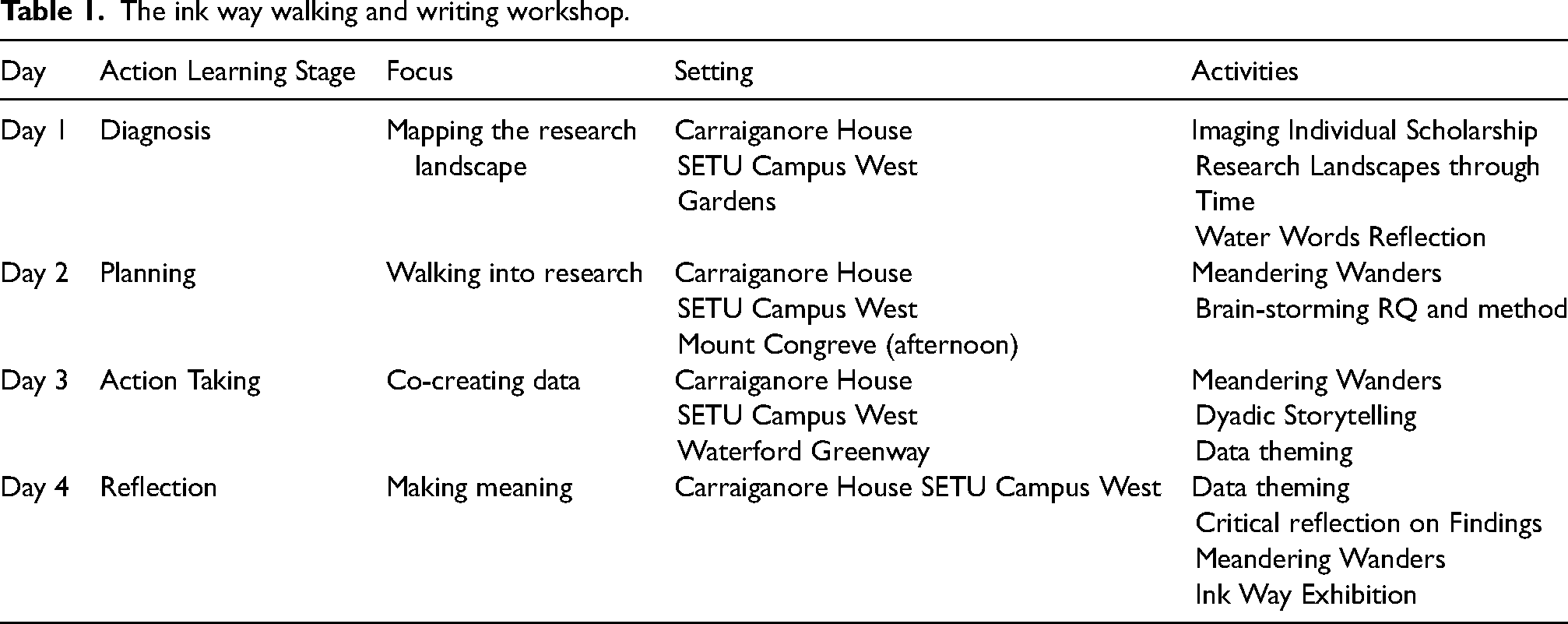
In the early summer of 2023, three senior scholars came together with eight doctoral students for an intense and structured 4-day walking, imaging and writing interaction; “The Ink Way”. The Ink Way was designed to move through an action learning structure, adapted to the scholarly writing journey (Kapp, 2015; Mann and Clarke, 2007, see Table 1). It thus provided this essay's raison story, context, community, data, and process. Centred loosely on the shared theme of enterprise-in-place, the Ink Way was intended to enhance writer confidence and competence, and to co-create a community of transformational scholarship. The process of writing a collective piece formed the workshop's structure. This is the resultant piece, in which we use the learning journey from our workshop to illustrate the voyage into transformational entrepreneurship research and practices that may assist us on that journey.
The ink way walking and writing workshop.
The Ink Way took place on the edges of a small 1100-year-old city, in an old manor house, on a wooded green field satellite campus, once home to an ancient Viking settlement. The campus’ acres spread between the town and the fields, close by the estuary, below the hills, between the woods and the water. The buildings are few in number, less than a handful, but impressive in style, or scale, or both - making place. The campus’ entrance is home to the University's multi-purpose sporting, conference and exhibition complex, with its everchanging comings and goings, and sporadic tides of buses. Hidden away over a small hill, and behind giant, ancient trees, is the old estate's manor house. Home to a leading nutrition and food research centre, the old house's sustainable kitchen gardens produce food for use by the university's culinary studies learners, in their trainee kitchens. Across the manmade pond sits the modern innovation, enterprise and technology hub building, gently bustling with new ventures and their support staff. On the campus’ far edge sits the groundbreaking technology and telecommunications centre in an aloof futuristic world of its own. This is a place of the past, replete with the plantings, growings, shapings and buildings of the old big house, and all its other legacies. It is a place of the present, the in-the-moment-ness of the one-day national conference, the pitches and pizzas of the accelerator. It is a place of the future, in the growth dreams of the resident entrepreneurs and innovators, and in the extremely advanced computing facilities, post-post-modern in their dark sleekness.
A retreat is always heterotopic, a withdrawal from the mainstream to a place and time that is in-between, circling to its own rhythms (Champenois et al., 2025; Foucault, 1986 (1967); Hjorth, 2005). The Ink Way's “home” was particularly so, layered in-between contextualities; town and countryside; past, present and future; innovation and tradition; striking examples of both built and natural edge-places. On Day 2, the Ink Way spent the afternoon wandering the heritage gardens of a near-by stately home, immersed in its man-made natural places, sharing food and ideas on its terrace. On Day 4, the Ink Way moved into the campus innovation hub building, opening back up to the wider entrepreneurship-on-campus community, and occupying its central space for a final open exhibition.
A variety of activities structured the workshop's journey, several with images and artefacts as inputs, process or outcomes (Table 1). Much time was made, too, for walking the campus and nearby Greenway, sitting in the sun, lying under trees, wandering down to the riverside, climbing up to the “innovation” installation on the hill, and the ancient beech opposite this. A few walks were solo, others paired, some in trios, and others free form, with the intention of promoting varied and diverse interactions between ever-changing participant groupings as people sped up or slowed down to join other clusters. Most walks had some specific focus or task associated with them, be it reflection, analysis or shared storytelling. It is these experiences, conversations, artefacts, and sets of contemporaneous notes (particularly those covering reflective walk debriefs) which form the data for our essay, showing the move towards transformational scholarship.
The tapestry of transformational scholarship
Imagine scholarship as a loose meshwork fabric, woven from threads of many colours, patterned and patched, embroidered with meandering trails and clustered with their knotted connections. Conjure in your mind's eye the downwards warp of the fabric, woven from the endlessly varied places within which transformational scholarship immerses itself. This is the multi-textured and richly patterned warp within which our scholarship is enacted. Picture now the more wandering stripes of the weft, comprising the story lines, the trails of our journeys; each thread similar in some ways, unique in others. Rarely straight, our journeys of being and becoming in(to) transformational scholarship meander as we lose and find our way, and as we knot ourselves into connections, community and collaborations. Connections are made with and through the places that journey lines weave through, becoming knotted together in multiplex and layered co-creation. Deep connections are made too with other travellers and their threads, knitted together and enacted through collaboration. These threads of scholarly journeys come together with others, in place, embroidering the localised patterns of community onto our fabric. These are the three main threads we perceive in the mesh worked tapestry of transformational scholarship: the warp of place; the weft of the scholarly journey; and the richly entangled embroidery of connections, community and collaboration (Ingold, 2017). Each of these merits some deeper unpicking, before we explore the practices for transformational scholarship which the tapestry highlights, depicts, suggests. In unpicking these threads, we are guided by multidisciplinary scholarship that can offer us different perspectives on transformations and change such as anthropology (Ingold, 2016, 2017, 2020; Tsing, 2004, 2015; Tsing et al., 2017), psychogeography (Sidaway, 2022), ecology, indigenous wisdom and ecopoetics (e.g., Kimmerer, 2013; LaBelle, 2025), and handicrafts and arts (e.g., Albers, 2018; Dunlop, 2023; Thorpe and Manzini, 2018).
Built and natural places across time, language and landscapes, emerged as a framing thread of the Ink Way, and for transformational scholarship. We communicated individual research experiences through imagery and other means, introducing each other to places rich with contextualised field meanings, significant as levels of analysis in their own right. Place is people through time, and it is places that root context, layering threads through time to thicken the warp of our fabric. The complexity of place interwove the built environment with the natural world, its many layers opening to us like Russian dolls.
Scholarly life experience trajectories weave through this deeply immersive engagement with place. Together they form the loose structuring, the warp and weft, of our tapestry. In the Ink Way, the journey allegory emerged as the main narrative thread around these trajectories.
Specifically, a clear and consistent journey storyline emerged around ‘becoming lost, so as to become found’.
Visual metaphors of the journey predominated some of which flowed back to past ways of being. In some, the research community was imagined as the connective bridge on others’ journeys. Journeys were depicted in Ink Way imagery and reflection as meandering in-between layers of place and time. Scholarly pathways trailed their threads in-between – entre—the past, present and future; in-between the built and the natural; overcoming or wayfinding around and through barriers along the way. This is a journey towards an authentic voice, an authentic role, for the other(ed), for nature, and for the transformed scholar.
Yet, our promising and exciting shared visions were also over-shadowed by a common articulation of the struggles and challenges of scholars’ own place at the emergent edges of our academy, the sense of being often lost and without a guide or compass in navigating their new terrains. The journey has its beginnings in past experiences, legacies, and memories; it comes from places of insecurity, of imposter syndromes, of feeling less than qualified, from fears of the unknown. Wayfinding towards belonging and becoming, the traveller seeks connections, community, and solidarity. Touchstones for such wayfinding emerged as scholars became immersed in specific research site places and communities; rooted in context, so they could flow. Curiously, though, it seems that making our own meanings, and finding our own ways, within the fabric of entrepreneurship scholarship did not always have this sense of welcoming immersion. Indeed, the academy could feel far more overwhelming than engaging, connecting and collaborating with other (entrepreneurial) communities and places. The journey of transformational scholarship necessitates that we become lost, so that we can find better, newer paths. Whilst being lost may be an individual moment on the journey, becoming found appears to require deep connections within and across communities and cultures. Communities – and the scholars seeking to engage with them – are embedded in the built and natural environments of place, across cycles of time, and languages’ limits and affordances.
Loosing yourself also is a joy. Who hasn’t experienced the delight in getting lost when walking, reading, listening to or experiencing music, doing sports, or in researching—just in doing what you cherish? This is a joyous, enriching and inspiring practice. We immerse ourselves in contexts, we flow (Csikszentmihalyi, 1990), a flow we need to root ourselves and to feel comfortable with others, but also a flow which results from being rooted. At the same time, losing yourself is daunting. Being and becoming lost is terrifying and turbulent. It touches upon our deeply internalised fears of being alone in the unknown, of not being able to save yourself and never find a way out of whatever it is that has drawn us in – the dark corners behind the doors, under the beds or in the cellars of our childhood.
The research journey is such a precarious balance between the joys and perils of getting lost. Researching entrepreneurship inherently embraces venturing into the unknown, without knowing where the path will lead you and whether there will be a path. At the same time there is, then, a need to be lost, before we can find our way. Meandering matters as much as following more structured paths, encountering new views, exploring multi-disciplines, building connections and community. Stories tell of moving from the dark into the light, from the unknown into the becoming-known, from chaos into the co-creation of tentative structure and emergent patterns; of new collective weavings.
Becoming lost can be perilous, highly stressful, and time consuming. How can we mitigate against these negative aspects of the journey? Who is there to pull us back onto the path, when in danger? How crucial is the safety-net of knowing there is someone close (enough) by who cares? Frequently, our fear of getting lost appears to hold us back: we recur to known topics and do not dare touching upon that which would be a delight to study or upon that which needs to be studied in terms of societal needs.
There is a thin line between the healthy journey of “having to find your own way”, and the unhealthy journey of “loosing yourself completely”. It is the community, that roots us. Being with others is our natural, instinctive home. Within the Ink Way, we found a strong desire for connectivity across differences, of place, language, context, culture, and stage in the scholarly journey. All the amazing affordances of connections in communities can be rightfully celebrated as a richness of inclusive diversity. By engaging with this treasure trove of understandings from multiple perspectives, we challenge and broaden our already established knowledge, our own beliefs.
The places and peoples which were especially valued and sought out were those of the margins, of the everyday edges. There was a pronounced sense of connection with depleted communities, and a fierce desire for collaborations as equals to, co-create new meanings and knowledge in these challenged places. Such scholarship knots together participatory research with societal engagement, also often connecting directly or indirectly to progressive policy initiatives. Here, the complex threads of theory and practice are woven together, enacted through care for the world, its communities and contexts, humbly seeking immersive access to the margins, building trust through useful collaborative action learning.
This type of democratised and decolonised collaboration was also valued as fostering the voices of the voiceless, working alongside overlooked people and places, becoming authentic community together. Such work has its own challenges, of course. How, for example, to simultaneously navigate promises and commitments to the (marginalised) field context, whilst avoiding the infantilizing paternalism of expertise, and the re-othering of liminal contexts? Here, connective, collaborative and community-driven epistemologies and methods can generate significant impact, crafting positive contributions to locally lived experiences, practices, and environments (see, for example, Bonner et al., 2025; Harrington et al., 2024). Uniting in authenticity and openness within community fosters the co-creation of genuine new civilizations, where we also educate each other.
Rooting so we can flow: practices of transformational scholarship
Our tapestry of transformational scholarship raises questions around sustaining scholars and scholarship, as well as the peoples and places engaged with. Throughout the Ink Way, two main and interdependent practices emerged as constitutive of place, community and the journey towards transformational scholarship; namely rooting and flowing. Taken together, rooting and flowing equip us intellectually, emotionally, socially, and culturally, offering contextual scaffolding on our journey of and towards transformational scholarship. Indeed, throughout the workshop, the golden thread of rooting so we can flow, wove its way through all our considerations of place, community and the journey. If we can be forgiven an overabundance of mixed metaphors “rooting so we can flow” became a crucial lens through which we examined our insights, and a touchstone to bring us back to a clearer path through our critical analysis. Whilst rooting practices grounded us within meshworks of connected community, complex place, and contested journey, flowing practices wove and knotted together the threads of the in-between, of theory and practice, or the lived experiences of scholar and entrepreneur alike, and of individual and community, of reality and reflection.
We take a little time and space here to explain how and why we came to view both rooting and flowing as vital practices for transformational scholarship, thus also adding a scholarship perspective to the entrepreneurship practice debates (Thompson et al., 2020). It is only through grounding, that we can flow. Indeed, paradoxically, it is a deeply rooted grounding which allows water to flow. Past roots may be fuzzy, or unclear, but their resilience nourishes communities, of today and tomorrow. In flow, we are always looking to the water, for reflection, movement, solace, and change. There is darkness, as well as light, in this movement, and these roots.
The Ink Way interactions highlighted the role that connectivity and collaboration can play in rooting us safely enough to allow us to enter the flow of becoming lost. We need roots to ground us, and roots also assist us in being able to reach out, into the unknown, crossing boundaries. It is easier to get lost without becoming lost once you are connected to what you do, where you do it, and who with. Think of trees which cast roots everywhere, that sometimes live in symbiosis without this being visible from the outside and support themselves as well as other fauna and flora within their reach. Research communities are our forests. Their roots connect beneath our feet, and their branches stretch out to shelter and bridge. Their paths invite us to meander, safe within their wildness. As our strongholds, they provide thematic, disciplinary or regional boundaries, grounding us in the past of our field or discipline and allowing us to reach out to others (Gartner, 2013). Ideally, we select research communities that resonate with our ethos, topics and interests – a requirement to find our connections and place within a community. Yet forests grow from many trees, their beauty and resilience lie in their biodiversity; each tree also stands out, and branches out, whilst fitting into the wider living entity.
However, forests only become welcoming places of play and safety when we know them deeply. So too, research communities offer roots mainly to those of us who are on the inside, while, at the same time, they construct borders and exclude those of us who are – still – on the outside. Communities need some degree of stickiness and glue (Anderson and Jack, 2002) to be welcoming but, sometimes, there's just too much of that (Klyver et al., 2011). Like trees which can get strangled by other flora, communities could become too exclusive. The more established a community, the more difficult it may be for newcomers and outsiders to join. Common interests are required to build a community as they allow researchers to bond, to feel accepted and comfortable in connecting and collaborating. Over time, when their common (research) interests have become established and acknowledged, communities may be more interested in making themselves and their topic distinctive. That often happens at the costs of reaching out to others and including new scholars who, however, may question existing common ground. This reflects place-based entrepreneurial communities in danger of losing their ability to bridge and link with others by relying on close internal ties to the detriment of outward connection (Kelliher et al., 2014).
If the forests, and its trees, provided us with an illustrative allegory for rooting, then water became our collective imagery for flowing. Indeed, our summary diagram at the conclusion of the Ink Way simply showed exactly this: water flowing past and through the roots of trees, encapsulating the intertwined and living nature of these two practices.
The Ink Way enticed insight on where and how do we flow? Critical reflection seemed to show a field which is always in flow, in-the-middle-of, a whole series of paired alternates. We are ever moving in-between iterative cycles, or spirals, of apparent contradictions, playing with paradox. We flow endlessly between self-ing and other-ing, listening and talking, being and becoming, safety and vulnerability, being alone and being together, the dark and the light, hopes and fears, chaos and patterns, being inside(r) and outside(r), the built and the natural, structuring and meandering (Dodd, 2014). We look back to look forward, we stand out to fit in. Surely this is what makes the entrepreneurship academy distinctive, unique. The in-between is and should be our play-space and flowing between and among these circling rivers of paradox, through these in-betweens, is our calling.
Rooting and flowing are not practices which are unique to entrepreneurship scholars. There is deep reflective resonance with the parallel ways that the entrepreneurs we study also weave and knot together the threads of the in-between. We suggest there exists congruence and synergies between us as academic researchers and that which we are researching. Not least, the lived experiences of both have the potential to allow for a greater mutual understanding, thus leading to richer knowledge. For example, the aspect of getting lost, the isolation, the fear of the unknown and “imposter syndrome” is something that emanates from entrepreneurs and entrepreneurship researchers alike. Moreover, if we take key traits of adaptability, flexibility, and agility, all apply to both academic researchers and entrepreneurs equally (Oinonen, 2018; Radu-Lefebvre et al., 2021). Thus, by understanding the transformational potential of our own scholarship, we can recognise the need to push boundaries on conformity (Dorschel, 2022) thus facilitating new roots to grow and allowing the next generation to flow.
Footnotes
Acknowledgements
The authors acknowledge support from the Research Connexions Fund, SETU, 2022–2023. Funding was also provided under SETU's Eminent Professor's Scheme, 2022-2024.
Declaration of conflicting interests
The authors declared no potential conflicts of interest with respect to the research, authorship, and/or publication of this article.
Funding
The authors received no financial support for the research, authorship, and/or publication of this article.