







Abstract
In urban Japan, it is not just public expressions of affection or touch between adult men and women that are uncommon, but opportunities for dancing among adults are very limited in Japanese daily life. This article explores the choreography of ‘parasexuality’ – delimited yet intensified sensuality – that is created through sensual touching among salsa dancers. While public expression of intimacy is highly charged and best avoided in Tokyo, I argue that the bracketed ‘pleasure zone’ of Latin dance legitimates and intensifies sensual interactions in the form of explicitly tactile ‘parasexuality’ for both men and women. What marks salsa as a romantic fantasy space is the disembeddeness of sensuality and sexuality from everyday routines, on the one hand, and participants’ individual expression of aesthetic pursuits that liberates them from the responsibilities of everyday gender ideology, on the other hand.
In urban Japan, the crowded press of the city make unintentional physical contact among anonymous others frequent and often even unavoidable. One of the infamous images of Tokyo is of men and women packed tightly in trains – an image which invokes reactions that urban Japanese have no hesitation to touch or push against others’ bodies. However, in contrast to the inevitability of anonymous physical contact in urban public spaces, public expression of affection or purposeful touching between adult men and women can provoke discomfort.
It is not just the public expression of intimacy or touch that is uncommon, but opportunities for dancing among adults are also very much limited in Japanese daily life. Aside from there being almost no dancing opportunities for couples at weddings or other social functions, dancing in public is also considerably restricted – both by cultural norms and by legal regulation that frame an ambivalent and sometimes skeptical attitude toward social dancing. Indeed, in Japan, both dancing clubs and drinking establishments have long been seen as operating within a cultural ‘gray zone’ between ‘proper’ business establishments and illicit business activities. Far from a part of everyday life and common socializing among both youth and adults in Japan, social dancing in both private and public venues remains a ‘non-ordinary’ activity for many people, and the venues that facilitate such activities have been strictly regulated under various forms of the Japanese entertainment business control law (fūeihō). 1 This is not just a legacy of conservatism or prudery in Japan, either – the regulations and enforcement of laws regarding dance venues have even been intensified since 2010, giving rise to an impression that ‘Japan is not a place to dance’ (odotteha ikenai kuni, nihon) (Isobe, 2012).
During my fieldwork in work and leisure spaces in Tokyo in the late 2000s, I frequently encountered the complexities and qualifications of actual bodily touch among adults in Japanese society. Even in the seemingly loose structure of the after-work leisure of business-like hostess clubs, there is one explicit rule, ‘no physical touching’ between men and women, while verbal interaction with customers is encouraged (Gagné, 2010). Despite the various social and legal regulations in many spaces in Japan, however, the space of salsa dance clubs is one place where physical contact between men and women becomes the most important vector of interaction.
With the exception of salsa aficionados, salsa clubs in Japan may be difficult to imagine in terms of the clientele, the dynamics, and the individual interpretations of this Latin dance style originally born halfway around the world. Indeed, the cultural place and social implications of salsa dancing in Tokyo highlight a particular instantiation of dancing culture, gendered dynamics, and erotic expression that is far removed from the ethnic, class-based, and counter-hegemonic origin of the dance form in el barrio – ‘the neighborhood’ – of Latin American communities in New York during the 1950s, 1960s and 1970s (Gonzalez, 1999; Renta, 2004; Wieschiolek, 2003). What motivates these participants to engage in this kind of seemingly extremely sensual and passionate dance in Japan? What is the nature of the particular performance of gender and sexuality that they express through salsa dance? And what are the implications of performing such intensified gender and sexuality for participants themselves?
In this article, I situate the brief history of social dance within Japanese leisure spaces and interweave the space of salsa dancing with theoretical approaches to touch and sexuality through the desires and experiences of salsa dancers whom I met on the dance floor. From the summer of 2006 to the fall of 2007, I conducted fieldwork in three salsa dance clubs in Roppongi, Tokyo, 2 along with other after-work leisure spaces. At salsa clubs, I joined salsa events and volunteered at events by cleaning the floor, collecting money, and distributing tickets. In addition to getting to know over 80 dance participants at the clubs, I conducted individual interviews with 22 regular and four occasional participants outside of the salsa clubs. Through my research on salsa dance and participants, this article argues that salsa in Japan reflects particular gendered desires and techniques which are best understood as an aesthetics of sexuality motivated and mediated by a ‘tactile parasexuality’. I show how participants carefully promote a delimited yet intensified sensuality that is created through safe and legitimated touch among salsa dancers. At the same time, the bounded and choreographed form of this tactile parasexuality dialectically plays on and intensifies participants’ emotions and passions for romantic interaction, and sometimes leads to explicit erotic sexuality beyond the salsa space. Thus, while public expression of intimacy or touch among couples may be uncommon and undesirable in urban Tokyo, the bracketed ‘fantasy space’ of Latin dance legitimates and intensifies such sensual interactions in the form of this explicitly tactile parasexuality.
One of the stereotypes of leisure in Japan is that it is an exclusively female fantasy, and Japanese women are often studied as agents of popular culture. Scholars reason that vibrant female consumption in Japan derives from Japanese women being the ‘underprivileged gender’ who are simultaneously liberated from much of the constraints of the structures of the work world (Iwao, 1993; Ogasawara, 1998). As a result, female consumption can become a ‘site of struggle’ over sex, gender and sexuality (Robertson, 1998) and can potentially challenge the domestic hierarchy (Kelsky, 2001). In contrast, Japanese adult men in particular have been marked by popular stereotypes of being emotionally cold and physically distant from each other and engaged in leisure that is exclusively corporate (e.g. Ben-Ari, Eyal, 1998) and/or limited to commercialized and sexualized female companionship, including courtesans, geisha and prostitution (e.g. Allison, 1994; Louis, 1992; Watanabe, 2004), or else perversely otaku (‘geek’ culture, e.g. Kinsella, 2000). Thus, the terms ‘romantic’, ‘sensual’, and ‘sexy’ are not commonly associated with Japanese men. However, Japanese men also pursue a variety of sensuous and aesthetic forms, including social dance.
By looking at the kinds of desires that male Japanese salsa dancers enact and embody in salsa dancing, I argue that Japanese men are also active agents in the production of leisure spaces. This is not because Japanese men are less constrained from the responsibility of work; Japanese men also confront different gender ideologies in the workplace, at home, and in society at large. As such, through the radically different space of salsa dance clubs, this disembeddedness of a particular sensuality and sexuality from everyday routines and from everyday expressions of masculinity and femininity can offer a space of possibilities. What marks this fantasy space is not a reformulation of or challenge to the gender ideology in salsa, but rather a space of liberation through a vector of self-expression beyond their everyday gender ideology and expression in Japan.
To this end, I introduce the salsa experience from the perspectives of Japanese men. While salsa is inescapably gendered even in its affects, for many men who participate in salsa, the intensified sensuality that salsa dancing both encourages and requires can offer men a different masculinity – a romantic masculinity – to express themselves as ‘an individual man’. 3 This romantic masculinity temporarily liberates them from other social spheres and responsibilities (i.e. roles of father, husband, employee, professor, etc.) and further suspends everyday masculinities – namely, the gender ideology of being the breadwinner or daikoku bashira (central pillar) for their families, which strictly ties them to the spheres of both home and work.
The salsa scene in Tokyo
On every Friday and Saturday night from 19:30 to 24:00, groups of Japanese men and women gather around in Roppongi 4 dance clubs to enjoy dancing to salsa music. They can join salsa events by paying 1500–2000 yen as an admission fee that comes with one free drink. Salsa’s participation is relatively inexpensive in Tokyo leisure spaces compared with other entertainment spaces where men and women interact through conversation and drinking, such as cabaret clubs, hostess clubs and host clubs, which are marked by official occupational roles of customers and servers. Salsa dancing is thus a more fluid and dialogic form of male and female interaction that is mediated more by participants’ dance skills; at the same time, salsa venues are also more emergent and contingent due to increased regulations regarding dancing and drinking in Japan, and the clubs and arrangements often change arbitrarily as some clubs are closed down and others spring up.
Despite Tokyo being an international city and the international flavor of salsa, Tokyo salsa clubs are not marked by cosmopolitan intermingling among participants. In contrast to many salsa clubs in the Americas and Europe where Latin American participants or non-Latin American locals gather to dance (e.g. Bosse, 2008; Kapchan, 2006; Román-Velázquez, 1999; Skinner, 2007; Wieschiolek, 2003; Urquía, 2005), many clubs in places like Roppongi in Tokyo rarely have Latin American participants, but rather their main clientele are Japanese and occasionally white European or North American foreign nationals. However, just like other salsa clubs and dancers in Hamburg, London, Ljubljana, or Texas (e.g. Kapchan, 2006; Pušnik and Sicherl, 2002; Wieschiolek, 2003; Urquía, 2005), participants are relatively older and do not represent marginalized groups in society. Moreover, salsa clubs in Japan are not marked by internal tensions over ethnicity and authenticity, but rather participants embrace a common passion for the dance while they downplay other distinctions such as age, social and occupational differences. Male participants in the salsa scene come from a variety of backgrounds – lawyers, professors, young and old salarymen 5 from different industries, and part-time workers – with ages ranging from late 20s to 70s. Female participants tend to be office workers or professionals and their ages are more limited to the mid-20s to upper 40s.
A brief history of social dance in Japan: Salsa as a global sport
While Japan has a long history of indigenous group dance, couples dancing has a relatively short history. As part of the large-scale influence on Japan from Europe and the United States in the last half of the 19th century, social dancing was strategically introduced in Japan for political reasons shortly before the opening of the country to the West in the Meiji period (mid-1800s). Japanese leaders felt that by showing Westerners that Japanese can also dance in a ‘civilized’ way, they could take steps toward rectifying the ‘unequal treaties’ with Western nations (Nagai, 1991: 20, 24, 2004: 659). As part of this strategy, they banned indigenous Japanese dancing such as bon-dancing and held Western-style dance events at the Rokumeikan, the first dance hall built to welcome foreign guests in Japan.
In some parts of the world, alongside Christianization, Western social dancing was one of the tools used by colonial empires to inculcate moral power and civilizing processes at home and in their colonies (e.g. Filmer, 1999; Wulff, 2008). In contrast, other forms of dance have been promoted against the moral authority of the Christian Church in England and other European countries (e.g. Reed, 2002; Thomas, 2002). However, in Japan social dance was promoted by the Japanese elites to facilitate foreign relations with the West as a part of an internal project of Western modernization, and the distaste for social dance was also a local phenomenon as many citizens felt that such dances were essentially vulgar and overly sexual (see Savigliano, 1994).
Despite the other image promoted by elites of social dance as elegant and civilized, social dance was increasingly seen as inappropriately sexual because Japanese citizens were not used to bodies so intimately intertwined in public (Nagai, 1991: 33). Indeed, observers at the time noted that dancers seemed to be almost intoxicated through the close bodily touch of social dancing, and this occasionally triggered illicit affairs between dance participants. One notable incident was an affair between Japanese aristocrats Hirobumi Ito and Kiwako Toda after they danced at a dance party in Rokumeikan (Nagai, 1991: 26). Such scandalous incidents became emblematic of the potential ‘dangers’ of dance, and they played into a growing skepticism of pair dance. Ultimately, after it had relatively unsuccessfully served its political purpose, Rokumeikan was closed in 1890 and social dancing was no longer seen as a necessary practice by Japanese elites; this eventually led to the banning of such dancing before the Second World War.
In his historicization of social dance, Nagai (1991: 21, 24) shows how the reception of social dance in Japan since this time reveals particular ambivalences, caught between the forces of ‘curiosity’, on the one hand, and the forces of ‘distaste’ for ‘westernizing human companionship’ (ningen kōsai [no] seiyouka) on the other hand. In many ways, both the introduction of social dancing in Meiji and its later prohibition before the war were both part of Japan’s nationalist strategy. What marked this history was that Japanese citizens themselves did not unconditionally accept the acts of men and women embracing each other overtly in public, but rather public consensus was that such interactions should be kept hidden inside the private sphere (Nagai, 1991: 37).
At the same time Nagai (1991: 72) cautions that this attitude was not specifically against social dancing per se, and thus it would be a mistake to see Japanese morals as more restrictive than Western morals. Instead, what was unacceptable was the intrusion of private activities ‘in the public eye’ (kōzen no menzen de). As long as such activities as male and female physical intimacy were kept hidden inside the ‘opaque structure’ of bounded pleasure quarters (e.g. yūkaku), any sensual and sexual interactions were permitted in Japan. Thus, the increasing legal restrictions against activities such as social dancing that intensified in prewar and wartime Japan were also mirrored by public ambivalence regarding the actual propriety of such public displays of physicality.
It was only after the Second World War that people started paying attention to dance again, and new dance halls were developed. This was partly driven by the fact that local Japanese citizens craved free interactions, and that American occupation forces needed something for their leisure. The revival of dance was facilitated in two ways: outdoor dancing for Japanese citizens, as they had no money to pay for indoor dancing establishments, and indoor dance parties for American occupation forces. Although social dancing per se was not technically a business, these dance halls also began serving alcohol, which automatically classified them as commercial businesses (eigyō). As such, dance halls were grouped alongside cabaret clubs as part of the ‘entertainment and amusement business’ (Nagai, 1991: 164, 170; 2004: 660).
In this way, in the midst of the vibrant post-war subculture, dance in Japan was increasingly commoditized as a part of the entertainment industry to make profits from the public intermingling of men and women rather than seen as a healthy means of socializing between men and women (Nagai, 1991). At the same time, moral panics regarding the potential dangers of men and women dancing in such public venues also evoked coping strategies on the part of dance teachers (see Nagai, 1991). One way was to compartmentalize dance spaces from open dance halls and to make them more like a school. As a result of the negotiation between public perception of dancing and private practices by dance teachers and students, social dancing was increasingly dichotomized. On the one hand, it took the form of a dance contained in dance schools which was not intended to be gazed at by spectators. On the other hand, social dancing became a part of the entertainment industry specifically oriented toward the gaze of others, and which thus needed to be policed (Nagai, 1991: 37).
Since the end of Japan’s economic high-growth period in the early 1970s, other popular American music and up-beat dances gained popularity. Social dance increasingly came to be seen as outdated, and dance halls were replaced by other entertainment establishments (Nagai, 2004: 660). Eventually, since the 1990s, social dancing including salsa regained popularity and thrived as a hobby for middle-aged men and women that came to represent a ‘safe and less risky and less sexual form of communication’ (Nagai, 2004: 661). Particularly with the success of the 1996 Japanese film, Shall We Dance?, what were once seemingly inaccessible and exotic dances became familiar to Japanese citizens, simultaneously proving to the world that the stereotyped expressionless Japanese salarymen can be passionate and expressive dancers – if they put in enough effort.
Phenomenology of salsa: Romanticism versus eroticism
As the anthropologist of dance Wulff (2003) notes, touch, and touching in ritualized and choreographed contexts such as dance in particular, can produce a range of pleasurable and repulsive responses depending on both cultural contexts and individual experiences. In Japan as well, salsa, precisely because of its entangled bodily engagement of touch, can be considered at some times and by some people as passionate and sexy, and by others and at other times as inappropriate and even vulgar. Thus, to follow Desmond (1994: 36), ‘every dance exists in a complex network of relationships to other dances and other non-dance ways of using the body … Its meaning is situated both in the context of other socially prescribed and socially meaningful ways of moving and in the context of the history of dance forms in specific societies.’ In the ‘right’ contexts and with the ‘right’ forms, then, ‘touch’ in global salsa dance is transformed into legitimate and sanctioned Japanese salsa ‘touch’.
Today, salsa as a rhythmic style is marked by the 3/2 or 2/3 rhythm known as clave and by the particular use of the clave (instrument) to mark the beats within each song, as well as a two-part structure of lead and call-and-response and the use of jazz harmonies and improvisation (Wieschiolek, 2003: 121–2). In dancing to the salsa rhythm, couples alternate stepping in place, forward and backward, such as with the woman taking one step in place with her right foot on the first beat and then stepping forward on her left foot on the second beat, and the man stepping in the inverse (Johnson, 2009). Like the music, the specific salsa dance that emerged with the musical style borrows from Afro-Cuban and ‘Nuyorican’ (Puerto Ricans living in New York; e.g. Borland, 2009: 489) styles, but owing to the diversity of its origins, the dance is more improvisational than other Latin American styles such as tango (Wieschiolek, 2003: 121–2). Furthermore, and of particular importance for understanding salsa in Japan, salsa dance is ‘the first dance since rock ‘n’ roll (with the qualified exception of the disco dance of the 1970s, tango and swing) performed by couples and with body contact’ (Wieschiolek, 2003: 122).
In salsa, as in other similar dances like tango, bodily boundaries become simultaneously clear and unclear, because the two bodies constantly balance and counter-balance each other through shifting weight and spins, and as in other salsa venues around the world, in Japanese clubs the close ‘kinetic connectivity’ allows participants to hear ‘breathing, grunting, the sound of falling or catching’ (Karatsu, 2003: 420), making it an incredibly ‘sensually intimate’ performance (Olszewski, 2008). At the same time, this kinetic connectivity is limited to the dance floor among Japanese participants and is facilitated partly by a certain degree of anonymity – there was little inter-gender verbal interaction during off-time at the clubs.
During off-time female members often gather with their friends, and male participants, who usually came alone, would simply get drinks and rest by themselves or talk to other male participants. As some men told me, compared with bars or other clubs, a ‘salsa club is more comfortable’ for men who feel uncomfortable talking with women, as they can relate with women simply through dancing. Indeed, most interactions begin and end on the dance floor. While frequent participants recognize each other and a few regular members become close friends with the organizer, salsa participants hardly know each other well on a personal level, as they seldom exchange real personal information. However, on certain occasions when two dancers connect with each other while dancing, some will exchange ‘personal’ business cards which frequently include a nickname (rather than company business cards), so that they can get to know more about each other. While the structure of these interactions precludes other forms of communication (e.g. verbal communication) and other forms of intimacy (e.g. knowledge about one’s family or work life), it also intensifies bodily communication and intimacy as well as the possibilities for participants to get to know each other outside the dance clubs.
In practical terms, dance is the triangular contact among partners and the dance floor. The ways in which partners touch each other and put pressure on their partners are important, as directionality and movement are controlled through alternating pressure, mediated by partners and the floor. As pairs balance and counterbalance, leaning, pulling and supporting each other, the way men put pressure and respond to the pressure that women give becomes important in constructing the ‘romantic’ feeling of salsa. At the same time, because of this, salsa often evokes the concept of eroticism. When I mentioned to non-salsa dancers that I studied salsa, they often thought of my site as inappropriate, as it was seen as overly erotic or vulgar. Many participants are aware of this image and reject these implications, and instead insist that salsa is ‘romantic’, not ‘erotic’. Participants, both male and female, often make a meaningful distinction between what is iroppoi (aesthetically sexy) and what is eroppoi (physically erotic or sexual). In Japanese, both iroppoi and eroppoi/eroi connote something ‘sexy’ and the distinction can be elusive, but the former has a more positive aesthetic connotation of ‘romantic’, while the latter has a more negative physical connotation of pornographic. According to some male participants, what marks the difference between irropoi and erropoi is the presence or lack of decency (hin) and the distance from actual physical sex.
The distinction between iroppoi and eroppoi is not just meaningful for women at the salsa clubs. It is particularly important for many men, as they do not want to look like someone who simply seeks sexual pleasure. One 42-year-old man, Hoshi-san, had practiced salsa for nine months when I met him. He told me the challenge he faced was that his way of dancing salsa might simply be seen as erotic rather than romantic or sexy. For him it was difficult to make this subtle but important distinction in the way that he moved and touched his dance partners, and he was afraid of ‘just looking like an ero-oyaji (dirty old man)’.
While female participants did not talk about fears of misinterpreted touches in their descriptions of salsa dancing, Hoshi-san’s concern is not uncommon among male dancers. In Japan, popular discourse portrays Japanese men homogeneously as anonymous older men or oyaji. Sometimes such oyaji are automatically seen as ‘perverted’ or ‘disgusting’ by younger Japanese women, and can be generalized as the unattractive model of Japanese masculinity. Within such contexts, what I learned from my informants was that many Japanese men desire to be seen as a ‘man’, not as a father, salaryman, or oyaji. The space of salsa offers these men a place to be sexy without being seen as ‘perverted’, and to be an individual who cannot be reduced to any stereotypes. Similar to Borland (2009: 480)’s observations on the ‘new kind of masculinity that honors the boundary (at least in the dance) between expressing sexuality and coming on to someone’ that is constructed among male salsa dancers in New Jersey salsa clubs, men at the Japanese salsa clubs are extremely careful not to look simply eroi (erotic), but rather to embody an iroppoi (sexy) ‘salsa masculinity’ by ‘dancing romantically’.
Some older men proudly told me that because of their own aging, they became more gentle and respectful in their dancing. For men, discerning the right pressure and showing subtle distinctions based on different partners are critical to performing salsa well, precisely because in salsa everyone improvises on the same basic movement but it must be calibrated to individual partners. Many women I talked to were critical of older men who came to the salsa space to touch women, but some of them also preferred older men as dance partners because ‘they lead more gently’, and ‘some young men can be pushy and too forceful’. In this way, the salsa space is one of the few leisure spaces where men can shine regardless of age and status by performing a particular ‘salsa masculinity’ marked by gently leading and elegantly supporting women. As participants cling to the concept of the romantic and sexy (irroppoi) in describing salsa, this very specific sort of intimacy on the salsa dance floors distinguishes salsa aesthetics as romantic sexuality from more explicit erotic sexuality in contemporary Japan.
Gendered motivations, constraints, and empowerment
Salsa dance, whether it is practiced in Cuba, the United States, the UK, Germany, or Japan, is marked by extreme gendered expressions: the man leads and the woman follows. At the beginning of salsa events in the Roppongi clubs there tend to be far more women waiting in the bar. As more men join after work, the dancers can pair up and begin to dance. According to male participants, this space is not easy to enter alone, because ‘it is a space for women’. This is not merely because of the gender imbalance – it is also because less proficiency is demanded of female salsa dancers, and they are permitted much more room for mistakes or a lack of skill. Given the gendered nature of salsa, where the man is required to lead, it is even more difficult to enter the salsa space as a man if one has no experience in salsa.
Most dancers who come to salsa clubs seem to know how to work it on the floor and the technicality of steps and movements. However, occasionally beginners do join salsa events, and I saw several female complete beginners, but I hardly saw a stumbling male dancer. However, one day I saw a young man in a suit at the very corner of the club who was trying to move his legs to make his steps without paring up. Ogino-san was a young salaryman in his 30s who joined a salsa event for the first time with his friend who had salsa experience. After spending the night trying to learn the basic moves from other men, he concluded that he was not suited for salsa. After receiving many encouragements from his friend and the organizer, he practiced the basic steps without a partner until he left for the train. On the train ride home he confided to me that he initially went there to try and meet young women, as he was single and looking for any opportunity to meet someone. However, after he experienced salsa, he was embarrassed by the fact that he could not lead. He realized that he needed to take salsa more seriously, and shortly after he signed up for weekly lessons.
Ogino-san was unusual in that his first experience with salsa was as a complete novice who was thrown into a salsa event. Most Japanese men who come to salsa clubs take formal lessons outside the clubs, as salsa is too complicated to perform without some formal training. Young men who came to the club for the first time left the space either completely discouraged and decided to give it up, or else determined to take formal lessons like Ogino-san. As in salsa clubs in other countries, the demand for male competency in salsa dancing is precisely because salsa is highly gendered in the dynamics of its choreography, and it is always the man who leads the woman in twists and turns. To this end, many Japanese men work hard at learning salsa.
As a highly gendered dance, the local dynamics of gender strongly shape the dynamics of the dance in a particular society. For example, for the German participants studied by Wieschiolek (2003: 127) the greatest challenge in getting into salsa is not about the unfamiliar rhythms and movements, but about their accepting highly differentiated roles for men and women which are very different from everyday, nondistinct gender roles in Germany. Wiescheliok notes that Germans see Latin American culture as rooted in more ‘traditional’ gender roles that are no longer publicly lauded in Germany, and thus the gender dynamics within salsa clubs differ starkly from those outside of the club. For German salsa dancers, these distinct gendered ideas of salsa, combined with the physical experience of leading and being led when dancing, challenge German egalitarian models of gender. In this context, Wieschiolek (2003: 130) notes that salsa dancers can potentially challenge the ‘the prevailing ideology of gender equality that is considered as a socially desirable norm by most members of the middle classes’.
In contrast, in Japan, salsa participants see the same exaggerated gender roles less problematically, sometimes even idealizing certain extreme expressions of masculinity and femininity as romantic and liberating rather than seeing them as either patriarchal or political (cf. Buffington, 2005; Skinner, 2008). Furthermore, as women and men try to emulate different styles of gendered expression, both female and male Japanese participants often see the differences in gendered dynamics inside the club more as aesthetic differences, and it was clear that both women and men worked hard to acquire such gendered expressions.
However, the salsa space also has a distinct ideology of equality. Once participants master the dance, they are no longer judged (i.e. they are ‘de-classified’) by age, occupational class and status, and everyday expressions of gender and sexuality. Instead, within the salsa club, by being decontextualized from everyday social roles, they can recontextualize themselves as an ‘individual’ man or woman who is immersed in an aesthetic pursuit. In other words, the degrees of skill and gendered sensual expression level distinctions other than ‘male or female salsa dancer’.
Inside the salsa club. Photo taken by the author in 2007.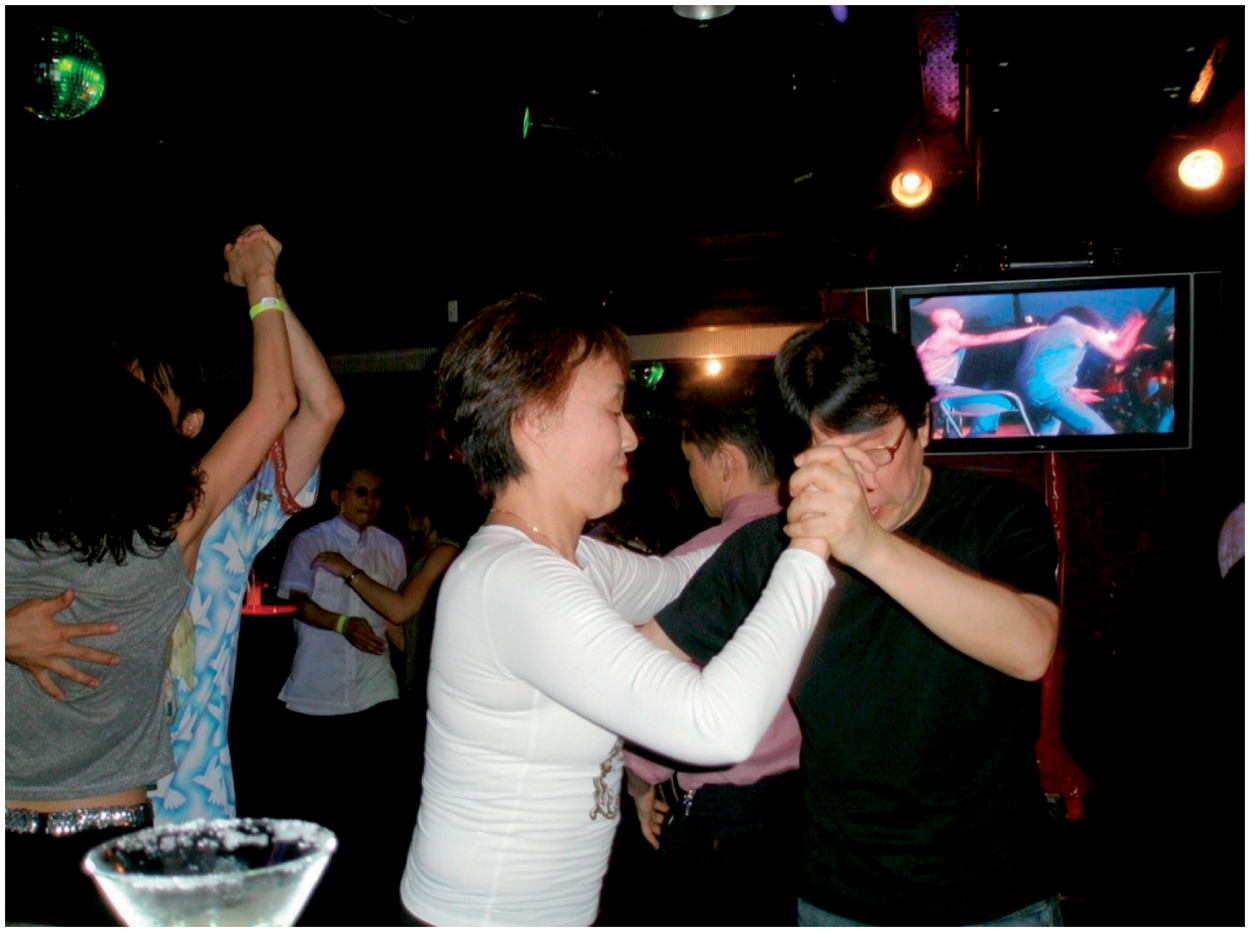
Leveling distinctions and creating equality among dancers is not limited to Japanese salsa, and equality on the dance floor can take a variety of forms depending on local contexts. For example, Wade (2011) shows how Lindy Hop dancers in the city of Charlestown in the US strive to recreate gendered equality by degendering the roles of leader and follower in their dance. What marks Japanese salsa participants is that both men and women tend to exaggerate the differences in gendered expression. Ultimately, what is important for Japanese participants on the dance floor is equally participating (rather than simply gazing, which is often problematized by dancers). As a part of the historical process in the history of dance in Japan that distinguished between dance as a healthy practice and dance as an object of consumption by the male gaze, the primacy of effort in participation by both male and female dancers marks the space of salsa clubs as structurally and symbolically differentiated from other commercialized dance places such as strip clubs, where voyeurism is the main dimension of sexuality.
Thus, for both male and female dancers, the mutual efforts to perform such extreme gendered expression can evoke what could be called a kind of ‘gendered equality’ which distinguishes salsa dance clubs from other service industries, as both men and women are redefining their cultural expressions of gender. For many participants, then, more than any kind of cultural identity or gender politics that might be found in other salsa scenes across the Americas or Europe it is this recontextualized, gendered, and effort-based participatory equality that can be particularly empowering.
The choreography of parasexuality: The salsa club as a romantic fantasy space
The gendered choreography of bodies on the salsa dance floor begins at the door of the salsa club. As male participants enter the club, they usually change only their shoes and enter the dance floor with their daytime clothes (e.g. suits or jeans). Women, on the other hand, use the lockers provided by the clubs and usually change their work attire entirely into deliberately sexy clothes – miniskirts, revealing tops, and high-heeled dance shoes. While this aspect of ‘hyperfemininity’ is often problematized because it seemingly reduces women to ‘sexed bodies’ (see Román-Velázquez, 1999: 129), the very ways that women actively (and as they expressed to me, enjoyably) self-fashion through a particular femininity and sexuality shows how both gender and sexuality cannot be simply reduced to sexed bodies. As one female dancer in her 40s told me, with the ‘right’ dress and shoes, she feels that she can dance appropriately – in other words, such self-fashioned femininity can help to counteract their sexed bodies by giving women confidence and control over their own performance. 6
The physical touching of bodies on the dance floor is one of the most sensual and sensational aspects of salsa dancing for many participants, but the kind of bodies that are touching is also a key element for understanding what such choreographed tactility means for the dancers. While men may not look that different inside and outside the clubs in terms of clothing and comportment, women go through a very visual transformation into a ‘hyperfeminine’ salsa dancer. The concept of hyperfemininity draws our attention to the non-original and non-essential nature of femininity or sexuality. Building from Butler’s (1999) insights on the nature of gender performance and construction that is rooted in socially channeled desires and meanings, Allan’s (2009) study on British single-sex primary school girls and Gagné’s (2013) study on young Japanese girls’ fashion play as ‘Lolitas’ compellingly show how the majority of women do not perform stereotypically ‘feminine’ selves in their daily live. Hyperfemininity is thus a ‘dramaturgical, glamorized femininity’ that is hardly related to women’s ‘conventional’ roles of daughter and student (Paechter, 2006: 255).
For contemporary women, Paechter (2006: 255) explains that this form of hyperfemininity is ‘idle, or at least leisured, operating outside the practicalities of the lives even of those women in traditional heterosexual family relationships’. Gagné (2013) shows that the hyperfeminine performances of some young Japanese female subcultures like Lolita reflect a similar desire to play an exaggerated feminine role vis-à-vis more mediatized vulgar and gaudy femininities in the midst of ‘mundane’ adolescent female social roles. A similar argument could also be made for adult women in Japan as well. In this way, we can merge the concept of hyperfemininity with what could be called ‘hypersensuality’, or intensified sensuality, to describe the distinctly gendered tactility of salsa dancing, made especially sensual precisely because these salsa dancers (both men and women) do not perform such sensuality in their everyday lives – usually not even with their husbands or wives.
While usually limited to the time and space of the dance floor, sensuality in the clubs can take on more lasting tangible forms as well. During my frequent visits to salsa events, I noticed a few women who were very popular among the men. One such woman was Ueno-san. She was married and in her early 40s, but she dressed and acted far younger. Ueno-san never came to the club by herself or with her husband, but always came with different male salsa partners. One day I happened to catch her coming with a new man, and had a chance to ask the man who used to come with her about why Ueno-san had started coming with a new man. According to the man I spoke with, the new man Ueno-san came with was her current boyfriend. Ueno-san kept her married status secret and acted as a free single woman. Yet, despite regretting that she had ended the relationship with him, he sympathetically reasoned that she was bored at home as her husband is an international banker who hardly has time for her, but she still had no intention to divorce him.
Irie-san’s desire for sensual and romantic excitement resonates with Ueno-san’s. Irie-san was a married man in his 50s who joined the salsa scene out of curiosity, through a friend’s introduction. Later he started going to salsa events by himself, and he was a regular member at the clubs I visited. When I asked him why he did not bring his wife, he told me that coming with his wife would ‘undermine the whole point’ of coming to salsa events. This was not just Irie-san’s feeling; many married men usually come alone to dance with other women.
Still, while many salsa dancers remain in the space of romantic fantasy without leading to explicit erotic fantasy in terms of actual sexual relationships, Irie-san ended up having an affair with another salsa dancer. After meeting him many times outside of the clubs, on one occasion outside the salsa scene, Irie-san confided to me after asking me not to judge him for his affair. He told me that he had not had any sort of physical, intimate relationship with his wife since she forcefully rejected his advances at the age of 35. This triggered him to lose any interest in her and to look for girlfriends outside marriage. However, on another occasion, he also told me that he was not satisfied at home because of having children; his family has struggled with his child’s ‘school refusal’ (futōkō), a serious issue which can threaten children’s future educational and career success. He added: ‘Home life almost became like business life, because all we talked about at home was children and the house, and love or emotional feelings became secondary issues. As long as you talk about this “business”, love will be undermined. So I decided not to seek for both love and business at home.’ Later Irie-san told me how he still likes his wife, though physical attraction was completely divorced from his relationship with her.
I introduce the cases of Ueno-san and Irie-san not because they represent the common relationships that form in the salsa scene – the degree of their passions lead to explicit erotic sexual expression: ‘plastic sexuality’ (Giddens, 1993). Nonetheless, they highlight the very ambiguous yet pregnant potential of sensuality at the salsa clubs. In particular, while many men did not want to look simply eroppoi (physically erotic) in their performance at the clubs, their motivations (or indeed, their fantasies) for the potential of explicit erotic possibilities were not rare. It is this dimension of the salsa club, where touch meets fantasy, which reveals the possibilities of ‘parasexuality’ for salsa dancers in Japan.
The concept of ‘parasexuality’ developed by Bailey (1990) explains the visual dimension of the role that barmaids played in the newly commercialized public spaces of pubs in Victorian England. Similar to Bailey’s (1990: 167) description of the barmaid and the pub, one could describe the modern-day salsa club in Tokyo as ‘part of a larger nexus of people and institutions that stood athwart the public/private line and provided the social space within which a more democratized, heterosocial world of sex and sociability was being constituted’. What is critical in Japan is not the visual dimension of women and men’s interactions in the salsa clubs, but how the tactile dimension of their interaction is situated in relation to conventional Japanese modes of physical comportment and touching.
The majority of men I met were married, and they did not dance with their wives or their wives had little knowledge about their hobby; indeed, there were no married couples at all among salsa participants in the Roppongi salsa clubs I visited. Moreover, unlike other societies where dancing is either mandatory or expected at certain events such as wedding ceremonies, the opportunities for dance among older Japanese couples are almost nonexistent. For older men or young single men, dance clubs or dance classes are the only places where they would ‘touch’ the opposite sex without subjecting themselves to ‘inappropriate’ situations. When I asked men at the clubs if they would hope to dance with their wives, some answered ‘no’, while others said they would like to, but they would be too embarrassed. Therefore, in contrast to the ‘sexualization of everyday life’ that Bailey argues permeated Victorian England, salsa clubs and similar dance spaces in Japan are better understood as particular spaces of sensual and sexualized fantasy within an everyday life at work and home which is markedly non-sexual.
While pubs and the barmaids within were in many ways extensions of an already ingrained practice for men (neighborhood pub culture) and the extension of previously backroom domestic-related service work for women (as daughters or servants of publicans), the heterosocial spaces of dance clubs in Japan can be seen as suspensions of the responsibilities of work and family for both men and women in an anonymous and sensually charged context. The spatially and temporally bounded context of the salsa club is marked by the freedom of licit sexualized interaction and mutually understood and managed limits of intimacy, as well as the possibility of illicit encounters and sexuality as bodies intertwine and limits are blurred. In this way, what Bailey calls ‘parasexuality’ – the ‘framed liminality or contained license that constitute[s] a reworking rather than dismantling of hegemony [of male primacy]’ (1990: 149) – can be applied to the salsa club not in terms of women as parasexual subjects who exist to mediate and alleviate male fears of female liberation, but rather in the sense that both women and men are parasexual agents who aim to liberate themselves from everyday spheres of ideologies and responsibilities.
Crucial to Bailey’s conceptualization of parasexuality is the element of ‘glamour’ as a managed and liminally framed desire that is always kept at a certain distance. For Bailey’s barmaids, this distance is managed by the actual distance between pub patrons and barmaids guarded by the bar counter. In this sense, Bailey’s parasexuality relies on a certain degree of materiality and physicality to maintain the buffer of fantasy. In the case of contemporary Japan, a visit to salsa clubs immediately reveals that physical and material distance between men and women is not what sustains their glamour and fantasy. Many informants present themselves quite differently inside and outside the club, and most would only open up about their private life or occupation in contexts that are separated from the salsa scene. Therefore, parasexuality in such heterosocial spaces is mediated by the shared social and psychological understanding that this space and all that occurs within it is fantasy itself – a fantasy that is mediated both by participants’ common understanding and by the ‘alibi’ of open salsa clubs that permit, and indeed demand, all participants to mutually embrace the fantasy. This ‘alibi’ is made possible in the ‘framed liminality’ of the salsa club because the kind of intimacy generated among participants in this parasexual space is both anonymized and voluntary, and so after the dance is over one can switch to a new partner, take a break, or leave the club entirely without the kinds of social ramifications of interpersonal relationships and obligations found in other spheres of men’s and women’s lives in contemporary Japan. The fantasy may lead to a reality in certain cases like Ueno-san’s and Irie-san’s, but for most this remains a fantasy – albeit one that is certainly made all the more compelling by rumors of such instances when parasexuality melts into explicitly erotic sexuality.
Just as with the incitement of relationship-driven self-construction under the fragmentation, segmentation, and disembeddedness of individual identity in many Western societies suggested by Bauman (1999) and Giddens (1991), the women and men who gathered on the salsa dance floors of the Tokyo clubs could be seen as momentarily embracing ‘instant intimacy’ (Erickson, 2011) of dance floor interactions. In late capitalist society, Giddens (1993) argues that a transformation of intimacy in late modern life has occurred. As individuals are disembedded from stable social relationships, they now seek to develop and construct identities based on ‘pure relationships’ – contingent love and plastic sexuality. However, the practice of going to a bounded leisure zone is a historically deep one in Japan (Watanabe, 2004) and the transformation of the public sphere did not transform the private spheres in the same way as Giddens depicted in other societies. Instead it is because of the continued resilience of other stable social relationships that participants sought a way of cultivating another part of themselves that was ‘decontextualized’ from these other spheres (cf. Buffington, 2005: 96; Erickson, 2011: 22). In this way dance clubs and sensual bodily interactions can become spaces of fantasy as they are suspended from other spaces of identity, responsibility and intimacy – the neighborhood, work, and home.
Japanese salsa, leisure dance reconsidered
Many modern dances were first introduced and promoted as something ‘inherently foreign’ by the Japanese aristocracy and British dance teachers in order to acquire Western social skills in the civilizing process. Because of this history and resilient reticence to couple’s dancing in Japanese society, such pair dances as social dance, tango and salsa often invoke the analytical issues of authenticity and the perceived inability for Japanese to express themselves through such dances. Savigliano (1994: 237) categorizes Japan as part of the ‘passion-poor core countries’ which have an inverse correlation with conventionally affluent economies (see also Erickson, 2011: 226). Just as the stereotypes of passion separate Japanese from Latin Americans, such stereotyping also raises a question about Japanese people’s ability to move passionately to a dance form that is thought to embody the fiery hotness of Latin emotion.
According to Savigliano (1994: 241), the expression of emotion and passion became an issue when tango was first promoted in Japan. In Japan and the UK, its passion and risqué physicality – that is, its ‘sensuality’ – were subdued through their appropriation by local tango instructors who tried to make the dance more accessible to their images of cultural propriety in their respective societies. Nonetheless, many Japanese tango dancers explained to Savigliano about the ‘compatibility’ of Japanese and Argentinean culture in terms of ‘sentimentality’, noting her informant’s comment that ‘tangos are basically sentimental, as are we Japanese’ (Savigliano, 1994: 243).
In contemporary Japanese contexts, Goldstein-Gidoni and Daliot-Bul (2002: 64) argue that the love for Western-style dance is still defined in comparison to the ‘West’ and the ‘Other’. Watching Japanese dancers dancing salsa, it is tempting for one to see it through the lens of exoticism – of Japanese bodies moving to Latin rhythms – and thus questions of ‘Japaneseness’, authenticity, and cultural identity often arise: Are they yearning to be ‘Western’, rejecting being ‘Japanese’, or consciously constructing a ‘cosmopolitan’ identity? Such discussions have dominated much work on salsa and tango dancing in Japan as well as in North America and Europe (e.g. Borland, 2009; Bosse, 2008; Enriquez Arana, 2007; Wieschiolek, 2003). These assumptions are enabled by the maturation of Japanese capitalism and globalization; they are further accentuated by the tactility and ‘ethnic flavor’ of Latin American dance that is contrasted with the lack of ‘touch’ and public display of emotional expression in everyday Japanese life.
However, for most participants in the Latin dance clubs that I attended during 2006 and 2007, questions of ethnicity and authenticity were never brought up. I rarely heard the terms ‘Latin’ or Western, although many participants recognized that the origin of salsa is connected with the Caribbean and that ‘Japanese people are not good at dancing in general’. In the clubs I attended, only a few had experienced salsa in Latin America, New York, or Los Angeles. The references to overseas locations that they would sometimes make were more about stylistic differences of ‘LA style’ or ‘Cuban style’, which were not based in differences regarding authenticity but rather aesthetics.
Salsa in Japan thus represents an intriguing space of possibilities for individual self-expression, intensified sensuality, and explicit erotic sexuality. It is bracketed and protected from everyday life in Japanese society and from the politics of cultural and ethnic identity found in many other societies. In contrast, in the UK, Román-Velázquez (1999) locates a strong sense of longing to embody a Latin identity among UK salsa musicians. Similarly, Johnson (2009) argues that salsa scenes in North Carolina are political spaces that are dominated by micro-geographies of movements which produce spaces of exclusion and inclusion based on individuals’ ideological valuing and devaluing of specific subgenres of salsa dancing. These studies and others show the ethno-political ideologies of identity that mark many salsa scenes around the world (see also Borland, 2009; Bosse, 2008; Urquía, 2005).
Far from yearning for exotic self-transformation, the men and women who frequented the salsa clubs in Tokyo seemed to seek a self-actualization and fulfillment that was firmly rooted in local desires for self-expression, recognition, and romantic possibility. This is not surprising given the current socioeconomic conditions facing many men in particular in contemporary Japan. With a changing economic milieu and corporate restructuring, what was once seen as ‘risk’ in terms of ‘social, familiar and personal status’ (Goldstein-Gidoni and Daliot-Bul, 2002: 65) to join in a hobby such as social dance scenes in Japan has come to represent less of a risk and more of a valid option as a meaningful vector of self-expression beyond work. Crucially, rather than representing a new incitement to self-cultivation resulting from a destabilization of individual identities and social roles under late modernity, parasexuality in salsa clubs highlighted how men and women’s social identities remain resilient and demanding, even in the midst of socioeconomic transformation in contemporary Japan.
Indeed, in the busy lives of my informants, salsa could be but one of a number of hobbies that they engaged in. For example, some salsa dancers also participated in social dance and tango. For them, they would choose a particular dance lesson or event depending on their mood and their aesthetic preferences. Furthermore, there seemed to be no age limit in their participation, unlike other more age-bound hobbies in Japan. For example, Nakaya-san, a man in his early 50s, found information about social dancing in 1995, which he had wanted to do for a long time. Since then, he had been taking lessons once a week but he was never that serious. In 1998, his social dance friend invited him to a salsa event, and he was hooked. He had since been practicing salsa three times a week.
Murofushi-san, who was 68 years old when we met in 2007, had just retired from a large-sized company. He was a long-term social dancer and oil-painter. When he hit his 50s, he started learning tango and salsa and had been going to dance lessons three times a week. For Murofushi-san, despite an original intention to dance with women, he rarely socializes in dance scenes. He told me, ‘Just like oil-painting, what is really important is to deeply immerse yourself, rather than to socialize, to be absorbed solely in something’.
A focus on the actual moments of the dynamics of physical, sensual dance in the minds of my informants thus offers a more visceral and intimate way of understanding what motivates (and excites) the Japanese participants in salsa dancing. Karatsu (2003: 427) argues that social dance participants do not long to express something ‘Western’, ‘Latin’, or ‘Japanese’, but rather they desire to ‘[slip] off the confining boundaries of “what is socially acceptable” and find a measure of liberty from their fixed identity and existence’. For Karatsu (2003: 417), social dance is an embodied way of expressing ‘a complex and hybrid self’. Likewise, my experience in dancing with and talking to many participants in the space of salsa dance clubs reveals how in fact their lack of ideological fixation to specific geopolitics enables them to focus solely on complete absorption in aesthetic sensuality. As Murofushi-san’s comments imply, being ‘absorbed solely in something’ can be empowering as they can recontextualize themselves thoroughly in the aesthetic pursuit.
In Japan, hobbies including salsa dancing as complete absorption offers individuals a way of cultivating the complexities of their selfhood by adding additional layers of engagement and interest to the other spheres of their lives. Importantly, as part of the regulated fantasy space of the salsa clubs, they do not necessarily share these complexities completely with either their family or their coworkers but prefer to remain decontextualized as romantic individual men and women within the parasexuality of the dance floor, and they seldom bring this dimension outside of the clubs (cf. Buffington, 2005: 104; Skinner, 2008: 72). More importantly, the combination of global salsa and local reinvention and improvisation through the very physical, phenomenological entanglements of dance becomes the means not just to express, but simultaneously to cultivate the participants’ complex self beyond any fixed locality, identity, or sexuality.
Salsa dance as a space of multiple possibilities
The combination of a reticence to touch strangers and a desire for the sensual fantasy of heterosocial interaction is not unique to Japan. Pušnik and Sicherl (2010)’s study of salsa clubs in Slovenia reveals a similar hesitance regarding close male-female physicality against the backdrop of the ‘cold intimacy’ of Slovenian culture, where public touching among men and women is proscribed under ‘rigid social prohibitions’ (2010: 119). Similarly, Wulff (2003: 188) notes in the case of Ireland that dancing has long been marked by solitariness and a reticence to physical touching in Irish culture. She quotes an Irish choreographer who cites ‘the Irish fear of touch’ and ‘a lack of touch, a lack of sexuality’ that has become challenged by popular media. From a different perspective, Wieschiolek (2003) notes that the gender politics in Germany that have led to a social acceptance and expectation of equality for men and women have also produced spaces of challenge such as the salsa scene among German men and women, where the man is expected to lead and the woman is taught to follow. In all of these cases, a sensual, gendered pair dance like the salsa scene is premised on close proximity, male-female partnering, and distinct gender roles within the dance – elements that can provoke discomfort among dancers in different societies, although for very different reasons.
One could say that (foreign-origin) dance in Japan has long been marked by a certain degree of distance and restraint. While gendered differences in male-female interactions are not particularly problematized, public expression of affection and touching between men and women is a distinctively marked practice in Japanese society. In other words, while Japanese folk dancing such as bon-dancing as well as ritualistic religious dancing is certainly social and gendered – that is, performed in groups with greater or lesser degrees of choreography and with differences in male and female costumes and expected gendered expression – the dancers themselves, while moving together, hardly ever touch each other.
These forms of dance in Japan are marked by a choreographed distance and individual movement en masse. It is in contrast to these kinds of dances of distance that salsa represents a distinctive kind of choreographed proximity – of accepted and acceptable touching within a particular space and among specific participants. Furthermore, unlike the ‘moral monopoly’ of religious institutions like the Catholic Church in Ireland, the ethnic identity politics of the US, the UK, or Germany, and the ideology of gender equality in German or US society (see Johnson, 2009; Kapchan, 2006; Wade, 2011; Wieschiolek, 2003; Wulff, 2003), the particularity and markedness of salsa’s sensuality in Japanese society does not emerge from institutionally and ideologically driven moral, ethnic and gender politics. Rather it is more about management of the space and dance practice vis-à-vis everyday spheres of roles and responsibility. Moreover, as in the Slovenian case where the ‘rigid social prohibitions’ and ‘cold intimacy’ of everyday life in fact intensifies the romantic fantasy of the salsa clubs, the passion and romantic sensual fantasy of Japanese salsa clubs is made meaningful and distinctive because of the historically and socially structured compartmentalization and contextual segregation of certain kinds of intimacy – including permitted and expected touching and physical yet highly aestheticized expressions of sexuality between men and women who are temporarily recontextualized as romantic individuals on the dance floor. In this way, seemingly exaggerated passion and overly sexual undulations of participants in the salsa scene reflect their strong sense of ‘propriety’ and ‘discernment’, rather than moral propriety and moral transgression.
What marks salsa as a romantic fantasy space is the disembeddedness of salsa’s sensuality and sexuality from everyday routines, on the one hand, and participants’ embeddedness in other social relationships, on the other hand. As salsa from the beginning was a counter-hegemonic expression of racial/ethnic identity in response to the dominant white US culture (see Johnson, 2009; Sánchez González, 1999), salsa became the vector for individuals in other societies to renegotiate dominant ideologies of gender norms or sensual self-expression that are salient to their respective time and places (see Skinner, 2008; Wieschiolek, 2003). In the case of Japan, regardless of the various motivations of participants, salsa clubs offer a place of possibilities to challenge the local idea of touch and bodily comportment, by suspending themselves from stable relationships, and individuals’ stabilized identities (see also Borland, 2009; Hewer and Hamilton, 2010).
This particular fantasy space, which allows men to imagine an identity as men rather than as husbands or employees, on the one hand serves as a conservative force for releasing pressure built up by men’s obligations to maintain family and work life. At the same time, such fantasy spaces in Japan do not necessarily foster unbridled transgressions or “the transformation of intimacy” beyond the salsa space. Nevertheless, due to changing socioeconomic milieus of contemporary Japan, salsa clubs in the 2000s accentuate the boundaries of fantasy vis-à-vis family and work, which can make individuals’ experiences in these spaces even more intensified and meaningful. As my informants’ reflections and expressions revealed, to keep romance romantic and meaningful it has to be kept separate from other everyday spheres both for men and women – even as the fantasy space within the salsa club may become deeply entangled when men and women cross paths with little knowledge of each other except for the bodily experience of dancing closely.
Footnotes
Acknowledgements
This paper was made possible with the help of Japanese salsa participants. I would also like to thank Paul Willis and the anonymous reviewers for their helpful comments and advice.