







Abstract
This paper asks ‘What is a life worth?’ by analyzing the wrongful death lawsuit for Douglas Morales, an undocumented student who died in 2008 at 17 from brain injuries suffered playing football. The paper first examines how sociologists and New Jersey law monetarily value a child’s life, especially when undocumented status would have decreased long-term earnings. Second, it uses ethnographic, counterfactual methods to do a ‘sociological autopsy’ offering a plausible alternative, a more positive scenario – including a path to legal status – for Douglas’s future life. It uses interviews and document review to establish Douglas’s life habits, leveraging sociological and psychological research on immigrant youth achievers to predict higher future earnings. The paper advances ‘public sociology’ by deploying ethnographic, case-oriented methods to challenge the devaluation of this undocumented life, critique American immigration policies, and to help the decedent’s family directly.
Introduction
‘Who was he in love with?’ I asked after seeing Douglas’s notebook, with a love poem he had written to a girl, adorned with an intricate, beautifully rendered rose. Douglas Morales had died in 2008 at 17 from a brain injury sustained during football practice. I was interviewing the family in 2012 for their wrongful death lawsuit against the Cliffside Park, NJ, school district, which the Morales family’s attorney, Oscar Sanchez, said had offered ‘go away money’ to settle the case. Sanchez believed the problem was Douglas’s undocumented status – he lacked legal permission to live and work in the US. Under New Jersey law, Douglas’s family could only recover losses for lost income he would have given them or for the cost of services he would have provided them; emotional loss did not count. Because Douglas had been undocumented, his future earnings would likely have been low. It was dizzying to weigh the question – What is this life literally worth? – with opposing notions juxtaposed in my mind: the school district offering ‘go away’ money to its deceased student athlete’s family versus the grief and pride of Douglas’s family while telling me what kind of young man he had been.
This paper engages the question ‘What is a life worth?’ by analyzing Douglas’s case in three ways. First, it examines how sociologists and New Jersey law value a deceased child’s life. Douglas’s undocumented status diminished the baseline legal value of his lost life, which the Morales’s attorney believed drove the school district’s low initial settlement offers. Second, it uses ethnographic case methods for a counterfactual, ‘sociological autopsy’ offering an alternative, more positive scenario to Douglas’s future earnings and life’s future value. I used elements of the ethnographic case approach, e.g. repeatedly discussing Douglas’s daily habits with family and friends, reviewing his diary/artifacts or other documents (e.g. school records, expert reports, contemporaneous news/ blog reports/comments; Kligman, 1998; Scourfield et al, 2012; Duneier, 1999; Freund and Thomson, 2011; Murthy, 2008). This biographical approach offered a plausible alternative future to that inherent in the school district’s low offers, and established Douglas’s route to legal status. Finally, Douglas’s future trajectory is posited, using research on immigrant youth achievers to forecast higher economic value on Douglas’s life, reflected in the settlement offer rising from $35,000 to $125,000 – shortly after my deposition.
The paper contributes to ‘public sociology’ (Burawoy, 2003; Gans, 1989). It offers a sociological autopsy analyzing how undocumented status affects people’s perceived value, here, in a legal case, even after their death. This is an indictment of American immigration policy.
What is a life worth? Sociology, forensic economics and New Jersey law
Simultaneously reading Viviana Zelizer, a historical sociologist, and Frank Tinari, a forensic economist, on the value of a lost life felt like looking at the same object simultaneously from an airplane and with a microscope. Writing in The American Journal of Sociology, Zelizer traces the long arc of how society establishes frameworks for allowing and disallowing economic valuation of lives, especially children. Zelizer argues that modern societies see children as ‘economically worthless’ but ‘emotionally priceless’. Tinari, in The Journal of Forensic Economics, discusses local legal guidelines for estimating a life’s worth. Both approaches mattered for Douglas’s case.
Zelizer’s work (1978, 1981, 1985, 2005) engages the general theme of ‘establishing monetary equivalences for sacred things … including life, death, emotions’ (1978). She examines sociological processes for determining the value of intimate relationships, e.g. long-term companionship, the wrongful death of a spouse, or the legal value of a slave who was an intimate partner. Her work on life insurance, especially for children, helped found a new field in sociology. Drawing on Simmel, Marx, and others, she argues that pre-modern societies accepted the economic valuation of decedents’ lives, including children. Indeed, Zelizer cites an 1856 New York state case wherein a mother was awarded $1300 for economic loss resulting from her 7-year-old’s death. Notably, the award was for ‘loss of earnings of a child from the time of death through her minority’ (Zelizer, 1981: 1046; emphasis added). Later in the 19th century, emphasis on children’s uniqueness made such valuation unacceptable, especially as they moved out of the economy and childhood was more protected.
Zelizer analyzes how the value of childhood came to be seen as fit for financial recompense in the late 19th-/mid-20th century by studying child insurance. She argues insurance companies defeated the notion that monetarizing the value of a child’s life was to ‘touch profanely a sacred thing’ (as one observer put it in 1905; Zelizer, 1981: 1039) by making child insurance a way of ‘sacralizing’ that child’s life, making it a ritual of mourning. But she argues tensions remain between the sacred and profane functions of monetarization, especially for children.
Tinari’s work (1998, 2004; Tinari and Kucsma, 2010) focuses on the economic and forensic nuts and bolts of estimating the worth of a decedent’s life. Estimation varies because state laws differ on what losses merit recompense, leading The Journal of Forensic Economics to do a 50 state review of how such economic damages are assessed. Hence, a deceased single woman with a son is worth more in Pennsylvania than in New Jersey, while the value of a deceased young mother is reversed in those two states (Tinari, 2003). Because New York state allows recovery for survivors’ emotional loss, Douglas’s death would have been worth more had he died in New York.
Undocumented status and wrongful death in New Jersey
New Jersey law provides that wrongful death loss estimates ‘should not include emotional distress, anguish, grief and sorrow, or loss of emotional satisfaction derived from the society and companionship of the decedent’, but can include ‘the reasonable value of benefits which would have been received in the nature of services, assistance and care as well as training, guidance and counsel the decedent’s survivors (such as children, parents or spouses) would have received had the decedent lived’ (Tinari and Kucsma, 2010: 221, emphasis added; New Jersey’s Wrongful Death Act and Survival Statute, 2002). New Jersey unusually allows recovery for ‘advice and counsel services and companionship services’ (Tinari and Kucsma, 2010: 222) as per Green v. Bittner (1980), and expert testimony on the value of lost services. Survivors in New Jersey can recover damages for anticipated out-of-pocket expenses, e.g. rides to work, and intangible services, e.g. advice in making key decisions.
Key questions for assessing damages for Douglas’s survivors were: What would he have earned? What ‘direct’ economic contributions and ‘advisor’ services would he have provided? Douglas’s legal status, unchanged, would have lowered long-term earnings. His personal conduct also mattered in positing his plausible imagined future.
The Morales family attorney reports that Cliffside Park attorneys never directly discussed Douglas’s legal status. Nor is legal status mentioned in New Jersey wrongful death law. But Sanchez felt it was the elephant in the room in negotiations. Without mentioning legal status, a school district attorney told Douglas’s family’s lawyers that ‘he expect[ed] damages to be very limited in this case’. A local reporter described Adan Morales: As much as he hates to think this way, Morales said he believes there’s a bias involved, that the death of a non-Hispanic white student would have triggered a full investigation that would have provided a concrete explanation for his son’s death. ‘They don’t seem to respect our concerns, to take them seriously,’ said Morales … ‘I feel it’s because they see us as just Hispanic immigrants that they don't need to answer to.’(Llorente and Roberts, 2010)
Because Douglas’s life was to be valued using lost future earnings, Sanchez asked me to assess how plausible a different imagined future for Douglas would be. In settlement proceedings, my sociological work enabled a plausible, higher estimation of future loss compared to the one his undocumented status made likely. Assuming Douglas got legal status and graduated college, our economist estimated losses at over $500,000.
Methods of inquiry and analysis
Counterfactual, case-based and net-effects analyses
This counterfactual analysis posits what would most plausibly have happened to Douglas’s earnings had he not died. Social science counterfactually examines particular historical or life junctures to assess what would have happened if something was changed (Winship and Morgan, 1999: Abell, 2004; Gangl, 2010; Elder, 1997, 1998; Smith, 2008; Hawthorne, 1991). Historians and sociologists emphasize that unmoored thought experiments offer less insight than counterfactuals that can be ‘insert[ed] into the real past’ (Elster, 1978; Tetlock and Belkin, 1996; Robinson et al., 2009). Stronger counterfactual analysis begins at a prior point where an alternative trajectory was equally or more imaginable (Mahoney, 2000). Some decisions or events (e.g. teens using drugs) can be ‘turning points’, setting trajectories that are harder to reverse later (Elder, 1974; Rumbaut, 2005; Settersten et al., 2005). Most research is at least implicitly counterfactual, especially in theoretical inference. This counterfactual analysis of Douglas Morales’s life starts by analyzing his history and the outcome it would have predicted.
Social science uses at least two logics of analysis – case-oriented research and probabilistic, or ‘net-effects’, statistical research (Abbott, 2001; Ragin, 2008; Ragin et al., 2004; Small, 2009; Burawoy, 1998; Duneier, 1999; Feagin et al., 1991; Blumer, 1956). Probabilistic methods seek to determine the net-effect of one variable on another, ceteris paribus, in a population – e.g. predicting how much increases in income increase likelihood of voting Republican. But net-effects research stumbles with complex causality, or fewer cases (Ragin, 2008). Net-effects counterfactual analysis compares outcomes of otherwise equal ‘treatment’ (exposed to stimulus) and ‘control’ groups, attributing differences to treatment.
The case-oriented approach accommodates complex causality, explaining how things came to be, and how mechanisms cause outcomes (Katz, 2002; Ragin et al., 2004; Small, 2009; Burawoy, 1998; Duneier, 1999; Feagin et al., 1991; Abbott, 2001; Blumer, 1956). It parses causality by comparing cases, and by process tracing outcomes within biographical case analysis (Heimer, 2001; Smith, 2012, 2010; Ragin, 2008).
Case construction is biographical and comparative. In institutional settings, cases are constructed comparatively ‘in routines and protocols’ or precedents (Heimer, 2001; Ragin, 2008; Smilde, 2010). Hence, Neonatal Intensive Care Unit (NICU) doctors construct patients as one in ‘streams of cases’, diagnosing via implicit comparison to other cases – NICU doctors know ‘a 28 week premie’ should exhibit specific traits (Heimer, 2001). Conversely, NICU parents view the child as unique, emerging from ‘streams of events in a biography’, constructing a relationship with the child even ‘when it has only a precarious existence’. Hence, ‘biographical analysis tends to be emergent’, an inductive narrative. Here, the subject of inquiry anchors the analysis, even in retrospective narrative construction, because the subject’s actions are what will be extended into the future (Heimer, 2001; Katz, 1997, 2001). Both dimensions of case construction are used in court. A suspect’s biography is rarely discussed during a trial’s criminal guilt phase, which establishes guilt partly by comparison with the imagined case of a ‘reasonable person’. In a trial’s penalty phase, a convict’s biography can mitigate punishment.
Next, I trace Douglas’s life until his death, drawing on accounts from family, friends and others, and on documents, to create a biography. I then use studies of youth development and mobility of children of immigrants to posit his imagined future, implicitly compared to other cases. I identify habits that fostered Douglas’s success and would likely have promoted more success, absent his death.
Sociological autopsy
The close, older cousin to the ‘sociological autopsy’ (Klinenberg, 2002; Scourfield et al., 2012) is the ‘psychological autopsy’, where researchers interview persons who knew a decedent to assess his/her state of mind before their suicide. Starting by studying police suicides in the 1930s, the goal is to explain the act of suicide (Shneidman, 2002, 1976; Friedman, 1967; Jabobs and Klein, 1993; Litman et al., 1963; Owens et al., 2008). Klinenberg’s (2002) ‘social autopsy’ analyzed how weakened institutions and social breakdown promoted the isolation contributing to fatalities in Chicago’s 1995 heatwave. Scourfield et al.’s (2012) sociological autopsy creatively combines narrative, case-based and variable-oriented data to uncover gendered patterns of suicide in men.
The sociological autopsy proposed here seeks to understand Douglas Morales’s life habits and social relationships using ethnographic case methods to posit his longer-term trajectory and future parental relationships, drawing on social science literature. The sociological autopsy is on firmer methodological, epistemic ground here than its psychological cousin because living persons can report on the object of analysis. Rather than seek to establish a decedent’s last, unknowable state of mind, a sociological autopsy documents the decedent’s life habits and social relationships by directly asking people in those relationships or who observed those habits.
For this sociological autopsy, I did individual and group interviews with Douglas’s family and friends. Group interviews usefully create observable social dynamics between interviewees in recollecting their experiences of the deceased, reminding each other of past events, or recollecting different dimensions of an event or person, providing fuller descriptions (Smith, 2006; Morgan, 1996). I also reviewed documentary evidence, including Douglas’s report cards, photos, writings or drawings, to evoke their memories and discussion (Freund and Thomson, 2011; Parker, 2009). Finally, I read relevant affidavits, court documents, newspapers, and blog accounts and online sources.
My interviews on this most awful, sensitive topic – the death of a child – were facilitated by Douglas’s parents’ belief that the school district valued his life very little ($35,000) and could thus ignore them. Hence, I entered the field not as a researcher seeking data, but as a professional who would help demand a proper hearing for Douglas. Our talks seemed cathartic (Hutchinson et al., 1994; Dickson-Swift et al., 2008), giving his family and friends a chance to tell Douglas’s story to someone who listened. While I was obviously an outsider in many ways, I was an insider to their family’s legal team (Cetin, 2015; Merton, 1972).
Douglas Morales’s life to age 17 years, 10 months, and future prospects
Douglas Morales was thriving when he died (King et al., 2005). His parents, brother, coaches, and peers all describe him as hard-working, well-liked and respected. All saw his premature death as tragic, and saw traits they believed would have made his life successful. Douglas was negotiating a successful path through adolescence using planful competence, discipline and hard work (Clausen, 1991; Elder, 1997), showing the ‘Five Cs’ of positive development: competence, confidence, connection, character, caring (Lerner, 2005; Eccles and Gootman, 2002; Roth and Brooks-Gunn, 2003; Catalano et al., 2004; Damon, 2004). Douglas had chosen and was involved by his parents in positive institutions, with good peer groups (Furstenberg et al., 1999); he was close to his parents and wanted to keep the ‘immigrant bargain’ (Smith, 2006; Nicholas et al., 2008; Fuligni and Pedersen, 2002; Louie, 2012). He purposefully avoided sites where trouble could derail his future (Smith, 2008; Rumbaut, 2005; Elder, 1997). He was a well-integrated second generation youth, focused on achievement by hard work. His wise choices had led him in adolescence down a cumulatively positive pathway: having chosen to work hard in school and at sports, to be active at church, to avoid problematic settings, and to get along at home, Douglas was set to become a successful adult.
Douglas exhibited planful competence, discipline and hard work. Planfulness describes a youth’s ability to imagine and take steps needed to achieve certain goals. More ‘planful’ youth do better in life, particularly making decisions at critical turning points (Clausen, 1991; Elder, 1974; Rumbaut, 2005; Smith, 2008, forthcoming) affecting later opportunities. Douglas’s planfulness and discipline are clear in the reports by family and friends on his daily schedule and leisure habits.
Douglas Morales’s Daily Schedule: School-day
6:30 or 7:00: get up. 8:00: at school until 2:30; do homework in half hour between end of school and start of practice. 3:00 to 5:30: practice for football. 6:00 to 8:00: home to eat and finish homework. 8:00 to 10:00: go to church with his family (sometimes skipped church to finish schoolwork). 10:00 to 11:00: finish homework, if needed; talk to girlfriend/fiancé on phone.
Most of Douglas’s time was occupied with productive pursuits – school, church, sports – with limited leisure time. His brother, Wilbur, said: ‘When he had a big project, he would start it early … They give you a week for a paper – he’d use it’. His friend Kevin Aragon told me Douglas had started preparing for the SATs (usually taken in junior or senior year) as a sophomore, when others were not yet thinking about college.
Douglas’s girlfriend/fiancé Johanna Herrera (the dual construction is discussed later) emphasized his discipline and planning: He was very mature – he knew what he wanted in life … I never met anyone so dedicated … he was always in the weight room. … He would talk to me about his plans … He wasn’t like everybody else. He was a student.
Douglas’s parents told me he had adopted good work habits himself, ‘since he was little’. His mother, Berta, while examining photos and report cards, told me: ‘I never had to tell him to do his homework … he would just do his homework on his own’. As a little child, he would turn away from the TV to do his homework without maternal prompting. His room was ‘well-ordered’, she said. He would tell her not to make jokes when he was talking about something serious; he wanted her to take it seriously, too.
Douglas’s strong sense of the ‘immigrant bargain’ (Smith, 2006; Louie, 2004, 2012; Fuligni and Pedersen, 2002) made him want to be the first to go to college, and thus redeem his parents’ sacrifices. All families have bargains, implicit deals, but there are weightier in immigrant families because parents must relinquish prior lives for their children. Wilbur, Adan (Douglas’s father) and Berta all said Douglas was supposed to be the first of their extended family to graduate college. He was an example to his younger relatives. His parents described his strong sense of family obligation. One of the first things his mother told me, looking tearfully at his notebook, was that ‘three days before he died, he told me: “I will buy you a house where you will live below, I will live above [second floor] because you are going to be a little bit older [ancianita].” He told me this right there on the corner, walking to the house, after church.’ He said he would buy a car and drive her so she would not have to pay for taxis. She described their easy closeness in just sitting and watching TV.
The family shared lots of time, attending church four times a week. This offered them ample time to discuss their thoughts and dreams. Douglas’s father, Adan, summarized their family life: ‘We were always together, always’. The family spent 11 hours a week in church – six hours on three days; five hours on Sunday – plus time together at home on weekends and week nights. Douglas actively participated in his church drama club, reenacting Bible scenes. He took lead roles, and encouraged others.
Douglas picked his friends carefully, avoiding risky situations. His family, girlfriend and friends say he ‘never went out’ on weekends. He stayed in because he thought parties led to risks he wanted to avoid, like ‘drinking or smoking’. ‘He hated smoking’, Wilbur said, fearing it would ‘set back his training’. Instead, he would work out, go to church, and watch TV with his family or Johanna. ‘But only the NFL channel … History channel … Discovery. He liked documentaries’, said Wilbur. ‘He would avoid problems at all costs. He never went to a party. He would go out with his girlfriend, only. On weekends he would go to church parties … He would be invited [to football parties] but he would always say no’. His parents said he was ‘muy evitado de problemas’ or ‘very avoiding of problems’, adding: ‘They never called us from school or at the church’ for problems with Douglas.
Douglas’s family and friends on the football team report that he would regularly lift, run and work-out during off-season and summer on his own. He also ran track. Wilbur reports Douglas could lift 225 pounds, though weighing only 150–160 lbs.
Douglas helped other students, encouraging them to do better. Kevin Aragon says Douglas helped him raise his expectations of himself. His parents would say ‘Be like Doug!’ Doug’s focus on college made Kevin rethink his future. Wilber reports that Douglas positively affected his work habits. Johanna and Kevin report that knowing Doug made them a ‘better person’.
Kevin Aragon enthusiastically described Douglas as ‘the nerd that everybody liked!’ and ‘hardest worker’. His ability to be a well-liked football team member while avoiding post-game parties shows Douglas’s social intelligence. Declining invitations to participate in common adolescent risk-taking behaviors (e.g. drinking) did not result in his being devalued by his peers, but instead admired for his hard work, discipline, and generosity.
Douglas’s head coach, John Ranu, enthusiastically assessed his character and prospects in 2008 (http://www.youtube.com/watch?v=Zrlx3pv9nSM) on Sports Time as: One of the best kids I’ve ever known… He was the one kid who was the fire in everybody on that practice field … keeping them focused … He’s come so far in terms of football: Starting out as an average player, but this year, through hard work, he was one of our starters. He’s a starter both ways. You just saw the progress in him.
Ranu noted that Douglas, a strong student, helped his teammates: ‘He’s an A student … helping other kids out … other kids who said if it wasn’t for him, they wouldn’t have passed their classes’. The team captain described Douglas on Sports Time: ‘He always worked so hard … was a great leader … an inspiration. I had so much respect for him’. Kevin Aragon and Johanna Herrera echoed that he helped his teammates on the football team in school.
This picture shows Douglas Morales thriving when he died soon before his 18th birthday. He had demonstrated planful competence, discipline, and the Five Cs for positive youth development. Douglas was competent, at school, work and sports. Doug was connected to his family, his friends, and his church, who felt supported by him. He was confident in his ability to succeed. From being an ‘average player’, his hard work made him a ‘starter’ for offense and defense, Coach Renu said. Doug had character, evidenced by his hard work and good choices. Doug was caring in helping his teammates, in telling his mother shortly before he died that he wanted to buy her a house and to take care of her. Douglas dreamed of becoming a professional football player, an architect or engineer, or a Marine, to serve his country.
Intra-family relations and future services that would now need to be purchased
The value of lost ‘advisor’ services per Bittner (1981; Tinari, 1998, 2011; Ireland, 2011) to Douglas’s family depends partly on intra-family relationships. Below, I evaluate future loss in advisor services using a biographical, ethnographic approach – by extrapolating Douglas’s future family involvement based on past involvement – and comparative and net-effects approaches – by using the literature on intra-immigrant-family processes. I argue the Morales family’s loss is greater than it would be for an ‘average’ US-born family because Douglas was the oldest, outgoing child of working-class immigrant parents with little formal education. Douglas would have played a key role in negotiating their relations with American institutions. His absence means some things will not be done, or be done badly. The family will suffer, unless commensurate services would be purchasable. Generally, Asian and South/Central American immigrants are more likely (than US-born, non-Hispanic whites) to live with their adult children and depend financially on them, even after long-term US residence. These youth are more oriented to helping their families as young adults (Glick and Van Hook, 2002; Fuligni and Pedersen, 2002). Thus, the lost value of future ‘advisor’ services to Douglas’s parents was likely high.
The family’s odyssey in pursuing this case shows the need for an educated ‘advisor’ in dealing with American institutions. Douglas’s father, Adan Morales, contacted the first lawyers in the case on 26 August 2008. They promised to get back to him. Sixteen months later (30 December 2009) Douglas’s father got a short letter from the lawyers, saying they did not see a case and were removing themselves as counsel. Sixteen of the 24 months of the legal time window to sue had expired without even preserving the right to sue. Mr. Morales told me he had called the lawyers many times, even visiting their office six or eight times, ‘but the secretary was always the only one who talked to me’. He only met the lawyers twice – in starting, and in their quitting the case. ‘He told me I did not owe him anything’, Mr. Morales reported. A second lawyer also advanced little, and tried to have his friend appointed as administrator of Douglas’s estate. The Morales family obtained their current counsel through happenstance, when Oscar Sanchez’s sister’s housecleaner mentioned the case to him.
When I asked Adan why he did not get another lawyer for 16 inactive months, he said: ‘I did not think to look for another lawyer because I trusted a little too much … I thought a lawyer would take the case because he wanted to work’. He did not know clients can demand updates or to meet with their lawyer. When Sanchez became estate administrator, Adan did not know the lawsuit had not been filed, or that he had nearly lost the right to fight for his son before starting.
This story indicates Douglas’s father will need professional ‘advisor’ services to replace those his more well-educated son, fluent in English and familiar with American institutions, would have offered. That Adan could not get past the secretary of the first lawyer for 16 months indicates that he will be out of his depth in negotiating with formal institutions like the legal system or buying a house. The Morales family rents an apartment, but Douglas’s plan was to buy a house for the whole family. Douglas’s future earnings would have significantly financed this house. His ability to find a mortgage, a broker, a lawyer, and take other critical steps would have been key to this plan. Without Douglas, this dream is gone. Any unforeseeable interactions with other formal institutions – e.g. a car accident or landlord trouble requiring a court hearing – would need a level of understanding of formal or legal institutions beyond Mr. Morales. (I have focused only on Mr. Morales, because he, and not his wife – with six years of schooling – handles such matters. In her deposition, she described delegating such matters to him because ‘I didn’t understand’ them, e.g. signing Douglas’s medical releases in the hospital.) Future interactions with the health care system are also implicated. Both Douglas’s parents have diabetes in their family; it killed Mr. Morales’s father, and afflicts Mrs. Morales’s mother. Were either to become diabetic, they would need an advisor to negotiate the healthcare system, from translating to insurance claims.
The Morales family dynamic indicates Douglas would have done such work. He always helped his father on the computer, e.g. paying bills online, which Adan could not do. As the oldest child of an immigrant family, Douglas would have been expected to do these tasks; his helping history suggests he would have willingly done so. His absence will be strongly felt in routine, everyday needs, and especially when the family interacts with large institutions.
Legal status
Douglas’s undocumented status would have lowered his future earnings, limiting any settlement. Being brought to the US at age nine, Douglas did not ‘choose’ to be undocumented, but lacked legal status at his 2008 death. While educational level and time on the job can boost earnings for undocumented immigrants, they still earn less than comparable documented immigrants or US citizens (Koussoudji and Cobb-Clark, 2002; Lozano and Sorensen, 2011; Chi and Scoot, 2010). But Douglas’s undocumented status was not a ‘master status’ (Hughes, 1940; Alport, 1954; Becker, 1963; Gonzales, 2015) pervading all social interactions. His coaches and friends clearly valued him as a model Cliffside Park high school student/athlete, an ‘inspiration.’
Options to legalize were limited in 2008. 1 This paper’s opening vignette, with the image of a love poem and rose, suggested a path to legal status. My meeting with Douglas’s parents and brother was an ethnographic fishing trip. I asked to see anything of his they wished to share – report cards, notebooks, drawings – as they told me about him (Freund and Thomson, 2011; Parker, 2009). The meeting was emotional, brimming with their love for Douglas, continued grief, and incomprehension that Cliffside Park had not sought to make the situation right.
When he died, Douglas and Johanna were deeply in love and planned to marry. Johanna, a US Permanent Legal Resident, would have been able to legalize Douglas by marriage. Had Douglas thus legalized his status, his life trajectory would have improved dramatically. Douglas had not ‘learned to be illegal’ (Gonzales, 2010) – meaning adjusting expectations downward because of his undocumented status. He had not done many things many undocumented students do when they believe legal status will obstruct their dreams: cutting school, dropping out, working full time, having children early, and generally ceasing to dream and plan for their futures (Smith, forthcoming; Gonzales, 2010). Rather, Douglas retained the optimism that had driven his prior success. Kevin Aragon told me Doug had confided his legal status to him, but was still determined to succeed. ‘I’m not going to get financial aid’ he told Kevin, looking for scholarships online and planning to work, showing planful competence even in negotiating his debilitating legal status. Douglas was investigating which schools had majors he wanted.
I learned Douglas and Johanna planned to marry from interviewing Douglas’s family, Johanna, and Carlos Turcios, a friend of both Johanna and Douglas. Not only had the couple decided to marry, but Douglas had arranged for them to live together. He had discussed this idea with his uncle and parents. Douglas had also given Johanna a ring. The couple had been presented as ‘novios’ to their church, a step shy of formal engagement but presuming marriage. By this presentation, the pastor recognized they would likely marry, saying the ‘Congregation should respect’ their partnership and ‘treat them like a couple’, according to Wilbur, who estimates 90% of couples presented as novios end up marrying.
Johanna told me: ‘We talked about getting married … all the time … The ring would stay as my wedding ring’. The ring Douglas had given Johanna had both their names engraved on it, and the date they had started dating (19 October 2007). He had showed up at her job ‘with roses and a ring!’ she said. Johanna laughed in describing how their courtship had started: ‘In the library and at church … Douglas would come with me to the library or to church – only in these places we saw each other’. She noted how good Douglas thought it was that their courtship began in these two places. She emphasized: ‘We were inseparable’ in their two years together. She said he would stay on the phone every night ‘until I fell asleep … He’d play songs, sing to me, talk to me about his plans, every night for two years’. Before she was with him, she had not thought about college; but after she met him, she definitely wanted to go.
During Douglas’s hospitalization and after his death, Johanna acted as a family member. Douglas’s mother remembered Johanna spent ‘five days – day and night – and did not leave his bedside’. Sitting vigil together at Douglas’s hospital bedside in the days before he died, Douglas’s mother remembers Johanna talking the ring off her finger, and putting it onto Douglas’s finger, as if she were marrying him. ‘She had to put it on his pinkie finger, because her fingers were smaller’, Douglas’s mother said. Douglas’s parents recalled that she even wanted to have Douglas’s child via artificial insemination (they declined). Johanna stayed in the Morales family home in the week before Douglas’s body was sent to Guatemala. She accompanied his body back to Guatemala, and walked with the funeral procession and burial. She movingly described walking ‘with him to the cemetery, to the family tomb’, watching how they ‘built it [the tomb] up brick by brick, covering the cherry wood coffin, with the eagle and the American flag … singing songs of prayer’.
Not only did Douglas intend to marry Johanna, their family was already negotiating this next step in the young couple’s relationship to promote Douglas’s upward mobility. Douglas’s parents told me that they had discussed his intent to marry Johanna, and had talked to Douglas’s uncle about the idea that Douglas and Johanna move in with him. Adan and Berta Morales did not want their son to marry young for fear that it would derail his academic career, but they recognized the depth of the young couple’s love and had decided not to stand in the way. They urged Douglas to slow down but, Douglas’s mother told me, smiling, that she had a counter proposal to make if Douglas actually wished to move in with his uncle. She told me, ‘I was not going to let him move out. Better she would come and live here with us’.
This negotiation reflects the close Morales family relationships, and the parents’ willingness to recognize the growing autonomy and romantic union of their nearly 18-year-old son. It suggests this union would not have led to a rupture but rather would have led to an extended family formation under the same roof – the family of Adan and Berta Morales, and Douglas and Johanna as a couple. To reduce the chances that marrying young would negatively affect his future, they would have invited Johanna to live with them rather than have him move out and for the young people to bear household costs alone. Given Douglas’s plans for college and career, moving in with Douglas’s parents seems the most likely outcome.
Given Douglas and Johanna’s declared intent to marry, and the relationship’s public recognition by their church and his parents, it seems likely Douglas would have received legal residence through his new wife. With legal residence, the main obstacle to Douglas’s future success would have been removed. The many formidable advantages he brought to his future – his planfulness, discipline, intelligence, social skills and likeability – would have found full expression, yielding very positive academic and career trajectories.
This complicated story emerged through ethnographic round-robin interviewing, using photos, drawings, electronic messages Douglas and Johanna had exchanged, and other data as prompts (Freund and Thomson, 2011; Parker, 2009). Douglas’s family first downplayed the Douglas-Johanna relationship, because, I learned later, they disapproved of her having children with, but not marrying, another boyfriend years after Douglas’s death. They had not presented Douglas’s relationship with her as serious. The rose and poem made me push to talk to Johanna. After interviewing her and their mutual friends, I returned to interview Douglas’s family again. In these later interviews, the parents fondly recalled Johanna and Douglas’s love, offering details Johanna had not shared or did not know. They opened up more fully to me as the research progressed. These round-robin interviews led me to better understand Douglas’s life, and to ask in later conversations with his parents about specific, intimate details of his life and death they had not shared with me. This felt almost like I had known him, which I believe made it safer for his parents to discuss their relationship with Douglas with me in honest depth. Such repeated interaction with people, and emergent empathy, are strengths of ethnography.
Douglas as a future high flier
Outcome category by education, income and legal status.
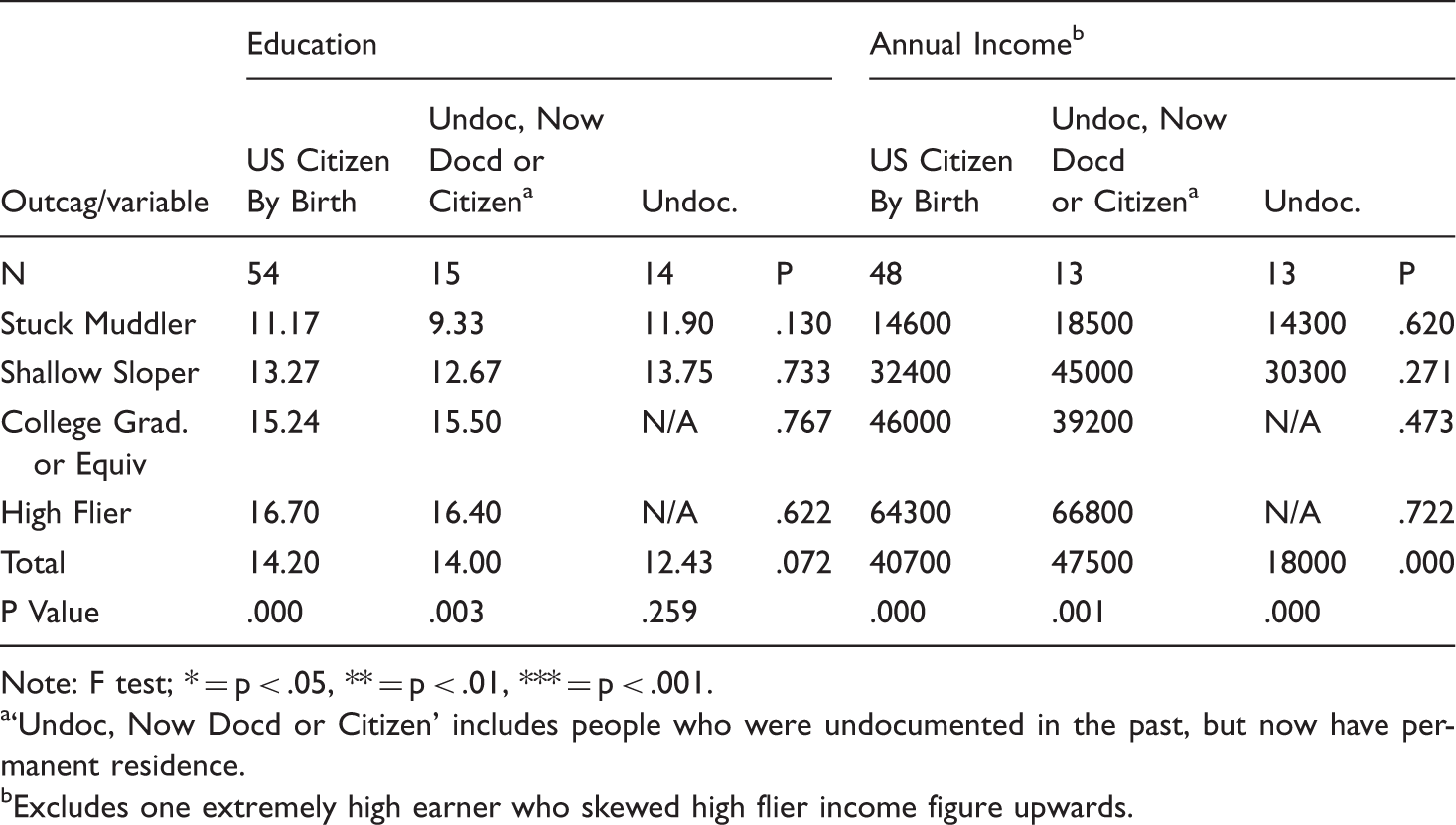
Note: F test; * = p < .05, ** = p < .01, *** = p < .001.
‘Undoc, Now Docd or Citizen’ includes people who were undocumented in the past, but now have permanent residence.
Excludes one extremely high earner who skewed high flier income figure upwards.
The four outcome categories in the table reflect research subjects’ various levels of achievement. High fliers go to competitive colleges or graduate school, or are self-employed, and make more money in career jobs. College graduates finish at least two years of college, and have jobs supporting middle-class lives in the long term. Shallow slopers jobs don’t offer careers or advancement, make less money and have less education (usually only high school), but have modest upward mobility compared to their parents. Stuck muddlers have mainly irregular work, made little money, and often had not finished high school. Educational attainment was a key variable determining financial outcomes for US citizens/permanent residents. But undocumented subjects gained no benefit from more college, being unable to get jobs commensurate with their educations.
This biographical analysis predicts Douglas Morales would have become a college graduate or high flier. With legal status gained via his wife, Douglas Morales’s exceptional discipline, likeability, intelligence, and personal habits would have promoted very high achievement.
Conclusion
This article offers a sociological autopsy of Douglas Morales’s life. Deploying strengths of ethnographic method – including repeated interactions and interviews, use of documentary evidence in discussion, and interaction between survivors – it does public, applied sociological work, which secured a better settlement for Douglas’s family. It also illustrates how ethnography can posit a plausible, counterfactual alternative future to the apparently obvious one. The paper both establishes Douglas’s habits via a biographical, retrospective case analysis, and then comparatively extends that case into a plausible future using sociological and psychological research on youth achievement. This article gets its ‘hands dirty’ in an applied setting, illustrating ethnography’s utility. Such work helps sociology engage more with public life.
This paper also does broader public sociological work by showing the pervasive, perfidious effects of long-term undocumented status. In this litigation, Douglas’s accomplishments and promise would not have counted without a plausible route to legal status. Absent that route, his accomplishments would have been ‘invisible’ to the law (Winders, 2013; Delano, 2014), curtailing potential settlement. This point contributes to valuation theory by documenting how legal ‘master’ status trumps the personal habits and observed behavior of a person in evaluating their worth, even though legal status did not govern the expressed evaluation of his worth in his daily life by, for example, his former coaches, who were on the other side of the lawsuit. Douglas Morales had not ‘learned to be illegal’, to diminish his goals. Rather, he had learned how to succeed as a young, American student-athlete. But in death, as in the labor market, his legal status would have been the only important thing about him. It is morally imperative that America offer permanent legal status and a short road to citizenship to its youth lacking status.
Finally, Douglas’s case engages Zelizer’s work on balancing the sacred and profane in market transactions. The Moraleses felt they ‘sacralized’ their loss by rejecting Cliffside Park’s ‘go away’ money – pursuing a lawsuit forcing those in power to answer for and perhaps thus prevent future deaths of other people’s children. Adan felt he was keeping a rarified intra-family bargain. He described why he kept pursuing the case to a reporter after the first round of litigation: ‘I promised him,’ he said, ‘I will get to the bottom of this.’ He paused to wipe away tears. ‘You have to turn back to it, to think about it’, Morales said. ‘It’s your child. You have to’. ‘Nothing more can be done for my son’, he said. ‘But maybe more can be done for the safety of other kids.’ (Llorente and Roberts, 2010)
Pursuing the case led to a larger settlement, which they felt was a more just recognition of Douglas’s worth and also helped protect other children, retroactively giving meaning to their loss. Drawing on Zelizer, we can say they sacralized their loss by pursuing the case, and the pursuit became a ritual of mourning for them.
Footnotes
Declaration of Conflicting Interests
The author(s) declared no potential conflicts of interest with respect to the research, authorship, and/or publication of this article.
Funding
The author(s) received no financial support for the research, authorship, and/or publication of this article.
Note
Author biography
Statutes,cases and model jury charges
New Jersey’s Wrongful Death Act and Survival Statute (2002)
Chapter 8.43 A: Definition of Damages in Wrongful Death
Green v. Bittner, 81 NJ 1;424 A2d 201 (N.J. 1980)
Depositions,secondary sources and interviews
Adan Morales, Douglas Morales’s father
Norberta Garcia de Morales, Douglas’s mother
Wilbur Morales, Douglas’s brother
Kevin Aragon, Douglas’s friend
Johanna Herrera, Douglas’s girlfriend/fiancé
Carlos Turcios, Douglas’s friend.
Depositions and secondary sources
Sean Gadino, Cliffside Park High School, athletic trainer
John Renu, Cliffside Park High School, football coach
George Fabiano, Cliffside Park High School, principal
Interviews
Oscar Sanchez, Douglas Morales’s lawyer
Expert reports
Edward Mantell, PhD (plaintiff)
Sandra Gutierrez, MD (plaintiff)
Kirk Thibault, PhD (defense)
Michael Miello (defense)