







Abstract
Many ethnographers had to reconceptualize or withdraw from their fieldwork due to COVID-19. While the process of exiting the field has always interested ethnographers, the pandemic has spurred further thinking about the complexity of this element of the research process. This paper adds to the conversations around leaving a field site by unpacking the different situations that can trigger departure. Using data from our experience conducting ethnographic fieldwork before and during the pandemic to further our understanding of the complexity of exiting the field, we explore the concept of field collapsing events by elaborating on the differences between interruptions and disruptions. It is not the case that one form of stoppage has more weight, merit, or impact on an ethnographic project. Instead, we argue that to parse out the complexities of exiting the field, we must create more clarity around the kinds of exits that ethnographers experience.
Introduction
In early 2020, as the coronavirus initially surged, we witnessed a unique kind of pause. Among its many other consequences, the COVID-19 crisis rapidly reconfigured research work for many social scientists, for at least some period over the last 2 years. Many researchers in the field were required to alter their approaches, including making abrupt exits from their fieldsites. In turn, the accelerated impact of COVID changed the conditions in equally dramatic ways for the sites, individuals, and communities of focus for researchers. During this time, many research institutions rolled out guidelines that put a moratorium on in-person research. While these guidelines have since been revised (and re-revised), with most restrictions now lifted, the initial disruption of COVID-19 continues through its consequences. The global nature of the pandemic has since forced us to consider how the scale at which such a stoppage occurs affects social science research. In this paper, we parse out the complexities of exiting the field to open the conversation on the different scales of impact of these types of events. We focus on defining and unpacking the broad genre of exits from the field to distinguish between interruptions and disruptions to ethnographic work. We base our conceptualization of these distinct events on our own research experiences before and amidst the pandemic.
Now, as public health mandates continue to lift and lighten, research in person has become more possible. Still, the full return to field research remains complicated for both the researcher and the sites and subjects of research. In particular, ethnography, with its emphasis on participant observation and interviewing, was one of the last forms of research cleared by many institutional review boards (Parry, 2020). This pause on ethnographic research raises questions for ethnographers, particularly regarding the abrupt exit many researchers experienced if they were in the field in March of 2020. While the COVID-19 pandemic prompted these questions, they are distinctly related to long-standing issues in qualitative research, particularly regarding the high level of commitment in both time and body required by these methods. The consequences of the pandemic are likely to endure far beyond the crisis itself; we see this paper as taking stock to theorize anew about these issues, in the context of COVID-19, but for the broader future of ethnographic practice.
In the case of both authors, the pandemic triggered an unexpected exit from the field-as-we-knew-it. After this moment of disruption, we both were able to continue with our research. However, our paths forward depended on various factors, including how the pandemic impacted the subjects of our research, the geographic locations of our field sites, and the resources available to us and to those we researched. In the months since, while processing the meaning of this departure for our dissertation projects. 1 We looked to the literature for advice on how to move forward. We realized that many discussions of exiting the field did not capture our own experiences and missed the varied ways that exiting can occur.
This paper adds to the conversations around leaving the field by considering the different situations that can trigger departure. To engage with these distinctions, we explore the different ways ethnographers can experience an unplanned exit, identifying interruptions and disruptions as unique kinds of exits. The scale at which the event is experienced is the first critical dimension distinguishing an “interruption” from a “disruption.” These pressures can occur on both individual and collective scales. While both interruptions and disruptions can have huge impacts on individual researchers, it is vital to consider the differences between a micro-scale interruption and a macro-scale disruption. This matters not only for the impact on researchers, but, more importantly, for what it means for those ethnographers research, for how to ethically continue (or not continue) research in times of crisis, and how to assess the impact of these disruptions on the communities of study. The second critical dimension is the stability of the event’s consequences, that is, the extremity of its endurance, its ongoing-ness. Unlike an interruption, there is a permanence to disruption. An interruption has an end-point in its impact on whatever it intercedes on. Interruptions do not alter structures. They do not completely upset the state of the situation. They may be in and of themselves something interstitial or liminal that does require altered behaviors and perspectives, but they do not permanently alter whatever is or was ongoing. An interruption stops things from progressing as usual, but it does not change our definition of normal. In contrast, disruptions “reset” the world, for both researcher and researched, and this reset becomes part of a new set of calculations of the ethics of research, of the boundaries of the study, and of group or case under investigation.
This article illustrates the distinction between interruption and disruption using data from each of the author’s separate ethnographic projects, drawing explicitly upon our combined notes from the (disrupted) field and the impact of COVID-19 on our ongoing work. We claim that rather than seeing COVID 19 as an interruption of fieldwork, it is a disruption. We also argue that disruptions and interruptions have fundamentally different characteristics for both researchers and the groups and individuals of study. Ward draws on her data from conducting 18+ months of ethnographic research with a group of young climate activists in a large Northeastern city. For Ward 2, it was not that these activists stopped what they were doing during the pandemic. Instead, what they were doing and, as a result, what she was doing-fundamentally changed. The change brought on by COVID-19 raised a series of questions and concerns around ethics, research design, and timing that always exist during ethnographic work, but the context of a pandemic shone a spotlight on them. In conversation with Ward, Leonard draws on her comparative, multi-sited study of activists and service-providers in the intimate partner violence movement fields of Boston, USA, and Buenos Aires, Argentina. In Argentina in March 2020, Leonard went abruptly from participating in mass events in the field, like the international women’s strike in the Plaza de Congreso in Buenos Aires on Monday, March 9, to leaving the field and returning to the United States by Saturday, March 14 in response to rapidly changing travel and public health policies. As the work continued, she found, like Ward, that it was not that those she studied stopped doing their work, but that the work itself changed, and thereby so too did the ethnographic field site(s). From their combined experiences of continuing qualitative research throughout 2020–2021, the authors have arrived at this distinction between interruption and disruption as intervening events in the practice of ethnography.
Ethnography as immersion
This paper emphasizes the complex and multifaceted process of ethnography by drawing attention to the role of field exit events like interruptions or disruptions. We argue that disruptions, including pandemics like COVID-19, but also other collective events like war, terrorist attacks, or natural disasters, impact the overall trajectory of an ethnographic research project in ways distinct from other cases of exit or interruption. The theorization of disruptions as necessary parts of the relational and interactional social order – indeed, as crafted exchanges that are evident of cultural skills – is increasingly the subject of sociological theorization (Tavory and Fine, 2020). However, before further exploring these destinctions between disruptions and other forms of interruption, we explore the meaning of ethnography and “the field.”
The question of what makes a project qualitative or ethnographic is somewhat contested. Recently, scholars in sociology have taken up a debate around the definition of qualitative research (Benzecry and Deener, 2021). Aspers and Corte (2019: 139) define qualitative research as “an iterative process in which improved understanding to the scientific community is achieved by making new significant distinctions resulting from getting closer to the phenomenon studied”. Well-known qualitative scholars like Small (2021), Lichterman (2021), Brown Saracino (2021), and Reich (2021) all responded to this definition with their own sets of questions and ideas about the prospect of defining the method. Perhaps unsurprisingly, these authors varied in their agreement with the singular definition of qualitative research proposed by Aspers and Corte. However, this debate is a reminder of the fluid, often contested nature of what makes a project “qualitative,” “quantitative,” or “mixed methods.” Contrary to those who might wish for a single, comprehensive definition, we find robust debates like these to be exciting indicators of the continued vitality, necessity, and creativity of qualitative social science research.
With Brown Saracino (2021), we agree with scholars who argue there are pitfalls to creating a standard definition, which may limit the potential of interdisciplinary work or our collective capacity for and openness to innovations in the field. As such, with Small (2021), we argue that continued dialogue about research methods, including such conversations about defining qualitative methods, is more important than any one definition itself. In the same vein as Stacey (1988) now classic question of “can be a truly feminist ethnography,” we argue that these questions about the methods we use and how to define them are more helpful in the discussions they raise than the answers they produce. These discussions, where scholars rigorously engage over what makes a project qualitative, are part of the reflexive process. These dialogues are part of the qualitative researcher’s mandate to continuously center attention on power in the process of their work. As Reich (2021) explains, such intimate connections between reflexivity and power are core considerations of the qualitative research process. By engaging in debate over the term’s meaning, taken for granted assumptions about what the work is are contested. Through such dialogues over definition and practice, qualitative scholars can be reflexive about the very method they are employing, not just their position in a field site.
The same thing can be said for creating boundaries around what makes a project ethnographic. One simple assumption behind ethnographic approaches is that certain questions require a fuller, embodied engagement with context than typically required or allowed for in other modes of social scientific investigation. It begins from the premise that the social world is complicated. Therefore, it is not always helpful or accurate to reduce it to countable variables or statistical relationships. Past this assumption, however, the way scholars define ethnography is quite varied. For example, Crang and Cook (2007: 35) define ethnography as “participant observation plus any other appropriate methods.” Looking at what drives ethnographic practice, Gerard Forsey (2010: 567) defines ethnography as “a formation of study aimed at understanding and explaining the cultural context of lived experience.” Timmermans and Tavory (2007: 469) instead define ethnography in terms of rapport, highlighting its ongoing processual nature and defining the central challenge of ethnography that it “is not about establishing rapport but about living rapport where every step one takes may preclude others.” Likewise, many feminist definitions of ethnography center power, relations, and process; for example, Davis and Craven (2011: 191) see feminist ethnography first and foremost as an intervention, arguing that it should counter “neoliberalism’s apolitical stance and its tendency toward reductive individualism and faulty dependence on objectivity.” Of course, feminist ethnography is part of a wider tradition of critical ethnography, reflective of efforts to refine and examine the power relations at the core of the research enterprise and to consider the impact and consequences of ethnography beyond scholastic production. The definition of ethnography is so elusive that it has led some scholars to claim, “That’s enough about ethnography!” (Ingold, 2014). We argue, similarly to the discussions about the definitions of qualitative research, that while there is no one singular definition of the term ethnography, engaging in discussion around this complexity makes for a more rigorous, reflexive method.
We find it helpful to describe the logic of ethnography as a logic of immersion (Geertz, 1973; Lewis and Russell, 2011; Sanford and Angel-Ajani, 2006). By immersion, we mean an engaged, extended embedding of the self in the site of interest. The actual practice of ethnographic immersion, of course, is widely varied. From global ethnography (Buroway et al., 2000; Gille and Riain, 2002), to visual ethnography (Schwartz, 1989), to digital ethnography, what it means to be immersed in a site can look quite different. In the ideal-type form of ethnography, we might think of Geertz (1973) living in Bali for years at a time, or even Benedict’s (1946) fieldwork in southwestern California. More familiar to sociologists might be Burawoy’s (1979) institutional ethnography of a Chicago factory or Hochschild’s (1985) ethnography of labor and emotions. While it might never be perfectly achieved in actual practice, becoming Simmel’s (1950) stranger accepted, or the outsider inside, is still the mark of the ethnographer. Ethnographers might center their work in one field site or, based on the case, might instead be engaged across multiple sites for reasons of comparison, the study of a field, or other motivations.
Here, we must be clear about what makes up a fieldsite and what it means that this immersion we focus on is expected to occur “in the field.” The concept of “the field” – and the practice of being “in the field” – is central to ethnographic practice. As with the definition of ethnography itself, the definition of what the field is and what it means to be in the field has evolved with changes, in theory, technology, and methodological techniques (Burawoy et al., 2000). Most simply, the field can be defined as the time/space in which the researcher is actively engaged in data collection. In their edited volume, Gupta and Ferguson (1997) made an essential corrective to the way scholars talked about what makes up the “field” and a “fieldsite,” drawing their reader’s attention to the ways unexplored assumptions about these concepts can lead to a limited vision of what ethnography can be and reinforce these problematic distinctions between “home” and “away.” As Gupta and Ferguson (1997: 13) claim, “The image of arriving in “another world” whose difference is enacted in the descriptions that follow, tends to minimize, if not make invisible, the multiple ways in which colonialism, imperialism, missionization, multinational capital, global cultural flows, and travel bind these spaces together.” In their collaborative work on the development of global ethnography, Burawoy et al. (2000), likewise assert that with ethnographers’ sensitivity to process, historical and geographical context, and local-global relations, the field site is always already in relation to the broader social world.
In many ways, the idea that ethnographers must go “away” to study one specific community for an extended time and then return “home” to write up their findings is antiquated. This binary distinction between “away” and “home” is rarely – and certainly not unproblematically – so true in practice. Indeed, with our evolving theories of the transnational and postcolonial, it is suspect that the distinction between home/away was never so solid (Bhambra, 2007). Today, many scholars conduct their ethnographic fieldwork entirely online (Pink et al., 2015). This shift towards digital ethnography brings up additional questions about how we define “the field.” Stellmach reminds us that “boundaries between the physical and the conceptual, what is and is not the field, have always been recognized as permeable. Digital communications, social media in particular, have further blurred the space between field and not-field” (Stellmach, 2020: 5). What it means to be “in the field” or doing fieldwork is in practice much more diverse and complex.
We do think it is worth noting, however, that many graduate students are taught methods within the narrow framework that an ethnographic dissertation project involves going “elsewhere” to complete fieldwork over a long duration, with the expectation that they will enter the field at some point, and exit sometime later. While field sites may, in fact, not be geographically or socially very distant, they are nevertheless constructed as “elsewhere”. For ethnographers, “being in the field” comes to signify being in another time/space even if the group or case of study is in fact in the same town or city in which the researcher lives. For example, Ward conducted fieldwork in the city in which she lived, yet made internal distinctions between when she was “in the field” and when she was not. She didn’t consider her local coffee shop “the field” when she went there on Saturday for a latte with her partner, but she did when she went there to conduct an interview with an activist. “The field”, then, is defined relationally; this is more often discussed in terms of positionality to examine the relations of power between researchers and the individuals and groups they study. Defining the field relationally, however, also clarifies how the time/space of the field is constructed through these relations, such that the ethnographer goes elsewhere when “in the field” even when the site is in other relational conditions not part of the field. In this way, spaces familiar, close to home, virtual, and etc. may also become the “elsewhere” of the fieldsite.
As made clear in the examples above, in practice, most people’s experience conducting fieldwork does not mirror a linear process of going “away” and then returning “home”, yet this construct of what fieldwork should look like often lingers in the background of our methodological training and discussions. And while those expectations are not law, they heavily influence the kinds of ethnographic work produced, especially by junior scholars. For this reason, and in fact because of it, we argue that scholars need to take the same care in defining what it means to leave the field as they do when defining fieldwork itself.
While we would like to challenge the binary construct of here/elsewhere and entry/exit in our analysis of field disruptions, we do focus here specifically on the exits from the field. Researchers have long documented the challenges of exiting the field (Batty, 2020; Morrison et al., 2012; Rupp and Taylor, 2011; Smith and Atkinson, 2017; Watts, 2008). Many of these studies assume a spectrum of choice regarding when a researcher exits the field. Others have documented various instances in which individual ethnographers have left the field for reasons other than a planned exit, such as sexual harassment (Kloß, 2016) or war and conflict (Caton, 2006). We argue that to better understand the different kinds of exits ethnographers can experience while in the field, there needs to be more analytical clarity around these distinctions. To clarify this, we distinguish between interruptions and disruptions as distinct experiences of exiting the field.
Just as ethnography is premised on a logic of immersion, it is consequentially concerned with disruption. However, the usual concern is how ethnographers disrupt their subject-participants and sites. This reflects ethnographers’ sensitivity to power relations and processes and our pursuit of ethical research engagements. We should first and foremost be concerned with how the scientist can alleviate the negative impact of their work and presence on the field. Nevertheless, two points may seem obvious but bear further discussion. First, not all disruption is negative. Second, not all disruption is caused by the individual ethnographer. This second point – when disruption happens to the ethnographer rather than by the ethnographer – has been made dramatically clear through the impact of COVID-19 on qualitative field research.
Field exits: Impacts on researchers and researched
While many scholars in conversation and writing discuss entering and exiting the field, the idea that this happens in terms of a simple entrance and exit is a somewhat reductive way of conceptualizing the process of ethnography. Anyone who has conducted fieldwork knows that it is very rarely linear. Instead, there are often a series of events and interactions that shape the entire experience. Acknowledging this complexity is essential when trying to understand the process of ethnography.
Rather than defining the events of ethnography simply in terms of entry or exit, we propose a fuller definition of the ethnographic process. The ethnographic process involves a series of field collapsing and field expanding events that may occur in variable sequences unique to individual research sites and projects. We define field expanding events as moments that bring the researcher deeper into the field site, thicken their connections to the site and their informants, and/or broaden the field. These events include what is typically understood as entry to the field site and other moments such as establishing the first connection with an informant or conducting an interview. In contrast, we define field collapsing events as those moments in which the researcher loses contact with the field site and their informants, the field narrows or disappears, and/or the researcher leaves the field. Field collapsing events include the standard event of exiting the field, but also other moments like losing an informant, policy changes that disrupt the researchers' access to the field, and, of course, a pandemic. Ethnography is accomplished through this whole spectrum of expanding to collapsing events, with these types of events varying in size, import, duration, and scope.
When exploring the experiences of qualitative research, the focus is usually on the individual researcher and their field site. While the impacts of race (Brown, 2018), gender (Gowan, 2010), age, and sexuality (Pascoe, 2011) on both the reflexive production of knowledge and the embodied vulnerability of the researcher have been documented, less attention has been paid to how large scale, global events can also impact an ethnographer’s time in the field. More importantly, scholars have yet to consider the unique impacts that different kinds of exits can have on the researchers, their research, and the groups and individuals of study and collaboration.
Recently, Tavory and Fine (2020: 366) have theorized disruption insofar as the microsociology of the social interaction order, arguing that attention to the relationship between disruption and alignment is the necessary next step for connecting the sociology of culture with the micro-sociology of interaction. Drawing primarily on Goffman’s (1959) dramaturgical approach, they define disruptions as “perceived misalignment of the dramaturgical structure of interaction in coordinating expected lines of action” (2020: 366). While these scholars are focused on the role of disruption in interactional exchanges, they argue that understanding disruption is necessary for further theorizing the connections between these micro-level patterns and meso-level analyses of relational (and even structural) orders (382). Although largely uncredited by Tavory and Fine, these insights build on the insights of feminist scholars of family and kinship into the dynamics of reciprocity (Nelson, 2000; Stack and Burton, 1993), specifically in the unequal distribution and organization of power through relational ties and social interactions. Yet, Tavory and Fine’s insights into the central significance of disruption to interactional and relational sociology are an essential new direction for theorizing cultural sociology. In this exploration of disruptions and exits in the context of doing ethnography, we likewise underscore how disruptions are socialy patterned and may foce “a rethinking of situations and relations” (Tavory and Fine, 2020: 372).
The event of the field exit, whether interruption or disruption, deserves the same fine-grained analysis that ethnographers give to the rest of their work. This paper focuses on field exits from ethnographic work and their consequences for both researchers and the groups and individuals with whom they research and collaborate. Interruptions are a common occurrence in ethnographic research. They are a part of being fully immersed in a fieldsite, where the researcher’s own life bleeds into the days, weeks, months, or years spent participating and observing. They may consist of everything from the mundane exit at the end of a project to the more traumatic experience of individual illness or accident. These individual, more temporally and spatially bound events sit in contrast to what we understand as disruptions. The disruption event is collective and more enduring in its scope and consequences for the field site and the field researcher. Drawing from our own experiences doing ethnography between 2019 and 2021, we examine the COVID-19 pandemic as a disruption.
Interruptions
All ethnographic projects will include interruptions as field exit events - these are the common events that pause, end, and intersperse the work of qualitative data collection. They are defined as (1) being individual in scope; (2) primarily imposed by internal and smaller-scale impositions; and (3) being non-malignant or contained in their impact on the researcher and with relatively little impact on the field site itself. As they are common, even anticipatable, qualitative researchers have always had to deal with interruptions in the field. These interruptions often go unnamed and unrecognized. During fieldwork, researchers have babies, get married, start a new job, or experience the death of a family member. All of these interruptions alter the researcher’s world and necessitate a moment for pause. Sometimes these interruptions are temporary; sometimes, they end the project altogether.
Three dimensions of field exit events.
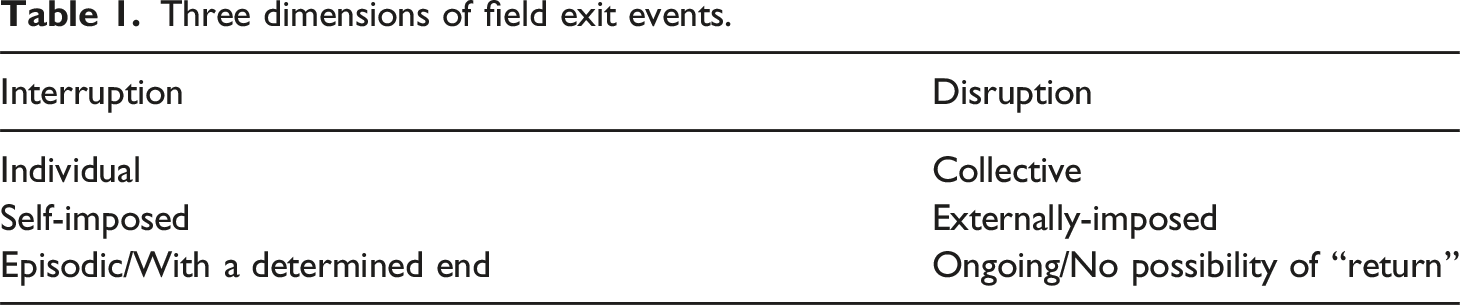
However, the distinction between interruptions and disruptions goes beyond self-imposed versus non-self-imposed, or, put another way, beyond internally and externally shaped events. While this is one factor in shaping these two forms of field exit events, the difference is found in the overlapping of these three dimensions (see Table 1). The most critical factor in the evolution of an interruption into a disruption is the third component. While the first two factors are primarily imposed upon the researcher, the final aspect of the duration of the event is also imposed upon the field site itself.
Ethnographers experience interruptions all the time, but they are often minimally examined or considered part of the fieldwork process. For example, the interruption of a wished-for pregnancy, a planned switch between field sites in a multi-site study, and the temporary loss of funding might all be interruptions. Interruptions can vary in the extremity of their consequences. They can vary in the degree to which the researcher feels they have some control over their scope or duration, and they can involve collective events in their articulation. We acknowledge that ethnographers are rarely doing uninterrupted research for weeks at a time. Even in a fully immersive field site, there are still moments of interruption where ethnographers take off their “researcher hat”. As we discussed above, these are relationally defined and constructed through the ethnographers’ relations to the actors and space of the field site.
Not all interruptions go unnoticed, however. Some alter the researcher’s plans, and others shift the project altogether. For example, to illustrate the individual character of an interruption, we draw upon Annette Lareau’s well-known scholarship detailing the impacts of race and class on the lives of children and their parents. In her methodological appendix, Lareau describes some of the challenges she had recruiting participants to take part in her study (Lareau, 2003). This experience is something familiar to many ethnographers. Detailing the successes and failures she experienced while recruiting, Larueau says, “I found the process of recruiting the families very stressful... Before making the telephone calls, I would pace the floor anxiously and my heart would pound. Even when I had cleared that first hurdle, I continued to find the first encounters to secure written permission and to schedule the home visits scary...Of course, no matter how persuasively I made my case, not all families agreed to participate. Some, in turning me down, explained, “We are not the perfect family” (2003: 351). This common experience of a subject turning down participation is a clear and relatable example of an interruption.
Ethnographers put time and energy into building relationships and recruiting participants. When one of those relationships ends because a person is no longer interested in being a part of the study, that is an example of an often momentary interruption. It is not that there are no longer any possible subjects to observe or interview, but that the loss of one relationship can interrupt the flow of the project. Much like Lareau, in their study of the Swedish judiciary, Bergman Blix and Wettergren (2015) detail the emotional labor involved with fieldwork and explore the disappointment they experienced after gaining access to a field site, only to have that access quickly revoked. Again, this particular experience of losing access to the fieldsite illustrates that the site disappeared on an individual level, making it a prime example of an interruption.
Second, an example of an interruption to fieldwork that demonstrates its self-imposed character is in the classic urban ethnography, Sidewalk (1999). Mitch Duneier’s experiences exiting the field are a clear example of the self-imposed nature of the interruption event. In the evolution of his project, what he initially understood as the conclusion of the research - and what produced a first draft of one version of the book - ultimately became an interruption, leading to a continuation and deepening of the field research. Upon his reflection on that first phase of research and in conversation (and co-teaching) with his key informant, Hakim, Duneier returned to the field, embedding himself into the site as observer-participant in the street vending of Sixth Avenue. What initially started as full removal from his field site ended up being a temporary interruption in the overall progress of the project.
Finally, we draw from Leonard’s current research to illustrate an example of an interruption that demonstrates its episodic character. Leonard deliberately incorporated interruptions into the design of her project. She planned to divide time between her multiple sites of Boston and Buenos Aires, organizing this schedule around the annual calendar of activities and mobilizations of each case. She began her fieldwork by entering the field in Boston in June, when an annual coalitional event occurs, but then spent a month in Buenos Aires in July. This initial shifting between cases threw both into relief, clarifying points of comparison. Leonard next spent 3 months in Boston to capture certain events within that field’s calendar and take advantage of interview participants’ availability, before returning to Buenos Aires for an extended immersion in that field, planned around its rhythms. These interruptions - planned, strategic, and reflective of the fields - were part of the research design. This self-imposed and individually-experienced shift between cases certainly shaped her experience of each site, but it was not the product of a collective experience or dramatic changes to the field itself.
This is categorically distinct from Leonard’s experience of the disruption to her field sites in March 2020 due to the COVID-19 pandemic. As we will detail further below in our discussion of the field collapsing event of disruption, her exit from the field in Argentina was abruptly created by external conditions that had collective consequences and transformed the field site and subject itself. Likewise, Ward’s exit from the field in Boston in March 2020 shared these characteristics, which we define as the key factors distinguishing between interruptions and disruptions as field collapsing events. Now, we turn to a discussion of disruption as a distinct event in the practice of ethnography, less common than interruptions, and more permanent in its impact.
Disruptions
So what is disruption in this sense? A disruption is an event or an action that prevents something – another event, action, or process – from continuing as normal or as expected. It could also be named as a derangement, a dislocation, disturbance, an upset, or the unbalancing of the world as it is expected to be. Innovation in business sometimes is euphemistically called a disruption, and such unsettlings of the status quo can undoubtedly be moments of creativity or positive resilience. Whether positive or negative, disruption implies a sense of “no return,” whether that is literal, in the sense that whatever existed previously can not be recuperated or revisited, or in a metaphorical sense, in that the previous state of conditions will never again exist “as they were”. When disruption takes the form of physical removal from a site, it can have a doubled effect on the qualitative researcher. First, there is the apparent impact of the unplanned absence from the site. Second, the site itself disappears, not just to the researcher but to all parties involved. This second effect is of most significance for what it means for how we think about the “doing” of ethnography and the living impact on the communities and sites of research.
When the “doing of ethnography” is disrupted, the work itself is transformed. Our fine-grained analysis of disruption unpacks the multiple facets of disruptions to examine the multiple pathways of those transformations. First, as we discuss in our reflections on the personal impacts of COVID-19 on our dissertation field research, disruptions have consequences for the researchers. The degree and significance of these consequences vary with the social location of the ethnographer, including career stage, as well as gender, race, class, sexuality, and disability. This transforms the project in ways that directly and dramatically alter the course of the researcher through the work. But with these disruptions of the researcher also come transformations of the researched,2 in ways that remake the project anew. It is not just that an event or a moment of crisis occurs during the period of research – there will likely always be some significant event, turning point, moment of crisis, or contention in any time period – but that between the “before” and the “after,” the landscape of the field fundamentally shifts. The challenge for the ethnographer arises in managing the individual consequences of this shift while also simultaneously navigating the continuation of their participant-observation through these changes for the researched.
The COVID 19 pandemic serves as a reminder that, in addition to micro-scale interruptions, macro-scale disruptions can also have an enormous impact on a researcher and their access to a field site. Disruptions occur on a distinctly large scale. An interruption can cause a fieldsite to disappear, but the effects of that disappearance are primarily contained to the individual researcher and perhaps the design of their project. The site continues on, just out of reach. With a disruption, the site can disappear or transform, not just to the researcher, but in its entirety, at least in how it had existed before. This distinction is essential, as it reminds us that not all field collapsing events have the same impacts.
This can potentially be an exciting moment for the research – but also simultaneously a tragic, stressful, and dangerous one – and for everyone involved in the fieldsite. For the ethnographer, it might be an opportunity to collect a unique and historical data set. As the authors reflect from their own data – and this is a reflection of the particular vulnerability of early-career scholars – this might also threaten the completion of the project in ways that alter the ethnographer’s professional and personal life courses. For the fieldsite and the group of study, their work changes too. What does the ethnographer do in the case of such disruption to the site and the group? Furthermore, how does this change the definition of the object of study in the continuation of the project? The world shifts – and the fieldsite and its actors shift with it. For example, in Gould’s (2009) ethnography of ACT UP and the role of emotion in contentious politics, the onset of the AIDS crisis completely reset the stage and priorities for the queer rights movement. With this disruptive event, new political opportunities and discourses were not only possible, but they were necessary in literally life-dependent ways. Gould’s research participants were transformed by their participation in the movement; but first, they were transformed by the impact of HIV/AIDS on their bodies, their communities, and their individual and collective identities. Another example – and not of a pandemic – is of Vaughan’s (1996) historical ethnography of the 1986 Space Shuttle Challenger disaster. In this case, Vaughan was, in fact, able to return to the site – an example of one type of Burawoy’s (1979, 2003) “ethnographic revisits” – because this was a historical ethnographic venture. Yet, in part, what attracted her attention was the nature of the case, which was fundamentally a disruption, and that it had upset the state of affairs for those she ended up studying in this project. In this case, Vaughan began with the foreknowledge of the disruption, with both the event and its transformative consequences already within view, if not already understood. But what of the researcher’s and researched’s experiences when they live together through a disruption, unexpected in its event and its consequences, its “eventfulness”? 3
In contrast, the authors and those they are researching lived through the disruption of COVID-19, an event that was experienced as simultaneously abrupt and ongoing, unexpected and enduring. As documented by the two authors in their fieldnotes, both field sites remained active and engaged right up until the middle of March. Both ethnographers remained in the field and observed the shift in their field sites occur. In the case of Leonard the activists she was studying went from protesting on the streets to experiencing a nationwide lockdown in a matter of days. As she documents: On Monday, March 9, I participated in the events of the international women’s strike in the Plaza de Congreso in Buenos Aires. On that day, there were fewer than twenty confirmed cases of Covid-19 in Argentina. One sign stated, “la violencia machista es epidemia y no hay barbijo que nos proteja” (sexist violence is an epidemic and there are no masks that can protect us from it). I observed others that framed gender violence and Argentina’s national debt against the pandemic of the coronavirus, making visible the prevalence, lethality, and long-term reality of gender violence. I had two interviews scheduled for the next week and leads on scheduling more during March.
As detailed above, Leonard had a series of upcoming interviews, and she intended to be in Argentina until May–June 2020. At that time, she planned to return to the United States to continue fieldwork at her second field site in Boston. Instead, COVID-19 disrupted and upended her fieldwork in both cities. This large-scale disruption was felt not only by Author 1 but by all the activists whom she had been observing. Over 2 weeks, activists went from protesting in the streets to organizing ruidazos from their porches, balconies, and kitchen windows in response to the unrelenting pattern of femicidios that continued even through the national quarantine in Argentina. The very fieldsite transformed, not only for Leonard but for all of those involved with activism and service provision in prevention of gender-based and intimate partner violence.
While Ward also observed her fieldsite shift and reconfigure, these changes looked a bit different. In her observation, Ward noted that her fieldsite fundamentally mutated as the activism she studied shifted on a movement-wide scale. Watching the fieldsite slowly transform, Ward writes: In March of 2020, on a local and national level, activists began to contemplate what Earth Day 2020 would look like in the context of COVID-19. Like many people, these activists were optimistic that things would go back to normal by April. However, in mid-March, they temporarily moved all activism online at the national level. They continued to plan for online and in-person events, but by mid-April, it was clear that there would be no in-person activities for Earth Day 2020. Like myself, the activists I studied were committed to continuing their work in whatever ways possible. They developed a complex and effective online system for training new and existing members. They held weekly zoom meetings ranging from online actions, trainings, and social gatherings. It was not that my activists stopped what they were doing during the pandemic. Instead, what they were doing and, as a result, what I was doing- fundamentally changed.
As this field memo notes, the collective transformation of norms and expectations around social gatherings resulted in changes to the very makeup of the fieldsite. The close-knit community of activists who were used to meeting in person to discuss, plan, socialize, and mobilize was now mandated to be entirely online. As a result, while Ward’s respondents were reconceptualizing what it meant to “do activism,” she was doing a similar reconfiguration around what it meant to be “in the field.” This initial ethnographic project that relied heavily on in-person participant observation was no longer possible. Ward was forced to reconfigure her understanding of fieldwork to adjust to this macro-scale shift to online activism. This simultaneous shift that impacts both researchers and respondents is what makes disruptions unique. While other field collapsing events can result in an ethnographic interruption, this process occurs only at the individual scale. It is not the case that both respondents and researchers are dealing with this collapse.
In the case of a disruption, the sheer scale of the transformation causes universal changes, not just around what is possible for the research project but also for the respondents. When experiencing the disappearance or transformation of a field site due to a large-scale disruption, researchers face unique questions that interruptions do not always trigger. While an interruption can be traumatic or involve risk to the physical and mental wellbeing of the researcher, the scale at which disruptions occur is more likely to require ethnographers to consider immediate questions of logistics, health, and physical safety, as well as the less tangible questions of ethics and reflexivity. Because disruptions happen at such a large scale, the disappearance of the fieldsite is often of secondary concern. In a field memo, Leonard documents her experiences dealing with the disruption of the COVID 19 pandemic: Over the course of that week, museums and cultural centers began to limit their hours and close exhibitions. I learned that several community and social movement events were now marked as postponed. Fairly late on the evening of Friday, March 13, I received an email alert from the U.S. Embassy in Buenos Aires notifying American citizens that Argentina had put in place travel restrictions that included flights to and from the United States. The last flight out to the U.S. would be on the morning of March 16. Fortunately, I was able to change my travel plans and leave on a flight Sunday evening/Monday morning. While I had about a day in which to finalize details regarding my apartment, travel details, etc., before leaving Buenos Aires, it still felt like an abrupt exit. In direct contrast to my slow slide into fieldwork, this abrupt departure happened within hours and days.
As this excerpt from Leonard’s field memo demonstrates, disruptions impact the ethnographer on multiple levels. They must make (sometimes rapid) decisions about the logistics of traveling, housing, and supplies, as they weigh their options for their physical and mental safety. This is different from an interruption because these decisions are happening at a collective level, simultaneously impacting both the research and their informants. Leonard was privy to how the pandemic abruptly altered individual plans, and she also observed the rapid changes wrought on the plans of the groups she observed. This included constraints on their actions and increased violence as a result of quarantines and diminishing resources, but also reimaginations of political action, such as virtual political lobbying or socially distanced protests from balconies, doorways, and rooftops.
While safety is often the first point of concern after a disruption, the ethics and logistics of continuing the project also prove to be unique. As the fieldsite disappeared and transformed, a new set of questions arose about the possibility of continuing the project. In the case of the climate activists, it was not initially clear how they would respond to COVID-19. While they took the virus seriously and went entirely online by mid-March, there was a time that their plans for the future were uncertain. While the disruption was quite abrupt, the aftershock lingered. Events were canceled, and meetings were moved online, but the remaining question was “for how long?”. Would these activists give up on a year-long plan to host massive Earth Day protests? As Ward notes in her field memo, it was difficult to know how to proceed. While the activists were navigating the pandemic and this new terrain for their activism, I negotiated a similar set of concerns regarding my research. If these activists went through with Earth Day in person, would I go as well? Should I continue to conduct in-person interviews? Where should I draw the line? How do I balance the need to finish my dissertation with safety concerns that have arisen from COVID-19?
While many of these questions were answered definitively as soon as the Institutional Review Board banned all in-person research, it does not mean the questions never existed or that they went away. With this ban came entirely new questions about how to proceed. Because the disruption caused a total transformation of both field sites, Leonard and Ward were confronted with challenging questions about the future of their dissertation. How does one pivot when the very conditions that were assumed to be stable throughout the data collection process are globally inverted? When a research design is based on the assumption that the ethnographer will be in person, how does one move forward? What are the ethical implications of continuing on? In the case of a disruption, finding a new field site is often not a truly viable solution. Because of the scope and the scale of disruption, researchers are forced to reconceptualize their project or stop data collection altogether. This element of disruption, where researchers are forced to navigate the ethics of continuing their research after this field collapsing event, is again unique because of the scale at which these disruptions occur.
As can be discerned from the excerpted field memos above, disruptions can bring about a particular set of challenges and questions distinct from other kinds of field collapsing events experienced by an ethnographer. Disruption can cause total disappearance or total transformation of the fieldsite. This disappearance or transformation is not only felt by the ethnographer or the individual. Instead, these shifts and changes occur at a large scale, uprooting not only the researcher and their project but the very function of the fieldsite to begin with. In addition, when these disruptions occur, researchers are faced with challenging questions about their own personal safety and the safety of their respondents, alongside ethical issues regarding the future of the project that can look fundamentally different from the questions that an interruption can raise. Again, in the case of disruption, the scale and scope of this field collapsing event has distinct impacts on the researcher, her collaborators, and her project.
Disruptions are distinct in the scale and duration of their impact not just for researchers, but for the field itself. These impacts obviously extend to the collective and individual actors who are members of the field; just as the field may be disappeared or transformed by disruptive events, so will the configuration of groups and the positions and possibilities of individuals within the site. For example, in both of the sites that Leonard was embedded, collective actors were required to reconfigure their modes of connecting with participants by shifting to virtual advocacy efforts. As one member of a policy organization reflected during a hastily reorganized virtual advocacy event, “thank you to [the organization] for intrepid leadership in moving forward with virtual advocacy during this public health crisis”. During the same event, it also became clear that the issue of concern had rapidly shifted in its scope and complication, as participants noted how intersecting crises of intimate partner violence, housing, and precarious employment were immediately impacted by the onset of the pandemic.
Likewise, for Ward, the way these young climate activists communicated and connected changed rapidly, Additionally, what these activists were doing fundamentally with the onset of the COVID-19 pandemic. While these activists were primarily concerned with climate change, they quickly realized that mobilizating around the climate crisis in the way they had been would no longer work as a result of this disruption. In meetings during April 2020, these activists cautioned against bringing up climate change at all, and pushed back against the narrative that COVID-19 was the Earth’s way of healing. In their “guide to organizing in COVID,” which was sent out to all movement participants in Spring 2020, these activists claim “COVID-19 has completely upended every aspect of our lives and world. It’s dramatically changed ou rmovement’s plans for the year, and the uncertain times have made it very challenging to set our long term strategy. What we do know is that COVID-19 and the government’s failed response are causing an unprecedented economic crisis, and in the next few years, there will be a long fight over what economic recovery will look like.” The disruption caused these young climate activists to reconsider their priorities, and instead of focusing on Earth Day 2020 as they had been intending to for years, they decided to mobilize around economic recovery that centered on the Green New Deal.
With such reconfigurations of the field for both individual and collective actors, ethnographers must be sensitive to the depth and extent of their impact on identities, networks, and resources both material and discursive for the members of the field site. While disruptions may force an ethnographer from the field unexpectedly and dramatically, they force the researched from their lives in truly life-changing and transformative ways. The disruption upsets the scene of their life and work, with consequences both potentially destructive and creative.
Ethnography as a labor of care
Exiting the field is a challenging process. It is also something that every ethnographer experiences at one point or another during their fieldwork. As a result, past scholarship has provided advice and validation for other researchers who are navigating this complicated element of the process of ethnographic research. This article argues that to engage fully with this part of ethnography, there needs to be more clarity around the different ways researchers can experience an exit. Just as important, with a renewed and refocused attention to field exits, we are better able to understand the impact on those we research and collaborate with in the field. For the authors, their experiences being in the field throughout the COVID-19 pandemic provided a unique vantage point for complicating the way ethnographers understand and write about exiting the field. As COVID-19 made clear, not all exits are planned. Some happen unexpectedly, others do not, and both may still vary in the range and duration of their consequences. To account for this, we have elaborated on the concept of a field exits to understand how they vary from interruptions to disruptions. We claim that while both interruptions and disruptions can be a challenging type of field exiting event to navigate, there are fundamental differences between these two kinds of experiences that need to be considered to fully understand the complexities of exiting the field. While COVID-19 served as a spotlight on these complexities, the implications of our dissection of exiting the field go far beyond the case of this pandemic.
Macro-scale disruptions can have an enormous impact on a researcher and her access to a field site and how this level of field collapsing event is fundamentally different from an interruption. Disruptions occur on a distinctly large scale and differ from interruptions along three dimensions. First, rather than a collective or field-wide episode, an interruption is an individual experience. Second, to some degree, an interruption is self-imposed by the researcher on the ethnographic work. Third, an interruption is a break in continuity, not a fracture of the field itself. While an interruption can undoubtedly vary in its extremity, duration, and consequences, it will end. In contrast, a disruption is experienced at the collective level, is externally imposed, and results in a total disappearance or transformation of the field itself. Through a disruption, the field site transforms, even disappears, with consequences that vary according to structures and relations of power and inequality, including race, gender, sexuality, citizenship, ability.
Although we focus here on field exits, we attempt to challenge through this elaboration the hard binary distinctions between exit/entrance, here/elsewhere, in/out of the field that are still present in much qualitative social scientific work. While these distinctions are to some degree necessary – and we also argue that part of learning to do ethnography is learning to navigate and define these tensions – they are ultimately relationally constructed through the process of doing ethnography. For both authors, as with so many other researchers, the pandemic triggered an unexpected exit from the field-as-we-knew-it. After this moment of disruption, we both were able to continue with our research. However, our paths forward depended on various factors, including how the pandemic impacted the subjects of our research, the geographic locations of our field sites, and the resources available to us and to those we researched. In both its impact on the researchers and the researched, our elaboration on field disruptions leads us to two distinct points for further dialogue and theorization by ethnographers.
First, the consequences of field exits for researchers vary tremendously depending on the positionality of the researchers. While this point may be obvious, it is worth unpacking and emphasizing to understand how the privilege of doing ethnography varies across axes of gender, race, sexuality, citizenship, health, and ability, as well as institutional membership (and the variance in material resources across institutions), career stage, caretaking responsibilities, and so many other factors. Doing social science is a privileged labor, regardless of method. Doing ethnography is an embodied practice that has been attractive to social scientists of otherwise marginalized or less visible identities precisely because it foregrounds and prioritizes identity and positionality as a source of knowledge. Yet, when we leave unexamined how such events like COVID-19 or other global disruptions impact the doing of research, we leave unexamined how to support this critical potential of ethnography. It matters who gets to do ethnography – whose embodied knowledge is privileged in the labor of analyzing the social world. Through our exploration of different forms of field exits, we aim to open a discussion of how the consequences of interruptions and disruptions vary based on the positionality of researchers. But this discussion doesn’t stop there; ultimately, it is in service of dialogue on how to support and foreground, rather than further marginalize, ethnographers of positionalities less visible in the academy.
Second, field disruptions, like pandemics, war, and natural disasters, also impact the individual and collective actors in the field. Again, this point should be obvious; also again, it bears repeating and unpacking, just as we’ve unpacked the difference between interruptions and disruptions. With disruptions, the field site is transformed – into something new, perhaps unrecognizable, or into something impossible, an absence where there once was a social space of action. While this has consequences for the researcher, its consequences for the researched are infinitely more personal and potentially enduring. As part of the work of attending to the details of power, ethnographers must consider how field disruptions may exacerbate vulnerabilities and inequalities. Yet, we must not stop there and instead also turn our analytic lens to comprehend how individual and collective actors shift their actions, identities, and systems of meaning in response to these transformations of the field.
On both points, we call for ethnographers to reflect on and further our conversations around leaving the field by considering the different situations that can trigger departure. Different scales of events have consequences that vary in duration and degree for both researchers and those with whom they research and collaborate. Disruptions, like COVID-19, transform the field, “resetting” our social worlds. With disruptions come new calculations of the ethics of research, of the boundaries of the study, and of group or case under investigation. Part of our collective work as ethnographers must include dialogue over the impact of field interruptions and disruptions for researchers, field sites, and our research partners and participants.
Footnotes
Declaration of Conflicting Interests
The author(s) declared no potential conflicts of interest with respect to the research, authorship, and/or publication of this article.
Funding
The author(s) received no financial support for the research, authorship, and/or publication of this article.
