







Abstract
Drawing upon an ethnographic study of guided tours in Svalbard, in this article I explore how is the wilderness enacted as a situational and contextual outcome of more-then-human relations, emerging from engagements with the environment. As the engagements during the guided tours contest the often expected ‘purity’ of wilderness, I further investigate in detail when and how nature-culture dichotomy is both contested and re-produced in the enactment of wilderness. I argue that the nature-culture dichotomy constituting wilderness on Svalbard shifts from the idea of human-less nature to life in harmony with nature in which some human traces are present. This dichotomy then emerges from more-than-human relations. Further, I show that the character of wilderness is also emerging from different situations and contexts, where temporality, knowledge and dependency on self or others influence the engagements and more-than-human relations.
Introduction
“Untouched: We are in the heart of Mother Nature. And it is rough, magnificent and always present no matter what time of year you visit us. In the small, but vibrant Longyearbyen, there is always life and spacious hospitality, while the pristine wilderness offers unique nature experiences.” (Basecamp Explorer; tour operator on Svalbard)
Coming to Svalbard for the first time, one is struck by notions of wilderness as pure, raw, pristine and untouched Arctic nature. The tourist is welcomed to an exhilarating frozen experience in a timeless but disappearing world. Both research (e.g., Enger, 2018; Kaltenborn, 1998) and the archipelago’s rapid rise in tourism suggest that the promotional campaigns depicting Svalbard environment as wilderness have been successful. The wilderness as pristine and untouched nature is visible in brochures and other tourism advertisements as well as in research on the values of Svalbard inhabitants and the motivations of Svalbard tourists (Enger, 2018; Kaltenborn, 1998; Radovanovic, 2011; Saville, 2022).
Indeed, compared to what ‘European urban dwellers’ are generally used to in their everyday lives, human traces are scarce in the Svalbard environment (setting aside the Anthropocene discourse acknowledging the impossibility of an ‘untouched’ nature – see e.g., (Steffen et al., 2011). However, while on guided tours, tourists engage with an environment far more complex than ‘pristine nature’ as they encounter remnants of past human activities and become familiar with Svalbard history, in which humans have participated for the last four hundred years 1 . The purity of the wilderness present in Svalbard’s tourism presentations and marketing is necessarily contested on-site, in practice of guided tours.
In this paper, I explore how the wilderness is enacted as a situational and contextual outcome of more-then-human relations, emerging from engagements with the environment. As the engagements contest the ‘purity’ of wilderness, I further investigate in detail when and how the nature-culture dichotomy in the enactment of wilderness is contested or re-produced. As the ways in which humans and nonhumans interact and create worlds around them can be best understood by studying specific moments of engagement (de Castro, 2015; Kohn, 2013), this study is based on an ethnographic study of guided tours on Svalbard. Guided tours 2 then provide these specific moments of engagements, such as encountering the remnants of the past human activities in which the wilderness is enacted. Such context then emphasizes the need of understanding different enactments of wilderness in different geographical, social and cultural backgrounds and adds to the scarce literature examining such enactment in ‘Western’ context.
Svalbard as wilderness destination
Tourism on Svalbard has a long history, but it grew rapidly since 1990s, when life started to change on the archipelago 3 . The development of tourism is co-created with a governmental focus on developing a post-mining industry, and environmental protection on Svalbard, established with the 1920s Svalbard Treaty and strengthened by the 2011 Svalbard Environmental Protection Act. This act aimed to ‘preserve a virtually untouched environment in Svalbard with respect to continuous areas of wilderness, landscape, flora, fauna and cultural heritage’ (Norway, 2002: Chapter 1, Section 1). The tourism industry aims to be a ‘sustainable destination’ with nature-based activities as its main orientation (Andersen, 2022; Hovelsrud et al., 2021; Ren, 2009). Accordingly, the industry produces an environment suitable for the (nature-based) type of tourism (cf. (Rantala, 2010).
The guided tours are meant to allow one to experience the Svalbard environment free of humans and full of vast landscapes with wild animals. Svalbard’s marketing and public presentations are most notable for their enactment of the environment into a wilderness that is ‘pure’, ‘real’, ‘untouched’ and/or ‘untamed’. This is in accordance with the collectively shared imaginaries and practices of nature that is separated from or purified of the social 4 (for the practice of purification, see Latour, 2005). Wilderness is then a very significant tourist attraction on Svalbard (Enger, 2018; Kaltenborn, 1998; Radovanovic, 2011; Saville, 2022) 5 .
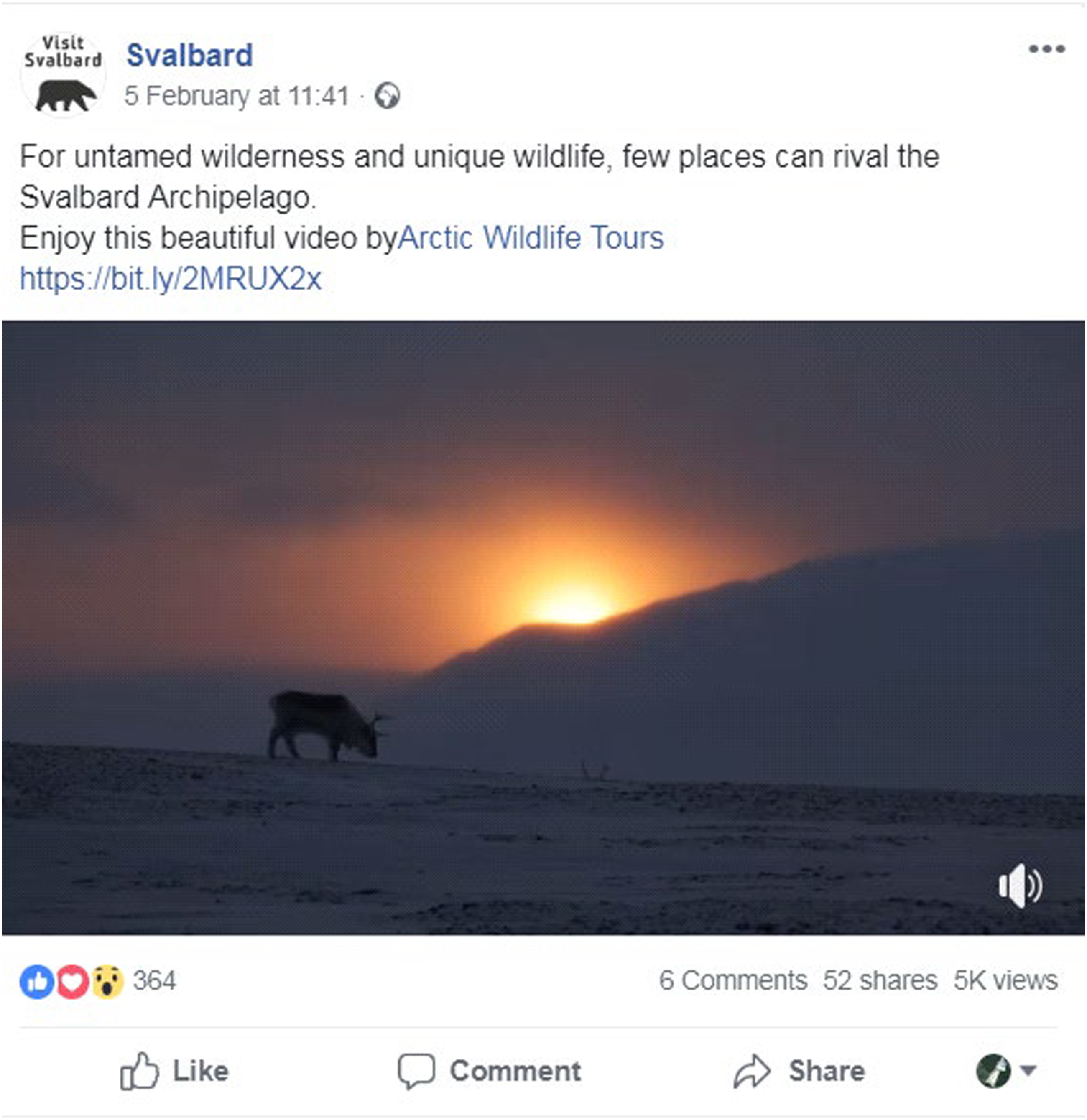
In the presentations of Visit Svalbard, the official tourism board, the archipelago is described as the ‘real Arctic’ and ‘located on top of the world’, containing ‘endless areas of unspoiled, raw Arctic wilderness’. Furthermore, the presentations promote the possibility of experiencing ‘tranquillity that is virtually unrivalled anywhere else on earth’ and supplied with ‘never-ending glaciers and rich animal life’ (Visit Svalbard, 2019; see Figure 1). These descriptions offer a grand vision of an unexplored landscape—a (time-)frozen, wild Eden—while rather neglecting both the human and natural history of the archipelago. Verbal descriptions are often complemented by videos or pictures of an ‘endless’ snowy landscape where wildlife such as reindeer, Arctic foxes and polar bears pass by (Figure 2), emphasizing the ‘untamed’ character of the land. This is in accordance with the romanticized and othered imaginary of the Arctic, simplifying the complexities of lived realities (Brode-Roger, 2021). Visit Svalbard, 2019. Visit Svalbard, 2019b.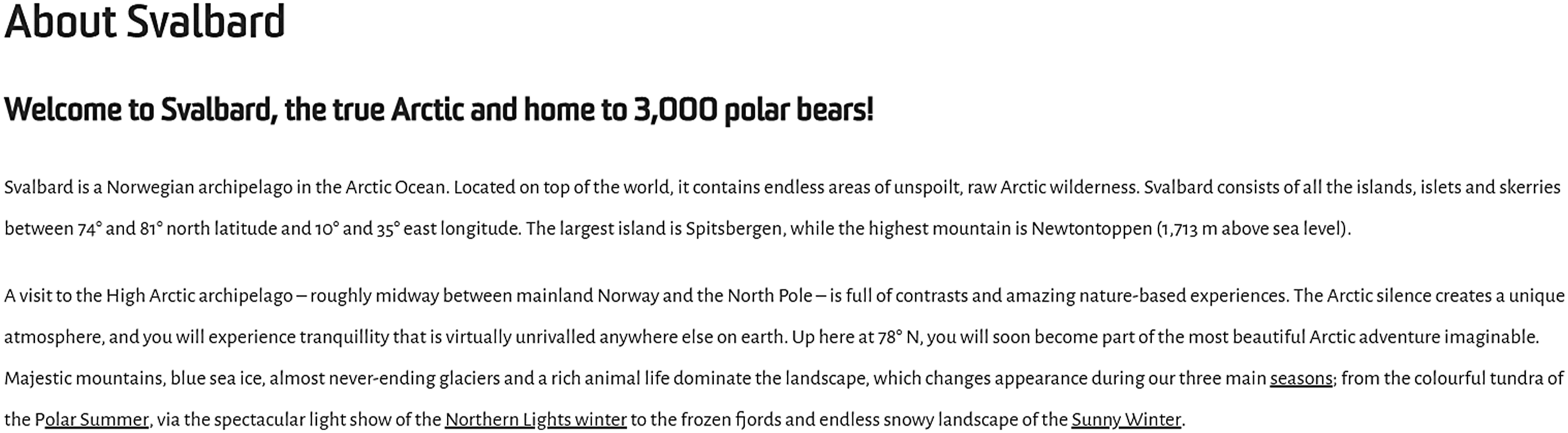
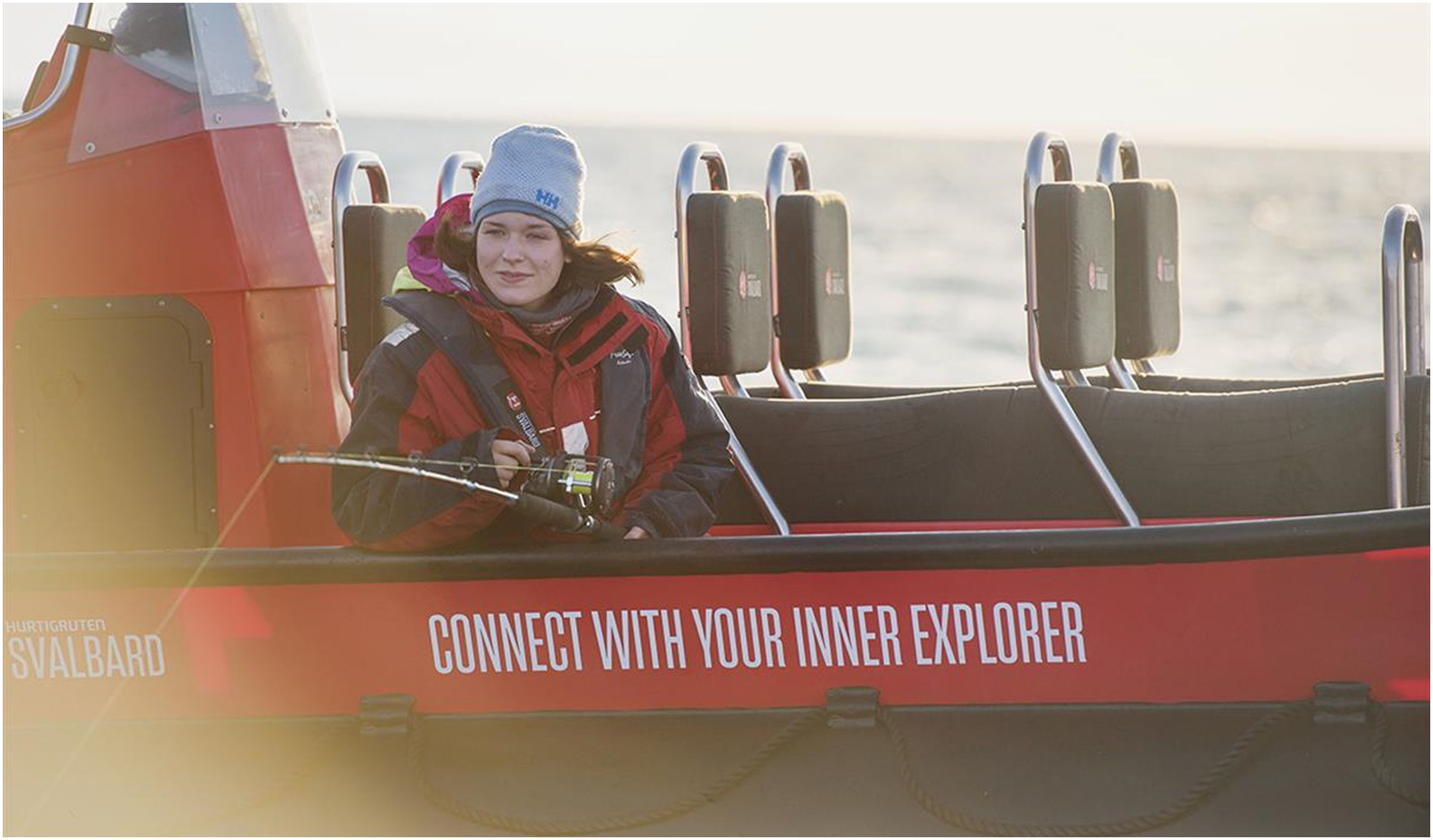
In the names or descriptions of the tours (Figure 3) the present humans are depicted only as visitors, looking at the landscape or ‘gliding over the snow, surrounded by silence’, in the otherwise human-less wilderness. Human traces such as a dog sledge, snowmobile or cabin are only there to provide comfort for the visitors so they can ‘connect with [their] inner explorer’ (Figure 4). Hurtigruten Svalbard, 2019, Svalbard wildlife expeditions 2019, Greendog Svalbard, 2019. Visit Svalbard, Sea fishing in the Arctic - Hurtigruten Svalbard. 2023.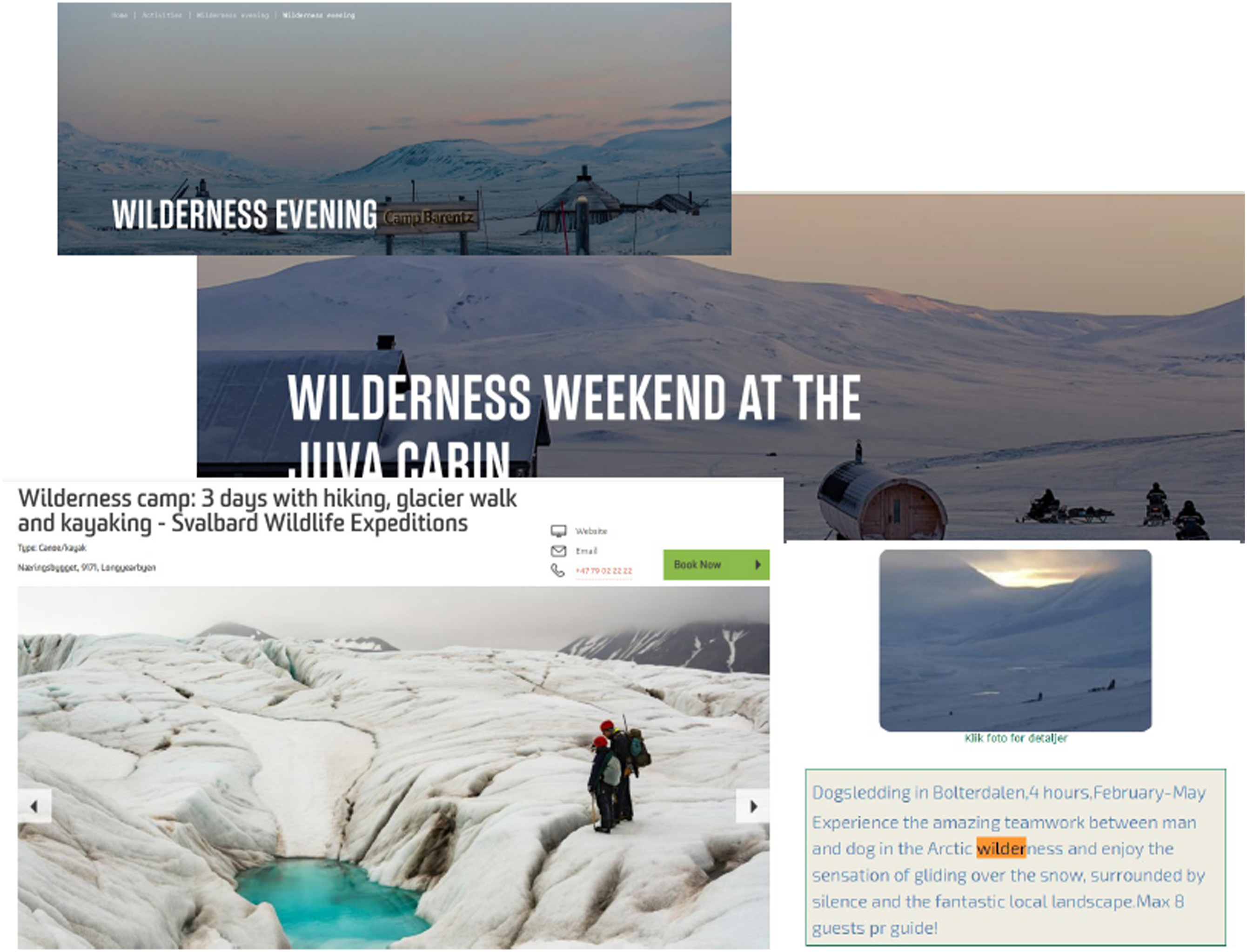
In these ‘pure’ wildernesses, the environment is rather static and homogenous, silencing the complex socio-material history of the environment and the relations within. The centuries of human activity on Svalbard (including whaling, hunting, trapping and mining) and the more or less related environmental dynamics (e.g., changes in the animal population, flora or geology as well as microplastics and other pollutants in the ocean, animals, soil and air) are what the wilderness is purified of in public presentations of Svalbard and its ‘raw’ and ‘untamed’ environment. Even though these human-related activities, past and present, are scarcer than in many other places, they are the very reason for the existence of tourism here—an essential part of the industry’s practices. Getting out of civilization, into the wild, requires a lot of civilization—not only the above-mentioned human history, marketing, global and local politics and economics and built-in infrastructure but also guides and guiding practices.
This tension between pristine wilderness in Svalbard’s tourism presentations and the present human traces, is negotiated in the practice of guided tours. Instead of discarding the concept of (pristine) wilderness, explaining it away as a mere outcome of ideas and thoughts detached from reality, or attempting to dialectically link the social thoughts and material environment, I follow theoretical understandings arguing for more-than-human relational perspectives in which the world is constituted in socio-material practices and processes. It is in this context that I explore the enactment of wilderness on Svalbard as a situational and contextual outcome of more-than-human relations, emerging from engagements with the environment.
Understanding wilderness beyond dichotomies
The theoretical shift to understanding wilderness in non-dualistic terms was preceded by discussions between socio-constructivist and materialist approaches to wilderness as a concept. As many authors have demonstrated, socio-historical development has significantly shaped the notion of wilderness as an untouched land (Belsky, 2000; Callicott and Nelson, 1998; Cronon, 1996; Goméz-Pompa and Kaus, 1992; Grant, 1998; Nash, 1982; Sæþórsdóttir et al., 2011; Tin et al., 2016). For example, Sæþórsdóttir et al. (2011) analyse how the notion of wilderness has developed in Iceland as well as the changes the concept has undergone, starting with the emergence of mythologies and mystic creatures; through the romantic movement, the Enlightenment and scientific reasoning; and, finally, wilderness as a tourist attraction. They claim that ‘the wilderness of Iceland is nowadays perhaps more a subjective and social idea than a reality in a natural science sense’ (Sæþórsdóttir et al., 2011: 269). According to the above-mentioned scholars, the notion of wilderness is socially constructed by ‘Western’ people and derived from romantic and Cartesian ways of thinking that separate nature from culture. The meaning of wilderness then changes through time and space and among different people, who give nature varying kinds of characters, thus forming what counts as a ‘wilderness’ (Saarinen, 2019; Sæþórsdóttir et al., 2011; Tin et al., 2016). The social constructivists’ understanding of wilderness thus focuses mainly on culturally embedded meanings and interpretations of nature and their contextual changes.
These theoretical understandings have led to an extensive debate. They have been criticized from the materialist or realist perspective for focusing ‘only’ on meanings and values while neglecting the material or physical characteristics of nature (Belsky, 2000). Criticism from the environmental perspective adds to this, arguing neglect of the value and importance of ‘pristine’ nature in and of itself (Callicott and Nelson, 1998; Crist, 2004; Nelson and Callicot, Baird J., 2008) or the value of the dichotomies themselves (Kopnina, 2016).
These debates highlight the issues of a dichotomic understanding of wilderness—either as an outcome of the social or the natural (physical). Several authors have attempted to move past the dichotomy by adopting both approaches (Belsky, 2000; Goméz-Pompa and Kaus, 1992; Kopnina, 2016). These pioneering efforts, although innovative and inspiring in many ways, have all employed the same strategy: to reconcile the social with the natural by dialectically linking them. For example, Belsky (2000) attempts to reflect on both the social constructivist and materialist perspectives, stating, ‘It is an important insight to recognize that while nature, indeed, has a physical reality, how we apprehend that reality never occurs outside a social context’ (Belsky, 2000: 41). Wilderness, in Belsky’s understanding, is then necessarily dependent on different political and economic interests and processes that ‘affect both the concept as well as the actual places we label as ‘wilderness’ (Belsky 2000: 46; emphasis added). Thus, Svalbard’s governmental aim to develop ‘one of the world’s best managed wilderness areas’ (Governor of Svalbard, 2019) could also be understood as a strategy of state control as can the protection of Svalbard’s nature (Saville, 2016, 2020). While the concept of wilderness certainly is perceived somehow, and has traces of e.g., political strategies or power relations, the limits if this dialectic approach lie in distinguishing the social and the natural a priori as well as in preserving the homogeneity and coherency of each of the realms. Essentially, the dichotomy remains with wilderness as a natural (physical, objective) reality on the one hand and a social (subjective, mental) apprehension of this reality on the other. The presumptive differentiation between the social and the natural, the wild and the cultural and other dichotomies has been criticized as reductionist in larger theoretical debates (Ingold, 1993; Kohn, 2013; Latour, 2005; Law, 2004b). A construction, in this sense, is an imposition of cultural ideas onto something (nature, environment) largely detached from the process of labelling. However, as Kohn notes, ‘If we treat [nature, for example] as a label—asking only whether it is a right label—something important is obscured’ (Kohn, 2013: 199).
The discussion regarding wilderness then moves towards relational approaches, arguing for entangled naturecultures. While acknowledging the role of romanticism, nationalism, the politics of protection and so on, Cronon proposes to understand wilderness as a part of the world that encompasses both the human and the natural and to consider wildness as a character of a place rather than labeling them as ‘wilderness’ (Cronon, 1996: 90). Similarly, Vannini and Vannini state the following: If we understand wildness in conventional terms as devoid of human influence, separate from civilization, and untouched by culture then we end up treating wild nature as a discrete, atomized entity that is severed by its binary opposition. But by re-thinking wildness as relational, instead, we trouble that opposition and destabilize the very notion of wildness as something ‘natural’ as opposed to ‘cultural’. (Vannini and Vannini, 2019: 261)
The discussion of relational approach is connected with criticisms of the ‘Western’ 6 hegemonic idea of wilderness, erasing the history and presence of many ‘non-Western’ (indigenous) peoples (Pludwinski and Grimwood, 2021; Valkonen and Valkonen, 2018; Vannini and Vannini, 2019). The ‘Western’ notion of wilderness is contrasted with indigenous cosmologies and perceptions of the environment, suggesting that what is wilderness for one can be a home for others who might divide nature and culture differently or not at all (Eriksen et al., 2018; Joks et al., 2020; Tervaniemi and Magga, 2018; Turton, 2011; Van Horn and Hausdoerffer, 2017).
The relational approach has been scarcely used when it comes to understanding this concept in a non-indigenous context. Among the few, Angelo and Øian highlight how human perceptions of wilderness can grow from a world created by both humans and nonhumans (Angelo, 2013; Øian, 2013). This article then adds to this body of literature, examining the enactment of wilderness through engagements and more-than-human relations emerging in ‘Western’ context during guided tours on Svalbard.
Enacting wilderness through engagements and more-than-human relations
In this article, I follow theoretical understandings arguing for the move from socio-historical explanations, materialist approaches and dialectics towards theoretical perspectives in which the ‘natural’ and the ‘social’ are entangled, and the world is constituted through engagements and more-than-human relations (Ingold, 2000; Kohn, 2013; Latour, 2005; Law, 2004b; Lien, 2015; Mol, 2002; Tsing, 2021). Thinking of the world through relations with nonhumans tells us a lot about humans (Kohn, 2013; Mathews, 2018; and others), and understanding relations within the environment reveals diverse ways of engaging with the world (Kohn, 2013).
To understand the concept of wilderness in the context of guided tours on Svalbard, I employ the concepts of engagement and enactment. Enactment, as a concept, aims to increase sensitivity in describing performative and practical processes of ‘constructing’ realities in more-than-human relations (i.e., mutually constitutive relations between humans, nonhumans as well as between humans and nonhumans). Humans, objects, animals and so on are part of events and practices that continuously enact realities (Haraway, 1991; Law, 2004a, 2009; Law and Mol, 2008). Only through this continuity can realities and objects become definite and singular (Mol, 2002).
Following Ingold, I understand engagement with the environment as a process of moving in the world, exploring it, attending to it, learning to see and acquiring knowledge (Ingold, 2000: 55). It is not only about acquiring schemata for mental or social construction and imposing them onto the world. Meanings are not necessarily ascribed to the world but are also derived from it (Ingold, 2000; Salazar, 2010). If a tourist or a guide notice something in the environment, it is not only because of their minds. Rather, the meaning lies also in their practical skills and knowledge, and emerges from the relational context of their engagement with both the human and nonhuman constituents of that world.
The focus of the utilized theoretical background is then on the relationality, processuality and practices of enactment (in opposition to solely cognitive interpretations and meanings, that is, ‘the social’ explanation) (Ingold, 1993; Kohn, 2013; Latour, 1993; Law, 2009). The more-than-human relations are not derived from inscribing characters onto nature but are an outcome of practices of living with and within the environment and not only a practice of thinking about the environment ‘out there’ (Ingold, 2000: 46). The hereby utilized theoretical approach see relations as emerging from mutual interactions that are shaping one another in continuous processes of enacting world. The mutually constitutive interactions are taking place between humans and humans, nonhumans and nonhumans as well as between humans and nonhumans.
This approach also provides insight into not only what processes, beings, materialities, or concepts such as wilderness mean to people but also what it is and does for them (Ingold, 2000; Kohn, 2013; Lien, 2015). What is wilderness to some may be a backyard or a home to others—this says more about the various relations different people have with diverse environments and how they engage within, than just about the distinct ways of thinking about the same environment. Wilderness can, therefore, exist as more than an idea and, simultaneously, as more than a reality detached from people, and also more than a dialectic link between the two. Such enactments of wilderness are a process present in different geographical, social and cultural backgrounds (Øian, 2013).
As much as the relational, more-than-human approach to realities advocates against dichotomic understanding of the world, this does not mean that dichotomies do not exist. Concepts such as wilderness can be, in lived reality, entangled but also disentangled and dichotomized. The analytical strategies to understand reality beyond dichotomies can be focused on the deconstruction of these dichotomies; on dialectical relations between them or, and this is how I align myself, the analytical focus is on how dichotomies work in practice and in detail and how and by whom they are reproduced and contested (Abram and Lien, 2011; Kohn, 2013).
Wilderness then might and might not involve dichotomies, but as Kohn (2013) points out, dichotomies, if and when they exist in the world, are constantly enacted in different practices such as embodied engagement and the challenges it poses (see also Abram and Lien, 2011; Ingold and Palsson, 2013; Kohn, 2013; Law and Lien, 2013). While concepts and dichotomies do emerge with human practices, this ‘does not make them reducible to or circumscribed by the human contexts in which such practices unfold’, Kohn suggests (Kohn, 2013: 216).
What is at the centre of attention in this article is consequently the socio-material process of enacting wilderness on Svalbard. In other words, I will investigate how wilderness is enacted in the world through different ways of engaging with Svalbard’s environment and emerging more-than-human relations. Furthermore, I will explore in which contexts and practices the nature-culture dichotomy can be contested and/or re-produced in the enactment of wilderness on Svalbard.
Studying wilderness through guiding: A note on methods
Focusing on how concepts such as wilderness emerge from practices, this article is based on ethnography of guided trips, providing a specific set of situations in which wilderness on Svalbard is enacted. Ethnography of guided trips and the of guiding and touring, include bodily experiences, narratives, materialities, situations and events that people live through. Furthermore, they reveal the moments of engagements that constitute ways in which environments are enacted through practice. Ethnography, therefore, allows one to capture the practices, encounters, materialities, challenges and issues emerging in everyday life (Amit, 2000; Hammersley and Atkinson, 2007; Mol, 2002).
The data were obtained using participant observation and semi-structured interviews during my ethnographic research on Svalbard between 2016 and 2020, with fieldwork visits lasting from two to 7 months. Over this time, I combined formal interviews with participant observation. I worked as a guide, sharing thoughts and informal (work and off-duty) settings with the other guides, which enhanced my ethnographic understanding. I participated with four different (Longyearbyen-based) tour operators and their employees in daily guiding and touring for two winter seasons and three summer seasons. The data for this text covers cooperations with a variety of tours (e.g., hiking, kayaking, boat trips and dog mushing) of differing durations (including half-day, full-day and multi-day).
Formal semi-structured interviews with 15 guides and five managers were conducted as well as more informal interviews with guides and tourists during the tours and shortly after. During the formal interviews, I spoke with male and female guides of different backgrounds (e.g., those who had spent many years on Svalbard and those who had arrived only recently; guides with many years of experience and those at the beginning of their careers; guides who had a university degree in guiding as well as those who were educated in different fields, guides specializing in certain types of tours or outdoor activities and seasonal as well as year-round employees). We spoke about their guiding ‘biographies’, their clients (tourists), everyday guiding practices in different seasons, storytelling and sources of knowledge, challenges and joys, expectations and the perceived expectations of tourists, changing) relation to Svalbard, encounters with animals (e.g., polar bears and reindeer) and the notion of wilderness. The interviews lasted from 30 minutes to 2 hours. The questions were prepared in thematic clusters. During the interviews, I paid attention to what my interlocutors found interesting and important while maintaining a focus on the topic of my research questions. The guides and managers were free to introduce topics specifying, complementing or even reconfiguring the prepared questions and topics.
Enacting wilderness on tour
When landing at the Svalbard Airport, staring out the aeroplane window at a clear sky, one can see what appears to be an endless mountainous landscape with glaciers and fjords. Once at the destination, the purification of wilderness is reinforced by details such as stuffed taxidermy polar bear at the airport and supermarket and signs showing distances to various world cities from the Svalbard Airport, emphasizing its vast distance from the civilization tourists left behind.
Coming to Svalbard with to some degree specific images and expectations of what is, or should be, Svalbard’s wilderness, tourists commonly express surprise over Longyearbyen’s ‘modern’ infrastructure (including its supermarket, hospital, cinema and variety of shops and restaurants) or the scarce presence of wildlife and good phone coverage in the town’s surroundings. Various versions of the following comment from tourists: ‘I thought it will be a lot more “Spartan”’ is a rather common reaction describing their first impressions of Svalbard and Longyearbyen. Similarly, the guides describe a ‘disappointment’ or discrepancy between their ideas of an ‘untouched’ land and the present human-related history on Svalbard: When I arrived here, I had no idea about Svalbard’s history. I had this idea that once you leave Longyearbyen, it would be a virtual no man’s land, and there wouldn’t be any cabins or anything, and it would be completely wild and untouched and so on. I was disappointed. I was disappointed that I came to places like Camp Morton and Kalypsebyen and Texas Bar or wherever, and everywhere people have been doing something. And you see, OK, well, there aren’t any unclimbed mountains, and there aren’t any white areas on the map. (Interview, guide Justin, 2018)
This ‘pre-tour’ wilderness is then close to the imaginary of pristine, human-less land or nature purified from the social. However, as guide Justin and many others expressed, while on-site, this imaginary of human-less environment is contested. The engagements with the complex environment and its socio-natural history are then constituting diverse ways of enacting wilderness in this socio-natural context. In this process, visuality (mostly utilized in presentation strategies) is not the only thing constituting attractions or engagements on the tourist site (see also (Picard, 2015).
‘How Wild This Place Actually Is’: Mining Remnants in The Wilderness
Svalbard’s human-related history was centred around coal (mining), whales and whaling, hunting and different explorations driven by science and sport. Any remnants of these activities from before 1945 are legally considered cultural heritage—and as such, they are protected as part of the environment (Government of Norway, 2001) 7 . These remnants of past human activities on Svalbard, such as planks, wires and buildings, are scattered in the environment. Although generally scarce, especially during day tours in the surroundings of Longyearbyen, a former mining settlement, one does commonly encounter them during guided tours. As one of the guides (Esther) noted, ‘It´s almost inevitable. It is only very few day tours during which you can go and won’t see any cultural heritage.’ Most remnants around Longyearbyen are of the coal mining industry, as it is in Hiorthamn, an abandoned mining settlement across the fjord from Longyearbyen and a common stop for day trips on boats, kayaks or snowcats in the winter. Encountering remnants of past human activities in the environment reveals one of the diverse moments of engagements in which more-than-human relations shape the emerging character of the present objects, and consequentially enact the wilderness on Svalbard.
Ruins or processes of decay can be understood as the absence of (conservation) control or an ethical form of relations to objects that are left to live their lives at their own rhythms (Brož and Stöckelová, 2015; Pétursdóttir, 2012, 2013). The absence of (human) control forms a situation in which relations between an object and its environment are coming to the forefront of wilderness enactment. The ruination leaves objects of the past to be slowly deteriorated by wind, water, mud and grass. Should a specific (type of) object, or a specific (type of) material the object is made of, be encountered in such relation with the rest of the environment, perceived as harmonious, the material remnants of human activity that once served as tools for mining become tools for enacting wilderness: What they used are wood and metal. There are not many pieces that are harmful to nature, there are a few things, of course, that are harmful, but it is beautiful to see that they were living so much closer to nature, more with nature. They had more respect, and it is nice to see these pieces and kind of let the cultural heritage tell the story of how people were living in and approaching wild places in history. I don´t think it makes the place less wild for me, and I try to present it in a way, to use it as a tool to explain how wild this place actually is. (Interview, guide Jolanda, 2018; emphasis added)
The guides tell stories (and let the objects tell stories) about miners and mining with the remnants. Wilderness thus becomes enacted as a form of engagement with (some) human presence; with materialized forms of past human engagement with the environment. The wilderness can then be enacted with, not despite of the mining remnants. This with is rather significant one – it is not only that the human traces are overlooked or ignored, but they are ‘a tool to explain how wild this place actually is’. The mining remnants can, however, become part of the process of wilderness enactment only in certain contexts emerging from more-than-human relations: With the cultural heritage from mining comes so many of these things that potentially are harmful to the animals walking through. You end up with a thin line. I am of the opinion that you should go through places like Grumant, and places like this, and clean up shattered glass and wires and stuff that is potentially dangerous—not only for reindeer that are caught in the wires and then die a very slow and painful death but also for the birds and foxes that go through. If you find a trapper cabin, and there is driftwood that has been put together, it does not have to be in the way of nature at all because you can really relate it to what is happening, and why people came and trapped in this area, and why the cabin is here and not over there and just put your focus on how the nature looks and why things are as they are. (Interview, guide Esther, 2018)
Only specific objects can have place in the enactment of wilderness – their character that establishes this, is emerging from the relation of the object with other nonhumans (defined by the guides and tourists as nature). The object is or is not harmful/in the way of nature, and consequently is or is not becoming part of the wilderness enacted during the tours on Svalbard. The concept of wilderness as pure nature shifts to the concept of wilderness as life in harmony with nature (in contrast with being ‘in the way of nature’).
The nature-culture dichotomy is being re-produced in this enactment, yet it is at the same time contested as the imaginary of wilderness pure of humans is to a vast degree abandoned as non-existent. Importantly, the nature-culture dichotomy here emerges not only as an outcome of ideas but from encountering and assessing the consequences of relations between certain objects (e.g., wires) and other nonhumans (in this case, animals). In other words, the dichotomy is re-produced and contested at the same time, and both of these processes are stemming from more-than-human relations emerging in engagement with the environment during the tour.
‘A Situation Where You Need To…’: Enacting Situational Wilderness
While engaging with the Svalbard environment and admiring its beauties, some of the guides and tourists at times reflect that what they experience and see is neither untouched nor pristine
8
. On one of the trips, I was standing on a beach with a tourist named Frédric, looking at a beautiful glacier terminus and discussing Svalbard’s nature as human-less. Frédric explained this as follows: Nothing is separated from the other—not humans from nature, not nature from humans. I mean, we are here, and it is amazing, but… Well, nothing is untouched by anything. That just doesn’t exist.
Frédric was a medical doctor interested in spending time in the mountains doing various outdoor activities. His thought, referring to either climate change or the Anthropocene discourse, demonstrates a level of reflexivity that possibly contests the ‘pre-tour’ wilderness as pristine—even before the engagement itself. More importantly, it possibly forms one of the starting points of enacting the wilderness on Svalbard. Some of the guides expressed similar thoughts, especially those who had already been working in Svalbard for a few seasons or years. When I asked one of the guides what ‘wilderness’ is to them, they stated the following: I don’t think anywhere on the planet is untouched, so that is not a description [of wilderness] that I would use. It is rather more of a feeling. When it is not easy to get help, I cannot just communicate with my mobile phone. I cannot just get food if I need it from a supermarket, and when you don’t see people, and you don’t see the tracks of people, and you are a good distance away, then I think you can start talking about wilderness. (Interview, guide Esther, 2016)
Another explained it as so: For me, it means a situation where you need to plan activities and rely on yourself—not planned trips, relying on a situation where you can go back to town in one hour, go to a café and warm up or jump in a shower. You plan a trip without taking this into consideration. So, that is wilderness for me. (Interview, guide Galbo, 2016)
Not being able to communicate with a cell phone, get food or warm up in a shower, is then part of enactment of wilderness growing from a situation one is in. It is a situation unfamiliar in most guide’s everyday life, in which the focus narrows down to self-securing existential needs (e.g., food, warmth and health) while being ‘good distance away’ (from other humans and human infrastructures). Furthermore, in this situation, to a certain degree one needs to change the everyday ways of engaging with the world, as well as self and other beings and entities in the environment. This shift in ways of engaging with the world includes other-than-everyday ways of communicating, securing food, warmth, health, comfort or even life. When a human wishes to engage with the Svalbard environment as a tourist, hiker, skier or similar, they are in many ways becoming subversive to the nonhumans and processes such as polar bears, glacier’s crevasses, avalanches and other human-life threatening beings and processes.
This, again, is not only a way of thinking about the environment – it is a way of engaging with it. Wilderness is more than a description of a certain kind of nature or, as Vannini and Vannini (2019) outline, a feeling of nature and its atmosphere. Wilderness grows from a situation embedded in unfamiliarity or other-than-everydayness of engagement with the environment, with a need of partial shift in ways of engaging with it (and its constituents).
Such situations change with knowing the environment, its constituents and its particularities. It also changes with time and number of engagements creating experiences and influencing the more-than-human relations within the particular engagement with a particular place, mountain, fjord, animal…: I think I have to be further away from town and deeper into the landscape now then when I started coming [to Svalbard]. I think I felt like I was in the wilderness while we were walking to Barentsburg, for example, but I don’t feel that anymore. I think it slowly dies down when you get to know the place, and you get to know how much snowmobile traffic there actually is, and then you start seeing things like mining or the Mine No. 7 on Foxfonna, and you know where there are weather stations, where people are driving snowmobiles...even without tourism there is a lot of snowmobile traffic in some areas. (Interview, guide Esther, 2018, emphasis added)
Knowing the environment and growing familiarity with its details then slowly shifts more-than-human relations within and consequently influences the wilderness enactment. The emerging characters of nonhumans are also changing in time: human traces that were to a certain degree invisible not only appear but become known, predictable, detailed and perhaps even common – as well as dynamics and relations with mountains, valleys, tracks, animals, snow and so on. Esther and Galbo had been living on Svalbard roughly 4 years, spending most of their time guiding in the proximity of Longyearbyen and Barentsburg. During my ethnography, I also noted that, unlike many visitors but also many inhabitants of Longyerbyen, many guides who had been on Svalbard for more than a year (continuously or repeatedly in shorter stints) considered the areas near these towns to be extensions of the town itself—a ‘backyard’, as they often called it. Spending most days of the week in those areas, with time, experience and repeated engagements, the relations between the guides and the environment and its constituents are changing their dynamics. The enactment is a continuous process (Law, 2004b; Mol, 2002). In this case, changed more-than-human relations are influencing the enactment, not because the environment or the nonhumans would change their essence or essential character but because their characters are emerging in relations (Haraway, 2008; Ingold and Palsson, 2013; Kohn, 2013). And more-than-human relations, as any other relations, change dynamics in time and with repeated engagements.
For tourists, or people who have limited time and engagements with the environment, the emptiness of the environment is in the front of their perceptions. As Mike (a tourist) noted during a trip in the surroundings of Longyearbyen, Svalbard reminded him of Alaska. He later reflected on his impressions of Svalbard: You know, as I said, it’s like Alaska. It seems to me—very remote, very life-on-the-edge. There are lots of things to do, but, I mean, I think it would be hard to live here year-round. Either you are really involved with your work as a tour activity leader or as a kind of escape, in this vacuum, in a big emptiness. You lose the stimulation you normally get in a normal urban environment.
Mike was an American engineer interested in travelling in Arctic areas. His commentary depicts the Svalbard environment as different from the urban ‘norm’. It is similar to what the guides were describing at the beginning of their stay on the archipelago. Mike have only spent few days on Svalbard—not enough time to see and come to know all the past and present human traces, activities and infrastructure that the guides notice. And even if Mike were informed of them (e.g., mining remnants), they would not be equated with the ‘stimulation you normally get in a normal urban environment’. The emptiness he referred to is an outcome of different ways of seeing and knowing related to the limited time for engagement with the environment and its constituents.
Different engagements with places (Basso, 1996; Cosgrove, 1993) or environments and its constituents, such as birds (Angelo, 2013), rivers and rocks (Maslen, 2020) or fish and elks (Øian, 2013), then shape the ways of knowing the environment and its emerging properties (Kotašková, 2024). This, together with temporality influencing the process of knowing and the process of engagement (Kotašková, 2024), shapes the situations in which the wilderness can be enacted.
‘This Place Makes You Do Things’: Wilderness with Infrastructure
Although in general the infrastructure in mountains, fjords and valleys on Svalbard is scarce, it still necessarily bring a ‘human’ element to the supposedly ‘pristine’ wilderness. At the same time, such infrastructures provide the possibility of engagement with Svalbard environment for a growing number of people. This is strengthened by a local law requiring any person leaving the inhabited settlements to be familiar with safety measures regarding polar bears and to carry the appropriate equipment (Government of Norway, 2001: section 30a)
9
. Speaking about his expectations from the tour on Svalbard, Louis (a tourist) said he would love to see some wildlife beyond reindeer but also just to be out in the mountains and see a glacier. Everything here is different from what he has seen before and, at the same time, accessible. He likes hiking, usually alone in Scotland or the Himalayas, but that is impossible here because of the polar bears and because he doesn't know anything about rifles. (Fieldnotes, 2018)
Louis was rather experienced with mountainous areas. As much as he would prefer to hike alone, the constituents of the Svalbard environment such as polar bears, rifles, glaciers and other nonhumans are too unfamiliar and potentially dangerous (for humans) while also being ‘different’, attractive or intriguing.
This process of ‘taming’ the environment and its constituents through infrastructure such as tour operators, guided tours, weaponry and such, is then constitutive of engagements and emerging more-than-human relations. As Scoville notes, how the nonhuman environment is instrumentalized creates new knowledge and new possibilities for more-than-human relations (Scoville, 2019).
The (absence of) familiar relations between visitors and constituents of the environment creates a dependency among humans on infrastructure, other people, equipment and the required skills and knowledge of what are the appropriate or desired ways of engaging with the environment, relating with its constituents or with what kinds of nonhumans to employ and how. For such engagement, visitor is dependent upon a number of others—both human (guides, for instance) and nonhuman (weaponry and the like) that co-create particular experiences of and more-than-human relations with constituents of the environment. So while for many of the guides, the wilderness is a situation in which one have to rely on self, for many tourists, wilderness is a situation in which they have to rely on an expert – guide.
This shows also in more-than-human relations emerging in different forms of mobilities in the Svalbard environment. As McCumber notes, different forms of mobility facilitate a specific mode of experiencing the environment and take part in the construction of particular forms of environment (McCumber, 2018; Tilley and Cameron-Daum, 2017). Experiencing diverse, unfamiliar and perhaps exotic ways of being in or engaging with nature on motorized vehicles, such as ATVs or snowmobiles, dog sledges, kayaking or snowshoeing, are, for many, encounters with human-made nonhumans that are as unfamiliar as many other constituents of the Arctic environment.
As Günther said after hiking up a mountain, ‘This place makes you do things you would never do in any other place.’ Günther’s comment demonstrates that the wilderness is also enacted as an intensive force of Svalbard’s environment and its both human and nonhuman constituents over the tourists—it ‘makes you do things’. Despite Günther’s rather low fitness level and hiking experience, he pushed himself to the top of the mountain with help from the guide and breaks taken by the group to wait for him and talk. Günther was very excited to be on the trip, to see the mountains and the glaciers and to get to the mountain peak. He wanted to ‘experience the place, the wild’. Therefore, he pushed himself as many others had. Mountains make a human sweat when hiking. Polar bears or glacier crevasses as well, when the human fear for their health or life. The infrastructure brings possibilities for knowing the environment and developing more-than-human relations, but as any other relations, in their beginning, they are unfamiliar. In this situation, the emerging characters of nonhumans are often by humans considered dominant, intensive, exotic or rough and raw — and also such is the emerging character of wilderness enacted during the guided tours on Svalbard.
Conclusion
The question of wilderness has sparked many theoretical discussions centred around the issue of understanding wilderness beyond a nature-culture dichotomy (Cronon, 1996; Tervaniemi and Magga, 2018; Turton, 2011; Van Horn and Hausdoerffer, 2017; Vannini and Vannini, 2019; Øian, 2013). Drawing upon relational analytical approaches (Ingold, 1993, 2000; Kohn, 2013; Law, 2004a; Tsing, 2021), this ethnography of guided tours on Svalbard provides a way to understand wilderness as a situational and contextual outcome of more-than-human relations emerging from engagements with the environment. The more-than-human relations (i.e., relations between nonhumans and interpretations of them as well as relations between humans and nonhumans) are constitutive elements of wilderness enactment. This perspective, thus, offers an understanding of concepts, such as wilderness, as an outcome of social and natural as well as imaginative and material spheres, which are entangled and disentangled—not a priory or dialectically but practically, in processes taking place in specific contexts and situations in the environment. As Salazar notes, ‘peoples and places are constructed in both the imaginative and material sense; destination making is as much about meaning or culture as it is about hard cash and politics’ (Salazar, 2010: 46). In this paper, I explored how is the wilderness enacted as a situational and contextual outcome of more-then-human relations, emerging from engagements with the environment. As the engagements with the environment on Svalbard contests the ‘purity’ of wilderness, I further looked in detail into when and how is nature-culture dichotomy in the enactment of wilderness contested or re-produced.
As the above-mentioned body of literature on wilderness is, with few exceptions, focused mostly on relationality of wilderness with non-Western contexts, this paper adds to this by examining the enactment of wilderness through engagements and more-than-human relations emerging in ‘Western’ context, during guided tours on Svalbard. Such context then emphasizes the need of understanding different enactments of wilderness in different geographical, social and cultural backgrounds, including the heterogeneity of ‘Western’ worlds. The ethnography showed that not only different wilderness is then enacted for different people (Øian, 2013) but different wilderness is enacted in the same place, for the same people, differently based on different contexts, temporalities and more-than-human relations.
The wilderness presented in the promotional material for Svalbard tourism creates, codifies and communicates (imagined) experiences and expectations of Svalbard as a ‘pristine’ environment. These depictions are part of the tourist ‘pre-tour’ wilderness that are relatively homogenous and influence perceptions and knowledge of the Svalbard environment as well as the attention paid to it while engaging with the site (Bruner, 2005; Salazar, 2010; Salazar and Graburn, 2014). At the same time, the ‘pre-tour’ Svalbard’s wilderness experienced through pictures and videos, is one to which the tourists have not yet set foot, have not yet encounter and engaged with directly. While the general concept of wilderness is on Svalbard strengthened by public presentations and marketing, rather neglects traces of past and present human activities on Svalbard, the tourists necessarily encounter them on-site. The ethnography of guided tours revealed how the wilderness is enacted as a situational and contextual outcome of more-than-human relations, emerging from engagements with the environment.
Research from other Arctic (wilderness) destinations suggests that, although visible human impact on the landscape (e.g., infrastructure) is not necessarily ruining the ‘wilderness experience’ for every visitor, the experience is reduced by traces of human activity (Sæþórsdóttir et al., 2011). I argued that the wilderness is enacted with, not despite of (visible) human traces in the environment. This inclusion of humans and human traces in the enactment of wilderness is, however, contextual and conditioned by human-nonhuman relation that is growing from relations between the nonhumans, e.g., the mining remnant and animals. Should the object be in harmony with nature, it will become a tool to enact wilderness on tour. This both contests and re-produces the nature-culture dichotomy present in the enacted wilderness. The idea of purity shifts into an idea of human-environment harmony. The nature-culture dichotomy in its way prevails and at the same time the concept of wilderness as a land purified of humans is disrupted. Enacting wilderness is then not necessarily a process in which human or human-made objects do not belong—a process of purification (Latour, 2005) ridding the environment or ‘nature’ from its human constituents. It can be a process of incorporating human-made objects of past human activities into a wilderness enacted through diverse, overlapping and situationally changing human-object and object-environment relations (and human interpretations of the latter and relations to it).
Knowing of the environment and temporality of engagements are constitutive elements in engagements, more-than-human relations and consequently, wilderness enactment. The wilderness on Svalbard is enacted differently depending on time spent in the environment and the knowledge about the environment one acquires. With increasing time and experienced engagements, the more-than-human relations start to change. For guides, with time spent on Svalbard; repeated engagements with the Svalbard environment in general and specific places in particular; experiences of diverse forms of engagements; acquired knowledge, etc., the wilderness becomes a situation one has to rely on self, while being in a specific geographical distance from human infrastructures (which also often means being in not so known places). This situation includes a necessary shift in ways of engaging with the environment.
For tourists (or generally people) who have limited time and experienced engagements, it is the emptiness of the environment that is in the front of their perceptions. The emptiness and associated purity of the wilderness that is in this case enacted, and the dichotomy these carries are the outcome of ways of (time-and-space-conditioned) engagements with the environment. It can be, however, also transformed during the limited stay on Svalbard and engagament with the diverse constituents of the environment and their histories.
Finally, infrastructuring environment influences the engagement with the environment, and enactment of wilderness. While for the guides, wilderness is a situation where they rely on self, for tourists it is a situation where they have to rely on others (typically on guide and provided infrastructures). The infrastructure brings possibilities for knowing the environment and developing more-than-human relations, but as any other relations, in their beginning they are unfamiliar. In this situation, the emerging characters of nonhumans are often by humans considered dominant, intensive, exotic or rough and raw—and also such is the emerging character of wilderness enacted during the guided tours on Svalbard.
Footnotes
Declaration of conflicting interests
The author(s) declared no potential conflicts of interest with respect to the research, authorship, and/or publication of this article.
Funding
The author(s) received no financial support for the research, authorship, and/or publication of this article.
