






Abstract
This article takes Sulcis, a Sardinian ex-mining sub-region, as a case study, and aims to place it in a regional dimension, analyzing local attitudes and opposition to EU energy transition policies against a background of industrial and environmental crises. Here the Green Deal-promoted energy transitions taking place involve a whole industrial system of carbon-dependent and coal-fired steel processing, which is the target of a large national plan to convert it into a regional-scale platform for onshore and offshore wind farms. Focusing on local opposition, the article shows a new kind of case study, a transition still in progress, suggesting that spaces classified as peripheral in anthropological studies on energy are in fact new centers of transition. When discussing energy speculation, local opposition likens the mechanisms of landscape grabbing—or seascape grabbing—to land grabbing. Local opposition to mega wind farms is supported by a deeper political opposition, which questions the very legitimacy of European institutions to govern transitions at the local level. Different local temporalities are intertwined in this process, overlapping experiences of dispossession.
Keywords
In the Summer 2021, I arrived in the Sardinian sub-region of Sulcis to study the local impact of contemporary national (PNRR)
1
and European energy policies (EU Green Deal). Locally, these are often defined as speculative and are characterized, among other factors, by an effectively neo-extractive dimension (Apostoli Cappello, 2026). The focus of my fieldwork was a municipal-sized (about 6.000 persons) community on the small island of San Pietro -whose only town is called Carloforte- (39° 8′ N, 8° 13′ E) an area of about 51 square kilometers and lies about 5 km from the industrial site of Portovesme, along the Sulcis coast. In San Pietro mobilizations against the imposing offshore wind farms planned by national policies interact, though not coincide, with Sardinian movements against the installation of large offshore and onshore wind farms. The very diversity of this marine-energy landscape enables the present study to throw light on the local effects of a specific type of policy that is less evident in the case of onshore projects, and can contribute to our understanding of how political space is reconfigured through the identification and exploitation of new energy resources (Figure 1). First published in The Give and Take of Wind (Berghahn Books, March 2026). The few contextual elements represented are the result of a second draft, which I requested.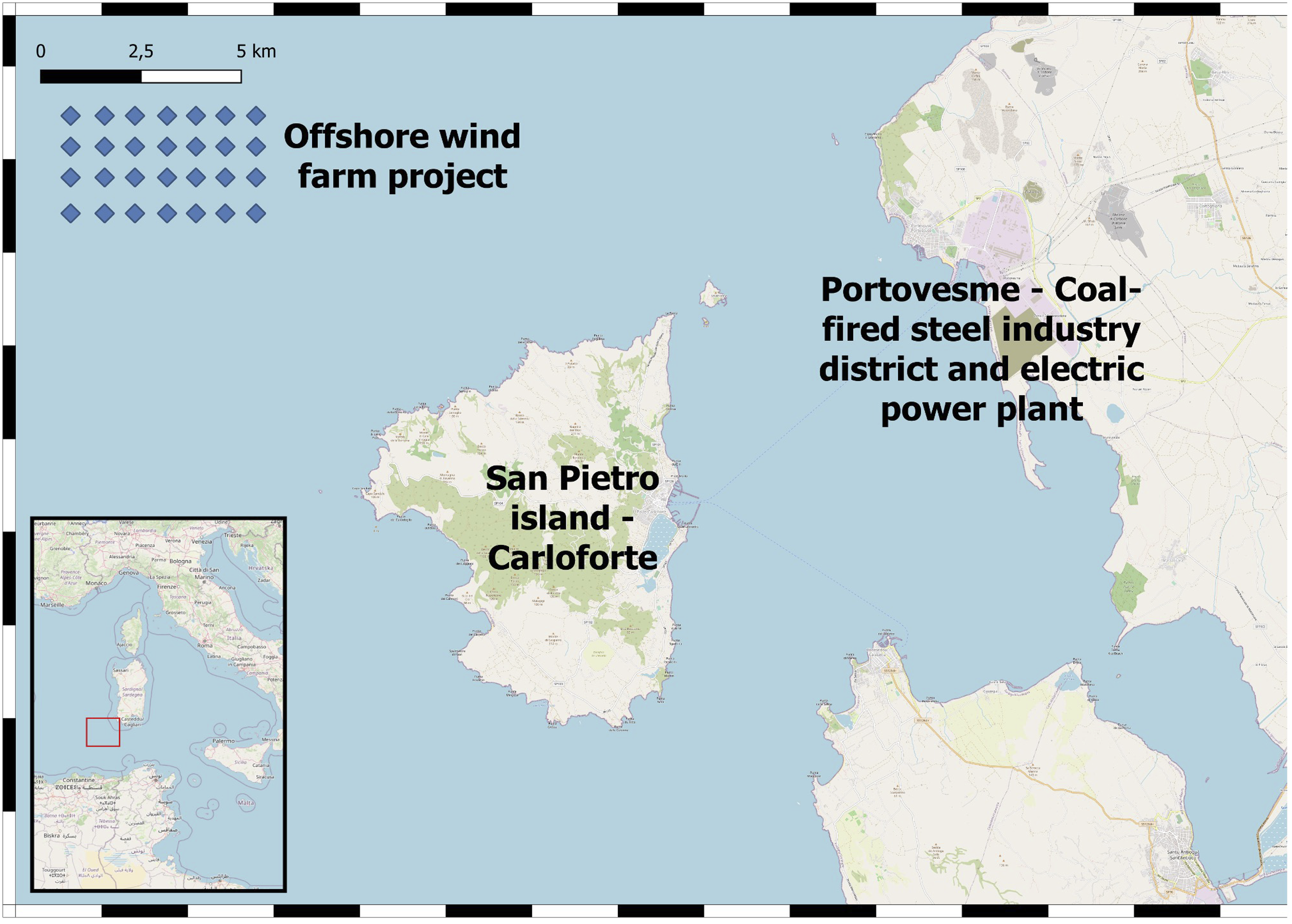
This story is about a continual overturning, from centre to periphery, from hegemony to subalternity, and back — but one that has produced a paradoxical outcome: what is geographically and economically a periphery has become a centre of energy extraction and geopolitical interest, while remaining dispossessed of the political and cultural resources that would make that centrality meaningful for those who live there. The centrality of this margin brings out global dynamics, but does not restore local power. This overturning plays out in a specific arena: a seascape. Unlike most anthropological studies of energy conflicts, which have focused on land-based communities and onshore installations, this paper proposes that the seascape constitutes a distinctive political space — one that communities claim as their own without holding any formal sovereignty over it, and that energy transition policies are now redefining as a resource to be extracted. Different local temporalities are intertwined in this process. I read the anti-wind farm mobilisations within a broader historical process of industrial policies, loss of industrial citizenship (Strangleman, 2015) and transformations that have been taking place in southern Italy and Sardinia since the end of the Second World War. Cycles of exogenous industrialization and de-industrialization have persisted here, having marginalizing effects on what, until a few decades ago, was Sardinia’s second commercial port. It explains why and in what sense I speak here of dispossession, which is mostly visible at the level of symbolic capital. The main thesis here is that this overturning of the center/periphery is connected to a symbolic expropriation that is expressed in semantic terms: dispossessed of a political language adequate to their situation, communities undergo a process of desemantization, to which they respond through a re-semantization of biological and atmospheric elements. Tuna, red sludge, and the mistral wind — as will emerge from Bruna’s kitchen conversation and from Carlo’s metaphors, and as the students of the local High School make tangible through their maps — become the primary discursive and bargaining tools when faced with an energy transition planned elsewhere.
The island of San Pietro has a maritime economy and a history of entanglement with the mining and industrial history of Sulcis that its inhabitants are at pains to deny. Carloforte — the island’s only town — was until the mid-twentieth century Sardinia’s second largest port and a central node in the logistics of the region’s mining industry, and has since provided labour for the Portovesme industrial pole. It is locally perceived as radically different from the rest of Sardinia — richer, sea-bound, Genoese in genealogy — and this perceived distinctiveness is, as we shall see, one of the key dynamics the paper explores.
However, today trade no longer passes through there and Carloforte has become commercially marginal. Its former geographical significance has changed. Today, you can join Carloforte by ferry from Portovesme and from the island of Sant'Antioco, crossing Carbonia, and Cagliari first: these many passages shaped new mental geographies. Geographically speaking, it is a marginal site. Its territorial detachment from the mainland has increased over decades. However, it lies at the centre of global, energy and geopolitical dynamics.
A growing body of anthropological work has examined grassroots opposition to the green transition in Europe and beyond (among others: McDermott Hughes, 2021; Franquesa, 2018; Benadusi, 2019, 2021; Dunlap, 2017; Boyer, 2019; Howe, 2019; Argenti and Knight, 2015). This literature has substantially advanced our understanding of how communities resist large-scale renewable energy installations — but has done so primarily in land-based contexts and where turbines are already present. The present study proposes a different vantage point: a marine site, and a community facing a transformation that has not yet materialized. At this stage, we can observe a complex dynamic in which local actors, often competing with each other for divergent economic interests (tourism, fishing, industrial jobs, institutional administration), co-evolve with marine energy extraction, while at the same time contesting and resisting it.
Anthropological studies have mainly framed energy production sites as peripheries (Franquesa, 2018). What this paper shows is something different: that the energy transition is producing a new kind of center — one that attracts geopolitical attention and extraction without restoring political agency to those who inhabit it. This distinction, between centrality and power, is what the ethnographic material from San Pietro makes visible.
After the methodology section, the article first presents the local dimension of the case study, then illustrates the ordre du discours on which local resistance to European energy policies is structured. I then present two ethnographic vignettes — Bruna’s and Carlo’s — and finally describe some elements that emerged from participatory mapping work in a high school in Carloforte.
Methodology
This work is based on ethnographic research that began in June 2021 2 , aimed at understanding how communities position themselves in the face of the local materialization of the European Green Deal — in this territory, largely the installation of major offshore and onshore wind farms. Following McDermott Hughes (2021), I toke the lack of social justice in the energy transition as a starting point rather than a conclusion, and use ethnography to capture the multiple dynamics at stake.
In the course of many stays in Sulcis, and particularly in San Pietro, I conducted dozens of extensive unstructured interviews and observations in various places in the region. I followed decision-making processes at deliberative sites, such as local assemblies on energy issues promoted by institutions, and informal meetings of committees against “energy speculation”. I also attended two cycles of municipal assemblies addressing issues related to the energy transition, and delved into the views of the participants I know best. Here I present an ethnographic vignette recounting the discussion about wind turbines that occurred in the kitchen of one of my longtime interlocutors.
At the same time, I attended six local meetings of the “No-Pale-Eoliche Carloforte” [No-wind-turbines Carloforte] committee, whose posters, public appeals and signature collections, petitions, were among official documents sent to the Ministry of Environment in order to express opposition to the construction of wind turbines at sea. Here I will present, in particular, an ethnographic vignette built on my relationship with one of the activists that sympathizes with the committee’s instances.
I also conducted three project-related workshops focusing on European energy transition policies and their impact on the region: one in Carbonia, with the representatives for Sardinia of two of major Italian NGOs (Italia Nostra and Legambiente), union representatives from the local industries, and representatives from public institutions (regional, municipal) dealing with industry and the energy transition. Information from these events enriched my background knowledge and I have continued discussions with the regional representatives of those NGOs ever since.
Finally, in October 2024, I had the opportunity to work with 18+ students in their final years classes at the High School in Carloforte. To go beyond elicitation and verbal exchange, I started by asking each one to draw a map (Hjorth Oldrup and Agervig Carstensen, 2012; Sletto, 2009a, 2009b; Tadaki et al., 2017) of the island and the subjectively important elements of the landscape, both negative and positive. I intended to get an idea of representational saturation, i.e. all strands of thought represented, and the recursiveness of represented and/or ignored elements, and discuss this with the classes and their teachers. Afterwards, during several sessions, we talked about the maps produced and the questions they posed for me. These discussions constitute the core data upon which I was able to develop and test my hypothesis and arguments.
Thanks to this combination of empirical methodologies, I was able to collect the views of at least three generations of people who currently live between Carloforte and the provinces of Carbonia and Iglesias: grandparents, grandchildren and parents; all are represented in the article. The study is based on a rich socio-demographic sample living over a relatively small area. The duration of my visits to the field allows me to situate most of my interlocutors in precise family and professional histories, and thus to situate particular strategies and concerns.
As agreed beforehand, all my interlocutors are anonymized, and biographical coordinates changed or mixed in a way that makes them unrecognizable.
San Pietro Island
Since the 20th century, Sulcis has been involved in different and consecutive extractive cycles: mining first, heavy industry next, and tourism today. This came together with the imposition of infrastructure and permanent environmental problems 3 (Bachis, 2017).
This liminal corner of a historically agro-pastoral Sardinia is Italy’s most important mining region. Zinc, coal, bauxite and other elements were profitably mined by local labor until the 1960s, when, faced with the mining industry’s competitiveness crisis, the Italian state intervened, installing industries in Portovesme as part of the Plan for the Rebirth of Southern Italy. This replaced mining work by creating a metallurgical industrial complex for aluminum production, and a large ENEL 4 coal-fired power plant. This hub went into crisis in the 1990s, losing competitiveness and failing to modernize its infrastructure and logistics. The result is that today the region has very high unemployment rates and among the highest levels of poverty in Italy 5 and in Europe. Thus, the Sulcis sub-region currently suffers from a profound industrial, social, environmental and energy crisis (Bachis, 2017; Marrocu et al., 2015). It has experienced the cultural dynamics of dispossession, these days labeled by the local press and some NGOs as “green colonialism,” or “energy colonialism” as many people in Sardinia call it today.
The energy transition envisaged by the Italian government in this region through the PNRR plan, involves a very large offshore wind farm close to the nearby Sulcitanian island of San Pietro.The most likely scenario is that they will be constructed at a distance of around 32 km from the coast of the small island – that is, quite far away. This scenario is strongly contested by the island’s population, which blames energy-speculation motives that I addressed (Apostoli Cappello, 2024, 2026) through the lenses of neo-extractivism (Gudynas, 2021; Svampa, 2019), dispossession (Murray Li, 2010; West, 2016) and spatial injustice (Harvey, 1997; Harvey et al., 2017; Lerner, 2010).
San Pietro’s main economic asset is today related to tourism, and this is threatened by landscape change due to offshore wind turbines, and because tuna fishing is potentially affected by turbine-derived acoustic pollution. San Pietro also hosts a considerable population of workers and ex-workers (about 150) at the Portovesme industrial pole. In sum, it is a key context because it is marginal but is involved in complex socio-productive systems. Moreover, many people here blame the state because siting wind turbines locally means dispossession of marine zones. Now, if peasant claims of agrarian dispossession operating today on the Sardinian ‘mainland’ are easy to understand, it is less easy to understand how a “seascape dispossession” could be locally framed. This is precisely what makes this case ethnographically distinctive: the seascape here is not merely a backdrop to energy conflict, but a political arena — one that communities claim as their own without holding any formal sovereignty over it, and that energy transition policies are redefining as a resource to be extracted.
In this sense, the immaterial nature of the wind, as Groupp (2025) argues for a North Sea case study, is being transformed into a resource that comes to play a role in the production and reconfiguration of material space in altogether new ways. The extraction and consumption of fossil fuels, such as coal, have contributed to the marginalization of a territory as a result of the loss of competitiveness of the extraction and production chains linked to it. At the same time, the study of this site allows us to highlight a dynamic that tends to redefine the contours of this territory, reconfiguring it as a new and more central political and energy space.
Bargaining on the tuna route
Carloforte is so well known for its ‘tuna straight from the trap’ that the first adverts you see when you land at Cagliari airport are for the island’s tuna. As will be seen below, this is also recalled by some interlocutors. Tuna is a crucial element in attracting tourist and institutional resources (such as EU funds). For example, the local authority is currently involved in an EU project, called the “Tuna Route.” Its purpose is to celebrate the bluefin tuna route which runs up the west coast of Sardinia, and to “implement tourist flows in the coastal destinations of the trans-Mediterranean route, with the ultimate goal of creating new job opportunities and incentivizing long-term skilled employment in the coastal regions involved” 6 . The project has also given a shade of green to what is probably the most popular local tourist event, the “Girotonno,” which was renamed “Sustainable Girotonno” from 2021 onwards. The tuna-based economy, not only as a source of food, but also (and possibly more importantly) for tourism, emerges as the main rhetorical argument for opposing the project to build offshore wind turbines.
While extensive local studies are being commissioned and awaited, recent scientific literature in the field of ecology (Schupp et al., 2021; Svendsen et al., 2022) suggests that fish in general do not undergo major alterations in either physiology or behavior in cases where large wind turbines are created at sea. These studies focus on the Baltic snd North Sea, where such installations have been present for many years now. But literature mainly addressing floating offshore wind farms in the Mediterranean suggests a need for greater caution in installing power plants (Lloret et al., 2022, 2023; Molins et al., 2023; Wawrzynkowski et al., 2025), invoking the precautionary principle in planning marine areas.
In Carloforte, the pervasive tuna-talk is probably the most important among several vernacular elements of local authenticity in social talk (Heatherington, 2001) about the ancestral nature of local fishing practices. However, this process of course does not come out of nowhere; it has considerable historical complexity. Atzeni (2009, 2011), for example, allows us to place the tuna discourse in a broader relationship between fishing and mining, and reconstructs the impact of mining on the quality of marine waters and fisheries, as well as the care and reclamation of mining sites subsequent to mining de-industrialization.
Mario, a merchant in the Port of Carloforte, one of the first people I met, began thus when he met me in 2021, introducing myself as a researcher interested in energy transition issues in Sardinia: “I am rather against the wind farms in the sea. They are on the tuna route and they could disrupt something that has been going on for centuries.” As my fieldwork progressed, I quickly became aware that I was getting this kind of response, in almost the same words, from a host of local merchants and cultural actors – as well as, of course, the workers and owners of the tuna fishery in Carloforte, unsurprisingly.
The raìs or leader of the tonnaroti, originally from Portoscuso (not from Carloforte, then), whom I met in 2022 during a photo exhibition in downtown Carloforte on the mattanza, explained his positioning in almost the same terms: The tuna route is an ancestral phenomenon. We don’t know anything about it yet. It is a phenomenon that cannot be disturbed, otherwise we are sure the tuna would change course if they put up wind turbines. Tuna are very sensitive to noise. If the paddles make a tremendous noise, the tuna will change course. They can't do that [i.e. they can’t install the offshore wind farms]
Based on previous experiences with anthropologists who came to Carloforte with an interest in tuna-related practices (Zambernardi, 2020), and because of a widespread idea of anthropology as a heritage-oriented discourse, my interlocutors generally implicitly expect me to adhere to arguments about about tuna as part of Carloforte’s heritage. When I note, in informal conversations, that to me, all things considered, it still seems important to strategically rethink the national energy supply, the argument shifts to the need for people to make decisions about their own territory (in this case “their” sea), to benefit directly and locally from its resources. Concerns about the loss of both economic and symbolic resources are constantly entangled.
I kept trying to interview people in Carloforte for whom tuna is or has been an economic resource of some importance. For a long time I looked for workers or former workers in the tuna fishery, without finding any. All the people I asked for help told me either that they did not know any, or that everyone who works in the tuna fishery has always – “traditionally” – been from Portoscuso. And in fact, as I later found out, no Carloforte people work in the tuna fishery. In Carloforte they mainly fish for tuna on the side, off the books, to sell to restaurants or to consume directly.
The tuna is also frequently evoked as an argument against offshore wind turbines in the main Sardinian newspaper, L'Unione Sarda. In April 2024, the mayor of Carloforte publicly expressed concern about “the possible negative impact on bluefin tuna fishing” caused by offshore installations, invoking the need for “in-depth studies” and noting that the municipality has “only advisory power on the issue.” The framing is telling: environmental protection and cultural heritage are invoked together, while the limits of local institutional agency are acknowledged.
Environmental protection is a topic that varies considerably of course, depending on what kind of actors are discussing it. In Carloforte, tuna is very often evoked as a natural element and metonym for the sea itself; it is the symbol of opposition to the extractive use of marine energy. This symbolic use of tuna raises the question of the ownership of the sea understood as a resource in itself and as a surface on which another important resource, the wind, acts (as noted by McDermott Hughes, 2021; Zanotelli, 2024; Groupp, 2025, among others). What is locally perceived as the islanders’ own is not recognized as theirs by any other actor, state or non-state.
Interestingly, for the people of Carloforte, the micro-insular community is part of the sea, unlike Sardinia, which is considered as “land-based”. Predictably, tuna industry owners strongly opposed the offshore wind-power project on the grounds of the area’s natural value and the landscape as a (touristic) resource. During a workshop in Carbonia in 2022, Giovanni, an important actor in the tuna, food and tourism, industries, further explains: So, offshore wind power – we’ll dismiss it in two words: it’s the actualization in the 2020s of what was done in the ’60s there in Portoscuso, because even in the ’60s in Portoscuso that stuff there received the same reasoning as offshore wind power: “It’s a wealth-creating thing, why be against it?” Because for the meters [i.e. instruments of measurement] at that time, the capacity for pollution and land destruction that produced that stuff is zero compared to the capacity for pollution and land destruction that offshore wind can produce today. Because when you put 350 blades in a spot where, practically, they turn all the currents that have to bring the tuna in, or that affect the waters … with a cable connecting Portoscuso that will produce galvanic currents, electricity, of everything ... you understand that you have put a definitive end to any tourist vocation of this place.
Giovanni is drawing on an argument that a lot of people in San Pietro are mobilizing against offshore wind. Probably the main one: offshore wind cannot be harnessed because it interferes with the ancestral tuna route. He does so by associating the installation of wind turbines with “that stuff,” namely the Portovesme steel plant. We will see in later sections, that the relationship of offshore energy extraction’s potential future pollution and the steel industry’s past pollution is at the core of the present oppositions.
The multiple voices on my fieldwork frame energy transition proects as a form of speculation and landscape grabbing underlying the ongoing seascape expropriation. This hinges on an idea of the sea, seascape and landscape as productive portions of land. In this sense, it does not stray far from thee industrial paradigm of production. Rather, it indicates that the extraction and exploitation of new energy resources such as wind power are shaping new geographies of power. Further research should be devoted to the possibility of extending the category of land grabbing to the landscape – land-scape grabbing – and to the sea – sea-scape grabbing – understood as productive territories within a paradigm of value extraction, both economic and symbolic. Ethnographic materials show that the nature of this value is twofold. Tuna, in this sense, is not only a resource to be defended. No one in Carloforte directly works at the tonnara — and yet it is tuna, rather than wages, contracts, or territorial rights, that structures the public argument against offshore wind. This displacement reflects something about what kinds of arguments are available, and what kinds are not — a question that that runs through the entire ethnographic material presented here. It may be connected to the specific overturning dynamic: the fact that a seascape long perceived as peripheral has suddenly become an arena of national and continental strategic interest, without this newfound centrality translating into any corresponding political recognition for those who live alongside it. In a space whose political status is being redefined from outside, the argument seems to be made through elements that carry a different kind of authority — ancestral, biological, atmospheric — precisely because the more conventional political registers are not available, or no longer adequate.
On the street, in Bruna’s kitchen
Three years later, in the summer of 2024, I find myself in Bruna’s kitchen, together with one of my main interlocutors, who is Bruna’s neighbor and close friend. I am looking for possible interlocutors among people who work or have worked in the Portovesme industries, with the intention of expanding my data on the family backgrounds of workers and former workers in the steel industry. Bruna, who apparently knows everyone in the village, takes many minutes to come up with a first name. Other relatives gradually join in the discussion. Next, in the wide-open kitchen overlooking the street on the ground floor, Bruna’s aunt, a retired school teacher, also arrives. Bruna is having great difficulty finding the names of former Portovesme steel-workers. When I explain that for me that is exactly the point, that for 3 years I have been told that many people worked there in Portovesme but no one seems to know about it directly – in a small town where everyone knows each other – Bruna admits that maybe they are ashamed, even though she has never thought about it. I say that it seems strange to me, because everyone talking generically about the industrial hub praises its virtues, saying that yes it has been a source of pollution but it has also brought prosperity, jobs, and offered an alternative to going to sea for months on end for men. Bruna agrees. But, she explains, working at sea is more prestigious than working in industry. This remark somehow unlocks her, and she begins to rattle off relatives and acquaintances who have worked or are working there.
Bruna’s aunt goes on to tell me that “once, in ’73 or ’74, they spilled cement mixers full of heavy metals into the sea, and it was discovered because, for 2 years, no more tuna came through. Then someone did the checks, cadmium was found (in addition to lead and other things), and then they forced the companies to put the red sludge in the spill pools. And the tuna came back.”
While she was at first in favor of offshore wind at first, after “they” started telling her “you’ll see, it’s like red sludge, you’ll see what they put into the sea, they’ll poison us again. And the tuna won’t come any more. And so I got scared. And I became against it.”
Many people in Carloforte evoke this “red sludge” while talking about offshore wind farms. This is a factor that divides the local community regarding the current transitions: some, say that “offshore wind turbines will poison people and tuna as the red sludge has done in the past”.
The “red sludge” episode — unverifiable but locally vivid — has become a persistent reference point in conversations about offshore wind, surfacing consistently only after real intimacy has been established. It is generally mentioned alongside praise for the wealth the industries brought, and followed by a shift toward anxiety about what the next cycle might bring: people are mostly ambivalent about this episode in their industrial history, which comes up again and again locally when talking about installing wind turbines at sea.
Although I cannot find any sources that can testify to it objectively, I think that it is necessary to consider this local experience of the recent industrial past since constant harping on it offers the key to understanding the present opposition to offshore projects. We are faced with the confluence of one past historical episode and another in the present. I argue that there is a connection between these two historical moments that is embodied in people’s experiences and, today, influences the rejection of European and Italian public policies towards energy transition. I mean transition, as well as sustainability here, not only as infrastructure (mostly wind turbines) but as a logic of organizing and governing regional planning together with the social sphere. Red sludge is itself used, if only as an argument, in the ongoing negotiation among many actors to define what sustainability and transitions are. Some people – like Carlo for example, who we will hear from later – think that the clean-up of the polluted industrial area is the main ecological transition to be made locally. Others go so far as to argue that the EU’s proposed technological transition through offshore wind farms will bring a new (unspecified) kind of red sludge (that is to say “danger”). Many in Sulcis and elsewhere in Sardinia, thus oppose discursive formations such as tuna and landscape-related elements against the technocratic sustainable transition conceived in Brussels. In Bruna’s kitchen, this opposition takes a specific temporal form: the red sludge of the 1970s and the wind turbines of the 2020s collapse into a single experience of expropriation, in which different historical moments overlap and reinforce each other. It is precisely this overturning of temporalities — the past continuously reactivated in the present — that gives the local resistance to the energy transition its particular shape and affective charge, and that explains why biological elements, rather than political categories, have become the dominant semantic register through which communities negotiate their position within asymmetrical relations of power.
From the industrial crisis and pollution of Sulcis, the inhabitants of the small meta-island of San Pietro, rhetorically distance themselves by strategically (Spivak and Harasym, 1990) claiming and performing a strong cultural specificity, built on ethnic arguments that also include biological features. This is especially evident when it comes to distancing themselves from communities ruined by the industrial history on the coastline opposite, which brought jobs, but then unemployment and now poverty. The differentiation mechanism finds – or claims – legitimation both because of San Pietro’s history, rooted in the profitable seafaring professions and because of its “Tabarkina” genealogy, as a Genoese settlement since 1739, as testified by several scholars (Toso, 2008; Tiragallo, 2015; Apostoli Cappello, 2026).
Exogenous industrialization, together with the ghost of red sludge that resurfaces today in many local conversations only after real intimacy has been established, is in my opinion at the root of today’s rejection of new models of development imposed from outside. This rejection is accompanied by a nostalgia for the pre-industrial, agricultural and even mining, and sea-bound world.
Faced with this widespread feeling, the present workers of Portovesme are interesting subjects in providing a lateral point of view on this apparently homogeneous situation. Thanks to Bruna, within a few days I meet Benito, a specialized mechanic. He is one of the few relatively young workers (he is 50 years old) still working in Portovesme, and he is proud to work there because he “made a living” there for a family and earns good money, and “thank God I am not exploited.” His father, father-in-law, and several of his and his wife’s now elderly uncles have worked in Portovesme in the past. He tells me: I have a feeling that industry in Sardinia is a mockery. The way Sardinia is, we could live off of something else, there is no need for industry. Even for sustainability and wind power, there is this feeling of being taken for a ride. You feel cheated. Like in Sarroch [Sardinia’s main refinery site, near Cagliari]: gasoline is very, very expensive. But why do I have to produce and destroy the land? You have to tell me why Sardinia is not like Montecarlo. We should live on something else. Over there where the turbines are [he points to the wind turbines next to the chimneys in Portovesme] they should have made an airport there, because it’s awkward for the tourists who land in Cagliari to get there. […] Who stands to gain from putting all these wind turbines there? I pay expensive bills, very expensive.
The core of Benito’s work strategy, together with that of his family and his wife, is tied to industry, and not tourism, for example. Thus, when talking about wind farms he directly focuses on the economic rationale, bypassing tuna and going straight to the point: “Who will benefit from wind turbines in terms of savings?”. In fact, scholars and local stakeholders at many sites around the world are asking critical questions about how the benefits of wind energy development could be distributed more equitably, while also raising questions about the ownership of wind (Groupp, 2025; McDermott Hughes, 2021; Zanotelli et al., 2024).
Instead, little or no mention is made, for example, of the risk of sea level rise for coastal lands, or of the gradual decline in fish populations, which plagues the Mediterranean and beyond. And this is surprising when you consider that fish and the coastline are emerging as the main local resources. Protecting the symbolic and economic integrity of the community in the present seems to be the main concern.
“Indians” and the frontier: Colonial thinking about a liminal area
Carlo is an elderly hippy from central Italy. He came from outside a few decades ago in search of a life “far from civilization”. There are many Italian, European and, in some cases, American residents who have made this kind of choice, in Carloforte. Today Carlo lives by trading food, seasonally, with tourists. He explains that he loves the island, understood simply as land: “I love Carloforte but I hate the Tabarkini 7 ”.
I get to know him while attending a meeting of the “No Energy Speculation – Carloforte” Committee in July 2024. In the wake of many others that have arisen in Sardinia in the past 2 years, this specific committee has been formalized since its founders promoted a petition against offshore wind power in May 2024. Its manifesto, fixed on several shop windows and other places in town asserts: “No energy speculation Carloforte is the name of the newly formed citizen’s committee with the aim of being vigilant to ensure that the transition does not compromise the habitat, particularly fauna and flora of the island of San Pietro […] In just under a week, it has collected 222 signatures that were brought to City Hall yesterday to urge the municipal administration to hold a meeting with citizens about plans for offshore wind farms in the Sulcis archipelago. Concern has spread following recent articles in the local press. Many are alarmed by the risk that the passage of bluefin tuna will be hijacked by the emission of electromagnetic waves and echo waves produced by the blades at sea, jeopardizing the survival of local tuna fisheries, the economy, the gastronomic culture and the very identity of the island.
Highly visible in the town and in local newspapers, at the time when I was on the field this committee is formed by a few people, mostly people not born in Carloforte.
The small island’s committee is part of a broader Sardinian panorama of grassroots committees mobilizing against what is deemed unfair and extractive management of areas to be allocated for solar and wind renewable energy facilities. However, the particular feature of the Carlofortino committee is that it refers to a marine territory, and furthermore extra-territorial. The aforementioned Sardinian newspaper “L’Unione Sarda” played a decisive role in stirring up these mobilizations, both for land and sea, and systematizing their claims.
Carlo tells me that “Carlofortinians never go it alone and never fight for anything”. By this he alludes to the fact that people who were born and live on the island are, in his view, inexperienced about the world, manipulable ontologically and in the first instance by actors who, according to his logic, have the power to buy consensus, such as the European institutions, in the case of those – the few – who favor the locally imposed energy transition. It doesn’t jar when, later, he paternalistically compares the Carlofortini to the Indians of North America.
On the other hand, the difficulty of the Sulcitan and, particularly, Carlofortinian communities in organizing themselves as a political subject and claiming collective rights is something I too have observed and framed as the outcome of expropriations suffered during different economic cycles. Actually, the feelings of distrust and dispossession expressed by different social groups are linked to exclusion from political resources, the lack of control mechanisms over land (and sea) and labor, and exposure to environmental hazards. So I believe that this has influenced the local experiences of citizenship and jeopardized the chances of creating any new political subjectivities.
When I try to understand how Carlo developed his concern and his militancy against offshore wind farms, he explains that he has been against them since he read a Facebook post a few months ago by a couple of activists I meet in the island. He tells me about the post: “That was enough for me.”
Asking him about the committee’s political practices, he explains that they quarreled because the new chairman wants to join with other Sardinian committees against onshore wind power – those who, he says, make “less of a noise, who think that picketing and direct action (blocking construction sites, for example) are violent”. He is disgruntled, does not think those actions are violent, and indeed thinks they are the only ones that should be pursued. He points out that in Carloforte it is more difficult to oppose the wind turbines because they are planned to be installed in the sea, unlike the other windfarms in Sardinia. So they are less obvious, even though they “disturb the tuna”. The specifically marine nature of this contested site requires a semantic shift in order for segments of the population to conceive of it as a space of political subjectification.
Carlo challenges the studies done by the companies proposing the offshore wind farms projects, sharing with me a public document outlining the committee’s objections that is to be sent to the Ministry of the Environment – in this case, in coordination with other Sardinian committees. The studies presented, he says, “are copy-pasted from those done in the North Sea, without taking into account the specificities of the Mediterranean”, claiming the new centrality of the very site. When I insist on asking him about the reasons for the opposition, he cites the vibrations of the concrete pylons on the seabed, and the electromagnetic currents they will generate. He tells me that “we do not know if this will disturb the tuna, but as a precautionary principle it would be better to study it before doing so”, invoking without quoting the same precautionary principle as recommended by many scientists (Lloret et al. 2022, 2023; Wawrzynkowski et al., 2025). Which is quite curious, considering that he systematically questions scientific findings that highlight the anthropogenic causes of climate change. But obviously, as in so many socio-cultural contexts, he picks and choose.
Carlo also tells me that the turbines will be very tall and will be visible. I ask him where, and he says “Somewhere they will be seen – and they will ruin the landscape.”
I ask him why many people in Carloforte, apart from the committee, are so opposed to offshore wind turbines. In fact, I make it clear that, if I find it fairly easy to understand the farmers expropriated by the state to build onshore wind farms in the Oristano area (where the strongest protest has begun), I still struggle to understand on what level the islanders feel expropriated.
He explains to me that, first, he does not believe that CO2 is a true problem, but just an aspect of the ongoing climate change which is not entirely human-dependent. He adds that, in his opinion, the reclamation and recovery of the Portovesme industrial area is more urgent, concerning a space closer at hand. He claims that the onshore wind farms in Portovesme are very visible, and they bother him a lot. He could make sense of it, he says, “if they took away the coal plant I could get over it, but they left the coal in Sardinia [he is complaining that the industrial pole is still coal-fired] and put in the wind turbines,” and that just doesn’t make sense to him. He can not make peace with it. And so he too links the unacceptability of today’s wind turbines with the unacceptable lack of a solution to yesterday’s industrial problem, which continuously reverberates in the present. Carlo’s colonial metaphor — the Indians, the buffalo, the railroad — translates this temporal overturning into a spatial one: the island as frontier, new center of external interests, yet dispossessed of any say over its own transformation. He links the energy transition to a broader logic of external imposition — military bases, European directives, national legislation — that he frames as successive forms of servitude. In his words: Another servitude for Sardinia, it’s like for the Indians, buffaloes and the railroad. The railroad itself was a useful thing, but they killed all the buffalo, kicked out the Indians. I stand with the Indians; I defend the Indians.
Geographically, landscape-wise, and in the imagination of many of its inhabitants and tourists, the island of San Pietro represents a frontier of the civilized, anthropized, human affected, world. It is an edge of the edge of Italy and its anthropized sea (rather than the open sea beyond San Pietro) and this is its main attraction for people who have moved here from far away like Carlo, but also for tourists.
Many of the second-home owners I have met over the years — people from London, Brussels, New York, and various Italian cities — explained that the sense of isolation and remoteness is precisely what drew them to Carloforte. They do not lead the protest, but their presence shapes the imagination of the island as a frontier of the unindustrialized world. In some case, they participate in the local social life, both material and symbolic, such as cultural activities (local book club, public events and/or artistic performances).
The idea that it is an anthropized sea that is glimpsed from this frontier would negate the potential appeal and unique landscape that attracts tourists to this liminal islet. Aware of that, the committee’s call for signatures in spring 2024, states: “We want to have a say in the use of the wind in our seas, protect the tuna route, marine and bird life, and the still very intact beauty of our overall landscape.” On the discursive level, tuna is a metonym for this wild and “natural” landscape, or at least it is used as such by many local actors who, in many other ways, have irreconcilable interests.
Wind turbines are the materialized expression of the financial actors and bureaucrats who decide policies elsewere without taking into account the popular consensus, by modifying local ecologies and boundaries – physical or imagined – between the anthropized, exploited, spoiled world, and the wild seascape. This seems to ignore the extractive nature of this new economic cycle, locally seen as economically salvific, which is centered on tourism.
The decontextualized island
As an ethnographic key-point I took a high school, the Comprehensive Nautical Institute of Carloforte, an important educational institution in Carloforte for several decades. The institution trains naval officers who will embark on mainly merchant ships and highly skilled mechanics for jobs requiring good qualifications in the industrial hub of Portovesme. This high school is an important economic asset, since it still guarantees skilled work in a region that is among the poorest in Europe. As I have witnessed, many of the students at the Nautical Institute come from the provinces of the mother-island of Sardinia, embarking each morning to study in Carloforte.
Thanks to “the sailors” (“i naviganti”) as they call them locally, Carloforte’s community has always been significantly richer than the rest of Sulcis and among the richest in Sardinia, although the region is currently experiencing an intense depopulation dynamic, mainly due to the lack of jobs. Among other things, the meta-island of San Pietro was, until the 1950s, a logistically important maritime hub in the Sulcitan coal and zinc industry, and Sardinia’s second largest port after Cagliari. From the 1950s, the Sulcitanian mining industry began a slow decline that Carloforte also suffered from, being an embedded part of the region’s coal and zinc trade. It remains an important training center, however, because of the naval officers, and for this reason I decided to work in the classroom with students from this institution, trying to capture their point of view.
In October 2024 I joined the the classes of 15 to 20 students (18+) in their final years, working through participatory mapping for a few days with students. They are predominantly male, as is often the case in technical institutes in Italy. I also meet some of them in groups over a few evenings, at their meeting place – a parking lot near the harbor – and this helped us to build a fairly informal relationship.
In the classroom, I asked the students to draw the territory on blank sheets, drawing the landscape elements that are important to them, both positive and negative, and thus working subjectively.
The Sulcitanian coastline and related smokestacks are not represented at all, at first glance. The coastal industrialization, however, is only seemingly absent from the narratives and the students constantly decontextualize the island and struggle to place their family experiences in a broader socio-productive landscape, if not the aesthetic, touristic landscape. I know the families of origin of some of the students fairly well – that is, the professional histories of parents and in some cases grandparents, class and income bracket. I know for a fact that several of these students have or have in the past had family members whose professional lives are connected to the industrial hub.
As the participatory mapping workshop unravels, tuna is represented on the maps as a sightseeing element and a place of interest (the route of the tuna shoals). And during the formal and informal interactions among students, tuna emerges as a social and community marker differentiating Carloforte from the poorer coastal towns. Continuing with the discussion, hoever, the students allowed the realization to surface that tuna is not the resource they feel they should claim it is – that is, that it does not really provide local jobs.
Naively, at first it seems strange to me that these very young people, studying as specialized technicians and “mechanics of the sea,” view the coming of the new infrastructure not as a chance to find employment but mainly as the loss of an inner and outer landscape. Who, if not they, would be entitled to demand that qualified local labor should be employed around these installations. But a feeling of loss is dominant, and in fact they themselves tell me that “the citizens do not decide anything anyway, and … Sardinians have never decided anything, not even for industries” (they mean Portovesme). They explain to me that if the wind turbines are erected, the tuna will no longer pass through Carloforte, and: “Carloforte depends on tuna because at Elmas [Cagliari airport], when you arrive the first thing you see is the Carloforte tuna advertisement.” They are thus actually referring to tuna as an attraction for the tourist industry, not for the fishing industry. Here too, the overturning is at work: these young people, trained to operate the very infrastructure of a maritime-industrial economy, relate to their territory primarily through its symbolic and touristic image, decontextualizing it from the productive landscape in which their own families are embedded — as if the industrial history that shaped their families had never consolidated into a transmissible language through which to claim rights or imagine futures. This decontextualization may also tell us something about the seascape as a political arena: a space whose centrality is being redefined from outside, but whose political status remains unrecognized, may be easier to inhabit imaginatively — as a landscape of tuna and wind and ancestral routes — than to claim politically. The maps, in this sense, are not only a symptom of desemantization but a trace of the specific overturning this paper describes: a community finding itself at the center of continental interests without the political and cultural resources to act as sovereign subjects within that centrality.
However, the same student then observes, “They could also make wind turbines there as long as none of us pay the energy bills any more, because it is here that the Mistral comes, only here”. And the Mistral wind is the reason why offshore installations are planned in that very stretch of sea.
The tuna topic also works as a discursive argument differentiating the Carloforte and Portoscusan communities. These other communities are significantly poorer. Some students living in Carloforte tell me, “But does it seem normal to you that all the tonnarotti [fishermen specializing in traditional tuna slaughtering] are from Portoscuso?” alluding to the fact that, as everyone knows, no one in Carloforte works directly at the tonnara.
A female student from a town near Iglesias makes the economic divide clearer: The Portoscusans didn’t get jobs there because they did the Minerario [technical mining school, except then the mines closed] and the industry didn’t take them on. The people from Carloforte attended the Nautical School, they are mechanics, and that got them jobs in industry.
Carloforte’s tuna is clearly one of the main tourist draws; it is consciously exploited as an economic resource for many people on the island who make their living from micro-tourism (domestic structures adapted as bed and breakfasts, restaurants, small hotels, small businesses). Alongside the legal industry, its informal fishing is an economic supplement for several families, but no one in Carloforte works at the tonnara, the last active one in the Mediterranean. The tonnara workers (about 20) live in Portoscuso, the town opposite the small island of San Pietro, and next to the industrial hub of Portovesme.
Economically speaking, tuna conservation seems primarily a tourism strategy, which is logical. Corresponding to it, however, is a strategy of self-preservation that is developed on a symbolic level. Indeed, this comes about in the face of a feeling of loss and crisis that spans three generations, as emerges in the materials presented here. Regardless of the different socio-demographic coordinates, my interlocutors in San Pietro and the Sulcitan coast share a feeling of existential threat, which leads them to self-represent themselves in isolation from the industrial history of the sub-region.
Conclusions
The main finding that ethnographic data provide is that energy transition makes new centers emerge that attract multiple kinds of attention and become bargaining arenas. What the case of San Pietro shows, more specifically, is that a seascape — a space without formal owners — can become simultaneously a center of energy extraction of national and continental interest and a site of intense symbolic contestation. It is in this specific arena that tuna, red sludge, and the mistral wind emerge not as local color, but as the primary discursive and bargaining tools through which a community negotiates a transformation it did not choose.
The present paper shows the need for the current literature to consider that these new centers are partially emptied of power. It is not enough to observe that peripheries become centers: what matters ethnographically is what happens to communities when they find themselves at the center of interests of national and continental strategic importance without the political and cultural resources to act as sovereign subjects within that centrality. Successive cycles of exogenous industrialization and de-industrialization have eroded those resources, and this — as the three ethnographic moments presented here converge to show — is the historical ground on which the process of desemantization becomes legible.
These three dynamics — the overturning of center and periphery, the seascape as a political arena without formal sovereignty, and the desemantization that drives communities toward biological and atmospheric registers — are not separate phenomena. They are, this paper has argued, aspects of a single process: the production of a new kind of center that is simultaneously a site of geopolitical interest and a space of political dispossession, in which the available instruments of contestation are tuna, red sludge, and wind rather than rights, citizenship, or territorial governance.
In a dynamic of constant reactualization of the past, and overlapping between different temporalities, the rejection of the EU Green Deal we see locally today is part of a process rooted in the loss of the logistical and commercial centrality of these territories, previously the subject of mining linked to wealth that meant, for many households, emancipation from the subsistence regime of agro-pastoral Sardinia. Extractive industry, however, has meant the loss of intergenerational chains of transmission of agricultural knowledge without consolidating the relative prosperity of mining for multiple generations. This extractive logic was succeeded in the 1960s by that of industry, which began with the “Piano di Rinascita del Mezzogiorno”. Here, too, industry profoundly altered the land and made uncultivable many square kilometers of agricultural land because of pollution. The steel industry, which was intended to be the answer, in terms of national public policy, to the economic vulnerability of the land, has thus further altered the lives of communities by providing welfare for only one generation of workers. In fact, the Portovesme industrial hub went into crisis as early as the 1990s.
The feeling of crisis, understood here in the sense that the Italian anthropologist De Martino (1977) gave it – the fear of separation from a condition of domesticity in the area I studied - is older than the European Green Deal and related wind turbines. The feeling of a progressive fading away as active subjects in the historical process goes back to a gradual general loss of economic centrality, which has affected Carloforte for at least three generations. Conflicting interests, claims and competition over use of the sea have only recently emerged. I argue that they show a decline in the strong specificity of Carloforte’s population, which used to stem from sea-related trade. Expropriations in Sulcis are not only an economic, but also an environmental and cultural issue.
It is within this crisis — understood as a progressive estrangement from a condition of cultural domesticity — that the process of desemantization becomes legible: not as a sudden rupture, but as the slow outcome of overlapping expropriations across generations. This loss of meaning affects many categories previously assigned to the political sphere in the strict sense, suggesting that we should consider as a primary loss the loss of language for socializing difficulties, negotiating rights, and planning land management through registers that are not biological or symbolic. This language seems substituted by discursive formations such as tuna, wind and the red sludge, that become thus political entities.
Different local temporalities are intertwined in this process, often overlapping hegemony and subalternity. This also shows the overlapping dynamics of marginalization and experiences of dispossession that today shape the way communities live and act out their political dimensions. More specifically, a continuous reactivation of the past is at work when people address the issue of offshore installations, reawakening fears rooted in experiences involving previous phases of industrialization in the area. It also emerges together with experiences of surprise of finding oneself at the center of interests of national and continental strategic importance. Not to mention the parallel surprise at unexpectedly finding oneself at the center of research attention, which emerged in my personal relationships with local interlocutors. This reflexive dimension is itself ethnographically telling: my interlocutors initially expected an anthropologist interested in heritage — tuna, Genoese identity, insular traditions — and found themselves instead repositioned, through the research encounter, as actors at the center of continental geopolitical dynamics. The overturning, in other words, was not only structural but also played out in the field, in the space between researcher and interlocutors.
Footnotes

Funding
The authors disclosed receipt of the following financial support for the research, authorship, and/or publication of this article: This study was supported by H2020 Marie Sklodowska Curie Actions - Cofund, Grant No. 101034324.
Declaration of conflicting interests
The authors declared no potential conflicts of interest with respect to the research, authorship, and/or publication of this article.