







Abstract
Uneventful ethnography is an attempt to enable fieldworkers to capture social and spatial intentions in seemingly empty fields. Events in anthropology have often been framed through liminality to explain rituals, acts and routines across walks of life, where social order is ultimately restored. A Deleuzian view through actualisation instead points towards a future-oriented outlook, where fieldworkers are concerned with the emergence of new possibilities. Drawing on 5 months of fieldwork across Japan, especially in rural places attempting to attract digital nomads, I present three vignettes examining how cultural imaginaries are negotiated when no events are immediately available during fieldwork. Observations turn towards faint and stifled wishes and desires embedded in spaces, narratives and actions, shaped by external forces and expectations. Uneventful ethnography becomes a methodological tool through which fieldworkers attend to not yet actualised events. Seemingly empty fields remain laden with possibilities not yet materialised, but which may eventually occur.
Keywords
Introduction
What happens with ethnography when no event occurs? Ethnographic fieldwork is an immersive inquiry conducted over a period of time to study components of whole cultural settings. Rather than thinking of celebrations, events could be understood as points in time that carry social significance, as “singled out… happenings and murmurings in our environment” (Hastrup, 1990: 49), which are particularly crucial when studying modes of action and descriptions of reality (Das, 1998). Malinowski, in fact, heavily relied on unfolding events when observing rituals, performing magic and gift-giving among the Argonauts of the Trobriand Islands. His published journals later revealed how he actively created situations (Malinowski, 1967; see also Pratt, 2022; Clifford and Marcus, 1986), which encapsulates how important events are for ethnographic accounts. Events stand in relation to everyday routines, from which anthropologists single out moments of social significance (Hastrup, 1987, 1990). The importance of events during fieldwork has inspired ethnographic innovations, such as short-term ethnography (Pink and Morgan, 2013) and focused ethnography (Knoblauch, 2005), that actively seek meaningful moments of intensity and visibility, but these approaches have left the stillness before events occur analytically underdeveloped. Through events, fieldworkers can witness intentions that change livelihoods (Das, 1998; Hastrup, 1987), but can also, as I will lay out in my argument, capture wishes and dreams before they unfold, thus critiquing the epistemic legitimacy of events themselves in producing ethnographic insight.
Events have in anthropology been conceptualised through a tradition of liminality, a concept which stems from Van Gennep’s analysis of rites of passage to describe phases when persons are removed and later reincorporated into a group in a new state of life (Handelman, 1990). Turner (1969) further developed liminality to describe a suspension of time marked by the absence of stability. The Brazilian carnival, for instance, is an event that disrupts everyday order through festivities, but streets are later cleaned as if nothing had happened (DaMatta, 1991). Liminality, which describes breaks in social order that later return to stability, relies heavily on a macro-perspective of whole cultural systems in order for the concept to function. Life, in fact, may not return to normal in other situations. When attention is directed towards ruptures in history and breaks in mundane life, memories, silences, stigma or embodied pain may be evoked (Das, 1998). The analysis turns towards a micro-perspective on individuals who undergo these changes, whether through rites into adulthood or through interruptions of everyday life by earthquakes. While liminality reflects an imagined static society that constantly returns to normality, fieldworkers cannot always rely on an inevitable return but may also direct their attention to the states of life that events are creating.
Events can thus be understood as actualisations. Kapferer (2015) provides a paradigmatic shift in the conceptualisation of events by turning to the philosopher Gilles Deleuze and the psychoanalyst Félix Guattari. Kapferer describes a post-structuralist analysis of events as dynamic sites of emergence that merge moments into a single one that actualises ever-expanding possibilities which continuously and repeatedly unfold. Stine Krøijer (2015), for instance, illustrates actualisation through her account of a coalition of protesters, including anarchist activists and Black Bloc participants, at a summit in Strasbourg, where protests oscillate between playful resistance through dance and moments of intense confrontation, but are interrupted by the police and kettled on a bridge before being dispersed. Such a view of events analyses changing directions that spawn new possibilities. An actualisation perspective encourages researchers to focus on searching for events rather than summarising already recurring moments. Actualisation offers a forward-looking perspective with attention towards the production of emerging realities of livelihoods that no longer return to the same and to what precedes events (Kapferer, 2015). This perspective on events can support fieldworkers in understanding how possibilities may eventually emerge in the field. I illustrate the differences between liminal and actualisations of time in Figure 1. Comparison of liminal events and actualisations of time. Source: author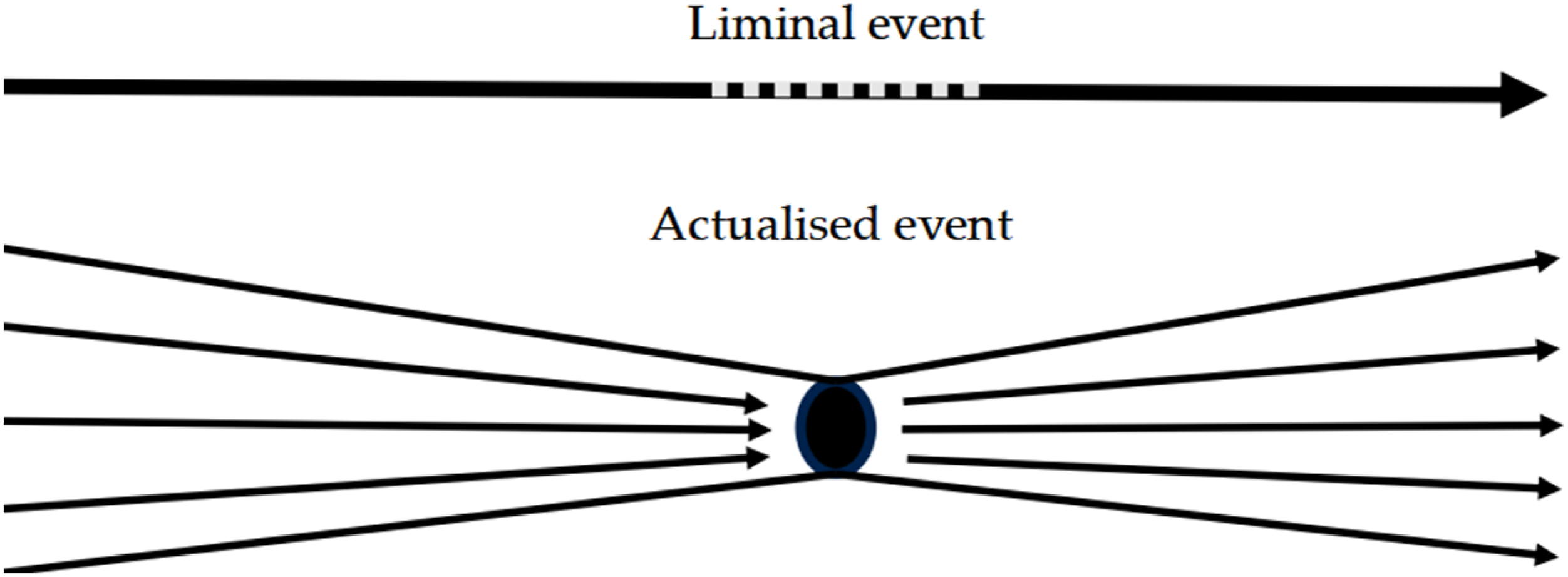
The question remains, as posed at the outset, what happens to ethnography when no events occur during fieldwork. Without any events directly available, there are nonetheless important observations to capture in the faint and stifled within the field. While liminality may lead fieldworkers to wait for, or search for, rituals or gift exchanges, a Deleuzian perspective based on actualisation directs attention towards dreams and hopes that are building up around what is meant or wished to happen, without forgetting intentions even when events have not yet, or may never, materialise. Such attention is connected to everyday life as ongoing adjustments to uncertainty (Jackson, 2013) or as embodied and sensory practices (Pink, 2009). The argument that I develop follows Hastrup’s understanding (1987) of events as social relations between happenings that break mundane structures. This methodological perspective shifts observations from repetition in everyday life towards the conditions of anticipation, intention and imagined futures. This includes a great deal of waiting beyond the control of both the fieldworker and those whom fieldworkers encounter (Hage, 2009). I attempt with this article to show how attending to narratives and spaces can capture details of intentions imbued with imaginaries that may one day unfold. Such perception follows a long anthropological tradition of describing what is not happening, for instance, through taboos or other cultural faux pas. Actualisation thus offers a methodological tool to reposition and analyse events, which I call uneventful ethnography.
Drawing on 5 months of fieldwork across Japan, I present three vignettes of how uneventful ethnography unfolded 1 . Originally from Sweden, and with little conversational proficiency in Japanese, I sought foreign digital nomads with the intention of understanding how cultural imaginaries change after moving beyond familiar backdrops when visiting rural locations. The first vignette shows a field shaped by larger structures wishing for digital nomads to arrive in Japan. The second vignette provides sensory and in-depth encounters with seemingly empty field sites, but where spaces reveal hopes and dreams. The final vignette presents encounters that contrast my imagined insights with what could occur, but where cultural changes were not important for digital nomads. These insights should not be seen as standing in contrast to anthropological understandings of the continuous unfolding of everyday life (e.g., Pink, 2009) 2 , but likewise attending to the waiting for changes that are beyond our control (Hage, 2009). Hopes and dreams are not emergences; they are repeated enactments of past histories, replicated from previously unfulfilled expectations and carried forward as waiting in hope on another terrain (Miyazaki, 2004). This article aims to enrich ethnographic fieldwork towards what might, or perhaps never, become something new, where, in the act of waiting, social life can be organised as anticipation and imagined futures (Hage, 2009; Miyazaki, 2004). I conclude by extending Das’s argument (1998) on an anthropology of events by taking a step further back. Fieldworkers should attend not only to the changes that events bring, but also to those latent transformations unfolding before events potentially occur.
Uneventful field-in-making
“Why don’t you go to Fukuoka? There you’ll meet digital nomads.” I stopped noting the repeated comments down. I knew they were trying to be helpful. But the realisation became a painful reminder that I would not meet any digital nomads in rural areas, at least not as I had imagined and planned when starting my fieldwork before I arrived in Japan in March 2026. Plenty of ethnographic studies of digital nomadism have already been conducted in cities and larger destinations, and going there would not help my project, or so I thought. My suspicions were later confirmed when I met Jack. “Where are the digital nomads?” he asked rhetorically, “I don’t know where they are!” We had coffee in a small co-working space in Sapporo. I met him when he created a project with another co-working space. His main job was with a global American company. Being American-Japanese, he had moved to Japan because he felt like a visible minority where he previously lived. Now travelling across East Asia, he had not encountered many digital nomads in Japan either. We met in shared doubt. Some time later, when searching for projects around Hokkaido, I also met other entrepreneurs, such as Hiroshi, who provides nature experiences near Obihiro and seeks to live outside urban areas. Hiroshi said that digital nomadism could offer an opportunity for longer stays compared to weekend Japanese tourists at his summer glamping site. As for me, he also saw that the promised arrival of digital nomads shone by their absence. Cities nevertheless remained the main destinations towards which digital nomads gravitated. I encountered a field-in-making, a series of attempts to draw digital nomads to the countryside of Japan.
Japan’s wish to attract digital nomads has not arisen from a vacuum. Once a celebrated economic wonder, marked since the 1970s by explosive growth as one of the world’s leading manufacturing nations, Japan entered a period of economic downturn and prolonged stagnation in the 1990s. What would eventually be known as the post-growth era became a steady norm of limited economic expansion, entailing a persistent hope for economic return (Allison, 2013). Contemporary post-growth Japan grapples with an ageing population and low birth rates, resulting in fewer working-age people, while younger populations move to metropolitan areas for work, leaving rural regions behind. As Japanese citizens relocate to the countryside, encouraged by internal migration policies (Klien, 2020), some are returning to home regions or seeking to distance themselves from urban livelihoods, while others face difficulties establishing new businesses, fitting in or overcoming loneliness, alongside moments of freedom (Klien, 2020). Hope is built from past histories and performed in many ways, sparking into existence in different settings (Miyazaki, 2004), of which digital nomads are one. This is a field-in-making: a not yet fully ready field for my original purpose, but a field that holds narratives of building up a future for that specific purpose. Digital nomads are a part of decades of political attention, of an ever-expanding hope of change and dreams of something else beyond Japan’s current post-growth condition.
To address economic stagnation, the Japanese government introduced policies to attract foreign workers. Filipina women, for instance, have been coming to live in rural Japan, but they continue to remain partially separate through ongoing attachments to their own cultural worlds (Faier, 2009). Brazilian migrants in the industrial sector have struggled with cultural integration within Japanese society (Ikeuchi, 2023). Tourism became an economic strategy aimed at bringing foreign capital through spending, yet with only moderate economic success (Liu-Farrer, 2020). Economic gains nevertheless justify externalities such as overcrowding, rising rents and disappearing neighbourhoods, as in Kyoto, where low-rise housing and a sprawling cultural life are drawn into tourist imaginaries of authentic Japan, often visible in practices such as tourists dressing in traditional kimonos for alternative experiences (Prough, 2022). Rural Japan still struggles to receive even small numbers of visitors (Chiba and Yanagawa, 2025). During the fieldwork, I read that the state-owned airline launched a campaign offering nearly free domestic flights to international arrivals to encourage travel beyond the main hubs. These efforts are part of the field-in-making, a Japan that is looking for a broader shift beyond the current status quo.
Japan joined the global race to attract digital nomads in April 2024. Digital nomads are, in brief, individuals seeking freedom through location independence, mobility and the ability to choose culture and place (Cook, 2022). By using digital technology for online work, they may travel to places other than home (Cook, 2023), often with a semi-permanent presence (Hannonen, 2020), ranging from those who maintain a home base to those who have dissolved it altogether (Reichenberger, 2018). The global push during the COVID pandemic led many countries to introduce visas aimed at easing transnational mobility (Bednorz, 2024; KC and Triandafyllidou, 2026). There is a false assumption that this group is lazy or unproductive, but rather, they should be understood as individuals for whom another type of livelihood becomes possible (Kesküla, 2023). They are skilled workers who generate economic revenue through spending and contribute human capital, especially to rural regions (Ünal, 2024): thus, digital nomads are a perfect fit for Japan to combat its economic and demographic issues. The Japanese government created a visa scheme that provides 6 months’ access for those earning over USD 68,000 annually, or JPY 10 million, and holding citizenship in a country with a double-taxation agreement, a staggering sum for many digital nomads. But the visa is not significantly different from a tourist visa, which allows visitors two periods of 3 months each. Yet official statistics released during fieldwork revealed that only 257 digital nomad visas had been issued. Most of them, I heard from informants, were in cities searching for permanent work. A needle in a haystack for me to find, quite literally.
“I hate the digital nomad visa,” Cherry said when I met him online. Cherry is from mainland Japan and moved to a smaller city on one of the many Japanese islands, where he, with a friend, is creating a co-living space and hosting one of the best-known digital nomad gatherings in Japan. We met at a co-living space some hours from Tokyo. And while I encountered a few digital nomads there, I was instead meeting a network of Japanese actors attempting to create new connections and attract people to rural Japan, such as Cherry. “I really don’t like it,” he continued. “The visa requirements are too high. It’s too troublesome to get. The standards are too strict” (Interview, May 2025). Cherry appeared unconcerned with large-scale policy projects and instead framed Japan as a cultural experience that digital nomads might access, especially in rural areas. At the same place, I also met Michiaki, who runs two digital nomad spaces on an island in southern Japan. He travels around the country building a network. I followed him for some days to see how these connections were being established among those hoping to attract people to rural Japan. Visitors, however, remained few. “I have one Mexican who stayed a month. He asked me about coming again soon.” But that was how few were coming. Michiaki did not care much about the digital nomad visa either. But when I asked why digital nomads were nevertheless important, he replied seriously, “We are 8000 people on the island and losing 200 people every year. If we do not do anything, in 50 years we would have to close down.” Digital nomads appeared to be a last resort.
Eventually, with some reluctance, I had to go to Tokyo anyway. I wanted to ask digital nomads why so few of them visited rural areas. Digital nomads here were visible in coffee chains or among designated co-working spaces, but not heaps as I was expecting before I came. I eventually came across one co-working space where I spent some time
3
, which, much like those associated with Cherry and Michiaki, attempted to push people towards smaller towns and rural areas. A café was on the ground floor and an office-like environment above (see Figure 2). I spent time speaking with people who were often on their way, not within Japan, but elsewhere, perhaps on a day trip to the countryside. When speaking with a couple at one co-working space, she is from Canada and he is from India, and they described travelling to the countryside mainly to resorts, or treating rural areas as routes away from and back again to the next city. All amenities for digital nomads are located in the city, ready to be used. Rural areas functioned merely as stops between cities. A field-in-making is one where events have not yet begun in relation to the intended research purpose. While there were sporadic visits in the countryside, cities remained an easy draw. The countryside was where they could come for a short while and leave soon again. Digital nomadism in Japan was so fragmented and dispersed across rural areas that, like other mobile and global groups (D’Andrea, 2006), digital nomads were few, sporadic and barely seen. Co-working spaces resemble standard office environments. Source: author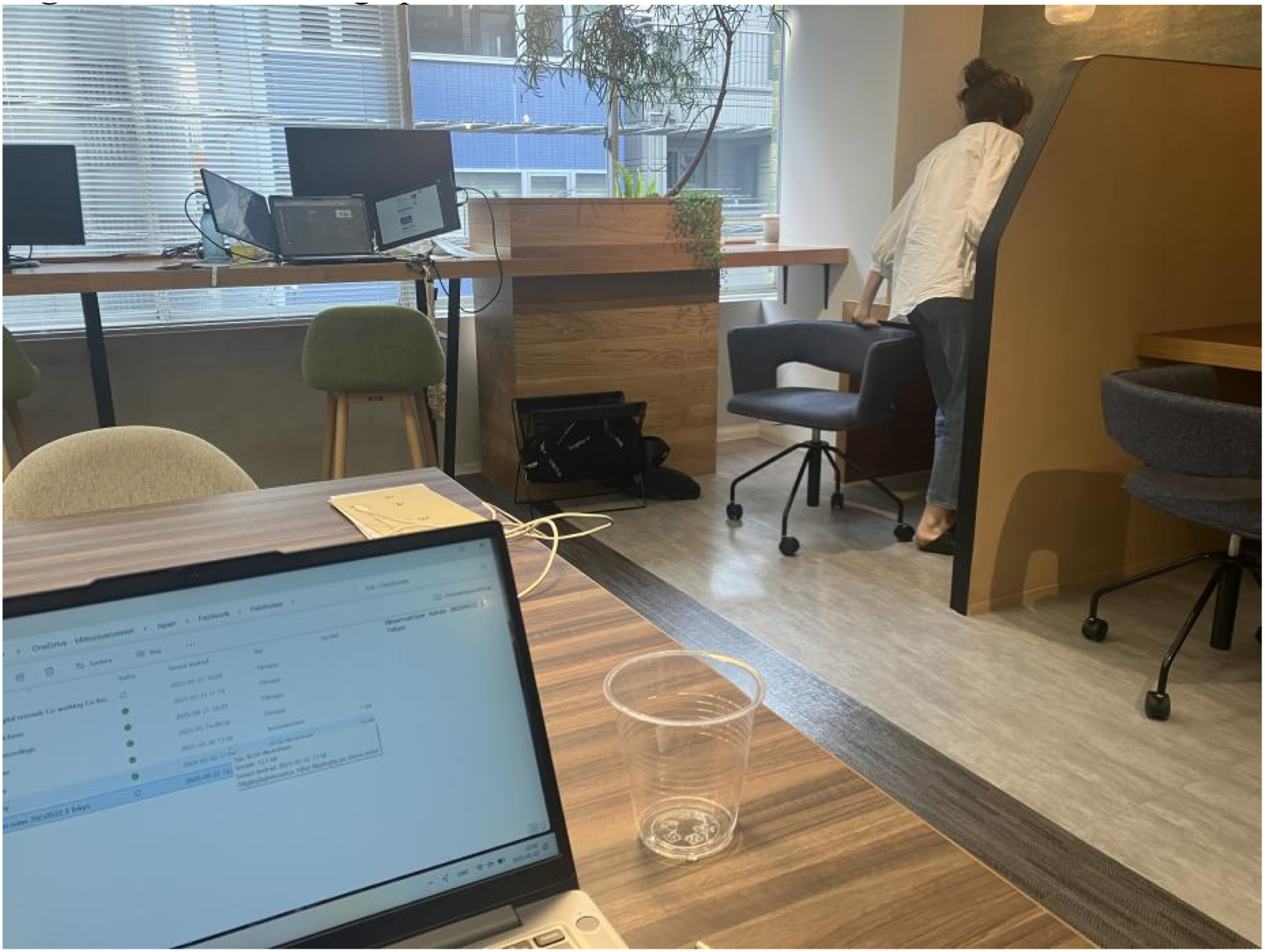
Time became one of the major issues in visiting places other than the large cities. When I turned to online spaces to locate digital nomads and understand where they could be, I managed to contact someone. Yet many of them opted out of the interview, and it is unclear why they stopped answering my messages. After multiple attempts, and perhaps out of desperation, I obtained one contact, Matt, who responded after some days:
“Hi Axel, got it. An hour is a bit too much for me, given my priorities.” (Matt, 9 April)
“Ok, how much time do you have?” (Axel)
“If you can stay within max. half an hour?” (Matt)
“Ok. Please choose a day and time and I will send you a Zoom link.” (Axel)
“Does that sound ok?” (Axel)
“Ok. You are currently in Japan, right?” (Matt)
“Correct. Any decent hour JST works, morning or evening. I am quite flexible.” (Axel)
“Ok, will let you know.” (Matt)
“Hi, I wonder if you would have time soon?” (Axel, 17 April)
He saw the message but chose not to respond. While digital nomads extensively use online platforms, the freedom they seek often involves strategies to remain frictionless in relation to states and obligations (Cook, 2022). Speaking with researchers did not appear to be particularly desirable. Like other flexible and mobile groups (D’Andrea, 2006), trust is built lightly, especially given time constraints, which can make ethnographic fieldwork difficult.
Uneventful ethnography captures a field-in-making across scales. From internal and external migration to tourism, Japan was a field-in-making for me where digital nomadism played one of several roles. Researchers, like me, are often expected to adhere closely to their initial plans. But I remembered reading reflections from Anna Tsing (1993: 65) in her book In the Realm of the Diamond Queen where she reflected on her own assumptions and actions when looking for her field site: “When I first arrived in the Maratus Mountains, I expected to do a village study as is still the predominant practice in the cultural anthropology of the rural Third World. Yet when I researched the central mountains, I found no villages to study. Lacking a stable group with which to ‘settle in’, it seemed best for me to move around. That is how I came to travel across a wide swathe of Maratus country, staying primarily with five loosely connected umbun in different neighbourhoods.”
Encountering uneventful spaces
Hokkaido, late March. Winter slowly melts, leaving piles of snow scattered across the ground and revealing yellow grass and patches of bare brown earth. The landscape feels uncannily like an analogy for my fieldwork. Until recently, I had stayed in Sapporo. Before the fieldwork started, I imagined meeting digital nomads everywhere. Cities were the departure point for my fieldwork, from where I intended to move outwards to more rural places. I already had a sense that digital nomads wished to remain unnoticed, to be free through mobility (Cook, 2022). Sapporo is the fourth largest city, beyond the usual hangouts of Tokyo and Fukuoka. My plan, however, had brought me little progress so far. Over the past weeks, I had made many attempts by sitting in co-working and co-living spaces, the so-called co-spaces (Lee et al., 2019). But after spending days in cafés and paid co-working spaces across the city, no digital nomads appeared, or at least very few who would speak with me. Even when I had been reaching out through online platforms to find digital nomads elsewhere on the island, the field fell silent. Now I was on my way to drive up into the south-central mountains in the hope of a kick-start to my fieldwork, or, so I thought.
Driving along the snowy road led me to Kutchan, a small town on a flat plain surrounded by high peaks, where foreigners have begun to settle. Coming from Sweden, having lived in the northern inland, and having just arrived in Japan, I felt comfortable, a bit like home. In online reviews and discussions that I had read before coming to Japan, the town was described as Little Australia due to the large influx of new Australian residents and tourists. Soon the area will be connected with the Shinkansen high-speed train, albeit with constant delays in its construction. Kutchan is not especially beautiful. The townscape feels nonetheless somewhat cosy and welcoming as so often in Japan. I felt lucky, thinking that this attempt might be my turn-around. I had chosen this place because the online reviews were written in languages other than Japanese, thus seeming promising for finding foreign digital nomads. At the time, few knew the extent of digital nomadism in Japan. It was a new field, and so I had to act in blind faith. I nevertheless arrived at my spot some hours before lunch. I went inside, ordered coffee and set up my fieldwork station with my notebook and computer, and waited. The café is small. The interior is covered in light wood like a modern ski cabin. As I sat down, I subconsciously sensed that nothing would happen. My mood slowly faded, like the melting snow outside. Apart from the staff, no one was in sight. “Humptudum,” I hummed quietly, waiting for something to occur. After yet another coffee, I ordered lunch, delicious as is often the case in Hokkaido. My frustration grew. I began to question whether this fieldwork was a matter of wrong timing, wrong place or whether there was simply nothing here at all. Maybe because I did not speak Japanese well enough. That would not help digital nomads either, perhaps that was the cause rather than the effect.
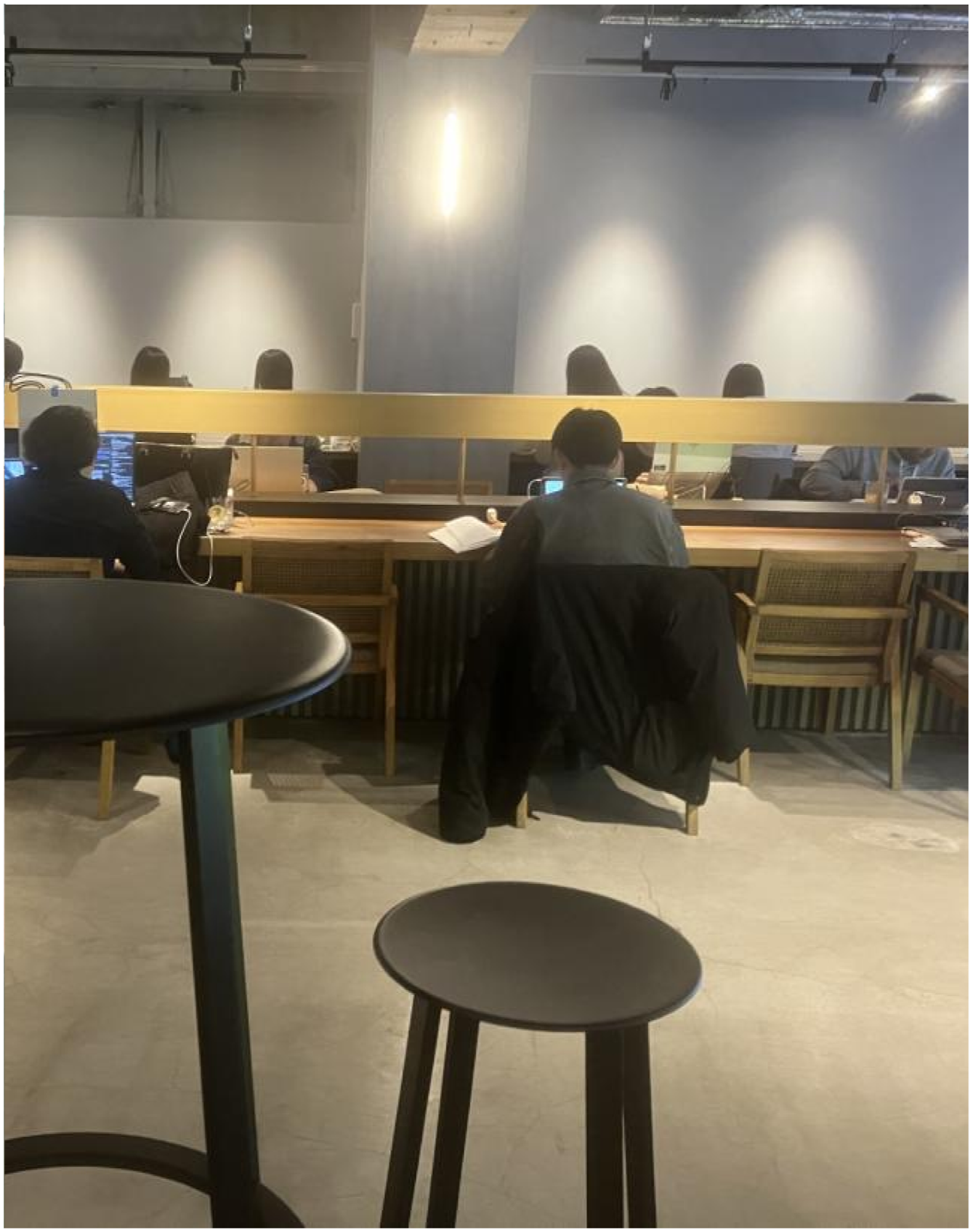
As I was sitting there almost alone, feelings of stress and disappointment started to emerge. I started to question my choice of place. Then, I started to look around. As in co-working spaces around Sapporo, benches in this café functioned as individual workstations (see Figures 3 and 4). I noticed some of the signs were written in English, relatively uncommon in Japan otherwise. The menu was also in English. Small messages were placed around the café. I started to scan for other objects. There were handmade souvenirs, almost turning the place into a small tourism hub. The intention was to attract people who would come here to work, precisely in this place. The room began to appear differently. I could see that there was a clear willingness to host foreigners who wished to work here. I realised that I had been looking in the wrong way. The field was not empty per se. What occupied the space was intention and willingness designed to help digital nomads function. In Kutchan, as in Sapporo, I could acknowledge the desire for events to occur, waiting for a major boom of digital nomads to arrive, but that had not yet occurred. This intent is what I follow in this section. A small café co-working space in rural Kutchan. Source: author A larger co-working space in urban Sapporo, functioning similarly to those in rural areas. Source: author 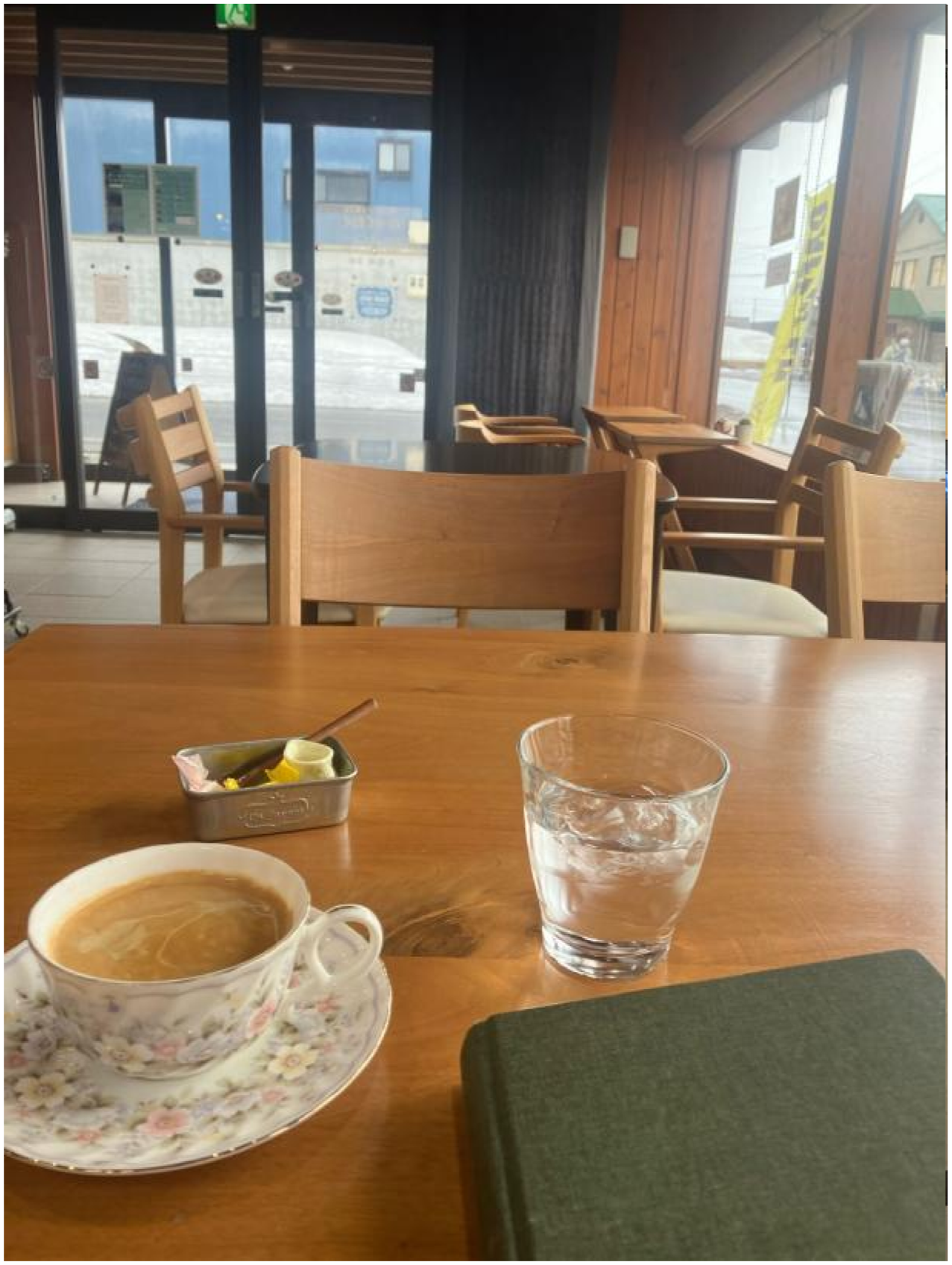
Spaces became central to my uneventful ethnography. The frictionless freedom through online work that digital nomads desire (Cook, 2022), combined with the café’s provision of working wifi, menus and descriptions in English, and tables arranged as workspaces, created an infrastructure that enables this possibility. Reflecting on the many hours I had spent sitting in cafés, I began to see how apparently empty spaces were filled with desires to meet and connect. Drawing on Merry White’s ethnography (2012) of cafés in Japan, coffee places became popular because, unlike tea, coffee lacks ceremonial rigidity and offers spaces free from prior cultural baggage, where people can meet at any time of day, away from everyday social pressures. Cafés thus become cultural bridges between worlds where digital nomads can be themselves. I observed behaviours otherwise considered unusual in the Japanese public sphere. People wore sunglasses indoors, displayed visible tattoos, spoke loudly and played music—practices that are generally uncommon in Japan—were permitted. I observed an Australian man, tall, blond, casually dressed and speaking loudly, warmly welcomed by staff who engaged with him in a noticeably less formal manner. I saw Italians chatting loudly at the bar, standing rather than sitting, as they might at home. A Swedish man, whose accent I recognised immediately, entered and exclaimed, extending with unshy gestures, “Wow, this is a really cool place.” Cafés thus became spaces of cultural encounter, where foreigners could ease into and maintain their own roles and behaviours without extensive cultural adaptation, and where one, as a foreigner, can enter and quickly acclimatise. Yet foreign digital nomads themselves remained few. Like the small space in Kutchan, Japan nevertheless appeared prepared for their arrival.
After visiting Kutchan, I travelled to Niseko to visit another café. While there were numerous foreigners, there were few digital nomads, as Niseko primarily attracts seasonal workers. There I met Hibiki from Japan, who had been working at a hotel. She dreamed of having online work and spent time watching people come and go from the café. She spoke of how others were able to leave for places such as Australia, while she herself could not afford to do more than hope for the next season. These dreams were also shaped through spaces, imagining herself as a digital nomad, soon connected to the world. At the same café, I met Andrew from Great Britain, an aspiring online kinesiologist trying to start his own company while working in hotels. He worked on his business in his spare time, driven by entrepreneurial ambition. He had just come out of a long meeting and sat down at a long table designed for work. The café was run by an Australian couple who had recognised years earlier that Niseko would become a place for foreigners, which it eventually did. The town was ready, with infrastructure already in place. Other attempts to establish co-working spaces nearby were visible through online reviews, but had since closed down. The narratives from Hibiki and Andrew show hope invested in the idea that this space provides possibilities for becoming a digital nomad. While Andrew planned to leave soon for Thailand, where he could work alongside others, Hibiki said she would come back next year, unsure what the next step would be, if it ever comes. These intentions are small hopes in waiting (Hage, 2009), but they are not yet realised events.
I eventually left Hokkaido in the hope of finding digital nomads in other rural areas. I met people with different projects, such as Sota, who manages a larger co-working space north of Tokyo, yet few digital nomads had arrived there, and plans to open a co-working space in a former Buddhist temple had fallen through. Other places associated with new development similarly reported few foreign digital nomads. When a colleague contacted one such place by email, they replied, “We have two people coming next week. Is that enough?” In Kyushu, the larger island across the sound over from Osaka, I encountered another site with only sporadic visitors. Like these places where I had been sitting in Sapporo, among the people I met along the way, a new rural Japan was taking shape. I began tracing the intentions shaping what was already there and what yet to come. Any transnational group is difficult to study ethnographically. Researchers cannot remain with them for long stretches because they are constantly moving elsewhere (D’Andrea, 2006), such as the diffuse group of digital nomads, ready to plug into almost any place (Busuttil, 2026). Digital nomads are few and far apart, but I see them cultivating hopes and dreams while remaining functional and frictionless.
Uneventful ethnography feel tressful. The assumption of not finding anything to report becomes emotionally daunting. But where interactions and events are scarce, spaces hold intentions for livelihoods not yet realised that resemble any other office environment, waiting for new events to emerge. “Waiting”, Hage (2009) describes, “indicates that we are engaged in, and have expectations from, life; that we are on the lookout for what life is going to throw our way”. The anticipation of events operates in two ways in the field, both for the people waiting for change and for me as a fieldworker. Uneventful ethnography requires attention to the details of what spaces are meant to become, and the narratives of what is supposed to emerge. Fieldworkers must work to unfold the field, even when it does not readily appear due to timing, place or misaligned intentions. Field sites are shaped by intentions embedded in people and spaces. As Japan opens up to the idea of hosting digital nomads, places seek to attract them in their organisation of space. I entered the field expecting to encounter a vibrant and colourful scene where digital nomadism was bursting into new locations. What I encountered was an imagined future designed to welcome digital nomads. Even amid debates over immigration and limits on tourism in Japan, I encountered intentions to create spaces where digital nomads might one day emerge.
Frontiers of the imaginary
A particular feeling strikes when walking through rural towns and villages in Japan. Before the realisation fully settles, what to me appeared as emptiness shaped by post-growth Japan was not entirely accurate. As I travelled across the country, my longest stay during fieldwork was in a small city around 3 hours south of Tokyo
4
. I first arrived there in April to stay in a co-living space and later returned in June for a 1-month gathering with digital nomads and members of the residents in the town. When I first walked through the streets, I thought, “The shops in the town will soon open”, but as the days passed, they never did. Looking behind the shutters, the interiors appeared as if they had been left in a hurry, falling apart, simply abandoned. Similar impressions emerged when walking through town after town, places marked by traces of what had once been active lives. In Figure 5, I show one such row of shops that once formed a lively commercial street but now resembles a ghost town. Birds have taken over the shotengai, the characteristic shopping street often covered with a roof. What does not meet the eye is that these towns are not empty but filled with life and hopes for a different future, not to grow or to be revitalised; they are vital, ready to invite people from around the world to Japan. Another Japan appears beyond demographic and economic decline, where different narratives have begun taking shape. Here are hopes for a new form of livelihood in which staying, attracting and living differently might become possible (Klien and Eriksson, 2026). Digital nomads, I thought, could connect here and break through barriers into another Japan, beyond dominant imaginaries. An example of empty alleys existing across rural Japan. Source: author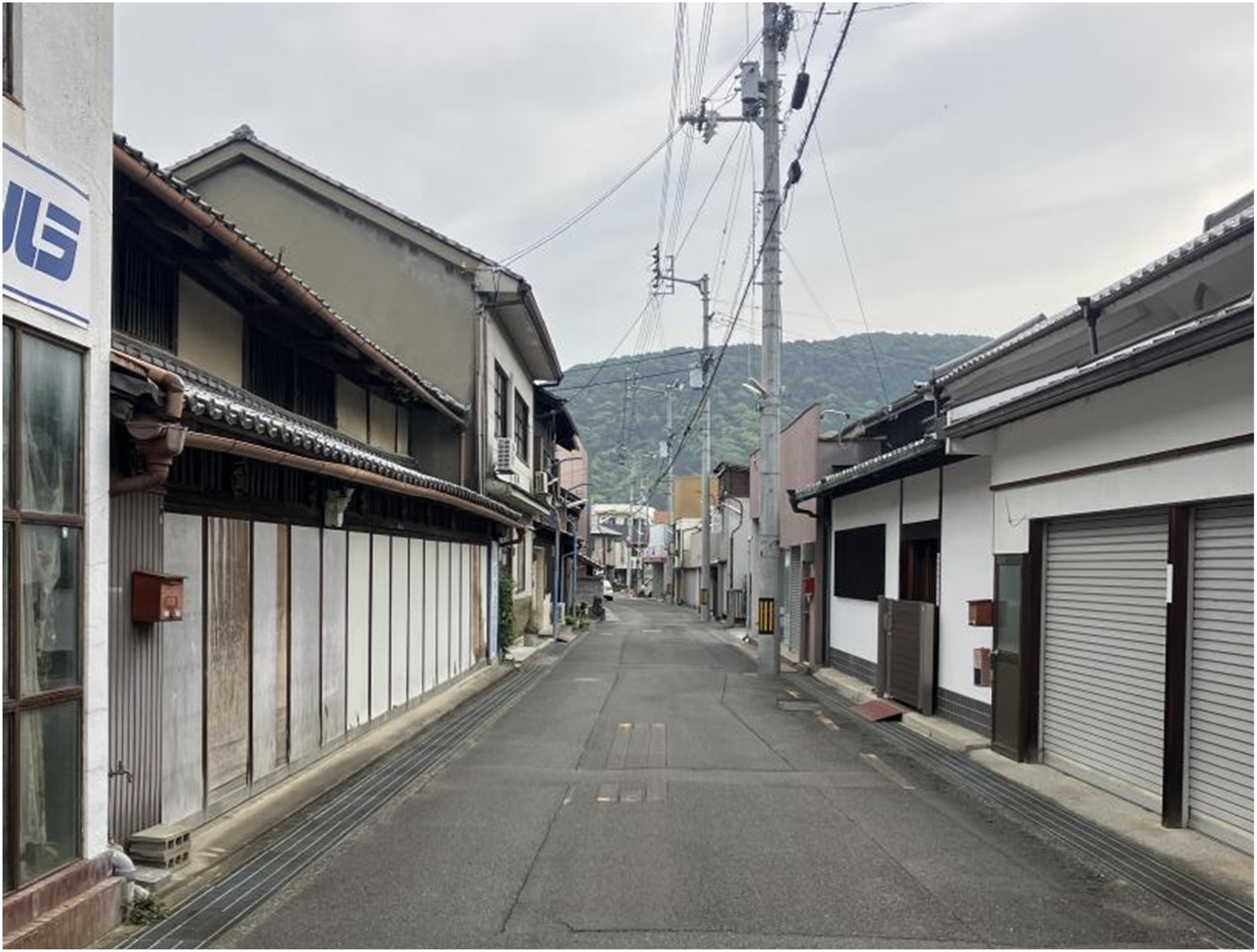
Anyone spending time on social media, guided by algorithms pointing towards Japan, has likely encountered thumbnail captions such as “Only in Japan”, depicting train conductors performing security checks with mechanical precision, or “Japan is in the year 3000”, showcasing futuristic self-flushing toilets. These imaginaries are not merely external idealisations of Japan, but are rooted in representations of the country as culturally separate and homogeneous, shaped through modernisation-era efforts to articulate national exceptionalism and circulated through education and elite discourse (Yoshino, 2005). Such framing overlooks historical and social complexity, marginalising Ainu and Ryukyuan groups (Hein and Selden, 2003; Siddle, 1996), the Korean population (Lie, 2008), and more recent migrant labour groups (Faier, 2009; Hansen, 2024; Ikeuchi, 2023), as well as contemporary transformations within rural Japan (Klien, 2020). Imaginaries are collectively produced through repeated representational practices that shape expectations and encounters (Salazar, 2012). Digital nomads similarly hold imaginaries through which they seek to differentiate themselves from tourists (Cook, 2022), often framed as a desire to push frontiers in search of something beyond conventional tourism. Drawing on Hansen’s concept of frontiers (2024), who analysed technological expansion in Hokkaido’s dairy farming with imagined raw and unfamiliar spaces that are gradually domesticated, digital nomads likewise extend familiar spatial and experiential boundaries and perhaps come to experience a changed view of Japan shaped by encounters with post-growth realities.
These frontiers of new encounters that I thought I would see were, however, largely absent in the field. Only a few individuals with whom I engaged came across this imagined frontier. Like Janna, a young German woman who came to Japan to explore and left her boyfriend at home. I would best describe her as an armchair digital nomad, someone aspiring to the lifestyle but currently working on a holiday visa (Cook, 2023). She was trying to work online in publishing, but for the time being was staying and working from the same hostel and co-working space as me. She searched for an alternative path, a way to move beyond what she framed as cultural Japan, but also beyond the festivity of Osaka, where she had previously stayed. Observing the town, she remarked, “You can see that this is a town for old people. They are only selling things for old people.” For her, the emptiness was interesting, but only as a short pause before moving on to the next place a month later. Other digital nomads experienced rural Japan differently. Josh, a landscape engineer from Australia travelling with his wife, described villages as places one moves through rather than engages with. “You pass through a lot of places, but you don’t stop. They’re just places you move through. You can see that things are set up for something to happen, but it just doesn’t” (interview, 22 April 2025). He later felt put off by Japan and said he would not return. Most digital nomads I encountered responded more like Dan, a British entrepreneur, perhaps superhuman, with enormous self-esteem, several companies, energy and skills, now travelling through Japan by van with his wife and child, who expressed even less recognition. When asked how he felt about the places he visited, he replied, “I don’t really notice those kinds of things. I’m just focused on getting my work done” (interview, 25 June 2025). While a few digital nomads encountered something different, many continued to relate to Japan primarily through work and mobility, moving from place to place without altering their imaginaries.
A gap emerged between the imaginary that I carried into the field and the experiences held by those I met. During my longer stay south of Tokyo, I joined a gathering of 10 foreign digital nomads and others from nearby towns and villages. Such gatherings often take place over short or extended stays intended to exchange ideas and counter loneliness (Busuttil, 2026; Cook, 2022; Klien and Eriksson, 2025; Lee et al., 2019; Reichenberger 2018). Over the month I spent with the group, our engagement was largely directed towards tourist sites. We travelled into the mountains, watched fireflies at night and participated in experiences that were touristic and therefore memorable, while separation from local life remained clear. When the organisers planned a visit to a local school where students were to practise English, none of the group members attended, and I later heard comments such as, “Why did you go there?” Although connection was discussed, it was rarely pursued, and reflections on the countryside were minimal. My own imaginary of what Japan should be, and what I hoped others might encounter during fieldwork, differed sharply from theirs. The digital nomads remained primarily connected to one another, circulating within global networks rather than embedding locally, and the frontier I imagined being crossed was rarely realised. Yet digital nomadism is not a fixed phenomenon. Small moments of curiosity occasionally emerged, as when Jane, a Taiwanese marketer living in London, asked after walking alone, “Why are the streets so empty?” Such moments were rare but revealing, suggesting that when mobility slows, attention may turn outward and imaginaries begin to loosen.
These interactions unsettled me while I was there. Reading back through my fieldnotes, I am now struck by how often I recorded my own irritation: “What unsettled me was not how participants spoke about rural Japan, but how they did not. Despite moving through the countryside, visiting local markets and being repeatedly told about local decline, few expressed any feelings towards the place at all. There was no articulated sense of loss, curiosity, discomfort or attachment. Affect appeared elsewhere, in discussions about work, growth, freedom or future plans, but rarely attached to the rural surroundings. The countryside functioned as a backdrop rather than an object of experience” (Fieldnotes, June 2025).
While feelings for rural Japan were rarely reciprocated by the digital nomads, hopes for transformation emerged more strongly among those working to create change. The idea of digital nomads breaking new frontiers became an attempt to make something else of the countryside. Eva moved to the town just before the COVID period. She fell in love with the place and made it her home. She began living in a co-living space and later created one of her own in the town. She organises gatherings for digital nomads that include returning visitors, Japanese participants and others exploring alternative ways of living. While autumn gatherings have attracted hundreds of Japanese participants, few foreign digital nomads attended this time. She nevertheless continues working to bring people there, constantly developing new projects. These gatherings also bring together local residents who, in similar ways, are searching for new futures. Like Cherry, Michiaki and other Japanese actors I met, Eva repeatedly reflected on depopulation, reorganising jobs into something that becomes meaningful for them. Digital nomads appeared as a source of hope, framed as figures who might help push new frontiers. Their hope was made explicit in a small brochure, as shown in Figure 6, which outlines what they tried to achieve with the gathering. A narrative created for a gathering, symbolising hopes and intentions directed towards digital nomads. Source: author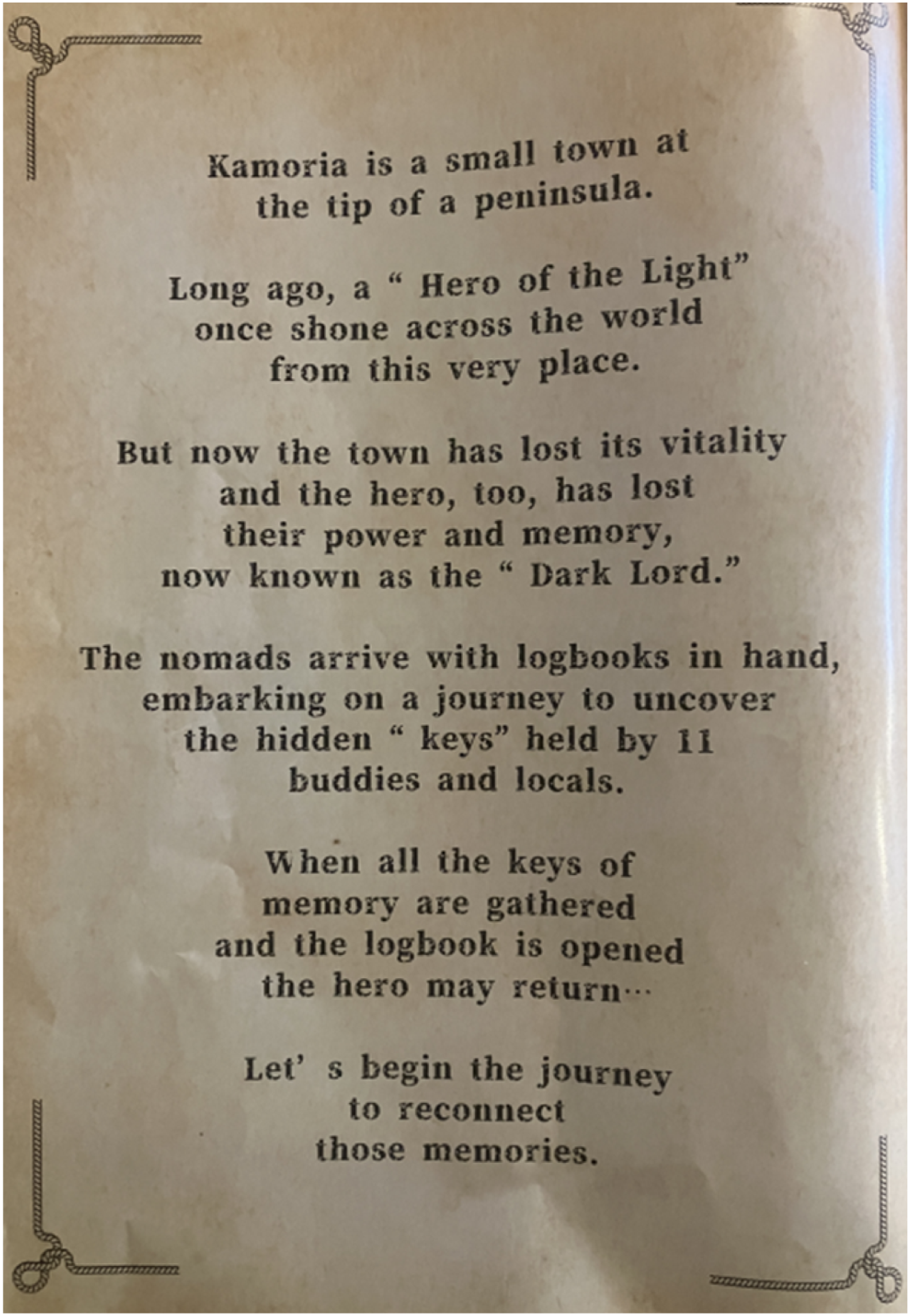
This vignette shows a non-reciprocated hope for breaking frontiers. Digital nomads seek freedom by pushing towards new imaginaries, but this unfolded differently than I initially expected. Uneventful ethnography sits on the frontiers of becoming, attending to intention as well as to the absence of expected events. Here, I expected encounters with post-growth Japan to generate a sense of ibasho, a sense of belonging to a place, within a different rural Japan (Klien and Eriksson, 2026). Yet digital nomad stays are typically too short for this to be realised, but these rural areas remain deeply connected to urban centres (Klien, 2020). The image of Japan as prosperous and unique remained dominant, while its problems largely went unseen. Digital nomads gravitated towards curated experiences, waterfalls, scenic coastlines and workshops before returning to urban centres. Imaginaries, Salazar (2012) reminds us, are sustained through collective and repeated representations. These attractions are what digital nomads seek, not post-growth Japan as I imagined. The gathering shows a buildup of hope in waiting, a knowledge of what has been, a replication and performance of what may become (Miyazaki, 2004). My irritation, evident in my fieldnotes, reflects my own desire for events to unfold, a hope for imaginaries that might break the frontier. Instead, I found myself standing at the frontier of what is being built. Uneventful ethnography thus marks where imagined research trajectories largely fail to unfold as expected, yet must remain at the frontiers of what might become, even when that future has not yet fully arrived.
Conclusions
Uneventful ethnography attends to anticipatory conditions, following a long anthropological tradition in which fieldworkers describe what is not said or done in social environments. Observations can, for fieldworkers, be directed towards what is expected to occur, even when events have not yet materialised at different scales. Uneventful ethnography should be understood less as a philosophical paradigm and more as a methodological tool that allows fieldworkers to attend to what might occur. This tool sharpens fieldworkers’ capacity to capture and decipher cultural elements of absence. While previous ethnographic innovations, such as short-term and focused ethnography (Knoblauch 2005; Pink and Morgan 2013), both of which have sought to intensify the capturing of events, with a focus on actualisation (Kapferer, 2015), fieldworkers may shift their attention away from anticipations and focus on the faint elements surrounding spaces, actions made and narratives told, all of which are filled with intentions, dreams and hopes not readily apparent. I extend Das’s (1998) call for an anthropology of events that seeks meaning through informants’ interpretations of previous events, arguing that fieldwork is not only concerned with the production of what events create, but, by taking a step back, also allows attention to the conditions through which events might eventually emerge. I do not call for deliberately seeking uneventful field sites, although that may be possible, but rather offer future fieldworkers an ethnographic interpretative tool when few events are available.
Uneventful fieldwork can be applied to any field site, not only my encounters with digital nomadism, but to broader anticipatory conditions. In the case of digital nomads, the anticipated event is less uncertain, while in other cases events may be more pronounced and explicit, whereas uneventfulness becomes particularly visible in times of uncertainty. In the Anthropocene—the geological epoch characterised by significant human influence—we are anticipating ecosystem failures, building protections to withstand an anticipated ecological collapse, such as whole countries threatened by sea level rise and intensifying storms. In other contexts, migration flows are continuously anticipated as conflicts appear to intensify. Migrants are expected to move across borders. Yet these events may unfold differently from what is imagined. Whichever direction uneventful ethnography takes, it provides a toolbox that can make fieldworkers less dependent on waiting for events and instead, as Anna Tsing (2015) suggests, turn to the arts of noticing, attending to what is physically there, listening to stories, scaling instances from the smaller to the larger event. In the faint and the strife exists what Miyazaki (2004: 128) describes as “the effort to replicate hope on a new terrain”. The fieldworker takes those moments out of sight into the larger picture. Waiting is part of ethnographic practice (Hage, 2009). Fieldworkers may find in the buildup of waiting for something or someone to act, or not act, as a form of epistemic knowledge.
Three vignettes assemble analytical lenses at different scales of digital nomadism in Japan. The first vignette situates the field within post-growth Japan, where both the Japanese state and local co-spaces are engaged in efforts to make something new happen. While these efforts differ in scale and form, they are produced within a field-in-making of anticipated events. The second vignette turns to detail in spaces. Furniture, chairs, messages and spatial arrangements are designed so that events may emerge, all filled with intentions. In the third vignette, where I encountered only a few signs of change, imaginaries remained largely unchallenged across different levels. These vignettes together show how digital nomads are part of a larger change, visible through noticing the details of uneventfulness that shape field sites. Field sites are shaped by what is imagined and expected. Here, the absence becomes an important source of ethnographic insight as part of a larger lifeworld (Jackson, 2013). While this insight brings connection from one perspective during fieldwork, namely digital nomads, other directions would reveal different paths, for instance how Japan is becoming a tourism magnet or how municipalities gain funding for attracting urban citizens to rural areas. I have not gained insights into these other contexts, as I focused on one group, and this limitation cannot fully account for the everydayness of life (Pink, 2009), where other tasks, objects and concerns extend beyond the immediate focus. Rather than treating everydayness as an opposite, uneventful ethnography should be seen as complementary to everyday life.
What these uneventful ethnographic accounts conclusively reveal about digital nomadism is a cultural formation driven by global intentions. While different actors work towards creating a post-growth Japan, foreign digital nomads remain largely within social and infrastructural bubbles where local attachment and personal obligation are limited, motivated by desires for freedom (Cook, 2022). Events are, in fact, not desired by digital nomads. Without events, digital nomads can continue seeking a life within existing frontiers, where perceptions are not directly challenged, and where imaginaries remain intact, unique and exceptional, drawn by scenic sites and curated experiences within a lifestyle that must remain efficient for new experiences. Rural areas are often perceived, albeit incorrectly (see Klien, 2020), as less connected and therefore become occasional detours that do not interfere with convenience or the sense of security afforded by global connectivity, found especially in cities. As a global phenomenon, digital nomadism depends on specific amenities, including networks of others in similar positions, which ultimately limit their ability to form local attachment. Digital nomad life depends on smooth, uneventful movements, where events become distractions and potential costs, whether money, time, expected experiences or resources. These intentions contrast sharply with those of Japanese actors who seek events to occur and stand ready with hopes of connection to a more rural life and to something new beyond post-growth Japan.
Footnotes
Acknowledgments
I would like to sincerely thank Professor Susanne Klien at Hokkaido University for her support and guidance during the fieldwork. Thanks to Helene Balslev Clausen for her feedback during the writing of the manuscript. I will also extend my gratitude to all the people whom I met and befriended over this time.

Ethical consideration
This fieldwork did not require formal ethical approval.
Consent to participate
All informants were informed about the role of the researcher and were able to withdraw their participation at any time. All informants and major sites have been anonymised to protect privacy.
Funding
The authors disclosed receipt of the following financial support for the research, authorship, and/or publication of this article: This research was funded by the Japan Society for the Promotion of Science (JSPS), grant number 906B001024, and the Swedish Society for Anthropology and Geography (SSAG).
Declaration of conflicting interests
The authors declared no potential conflicts of interest with respect to the research, authorship, and/or publication of this article.
Data Availability Statement
Data is not available for external review.