






Abstract
This paper develops the concept of entangled positionality as a way of theorising how researcher positionality is constituted across the multiple connected worlds the ethnographer inhabits. Drawing on Crossley’s relational sociology and building on Desmond’s call for relational ethnography, we extend recent scholarship on relational positionality (Bolade-Ogunfodun et al., 2023; Delfino, 2025; Drujon d’Astros et al., 2024) by applying Crossley’s (2011) network-analytic vocabulary to the question of positionality. Through three vignettes drawn from 20 months of longitudinal ethnographic fieldwork in an elite youth football academy, we show how access, disclosure and emotional labour were shaped by sedimented histories of interaction and structural intersections across overlapping small worlds. We argue that positionality is not a property the ethnographer carries into the field, but a configuration of ties produced and sustained across the worlds the ethnographer inhabits. The paper makes three specific contributions. Specifically, it applies Crossley’s (2011) theorising to positionality, it draws analytical attention to the ethnographer’s life beyond the field as structurally connected to the field, and it uses the empirical case of sports coaching research to demonstrate how dense, affective and morally charged occupational worlds make these networked dynamics particularly visible.
Introduction
One becomes an ethnographer by doing it, with immersive fieldwork often regarded as the defining practice of the trade (Van Maanen, 2011). The work of doing ethnography is far from a neutral or technical activity. It is a situated, embodied and relational process in which researchers bring their own histories, commitments and vulnerabilities into dense social worlds already structured by power, emotion and expectation (Bolade-Ogunfodun et al., 2023; Coffey, 1999; Delfino, 2025). Within the sociology of sport, this has been recognised through a broader reflexive turn that has challenged ethnographers to treat their subjectivity and positionality not as sources of bias to be eliminated, but as resources for generating rigorous, transparent and ethically attuned research (Ali et al., 2023; Townsend and Cushion, 2020).
Recent scholarship has begun to develop more substantive relational accounts of positionality. Bolade-Ogunfodun and colleagues (2023) propose the concept of entwined positionality to theorise how the researcher’s formative context interacts with their sensory capabilities in the field, arguing that ethnographers come to fieldwork already possessing embedded cultural values and traditions that have become part of their sedimented being. Delfino (2025) extends this work through the metaphor of interrelated shadows, demonstrating that researchers and participants co-construct positionality through formal and informal interactions, and that achieving a balanced position between emotional closeness and professional distance is rarely feasible in field settings. Drujon d’Astros and colleagues (2024) draw attention to the lingering nature of fieldwork emotions, showing through collective autoethnography how shame extends beyond emotional labour to shape the academic work that follows fieldwork. These contributions, alongside foundational accounts of fieldwork relationships (Adler and Adler, 1987; Coffey, 1999) and the longstanding tension between closeness and detachment (Maier and Monahan, 2009; Pilbeam, 2023), establish that positionality is co-constructed, embodied, and emotionally consequential.
What remains underdeveloped within this growing literature is an account of how positionality is constituted across multiple connected social worlds rather than within any single field. Each of the relational positionality accounts noted above attends carefully to what happens within the field and, in some cases, to what lingers from it. Less attention has been paid to the structural connections between the field and the other worlds the ethnographer inhabits. Researchers in dense occupational settings often move between the field, the university, the family home, and the broader professional networks within which their working and personal lives are embedded (Alvesson, 2009; Brannick and Coghlan, 2007; Edwards and Jones, 2018). The ties that bind these worlds together are not external to positionality. They are constitutive of it, in ways that scholarship on at-home ethnography (Alvesson, 2009) and the situated researcher (Wacquant, 2015) has begun to recognise but has not theorised in networked terms. A relational account of positionality, therefore, needs analytical tools capable of theorising the network of connected worlds within which the ethnographer is positioned, and the ways in which positionality is produced and tested through movement across them. Such tools allow researchers to map the relational histories, obligations and intersecting memberships that precede entry to the field, to account for the structural conditions under which disclosure and trust become available, and to conduct reflexive practice across the full configuration of worlds they inhabit rather than within the field encounter alone. In this way, the networked account of positionality developed here does not simply redescribe what happens in the field. It directs analytical attention to what makes the field encounter possible in the first place.
This paper offers Crossley’s relational sociology (Crossley, 2008b, 2010, 2015, 2018, 2022) as a generative lens for theorising this networked dimension of positionality. Building on the broader relational turn in sociology (Donati, 2011; Emirbayer, 1997), Crossley’s work integrates symbolic interactionism, dramaturgy and social network analysis, providing a vocabulary for understanding social life as constituted through patterns of ties, sedimented histories of interaction, strategic exchanges and emergent small-world formations. Crossley’s (2010) framework draws directly on Goffman’s (1959) dramaturgical sociology, particularly the account of how participants in social encounters read each other’s positions and adjust what becomes sayable accordingly. This dramaturgical thread is central to the analysis that follows. Indeed, it helps theorise how the configurations of ties through which positionality is constituted are also configurations that participants themselves can read and respond to in practice. Where existing relational positionality scholarship draws on critical sensemaking (Bolade-Ogunfodun et al., 2023), critical realism (Delfino, 2025) or Hochschild’s emotional labour (Drujon d’Astros et al., 2024), Crossley’s network-analytic apparatus directs analytical attention specifically toward the configurations of ties through which positionality is produced. This is an apparatus the existing literature does not have, and it makes available a different set of analytical questions about how positionality is sustained, constrained and transformed across the connected worlds the ethnographer inhabits.
Building on Desmond’s (2014) call for relational ethnography, which directs ethnographers to study fields rather than places, boundaries rather than bounded groups, processes rather than processed people, and cultural conflict rather than group culture, the paper develops the concept of entangled positionality. Where Bolade-Ogunfodun and colleagues theorise positionality as entwined within the field, this paper theorises positionality as entangled across the multiple connected worlds the ethnographer inhabits. The terminological shift from entwined to entangled is deliberate. Entwinement implies two things twisted together, fitting an account of positionality as the interaction of formative context with sensory experience in the field. Entanglement implies multiple things twisted together across boundaries, fitting an account of positionality as the configuration of ties produced and sustained across the field, the university, the family and the wider professional community. The existing relational positionality scholarship has made substantial and generative contributions to understanding how positionality is co-constructed, embodied and emotionally consequential within the field. The argument developed here builds on those contributions by theorising the networked configuration of worlds across which positionality is constituted. For us, this approach can help make visible relational dynamics in ways that exclusively in-field accounts cannot fully render.
This paper makes three specific contributions to the relational positionality literature. First, it applies Crossley’s network-analytic vocabulary to the question of positionality, providing analytical tools (sedimented histories of interaction, ties across small worlds (Fine, 2012), exchanges, and the relations of power they generate) that the existing relational positionality literature lacks. Second, it draws attention to the ethnographer’s life beyond the field as structurally connected to the field through overlapping small worlds, theorising positionality as constituted through the connections between worlds rather than within any single one. Third, it uses the empirical case of sports coaching research (Corsby et al., 2022; Potrac et al., 2017; Townsend and Cushion, 2020) to demonstrate how dense, affective, and morally charged occupational worlds make these networked dynamics particularly visible. The vignettes that follow are presented not as illustrations of established theory but as analytical sites through which the relational and networked nature of positionality is rendered legible in ways that an in-field account would not permit. Indeed, by foregrounding the interconnected nature of the worlds ethnographers inhabit, the paper highlights how methodological rigour in qualitative research can be strengthened by attending not only to what happens in the field, but also to the histories, ties, obligations and emotional currents that bind researchers to the wider social worlds through which their work is enacted.
Method
Approach and methodological stance
This study is an ethnography conducted by the first author over 20 months of fieldwork within an elite youth football academy in England, supported by collaborative reflection and analysis with the co-authors. The methodological problem the paper addresses is one that a conventional bounded-field account of ethnography is not well equipped to handle. When researchers work within occupational worlds they also inhabit as coaches, educators, colleagues and family members, the field is not a discrete site they enter and exit. It is one node in a configuration of connected worlds whose ties, histories and obligations shape what the researcher can see, say and do from the outset. A relational ethnographic approach, following Desmond (2014) and drawing on Crossley’s relational sociology, is therefore not simply a methodological preference here. It is the paradigmatic response to a problem that more bounded accounts of fieldwork cannot fully address.
The duration of the engagement also matters analytically. Longitudinal ethnographic studies allow understandings of the field to develop, be tested, and be revised through repeated encounters across time, in ways that shorter or more episodic engagements cannot (Barley, 1990; Hammersley and Atkinson, 2007). The work draws on autoethnographic methods as part of its design. The vignettes presented later in the paper are first-person accounts produced by the first author from personal diaries, fieldnotes, and inter-researcher dialogue. The analytical framing of those vignettes and the broader argument the paper develops are the work of the authorial team, conducted through sustained collaborative engagement throughout the study.
We refer to the work as ethnography rather than as ethnographically inspired research because the study sustained immersive engagement with the field across a period long enough to develop and revise the relational and contextual understandings that ethnography requires (Hammersley and Atkinson, 2007; Van Maanen, 2011). The autoethnographic component does not displace the ethnographic frame. It contributes one of several methods through which the ethnographic understanding was produced, alongside more formal observations, semi-structured interviews, and participatory mapping exercises. We follow Anderson (2006) and Bolade-Ogunfodun and colleagues (2023) in treating autoethnography as a means of integrating the researcher’s experience into the analysis rather than as a substitute for engagement with participants and field settings.
A note on voice in the paper. The vignettes presented later are written in the first-person singular voice of the first author and reflect his experience of specific moments in the field. The analytical and methodological prose is written in the first-person plural voice of the authorial team and reflects the collaborative work undertaken throughout the study. Where the structural distinction between the first author’s particular role and the authorial team’s collaborative work matters, the term “the first author” is used. This convention is itself a methodological move. It makes the relational and networked nature of the analytical accomplishment visible in the paper’s grammar, with the first author’s first-person experience and the team’s collaborative analysis represented in distinct voices.
The methodological orientation is grounded in a relational approach. Following Desmond’s (2014) argument that ethnographic objects of inquiry should be configurations of relations rather than bounded sites, and drawing on Crossley’s relational sociology (Crossley, 2010, 2018, 2022), we approached ethnographic encounters not as discrete moments of data collection but as sites of ongoing interaction, exchange, and ties through which configurations of relations were sustained, transformed, and made visible. The introduction has set out the conceptual contribution that this orientation makes. The remainder of the method section addresses how this orientation was enacted in practice. Specifically, we describe how we distinguish positionality from reflexivity, the structural conditions of the field site, the strategic mapping that preceded entry, and the reflexive practices we employed during and after fieldwork.
Positionality and reflexivity
We use positionality and reflexivity as related but distinct terms (Berger, 2015; Holmes, 2020; Sibbald et al., 2025). Positionality refers to the relational and structural position from which the researcher works, including the configurations of ties, sedimented histories of interaction, and overlapping memberships across the worlds the researcher inhabits (Bolade-Ogunfodun et al., 2023; Holmes, 2020). Reflexivity refers to the ongoing practice of attending to that positionality, including how it shapes what becomes accessible, what is registered, what is interpreted, and what is communicated (Finlay and Gough, 2008; Holland, 1999). Positionality on this account is the relational fabric through which knowledge is produced. Reflexivity is the methodological practice of working with and through it. As Sibbald and colleagues (2025) argue, the two are inseparable in practice, with reflexivity locating positionality within the research and positionality opening the path for reflexive analysis. The relational and networked account we develop deepens this connection. Positionality is constituted across configurations of overlapping worlds, and reflexive practice therefore needs to attend to those configurations rather than to the researcher in isolation.
The first author was positioned within the field through a configuration of ties built over many years prior to the study. Several academy staff were former students of his, others had worked alongside him on coach education courses, and others had collaborated with him on community projects. He held a recognised academic position at a university with formal partnerships with coaching centres in the region, and he had coached within the club’s pathway in earlier years. The co-authors were positioned through related but distinct configurations, with overlapping ties to the wider football and coaching education community, longstanding research collaborations with the first author, and parallel histories as coaches and educators. These positions afforded substantial access and trust within the field. They also generated specific obligations and expectations that ran across the configuration, with implications we trace in the analysis that follows.
The asymmetries of power and resource that shaped these positions warrant explicit acknowledgement (Karnieli-Miller et al., 2009; Pillow, 2003). The first author held resources that participants frequently sought, including access to coach education routes, professional development opportunities, and the recognition that came with being a familiar figure in the wider football community. Participants held resources we needed, including access to the field, willingness to disclose, and the credibility that came from their continued cooperation. These exchanges were not symmetrical. Some participants spoke from positions made vulnerable by precarious employment, by gendered expectations of stoicism in football coaching cultures, or by their own histories within the configurations through which the work was conducted (Roderick, 2006; Roderick et al., 2017). The relational and networked account of positionality we develop is therefore not a description of horizontal partnerships. It is an account of how power operates differentially across configurations of overlapping ties, including those with considerable asymmetry (Crossley, 2022; Pillow, 2003).
To attend reflexively to these dynamics, we adopted a set of practices, which we describe in the following subsections. These included the strategic mapping of relational networks before entry to the field, regular member-checking with participants through pitch-side conversations following interviews or participatory mapping sessions (Birt et al., 2016), explicit invitations for participants to revisit or retract sensitive disclosures, and what Hamdan (2009) and Ali et al. (2023) describe as reflexivity of discomfort within and beyond the authorial team. These practices were not undertaken to neutralise our positionality, which, on the relational and networked account we develop, is neither possible nor desirable (Berger, 2015; Holmes, 2020). They were undertaken to keep its configurations and consequences in view. This is precisely the problem that the concept of entangled positionality is designed to address. When positionality is constituted across a configuration of connected worlds rather than within the field alone, reflexive practice that attends only to the field encounter is insufficient. The concept directs researchers toward the full configuration, including the sedimented histories, the overlapping obligations, and the readings that others perform across connected worlds, as the proper object of reflexive attention.
Context
The study was situated within a Category 3 youth football academy in England. Academies in the English football system operate within a tiered framework based on the Elite Player Performance Plan (EPPP), which incorporates financial and managerial support, coaching provision, sports science services, training facilities, and access to appropriate levels of competition (Abbott and Collins, 2004; Sotiriadou, 2013). Category 3 academies typically lack the financial, infrastructural, and staffing resources of higher-tier institutions, but they remain characterised by dense and dynamic relational configurations. The fieldwork involved polyvocal accounts from interconnected stakeholders including academy management, coaches, recruitment personnel, sport scientists, video analysts, and parents. These environments are marked by competitive pressures, fluctuating expectations, and high staff turnover (O’Gorman et al., 2021; Thomas et al., 2025). They are also embedded in wider configurations through which careers, reputations, and obligations travel across small labour markets.
Following Desmond’s (2014) call to study fields rather than places, we treated the academy as one node in a wider configuration rather than as a bounded site of fieldwork. The configuration included the academy itself, the university and its formal partnership arrangements with coaching centres, the wider community of coach education through which the first author and several participants had moved, the family and personal networks within which the first author conducted his life beyond the field, and the coaching and academic communities that connected these worlds. The vignettes presented later draw on episodes that took place within the academy, but the relational dynamics they make visible operate across the full configuration. Figure 1 represents the configuration as we understood it at the outset of the study. A relational map of the configuration within which the fieldwork was situated. The figure shows the academy at the centre as the immediate site of fieldwork, with connected nodes representing the university and its partnership arrangements with coaching centres, the wider coach education community, the local football networks within which several participants had moved, and the family and personal networks within which the first author conducted his life beyond the field. Each named researcher is shown in a distinct colour, with the labelled nodes within each cluster representing the principal worlds that researcher inhabits. The smaller unlabelled circles within each cluster represent individual actors located within those worlds, sketched here to indicate density rather than to identify particular ties. The lines between nodes represent ties produced through prior interactions and sustained through continuing engagement, including former teaching and supervisory relationships, coaching collaborations, and ongoing professional and personal connections. The figure represents these ties as visually equivalent for clarity, but they are not equally strong or consequential in practice. The tie between the first author and his family operates differently from the tie between the first author and the academy, with different obligations, expectations and emotional weight running across each. The figure is not a representation of every individual tie within the configuration, nor of the relative strength of those represented. It is a schematic representation of the principal worlds within which the configuration was constituted, and through which the first author’s positionality at the field site was produced.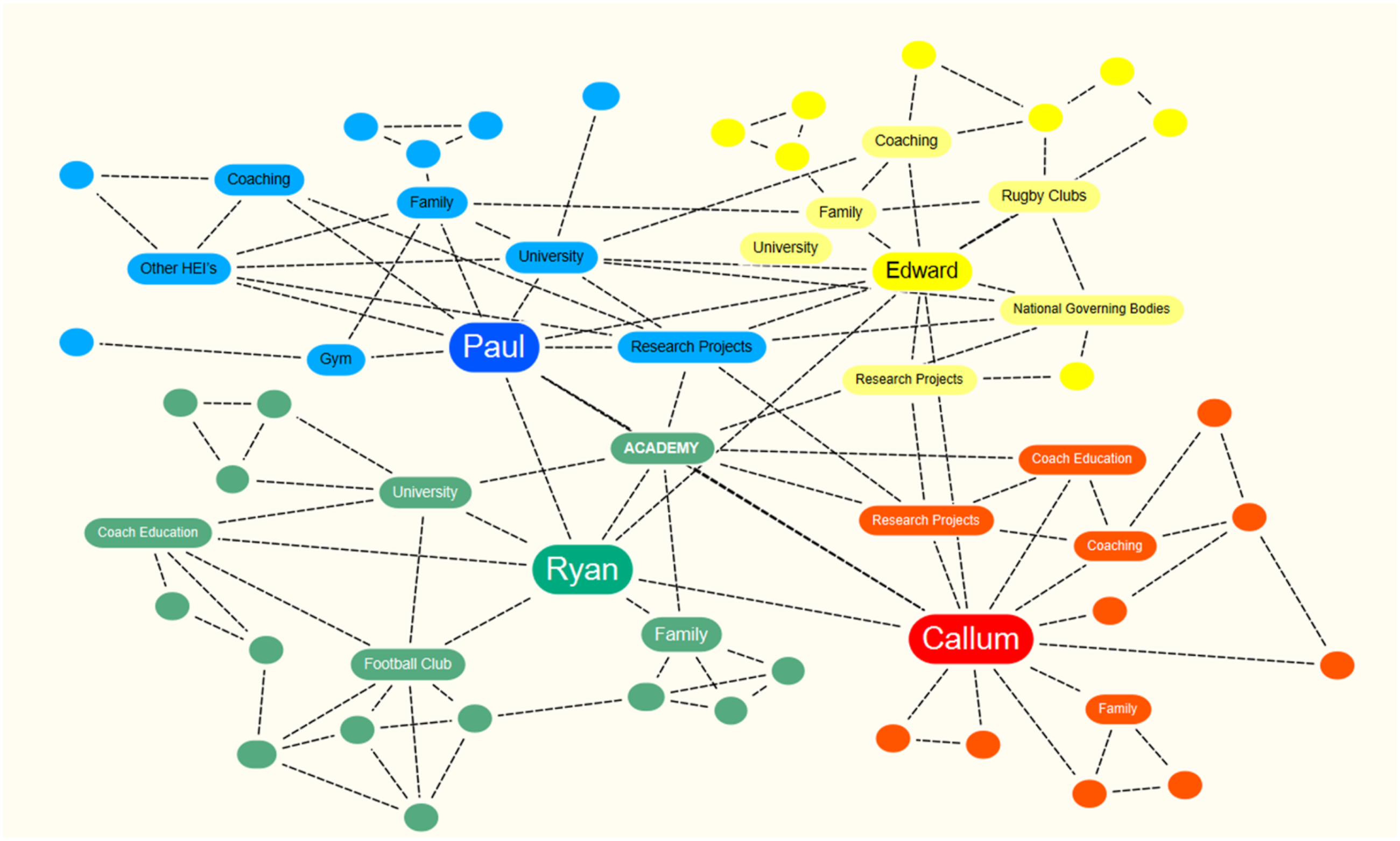
Strategic mapping of relational networks
Our approach to positionality and reflexivity began before entry to the field, through an intentional mapping of the relational networks within which the study would be conducted. This mapping helped identify likely participants, the histories and obligations through which they were already connected to us, and the distinct social worlds with which we were already entangled. Some academy staff were graduates of university programmes in which we had taught. Others had collaborated with us on national governing body coach education courses, on community projects, or in shared coaching roles across previous seasons. These ties were not external context to the project. They were constitutive of the configuration through which the project was conducted, and the mapping helped us anticipate where they might enable the work and where they might constrain it.
The mapping also surfaced relational vulnerabilities. The boundaries between our academic, sporting, professional and personal lives were often blurred across the worlds the configuration spanned. Where loyalties, trust or competing obligations cut across distinct nodes in the configuration, the strategic mapping helped us anticipate the consequences. Figure 2 depicts the configuration of overlapping worlds in which the study was conducted, with attention to the points where competing obligations and ties intersected. Strategic mapping of overlapping social worlds within which the study was conducted. The figure represents the principal worlds within which the configuration of ties operated, including the Category 3 academy, the university, and the wider coaching community within which the first author and several participants had moved. These three nodes denote institutional and community settings that the researcher inhabits. The lighter nodes positioned between them denote relational properties that operate across the configuration rather than worlds in their own right. Informal access, shared history and trust are not places the researcher inhabits. They are resources produced through ties across the worlds shown, and they shape what becomes possible within the configuration. The dashed perimeter signals that the configuration is not bounded but extends into the wider professional and personal networks within which the researcher’s working and personal life is conducted. The figure foregrounds the configurations through which positionality was constituted across multiple connected worlds rather than within any single one.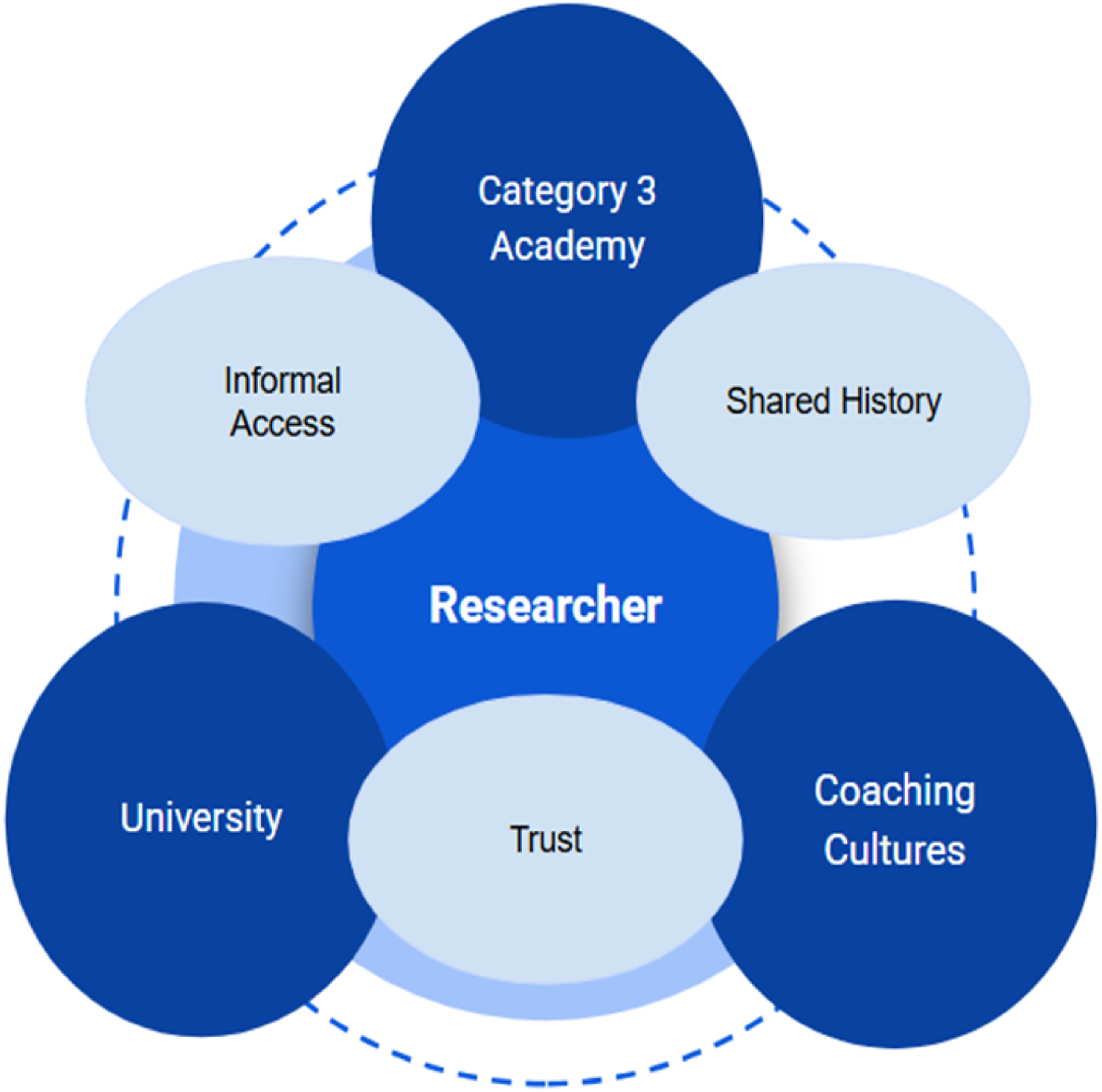
The mapping was not a one-time exercise completed before fieldwork began. It was revisited throughout the study as new ties formed, as existing ties were tested, and as the configuration shifted in response to events at the academy and in the connected worlds. This iterative process helped us recognise that fieldwork unfolded as the outcome of relational connections and configurations of working, sporting and emotional lives, rather than as a procedural sequence governed by gatekeepers and institutional ethics agreements.
Vignettes as relational artefacts
The vignettes presented in the paper are data artefacts generated from personal diaries, fieldnotes, and inter-researcher dialogue arising from longitudinal engagement in the field. They derive from informal pitch side or touchline conversations with participants, from more formal observations and semi-structured interviews, and from participatory mapping exercises. Following McQueeney and Lavelle (2017) and Bolade-Ogunfodun and colleagues (2023), we adopted vignettes not as introspective accounts but as relational artefacts that situated emotions, decisions and disclosures within the configurations of ties through which they were produced. The selection of the three vignettes presented here was driven by their analytical capacity to make visible the three contribution moves the paper develops. Namely, the configuration through which access was produced, the structural intersection through which disclosure became available, and the connections between worlds through which positionality was constituted across the field and beyond it. The collaborative dialogues through which the authorial team analysed the vignettes are noted in the analysis where they bear on the interpretation offered.
Stories from the field
Sedimented histories and access
Here, we illuminate how histories of interactions and relations with certain actors, often forged within a different social world, were critical in gaining access to a typically secretive and closed field. Methodologically, this was important, as without acknowledgement of such sedimented histories, the ethnographic experience may have been wildly different. The vignette is situated at the start of a prolonged period of data generation activities. It highlights an early but significant moment that sheds light on the first author’s fluid positionality and the informal nature of interaction that generated unease about relational expectations.
Vignette 1: past identities that shaped access, trust and expectations.
Walking into the academy for the first time should have felt comfortable, familiar, even cosy. I wasn’t a stranger to this environment, or indeed to many of the people within it. Yet it wasn’t long before the weight of what I had taken on hit me like a ton of bricks. “Alright, mate? Project starts tonight, doesn’t it? Wow… there’s loads for you to analyse! Good luck.” Off he went, chuckling to himself as he greeted his players and prepared to start the session. The familiarity within this early disclosure came from a good place, perhaps an attempt to ease me back into the banter-laden culture of youth football. Still, such a blunt and unfiltered remark from a former student and coaching colleague caught me off guard. Before I had even opened my notebook, I felt drawn into his world. I was acutely aware that gaining access to professional football clubs is rarely straightforward for academics engaged in interpretivist research. I was unlikely to uncover neat solutions or incontrovertible truths that could be packaged as competitive advantages. Instead, I anticipated encountering uncomfortable aspects of practice, insights that prompted questions of “why”, rather than “what” or “how”. Standing pitch side in my university-logo’d tracksuit, I felt a rush of conflicting emotions as I prepared to observe the everyday rhythms of academy life. Why was I so lucky to be here? What did this access require of me in return? Would I now need to go over and above to justify my presence in this typically closed world? As the session unfolded with the energy and professionalism I had come to expect, my participation began to feel like both a privilege and a burden. My primary gatekeepers were both former students at my university. I had also coached within the club’s pathway, keen to demonstrate credibility to my own students. At that moment, it felt as though they were helping me now, just as I had supported them in the past. Through the reformation of these ties, I became acutely aware of the expectations attached to my presence. Despite this unease, it was the coach’s opening comment that lingered most. Whether it was the reference to the sheer volume of “things” to analyse, or the casual chuckle as he took up his position on the pitch, I sensed that our sedimented histories enabled him to share frustrations freely, before the research had even formally begun. Life in the academy was clearly demanding, emotionally and professionally, and I was already being positioned as someone who could listen. I was there because I was known. That familiarity was a blessing, yet it quickly revealed itself as also a curse. I was immediately positioned as the person coaches confided in, sharing frustrations and disappointments as though I were reliving versions of my former self. While this closeness appeared advantageous for the project, it also resurfaced the pressures attached to my role. The outcomes of this work were tied to my academic position and future career. Meeting the expectations of the research, amplifying coaches’ voices, and navigating the obligations felt towards former students and colleagues generated a persistent mix of anticipation and anxiety; one that would follow me throughout the next twenty months of data generation.
What this vignette makes visible is not simply that the first author had prior relationships with people at the academy. The literature on access to elite sport settings has long recognised that prior relationships ease entry (Potrac et al., 2013; Roderick et al., 2017). What is harder to see without a relational and networked vocabulary is the structural configuration that produced his position at the moment of entry. The coach who delivered the opening remark was a former student. The primary gatekeepers were also former students. The first author had himself coached within the club’s pathway. He had supervised his current gatekeepers as undergraduates. He had supported them through transitions into employment. He held a recognised position at a university with a partnership arrangement with the club. Each of these connections, viewed in isolation, is a single tie. Viewed together, they form a small-world configuration in which he was simultaneously a former teacher, a former coach, a current colleague, a future referee for promotion, and a present researcher. The coach’s opening remark was addressed not to any one of these positions but to the configuration of them.
This is what Crossley’s network-analytic vocabulary makes available that other relational accounts of positionality do not. Bolade-Ogunfodun and colleagues’ (2023) account of entwined positionality directs analytical attention to the interaction between the researcher’s formative context and their sensory experience in the field, drawing on Wacquant’s (2015) account of sedimented being to theorise how the researcher comes to fieldwork already shaped by formative cultural experience. The vocabulary is well suited to theorising how the first author’s biography as a coach and educator shaped what he noticed, felt and registered as he stood pitchside. Crossley’s network-analytic vocabulary (Crossley, 2010, 2011, 2018) extends this work by making the structural configuration of overlapping ties through which his entry was produced analytically visible alongside the formative context Bolade-Ogunfodun and colleagues (2023) theorise. Sedimented histories of interaction, in the sense Crossley (2010) develops following Mead and Strauss, are not the background context for the field encounter. They are the architecture of the field encounter itself.
The coach’s remark also illustrates something about how this network architecture shapes what disclosure becomes possible (Goffman, 1959). The remark was a half-confession delivered as banter, before the research had begun, by a former student to a former teacher who was also a current researcher. The coach was not addressing the researcher’s role alone. He was addressing a position in the network that already carried obligations of care, history, and recognition. From a Crossley-informed perspective, this is what makes the disclosure structurally available. The participant was not opening up to a stranger. He was speaking into a configuration of ties that had been forming for years before the research began and would continue to form long after the data-generation period ended. The fluidity of his disclosure and the weight the first author felt upon receiving it are products of the small-world configuration (Fine, 2012) rather than of the immediate encounter.
This shifts our understanding of the methodological problem of access (Alvesson, 2009; Brannick and Coghlan, 2007). Within the bounded-field framing that Desmond (2014) critiques, access is conceived as the moment when the researcher crosses the boundary between not being in the field and being in the field. The relational and networked account developed here suggests that for ethnographers working within their own occupational small worlds, the boundary itself is not where the analytical action lies. The first author was already inside the network long before he entered the academy. What he experienced at the moment of entry was not the crossing of a boundary but the activation of a configuration of ties whose existence preceded the project, persisted across its duration, and would continue to shape what his presence meant for years afterwards. The vignette is therefore not simply an account of how prior relationships ease access. It is an account of how positionality, as a networked accomplishment, was already constituted before the field encounter began.
Trust, disclosures and methodological distance
Below, we demonstrate how the close ties the first author developed with certain participants created conditions of enhanced interpersonal trust, and perhaps most significantly, sensitive and politically charged disclosures. Certain participants positioned him as their “therapist”, so there was an immediate need for care and empathy rather than detachment and objectivity. The key incident(s) described occurred approximately 14 months into the data-generation activities and marked a pivotal moment in the fieldwork. The vignette foregrounds the blurred boundaries and shifting role expectations commonly experienced by ethnographers but sheds further light on the relational features and ethical tensions that accompany them.
Vignette 2: close ties, sensitive disclosures and blurred boundaries
“Mate… you’re my therapist.” The comment was intended as a half-joke, half-confession, yet I could tell he was deeply burdened and in need of someone to talk to. My presence had shifted into a role I neither sought nor fully understood. “I haven’t seen my kids awake in nearly three weeks and it’s breaking me. You’re a Dad, you get it. How do you keep all your plates spinning? Because I feel like mine are smashing… I’m breaking. I hate this, and it’s making me ill.” In that moment, I realised I was no longer simply the researcher. The sedimented histories between us, and the trust built through shared roles across connected and unconnected sporting worlds, had enabled a disclosure so sensitive that I was forced to adapt immediately. I had to understand his world, reflect on my own, and respond with care, while also acknowledging that this moment held profound methodological significance for the project. This was not an isolated encounter. Later that month, another participant disrupted the already blurred boundary between researcher and confidant with a comment that shook me deeply. “I think, no, I know my marriage is breaking down, and it’s because of the job. It’s brutal. You either get on the bus or you’re out. I know it’s my choice, but my marriage is shot to pieces.” His voice cracked as he shared details too personal to voice to colleagues and too heavy for the professional scripts we both inhabited. Within minutes, he unloaded a torrent of frustration about academy life and the fear of what challenging entrenched football cultures might mean for his, and his children’s, futures. The burden had become too much to carry alone, and I was his chosen conduit. I found myself wondering whether he knew of my own past struggles, torn between being a present husband and father, and the ambitious coach, educator and researcher drawn into the greedy cultures of professional football and neoliberal academia. I was grateful that my own life experiences allowed me to sit with such disclosures, yet acutely aware of the responsibilities they carried. I valued the trust embedded in our close ties, but that closeness also produced tension. My sense of care for them as people conflicted with my sense of duty to represent the brutal realities of their working lives. Through our regular dialogues of discomfort, my colleagues and co-authors shared similar experiences from their own ethnographic work. These conversations helped me regain a measure of methodological distance, offering space to process emotion and shift analytic focus. Yet this distance sat uneasily alongside my responsibility as a human being. Watching individuals suffer in this way was deeply unsettling. I wanted to keep checking in, to advocate on their behalf, or to challenge the club’s rhetoric of “family” against the realities of its practices. I don’t think I ever resolved this tension successfully, and I didn’t seek institutional intervention. While it was painful to see both individuals eventually leave the club, I also knew, quietly, that it was the right decision for each of them.
The framing of the researcher as therapist is not new (Coffey, 1999; Coombs and Osborne, 2018; O’Brien, 2025; Schmidt et al., 2024). A growing body of work has illuminated the awkward dependencies, embodied tensions and dynamic identities that emerge when ethnographers receive disclosures from participants who treat them as confidants. The relational positionality literature has extended this work in productive directions. Drujon d’Astros and colleagues (2024) examine how such disclosures generate emotions of shame that linger beyond fieldwork. Delfino (2025) theorises moments of destabilisation as shadows that reveal hidden organisational realities. Maier and Monahan (2009) frame the closeness produced by disclosure as part of the perennial tension between rapport and critical distance. Each of these accounts has an analytical purchase. The Crossley (2008a) informed account developed here builds on them by attending specifically to the question of why this disclosure was made to this researcher at this moment. Importantly, it locates the answer in the configuration of overlapping worlds through which the participant could read the first author’s position.
The participant who said “Mate, you’re my therapist” was not addressing a stranger. He was addressing someone whose position he recognised. From Goffman’s (1959) account of the structure of social encounters, recognition operates through participants reading the position another occupies in relation to themselves and to the wider configuration of relations within which the encounter takes place. The first author was not only the researcher in the room. He was a fellow father navigating the demands of professional sport and family life. He was a former coach who had worked within similar academy environments. He was an educator whose academic position was connected to the professional development pathways through which the participant’s career had moved. Each of these positions located him in a world the participant also inhabited. The disclosure was made to this researcher because the participant could see that he sat at the intersection of those worlds. The recognition embedded in the participant’s remark was a relational reading. The participant was not opening up to a confidant who happened to be present. He was opening up to a node in a configuration of overlapping worlds (Crossley, 2010, 2018), and the disclosure was structurally available because of where that node sat.
This is what Crossley’s relational sociology (Crossley, 2010, 2018, 2022) adds to the existing literature on relational positionality. The disclosure is theorised here not only as an emotional event within the field or as an interaction between the researcher’s formative context and his sensory experience. Instead, it is also presented as a network event whose conditions of possibility lie in the structural intersection of multiple worlds. The participant was not reaching out into a void. He was speaking into a position whose properties he could read because his own life intersected with the same configuration. The first author’s positionality at this moment was not a property he carried into the field. It was constituted at the intersection of the field with his other worlds, and it was legible to the participant because the participant inhabited a similar intersection.
The second disclosure in the vignette confirms the pattern. The participant whose marriage was breaking down spoke not because he had identified the first author as a sympathetic researcher but because he had identified him as someone whose own life sat in the same configuration of pressures. The professional cultures of academy football and academic research are not the same. They are connected. They share a logic of what Coser (1974) termed greedy institutions, where total commitment is expected, contingent employment is normalised, and personal life is routinely subordinated to organisational demands (Allen-Collinson, 2009; Roderick et al., 2017). The participant’s disclosure was made to a researcher whose presence, however implicit, registered that he too was navigating such a configuration. The disclosure is not therefore reducible to a moment of emotional vulnerability in the field. It is a relational event that depended on the participant’s ability to read the first author’s structural position across the worlds they both inhabited.
This shifts our understanding of emotional labour in fieldwork. Hochschild’s (1979, 1983) account of emotional labour, taken up in recent qualitative methodology by Drujon d’Astros and colleagues (2024), theorises the affective work the researcher does in receiving such disclosures and the way feeling rules from different communities shape what can be expressed. The Crossley-informed account developed here does not displace this work. It adds something specific. It directs attention to the structural conditions under which such disclosures become available in the first place. The emotional labour of receiving a disclosure follows the disclosure. The networked configuration that makes the disclosure available precedes it. Both are part of the same relational accomplishment, and a complete account of positionality needs to attend to both.
The tension the first author describes at the close of the vignette, which he neither resolved successfully nor sought institutional intervention for, warrants attention. It would be straightforward to read this as a methodological failing. The relational and networked account we develop suggests a different reading. The decision not to seek institutional intervention was itself a positional decision made from within the configuration. Routing the disclosures through formal institutional channels would have altered the configuration in ways the first author was reluctant to authorise. This included the standing the participants held within their employment, the trust the first author held within the wider football community, and the obligations of care that ran across former student and colleague relationships predating the project. The decision was uncomfortable rather than confident. Sitting with this discomfort, rather than resolving it through institutional procedure, shaped the work that followed in specific ways. The first author became more attentive to what he invited from participants in subsequent encounters and more willing to sit with what arrived without seeking to redirect it. The authorial team became more deliberate about how sensitive disclosures were featured in the written work. These disclosures continued to inform our analytical sense-making, shaping how we read patterns across the data and how we understood the structural conditions under which vulnerability became expressible. At the same time, we avoided direct extracts that could harm the participants within the configurations they continued to inhabit, choosing instead to illustrate selectively and at a level of abstraction that protected their standing. We also shared our analysis and emerging interpretations with the participants concerned, inviting them to refine, contest or withdraw any element with which they were uncomfortable. The team returned to questions of duty of care more frequently in subsequent dialogues, with the unresolved tension serving as a recurring reference point. We do not consider our choices and actions as a model to be followed. Instead, they illustrate how positional decisions, including the decision not to act, are themselves part of the relational accomplishment of the research and carry consequences that reverberate across the configuration well beyond the moment of disclosure.
Taking the field home: Emotional exhaustion and sense-making
Here, we highlight how the first author’s emotions from the field were carried across his social worlds, such that they could not be analysed and understood in isolation. Crafted from fieldnotes in the same week as the conversations with coaches above (14 months), the vignette captures a moment of heightened significance, prompting introspection. The following experience enabled analytical reflection on the consequences of such emotionally charged interaction and on the reconfiguration of relations with close ties in other worlds. The vignette foregrounds and sheds further light upon the lived, entangled, and relational features of ethnography, which was carried beyond the boundaries of the field itself.
Vignette 3: field emotions permeating into connected worlds.
It wasn’t until I was sitting at the dining table, an empty plate in front of me, that I realised I still hadn’t really left the academy. The kids had long since finished their own meals and my wife was sharing a joke with them. Usually the purveyor of terrible Dad jokes, there was a bit of surprise at my lack of involvement. “Boys, can you give us a minute please?” My wife could tell that my mind wasn’t really present with the family. It had been a really busy month of teaching and the deadline for a range of unnecessarily complicated and performative administration tasks swarmed over me. I had a coach education course to run that weekend, and fieldwork demands were the cherry on top. I knew very well what was coming, but I found it hard to shake the entanglements from my research that night with the pressures I felt in a range of connected employment worlds, study, and the happy home I’d returned to. “What’s wrong? I can tell that something is up. You’ve been ‘off’ all week”. The interactions with participants that month not only trailed me home but forced a prolonged period of self-reflection that I struggled to contain. “I’m sorry. Really sorry. I’ve been a terrible husband, and you have deserved more than this. I say that my career helps the family, and the extra cash is great, but it’s selfish. I’ve always put myself first. I need to change.” Through our tearful embrace, it was clear that the emotions that I’d absorbed through my ethnographic fieldwork had completely shaped the mood and influenced the nature of my interaction and relations that evening with my wife. The truth is, my research was not an abstract “thing” that sat separately from the other “things” in my life. In working through each participant’s emotional toils, it forced me to reflect upon my own, and how this in turn impacted the very things that I was supposedly doing it for. I realised that I went beyond a simple demonstration of empathy with each participant. I recognised myself in their struggles. However, what was perhaps most important was the fact that this had spilled over into all of the worlds that I inhabited. I was always somebody who “got shit done”. A “safe pair of hands for any task, at any time” (according to a former line manager). But this wasn’t burnout, it was a relational strain from emotional exhaustion that did not dissipate once I exited the academy environment. It shaped my values, beliefs and therefore interactions and relations with a range of individuals. It travelled with me across interconnected worlds, further shaping me and reinforcing who I thought I wanted to be. It became a light-bulb moment in bringing the theory to life, revealing how emotions, identities and obligations were co-produced and carried across networks. Never contained within a single site, and never fully left behind. But it also had consequences in facilitating changes in how I worked and lived, and therefore the interactions, relations and ties that I experienced in the future.
What this vignette makes visible is the dimension of positionality that the existing relational scholarship has had the least apparatus to theorise. Drujon d’Astros and colleagues (2024) attend to the way fieldwork emotions linger beyond the field and shape the academic work that follows. Bolade-Ogunfodun and colleagues (2023) develop entwined positionality through the interaction of formative context with sensory experience in the field. Delfino (2025) theorises the destabilising shadows that researchers and participants co-construct through field interactions. Each account is valuable. The argument developed here extends this work by theorising the worlds the ethnographer inhabits beyond the field as themselves sites in which positionality is produced and tested. Where existing accounts have tended to frame the dinner table (when they have addressed it at all) as a site where field emotions are processed or residue is felt, the networked account developed here positions it as part of the architecture through which positionality is constituted.
The Crossley-informed account developed here makes a different move (Crossley, 2010, 2018, 2022). The dinner table is theorised here as a connected node within a small-world network whose configuration includes the academy, the university, the wider professional community and the family home. The wife’s reading of the first author’s distance, the children’s surprise at his absence from the family banter, and his tearful admission to his wife are not after-effects of fieldwork. They are events in a network whose properties extend across both the field and the home. From a Crossley-informed perspective, what happened at the dinner table did not happen because the field had spilled over into the home. It happened because the field and the home are connected nodes in the same configuration, and the network’s properties are continuous across them. The first author’s positionality at this moment was constituted in the home as much as in the academy, because the home is part of the network through which positionality is produced.
This claim has methodological consequences (Berger, 2015; Holmes, 2020; Pillow, 2003). If positionality is produced across connected worlds rather than within the field, the reflexive accounting an ethnographer is asked to undertake cannot be confined to the field. What the ethnographer does, says, feels and registers in the home is part of the relational fabric through which the work is conducted. The wife who registered the first author’s absence from the family banter was reading a configuration that included her, the children, the participants whose disclosures he had received, the academy, the university and the wider professional community within which his career and her own family life were entangled. Her reading was a relational reading. It depended on her position in a configuration that overlapped with his. From this perspective, the family is not external to the methodological accomplishment of the research. It is part of it (Delamont, 2009).
The empirical case of sports coaching research is well suited to making this claim visible (Corsby et al., 2022; Potrac et al., 2017; Townsend and Cushion, 2020). Coaching is conducted within dense small-world networks where reputations travel quickly, employment is precarious and contingent, and the boundaries between professional, educational and personal life are routinely blurred (Roderick, 2006; Roderick et al., 2017). Researchers within these networks frequently move between roles as coaches, educators, mentors, participants and friends (Edwards and Jones, 2018; Townsend and Cushion, 2020). The networks within which they conduct their research are also the networks within which they live their professional and personal lives. What the dinner table scene reveals is not unique to sports coaching, but it is unusually visible there. The density and affective weight of the networks make the connections between worlds harder to ignore, and the recognition of those connections more methodologically pressing. This is the specific contribution the empirical case offers to the broader argument the paper develops. The point is not that sports coaching researchers have a special problem of networked positionality. It is that the conditions of sports coaching research make the networked dimensions of positionality particularly difficult to overlook, and therefore particularly available for analytical investigation.
The vignette also illuminates something the paper’s contribution claim has thus far only implied. Positionality across connected worlds is not only a matter of how the ethnographer reads themselves into the field. It is also a matter of how others, in the worlds the ethnographer inhabits, read them across the same configuration (Bolade-Ogunfodun et al., 2023; Delfino, 2025; Pillow, 2003). The first author’s wife was not external to his positionality. She was reading him from within an overlapping configuration. Her reading shaped his self-understanding in that moment, just as his earlier participants’ readings of him had shaped his sense of his role in the field. Positionality, on this account, is not produced by the ethnographer alone. It is produced relationally across the configuration, by the ethnographer and by the others who position him within it. This is what Crossley’s relational sociology (Crossley, 2010, 2022), and the broader relational tradition Desmond (2014) calls for, can articulate that more individualistic accounts of reflexivity (Holmes, 2020) cannot.
Entangled positionality across connected worlds
Taken together, the three vignettes presented here establish three claims about positionality that existing relational scholarship can inform but cannot entirely articulate. Vignette 1 illustrated how access to the field is shaped by sedimented histories of interaction that have produced a small-world architecture prior to the project. Vignette 2 illustrated how disclosures within the field are made structurally available by the participant’s recognition of the researcher’s intersection across multiple worlds. Vignette 3 illustrated how positionality is produced and tested in sites beyond the field, with the home read here as a connected node in the same network through which the field is constituted. The argument the paper develops is that these three dynamics are not separate features of fieldwork but parts of the same relational and networked accomplishment. Positionality is entangled in the precise sense that the configuration of ties through which it is produced is continuous across the worlds the ethnographer inhabits.
The configuration through which positionality is constituted is not only a structural fact for the researcher. It is also legible to the participants who inhabit it, and their readings of the researcher shape what becomes possible in the encounter. Goffman’s (1959) dramaturgical account of how participants read each other’s positions in social encounters, which Crossley’s (2011) relational sociology draws upon directly, is therefore part of the theoretical apparatus the paper deploys. The coach’s opening remark in Vignette 1, the participant’s framing of the first author as therapist in Vignette 2, and the wife’s reading of the first author’s distance in Vignette 3 are each instances of others reading the first author’s position across the configuration. The configuration becomes consequential not only because it is structurally present, but because participants in the worlds it spans can read it and act on what they read.
This argument has consequences for how the relationship between the field and what lies beyond it is understood. The field has often been treated, in qualitative methodology, as the analytical site of fieldwork, with the ethnographer’s life beyond the field appearing as background, residue or context. The relational positionality literature has begun to soften this distinction. Drujon d’Astros and colleagues (2024) attend to the lingering of fieldwork emotions. Bolade-Ogunfodun and colleagues (2023) attend to formative context as constitutive of how the field is read. Delfino (2025) attends to the co-construction of positionality through field interactions. Building on these contributions, the Crossley (2011) informed account developed here treats the field and the worlds beyond it not as separable sites linked by spillover or residue, but as connected nodes within a single configuration through which the ethnographer’s positionality is constituted as a whole. The analytical task is not to track what passes between the field and what lies beyond it. The analytical task is to understand the network within which both are positioned.
The networked configuration of positionality is not symmetrical (Crossley, 2022; Pillow, 2003). Crossley’s relational sociology (Crossley, 2010, 2018, 2022) directs attention to the ways in which interaction within networks produces patterns of exchange, dependence and power that shape what actors can do. Applied to the question of positionality, this directs attention to how the ethnographer is differently positioned in relation to different actors across the configuration. The first author was simultaneously a former teacher, a current colleague, a future referee, a fellow father, and a field researcher. Each of these positions located him in distinct relations of exchange and dependence. He held resources that participants needed, including access to coach education, professional development opportunities, and recognition as a familiar figure in the wider football community. Participants held resources that the first author needed, including access to the field, willingness to disclose, and the credibility that came from their continued cooperation. The exchanges across the configuration were not all of the same kind. Some involved obvious power asymmetries (Karnieli-Miller et al., 2009). The participant who feared challenging entrenched football cultures was speaking from a more vulnerable position than the first author held. Others engaged in reciprocal exchanges in which relations of dependence ran both ways (Crossley, 2022). The networked account of positionality that the paper develops makes these asymmetries visible as features of the configuration rather than as background conditions.
The methodological implications follow (Berger, 2015; Finlay and Gough, 2008; Holmes, 2020). If positionality is constituted across a configuration of connected worlds, the reflexive practices through which methodological rigour is produced cannot be confined to the field encounter. Reflexive accounting needs to attend to the ties, exchanges and power asymmetries that operate across the configuration, including those that operate at sites the ethnographer does not conventionally consider part of the research. The conversations between the first author and his co-authors, the exchanges with former students and colleagues whose cooperation made access possible, the readings of the first author that his wife and children performed at the dinner table, are not external to the methodological accomplishment of the research (Delamont, 2009; Sibbald et al., 2025). They are part of the relational fabric through which the research is conducted. A reflexive account that attends only to the field encounter misses the configuration through which the field encounter is produced and through which its consequences are carried.
This is what entangled positionality, on the relational and networked account the paper develops, makes available. The concept does not displace the contributions of entwined positionality (Bolade-Ogunfodun et al., 2023), interrelated shadows (Delfino, 2025) or the lingering emotions of collective autoethnography (Drujon d’Astros et al., 2024). It adds an analytical dimension that those accounts lack. By drawing on Crossley’s relational sociology, the paper offers a vocabulary to articulate the configurational and networked properties of positionality. By using sports coaching research as the empirical case, the paper offers a setting in which these properties are particularly visible, given the dense and overlapping ties that characterise the worlds in which sports coaching research is conducted. The conclusion that follows turns to the methodological consequences of this account for the conduct of qualitative research in sports coaching and beyond (Ahner and Freeman, 2023; Asselin, 2003; Barnwell, 2025; Burkitt, 2012).
Conclusion
This paper has developed the concept of entangled positionality as a way of theorising how researcher positionality is constituted across the multiple connected worlds the ethnographer inhabits. Drawing on Crossley’s relational sociology and building on Desmond’s call for relational ethnography, the paper has made three specific contributions to the recent literature on relational positionality. It has applied Crossley’s network-analytic vocabulary to the question of positionality, providing analytical tools that the existing relational positionality literature does not have. It theorises positionality as constituted through connections between worlds rather than within any single field, drawing analytical attention to the ethnographer’s life beyond the field as structurally connected to the field through overlapping small worlds. It has used the empirical case of sports coaching research to demonstrate how dense, affective and morally charged occupational worlds make these networked dynamics particularly visible. The three vignettes and their analyses, taken together, establish that positionality is not a property the ethnographer carries into the field, but a configuration of ties produced and sustained across the worlds the ethnographer inhabits.
The methodological implications follow from this account. If positionality is constituted across a configuration of connected worlds, the reflexive practices through which methodological rigour is produced cannot be confined to the field encounter. Reflexive accounts that attend only to the immediate site of fieldwork miss the configuration through which the field is accessed, the structural conditions under which disclosures become available, and the ways in which the ethnographer is positioned by others across the worlds they share. Practical reflexive practice, on the relational and networked account developed here, includes attention to the sedimented histories of interaction that precede the project, the configurations of overlapping ties through which the field is entered, the structural intersections through which disclosures are recognised and made available, and the readings that others perform of the ethnographer across the configuration. Reflexive accounting on this view is not a solitary or introspective exercise. It is a relational accomplishment whose rigour depends on attending to the network within which positionality is produced. Goffman’s (1959) dramaturgical account of how positions are read in social encounters, which Crossley’s relational sociology draws on, sits within this apparatus. Indeed, it directs analytical attention to the readings that participants themselves perform of the researcher across the configuration.
These methodological implications carry particular weight for qualitative research in sports coaching. The networks within which sports coaching researchers conduct their work are also the networks within which they live their professional and personal lives. Coaches, educators, mentors, former students, club staff and family members are frequently positioned at overlapping nodes within configurations that endure across decades of working life. The boundaries between professional, educational and personal worlds are routinely blurred, with reputations travelling quickly across small labour markets and obligations of care and recognition extending well beyond the formal duration of any single project. These conditions make the networked dimensions of positionality particularly difficult to overlook. They also make sports coaching research a productive site for the further development of relational and networked accounts of positionality, both within sport and in adjacent fields where similar conditions hold.
The argument the paper develops has limits and openings worth acknowledging. The vignettes presented here are drawn from the experience of a single researcher at an elite youth football academy over 20 months of fieldwork. The configurational claims the paper makes will need to be tested across a wider range of settings and against the experiences of researchers whose positions in the configurations they study differ from the first author’s. Researchers whose entry into the field is not preceded by sedimented histories of interaction, whose intersections with participants’ worlds are more partial, or whose lives beyond the field are less densely connected to the worlds they study, will produce different empirical material from which to develop or challenge the argument. The paper offers entangled positionality as a concept whose value will be established through its uptake and modification by other researchers, not through its application to a single case. There are also questions the paper has not addressed that the relational and networked account makes available. The temporal dynamics of how networked positionality changes over the course of a project, the configurations through which co-authorship and team ethnography produce their own networked positionalities, and the ethical implications of positionality as a configurational rather than individual accomplishment each provide directions in which the argument could be developed.
By foregrounding the configurations through which researchers come to know what they know, the paper contributes to the wider relational turn in qualitative methodology and offers an account of positionality that takes seriously the connected worlds through which fieldwork is conducted. We hope the conversations herein extend methodological understanding of ethnography beyond accounts of difficulty, to a more nuanced understanding of how it is enacted across the interconnected worlds that we inhabit.
Footnotes

Ethical considerations
This study received ethical approval from the Faculty Ethics Committee at Northumbria University.
Consent to participate
All procedures complied with institutional ethical guidelines, and informed consent was obtained from all participants.
Funding
The authors received no financial support for the research, authorship, and/or publication of this article.
Declaration of conflicting interests
The authors declared no potential conflicts of interest with respect to the research, authorship, and/or publication of this article.