







Abstract
This paper critically analyses state-of-the-art practices in African scholarship on tourism and hospitality. This broad aim translates into two objectives. The first was a bibliometric analysis of the publication patterns of Africa-based scholars in four leading tourism and hospitality management journals between 1990 and 2010. The second objective identified the challenges to getting research articles published in high-impact journals. The results suggest that within the 20-year period, very few research articles were published albeit by single authors. The subject content of the journal articles focused on tourist perceptions and behaviour mostly produced by universities and institutions in South Africa, Kenya and Botswana. The research field was also generally under studied with its attendant axiomatic reliance upon Western/Eurocentric canon. Furthermore, the major identified bottlenecks to research productivity were mostly human-induced. Against this backdrop, the study argues that considerable efforts are needed to develop a culture that encourages research publications in high impact journals from an African worldview.
Keywords
Introduction 1
Increasingly, the analysis of publication records of scholars across top-tier tourism or hospitality management journals as well as journal rankings and relevance continue to garner much attention (e.g. Frechtling, 2004; Hall, 2011; Jamal et al., 2008; McKercher, 2007, 2008; McKercher et al., 2006; Page, 2003; Park et al., 2011; Pechlaner et al., 2004). A considerable amount of time and effort has been spent on the subject that one risks overindulging in it. Some have argued this is symptomatic that tourism has come of age as a field of study replete with core concepts and a vibrant community to debate the merits of its canon. But McKercher (2005) contends that only a small proportion of prolific publishers in tourism studies write in high-impact tourism-specific journals. Racherla and Hu (2010) also note that 70% of tourism authors appear only once in any given tourism and hospitality management journal. Even so, many of the few acclaimed prolific authors tend to be from the developed and western countries (Jogaratnam et al., 2005; McKercher, 2008; Park et al., 2011; Racherla and Hu, 2010; Sheldon, 1991).2
Therefore, given the fact the canon of tourism studies is western driven, it also follows that the debate on publish or perish resides in that realm. This is not surprising considering that even against the backdrop of the recent global economic downturn, destinations in developed countries still (as in the past) dominate the international tourism economy (World Travel and Tourism Council, 2011). For example, Europe as a destination still accounts for about 50% of all international travel, and four-fifths of these trips are intra-European. The United Nations World Tourism Organization (UNWTO, 2013) suggests that France and Spain together receive over one-third of the world’s net tourism. Spain, which receives fewer visitors than France, is visited by three times more people than Austria, Italy and China put together. This also reflects investment in the industry as well. It was only in 2012, that China surpassed Germany and United States (both close to US$84 billion in 2012) as the largest spender on international tourism (UNWTO, 2013).
Even though western canon dominates tourism studies, some attempts have been made to critically examine the field (Coles et al., 2009; Jamal and Everett, 2004; Tribe, 1997, 2006). In particular, the debate on research productivity and its attendant concerns over career advancement have been rife (Henderson et al., 2012; McKercher et al., 1995; Weber and Ladkin, 2008). Largely ignored is the core-periphery relation taking shape in the tourism academy. This condition has given rise to a seeming lack of interest by those in the periphery to raise their profile in knowledge production and dissemination on a sustained basis. As innocuous as the question of research publication in scientific journals may be, it raises a number of complex issues about how knowledge is produced and disseminated in the periphery. It also invites scrutiny and criticism, especially, considering the challenges of getting research articled published (Yuksel, 2003). Teferra (2003) intimated that African scholarship suffers because scientific journals are few, irregular, have a wider as opposed to focused, specific scope and are more likely to be poor in quality.
Nevertheless, insofar as publishing in a scholarly journal attests to one’s contributions to knowledge, demonstrates the skills of authors, and determines promotion, emoluments and research funding, it is crucial to assess the research productivity of academics (Day, 1998; Woodwark, 1992). As the Task Force on Higher Education and Society (TFHE, 2000: 42) points out, ‘one of the most powerful arguments for a public interest in higher education is the value to a country of a well-developed system for research and knowledge generation. This is of increasing importance within the emerging knowledge economy, not only allowing a country to generate new knowledge but also to engage in scholarly and scientific commerce with other nations’. However, while the epistemological vistas of tourism have broadened and its geographic frontiers expanded (Pritchard and Morgan, 2007), it seems that Africa-based scholars have not been part of this project and lag behind by far in knowledge creation and dissemination. In addition to exploring the research productivity of Africa-based scholars, the current paper also highlights the challenges that inhibit appearance of their works in top-tier journals. Specifically, the study concentrates on the following two objectives: (1) to analyse the authorship of tourism and hospitality research by Africa-based scholars in four journals between 1990 and 2010 and (2) to explore the challenges of getting research articles published in top-tier journals. In the latter case, the study contends that the promising scholars in the sub-region must make their work more visible. Identifying the publishing patterns of Africa-based scholars in top-tier journals helps in evaluating the status of the field in Africa, especially, regarding their ability to engage in research at the international level. A practical application of the current paper is providing a standard for comparing institutions housing academics whose research focuses on tourism and hospitality management.
The context
The current paper concentrates on research productivity of scholars from Sub-Saharan Africa (SSA), which geopolitically refers to the area south of the Sahara. While the boundary to the north is not very well defined, Algeria, Egypt, Libya, Morocco, Tunisia, Western Sahara and Sudan are excluded in the definition on account that they constitute part of what is now the Arab world. More importantly, countries in the sub-region are considerably diverse and have been shaped by a mix of influences. Perhaps the most noteworthy being the balkanisation of the continent into arbitrary nation-states by various European powers (Afigbo et al., 1992). However, SSA stands out because of the prevalence of poverty and low levels of economic development. According to the World Bank (2010), 48.5% of SSA’s population survive on less than US$1.25 a day. Thus the importance of tourism for development in SSA is clear and well documented in the literature (Brown, 1998; Dieke, 2003; Holden et al., 2011; Novelli and Hellwig, 2011). The question remains, though, whether the extent and impact of tourism equals the attention by academics in the field.
For several reasons, SSA lends itself to an examination of scholarship in the field of tourism and hospitality. Firstly, the end of a long period of colonisation meant that many SSA countries lacked the requisite scientific, administrative and technical personnel to propel economic development. Though the reasons were obvious, it is important to recognise as Amonoo-Neizer (1998: 302) suggests that, “most African universities were established to produce skilled human resources required to staff and manage mainly public and some private institutions”. The emphasis on public service (as opposed to new knowledge and new ways of thinking) conceivably meant that African universities were constrained in pursuing their essential intellectual values. It is assumed that not only are universities crucible for knowledge production but that research is one of the most common ways of knowledge production (Altbach, 2000; TFHE, 2000). Thus, universities in Africa will not only have to confront their colonial vestiges but also adapt, transform, reform and revitalise themselves in the increasing globalisation of university education (Amonoo-Neizer, 1998; Nyamnjoh, 2004). Although out-dated, the seven-point plan outlined by the Conference of Ministers of Education of Independent States (1962: 18), for how African universities could become the crucible of knowledge following colonisation is important to quote in full:
To teach and advance knowledge through research; To maintain adherence and loyalty to world academic standards; To ensure unification of Africa; To encourage elucidation of, and, appreciation for, African culture and heritage, and to dispel misconceptions about Africa, through research and the teaching of African Studies; To train the ‘whole person’ for nation-building; To develop human resources for meeting labour force needs; To evolve over the years, truly African institutions of higher learning dedicated to Africa and its people, yet promoting a bond of kinship to the larger human society and to emphasise science and technology so that the continent by 1980, could produce 60% of its own doctors and agriculturalists.
The roles outlined above could be adopted almost anywhere. With regards to the first two points, African scholars and the universities they represent seemed not to have achieved their intellectual goal. Amonoo-Neizer (1998) points out that research received far less prominence than teaching in SSA universities largely because of lack of national investment. This is true to some extent, but the issue of funding or national investment in scientific research is not geopolitically concentrated: universities in developed countries have in recent years suffered deep cuts in research funds from the public purse. Truth is that even where funding exists for research for Africa-based scholars many of them are unpublished or gather dust on the shelves of university libraries and government agencies inaccessible to many (Njuguna and Itega, 2013). The TFHE (2000: 43) reminds us that, It is difficult for any single nation to justify investing heavily on research focused on transnational problems, when other nations can benefit without having contributed. Creating this knowledge is in the public interest of all nations, but it needs supra-national public investment if it is to be provided.
Closely linked to the above are the issues of finance, relevance, efficiency, quality, equity, governance and university-state relations that have received much scholarly attention (Amonoo-Neizer, 1998; Carte, 1964; Darvas, 2007; Ngara, 1996; Ogom, 2007; Psacharopoulos, 1980a; 1980b; Sawyerr, 2004; Steier, 2003; Teferra and Knight, 2008; Yusuf et al., 2009; Zeleza, 1997). For the purpose of this article, the debate on relevance is highlighted to illustrate the challenges faced by Africa-based scholars in knowledge production and dissemination. According to Teferra (2005) African scholars publish in reputable international journals because of the broken scholarly journal system on the continent.
While recognising that some progress has been made since the end of colonialism, it is also evident that the post-colonial political environment played a crucial role in knowledge production and dissemination (Zaleza, 1997). Government control of academics and universities in much of the post-independence era created a situation where the latter depended on the former. Consider, for example, the following statement on the consequences of military despotism on academic culture and research publication in Nigeria by Olukoju (2004): First, many outstanding scholars simply fled the country’s tottering ivory towers for more stable climes. Second, those who did not leave by choice or lack of it were distracted into pursuits aimed at ensuring their material survival. Some left the academia for business or the private sector, which offered greater financial remuneration and material comfort. Still others simply vegetated as library facilities proved increasingly obsolete and grossly underfunded. Libraries could no longer subscribe to current journals and, consequently scholars could no longer keep pace with developments in their fields. Many dropped out of the race and stopped writing for international journals, which routinely rejected manuscripts that attempted to disseminate outdated concepts and intellectual arguments.
One of the hoary truisms of academia is that not everyone succeeds. Many ‘perish’ because they were unable to survive the perils of research and publications. Notwithstanding this, Olukoju (2004) makes an observation in his paper that should not escape any critical observer of scholarship in SSA. He noted that while some academics formed journals, their boundaries were defined by nepotism and cronyism: Those not willing to perish in the academic jungle decided to take some steps. First, a number of journals sprouted in Departments and Faculties in Universities across the country. To be sure, some did not go beyond the first few issues before they collapsed either because of poor subscription and funding, or because of their internal contradictions. Regarding the latter, once the editors and their friends had published themselves and their friends, and achieved their immediate objective, they lost interest in the journal (p.367).
Method
This study is part of an ongoing project that began in 2011 examining the culture and practices of Africa-based scholars in the field of tourism and hospitality management.
Inevitably, the notion of Africa-based scholars becomes ambiguous and difficult to operationalise given the geopolitical situation of SSA enumerated above. However, for the purpose of this study, Africa-based scholars refer to non-academic and academic staff authoring or co-authoring publications with institutional affiliation in SSA. Such an approach does not account for nationality or ethnicity especially for scholars in countries such as Kenya, Zimbabwe, Mauritius, Botswana and South Africa with their special circumstance of history.
The study utilised the multi-strategy research design (Bryman, 2001; Tashakkori and Teddlie, 2003) that involved two phases. The first stage sought to examine the research productivity of Africa-based scholars in tourism and hospitality scholarship. In this regard, four top-tier tourism and hospitality management journals; namely, Annals of Tourism Research (ATR), Journal of Travel Research (JTR), Tourism Management (TM) and International Journal of Hospitality Management (IJHM) were selected to constitute the basis for analysis. There is much empirical evidence in support of the choice of these journals (Frechtling, 2004; Jogaratnam et al., 2005; McKercher, 2008; McKercher et al., 2006; Park et al., 2011; Pechlaner et al., 2004; Racherla and Hu, 2010; Sheldon, 1990, 1991).
However, the journal articles were restricted to full-length academic articles, research reports or notes published in all volumes and issues. The 20-year study period was considered sufficient to examine the research productivity of Africa-based scholars in the field. The quantity of research outputs was operationalised using the publication counts approach used by Sheldon (1991) though Phelan (1999) contends that counting publications is inadequate measure because some researchers publish large number of papers but receive few citations. Nisonger (2004) goes even further to suggest measuring the international impact of a scholar’s work. While citation measures are arguably more robust, this study is limited to publication counts. In this study, the instances (I) approach analysed the number of times an author with an institution/affiliation contributed to a research article, research report or note either partially or wholly. The weighted instances (WI), on the other hand scored equal weights to authors to a particular publication although most often than not, the first author is thought to have spearheaded the study. However, in situations where authors from the same institution/affiliation co-authored a paper, that institution/affiliation received two instances but only one weighted instance. A ratio of one implied that all articles from that institution were solely authored, whereas a ratio of two meant that the articles with two co-authors were the norm. Thus, the instances and weighted instances scale the degree of collaboration between authors for a given institution/affiliation.
The second phase sought to gain insights into the challenges of getting published through an e-mail questionnaire survey. The design and implementation of the survey was adapted from Schaefer and Dillman (1998). The procedure consisted of an initial e-mail to 168 tourism and hospitality management faculty members soliciting their participation in the study. Contact details were obtained from TRINET and staff profile websites of universities and institutions with tourism and hospitality programmes. A self-administered questionnaire was developed on Qualtrics, a self-service Internet survey system. The sample was then provided the link to access the questionnaire via e-mail. One week later, follow-up e-mails were sent to respondents. Two weeks later, a second e-mail containing the questionnaire with a letter of invitation was sent to those who did not respond. After undelivered e-mails and incomplete responses were accounted for, the usable questionnaires numbered 92, which accounted for a 54.7% response rate.
The questionnaire included both open-ended, closed-ended and Likert scale items regarding (1) current position, (2) career paths and motivation, (3) career satisfaction, (4) advancement challenges and (5) demographics. However, the analysis presented here is limited only to open-ended responses to questions dealing with challenges to getting published. The questions were gleaned from earlier studies, particularly Weber and Ladkin (2008) and Henderson et al. (2012). The questionnaire was available only in English, and thus marginalised substantially non-English speaking academics.
Content analysis was used for analysing the responses. The texts were systematically reviewed to identify common themes, patterns and trends. Following the procedure used by Strauss and Corbin (1998) the responses were coded to capture the meaning of respondents’ descriptions. Finally, a narrative approach, using direct quotations was adopted in the presentation of the study findings.
Findings
Research contributions by universities/affiliation.
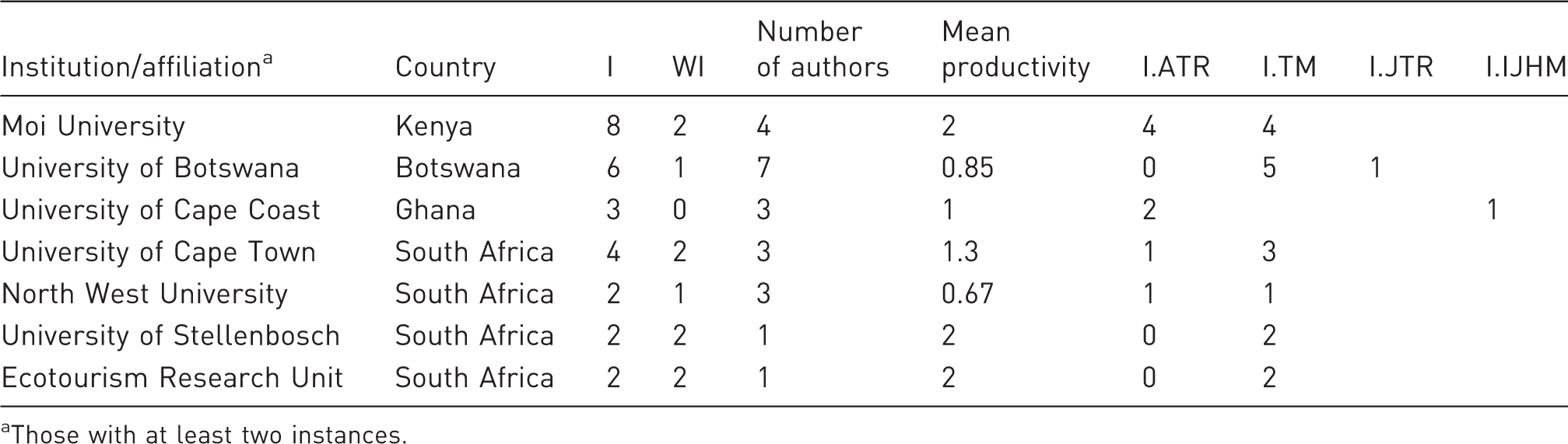
Those with at least two instances.
Contributions by geographic locations.
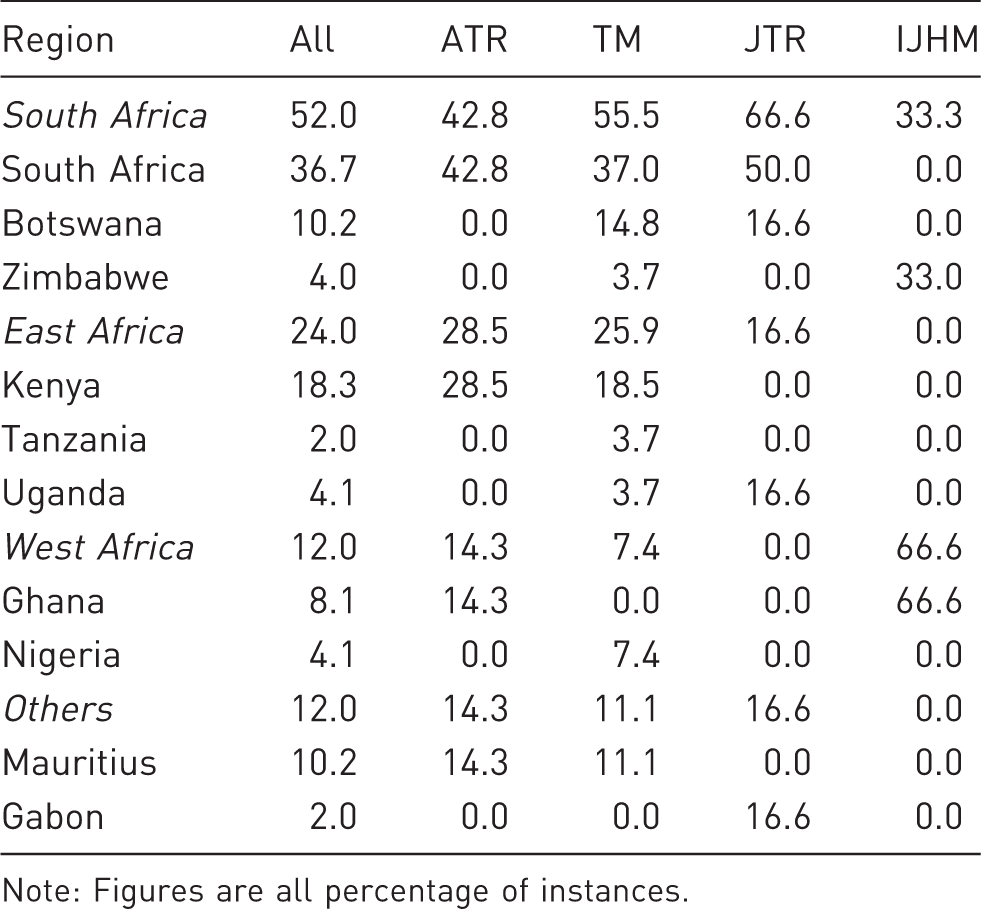
Note: Figures are all percentage of instances.
About 44.4% of the researchers from South Africa published more than those from the East (20.6%) and West (12.6%), respectively. South African authors also published more of their works in TM than either of the other journals (Table 2). Furthermore, whereas authors from south and east universities publish more in tourism and hospitality management journals, those in West Africa published mostly in hospitality management journals.
Author contributions by journals.
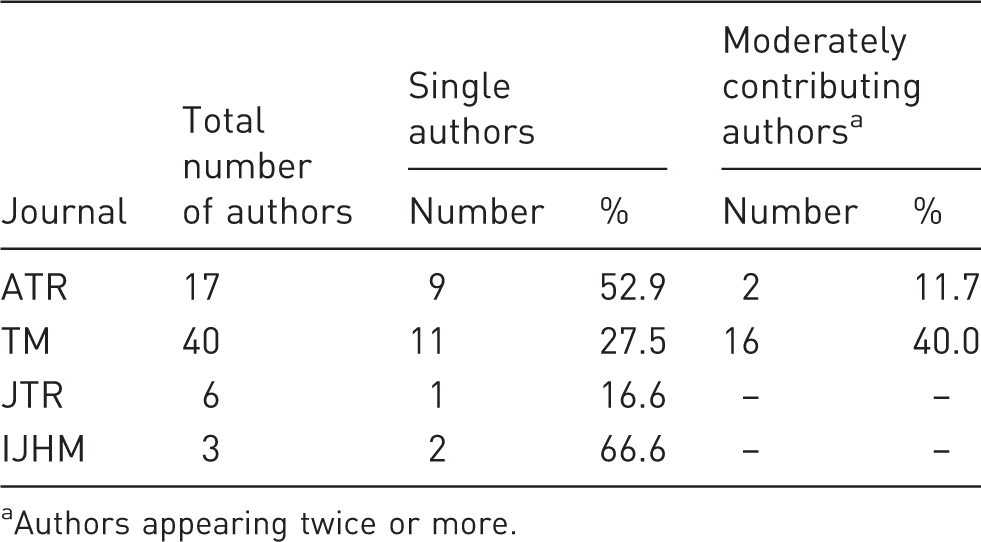
Authors appearing twice or more.
Publications by author contributing at least 2 instances.
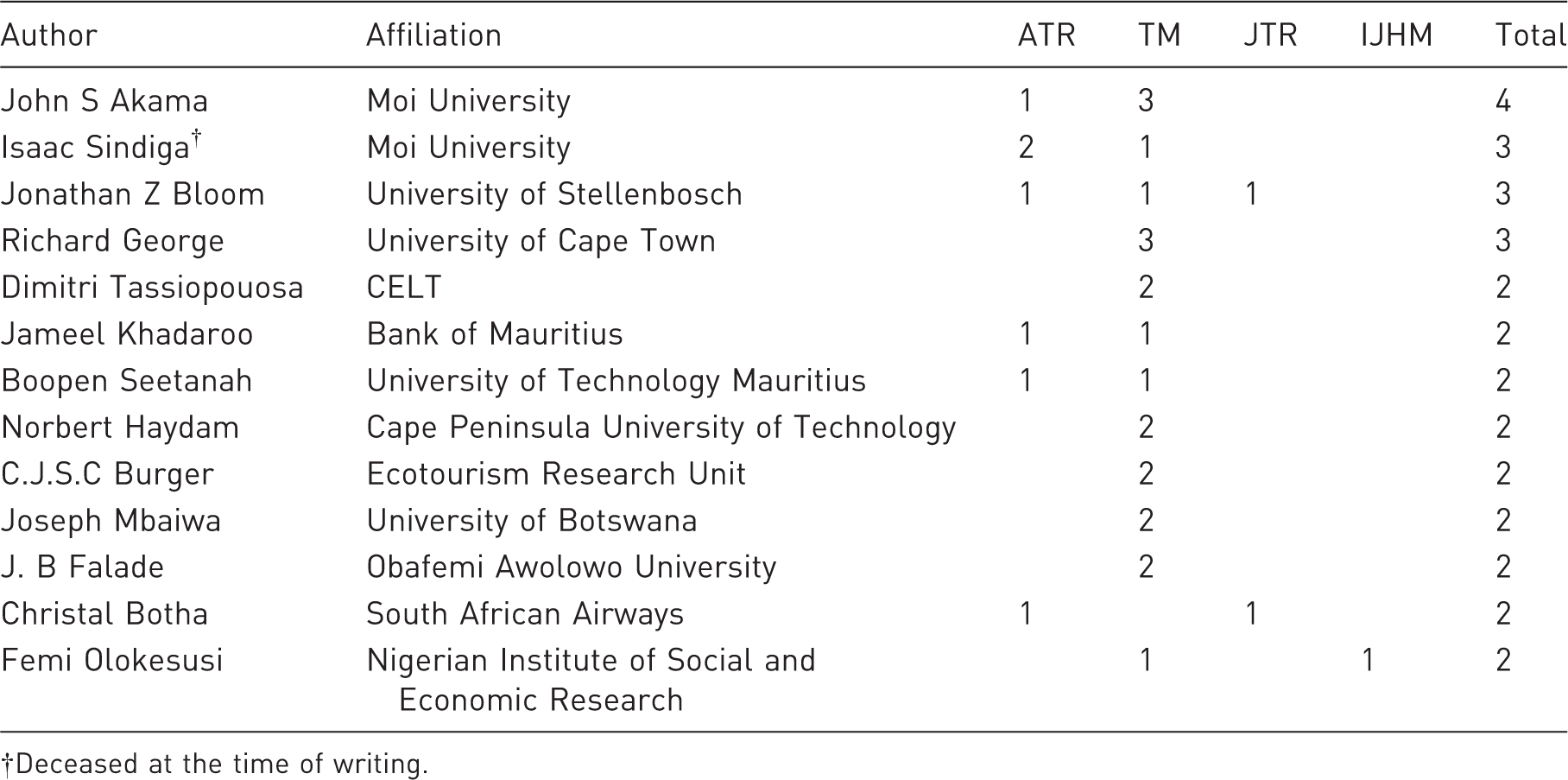
Deceased at the time of writing.
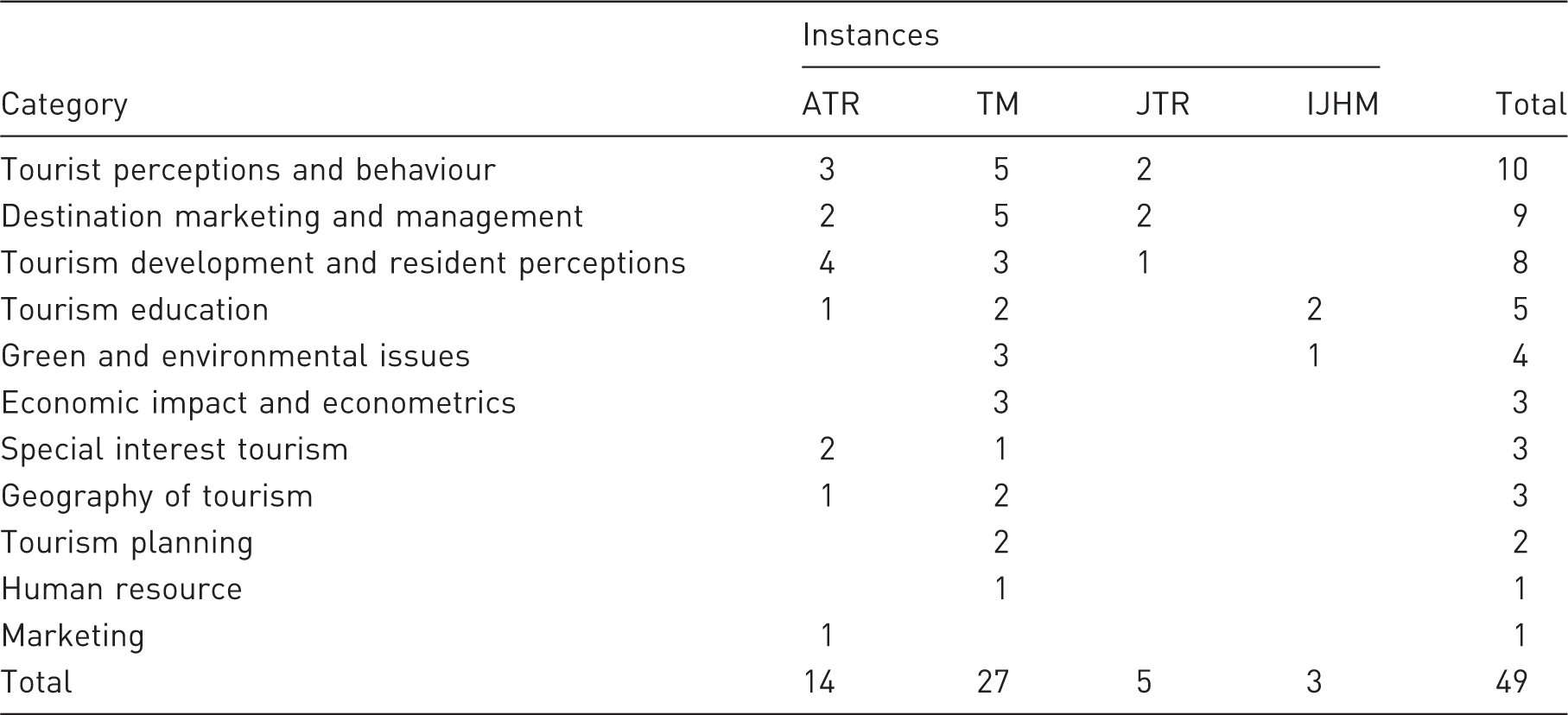
Research themes covered in selected journals.
Challenges of getting published
The questionnaire survey explored the challenges of getting published in top-tier journals. Several themes emerged from the data that highlighted the barriers to getting published. The first theme was related to the idea of African academics as ‘endangered’. The comments suggested that most Africa-based scholars care less about getting published because they felt ‘safe’ in their faculty positions. In the face of increasing student enrolment without corresponding growth in academic staff, some felt the value of quality teaching in universities as a factor for staff promotion was of greater value than quality research publication. In the words of one survey respondent, the publish or perish mantra does not resonate among academics in the sub-region given the focus on the measures of quality teaching as opposed to the emphasis on high-quality research and publication of articles witnessed in European and North American universities: What really struck me as a doctoral student in Europe was the culture of “serious” academic work! There it was about creative thinking and writing and academics publish for promotion and prestige. Compared to the kind of scholarship I have come to witness here, there is a certain kind of feel good syndrome that one’s position in the university is secured with only teaching” (#2, 2011). I quite recall the story I heard about one vice-chancellor [name withheld] who used to place “referee cards” into pigeonholes of faculty members to caution them to publish. This received stiff opposition and displeasure from senior faculty members (#4, 2012)
Apart from the respondents expressing frustration with their inability to publish in top-tier journals over a variety of issues many of which have identified by Woodwark (1992) as well as Day (1998), they alluded to gatekeepers to staff promotions as a disincentive to getting published. Sharing anecdotal experiences, some respondents said even when they increased research productivity, and succeeded in getting published, the old gatekeepers thwarted their promotions and career advancement. They expressed unhappiness that the old gatekeepers continued to exert influence over junior staff promotions presumably to maintain their patronage and promote personal choices. According to respondents, too often, staff promotion had nothing to do with research productivity or academic merit but rather institutional politics and power play. You definitely have to belong to a side or corner to move up the rungs of the career ladder. I mean everything from access to [scant] resources and promotion is based on which side or camp you belong. It is either you “eat or be eaten” (#70, 2011)
Discussion
This paper examined the research productivity of Africa-based scholars in the field of tourism and hospitality studies through the analysis of articles published in four top-tier journals. For the 20-year period analysed, 49 articles were published in the selected journals. Indeed, the publications were too few to warrant the use of inferential statistics or econometric models (Barrios et al., 2008). Even the use of simple descriptive statistics was limited to frequency distribution and percentages. The limited number of Africa-based scholars’ contributions may seem contradictory given that a growing number of them operate in the field. As such, the conclusions that one can draw from the data are limited. Yet Moi University in Kenya made the most contributions to the four journals. Altogether, universities in South Africa made the largest and most frequent contributions to knowledge in the field. This confirmed the trend established in tourism development in the sub-region. The highest research publication per author was four and although there are many reasons why authors chose a journal in which to send their work, the most prolific author published more with TM. By the same token, the majority of the articles were not only published in TM but also written by single authors. Rogerson and Rogerson (2013) point out that the majority of research outputs of Africa-based scholars are published outside the elite tourism and hospitality journals. While in some cases this may be true (particularly considering the large amount of literature from South Africa outside of the selected journals), it is important to draw attention to McKercher’s (2008) paper, which clearly shows that African research on tourism is not visible and influential within the international tourism academe.
The theme that was prominent across the selected journals related to tourist perceptions and behaviour. This was not surprising, the general tourism research focuses on such subject themes or subdomains. The implication is that as international journals continue to place more importance on these subject areas, African academics will be reliant on western/Eurocentric impulses and are unlikely to stimulate and understand tourism in the sub-region. For instance, studies dealing with complex issues such as conservation and development as well as community-based and pro-poor tourism, to name just a few, largely remain Western conceived and driven. Even where these issues are discussed by Africa-based scholars, they are either published in less prestigious journals or remain ignored. Moreover, the amount of publications in tourism journals far outweighed hospitality journals and highlighted many under researched areas.
The study also qualitatively explored the practical barriers to African academics publishing in top-tier journals. First, it was commonly acknowledged that due largely to staff shortages that many universities and institutions of higher learning face, established faculty members have not only become permanent obligatory passage points but also rarities. In this context, quality of teaching was given more prominence over publication of research articles as a prerequisite for promotion into the ranks of senior academics. Thus, the inability of the system to produce, attract and retain valuable personnel has benefited the few established faculty members and decimated the ranks of the professoriate.
It also emerged from the analysis that university-based research assessment exercises are lax and inefficient. Though this point did not hold true for the entire sample, some respondents felt that publications submitted by faculty members are not rigorously assessed. Interestingly, this issue was largely raised by junior academics. Understandably, avoiding mentioning specific publications, respondents intimated that the very few reputable journals and publishers in the sub-region led academics to publish in lower quality outlets. They felt the existing criteria are readily manipulated in favour of some faculty members. While there is substantial direct evidence of bias associated with this finding, ceteris paribus, the empirical evidence is a pointer to research productivity of academics in the field, as respondents’ experience show.
Third, and closely related to previous two points was the idea that established senior academics frustrate the career advancement of junior ones. For respondents, senior academics were not assisting junior staff in their career development but rather increasing the importance of patronage, established networks and personal alliances. They attributed the problem to the residual effect of an ageing professoriate with no commensurate expansion in the numbers of young academics entering the field. Thus, their inability to move up the academic ladder threatened the survival of active and productive research.
Lastly, questions were raised about research addressing situations in industry and wider society. Respondents noted that the pressure to publish or perish was overhyped because there was little application of research in the sub-region. For one, respondents were conscious of the effect that top-tier publications had on advancing knowledge, but pointed out that the information generated by research had barely stimulated development of the industry.
Footnotes
Conclusions: Saving the perishing
There are at least two conclusions one might draw from the study. The first is that there is a need for universities and institutions of higher learning to adopt a stricter policy of encouraging academic staff to publish in the select group of threshold journals, wherever possible, and to target top-tier journals where appropriate. Although the argument can be made that the quality of research articles should be evaluated independently of journals, it is important to reflect on the current bibliometric data. Indeed, at the time of writing this paper some research articles by Africa-based scholars have been published in the selected journals. However, the frequency was still too limited to include in the current study. Therefore, drastic measures are needed to make African universities the main place of knowledge production and dissemination especially on Africa matters.
The second is the need for cross-fertilization of knowledge on major tourism and hospitality subject areas. In this way, new ideas may be generated to better understand the field. Such collaboration is likely to lead to a better balance between academic and research competence and the intellectual confidence of scholars in the sub-region. A further consequence is the publication of research articles in top-tier journals and to achieve more visibility in the international arena. However, this implies a conscientious effort by universities in the sub-region to invest in providing faculty members with unfettered access to updated published resources. While this approach holds much promise, it is not without its limitations. The greatest challenge is that the nature of what constitutes relevant tourism scholarship is not only being affected by external factors (editorial policies, reviewer bias, impact factors, etc.) but also if Africa-based scholars do publish, and are even read, they may still perish because they did not publish in the ‘right’ journal or get cited.