







Abstract
Backpacking is an emerging market within the tourism sector. Despite its growth limited research has been conducted in Scotland, or even Europe, in relation to this form of travel. Qualitative data were gathered utilising a combination of interviews and focus groups to help achieve the aim of understanding backpackers’ motivations for visiting Scotland. It emerged that the primary push factors were escape and knowledge seeking. Both of which can be related to the optimal arousal theory; those seeking escape as experiencing over stimulation in their normal lives, and those who were seeking knowledge as experiencing under stimulation. Pull factors for visiting Scotland included: Scotland’s scenery, positive word of mouth recommendations, geographic location, genealogy, the English language, job opportunities, outdoor activities and tangible aspects including cultural and natural features. Results suggest that the backpacker market is highly heterogeneous regarding motivations and there is a necessity for more research in this area so that backpackers’ needs are fulfilled which will help facilitate destination loyalty.
Background
In today’s postmodern society we are ever mobile as social hierarchies no longer keep us fixed and determine our identity (Bell and Hollows, 2005; Featherstone, 2007; MacCannell, 1976; Yeoman et al., 2007). Travel experiences have therefore become more popular and are used as a way of forming our self identities and the ‘backpacker’ can be described as a cultural symbol of this movement (Myers and Hannam, 2008). In conjunction with this, globalisation has caused an increasing ease of international travel with an abundance of budget accommodation, airlines and travel companies, now existing to serve backpackers’ needs (Cohen, 2004; O’Reilly, 2005; Richards and Wilson, 2004). It is therefore not surprising that academic interest in backpacker tourism has grown in recent decades (Richards and Wilson, 2004; Sorensen, 2003). However, the majority of this interest has been in South East Asia, Australia and New Zealand where the impact of backpacking is more noticeable. According to the study by Tourism Australia in 2011, of 948 travellers, each spent a minimum of one night in a hostel. In this survey 49% planned to or had worked during their trip, and 69% stated that money earned was to be used to fund their travels. The most popular occupations included bar work and hospitality (Tourism Australia, 2011).
Europe has only really been considered as a source of outbound backpacker tourism with minimal attention paid to those backpacking within Europe (Richards and Wilson, 2004; Wilson et al., 2008). Keeley (2001) presents information on backpackers in Britain but this is limited and now dated. The only studies involving backpackers visiting Scotland are based on their satisfaction levels with budget accommodation (Nash et al., 2006), a lifestyle segmentation analysis of the backpacker market (Thyne et al., 2008), and any insight into their motivations has been survey based (Speed and Harrison, 2004). VisitScotland appears not to recognise backpacking tourism as a market segment in its own right, and currently no data exist on the market, despite extensive research into other sub markets such as adventure, business and sailing tourism (Tourism Intelligence Scotland, 2012). However, given that despite the adverse conditions created by the economic downturn, the Scottish hostel sector has performed well since 2008. Between 2008 and 2012 hostels have maintained a strong performance within the Scottish accommodation sector, generating an average of 413,000 total trips, 2.4 million nights and £126 m per annum, with most notably the average spend per trip during 2011 nearly doubling that in 2010 to £248 and the average spend per trip being higher in 2012 than any over the last five years (VisitScotland, 2014).
Backpackers arguably set new travel trends so understanding their decision making process can be of value to the tourism market as a whole. Moreover, increasing incomes and freedom to travel combined with the possibility of backpackers returning to a destination later on in life means attracting this market can be seen as a crucial stage in a long term marketing policy for certain destinations (Richards and Wilson, 2004), not to mention their positive contribution to the local economy (Hampton, 1998; Kain and King, 2004; Loker-Murphy and Pearce, 1995; Scheyvens, 2002).
This research is based in Scotland and Inverness was chosen as a location for the research because of its title “Capital of the Highlands” (Voigts, 2012). A significant motivation for backpackers is to experience the natural landscape (Speed and Harrison, 2004) and as the Scottish Highlands contain the largest area of natural mountains and lakes in Western Europe (Boniface and Cooper, 1994) it is an ideal destination for backpackers to visit (Scheyvens, 2002). More importantly, Inverness is often a key destination for backpackers’ when travelling and working their way around Scotland.
Literature review
Commonly agreed characteristics of backpackers is that they are individuals who independently organise a flexible travel itinerary, their journeys are usually lengthy and incorporate multiple destinations and they also travel on a budget and opt for budget accommodation, with an emphasis on meeting fellow travellers and locals (Loker-Murphy and Pearce, 1995; Pearce, 1990). However, other authors in their research (Larsen et al., 2011) have utilised narrower definitions in sampling their backpackers and have adopted the Tourism Research Australia (2008) definition of “a person that spends one or more nights in either backpacker or hostel accommodation”. The complex nature of defining backpacking can also be recognised in the variety of titles given to backpackers: ‘drifter’ (Cohen, 1972), ‘long term budget traveller’ (Riley, 1998), ‘wanderer’ (Vogt, 1976), ‘tramping youth’ (Adler, 1985), ‘traveller’ (O’Reilly, 2005; Sorensen, 2003), ‘youth market’, or ‘young independent traveller’ (Kain and King, 2004).
Because backpacking has become increasingly popular and highly accessible (O’Reilly, 2006) it has been suggested that backpackers are not different to ordinary tourists in terms of their travel styles, behaviour (Cohen, 1972) and motivations (Larsen et al., 2011) and in some cases backpackers also define themselves as tourists (Niggel and Benson, 2008). However, others argue that backpackers distance themselves from tourists as much as possible (Caruana and Crane, 2011) and possess a ‘tourist angst’ (Riley, 1998; Welk, 2004). Larsen et al. (2011) argue backpackers differ from traditional tourists in that they have little interest in luxury and are less concerned about risk. Additionally, other research has indicated that backpackers are more interested in cultures, do more activities while in a destination, and have more interactions with the wilderness, meaning they gain more than just a superficial understanding of the host community than regular tourists (Murphy, 2001). Furthermore, backpackers often go further out of their comfort zone than the average tourist and are susceptible to more stress, and uncertainty which means their experiences are often highly rewarding (Hottola, 2008; O’Reilly, 2006; Scarinci and Pearce, 2012). Elsrud (2001: 597) found that, “culturally and socially constructed narratives about risk and adventure are manifested by individuals in backpacker communities”. Such manifestation is carried out through the consumption of, for instance: experiences, food, beverage and clothing. It is argued that tales and acts of ‘risk and adventure’ work particularly well in individuals’ efforts to ‘narrate identity’.
While it is believed that backpackers have more contact with local people, and this is one of their prime motivations, it proves difficult (Binder, 2004) as they prefer places with high levels of tourist metaspatiality where they can counter ‘culture confusion’ (Hottola, 2008; Turner and Ash, 1975). Consequently, they spend most of their time with other travellers in enclaves (Noy, 2004; Sorenson, 2003) where they can be in a more familiar environment and thereby reduce the ‘stress’ that is encountered (Binder, 2004; Cohen, 2011; Maoz, 2007). This reinforces the theory that backpackers are self centred and ego tourists (Mowforth and Munt, 1998; Speed, 2008) and are examples of Urry’s (1990) collective gaze. However, MacCannell (1973) disagrees as backpackers often search for places that are ‘off the beaten track’ and rural locations, for authentic, self transforming experiences where high amounts of what Bourdieu (1984) refers to as ‘cultural capital’ can be obtained. This is an example of how in Western societies there is a strong need for individualism and exclusive experiences for narratives of self change to be told and for self transformation to occur (Desforges, 2000; Elsrud, 2001; Noy, 2004).
In terms of recent developments, the arrival of internet cafes on the backpacker routes gave rise to an emergent market of flashpackers. Paris (2012) defines the flashpacker as affluent and tech-savvy, sharing the same ethos as the backpacker, but affecting it in style and comfort. Flashpacking refers to two interrelated developments in backpacker travel. First, it describes a shift in the backpacker population away from the 20-something travellers getting by on limited budgets, to older, more established and relatively affluent travellers. The second connotation of “flashpacking” refers to the backpackers increasing use of new technologies and social media (Jarvis and Peel 2010). In their work Butler and Hannam (2013) acknowledge that both backpackers and flashpackers demand highly adventurous and unique experiences through journeys off the beaten track, the modes of transport chosen is likely to differ. Backpackers are more inclined to travel on public transport, largely on account of restricted travel budgets. Flashpackers in contrast indicated private modes of transport were key to satisfying travel demands.
Backpackers choice to use budget style accommodation in general and hostels in particular is important. This allied to the relatively strong performance reported by hostels (VisitScotland, 2014) suggests that the flashpacker niche segment could be a future market opportunity for Highland Scottish tourism growth. In their study of flashpackers in Fiji, Jarvis and Peel (2010) suggest that policy makers at destinations need to recognise the flashpacker market as a potential niche for future sustainable tourism development, and that destinations should focus on supporting local industry to address new demands associated with “flashpackers”. In Scotland the Scottish Youth Hostel Association (SYHA) provides the largest network of hostels with 70 locations across the country. These hostels need to be fit for purpose for the emerging flashpacker niche.
Motivations
It can be suggested that tourists’ destination choice, destination image and the activities on offer are directly influenced by their travel motivations (Bansal and Eiselt, 2004; Dann, 1981; Moscardo et al., 1995). The destination choice set model developed by Um and Crompton (1990) states that tourists’ destination choice is finalised by a three stage sequential process. The first stage is the composition of awareness set that includes a group of destinations that a tourist is aware of. Secondly, the evoked set, that is developed from the awareness set, and is characterised by tourist’s actively consulting information to select a destination that will best meet their needs. Finally, a destination is decided upon. The criteria that affect this process are push and pull factors and constraints (Tzu-Kuang et al., 2009).
The majority of studies involving tourist motivation have indeed centred on the concepts of these ‘push’ and ‘pull’ factors (Crompton, 1979). Push factors can be described as internal (psychological) motivators that initiate the desire to travel and pull factors as external, cultural (non-psychological), motivators that drive people to a certain destination because of its attractiveness (Crompton, 1979; Tzu-Kuang et al., 2009; Uysal and Jurowski, 1994). The push and pull motivation in the desire to travel and destination choice is described by Goossens (2000) as being pushed by emotional needs and pulled by emotional beliefs. Brown (2013) suggests a Heideggerian theory of the Spielraum to the tourism experience, which suggests that the traveller seeks a space to reflect on life from a distance and to consider change – as Pearce and Packer (2013) point out, tourism research can profit from developments in contemporary psychology. Paris (2012: 244) found the two key dimensions consistently present in backpacker motivation are relaxation and cultural knowledge which “suggests that these two dimensions constitute the core motivations for backpackers”. Elsewhere, Paris’s findings are supported by Correia et al. (2013) who explores and extrapolates push–pull theory, finding also, in the development of a scale to measure satisfaction, that culture is the dominant and constant motivator for the backpacker. Schneider and Vogt (2012) too, in a study investigating the motivation for adventure travel, found cultural experiences to be a consistent predictor of adventure travel propensity. The backpackers ‘ability to cover significant geographical areas in relatively short periods of time has been used to identify them as “boundless” or “nomadic” tourists (Richards and Wilson, 2004).
Push factors
Dann (1981) categories push factors under the headings of anomie and ego enhancement. Anomie referring to the need to feel isolated and to ‘get away from it all’ and ego-enhancement relating to one’s personal needs for recognition. This theory is partially based on Maslow’s hierarchy of needs as anomic tourists are typically at the base of the pyramid with love and belonging needs, while ego-enhancement tourists can be associated with the self esteem need. Anomie and escape from a perceived mundane environment coincides with Buddhabhumbhitak’s (2010) findings in that ‘escape’ was one of the seven themes identified in their research. Cohen (2004) also states drifters seek escapism in the form of abandoning conventional ways of life and to experience more primitive surroundings; associated with avoiding materialism and confronting the pure self (Binder, 2004). This point is also illustrated by Fodness (1994), Tzu-Kuang et al. (2009) and Welk’s (2004) as they state individuals travel to rest and relax as a way of escaping from their predictable lives. Alternatively, Larsen et al. (2011) found that relaxation was the weakest motive found in backpackers, and Maoz (2007) found that Israeli backpackers were ‘escaping’ to India to relax because they had just completed their mandatory army service where everything was ordered and controlled. This can be connected to optimal arousal theory whereby “we search for a level of interaction with our environment that maintains our psychological equilibrium” (Holden, 2006: 69). Consequently, tourists are pushed into travelling to avoid over exposure of over stimulation from work and stress, or from under stimulation due to boredom.
Dunn Ross and Iso-Ahola (1991) argue that knowledge seeking is the most important push factor. On the other hand, Cohen (2004), Elsrud (2001) and Noy (2004) found that a thirst for adventure and experience seeking in exotic settings was the main drivers for drifter tourists as it aided a sense of self identity to be created which ultimately led to self fulfilment. Murphy (2001), Pearce (1990) and Riley (1998) place emphasis on the desire for social interaction. Richards and Wilson (2004) emphasise the importance of backpacking as a form of self development where individuals are enlightened to not only other cultures but their own society too. Vogt (1976) further recognised criteria which can help achieve the prestige and ego-enhancement aspects: independence, exoticness of destination and exoticness of travel mode. This builds on MaCcannell’s (1973, 1976) argument that tourists are searching for authenticity and cultural capital. The satisfaction of individualistic inner desires can be achieved when a destination is increasingly rural, authentic and exotic, as it will provide the necessary obstacles which require independence, adaptability, resourcefulness and open-mindedness which facilitate learning about the world, and self, and help create intimate interpersonal relations (Riley, 1998; Vogt, 1976). Furthermore, this can be related to what Bourdieu (1984) calls ‘distinction’ where people aim to raise their own lifestyle above the masses, indicating good taste, in order to be seen in a desirable way (Binder, 2004). Nevertheless, Cohen (2004: 42) highlights a paradox: “though the desire for variety, novelty and strangeness are the primary motives for tourism, these qualities have decreased as tourism has become institutionalised.”
Pull factors
Pull factors of a destination both respond to and reinforce the push factor motivation (Dann, 1981) and therefore they should not be treated independently (Crompton, 1979) as they have a direct link (Bansal and Eiselt, 2004). Kucukkurt (1981, cited in Kain and King 2004) emphasise the functional value of a destination such as its increased media exposure and safer, speedier, more comfortable travel factors influencing its attractiveness. Crompton (1979) argues that the destination itself is relatively unimportant as it is merely a medium through which individual push factors can be realised, and these are unrelated to any specific destination. Kozak (2002) accentuates the tangible aspects and argues that a destination is just like a product or brand as the way that the climate, infrastructure, natural and cultural attributes, attractions and features are combined to make the destination a unique product. Studies by Godfrey (2011) and Markward (2008) discovered that New Zealand’s natural beauty was a prime pull factor for backpacker visits. Furthermore, interactions with natural, or rural, environments (authentic locations) are significant not only in allowing exciting stories to be told, but also for stories relating to lasting self change and identity (Noy, 2004).
However, Parrinello (1993: 243) disagrees with Kozak (2002) in that tourism is like any other commodity as the heavy significance of word of mouth publicity means that tourism “permeates imperceptibly throughout all aspects of everyday life.” Riley and Van Doren (1992) agree that word of mouth advertising can have a dramatic input on a destination’s image. Godfrey (2011) and Murphy (2001) confirm this in their studies as one of the main themes in their research was that New Zealand is a recommended destination by backpackers’ family and friends. Word of mouth can shape the image of a destination and influence destination choice, just as much as, or even more so, than tangible resources (Prayag, 2010). Many other authors also regard the ‘functional’ value of a destination as the most insignificant component (Myers and Hannam, 2008; Pearce and Lee, 2005; Tzu-Kuang et al., 2009) as they have recognised price being irrelevant in travel decisions.
From a Scottish perspective a research paper dedicated to segmenting Scotland’s backpackers on the basis of lifestyle also includes some brief information on participants’ pull factors for visiting (Thyne et al., 2008). Again, Scotland’s scenery and fresh air scored highly, alongside family and friends recommendations. Additionally, some had ancestral roots in Scotland and if they were not visiting family and friends they wanted to experience the country where their ancestors came from (Thyne et al., 2008). This further coincides with Vogt’s (1976) pull factor of maintenance of personal ties. A study by Andersen et al. (2008) of independent Japanese travellers in Scotland found that the top rated motivator was Scotland’s scenery and countryside, with culture and history following behind. These results reinforce the idea that tourists’ expectations and perceptions of a place, combined with the activities on offer, and the benefits of participating in these activities, can result in selecting a particular destination (Crompton, 1979; Crompton and McKay 1997).
Myers and Hannam (2008) state that present location can be the trigger on which a following destination is decided on. This fits in with Godfrey (2011) as New Zealand’s geographical location in relation to other popular backpacker destinations (Australia, Pacific Islands and parts of South East Asia) was a major pull motive. This also is clearly beneficial to Scotland which is a neighbour to the rest of Britain and mainland Europe.
Travel career ladder
In Myers and Hannam’s (2008) study safety was a crucial factor for female backpackers in planning their journeys; stemming from the desire to feel ‘freedom’. Other generic pull factors that favour Scotland include job opportunities (Fodness, 1994) and the chance to learn English (Toxward, 1994). Crompton (1979) also addresses this issue as many American backpackers begin their European trip in the UK, where English is spoken and is more familiar, before travelling to Asia or other ‘exotic’ destinations. This is further backed up by the World Youth Student and Educational (WYSE) Travel confederation (2007, cited in Bowen and Clarke, 2009) who state that less experienced travellers tend to be found in Europe where there is a well developed independent travel infrastructure. We can relate this to travel career ladder; a travel motivation theory based on Maslow’s hierarchy of needs. While the motives of escape/relax, novelty, kinship and self actualisation are significant and common motives for all travellers it can be said that those on a high travel career level place greater emphasis to externally orientated motivations such as self development through host site involvement and interactions with nature. Alternatively, those on lower travel career levels stress internally orientated motivations like self enhancement, security, recognition, romance, kinship (belonging) and autonomy. Although individuals may have more than one travel motivation, one will be more dominant (Pearce, 2005; Pearce and Lee, 2005). Exclusive and inaccessible destinations will therefore be attractive to those higher up the travel career ladder that have already experienced familiar destinations and are searching for sites which are further culturally and environmentally separate from their originating country. Generally, people will transcend the career ladder although limitations such as health and finances can mean someone will remain at the same stage (Pearce and Lee, 2005; Pearce, 2005).
Ryan (1998) challenged the travel career ladder theory and a revised version of the theory emerged; the travel career pattern. The travel career ladder focused too much on ascending the steps of a ladder and only being on one step at a time, whereas the travel career pattern is a more dynamic, multi level approach. Yet, the core concept of travellers exhibiting different motivational patterns over their life stages, and/or travel experience, remains central to the theory. Based on the three variables of domestic travel experience, international travel experience and age, different categories of travel experience are identified:
Experienced travellers (those who have a high level of travel experience both internationally and domestically); inexperienced travellers (those who have low levels of travel experience for all travel experience variables); experienced domestic travellers (have low international travel experience but high domestic travel experience);
Methodology
In addition to the themes identified in the literature other themes were selected largely based on those used by Godfrey in her 2011 study into backpackers’ motivations for visiting New Zealand. In that study scenery, geographical location, positive word of mouth recommendations and adventure activities were recognised as pull factors for backpacker visits to New Zealand. In this study the data collection comprised of three stages. Stage one and two collected data using semi-structured interviews in Inverness and stage three consisted of focus groups also in Inverness.
Qualitative research was chosen as this is most appropriate in exploratory studies where you wish to uncover individuals’ views, attitudes, or motivations and the reasons for these. After investigating previous research it was discovered that similar studies in this area were conducted using qualitative methods too (Godfrey, 2011; Maoz, 2007; Toxward, 1994), further justifying this decision. In terms of data collection a deductive approach was implemented. A theoretical framework was used as existing evidence on backpacker motivations, and central themes uncovered in the literature review, guided the research process (Saunders et al., 2000). Semi-structured interviews and focus groups were therefore the chosen method of data collection as the pre-determined themes provided the basis for the interview guide.
Non probability sampling methods were used as probability sampling methods seldom apply to the qualitative approach (Mason, 2002). A mixture of purposive sampling (maximum variation) and self identification sampling were used. Respondents were asked if they would like to participate in the research; the aim being to select a variety of ages, nationalities and genders. This sampling method was chosen as in small sample sizes having a range of differences will allow key themes to emerge and the “broadest possible reach of the range of perspectives” (Darlington and Scott, 2002: 52) to be achieved, increasing the reliability and validity of findings where generalising is not possible (Berg, 2008; Mason, 2002). The data collection consisted of three phases outlined below but first the questionnaire was piloted and both positive and negative feedback gained during piloting led to the refining of the data collection tool therefore enhancing reliability and validity (Bell, 2005).
The first two stages of data collection involved semi-structured interviews that were conducted face to face allowing maximum control over who was selected to participate and to create a more personal atmosphere; promoting trust and thus encouraging interviewees to talk more freely for more reliable and varied results to be produced (Muise and Olson, 2007; Saunders et al., 2000). Where ever possible the interviews were digitally recorded and later transcribed and notes were taken in addition to the recording. After reading the transcriptions and becoming familiar with the data, notes of key points were made before the transcriptions were content analysed (Schwandt, 1997).
Phase 1
The respondent sample consisted of 14 backpackers with seven participants recruited from each hostel in Inverness. The interviews and the seven questionnaire themes used were largely based on those used by Godfrey (2011) and these are listed below:
Background information on interview participant Previous travel experience Current backpacking trip Motivations for travelling in general Travel style Motivations for visiting Scotland specifically Returning home
Responses from this group are identified using a capital letter – for example – interviewee M.
Phase 2
The second phase of data collection replicated the first phase but was carried out in several stages that resulted in a further 20 respondents. Responses from this group are identified using double capital letters – for example – interviewee CC.
Phase 3
In addition to the qualitative interviews and in a departure from Godfrey’s study, three focus groups were conducted to further develop the themes and to provide greater depth to the studies. These focus groups involved seven respondents, five respondents and eight respondents respectively and they were all convened by a senior member of the research team and all three were conducted in Inverness. The themes for the focus groups followed the seven themes outlined above. Responses from this group are identified using a capital letter and the words Focus group – for example – Focus group A
In terms of coding the interview guide provided the guidelines for data analysis and helped to produce an initial coding frame (Miles, 1994). The coding process involved creating categories and assigning them to selected data (Dey, 1993). The interview guide provided the guidelines for data analysis and helped to produce an initial coding frame (Miles, 1994). Firstly, descriptive coding occurred. This was a simple process where interviewee attributes such as gender, age and nationality were stored in table form. Following this, topic coding took place. This stage involved text being labelled according to its subject. Following this, the data relating to each theme was grouped together so aggregation relative frequency could be determined. Next, analytical coding was implemented where common themes and patterns were examined (Miles, 1994) with any apparent relationships between categories being identified. The process was iterative in nature and involved reading, reflection and interpretation of the data (Arksey and Knight, 1999; Marshall and Rossman, 1999).
Limitations
It is recognised that interpretation of data retrieved from open questions is more provisional and contentious than if interpreting quantitative data (Richards, 2005) and it is possible that the researchers’ background, personality, mind set and actions influenced their interpretation of the information, and that a different researcher would not have reached the same conclusions. However, attempts were made to limit this by having colleagues examine the category headings and the segments of text associated with each to ensure the analysis was impartial, and consistent, as possible (Arksey and Knight, 1999).
While every effort was made to limit potential bias in the selection of the backpackers some were unavoidable. In some instances it was not possible for certain individuals to participate because their level of English language was too weak to provide substantial and valuable responses. Another limitation is due to the fact that the interviews took place solely in hostels. Other forms of accommodation used by backpackers (and flashpackers), such as guest houses or bed and breakfasts could also have been used.
The interviews were conducted in phases and at several different times, so it is probable that the findings from the different phases of the research may yield different results that a study conducted over a shorter time period. The research was originally designed with just the first phase data collection in mind but after the initial results were analysed it was decided to collect further data in an attempt to triangulate and further enhance the validity of the data. This involved stretching the data collection process over a relatively protracted period of time, which was not ideal.
The results and discussion section below presents, analyses and discusses the findings of the primary research based on the key research questions in the literature review. Results are presented and discussed in a combined format with interviewees being identified using capital letters as discussed above. The section follows a similar structure as the literature review: backpacker characteristics, push factors, pull factors and travel career ladder, while drawing up on the optimal arousal theory where appropriate.
Results and discussion
Backpacker characteristics
A key aspect of backpacking is to travel on a budget. However, quite surprisingly, the majority of the interviewees in this study were significantly less concerned about budgeting than anticipated: “I could keep it cheaper but I don’t have to” (Interviewee K) “Hell, this is a once in a lifetime trip for me so I am not too concerned about the cost” (Interviewee CC)
This was further illustrated in their reasons for choosing to stay in budget accommodation. Low price was not the only factor involved, and in some cases not important at all, but to have the opportunity to “meet people” and for this social interaction leading to “lots of information of where to look for jobs, how to get around, where to go and visit”.
The findings of this study do not support the claims suggesting that backpackers are travellers who spend more time with members of the local communities and become more immersed in a culture than tourists do. The results actually support Binder (2004), Noy (2004) and Sorenson (2003) in that, generally, backpackers spend most of their time with other travellers and have minimal interaction with local communities: “Actually, I don’t meet many people from the places I went to” (Interviewee K) “In Edinburgh there are a lot of Spanish … and you find Spanish and it’s easy … you make like a little ghetto but it’s so difficult don’t enter the ghetto” (Interviewee L) “I seem to be spending most of my time with other hostellers” (Interviewee AA)
The backpackers preferred to spend time with other travellers, creating a backpacker enclave. This can be seen as a way of them remaining within their environmental bubble and not coming into contact with too much ‘otherness’ so their level of arousal did not exceed their optimum. Subsequently, this suggests that these backpackers were low sensation seekers, resembling organised mass tourists who were at a relatively premature stage in their travel career. Also, it appears to suggest that within the backpacker social clusters, it is not necessary for them to travel to ‘exotic’ destinations for cultural capital to be achieved but for them visiting a large number of different destinations’ was more important.
Push factors
Many of the backpackers decided to embark on their trip at a transitional period in their lives: passed for a promotion at work, mother passed away and before beginning university. Some of the interviewees commented on how they were bored, or losing interest at work (relating to optimal arousal theory), which caused them to go travelling. However, it may be a possibility that it was their desire to go travelling that initiated this unsatisfactory mood with their current life, as suggested by Riley (1998): “I felt like I was going nowhere and needed a change” (Focus group A) “I was fed up at work with the way things were run” (Interviewee BB)
Direct quotes relating to the identified push motives of escape and knowledge seeking.
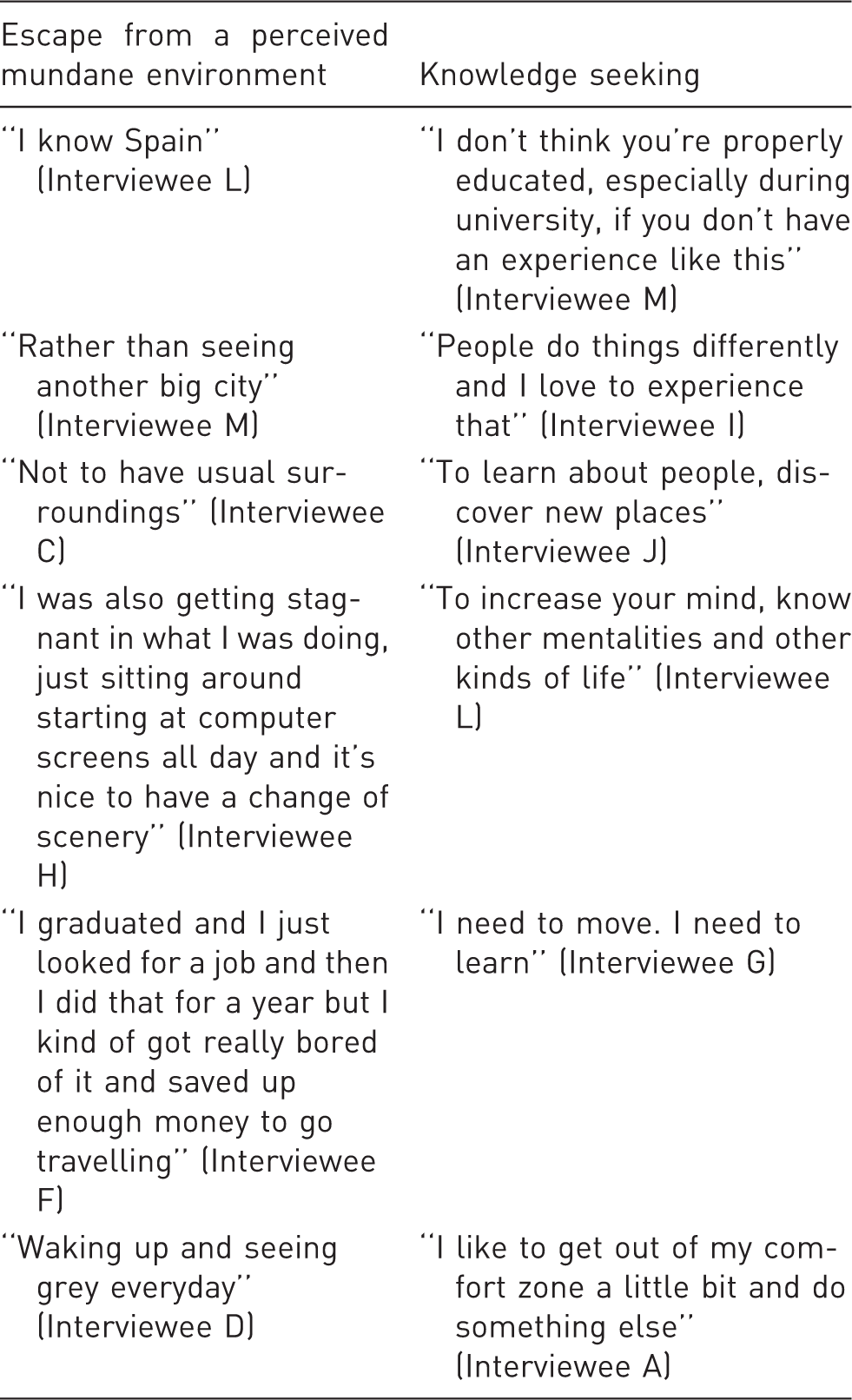
Undoubtedly the push motives for backpackers directly link to optimal arousal theory. The backpackers’ characteristics and travel behaviour are linked to push and pull factors that are linked optimal arousal theory. The most common push motives identified related to escape and knowledge seeking. It can be suggested that those individuals who were travelling for escape reasons did so because they were subject to a higher level of stimulation in their ordinary lives and needed to re establish their arousal level. For one interviewee this was absolutely the case: “I couldn’t stay in Cologne anymore, it was too much of a hurry and in a rush. I suffer from epilepsy as well and I had occasional seizures because everything was always in a rush” (Interviewee C)
“I feel like other people would hijack what I wanted to do and I’d resent them” (Interviewee H)
Direct quotes relating to the push motives of anomie and ego enhancement.
“So I can nick off to a place whenever I want” (Interviewee A)
Scotland is often perceived as a quiet place with plenty of open space was consequently very appealing to these anomic individuals: “Scotland seemed like a great place to get some real freedom.” (Focus group A) “I love the wide open spaces up here" (Interviewee DD)
Moreover, travelling solo allows the sense of independence to grow and can consequently fulfil personal development motives. The ego enhancement push motives often exist as individuals wish to accrue cultural capital; allowing a distinction to be made between them and their non travelled peers so they are can be differentiated as more cultured and knowledgeable. This objective of ego enhancement and prestige was quite potent with one backpacker (H) admitting to having a competition with his friend to see who will visit the most countries first. This was also commented on by interviewee CC who said that he “wanted to see as many countries as he could in as short a time as possible.” Interviewee (N) was asked if she would return to Scotland she replied “why go to the same place twice when you can go somewhere else?” It appears that travelling to a number of different destinations is significant, whether they are ‘exotic’ or not, contradicting Cohen (2004), Elsrud (2001) and Noy (2004). What is deemed ‘exotic’ will depend on an individual’s peer group, and their peers’ travel experiences and perceptions, and it is therefore highly subjective.
For other interviewees, it wasn’t about differentiating themselves from their peers but keeping up with them. This could be because backpacking has developed more as a rite of passage and because it is now relatively common amongst youngsters it is engaged in as a means of maintaining a social position, rather than gaining social status: “My lack of experience of travelling as a lot of my friends has travelled around the world and I just wanted to be educated” (Interviewee C) “I met a couple of people who had been travelling and I looked into it, got some money, saved up and just went” (Interviewee D)
The facilitation of social interaction was not a common push motive and arguments were put forward that this ‘motive’ could be placed under the broader heading of knowledge seeking, or that in fact it only impacted on backpackers’ travel style. The research findings of this study did not support the claims of Murphy (2001), Riley (1998) and Pearce (1990) in that facilitation of social interaction is a principle push factor amongst backpackers. Only one interviewee mentioned this aspect as a push factor.
Pull factors
Similar to Godfrey (2011) and Markward’s (2008) findings in New Zealand and Andersen et al.’s (2008) findings, scenery was a top rated motivation with almost half of the respondents saying it was a pull factor. Many mentioned the mountains, lochs, air, wildlife, the amount of space, clean air, natural beauty and landscapes as their reasons for wanting to visit: “The scenery in Scotland, especially in the Highlands is stunning” (Interviewee FF)
The appreciation of Scotland’s scenery and culture could be due to what Kucukkurt (1981, cited in Kain and King, 2004) suggest as a central pull factor – a destination’s functional value which includes increased media exposure. Several of the interviewees stated that they had seen and become interested in Scottish scenery as a result of films. It has been the location for a significant number of high-grossing box office hits such as Braveheart and Highlander, and more recently Skyfall: “One of the main reasons I wanted to come to Scotland was because of Braveheart. A great movie” (Interviewee GG) “Scotland looks great in the Bond film and I wanted to see it” (Interviewee LL)
This supports the suggestion that the media is key when developing and pushing an image of a destination. It is also true to say that cultural and heritage tourism in Scotland owes much to the media portrayal and there are many documented cases and examples of the cultural and historical appeal in Scotland and the Highlands. For example, the history and mystery of the Highlands of Scotland are explored by Inglis and Holmes (2003) who identify ghosts and the unexplained as a key attraction in Scottish tourism, while Knox (2008) looks to Scottish folk song as an attraction in Aberdeenshire.
Other functional aspects Scotland offered over other destinations incorporate the following:
Easier and cheaper to fly to Glasgow than London. For EU citizens no visa is required so lengthy trips incorporating seasonal work is feasible. For Australians owning British passports the process is made easier; also relating to visa issues. It offered safer, and more comfortable, travel over a second destination option of Greece due to riots occurring there.
Moreover, knowledge of the English language was another functional pull factor attracting backpackers to Scotland and why it was chosen over other destinations. One interviewee’s (L) primary purpose of coming to Scotland was to learn English: “I love the fact that I can improve my English here” (Interviewee JJ)
Job opportunities were another functional pull factor. One interviewee (I) discovered that there was a demand for supply teaching in the area that suited her perfectly. An abundance of seasonal, live in work drew backpacker D and NN to Scotland. Backpacker J also said that his decision to come to Scotland was because finding a job as an outdoor adventure guide is much easier than in France (his home country) where you must spend a lengthy time studying beforehand. It can be assumed that working in Scotland attracted backpackers as it would increase the chance of gaining host community contact and therefore help achieve the push objective of self development: “I think you tend to meet more travellers when you’re travelling unless you really live inplace and get your own place and start to live there” (Interviewee B)
Also, price was deemed as an irrelevant factor in the choice to visiting Scotland. Results from this study agree with Tzu-Kuang et al. (2009), Myers and Hannam (2008) and Pearce and Lee (2005) in that the functional aspect of price does not have an influential effect on destination choice. Although backpacker D said that travelling to Scotland was far cheaper than other destinations due to cheap bus links from England: “Hey, I’m from Australia so everything is cheap over here.” (Focus group B)
Word of mouth recommendations also emerged as being important. Some of the interviewees’ friends and family members had visited Scotland and had told them stories of their enjoyable experiences; a form of destination loyalty that derives from satisfaction (Chen and Gursoy, 2001). Another Interviewee (M) had an extremely positive encounter with Scottish people while on a night out in Newcastle and this had swayed his decision to visit. Another (A) was at a London bus station when a stranger recommended Scotland as it was the time of the Edinburgh festival which is why he decided to come. However, quite interestingly, some of the interviewees said that they had never met anyone who had visited Scotland and in fact this is why they came, this can be linked to creating distinction and cultural capital. Interviewees F, N and G had no word of mouth recommendations at all and this is in fact what drew them to Scotland. They were curious, they “had to be the first”. This can be related to knowledge seeking, acquiring cultural capital and distinction, which were discussed previously.
A final pull factor supports the findings concur of Myers and Hannam (2008) in that being in a particular location can lead to travel to another specific destination. Scotland’s location in relation to other popular backpacking destinations was a major pull factor for several of those interviewed. In fact and many said they were drawn to Scotland because of its closeness to Europe where a variety of countries and different cultures are ready to be explored: “Being so close to Europe makes a visit to Scotland easy” (Interviewee OO) “I wanted to look into my family heritage in England but being England’s neighbour meant a visit to Scotland would be a must” (Interviewee HH)
These findings are also similar to Godfrey’s (2011) study that found that being close to Australia was a major draw for backpackers visiting New Zealand.
Travel career ladder and travel career
It can be suggested that the travel career ladder/pattern can be related to optimal arousal theory. Interviewee I told of how Scotland’s agricultural industry reminded her of home and yet she declined a job offer based in London because she was told she would be living with all other Australians. It appears that selecting Scotland as a destination is often a result of gauging optimum arousal level and this is affected by their level of travel career. It can be said that the majority of backpackers in this study were searching for a destination that did not induce too much stress, or that was slightly more in their environmental bubble. As most of the backpackers were from Anglo-Saxon or European nations that are not too culturally different from Scotland (Hofstede, 2012), or not too geographically distant from Scotland, it leads to the conclusion that these individuals, while in Scotland, resemble explorers or independent mass tourists. As such, it is suggested that these backpackers are likely to be low on their travel career, and therefore may possess low sensation seeking traits, as they search for familiarities in a destination. As Elsrud (2001) stated, stimulation overload in everyday life can lead to travelling to familiar environments however the safety, security and familiarity, that Scotland offers is usually associated with attracting conventional tourists and emphasises how backpacking is becoming more standardised and commodified: “Everyone is doing it now” (Interviewee RR)
Research results also reflect Crotts’ (2004) findings that suggest the higher the cultural distance between host and home country the more tourists would engage in risk reducing travel behaviours such as using travel packages. As Scotland is not too culturally different for many of the backpackers in this study it can be assumed that this enabled them to travel more independently to meet their push motive objectives of novelty, or arousal. It is probable that those with low travel career ladders who were backpacking in Scotland may not have visited rural areas, hitchhiked, made friends with locals, or cycled around the country, if Scotland was far more ‘exotic’ and culturally different to them. As a result the backpackers had to be independent, and use exotic travel modes, in order to accomplish prestige/ego enhancement push motives.
It must be noted that even though interviewee F had travelled extensively (she had visited over 35 countries) she was the only one to be travelling as part of a backpacker tour in Scotland. This travel mode is representative of an organised mass tourist, a low sensation seeker. The suggestion therefore arises that the criteria involved in establishing the travel career ladder and pattern theories may be flawed. The categories of experienced traveller, inexperienced traveller and experienced domestic traveller are allocated depending on domestic travel experience, international travel experience and age. It does not take into account the length of time someone spends in a country, how immersed the individual becomes into the host country’s culture, and how culturally or environmentally different the host country is from their originating country.
This research suggests that Scotland attracts low sensation seekers, or backpackers resembling organised mass tourists, who are at a low level on their travel career, from psychic similar countries, or physically near countries in Europe. As Scotland is not too culturally alien from their home culture and English is the national language it means they are not subject to added stress: “There are a lot of similarities with home.” (Focus group B) “It makes me feel more comfortable here things are not too different to home” (Interviewee JJ)
Scotland’s abundance of natural scenery does offer opportunities for the backpackers to enter more authentic settings but still not be too far outside their environmental bubble. However, this study has also demonstrated that Scotland has the potential to attract high sensation seekers, backpackers resembling drifters, or explorers, who have obtained a high travel career ladder but who are looking to travel in Scotland for a longer period of time, with the likelihood of working. These individuals have the push motive of self development which is achieved via host site involvement and it is therefore necessary to be able to immerse yourself into the host culture; language is obviously important: “Things are easy here. The language and the driving on the same side of the road as well as some sports are the same.” (Focus group C)
Perhaps the travel career pattern reaches a saturation point where accumulated travel experience eventually leads to visits to culturally similar destinations as a satisfactory amount of cultural capital has already been achieved. It may be that Ryan’s (1998) travel career pattern is more applicable than Pearce’s travel career ladder as individuals do not necessarily transcend the rungs of the ladder but can move between levels as their dominant motive alters. Lastly, many of the backpackers were residing in Scotland on a long term basis and were using it as a ‘base’ where the rest of Europe could be explored while they returned to Scotland to live and work.
Conclusions and recommendations
The main aim of this research was to explore backpackers’ motivations for visiting Scotland. It became apparent that there is much contradiction in the literature surrounding backpacking, and motivation theories, and therefore results from this study both reflect (although do not directly reproduce) and dispute with previous research findings. Similarities in pull factors associated with Godfrey’s study of backpackers in New Zealand were: natural scenery, adventure tourism/outdoor activities (although not a major draw) and its geographic position in relation to other countries making it an ‘add-on’ destination. Differences in pull factors to New Zealand were that backpackers did not travel to New Zealand for history or art and job opportunities, ancestral routes, the actual absence of word of mouth recommendations and English being the native language were recognised as pull factors in this study but not in the New Zealand study.
Because of the peace and quiet and the open space Scotland is considered very appealing to the anomic backpackers who are considered to be relatively low in their travel career. On the other hand, those who travelled for knowledge seeking purposes could have been sitting at a lower level of arousal in their ordinary lives and were searching for ways to reach their optimum and could be described as ego enhancement tourists and at a slightly higher level of their travel career. Scotland was appealing to these backpackers because of outdoor activities and the ability to socialise as no language barriers existed. Social interaction was not noted as a common push motive and it is suggested that this ‘motive’ could be placed under the broader heading of knowledge seeking. As well, relaxation was not a common push factor and where it was stated it could be deemed as an escape motive.
The pull factors for coming to Scotland were predominantly due to its scenery that was noticed from media exposure, job opportunities, English as a language, close proximity to other locations, present location, outdoor activities such as hill walking and hiking, word of mouth recommendations, place of ancestral routes and tangible aspects including history, art, climate and cultural attributes such as whiskey, haggis and kilts. Also, price was not considered to be an important factor affecting the choice to visit Scotland.
As it can be seen backpackers’ characteristics and travel behaviour are linked to push and pull factors and to optimal arousal theory and stage of travel career. Backpacking tourists are pushed into travelling for a number of reasons but key amongst them are to avoid over exposure of over stimulation from work and stress, or from under stimulation due to boredom. All of these elements share a common thread and reinforce the point that travel motivation is challenging, endless, highly heterogenic and complex. It is therefore possible to say that Scotland has the capacity to attract all subgroups of backpackers based on Cohen’s (1972) classifications of international tourists, from those that resemble organised mass tourists to the drifters, depending on their own travel career pattern and optimal arousal level. Consequently, the results do not agree with Crompton (1979) in that any destination can satisfy push factors. Scotland has allowed the individuals in this study to reach their optimum arousal level (a push motive for travelling) and reinforces how push and pull factors are directly connected. This argument further confirms Um and Crompton’s (1990) destination choice set model where tourists will select a destination that will best meet their needs. Some large generalisations have been made on the small sample size but the conclusions put forward are nevertheless plausible based on the available evidence.
VisitScotland needs to recognize the current contribution backpacking is making to the economy of Scotland, and future potential flashpacking offers the country. The National Tourism Organisation (NTO) should be encouraged to collect data on this market segment to help inform future market development and provide a service to those providers catering in the widest sense for the backpacking market. A recommendation follows, then, that the Scottish Government though industry lead bodies VistScotland and Scottish Tourism Alliance work to meet the current and future needs of flashpackers. This will force VisitScotland to recognize the importance of backpacking in Scotland. This will require not only incentives backed by the two Enterprise Companies to improve (electronic) infrastructure at a national level, but also e-enable SHYA locations.
The relevance of cultural pursuits and adventure tourism as motivators for backpackers to visit the Scottish Highlands and the portrayal of Scotland in film and TV are lucrative and free vehicle to increase the pull motivations associated with Scotland. Finally, because backpackers seek out work opportunities simplifying employment legislation and taxation to make employing backpackers on short term contracts for work in the hospitality industry would help alleviate the labour shortage pressures in rural areas, providing a flexible solution with social and political benefits.