







Abstract
The research note highlights the potential of integrating Halal principles with Maslow’s Hierarchy of Needs to better cater to Muslim travelers’ motivations. It proposes a model incorporating spiritual and religious dimensions into Maslow’s traditional psychological frameworks, aiming to offer a comprehensive understanding of motivations in Halal tourism. This integration enriches academic discourse and provides practical insights for the tourism industry, promoting more inclusive, respectful, and culturally sensitive tourism practices.
Keywords
Introduction
Abraham Maslow’s Hierarchy of Needs, a pivotal theory from the mid-20th century, presents a structured understanding of human motivation through five hierarchical levels. Nevertheless, it falls short in considering the nuanced motivations that cultural and religious values influence. This oversight is particularly significant in Halal tourism, an emerging sector that caters to Muslim travelers seeking experiences in alignment with Islamic principles (Islam et al., 2023; Maslow, 1954). The sector’s growth, driven by the Muslim population’s increasing disposable income and desire for Islamic-compliant travel experiences, highlights a gap in the theoretical framework’s applicability to diverse global populations (Al-Ansi et al., 2023).
The relevance of integrating Halal tourism principles with Maslow’s Hierarchy of Needs in 2024 can be underscored by the rapid expansion of the global Muslim travel market, projected to reach $300 billion by 2026, making it one of the fastest-growing segments in the tourism industry (Al-Ansi et al., 2023). This growth is not merely quantitative but reflects a significant shift in consumer expectations toward culturally and religiously sensitive travel experiences. For instance, Muslim travelers increasingly prioritize destinations that offer not only Halal food but also facilities for prayer, gender-segregated amenities, and activities that align with Islamic values, such as family-friendly entertainment and modest fashion shows.
These needs highlight the inadequacies of traditional psychological models, like Maslow’s Hierarchy of Needs, which do not fully capture the spiritual and religious dimensions crucial to Muslim travelers’ motivations. This paper addresses a critical gap in the existing literature by adapting Maslow’s model to incorporate these dimensions. It provides a more comprehensive framework for understanding and catering to the needs of this demographic. As the tourism industry faces a pivotal moment in 2024, where ethical tourism, diversity, and inclusion become increasingly prominent, this research note offers timely insights into how traditional psychological theories can be re-envisioned to serve the complex and multicultural demands of today’s global travelers (Al-Ansi et al., 2023; Islam et al., 2023).
Halal tourism’s exponential growth also underscores a shift in consumer behavior towards services that honor religious convictions and cultural practices, extending beyond dietary restrictions to include all activities compatible with Islamic values. Despite its significant market potential, the theoretical exploration of Halal tourism remains limited, especially regarding how it integrates with established psychological frameworks like Maslow’s. This gap points to the need for a theoretical model incorporating motivation’s spiritual and religious dimensions, particularly for Muslim consumers whose faith significantly influences their well-being and decisions (Brown and Osman, 2017; Maslow, 1970).
Addressing this, the paper proposes integrating Halal principles into Maslow’s Hierarchy of Needs, arguing that the original hierarchy overlooks the critical role of spiritual and religious needs. By revising Maslow’s model to include these dimensions, the research aims to provide a more comprehensive understanding of Muslim travelers’ motivations. This endeavor seeks to enrich academic discourse in psychology, tourism, and marketing and offer practical insights for industry practitioners. By developing tourism products and services that resonate with Muslim travelers’ values and beliefs, the industry can move towards more inclusive, respectful, and culturally sensitive offerings, associating a crucial theoretical and practical gap.
Methodology
This research integrates Halal principles with Maslow’s Hierarchy of Needs to understand Halal tourists’ motivations through a detailed methodological framework that includes constructivist epistemology, relativist ontology, and a pragmatic philosophical stance. By interpreting the cultural, religious, and personal experiences of Halal tourists, this approach constructs knowledge that recognizes the fluid and diverse nature of motivations (Ekka, 2024; Yousaf and Xiucheng, 2018). For example, the research might examine how the need for Halal food satisfies physiological needs and connects deeply with spiritual and communal aspects, illustrating the constructivist viewpoint. The relativist perspective acknowledges the varied interpretations of Halal practices among different cultures, suggesting that a one-size-fits-all model is ineffective. Finally, the pragmatic stance focuses on applying these theoretical insights to practical scenarios, such as designing tourism packages that cater specifically to the nuanced needs of Muslim travelers, thereby making the research directly relevant and beneficial to industry practitioners aiming to enhance the travel experience for this demographic (Han et al., 2019; Islam et al., 2023).
Context
Incorporating Halal tourism principles within Maslow’s Hierarchy of Needs offers a profound insight into the motivations behind Muslim travelers’ preferences, merging the psychological framework of human motivation with the cultural and religious requisites of Islamic law. Maslow’s model, which categorizes needs from physiological necessities to self-actualization, provides a base for understanding the universal drive behind human actions (Jafari and Scott, 2014; Maslow, 1970). However, its application in a multicultural and diverse world necessitates adaptation, such as integrating Halal tourism principles to cater to Muslim travelers. This integration ensures that the basic needs for food and safety, aligned with Islamic principles, are met while facilitating a sense of belonging and esteem through services that respect religious practices (Luz, 2020; Maslow, 1987).
Integrating Halal principles into Maslow’s Hierarchy of Needs is crucial for developing a more comprehensive understanding of Muslim travelers’ motivations. While studies such as those by Brown and Osman (2017) and Jafari and Scott (2014) explore aspects of Islamic tourism, they do not specifically apply Maslow’s model to analyze religious motivations. For instance, studies like Zafran (2022) have applied Maslow’s model to Islamic consumer behavior but focus predominantly on lower-order needs like safety and physiology, overlooking higher-order needs such as esteem and self-actualization, which are deeply influenced by religious practices like prayer and pilgrimage. Although works by Henderson (2016) and Han et al. (2019) address aspects of Muslim travel behavior, they do not fully integrate the spiritual dimensions into Maslow’s hierarchy. This paper builds on these insights to propose a more holistic model that incorporates religious needs at all levels of Maslow’s hierarchy, offering a deeper understanding of Muslim travelers’ motivations.
Furthermore, while models like the Theory of Planned Behavior (TPB) (Ajzen, 2011) have been used to understand the intentions behind religious tourism (e.g., Al-Ansi et al., 2023), they primarily focus on predicting and explaining behavioral intentions, such as decisions to travel or participate in religious activities. However, these frameworks often do not sufficiently explore deeper spiritual fulfillment, a key motivational driver for many Muslim travelers. Spiritual fulfillment refers to the intrinsic satisfaction derived from religious observances, such as prayer, fasting, and pilgrimage, which connect the individual to their faith and foster a sense of closeness to God. The gap in models like TPB and other frameworks—such as the Theory of Reasoned Action (Ajzen I, 1980) or Value-Belief-Norm Theory (Stern et al., 1999)—lies in their focus on behavioral intentions, without addressing how religious observance meets higher-order needs like esteem and self-actualization. For instance, while TPB might explain why a Muslim traveler intends to perform Hajj, it does not fully capture the pilgrimage’s profound spiritual growth and emotional fulfillment. This deficiency in existing models highlights the need for a more comprehensive framework that fully integrates spiritual and religious dimensions, providing a richer understanding of Muslim travelers’ motivations beyond mere behavioral intentions.
Halal tourism, a response to the growing demand from Muslim travelers for services that comply with Islamic laws, extends beyond mere dietary restrictions to include prayer facilities, gender-segregated amenities, and overall environments that adhere to Islamic ethics. Examples such as Halal-certified hotels, airport prayer areas, leisure activities like family-friendly entertainment, and modest fashion shows illustrate how the industry can innovate to meet these needs. This sector’s expansion is not just about accommodation but about enriching the travel experience, allowing Muslim travelers to explore the world without compromising their faith (Jafari and Scott, 2014; Maslow, 1954).
Therefore, the extant literature highlights the need for the proposed model (Figure 1), integrating halal tourism principles into Maslow’s hierarchy of needs. Traditional models such as the Theory of Reasoned Action, Theory of Planned Behavior (TPB), or Value-Belief-Norm Theory have been extensively used to explain human motivation and behavioral intentions in general travel contexts. However, these models do not fully account for Muslim travelers’ unique cultural and religious needs, particularly regarding their higher-order motivations related to spirituality and self-actualization. Existing research, such as studies by Zafran (2022) and Battour et al. (2022), tends to focus primarily on the lower levels of Maslow’s hierarchy, such as safety and physiological needs, often overlooking the influence of religious practices on higher-order needs like esteem and self-actualization. This creates a gap in the current understanding of the full range of Muslim travelers' motivations, which are deeply influenced by their faith. Our proposed model directly addresses these gaps by integrating Halal principles, such as the need for Halal-compliant food, prayer facilities, and other religiously sensitive services, at every level of Maslow’s hierarchy. This provides a more comprehensive and culturally sensitive framework for understanding Muslim travelers’ motivations. Integrating halal tourism principles into Maslow’s hierarchy. Adapted from Islam et al. (2023), Jafari and Scott (2014), Maslow (1954).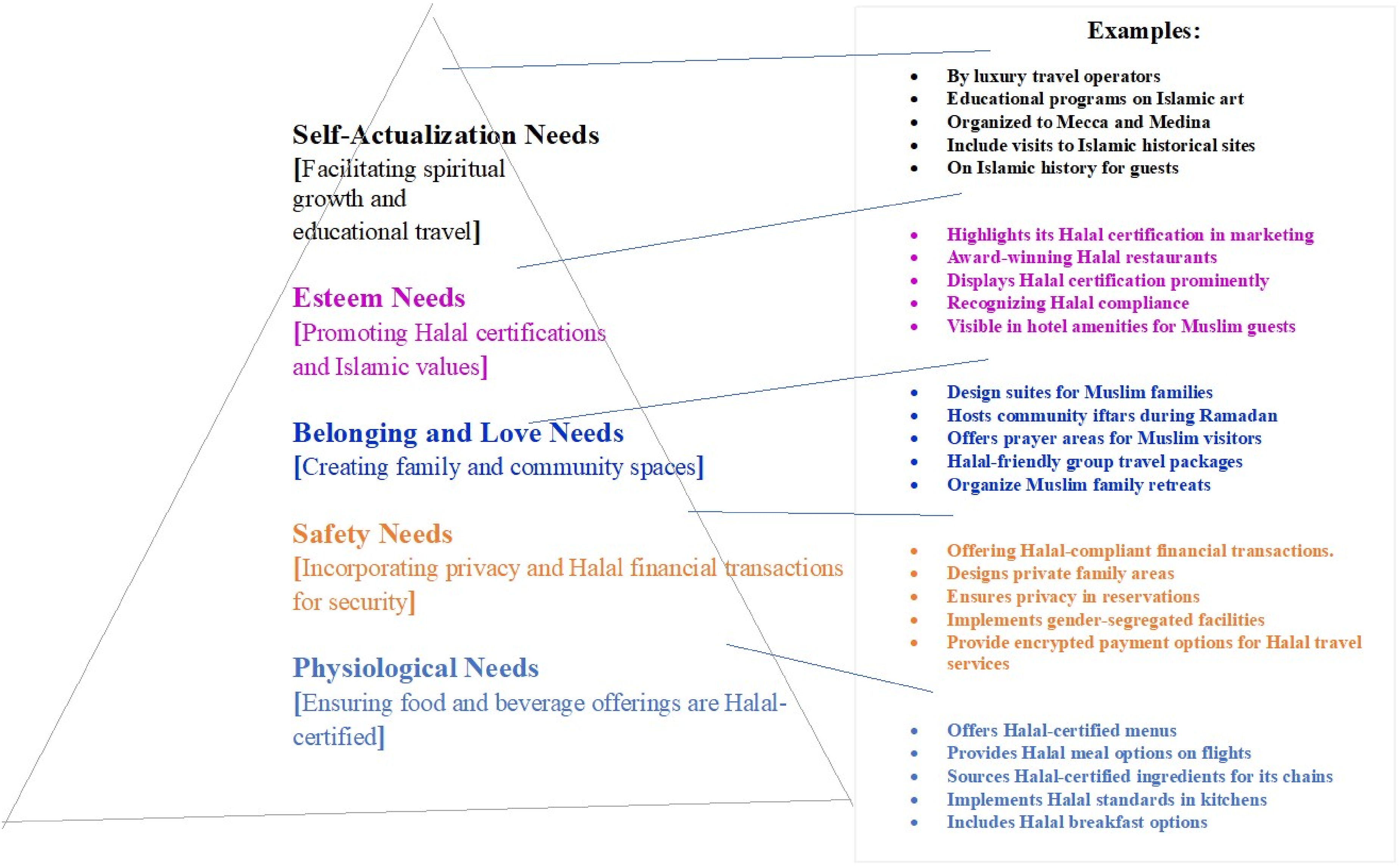
The proposed model
Developing an integrated model (Figure 1) that harmonizes Halal principles with Maslow’s Hierarchy of Needs presents a pioneering approach to understanding the motivational drivers of Muslim consumers within the tourism and hospitality sectors. The conceptual foundation for this integration is premised on recognizing that religious beliefs fundamentally influence an individual’s hierarchy of needs. Traditional interpretations of Maslow’s framework have predominantly centered on a secular understanding of human motivations (Maslow, 1954; Tay and Diener, 2011), which inadvertently sidelines the profound impact of spirituality and religious observance on consumer behavior. By weaving Halal principles into the fabric of Maslow’s model, we acknowledge faith’s intrinsic role in shaping the physiological and safety needs and the psychological and self-fulfillment aspirations of Muslim individuals. This conceptual integration offers a more holistic understanding of consumer motivations, which reflects the diverse and complex nature of human needs in a multicultural and pluralistic society (Wulff and Maslow, 1965).
Therefore, the new model (Figure 1) adapts Maslow’s conventional hierarchy to incorporate Halal principles at every level. The need for Halal food and drink is emphasized at the physiological level, reflecting the fundamental requirement for sustenance that complies with Islamic law (Islam et al., 2023). The safety level is expanded to include financial security through Halal financial services and privacy in accommodations that respect Islamic norms of modesty. Social belonging integrates the need for family-oriented and gender-appropriate leisure activities, fostering a sense of community and belonging within the parameters of Halal practices (Yousaf and Xiucheng, 2018). Esteem needs are addressed by recognizing and respecting the identity and values of Muslim consumers and promoting products and services that enhance their dignity and self-respect within an Islamic context. Finally, self-actualization is reinterpreted to encompass the pursuit of activities that fulfill personal growth and potential and are aligned with religious values and obligations, such as pilgrimages and educational travel that enriches spiritual understanding (Islam et al., 2023; Yousaf and Xiucheng, 2018).
However, integrating Halal principles into Maslow’s Hierarchy is not without challenges. A potential drawback is the risk of oversimplification, where Halal’s complex and diverse interpretations among Islamic cultures are reduced to a one-size-fits-all model. This could inadvertently overlook the nuanced differences in Halal observance and practice, diminishing the model’s applicability across the global Muslim population (Al-Ansi et al., 2023; Han et al., 2019). Moreover, some might view the adaptation of Maslow’s hierarchy to incorporate religious principles as a departure from its original psychological and secular underpinnings, raising debates on the universality versus specificity of human needs (Brown and Osman, 2017; Maslow, 1954).
This model extends beyond traditional applications of Maslow’s Hierarchy of Needs by embedding critical spiritual and religious dimensions into each level of the hierarchy, offering a more comprehensive understanding of Muslim travelers’ motivations. Unlike existing models that often focus narrowly on physiological and safety needs, this integrated approach emphasizes how these basic needs—such as Halal food and culturally appropriate accommodations—are inseparable from higher-order needs like community engagement and spiritual fulfillment. Specifically, the model recognizes that the desire for community-oriented activities, such as attending congregational prayers or participating in Halal social events, and the pursuit of spiritual enrichment through visiting religious sites or engaging in spiritual retreats, are intrinsic to the motivations of Muslim travelers at the levels of belonging, esteem, and self-actualization.
By incorporating Halal principles across all levels of Maslow’s hierarchy, from physiological needs to self-actualization, the model acknowledges that for many Muslim consumers, religious compliance is not a peripheral aspect but a central component interwoven with their primary and higher-order motivations (Jafari and Scott, 2014; Wulff and Maslow, 1965). For instance, including Halal dietary requirements at the physiological level underscores the model’s sensitivity to faith’s foundational role in shaping even the most basic consumer needs. As we ascend the hierarchy, the model adapts to encompass the pursuit of religious knowledge, spiritual growth, and participation in significant religious activities, reflecting the holistic nature of Muslim travelers’ needs. This approach addresses the limitations of existing frameworks and contrasts sharply with models that often overlook the profound impact of religious motivations on consumer behavior (Luz, 2020).
Conclusions and limitations
Integrating Halal tourism principles within Maslow’s Hierarchy of Needs offers a pioneering perspective that enriches academic and industry frameworks by providing a nuanced understanding of Muslim travelers’ motivations. This approach urges a reevaluation of the conventional Maslowian model to embrace the complexity of cultural and spiritual influences on travel behavior, which have often been overlooked in previous studies. By grounding the model in the existing literature and adapting it to reflect the holistic nature of Muslim travelers’ needs, the research note highlights that these motivations are not merely secular but deeply intertwined with religious faith and cultural identity (Din, 1989; Henderson, 2016). For instance, Muslim travelers may seek Halal-certified meals and environments where they can pray and reflect, fulfilling their safety and self-actualization needs. This adaptation demonstrates the model’s efficacy and relevance, particularly as studies have shown that Muslim tourists prioritize destinations that cater to their spiritual needs (Han et al., 2019; Yousaf and Xiucheng, 2018).
The practical implications of this research extend beyond mere compliance with Halal standards. The model calls for a holistic integration of these principles into service design, marketing, and operational practices, ensuring that tourism products and services align with the values and expectations of Muslim travelers. By recognizing that spiritual needs are as essential as physical and psychological ones, this model enables tourism practitioners to enhance the overall travel experience and satisfaction of this demographic. Furthermore, catering specifically to the holistic needs of Muslim travelers offers a strategic advantage, fostering loyalty and achieving competitive differentiation in the global market (Al-Ansi and Han, 2019).
However, the proposed model’s applicability across diverse settings remains to be empirically validated, highlighting the importance of ongoing research in this field. While the model has demonstrated theoretical and practical relevance, future research must refine and adapt it to various cultural and spiritual contexts beyond the Muslim market. This expansion could lead to a more ethical, sustainable, and inclusive approach to global tourism practices, embracing the rich diversity of traveler motivations across different cultures and religions.
Additionally, future research should explore how digitalization and global trends influence the model’s efficacy and applicability. As the tourism industry continues to evolve, understanding the impact of these trends on the model will be crucial for developing strategies that cater to the specific needs of Muslim travelers and contribute to creating more inclusive and responsive tourism experiences for all. This endeavor represents a significant step towards accommodating the rich tapestry of global cultures and religions within the tourism and hospitality sectors.
Footnotes
Declaration of conflicting interests
The author(s) declared no potential conflicts of interest with respect to the research, authorship, and/or publication of this article.
Funding
The author(s) received no financial support for the research, authorship, and/or publication of this article.
