







Abstract
The study aims to explore the relationship between mindful tourism practices and eudaimonic well-being of tourists. The study explains how prior stress level moderates the relationship between mindful tourism practices and self-awareness and how self-awareness mediates the relationship between mindful tourism practices and self-actualisation. Further, the study also explores how self-actualisation leads to self-transcendence and ultimately how self-transcendence leads to eudaimonic well-being. The analysis was performed using VB-SEM from a structured survey of 669 tourists (both Indians and foreigners) who visited Rishikesh (India) for mindful tourism. The findings highlight that self-awareness partially mediates the relationship between mindful tourism practices and self-actualisation and stress level negatively moderates this mediated relationship. Further positive influence of self-actualisation on self-transcendence and self-transcendence on eudaimonic well-being was found. The study contributes to the emerging body of study in exploring basic (self-awareness) to advance level (self-actualisation and self-transcendence) mindful tourism experiences using the extended Maslow’s need hierarchy model. Also, supported by self-determination theory, the study adds a underexplored perspective by exploring eudemonic well-being, an important outcome in the context of mindful tourism. Practically, the findings contribute to the growing body of knowledge on mindful tourism by highlighting its transformative potential in enhancing tourists’ psychological well-being. The study offers valuable implications for tourism practitioners and policymakers to reposition mindful tourism as a meaningful, long-term contributor to individual and societal well-being.
Keywords
Introduction
The modern traveller is no longer just a sightseer but increasingly a seeker of meaning, connection, and sustainability. This shift paves the way for the rise of mindful tourism (Heintzman, 2000). In a world where travel often mirrors consumption, the call for mindful tourism urges a shift from footprints on sand to footprints of awareness (Moscardo, 2017). Mindfulness, as described by Kabat-Zinn (2015), involves a deliberate and non-judgemental awareness of the present moment, achieved by consciously focusing attention on current experiences without reacting impulsively or forming evaluations. Engaging in mindfulness has been linked to numerous psychological and emotional advantages, such as increased personal autonomy, enhanced creativity, deeper self-awareness, overall well-being, and the development of a cohesive life perspective (Vegors, 1999).
As global tourism continues to grapple with issues like overtourism, cultural erosion, and environmental degradation, the need for a more conscious and ethical approach to travel has become critical (Drápela et al., 2025). Hence, mindful tourism offers a promising alternative by encouraging travellers to engage with destinations in a more meaningful, responsible, and present-focused manner. People have expressed a preference for mindful tourism over conventional tourism, stating that it offers deeper and more meaningful travel experience (Mishra and Chowdhary, 2024). They state that, unlike typical tourism, which often focuses on sightseeing, consumption, and rushed schedules, mindful tourism encourages travellers to remain present, show respect, and be aware of their impact on local communities and the environment (Ntshabeleng and Phori, 2024). However, despite growing interest, the integration of mindfulness into tourism practices remains relatively underexplored (Leban et al., 2024). Therefore, studying mindful tourism is essential not only to enhance the quality of tourist experiences but also to promote sustainability, cultural sensitivity, and personal growth in a rapidly evolving global travel landscape (Stankov et al., 2022).
Despite the growing importance of mindful tourism, significant gaps persist within the academic literature, particularly in the context of emerging markets. First, mindful tourism practices (MTP) construct with limited empirical exploration, requires further research to establish conceptual clarity (Pongsakornrungsilp and Pongsakornrungsilp, 2023). Fulfiling this knowledge gap will strengthen the theoretical foundation and will offer a structured approach for future studies. Second, under-representation of India, a globally recognised hub of spirituality, mindfulness, yoga, and meditation in mindful tourism research is a significant oversight (McCartney, 2019). Exploring India in this context will fulfil the contextual gap. It would not only provide culturally rich insights but also allow researchers to anchor mindful tourism within an authentic, historically rooted setting. Third, no paper has analysed basic (self-awareness) to advance level (self-actualisation and self-transcendence) mindful tourism experiences. Exploring this spectrum of experiences using the Extended Maslow’s need hierarchy model in mindful tourism addresses this theoretical gap. Fourth, examining prior stress level (SL) as a moderator introduces a critical and unsearched psychological variable in the context of mindful tourism that reflects real-world complexities. Since stress significantly influences individuals’ perceptions and behaviours during travel (Wang and Sim, 2025), integrating it into mindful tourism research enhances the predictive accuracy and contextual relevance of existing models. Fifth, eudemonic well-being (EWB), a highly important outcome, is not studied in the context of mindful tourism. Addressing this conceptual gap using Self-determination theory (SDT) moves the research focus beyond temporary pleasure (hedonic well-being) to long-term fulfilment and personal growth.
Theoretically, the study extends the application of Extended Maslow’s hierarchy of needs by contextualising it within the framework of mindful tourism. Traditionally applied to personal growth and motivation, Maslow’s theory is employed here to illustrate how tourism, when approached mindfully, can serve as a pathway not only to meet basic psychological needs (SAW) but also to fulfil higher-order needs (SAC, ST, and EWB) (Cave et al., 2022). Also, the study contributes by reinforcing and extending SDT within the domain of mindful tourism. SDT emphasises that the satisfaction of three basic psychological needs (autonomy, competence, and relatedness) is fundamental to achieve EWB (Sedikides et al., 2019). The findings empirically support this by showing that MTP naturally create an environment that fulfil these needs. Through self-directed actions, skillful engagement with cultural or natural settings, and meaningful connections, individuals experience enhanced psychological engagement and personal growth, ultimately fostering EWB.
Methodologically, the use of a moderated-mediation approach contributes to the literature by uncovering the conditional indirect effects of MTP on SAC through SAW, moderated by the prior SL. This approach allows the study to move beyond simple mediation by demonstrating that the strength of the mediated relationship is not uniform but varies (Yadav, 2025; Yadav et al., 2025) across individuals experiencing different levels of stress. Practically, the findings of this study contribute to the growing body of knowledge on mindful tourism by highlighting its transformative potential in enhancing tourists’ psychological well-being. The results emphasise that MTP significantly foster SAW and SAC, ultimately leading to ST and EWB. Additionally, the study reveals the critical role of prior SL in enabling deeper self-reflection. These insights underscore the importance of designing tourism experiences that go beyond relaxation, aiming to facilitate personal growth, inner clarity, and purpose-driven travel.
On the basis of the above gaps, the following research questions are formulated: RQ1: What is the relationship between mindful tourism practices and self-actualisation of tourists? RQ2: How does self-awareness mediate the relationship between mindful tourism practices and self-actualisation of tourists? RQ3: How does the stress level moderate the relationship between mindful tourism practices and self-actualisation mediated via self-awareness of tourists? RQ4: What is the relationship between self-actualisation and self-transcendence of tourists? RQ5: What is the relationship between self-transcendence and eudaimonic well-being of tourists?
Review of literature
Theoretical underpinnings
The conceptual framework of the present study (see Figure 1) is precisely constructed by integrating key components from two foundational theories: Extended Maslow’s need hierarchy theory and Self-determination theory (SDT). The variables are closely aligned with the stages of the extended Maslow’s hierarchy of needs, which moves beyond basic physiological and safety needs to include higher-order psychological and self-fulfilment needs (Cave et al., 2022). Self-awareness corresponds to the esteem level, where individuals begin to understand their inner selves and seek personal recognition and clarity (Moscardo, 2009). Self-actualization directly maps onto Maslow’s self-actualization stage, reflecting the pursuit of personal growth, realization of one’s potential, and meaningful experiences (Agarwal et al., 2025). Self-transcendence, an addition in the extended hierarchy, represents the individual’s desire to move beyond the self and connect with a higher purpose, others, or the environment, which ultimately leads to eudaimonic well-being, the state of living meaningfully and purposefully (Huta and Ryan, 2010). Simultaneously, SDT, which posits that human well-being and motivation are driven by the satisfaction of three basic psychological needs: autonomy, competence, and relatedness also supports the model (Sedikides et al., 2019). In mindful tourism settings, practices such as meditation, yoga, and slow engagement with the environment enable individuals to exercise autonomy by allowing them to choose experiences that align with their inner goals and values (Çıkı and Tanrıverdi, 2023). These activities also foster a sense of competence as tourists learn new skills, regulate their emotions, and deepen self-awareness. Additionally, the communal and reflective nature of retreat environments enhances feelings of relatedness by nurturing meaningful connections with instructors, fellow participants, and the surrounding natural setting (Buzinde, 2020). Conceptual framework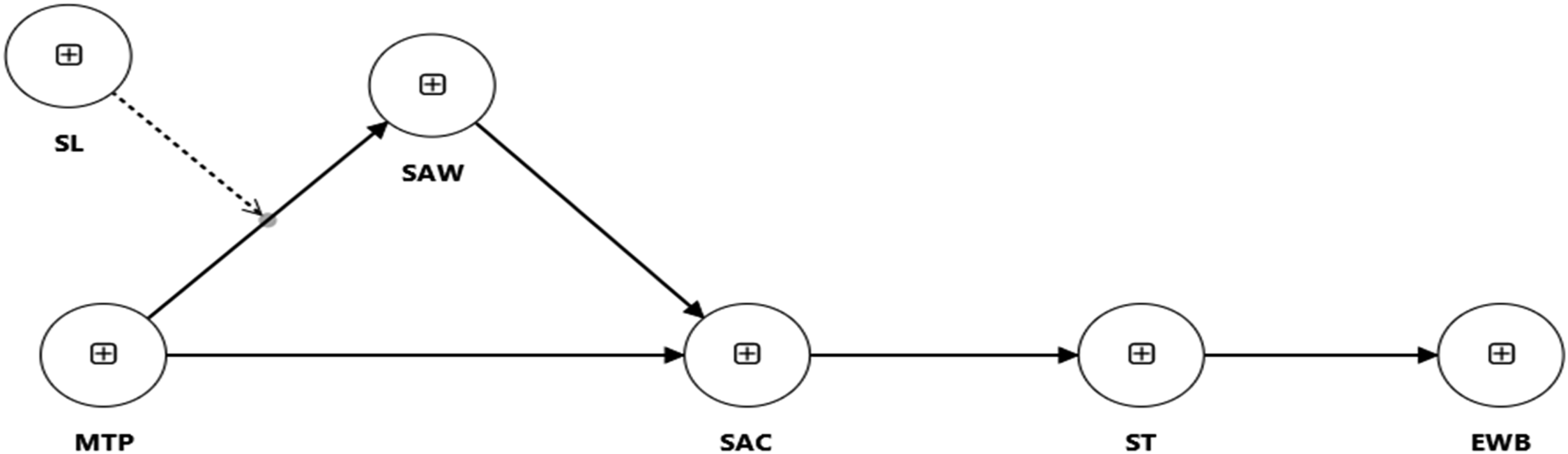
Though the integration of Maslow’s extended need hierarchy and SDT provides a robust foundation for understanding psychological growth through mindful tourism, it is important to acknowledge the theoretical interlinkages between these frameworks. Maslow’s model is inherently hierarchical and sequential, proposing that individuals move from basic to higher-order needs in a linear progression (Cave et al., 2022). In contrast, SDT posits that the needs for autonomy, competence, and relatedness operate simultaneously and are essential across all life domains, without requiring hierarchical fulfilment (Sedikides et al., 2019). To reconcile these perspectives, the present study adopts a complementary rather than substitutive approach: Maslow’s extended hierarchy is used to conceptualise the types of higher-order outcomes relevant to mindful tourism (i.e., self-awareness, self-actualisation, and self-transcendence), while SDT is employed to explain the motivational processes through which these outcomes emerge. This dual-theoretical lens allows the model to capture both the vertical progression of internal psychological development (from awareness to actualisation to transcendence) and the horizontal motivational forces (autonomy, competence, and relatedness) that operate concurrently during tourism experiences.
Further, the study acknowledges that psychological development in mindful tourism may not always follow a strict linear progression; tourists may experience elements of self-awareness, self-actualisation, and self-transcendence in overlapping or recursive ways. Accordingly, Maslow’s extended hierarchy is treated as a heuristic device to categorise the nature of higher-order experiential outcomes, rather than as a deterministic developmental sequence, while SDT provides a process-oriented explanation of how motivational need satisfaction dynamically facilitates these outcomes. By explicitly recognising this tension, the model adopts a theoretically pluralistic stance that captures both structured developmental tendencies and context-dependent motivational dynamics inherent in mindful tourism experiences.
Conceptual framework and hypotheses development
Mindful tourism practices
Mindfulness has been described as the integrated alignment of an individual with others, encompassing traits such as autonomy, creativity, and cohesive life philosophy (Vegors, 1999: 19). Langer (1992) defines mindfulness as a state of active, conscious awareness in which one remains attuned to both the context and content of information. A key aspect of mindfulness is maintaining concentrated attention and present-moment awareness (Moscardo, 2009). The theoretical framework of mindfulness distinguishes between two cognitive modes: a mindful approach marked by receptiveness and present-focus, and a mindless approach characterised by habitual reliance on past categorisations (Langer, 2014). Boyce et al. (2011) noted that mindfulness can convert monotony into curiosity, agitation into calm, and pessimism into appreciation. The foundational elements of mindfulness are generally identified as attention, awareness, and actualisation. It represents the conscious traveller who engages with their environment through heightened awareness and presence (Stankov et al., 2020). The definition of mindful travel draws significantly from Buddhist principles of mindfulness, which emphasise focused attention, situational awareness, and non-judgemental acceptance of the present moment (Kabat-Zinn, 2015).
While earlier tourism research generally treats mindfulness as an inherently positive psychological resource, recent work cautions that mindfulness is not universally beneficial nor uniformly experienced across travellers (Galla et al., 2024), this highlights that the value of mindfulness depends heavily on contextual cues and individual predispositions—an aspect underexplored in tourism settings. These debates highlight the need to critically investigate how mindfulness is operationalised in tourism, particularly when linking it to psychological outcomes such as self-awareness, self-actualisation, and self-transcendence.
Self-awareness
Mindful tourism, which encourages travellers to engage with destinations in a present, purposeful, and non-judgemental manner, has emerged as a significant contributor to enhancing self-awareness (SAW) among tourists (Chhabra, 2021). This form of tourism emphasises slowing down and observing experiences intentionally, which aligns with psychological theories of mindfulness that link it with increased self-reflection and personal growth (Chhabra, 2021; Li, 2025). Recent studies suggest that travellers who adopt mindful practices during their journeys report heightened awareness of their thoughts, emotions, and values, often leading to transformative experiences, such as self-actualisation (Cave et al., 2022). Moreover, mindful tourism has been linked with emotional regulation and greater alignment between personal goals and behaviour, key dimensions of SAW (Stankov et al., 2022). For instance, Sanz-Gómez and Calle-Lamelas (2025) demonstrated that participants who engaged in mindful walking tours and cultural immersion activities reported increased self-congruence and emotional insight compared to traditional tourists. Furthermore, destinations that integrate mindfulness elements into their tourism offerings, such as meditation retreats, nature-based experiences, or wellness-focused itineraries may act as catalysts for SAW by encouraging reflection away from daily distractions (Barnert et al., 2014). Although SAW is often portrayed as a positive psychological outcome of mindful tourism, literature presents differing views regarding its antecedents and consequences (Eckroth-Bucher, 2010). Chhabra (2021) and Li (2025) suggest that mindful travel encourages introspection, emotional congruence, and clarity. However, contrasting evidence shows that increased self-awareness can sometimes heighten self-criticism or emotional discomfort, particularly when travellers confront identity conflicts or unresolved personal issues (Chon and Sitkin, 2021; Walsh and Arnold, 2020). This indicates that SAW may not always follow a linear or uniformly positive progression, leaving a major scope for further investigation.
Stress level
Tourism has been increasingly acknowledged for its role in stress reduction and the promotion of mental well-being (Wang and Sim, 2025). This stress-reducing effect is critical not only for improving tourist well-being but also for enhancing psychological outcomes such as SAW (Qiu et al., 2022). Recent research indicates that reduced stress acts as a facilitator for SAW by removing cognitive distractions and emotional turbulence, allowing travellers to better reflect on their values, behaviours, and personal growth (Rana et al., 2025). As a result, mindful tourism can create a unique psychological space where low stress levels (SL) enable deeper introspection and SAW (Pop et al., 2023). The stress not only influences tourist well-being directly but also conditions the efficacy of mindfulness-based interventions in travel. Consequently, managing stress is vital to unlocking the full benefits of mindful tourism (Li et al., 2025). Though Avecillas-Torres et al. (2025) highlighted that stress levels influence the effectiveness of mindfulness interventions, yet tourism studies seldom test stress as a boundary condition. By incorporating stress as a moderator, the present study contributes to refining theoretical assumptions about mindfulness–well-being relationships in tourism contexts.
Self-actualisation
Mindful tourism, characterised by present-moment awareness and intentional engagement with experiences, has increasingly been linked to self-actualisation (SAC). SAC is the realisation of an individual’s full potential and personal growth (Agarwal et al., 2025). The concept, rooted in Maslow’s hierarchy of needs, finds new relevance in travel studies where mindful tourism is recognised as a medium for profound personal transformation (Hussain, 2021). Travellers engaging in mindful practices, such as meditation retreats, silent walks, and nature immersion often report enhanced feelings of purpose, clarity, and SAC (Bhuyan et al., 2025). Recent empirical studies reinforce the connection between mindful tourism and SAC by highlighting how such experiences contribute to psychological well-being, autonomy, and a sense of mastery (Li and Phuong, 2025). Mindfulness-based eco-tourism programmes significantly increased participants’ self-determined motivation and personal authenticity (Nicolaides, 2020). Similarly, mindful travel enhances emotional resilience and existential awareness, which are fundamental to achieving SAC (Lewis et al., 2022). However, contradictions persist regarding whether SAC emerges directly from mindfulness or whether it requires an intervening psychological process such as self-awareness or reduced stress. These inconsistencies point to theoretical ambiguity that our model seeks to address by positioning SAC as a distinct outcome shaped by mindful tourism practices and internal psychological conditions like self-awareness.
Self-transcendence
In tourism research, self-actualisation is commonly conceptualised as an inward-focused developmental process in which individuals gain clarity about their values, strengths, and life purpose through reflective or growth-oriented experiences (Bhuyan et al., 2025; Hussain, 2021). This process emphasises personal development, self-knowledge, and inner fulfilment, centring on the idea of becoming one’s “best self”. However, many tourism studies often conflate SAC with self-transcendence (ST), leading to conceptual overlap and measurement ambiguities (Koltko-Rivera, 2006; Oh et al., 2016). Such conflation has contributed to theoretical inconsistencies, despite their distinct psychological orientations.
In contrast to the inward orientation of SAC, ST represents the outward orientation, a movement beyond the personal self toward wider engagement with humanity and the world (Yan et al., 2024). It is defined as a decrease in the importance of oneself and an increase in connectedness to others, social groups, or something greater than oneself (Yan et al., 2024). Having a non-conceptual, clear-eyed, and non-attached awareness of one’s environment nurtures the ability to dissolve self-ego and to recognise social connectedness (Sheldon, 2020). Mindfulness theory suggests that mindful individuals develop quality social interactions and relationships because such individuals feel more attuned and connected to the parties in these interactions or relationships (Brown et al., 2007). Specifically (Maslow, 1969: p. 66), defines self-transcendence a higher level need beyond SAC, as “the very highest and most inclusive or holistic levels of human consciousness, behaving and relating, as ends rather than as means, to oneself, to significant others, to human beings in general, to other species, to nature, and to the cosmos.” Yaden et al. (2017) advance two main components of ST: (1) annihilational, referring to both the dissolution of bodily sense of self accompanied by reduced self-boundaries and self-salience; and (2) relational, referring to the sense of connectedness, even to the point of oneness, with something beyond the self, usually with other people and aspects of one’s environment or surrounding context. In mindful tourism, eudaimonic reflection is linked to ST and should be more likely to do so than hedonic reflections. Also, eudaimonically motivated activities compared to hedonically motivated activities, uniquely predict outcomes such as elevating experiences and feeling connected to a larger whole (Huta and Ryan, 2010).
Eudaimonic well-being
Past studies have divided well-being into two dimensions (McMahan and Estes, 2011). First, “hedonia”, a concept of seeking pleasure and avoidance (Deci and Ryan, 2008), and second “eudaimonia”, which includes self-reflection and personal meaning. Eudaimonia is related to self-growth and self-realisation (Huta and Waterman, 2014), which suggests that people are committed to pursuing the meaning of life and realising self-value (Ryan and Deci, 2001). Eudaimonic well-being (EWB) is frequently positioned as an outcome of self-realisation and meaningful engagement (Huta and Waterman, 2014). Eudaimonia as a meaning related outcome has long-term enduring outputs and has been discussed as a major purpose of tourism when tourists search for authenticity as a way of gaining self-consciousness, to know more about the self, the world, and tourists’ place in the world (Laing and Frost, 2017). However, debates continue over whether EWB is a state, a process, or a set of activities—an ambiguity that complicates its application in tourism.
Literature suggests that self-determination theory (SDT) explains eudaimonic well-being (Ryan and Deci, 2001). Tourism studies often treat EWB descriptively rather than analytically, overlooking potential conflicts between hedonic enjoyment and eudaimonic growth (Vada et al., 2020). Additionally, prior research rarely integrates EWB with constructs such as self-transcendence, despite conceptual overlap. The present study addresses these gaps by examining EWB as the psychological culmination of SAW, SAC, and ST within a unified mindful tourism framework.
On the basis of the extant literature, the following hypotheses have been framed:
Mindful tourism practices significantly influence self-actualisation of tourists.
Mindful tourism practices significantly influence self-awareness of tourists.
Self-awareness significantly influences self-actualisation of tourists.
Self-awareness significantly mediates the relationship between mindful tourism practices and self-actualisation of tourists.
Stress level significantly moderates the mediated relationship of mindful tourism practices and self-actualisation via self-awareness.
Stress level significantly influences self-awareness of tourists.
Stress level significantly moderates the relationship between mindful tourism practices and self-awareness of tourists.
Self-actualisation significantly influences self-transcendence of tourists.
Self-transcendence significantly influences eudaimonic well-being of tourists.
Methodology and research design
Study context
Yoga, derived from the Sanskrit word Yuj, meaning “to join” or “to unite,” signifies the union of the individual with the mind and nature (Pradhan, 2015). Deeply embedded in Indian culture, yoga and meditation are widely regarded as a symbol of India’s cultural identity. As an indigenous therapy, yoga and meditation have gained global recognition and inspired a growing trend known as mindful tourism (Bowers and Cheer, 2017; Lindell et al., 2022). Yoga tourism provides tourists with enriching experiences through yoga and meditation, often contributing to their psychological and physical recovery from hectic and stressful lives (Dillette et al., 2019). Among the destinations, Rishikesh, a place nestled in the state of Uttrakhand, India, is considered the premier site for international yoga tourism, where tourists seek immersion in authentic practices guided by experienced yoga coaches (Tiwari et al., 2024). Rishikesh is globally recognised as the “Yoga Capital of the World” or the “City of the Divine”. It has long been a centre of spiritual activity, where people come with a ‘travel to feel well’ philosophy (Charak et al., 2021). Situated in the serene backdrop of the Himalayas, its streets are lined with temples, shrines, and saffron-clad spiritual practitioners. The presence of the sacred Ganga River, the surrounding majestic Himalayas, and the globally recognised tranquil ashrams create a setting that fosters a deep sense of inner renewal and spiritual connection (McCartney, 2019).
This place also hosts the ‘Annual International Yoga Festival’ in collaboration with Parmarth Niketan Ashram, attracting yoga and meditation participants worldwide (Nautiyal et al., 2023). Many international visitors travel to Rishikesh to deepen their yoga routines, gain insight from ancient teachings, and experience India’s spiritual essence. In Rishikesh, yoga tourism investment is projected to reach USD 85 billion by 2028, reflecting over 50% growth dependent on international arrivals (McCartney, 2021), supported by a compound annual growth rate of 5.8% over the next 7 years. Visitors are increasingly motivated by the perceived authenticity of India as the homeland of yoga (Rungsimanop and Ashton, 2021) and believe that through yoga techniques, they can transform their lifestyles (Cheer et al., 2017). Therefore, given its cultural significance and central role in global yoga tourism, Rishikesh has been chosen as the context for the present research.
Data collection
This research utilised a structured survey questionnaire aligned with a descriptive research framework (Hinkin, 1998). A purposive sampling method is adopted to engage participants for the study (Etikan et al., 2016). Purposive sampling helps practitioners deliberately choose individuals with first-hand, meaningful experience of the phenomenon under investigation, thereby enhancing the richness and relevance of data (Etikan et al., 2016). Also, it works particularly well in a special context such as mindful tourism, where only a minority of visitors actually engage in the behaviour desired (meditation, yoga, spiritual immersion). The study specifically focused on how yoga and meditation experiences in Rishikesh contribute to the broader construct of mindful tourism. Researcher strategically stationed at renowned ashrams, wellness resorts, yoga schools, and riverfront ghats, where tourists and spiritual seekers commonly engaged in mindfulness-based activities. Data collection was carefully planned during the participants’ stay and after the completion of their experience. During their stay, data was collected at transition points such as post-meditation breaks, meal times in community dining halls (langars), and informal satsangs (spiritual gatherings), when individuals were more relaxed and open to dialogue. The researcher approached potential respondents with a warm, non-intrusive introduction and presented an ethics-approved consent form that clearly outlined the purpose of the study, assurance of confidentiality, and the voluntary nature of participation. Participants who agreed to take part were invited to complete a structured survey administered either digitally on tablets or through printed forms, based on their comfort with technology and literacy levels. Selecting samples from these sites improves construct validity as people at these locations are engaged in mindfulness-based travel routines rather than casual tourists with superficial exposure. It is essential to align context correctly so that the depth of mindful tourism experiences can be captured to test a theoretically grounded model. Also, inclusion of Indian and foreign tourists at various ashrams and wellness centres adds to the cultural variation within the sample while keeping the focus on participants who are legitimately part of the mindful tourism segment.
Prior to the main data collection, the survey instrument was evaluated by two domain experts to establish content validity, leading to revisions in certain items based on their feedback. A pilot study involving 50 participants was conducted to test the instrument’s reliability and clarity. A total of 692 valid responses were collected from individuals who visited Rishikesh between March 2025 and May 2025. The final sample exceeded the recommended criterion of 10 participants per indicator variable (692 > 28*10) and was deemed sufficient based on GPower analysis (Memon et al., 2020), ensuring a statistical power of 0.80 with a small effect size of 0.02 (Faul et al., 2007). Gender distribution in the sample was relatively balanced, with 56% identifying as males and 44% as females. 50% of respondents were aged between 40 and 60, followed by 30% in the 20 to 40 age bracket. 57% of participants were Indians and 43% were foreign nationals. All participants were briefed on the purpose of the research, and the questionnaire was translated where required to enhance understanding. The constructs measured in this study were reflective in nature and assessed on a five-point Likert scale, ranging from 1 (Strongly Disagree) to 5 (Strongly Agree). The questionnaire was organised into three key segments: an introductory cover letter explaining the study’s objectives, a demographic section collecting basic participant information such as age, gender, and nationality and a final section dedicated to measuring the core constructs of the research.
Five MTP statements are adapted from Moscardo (1992). Four SL statements are borrowed from Cohen et al. (1983). Five SAW items are taken from Govern and Marsch (2001). The five items of SAC and four items of ST are adapted from Phang et al. (2006) and Nordlund and Garvill (2003). The EWB construct is measured using the five items of Ryff and Keyes (1995). Specifically, all constructs were operationalised using well-established scales that have been widely validated across various research domains. Given the mindfulness-based tourism context, minor modifications in wording were done to ensure relevance and contextual clarity. Importantly, these modifications were strictly linguistic and did not alter the underlying conceptual meaning of the constructs. Furthermore, to maintain construct validity, the adapted items underwent rigorous pre-testing through expert reviews and a pilot study to confirm that participants interpreted the items consistently with their original intent. Reliability and validity assessments further confirmed that the modified items continued to load appropriately on their respective latent constructs. The conceptual framework constituting all constructs is presented in Figure 1.
Rationale of statistical tools/techniques
To analyse the data, this study utilises Variance-Based Structural Equation Modeling (VB-SEM) through SmartPLS version 4.1, aligning with the research goal of identifying the highest explained variance (R2) in the outcome variable (eudaimonic well-being) attributed by the proposed independent constructs. The observed non-linearity in participant responses further justifies the application of VB-SEM. This analytical approach is particularly suitable for examining emerging frameworks like mindful tourism practices and assessing their predictive capabilities (Sarstedt et al., 2022). The study has selected PLS-SEM instead of CB-SEM based on statistical and conceptual factors. Mardia’s test revealed substantial skewness and kurtosis, confirming the absence of multivariate normality, thus making PLS-SEM more suitable. The research seeks to optimize explained variance in EWB and investigates innovative constructs and intricate pathways including mediation and moderation. PLS-SEM works well with complex structures and non-normal data, making it a good choice for these prediction-oriented, exploratory models (Sarstedt et al., 2022).
Further, to mitigate concerns related to Common method variance, the study employed the full collinearity assessment by evaluating the inner VIF values for all latent constructs. Each value was below the threshold of 3.3, indicating the absence of CMV-related bias in the dataset (Kock, 2015). In addition, Harman’s single-factor test indicates that a single component accounts for less than 50% variance, confirming the absence of issues related to CMB (Podsakoff et al., 2003).
VB-SEM
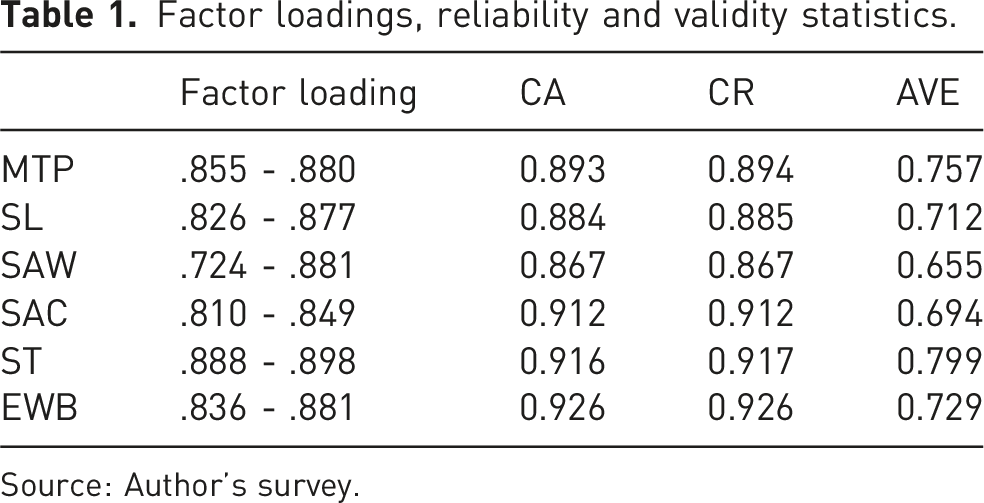
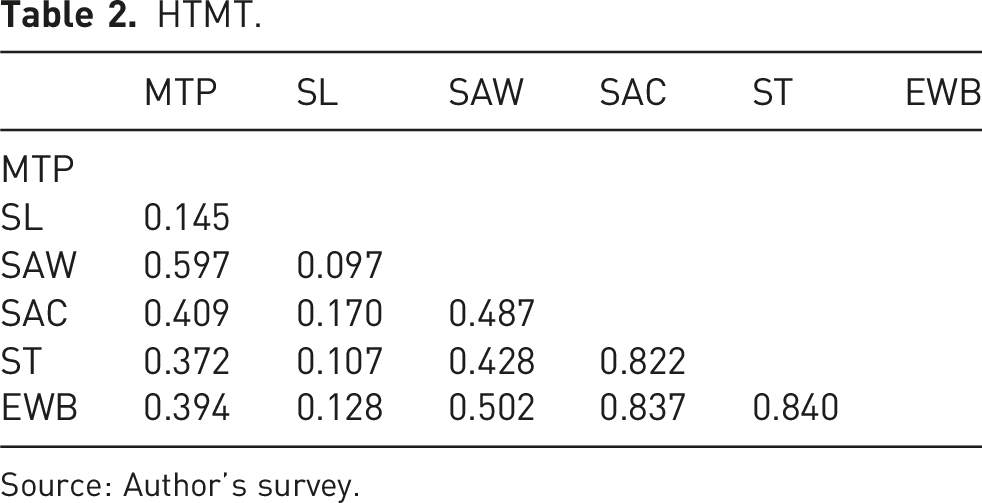
This research adopts VB-SEM for statistical analysis, which involves a two-stage analytical process: evaluation of the measurement model followed by the structural model (Sarstedt et al., 2022). The measurement model is employed to verify the reliability and validity of the latent constructs, whereas the structural model is used to test and confirm the hypothesised relationships among the latent variables.
Measurement model (confirmatory factor analysis)
Factor loadings, reliability and validity statistics.
Source: Author’s survey.
HTMT.
Source: Author’s survey.
Structural model
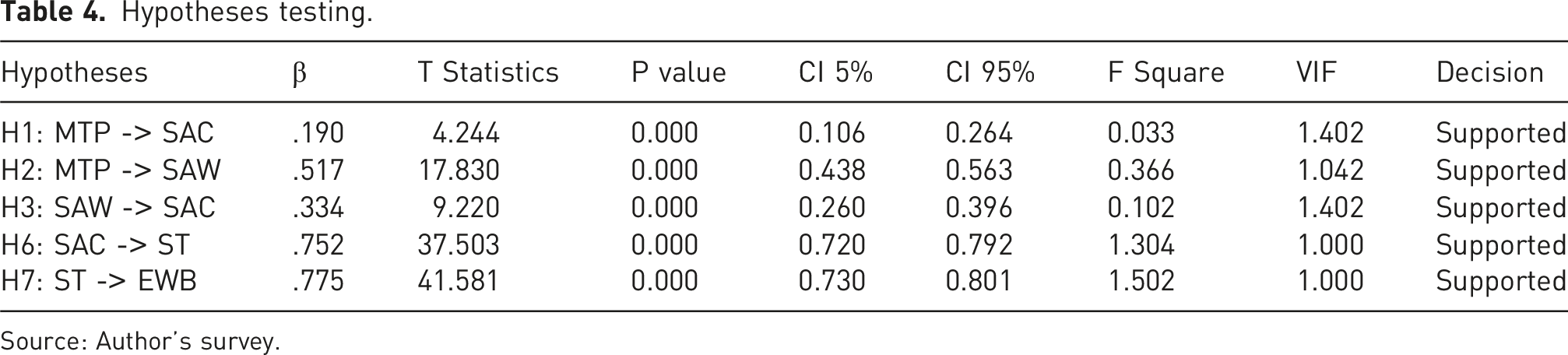
Hypotheses testing
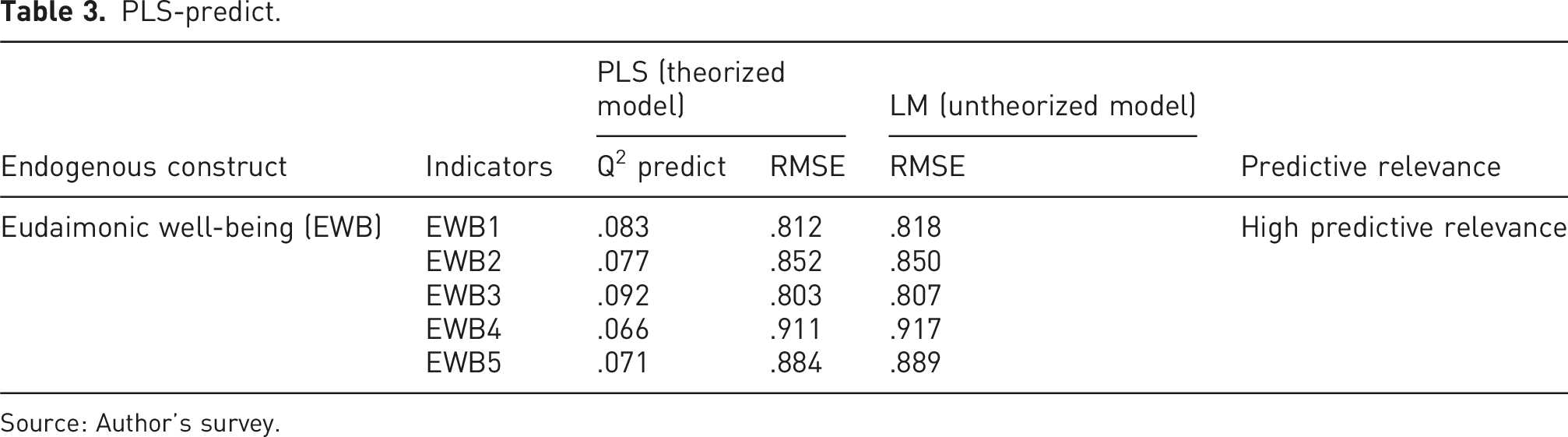
To evaluate proposed hypotheses, a bias-corrected bootstrapping procedure with 10,000 resamples was conducted at a 95% confidence level using a two-tailed test in SmartPLS (Hair et al., 2019). To assess the model’s predictive strength, both R2 and Q2 values were examined. The R2 values obtained for SAW (0.298), SAC (0.216), ST (0.566), and EWB (0.600) indicate that the model exhibits moderate to high levels of explanatory power (Sarstedt et al., 2022). In addition, the Q2 values for these constructs are 0.576, 0.566, 0.884 and 0.896, confirming model’s predictive relevance (Sarstedt et al., 2022).
PLS-predict.
Source: Author’s survey.
Hypotheses testing.
Source: Author’s survey.
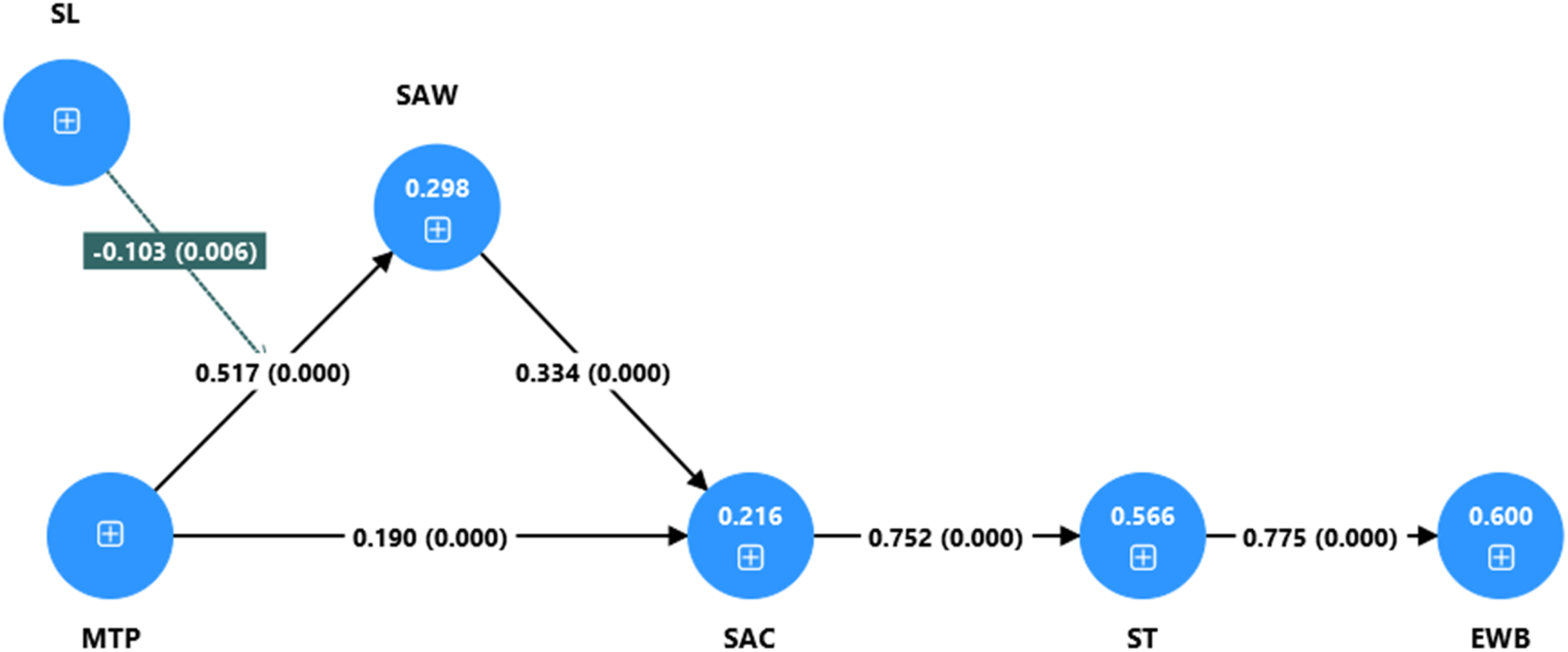
Structural model.
MTP significantly influences both SAC (β = .190) and SAW (β = .517). Notably, the effect of MTP on SAW is comparatively strong; with one of the largest standardized coefficients. This indicates that mindfulness practices play a substantial role in enhancing individuals’ self-awareness. In contrast, the effects of MTP on SAC (β = .190) and the subsequent paths, SAW → SAC (β = .334), SAC → ST (β = .752), and ST → EWB (β = .775) vary in magnitude, with SAC → ST and ST → EWB representing strong associations within the mediation chain. The effect size (f2) analysis further supports this pattern: MTP exerts a strong effect on SAW (f2 > 0.366), while the remaining relationships fall within the moderate-to-weak range (Sarstedt et al., 2022).
Mediation analysis
Mediation analysis.

Source: Author’s survey.
The results confirmed Hypothesis H4, indicating SAW significantly mediates the relationship between MTP and SAC (β = 0.173). The indirect and total effects are both significant, and the Variance Accounted For (VAF) of 52.34% falls within the accepted range of 20%–80%, indicating partial rather than full mediation (Preacher and Hayes, 2008). This indicates that, while a substantial proportion of MTP’s influence on SAC operates through enhanced self-awareness, a meaningful proportion of the effect persists independently of SAW as well. The persistence of a significant direct effect implies that additional mechanisms beyond self-awareness are likely to contribute to how mindful tourism practices enhance self-acceptance. These may include factors such as emotional regulation, stress reduction, or reflective cognitive processes, which were not explicitly modelled in the present framework but are theoretically consistent with the mindfulness literature (Jung and Ha, 2025). The positive associations observed among MTP, SAW, and SAC indicate a complementary partial mediation, meaning that both the direct and indirect effects operate in the same direction and jointly strengthen the overall relationship (see Table 5).
Moderation analysis
Moderation analysis.

Source: Author’s survey.
Moderated mediation analysis
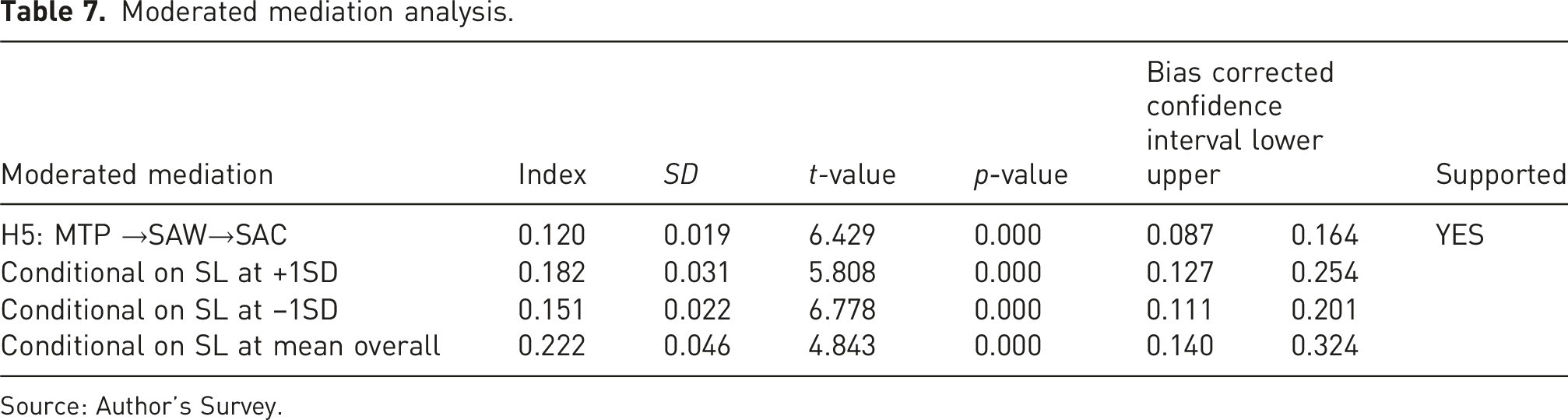
Moderated mediation analysis.
Source: Author’s Survey.
To enhance comprehension of the moderating effects, a slope analysis of the interaction terms was conducted (Dawson, 2014). The graphical depiction (Figure 3) indicates how the relationship between MTP and SAW changes at different levels of stress (SL). When stress is low (−1 SD), the positive effect of MTP on SAW is stronger, reflected in a steeper slope. However, when stress is high (+1 SD), the slope becomes flatter, indicating that the influence of MTP on SAW weakens. In simple terms, mindfulness practices contribute more to individuals’ sense of awareness when they are experiencing lower stress, whereas high stress reduces the strength of this relationship. Slope analysis.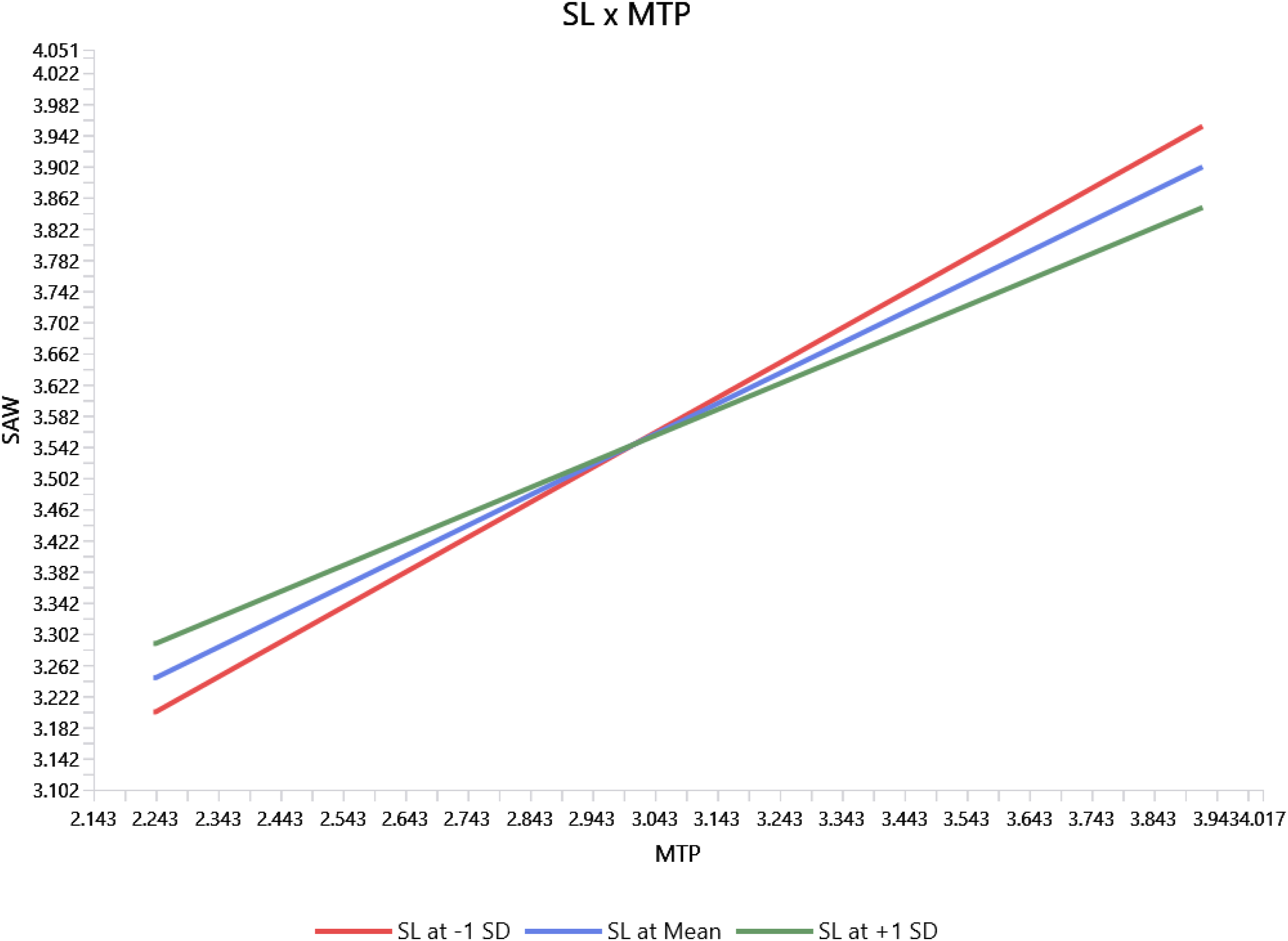
Discussion
The paper aims to examine the relationship between MTP and EWB of tourists in the light of Maslow’s need hierarchy theory and self-determination theory (refer Tables 4–7). The analysis highlights that mindful practices such as yoga and meditation significantly impact the SAW and SAC of tourists (Brown and Ryan, 2003), however, the mechanisms underlying these relationships may be more complex than the model implies. While these practices encourage individuals to slow down, disconnect from routine distractions, and engage deeply with their inner thoughts and emotions, it is important to acknowledge alternative explanations. Individuals who opt into mindfulness-based tourism experiences may already possess a predisposition toward introspection and retreat-like environments such as ashrams or yoga schools or may themselves create strong situational cues that promote reflective thinking independent of the practices (Lantheaume et al., 2024; Martiny-Huenger et al., 2022). Moreover, self-reported reflection in wellness-oriented contexts may be influenced by social desirability norms. Nonetheless, existing literature suggests that mindfulness practices can guide individuals to observe their mental and emotional states more clearly, fostering heightened SAW (Martin et al., 2025). When tourists are self-aware, it eventually leads to their SAC as SAW is a foundational step in understanding one’s true desires, strengths, and purpose (Jo, 2024). Through these, tourists gain insight into their inner selves, which allows them to recognise what truly brings them fulfilment (Sardesai and Gore, 2025). This deep reflection helps align their actions and choices with their core values, moving them closer to achieving personal growth and realising their full potential (Chhabra, 2021).
The study findings also highlight that prior SL negatively moderates the influence of mindful practices on SAW and ultimately on SAC (Vago and Silbersweig, 2012). This is because high stress impairs cognitive clarity and emotional regulation, making it difficult for individuals to fully engage in mindfulness activities like yoga and meditation (Pop et al., 2023). Under stress, the mind tends to remain preoccupied with worries, reducing the ability to stay present and introspective, key components for cultivating SAW. However, the results do not allow us to disentangle whether all types of stress function similarly. Chronic stress, sudden acute stressors, environment-related stress (e.g., travel fatigue), or internal psychological strain may have differential effects on one’s capacity to engage mindfully. For example, psychologically, chronic stress activates the amygdala and suppresses the prefrontal cortex, impairing reflective thinking and self-growth processes, which are essential for both awareness and actualisation (Abarca et al., 2022). Future research should examine whether certain stress profiles more strongly impair SAW, or whether particular mindfulness formats (e.g., guided meditation vs silent observation) are more resilient to stress interference.
The findings also support a strong relationship between SAC and SAT of tourists, as grounded in Maslow’s hierarchy of needs theory (Varga et al., 2024). According to Maslow, once individuals fulfil their potential and achieve SAC realising personal growth, creativity, and authenticity, they naturally seek a higher purpose beyond the self (Worth and Smith, 2021). In the context of tourism, this progression is reflected when self-actualised tourists begin to pursue experiences that connect them with something larger, such as nature, humanity, or spirituality (Assiouras and Bayer, 2025). These self-transcendent experiences often involve a sense of unity, purpose, and altruism, where tourists derive meaning not just from personal fulfilment but from contributing to the well-being of others or engaging with causes greater than themselves (Zhao et al., 2024).
Ultimately, the high transcendent individuals achieve EWB as supported by findings (Varga et al., 2024). Mindful tourism activities facilitate inner awareness, self-reflection, and personal growth. Tourists engaging in such experiences often report a sense of purpose, inner peace, and deeper connection with the self and others, which are key aspects of EWB (Guardini et al., 2023). Research indicates that highly transcendent individuals, who seek meaning beyond materialistic pursuits and value SAC, are more receptive to these benefits (Varga et al., 2024). Through mindfulness practices, individuals cultivate qualities like compassion, awareness, and acceptance, leading to sustained psychological fulfilment (EWB) rather than just temporary pleasure (hedonic) (Richter and Hunecke, 2021). However, the conclusion that SAT leads to higher EWB should be tempered by recognising variability in how different tourists experience mindfulness-based tourism. The current study does not differentiate between types of mindful activities, which may vary substantially in their psychological depth. For example, intensive yoga retreats may promote deeper internal transformation than casual nature walks or drop-in meditation sessions. Likewise, international tourists, domestic tourists, or repeat visitors may respond differently based on cultural expectations, prior exposure to contemplative practices, or travel motivations. As per the SDT, individuals can achieve EWB through their engagement in MTP, provided three essential psychological needs are met. These core needs include: autonomy, or acting in alignment with one’s personal values and interests; competence, which involves feeling capable and effective when undertaking meaningful challenges; and relatedness, defined by the experience of meaningful, supportive relationships and mutual care (Sedikides et al., 2019).
Despite the theoretical grounding and empirical support for the proposed relationships, the findings should be interpreted with caution due to the cross-sectional nature of the study. The observed associations cannot be taken as evidence of causal pathways as alternative temporal sequences remain plausible. For example, tourists with higher baseline levels of self-awareness, self-actualisation, or eudaimonic well-being may be more inclined to seek out mindful tourism practices, rather than these practices solely producing such outcomes. Similarly, the relationships among self-awareness, self-actualisation, and self-transcendence may be iterative or mutually reinforcing rather than strictly linear. Uncaptured factors such as personality traits or prior spiritual orientation may influence reported psychological outcomes. Accordingly, the proposed model should be interpreted as a theoretically informed explanatory framework rather than a definitive causal structure. In a nutshell, the findings of this paper are consistent with the studies conducted in the different parts of the world (Eck et al., 2023; Farkic et al., 2021; Leonard, 2025; Pongsakornrungsilp and Pongsakornrungsilp, 2023), indicating that these psychological processes are not culturally bound. This global framing enhances the applicability of the model and strengthens its value for the wider international tourism community.
Implications
Theoretical implications
The significant association between SAW and SAC supports the theoretical assertion that a deeper understanding of the self is a precursor to realising one’s full potential. This supports Maslow’s hierarchy, where SAW is a necessary condition for SAC. The transition from SAC to ST reinforces the concept proposed by Maslow in his later work that once individuals fulfil personal potential, they often seek meaning beyond the self, embracing altruism, unity, or spiritual experiences. This pathway is critical in linking individual development to higher-order well-being.
In addition, the study also offers a significant theoretical contribution by reinforcing and extending the tenets of SDT within the context of mindful tourism. SDT posits that the fulfilment of three innate psychological needs (autonomy, competence, and relatedness) is essential for optimal functioning and the realisation of EWB. The findings provide empirical support for this proposition by demonstrating that MTP inherently foster conditions conducive to satisfying these basic needs. When individuals engage deeply in mindful tourism experiences, they not only exercise autonomy through self-directed and value-consistent actions but also experience a sense of competence by navigating and appreciating complex cultural environments through meaningful connections. This holistic fulfilment leads to heightened psychological engagement and personal growth, ultimately culminating in enhanced EWB.
Practical implications
The findings of this study offer valuable guidance for all stakeholders. The strong influence of MTP on SAW and SAC suggests that integrating mindfulness-based activities such as meditation, yoga, nature walks, and digital detox experiences into tourism offerings can significantly enhance tourists’ psychological engagement and personal growth. For instance, retreats like Swaswara in Gokarna, India, or Shreyas Retreat in Bangalore combine traditional yoga with ayurvedic therapies and silent reflection periods, offering tourists immersive programmes that lead to increased clarity, presence, and awareness. These programmes not only help reduce stress but also serve as a catalyst for deeper introspection and emotional well-being, essential for beginning the journey toward SAC.
Moreover, the observed negative relationship between SL and SAW underscores the importance of reducing psychological stress to enable deeper self-reflection. This highlights the need to design tourism environments that promote mental peace through natural immersion, structured mindfulness practices, or minimal digital interference. For example, Vipassana Meditation Centres across the globe, including the well-known in Igatpuri, Maharashtra, provide 10-day silent retreats that eliminate all external distractions and foster deep internal exploration. Similarly, forest bathing experiences in Japan (Shinrin-yoku) and eco-resorts in Kerala’s backwaters in India allow tourists to reconnect with nature, reducing stress and promoting inner calm.
Importantly, the strong sequential path from SAW to SAC and ultimately to ST significantly predicts EWB, demonstrating tourism can act as a powerful medium for deeper psychological and spiritual transformation. Tourism operators can foster this progression by offering structured activities that promote personal reflection and values-based living. For example, Souljourn Yoga, an organisation that blends yoga retreats with philanthropic engagement in countries like Peru and Morocco, encourages participants to connect with local communities while engaging in self-growth. This not only nurtures ST through altruistic experiences but also enriches participants’ sense of meaning and purpose.
From a marketing perspective, these insights suggest the need to reposition mindful tourism not merely as a temporary escape from stress but as a long-term investment in personal growth and psychological well-being. Travel brands can take inspiration from programmes like The Art of Living’s Happiness Retreats, which are explicitly designed to elevate participants’ state of mind and personal purpose. Promoting such offerings through targeted campaigns toward self-aware millennials, burnt-out professionals, and conscious solo travellers could increase loyalty and attract a niche segment of mindful consumers who value transformation over indulgence.
At the policy level, governments and tourism boards can use these insights to promote destinations that nurture psychological and spiritual well-being. For instance, India’s Ministry of Tourism has launched initiatives like “Dekho Apna Desh” and “Incredible India – Wellness Edition” to promote spiritual circuits, yoga tourism, and Ayurveda-based retreats. Encouraging the development of wellness villages, funding green infrastructure in tourist locations, or supporting local communities to host spiritual experiences can help align tourism growth with national well-being agendas. Countries such as Bhutan, which measures Gross National Happiness (GNH), serve as global examples of how tourism can be intentionally crafted to support both mental wellness and sustainability.
Limitations and future scope
While the present study provides valuable insights into the transformative potential of mindful tourism and its impact on tourists’ psychological well-being, several limitations must be acknowledged to contextualise the findings. Firstly, the study focuses on a single mindful tourism destination within one country, which may limit the generalisability of the results. Mindful tourism experiences can vary significantly based on cultural, environmental, and contextual factors. Therefore, future research should consider multiple destinations across different regions to allow for comparative analysis and broader applicability of findings. Additionally, although this study captures data both during and after tourists’ engagement in mindful practices, it still relies on self-reported perceptions. To obtain more robust and causally sound evidence, future research could adopt experimental designs that measure tourists’ psychological states before, during, and after participating in mindful tourism activities. Such designs would not only help establish causal relationships but also provide a more nuanced understanding of the immediate and sustained effects of these practices. Last, while the results broadly align with existing literature, they must be interpreted cautiously, particularly given the cross-sectional nature of the study and the contextual features of the sample.
Supplemental Material
Supplemental Material - Mindful tourism practices and eudaimonic well-being: A moderated mediation of stress level
Supplemental Material for Mindful tourism practices and eudaimonic well-being: A moderated mediation of stress level by Shashi Yadav in Tourism and Hospitality Research.
Footnotes
Acknowledgment
The author would like to express sincere gratitude to her respective institutions for the unwavering support and resources that made this research possible. Author also extend the heartfelt thanks to the friends and family for their constant encouragement and understanding throughout this journey. Their support has been invaluable in the completion of this work.

Ethical considerations
All ethical protocols were followed while collecting data from respondents and informed consent was obtained.
Author contributions
The conceptualization and development of this paper were solely undertaken by the author. All sections have been independently written and composed by the author herself.
Funding
The author received no financial support for the research, authorship, and/or publication of this article.
Declaration of conflicting interests
The author declared no potential conflicts of interest with respect to the research, authorship, and/or publication of this article.
Supplemental Material
Supplemental material for this article is available online.
Author biography
References
Supplementary Material
Please find the following supplemental material available below.
For Open Access articles published under a Creative Commons License, all supplemental material carries the same license as the article it is associated with.
For non-Open Access articles published, all supplemental material carries a non-exclusive license, and permission requests for re-use of supplemental material or any part of supplemental material shall be sent directly to the copyright owner as specified in the copyright notice associated with the article.
