






Abstract
This study develops a Strategic Management Maturity Model (SMMM), categorizing hotels into Basic (Reactive), Developing (Adaptive), Mature (Proactive), and Advanced (Transformational) levels based on their strategic characteristics, competitive positioning, and firm scope. Using a qualitative, conceptual research approach, the study synthesizes insights from strategic management theories, including the Resource-Based View (RBV), Dynamic Capabilities, and Competitive Advantage Frameworks, and incorporates comparative case analysis to examine strategic variations across hotel firms. The findings reveal that larger, globally operating hotel firms exhibit higher levels of strategic maturity due to their integration of AI-driven personalization, digital transformation, sustainability leadership, and crisis resilience strategies. In contrast, smaller hotel firms operate with limited strategic planning and minimal technology adoption. A heatmap visualization is employed to illustrate the progression of strategic sophistication across different firm scopes. This study contributes to hospitality strategic management research by offering a structured maturity framework enabling hotel executives to assess strategic positioning and identify pathways for advancement.
Keywords
Introduction
The hospitality industry plays a critical role in global economic development, contributing significantly to employment, investment, and international trade (Andriotis, 2002; Thommandru et al., 2023). Hotels, as a central component of this industry, operate in an increasingly dynamic and competitive landscape, requiring them to develop sophisticated strategic management approaches to achieve sustained growth (Arici et al., 2023; Chen, 2019a; Ruiz-Fernández et al., 2026). The competitive nature of the hotel industry is shaped by technological advancements, shifting consumer expectations, regulatory changes, and global crises, such as pandemics and economic downturns (Bilgihan et al., 2011; Kim et al., 2023). Given these challenges, hotels must continuously evolve their strategic capabilities to maintain their market position and operational efficiency (Aladag et al., 2020).
Strategic management in hotels is not a one-size-fits-all process; it varies significantly depending on the scope of the firm, the market segment it serves, and its competitive positioning (Evans, 2024; Rossidis et al., 2021). Small, independently owned hotels may prioritize cost efficiency and personalized service (Barros and José Mascarenhas, 2005; Takuatung and Bussracumpakorn, 2024), while large multinational hotel chains invest in technology-driven customer experiences and sustainability initiatives (Chen, 2019; Jones et al., 2014). These differences necessitate a structured framework that delineates strategic maturity levels across various hotel firm scopes. A well-defined maturity model can serve as a diagnostic tool, allowing hotel executives to assess their organization’s strategic position and identify pathways for growth and development.
While strategic management frameworks have been extensively studied in the broader business literature (e.g., Greco et al., 2013; Henry, 2021; Peach Martins, 2007; Takacs et al., 2022), hospitality research still lacks a hotel-specific strategic management maturity framework that integrates developmental progression with firm scope and multidimensional competitiveness. Earlier service development perspectives, such as the Service Firm Lifecycle (Sasser et al., 1978), provide an important foundation for understanding how service organizations evolve over time. However, they do not offer a hotel-focused typology that classifies firms according to their strategic sophistication across dimensions such as technology adoption, sustainability, crisis resilience, financial reinvestment, and human capital development. Accordingly, the gap addressed in this study is not the complete absence of developmental thinking in services, but the absence of an integrated, hospitality-specific maturity model of strategic management. Theoretical frameworks, such as the resource-based view (RBV), dynamic capabilities, and competitive advantage provide valuable insights into the strategic priorities of hospitality firms. However, these frameworks have not been systematically applied to categorize hotels based on their level of strategic maturity. The RBV suggests that a firm’s internal resources and capabilities determine its competitive advantage (Chisholm and Nielsen, 2009), while dynamic capabilities emphasize an organization’s ability to adapt to environmental changes (Burton and Dickinger, 2025; Nieves et al., 2016). Competitive advantage theories, particularly those proposed by Porter (1990), highlight the importance of cost leadership, differentiation, and focus strategies in achieving sustainable success. While these perspectives offer valuable guidance, they do not provide a structured typology that classifies hotel firms according to their strategic development over time.
To address this gap, this study introduces a strategic management maturity model for hotels, categorizing firms according to both their strategic sophistication and their firm scope. This dual emphasis is important because maturity in the hotel industry cannot be understood only as the presence or absence of formal strategy. Rather, it is shaped by the structural conditions under which strategy is developed and implemented. Firm scope matters because hotels differ substantially in ownership structure, market reach, brand portfolio, resource endowments, and managerial capacity. These differences influence whether a hotel can invest in long-term planning, digital transformation, sustainability initiatives, and crisis preparedness. Accordingly, understanding how strategic maturity develops in hotels requires not only identifying stages of strategic sophistication, but also examining how those stages vary across different firm scopes.
A second gap concerns the absence of an integrated hospitality-specific framework that clarifies which strategic dimensions most meaningfully reflect hotel competitiveness within a maturity perspective. Existing hospitality research has examined several relevant dimensions separately, particularly technology adoption, sustainability practices, crisis resilience, financial performance, and human capital development. These dimensions are not intended to represent an exhaustive list of all possible determinants of hotel competitiveness. Rather, they emerged from the present synthesis as the most recurrent and analytically central dimensions for explaining differences in strategic maturity across hotel firm scopes. Other relevant domains, such as marketing capability, branding, and customer relationship management, remain important, but in the present framework they are treated as embedded within broader dimensions of strategic sophistication, especially technology adoption, market positioning, and human capital-supported service capability. However, these dimensions have rarely been brought together within a single maturity-oriented typology that explains how hotels evolve strategically over time. These focal dimensions are particularly relevant because they represent recurring areas through which hotels build, sustain, and renew competitive advantage in volatile service environments. Technology adoption reflects a hotel’s ability to digitalize operations and enhance guest experience; sustainability practices indicate long-term strategic responsibility and market responsiveness; crisis resilience captures adaptive capacity under disruption; financial performance reflects the ability to generate and reinvest value; and human capital development signals organizational capability for sustained strategic renewal.
Based on these gaps, this study develops a qualitative conceptual model drawing on academic literature, industry reports, and comparative case analysis (Baumgartner and Ebner, 2010; Perera et al., 2023; Witek-Crabb, 2016). By mapping hotels onto a structured maturity framework, the study provides a visual representation of how different hotel types evolve in their strategic management practices. The proposed typology categorizes hotels into four strategic maturity levels. At the lowest maturity level, Basic (Reactive) hotels, typically small and independently owned, exhibit minimal strategic planning, reactive decision-making, and limited technology adoption; illustrative examples include single-property boutique or family-run hotels operating primarily in local or niche markets. The Developing (Adaptive) category consists of regional hotel chains and mid-sized operators that have begun to integrate strategic planning into their operations; examples include regionally concentrated chains such as Scandic in its regional growth logic. National and mid-sized international hotel brands often fall into the Mature (Proactive) category, where structured strategic planning, economies of scale, and data-driven decision-making become more established; illustrative examples include brands such as Radisson operating with stronger standardization and broader market coordination. Finally, Advanced (Transformational) hotels are represented by global hospitality corporations, characterized by extensive brand portfolios and innovation-driven approaches; examples include multinational groups such as Hilton, Marriott, and Accor. These examples are intended to be illustrative anchors for the typology rather than fixed classifications of individual firms.
In light of these gaps, the research questions guiding this study are as follows: (1) How do hotel firms evolve in their strategic management maturity? (2) How does firm scope influence strategic sophistication? and (3) Which key dimensions define hotel competitiveness within a strategic management maturity framework? These questions are explored through a systematic analysis of literature, industry reports, and comparative case studies, culminating in a comprehensive typology of strategic management maturity in hotels.
A key contribution of this study is its incorporation of a heatmap visualization to illustrate how strategic sophistication varies across different firm scopes. The heatmap provides a clear depiction of the strengths and weaknesses of each hotel category, allowing for a nuanced understanding of how hotels progress through the maturity spectrum. By leveraging comparative case studies, this research offers real-world examples of hotels that exemplify each maturity level. Case studies of small boutique hotels, regional chains, like Scandic Hotels, national brands, like Radisson, and global hospitality corporations, like Hilton and Marriott, provide empirical grounding for the typology. These case studies help validate the conceptual framework and demonstrate its applicability to diverse hotel segments. From an industry practitioner perspective, this study helps hotel managers make more informed decisions about investments in technology, human capital, sustainability, and resilience by understanding their organization’s current strategic maturity level. The typology serves as a roadmap for hotels seeking to transition to higher maturity levels by identifying development priorities and capability gaps. Importantly, these advantages are unlikely to be distributed equally across territories. Hotel markets differ substantially in terms of digital infrastructure, access to finance, workforce capabilities, sustainability regulation, and exposure to international competition. As a result, some territorial contexts may support more advanced forms of strategic maturity than others. Accordingly, policymakers and tourism development agencies can use the model not only to assess the competitiveness of hotel sectors in different regions, but also to identify territorial gaps in strategic maturity and design context-sensitive interventions to support sectoral development.
Literature review
Strategic management has been widely studied across various industries, with scholars examining how organizations develop and implement strategies to gain competitive advantage (Chigudu, 2020; Henry, 2021; Takacs et al., 2022). In the hospitality sector, strategic management plays a critical role in determining a hotel’s ability to adapt to market changes, innovate, and sustain long-term growth (Aladag et al., 2020). Despite extensive research on strategic planning, competitive positioning, and resource management (Biloslavo et al., 2024; Chisholm and Nielsen, 2009; Manrai et al., 2020), there is a lack of structured maturity models tailored to the unique complexities of the hotel industry. Existing theories, such as the resource-based view, dynamic capabilities, and competitive advantage frameworks, provide valuable insights into hotel strategy. However, these theories have not been systematically applied to classify hotels based on their level of strategic maturity. This literature review synthesizes previous research on strategic management in hospitality, examines the relevance of maturity models in business research, and explores the impact of firm scope on strategic development.
Strategic management in hospitality
The foundation of strategic management in hospitality is rooted in classical business strategy theories that have been adapted to the unique characteristics of service industries. One of the most influential frameworks in strategic management is the resource-based view (RBV), which argues that a firm’s internal resources and capabilities are the primary determinants of its competitive advantage (Barney, 1991). The RBV posits that valuable, rare, inimitable, and non-substitutable (VRIN) resources enable firms to differentiate themselves from competitors (D’Oria et al., 2021). In the hotel industry, key resources include, but are not limited to, brand reputation, service quality, human capital, location, proprietary technology, customer data, managerial know-how, organizational culture, distribution capabilities, and relational assets, such as strategic partnerships. Studies have shown that hotels with strong brand equity, such as Marriott and Hilton, leverage these tangible and intangible assets to maintain customer loyalty, strengthen market positioning, and support long-term competitiveness (Bailey & and Ball, 2006; González-Mansilla et al., 2019). However, while the RBV provides a theoretical foundation for understanding hotel competitiveness, it does not explicitly account for how hotels develop and evolve their strategic capabilities over time.
Another important perspective is dynamic capabilities theory, which extends the RBV by emphasizing a firm’s ability to continuously adapt and reconfigure its resources in response to environmental changes (Camisón and Monfort-Mir, 2012). Teece et al. (1997) introduced the concept of dynamic capabilities, arguing that firms must develop sensing, seizing, and transforming capabilities to sustain competitive advantage. In the context of hospitality, dynamic capabilities manifest in hotels’ ability to adopt new technologies, respond to customer trends, and recover from crises, such as economic downturns or pandemics (Burton and Dickinger, 2025). Research on hotel resilience has highlighted the importance of agility in crisis management (Akgün et al., 2023; Seyfi et al., 2025), with some studies examining how hotels that rapidly shifted to digital operations during the COVID-19 pandemic were able to maintain profitability and customer engagement (A. Huang and Farboudi Jahromi, 2021; Kenny and Dutt, 2022; Li et al., 2021; Marco-Lajara et al., 2022). However, while dynamic capabilities theory provides a useful lens for examining strategic flexibility, it does not offer a structured model for assessing the progression of strategic sophistication across different hotel categories.
Porter’s competitive advantage framework has also been widely applied in hospitality research, particularly in studies examining cost leadership, differentiation, and focus strategies (Bilgihan et al., 2011; Tajeddini et al., 2023; Webster and Cain, 2025). Hotels pursue cost leadership by optimizing operational efficiency, reducing overhead costs, and standardizing service delivery (Donate et al., 2022). Budget hotel chains, such as Ibis, exemplify this strategy by offering low-cost accommodations with limited service differentiation and, increasingly, reduced human service intensity through lean staffing models, self-service technologies, and more standardized guest interactions (Sakovska et al., 2023). Differentiation strategies, on the other hand, focus on creating unique value propositions through luxury services, themed experiences, or sustainability initiatives. High-end brands, such as Four Seasons and Ritz-Carlton rely on differentiation strategies to attract premium customers (Banyeva et al., 2023; Tran, 2024). The focus strategy involves targeting niche markets, such as boutique hotels that cater to eco-conscious travelers or wellness retreats specializing in holistic health experiences (Huang et al., 2007; Rogerson, 2010). While Porter’s framework is instrumental in understanding competitive positioning, it does not capture the evolutionary nature of strategic management, nor does it provide a classification system that maps hotels onto a maturity continuum.
Empirical studies on strategic management in hotels have examined various dimensions of competitive strategy, including innovation, branding, and market responsiveness (Banyeva et al., 2023; Chen, 2019; Köseoglu et al., 2020). Several scholars have analyzed the role of digital transformation in shaping hotel competitiveness (Altinay and Arici, 2021), highlighting how artificial intelligence, big data analytics, and smart hospitality technologies are redefining guest experiences (Arici et al., 2023). Others have focused on the impact of sustainability initiatives, arguing that green certifications, carbon neutrality goals, and eco-friendly operations contribute to long-term financial performance (Boley and Uysal, 2013; Cop et al., 2020; Luu, 2020; Zaragoza-Sáez et al., 2023). In addition, externally validated frameworks, such as B Corp certification may increasingly serve as visible markers of advanced sustainability and broader stakeholder-oriented responsibility in hospitality, as they evaluate not only environmental performance but also governance, worker practices, and community impact (Ashton and Filimonau, 2025).
Despite these contributions, there remains a need for a comprehensive framework that integrates multiple strategic dimensions into a unified maturity model. Existing research tends to focus on individual strategic elements rather than examining how hotels systematically progress through different levels of strategic sophistication. This gap underscores the importance of developing a structured typology that categorizes hotels based on their strategic maturity, providing a holistic view of how firms evolve in response to industry dynamics.
Maturity models in business research
Maturity models have been widely used in various industries to assess organizational development and guide strategic planning (Köseoglu et al., 2021; Perera et al., 2023; Secundo et al., 2015). The Capability Maturity Model (CMM), originally developed for software engineering, provides a structured framework for evaluating the maturity of processes within an organization (Paulk et al., 1993). The CMM consists of five levels: initial, managed, defined, quantitatively managed, and optimizing (Shen et al., 2021). Although the model was designed for software development, its principles have been adapted for use in other industries, including project management, healthcare, and supply chain management (Arar et al., 2025). The underlying premise of maturity models is that organizations progress through a series of stages, with each stage representing a higher level of sophistication and capability (Secundo et al., 2015). Applying this concept to the hotel industry could provide a structured approach to assessing strategic development, enabling hotels to benchmark their strategic maturity against industry standards.
An earlier precursor to developmental thinking in services is the Service Firm Lifecycle proposed by Sasser et al. (1978), which conceptualizes how service firms evolve over time. This perspective is important because it introduced a staged understanding of service-firm development and has informed later hospitality-oriented applications. However, its focus is broader than the present study. It does not provide a hotel-specific strategic management maturity typology that integrates firm scope with strategic sophistication and multiple competitiveness dimensions. This developmental logic was later acknowledged in hospitality strategy research, most notably by Olsen et al. (1992), who attempted to explain the relevance of the Service Firm Lifecycle within the hospitality industry. Their work was important because it recognized that hospitality firms do not remain strategically static, but evolve through changing organizational, market, and competitive conditions. However, although this earlier contribution helped introduce lifecycle thinking into hospitality strategic management, it did not develop a hotel-specific strategic maturity typology that systematically links firm scope, strategic sophistication, and multiple competitiveness dimensions. The present study, therefore, builds on but extends beyond this earlier lifecycle perspective by proposing a maturity framework tailored specifically to hotel firms.
In hospitality research, maturity models have been used to examine service quality management, digital transformation, and sustainability practices (Jamkhaneh et al., 2022; Lopes et al., 2021). For example, scholars have developed tourism destination maturity models that classify destinations based on their level of infrastructure development, visitor capacity, and market positioning (Franz & and Cruz, 2024; Imboden et al., 2022). These models highlight how destinations evolve from emerging tourism markets to fully developed, globally recognized destinations. Similarly, digital transformation maturity models have been proposed to assess how hotels adopt and integrate technology into their operations (Alrawadieh et al., 2021). Some studies have identified different stages of digital adoption, ranging from basic website presence to full-scale AI-driven guest personalization (Altinay and Arici, 2021). These maturity models provide valuable insights into specific aspects of hotel management, but they do not offer a comprehensive framework that integrates multiple strategic dimensions into a single model.
A key limitation of existing maturity models is their focus on linear progression, assuming that all organizations follow a predetermined path toward higher levels of sophistication. However, the hotel industry is characterized by diverse business models, market segments, and external constraints that influence strategic development (Köseoglu et al., 2020). Small, independently owned hotels may never reach the level of strategic complexity seen in multinational hotel chains (Rogerson, 2010), not because of inefficiency, but due to structural and market limitations (Banyeva et al., 2023). Therefore, a hospitality-specific maturity model must account for variations in firm scope, recognizing that different types of hotels operate within distinct strategic paradigms. This necessitates the development of a typology that not only classifies hotels based on their maturity level but also considers how firm scope influences their strategic trajectory.
Firm scope and strategic development
Firm scope plays a crucial role in shaping strategic decision-making and competitive positioning in the hotel industry (Dev and Klein, 1993; Sainaghi et al., 2013). The scope of a hotel firm can be defined by its market reach, brand portfolio, ownership structure, and level of vertical integration (Assaf and Tsionas, 2018; Olorunsola et al., 2024). Single-location independent hotels typically operate within local or regional markets, relying on personalized service and niche positioning to attract guests. These hotels often face resource constraints, limiting their ability to invest in advanced technology or large-scale branding initiatives (Mattila, 2007). In contrast, regional hotel chains benefit from economies of scale, standardized branding, and regional market dominance. They have greater strategic flexibility than independent hotels but still operate within a constrained geographical footprint (Johnson and Vanetti, 2005).
National and mid-sized international hotel brands exhibit higher levels of strategic maturity, leveraging brand recognition, corporate governance structures, and investment in technology to gain a competitive edge (Scaglione and Schegg, 2016). These firms implement comprehensive strategic planning processes, integrating revenue management systems, customer relationship management platforms, and sustainability initiatives into their operations (O’Neill et al., 2023). Global hospitality corporations represent the highest level of strategic maturity, characterized by extensive brand portfolios, global market penetration, and leadership in innovation (António and Sá, 2021; Garbin Praničević et al., 2011). These firms invest heavily in artificial intelligence, big data analytics, and ESG (Environmental, Social, and Governance) strategies, often placing them at the forefront of large-scale strategic innovation in hospitality (Banyeva et al., 2023; Bilgihan et al., 2011). At the same time, pioneering strategic practices are not limited to global corporations, as smaller luxury and high-end operators may also lead in areas such as service personalization, experiential design, and niche sustainability innovation.
The relationship between firm scope and strategic maturity underscores the need for a structured framework that categorizes hotels based on both dimensions. A hotel’s strategic sophistication is influenced not only by its internal capabilities but also by its market position and competitive landscape (Koseoglu, 2016). Large multinational hotel groups have the financial resources and organizational structures to adopt cutting-edge strategies (Vrontis et al., 2022), while smaller hotels may prioritize operational efficiency and niche differentiation (Ettinger et al., 2018). Recognizing these variations is essential for developing a maturity model that accurately reflects the diversity of strategic approaches in the hospitality sector.
Beyond shaping general strategic development, firm scope is also directly related to strategic sophistication, that is, the degree to which a hotel adopts formalized, data-driven, integrated, and forward-looking strategic practices. Strategic sophistication does not simply refer to having a strategy; it reflects the complexity, coherence, and adaptability of strategic decision-making across organizational functions and market environments. Hotels with broader firm scope typically possess greater financial resources, more specialized managerial structures, stronger brand systems, wider access to market intelligence, and higher capacity for cross-unit learning. These conditions enable them to move beyond reactive or incremental decision-making toward more sophisticated strategies, such as AI-supported revenue optimization, multi-market brand positioning, ESG integration, and proactive crisis planning. By contrast, hotels with narrower firm scope often operate under tighter financial and managerial constraints, which may limit the formalization, scale, and strategic integration of their decision-making processes. For this reason, examining the relationship between firm scope and strategic sophistication is analytically important, as it helps explain why hotels do not merely differ in size or reach, but also in the depth and complexity of the strategic capabilities they can develop and sustain.
Firm scope, therefore, plays a significant role not only in shaping strategic development in general but also in determining the level of strategic sophistication that hotel firms can realistically achieve and sustain. Because hotels differ in their resource bases, governance systems, market complexity, and capability to coordinate strategic initiatives across units and geographies, strategic sophistication is likely to vary systematically across firm scopes. This suggests that a comprehensive maturity model must integrate both firm scope and strategic sophistication rather than treating them as separate or loosely related dimensions (Darnall et al., 2010; Jensen and Zajac, 2004). Building on this logic, the present study proposes a strategic management maturity model for hotels that explains how differences in firm scope are associated with differences in strategic sophistication and competitive positioning.
Methodology
This study adopts a qualitative conceptual research design to develop a Strategic Management Maturity Model (SMMM) for hotels. Rather than relying on primary data collection, the study uses a structured synthesis of academic literature, industry reports, and comparative case materials to identify the strategic dimensions through which hotel firms differ and to construct a maturity-based typology. This approach is appropriate because the objective is theory building and conceptual classification rather than hypothesis testing. It enables the integration of established strategic management theories with sector-specific evidence from the hotel industry to produce an analytically grounded maturity framework.
The research approach is informed by theoretical models from strategic management, including RBV, Dynamic Capabilities Theory, and Competitive Advantage Frameworks. This study adapts these frameworks to develop a structured typology that classifies hotel firms based on their level of strategic maturity and market positioning. Additionally, maturity models from other industries, such as CMM, provide a foundation for understanding how organizations progress through different levels of strategic sophistication. By incorporating these perspectives, the study ensures that the proposed model is grounded in established theoretical frameworks while also being tailored to the unique characteristics of the hotel industry.
The data sources for this study include academic literature, industry reports, and publicly available data on hotel firms. The literature synthesis is conducted by reviewing peer-reviewed journal articles, conference proceedings, and books on strategic management in hospitality. Industry reports from Deloitte, STR, WTTC, and McKinsey provide up-to-date insights into strategic trends in the hotel sector, including digital transformation, sustainability leadership, and competitive positioning. These sources ensure that the proposed maturity model is aligned with current industry realities and strategic best practices.
To enhance transparency, the literature synthesis followed explicit scoping parameters. The academic review focused primarily on peer-reviewed journal articles in strategic management, hospitality, tourism, and service management, supplemented where necessary by major scholarly books and selected conference proceedings relevant to maturity models and hotel strategy. Priority was given to studies published from 2010 to 2025 in order to capture contemporary developments in digital transformation, sustainability, and crisis resilience, while older foundational works were retained when they were theoretically central, such as contributions on the resource-based view, dynamic capabilities, competitive advantage, maturity models, and service-firm development. Sources were included when they addressed at least one of the following: hotel strategic management, firm scope, competitiveness dimensions, maturity models, or organizational development in hospitality and service settings. This approach was intended as a structured conceptual review rather than a fully systematic review and was designed to balance theoretical foundation with contemporary sector relevance.
The industry-report component was used to complement the academic literature with current sector-level evidence. Reports were drawn from widely recognized industry and consultancy sources, including Deloitte, STR, WTTC, and McKinsey, because these sources regularly publish comparative analyses of hotel-sector performance, digital transformation, sustainability priorities, and post-crisis strategic adaptation. Their role was not to serve as stand-alone empirical proof, but to provide contemporary practice-oriented evidence that helped contextualize the conceptual categories derived from academic synthesis.
The analytical process was conducted in four stages. In the first stage, the study reviewed three categories of material: peer-reviewed academic studies on strategic management and hospitality competitiveness, industry reports on hotel sector transformation, and publicly available case-based evidence from hotel firms operating at different scales. Academic sources were used to identify the main theoretical mechanisms associated with competitive advantage and organizational development, particularly those related to the resource-based view, dynamic capabilities, competitive positioning, and maturity model research. Industry reports and case materials were used to capture how these strategic patterns manifest in contemporary hotel practice.
In the second stage, the collected material was subjected to qualitative coding through an iterative thematic synthesis process. The analysis began with first-order descriptive coding, in which recurring strategic practices, organizational features, and competitiveness indicators were identified across the source materials. These first-order codes included, for example, formal strategic planning, digital technology adoption, data-driven decision-making, sustainability initiatives, crisis preparedness, financial reinvestment, brand standardization, market reach, and workforce development. The purpose of this stage was to identify recurring patterns in how hotel firms organize and renew their strategic capabilities.
In the third stage, these first-order codes were consolidated into broader second-order analytical themes representing the core dimensions of hotel strategic maturity. Through constant comparison across literature, industry sources, and case examples, five higher-order dimensions were derived: technology adoption, sustainability leadership, crisis resilience, financial performance and reinvestment capacity, and human capital development. In parallel, a separate organizing dimension (i.e., firm scope) was retained to capture structural differences among hotel firms in terms of market reach, ownership complexity, brand portfolio, and organizational scale. The distinction between strategic dimensions and firm scope was important because the study sought not only to identify what constitutes strategic maturity, but also to explain how maturity varies across different organizational contexts.
In the fourth stage, the maturity typology was developed by arranging the emergent themes into a progression model based on increasing levels of strategic sophistication. The typology was constructed using a comparative logic: hotels were not classified by a single indicator, but by the combined intensity, integration, and proactiveness of their strategic practices across the identified dimensions. This process produced four analytically distinct maturity levels: Basic (Reactive), Developing (Adaptive), Mature (Proactive), and Advanced (Transformational). Hotels in the Basic category are characterized by limited formal planning, low digitalization, and largely reactive decision-making. Developing hotels show emerging strategic coordination, moderate standardization, and selective adoption of digital and sustainability practices. Mature hotels demonstrate integrated planning, stronger differentiation, and structured investment in technology, resilience, and brand systems. Advanced hotels exhibit highly sophisticated, data-driven, innovation-oriented, and system-wide strategic management capabilities.
National and mid-sized international hotel brands represent the Mature (Proactive) category, where structured strategic planning, competitive differentiation, and investment in technology become the norm. Finally, global hospitality corporations, such as Hilton, Marriott, and Accor are analyzed as examples of Advanced (Transformational) strategic maturity.
To strengthen conceptual validity, the typology was then examined through comparative case analysis using illustrative hotel categories and representative brand examples. The case evidence was drawn from publicly available corporate materials, company sustainability and annual reports, brand and investor communications, industry analyses, and prior academic studies discussing the strategic practices of hotel firms operating at different scales. Cases were selected purposively to reflect meaningful variation in firm scope, including single-location independent hotels, regional hotel chains, national or mid-sized international brands, and global hospitality corporations. These materials were not analyzed as isolated narratives; rather, they were integrated into the comparative thematic synthesis by examining how each case reflected the first-order codes and second-order dimensions identified earlier in the analysis. In this way, the case materials were used to assess whether the proposed maturity levels were internally coherent, externally plausible, and distinguishable from one another. Their purpose was analytical grounding and refinement of the typology rather than statistical generalization.
Finally, the heatmap visualization was constructed as a synthesis device to display relative differences in strategic sophistication across firm scopes and maturity levels. The heatmap does not represent statistical measurement; rather, it is an interpretive visual summary derived from the comparative thematic analysis. Intensity levels shown in the heatmap reflect the relative strength and integration of strategic practices reported across the analyzed materials. In this sense, the heatmap serves as a heuristic representation of the maturity model, helping visualize how strategic capabilities tend to deepen and broaden as hotels move from reactive to transformational forms of strategic management.
The heatmap was constructed using an ordinal interpretive scoring logic based on the comparative thematic analysis. Each maturity dimension was assessed on a four-point scale corresponding to the four maturity levels: 1 = Basic (Reactive), 2 = Developing (Adaptive), 3 = Mature (Proactive), and 4 = Advanced (Transformational). To strengthen the transparency and reproducibility of the heatmap, the scoring procedure was further specified through a set of qualitative assignment rules. Each maturity dimension was assessed according to four judgment criteria: intensity, formalization, integration, and proactiveness. Intensity refers to the extent to which a strategic practice is present within the hotel firm. Formalization refers to whether the practice is informal and ad hoc or embedded in explicit managerial systems, policies, and routines. Integration refers to whether the practice is isolated within a single function or coordinated across departments, properties, brands, or markets. Proactiveness refers to whether the practice is mainly reactive to immediate pressures or used anticipatorily to shape future competitiveness.
Based on these criteria, a score of one was assigned when the evidence indicated limited, fragmented, informal, or reactive practices. This level was associated with basic operational systems, limited technology use, ad hoc sustainability activity, weak crisis preparedness, short-term financial orientation, and mainly informal workforce development. A score of two was assigned when the evidence showed emerging but selective strategic practices. This level was associated with partial formalization, moderate digital adoption, early sustainability initiatives, basic crisis-response routines, improving financial coordination, and more systematic staff training. A score of three was assigned when the evidence indicated integrated and consistently proactive strategic practices. This level was associated with advanced revenue and customer analytics, structured sustainability programs, formal crisis-management systems, reinvestment-oriented financial planning, and strategic human resource development. A score of four was assigned when the evidence showed system-wide, innovation-oriented, and transformational strategic capability. This level was associated with AI-supported personalization, ESG leadership, predictive crisis planning, diversified revenue systems, and strategically embedded talent management across organizational units.
Score differences were interpreted as ordinal thresholds rather than equal numerical distances. A one-point difference indicates a meaningful qualitative shift in the maturity of a strategic dimension, such as movement from informal to selectively formalized practices, or from selectively formalized to integrated and proactive practices. A two-point difference indicates a stronger shift from fragmented or emerging practices to consistently integrated strategic systems. A three-point difference indicates the widest maturity gap, moving from reactive and operationally focused practices to transformational, system-wide, and innovation-led strategic capability. The scores were assigned through comparative judgment across the reviewed academic literature, industry reports, and case materials. Therefore, the heatmap should be interpreted as a transparent ordinal conceptual representation of relative strategic maturity, not as a statistically validated performance scale. The scoring rules, judgment criteria, and typical observable indicators used to assign heatmap scores are summarized in Table 2 (Online Supplement).
Findings
The strategic management maturity typology in hotels
The typology classifies hotel firms into four maturity levels-Basic (Reactive), Developing (Adaptive), Mature (Proactive), and Advanced (Transformational), and further differentiates them based on firm scope. Table 1 (Online Supplement) presents this classification, demonstrating how hotels progress from localized, cost-driven operations to highly strategic, data-driven, and globally competitive business models.
At the Basic (Reactive) level, single-location independent hotels typically exhibit limited formal strategic planning and operate with shorter-term, operationally focused business models. These hotels often rely on personalized customer relationships, niche positioning, and relatively lean organizational structures. While they may not invest in technology at the same scale or level of integration as larger hotel groups, many now adopt accessible cloud-based tools, such as property management systems, booking platforms, and basic customer relationship applications. Their competitive advantage may derive from cost efficiency, authenticity, flexibility, or niche market appeal. However, compared with higher-maturity firms, they often remain more vulnerable to economic fluctuations and tend to have less formalized crisis resilience and long-term strategic coordination.
Hotels that reach the Developing (Adaptive) stage begin to incorporate structured strategic initiatives, particularly in branding, digital transformation, and market expansion. These are typically regional hotel chains and small-scale franchises that standardize operations across multiple locations and establish stronger regional or segment-based competitive positioning. At this level, digital tools, such as PMS and CRM platforms, become more systematically integrated into strategic and operational routines, rather than being adopted only in isolated or basic forms. The distinction from the Basic level is therefore not merely access to technology, but the degree to which technology is formalized, coordinated, and embedded in broader strategic decision-making. Sustainability efforts also emerge, with eco-certifications, waste-reduction initiatives, and energy-efficiency programs becoming part of their corporate strategy. Despite these advancements, crisis resilience remains relatively weak, as these hotels still rely heavily on regional networks and limited contingency planning.
The Mature (Proactive) level represents national and mid-sized international hotel brands that operate with highly structured strategic frameworks. These hotels leverage brand differentiation, economies of scale, and advanced technology adoption to secure their market position. Competitive advantages at this stage include strong customer loyalty programs, enhanced guest experiences, and AI-powered revenue management systems. Sustainability becomes a core part of their corporate identity, with firms committing to carbon neutrality goals, green supply chains, and corporate social responsibility (CSR) initiatives. Financially, these hotels exhibit strong profitability and reinvest in digitalization and sustainability, further enhancing their strategic resilience. Crisis management is structured and proactive, incorporating multi-channel revenue diversification and global risk management strategies.
At the highest Advanced (Transformational) level, global hospitality corporations and multi-brand conglomerates operate with highly sophisticated, data-driven strategies. These hotels lead the industry in AI-powered personalization, immersive digital experiences, and large-scale innovation projects. Competitive advantage is derived from global brand equity, end-to-end customer personalization, and cross-industry partnerships. Their sustainability strategies include net-zero commitments, circular economy integration, and full ESG compliance, making them industry leaders in sustainability-driven hotel operations. Crisis management at this level is highly proactive, utilizing predictive analytics and adaptive business models to mitigate risks. The financial performance of these firms is industry-leading, characterized by maximum profitability, diversified revenue streams, and significant reinvestment in innovation. Human capital development is fully integrated into corporate strategy, with AI-driven workforce planning, predictive hiring models, and strong organizational culture initiatives.
Heatmap representation of strategic maturity and firm scope
Figure 1 visually synthesizes the Strategic Management Maturity Model by mapping the relationship between firm scope, strategic sophistication, and the key competitiveness dimensions identified in the analysis. The heatmap is based on an ordinal interpretive scoring system derived from the comparative thematic synthesis. Specifically, each hotel category was assessed across the core dimensions according to the relative intensity, integration, and proactiveness of its strategic practices, using a four-point scale aligned with the maturity model: 1 = Basic (Reactive), 2 = Developing (Adaptive), 3 = Mature (Proactive), and 4 = Advanced (Transformational). These scores are intended as heuristic representations of relative strategic maturity rather than as statistical measurements. Heatmap representation of strategic management maturity across firm scope in hotels.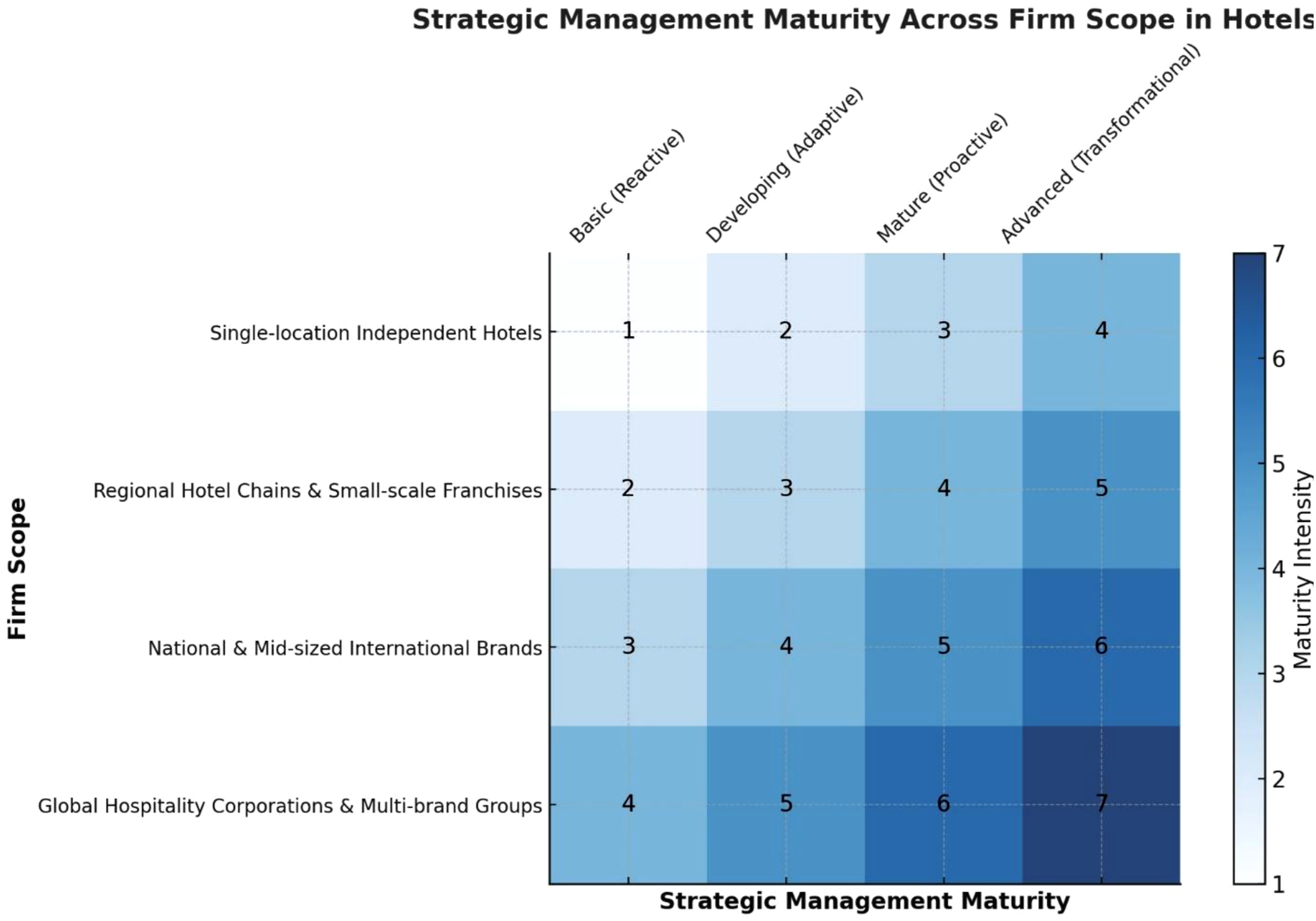
The heatmap directly addresses the first research question by showing that hotel firms evolve through a structured progression of strategic maturity. At the Basic (Reactive) level, single-location independent hotels display limited formal planning, low digitalization, weak sustainability integration, and largely reactive crisis responses. Their scores remain low across most dimensions because strategy tends to be informal, short-term, and operationally oriented. In the Developing (Adaptive) category, regional hotel chains and mid-sized operators begin to formalize selected strategic practices, particularly in branding, technology use, and market positioning. However, these firms still exhibit uneven development across dimensions, indicating that strategic maturity progresses incrementally rather than uniformly. Hotels in the Mature (Proactive) category demonstrate more integrated strategic planning, stronger data use, clearer differentiation, and greater investment in sustainability and resilience. At the Advanced (Transformational) level, global hospitality corporations demonstrate the highest degree of strategic maturity, characterized by system-wide digital transformation, predictive crisis planning, ESG integration, diversified revenue logic, and innovation-led corporate strategy. Together, these patterns indicate that hotel strategic maturity develops as a staged, yet non-linear, process in which capabilities deepen, become more coordinated, and become more forward-looking over time.
The heatmap also provides a direct answer to the second research question by showing that firm scope significantly influences strategic sophistication. Hotels with narrower firm scope, such as independent single-property operators, tend to exhibit lower strategic sophistication because they often lack the financial resources, managerial specialization, market intelligence, and organizational scale needed to support highly integrated strategy systems. By contrast, hotels with broader firm scope, including national brands and global corporations, are better positioned to institutionalize formal planning, deploy advanced technologies, coordinate cross-unit learning, and sustain long-term investment in strategic renewal. Importantly, the heatmap suggests that firm scope does not merely reflect organizational size; rather, it shapes the complexity and sophistication of strategic action by influencing which capabilities hotels can realistically develop and maintain. This explains why broader-scope firms cluster at the higher end of the maturity spectrum.
Finally, the heatmap and typology jointly answer the third research question by identifying the dimensions that define hotel competitiveness within a maturity framework. The results indicate that hotel competitiveness cannot be captured by financial performance alone. Instead, competitiveness emerges from the combined development of technology adoption, sustainability integration, crisis resilience, financial performance, reinvestment capacity, and human capital development. These dimensions differentiate lower-maturity from higher-maturity hotel types in meaningful ways. For example, technology adoption progresses from basic operational systems to AI-supported personalization and revenue management; sustainability evolves from limited compliance-oriented practices to system-wide ESG leadership; crisis resilience develops from reactive response to predictive and adaptive capability; financial strength shifts from short-term survival logic to reinvestment-based strategic growth; and human capital development advances from basic staffing practices to strategically embedded talent management. The maturity typology, therefore, demonstrates that hotel competitiveness is multidimensional and progressively constructed through the integration of these strategic domains.
Overall, Figure 1 should be interpreted not as a stand-alone illustration, but as a visual synthesis of the study’s three research questions. It shows how hotels evolve in strategic maturity, how firm scope conditions the level of strategic sophistication they can achieve, and which dimensions most clearly define competitiveness across the maturity spectrum. In this sense, the heatmap strengthens the typology by visually integrating the study’s conceptual model and comparative findings into a coherent analytical representation.
Evolution of strategic management maturity in hotels
The findings reveal that hotel firms progress through four distinct levels of strategic maturity: Basic (Reactive), Developing (Adaptive), Mature (Proactive), and Advanced (Transformational). This evolution is driven by the degree of strategic planning, technology adoption, sustainability integration, and crisis resilience embedded in a firm’s competitive strategy.
At the Basic (Reactive) level, hotels exhibit minimal strategic planning, with decision-making primarily reactive rather than proactive. These firms often focus on cost containment and operational efficiency rather than long-term strategic differentiation. Their ability to sustain competitiveness is limited due to the absence of structured revenue management, digital tools, or sustainability initiatives.
Hotels in the Developing (Adaptive) category begin to integrate branding, moderate digital transformation, and sustainability initiatives into their strategic outlook. However, their approach remains largely incremental, responding to industry trends rather than setting them. At this stage, firms demonstrate a willingness to adopt emerging technologies, such as customer relationship management (CRM) systems and property management software, but lack full integration of AI-driven insights.
As hotels move into the Mature (Proactive) category, structured strategic planning becomes a core element of decision-making. These firms prioritize competitive differentiation, economies of scale, and digital transformation to sustain market positioning. Investments in advanced customer analytics, loyalty programs, and ESG (Environmental, Social, and Governance) initiatives define this maturity level. Hotels in this category also demonstrate strong financial reinvestment strategies, ensuring long-term growth and resilience to external shocks.
At the highest level of maturity, Advanced (Transformational) hotels operate as global industry leaders, leveraging AI-driven personalization, data-driven revenue management, and sustainability leadership to maintain market dominance. These firms implement cross-industry partnerships, full-scale digital ecosystems, and highly adaptive crisis management frameworks. Their strategic agility allows them to proactively shape industry trends rather than merely react to them.
The findings suggest that strategic evolution is not strictly linear-some firms leapfrog maturity stages by embracing radical innovation and sustainability leadership, while others stagnate due to resource constraints, market positioning, or strategic inertia.
Influence of firm scope on strategic sophistication
Firm scope emerges as an important condition shaping strategic sophistication in hotels, but its effect is enabling rather than deterministic. Hotels with broader scope typically possess stronger managerial specialization, greater access to capital, wider market intelligence, and more developed governance systems, which together support more integrated and forward-looking strategic decision-making. By contrast, narrower-scope firms often operate with leaner structures and tighter resource constraints, which may limit the scale and coordination of their strategic initiatives.
At the single-property level, hotels often compete through niche positioning, flexibility, authenticity, or cost efficiency rather than through highly formalized strategy systems. Regional chains and mid-sized operators generally exhibit stronger coordination across branding, digital systems, and operational standardization, while national and international brands are more likely to integrate customer analytics, revenue management, sustainability planning, and resilience capabilities into a coherent strategic model. Global hospitality corporations represent the most systematized form of this progression, as strategic planning is embedded across multiple brands, markets, and functional domains.
However, the relationship between firm scope and sophistication should not be interpreted mechanically. Smaller hotels may demonstrate selective excellence in innovation, luxury differentiation, or sustainability, while larger firms may still underperform when strategy is weakened by bureaucracy or fragmented execution. Firm scope, therefore, shapes the structural conditions under which strategic sophistication develops, but it does not determine maturity in a strictly linear way.
Key dimensions defining hotel competitiveness
The findings identify five core dimensions that define hotel competitiveness and determine strategic maturity across different firm scopes: technology adoption, sustainability leadership, crisis resilience, financial performance, and human capital development. These dimensions should be understood as the principal dimensions emerging from the present synthesis rather than as an exhaustive list, as marketing-related capabilities, such as branding, customer engagement, digital visibility, and market positioning, are embedded across several of them. These dimensions are best understood as the core dimensions emerging from the present synthesis rather than as an exhaustive list of all possible drivers of competitiveness. Together, they distinguish lower-maturity hotels from more strategically advanced firms.
Technology adoption differentiates hotels not simply by whether digital tools are present, but by how deeply they are integrated into decision-making, service delivery, and value creation. Sustainability leadership reflects the extent to which environmental and social commitments are embedded in business strategy rather than treated as isolated initiatives. Crisis resilience captures the ability of hotels to anticipate disruptions, diversify responses, and adapt under uncertainty. Financial performance matters less as a stand-alone outcome than as a basis for reinvestment in strategic renewal, innovation, and long-term capability building. Human capital development reflects whether hotels treat workforce capability as an operational necessity or as a strategic asset linked to resilience, service quality, and future growth.
These dimensions show that higher strategic maturity is not defined by scale alone, nor by profitability in isolation. Instead, it is reflected in the extent to which hotels combine these capabilities into a coordinated strategic architecture that supports adaptation, differentiation, and sustained competitiveness over time.
Discussion
Evaluation of the findings
The findings of this study provide a structured explanation of how hotels evolve in strategic management maturity and how this progression differs across firm scopes. Rather than treating hotel competitiveness as a static outcome, the proposed model conceptualizes it as a staged process in which strategic capabilities become progressively more integrated, formalized, and forward-looking. The four-level typology shows that hotels move from reactive and operationally focused strategic behavior toward increasingly proactive, innovation-oriented, and system-wide strategic management. In this sense, the study addresses the first research question by demonstrating that hotel strategic maturity is not binary but developmental, with distinct differences in the depth and coordination of strategic practices across maturity levels.
One of the key contributions of this study is its ability to bridge the gap between strategic management theory and practical applications in hospitality. Existing theories, such as the resource-based view, dynamic capabilities theory, and competitive advantage frameworks, have provided valuable insights into how firms develop and sustain competitive advantage (D’Oria et al., 2021; Porter, 1990; Secundo et al., 2015). However, these theories have largely been applied in a general business context, with limited adaptation to the unique characteristics of the hotel industry (Burton and Dickinger, 2025; Luu, 2020; Webster and Cain, 2025). This study extends these theoretical perspectives by incorporating a staged maturity model, demonstrating how hotels systematically develop their strategic capabilities. The heatmap visualization further strengthens this contribution by offering a visual representation of strategic intensity, allowing for a more intuitive understanding of how firm scope influences strategic sophistication.
The findings also show that firm scope is not simply a background characteristic, but a central condition shaping strategic sophistication. Hotels with broader scope typically possess stronger managerial specialization, greater access to capital, wider market intelligence, and more developed governance systems, all of which support the adoption of more advanced strategic practices. By contrast, narrower-scope hotels often operate under financial and organizational constraints that limit the formalization and integration of strategic management. This finding directly addresses the second research question and suggests that strategic sophistication is partly conditioned by the structural context in which hotels operate.
At the same time, the findings should not be interpreted deterministically, as smaller or independent hotels may also demonstrate high levels of innovation, premium differentiation, and broader market reach, particularly in luxury, niche, or digitally visible segments; the model instead suggests that firm scope more often influences the scale, integration, and repeatability of strategic sophistication than its mere possibility.
Regarding the third research question, the findings indicate that hotel competitiveness is best understood as multidimensional. Technology adoption, sustainability leadership, crisis resilience, financial reinvestment capacity, and human capital development emerged as the core dimensions differentiating lower-maturity from higher-maturity hotels. Importantly, the results suggest that competitiveness is not defined solely by financial performance, but by the ability to reinvest resources into long-term strategic capabilities. This reinforces the view that competitive strength in hospitality depends on integrating multiple strategic domains rather than on excellence in any single area.
Technology emerges as a key driver of strategic maturity in hotels (Bilgihan et al., 2011). The study confirms that hotels with higher strategic maturity levels consistently exhibit greater investment in digital transformation, with advanced firms integrating AI-powered personalization, cloud-based property management systems, and predictive analytics into their operations. This finding underscores the critical role of digitalization in shaping competitive advantage, particularly as customer preferences shift toward data-driven, personalized guest experiences (Altinay and Arici, 2021).
Sustainability is another defining characteristic of higher strategic maturity in hotels. The study demonstrates that hotels at advanced maturity levels fully integrate ESG (Environmental, Social, and Governance) strategies into their business models, aligning sustainability initiatives with financial performance. This confirms the growing consensus in the hospitality literature that sustainability is no longer a niche concern but a fundamental component of long-term competitiveness (Hermundsdottir and Aspelund, 2021; Tajeddini et al., 2023; Wu et al., 2023).
Crisis resilience emerges as a key differentiator between strategic maturity levels, with higher-maturity hotels demonstrating stronger risk management, adaptive business models, and diversified revenue streams. The findings confirm that hotels that proactively implement crisis management frameworks are better positioned to withstand economic downturns and industry disruptions (Altinay and Arici, 2021; Altinay and Kozak, 2021).
These findings extend prior strategic management research in hospitality by bringing evolutionary logic into the analysis of hotel competitiveness. Existing studies have examined digitalization, sustainability, innovation, and market positioning separately, but the present study shows how these domains can be understood within a unified maturity framework. The heatmap and typology, therefore, contribute a more synthetic explanation of how hotels differ not only in strategic priorities but also in the level of strategic development they have achieved.
Theoretical implications
This study offers four main theoretical contributions. First, it extends the hospitality strategic management literature by developing a hotel-specific Strategic Management Maturity Model. Prior hospitality strategy studies have examined strategic planning, competitive positioning, technology adoption, sustainability, innovation, and crisis resilience, but these areas have often been studied separately. The proposed model integrates these fragmented strategic domains into a staged framework that explains how hotels move from reactive, operationally focused strategy to proactive, transformational strategic management.
Second, the study extends the resource-based view and the dynamic capabilities perspectives in hospitality. The resource-based view explains how valuable, rare, inimitable, and non-substitutable resources support competitive advantage, while dynamic capabilities theory explains how firms sense, seize, and reconfigure resources in response to changing market conditions. However, these theories do not specify how hotel firms develop different levels of strategic sophistication over time. The proposed maturity model addresses this limitation by showing how hotel resources and capabilities become progressively more formalized, integrated, and future-oriented across maturity levels.
Third, the study contributes to maturity model literature by applying maturity thinking to hospitality strategic management rather than to a single operational or technological domain. Existing maturity models in hospitality and tourism have often focused on areas, such as digital transformation, service quality, sustainability, or destination development. This study extends maturity model research by conceptualizing strategic maturity as a multidimensional construct composed of technology adoption, sustainability leadership, crisis resilience, financial performance, reinvestment capacity, and human capital development.
Finally, the study contributes to the literature on firm scope and competitive heterogeneity in hospitality. It shows that firm scope is not merely a descriptive feature based on size, ownership, or market reach. Rather, firm scope shapes the structural conditions under which strategic sophistication can develop. By linking firm scope with maturity levels, the study explains why hotels differ not only in resources and market position, but also in the scale, integration, and repeatability of their strategic capabilities.
Practical implications
The study also provides several practical implications for hotel managers. First, the maturity model can be used as a diagnostic and benchmarking tool to help hotels assess their current strategic position and identify realistic pathways for progression. Managers in lower-maturity hotels can use the framework to recognize which strategic capabilities remain underdeveloped, while managers in more advanced firms can use it to evaluate whether their strategic investments are sufficiently integrated across technology, sustainability, resilience, finance, and workforce development.
Second, the findings suggest that improving competitiveness requires more than isolated investments. Hotels should pursue coordinated capability development. For example, technology adoption should be linked with staff training, sustainability initiatives should be embedded in long-term business strategy, and financial performance should be treated as a means of reinvesting in strategic renewal rather than as an end in itself. This is especially important for mid-level hotels seeking to move from adaptive to proactive strategic management.
Finally, the framework is also relevant for policymakers and tourism development agencies. It can support regional benchmarking by revealing where hotel sectors are strategically strong or weak and by informing targeted interventions related to digital transformation, sustainability incentives, crisis preparedness, and workforce capability development. In this sense, the model has value not only for individual firms but also for destination-level competitiveness planning.
Limitations and future research directions
While this study provides a structured conceptual framework for understanding strategic management maturity in hotels, several limitations should be acknowledged. First, the proposed model is based on a qualitative synthesis of academic literature, industry reports, and illustrative comparative case materials rather than on primary empirical data or large-scale secondary datasets. As a result, the typology should be interpreted as an analytically grounded conceptual framework rather than as a statistically validated measurement instrument.
Second, the heatmap and maturity classifications rely on an interpretive scoring logic derived from thematic synthesis and comparative analysis. Although this approach is appropriate for theory-building purposes, it necessarily involves analytical judgment. Future research should therefore test the robustness of the model through empirical validation using survey data, archival hotel performance data, expert panels, or mixed-method designs.
Third, the framework simplifies a highly heterogeneous industry. Hotels operate under different institutional, territorial, and market conditions, and strategic maturity may therefore develop differently across regions, ownership structures, service segments, and business models. In this sense, the model is intended to capture broad patterns rather than fully account for all contextual variation. Future research could examine how territorial factors, regulatory environments, luxury versus budget positioning, and independent versus chain-based governance structures shape alternative maturity pathways.
Fourth, although the model identifies five core competitiveness dimensions, these should not be interpreted as exhaustive. Other potentially relevant domains, such as marketing capability, distribution power, customer community effects, and destination-level embeddedness, may also influence hotel competitiveness. Future studies may refine, extend, or reweight the dimensions included in the framework depending on the empirical context.
Finally, the illustrative case examples used in the study were intended for analytical grounding rather than representativeness. They help demonstrate the plausibility of the typology, but they do not substitute for systematic comparative testing across a broader sample of hotel firms. Accordingly, future research should examine whether the proposed maturity levels hold consistently across different hotel categories, countries, and market conditions, and whether firms may follow non-linear or hybrid pathways between maturity levels.
Conclusion
In conclusion, this study develops a Strategic Management Maturity Model that explains how hotels evolve from reactive to transformational forms of strategic management. By integrating firm scope, strategic sophistication, and five core competitiveness dimensions, the study provides a structured and hospitality-specific framework for understanding hotel development and competitive positioning. The model contributes to theory by extending maturity thinking into hospitality strategy research and contributes to practice by offering a diagnostic roadmap for managers and policymakers seeking to strengthen long-term competitiveness in a volatile industry environment.
Supplemental material
Suppplemental Material - Strategic management maturity in hotels: A typological framework for competitive advantage and organizational evolution
Suppplemental Material for Strategic management maturity in hotels: A typological framework for competitive advantage and organizational evolution by Hasan Evrim Arici, Mehmet Ali Köseoglu in Tourism and Hospitality Research
Footnotes

Funding
The authors received no financial support for the research, authorship, and/or publication of this article.
Declaration of conflicting interests
The authors declared no potential conflicts of interest with respect to the research, authorship, and/or publication of this article.
Supplemental material
Supplemental material for this article is available online.
Author biographies
References
Supplementary Material
Please find the following supplemental material available below.
For Open Access articles published under a Creative Commons License, all supplemental material carries the same license as the article it is associated with.
For non-Open Access articles published, all supplemental material carries a non-exclusive license, and permission requests for re-use of supplemental material or any part of supplemental material shall be sent directly to the copyright owner as specified in the copyright notice associated with the article.
