







Abstract
• Summary: A concern amongst policy-makers to identify high cost and low productivity populations has created a new interest in identifying those who experience adversities across the life course. This article outlines the development of conceptual understandings of families whose children experience multiple adversities and links this with later poor outcomes in adult life and examines some of the research challenges in establishing such linkages.
• Findings: It is argued that current thinking with regard to these issues reflects historical domains within which services to children and to adults are located. The challenge to domain thinking is both horizontal and vertical, policy being required to address the horizontal axis by co-ordinating planned approaches to multiple needs across services, and policy being necessary to address the vertical cleavage between children’s and adult services in ways which join up services across the life path; conceptually and practically acknowledging the links between child and adult experiences.
• Applications: Such policy developments will inevitably require social work to develop alternative paradigms for understanding the needs of children and adults and designing services to effectively meet these.
Introduction
Within the social investment state (Lister, 2003) there is a concern to identify high cost and low productivity populations (this article is focused upon families with multiple problems) and target these for particular interventions. Such interventions are designed to generally, prevent social exclusion in the present time and more particularly, ensure that disadvantage is not inherited to be expressed in the next generation. Whilst a proportion of such families reside within areas designated as communities of social exclusion with services targeted at this level, many families do not live in such ‘zoned’ areas (Buchanan, 2007). Consequently, particular signifiers have been developed to further differentiate and target families and individuals identified by certain characteristics. In the United Kingdom, children in state care, children with disabilities and families with multiple problems have been identified as sub-populations requiring specialist interventions by the state (HM Treasury and Department for Education and Skills, 2007). In relation to the issue of identifying families with multiple problems, claims have been made by social work professionals that they can predict which families known to social services are most likely to experience poor future outcomes via the presence of certain indicators. These include the registration of a child on the child protection register and initiation of child protection or care proceedings (HM Treasury and Department for Education and Skills, 2007). These are essentially proxy measures for the experience of childhood maltreatment. Such claims make the populations served by social workers of great interest to policy-makers and create the potential for reorientation of state mandated social work responses to families with multiple problems.
Previous work by the author and colleagues has largely concentrated on identifying and locating families with multiple problems within a changing social policy context (Spratt, 2009) and researching the readiness of social work agencies internationally to meet the challenges involved in recognizing and providing services to such families (Spratt & Devaney, 2009). This article builds on this work with the aim of addressing some key issues involved in understanding multiple childhood adversities and the effects of these across the life course. Four objectives are indicated: first, to trace conceptual developments in relation to families with multiple problems; second, with a starting point in the research linking childhood maltreatment and adult outcomes, to examine some of the research challenges involved in tracking outcomes for children experiencing multiple problems into adulthood; third, to draw attention to the restrictions placed on our thinking in relation to problems experienced across the life course by conceptually separating problems faced by children and by adults; and fourth, to outline some of the challenges involved in designing and delivering services to families with multiple problems. Concluding comments will draw out implications for researchers, policy-makers and practitioners. To begin, however, it is important to trace some of the antecedents in the development of identification of families with multiple problems.
Families with multiple problems: Developing concepts
Contemporary interest in families with multiple problems within social work has antecedents in a preoccupation amongst researchers to identify the causes of child maltreatment. Much of such early research was concerned with identifying sets of parental personality factors associated with an increased risk of their harming children (Spinetta & Rigler, 1972). Over time a broader range of familial characteristics were considered, namely parental behaviours (such as alcohol and drug use) and vulnerability factors in relation to children. Parton, Thorpe, and Wattam argue that it became ‘more appropriate to see child abuse as a result of multiple interacting factors, including the parents’ and children’s psychological traits, the family’s place in the larger economic structure, and the balance of external supports and stresses’ (1997, p. 54). This preoccupation with identifying sets of characteristics and conditions associated with child maltreatment had the effect of creating rather narrow research agendas. These were concerned either with isolating variables predictive of child maltreatment or establishing associations with the experience of child maltreatment and particular outcomes in adult life.
The antecedents to a broader based understanding of the range of harms experienced in childhood and how these might be expressed along the developmental continuum and into adulthood lie in the provisions for Children in Need within the 1989 Children Act and in subsequent efforts by policy-makers to shift social work practice away from narrow child protection considerations in the 1990s. Whilst such efforts may have had limited impact on social work practice (Spratt, 2001), the development of policy to both relocate childhood adversity across a wider range of signifiers and create a broader range of services has continued unabated under the New Labour government in the UK. Essentially these policies reflect a concern to address the issue of cumulative disadvantage, wherein the experience of these may be seen to deeply prejudice life outcomes. Of particular interest is the identification of sub-populations situated within the concept of social exclusion (a much wider concept than that of child maltreatment). Whilst the concept is not restricted to the UK, having some currency for example in the United States (Kamerman, 2005), it remains closely associated with New Labour. The Social Exclusion Unit (SEU) was set up in 1997 and from its inception recognized that social exclusion was multidimensional in nature with economic and social difficulties sometimes combining to create a multiplicity of problems for families. More recent attempts to develop our understanding of children’s needs (Howarth, 2009) have sought to locate these within three strands; individual (e.g. low birth weight or the experience of abuse), familial (e.g. parent with a mental health problem or father imprisoned), and environmental (e.g. low income or living in a deprived neighbourhood).
To develop understanding of how families respond to environmental factors, Axford (2010) has helpfully differentiated between the nature of structural forces in the creation of stressors and the role of human agency in determining reaction to such stressors. Exclusion is consequently not a de facto result of unemployment or other adverse social circumstances, but is mediated via individual response. Understood in this way it may be argued that families that experience adverse social conditions are at increased risk of developing stress related responses such as mental health difficulties or alcohol and substance misuse, which in turn increase the number of problems they experience (Social Exclusion Task Force [SETF], 2008). This multiplication of problems increases the risk of the children of such families experiencing multiple adversities in adulthood (Feinstein & Sabates, 2006). Consequently, as Axford argues, ‘it has actually proved very difficult to talk about socially excluded children without referring in the same breath to their multi -faceted and complex needs’ (2010, p. 749).
It is important to note that it is not particular combinations of factors that predict poor outcomes but the numbers of factors present (Spratt, 2009). However, it is possible and indeed likely that many families experience multiple adversities across the three strands identified by Howarth but are only brought to the attention of social work agencies where child maltreatment is indicated (Buchanan & Ritchie, 2002). For example, the contrasting effects of pre-birth neurobiological disturbance (Neigh et al., 2009) and income benefit dependency (Cusworth, Bradshaw, Coles, Keung, & Chzhen, 2009) whilst considered ‘risk factors’ for poor later outcomes would not, in themselves, bring families to the attention of social workers. Any change to this prioritization would require a shift in how the problems faced by families are enumerated and conceptually understood. Creating the conditions for such change requires a closer consideration of some of the research challenges requiring attention before service interventions on the basis of identified multiplicity of problems in families might become mandated.
Families with multiple problems: Research challenges
In part because of a privileging of research into the effects of child maltreatment, there has been a lack of research dealing with the pathways between the experience of multiple problems in childhood and the experience of multiple problems in adulthood. Rather, the research literature is awash with studies dealing with associations between singularities, that is, a problem in childhood and a problem in adulthood, with smaller research subsets concentrating on associations either between singular problems in childhood and multiple problems in adulthood or multiple problems in childhood and singular problems in adulthood. Much of this literature is concerned with the effects of child maltreatment on adult life. Davidson, Devaney, and Spratt (in press) have reviewed this research literature. The authors find that: [S]tudies have tended to focus on specific forms of adversity, predominantly abuse and neglect, and either: specific populations and specific outcomes; specific populations and general outcomes; or general populations and specific outcomes. This means there may be incomplete understanding of the inputs (the range of adverse experiences in childhood), the processes (how these may affect people) and the outcomes (across domains in adulthood). (Davidson et al., in press)
Four types of studies
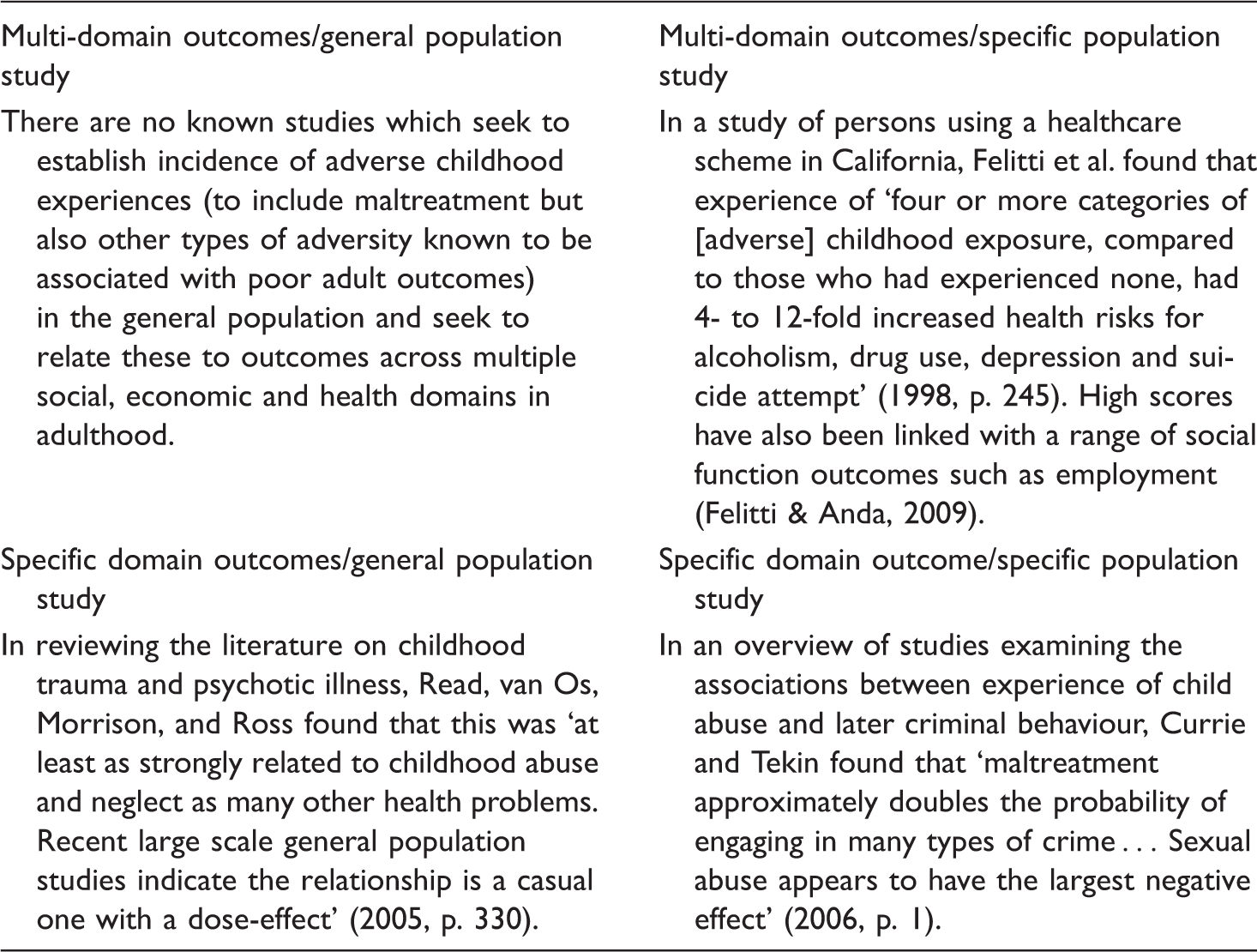
Those studies concerned with general populations and specific domain outcomes are usually undertaken by researchers utilizing large national data sets. For example, the National Longitudinal Study of Adolescent Health in USA has been used to examine associations between childhood maltreatment and later adult behaviours. However, as Currie and Tekin observe (in a study linking childhood maltreatment with later criminal behaviour), a major limitation of such data sets is ‘the relative crudeness of the available measures of maltreatment’ (2006, p. 3). Whilst such data sets may have design limitations, large-scale studies are nevertheless useful in that they provide evidence of the prevalence of risk factors associated with later adult outcomes. For example, using the British Cohort Studies, Margo observes that ‘the key factor associated with offending is socioeconomic background’. With the addition of other risk factors such as ‘having been drunk once or more a month’ or ‘getting on badly with at least one parent’ having predictive value for later offending [72% and 56% respectively] (2008, p. 36). Building on the identification of such factors, some researchers utilize statistical methods to produce predictive models, for example, using linear regression analysis to weight childhood factors in relation to association with risk to outcome. Feinstein and Sabates claim that: By age 5 it is possible to identify over one third of those who will experience multiple deprivation 25 years later in adulthood. By age 10 it is possible to identify between 44% and 87% of those who will experience multiple deprivation as adults … the true picture is likely to be around 70%, that is roughly 70% of individuals who will experience multiple deprivation at age 30 can be identified at age 10. (2006, pp. 20–21)
It is the studies incorporating individual, familial and environmental factors that provide most assistance to help identify multiple problems in families. Some researchers co-join direct experience of maltreatment with familial factors; for example, the 10-item Adverse Child Experience (ACE) questionnaire (developed by Felitti & Anda, 2009) enquires: ‘Q2. Did a parent or other adult in the household … every hit you so hard that you had marks or were injured? Q9. Did you live with a problem drinker or alcoholic or who used street drugs?’ (2009, p. 5). Others co-join maltreatment and familial factors with environmental factors such as poverty (Margo, Dixon, Pearce, & Reed, 2006). It may be concluded that if childhood maltreatment is a proxy for the presence of multiple problems within families then the most frequently indicated of these in the research literature is the presence of income poverty (Gilbert et al., 2008), with ‘a vast majority of children and households subject to child protection interventions … living in poverty’ (Parton et al., 1997, p. 332). Thus indicating that service response should be systemic, tackling both the causes as well as the responses to poverty.
These examples notwithstanding most researchers to date have concentrated on relating specific outcomes with specific populations with a concentration on child maltreatment and later outcomes located in discreet adult domains. We may, however, discern inferential clues within such work which point to multiplicity of childhood adversities having a graded effect on severity of problems experienced in adult domains. So, for example, in their study of undergraduate women’s abilities to cope with stress, Leitenberg, Gibson, and Novy found that ‘women with cumulative adverse and/or abusive childhood histories [develop] particular maladaptive coping strategies to deal with various new stressors in later life’ (2004, p. 181).
Perhaps a more familiar set of associations with respect to the identification of adversities, are the three ‘risk factors’ reoccurring in the literature, ‘domestic violence, mental health difficulties and substance misuse problems’ (Devaney, 2008, p. 242). It is important to bear in mind, however, that risk factors are not causes but rather markers and we need to establish mediating pathways between such risk factors and outcomes (Loeber & Farrington, 2000). Researchers have modelled a range of theoretical connections between the experience of adversity in childhood and later problematic outcomes in adulthood. These include Rutter’s (2000) negative chain effects, wherein early adversity may predispose to further negative experiences in later life, and Felitti and Anda’s (2009) notion of self-medication, wherein the coping strategies to help deal with memories of early adversity (for example, smoking and drinking) are associated with negative health outcomes (for example, cancer and heart disease). There is also a large and growing literature on the concept of resilience which highlights a ‘hierarchically organized set of protective systems that cumulatively buffer the effects of adversity’ (Roisman, Padron, Sroufe, & Egeland, 2002, p. 1216). To test such theories ‘future research informed by a longitudinal perspective is therefore needed to investigate the extent of inter-generational change in the relative risks of multidimensional exclusion for young people’ (Levitas et al., 2007, pp. 122–123). A call echoed by the Social Exclusion Task Force (the government body charged with taking forward measures designed to reduce social exclusion in the United Kingdom): ‘The limited data about the lived experiences of families with multiple and enduring difficulties means it is difficult to interpret the data about take up and refusal – indicating a significant gap in research and evaluation’ (2008, pp. 13–14).
It is evident that two types or research are required: first, research to establish the incidence of a range of adverse individual, familial and environmental factors in the general population; and second, research into the pathways between childhood and adult experiences to examine theories of transmission and resilience. Inevitably, this would necessitate adopting a wider range of measures which, whilst including the experience of maltreatment in childhood, do not privilege this factor but seek to combine it with other childhood experiences associated with poor outcomes in adulthood. Designing and undertaking such research will pose significant challenges for researchers as well as for policy-makers and service providers who have a tendency to conceptualize such issues within domain boundaries.
Domain thinking challenges
The Social Exclusion Task Force’s recently published Think family: Literature review of whole of family approaches, rightly identifies the dangers associated with professionals adopting narrow experience orientated service perspectives in their work: ‘The divide between adult and children’s services runs as a fracture through any attempt to develop whole family approaches and generates challenges for families and for professionals’ (2008, p. 13). We may observe the same tendency in how researchers have approached the issue of associations between multiple problems experienced in childhood and adult outcomes. In speculating as to the reasons why such tendencies exist, it may be that the reluctance to undertake general population studies is associated with difficulties in accessing resources to undertake this type of research which has traditionally been the province of medical research, government statistical survey or market research. It is, however, the co-joining of health and social research towards economic goals that will inevitably increase interest in, and need for, such research. There is also a preoccupation in the UK context with present rather than future risks. This is largely driven by a public concern that professionals should be able to case find, that is, identify those families within which severe abuse and neglect may be indicated. This has tended to influence research in a direction that eschews mapping of long-term consequences in favour of short-term outcomes, that is, calculating which families may go on to abuse or re-abuse their children rather than investigating and understanding outcomes in adulthood for these same vulnerable children. The net result is that research is driven by immediate public/policy/political concerns and is often domain specific. Thus reflecting the conceptual ways in which social problems are codified and the configurations of service provision.
Acting as a counterweight to this tendency to prioritize child abuse is the economic imperative to find families whose circumstance indicate a need for early investment which is preventative in nature (Pithouse, 2008). The economic modelling undertaken to date has involved two components. The first is a calculation of costs of experience of multiple adversities to society. This has three elements: service/intervention costs in childhood (those extra services/interventions offered to families); service/intervention costs in adulthood for problems resulting from childhood adversity (increased levels of services/interventions when compared with the general population); and reduced economic contribution as measured by tax returns (Corso & Lutzker, 2006). The second component, following the work of Heckman (2006), is the cost–benefit resulting from interventions designed to target problems experienced in childhood to prevent or reduce the uptake of services and enhance production of tax in adulthood. Modelling is concerned with combining costs from programmes delivered at different levels and times and across service domains and offsetting these against improved economic performance.
Within the social exclusion discourse, there is rather more recognition from the Social Exclusion Task Force that the deeply and persistently excluded, whilst often initially located within single service domains (the homeless population, for example), because they experience a multiplicity of problems will be found to populate a range of service domains. Crome, Chambers, Frisher, Bloor, and Roberts comment: ‘Social instability and marginalisation, as manifested by homelessness, economic deprivation, unemployment, crime and violence, characterise this group, who are also at increased risk of victimisation, and may have experienced childhood and adolescent trauma, educational and social skill deficits arising from family problems and childhood trauma.’ They go on to argue that as a consequence such adults present to a wide range of service providers but that ‘there is a consistent failure to recognise this complex and demanding sub-set of service users’ (2009, p. 7). Essentially this is because services have traditionally operated within eligibility defined boundaries and concentrated on narrow service remits in practice.
The challenge to domain thinking is therefore both horizontal and vertical. It is important to conceptualize the needs of such service users as being horizontally evident across different domains contemporaneously. Policy is therefore required to address this horizontal axis by co-ordinating planned approaches to multiple needs across services. However, it is also important to address the vertical cleavage between children’s and adult services in ways which join up services across the life path; conceptually and practically acknowledging the links between child and adult experiences. The evidence for addressing both horizontal and vertical dimensions is compelling. The Social Exclusion Unit report that: prisoners are thirteen times as likely to have been in care as a child, thirteen times as likely to be unemployed, ten times as likely to have been a regular truant, two and a half times as likely to have had a family member convicted of a criminal offence, six times as likely to have been a young father, and fifteen times as likely to be HIV positive … 60 to 70 per cent of prisoners were using drugs before imprisonment. Over 70 per cent suffer from at least two mental disorders. (2002, p. 6) Rather than reflecting a concern with the situation and needs of ex-offenders for example … does the ‘bottom 2.5%’ [Social Exclusion Task Force terminology for the proportion of people in society deep and persistent exclusion – also referred to as poverty plus or multiple problems] point instead to concern for unemployed ex-offenders who have had experiences of homelessness and who have mental health problems? (2008, p. 6)
Service design challenges
There is growing recognition that families with multiple problems have particular service requirements within policy modelling undertaken in the UK (Spratt, 2009; Spratt & Devaney, 2009). New Labour’s targeting of preventative services to differentiated populations identified those situations ‘where there are multiple, complex and long-standing difficulties that will require a customisation of services’ (Children and Young People’s Unit, 2001, p. 37) as being a particular priority. Such customization developments were first evident in the criminal justice sector where notions of prediction of future criminal behaviour in children (Farrington & Welsh, 2007) informed much of the, now defunct, Respect Agenda’s concern to grip the families of such children; this meaning, ‘great persistence and assertiveness by project workers to ensure families stick to agreements and changes in behaviour’ (Respect Task Force, 2006, p. 22). The translation of assertive outreach policies to encompass families with multiple problems has, however, been problematic. As Morris and Barnes observe, ‘the role of social workers in identifying and targeting troublesome families and/or trying to negotiate access to highly focused service provision requires careful consideration of the underpinning assumptions about change and exclusion’ (2008, pp. 1208–1209). The underpinning assumptions referred to are that deep exclusion is predictable, preventable or treatable. As the then Prime Minister Tony Blair put it: ‘Where there are multiple problems … then instead of waiting until the child goes off the rails, we should act early enough … You can detect and predict the families likely to go wrong’ (2006). The policy apparatus created to address the needs of such families is located within the new architecture of children’s services envisaged in Every child matters (Department for Education and Skills, 2004), wherein the notion of prevention encompasses prevention of multiple problems expressed socially and economically across generations.
The main thrust of service provision has been through Intensive Family Support Projects (Nixon et al., 2006), targeting so called hard to reach families and offering a range of intensive services, with long-term support reserved for those families with multiple and complex needs (Tunstill, Blewett, & Meadows, 2009). In one sense this model differs from that of the Respect Agenda’s in that it appears to encompass traditional social work values. It may, however, suffer some of the limitations noted by Case and Haines (2004) in tackling youth crime, that is, that the targeting of behaviour of individual families requires complementary action in respect of environmental issues such as unemployment and poverty to be effective. This returns us to the ecological notions underpinning intervention strategies wherein individual and familial problems must be seen against a particular environmental hue and consequently tackled at multiple levels. The danger here for social work is a reflexive default into individualized case management. As Lonne, Parton, Thompson, and Harries point out: Case management systems have tended to adopt short-term and narrowly targeted practice … This is short sighted and completely at variance with those needing services due to abuse or neglect who typically have longstanding multiple, and complex social and personal problems that cannot be simply ‘fixed overnight’. (2009, p. 139)
Conclusion
It is necessary to learn from the research to date and identify areas for further exploration. Such research challenges the limitations of current thinking of parcelling individual adversities experienced by children and their families into separate domains by viewing the problems of individuals and families over the life course as expressed across a range of social, economic and health dimensions. There are, however, very significant challenges for researchers. The scientific work necessary to establish the prevalence of adverse childhood experiences in the general population, the particular pathways between multiple adversity experienced in childhood and problems experienced across domains in adulthood, together with interrogation of possible effects of adversity experienced at the different developmental stages of childhood is immense. However, if we were to bring the same level of industry, application and dedication to this area of research as has been brought to space exploration or the unravelling of the genome, such efforts to unravel social problems might indeed be rewarded. In Western societies it may be that the great miseries of the relatively few may continue to provide enough of an assault on our collective view of ourselves to motivate action, or we may simply regard it as economically worthwhile.
The priorities for the next generation of policy-makers may well be informed by a political calculation as to the social and economic imperatives associated with locating families with multiple problems and intervening to meet their needs. When we factor in the human and economic costs associated with experiencing multiple adversities, it will be important to design services which are not constrained by traditional domain boundaries and promote new models of intervention. Such families are not neatly captured either within the singular domains within which we currently conceptualize problems, nor are they easily locatable using current service configuration schemas. As yet we do not have dedicated procedural protocols to locate such families via assessments which case-find on the basis of multiplicity of problems and across time (such assessment schedules as there are tend to locate and prioritize problems in relation to severity with a nod towards ecological context). It is consequently difficult for policy-makers to propose solutions in the absence of tools and proven treatments. Given these problems it is likely that continued media and political pressures in relation to immediate child protection issues will continue to lay a heavy restraining hand on any move towards consideration of outcomes in the longer term (Ayre, 2001).
For service providers and practitioners the challenge to think anew with regard to the issues faced day and daily by social workers and other professionals has its attractions. Two very basic changes in approach are indicated, first family problems might be viewed in new ways that relocate the problems of families across generations and direct new and longer-term ways of working across current service boundaries. Second, that approaches to families might be directed by more scientific understandings of needs and responses.
Such observations, of course, raise a number of potential objections, often framed as ethical in nature. The complex moral issues concerned with state mandated intervention on the basis of prediction are not the subject of this article. Comment, however, is required on two very common mistakes concerned with identifying sub-populations with risk indicators for specific interventions on the basis of probability. The first is to take the issue of false positives (those predicted to encounter future problems but who, in fact, do not) and argue that because ‘most children in such groups are not abused and neglected … such factors should not be used as predictive measures’ (Taylor, Baldwin, & Spencer, 2008, p. 1199). This argument is usually based on the assumption that future adversity is framed within a child maltreatment discourse and that consequently interventions are state mandated and child protection in nature, and thus stigmatizing. Such arguments ignore the relationship between multiple adversities in childhood and harms realized in adulthood. Indeed, if the types of support where seen as socially desirable (e.g. preferential admission to better performing schools) then this concern might be countered. Second, conflating scientific prediction and social policy projects to argue that participation in these is at odds with social work as a caring profession is to introduce a false opposition. This is much like arguing that doctors should stop prescribing nasty medicines and get on with the business of developing bedside manners.
If social work as a profession is to develop alternative paradigms for understanding and acting upon social problems it is necessary to take a longer and altogether cooler view of the issues. The requirement at this time is to continue to develop the research to underpin our understandings of what leads to harms across the life course and appreciate what part we might play in the work of developing effective solutions and services for children, their families and adults as well. One way of taking these aspirations forward might be to convene an international conference to begin the task of locating a response from social work to the pressing challenges outlined in this article. This would provide a forum for sharing current research, planning collaborative endeavours and beginning the task of relocating social work as a profession concerned with the life course and emergent from its own restrictive domains.