







Abstract
• Summary: Community engagement, or acting on behalf of the collective, can provide a variety of rewards. Nonetheless, people who misuse substances are less likely to endorse such goals as making a contribution to society or correcting systemic inequities. As people modify their use of drugs or alcohol, they have been shown to draw purpose from community engagement. This mixed methods study examined contributors to a community engagement orientation among 68 respondents with a history of substance misuse and incarceration.
• Findings: In the initial qualitative analysis, four themes emerged related to the respondents’ sense of purpose in life. The theme most frequently mentioned, community engagement, is the focus of this study. Discriminant analyses revealed that those endorsing community engagement goals were older at the onset of heavy drinking, more likely to have received public assistance, more highly educated, as were their mothers, manifested greater self-esteem, and had previously been involved in an organization addressing community concerns.
• Applications: Social workers might assist clients in identifying and manifesting what they believe to be their purpose in life, with particular attention to community engagement. In this way, they may utilize the wisdom gained from challenging experiences to benefit others and bring about social change.
Introduction
Engagement in activities that benefit the community can engender a variety of rewards including intellectual stimulation, the chance to form personal attachments and gain the respect of others, as well as a sense of gratification from supporting causes in which the participant believes (Schlozman, Verba, & Brady, 1995). People who misuse substances have been less likely to endorse such goals as making a contribution to society, working to correct social and economic inequities, or being a leader in the community (Coleman, Kaplan, & Downing, 1986). Moreover, drug and alcohol abuse have often been associated with thought patterns and behaviors that may result in harm to self or others (Green, Fullilove, & Fullilove, 1998). In their research, Khantzian and Mack (1994) found that as people modify their use of substances they often report a sweeping transformation in values and begin to demonstrate greater interest in caring for those around them. Motives for abstinence have been shown to change over time with negative or avoidant incentives such as fear of arrest, physical deterioration, family break-up, or job loss yielding to more positive or ‘approach’ type motives such as an enhanced sense of purpose in life (Piedmont, 2004). Lower rates of recidivism to prison have also been linked to a greater sense of purpose (Black & Gregson, 1973). Involvement in activities that benefit the community and ongoing engagement with people who share common interests have been shown to ameliorate substance abuse (Amodeo, Kurtz, & Cutter, 1992). Further, community service is central to the methodologies employed by 12-step groups such as Alcoholics and Narcotics Anonymous (Katz, 1993). Often, substance abuse treatment within the context of the criminal justice system has employed some type of therapeutic community approach which emphasizes the establishment of prosocial norms and expectations (De Leon, 1995). Given the integration of individual and collective empowerment in the practice of social work (Karoll, 2010), it could be advantageous to both clients and their communities to assist these men and women in articulating their interests in community engagement and to support them in implementing those aspirations. In this way, clients may draw on the lessons learned from the adversities they have faced to improve the lives of others and engender social change.
The goal of this research was to identify contributors to a community engagement-oriented purpose in life among people with a history of substance misuse and incarceration. For the purposes of this study, the term ‘community engagement’ was used to describe activities that would benefit another person, group, or cause, in other words actions taken on behalf of the collective welfare, which would entail a more extensive and ongoing commitment than spontaneous assistance, monetary or in-kind contributions to a specific organization, or simply voting. Care provided to friends and family members was not included in this category (Rosenthal, Feiring, & Lewis, 1998; Schlozman et al., 1995; Wilson, 2000).
There has been little research on the contributing factors to community engagement among those who have abused drugs or alcohol and been incarcerated, a group not generally viewed as holding prosocial interests. However, since the 1970s there has been increased attention to the concept of ‘restorative justice’ (Wenzel, Okimoto, Feather, & Platow, 2008). Foundational principles in restorative justice include making amends and the reintegration of offenders into the community as contributing and productive members (Van Ness & Strong, 2006). Ward and Langlands (2009) emphasize the importance of giving those with a criminal justice history the opportunity to reflect on what would give their lives the greatest meaning, then providing them with the internal competencies and external opportunities to achieve their goals.
From a psychosocial perspective, aspirations related to community engagement are likely shaped by the interplay of individual attributes with broader social and political forces (Lewis, 1997). Relevant factors may include demographic characteristics such as age (Hart Research Associates, 1998; Jennings & Markus, 1988; Mattis et al., 2004), gender (Independent Sector, 1996; Mattis et al., 2004; Schlozman, Burns, & Verba, 1994; Verba, Burns, & Scholzman, 1997) and ethnicity (Independent Sector, 1996; Mattis et al., 2004; Verba, Scholzman, & Brady, 1995). As previously mentioned, alcohol and drug consumption have been shown to play a role in community engagement (Coleman et al., 1986; Green et al., 1998), as may treatment for problematic use (Katz, 1993). Also to be considered are societal influences such as socioeconomic status (Rietschlin, 1998) and education (Brady, Schlozman, & Verba, 1995; Nie, Junn, & Stehlik-Barry, 1996), as well as psychological factors such as self-esteem (Brady, Verba, & Schlozman, 1995; Rosenthal et al., 1998).
Viewing community engagement from a developmental perspective (Lewis, 1997), individuals who are likely to engage in such activities are believed to have differing characteristics and life histories than those who choose not to participate. In considering demographics, previous research on the relationship between age and community engagement has produced varied results with some studies showing that participation may be greatest in the middle (Jennings & Markus, 1988; Verba & Nie, 1972) or latter years (Mattis et al., 2004). Some research has demonstrated that young adults are less likely to engage in activities that benefit the community (Keeter, Zukin, Andolina, & Jenkins, 2002) while others have indicated that they are more apt to take up such pursuits (Hart Research Associates, 1998). In considering the impact of gender, some studies have found women to be less active in the community than men (Schlozman et al., 1994; Verba et al., 1997) while others have shown that the reverse is true (Independent Sector, 1996; Mattis et al., 2004). In relation to ethnicity, some research has reflected that white individuals are more likely to volunteer their time and efforts to benefit the community than people of color (Independent Sector, 1996); however, these disparities often become statistically insignificant when the resource distinctions associated with group membership are taken into account (Verba et al., 1995). In a sample of African American men, Mattis and colleagues (2004) found that the amount of distress reported as a result of racism significantly predicted involvement in political and social justice organizations.
Socioeconomic status has produced mixed results in relation to community engagement. Some studies have indicated that higher status is contributive to such activity (Rietschlin, 1998) and that the children of wealthier parents are more likely to volunteer their time to benefit the community (Rosenthal et al., 1998). However, Janoski and Wilson (1995) found that neither the parents’ nor the respondents’ own status has much effect on volunteering. Nelson (1979) demonstrated that seeking public assistance, an indicator of financial need, was uncorrelated with community engagement. Greater affluence has also been associated with a heightened tendency towards individualism (Triandis, Bontempo, Villareal, Asai, & Lucca, 1988). Marginality and social compensation theories suggest that those who experience chronic economic distress may be more likely to endorse communally oriented values (Williams & Windeback, 2000) and that a lack of the basic resources needed for survival may enhance the perception of interdependence (Mattis, Hearn, & Jagers, 2002). Kirshner, Strobel, and Fernandez (2003) found that youth growing up in low-income neighborhoods were motivated by the challenges they had faced to engage in community activism. Mattis and colleagues (2002) posited that the lived experience of oppression reinforces the idea that one’s own survival and destiny are linked to that of one’s social or ethnic group, as well as being inextricably connected to the fate of all oppressed people (Wilmore, 1998). These attitudes may also be manifested in a tradition of charity (Clayton, 1995).
Increased education has been a consistent predictor of community engagement (Nie et al., 1996), possibly because it tends to enhance empathy, self-worth, and an awareness of social problems (Brady et al., 1995). More extensive education among parents has been linked to heightened school retention among their offspring (Ma & Klinger, 2000). Higher levels of self-esteem have also been associated with community engagement (Brady et al., 1995; Rosenthal et al., 1998). In addition, and perhaps not surprisingly, previous involvement in civic affairs has been found to be one of the most influential predictors of future community engagement (Brady et al., 1999).
Studies on the reduction of substance abuse (Piedmont, 2004) and recidivism to prison (Black & Gregson, 1973) have pointed to the utility of engendering a greater general sense of purpose and have highlighted the significance of community engagement (Amodeo et al., 1992; Khantzian & Mack, 1994). However, until now, there has been little research among those who have misused alcohol and/or drugs and been incarcerated on the factors that might influence the development of a sense of purpose specifically focused on community engagement. The empowerment of communities that have been marginalized and disenfranchised is central to social work’s mission (National Association of Social Workers, 1999), as are activism, advocacy, and challenging injustice (Miley, O’Melia, & DuBois, 2007), yet little attention has been paid to community engagement among the formerly incarcerated.
The aim of this study was to identify contributors to a community engagement-oriented purpose in life among people with a history of substance misuse and incarceration. The theme of community engagement was distilled from the qualitative data using an inductive process of constant comparisons in which memoing and open coding results were incorporated into a matrix aligning dimensional similarities and differences. Themes were then aggregated for use in a series of quantitative analyses. Initially, bivariate analyses were conducted to explore the relationships of variables that previous research has associated with community engagement (e.g. demographics, substance use, treatment, socioeconomic status, education, self-esteem, previous civic involvement). Those found significant were incorporated into discriminant analyses.
Methods
Procedures and sampling
This study utilized a cross-sectional mixed methods survey design employing face-to-face interviews based on a semi-structured questionnaire that included both closed and open-ended items. Qualitative and quantitative approaches were implemented concurrently throughout the research including data collection and analysis, as well as in the interpretation of results. The majority of participants were recruited through in-house meetings at a community-based residential substance abuse treatment program in San Francisco to which the clients were predominantly referred by the criminal justice system. There was a low to moderate response rate, with about one-third of those solicited (approximately 200 over a 12-month period) consenting to be interviewed. Financial incentives were not offered; however, participation in the research contributed to the fulfillment of community service hours required by the program. Prior to being conducted, the study was approved by U.C. Berkeley’s Human Subjects Committee and it was partially funded by the Alcohol Research Group, Berkeley. Consent forms were read out loud, then signed by all participants prior to the interview. All interviews were conducted by the researcher and lasted a mean of 2.5 hours (SD = .90, range: 1–4.5). Each interview was taped and transcribed in its entirety.
Sample
The sample consisted of 68 men and women participating in criminal justice referred residential substance abuse treatment. The participants were 75 percent male, 25 percent female and ranged in age from 24 to 54 (M = 39.00, SD = 6.86). Fifty-two percent identified as African American, 25 percent as white, 9 percent as Hispanic/Latino, 3 percent as Asian/Pacific Islander, and 11 percent as multiethnic. For the most part, the study participants shared an extensive legal history, having been arrested a mean of 28.58 times (SD = 26.66, range: 3–150). All had been incarcerated at least once, with a mean of 19.95 episodes (SD = 15.35, range: 3–65), and they had spent a mean of 8.5 years in prison or jail (SD = 6.13, range: .5–25). Forty-two percent had last been convicted for explicitly drug-related offenses.
Measures
Measures were selected based on their representation in the literature as having significance in relation to community engagement. Quantitative and qualitative data were collected from all 68 respondents during a single interview using the same semi-structured questionnaire. Ninety-one percent of the respondents answered affirmatively when asked whether they had discovered a mission or purpose to their lives. They were then asked to describe what they thought that purpose might be. Four principal categories emerged related to what the respondents suggested was their purpose in life including community engagement, improving the quality of one’s own life, expressing spirituality, and serving the immediate family; however, only community engagement was the focus of this study.
History of alcohol use was measured through the following eight indicators: 1) whether the respondents had ever consumed alcohol (97%); 2) whether they had consumed alcohol during the six months before entering treatment (or the most recent episode of incarceration if they had entered the program directly from prison or jail) (76%); 3) whether they classified themselves as ‘heavy drinkers’ (68%); and 4) whether they considered that at some point they had been dependent on alcohol (43%). 5) The quantity of alcohol consumed during the six months before treatment was appraised by the average number of standard drinks consumed per occasion (with one drink equaling a can or glass of beer, a 4 ounce glass of wine, a 1–1/2 ounce shot of liquor, or a mixed drink with 1–1/2 ounces of liquor). A four-point anchored rating scale was used ranging from 0 (none) to 3 (five or more drinks) (M = 1.66 [1–2 drinks], SD = 1.24, range: 0–5 or more drinks). 6) The frequency with which the respondents drank during the same period was assessed using a six-point scale ranging from 1 (less than once a month) to 6 (every day) (M = 3.71 [once a week], SD = 2.20, range: less than once a month–every day). 7) When queried as to when they started to drink, respondents reported a mean age of 12.39 years (SD = 5.35, range: 2.00–28.50). 8) The mean age at which they began drinking heavily was 19.18 (SD = 5.85; range: 10.00–38.00).
History of drug use was measured through the following five variables: 1) consumption at some point during the respondents’ lives (100%); and 2) whether they had used drugs during the six months before entering treatment (or incarceration) (97%). 3) Drug use frequency was assessed through the same six-point scale as that of drinking. Drugs were consumed more often than alcohol at a mean of 5.63 (everyday) (SD = .86, range: less than once a month–everyday). Quantities of the drugs used were not assessed as this would likely vary based on the type of substance and would not necessarily reflect severity of usage patterns. 4) In assessing self-reported dependence, 90 percent of the respondents affirmed that at some point they had felt dependent on drugs. 5) Respondents said that they had started their drug use at a mean age of 14.89 years (SD = 5.39; range: 4.50–35.50).
Time spent in treatment was measured through three indicators including: 1) the duration of the current treatment episode (M = 2.84, SD = 2.97, range: one week–18 months), and 2) the number of treatment episodes that the respondents had engaged in over a lifetime. Their range of treatment episodes varied from this being their first to 20 different admissions (M = 3.67, SD = 3.73). 3) Study participants were also queried as to the aggregate amount of time spent in treatment throughout their lives, which ranged from a total of one week to a reported 10 years (M = 16.04 months, SD = 21.87). The data do not indicate what percentage of treatment was provided while the respondents were incarcerated.
Attendance at AA or NA was assessed through the respondents’ presence at a minimum of one meeting of either of these 12-step groups. More than half of the respondents reported attending at least one meeting of 1) Alcoholics or 2) Narcotics Anonymous (52% and 59% respectively).
Criminal justice history was assessed through the number of arrests, episodes of incarceration, and the total time spent incarcerated experienced by the respondents (see the previous section describing the sample for details relevant to these variables).
Socioeconomic status was assessed through two indicators addressing whether 1) public aid had been granted to the respondents’ households before they turned 18 (28%), or 2) at or after the age of 18 (96%).
Education was measured through three variables: 1) the number of years that the respondents had completed in school (M = 11.37, SD = 2.08; range: 6–16), as well as the years of school completed by their 2) fathers or 3) mothers (or primary male or female caretakers) (fathers: M = 11.66, SD = 4.48; range: 0–23; mothers: M = 10.98, SD = 3.69; range: 0–18).
The Rosenberg Self-Esteem Scale (RSE) (10 items) was the only previously validated standardized instrument utilized in this study. The RSE is unidimensional and measures a generalized sense of self-worth. It employs a Likert scale ranging from 1 (strongly disagree) to 4 (strongly agree) and includes such items as ‘On the whole, I am satisfied with myself ’, ‘I feel that I am a person of worth, at least on an equal level with others’, and reverse coded, ‘At times I think that I am no good at all’, and ‘All in all, I am inclined to feel that I am a failure’. In the present study, the RSE produced a Cronbach’s alpha coefficient of .84 indicating a satisfactory degree of internal consistency.
Past community engagement was ascertained by asking respondents whether they had ever participated in a political or neighborhood organization addressing issues of concern to the community. The 54 percent who answered affirmatively were then asked in an open-ended manner to provide details about the types of organizations in which they had been involved and the nature of their activities.
Hypotheses
Findings from past studies on the relationship between demographic characteristics such as age (e.g. Hart Research Associates, 1998; Mattis et al., 2004), gender (e.g. Independent Sector, 1996; Mattis et al., 2004; Verba et al., 1997), and ethnicity (e.g. Independent Sector, 1996; Mattis et al., 2004; Verba et al., 1995) were contradictory; thus, no firm hypotheses were advanced for these variables. Previous research (e.g. Coleman et al., 1986; Green et al., 1998) has shown that alcohol and drug use are negatively related to community engagement concurrent with that use. Although there were no findings from the literature demonstrating an association between past substance misuse and current community engagement, it was posited that a greater quantity and frequency of past use, perceived dependency, heavy drinking, and earlier onset might be associated with a lesser likelihood of endorsing this category of purpose. However, given the emphasis on using one’s experience to benefit others among those with a history of substance abuse, it was anticipated that treatment might have an impact on a desire for community engagement (e.g. Amodeo et al., 1992; Katz, 1993; Khantzian & Mack, 1994), as manifested in length of time in either the current treatment episode or over a lifetime, number of admissions, and previous attendance at AA or NA meetings. There was little found in the literature referring to the association between community engagement and criminal justice history (e.g. number of arrests, episodes of incarceration, and aggregated time spent in prison or jail) so a priori hypotheses could not be determined for these variables. Given the equivocal results of past studies on socioeconomic status (e.g. Kirshner et al., 2003; Rietschlin, 1998; Rosenthal et al., 1998), and being granted subsistence aid (Nelson, 1979), definitive hypotheses were not proposed for the variables of receiving public assistance either before or after the age of 18. Based on previous research, it was anticipated that those with a higher level of education (e.g. Brady et al., 1995; Nie et al., 1996) or who had parents or primary caretakers who had completed a greater number of years in school (e.g. Ma & Klinger, 2000) would be more likely to endorse a community engagement-oriented purpose in life. Within the context of past studies (e.g. Brady et al., 1995; Rosenthal et al., 1998), it was anticipated that participants with higher self-esteem scores would more likely endorse a community engagement sense of purpose, as would those who had previously been involved with a political or neighborhood organization (e.g. Brady et al., 1999).
Data analyses
Qualitative data were analyzed using the inductive ‘grounded’ theory methodology of constant comparisons in order to identify schema related to purpose in life (Glaser & Strauss, 1967). Initial memoing and open coding results were incorporated into a matrix comparing dimensional similarities and differences (e.g. self-enhancement versus service to others; assistance to family members versus assistance to those not related to the respondent). Confirming and disconfirming cases were classified and re-categorized until saturation was achieved and central themes emerged (Strauss & Corbin, 1998). Qualitative themes related to purpose in life were coded dichotomously as present or not (1 or 0) for each participant then aggregated and included in discriminant analyses as the dependent variable. Verbatim quotes are included as exemplars of theoretical tendencies and to illustrate relationships between the qualitative and quantitative results.
Quantitative variables hypothesized to have a relationship with the dependent variable of a community engagement-oriented purpose in life were included in bivariate analyses and those significant at p < .05 were entered into the discriminant models. Variables were subsequently removed if they contributed little to differentiating between the community engagement and comparison groups as evidenced both by group separation (Wilks’s lambda) and classification accuracy. Missing data were replaced by an arithmetic mean. A minimum total sample size of N > 3 kp (k = # groups, p = predictors) was maintained to support the leave-one-out method of classification (Huberty, 1994) and only variables with loadings greater than .33 (translating into 10% of the variance explained) were included (Comfrey & Lee, 1992). Variables that were highly correlated were also removed (Huberty, 1994). After screening, none of the variables diverged to any great extent from the multivariate normal distribution, which is an assumption for discriminant analysis. The data were also screened for outliers since ambiguous cases tend to be classified into groups with larger dispersion; however, no multivariate outliers were found. Box’s M revealed homogeneity of variance-covariance matrices. All of the variables were entered into the discriminant analysis at the same time and all 68 cases were included. Classification coefficients were calculated and tested, as well as ‘leave-one-out’ cross-validation (whereby data from a case are left out during the calculation of coefficients used to classify that case, and this process is repeated for each case in the data-set). Ultimately, statistical results and narrative themes were rendered in an integrated fashion, thus contributing to triangulation (Creswell & Plano Clark, 2007).
Results
Four principal categories emerged related to what the respondents suggested was their purpose in life. The most commonly mentioned set of goals were those associated with community engagement (76%). Additional purpose-related themes were improving the quality of one’s own life (62%), expressing spirituality (50%), and serving the immediate family (29%); however, these themes were not the focus of this study. As respondents were permitted to name more than one purpose, membership in each category was not mutually exclusive; however, chi-square analyses revealed significant differentiation between categories and each of the groupings had predictors that were conceptually distinct (Redman, 2006).
Direct discriminant analyses were conducted to ascertain whether mean differences between the community engagement and comparison groups (the respondents who said that they had either discovered a purpose other than community engagement or had not discovered a purpose) were likely to have occurred by chance alone. Based on the results of the bivariate analyses, the demographic characteristics of age, gender, and ethnicity, along with criminal justice history, proved non-significant and so were not included in the multivariate model. The six variables entered into the final model were: 1) the age at which the respondents began drinking heavily; 2) having received public assistance at or after the age of 18; 3) the number of years that the respondents had completed in school; 4) the number of years in school completed by the respondents’ mothers; 5) the Rosenberg Self-Esteem Scale; and 6) previous participation in a neighborhood or political organization addressing issues of concern to the community.
Group centroids (or the point representing the means for all variables in their multivariate context) showed highly significant differences (comparison = −1.416 versus community engagement = .436, X2 [6] = 30.98, p < .0001). Wilks’s Lambda, a statistic of separation ranging from zero to one with smaller values representing better separation, was .612. The canonical correlation, which squared represents the proportion of total variability explained by differences between groups, was .623.
In relation to their substance use, while these respondents were no more likely than others in the sample to identify as heavy drinkers, if they did categorize themselves in this way they were older at the onset of that type of use (M = 19.85, SD = 5.13 vs M = 16.98, SD = 2.56; F[1,66] = 4.63, p < .035, r = .332). There was little in these men’s and women’s narratives to explain this result.
It’s like the same old models I had when I was comin’ up was the same old models I portrayed when I became a man. I was lookin’ at shit like John Shaft and Superfly and the hucksters and the pimps and the dope dealers, you know. That’s who I saw first’ cause that’s what was bein’ portrayed to me. Then I showed youngsters how to cook cocaine, or bag weed, get a fix, pick a pocket. And so it’s like the two times that I went to San Quentin and seen these kids in jail, I kind of felt bad. I mean I’m not responsible for all of them, but I played a part in maybe some of ’ em, you know what I’m sayin’.
Means, Standard Deviations, Wilks’s Lambda, F, and p-values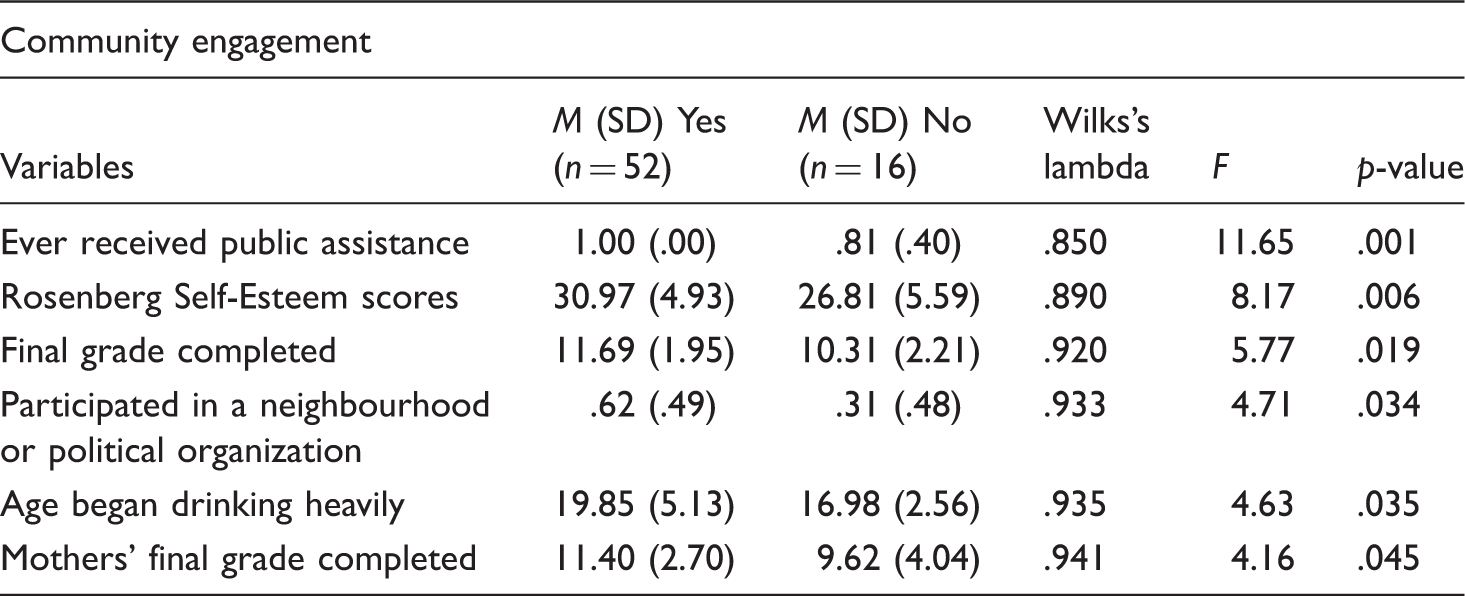
Canonical structure matrix
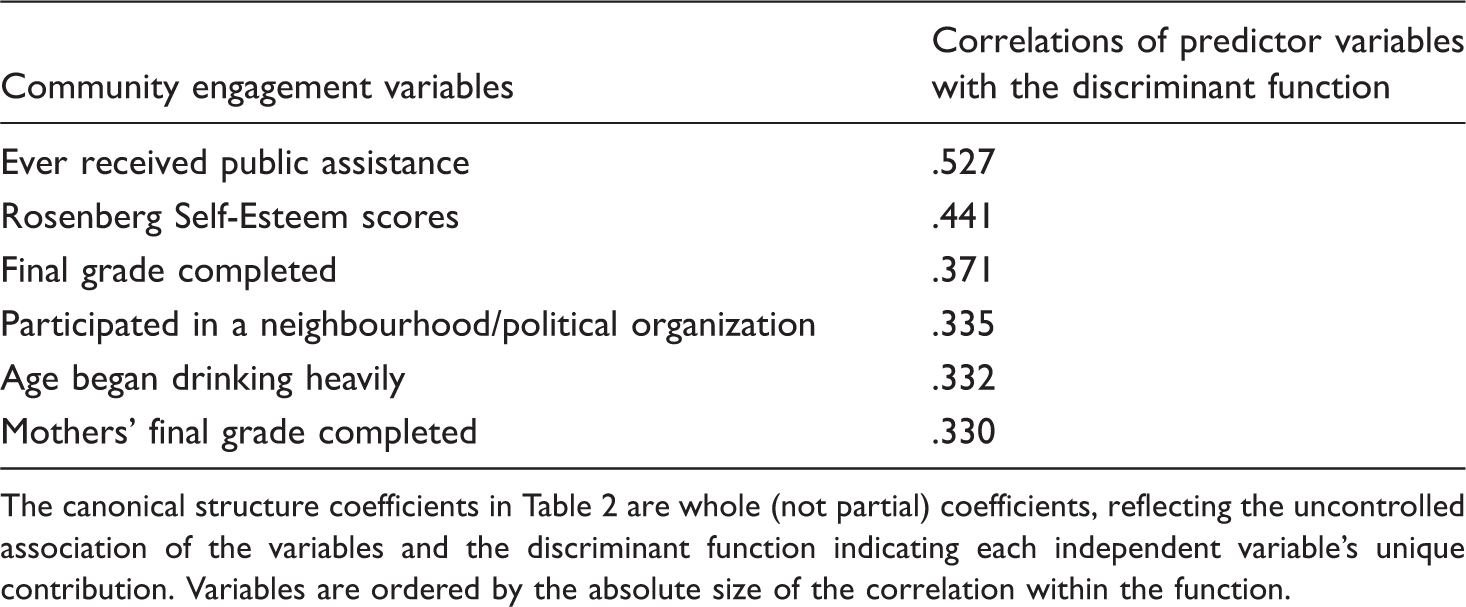
The canonical structure coefficients in Table 2 are whole (not partial) coefficients, reflecting the uncontrolled association of the variables and the discriminant function indicating each independent variable’s unique contribution. Variables are ordered by the absolute size of the correlation within the function.
This respondent, who had graduated from high school and gone on to college, stated that he had come to the realization that his purpose in life was to pass along the fruits of his own education and teach ‘at risk’ youth computer and business skills so that they might stand a better chance of succeeding in the mainstream economy. Like this man, it was common for these study participants to articulate the hope that through engagement with the community they might begin to make up for the harm they had inflicted during their years of abusing drugs and alcohol. Many reported bringing considerable misfortune to others in the course of a brief, dramatic act of violence, or in the slow, corrosive erosion of health and well-being engendered by neglect or humiliation. In order to sustain a habit, or survive and exercise leverage on the streets or while incarcerated, they admitted to engaging in a multitude of acts that could be harmful to self or others.
It was common for the respondents to depict a nightmarish series of incidents that they had witnessed, fallen victim to, or participated in during their periods of incarceration. As one man said, ‘I seen a whole lot of people injured, especially in the pen [penitentiary] or jail. I was there five years, I must have seen over a hundred stabbings. And at least 15 killings within that five years.’ He had originally been convicted for murdering his brother in a drug-induced rage. He wept as he said, ‘I got to live with this’ til the day I die. And I, I mean, it hurts. It really hurts.’ He explained that his profound remorse over the death of his brother, as well as actions taken during his time in prison, had contributed to his desire to engage in activities that would benefit the community so that others might avoid the misery that he had endured.
The men and women in the community engagement group also scored higher on the Rosenberg Self-Esteem Scale, suggesting that they experienced an enhanced sense of self-worth (M = 30.97, SD = 4.93 vs M = 26.81, SD = 5.59; F [1, 66] = 8.17, p < .006, r = .441). It was common for these respondents to reflect that while they had undergone a range of potentially dehumanizing events, they believed that this had imbued them with valuable lessons and a singular wisdom which they could subsequently employ to help others. For example, one man spoke of the ways in which the humiliating aspects of drug abuse and incarceration had contributed to a unique set of perspectives that he now had to share and alluded to the ways in which his efforts as a community health worker had enhanced his sense of self-worth:
Life experience has given me something. And you can only call it a blessing’ cause you’ve been blessed to reach people. It’s encouraging when people believe in you, when you leave an impression. Reaching out and being able to [he paused for a moment] light a fire in people. To reach for their own light back, you know. Not to give them my reasons for living, not to give them my reasons for trying to achieve or succeed in what I’m doing, but to seek their own reasons. Just to light the fire. If I can catch their attention long enough to light the fire, maybe we can get something burning there.
The respondents in this group had also, in the past, more probably participated in a neighborhood or political organization confronting issues of concern to the community (F [1,66] = 4.71, p < .034, r = .335). In their narratives, they mentioned involvement with associations addressing prison reform; homelessness; community violence; police misconduct; labor or legislative advocacy; foreign policy; the environment; and gay, lesbian, bisexual, and transgender rights. Some also referred to prior efforts at engendering social or political change within what they identified as their own communities (e.g. those living within the same geographic location, people with a similar history of substance use and incarceration, or members of their own ethnic group). For example, one woman who affirmed that she had previously been involved in neighborhood organizing said that her sense of purpose revolved around taking leadership in the Hispanic recovery community:
I noticed, you know, being Hispanic, my people packin’ up the prisons. I have no color in my eyes but I know my people need a lot of help. There’s so many of my people that are just killing theirselves, taking each other out, so many Hispanic women that are turning to dope and spending all their money, their welfare checks – so recovery has to come out stronger. So that’s one of my goals, is to be a Hispanic, strong leader in recovery.
One of the African American respondents reflected on his desire to engage in activities that would appropriate the political power he believed his community deserved:
My ancestors and my forefathers were forced to come over here, but I’m here now you know. Far as I’m concerned you can see [they] broke their backs and from sweatin’, built this country. I’m part of this, you know. I’m part of this … I think if you have a mass or a group or a unity of people changing theirself, they see what’s goin’ on out there, then they can do something, but jus’ one person can’t do it. That’s not going to happen.
Another respondent suggested that the next generation of leaders was going to come from those who had been incarcerated, ‘brothers just like me that’s been there, been through the system and everything. I think that um, African American adults in my category are a major part of the new leaders that people don’t really see or know about.’ He voiced his intention to begin organizing in the community, educating and mobilizing people through meetings and a newsletter that he would create. When asked when this awareness of wanting to serve the community had surfaced, he responded that it was during his time in prison:
The suffering and the struggling and the trials and tribulations I went through … It was basically through my incarcerations that it became solid … I think my moanin’ and my groanin’ and my wailin’ … I related it to the moanin’ and groanin’ of the entire creation. That’s how I seen it.
Classification results for community engagement
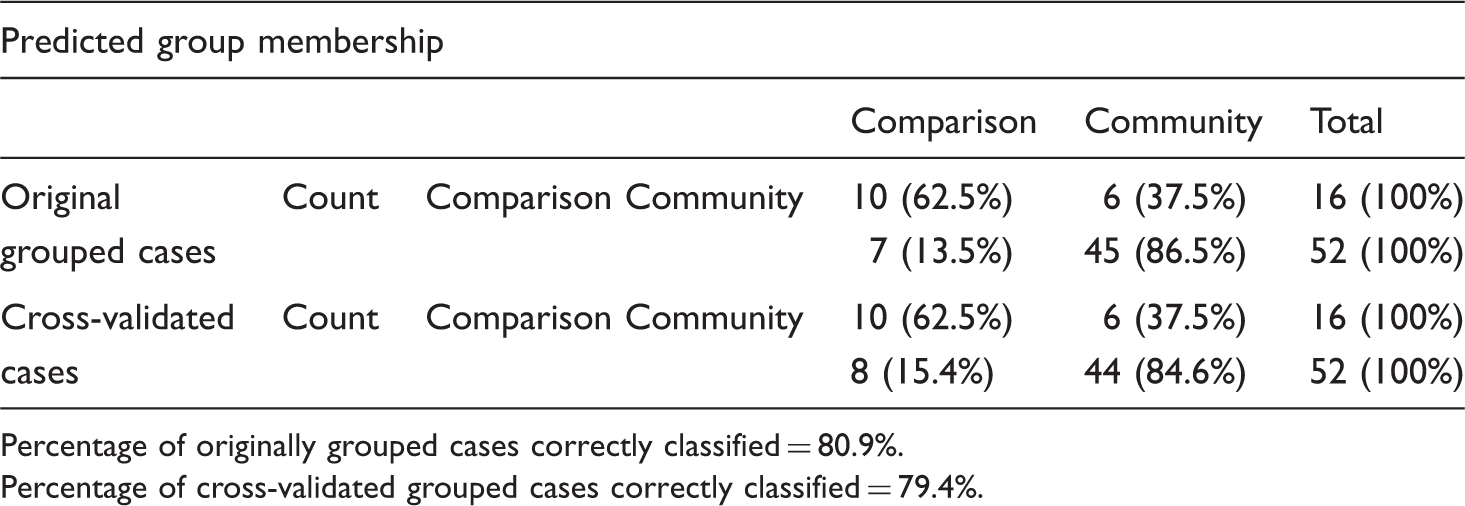
Percentage of originally grouped cases correctly classified = 80.9%.
Percentage of cross-validated grouped cases correctly classified = 79.4%.
Discussion
Qualitative and quantitative methods were used in an integrated fashion in this study to draw relationships between a sense of purpose in life focused on community engagement and its psychosocial contributors. The principal themes qualitatively articulated by those respondents affirming that they had discovered a purpose to their lives were then quantitatively aggregated into four categories, in order of endorsement: community engagement, improving the quality of one’s own life, expressing spirituality, and helping the immediate family. It is of note that despite the fact that individuals with the extensive legal history represented by those in this sample are not often conceived of as having prosocial aspirations, more than three-quarters of these study participants listed activities related to community engagement as those that would give their lives purpose. These men and women often evinced a longing to make up for the harm they had inflicted on those around them during their periods of substance abuse or incarceration by sharing the lessons gleaned from their ‘lost’ years to help others. Some expressed gratitude for having been shown life’s harsher realities, maintaining that this had left them with a unique capacity to reach out to people who had experienced similar hardships. A fair number stated that they wanted to be role models in the community, reflecting a different set of norms than those they had grown up with and subsequently perpetuated. Some articulated an awareness of their own oppression and its connection to that of others and this led to a desire to engage in social or political change.
Contrary to the original hypotheses, no significant differences emerged between the community engagement and comparison groups related to the quantity and frequency of past substance use; however, if they considered themselves to have been heavy drinkers, the respondents with a community engagement orientation were older at the inception of that type of consumption. Because of the ways in which data were collected it was not possible to ascertain whether an interest in community engagement contributed to the delayed onset of heavy drinking or whether the reverse might be true; however, previous research has shown that community engagement among youth is associated with a reduction in their current use of alcohol and drugs (Roth et al., 1998). One might surmise that the sense of belonging, social support, and political agency associated with activities that benefit the collective may buffer against the stressors that could otherwise contribute to substance abuse (Piedmont, 2004). It is also possible that a less problematic use of drugs and alcohol might simply allow for enhanced participation in community life.
Also contradicting the initial hypotheses, neither time spent in the current treatment episode or over a lifetime figured significantly into a community engagement orientation. It is of note that there were no significant differences between people who had spent a single week and those who had spent months or even years participating in some type of substance abuse intervention. There was also no difference between the respondents who had and those who had not attended meetings of AA or NA, with these groups’ emphasis on community service. As this was a cross-sectional rather than a longitudinal study, one can only speculate as to the precursors to the respondents’ desire for community engagement; however, the findings suggest that people may hold pre-existing aspirations to serve the community when they enter treatment. Thus, results from this research imply that for those who have perpetuated acts that engender shame and pain, an expressed desire for community engagement is more than an artefact of treatment. As reflected by the participants in this study, previous researchers (Kraus & Nauta, 2005) have found that experiencing hardship oneself may increase the desire to help others, particularly those who have been marginalized or oppressed, in an effort to provide them with the resources that were lacking in one’s own life.
In fact, the most influential contributor to a community engagement orientation among these respondents was having received public assistance at or after the age of 18. This runs counter to Nelson’s (1979) research which showed that being granted subsistence aid was uncorrelated with community engagement. Instead, these findings support previous studies which have shown that people may take action to help others because they have themselves received help and want to give something back (Banks, 1997) or that their perception of interdependence and shared destiny has been enhanced by their history of economic distress (Mattis et al., 2002; Wilmore, 1998). It has also been suggested that those who have received professional assistance may have vicariously observed the rewards associated with helping others in need and that this may increase their interest in engaging in such processes themselves (Krumbolz, Mitchell, & Jones, 1980).
Increased education, as hypothesized, emerged as significant in the community engagement group, echoing the results of prior research (Nie et al., 1996). As was reflected in previous studies (Brady et al., 1995; Nelson, 1979; Rosenthal et al., 1998), as well as in the respondents’ narratives, it is conceivable that greater educational attainment might have contributed to a more fully articulated analysis of the environmental influences in their lives along with an enhanced sense of efficacy in addressing them. The mothers of respondents in the community engagement group had also spent longer in school, which research has linked with higher academic achievement among offspring (Ma & Klinger, 2000), again a contributive factor to community engagement. As to the reasons for the greater influence of their mothers’ level of education than that of their fathers, more than two-thirds of these study participants’ parents had separated before the respondents turned 18 and in their accounts, many revealed that they had experienced little contact with their fathers.
As hypothesized, and echoing previous research results (Brady et al., 1995; Rosenthal et al., 1998), the respondents stating that their purpose in life revolved around community engagement manifested a greater sense of self-worth, as reflected in higher scores on the Rosenberg Self-Esteem Scale. Marten (2001) proposed that the motivation to effectively impact the environment is one of a relatively small set of factors associated with maintaining a positive sense of identity in the face of situational stressors. The respondents’ narratives corroborated the quantitative results as they described drawing wisdom from potentially demeaning experiences, expressing the belief that facing these challenges had granted them with unique gifts to offer to the community. Transforming what might otherwise be viewed as weaknesses and deficits into strengths and assets seemed to contribute to a greater sense of self-worth.
In addition, as anticipated, given that prior studies have shown that a history of civic involvement is predictive of such activity in the future (Brady et al., 1999), respondents in the community engagement group were more likely in the past to have participated in a political or neighborhood organization addressing issues of concern to the community. These men and women referred to a wide range of previous commitments and described the satisfaction they experienced in feeling as if they could have an impact on the broader social and political environment. Contrary to previous studies (e.g. Independent Sector, 1996; Mattis et al., 2004; Schlozman et al., 1994), the respondents’ ethnicity, gender, and age did not prove significant in their orientation to community engagement, nor did their history of involvement with the criminal justice system.
This study has several limitations. One is a modestly sized sample, reducing the power of the quantitative analyses. The number of variables used to assess a history of alcohol and drug use, as well as time spent in treatment, increased the risk of committing a Type I error. However, given that the variables of interest were subject to multivariate discriminant analysis, the probability of a Type I error was somewhat reduced (Rubin & Babbie, 2007).
Because of the scarcity of literature on community engagement among the population represented in this study, it was not always possible to set a priori hypotheses and this represents a further limitation. In addition, random selection was not employed, thus self-selection bias might have occurred and information was not collected regarding those who declined to participate in the study. However, an effort was made to interview people of differing age, gender, ethnicity, and length of time in the program such that they might more fully represent a range of relevant experiences. Self-selection bias might also have been reflected in the disproportionately large number of respondents endorsing a community engagement related purpose in life, given that participating in the interview could be viewed as service to the collective. However, it should be noted that the treatment program required a set number of weekly community service hours and engaging in the interview might have seemed more appealing than some of the more physically taxing alternatives such as mopping floors, cleaning bathrooms, unloading trucks, or sweeping the streets. Thus, the participants’ motives might not always have been entirely attributable to a desire to serve the community.
The generalizability of these findings is limited by the fact that this was a residential sample from one treatment setting and represented a population typically characterized by higher levels of consumption and substance use-related problems than most community samples. Therefore, the present results may not apply to individuals exhibiting a lower severity of difficulties. Future research using prospective designs with both clinical and non-clinical populations would be helpful in further elaborating on these constructs. Another limitation is that the research did not account for the relationship between an array of treatment modalities, thus distinctions that may have been site-specific could not be assessed. It is possible that the program itself might have had an impact on the respondents’ sense of purpose. Future research would be helpful in examining purpose-related goals across a variety of treatment approaches as well as the ways in which they contribute to successful outcomes. And because a cross-sectional design was used, it was not fully possible to assess the impact of length of treatment on changes in the respondents’ sense of purpose in life; however, neither time spent in treatment nor participation in AA or NA proved significant which suggests that these men and women might have entered the program with a previously articulated desire to serve the community.
Another concern is that of the validity of self-reported data and the fact that substance-using behavior was measured retrospectively. The findings could have been strengthened by more objective indicators of substance use. There was no way of determining the degree to which misreporting might have occurred; however, previous research has supported the reliability and validity of self-reported alcohol and drug use when participants’ confidentiality is assured (Stacy, Widaman, Hays, & DiMatteo, 1985). In addition, potentially influential variables such as the nature and severity of the offenses committed or psychological factors related to antisocial behavior were not included in the analyses. These represent fruitful areas for future research.
As triangulation of data was considered to be a critical component of this research (Lincoln & Guba, 1985), both quantitative and qualitative approaches were employed. Qualitative variables were mined for their richness of detail while the quantitative elements allowed for a more linear approach than might have been applied in a purely qualitative study and made possible more generalizable results. While multiple coders were not used to identify themes, thus it was not possible to check for intercoder reliability, the transcripts were systematically examined for information that both supported and contradicted initial interpretations (Erickson, 1986). The researcher also utilized ongoing consultation with participants, their peers, and professional colleagues referent to the evaluation of codes, categories, and emerging theoretical constructs (Lincoln & Guba, 1985).
Implications for social work practice and policy
For the most part, the men and women in this study expressed a clearly articulated sense of mission, supporting the contention that social workers serving those who have misused substances and been incarcerated should assist their clients in identifying and manifesting what they perceive to be their purpose in life. Janoff-Bulman (1992) proposed that one of the strategies frequently employed by those who have undergone suffering involves re-evaluating stressful experiences in terms of their potential benefits for others and their ultimate purpose. Researchers have suggested that those who are unable to draw a sense of meaning from adversity may also have a harder time making other life adjustments (Drauker, 1995). Piedmont’s (2004) study reflects that a sense of community connection and responsibility may be salient in the successful modification of substance abuse; thus, particular attention should be paid to the desire to utilize the knowledge gained from hardship in activities that are focused on benefiting others or contributing to social change. Where possible, methodologies that would allow for this type of exploration should be built into treatment. Supporting clients in reflecting on the unique gifts and wisdom that they have to offer alongside of the actions that have brought pain and shame might buttress the ‘approach’ type motives associated with a long-term reduction in substance use (Amodeo et al., 1992) and reinforce the most persuasive incentives for making challenging life changes. The results of this study suggest that social workers should assist people in conceiving of themselves not solely as help-recipients, but potentially as help-providers with the agency to beneficially impact their environment. A common social work goal is the enhancement of self-esteem among those whose sense of worth has been eroded by hardship and societal inequity. This research points to the utility of meaningful community engagement as a countervailing force to the situational stressors facing those assisted by the social work profession.
Being able to successfully obtain public assistance was the single most significant factor nurturing an interest in giving back to the broader community; thus, advocating for sufficient resources and assuring that material aid is available when necessary might prove fruitful in engendering a sense of collective responsibility. In addition, as education seems to be a key contributor to community engagement, ongoing attention to accessibility and retention would likely be of benefit. These represent potentially productive areas of focus for public welfare and school-based social workers as well as those involved in policy-making.
For individuals who have been isolated and marginalized by incarceration, practitioners can help to facilitate community-level reconciliation by establishing venues for restitution and the enactment of a range of socially contributive roles. Not only might this enhance the lives of the individuals playing these roles, but it could reduce the stigma associated with a history of substance misuse and incarceration. In this way, the community’s view of people such as those represented in this study might shift from one primarily focused on harm to one encompassing the distinctive assets that these men and women have to offer. Given the integral relationship between micro- and macro-practice in the field of social work, cultivating civic involvement and fostering political advocacy are an appropriate focus for our professional efforts. In that the results of this study reflect on the concept of restorative justice, there is a consonance with the social workers’ mandate to pursue social change, particularly in alliance with vulnerable and oppressed populations, reducing recidivism while strengthening the well-being of the community. It remains to be fully demonstrated whether community engagement might decrease recidivism to substance abuse and incarceration; however, Piedmont’s (2004) study suggests that the dominant predictor of successful treatment outcomes is the recognition of one’s unique place and purpose in a larger social context.
Footnotes
Acknowledgements
This study was supported in part by a grant from the Alcohol Research Group, Berkeley, CA. I am also deeply grateful to Lorraine Midanik, Yu-Wen Ying, Mac Runyan, Steve Hinshaw, and Martha Stein, for their encouragement, guidance, and thoughtful comments at various stages of the research.