







Abstract
Summary
This study examines understandings of social pedagogy. Interviews were conducted with nine social pedagogical researchers from Northern Europe. The interviewees were selected as representatives of their cultural and professional context and provided insight into their countries’ social pedagogical discourses. The interviewees were asked to talk about their understandings of social pedagogy from both theoretical and practical perspectives.
Findings
The empirical data were divided into two discourses; the universalistic and the particularistic. In the interview statements it was evident that interviewees leaned towards one of the two discourses as a starting point for their understanding of social pedagogy. However, the way the two discourses were combined varied among the interviewees. In further analysis, three models were constructed, which can be regarded as ideal types. These models shows that social pedagogical way of thinking extend from an individualistic, adaptive, starting point through a democratic approach to a mobilising collective approach.
Application
These models can be seen as an important contribution to understanding of social pedagogy that illustrate three different ways of understanding social pedagogy from northern European perspectives. The models elucidate the complexity embedded in the concept, but can also be used to facilitate analyses and interpretations of various social pedagogical activities. This findings has implications for how education in the field is constructed and implemented. Social pedagogy may not be definable in a simple way, but it can nevertheless be understood and described by the models constructed in this study.
Introduction
In some north European countries, social pedagogical thinking is an important element of the social professions (Hämäläinen, 2003; Kornbeck & Rosendal Jensen, 2009). Significant terminological differences exist among the social professions in Europe, but these differences do not necessarily represent differences in practice (Lorenz, 2008). In nearly all European countries, there is a duality between social work and social pedagogy. Further complicating the understanding of the concept of social pedagogy is the fact that it can be viewed to take two examples (for instance, in Sweden) as a field of professional activities, an object of study within the social sciences or a research field (Eriksson & Markström, 2009; Hämäläinen, 2003). Social pedagogy can thus be understood in a variety of ways. Furthermore, no particular theoretical construct can be described as strictly related to social pedagogy. This is the situation in Sweden and in other places, such as Germany (Eriksson & Markström, 2009; Mikser, 2006), and it may be a common condition in traditions within the social sciences. Social work, for instance, is sometimes described in a similar way (Frost, 2008; van Ewijk, 2009), although attempts have been made to use specific theories to increase the general understanding of these professions (e.g. Wirth, 2009). In many ways, this situation creates an impression of social pedagogy as a diffuse and elusive field. Further complicating the situation, the same concept is not understood similarly in English-speaking countries (Smith & Whyte, 2008). Research has shown that there may be cultural limits to the exportability of social pedagogy (Kornbeck, 2002). Such obstacles explain why issues are raised around social pedagogical meanings and identities and if there is something unique about social pedagogy and it that case, how these aspects of social pedagogy can be defined.
The development of the concept of social pedagogy
During the 1850s in Germany, the social pedagogical perspective focused on attempts to identify educational solutions to social problems (Hämäläinen, 2003) and was linked to new social problems caused by the processes of industrialisation and urbanisation (Sünker & Braches-Chyrek, 2009). A belief existed that it was possible to influence various social circumstances through education. One perspective sees social pedagogy as a German contribution to the theoretical improvement of social work (Lorentz, 2008). In this sense, social pedagogy is closely linked to the German concept of ‘bildung’, which can be understood as the process of socialisation. A sense of community is both a precondition and a goal of social pedagogy, according to Natorp (1904), who was one of the main figures at the forefront of contemporary social pedagogy and is considered by many to be its creator.
The evolution of the concept of social pedagogy has led to blurred boundaries between social work and social pedagogy. In Sweden, this is evident in different education programmes and workplaces (Eriksson & Markström, 2009). However, some researchers argue that one of the core questions in social pedagogy involves the integration of the individual into society, and another question involves the prevention of exclusion (Hämäläinen, 2003). Social pedagogy also promotes participation and integration. Social pedagogy emerged as a way to solve problems of incomplete socialisation and to promote personal growth and the acquisition of social competencies. The relationship between social work and social pedagogy is sometimes perceived as a significant issue, sometimes not. Hämäläinen, one of the few researchers who addressed the dynamics between social work and social pedagogy, views social pedagogy as a perspective of social work, although not only reduced to a method. He argues that social pedagogy can contribute to social work in various ways (Hämäläinen, 2003).
Today, the understanding of social pedagogy ranges from a practice geared towards children and youth in residential institutions to activities aimed at mobilising communities (Eriksson, 2011). International journal articles about social pedagogy can be divided into two main groups based on their content. One perspective addresses residential care work, and the other utilises social pedagogy as a resource for group work in schools (Mikser, 2006). Additionally, researchers have stressed the need for empirical research to create a theory of social pedagogy (Hämäläinen, 2003; Rauschenbach, 1999; Winkler, 1999). This article uses empirical data, theories used as the basis for social pedagogical activities and social pedagogical thinking, to examine the meaning and identity of social pedagogy.
Social pedagogy is more common in some European countries than in others, both as a description of practice and as a theoretical concept. Social pedagogy is used as a basis for professional practice primarily in the northern region of Europe. In terms of professional practice, however, the concept is beginning to spread. In the UK, for example, there is ongoing academic discussion regarding the importation of ‘continental’ social pedagogy (Cameron, 2004; Petrie and Cameron, 2009; Smith, 2003). This development has progressed rapidly in recent years; as a result, numerous articles on social pedagogy have been produced in the UK.
Previous research
Previous research has compared different understandings of social pedagogy, although this research typically was not based on empirical data (e.g. Eriksson & Markström, 2000)
Similar attempts have been made within the field of social work. For example, Soydan (1993) studied the history of ideas of social work. Payne (2005) described the existing praxis theories and described how they are used, their value for social work and the differences between them.
In summary, social pedagogy is perceived as an elusive and difficult topic to define. It appears in various forms in different countries. One important question is whether it is possible or desirable to attain a common cross-national understanding of how to describe social pedagogy.
The purpose
Many people are involved in different ways in social pedagogical activities or social pedagogical educational programmes. Research in the field with reference to Sweden is limited. Therefore, there is a great need within professional areas and educational fields for new knowledge that can contribute to the understanding and practice of social pedagogy. Conducting research on social pedagogy offers the opportunity to highlight elements of reality in new ways by providing new perspectives on well-known phenomena (Brante, 2003; Hämäläinen, 2003). The intention of this article is not to distinguish social pedagogy from other social professions or disciplines, but rather to explore different conceptions of social pedagogy.
The purpose of this article is to gain an understanding of social pedagogy as it is perceived by social pedagogy researchers in a northern European context. Previous research has often divided social pedagogy into practice-related fields (by profession) and theoretical fields based on abstract reasoning (e.g. Hämäläinen, 2003). This way of understanding and describing social pedagogy provided a starting point for this study. The following key themes are explored:
social pedagogy as a theoretical concept, social pedagogy as a practice, and factors that influence these conceptions.
Methods
The study design is based on a social constructionist perspective. This qualitative study is based on expert opinions derived from interviews with experts on their conceptions of social pedagogy. These explorations contributed to a collective definition process by which various phenomena (in this case, social pedagogy) are constructed. These processes are related to their social and historical contexts (Burr, 1995).
The interview subjects
Interviews were conducted with nine social pedagogical researchers (2 women and 7 men). Two were from Finland, two from Sweden, one from Norway, two from Denmark and two from Germany. All interviewees were between the ages of 41 and 59 and had significant work experience. Six of them had worked as professionals in different social fields before beginning their research careers in universities.
The interviewees were selected as representatives of their cultural and professional contexts and provided insight into their countries’ social pedagogical discourses. They had also participated, to varying degrees, in the national and international dialogue on social pedagogical issues through publications, conferences and similar activities. In some ways, they were ‘leaders’ within the field of social pedagogy in their own countries. Within the Nordic social pedagogical education programmes, established exchange networks of teachers, students and ideas exist. These networks were used to locate appropriate subjects for interviews. My involvement in these networks meant that I had insight into the individuals who could be considered key figures in this field. In Denmark, Norway and Sweden, I personally selected the interviewees. In Germany, I made contact with a social pedagogue who helped me to contact another social pedagogical teacher. In Finland, I turned to the social pedagogical association (an interest association), and its board selected two individuals to be interviewed.
Six of those interviewed were working both as teachers and researchers. As teachers, these individuals were linked to different forms of social pedagogical educational programmes. These programmes were constructed in various ways. Three of the programmes were integrated with social work educational programmes, five were vocational-training courses and one was purely theoretical.
Interviews and analysis
The interviews were conducted in the workplaces or homes of the interviewees. Two interviews were conducted in a hotel. The interviews took the form of conversations based on an interview guide. In this sense, the interviews were semi-structured, and each lasted between 1 and 2 hours. During the interviews, the interviewees were asked to talk about their understandings of social pedagogy from both theoretical and practical perspectives. They were asked to describe the educational programmes with which they worked and to reflect on societal development connected to social pedagogy. All interviews were recorded and subsequently transcribed
During the analysis, the empirical data were categorised into two main categories. These categories emerged from the data concerning the researchers’ statements about social pedagogy, which were rich in meaning and, initially, difficult to predict. The interviews included many different approaches to social pedagogy. Therefore, the interviews were divided into two categories of statements, referred to here as discourses: one was theoretical, and the other focused on practical work. Further analysis produced a more holistic understanding of social pedagogy. I intended to examine whether it was possible, based on empirical data, to describe a more comprehensive way to understand social pedagogy that included both theoretical and practical considerations.
To achieve this goal
Social pedagogy as a discourse?
The empirical data describing the interviewees’ perceptions of social pedagogy can be divided into two types. In the analysis, I refer to these as discourses. Discourses are defined here as ‘ways to talk about’ social pedagogy. The two discourses described are universalistic and particularistic, and they present different knowledge interests. The universalistic discourse is based on ideas and thoughts about concepts perceived as relevant to social pedagogy So I think it ought to be rooted in both. In theory and in practice, that there could be such a synthesis of practice and theory as a basis. It is my opinion. That you cannot tell them apart. (respondent 1)
Visa romanisering
Thus, the interpretation is that theory and practice are different to their characters. Freire, who reflected on the relationship between theory and practice, describes the concepts of reflection and action. He argues that if action is missing, words are just empty talk; similarly, a lack of reflection leads to pure activism (Freire, 1972). In this way, one could say that there is a dialectical relationship between theory and practice (Eriksson, 2006; Mathiesen, 1998). The interviewees often had starting points in a particular discourse, and their choices could be interpreted in relation to their personal backgrounds, the study programmes in which they worked and the societal contexts. Division into two discourses is a theoretical construction based on the empirical data.
The universalistic discourse
The universalistic discourse includes the theoretical talks of social pedagogy. One of the several ways that this was presented during the interviews was through discussion of the theoretical and historical bases of modern social pedagogy. Four different lineages were analysed in the interview material regarding historical roots: German social philosophy with Natorp as a main figure (Natorp, 1904), Latin American pedagogy with Freire (Freire, 1972) as a front figure, a lineage that emerges from American social work (Addams, 1910) and one that originates in Nordic psychiatry. These historical roots seem to have various affects on thoughts about social pedagogical issues. Social pedagogical thinking and activities have developed in different directions depending on their histories. How social pedagogy is interpreted in the twenty-first century depends not only on its historical roots but also on developments within different societies. This is one way to interpret the statements by the interviewees.
In addition to historical roots, the universalistic discourse includes theoretical aspects. Three levels of theory, developed within the framework of other disciplines, are apparent in the statements. The first group of theories, methodical theories, is used in different treatment methods. The second group of theories consists of explanatory models, which could be used to explain the emergence of social problems and to identify causal relationships. The last group of theories represents a point of reference, reflecting different value platforms (e.g. democratic theories). This last group of theories directs social pedagogues’ theoretical choices at other levels; every social pedagogue constructs his or her own theory building by combining ideas from the different theoretical levels. As a result, it is possible to construct ideal models.
Describing important concepts is another way of talking about social pedagogy in a theoretical way. Describing the content within a certain concept area also describes the social pedagogical knowledge arenas. From the perspective of the social pedagogical researchers, two concepts seemed to be of greater importance than others: bildung and community. The understanding of these concepts differed among countries and individuals, but bildung and community were well-used, ‘living’ concepts. Bildung is seen as education, upbringing, empowerment and a means toward citizenship. To analyse the interviewees’ opinions on bildung, their statements were related to different ideals of bildung, which have different ideological roots. One ideal in previous research is that of civic bildung (Gustavsson, 1991), which originated in the Enlightenment. This view emphasises Visa romanisering science and reason, and knowledge, or bildung, enables people's participation in the community. This is an emancipatory interest, and a democratic education is important (Gustavsson, 1991). The second ideal is associated with the formation of personality. It is tied to neo-humanism and is concerned with issues of human self-realisation. Bildung, in this ideal, is not particularly useful. Both of these aspects of bildung are represented in the interview statements. Most of the interviewees’ views of bildung, however, were similar to what we refer to here as civic bildung. According to one of the Swedish interviewees, It is precisely this that is bildung … in some way, to rise, to grow, to be aware and see things more clearly. You become a more thoughtful person, and that's the most important in the concept of bildung. (respondent 3)
The interviewees argued that both of these ideals of bildung are represented in social pedagogical thinking and acting, but all preferred the civic bildung ideal.
Even the concept of community was seen as crucial and as existing in the historical understanding of social pedagogy. Understandings of community have changed since Natorp's time, and there seems to be a different kind of community today. According to those interviewed, this modern community is more post-modern and does not offer protection in the same way as in the past. This seems to be the understanding of contemporary societal conditions among the interviewees, and they share this understanding with several contemporary scholars, such as Bauman (2000). An emphasis on changes in the understanding of concepts such as community may offer a better understanding of the preconditions of modern social pedagogy
The particularistic discourse
The particularistic discourse contains statements about social pedagogy as practice or field of activities. Thus, these are statements about occupational activities, professions and their meanings. In the analysis, different subcategories were constructed, including social pedagogy as a goal, social pedagogy as an approach, social pedagogy as a method, tools in social pedagogical activities, professional social pedagogical roles, social pedagogical target groups and social pedagogical arenas. These categories are rich in meaning. The interviewees’ statements contained many different opinions of how to describe and understand social pedagogical activities. Other researchers have noticed the differences among these factors and found it impossible to achieve a unified entity (Mikser, 2006). The statements in this study could sometimes be interpreted as thoughts about how things ought to be, the interviewees’ experiences, or, in some cases, as statements about how these issues were enacted in practice.
Interestingly, one individual sometimes discussed social pedagogy in opposite ways. For instance, an interviewee might describe social pedagogy as having an individualistic approach and subsequently discuss it from a collective view. One explanation for this is that social pedagogy is multifaceted, and it shifts in meaning through time and space (Hämäläinen, 2003). This understanding is also illustrated through the way the interviewees spoke about goals, methods, tools, roles, target groups and arenas. Taking comments about the goals of social pedagogical activities as an example, some interviewees described socialisation as the goal, whereas others cited mobilisation; these represent two significantly different approaches. The social pedagogical methods were also described as being multifaceted, although the most prominent methods were creative methods, community development and community work (see, for example, Eriksson, 2011). Community development is understood, in this case, as a collective method that strives to mobilise groups of people in need of support to play active parts in their own or their groupés lives (Eriksson, 2011). These methods were regarded as specific to social pedagogy. Most interviewees argued that community development was a characteristic method of social pedagogy, but they also deplored its disuse.
Three tools important for social pedagogical activities were highlighted in the analysis: relations, dialogue and activity.
Concerning the roles, the statements were divided into two groups, internal and external. Both were based upon situations of asymmetrical power relations. The social pedagogue is described as the strong party, and the other party (the client or the patient) is either weak or has deficiencies in one or more areas. The interviewees’ statements were interpreted as suggesting that they believe social pedagogues have something to offer, whereas the other individual is often described as a passive recipient. With a few exceptions, the interviewees did not address the possible strengths of the clients in this context.
The internal roles were interpreted as being closely related to the direct relationship between the social pedagogue and his or her client. The external roles, however, describe a situation in which the social pedagogue is involved in the environment and context of the client to a greater extent to improve the client's situation in an indirect, long-term way. Examples of internal roles are those of an advocate, guide, facilitator and problem definer. Examples of external roles are networkers and community constructer.
Concerning target groups most interviewees agreed that there has been some change over time. Previously, social pedagogues’ principal target groups were children and adolescents. Now, their principal targets are subordinated and marginalised people and groups, according to the interviewed researchers. Social pedagogues previously worked with individuals; currently, intervention is often directed towards the whole family or group. This phenomenon has also been described in previous research (Madsen, 2005). Social pedagogical arenas are everywhere, especially in public and private activities, although they seem less common in the voluntary sector (at least in the Nordic countries). The interviewees claimed that the number of arenas in which social pedagogues work is continuously expanding. In addition to working in various residential institutions for children and youth, it is now common to find social pedagogues in schools, prisons and hospitals, among other places. One can observe a shift over time from social pedagogues who work mainly in institutions for children and youth to situations in which social pedagogues work with all marginalised groups and individuals wherever they may live and act.
Three social pedagogical models
In the interview statements, it was evident that interviewees leaned towards one of the two discourses as a starting point for their understanding of social pedagogy. In some cases, one of the discourses was more prominent, but most often, both discourses were present at the same time. This is not remarkable because all interviewees would be expected understand both the theoretical foundations and the practical activities of social pedagogy. However, the way the two discourses were combined varied among the interviewees. These combinations could be either country-specific or specific to the individual. Other researchers have pointed out that social pedagogical traditions are often specific to the country in which they are practiced (Hämäläinen, 2003). This phenomenon was less obvious in this study; it appeared that the societal context was not more important than, for instance, the personal context
The models of social pedagogical meanings.
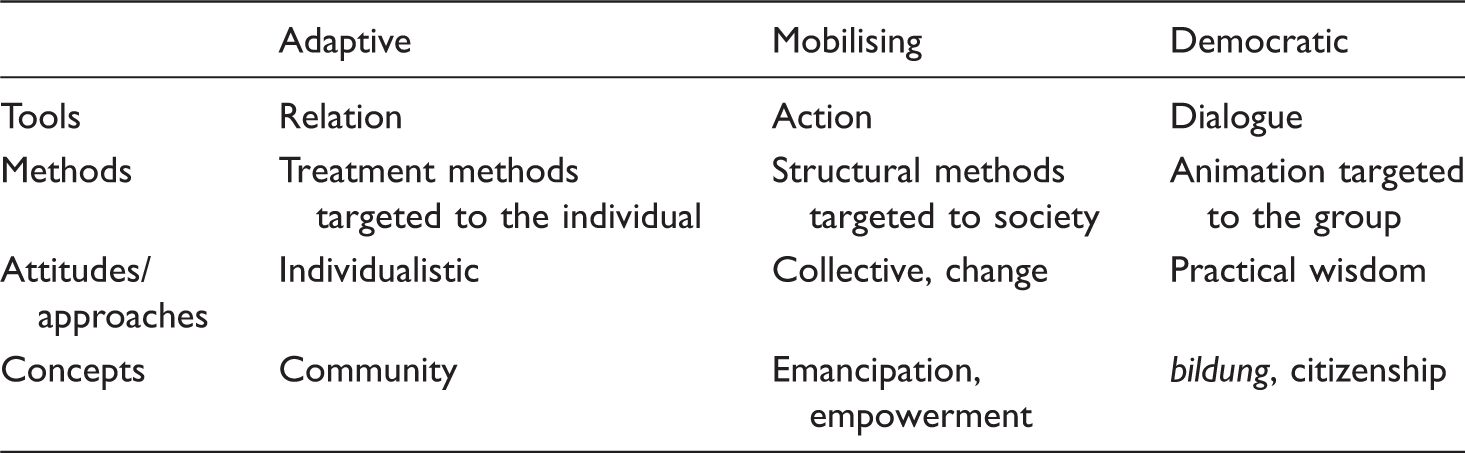
The adaptive model
In the adaptive model, the main goal is adaptation to society, and there is an underlying, sometimes implicit, assumption about an existing ‘good’ society. In statements related to this model, the ‘good’ society is described as existing or, at least, as possible in the future or having existed in the past (e.g. Bauman, 2000). The interviewees mean that this society functions as a gathering community for all individuals and that the only way to become a human being is by participating in the community. An individual cannot exist alone. The following quotations illustrate this: The social pedagogue should help people who are in any way marginalised, mentally handicapped, criminals, drug addicts, prostitutes and so on, and children who cannot live with mom and dad. You try to socialise them into the community. (respondent 6) Social pedagogy is aimed to socialise people into society. So in some way you can talk about a principle of integration. (respondent 7)
This way of thinking finds support in Natorp's and Dewey's thinking, both of whom saw humans as social beings in constant development in interaction with the community (Dewey, 1916). Both Dewey and Natorp were inspired by Hegel. Natorp's opinion was that the goals set for the education system were twofold. The first goal was to educate people to be members of the community, and the second was to educate citizens to want to improve the community. The community body of knowledge provides the ultimate guide to the choices that individuals must make. Community knowledge serves as security for the individual. The interviewees’ reasoning can thus be traced back to both Natorp's and Dewey's philosophical reasoning.
These statements involve the idea that individuals or groups that have been excluded by society for various reasons may become participants in the ideal ‘good’ society through social pedagogical interventions. This social pedagogical work is based on ‘good’ relationships between the professional and the client. In the interviews, these “good” relationships were described as both possible and desirable
In the adaptive model, different kinds of treatment methods are used to reach the adaptive goal of curing the client and enabling him or her to be a ‘good’ member of the community, understood here as an integrated and active member of society I fear the use of social pedagogy in adjustment processes. And I'm very critical of Swedish society, I know that this is even more common among you. It is used to suppress people or teach people manners and I am afraid that we will use it as an instrument in the same way that I know has happened in several places. (respondent 2)
The interviewees argued that social pedagogues ought to work in other ways. This model is similar to what Madsen calls the ‘treatment discourse’ (Madsen, 2005), which describes social pedagogy as relation-oriented, with adaptation as a goal. The model also relates to descriptions of residential care work (Cameron, 2004).
The mobilisation model
The goal of the mobilisation model is the emancipation of the client. This model illustrates a more radical interpretation of social pedagogy. The social pedagogue wants clients to reflect upon their own situation and to be aware of the impact of societal structures and processes on their everyday lives. Through this awareness, the client becomes ‘released’. The statements that form the basis for this model are similar to Freire's thoughts about conscientisation and liberation (Freire, 1974). Many consider Freire an important figure within social pedagogy, and several of the interviewees referenced him. Freire has many followers, but still seems to be the most important in a social pedagogical perspective. The mobilisation model is action-oriented, as is Freire's pedagogy of the oppressed
Changing beliefs may be reflected in the interviews, such as when the interviewees stated that community work is no longer an important part of curricula or practical activities. One of the German interviewees said: And mobilisation is a thing that has become more and more difficult, because in this process of individualisation it is quite, quite difficult to mobilise, for instance, poor people to stand in for their interest. So, sometimes it may happen, but it is really difficult, and in the late 70s, of course to mobilise young people was quite easy and even for adults in poor district, and they went in town hall and demonstrated a long time ago. (respondent 8)
In general, some trends in welfare work in Sweden have developed from structural interventions to efforts directed at individuals. The same development is evident in community development work, according to researchers in the field (van der Veen, 2003). Development in all of the Nordic countries seems to have proceeded similarly. Thus, according to several of the interviewees, development away from the structural approach towards a more individual approach is apparent throughout society. There is a clear trend towards an individualised society. Because social pedagogy is influenced by society and societal trends, some of the interviewees suggest that it is not possible to discuss specific methods for social pedagogy over time. When the boundaries between, for instance, social workers and social pedagogues are blurred, as is the case in Sweden, the methods used by working social pedagogues also change. Most of those interviewed believe that methods with a collective focus are closely associated with social pedagogy. This is the preferred model for several of those interviewed, although it is associated with difficulties, as the following quote shows: But our clients are not in the position to change the society, so empowerment … the talk of community work conception, like Alinsky, that is very nice to me. But it doesn’t work. (respondent 8)
This model has some similarities with Madsen's action discourse, which he describes as a reaction to the treatment discourse. In the action discourse, the role of the social pedagogue is to advocate for the weak (Madsen, 2005).
The democratic model
The democratic model emerges from statements made in the interviews and is based on humanistic democratic thinking. This model reflects the perspective that individuals can reach some type of ‘citizen bildung’ through support and ‘education’ from social pedagogues. This perspective takes a mobilisation approach, but it is less radical than the mobilisation model. A ‘good’ dialogue is central, according to the interviewees
The methods used in the above-mentioned model are somewhat similar to animation. The concept of animation, which is not often used in the Swedish context but is common in, for instance, France and Italy, can be described as a form of popular adult education directed towards groups within the local community. These, mostly pedagogical interventions, strive to help groups cope with their own situations.
The limitations of the study
This study examines understandings of social pedagogy from the perspective of 9 social pedagogical researchers. The study has some important limitations. One limitation is that I knew most of those interviewed, which may have influenced the interviewees’ responses. Based on the purpose of the study, however, there did not seem to be a resulting disadvantage.
Another limitation is that no social pedagogical practitioners were interviewed, although virtually all interviewees had been previously involved in social pedagogical work. The results may have been different if I had interviewed practitioners regarding their understandings of social pedagogy.
A further limitation is that I did not examine the contexts and their implications. The respondents live in different societies, work at different universities and have different personal backgrounds. All of these factors impact their ways of thinking about social pedagogy, although in this article I have chosen to concentrate on their similarities.
Conclusions
The results presented in this article support previous research describing social pedagogy as confusing and disparate (Mikser, 2006). In this article, three theoretical models have been constructed based on empirical data elicited from an interview study. These models can be seen as an important contribution to understandings of social pedagogy that illustrate three different ways of understanding social pedagogy from northern European perspectives. The models elucidate the complexity embedded in the concept, but they can also be used to facilitate analyses and interpretations of various social pedagogical activities. The models show that social pedagogy cannot simply be regarded as a type of social practice or theoretical framework; social pedagogy entails both theoretical and practical considerations. This division can also be identified, for instance, in German research (Mikser, 2006). To understand social pedagogical traditions, it is also important to understand their varying value systems and the consequences inherent in the concept. A social pedagogical way of thinking can extend from an individualistic, adaptive foundation to a democratic, dialogue-based approach or a mobilising, collective approach. This study reveals that all social pedagogues have their own understandings of social pedagogy that are influenced by personal experience, the educational programme to which they are linked and the development of the society. This means that it is difficult to argue that one universal approach to social pedagogy should exist. This finding has implications for how education in the field is constructed and implemented. Different teachers and educational institutions may convey different views of what comprises social pedagogy. However, this study shows that it is possible to construct a way of understanding social pedagogy that can be shared between countries and contexts. The constructed models allow practitioners and researchers in the field to recognise and understand different ways of relating to society and to others. Social pedagogy may not be definable in a simple way, but it can nevertheless be understood and described by the models constructed in this study. The models also imply that social pedagogy cannot simply be understood as an activity or a theoretical approach; it is necessary for theory and practice to compose a single entity.
Footnotes
Acknowledgements
The author would like to thank the interviewees for their contributions to the study. Without their commitment and knowledge it would have been impossible to write this article.
Funding
This research received no specific grant from any funding agency in the public, commercial, or not-for-profit sectors.