







Abstract
Summary
This article explores young people’s experiences of service use and their life experiences, including exposure to harmful events and environments, such as abuse, violence, addictions, disengagement from school and mental health issues. It draws on the findings of a New Zealand study that used a mixed methods approach to investigate young people’s (aged between 13 and 17) experience of service use. These young people were multiple service users of statutory and non-governmental services including: child welfare services, juvenile justice services, remedial education services and mental health services. The first phase involved the administration of a survey (n = 605) and the qualitative phase (n = 109) used a semi-structured interview schedule to explore the service use experience of these young people. The qualitative interviews took place over 14 months which reflects the time it took to locate the young people and complete interviews. This article briefly reports on the quantitative phase and then focuses on a key finding from the qualitative phase, service engagement.
Findings
The findings identified the resources and strategies young people used to mitigate the effects of harmful events and environments in order to achieve their goals. The study produced rich accounts of service encounters: what was positive in these encounters and the barriers to successful engagement with services. Key themes focused on what happens for young people when there is confusion about service provision and when provision is intermittent. The findings emphasise the important role of social workers in creating positive service encounters for young people.
Applications
The findings underline the importance of the relationship between social workers and their clients as a foundation for successful interventions. It reiterates the need for social workers to take the time to understand young people’s contexts and how young people make sense of these contexts.
Introduction
There is much interest in the nature of service delivery and its relationship to improved outcomes for clients. Of particular interest is evidence that defines the characteristics of the most effective interventions (Fernandez, 2009; Maluccio et al., 2011; Wigley, Preston-Shoot, McMurray, & Connolly, 2012). This article explores one aspect of service experience, how young people who have been exposed to harmful environments and experiences make sense of their engagement in services (child welfare services, juvenile justice services, remedial education services and mental health services). The study emerged out of a need to understand the factors that enabled young people to make the most of the resources that were available within services. In our meetings with practitioners and policymakers we heard of their concerns and the challenges they faced in providing services that were responsive to the needs of young people. While young people were using a range of services that were designed to address their complex needs, including welfare services and mental health services, positive change for these young people did not always eventuate. Many young people became involved with services at a young age and had episodic or sustained involvement (such as living in foster care) for most of their childhood. However despite engagement with services over long periods, social workers reported that young people did not always receive the targeted help they required across multiple service systems, such as safe living situations, appropriate behavioural interventions, family support and counselling. These accounts suggested that young people moved through the service system, but did not actually connect and engage with the resources that would lead to positive outcomes. In planning the study the researchers concluded that in order to gain a deeper understanding of what was actually going on for these young people it was also important to hear from the young people themselves and to focus on their accounts of service engagement. These first-person accounts have the potential to generate fresh insights and understanding of service encounters and the circumstances under which services could mitigate harm and enable young people to achieve their goals and realise positive futures (Berzin, 2010; Foster & Spencer, 2011; France, 2000, Stalker, 2003; Ungar, 2013).
The study
The study population
Organisations connected with the research.
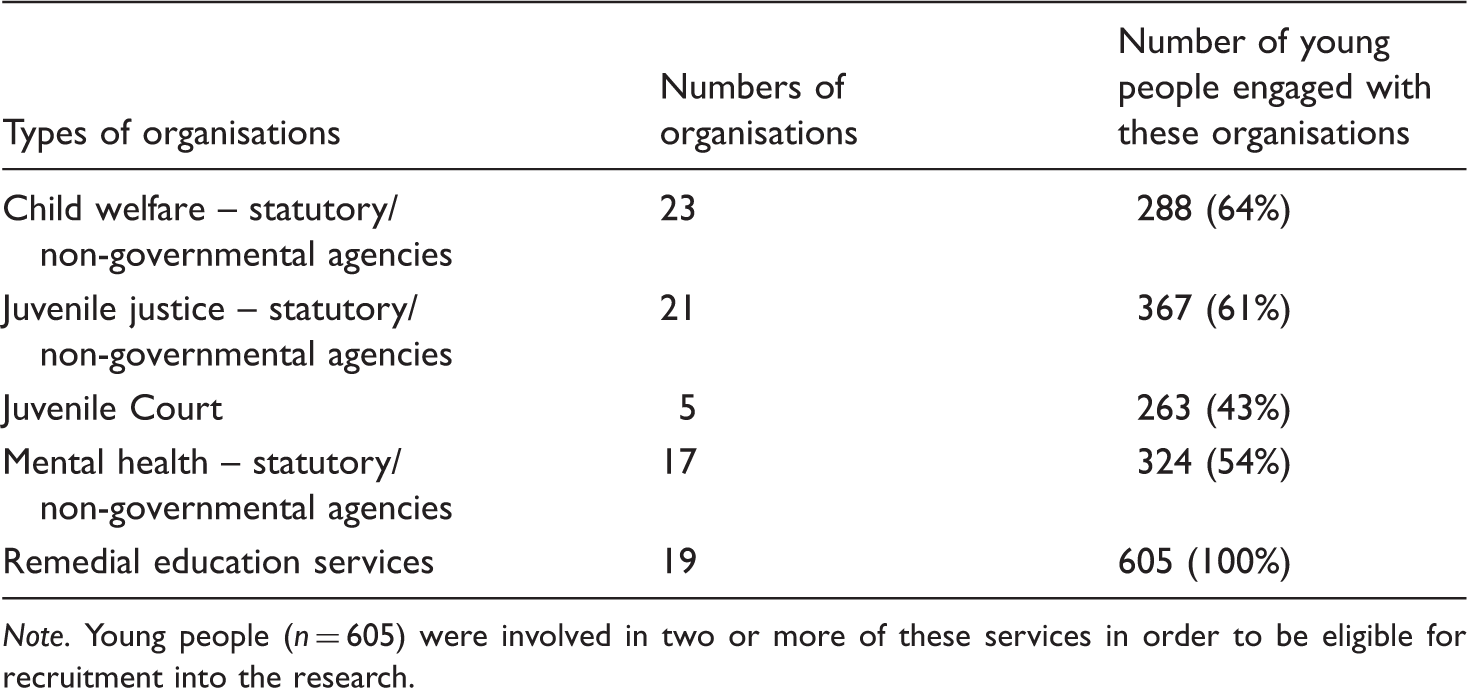
Note. Young people (n = 605) were involved in two or more of these services in order to be eligible for recruitment into the research.
Ethical approvals were granted from the University Human Ethics Committee. There were a number of ethical issues that required careful attention including the processes for gaining access to young people via organisations, obtaining direct consent from the young people and establishing protocols for managing sensitive issues such as when a young person disclosed that they were unsafe. The refusal rate for the study was 2.5%. This low rate of refusal was a result of the recruitment methods adopted which involved a careful process of negotiation with providers to secure support for the research and their willingness to support young people to participate in the research. Several meetings were held with agencies in the research planning stages and the researchers maintained contact with these agencies throughout the project. While the researchers kept services informed of the overall progress of the research, information about particular young people remained confidential. The researchers obtained direct consent from the young people and this process was carefully monitored by the researchers to ensure that the rights of young people were protected. Recruitment processes involved an initial contact with the agency and then researchers met with young people independently of agency staff, explained the research to them and gave them opportunities to ask questions. Once consent was obtained an interview time was organised with the young person. Agency staff were not involved in this process. Young people determined the time and location of the interview. Young people were clearly informed of the relationship between the researchers and the agency, that the agency was a place to meet with young people who may be interested in participating in the research but that all the information the young person shared in the interview remained confidential and was not discussed with agency staff. Agency staff did not know which young people agreed to participate in the research.
Characteristics of the study population.
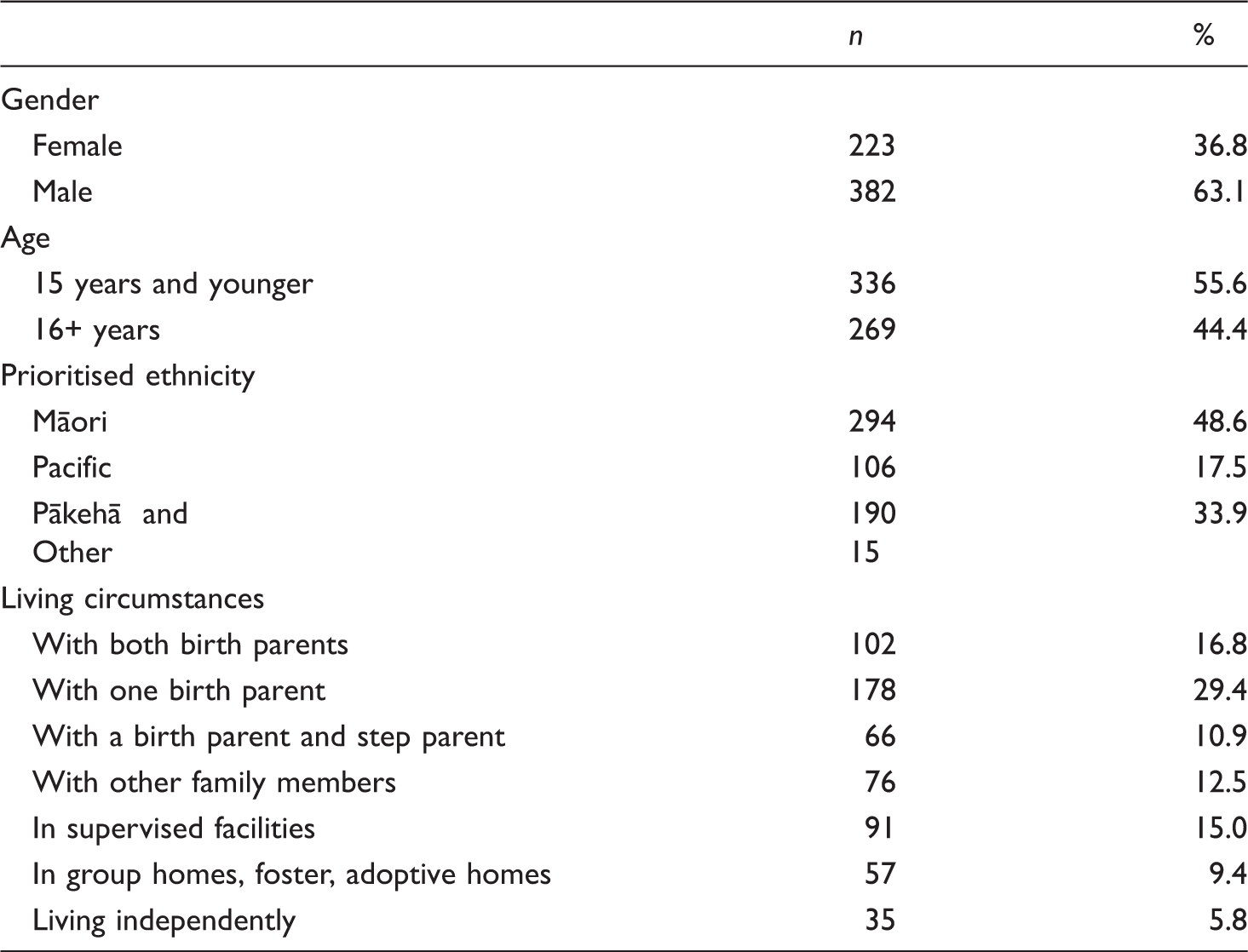
In two questions about mother and father figures, young people were asked to identify from a list of people (for example, biological parent, step parent, grandparent, foster parent) who in their life best represented their mother and father figure, the person who made the day-to-day decisions about or with them. Nearly three quarters of the young people (73%) chose their biological mother as their mother figure and 56% chose their biological father. Other young people nominated relatives and some nominated foster parents and other non-familial adults such as social workers. Of note is that 37 young people could not identify a mother figure and 131 could not identify a father figure.
The young people had interrupted education experiences; two thirds (64%) had stopped attending school by their second year of high school and under half (47%) had achieved the first compulsory high school qualification. Many of these young people had been excluded from mainstream school (54%) and while some of these young people had moved into alternative education settings their attendance was often intermittent (Sanders et al., 2013). Young people were asked to record their feelings about their last or current mainstream school; one third (34%) were positive about their school and one third (37%) felt a sense of belonging to their school. Despite these findings, 59% scored over the mean on a 5-point scale that asked if getting an education was important to them.
In the qualitative phase of the study 109 young people were interviewed. All of these young people had required remedial education services and most were involved in at least three services at the time of the interview. Almost equal numbers of males (56) and females were interviewed (53). The age range was 13 to 17 and the mean age of these young people was 15.1 years (SD = 1.0). The distribution of ethnicities aligned with those in the wider study sample.
Methods
The first phase of the study involved the administration of a survey entitled the Pathways to Resilience Youth Measure adapted from a Canadian instrument (Sanders et al., 2013) and this was followed by the qualitative interviews and case file reviews. The survey captured demographic information, patterns of service use, their experiences of harm, relationships with family and friends, and the role of material, social and emotional resources in achieving functional outcomes including involvement in school, social participation, pro-social behaviour, positive peer group and future aspirations. It was administered by a trained interviewer. The survey contained a range of subscales (Sanders et al., 2013) that assessed individual harm such as substance abuse, delinquency and risk and contextual harm such as family and school risk and community danger. Young people’s resilience resources were assessed via the Child Youth and Resilience Measure – 28 (CYRM – 28, Liebenberg, Ungar & van de Vijver, 2012) which measured young people’s resources in three domains: individual resources (such as the ability to problem solve), relationships with parents or caregivers and contextual resources (including connection to culture, religion and spirituality, and engagement with education).
Lifetime service use was measured using a composite score that assessed the total volume of services that youth had received (child welfare, health, mental health, juvenile justice, educational supports beyond regular classroom programmes). The service quality score (composed of 13 questions) was adapted from the Youth Services Survey (YSS) and assessed service satisfaction as a whole with a focus on whether the youth experienced services as being responsive to their situations, whether services were respectful, whether services were relevant and accessible, whether they enabled the young person to have a say in how the service was provided and how the service engaged with their family and caregivers. The young person nominated the two services for the service quality question and while there is some evidence (see, e.g., Stiffman et al., 2000) that youth self-reports of service involvement may be unreliable, in this study considerable effort was expended to ensure accuracy of data. Interviewers were trained to understand the different service types, the names of agencies and personnel providing these services in each interview location.
The qualitative interviews were designed to explore more fully the young people’s experiences of service use. The young people were identified for inclusion in this phase based on their responses to the survey questions that measured resilience, the CYRM–28 and the subscales that measured harm (such as substance abuse, delinquency and depression). Young people with the highest or lowest resilience scores and who scored highest on the harm questions were invited to become part of the qualitative phase of the study. This process meant that the young people facing the highest level of harm and those who had the most or least resources and strategies to mitigate harmful environments were interviewed. In total 109 young people were interviewed for this part of the study. Interviews lasted between 40 and 90 minutes and were carried out in a location chosen by the young person. The semi-structured interview schedule included a range of questions that captured the life experiences of the young person and had a specific focus on service use. The questions focused on: experiences of family, school, community, their resources and networks of support, relationships, experiences of harm, understanding of health and wellbeing, their views on what did or what could assist them in addressing their challenges and achieving their goals, and, their experiences and understanding of the services that became involved in their lives. The interviews generated rich accounts and deep understanding about service provision for young people, from the perspective of these young people (Abrams & Hyun, 2009; Bolzan & Gale, 2012; Halvorsen, 2009). Of particular interest was defining what young people brought to the service encounter, what they understood to be the purpose and role of services, how services helped them mitigate their harmful experiences, how services worked together to support them, the barriers to effective service delivery and what could be improved. Interviews were transcribed verbatim and coded using the NVivo computer program. Thematic analysis was carried out in order to generate key themes that focused on engagement with services and the other domains in young people’s lives, such as family and peer relationships.
The young people gave permission for case file reviews to be completed for up to four of the services they had received. This enabled the researchers to build an understanding of service pathways including how young people came into services and their experiences across service domains. Service experience was at the centre of this exploration and the data revealed the processes involved in becoming a client, the young person’s pathways through services and the key decision points in their service journeys. These were examined alongside the young person’s experiences with other domains such as their experiences in the education system and their interaction with family and community networks.
Findings
Service experiences and service quality
The study produced insights into the harms and challenges young people faced, their resources and networks of support, and their experiences and understanding of the services that became involved in their lives (Sanders et al., 2013). The survey findings revealed that a majority of young people (66.4%) had at some time in their lifetime used all of the four services which were a focus of this study and at the time of the survey, 307 (50.8%) were using three or more services. As outlined above a service quality score was created from 13 service satisfaction questions. Young people were asked to complete service quality questions on two services they had recent experience of, in either the statutory or non-governmental sector. A one-way between-groups analysis of variance (ANOVA) was undertaken on the relationship between service system type and ratings of service quality. Results indicated that when young people could assert some agency over service engagement, had a choice about attending services, and when providers were respectful in their interactions, the service quality score was increased (Welch’s F (3, 298.61) = 25.8, p < .001, η2 = 0.11). Post hoc comparisons indicated that education (M = 7.95, SD = 1.45) and mental health (M = 7.71, SD = 1.7, p = .652) mean scores were similar and significantly higher than those for child welfare (M = 6.39, SD = 1.89, p = .000) and juvenile justice (M = 6.90, SD = 1.59, p = .000). Child welfare services had significantly lower scores than juvenile justice (p = .034). Analysis of the case files revealed that youth generally entered the juvenile justice system as a result of offending and the child protection services as a result of family issues or when their caregivers had failed to meet their needs. Both instances provided challenges for practitioners in terms of creating opportunities for agency and also in terms of being able to work in responsive ways with youth. On the other hand, youth had some choice about engaging with both alternative education and mental health providers and this appeared to make it easier for staff to create opportunities for youth to exercise agency and to be more responsive to young people’s circumstances.
In addition to the service quality score analyses were carried out to ascertain the relationships between harm, resilience resources, service use and quality (Sanders et al., 2013). This analysis revealed that there was no relationship between the amount of lifetime service use and service quality. However, there was a relationship between both individual and contextual harm and service quality; youth with higher exposure to contextual harm (r = −.25, n = 605, p < .001) and individual harm (r = −.27, n = 605, p < .001) experienced lower service quality than did youth reporting lower levels of harm. Thus the greater the exposure to harm the less likely it was that services would be delivered in ways that were empowering, respectful and responsive; young people facing the highest experiences of harm had the fewest opportunities to engage with services that provided them with opportunities to exercise agency and to build trust in providers who might assist them to embark upon change. On the other hand, service quality had a direct positive relationship with functional outcomes (r = .11, n = 605, p < .05) suggesting that when services did work in empowering and enabling ways with young people that better outcomes (including involvement in school, social participation, pro-social behaviour, positive peer group, positive future aspirations) were achieved. The analysis also revealed that while the amount of contact with services over the young person’s lifetime had little effect in terms of promoting resilience processes, high quality services did harness resilience in a significant way (r = .29, n = 605, p < .001). These findings point to a powerful role for the support relationship and in particular for practice that encourages agency and that is responsive to and respectful of young people.
These findings from the survey data were echoed in the qualitative interviews which also highlighted the powerful role that empowering and respectful practice played in successful service delivery. In particular, three key themes emerged from the thematic analysis of the qualitative data on service experiences from the perspective of young people: ‘Why am I here? Young people’s confusion about service encounters’; ‘Starting and stopping – the unevenness and messiness of service delivery’; and, ‘They are still here – the social worker who made a difference’.
Engagement with services
Why am I here? Young people’s confusion about service encounters
Confusion regarding how they became involved in services featured as a prominent theme in the interviews with the young people. This was not concentrated in any one particular service system but to some extent was present within all of the services. In the child welfare system, young people who were placed into foster care, described confusion about why they were removed. As well as being confused about the precipitating factors that may have led to this action, equally there was uncertainty concerning who would be caring for them and what would be happening next. Alongside young people’s confusion about what was happening, foster parents also often did not understand the precipitating factors that led to removal, often had little information about the young person and their needs, and consequently found it difficult to provide appropriate support. They were often unable to answer the young person’s questions. This young woman (aged 16) moved to foster care at age 11 and in her interview talked about foster parents not seeming to have the right information that would help her understand the decisions that were being made: I left my grandfather and had to go to a foster family. They were nice but they couldn’t tell me what was going on and when I could see him [grandfather] again. So I kept running back to my granddad.
While young people’s circumstances can require immediate action and removal from their families, and in this moment many will inevitably experience confusion and distress, it was apparent from the interviews that typically this confusion was not always adequately dealt with by staff. The absence of explanations for decisions about what would be happening for these young people was strongly related to feelings of confusion. Young people reported that they often did not know why things happened, many were not given the name of their key worker and there was inadequate explanation about key events such as meetings. Youth experienced this as a lack of respect and reported that the paperwork appeared as more important: ‘You are just a number and no-one really cares about you’ (a 16-year-old young woman who used mental health and welfare services).
There was also inadequate explanation regarding why particular programmes were seen as appropriate; programme efficacy can be undermined when young people do not know why they are participating: ‘They just get too busy to make sure it is working and me and my parents just stopped it all coz we didn’t understand what was going on’ (a 17-year-old young woman who used mental health, welfare and education services). In the education, juvenile justice and mental health services, programmes were often implemented without clear justification and guidelines. Frequently, youth could not name the services or why they were involved. Young people, however, had developed explanations for the way things were, such as accepting that workers may be too busy to provide them with adequate attention. One young man (aged 17) described how things were rushed and happened too quickly: ‘now we’ve got to fill in this form and get through it and make an appointment’. Being pushed into decisions, not being given time to absorb what was happening, including the implications of decisions, could result in distrust of services and have significant consequences. This young woman (aged 17) had been under the mandate of child welfare services from a young age and explained being alienated from decisions about custody of her son: We all agreed that they’d look after him until I was ready to have him. Then I was put away for youth justice reasons and they went behind my back and took a custody order and nobody told me. Now that they’d gone behind my back and didn’t tell me I have no trust. They need to think about what they’re asking a young person about and think about what the young person is going through before they say anything, and they need to think about the attitude, how they ask them, not just demand it be known. Coz people that hurt themselves are the people that do need a lot of time and a lot of caring.
Combined with confusion and uncertainty, service delivery was often intermittent and this further undermined the potential for services to work effectively with young people.
‘Starting and stopping’ – the unevenness and messiness of service delivery
Intermittent and inconsistent service delivery, the ‘starting and stopping’ of services, impacted on young people’s ability to engage with services, made it difficult for them to exercise agency and control over their circumstances and focus on addressing their challenges both in the short and long term. This theme was characterised by intense service engagement when a crisis occurred or when young people’s behaviour escalated (offending, self-harm and expulsion from school), followed by a sharp drop in contact after the crisis had abated. Episodic interventions were unhelpful for these young people who faced a mix of chronic issues such as neglect, abuse, substance abuse, lack of attachment to a primary caregiver, and disengagement from school. Many spoke of their lives being disrupted by a crisis and then left to manage on their own until the next episode provoked a service response. In such situations they felt abandoned. They spoke of needing intense daily support and that without this it was inevitable that they would drift from crisis to crisis. The interviews revealed that these youth lived long periods in a liminal space waiting for referrals to be accepted and for workers to be in touch, as was the case with this young woman (aged 17) who was waiting for a referral for drug and alcohol counselling: But what I saw from them they take their time to get back to you and everything so I just don’t want to bother with them. I know that I am safe now, not like before with [name of agency] … Yeah I would never choose the option of going back to them, I thought they were real slack … They wouldn’t talk to me, like every three months they would come see me and that was that. Because I have like, I have tried to tell them many times that I do not want to live with my mum and the social worker said I had to go back with my mum … They could have liked listened and made a different, like come to a decision that I agree to. Like just found something different instead, of going back to my mum. I am not safe there because I can’t get away from the drugs when I am there. The books [text books] take ages to turn up. This means that sometimes I am left with no work to do. Yeah if I had the proper foundations so that it kept me in a comfortable situation and then there wouldn’t be a problem. And if I had someone who could help me take notes; explain what something is if I don’t know what it is or something, then I would have probably done a lot better …. But without the proper help and stuff I just didn’t see how I could get very far.
Another dimension of the intermittent and inconsistent theme was the lack of alignment between need and services offered. This was most apparent in relation to counselling services where young people spoke of needing practical support alongside emotional support as one young man (aged 17) suggested: ‘I need help in the practical tasks like doing a CV’.
According to the young people’s interviews transitions between services and transition from care were critical points where inconsistent and intermittent service provision had serious consequences. Inadequate preparation and planning for transitions between services was apparent and in particular, young people were typically not well prepared for ‘independence’ prior to exiting from care. As a consequence many ended up in unsafe and harmful situations. This young woman elaborated on the uncertainty about what would happen after discharge from child welfare services: Coz I’m getting to the age where I’m almost 17 and I’m almost ready for independence. And they had nowhere to put me so they needed to, I can’t go just anywhere, I would have either had to go to independent or something in my own flat and be given an extra package and stuff …. So it was all just really getting rid of me.
The young people had important insights into the nature of service delivery and how it could be improved. They understood what was required to make a real difference in their life circumstances.
They are still here – the social worker who made a difference
Analysis of the service quality data in the survey indicated that support relationships that were empowering and respectful made a difference for young people. In the qualitative interviews young people elaborated on these aspects of service delivery. Here it was clear that young people responded positively to practitioners who were respectful, took account of the young person’s belief systems and cultural values, and involved them in service delivery decisions. The relationship between the young person and the practitioner was of critical significance and these qualities were fundamental to what made a positive and meaningful difference in their engagement with services. Many of these young people did not have an enduring, committed adult presence in their lives so a relationship that was dependable and that provided for both practical and emotional needs was highly valued. Behaviours that were particularly valued by young people included active listening and direct responses to young people’s concerns, reliability, availability and timely responses, and advocacy, as one young woman (aged 16) suggests: ‘My social worker [from a child welfare statutory agency] was always there when I needed her. I could text her and she would come visit’. The relational aspects were as important as the actual intervention or programme being delivered to the young person. This young woman (aged 16), who had a positive experience with a social worker from a statutory child welfare agency, captured the essence of this: My social worker, I love her so much, she’s just pure awesomeness; we get along so well. I really can’t explain it. She’s always been there, she’s like a real mummy.
In addition to emotional connection, the young people valued practical strategies and resources that enabled them to address their issues and keep them engaged with programmes and interventions building confidence that they could achieve their goals. These strategies and resources had generally been missing from their environments and their presence were what actually made the difference for the young person. For example, predictability, structure and routines were some of these key factors as explained in the following excerpt from a young woman (aged 16) in a residential programme: They gave me structure and I wasn’t really used to structure and I had like rules and they helped me stick to my goals, they helped me stay in College for over a year and I’m still there.
Young people reported that it was helpful when social workers had experience of harmful environments and complex issues. This young woman (aged 17) had been involved in child welfare and juvenile justice services over many years and was clear that she had difficulty respecting and trusting social workers who had little background experience of harmful environments: Oh like I find it funny how people with no background may become social workers and yet they have no idea coz they have no idea coz they have no experience. I mean they can have a degree and a diploma but it is experience that you need.
Effective social workers worked with other providers to create smooth and seamless pathways into services. Young people knew that at times social workers had to make difficult decisions and they respected this if they felt listened to. The following young woman (aged 17), who had been involved in child welfare services from a young age, represented this view: You have got to listen, you have got to hear where they are coming from. When I was a child that is how I felt, if I thought I wasn’t being listened to that was when I would act up. Now if you listen to me, give me what I want, I will you know meet you half way. You know if I felt I was heard then there was more chance of me behaving myself.
Discussion and implications for social work practice
The young people in this study had experienced harm and adversity over a sustained period and engagement with services presented an opportunity to move beyond these experiences to create new developmental pathways that could lead to better outcomes. The key challenge as the findings show was to create enduring connections with services so that substantive change could occur. According to the young people, the practitioner–client relationship was the primary vehicle through which these enduring connections could be made.
The qualitative interviews supported the survey data and highlighted that social work practices that were empowering and respectful were related to better outcomes. When practitioners explained service involvement in ways that youth understood and created opportunities for youth to participate in decision-making, the service experience was enhanced. When practitioners failed to connect with young people service involvement was perceived by the young people as confusing and as interference in their lives. Confusion undermined the effectiveness of services and limited the ability of young people to make the most of their service engagement.
Episodic interventions in what were clearly situations of chronic and long-term need disrupted the ability of youth to make connections with social workers. Young people reported that when services were inconsistent and intermittent they failed to meet their needs. As Wigley et al. (2012, p. 576) suggest, when social workers do not respond directly to young people’s needs and circumstances, youth experience powerlessness and feel unable to contribute to decisions about service delivery (2012, p. 586). In our study this feeling of powerlessness made it difficult for many of the young people to stay engaged with services. When youth are not respected and supported by services it is likely that they will disengage or remove themselves and deal with their issues alone. This lack of support from others is likely to undermine young people’s own natural coping strategies and confidence in being able to make positive changes.
What made a difference for the young people in this study was the involvement of a social worker who became the ‘enduring presence’ in the young person’s life and this created a foundation from which young people could create change. Social workers who were emotionally connected to young people listened to them, took the time to understand their experiences, provided nurturing and consistent support, and advocated for support and resources. The essence of such relationships was the ability of social workers to mediate confusion and disruption. Given the lack of stability in young people’s living circumstances and disruption to key experiences such as education (Allard, 2007; Evans, 2007; Wigley et al., 2012), a central role for these social workers was to support the young person to re-engage in the ordinary daily experiences that other young people participated in, such as going to school. Providing opportunities to engage in ordinary experiences is a fundamental building block for successful adult experiences. Advocating for young people to re-engage in important peer-related activities such as school, was a significant intervention and one which youth valued highly.
The findings have messages for practitioners and policy makers alike as they focus attention on the fundamental importance of the support relationship in service delivery. This may require service providers to think differently about how they can make better use of their resources to develop programmes that enable social workers to make meaningful connections with young people. Services can make a key difference by expanding young people’s range of experiences and opening up new opportunities. Effective programmes provide time for social workers to fully engage with young people. The social work relationship is an important vehicle for authentically engaging with the social practices of young people; it can enable small positive events in the everyday lives of young people that have the potential to have large effects (Kumpulainen, Lipponen, Hilppo, & Mikkola, 2013, p. 14).
The young people in this study had contact with multiple services because of their experiences of harm and disadvantage. Understanding the complexity and diversity of the experiences of young people requires social workers to keep an open mind, to be genuine and to listen to young people (Evans, 2007; Foster & Spencer, 2011). Young people who are in need of services can be constructed in particular ways, as worthy of our attention and care, or as risky and needing to be managed and controlled (Aaltonen, 2013; Foster & Spencer, 2011; France, 2000; Stalker, 2003; Sukarieh & Tannock, 2011). There is a powerful role for services in supporting young people to exercise agency. Services can be more than sites to contain young people and manage risky behaviour; they can also be sites that hold young people’s dreams and encourage them to pursue these dreams. When they work well services are the places that support young people to construct healthy identities and a sense of self. Thinking of the social worker who made a difference, this significant interaction created social practices that supported the young person to develop agency, to pursue ‘intentional actions’ (Kumpulainen et al., 2013, p. 3) that mediated the risks in their current circumstances and expanded horizons. Agency is a dynamic process that is constructed within particular contexts. As clients, young people are active subjects who have managed their challenges and, according to the young people in this study, the support relationship worked best when it built on these capacities and created new social practices with young people as partners in interventions (Kumpulainen et al., 2013). Practices that encouraged agency drew upon young people’s own resources and strengths in order to realise new possibilities (Munford, Sanders, & Maden, 2012).
Effective interventions are much larger than responses to immediate issues and managing risk (Foster & Spencer, 2011; Stalker, 2003). The service encounter opens up new spaces where a worker can address immediate issues while holding the dreams of the young person, actively supporting them to ‘seek their own desired outcomes’ (Foster & Spencer, 2011, p. 128). The connection with a worker can be a critical moment (Aaltonen, p. 377) where young people who, because of their social situations and material conditions, have been subjected to a bounded agency (Aaltonen, 2013; Evans, 2007) that has restricted opportunities and future aspirations. The social workers who made a difference understood the complexity of young people’s lives and the potential the service encounter held for opening up new directions for these young people.
The research explored young people’s life experiences including exposure to harmful events and environments, such as abuse, violence, addictions, disengagement from school and mental health issues. The study focused on identifying the events and experiences that had made a positive difference for young people including their engagement with services. This article has focused on young people’s perceptions of service use and identified that effective service delivery was characterised by empowering and respectful social work practices that responded to the unique situations of youth. The research reaffirmed the potential of social workers to use the service encounter to support young people to extend their agency and control over their circumstances and to achieve positive outcomes. For many of the young people their client experiences had been confusing and intermittent and did not always generate new opportunities. In such situations interventions were experienced as control rather than care. However, when social workers engaged with young people and harnessed their resources and strategies, opportunities for positive change increased.
Limitations of the study
The study reported here is cross-sectional in design and therefore causality cannot be demonstrated. The study provides insights into multiple service use at the time of sampling. The sample was drawn from the client lists of service providers in order to ensure that the at-risk group was composed of the youth who were facing the most adversity in their neighbourhoods. It is possible, although unlikely, that the most at-risk youth were in fact not receiving any services and therefore would not be represented in the study. It was not possible to generate a national list of all eligible multiple service-using youth from which a random sample could be drawn for the study. Generalisability of findings to general populations is limited as the focus was on multiple service-using youth who face the most adversity.
Conclusion
This article provides some important insights into the contribution that relationship-driven social work can make to successful outcomes for vulnerable young people. It suggests that responsive, respectful and empowering practices have a strong relationship with better outcomes for young people. The study findings demonstrate that if young people are unable to connect and engage with practitioners it is unlikely that, no matter how well-designed, programmes and interventions will be unsuccessful. The relationship between social workers and young people is a foundation for successful interventions. This relationship provides a context within which to encourage agency and capacity and thus enables young people to develop behaviours and strategies that can lead to positive futures and outcomes.
Ethics
Ethical approval was granted by the Massey University Human Ethics Committee.
Footnotes
Funding
Thank you to the Ministry of Business, Innovation and Employment for providing funding for this research (MBIE/2008).
Acknowledgements
We thank all the young people and others who participated in the research. We acknowledge the contribution of the Donald Beasley Institute, Kapiti Youth Support (KYS), Youthline Auckland, and all the researchers and organisations that helped with the research.