







Abstract
Summary
The portability of publicly-funded adult social care across local authority boundaries received recent policy attention in England and was addressed in the Care Act 2014. This article presents the findings of a scoping review conducted between July–September 2012 that searched selected journals and online databases for relevant material. The aim of the review was to identify what is known about the experiences of adults entitled to publicly-funded social care who move between local authorities, and the support provided by social workers to those planning to relocate. The review focused specifically on disabled adults and carers, eligible for and in receipt of social care support, who relocate for work or education in England.
Findings
The review identified little direct research covering experiences of moving between local authorities. However, six specific barriers, challenges and facilitators to relocation were identified; these included the portability of social care support, variations in policy and practice between local authorities, and housing availability. The review concludes that the process of relocation may be complex, challenging, and uncertain, although individuals may experience benefits and positive outcomes.
Applications
The review outlines areas for good social work practice in supporting people using social care services to relocate. These include: ensuring the provision of information; close working between local authorities and social workers; the development of interim plans to address potential delays in setting up support; proactive and rapid monitoring and reassessment following a move to address potentially changed support needs arising from changed housing circumstances.
Introduction
In countries where local or regional governments have responsibilities for social care there are likely to be variations between areas reflecting local priorities and practices. People with social care needs who wish to move across such administrative boundaries may be most likely to witness the impact of these variations. Little is known about disabled people’s moves across local authority borders in England and the portability or transferability of care funding and assessments.
There is international evidence to suggest that experiences of moving across administrative boundaries may not be smooth for those in receipt of social care. For example, in Australia the challenges associated with the portability of funding and the need for reassessments as disabled people move across state borders or jurisdictions have been reported (National People with Disabilities and Carer Council, 2009). In Scotland, ‘frustration with the lack of portability of care packages’ among some disabled people has been highlighted (Self Directed Support Scotland & Independent Living in Scotland, 2012, p. 6). Reforms to Welsh social services enshrined in the Social Services and Well-being (Wales) Act 2014, address arrangements for the portability of care and support (National Assembly for Wales, 2014). Thus this appears a matter of international significance.
This article presents the findings of a scoping review conducted between July–September 2012 which focused on the transfer of social care support when an adult eligible for publicly funded social care moves from one English local authority to another. This is often referred to as the ‘portability’ of social care. While people may move for many reasons, this review explored portability in respect of people moving for employment or to study within Higher Education. Such relocation may enable disabled people to access the jobs and educational courses they want, and to respond to the availability of work in different areas and regional differences in the pace of economic recovery (Sayce, 2011). The review therefore provides evidence about the extent to which disabled people (and others in receipt of social care support) have equality of opportunity in respect of geographic mobility and access to a range of employment and academic options. Geographic movement of people in receipt of social care may also occur for other reasons (e.g., to be closer to family members). The findings of this scoping review may be relevant to others moving. However, it is recognised that people moving for education or work may, in some respects, differ from other care users in that their moves may represent primarily positive choices and opportunities for growth and development. Others may move in response to less positive or desired circumstances, such as health problems, inadequate housing, isolation or redundancy.
The scoping review focused on people who change their place of ‘ordinary residence’ (as opposed to those making short term moves to study or where out of area placements are funded; in both cases the funder does not change). Thus a key focus of the review was on the ways that local authorities and social workers support individuals when their funding authority changes.
The problems surrounding portability have commanded recent attention (e.g., Department of Health (DH), 2010; Dilnot, 2011; Law Commission, 2011). The Care Act 2014 has clarified responsibilities to ensure continuity of care and support when individuals move to a new area. The Act seeks to deliver continuity and stability at the point of transition, but does not guarantee replication of care and support in the new authority. Such an assurance was judged to be inappropriate since the changed circumstances associated with relocation may alter people’s care and support needs and therefore impact on the level and/or type of support provided (Law Commission, 2011; Slasberg, 2011–12; HM Government, 2012).
The scoping review found no information about the numbers of adults in receipt of social care support who relocate for employment or education. However, data suggests that the number may be relatively low. The Higher Education Statistics Agency (HESA) reported that in the academic year 2008–09 there were 95 university students receiving personal care support, although this figure may reflect some under-reporting (National Union of Students (NUS), n.d.). Further, Tunnah and Leacy’s (2012) survey of the destination of disabled graduates suggested that a very small proportion of university students (approximately 10–15 respondents annually) required personal care and support. With regard to employment, Howard (2002) reported that in 2001 fewer than 1% of Independent Living Fund (ILF; Government funding to enable severely disabled people to live in the community rather than residential care) recipients were employed; however, some disabled people in receipt of social care funding, but not eligible for ILF funding, may also be anticipated to be in employment.
Although the numbers of people may be relatively small, an exploration of relocation may highlight areas of practice of particular interest to social workers, both in supporting individuals to move, and in respect of wider social work practice. This subject is of relevance to social workers, since they are likely to be the key practitioners supporting individuals to relocate (although this support may involve contacting and working with other organisations). Additionally, the issue of relocation appears to exemplify challenges within contemporary social work practice. For example, the discussion of relocation highlights the challenges for social workers in supporting people with complex care packages, and challenges in supporting people who manage their own support staff and budgets. The scoping review enabled the initial identification of some implications for social work practice, although further research (within the additional stages of the study) is required to strengthen our understanding and recognition of good practice in this area.
The findings reported here are part of a wider study funded by the National Institute for Health Research (NIHR) School for Social Care Research. The study addressed two research questions which were to form the parameters for the scoping review reported in this paper:
What are the experiences of people who receive adult social care support or funding who move between local authorities for employment or education? How do social workers facilitate the portability of social care support or funding, and support adults who receive social care to relocate between local authorities for work or to study?
Methods
Search terms used in electronic database searches.
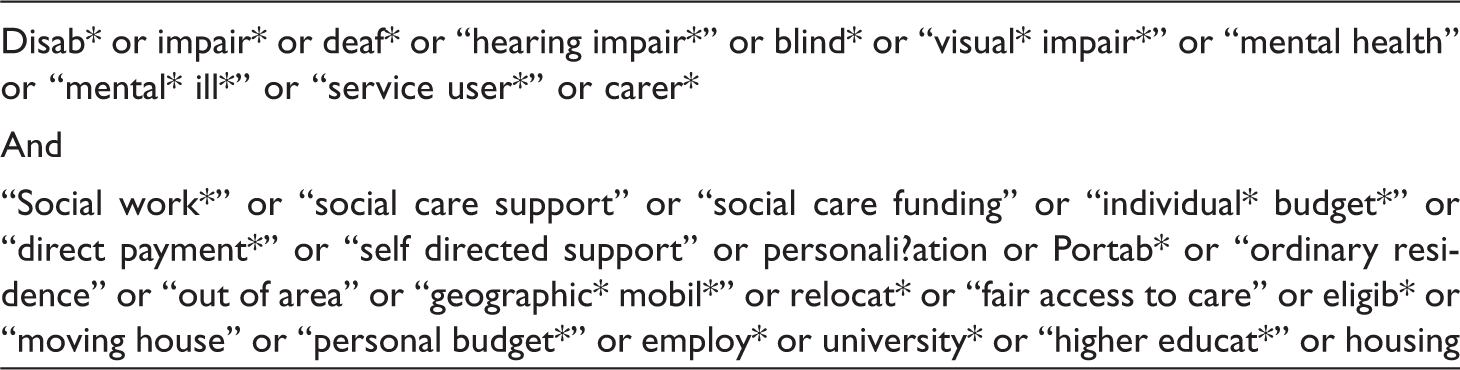
Searches were limited by year of publication, with papers published since 1995 selected for inclusion. This date reflected the passing of the Disability Discrimination Act 1995 and the Community Care (Direct Payments) Act 1996. An initial exploration indicated that the search terms relating to employment, housing and university/Higher Education generated numerous references, frequently not relevant to the research questions. These searches were limited to studies taking place within the United Kingdom (UK). This limitation was not applied to the other search terms which were anticipated to yield fewer references, as this risked missing papers of potential relevance in which the location was identified by region or local authority area. Throughout the review ‘grey literature’ was added from a range of sources, this included material published by disability groups, carers’ organisations, research groups and statutory bodies.
The searches yielded 6506 references. Duplicate references were removed. The remaining material was initially screened by title, keywords and abstracts. Material was excluded if:
It was not published in English It did not relate to or refer to social care/social work practice and experience in England (although material with a focus on practice or experience in the UK was included where relevant) It was concerned with the care and support of people under the age of 18 years The issues did not appear to relate to relocation between local authorities.
A total of 6412 references were excluded. The remaining papers (94) were read in full to identify relevant material. Grey literature identified from other sources (18) was also read in full and screened at this stage. A total of 17 studies were selected for inclusion in the review. Other papers or reports which provided additional information or detail, but which were not central to the research question, were also identified and consulted.
A final hand search of the six key journals was conducted in July 2013 to identify any recent, relevant key studies. None emerged, although papers providing further detail were identified. During the preparation of the review, further grey literature was also consulted; while no further key studies were found, some publications providing additional detail were identified.
As Manthorpe and Moriarty (2014) have commented, while literature reviews do not require ethical approvals, it is good practice for researchers to consider if the material they have retrieved raises ethical issues. We decided the review did not present any ethical concerns because none of the published material consulted included information identifying individuals that was not in the public domain.
Findings
The searches identified no study which addressed the relocation of people receiving social care support for education, employment or other purposes as its key research question. This suggests that, although the law has recently changed to improve the portability of social care support in England (see Care Act 2014), evidence for the policy change has been drawing upon other sources. The literature identified included the following:
Research which explored elements of relocation between local authorities as part of a wider study Research and commentary not directly concerned with relocation, which raised issues (e.g., the availability of housing) likely to be relevant to social care recipients moving to new areas Policy documents highlighting current policy or policy developments relevant to geographic relocation and portability.
The research identified included both peer reviewed studies where a clear methodology was presented, as well as grey literature, from a range of sources; this grey literature included some reports where little methodological detail was provided. Although there was scant information in some reports about how data was gathered and analysed, such reports helped shed light on key debates in respect of relocation and the portability of social care.
Overall therefore this is a neglected subject within research. Few studies have explored individuals’ direct experiences of relocating in the context of their receipt of social care support, even indirectly. Where studies have included information on individuals’ experiences they primarily relate to disabled students moving between local authorities. These studies do not always indicate whether the students moved during term-time only (where it would be expected that their care and support would continue to be funded by their ‘home’ local authority) or long-term, such that their place of ordinary residence changed (and funding responsibility for social care would transfer to the new authority). Despite these limitations, these studies illustrate some of the challenges facing people with social care needs who seek to relocate.
Barriers and facilitators to relocation
The scoping review identified six prominent barriers, challenges or facilitators in respect of relocation between local authorities.
Portability of social care support
Individuals who receive social care support may face challenges when they seek to ‘relocate’ their support to a new local authority, a process that has been described as ‘like having to navigate “a really tough immigration policy”’ (NUS, n.d., p. 49).
Specifically, disabled people considering moving to a new area for work or to study may experience worry, anxiety and concern about the likelihood of maintaining the same level of care and support provided by their existing local authority (NUS, n.d.; Sayce, 2011). The fear of losing support has been described as a barrier which prevents people from moving and restricts their choices and opportunities to access work and education opportunities (Arksey & Baxter, 2012; Sayce, 2011; Trailblazers, 2012). The Commission on Funding of Care and Support identified that the current system ‘leaves some people unable to relocate – and many more worrying about the impact of moving, should they do so’ (Dilnot, 2011, p. 47). Others planning to move may not anticipate the potential challenges associated with relocation (NUS, n.d.) and may be unprepared for any difficulties.
A small amount of direct evidence was located in the report of a Select Committee hearing where Parliamentarians heard from two individuals and several disability groups (Human Rights Joint Committee, 2012). These (and other) individual accounts of relocation suggest that some people may experience poor transitional arrangements, delays, the impact of variations in eligibility criteria between authorities and different assessment processes (Dilnot, 2011; Human Rights Joint Committee, 2012; NUS, n.d.). Care may be interrupted while the new local authority assesses the person’s needs (Dilnot, 2011). Agreements may be made just before the move takes place (Arksey & Baxter, 2012), which may cause anxiety and uncertainty, leave people without adequate support, or mean individuals are unable to take up employment or a university place because decisions are delayed, and support is not in place (All Party Parliamentary Group (APPG) for Young Disabled People, 2012). Some individuals have received fewer care hours following a move; accordingly they may become reliant on family and friends (NUS, n.d.) at times when changing circumstances may enhance support needs (Arksey & Baxter, 2012). Consequently, relationships with informal networks may be placed under strain (NUS, n.d.).
Although the scoping review was primarily concerned with the portability of social care, additional themes in respect of portability arose. These relate to employment funding and equipment. Those receiving Access to Work funding (national funding for working disabled people to meet travel, support or equipment costs) may need to reapply when changing jobs or moving between areas, risking delays (APPG for Young Disabled People, 2012; Howard, 2002; Sayce, 2011; Trailblazers, 2010, 2013). In addition, individuals may have to return equipment to their local authority of origin if they move (APPG for Young Disabled People, 2012); however, guidance under the Care Act 2014 indicates that, in general, local authority-provided equipment should ‘move with the person’ (Department of Health (DH), 2014, p. 361).
Variations in policy and practice between local authorities
Much of the literature relating to variations between local authorities is concerned with eligibility thresholds; however, other variations which may affect individuals who relocate were identified.
Geographic variation in eligibility for social care support and funding
Decisions about eligibility for social care support in England are underpinned by the Fair Access to Care Services (FACS) framework, introduced to ‘provide a more consistent approach to eligibility and fairer access to care across the country’ (Department of Health (DH), 2003, p. 1) through the introduction of four ‘eligibility bands’. Although a national framework, there was no expectation that different local authorities would make identical decisions about eligibility, and individual authorities may determine their local threshold for eligibility (DH, 2003).
With regard to relocation and the portability of social care, there appear to be two critical points relating to eligibility; local authority variations in eligibility thresholds, and practitioner discretion or variability.
FACS allowed local authorities to set eligibility thresholds, introducing a source of variation into decisions about eligibility for social care, contributing to the ‘postcode lottery’ (Commission for Social Care Inspection (CSCI), 2008; Henwood, 2012; Howard, 2002). Fernandez and Snell (2012) found 67% of local authorities surveyed set their eligibility threshold at ‘substantial’ and 32% at ‘moderate’. However, decisions about eligibility are also influenced by ‘rationing by discretion’ (Henwood & Hudson, 2008). Studies have explored how practitioners make decisions about eligibility (Charles & Manthorpe, 2007; Fernandez & Snell, 2012; Henwood & Hudson, 2008; Newton & Browne, 2008). These found variation in individual practitioners’ decisions about eligibility; an aspect of practice described as informed by professional judgement, interpretation, discretion, subjectivity and ‘practice wisdom’ (Cestari, Munroe, Evans, Smith, & Huxley, 2006; Charles & Manthorpe, 2007; Fernandez & Snell, 2012; Henwood & Hudson, 2008; Newton & Browne, 2008). Practitioners’ decisions are influenced both by the eligibility threshold or rationing system set by their employing authority, and their professional values and wishes to seek the best outcomes for clients. Where practitioners believe individuals are in need of services, it appears that they may try to place them in a FACS banding which ensures they will receive services, through a process described as ‘upcoding’ or ‘band racheting’ (Cestari et al., 2006; Charles & Manthorpe, 2007; Fernandez & Snell, 2012; Henwood & Hudson, 2008; Newton & Browne, 2008). Newton and Browne (2008, p. 243) thus concluded that many practitioners: Are using their professional judgement to decide that the needs are just above the threshold, wherever their authority has drawn that line!
In England the government has outlined a national eligibility criteria which sets a minimum threshold for adult social care for all local authorities (DH, 2014). This is anticipated to promote greater transparency and clarity (DH, 2014). However, this development is unlikely to remove all variations in eligibility decisions, since local authorities are empowered to ‘meet needs that are not deemed to be eligible if they chose to do so’ (DH, 2014, p. 96), and because decisions about eligibility involve, and continue to be likely to involve, interpretation and discretion, such that ‘major issues of consistency and objectivity’ are likely to remain unresolved (Henwood, 2012, p. 61).
Geographic variation in the availability of services
The availability and type of support provided vary between (and within) local authorities whatever its sources. For example, rural carers have highlighted specific difficulties in finding local services, with consequent limited choice (Yeandle & Buckner, 2007). As individuals move areas they may experience difficulties in replicating the network of services and support available in their previous authority, or alternatively may find that social care is enhanced in both quality and quantity.
Geographic variation in charging policies
Local authorities have discretion over charging for social care (Dilnot, 2011). This leads to differences in the level of charging, which services are charged for, and whether there is a maximum charge which can be applied (Henwood & Hudson, 2008; Newton & Browne, 2008). Such variations mean that individuals may experience change (upwards or downwards) if they move.
Personalised funding
In common with other countries, in England, ‘cash for care’ (Arksey & Baxter, 2012) options have been developed. These are collectively termed ‘personalised funding’ (including personal budgets, direct payments, self-directed support). Such personalised funding has implications for the support of disabled individuals in education and employment, and for those considering work or education related relocation.
Newbronner et al. (2011, p. 26) found that personalised funding ‘opened up new possibilities’ and enabled some personal budget holders to ‘access different types of services and support’. Some have used personalised funding to purchase services or equipment related to employment or education (Care Services Improvement Partnership, 2007; Coyle, 2011; Eost-Telling, 2010; Newbronner et al., 2011). It may be that if individuals use their budgets to take up education and employment opportunities, they may consider relocation to access further possibilities. However, research on personalised funding has highlighted potential difficulties for personal budget holders seeking to relocate. The process of putting personalised funding into action – which includes getting funding and support plans agreed, and finding suitable care workers – may be lengthy and individuals may experience delays (Newbronner et al., 2011). The slow and uncertain pace of this process may present difficulties for those moving to a new area to take up work or education opportunities.
Different Resource Allocation Systems (RAS; in which decisions about levels of individual budgets are made) (Commission for Social Care Inspection, 2008; Henwood, 2012; Newbronner et al., 2011) may also affect people seeking to relocate. Individuals may receive different levels of funding, reflecting the different RAS used. Newbronner et al. (2011) identified variation in whether local authorities set a maximum amount payable for personal budgets and differences in what can be paid for through such moneys. Labour market variations and different patterns of service availability may contribute to delays or difficulties in setting up support (Carers UK, 2008; Daly & Roebuck, 2008; Newbronner et al., 2011). These challenges may affect some areas particularly, for example some rural areas, although personalised funding may improve care worker recruitment, perhaps by offering better terms and conditions to local workers (National Mental Health Development Unit (NMHDU), 2010; Priestley et al., 2010).
Personalised funding enables budget holders to employ family and friends, however, budget holders who move to a new area may experience guilt about making a relative redundant should they be unable to move with them (Arksey & Baxter, 2012). A need for information for budget holders about employing family and friends and support to think about future dilemmas and possibilities has been noted (Arksey & Baxter, 2012; Newbronner et al., 2011).
Family carers’ needs in relocation
Although much literature explores the experiences of working family carers, relatively little research explores carers’ relocation for employment and education when they are themselves users of social care services. However, studies of working carers, young and young adult carers have provided some illustrations about what support is needed by carers seeking to relocate.
Research with young and young adult carers (Becker & Becker, 2008) identified specific barriers to leaving home to access work or education opportunities; consequently young people may restrict their choices to those available locally. They may be deterred from moving if family members are unwilling to accept new care arrangements, or where there are few alternative sources of care; support for the person receiving care appears to be an enabling factor in supporting young carers to relocate to study. Young people may be unaware of local services and their right to a carers’ assessment; if eligible, such assessments may act as a gateway to services which could support the young person in work or education, locally or in new areas.
We did not identify any information about the numbers of carers who seek to move to work or study. There is more emphasis on working carers leaving employment to enable them to care (King & Pickard, 2013; Manthorpe & Philips, 1998; Vickerstaff et al., 2009; Yeandle, Bennett & Barker, 2007; Yeandle & Buckner, 2007). Maintaining employment is, for some, a precarious balancing act, and maintaining existing employment may be a higher priority for many carers than seeking fresh opportunities in new areas.
Where carers, at any stage of their lives, seek to relocate they need clear information about local services; assessment processes which recognise their needs as students or employees; support which meets the needs of the person they care for, while enabling them to work or study; and carers’ support services which meet the needs of carers in work or education (Becker & Becker, 2008; Manthorpe & Philips, 1998; Vickerstaff et al., 2009; Yeandle et al., 2007; Yeandle & Buckner, 2007; Yeandle, Wigfield, Crompton, & Dennett, 2002).
Housing, accommodation and adaptations
Although this scoping review was primarily concerned with the relocation of social care support, in general disabled people may encounter barriers in securing accessible and adapted accommodation. These barriers may be faced by disabled people who relocate with social care support to a new area or in any move since, for example, there is a shortfall in wheelchair standard housing (APPG for Young Disabled People, 2012). Accessing information and advice about accessible accommodation at a distance may be hard; and information from local authorities, estate and letting agencies may contain little detail about adaptations and support which would enable disabled people to identify suitable properties (Logan, Batchvarova, & Read, 1997; Nocon & Pleace, 1998; Trailblazers, 2012). This lack of information and the perceived difficulty of finding suitable accommodation may act as a deterrent to moving (Trailblazers, 2012).
Disabled students may experience specific accommodation problems. Where students require accommodation for personal assistants there may be a lack of clarity about how such accommodation should be funded (APPG for Disabled Young People, 2012; NUS, n.d.; Trailblazers, 2013). Additionally, students may require additional space for wheelchairs and equipment, or specially adapted rooms; these may be expensive (APPG for Disabled Young People, 2012; NUS, n.d.).
Home adaptations make a significant contribution to improving accessibility and enabling people to live independently. Accessing adaptations can be a lengthy process and especially problematic in rented accommodation, as some landlords may refuse permission for such modifications to their property (Butt & Dhaliwal, 2005; Nocon & Pleace, 1998; NUS, n.d.; Trailblazers, 2012). Substantial adaptations, such as lifts, may be funded through Disabled Facility Grants (DFGs; grants which enable disabled people to adapt their homes), however those who are working or have a working partner may be ineligible for this grant (Papworth Trust, 2012; Trailblazers, 2012). Differences are also reported between local authorities in the administration of DFGs, access to and waiting times for home adaptations, and whether local authorities will ‘top up’ DFGs (Butt & Dhaliwal, 2005; Papworth Trust, 2012), underlining that access to adaptations and support with their costs may vary between authorities.
These findings indicate that disabled people and carers who seek to relocate may face difficulties finding housing which meets their needs and arranging timely adaptations, especially if people need to move quickly (Joseph, Perry, Watson, & Vickery, 2010). Such barriers to accessing appropriate housing and adaptations are significant because housing enables disabled people to live more – or less – independently, since there is a critical relationship between housing, independence and social care support (Bochel, Bochel, & Page, 1999; Butt & Dhaliwal, 2005; Esmond, Gordon, McCaskie, & Stewart, 1998; Joseph et al., 2010; Sapey, 1995). Housing which meets individuals’ needs may reduce their needs for care and support (Bochel et al., 1999; Esmond et al., 1998). These findings highlight the importance of social workers and others attending to individuals’ housing circumstances as they relocate; this includes a rapid and responsive process of reassessment to ensure that barriers to independence arising from poor or unsuitable housing are addressed.
Social workers’ knowledge and attitudes
Little evidence emerged from this review about social workers’ knowledge of and attitudes to relocation among service users. The available information comes from reports about students relocating and does not always state whether students’ ordinary residence and funding authorities change as a result of a move. Moreover, information is solely from the perspectives of those relocating; we found no evidence from practitioners or other sources about how practitioners address relocation.
The literature suggests that practitioners have little experience of supporting relocation, and little knowledge of how to meet the needs of social care recipients when taking up studies in a new authority (Arksey & Baxter, 2012; NUS, n.d.; Trailblazers, 2009, 2013). The following example illustrates a student’s perception that their situation was new and challenging for some practitioners: My local council had never sent a disabled person away to university before. They were quite insistent that I should stay and study at my local university … and do a course that I had absolutely no interest in. My decision to move away was treated with complete bewilderment; there was no understanding of how my care package would be accommodated. (Trailblazers, 2013, p. 3)
Where people who are planning to relocate perceive that practitioners lack knowledge, confidence, skills and experience of how to provide effective support this may raise anxiety about the ease of moving and whether their care needs will be met in their new area.
Limited practitioner knowledge and experience of this subject may mean that disabled individuals have to navigate the complex processes of relocation with restricted professional support. This may demand considerable energy, time and resourcefulness from people moving, their families and friends. The detrimental impact of these demands, affecting the work or education for which they may have moved, was reported by some students who: Found it was so difficult and time-consuming dealing with all the different organisations that they spent more time sorting out their personal care packages at university than they did studying or making friends. (NUS, n.d., p. 69)
This report (NUS, n.d.) observed that whilst some practitioners were described as supporting individuals’ decisions to study away from home, others were perceived to be negative.
The observation that social workers appear to have limited knowledge and experience of supporting individuals to relocate for education or employment is consistent with the conclusions of other commentators such as Sayce (2011, p. 131), who has suggested that: A huge cultural shift [is] needed for health and social care services to support aspiration and employment opportunities.
Discussion
The findings of the scoping review expose the very limited evidence base about practice and outcomes with regard to relocation for education and employment purposes, with no studies identified which have explored, as the key research question, the experiences of social care recipients and carers who have moved to new areas, or practitioner responses. However, despite this limitation, the available literature enables some initial conclusions to be drawn about the nature of such experiences, and about social work practice to facilitate relocation.
Relocation may be characterised as unusually complex and challenging. Those moving have to take into account a range of needs, and ensure that key issues are addressed. As highlighted by the review this may include:
Understanding and addressing variation between local authorities in respect of eligibility and the availability of social care services. These may impact on the levels and kinds of support accessed. Individuals who relocate may need contingency plans to ensure support will be sufficient as they move between local authorities. Setting up personalised funding in a new area, finding and employing care workers and/or services. Ensuring that support is available for unpaid family carers if required. Getting work and ensuring workplace equipment and adaptations are in place. This may include reapplying to Access to Work for funding and support. Finding suitable accommodation with necessary adaptations.
Disabled people who relocate may therefore have to liaise with several individuals, agencies, organisations and systems across the two areas, some of which may be new or unknown to them.
Our findings also indicate that relocating across local authority boundaries is a risky undertaking. Although individuals may experience positive benefits and outcomes as a result of moving, they may also experience difficulties, problems and risk of harm associated with the loss of, or a reduction in, levels of support. It appears difficult for individuals to research and identify, in advance of moving, whether they will be eligible for services in their new area, and if eligible, the amount of support they may be entitled to and the cost of support. This suggests that relocation can be understood as an uncertain process, in which those moving cannot be sure about what support they will receive in their new authority. Therefore the review findings suggest that moving to a new area, a time commonly associated with stress in the wider population (e.g., Mental Health Foundation, 2013), may be especially stressful or anxiety provoking for people who receive social care, and possibly their families and friends. The literature upon which this review is based is limited; further research is needed to identify the extent to which these experiences are more widely shared.
Disabled people, carers and others in receipt of social care support are also affected by the impact of the recent economic crisis and cuts in local government resources. Morris (2014, p. 14), in reviewing the government’s Independent Living Strategy, has suggested that opportunities for participation in family and community life are currently ‘diminishing’ for disabled people in need of care and support. The problems reported by Morris include reduced local authority spending on social care; raised eligibility thresholds; reduced levels of social care provision and support; the abolition of the Independent Living Fund; cuts in funding and threatened closures of disabled people’s organisations (Morris, 2014). Such changes may negatively impact on opportunities for disabled people to work, study and lead independent lives, and may provide challenges to social care recipients seeking to relocate, over and beyond those already reported.
In addition, the scoping review highlighted the lack of evidence in respect of social work practice and support for those moving with social care support. Further research is needed to identify good practice in supporting individuals and their families to move to new local authorities. However, the initial findings from this review identify important aspects of relocation and therefore implications for practice. These include:
The complexities associated with relocation and the need to support some individuals to navigate this complex transition, if that is required. The provision of information to those moving, and close communication between the local authorities and social workers concerned, may help address such complexities and enable smooth, well-planned transitions. The provisions of the Care Act 2014 and associated guidance (DH, 2014) recognise and highlight the importance of clear communication and close working between local authorities, and with those moving. The time required to set up new personal budgets, find and recruit personal assistants or care agencies can be lengthy. Therefore, it is important that social workers anticipate the potential for delays and develop contingency plans with those moving, to ensure that care and support can be delivered while recruitment takes place. The challenges associated with accessing appropriate housing and adaptations, and the impact of unsuitable housing on individuals’ independence and the level of social care support required. Proactive monitoring and rapid reassessment of individuals’ social care needs are required following a move to a new local authority, to ensure that their needs are met within new (and sometimes challenging) housing contexts. Additionally, the need for social workers to be aware of the processes for accessing adaptations, and to signpost to relevant agencies is indicated. The challenges for family carers who seek to relocate to work or study. Social workers need to be alert and responsive to the needs of such carers. This includes actively ensuring that carers are aware of their rights to carers’ assessments, and ensuring that support is delivered to their relative in ways which enable carers to meet their own work or education responsibilities. The review identified little information regarding practitioner attitudes towards those who seek to relocate, although there was some limited evidence suggesting practitioner caution and uncertainty. While it is important that practitioners recognise the potential challenges to relocation, it is also important that they recognise the aspirations and resourcefulness of those seeking to move, and together work to address potential barriers and challenges.
The subsequent stages of the research are anticipated to further our understanding of the specific challenges experienced by those seeking to relocate their social care support, and the support provided by social workers. This additional research may also help to illustrate how social workers and local authorities are responding more generally to contemporary challenges within adult social care. These include the need to respond to the drive within social policy to deliver personalised support, choice, control and social inclusion within a climate of reductions in public spending, austerity measures, tightening eligibility criteria, demanding workloads, changing social work roles, working patterns and assessment processes (Jacobs et al., 2013; Lymbery, 2012, 2014).
The review has highlighted a lack of data on the numbers of people with needs for social care and carers who are moving between local authorities. The evidence suggests that their numbers may be low, however nothing is known about the numbers of people who wish to relocate but who are deterred by the perceived barriers and apparent complexity associated with relocation.
Limitations of this study
The findings of this review are based on qualitative literature rather than specific data exploring the incidence and prevalence of relocation and its challenges and problems. The literature accessed had not explored relocation with social care support as a key research question, but instead obliquely as part of wider research questions or campaigning. This literature could be understood as ‘impressionistic’, rather than providing clear, comprehensive accounts of a range of different relocation experiences. Nevertheless, the review has highlighted a number of current problems which may be of interest to those investigating the impact of legislative changes and to those considering relocation on their own or others’ behalf.
Conclusion
This review found little research which directly explored the experiences of people who had relocated with social care support; social work practice which facilitates relocation; or identified numbers moving or aspiring to move. However, initial conclusions have been drawn about the context in which people move and the associated challenges, which social work practice should seek to address. These conclusions suggest a transition associated with unusual complexity, risk, uncertainty and anxiety. Subsequent stages of the research are anticipated to offer further understanding in respect of individual experience and the practice required to support relocation and facilitate the portability of social care.
Policy interest in the challenges associated with relocation and the portability of adult social care and support appears at present to be ‘ahead’ of the research and evidence. The Care Act 2014, which seeks to clarify local responsibilities as individuals move and the new national eligibility criteria are designed, inter alia, to facilitate relocation and promote greater continuity of care and support for those moving to new areas. Those researching the effects of these legislative changes should not assume that there exists substantial information about portability from which a baseline could be established to assess the impact of such change.
Footnotes
Ethics
Ethical approval for this study was given by the Social Care Research Ethics Committee (Reference number: 12/IEC08/0021).
Funding
The author(s) disclosed receipt of the following financial support for the research, authorship, and/or publication of this article: This work was supported by the National Institute for Health Research (NIHR) School for Social Care Research (Grant number: T976/T11-017/UHDM).
Acknowledgements
We thank Fiona Ware (Academic Liaison Librarian, Library and Learning Innovation, University of Hull) for valuable support, advice and guidance in developing the search strategy for the scoping review.