







Abstract
Summary
This article aims at contributing to a systematisation of comparative social work research with regard to reflection on its purpose, object, and methodology. On one hand, models and approaches from comparative welfare and education are presented and applied to comparative social work research. On the other hand, a theoretical and methodological framework model is suggested which develops comparative social work research from a life course perspective which allows to contextualise social work practice in terms of the functions and meanings it takes in different societies. This model of life course regimes is based on a series of comparative studies on young people's transitions to adulthood and the public policy and practice addressing them.
Findings
The model of life course regimes provides a framework of contextual knowledge which enables interpretation by relating comparative findings with regard to social work to the respective societal contexts. It represents a framework for clustering different constellations of social integration and normality providing social work with specific functions and meanings.
Application
The model of life course regimes may inform the sampling of comparative studies as well as guiding the process of interpretation and analysis. Apart from this it represents a source of critical reflexivity both for theory and practice.
Keywords
Introduction
The weakening of the nation state and with it of the welfare state in the wake of globalisation call for a new orientation in the social work methods discourses in Europe … What requires attention is therefore not just the differences in theory frameworks in social work but their significance within a particular political agenda. In every intervention of social work the entirety of social relationships gets negotiated and this is particularly acute in a period of considerable re-organisation in European welfare regimes. (Lorenz, 2006, pp. 159–160)
This quote from Walter Lorenz' seminal work on European perspectives in social work reflects the assumption that the history of social work is closely connected to the development of national welfare states, which, at the same time, are losing sovereignty in the process of globalisation. In recent years, social work has developed an increasing number of international platforms and discourses, for example, on managerialist and evidence-based social work (cf. Otto, Polutta, & Ziegler, 2010) or on transnationalism in social support (cf. Chambon, Schröer, & Schweppe, 2011). However, it has not yet developed a genuine international comparative research tradition. While some may argue that it is not worthwhile to start such research at this point of time in which ‘the national’ has become less relevant, this article starts from the assumption that a reflexive approach towards globalisation and transnationalism requires reconstructing the legacies of national welfare development inherent to the expressions of social work across different social contexts. One way to compensate for the lack of a tradition in comparative social work research is to consult the experiences of other areas of comparative social research and relate them to social work. While comparative welfare research contributes to contextualising the different institutional environments of social work, comparative education shares its study of interactive practices between public and private with comparative social work.
This article may be understood as such a consultation process which seeks to contribute to a systematisation of comparative analysis in social work research by developing a theoretical and methodological framework that helps to contextualise the functions and meanings social work practice takes in different societies. It centres on the concept of life course, which is understood as the socio-economic, institutional, and cultural configuration of social integration and normalisation on which social work relies.
The reflections are based on empirical research carried out in the framework of the European Group for Regional and International Social Research (EGRIS), which, since the mid-1990s, has brought together researchers from different disciplines to analyse and understand the changes in young people's transitions from youth to adulthood. While the primary objective of this framework was to identify general aspects of these change courses across different European contexts, this was not separated from analysing the different challenges young men and women are confronted with, the coping strategies they develop, and how these issues are addressed differently by support and policy measures. In some contexts, such measures are explicitly conceptualised in terms of social work while others have a less clearly articulated professional and disciplinary profile. This article is based on the following studies:
‐ The Misleading Trajectories project funded by the 4th EU Framework Programme for Research focused on the emergence of the condition of young adulthood since the 1980s with regard to increasing discrepancies between the dynamics of flexible labour markets, institutional regulations of school to work transitions, and the biographies of young men and women (EGRIS, 2001; López Blasco et al., 2003). ‐ The project Youth Policy and Participation (YOYO) funded by the 5th EU Framework Programme for Research analysed the relationship between young people's motivation to actively engage in their transitions from school to work and the scope of participation and choice they encounter in education and training or second chance measures organised in youth or social work settings (Walther, du Bois-Reymond, & Biggart, 2006). ‐ The Thematic Study concerning Policy Measures for Disadvantaged Youth funded by the European Commission's DG for Employment and Social Affairs was concerned with constellations of unemployment, early school leaving, and policies pertaining to this issue across 13 EU member states (Pohl & Walther, 2007; Walther & Pohl, 2005). ‐ The study Governance of Educational Trajectories in Europe (GOETE) funded under the 7th Framework Programme of Research analysed interactions in decision-making and supporting children and young people in transitions during school involving youth or social work as well (Parreira do Amaral, Litau, & Walther, 2013).
1
‐ Members of the EGRIS network have also contributed to the Study on the State of Youth and Youth Policy in Europe by undertaking a comparison of the education and training youth workers in 18 European countries (IARD, 2001).
Cross-cutting these studies, attempts have been made to conceptualise differences and similarities in youth transitions in a comparative model of youth transition regimes (Walther, 2006). A further step consisted of expanding the model to include the entire life course in order to provide a systematic framework for comparative social work (Walther, 2011).
It is worth noticing that this article is written from a German perspective and against the disciplinary background of Social Pedagogy, which implies a specific welfare configuration (which will be made more explicit below) and a social work approach relying on an education and learning perspective (cf. Schugurensky & Silver, 2013). The article is structured in four parts. The first section will assess the current state of comparative social work research, while the second section deals with three main gaps in comparative social work research and connects them to the state of art in comparative social and educational research, including the need to reflect on the purpose and the objects of comparative social work research as well as comparative methodology. A model of life course regimes that seeks to close some of these gaps is described in the third section. This model has been developed on the basis of comparative empirical research on young people's transitions into adulthood and the different ways and normalities that are associated with constructing and addressing their support needs. The final section depicts this model's contribution to social work theory and practice.
Comparative and international dimensions of social work research
The observation that social work is still in the early stages of comparative research applies not only to the limited number of comparative studies in existence but also to the fact that the few studies that have been published are largely descriptive and do not explain similarities and differences or connect their arguments to theoretical discourses in social work.
There are at least three reasons for the limited relevance of comparison in social work theory. First, there is a general time lag in the development of empirical social work research in many countries (Meeuwisse & Swärd, 2007). Second, the welfare state and its associated social services and social work were developed in the early 20th century as one key element of building the nation state (cf. Lorenz, 2006). Finally, there are few cross-national theory discourses in social work. Even Payne's (2005) ‘Modern Social Work Theory’, which is probably the most widely distributed overview of social work theories, focuses on Anglo-American debates. Consequently, the lack of comparative research in social work has only become visible with the decline of the national welfare state's sovereignty, whereby discourses on globalisation and transnationalism suggest that the ‘national’ is outdated. Despite this, comparative research has remained relatively limited in social work. Accordingly, this article seeks to illustrate that in a globalised world, social work is still nationally structured, a fact that calls for consideration by a discipline that claims critical reflexivity to be one if its central principles (cf. Lorenz, 2006, p. 39).
It is of course not true that no comparative social work research exists. Meeuwisse and Swärd (2007) distinguish between studies based on social policy models, profession-oriented, and practice-oriented comparative studies while other authors have made methodical and methodological proposals (e.g. Homfeldt & Walser, 2004; Lorenz, 2006; Schnurr, 2005; Soydan, 1996; Treptow, 2010). Still, some key questions have not been adequately addressed:
Why should we compare? What is the added value of comparison, including its relationship to the current developments of globalisation and transnationalism? What do we compare? How do we overcome the fact that differing institutional, professional, and disciplinary boundaries of social work are considered to limit the comparability of objects in social work research (cf. Meeuwisse & Swärd, 2007)? How do we compare? What does comparison mean methodologically and how is it – especially if the aim is to explain differences beyond description – done?
Why, what, and how? Key dimensions of comparative social work research
Why should we compare?
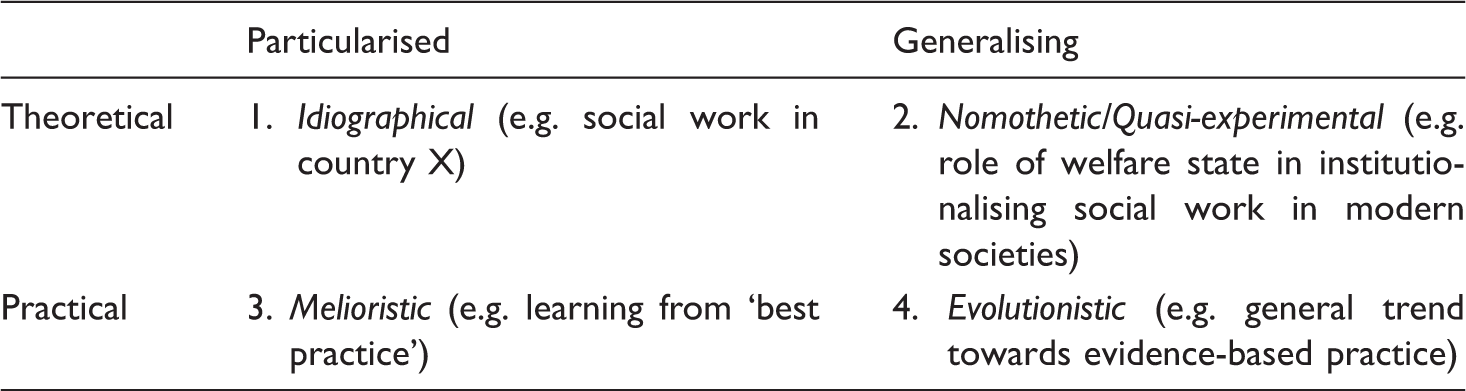
The question about the purpose of comparative research is probably the least considered question in social work. In particular, reference to globalisation is taken as a self-evident reason for any kind of internationalisation whereby research interests are either not made explicit or remain ambiguous even for the researchers. Nevertheless, functions and purposes of comparative research are necessarily connected to general epistemological interests. For the area of comparative educational research, Hörner (1999) discerns four ideal types of epistemological interests between particular and generalising, theoretical, and practical resulting in different research designs (see Table 1).
Idiography refers to descriptions of the ‘other’ and ‘unknown’ in its particularity in order to understand and to ‘enlarge the universe of human discourse’ (Geertz, 1973, p. 30) such as describing constellations of social work practice in one specific context. Nomothetic or quasi-experimental comparison relates to Durkheim's (1966) statement that comparison is the method in empirical social research that comes closest to the model of scientific experiment. Analysing phenomena across different societies is seen as the only possibility for controlling independent variables. Here, the purpose of comparison is qualifying generalising statements such as ‘social work is … ’, ‘social work has to … ’ or ‘social work can …’ by contextualised testing and differentiation between general structures and context-specific expression. Melioristic comparison is interested in learning from other practices – believed to be more successful – in terms of borrowing, transfer, or reference in political debate (cf. Zymek, 1975). However, comparatists in public policy warn against high expectations (cf. Dolowith & Marsh, 2000; Crouch, 2001) and limit possibilities of transfer and exchange to minor policy details between similar systems (Schmid, 2002). Finally, evolutionistic comparison aims to analyse trends of convergence versus divergence in the course of modernisation. This purpose may be considered a sub-category of nomothetic comparison focusing on trends in policy and practice, e.g. the question whether there is a universal, global trend towards managerialism and evidence-based practice in social work, which leads to diminishing cross-national difference. Comparative educational research purposes (Hörner, 1999; own examples).
Of course, these are ideal types. In most comparative studies, more than one underlying research interest can be found; yet, these are often implicit and draw on a general feeling that comparative analysis is interesting and worth doing. Obviously, most cases of comparison in social work – due to its applied nature – imply melioristic interest. In educational research, the OECD's PISA studies do not only compare the outcomes of different education systems but – by doing so – have also introduced (or imposed) a new concept and benchmark for education in terms of reading literacy. In turn, this has reinforced a general educational discourse and educational policy that centres on competence and human capital and thereby can be ascribed also an evolutionistic approach (OECD, 2001; cf. Rychen & Salganik, 2003).
In a cross-cutting perspective, these different functions and designs of comparative research share a common denominator in the form of the potential deconstruction of assumptions about normality that are deeply interwoven with the nation-state's institutions, its interrelation with culture and language, and its expressions in practice and research, especially for social work which has and will always be associated with forms of deviation from and the reproduction of normality. Geertz (1973) explains the value of ethnographic research in foreign contexts after a ‘thick description’ of a conflict related to a sheep raid between a salesman, a gang of bandits, and the French troops in the Berberian mountains in Morocco in the first half of the 20th century: Looking at the ordinary in places where it takes unaccustomed forms brings out (…) the degree to which its meaning varies according to the pattern of life by which it is informed. Understanding a people's culture exposes their normalness without reproducing their particularity … The reason that protracted descriptions of distant sheep raids (and a really good ethnographer would have gone into what kind of sheep they were) have general relevance is that they present the sociological mind with bodied stuff to feed. The important thing about the anthropologist's findings is their complex specificness, their circumstantiality … The essential vocation of interpretive anthropology is not to answer our deepest questions, but to make available to us answers that others, guarding other sheep in other valleys, have given, and thus to include them in the consultable record of what man has said. (Geertz, 1973, pp. 14–30)
What do we compare?
The second desideratum of comparative social work research is defining the approach's research object in the sense of an overarching research question, the so-called tertium comparationismus, which requires a common reference to which at least two different entities are being related. Schriewer (2000) characterises comparison in the social sciences as ‘relating relationships’ such as functions, meanings, and practices – in contrast to relating objects in natural science. In social work, this is ambiguous because different institutional, professional, and disciplinary profiles raise questions regarding the comparability of what is being referred to as ‘social work’ in different contexts (considering for example the difficulties in relating German Social Pedagogy to other constellations of Social Work, cf. Kornbeck & Rosendahl, 2009; Lorenz, 2006; Meeuwisse & Swärd, 2007).
In order to overcome these problems, Schefold (1996) argues that comparative social work research requires a functional equivalent on a meta level and suggests that this may be ‘support in coping with the life course’ (p. 98). The concept, life course, refers to the institutionalisation of life ages in modern societies as a reaction to the individualisation of social integration (cf. Elder, 1985; Heinz, 2009; Kohli, 1985). The life course is an institution that standardises individual lives around work and family. Thus, individual development is related to the societal division of work according to age, gender, class, education, and ethnicity (cf. Durkheim, 1969), whereby the life course is also a mechanism for reproducing social inequality.
While the life course needs to be seen as a meta-institution, it is founded on concrete institutional bodies, or life course politics (Leisering & Leibfried, 1999). These include the education system, which prepares individuals for productive and reproductive adult roles, the welfare state, which rewards work-based life plans as a normal and good life, social security, which connects regular employment with access to pensions in later life, and social services as a wider term for social work, which provides support for coping with the demands of the life course. Thus, as one of the elements of the life course, social work involves a ‘hidden curriculum’ towards leading a ‘normal’ life. Accordingly, Kohli (1985) has introduced the notion of life course regime. Here, ‘regime’ refers to the fact that the life course transcends regulation through state institutions while the interplay of socio-economic, institutional, and cultural factors gives way to discourses of the ‘typical’ and ‘normal’ ways of moving through life phases and the transitions that exist between them. These normalities are reproduced through the biographical life plans and everyday practice of individuals (cf. Foucault, 1980).
Inasmuch as welfare and education have been the pillars of the nation state, life course normalities have developed in tandem with national culture. They are contingent but deeply interwoven with a nation's political, social, and cultural history (cf. Lessenich, 1995). However, the social modernisation and individualisation involved in the institutionalisation of the life course have been continually evolving. Western societies, at least, have been witnessing a process of ‘de-standardisation’ of the life course for some decades now: life phases have become fragmented and transitions gained importance in terms of extension, uncertainty and risk (cf. Beck, 1992; Heinz, 2009; Mayer, 2005). The de-standardisation of the life course not only undermines the self-evidence of the ‘normal’ life course, the increasing discrepancies between expected and experienced lives have also drawn attention to the subjective biographies of individuals: their subjective appropriation of the life course and their active construction of a subjective life story (cf. Alheit & Dausien, 2000). Biography might also be considered identity over time in terms of assessing personal past and imagining personal future while the past and future are articulated in terms of coping with the present life situation (cf. Walther, Pohl, & Stauber, 2009). The heuristic potential of the relationship between life course and biography also lies in its relationship to the micro, the meso, and the macro levels (cf. Treptow, 2010), and its coincidence with the dialectics or the ‘space between structure and agency’ (Settersten & Gannon, 2005). From a life course perspective, the heuristic potential of social work comparison can be specified as follows:
First, it enables consideration of both the function of standardisation and control in social work and its potential in empowering individuals as a result of being situated between life course and biography; Second, it involves a time perspective that spans the past, present, and future, which is reflected by the continuum between preventative and compensatory intervention; Third, the life course refers to the wider context of social production of ‘normality’ which is a ‘latent operative dimension’ of social work (Böhnisch, 1984, p. 108).
To the extent that the life course regime is produced and reproduced by the interplay between structure and agency, social work, as support for individuals in coping with the life course, implies a double mandate: on one hand, it supports and empowers individuals in constructing their biographies by opening access to resources and opportunities or by providing counselling that acts as time and space for biographical reflexivity, while on the other hand, social work acts as a ‘gate-keeper’ (cf. Heinz, 1992) to the degree that social services contribute to directing individuals to specific trajectories in the segmented ‘normal’ life course regime, which reflect dominant patterns of social integration: People become clients of bureaucrats, social professionals, and experts such as doctors, psychologists, lawyers, and sociologists. Experts do not only provide services but redefine the identities and knowledge categories by which people perceive themselves and their situation. (Leisering, 2003, p. 214) The biographical order of social work (developed from Hamburger, 2003, p. 156).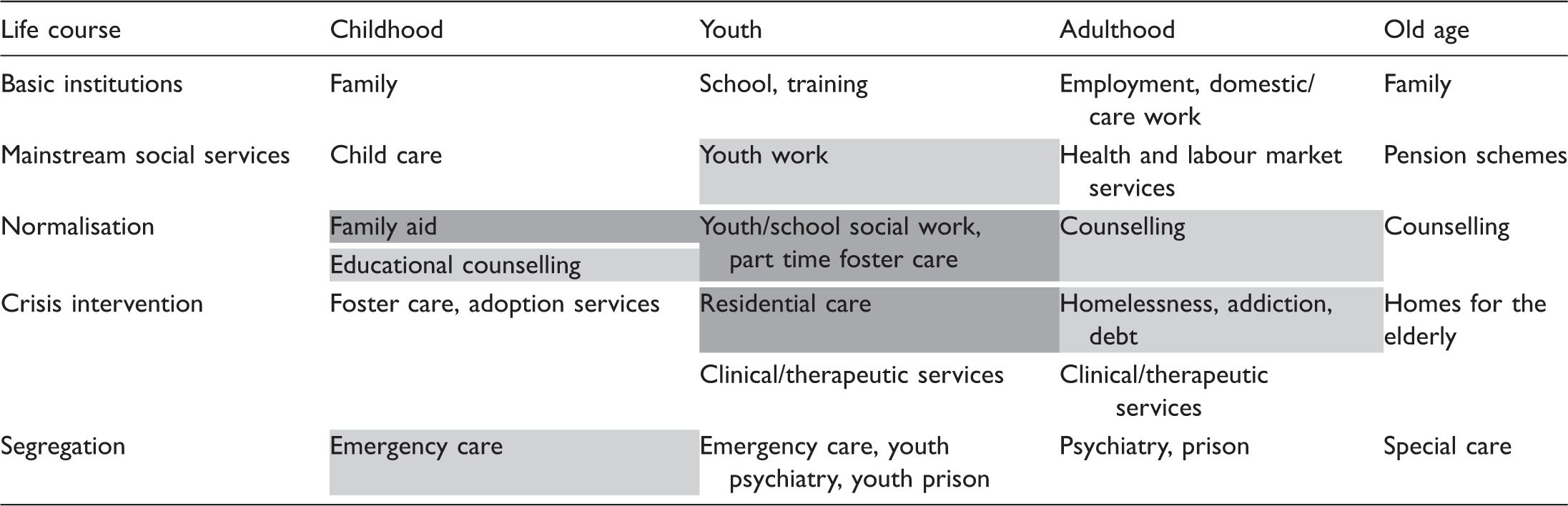
This biographical order is obviously based on assumptions associated with standard life course trajectories that have ideal type deviations or problems. However, with the de-standardisation of the life course, this order appears increasingly dysfunctional. New areas of intervention emerge, focussing on specific transitions. In Germany, especially within the field of ‘youth social work’, a growing number of services have been developed to address transitions into or within education settings or into and out of residential care (Walther, 2012; cf. Coussée, 2010). While a biographical order of areas of social work intervention is likely to look different in other countries, it is suggested that life ages and assumptions of a ‘normal’ life course are general criteria for the differentiation of areas of intervention.
How can we compare?
The third desideratum of comparative social work research refers to the methodological reflection underlying comparative research and, consequently, the requirements of research methods that meet the demands of ‘relating relationships’ (Schriewer, 2000). In fact, depending on purpose and interest, comparative research may rely on the same research methods as local or national research but data need to be prepared in terms of comparability. Bereday (1964) distinguishes four steps of comparison:
Description refers to the process of data collection according to joint instruments. Here, a key issue is the challenge of assuring that units of analysis are functionally equivalent. One way to overcome this is to use ‘vignettes’, i.e. constructed cases as stimulus for oral or written inquiries (cf. Soydan, 1996). In a second step, context-immanent interpretation prepares data for comparative analysis in terms of translation, coding, or even first steps of analysis along joint dimensions. This step implies aggregation to avoid getting lost in an unmanageable amount of data from two or more different contexts. Comparison starts with the third step: juxtaposition means sorting findings in a synoptic overview following the dimensions of interpretation whereby similarities and differences become visible. The fourth step comprises comparative analysis in a stricter sense of explaining differences and similarities as well as different outcomes – policies or practices – by relating them to contextual factors. This means that contextualisation is essential for comparative analysis. The results of this step are often depicted in country typologies. Based on experience, it seems worth including a fifth step at the very beginning: organisation and design, not only in terms of defining the research question and clarifying the epistemological interest, but, in a time of increasing international collaborative research, also in terms of decisions on language and partnership. Thereby comparative research needs to be understood as an intercultural practice itself (cf. Kuhn & Remøe, 2005; Walther, 2011).
One means of contextualisation – which is of course not an exclusive property of comparative analysis – is the model of qualitative multi-level analysis. This approach has been developed by Helsper, Hummrich, and Kramer (2010) for the analysis of the interrelationship between structure and agency in individual learning biographies (Figure 1). A key principle of multi-level analysis is starting from conceptualising the research object in its complexity in order to ‘decipher the complex specificness of normality’ (Geertz, 1973, p. 30). The model distinguishes different levels of meaning and the different forms of relationship between them:
the individual level of a person's experiences, orientations, and choices as reconstructed from subjective narratives; the level of interactive practice between individuals in informal settings or between individuals and professionals in the context of formal organisations; the institutional level of such organisations and how they process individual lives by translating specific conditions and practices into deficits, problems, or needs; the local or regional level at which educational or social services are implemented by specific actors and embedded in concrete socio-spatial conditions; the national (and global) level of labour market and general structures of social reproduction as well as the overall organisation of welfare state and education system. The concept of qualitative multi-level analysis (Helsper et al., 2010).
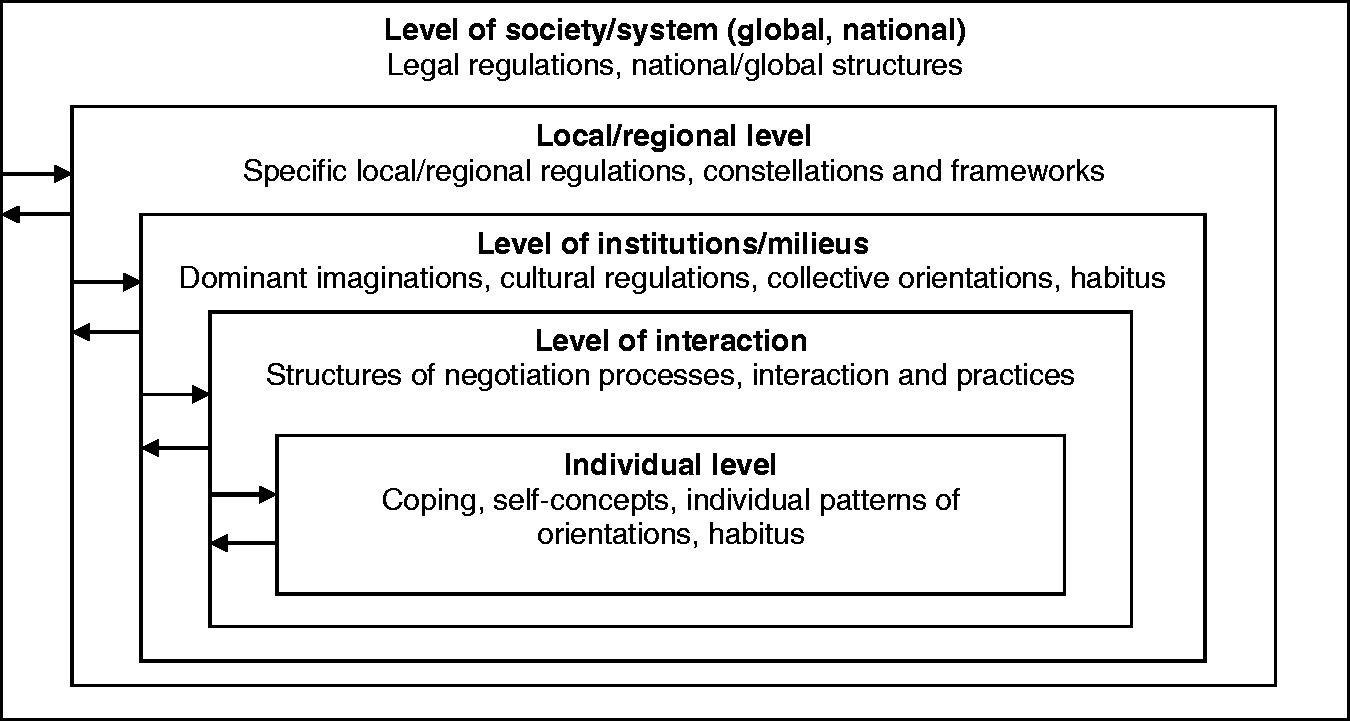
Clearly, there is some analogy and interrelation between these levels of meaning and the distinction of macro, meso, and micro levels of social reproduction throughout the life course; while the latter focus on degrees of aggregation, the former refer to mechanisms of meaning making. Both, in turn, are cross-cutting ‘the space between’ life course and biography in which social work is operating.
Applying this model to comparative research may imply extending it beyond qualitative methods to include different methods and data, all the while remaining within an overall qualitative logic. Experience has shown that comparative research – both qualitative and indicator-based – risks failing its object if it does not rely on a solid hermeneutic understanding of the meaning of the indicators in the different contexts. Such a meaning of qualitative analysis corresponds to the ‘qualitative comparative method’ introduced to overcome the decontextualisation of indicator-based comparative research (cf. Ragin, 1987, 1998).
Depending on the specific research question, social work research involves either all these levels or only some. In international comparative research, it seems plausible that at least the institutional and the national levels are relevant while also being rather easy to operationalise. This is much less the case with regard to the individual or the interactive levels. However, most biographical narratives contain individuals' references to particular institutions and interpretations, which reflect country-specific contexts.
Life course regimes as configurations of normality
Although a multi-level analysis model facilitates the analysis of complex relationships, its disadvantage lies in its requirement of a huge amount of analytical operations, particularly when it comes to comparison between two or more contexts. Comparative studies, therefore, need to build on existing contextual knowledge. The following section introduces the model of life course regimes and recommends it as a framework for contextual knowledge in the comparative social work research context, at least in terms of a European perspective. The model emerged from research concerned with the analysis of the factors and consequences of a de-standardisation, individualisation, and diversification of transitions from school to work as well as with policies and institutions aimed at supporting young people in coping with these transitions (cf. du Bois-Reymond & Chisholm, 2006; López Blasco et al., 2003; Walther et al., 2006; Walther & Pohl, 2005). The more factors and countries involved in this analysis, the more urgent the need for a systematic overview and general dimensions, according to which data could be aggregated and related, became (cf. Bynner & Chisholm, 1998).
Welfare regimes
In this regard, Esping-Anderson's (1990) model of ‘welfare regimes’ served as an initial point of reference for several reasons: first, as youth transitions are one of the crucial links between individual lives and the social division of labour, the function of the welfare state is to act as the regulator of these transitions; and second, the model combines a statistical and a historical approach within a comprehensive theoretical model. The interdependency between socio-economic structures, public institutions as well as cultural factors is reflected in the model not only through different interpretations of social rights, construction of needs, and access to services but also through the depiction of individuals' life course trajectories and life plans, the risks of exclusion and poverty they are confronted with, and how they make use of services (cf. Lessenich, 1995; Mayer, 1997; van Oorschoot, 2007). Thus, welfare states stand for different configurations of ‘normality’, which are powerful as well as relatively path dependent on social change due to the interdependency between different actors and factors. Therefore, comparison in welfare – as well as in social work – cannot be limited to comparison between social systems; it requires intercultural comparison and comparison of different historical developments (cf. Pfau-Effinger, 2005; see also Figure 2).
Dimensions of welfare regimes (own elaboration).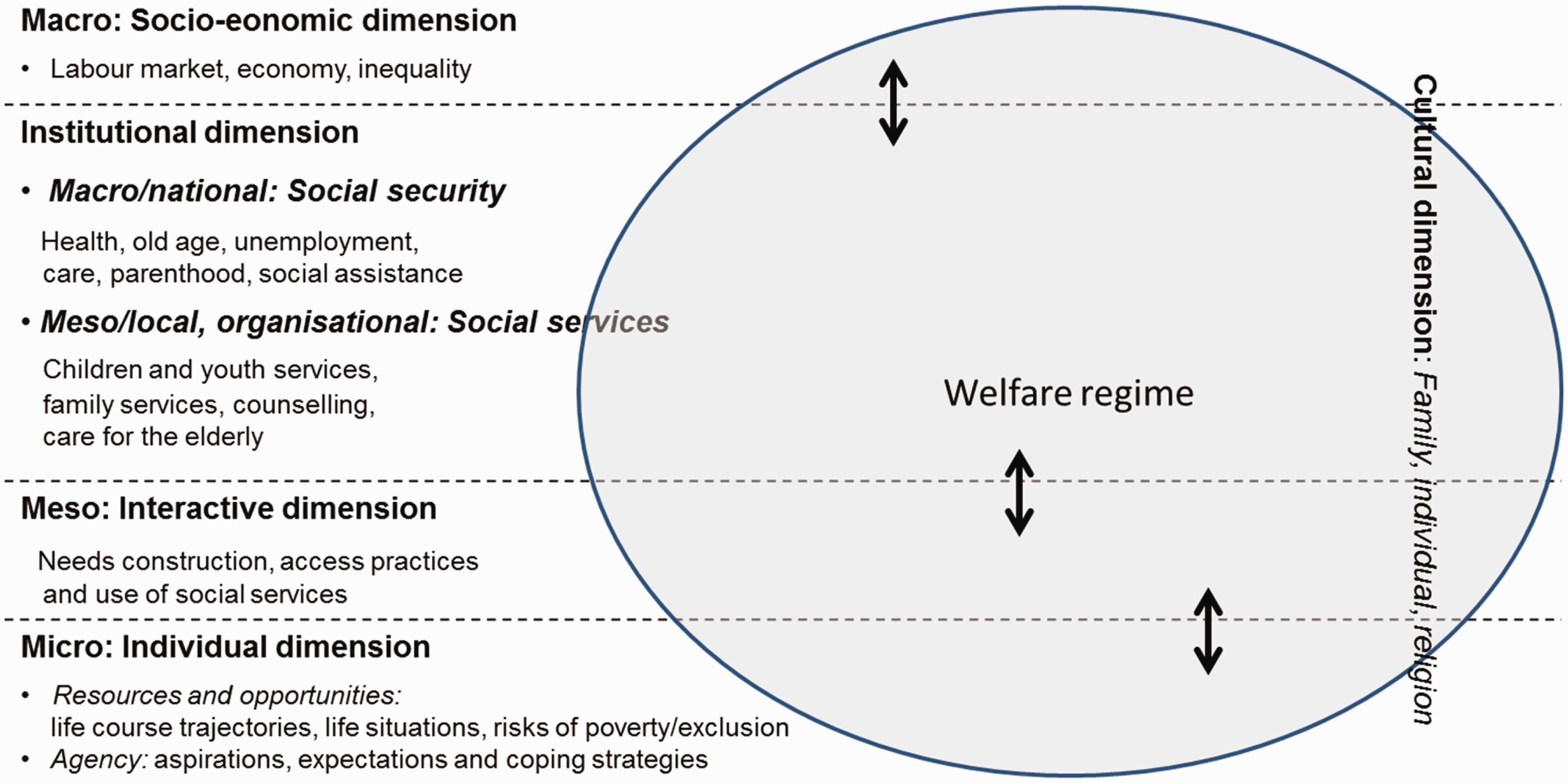
Access to and levels of social security in different welfare regimes (own elaboration based on Esping‐Anderson, 1990; Gallie & Paugam, 2000; Lorenz, 2006; cf. Walther, 2011).
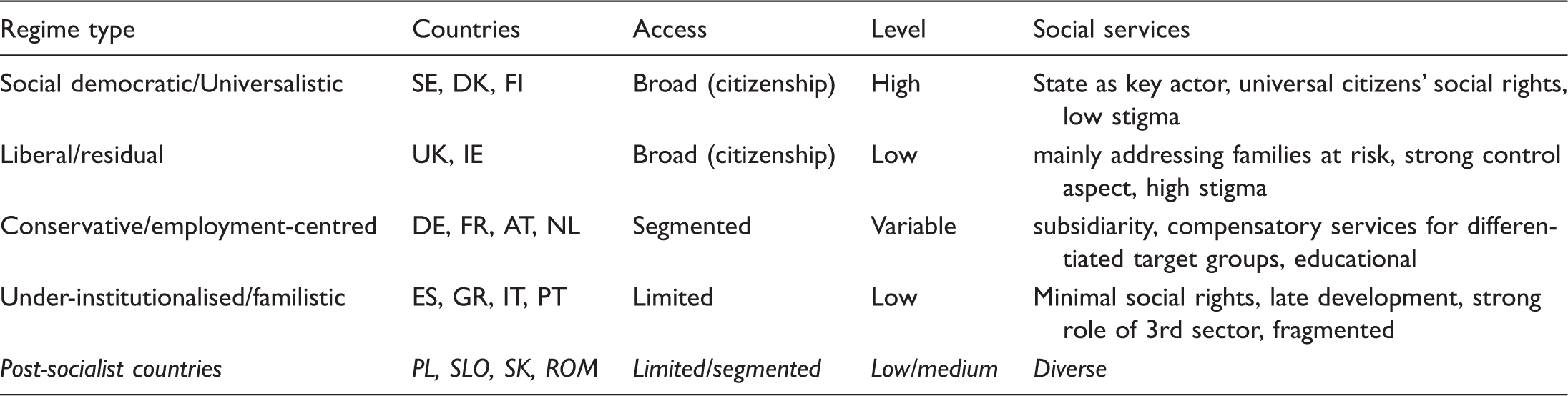
In his reconstruction of the development of social work in Europe, Lorenz (2006) identifies a significant analogy between this model and different constellations of social services (see also Table 3):
‐ a model based on universal citizens' social rights including social services and their low stigma in Nordic countries; ‐ a model concentrating on at-risk families and the high-level of both control and stigma attached to it in Anglo-Saxon countries; ‐ a mainly compensatory model in the subsidiary and segmented framework of the Western continental countries with a considerable differentiation among target groups; ‐ a model resulting from the late development of public social services, often in the third sector due to minimal social rights in Mediterranean countries.
Again, the situation in transformation societies is a complex mixture of ex-Socialist structures and orientation towards Western models with a universalistic constellation for example in Slovenia, orientations towards conservative or liberal levels like in Poland or Hungary, and sub-protective realities such as in Bulgaria and Romania (cf. Kobolt, 2004; Koldinská & Tomes, 2004).
Transition regimes
While welfare regimes may be partly depicted by constellations of social services, this is not self-evident with regard to the life course in general or youth transitions in particular. Comparative transition research carried out in the EGRIS network, therefore, specified and extended the dimensions of comparison (see Figure 2) with regard to youth transitions (see Table 4). Apart from a differentiated view on social security regarding access to and services for young people, one of the most important dimensions concerned structures of education and training in terms of differentiation and standardisation (cf. Allmendinger, 1989). Other dimensions were organisational versus occupational structures of labour market entry (cf. Müller & Gangl, 2003), youth policies addressing young people as a problem or as a resource (IARD, 2001), or the central orientations of measures aimed at the integration of disadvantaged and/or unemployed youth (Pohl & Walther, 2007; Walther et al., 2006; Walther & Pohl, 2005). Through the analysis of institutional dimensions, different cultural patterns emerged as well, such as different meanings of disadvantage as well as dominant concepts of youth (cf. Walther, 2006, 2011). Relevant information was obtained from literature reviews, analysis of legal regulations, and policy programmes, expert interviews, and in-depth interviews with young people. It revealed that comparability was best achieved by posing apparently simple questions that underscore things considered self-evident: ‘What are you doing to support young people? Why are you doing it this way, what could other alternatives be? What is the main difference between policies for young people and policies for adults?’ In terms of juxtaposition, a rather complex matrix or synopsis was developed from which a typology of transition regimes emerged. The different meanings of disadvantage and their interdependency on other institutional and cultural factors are crucial examples of the need to compare support measures for young people in transition, as ‘disadvantage’ can be either ascribed to individual deficits or to structural deficits (see also Table 4):
‐ In the universalistic regime, the dominant concept of disadvantage balances structural and individual aspects: even if young people are classified as needing additional support, the latter is provided in regular school or training on the basis of individual social rights and does not exclude individual choice. ‐ In the liberal regime type governed by the ideal of economic independence, disadvantage primarily refers to the work ethic and employability of individuals, their willingness to take responsibility for their own lives. Support measures imply pressure and control to make sure that young people accept precarious outcomes as well. ‐ The conservative or employment-centred regime type is characterised by a selective and standardised order of occupational and social positions. Disadvantage means that young people lack education. Compensatory pre-vocational schemes aim to make them ‘trainable’ with a limited range of choice. ‐ In the under-institutionalised regime, the structural deficit of social services and the long dependency on the family implies that all youth are considered disadvantaged for a long time. Policies, therefore, search to provide them some status either – either in work (even if precarious) or in any kind of education. Transition regimes in Europe – selected dimensions (own elaboration).
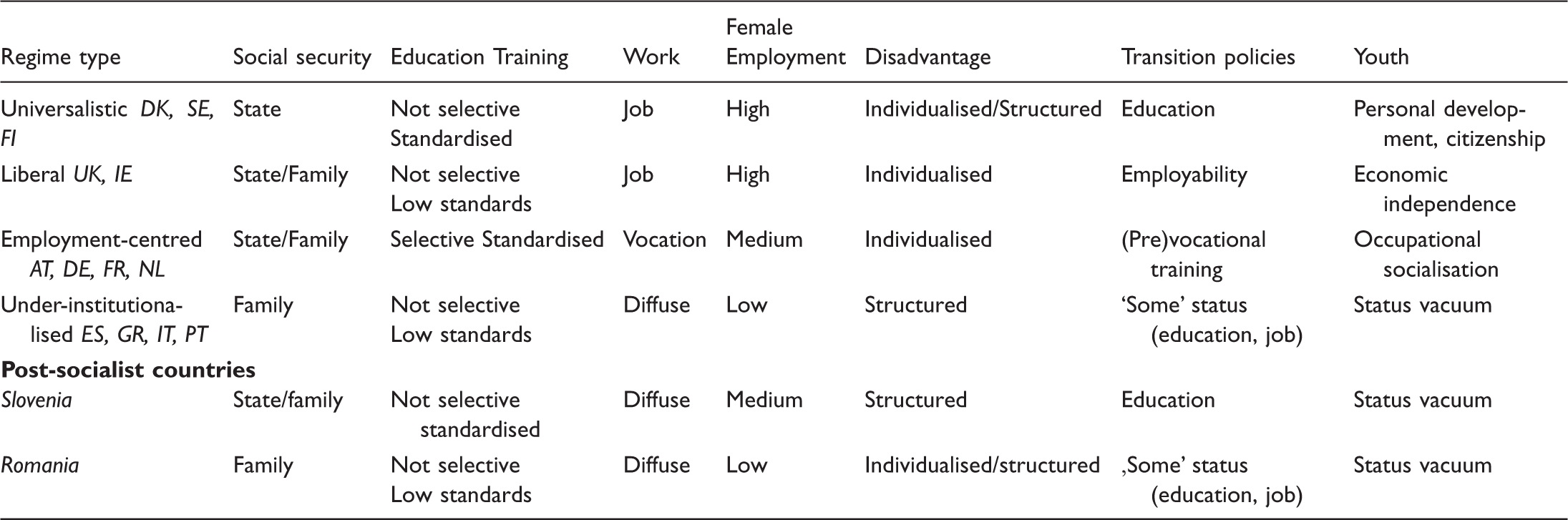
The problem with typologies is that they are limited and static by necessity. With regard to Central and Eastern European countries, the dimensions of the model have been used for the analysis, while subsuming resulting configurations to existing regime types or creating one post-socialist regime type proved impossible because it would lead to neglecting both the dynamics of transformation and the increasing differences between these countries. However, apart from limiting the explanatory potential of comparative typologies, social change can also be seen as an opportunity to improve them. For example, in analysing the impact of the apparently global trend and discourse of activation on transition policies, variations in interpretation and implementation have been found. This means that convergence and path dependency are not necessarily contradictory (Pohl & Walther, 2007; cf. Harsløf, 2005; van Berkel & Hornemann Møller, 2002).
Similar to the theoretical concept of the life course, the analysis of transitions also remains incomplete if it does not include the biographical perspective of young people in accounts; it is only through their perceptions that use and interpretation of available pathways (and support) are actualised (cf. Henderson, Holland, McGrellis, Sharpe, & Thomson, 2006). While an international comparison of subjective biographies seems difficult if not impossible as it implies re-institutionalising personal life stories, qualitative transition research provides rich evidence of how national institutions and normalities are reflected – directly or indirectly, positively or negatively – in young people's narratives on their transition experiences (all quotes from Walther, 2009):
‐ Not surprisingly, in an under-institutionalised regime (like Italy) and some post-socialist countries (like Bulgaria), young people did not have had any experience of support or even found the question quite strange: ‘We are alone. If you have friends, ok, but otherwise …’; ‘What support, what state?’ ‐ In liberal (like the UK) and the employment-centred regimes (like Germany), most young people stated that they had received support but valued these experiences as ambivalent: not sufficient, not effective, and/or connected to stigmatising experiences. Actually, responses were often quite aggressive: ‘Yes but …’; ‘You are treated like a slave’; ‘Just looking in your file, treating you like a cow.’ ‐ Finally, in the universalistic regime (in this case Denmark), young people at first glance provided responses that were rather similar to Italian or Bulgarian young people, such as ‘no, not really …’, despite the fact that they had received a generous educational allowance and benefited from low-threshold, non-stigmatising counselling at all levels of transition. They simply saw this as a right and making use of it as ‘normal’.
Life course regimes
The model of transition regimes has proved helpful for the comparative analysis of policies and practice for the transition of disadvantaged youth into employment as well as activities that are explicitly referred to as social work in some countries but represent functional equivalents in terms of ‘support in coping with the life course’ in others. Certainly, comparative social work research needs to cover more than interventions with regard to youth transitions. As a more general framework of reference covering different life ages as well as different areas of social work intervention, a model of life course regimes is suggested.
In comparative life course research, the concept ‘life course regimes’ has already been developed and applied, yet it has been limited to a macro level relating life course trajectories to national education and welfare systems (cf. Mayer, 1997). For the purpose of comparative social work research, life course regimes mean configurations of socio-economic, institutional, and cultural factors that structure individual life courses including the subjective dimension of individual coping with everyday life. Life course regimes outline the boundaries of normalities (or discourse arenas) shaping the relationship between rights and responsibilities and legitimate and illegitimate aspirations in which social work interventions emerge and operate, are accepted or rejected, used or subverted by their clients. They reflect what is considered necessary for a ‘normal’ life by re-defining deviant or risky life styles in terms of needs of support. These normalities define who has access to what kind of support under what conditions in a given social context. Figure 3 outlines a model of life course regimes as a modification and extension of welfare regimes, similar to – albeit more comprehensive – the model of transition regimes.
Dimensions of life course regimes (own elaboration).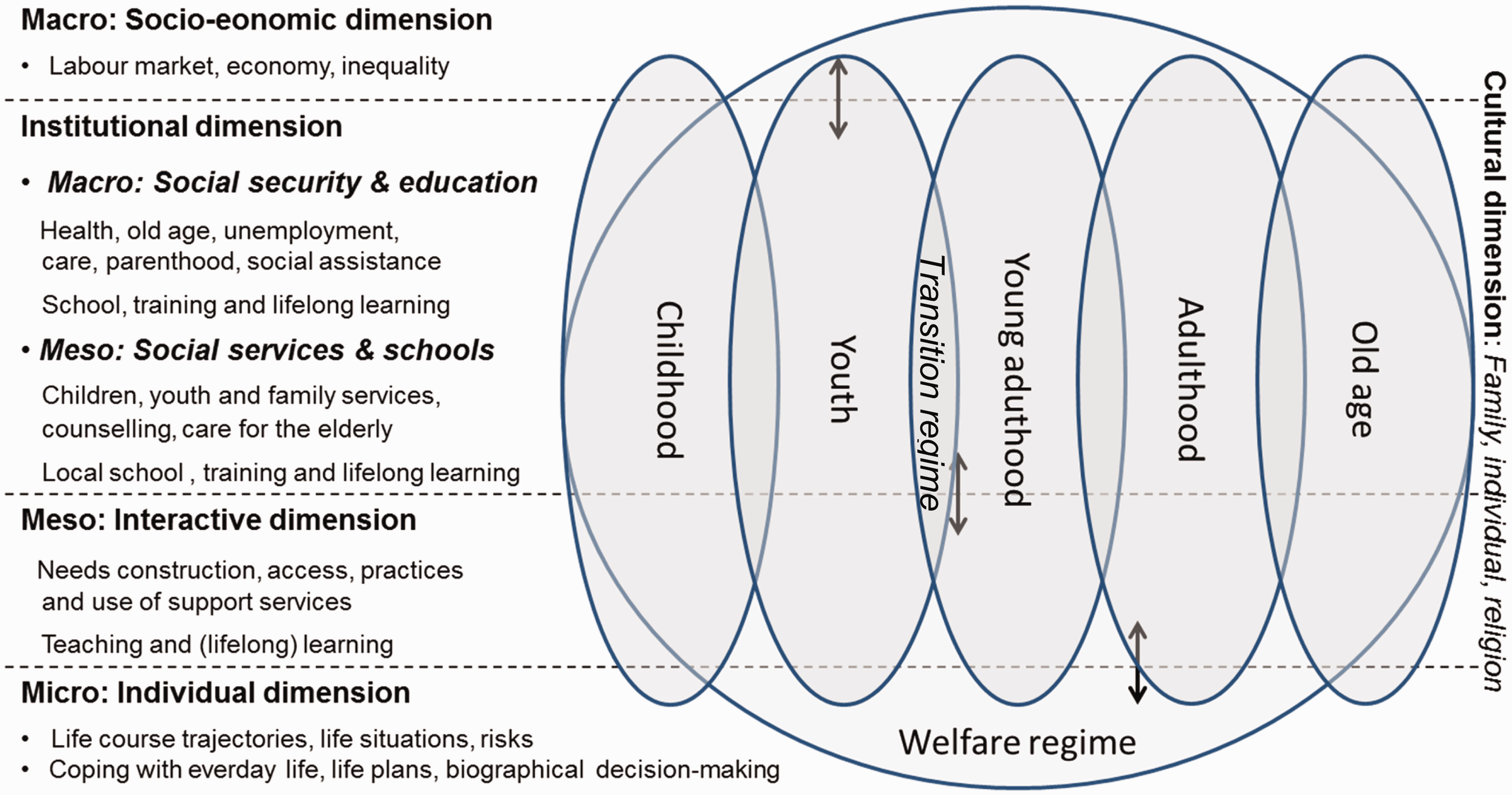
The ‘complex specificness and circumstantiality’ (Geertz, 1973, p. 30) of comparative social work research becomes obvious if one imagines integrating the ‘biographical order’ of areas of social work intervention (see Table 2) into the institutional meso level of this model. On one hand, this exercise reveals the institutional interdependencies and the modest proportionality of social services in this framework, while on the other, it shows that comparative research requires flexible minds that are able to constantly pendulate between the particular, the micro, the individual, or the local, and the general, the macro, the institutional, the national, or the global.
Conclusions
In order to be applied to comparative social work research, the model of life course regimes clearly requires differentiation and further refining. First, although the model accounts for knowledge about the implications and changes of life ages and the transitions between and within them, not all phases and transitions of the life course are institutionalised and standardised nationally to the same extent (cf. Mayer, 1997, 2005). Second, further understanding requires taking varying relationships between national frameworks and local implementation and the delivery of social services into account (cf. Le Galès, 1998; Loncle, 2010). Finally, it is important to note that typologies must not be reified as pictures of social reality but used as heuristic constructions.
So then, what gains, contributions, limitations, and losses are associated with a life course regime model as a framework for comparative social work research? The model of life course regimes may be used during the early stages of future comparative studies to guide country sampling as it distinguishes different and similar contexts of social integration and life course normality. It may also serve as the final step of a comparative analysis by providing a framework of contextualised interpretation inasmuch as it contains contextual knowledge to which findings might be related and by which they might be interpreted. It provides keys to operationalise dimensions of comparison as it helps to identify bridges and points of connection between different levels of meaning, such as between general structures of labour markets, dominant assumptions of normality, constructions of needs, regulations of access to social support, and individuals' everyday life practices. Yet, this contextual knowledge is limited to specific contexts and is static as it stems from previous research. This means that the model does not and cannot replace comparative research in the form of simply replicating the model. In contrast, its staticness and limitation requires constant modification, updating, extension, or limitation. It is not only a middle range theoretical model, it is also and will always be provisional; it tends to neglect differentiation with regard to individual perspectives as well as the local level which cannot be linearly deduced from national structures (cf. Walther, 2011).
Finally, what is the contribution of life course-related comparison to social work theory and practice? It allows scholars to qualify generalising statements by providing a functional equivalent to contingent forms of social work practice as expressions of different configurations of normality of support in coping with the life course, particularly the relationship between social work and the welfare state and its position in the space between structure and agency. The fact that such configurations are deeply interwoven with national histories is even more important under late-modern conditions. Globalisation and transnationalism do not replace but evolve in a dialectic relationship with the ‘national’ (cf. Chambon et al., 2011). Beyond the ambiguities of social change from national welfare states towards a supposedly global and universal activation regime, comparative analysis from a life course perspective allows the deconstruction of normality by questioning the contingency and limitation of one's own normative perspectives and contributing to an increase in critical reflexivity (cf. Kessl, 2009). While departing from particular normative standpoints towards autonomy, social justice, and emancipation, critical perspectives can be reinforced by the comparative evidence of different normalities between social work and the life course.
Footnotes
Ethics
Ethical approval not required.
Funding
The author(s) received no financial support for the research, authorship, and/or publication of this article.