







Abstract
Summary
The revised global definition for social work promotes the profession’s commitment to social change and development, social cohesion and the empowerment and liberation of people. By reviewing the implications of this definitional shift and locating this within existing influential social work ontological models, the implications for social work within global and national contexts are critically reviewed.
Findings
The changes to the global definition, along with recognition of the importance of strengthening knowledge and theory, encourage critical review of the implications of a shift from an emphasis on individual approaches to the importance of collective and macro perspectives in social work intervention. The location and exploration of these debates using existing key ontological frameworks and socio-economic contexts encourages critical reflection on the purpose, role and function of social work in society.
Implications
Social work must critically review what it means by, along with the implications of, the profession’s commitments. The profession needs to consider how theory, its academic discipline and social work interventions support these commitments. The critical examination of ontological frameworks, indigenous knowledge and social work interventions is vital to inform social work education and practice to enable a reinvigorated profession able to address the contemporary challenges of both society and individuals.
Keywords
Introduction
The new global definition of social work (International Federation of Social Workers (IFSW), 2014) places greater emphasis on the academic and scientific underpinning of the profession, the need for collective solutions and the recognition of macro and structural influences on societal functioning. Whilst understanding that social work is contextually driven, the global importance of the profession and its definition has been underpinned by the Global Agenda (Jones & Truell, 2012) and by the recently revised global definition (IFSW, 2014). We propose that the revised definition offers a renewed transition towards a profession that seeks to re-engage the ‘social’ in social work. Although recognising the complexity, vastness and contentiousness of this endeavour, we seek to highlight the need for a more critical and participatory discourse on the implications of the revised global definition at the local and international level. We believe that this includes three critical areas of transition: micro versus macro frameworks, individual versus collective approaches and the importance of academic, scientific and indigenous knowledge.
The nature and context of indigenous knowledge has been the subject of substantial debate within the profession (Feng, 2014; Ferguson, 2005; Gray, 2008; Gray & Coates, 2010; Tsang & Yan, 2001; Yan & Cheung, 2006; Yunong & Xiong, 2011). However, although these debates are critical, they fall outside the remit of this article. Therefore, whilst recognising the need to further evaluate and critically discuss indigenous knowledge development, the impact of linguistic imperialism (Brydon, 2011; Phillipson, 1992) and the existence of Western dominance within social work theory, the authors of this article will focus on an analysis of the new global definition through primarily Western and English-based theory and ontological frameworks. Thus, certain arguments in this article may be more directly relevant to the English speaking and European social work context, and the need to develop this analysis further through contextualised and indigenous frameworks is both recognised and strongly encouraged. That being said, we do believe that this analysis holds significance for international social work knowledge development.
Furthermore, recognising that the social work profession faces new challenges in the 21st century, the authors will reflect upon the current global economic paradigm of neoliberalism and its implications and challenges for the profession and its future, within the context of the revised global definition. ‘New global challenges in human conditions propel us into a search for new global responses’ (Jones & Truell, 2012, p. 455) and thus the significance of these recognised shifts in the global definition is understood alongside critical reflection and a reinvigorated profession.
The new global definition of social work
The previous international social work definition (IFSW, 2010) highlighted the profession’s commitment to social justice and human rights. However, this definition was subject to considerable professional criticism. Social work professionals regionally took positions against the impact of neoliberalism (Paulsen, 2012); the perceived Western bias of the definition; its emphasis on individualism; its lack of recognition of collectivism, social stability and social cohesion (Truell, 2014); its omission of a strong theoretical underpinning; and finally, its failure to recognise the importance of indigenous knowledge (Jones & Truell, 2012; Truell, 2014), along with redress for historical, cultural and political Western scientific colonialism and hegemony (Huang & Zhang, 2008). In light of these criticisms, a joint IFSW and International Schools of Social Work (IASSW) group undertook a fresh review of the international definition with representation by over 110 country members; which was a significant shift in comparison to the 63-country member participation of the 2000 (IFSW, 2001) definition. Thus, whilst some regions may still feel that the new definition needs to be further developed, we acknowledge the significant change from the previous position, demonstrating some shift in geopolitical and economic power away from traditional Western dominance and the start of a debate for the future. The new global definition of social work reads as follows: Social work is a practice-based profession and an academic discipline that promotes social change and development, social cohesion, and the empowerment and liberation of people. Principles of social justice, human rights, collective responsibility and respect for diversities are central to social work. Underpinned by theories of social work, social sciences, humanities and indigenous knowledge, social work engages people and structures to address life challenges and enhance wellbeing. (IFSW, 2014)
Strengthening of theory and knowledge
The new definition more strongly promotes the theoretical base of the social work profession, from being a profession which ‘utilises theories of human behaviour and social systems’ (IFSW, 2010) to one that is ‘an academic discipline … underpinned by theories of social work, social sciences, humanities and indigenous knowledge’ (IFSW, 2014). Therefore, whilst the theoretical underpinning of the social work profession was acknowledged in the previous definition, it is evident that the significance, scientific origin and the scope of theory is now more strongly advocated, with a transition to a more theory based, academic and scientific framework. In the detailed IFSW (2014) commentary on the new definition, the social work profession is recognised as drawing on a wide array of scientific theories, which include, but are not limited to, community development, social pedagogy, administration, anthropology, ecology, economics, education, management, nursing, psychiatry, psychology, public health and sociology (IFSW, 2014). Previously, only theories of human development, behaviour and social systems were emphasised, predominantly as a means of developing an understanding of the person-in-environment perspective (IFSW, 2010).
The new definition now advocates for both the recognition and development of a social work specific and scientific knowledge that goes beyond human behaviour approaches. What is more, the revised definition acknowledges that social work is informed not only by specific practice environments and Western theories, but also by indigenous knowledge, ideas and frameworks. There is thus a dual recognition for the profession to engage more broadly within global discourse, while increasingly acknowledging and integrating the values, knowledge and contributions of indigenous peoples in each region, country or area.
Moving from the individual towards the collective
The previous 2010 international definition remained predominantly focused on the individual, advocating for service delivery that worked from the inside outward; empowering individuals to function within their environments; and recognising the social worker as a change agent that worked closely with individuals to enable them to achieve well-being. This focus on individualism was critiqued by many as being in direct opposition to social work’s commitment to social and economic justice (Council on Social Work Education, 2009) and the expansion of people’s capacity ‘to address their own needs’ (National Association of Social Workers, 2010). Rankopo and Osei-Hwedie (2011, p. 142) highlight that North American and European social organisations emphasise individualism and competition, whilst other societies promote collectivism, communism and cooperation. Hopps and Lowe (2008, p. 145) identified the master narrative of the previous definition as being one that emphasised the more likely attainment of social work intervention goals by supporting individuals to address personal challenges, enabling them to move out of poverty as a result of their improved ‘moral physical capacities’.
Whilst the new definition continues to recognise the significance of the individual and keeps some emphasis on the person-in-environment perspective within intervention, there is a notable transition towards a more collective stance over that of the previous purely individualistic focus. This is particularly evident in the utilisation of the term ‘collective responsibility’, which did not appear in the previous definition, hence a shift which ‘[recognises] capacity of people to be both affected by and influential over the range of influencing aspects within their environment … meeting human needs and developing human potential’ (IFSW, 2001) to one where it is recognised that ‘advocating and upholding human rights and social justice is the motivation and justification for social work’ and that ‘individual human rights can only be achieved and realised through collective responsibility’ (IFSW, 2014). Thus, an emphasis upon an increasingly collective social work approach is evident, where individual problems are seen as being solved through cooperative solutions and collective action. It is imperative to reflect upon the implications of such a shift: the use of more collective approaches will require the social work professional to be more critically engaged in policy development, implementation and evaluation, as well as to engage authoritatively and critically with the media, national and international politicians, officials, policy makers, citizens and users of services. This will require a wider skills development (which ties in well with the increased focus of social work as an academic discipline) as well as more specific training in social policy development, service evaluation, social justice, critical reflection and professional self-confidence.
Micro versus macro perspectives of inequality
Finally, in the new definition, there is a greater call to engage with structural sources of oppression, with a shift in emphasis from a micro to a more macro approach, implicating a movement towards a collective vision; in order to address macro and structural changes that impact upon a greater collection of people and thus demonstrate a collective nature, with an understanding that ‘Whatever happens to the individual, happens to the whole group, and what happens to the whole group happens to the individual’ (Asante & Karenga, 2005, p. 310). This shift in emphasis can be seen through the advocacy of the social work role, in the new definition, as being one that participates in and influences macro aspects of society and functioning, such as ‘social cohesion’, ‘social development’, ‘the empowerment and liberation of people’ and the call to engage with ‘people and structures’ (IFSW, 2014). Although social change was recognised as a social work role in the previous definition, this was in a more micro-focused manner, emphasising ‘problem-solving’, ‘human relationships’, ‘human behaviour’, ‘social systems’, the engagement with people ‘at the points where people interact with their environments’ (IFSW, 2010). The shift in the new definition to a greater macro focus can be seen in the change of the social work role, from what was a ‘mission of enabling all individuals to develop their full potential, enrich their lives, and prevent dysfunction … [focusing on] aspects of problem solving’ (IFSW, 2001), to a ‘significant need within the social work profession for the development of … a critical consciousness. This is achieved through the reflection on, and understanding of, the sources of such structural barriers’ (IFSW, 2014).
This transition reflects the critique offered by Reisch and Jani (2012) and Webb (2001), where they argue that an emphasis on the effectiveness of interventions (at a micro level), rather than addressing the structural roots of social problems (at the macro level) indicate a subtle assumption that social problems are ‘conditions to be managed rather than eliminated’ (Reisch, 2013, p. 74). Not only is the need for greater consideration of how macro structures impact on society advocated, but the need for social workers to recognise their role in the removal and/or rethinking of such structural challenges, is highlighted. IFSW (2014) defines this mandate of ‘social development’ as ‘strategies … that transcend the micro-macro divide … aimed at sustainable development’. This is viewed as being done through inter-sectorial and inter-professional collaboration with the primary priority of such interventions being socio-structural and economic development, which ‘does not subscribe to conventional wisdom that economic growth is a prerequisite for social development’ (IFSW, 2014).
These core shifts, as discussed above, indicate both a renewed recognition and a transition in how the role of the social worker within society is to be understood and enacted. The significance and implications of the changes in the new definition, and the direction of this suggested professional transition, can only be properly understood when measured against existing social work ontological frameworks. That being said, the existence of Western bias within the profession’s ontology, and the need for further debate and integration of indigenous frameworks into this ontology is recognised.
Ontological frameworks
Social work practice is ‘based on theorising’ and it remains a ‘fallacy’ to refer to ‘theoryless practice’; theory and practice are considered to be two sides of the same coin (Thompson, 2010, p. 5). It is vital therefore to reflect upon the new global definition against an ontological backdrop. Towards an understanding of the implications of the definitional changes, ontological social work perspectives are essential, particularly when discussing broad terms such as ‘collectivism’, ‘macro versus micro’ and ‘individualism’. These values, such as collectivism, whilst mainstream in non-Western societies, may be considered less mainstream in Western societies who value individualism (Yunong & Xiong, 2011).
Four key predominant Western ontological frameworks have been identified within international social work theory as been significant in structuring social work and its role within society. Although these frameworks predate the indigenisation debates, to some degree, they reflect the consideration of the deliberation of individualism versus collectivism within the profession (Brydon, 2011). These four frameworks can be found within the works of Dominelli (2002), Garrett (2013), Howe (1987) and Payne (1996). It is important to recognise here, once again, the dominance of Western-based knowledge and the need for increased indigenous contributions within social work ontological frameworks, as is indicated within the new global definition and the continued debate on indigenisation (Feng, 2014; Ferguson, 2005; Gray, 2008; Gray & Coates, 2010; Tsang & Yan, 2001; Yan & Cheung, 2006; Yunong & Xiong, 2011). As much as these perspectives are identified as being key international theoretical frameworks for the social work profession, as reflected in the SAGE Handbook of International Social Work (Lyons, Hokenstad, Pawar, Huegler, & Hall, 2012), their use is not uncontroversial. Within the indigenous knowledge debate, questions have been raised regarding access to the discourse on international social work being dependent on English-based literature (Brydon, 2011). This raises concerns regarding the capacity to achieve mutual exchange and dialogue within social work practice, research and knowledge development (Haug, 2005). Gray and Fook (2004, p. 638) identify the importance of ‘finding and developing commonalities to fight a common cause’; yet it needs to be recognised that such ‘commonalities’ are impacted by linguistic imperialism and Western dominance. However, for the purpose of this article, these four Western ontological understandings will be utilised to provide context, meaning and theoretical support for the transitions within the new definition. The authors highlight that these understandings and debates need to be contextualised to locality, social, historical, cultural and political context (Huang & Zhang, 2008).
Ontological frameworks for social work intervention.
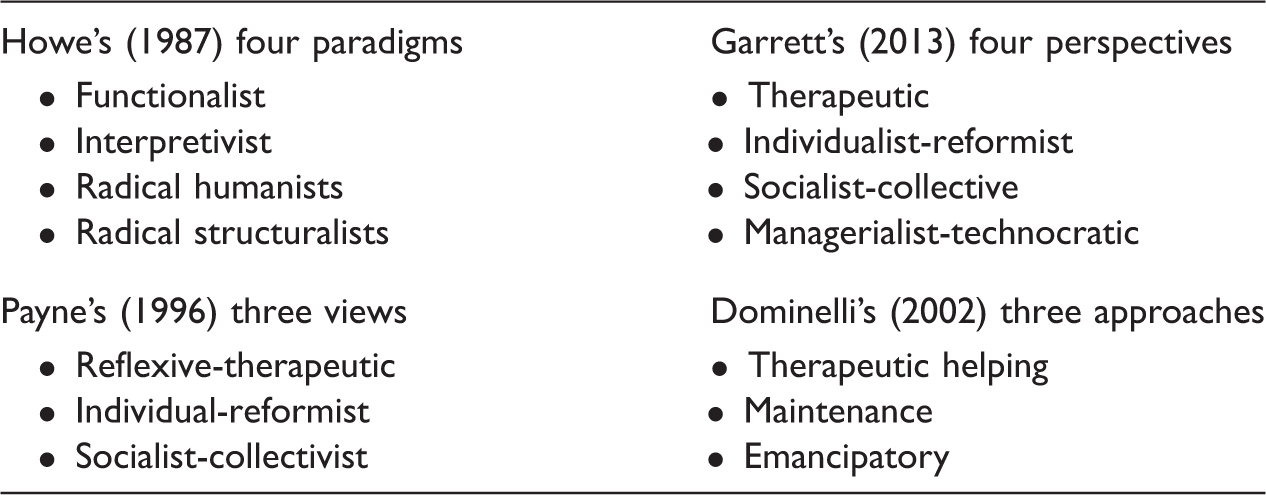
Hybridisation of ontological social work frameworks
Hybrid ontological social work frameworks.
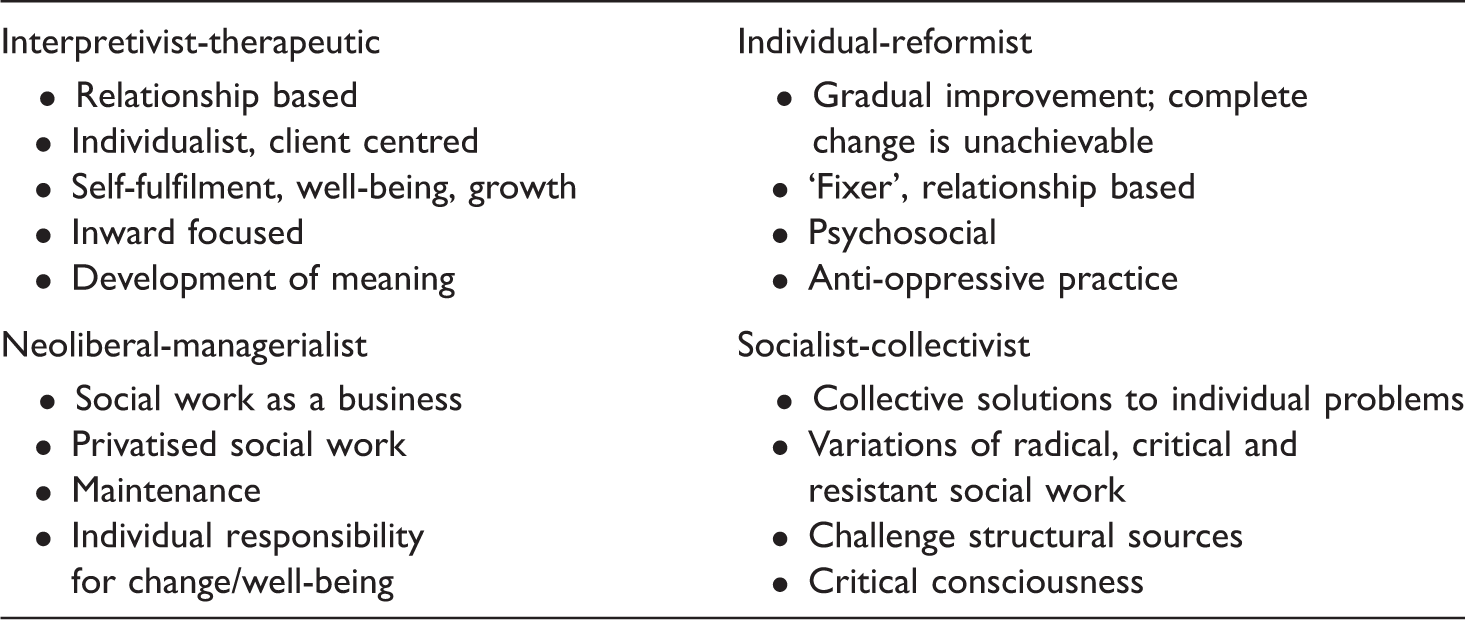
Adapted from Dominelli (2002), Garrett (2013), Howe (1987) and Payne (1996).
The interpretivist-therapeutic framework
The interpretivist-therapeutic framework aligns with of the views of the interpretivist paradigm (Howe, 1987), the reflexive-therapeutic view (Payne, 1996), the therapeutic helping approach (Dominelli, 2002) and the therapeutic perspective (Garrett, 2013). It is based on the principles of psychoanalysis, relationship-based work and emotional intelligence. This framework focuses on individual change and psychological functioning as the basis for intervention, with a strong emphasis on the individual and their capacity to cope with personal struggles and suffering, independent of the social and economic circumstances in which they are embedded. The aims of these interactions are for service users to gain a better understanding of their world and become empowered to overcome or rise above their suffering and situation.
Here, the social workers are ‘interpretivists’, or ‘seekers after meaning’ (Howe, 1987, p. 50) and operate upon the assumption that orderly relationships arise through interpersonal negotiations.
The individual-reformist framework
The individualist-reformist framework represents the functionalist paradigm (Howe, 1987), the maintenance approach (Dominelli, 2002) and the individualist-reformist view/perspective (Garrett, 2013; Payne, 1996). According to Garrett (2013, p. 5), ‘this perspective does not seek major social change but gradual improvement in conditions’. It is derived from Fabianism (Garrett, 2013), influenced by anti-oppressive practice, as well as some principles of the therapeutic perspective. Within this framework we find the functionalist social worker, also referred to as fixers (Howe, 1987), who emphasise social order within a methodological framework of the natural sciences.
Here, the focus is on meeting individual needs and improving services, while maintaining a good fit between the individual and the environment. This framework does not seek social change but sees social work as contributing towards the maintenance of the dominant social system. This is recognised as an approach, which reinforces a need for compliance to the dominant status quo (Dominelli, 2002). According to Edmondson (2014, p. 16), the emphasis on the word ‘maintenance’ is important as it ‘critiques social work as ultimately accepting both the basic structure of society and also of social work as a compliant profession which accepts imposed limits to its role and function’.
Neoliberal-managerialist framework
The neoliberal-managerialist framework represents the views of Garrett (2013) in his managerialist-technocratic perspective, as well as elements of Howe’s (1987) radical humanist paradigm, and Dominelli’s (2002) maintenance approach. Within this framework, social work is viewed as being a business that ‘aims to provide an excellent and quality range of services to a diverse range of customers’ (Garrett, 2013, p. 5). Social work rendered within this framework can sometimes charge for intervention services and there is a lowered level of professional authority, with a blurring of the distinctions between those less trained, such as auxiliary workers (Garrett, 2013). The focus is on performance measurement, individual empowerment and the implementation of managerialist techniques. This can be seen to tie in with Howe’s (1987) radical humanists paradigm, where these raisers of consciousness believe that individuals create their places in an unequal and conflictual world, implementing consciousness raising and the gaining of personal control as key methods of intervention (Dow & McDonald, 2003).
Ultimately, the neoliberal-managerialist framework sees the individual as being responsible for the fostering and maintenance of their own well-being. Undercurrents of Dominelli’s (2002) maintenance approach can be found in terms of the encouragement of social work professionals to maintain the status quo as established by the market system (Lishman, 2007). This is often referred to as the social work business (Harris, 2003) and is associated with the introduction of McDonaldization where tasks are broken down into smaller, discrete tasks so that the exact resources required for their delivery can be calculated for production, with workers following clear management guidelines and instructions, governed by manuals, policies and procedures (Ritzer, 2009).
Socialist-collectivist framework
The socialist-collective framework is based upon the categorisations of Howe’s (1987) radical structuralist paradigm, Payne’s (1996) and Garrett’s (2013) socialist-collectivist view/perspective and Dominelli’s (2002) emancipatory approach. Within this framework, the core belief is that ‘seeking personal and social fulfilment is impossible given the constraints that capitalism imposes’ (Garrett, 2013, p. 5). Garrett (2013) views the socialist-collectivist understanding as being in complete conflict with the therapeutic and psychodynamic models, as it recognises and advocates for the collective. The social worker, therefore, recognises that disadvantaged and oppressed people can gain empowerment only through social transformation. According to this view, the socialist-collectivist aims to promote greater social equality through individual and collective strategies. Models of radical social work, critical social work, resistance social work and developmental social work often fall within this category. This is seen as being representative of Howe’s (1987) radical structuralist paradigm, believing that society has an objective material reality, which is then characterised by competing interests and control. Therefore, in this regard, ‘the aim of social work is to structurally redistribute wealth and power through mobilising collective action’ (Dow & McDonald, 2003, p. 7).
Debates on ontological social work frameworks
The hybrid ontological frameworks, whilst not wholly discrete, do have different beliefs in the origins of social problems and the role of the social worker in empowering change. While the interpretivist-therapeutic worker focuses on the individual, the individual-reformist allows for some assessment of environmental impact, albeit this may be limited; the individual remains the centre of intervention. The neoliberal-managerialist implements social work intervention from a distance; it does not exclude environmental impact, however, it also does not implement relation-based work, but rather views individuals as being the primary actors in their narratives and as holding full responsibility for their well-being. Finally, the socialist-collectivist worker views macro, structural sources of oppression as being key to the development of well-being, and although the individual is still a significant player in intervention, the focus is from the outward in, challenging the sources of social problems.
Payne and Askeland (2008) argue that social work in the West uses all three of his categorised views, and social work in any one setting may use a mixture, depending on organisational and cultural expectations and societal expectations. In contrast, Garrett (2013) proposes that differing perspectives are conflicting in nature and thus cannot be implemented simultaneously, but rather are in direct contradiction to one another. Mary (2008, p. 172) argues that ‘the vast majority of our [primarily Western-dominated] work uses the first two approaches [Interpretivist-therapeutic and Individual-reformist], neither of which is very relevant to a new transformational vision of social welfare as global collective wellbeing’. However, resistance to the domination of these approaches emerged in the late 1960s and early 1970s through the development of radical social work, which challenged the notion that casework was being used to target and pathologise the individual as the source and root of social problems, ignoring the effects of structural inequality (Mary, 2008).
In analysing the new global social work definition and identifying the ontological frameworks presented earlier, it is possible to recognise certain ontological underpinnings of the new global social work definition and implications for social work, which will be elucidated in the following discussion.
The ontological underpinnings of the new global definition
In reflecting on the underlying ontology of the new global definition of social work, the influence and emergence of increasingly socialist-collectivist ideals can be recognised. Evidence of this can be found in the shift to a collective discourse, and from a micro-based to increasingly macro-focused understanding of social action. Terms utilised in the new definition and the commentary thereof, such as ‘promotion of social change and development’, ‘social cohesion and empowerment’, ‘liberation of people’, ‘social justice’ and ‘collective responsibility’ (IFSW, 2014) indicate these changes. The term ‘collective responsibility’ could be argued as being a socialist-collectivist stance, particularly in the commentary of the definition where it is stated that ‘advocating and upholding human rights and social justice is the motivation and justification for social work …. [recognising] that human rights need to coexist alongside collective responsibility’ (IFSW, 2014). This resonates with the socialist-collectivists promotion of a greater social equality through collective strategies, and Dow and McDonald’s (2003, p. 7) acknowledgement of redistribution of wealth and power and the mobilising of collective action. The new definitional call for social work to develop a ‘critical consciousness’ is also evidence of these shifts compared to that of previous international social work definitions (IFSW, 2001, 2010), with the influence of social and economic conditions more keenly recognised and understood as being significant in this regard.
However, although emerging undercurrents of socialist-collectivism can be found, this is not to say that the new definition is a single, uniform movement towards a socialist-collectivist approach, nor is the definition particularly radical in its intentions. Rather, the new definition seems to embrace socialist-collectivist principles, while still maintaining its traditional person-in-environment perspective and consideration of the individual. The commentary and analysis of the new definition (IFSW, 2014), recognises the role of the social worker as being one of individual-focused interventions, supporting the individual to cope with the difficulties and struggles they are experiencing within their environment. There is a continued focus on the liberation of people within their economic and social contexts, and there are still hints of what one might refer to as a ‘therapeutic aroma’. Equally so, the extent of socialist-collectivist implications in the new definition is not clearly articulated, for instance how far along the collective path the new definition proposes travel. These uncertainties can infer the development of an ‘eclectic definition that could be interpreted in various convenient ways’ (Ioakimidis, 2013, p. 196). However, we believe that certain shifts in thinking and power are clearly apparent and that the extent of these changes is what requires more critical discussion and debate.
This debate between the individual and collective perspectives of social work focus is not new, with social work always being on a continuum between ‘community work/social change on one end and therapeutic work with individuals, families or groups on the other’ (Staniforth, Fouche, & O’Brien, 2011, p. 193). Social workers who practice counselling or therapeutic methods as their core functions have been seen by some as, having ‘sold out’ (Staniforth, Fouche, & O’Brien, 2011, p. 193), moved away from the roots of social justice (Specht & Courtney, 1994) while others believe that social justice can still be achieved through individual change and that the social worker has a therapeutic role to play in intervention (Buchbinder, Eisikovits, & Karnieli-Miller, 2004). Staniforth, Fouche and O’Brien (2011) highlight that there has been much written about this debate (see Beddoe & Maidment, 2009; Connolly & Harms, 2009; Maidment & Egan, 2009; Staniforth, Fouche, & O’Brien, 2011; Weld & Appleton, 2008). Staniforth, Fouche and O’Brien (2011, p. 193) advocate a ‘both/and’ view, with both collective and individual focus being within a systems approach to intervention and well-being; therefore, both sides have a place within the social work practice framework. In reflecting on the ontological underpinnings of the new global definition, this ‘both/and’ view is apparent. Thus, although a shift towards a more collective and macro-focused stance is clear, it is perhaps more evident when viewed in contrast to the more individual focus of the previous international definition (IFSW, 2010).
In understanding the shift towards increased socialist-collectivist thinking and ontology in the new definition, one needs to reflect upon the context within which, and towards what, the new definition was developed. Although we highlighted the Western dominance of ontology used in international social work frameworks, the new global definition can already be said to be somewhat more indigenous in its underpinnings, having increased involvement of Latin American, Asia-Pacific and African countries. It can be suggested, therefore, that advocating for the importance of collectivism, development and interdependence in the new global definition may be largely owing to the influence of these participating countries, who have long backed the inclusion of these values (Ferguson, 2005; Gray & Mazibuko, 2002; Rankopo & Osei-Hwedie, 2011; Truell, 2014; Yunong & Xiong, 2011). Equally so, the shift to the need for increased collectivism and macro-understandings can also be understood as being a recognition of the changing socio-economic, political, spatial and historical context of individuals and communities (Spolander et al., 2014).
In implementing the new definition, we believe that the development of stronger academic and critical veracity, greater integration of indigenous knowledge, development of critical consciousness and an improved understanding of socio-economic contexts are key within today’s global world of social inequality, poverty, social exclusion, violation of human rights and the impact these have on individuals, families and communities.
Socio-economic contexts
It is widely recognised that social work is embedded in challenging times, as the infiltration of global economic policies, market capitalism and neoliberal tenets have fast begun to take hold across Europe and beyond. Harvey (2005) refers to this as a neoliberal globalisation, a blanket guiding perspective for all economic, social, political, cultural and internationally based interactions and relations. The increasing global convergence of economic policies and practices, although implementation, visibility and discourse may vary across countries, has had an international impact upon aspects of well-being, the widening gap between the rich and poor, the retrenchment of the welfare state, the power of the market, the privatisation of care and the influence of a management agenda in all spheres of service provision (Dominelli, 2002; Harvey, 2005; Hay, 2002; Midgley, 1997; Spolander et al., 2014). Furthermore, the impact of globalisation and converging economics has seen an increase in macro-scale social problems, all the while neoliberal principles continue to emphasise the responsibility of the individual.
While social problems have been exasperated through economic recession, heightened further through a reduction in social protection and increased welfare reforms in many countries (Dominelli, 2002), the theory underpinning neoliberalism ‘proposes that human wellbeing can best be advanced by liberating individual entrepreneurial freedoms and skills’ (Harvey, 2005, p. 2). Social work, much like global policies, has perhaps overly embraced this concept of individualism. In fact, it has even been suggested that rather than being a victim of neoliberalism, social work has perhaps at times been a willing participant and uncritical of the role it has played in the conscious or unconscious promotion of neoliberal ideals (Lorenz, 2005). The previous international definition (IFSW, 2010) was highly criticised for failing to acknowledge the importance of collectivism and interdependence (IFSW, 2014; Jones & Truell, 2012). Within an increasingly globalised world, the need for a broader contextual and collective understanding within social work and social development initiatives, therefore, has been increasingly recognised (Harris, 2014; Jones & Truell, 2012; Lymbery, 2001; Woodward, 2013).
Thus, it was within this context that the new global social work definition (IFSW, 2014) is embedded, and thus understood, calling social work professionals to expand their contextual understanding and awareness of their role in today’s global context. With the definitional and ontological evidence of a transition in the social work profession, and within a contextual understanding, the profession’s role now lies in critically questioning and debating what these changes mean for social work at a global and national level. What are the implications of such a shift for social work education, practice and leadership?
Implications and challenges for social work
In reflecting on the shifts identified in the new definition, the ontological positions it represents and the socio-economic context of today’s world, various questions beg to be answered: do we as professionals need to make changes to how we see our role in society and how we implement intervention? Or is it more simply that the lens through which we see social problems and social work needs to be broadened? What does this mean for social work training and practice? We believe that these are critical questions, which need to be developed and debated by the social work fraternity. It is, however, clear that unless social work is able to appropriately identify the nature and causes of social distress, it will be unable to recommend and support appropriate interventions. A more collective social work, with renewed recognition of social justice, cohesion, development and ontology, may have implications for current models of social work. Furthermore, uncritical perspectives of social capital, social control and even core concepts such as social justice, may be influenced by, or have close links to, neoliberal concepts, such as self-help, lacking the structural perspectives that restrain personal and social development (Gray, 2011, p. 10), and further highlighting the need for a more academic and scientific social work.
Development is needed in the areas of macro and collectivist interventionist skills; critical review of ideology within social work, with the recognition of vested interests; critical reflection on, and understanding of, aspects of social control and cohesion, recognising the role of the profession as an agent of social control within the global neoliberal world and our promotion of such ideals; the positive and negative influences in ideology; the complex interrelationship between ideology and discourse and the differing ideological interests and forms that may exist in policy, practice and education (Carey & Foster, 2013). For example, the current global neoliberal context promotes the principles of individualism and consumerism as being cultural norms, while the new definition renews the call for social work to counter such developments with the reaffirmation of core values, ethics and knowledge, such as collectivism, social development, social justice and social cohesion (IFSW, 2014).
Therefore, social workers need to assess and critically debate the ontological paradigm within which they practice and/or understand the role of social work, continue to question the existence of Western dominance and critically reflect upon what the empowerment and liberation of people might mean in practice. Professionals need to ensure coherence between theory, practice and principles, recognising ontological paradigms, which would best achieve the development, and a collective and empowerment call of the new global definition. Social workers should embrace the broadening of their ontological understanding and interventions, moving beyond blanket terms such as social justice and social development towards a fuller understanding, as well as acting, to ensure their achievement, whilst ensuring they do no harm. Surely, empowering individuals to ‘live in’ and acclimatise to their present circumstances, alone, is no longer sufficient?
The challenge for social work then is to develop, practice and research their understanding between the global trends and realities, local community and individual needs (Healy & Link, 2011; Jones & Truell, 2012; Payne & Askeland, 2008; Pettifor, 2004, Spolander et al., 2014). The global definition was essentially a re-evaluation of a journey to respond to the increased global complexity in which social work is embedded (Jones & Truell, 2012). A critical implication for the profession is thus to expand its orientation to include wider perspectives such as political economy, social policy and research in both practice and education, as well as recognising policy development, implementation and evaluation as a primary social work function (Jansson, 2003). We are indeed obligated to informing and participating in policy development, and this requires an active engagement with global and regional political institutions (Jones & Truell, 2012; Mmatli, 2008).
Conclusion
Although this article cannot claim to have captured the vastness and complexity of definitional shifts in social work and its implications and challenges for the profession, we hope that the questions and ideas raised in this article will spark further discussion and debate. The profession in its global, regional and individual context has different views on the future of social work, assessments of the problems and how the profession should and can respond to the present challenges. However, the new global definition requires the profession to redirect and articulate clear approaches to achieve its goals of social justice, equality, development, empowerment and well-being, and to do so with an increased collective understanding, a recognition of the structural sources of oppression, and a commitment to bringing about social cohesion through both collective and individual approaches.
Although some may be critical of a more radical social work perspective, the need to recognise an interconnected ‘macro portrait’ of our world cannot be rejected. The importance of social, economic, political, spatial, individual and historical contexts and the role of political economy are vital to understand social distress, policy initiatives, social work theory/models and their impacts. There is a need to recognise and challenge these interconnected influences, as well as the impacts these have upon individuals, communities, organisations and the wider social context.
There is no doubt that neoliberal policy is impacting on individuals, communities, the profession and nation states. Social work has a critical role in this debate and should not just acquiesce to priorities, premises and policies of current regimes. Rather, it should use research, theory, pedagogy and critical voice to support it in facilitating social change, development, cohesion and social stability, as well as the empowerment and liberation of people. The new global definition recognises this potential. By critically reflecting on the significant definitional shifts towards macro understandings of oppression, collective solutions and increased academic and indigenous integrity, the profession can continue to remain relevant and accountable to its commitment to promote social cohesion and social justice within today’s challenging global world.
Footnotes
Ethics
Secondary data was utilised for the project. Ethical approval was obtained from Coventry University and participating universities as required.
Funding
The author(s) disclosed receipt of the following financial support for the research, authorship, and/or publication of this article: The research leading to these results has received funding from the European Union Seventh Framework Programme (FP7/2007-2013) under grant agreement No. 318938.
Acknowledgements
This article stems from an EU-funded research project: Civil Engagement in Social Work: Developing Global Models (NL_CIVIL; Grant Agreement Number: PIRSESGA-2012-318938).