







Abstract
Summary
Although tenants of public housing face numerous challenges, recent research suggests they can experience positive well-being. The study examines a group of tenants’ perspective on structures of their residential environment that influence their positive well-being, using the empowerment-based Photovoice method. Ten peer-researchers took pictures, participated in facilitated group discussions, and performed a thematic analysis. The study presents themes emerging from the pictures, as well as concrete outcomes of implementing such a method in a public housing setting.
Findings
Six themes emerged from the pictures taken: (1) a pleasant home, inspiring pride; (2) variety of local resources; (3) mutual support and social participation; (4) control over life situations; (5) social, leisure and growth opportunities; (6) beneficial access to nature. The findings reveal the nuances of tenants’ relationships with their residential environment, which has the potential to support their emotional, psychological, and social well-being. However, several needs for improvement were also identified, as well as avenues for tenants to take more power over these negative situations. The Photovoice method appears to have produced positive outcomes in terms of environmental improvement and tenant empowerment.
Applications
The study suggests social workers should bear in mind the multifaceted person–environment relationship of the people they work with. It also emphasizes that public housing tenants can play an active role in making their environment a place where they can flourish. The Photovoice method is highlighted as a useful tool for social work community practitioners to support tenant empowerment.
Introduction
Housing is a key social determinant of health and well-being (Shaw, 2004). Around 1.2 million households live in public housing 1 in the US (US Department of Housing and Urban Development, 2015) and about half a million in Canada (Statistics Canada, 2013). In the spirit of the Housing Act of 1937, public housing programs are designed to provide decent housing to underprivileged groups (Fertig & Reingold, 2007; World Health Organization, 2011). Housing policies and interventions have been shown to be efficient in reducing health inequalities faced by socio-economically disadvantaged groups (Gibson et al., 2011; Shaw, 2004). Nevertheless, research to date has mostly documented the negative reality of public housing tenants. In addition to their precarious economic situation, they face numerous difficulties at the personal (e.g., mood, anxiety, substance use disorders, Black et al., 1998; Shin, Sims, Bradley, Pohlig, & Harrison, 2014; Simning, van Wijngaarden, & Conwell, 2011) and social levels (e.g., lower education, single parenthood, exclusion from the labor market, Rivest, 2006). These difficulties make the people living in public housing one of the most underprivileged communities in our societies. Social workers practicing from a community perspective (Cox, 2001) face the challenge of supporting the empowerment of people from such oppressed populations. Empowerment-oriented social workers strive to promote self-determination and social justice while reducing discrimination (Cox & Parson, 1994).
Despite the adversity faced by public housing tenants, a study by Ruel, Oakley, Wilson, and Maddox (2010) suggests that public housing provides them with a safety net. In the field of positive psychology (Seligman & Csikszentmihalyi, 2000), studies with economically disadvantaged communities have documented the possibility of experiencing positive well-being, such as feelings of satisfaction, meaning in life, and flourishing relationships, despite material hardship (Biswas-Diener & Diener, 2001, 2006; Linley, Bhaduri, Sharma, & Govindji, 2011). A few studies show that public housing tenants can develop a positive sense of belonging to their community (Manzo, 2014; Manzo, Kleit, & Couch, 2008; Sinha & Kasdan, 2013; Tester, Ruel, Anderson, Reitzes, & Oakley, 2011; Tester & Wingfield, 2013). However, to our knowledge, underlying aspects of positive well-being have never been thoroughly explored in a public housing context.
Anchored in a salutogenic perspective (Antonovsky, 1996), positive well-being is the counterpart to mental illness (Keyes, 2002). It is also known as flourishing or positive mental health (Keyes, 2009; Seligman, 2011). In the same way that mental illnesses represent clusters of negative symptoms, Keyes (2005) conceptualizes positive mental health as clusters of positive symptoms: emotional (e.g., life satisfaction and positive emotions), psychological (e.g., self-acceptance, environmental mastery, and personal growth), and social (e.g., social contribution, integration and actualization). Several studies have established that positive mental health and mental illness represent two distinct continuums (Keyes, 2005; Westerhof & Keyes, 2010). Although these continuums are mostly independent from each other, a ten-year longitudinal study has shown that gains in positive mental health predict declines in mental illness over time (Keyes, Dhingra, & Simoes, 2010). Thus, promoting positive well-being could contribute to reducing the flow of psychological disorders (Cowen, 2000).
The present study’s aim was to investigate how the residential environment of public housing influences the positive well-being of tenants. In line with empowerment-oriented social work practice (Cox, 2001), our action research builds on the point of view of a group of tenants, with the goal of drawing on their expertise while giving them an opportunity to develop more control over their life (Guta, Flicker, & Roche, 2013).
The influence of residential environment in public housing
In Montreal, Canada, where the study was conducted, the two main clienteles of public housing are elderly women living alone and families headed by single mothers (Apparicio & Séguin, 2006). These clienteles are generally limited in their daily mobility due to financial constraints (Apparicio & Séguin, 2006). As they spend a great proportion of their time in their house and neighborhood, they are considered a locally dependent group (Horelli, 2006). As such, the quality of their residential environment is likely to play a significant role in their positive well-being.
Although there is some variation regarding how residential environment is defined, it is generally understood as being composed of two main components: the house and the neighborhood (Amérigo & Aragonés, 1997), both of which can be further subdivided. In a public housing context, rooms are comprised in a dwelling unit, comprised in a building, in turn comprised in a housing development (Weidemann & Anderson, 1985). Neighborhood is a more or less large area around the house (Amérigo & Aragonés, 1997), which includes a micro-neighborhood, nested in a macro-neighborhood, nested in a larger community (Marans & Rodgers, 1975).
Based on theoretical models (Amérigo & Aragonés, 1997; Marans, 2003) and empirical evidence (Weden, Carpiano, & Robert, 2008; Wright & Kloos, 2007), it is how people perceive the environment that is the most influential on their well-being. According to the notion of person–environment congruence, individuals experience well-being to the extent that they perceive that their environment offers the opportunity to pursue their goals and fulfill their needs (Moser, 2009). Horelli (2006) proposed a heuristic model for person–environment fit of locally dependent groups. The model encompasses four types of structures: physical (e.g., nature, meeting places), functional (e.g., services, local initiatives), participatory (e.g., governance, capacity building), and cultural (e.g., shared culture of community, social capital). This model converges with research in environmental psychology that shows that above and beyond the physical components of space, sense of place encompasses the meaning one attaches to the space, in terms of several other aspects (e.g., emotional, cognitive, behavioral and social components; Jorgensen & Stedman, 2001; Low & Altman, 1992; Manzo, 2003).
Horelli’s (2006) model offers a framework integrating dimensions along which people in public housing or with low income evaluate their environment, such as quality of infrastructures, natural spaces, and relationships with neighbors (see Amérigo & Aragonés, 1997). Recently, Hayward et al. (2015) conducted focus groups with public housing tenants on environmental factors influencing their health. The themes that emerged focused on negative aspects, including unhealthy physical environment, limited trustworthy relationships, and the need to increase neighborhood social capital.
Social workers are known to consider the complex relations between a person and his/her environment (Freedman, Pitner, Powers, & Anderson, 2014; see review from Rogge & Cox, 2002). Indeed, person-environment fit is one of the pan-theoretical themes that emerged from a recent survey asking social workers to define their field (Staniforth, Fouché, & O'Brien, 2011). However, to our knowledge, no study in social work or other related domains has examined the structures of residential environment perceived to be congruent with public housing tenants’ goals and needs, and how these contribute to positive well-being. Positive well-being’s determinants differ from those pertaining to mental illness (Karademas, 2007; Ryff et al., 2006). Thus, residential structures influencing positive well-being might not be the same as those shown to influence mental illness or even health, broadly conceived. The objective of this study was to describe what public housing tenants perceive as positively and negatively influencing their positive well-being, considering the set of structures from Horelli’s (2006) model. To capture tenants’ point of view while also supporting their empowerment, a Photovoice (Wang & Burris, 1994, 1997) research approach was adopted.
Empowering through a Photovoice project
Presented by Wang and Burris (1994, 1997), the Photovoice method is a community-based participatory research tool (Hergenrather, Rhodes, Cowan, Bardhoshi, & Pula, 2009) often used in health promotion (Wang, Yi, Tao, & Carovano, 1998; see Catalani & Minkler, 2010). In asking participants to take pictures, the method allows them “1) to record and reflect their community strengths and concerns; 2) to promote critical dialogue and knowledge about important community issues […], 3) to reach policymakers” (Wang & Burris, 1997, p. 370). Application of the method includes training on photography and ethics; picture taking; group discussion of the pictures with the help of a facilitator; analysis of the data using a participatory approach; and sharing of the results through a public exhibit (Catalani & Minkler, 2010; Wang & Burris, 1997).
Photovoice was selected for its potential to promote well-being by catalyzing personal and community change (Wang et al., 1998). Influenced by Paulo Freire (1970), the Photovoice method has a strong empowerment component, encouraging participants to take an active role in shaping their life and environment to their needs (Duffy, 2011). Empowerment is a mechanism through which people take control over their life (Rappaport, 1981; Zimmerman & Rappaport, 1988). At the individual level, empowerment refers to improved perceptions of oneself, including one’s skills and capacities (Boehm & Staples, 2004). At the collective level, it is about a group of people coming together, supporting each other, and taking part in collective actions toward shared goals (Boehm & Staples, 2004). A qualitative study has documented the enduring individual and collective benefits of single mothers’ participation in a Photovoice project (Duffy, 2011). The Photovoice approach used in the present study aimed to create an “empowerment group” where both individual and collective levels of empowerment could be drawn on simultaneously (Lee & Hudson, 2011). As such, the intent was to promote three dimensions of empowerment: distributive change—i.e., improved access to goods and services for tenants; procedural change—i.e., enhanced recognition of tenants’ contribution, individually and collectively; and capacity building—i.e., increased abilities of tenants to take action for themselves (Elwood, 2002).
The Photovoice process recognizes that the best way to understand the experience of a group is to allow its members to document and ponder their social reality themselves (Wang & Burris, 1994). Hence, participants play a central role in Photovoice studies and are considered “peer-researchers” (Roche, Guta, & Flicker, 2010). Peer-research is a form of research where members of the community are trained and supported to collaborate actively rather than being involved only in data collection (Guta, Roche, & Flicker, 2010). This improves data quality and promotes capacity building in the community (Guta et al., 2010).
The Photovoice method seeks in-depth understanding of the reality of a specific group of participants through contextualized results. Even though this precludes simple generalization, the ecologically representative descriptions provided can stimulate reflection on aspects to be discussed and validated in future studies with tenants from other housing developments. Using photography in social work can help humanize research findings (Russell & Diaz, 2013). In a study with lesbian women, the pictures made the findings concerning the participants’ reality more revelatory, possibly facilitating the knowledge transfer process (Russell & Diaz, 2013). Incorporating photography has the potential to not only provide pertinent data, but also to enhance public awareness concerning the selected issue. As Mahalingam and Caridad Rabelo (2013) have suggested, Photovoice represents both a method and an intervention. Nevertheless, although this type of qualitative method is gaining momentum in the field (e.g., Burles & Thomas, 2012; Freedman et al., 2014; see review Clark & Morriss, 2015), it is still not fully exploited.
The present study also intended to explore the usefulness of the Photovoice method for working with public housing communities. Our research team aims to use this first case study as a stepping stone toward analyses of distinctions and similarities within and between future case studies in a diversity of public housing settings. The combination of situated knowledge generated by these various case studies could lead to a rich and nuanced theory of public housing tenant’s well-being (Mahalingam & Caridad Rabelo, 2013).
Objectives
The objectives of the study were (1) to examine a group of public housing tenants’ perspective on the structures of their residential environment that promote and hinder their positive well-being; and (2) to explore the usefulness of implementing Photovoice as an intervention method in a public housing setting by describing its short-term outcomes for an initial case.
Method
Setting
To be selected for this study, the public housing development had to (1) have mainly French-speaking tenants; (2) never have been involved in a research project; (3) not be in a renovation process during the study; and (4) exhibit emerging tenant mobilization. The language and mobilization criteria served to ensure a sufficient number of participants for a French Photovoice process. The criteria concerning involvement in a previous study or current renovations were to minimize the influence of confounding variables. A development was chosen in consultation with Montreal’s municipal housing office, which is responsible for the city’s 22,869 public housing units.
The public housing development was situated in one of the largest and the sixth most populated of Montreal’s nineteen boroughs. The annual income in this borough averaged above C$60,000, making it one of the city’s six richest boroughs (City of Montreal, 2011), although there are also more deprived areas in the neighborhood. This borough contained residential and industrial areas while also offering good access to nature preserves and parks. In a previous research, objective indicators suggested that proximity to services was very low for public housing tenants in this area (Apparicio & Séguin, 2006), and its location in periphery of Montreal hindered access to the city centre. This represents the larger context surrounding the public housing development in which the study was implemented. Although not deprived in terms of residents’ average income, the borough seems socially deprived when considering the availability of services. The housing development contained 188 dwellings for families and single adults under the age of 60. These units were spread across one large building, four smaller buildings, and 13 townhouses. The housing development was first built in 1972 and extensively renovated between 2009 and 2014. A youth center and several support organisms for families were located on the development’s premises. Data from a recent survey that we conducted in this public housing development suggest that tenants had been living there on average for six years, and for up to 40 years. This is in line with another survey illustrating that people living in public housing usually do so for several years (Leloup, Gysler, Portal, Antar, & Bordet, 2009).
Participants
Recruitment
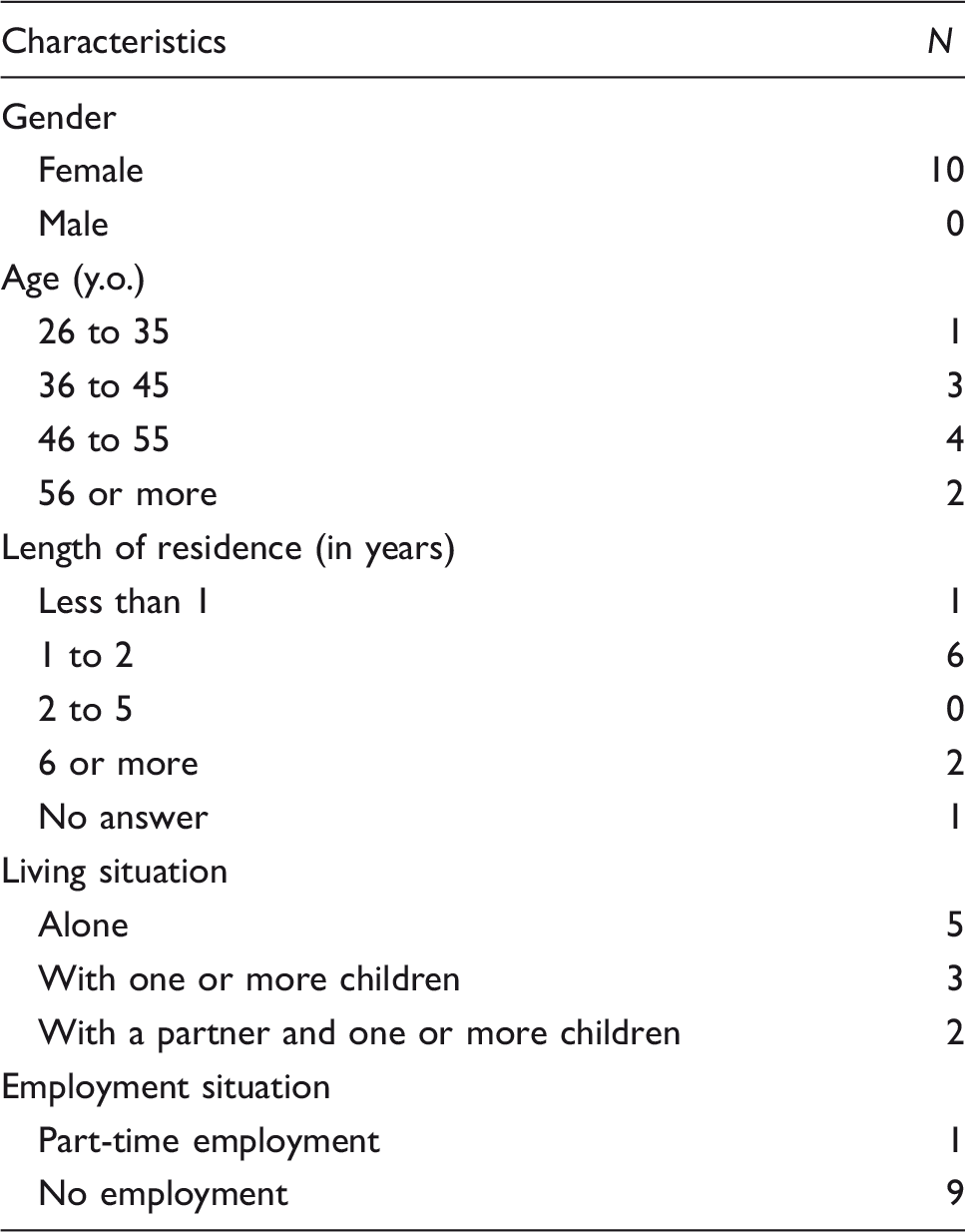
Participants were recruited via flyers distributed to each address by the tenants’ association and two research assistants. Posters were put up to advertise an information session. During this session, the research project was explained thoroughly to the tenants. Ten tenants who expressed their interest in participating formed the committee of peer-researchers. A group size of ten was deemed adequate to stimulate active participation in discussions. It is similar to the median number of participants in previous Photovoice studies (Catalani & Minkler, 2010; Hergenrather et al., 2009). Participants signed a written consent form.
Peer-researchers were paid a stipend of 20 dollars at each of the eight sessions. This level of compensation is comparable to similar Photovoice projects (Hergenrather et al., 2009). Food, digital cameras, and childcare arrangement were also provided.
Peer-researchers
Characteristics of the ten peer-researchers.
Procedure
The study was structured in eight 2.5-hour weekly sessions over a two-month period, in line with previous Photovoice studies (see Catalani & Minkler, 2010; Hergenrather et al., 2009). The group met in a communal room on the public housing development premises. Sessions were facilitated by two doctorate-level research assistants, trained and supervised by an interdisciplinary research team (social work, community psychology, sociology, and urban studies). In addition, the research team met with the peer-researchers on two occasions, to discuss the Photovoice results and their implications.
Training
In the first two sessions, the peer-researchers received training on the research topic, research ethics, and photography techniques. They were given explanations of the theoretical models of positive well-being (Keyes, 2005) and residential environment (Horelli, 2006) that were being used in the study. Particular care was taken to avoid influencing peer-researchers' opinions. A map of the neighborhood depicting a 500-meter radius around the public housing development was discussed with the peer-researchers. Drawing on their perceptions (Amérigo & Aragonés, 1997), they defined the limits of their residential environment, and the map was modified accordingly. The peer-researchers also learned about general research ethics principles and concrete ethical concerns, such as how to obtain consent to photograph a person (Wang, 2006; Wang & Redwood-Jones, 2001). Finally, a professional photographer demonstrated the basic skills and techniques necessary to operate the digital cameras provided.
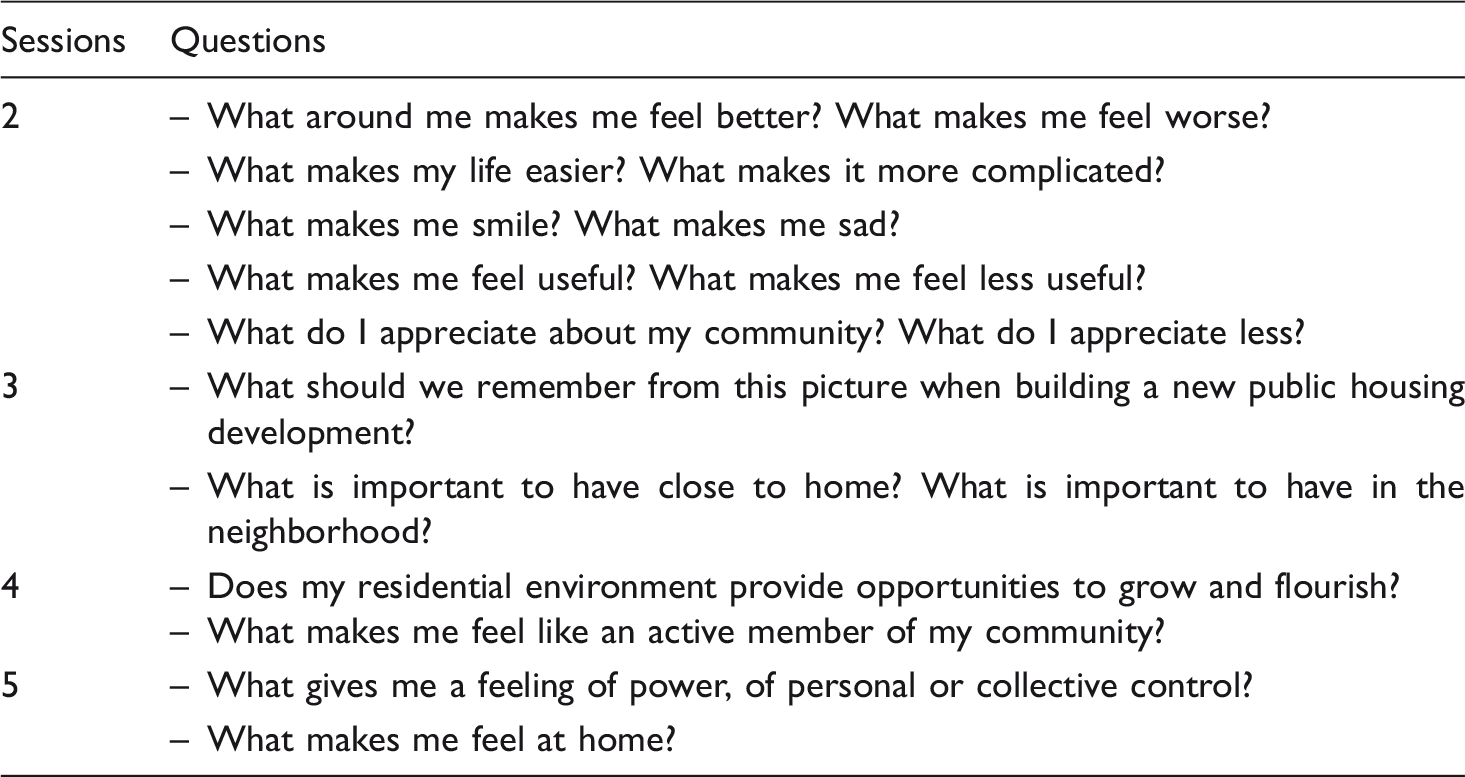
Data collection
Cues given to enhance the diversity of pictures taken for the following session.
Data analysis
It was essential that the peer-researchers take part in each step of the data analysis and have the opportunity to correct any misinterpretations, to ensure a more valid interpretation (Wang & Burris, 1997). For this reason, the three-stage process for participatory analysis suggested by Wang and Burris (1997) was followed: (1) selecting the photographs that best answered the research question; (2) contextualizing by sharing the meaning behind the photographs with the other peer-researchers; and (3) codifying the themes or issues brought forward through the group discussions.
Selection
Before each session, the participants chose two of their photos that they would most like to discuss with others and noted the thoughts they wanted to share with the group (Catalani & Minkler, 2010). These choices already provided a wealth of information on important issues in the community.
Contextualization
The group was invited to discuss each photograph after it was presented by the person who took it. The SHOWeD questions (Hergenrather et al., 2009; Lykes, 2001; McIntyre, 2003; Shaffer, 1983), a series of questions to facilitate constructive discussion about the pictures, were slightly modified to adapt them to the study’s objectives (McIntyre, 2003). Questions asked included, “What is important to me in this picture?”, “Why did I want to take that picture?”, “Why does this situation need to change?”, and “How do I feel when I look at this picture?” During the discussions, participants acknowledged emerging themes and expressed themselves regarding actions that could improve aspects of their residential environment.
Throughout the process, the two research assistants did not give their point of view on the pictures, as their role was only to facilitate discussions. At times, the facilitators probed for more information concerning the important themes underlying a picture or intervened so that everyone could readily express her opinion. However, most of the time, very animated discussions evolved naturally among the peer-researchers, without any intervention. As a result, the facilitators mainly managed time, while also periodically redirecting the group discussion when it diverged from the topic addressed by the picture.
Codification
At the beginning of each session, the peer-researchers and facilitators worked together to classify the previous session’s pictures into categories encompassing aspects of the residential environment, following principles of thematic analysis (Braun & Clarke, 2006). Using printed copies of the pictures, they began by grouping related pictures into themes. Some common content identified by the research team prior to the session served as a starting point for the discussion, but the peer-researchers had the final say on the classification. In the initial sessions, only a few themes emerged from the discussions, and pictures that did not clearly share content with others were kept apart. As the sessions progressed and more pictures were taken, what first appeared to be marginal themes became more clearly defined. Up until the last session, pictures could always be moved around if peer-researchers judged that a new thematic classification would be a better fit. The themes were thus dynamically chosen and not determined ahead of time. Once the last pictures had been taken, the group reached a final thematic classification in which themes had to be mutually exclusive and each picture classified under a single theme. The themes were named by the peer-researchers with support from the facilitators. The peer-researchers were satisfied that the final themes represented their perspective on the research question. Our participatory analysis method is consistent with several other Photovoice studies in which the researchers facilitated participants’ discussions around theme identification (see review from Hergenrather et al., 2009). It is also entirely consistent with the participatory visual analysis that Wang and Burris (1997) proposed when they developed the Photovoice method (Catalani & Minkler, 2010).
Exhibit
During the seventh and eighth sessions, the participants prepared an exhibit that took place at a local cultural center. Each person had to select what they considered to be their two most significant photos, and one of them was enlarged for the exhibit. The peer-researchers then completed a short questionnaire, ranking the pictures with regard to the importance for stakeholders, the positive and negative effects on well-being, and the representativeness of each theme. With this feedback, six panels containing eight to ten pictures were created to represent each theme. The participants then came up with captions for each photo (Strack, Lovelace, Jordan, & Holmes, 2010). Community decision-makers were invited to the exhibit’s opening night. About 50 people (friends and family, the borough mayor and a federal member of Parliament’s assistant, the director of the housing office, teachers, police force representatives, etc.) were present.
Results
As stated previously, this study has both research and practical purposes. As such, the first sub-section below presents the results concerning the peer-researchers’ perceptions of the relationship between their environment and positive well-being. The second sub-section describes the concrete outcomes resulting from the Photovoice method.
Research findings
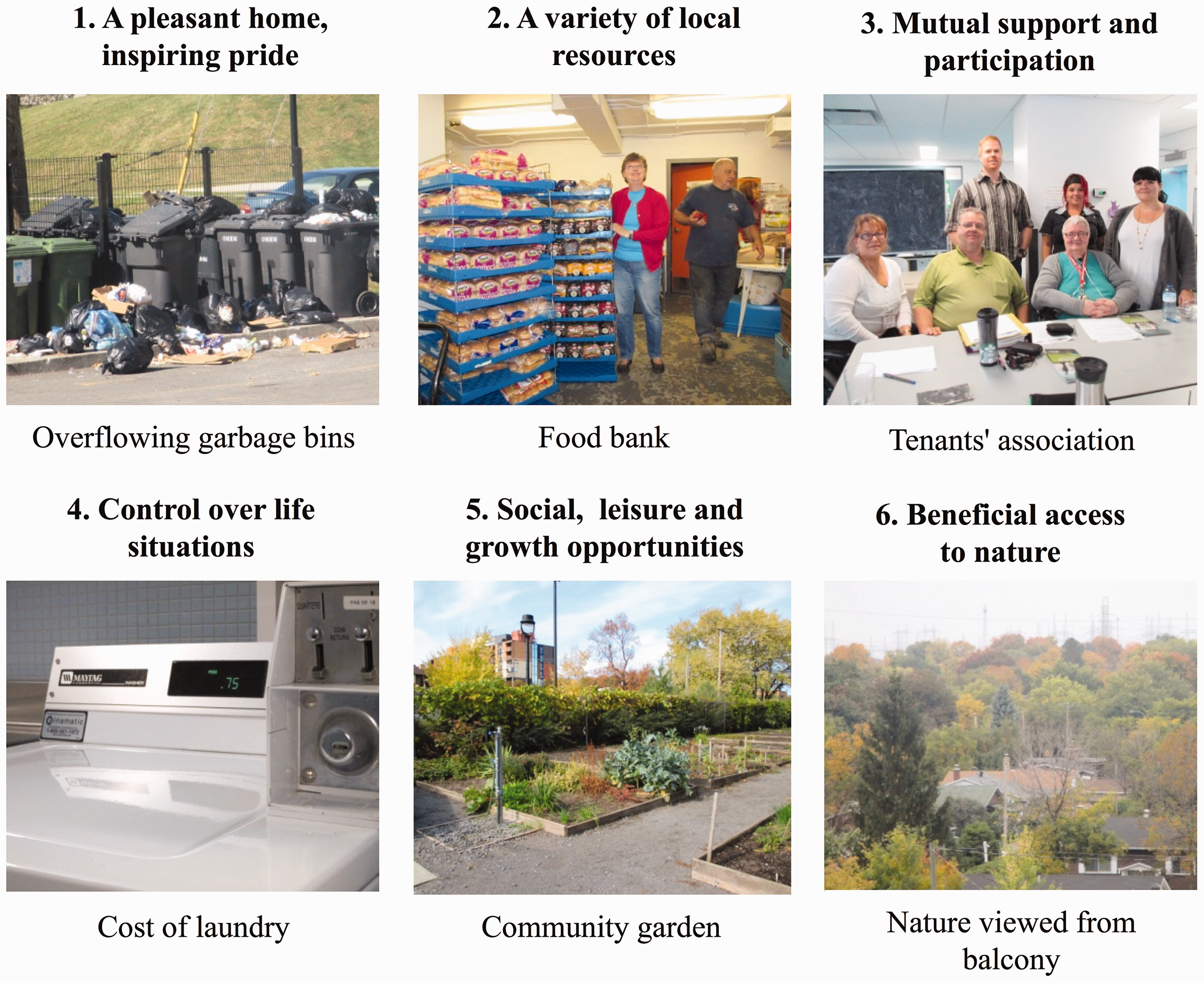
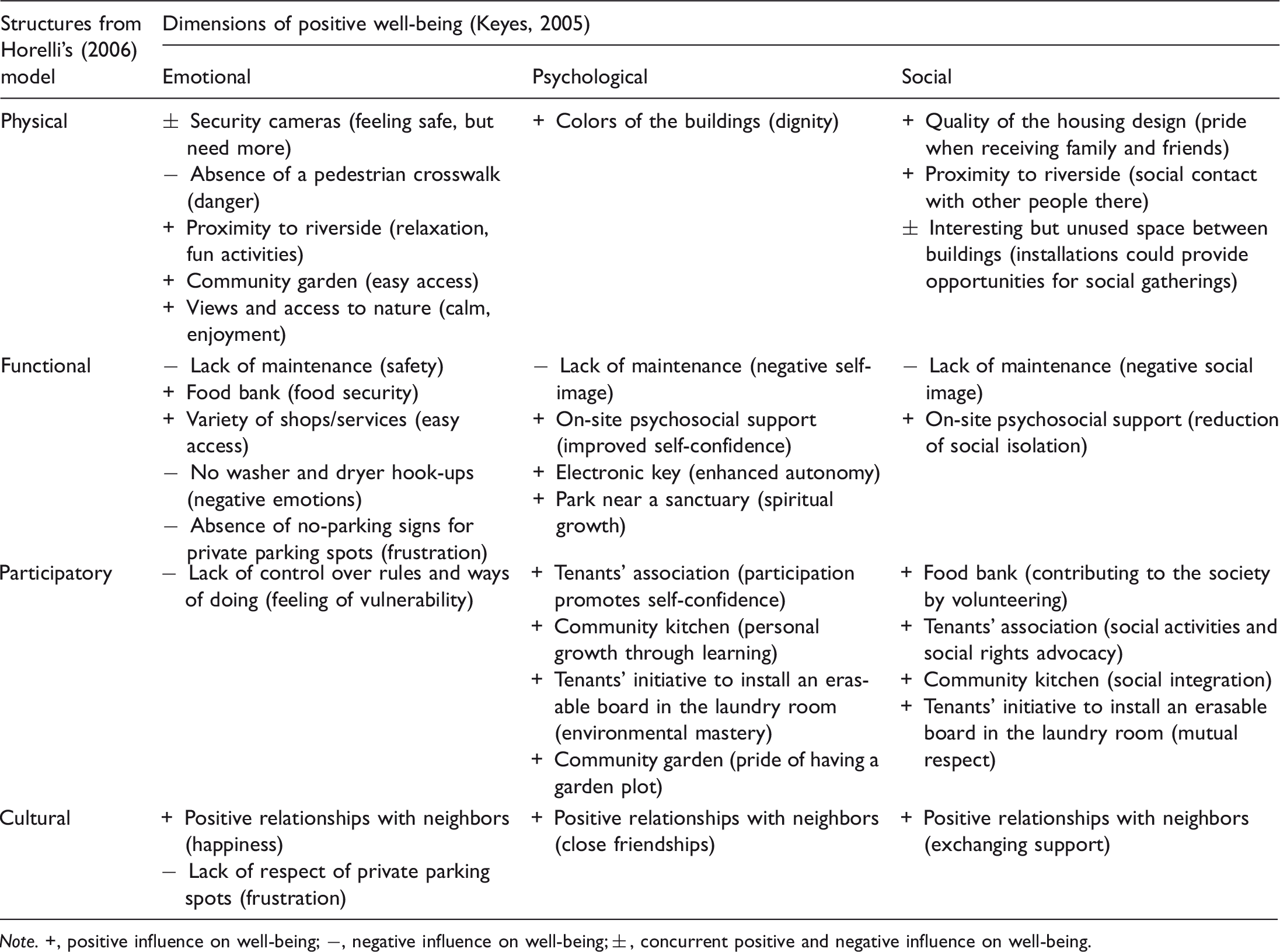
Six main qualitative themes emerged from the pictures and discussions as influential for the positive well-being of public housing tenants: (1) a pleasant home, inspiring pride; (2) variety of local resources; (3) mutual support and social participation; (4) control over life situations; (5) social, leisure, and growth opportunities; and (6) beneficial access to nature. These themes, along with selected quotations accompanied by participants’ ID numbers, are presented below in order of salience (see Figure 1 for a summary of themes and photos of significant examples). Each theme contained a number of positive and negative issues related to Horelli’s (2006) physical, social, participatory, and cultural structures. As expected, these structures were all perceived by peer-researchers as having an impact on the various dimensions of their positive well-being. Table 3 summarizes the positive and negative issues emerging from the pictures.
1. A pleasant home, inspiring pride
Examples of the most significant photos. Most salient issues photographed, in relation to their perceived contribution to positive well-being. Note. +, positive influence on well-being; −, negative influence on well-being; ± , concurrent positive and negative influence on well-being.
Peer-researchers highlighted the importance of an attractive, safe, and well-maintained residential setting, where they could be proud to live. On the positive side, participants found the buildings’ colorful exterior design, different from a typical public housing development, particularly beneficial: “I love the colors of the buildings. It’s not all gray like the other buildings around” (P5); “It gives us dignity” (P1).
Peer-researchers had negative comments concerning overflowing garbage bins (Figure 1, Picture 1) and their proximity to the units. This lack of maintenance impeded their emotional well-being and even affected their self-image: “It attracts vermin and the smell is unpleasant” (P10); “Welcome to our place! This is not good for the reputation of public housing!” (P2). Of all the issues addressed during the project, waste management was identified by the largest number of peer-researchers as the situation that hindered their well-being the most.
2. Variety of local resources
On the positive side, participants photographed several resources available on-site and in the neighborhood. Among the most significant resources were community organizations helping to fulfill basic needs such as food and clothing: “The food bank is a wonderful resource giving us food security” (P7) (Figure 1, Picture 2). The food bank also represented an opportunity for people to volunteer, which was beneficial for their social and emotional well-being: “It’s a way for me to contribute to my community. It makes me feel good” (P8).
Peer-researchers were grateful for an on-site community organization offering psychosocial support to families: “Their presence here is a gift. Having people to talk to helps reduce our isolation. There, we can talk to people who have great compassion, all of it confidentially. They give us confidence” (P9). Easy access to a variety of shops and other services such as a supermarket, a department store, and a drugstore was also discussed.
While less significant for peer-researchers, some possibilities to improve services were identified. For example, a ventilator-dependent peer-researcher stated “A lot of tenants suffer from physical or mental health conditions, but often they don’t have the reflex to consult a professional. It would be beneficial if the link between public housing and health services was improved” (P3).
3. Mutual support and social participation
Another theme was represented by pictures related to opportunities for tenants to engage in mutual support, on-site or in the neighborhood. At the interpersonal level, positive relationships with neighbors and family members were also mentioned. These pictures illustrated aspects that contributed positively to participants’ positive well-being.
One of the support and participation structures considered the most significant was the tenants’ association (Figure 1, Picture 3): “I have been in the committee for two years and it has been a full-time commitment. It is about improving my quality of life, because I engage myself, but also about how I can help improve other people’s quality of life. It improved my self-confidence.” (P7) 4. Control over life situations
Most pictures grouped under this theme were negative, illustrating how the peer-researchers felt powerless and vulnerable with respect to certain situations and rules. However, some of the situations generated creative solutions for taking ownership of their life setting.
One example of a negative situation concerned the laundry machines (Figure 1, Picture 4): “There are no washer and dryer hook-ups in my apartment. So I have to pay ¢75 per wash. This situation doesn’t bring me well-being. It’s even destructive for me” (P5). Also, the number of washing machines was judged to be insufficient, as there was only one for each floor, servicing 13 apartments. Tenants often had to deal with machines being in use when they wanted to do their laundry. On one floor, tenants installed a board over the laundry machine, where the tenant currently using the machine could write his/her apartment number. The next tenant who wanted to use it could add an apartment number. The first one could then knock on the second one’s door when the machine was free. “We wanted to know each other better and be more respectful of each other” (P7). In response to a problematic situation, tenants developed a solution that brought them a greater sense of social well-being and enhanced their environmental mastery.
On the positive side of the theme of control, peer-researchers mentioned the electronic key they had recently obtained, which supported their autonomy and gave them a sense of freedom, as it allowed access to their storage lockers between 9:00 AM to 9:00 PM, compared to previously more restricted hours.
5. Social, leisure, and growth opportunities
Peer-researchers were very positive regarding different places in the neighborhood (e.g., public areas, arenas, etc.) that provided opportunities for meeting other people, having fun, and developing their potential. A picture of the community garden was identified as the most significant in this category (Figure 1, Picture 5). Several peer-researchers used this space, which was located across the street from the public housing development. “For $12, we can have a plot and access to all the necessary tools. There are elevated garden bins for people with disabilities” (P8).
Access to the nearby Saint Lawrence River, which provided people with a variety of socialization, leisure, and relaxation opportunities, was underscored as a benefit: “Each time I take a walk on the riverside, I meet a lot of people, families, and couples. Fishing makes people come together” (P5).
On the negative side, peer-researchers noted that the large green areas between the public housing development buildings were mostly unused due to the absence of recreational installations. This was seen as an improvement opportunity that could impact their well-being.
6. Beneficial access to nature
The housing’s access to nature was a theme that clearly emerged in the first pictures taken by the peer-researchers, from easy access to green areas to beautiful views of natural elements. One participant expressed how privileged she felt that her apartment was located on a higher floor, affording pleasant views of the surrounding landscape (Figure 1, Picture 6): “I feel lucky and spoiled by Nature, across the seasons. This view is calming, it makes me smile inside” (P7).
Participants identified several nearby parks. One of these parks was large, with trails for hikers and cyclists. Another park was located beside a religious sanctuary: “I can pause for a moment of silence in the middle of nature” (P10). Peer-researchers elaborated on the multiple benefits of nature, underlining how it motivated them to take care of their physical health, inspired positive emotions, and stimulated their personal and spiritual growth. The discussion also triggered some thoughts on the importance of respecting nature: “People here make efforts to keep the environment clean. These are the beautiful lungs of our planet” (P9).
Community intervention outcomes
Based on the research findings, peer-researchers brainstormed on what should be improved, how this could be achieved, who had power over the designated issues, and the complexity of the actions to be undertaken. Peer-researchers identified five avenues for action: (1) incite tenants to be more involved in maintenance (related to waste management); (2) celebrate tenants’ involvement; (3) facilitate the use of laundry machines; (4) increase availability of information about resources and services; (5) organize activities for all tenants. Peer-researchers then presented these priorities to the tenants’ association and to a community organizer from the municipal housing office, to share the ensuing responsibilities.
A first joint action between peer-researchers and the tenants’ association was a meeting with the housing office’s director of maintenance concerning waste management (avenue 1). Also, with the aim of making information accessible (avenue 4), the director was asked to install a bulletin board in the entrance of the main building, which was done recently. To facilitate the sharing of laundry machines (avenue 3), peer-researchers installed dry erase boards like the one described earlier (see Research findings, sub-section “Control over life situations”) to provide a means of communication between tenants concerning machine use. The effort to organize activities (avenue 5) was led by a peer-researcher who, with the support of the tenants’ association, developed a list of ideas for activities to be offered on-site. A survey recently conducted by the research team collected the opinions of a large proportion of tenants regarding their intention to participate in these activities should they be offered. Finally, although not directly mentioned in an avenue for action, a request was sent to a city councillor to have a pedestrian crosswalk installed. Although the pedestrian crosswalk has not yet been added, as a result of the tenants’ request, a stop sign has been installed to slow traffic. A brochure summarizing the study’s results was distributed to every public housing development household. A public forum is currently being organized by the peer-researchers, where all tenants and influential stakeholders will celebrate the strengths of their community and collectively identify priorities for actions (Hergenrather et al., 2009).
Although final outcomes have yet to be determined, the intermediate outcomes are consistent with Catalani and Minkler’s (2010) review of Photovoice outcomes: enhanced community engagement in action and advocacy, increased community mobilization, and improved understanding of community needs and assets. According to feedback from eight of the peer-researchers, their participation was positive at the personal level, improving their self-esteem, sense of control, and social skills. At the collective level, five of the eight were positive that the project would lead to concrete improvements in the residential environment. The other three were more skeptical, underscoring that, although they are now more aware of the situation, the final decisions depend on higher authorities.
Discussion
Toward a comprehensive view of well-being in the public housing environment
Peer-researchers mostly photographed aspects of their residential environment that promoted their well-being, as evidenced by the preponderance of plus signs in Table 3. Well-being was mostly enhanced by the variety of local resources; mutual support and participation; availability of social, leisure and growth opportunities; and beneficial access to nature in the residential environment. The peer-researchers’ overall positive perception differs from previous studies depicting a rather negative view of public housing tenants’ environment and well-being (Black et al., 1998; Hayward et al., 2015; Rivest, 2006; Shin et al., 2014; Simning et al., 2011).
When describing the impact of their environment on their well-being, the peer-researchers reported an array of positive emotions, appropriate psychological functioning, and flourishing relationships within the community. In line with studies showing the emotional, psychological, and social meanings of the home environment (e.g., Manzo, 2014; Tester & Wingfield, 2013), our findings suggest that these dimensions are important when considering well-being outcomes. As the classic indicator of place-related quality of life (Wahl & Mollenkopf, 2003), residential satisfaction has been the focus of several studies on public housing (e.g., Lord & Rent, 1987; Mohit, Ibrahim, & Rashid, 2010). Nonetheless, based on the peer-researchers’ point of view, this focus may be insufficient: housing was not only considered as a commodity that can be satisfying or not, but also as something that had a more profound impact on their psychological and social flourishing.
One might think that the predominance of positive perceptions is due to positively oriented questions. However, peer-researchers were reminded several times that aspects hindering their well-being were also relevant. In fact, they were far from having a Pollyanna view of their residential environment. They discussed several problems (e.g., waste management difficulties, lack of safety) that needed to be resolved for the housing development to truly become a pleasant home, inspiring pride. They noted several recurring problems (e.g., limited dissemination of information), as well as a lack of amenities (e.g., laundry machines) in the residential environment that made them feel a lack of control over their life situation. These aspects are consistent with other studies on public housing tenants’ perceptions on lack of safety and maintenance, which have underlined the need for empowerment (e.g., Hayward et al., 2015; Normoyle & Foley, 1988). Beyond confirming these negative aspects of public housing tenants’ experience, our results support the adoption of a balanced perspective. The peer-researchers discussed concurrent positive and negative aspects of safety measures (i.e., feeling safe because of security cameras, while at the same time finding they were not sufficient in number) and leisure opportunities (i.e., interesting but unwelcoming green areas between buildings). Although they might be ambivalent (Manzo, 2014), the peer-researchers seemed to have developed a strong sense of belonging to their environment. This matches the experience of other public housing tenants who disagree with the traditional rhetoric “of public housing as places of last resort that people are eager to leave” (Manzo, 2014, p. 404). Rather than presuming that public housing tenants’ opinions of their environment are negative, social workers should bear in mind the many facets of the person–environment relationship of the tenants they work with.
Despite its exploratory nature, the present study highlights that various structural characteristics of one’s residential environment have the potential to support each dimension of positive well-being. The themes emerging from the pictures encompassed all four structures from Horelli’s (2006) person–environment fit model, as well as all three dimensions of well-being from Keyes’ (2005) model. While the results are highly contextualized and generalizations should be made with caution, it is interesting to see that the themes identified in the study are consistent with these two models. Furthermore, the emergence of themes related to the presence of natural elements, availability of services and leisure facilities, as well as mutual support between neighbors is in line with previous research on the crucial aspects of residential environment (e.g., Hayward et al., 2015; see reviews from Amérigo & Aragonés, 1997 and Weidemann & Anderson, 1985).
The grid formed by the intersection of both models (Table 3), which integrates knowledge on human flourishing and its structural determinants, is a useful tool for community social workers, stakeholders, policymakers, and urban planners alike. Given the limitations of the present exploratory study, the grid framework should be used as a community intervention tool without focusing on the specific issues it contains for this case. For example, it could be employed when evaluating and designing a public housing environment from a user-centered perspective (Brabham, 2009) or when working with tenants to improve their environment. This grid can be used to ensure that an array of important structures are considered when designing the environment and to stimulate discussion on how these structures can meet people’s various needs in terms of well-being.
Tenants as active agents in improving the person–environment fit in public housing
Our findings illustrate that public housing tenants can play an active role in making their environment more congruent with their needs and goals. In fact, control over their life situation emerged as a theme in itself. Although peer-researchers considered their control limited, they discussed both formal (e.g., tenants’ association) and informal (tenants’ initiatives) channels for appropriating more power. Such channels appeared to not only enhance the tenants’ environmental mastery, but also to promote social well-being. This is consistent with Horelli’s (2006) proposition that appropriation of structures of the residential environment by residents leads to the creation of a shared culture of community and social capital.
In line with its empowerment-based rationale (Wang & Burris, 1997) and previous empirical evidence (e.g., Duffy, 2011), the Photovoice approach appeared to potentiate the active role of public housing tenants. Feedback gathered after the end of the project suggests that participation had empowerment-related benefits at personal, interpersonal, and collective levels. Several peer-researchers expressed how much they appreciated that their opinions had been taken into consideration by the team of researchers and shared with stakeholders. One participant described how the project helped her overcome her shyness as she presented the findings to an assistance of more than 50 people at a conference. Although several of the peer-researchers were volunteering in their community before the project, others were only marginally mobilized. That two of these less engaged participants collaborated on follow-up steps suggests a potential enduring effect of the project. They appeared highly motivated to translate the results into positive changes for their residential environment. In terms of concrete outcomes, environmental improvements were observed following the project as a result of the mobilization of peer-researchers and their community partners. This evidence, although preliminary, supports the usefulness of the Photovoice method as a means for social workers to support public housing communities in empowering themselves.
Revising Honneth’s (1996) recognition model, Houston (2016) recently proposed that social workers should strive to recognize the abilities and worth of people from oppressed communities so they can achieve pride in themselves. Restoring one’s pride through recognition has the power to activate one’s belief that it is possible to change his/her social conditions. Through our research, such as during the exhibit which publicly celebrated peer-researchers’ expertise and strengths, Photovoice has proved to be an efficient group-based strategy that social workers could use as a powerful social recognition tool.
Limitations of the study
The Photovoice is designed to be used with small groups (Mahalingam & Caridad Rabelo, 2013), allowing in-depth discussions of the issues photographed. In that sense, the sample size of the study is adequate, near the median number of participants in Photovoice research (see reviews from Catalani & Minkler, 2010; Hergenrather et al., 2009). However, when considering dominant research standards, the sample size remains a limitation that reduces generalizability. Peer-researchers were advised not only to think about their own experience, but also to think more globally in terms of the other tenants and what would be essential for future public housing developments. Nevertheless, the fact that most participants were women who were advanced in age might have biased the results. For example, access to educational facilities and employment services was not salient. The fact that many peer-researchers were volunteers in the housing development before the study may have biased the results positively since community participation has been associated with higher levels of residential satisfaction (Dassopoulos & Monnat, 2011). While recognizing this as a limitation, we also note it as a strength, since the participants’ greater involvement made them more knowledgeable regarding their residential environment. The fact that several of the peer-researchers had only recently been living in the public housing development was probably not representative. On the other hand, when considering that people may adapt over time to their residential situation through cognitive restructuring (Amérigo & Aragonés, 1997), the peer-researchers’ fresher point of view could be seen as positive, as they probably were more likely to notice and report the negative elements. Nevertheless, other studies could adopt a more personalized outreach approach to ensure that men and people from diverse cultural backgrounds are represented, as well as longer-term tenants. Finally, the fact that the public housing development had recently been renovated could account, at least partially, for the positive observations made by the peer-researchers concerning the physical structures.
Given these barriers to standard generalization, the authors have opted in this article to provide a “thick description” of the phenomenon and context under study, so that readers can evaluate the transferability of the findings (Miyata & Kai, 2009; Shenton, 2004), which is the appropriate approach to take in a qualitative paradigm (Lincoln & Guba, 1985). Some issues highlighted by the peer-researchers in this study seem similar to the experiences of tenants from other developments in Québec (Canada). For example, issues associated with the cost of using washing machines, as well as the lack of control felt by tenants, have previously been highlighted by a provincial tenants’ organization (Fédération des locataires d’habitations à loyer modique du Québec, 2013; Labrecque, 2015).
Although the facilitators were instructed to let the group express its own point of view on the pictures, their presence as community outsiders may have biased the discussions. While the facilitators had not experienced living in a public housing setting and were younger than most peer-researchers, some similarities between both groups are noteworthy. They shared the same ethnic background, as they were all White, Canadian, French-speaking individuals. One facilitator was a woman, while the other was a man. His presence might have limited participants’ expression concerning certain topics that can be influenced by gender, such as feeling safe in the neighborhood (Schafer, Huebner, & Bynum, 2006). A trusting relationship nevertheless appeared to develop between both facilitators and the peer-researchers. For example, during the process, peer-researchers were instructed to contact the facilitators by phone for any problem or question related to their work on the project. The fact that several peer-researchers did not hesitate to contact both facilitators when needed is an indicator of the quality of the ensuing relationship. Moreover, on various occasions following the Photovoice project, peer-researchers invited the facilitators to community gatherings organized by the tenants’ association.
Conclusion
Findings from the study suggest that, through the use of Photovoice, researchers and practitioners can contribute to social work’s grand challenges, as recently released by the American Academy of Social Work and Social Welfare. The present research has developed new knowledge and promoted concrete positive outcomes in relation to individual and family well-being, a stronger social fabric and a just society. These have been identified as the three organizing areas of social work’s grand challenges (Bent-Goodley, 2016).
Contrary to the majority of research on public housing, this study’s salutogenic focus led to an understanding of what is “going right,” in addition to what is “going wrong” (Biswas-Diener & Patterson, 2011). However, the findings should not be interpreted in a way that minimizes the difficulties public housing tenants face. Neither should the entire responsibility of their well-being be put on their shoulders. “Blaming the victim” (Ryan, 1976) has been highlighted as a paradoxical risk of positive approaches (e.g., Held, 2002). Rather, the overall transaction between person and environment should be considered. Although peer-researchers recognized their active role in improving the situation, they also expressed their fear that local decision-makers might not support their initiatives. Tenants’ strengths and mobilization should be harnessed as vectors for social change (Rappaport, Davidson, Wilson, & Mitchell, 1975), while considering that a certain amount of strategic external support is useful and sometimes essential (Foster-Fishman et al., 2006). Community social workers therefore have to strive to find the right balance between empowering and assisting. In the larger scheme, their work must also be viewed as complementary to a wider societal effort to reduce place-based social inequalities.
Footnotes
Ethics
Ethical approval (S-705135) was granted by the institutional research ethics board for research involving human participants at Université du Québec à Montréal, Canada.
Funding
The author(s) disclosed receipt of the following financial support for the research, authorship, and/or publication of this article: an Insight Development Grant (#430-2014-00483) from the Social Sciences and Humanities Research Council of Canada.
Acknowledgments
We want to acknowledge the invaluable contribution of the ten peer-researchers without whom this research would have been impossible: AL, Claire Béliveau, CG, F Bisson, Johanne, Lucie Cayouette, M Dunn, SD, Suzanne Raymond, and Valérie Lavoie. Thank you so much for your time, creativity, motivation, and long-term commitment. We are also grateful to Benoit Martel, Josiane Roy, and Andréa Jacques for their research assistance at different stages of this project. We would like to underline the precious collaboration of the Office municipal d'habitation de Montréal (Danielle Lacroix and Elaine St-Onge), the Maison de la culture Pointe-aux-Trembles as well as the Community kitchen À toute vapeur.