







Abstract
Summary
It is commonly understood that enrolment in higher education means inevitable financial strain. In an online national survey in 2015, a sample of 2320 current students from 29 Australian social work programs reported on their experiences of juggling life, study and work.
Findings
This article details preliminary findings regarding the impact of low levels of income on the lives and study success of an Australian student cohort, and offers a considered comparison to relevant available data. Students in this study reported regularly going without necessities, and identified that a lack of finances and long hours in employment were adversely affecting their study experience. These problems became acute during compulsory field placements.
Applications
The purpose of this study was to illuminate social work students’ complex study realities in order to inform future education, policy and practice. The findings identify that for these students adverse outcomes including poverty and disruption to studies may be increasingly difficult to avoid. This situation may not be confined to this cohort or the Australian experience. There appears to be an urgent need for national bodies, universities and students to join together in advocating for increased support for tertiary social work students.
Introduction
In Australia, progressive higher education policies, a social inclusion agenda and widening tertiary access all have increased the numbers of working-class, mature-aged, first generation and Indigenous university students. In 1974, the government abolished university fees in Australia and established a system of student income support payments that continue to today. In 1989, fees were introduced but at the same time a Government loan system was introduced that meant that students who could not afford tuition fees could delay payment till in paid employment. Loans are low interest and repaid through the taxation system. While university scholarships still exist, they account for only a small percentage of student income or tuition fees. As a result of these and other university centred policies, working-class, mature-aged, first generation and Indigenous university students now comprise a significant proportion of the higher education sector (Tones, Fraser, Elder, & White, 2009). However, the level of government income support to assist these new students has not responded to this new reality, resulting in large numbers of students experiencing severe financial hardship during their student lives (Bexley, Daroesman, Arkoudis, & James, 2013). Over the last 20 years Australian governments, both Labor and Conservative, have overseen a reduction in real terms of income support payments paid to students (Klapdor, 2013). While this study is restricted to an Australian cohort, it has implications beyond Australia to international cohorts where levels of financial support for students are declining or are under threat. Nationally and internationally there may be an enduring discourse that university places predominantly still go to the school-leaver children of the elite, contributing to reduced compassion for financially struggling university students (Gittins, 2008; Haveman & Smeeding, 2006).
Flowing from this discourse is a failure to take seriously the poverty of students. It is assumed that these more contemporary cohorts will make the required academic, cultural and social transitions to break the cycle of inherited, intergenerational poverty and disadvantage, and successfully graduate from higher education (Gofen, 2007; Preece, 2006).
While most Australians who are poor, live in relative poverty (McDonald, 2013, p. 6), it is known that such poverty can inhibit and limit higher education success and that financial constraint is a cause of withdrawal from tertiary studies (Ellender et al., 2008; Gale & Tranter, 2011). As noted above, students from working-class, first generation and Indigenous backgrounds make up a growing proportion of the tertiary student body. These students may already be under financial and social stresses in many aspects of their lives, often due to structural and social disadvantage, over-indebtedness, material hardship, welfare cuts and modest means (Krumer-Nevo, Gorodzeisky, & Saar-Heiman, 2016; Tones, Fraser, Elder, & White, 2009). There appears to be limited analysis in the higher education literature highlighting the daily implications for some students who are members of these new, previously excluded cohorts representing diversity and difference.
Further, it has been reported that financial debt for more recent cohorts of tertiary students has been growing to unacceptable levels, thereby impacting key envisaged outcomes (Bexley et al., 2013; Bradley, Noonan, Nugent, & Scales, 2008). In this article, the financial and study circumstances of a current cohort of Australian tertiary social work students is reported. In doing so, we hope to give a broader understanding of the depth and breadth of the problem of student poverty to help inform the work of educators, academics and policy makers and to challenge the widely held view that student poverty is of minor significance. As such it is an act of resistance to what Bessant (2007, p. 29) has called, ‘a long standing political strategy designed to denigrate unfavourable research findings while simultaneously deflecting attention from the Government’s failure to take effective action in respect to the problem of student poverty’.
The purpose of the study was to illuminate social work students’ complex study realities in order to inform future education, policy and practice. Previous large national Australian studies exploring impact of low income on the lives and study success of social work students were not apparent.
Understanding the realities of study and work stresses for tertiary students
A recent Universities Australia study of student finances reported that the percentage of full-time domestic students who regularly had gone without food or other necessities had risen from 14.7% in 2006 to 18.2% in 2012 (Bexley et al., 2013, p. 7). Additionally, several recent Australian studies looking at the issue of food insecurity found much higher rates in tertiary student cohorts than was reported in the general population (Gallegos, Ramsey, & Ong, 2013; Hughes, Serebryanikova, Donaldson, & Leveritt, 2011; Micevski, Thornton, & Brockington, 2014).
Linked closely to the phenomenon of growing financial stresses for higher education students has been the increasing number of paid work hours that students are undertaking. The abovementioned Universities Australia study found that, among the 80.6% of domestic full-time undergraduate students with paid employment, the average hours worked had increased from 14.8 to 16 hours over the previous 4 years, with approximately 25% of these students working more than 20 hours per week during the semester (Bexley et al., 2013, p. 8). Fifty percent of students in that study indicated that their paid work adversely impacted their study. Similarly, James, Krause, and Jennings (2010, p. 56) in a study of first year students found that ‘Students who consider deferring are more likely to work longer hours than students who do not consider deferring. These students also tended to do less well academically and engaged less with academic life’. A follow-up study of first year students by Baik, Naylor, and Arkoudis (2015, p. 61) found that students reporting financial stress had increased from a third to nearly 40%. Baik et al. (2015) found that almost two-thirds of students who worked did so to afford basic necessities especially those students who were older or from lower socio-economic backgrounds. Polidano and Zakirova (2011, pp. 33–34) found that young (under 25) full-time students who worked more than 8 hours per week were less likely to complete their course than those who do not work at all. Further, they found that the more hours students spent in paid work, the higher the likelihood of students not successfully completing their course (Polidano & Zakirova, 2011). While it has been argued that study ‘success’ need not always mean course completion, with benefits such as learning and self-development reported from students who had partially completed their studies, nevertheless most students seek the benefits of course completion (Merrill, 2015, p. 1860).
A critical issue is the low and declining rates of government allowances paid to eligible students. Within Australia’s income support system, the main payment types are pensions and allowances. Pensions are generally paid to older persons (Aged Pension) or to persons with a significant disability (Disability Support Pension). Allowances are paid to persons who are potentially part of the paid workforce who are either unemployed (Newstart Allowance, Youth Allowance) or students (Austudy, Abstudy, Youth Allowance). In 1997, the payment rate for Newstart Allowance for individuals looking for work was 92% of the Pension rate. By 2013, the rate was 67% of the pension and declining (Klapdor, 2013). The main allowances paid to students, Youth Allowance and Austudy, are paid at lower rates than the unemployment allowance. At the time of writing the Youth Allowance and Austudy allowances were the equivalent of 54% of the pension rate.
Contrary to the abovementioned studies, some authors have downplayed the effects of growing student financial distress, poverty, longer paid working hours and reduced government payments, particularly for younger tertiary students. For instance, Ryan (2014, p. 121) in a study of Youth Allowance and the financial position of young Australians concluded that his findings did not support increased benefit payments, ‘especially since the majority of students can improve their financial position by working part-time’. Similarly, Polidano and Zakirova, (2011, p. 35) concluded that young (under 25) tertiary students work for financial independence or to support their lifestyle, rather than to pay for basic necessities. Halliday-Wynes and Nguyen (2014, p. 27), while not disputing significant numbers of younger students experience financial distress, also argued on the basis of a small qualitative study, that financial needs ‘do not appear to be the main driver affecting completion rates and/or study decisions’. Yet the notion that financial stress is one driver in completion rates, even if not the primary driver, seemed worthy of further research interest, including differences for different tertiary cohorts. Halliday-Wynes and Nguyen (2014, p. 22) noted that ‘Because of their need to support themselves and focus on finding a job, they were left with less time to study, which induced further stress’.
As noted above, tertiary students may no longer be traditional school leavers with available family support who primarily seek paid employment to advance their independence. Rather, with changed higher education policies, older, mature-aged, first generation students, from lower socio-economic backgrounds, with care responsibilities for dependent children increasingly are seeking to upgrade their qualifications or retain their current employment through tertiary studies, particularly in some disciplines and some geographical regions (Tones et al., 2009). While mature-aged students have the potential to succeed at university at the same rates as school leavers, their economic and family responsibilities may hinder study success and lead to attrition (Tones et al., 2009). In their study of low socio-economic, mature-aged, tertiary Queensland students, Tones et al. (2009) identified that inadequate finances posed a major barrier to study success. Similarly, Ellender et al. (2008) found that the most prominent reason given by Indigenous students for withdrawal from their tertiary medical studies was financial.
Some studies have looked at the specific experience of social work students as they juggle study, household finances, and social and family commitments. Collins, Coffey, and Morris (2010) in a United Kingdom study found a relationship between emotional exhaustion in social work students and working more hours in part-time jobs. Similarly, in a recent Australian study, Agllias, Howard, Cliff, Dodds, and Field (2016) revealed the complex tensions for students in successfully balancing paid work, study and wellbeing.
Equally, Ryan, Barns, and McAuliffe (2011) in a study of Australian social work students across three social work programs found that 83.6% were in paid employment. While students identified a number of benefits to paid work, 76% indicated that their paid work impacted on their studies. These students specifically identified reduced time for study and fatigue from work (Ryan et al., 2011).
Of relevance, a recent study across six Australian universities has highlighted how compulsory field placements for social work students can heighten the financial hardship already experienced by many students ‘by impacting on students’ employment, financial situation, studies and wellbeing’ (Johnstone, Brough, Crane, Marston, & Correa-Velez, 2016, p. 486).
This comprehensive study across 29 Australian tertiary social work programs, involving every year of social work study, sought to explore students’ low levels of income and the effect of financial disadvantage on the lives of social work students and their study experiences. In doing so it contributes to our understanding of the serious problem of student poverty in Australia.
Method
This study proceeded as a working partnership between the Australian Association of Social Workers (AASW) and James Cook University. The research design comprised a national web-based survey of open and closed questions to collect data on tertiary social work students’ study experiences (Creswell, 2013). This method was chosen because it would enable the collection of quantitative and qualitative data, and could allow for a direct comparison with findings of the national electronic survey of a Universities Australia 2012 (Bexley et al., 2013) study of student finances. A survey instrument was regarded as the most efficient method of obtaining a large sample of responses.
The survey consisted of 23 questions (a full list of the survey questions can be obtained at the AASW website at www.aasw.asn.au/document/item/8872). The topics included student allowances and government assistance received, hours of paid work, reasons for engaging in paid work, and whether the family supported the student financially. Other questions sought to identify the impact of insufficient income on life and studies, the experience of studying while parenting and meeting other family responsibilities, hours spent studying, income, savings, and the financial impact of compulsory, unpaid field placements. Students enrolled in Australian accredited social work programs undertake a total of 1000 hours usually in two block placements of approximately 15 weeks located in the third and fourth year of their undergraduate studies or in both years for Masters students (MSW – 2 year program). This field placement requirement is not dissimilar to some other national professional programs. Additionally, there were several demographic questions. A total of 14 questions invited open-ended comments. In constructing the survey, while selecting questions that mirrored some Universities Australia study questions, the authors also considered an earlier pilot survey of student members of the AASW (2014), as well as the work of Ryan et al. (2011). The survey used SurveyMonkey technology.
In order to achieve as large a sample as possible, a number of techniques were used. First, before the survey was made available, the researchers communicated with the Australian Council of Heads of Schools of Social Work, seeking their support in recruiting students to this national study. Accompanying this communication was a letter co-signed by the Head of Social Work at James Cook University and the Chief Executive Officer of the AASW explaining the purpose and envisaged benefits of this jointly supported study. Researchers explained in the letter that they were seeking the enlistment of local champions at all Australian universities who would encourage student participation. A national reference group oversaw the study.
At the launch of the survey an email was sent to either the individual Heads of Schools or their nominated champion that contained an electronic flyer with an embedded link to the survey, along with a request that the survey flyer be distributed to all enrolled social work students. An additional email was sent to volunteer student champions promoting the study, as well as to all student members of the AASW inviting their participation (1100). A link to the survey was disseminated through the AASW’s National e-bulletin (18,000) to forward to students. Overall these recruitment strategies significantly contributed to the survey response rate.
Two weeks after the survey was launched, 950 students had participated and all 29 Australian accredited social work programs were represented. A snapshot analysis identified those social work schools with relatively low representation in the study. These schools were followed up with the purpose of finding additional local champions, either academic or student, who could promote the study. At this point, a number of student champions used social media including Facebook to increase participation. By the ninth week of the survey, 1770 students had completed the survey. A final email was sent to Heads of Schools and champions in the remaining 3 weeks before the close of the survey, resulting in a final completion tally of 2320 students. The total population of Australian social work students enrolled in tertiary social work programs at the time of the study was just short of 10,000 students based on compulsory accreditation reports from universities to the AASW.
Results
In this section, the demographics will first be described giving an overview of the respondents. Next, evidence in relation to how social work students were faring in comparison to other Australian university students is presented, together with data on the impact of low levels of finances on their lives and their study experience. Finally, data are included regarding paid employment, reasons for paid work, and its impact on their lives, wellbeing and study experience.
Demographics
In all, 87% of respondents were identified as female and 13% male. Thirty-one percent of the respondents were under 25 years of age, 33% were aged between 25 and 34 years and 36% were over 35 years. These figures reflect generally the gender and age bias of social work students in Australia.
Sixty-three percent of students were enrolled in a Bachelor of Social Work degree, 27% in a Masters of Social Work (qualifying or graduate entry) and 11% percent in a Masters of Social Work (by coursework or research).
Seventy-five percent of the students indicated that they had a full-time study load, 14% had a part-time load and 9% identified they were studying externally by distance education. Sixty-four percent of students lived in a metropolitan area, 27% in a regional area and 9% in a rural area. All Australian States and Territories were represented in the study.
Four percent of respondents identified their cultural background as Aboriginal and/or Torres Strait Islander (Australia’s Indigenous peoples). Nine percent of the students were international students, and 19% of respondents identified as members of the AASW (nationally about 11% of the total social work student population were members of the AASW at the time of the survey).
A total of 47% of students received government financial assistance in the form of allowances or pensions: Youth Allowance (18%), Newstart Allowance (4%), Abstudy (1%; Aboriginal and Torres Strait Islander students only) or Austudy (14%), Parenting Payment (5%), Disability Support Pension (2%), Carers Allowance (3%). In addition, 14% of students received Rent Assistance and/or Family Tax Benefit. Forty-eight percent of participants reported receiving no government assistance.
Comparison with the Universities Australia national study of university students
As noted, in order to better understand how social work students were faring when compared to the general Australian tertiary cohort, a number of questions were replicated from the Universities Australia national study (UA; n = 11,761). In this section, the preliminary findings are reported with a focus on the replicated questions. A summary of key results appear in Table 1 which focuses on the comparison of three questions: the extent to which students had gone without food or other necessities, savings in the case of financial difficulty, and whether students were supported financially by family. The questions in Table 1 appear in order of considered importance for comparison, rather than the order in which they appeared on the survey instrument. On the survey, ease of use and logical progression for the respondent was the higher priority. Here, those replicated questions capture student circumstances most succinctly and highlight the even greater financial difficulties experienced by social work students beyond those experienced by university students generally.
Comparison of National Study of Social Work Students (NSSWS) and University Australia (UA) study results for full time domestic students.
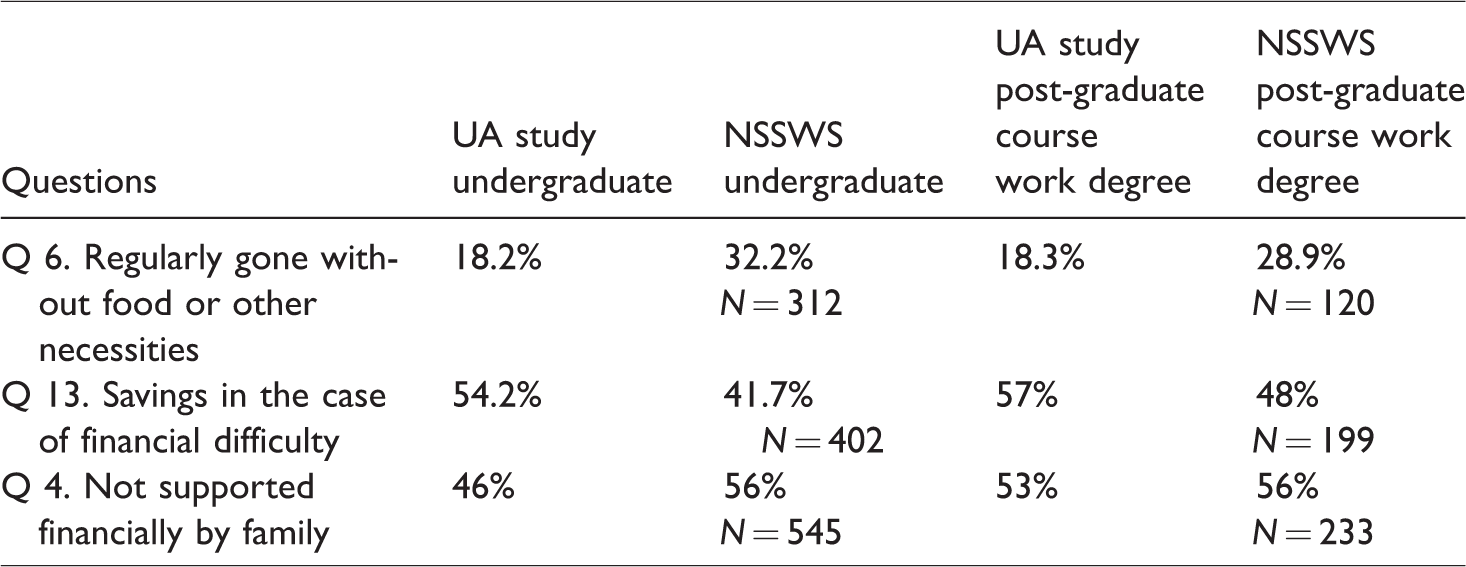
As reported above, in relation to Question 6, the percentage of full-time domestic social work students who reported regularly going without food or other necessities was substantially higher than in the general university cohort. This held true for students enrolled in both undergraduate and post-graduate course work social work degrees. A similar pattern emerged for part-time domestic students. For undergraduate students the figure for the UA study was 14.4% and for the NSSWS it was 29.6%. For post-graduate students by coursework the UA figure as 9.5% and for Social Work Masters students the result was 14%.
In Question 13, students were asked if they had any savings in the event of financial difficulty. Again there were differences with social work students having comparatively fewer savings.
Another question included in the NSSWS that was replicated from the UA study, Question 4, asked whether students were supported financially by parents, partners or other family members. Social work students tended to have less financial support from family or partners than findings from the UA study, although this was less marked for the full-time post-graduate students.
As the percentage of females who responded to this study was higher than in the UA study, the question arises as to whether the higher levels of disadvantage were related more to differences in gender rather than to the fact that the students were in social work courses. However, further analysis of the above questions only revealed small differences between males and females with a slight tendency for the males to be more disadvantaged.
Effect of insufficient funds on students’ lived experiences including placement
Bessant (2007, p. 25) argued that poverty line research and social exclusion explanations are limited in the contribution they can make towards building an accurate understanding of . . . student poverty . . . because they are not designed to produce information that allows us to see how various aspects of the student’s social world inform and interact with each other.
As in the earlier AASW (2014) pilot study, students were asked in Question 5, ‘As a student have you had at any time insufficient money for any of the following: food, clothing, accommodation, educational resources, transport, medication’. The major results are presented in Table 2.
Responses to the question ‘As a student have you had at any time insufficient money for any of the following?’.
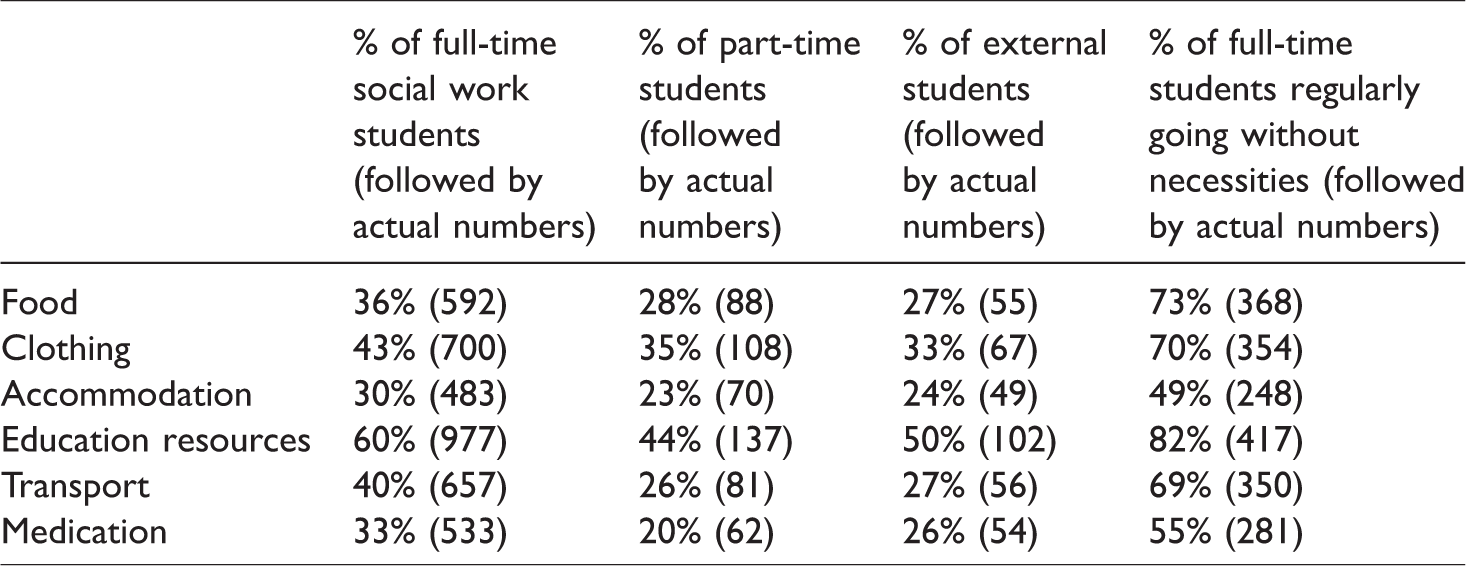
The answers to this question highlight necessities for which students lacked sufficient resources. Across all the categories and study modes, the percentage and numbers of students who had at some time insufficient money for a necessity was of concern. For students who had reported regularly going without necessities, Table 2 gives an understanding of the range of necessities that this involved. It also indicates that alongside the students who stated that they regularly went without necessities there was another quite large group that at some time in their studies acknowledged not having enough money for food, clothing, accommodation, education resources, transport or medication.
In addition to the quantitative data, qualitative comments were invited in a number of questions. In relation to Question 5, a key question on the survey for illuminating students’ insufficient resources, 829 students responded to the invitation to ‘please give a short description’. While these comments will be analysed in more detail in a later article, a representative sample of quotes is given below. The quotes highlight narratively the inter-related ways financial hardship is impacting the everyday lives and study experiences of social work students. *Yes at any given time, my rent is paid late, my car runs out of petrol getting home from fieldwork placement and I go without educational resources such as textbooks and laptop, and attending medical care as needed. (Student, 2316) *In the past when I worked part-time and received Austudy/Youth Allowance I had very little money and was rarely able to purchase textbooks or readers. I also have a chronic disease which requires a large amount of medication, which I have had to stop taking due to having insufficient money. (Student, 2210) *I have struggled financially throughout my entire degree. Several times I have missed out on certain things or not bought certain things due to finances. At times I have been incredibly ill and have not been able to afford a doctor’s appointment, medication, and have still been required to work to sustain an income. (Student, 2165) *I am a full-time student with 2 children in my care and being on Centrelink [government welfare office] benefits with no income coming from child support nor paid part-time job, yes, it is common for me and my family to experience a shortage of money in all aspects and it’s been challenging. (Student, 2161) *As a student I was very, very short of money. I could pay the rent and telephone bill and internet bill and just enough petrol to travel to university. I lived on $1 noodles everyday, and took free food that I could find at the university and thought about living in my car. In the end, I couldn’t pay my bills and became bankrupt … whilst I was doing my placement. (Student, 1730) *With not being able to work more than approximately two hours per week with my disability and my husband being self-employed and having two teenagers in high school, finances are extremely tight and more often than not I have to rob Peter to pay Paul. (Student, 30)
Effect of insufficient funds on general study experiences of social work students
A series of further questions explored the effect of lack of finances on the study experiences of students. As previously noted in Table 2, in answer to the general question about insufficient money to pay for educational resources, over half the students reported that insufficient funds was an issue for them.
The results of a more specific question about the effect of lack of money on their ability to complete studies are reported below in Table 3.
Responses to the question ‘Does the amount of money you receive from the government affect your ability to complete your studies in any of the following ways?’.
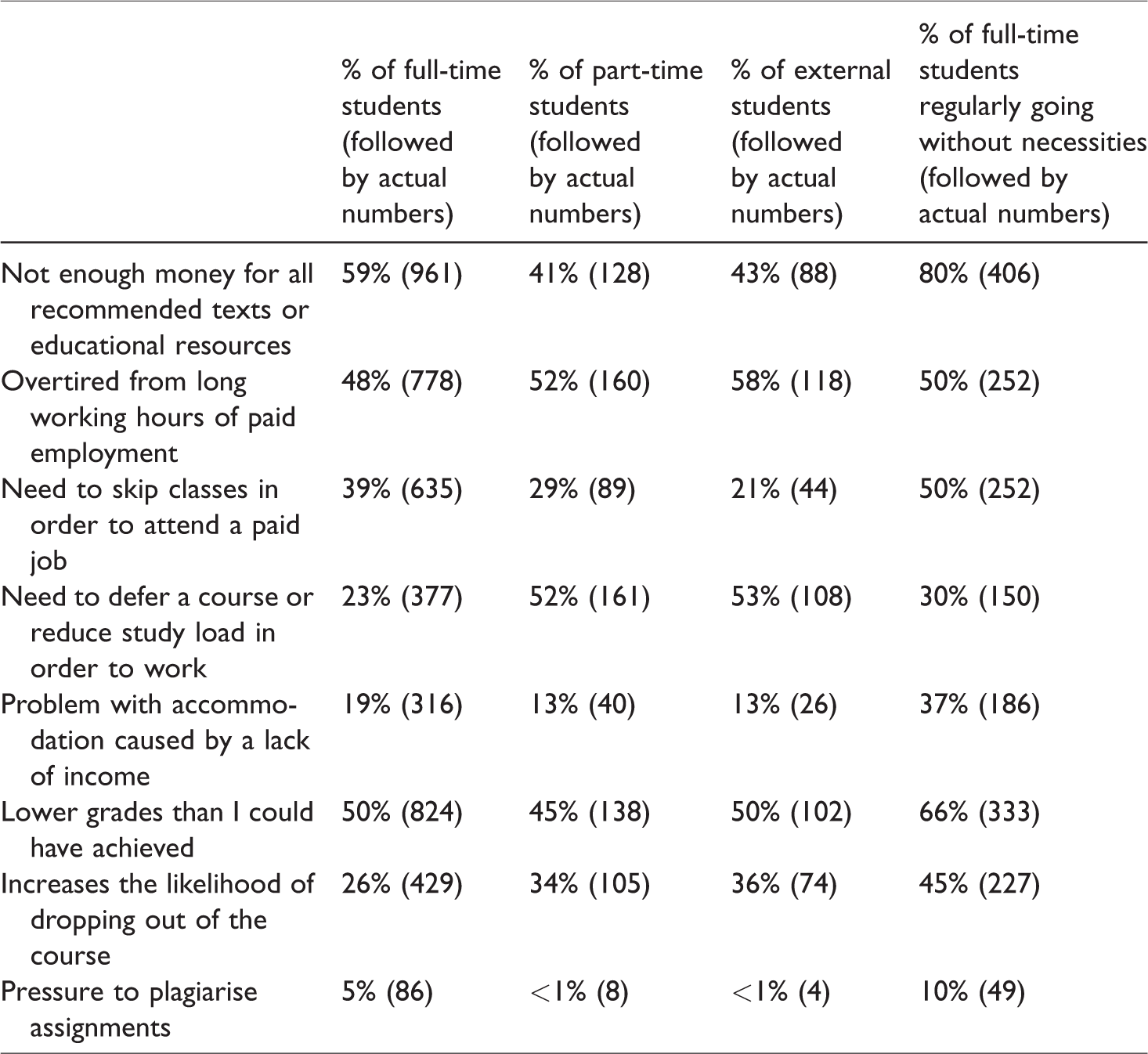
These results indicate a range of ways in which lack of finances and lack of study time (due to paid work) impacted on the lives of students, from lower grades through to deferring or reducing study load, and feeling pressure to plagiarise the work of others. Typically, students in this study who identified one impact also identified other impacts. For example, among full-time students who identified deferring or reducing study load, other impacts were identified including being overtired from working long hours (66%), needing to skip classes to attend paid work (56%) and problems with accommodation (29%). The effect was even more marked for those students who were regularly going without study necessities including not enough money for recommended texts or educational resources (80%), and problems with accommodation (37%) that increased the likelihood of dropping out of the course (45%).
Paid employment of social work students
Question 3 looked at why students stated that they engaged in paid employment. The results are contained in Table 4.
Responses to the question ‘What are the reasons you engage in paid work?’.
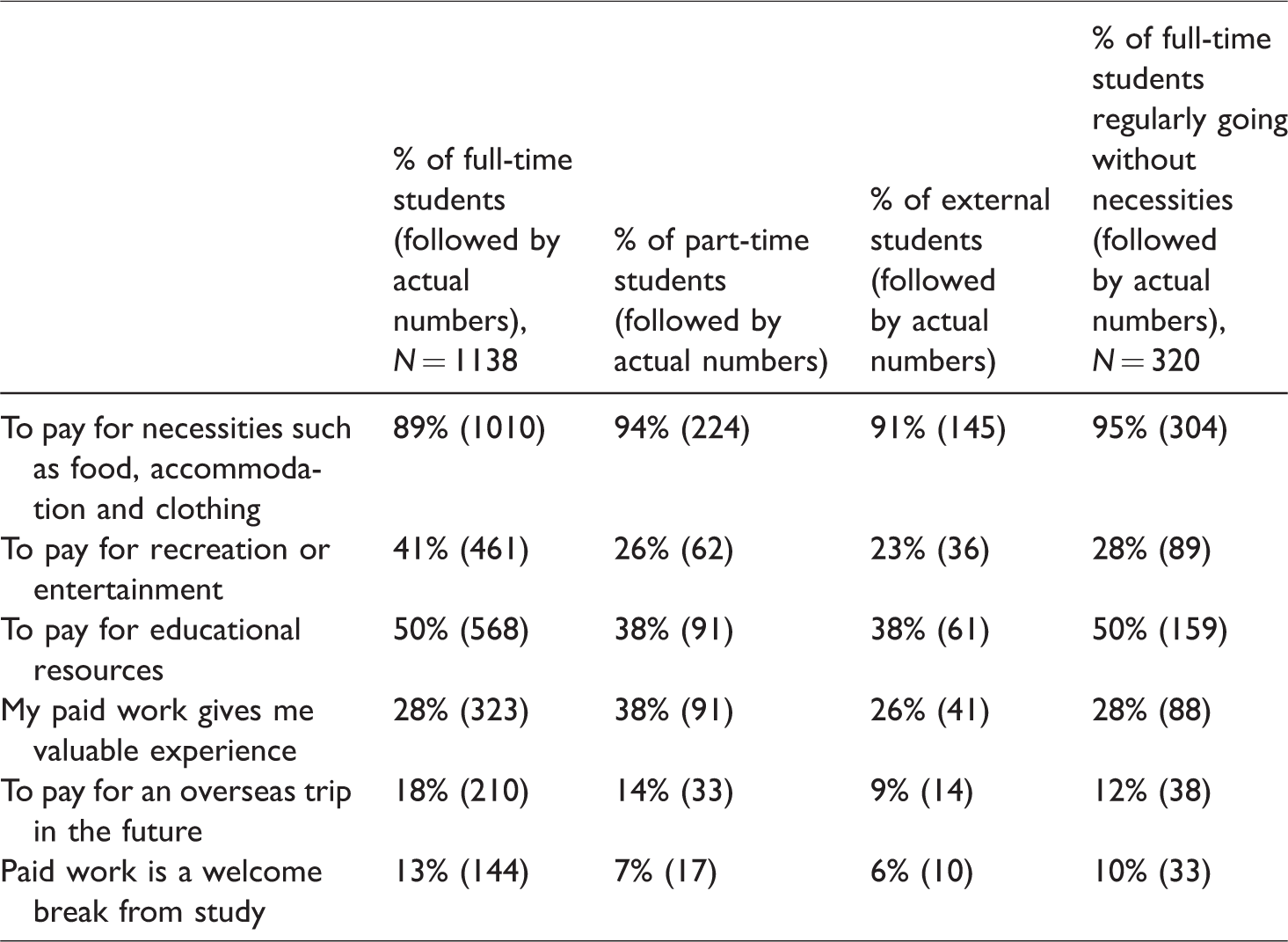
Around 90% of students consistently nominated having to pay for necessities as a reason why they engaged in paid work. However, students also nominated other reasons and other benefits to paid employment. For example, 28% of full-time students perceived their employment gave them valuable work experience. Of interest, older students were less likely than younger students to nominate lifestyle-related reasons for paid employment.
Hours in paid work
Students specifically were asked about the numbers of hours they spent in paid employment during term time. Seventy percent of full-time domestic social work students engaged in some form of paid employment. This is less than the rate of 80.6% recorded by the UA national study for all full-time domestic students. Compulsory placement may be a factor in this finding. Among the students who were without work, 26% indicated that they had quit paid work to attend their field placement. The number of hours worked by social work students in paid employment is outlined in Table 5.
Hours of paid work per week for employed students (Question 2).
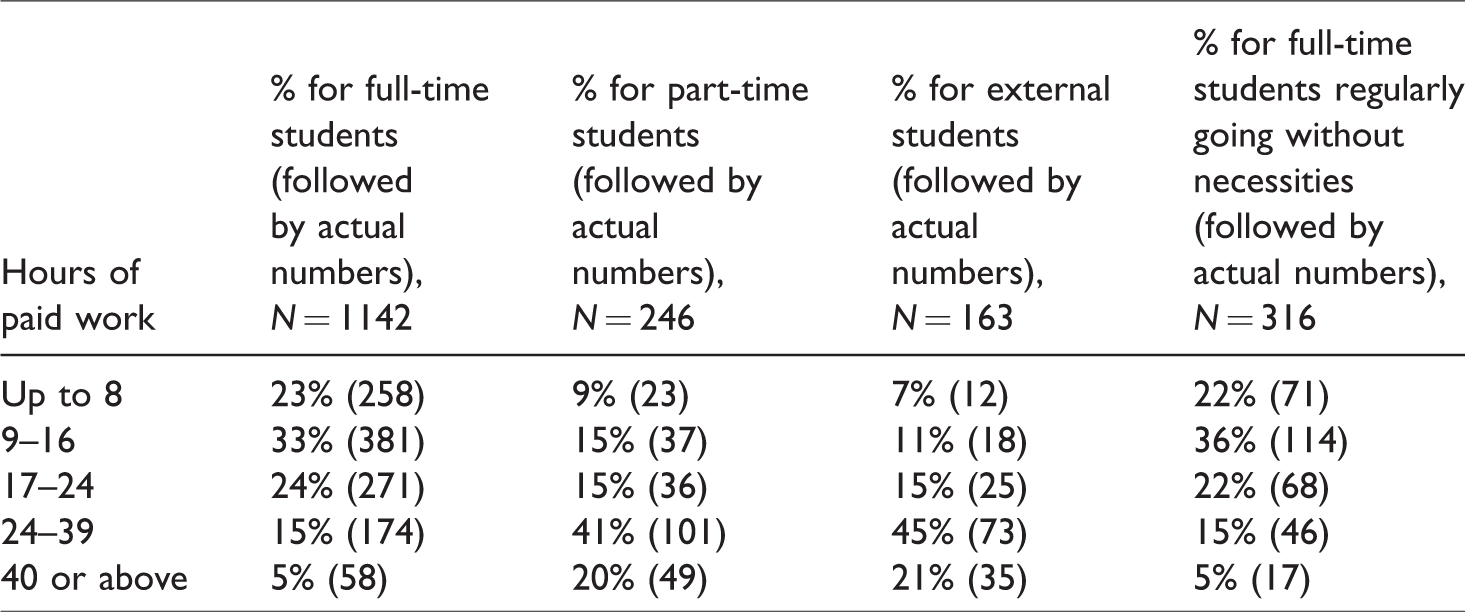
For those students who worked, the hours of employment for many of them were substantial. Among full-time students, 44% worked more than 16 hours per week with 20% working more than 24 hours.
Discussion
The findings from this study highlight the rates of financial difficulty being experienced by social work students as substantially higher when compared with those documented previously for a broader Australian tertiary cohort. The findings revealed that for many social work students, financial difficulty was a relative constant and it deeply impacted their studies, lived experiences and ability to secure necessities. For another large group, as described in Table 2, financial difficulties adversely affect their study from time to time.
It is of concern that high numbers of social work students were having difficulties with fulfilling their basic needs for food, accommodation and medication. Such deprivations have been considered in other contexts to constitute social injustice and breached basic human rights (Preece, 2006). Equally, it is difficult to see how these students are meeting the higher learning demands of tertiary studies in order to graduate. This hindered learning is further evidenced in the high percentage of students who stated they did not have enough money to buy recommended texts, as well as those reporting that they have achieved lower grades than they could have achieved because of a lack of financial support (Table 3) and those who felt pressured to plagiarise other’s work. Devlin and Gray (2007) identified causes for plagiarism including unintentional copying, time management pressures, a need to ease their workload and financial pressures, while Kenny (2007) identified that the pressure on tertiary students of balancing work and study was contributing to a rise in plagiarism.
Linked closely to the question of financial constraints is the complex balancing act between study and paid employment. Ninety percent of respondents in paid work used the additional money to pay for necessities and approximately 50% used it to pay for educational resources. Acknowledged here, some students indicated that aside from necessities, paid work had other advantages including valued work experience and entertainment.
Nevertheless, students confirmed that the long hours they were working to meet basic financial needs was impacting their learning. Forty-seven percent reported being overtired from long working hours of paid employment and 34% reported the need to skip classes to attend a paid job, both of which could impact on their learning, skill development and resultant professional capabilities as a graduate social worker.
Of equal concern, students who did not have paid work tended to be significantly worse off financially with 42% of these full-time undergraduate social work students stating that they had to go regularly without food or other necessities because they could not afford them. In a seeming ‘study versus paid work double bind’, some students reported they had forfeited paid work to complete their study requirements. This situation potentially leads to a more precarious balancing act between completing their course and having enough finances to survive. As noted above, among the students without paid work, 26% indicated that they had quit work to undertake their field placement.
While this research did not measure directly the effect of low finances on the decision to withdraw from study, defer or reduce subjects, several questions were asked about students’ perceptions. Among all students, 27% perceived that a lack of financial support increased their likelihood of dropping out of the course, this figure increasing to 45% for those students regularly going without necessities.
Delaying study, deferring or withdrawing from a university course can occur for a wide variety of reasons not yet fully understood (Stinebrickner & Stinebrickner, 2013). Attrition often is perceived as a phenomenon that is acute during the first year of study. However, a recent Australian study by Cardak and Vecci (2016) indicated that although the rate of dropout decreased across the first 3 years of a course, after 3 years of study the risk of dropout increases for students who were financially constrained. This finding is pertinent for vulnerable social work students because traditionally the final field placement occurs during the last semester of their fourth year. In this study, 29% of students reported needing to defer, or reduce study load to undertake paid work. Deferrals are known to increase the chance of students dropping out altogether, and they delay students’ progress for reasons that are not related to academic capacity.
What also seems clear are the additional costs of student poverty, including a loss of human potential, inhibited capacities, and dividends left unclaimed by students, educators, families and the profession when students drop out of their studies or struggle through with such high workloads that their professional knowledge base is impacted. A logical next step is what might be done to ameliorate these adverse effects as a matter of equity and justice.
While acknowledging that the situation is complex, as previously noted, the comparative levels of student income support have been in decline in Australia since 1997. These findings provide evidence of the need for increased levels of financial support for tertiary students to address the deprivation and disadvantage that is impacting their lives and their studies.
Specifically the accrediting body, social work educators and students may need to unite in political action to illuminate systemic allowance inequities, and urge government to reconsider the case for increased student allowance, particularly for tertiary students who are required to complete compulsory field placements. A reconsideration of student allowance eligibility also may be needed. There appears to be students who need government income assistance but who may not meet the current criteria. Only about half the students in this study were receiving government assistance of any form, yet more than half were showing signs that a lack of finances was seriously impacting their lives and study success.
One conclusion may be that the eligibility for assistance is set unfairly high. Bexley et al. (2013) in their study claimed that student assistance was well targeted because far fewer students from high socio-economic backgrounds were eligible. On the evidence of this study, we would dispute this claim. There are clearly many social work students with low incomes and little family support who are struggling financially to complete their social work studies. While students who do not require assistance should not receive it, a properly targeted system ensures that those students in need receive assistance.
At a national profession level and at a local, administrative course level, programs need to monitor the extent to which students are in need of increased study support. While the survey data reported here have been consolidated across national programs, every individual university program had students who reported living in poverty. Improved university student support, including increased universal academic support, could reduce risks of plagiarism and extend available early intervention across all years for ‘at risk’ students, thereby helping to address retention rates beyond first year.
For social work education, both nationally and internationally, an emphasis on teaching social work students about the manifestation of poverty in the lives of service users is essential (Beddoe & Keddell, 2016; Larochelle & Campfens, 1992). Yet, the extent of poverty revealed in this article indicates that some students know the experience quite well, and an additional focus could consist of acknowledging students’ own experiences from a structural viewpoint, to identify helpful ways to agitate to reduce the barriers that poverty imposes. In Australia, the government’s primary means of poverty relief is the income security system (McDonald, 2013, p. 6), of which student payments are a part. Helping students reflect on why their support payments are too low is an important step in helping them understand one of the ways poverty is reinforced structurally within Australia.
While not the focus of this article, an issue repeatedly raised was the impact of long, compulsory field placements on social work student finances and on students’ personal levels of emotional health and wellbeing. This matter, raised frequently by students over time, may need more insightful national attention.
Finally, this research centred on the impact of low levels of income on the lives and study success of Australian social work students. What is not illuminated is why students’ study choice of social work would mean greater financial constraints when compared to other tertiary Australian students’ experiences as demonstrated in the University Australia study. This question may need international social work research collaborators to help identify cohort patterns, and help ameliorate common stressors. Considerations could include that social work students may represent higher numbers of students coming from lower socio-economic backgrounds who have low levels of savings. A gender factor may be pertinent, given that social work is a female-dominated profession, or a lack of study preparedness given that comparatively, social work students might constitute an older, more non-traditional student group. Equally, compulsory field placement appeared to result in magnified financial stress. Yet other disciplines have compulsory placements although it may be the case that student demographics may be different in other professional programs. A final consideration is that in the years since the Universities Australia 2012 study was completed, the mainstream Australian tertiary student study experience has been further degraded with even more financial constraints and therefore these findings are of concern beyond social work (Dale, 2017).
Limitations of the study
Limitations of this study include that study findings came from only one source of data, and therefore triangulation of data was not possible. Nevertheless, comparative discussion has been possible because of replicated questions from key national studies. Equally, questions in the survey may not have allowed specific circumstances of student respondents to be illuminated, and more carefully targeted questions might have helped to reveal unique contexts. We consider that a certain level of bias is hard to avoid in the construction of a survey instrument and some may consider this to be a limitation in this study. Further research on this topic, including in an international context, appears warranted.
Conclusion
Many university students juggle work, life and tertiary study. Recent literature suggests that for some tertiary students, undertaking this balancing act is becoming more difficult, and financial constraints are placing their studies in increased jeopardy. The findings reported here support previous research. These findings reveal that social work students are doing it tough when considered alongside a wider university cohort study of Australian tertiary student experiences. Further research can illuminate the study circumstances of social work students beyond the Australian context. There appears to be an urgent need for national bodies, universities and students to join together in advocating for increased support for tertiary social work students. Equally, the findings may have implications beyond the social work student experience.
Footnotes
Ethics
Ethics approval for this research was given by the James Cook University Human Research Ethics Committee (H6155).
Funding
The authors received no financial support for the research, authorship, and/or publication of this article.
Acknowledgements
The authors thank the social work students who completed the survey, the academic and student champions and the reference group for their valuable guidance.