







Abstract
This study examined communication between 51 transition-aged foster youth and their social workers as related to perceived relationship quality and satisfaction with care receipt/provision. Youth–worker dyads were audio-recorded during a requisite monthly meeting and completed assessments of perceived relationship quality and satisfaction with social services. Communication was rated in a 5-minute excerpt across full audio-recorded speech, verbal transcribed content, and nonverbal content-filtered tone.
Findings
Ratings of workers’ communication in transcribed content most closely reflected workers’ reported perceptions of their relationship with the youth. In turn, youth’s perceptions of the relationship and satisfaction with care were most strongly linked to the content of workers’ communication. Similarly, youth’s communication in full speech and content most closely reflected their reported perceptions of their relationship with the worker and their satisfaction with care, and workers’ perceptions of the relationship and satisfaction with care were most strongly linked to these channels of youth communication.
Applications
Findings suggest that foster youth and social workers may communicate their authentic beliefs and expectations differentially by communicative channel. Further, both communication partners appeared selectively attuned to the most authentic speaker channels. These findings can inform case planning and intervention work focused on leveraging the power of the worker–youth relationship to improve key service outcomes for foster youth.
Introduction
A growing body of literature has investigated features of communication between providers and consumers as they relate to each participant’s satisfaction, engagement, treatment adherence, and well-being. The preponderance of this literature derives from medical settings where studies of provider–patient communication demonstrate that communication features are related to the quality of the provider–patient relationship, providers’ effectiveness and satisfaction in care provision, and patients’ treatment adherence and satisfaction. The current study extended prior research to a novel context by investigating the characteristics and correlates of communication between social workers and older foster youth in the child welfare setting. We evaluated multiple channels of communication, including semantic content in transcribed speech and nonverbal tone in content-filtered speech, to examine how communication exchanges between social workers and older foster youth map onto workers’ and youth’s perceptions of the social service relationship and their satisfaction with care provision and receipt, respectively.
Transition-aged foster youth and the social workers who serve them
Although many foster youth attain permanence through adoption or family reunification, approximately 9% of foster youth remain in the child welfare system until their 18th birthday (U.S. Department of Health and Human Services, Administration for Children and Families, 2016). For the 40,000 youth who turn 18 and emancipate or “age out” of the American foster care system each year, the transition to adulthood is fraught with difficulty. Prompted by overwhelming evidence that newly emancipated foster youth struggle to negotiate early adult challenges, such as securing higher education, employment, safe housing, and supportive relationships (Courtney, Dworsky, & Peters, 2009), several states have introduced non-minor-dependent care (i.e. extended foster care) to eligible youth.
Non-minor-dependent care allows eligible youth to retain financial and relational child welfare supports until age 21 and is associated with significant benefits, such as increased college completion (Courtney et al., 2009) and housing security (Dworsky, Napolitano, & Courtney, 2013). However, despite the wealth of resources available to youth who continue to access foster care support, a sizable subset of foster youth opt out of extended care benefits. For example, in Illinois, a third of eligible youth opted out of extended care services by 19, and nearly half had done so by age 20 (Courtney, Dworsky, & Pollack, 2007). Among the myriad factors that may influence youth’s decision making regarding extended (and other) foster care supports, the quality of the worker–youth relationship and the communication processes therein have received little attention to date.
Paralleling the experiences of the youth they serve, child welfare workers are among the most taxed workers in our society (Kim & Kao, 2014). Nearly one quarter of social workers leave their post within one year and vacancy rates average nearly 10% annually (American Public Human Services Administration, 2005). A range of individual and organization-wide factors, such as worker education level or the quality of supervision, affect social workers’ job satisfaction and their capacity to provide high quality resources and relationships to youth in care (Barth, Lloyd, Christ, Chapman, & Dickinson, 2008). Although social workers occupy a central position in the child welfare system and likely influence youth’s experiences in care, few studies have focused on the quality of the worker–youth relationship as relevant to both workers’ and youth’s service engagement and satisfaction. To address this gap, this study drew on evidence from communication research in medical settings (DiMatteo et al., 1993; Haskard, DiMatteo, & Heritage, 2009), to examine if and how worker–youth communication features relate to workers’ and youth’s perceptions of the social service relationship and satisfaction with child welfare service provision and receipt, respectively.
Facets of provider–consumer communication
Communication research offers a lens through which an array of relationship processes may come into focus. Early work by Rosenthal and Jacobson (1968) demonstrated that teachers’ experimentally manipulated expectations of students as gifted or underachieving yielded marked disparities in student achievement. Importantly, these expectancy effects were mediated by both verbal and nonverbal communication processes, including what teachers said (i.e. input), opportunities they offered for student communicative contributions (i.e. output), the nature of their response to student output (i.e. feedback), and the overarching affective tenor of their student-directed communication, such as warmth and hostility (i.e. climate; Harris & Rosenthal, 1985). These early works demonstrated the impact of communication processes in the classroom setting, which have since been documented in a variety of contexts, ranging from courtrooms (Blanck, Rosenthal, Hart, & Bernieri, 1990) to doctors’ offices (Haskard et al., 2009).
Communication conveys information across multiple channels, which, correspondingly, warrant multilevel analysis. Human speech encompasses (a) a verbal content channel capturing what speakers say, (b) a nonverbal tone channel capturing how speakers say what they say, and (c) a nonverbal visual channel capturing somatic information via body language. The current study evaluated audio-recorded conversations between social workers and transition-aged foster youth using transcribed speech to assess verbal content and content-filtered speech to assess nonverbal tone. In content-filtered speech, the audio frequencies necessary to differentiate words are removed to yield perceptually muffled, word-free voices that nevertheless convey a range of tonal elements (e.g. intonation, rhythm, tempo, volume) that are thought to capture paralinguistic speech features, such as warmth or anger (LaPlante & Ambady, 2003; Rogers, Schererf, & Rosenthal, 1971).
Both theory and data support the incremental salience of multiple communicative channels for understanding relationship features and effects. For example, in a comparative analysis of judgments about communicative meaning across transcribed content, content-filtered tone, and visual speech channels, Krauss, Apple, Morency, Wenzel, and Winton (1981) found that transcribed content accounted for the most variance in judges’ accuracy when discerning a speaker’s affective (i.e. socioemotional) meaning. This finding indicates that verbal content, even without the additional information afforded by content-filtered tone and nonverbal body language, is central to listeners’ perceptions of affective speech qualities. Consistent with the findings of Krauss et al. (1981), several studies have demonstrated the importance of speech content for understanding communication processes and outcomes, largely in healthcare settings (e.g. Pawlikowska, Zhang, Griffiths, van Dalen, & van der Vleuten, 2012). Across four pooled clinical trials, Kaplan, Greenfield, and Ware (1989) determined that the content of doctor–patient communication, such as asking questions and giving directions, was related to patient health status at follow-up. Moreover, patients’ own communicative content, such as directing the conversation, question asking, and positive or negative affective statements, was also related to patients’ health outcomes.
Although communicative content (i.e. what dyads say) appears to be very important in provider–consumer relationships, several studies suggest that nonverbal communication features such as tone or body language are also important for understanding the quality and consequences of provider–consumer communications. Indeed, although Krauss et al. (1981) found that content appeared to be central in communicating affect, both content-filtered tone and visual somatic communication channels accounted for incremental variance in listeners’ affective perception over and above transcribed content. In fact, some theorists argue that nonverbal tone plays a dominant role in the communication of affect (Ong, De Haes, Hoos, & Lammes, 1995; Roter, Frankel, Hall, & Sluyter, 2006). For example, in a study of patient–provider communication, Griffith, Wilson, Langer, and Haist (2003) demonstrated that nonverbal channels of communication, such as content-filtered tone, explained more variance in patients’ satisfaction with a medical encounter than content-based verbal channels, such as full speech or transcribed content. Likewise, global affective ratings of warmth, hostility, support, and enthusiasm in a provider’s content-filtered tone have been linked to patients’ reported trust in the provider, perceived relationship quality, medication adherence, and sense of control (Haskard, Williams, DiMatteo, Heritage, & Rosenthal, 2008). Together, these findings suggest that communicative tone (i.e. how dyads communicate) conveys important elements of care in provider–consumer relationships and influences service provision and engagement among providers and consumers, respectively.
In sum, prior studies reveal the complexity of provider–consumer communication and illustrate that both transcribed content and content-filtered tone may impart important and unique information that may be obscured when studies focus solely on full speech recordings, which include both content and tone. That said, although verbal content and content-filtered tone may evidence unique associations with adjustment outcomes, some data suggest that verbal and nonverbal communicative features typically mirror (and may reinforce) each other, such that information communicated in full speech may be more influential than that conveyed through either transcribed content or content-filtered tone alone (Martin & DiMatteo, 2013a). Alternately, the salience of specific speech channels may vary across communication components (e.g. positive versus negative affect), differential power contexts (e.g. communication between equal partners versus communication between a superior and a subordinate), and/or specific qualities of the individuals (e.g. anxiety levels; Krauss et al., 1981; LaPlante & Ambady, 2003; Ong et al., 1995).
Child welfare communication, relationship quality, and service satisfaction
Just as healthcare research has shown that satisfied patients evidence greater adherence and improved physical health (DiMatteo et al., 1993; Haskard et al., 2009), some data suggest that foster youth who are more satisfied with their child welfare service experiences may be more engaged with services in and beyond foster care (Geenen & Powers, 2007). For example, Godfrey and Yoshikawa (2012) found that even brief exchanges with caseworkers during Welfare-to-Work office meetings positively influenced clients’ economic trajectories over time. Thus, the quality of communication between foster youth and the social workers who serve them may be related to both members’ perceptions of the social service relationship and to their satisfaction and engagement with care provision.
Notably, prior studies indicate that certain communicative elements may be more strongly related to youth’s versus workers’ perceptions and experiences in the social service setting. For example, healthcare studies show that providers’ professionalism, answering questions, and establishing positive rapport feature prominently in patients’ satisfaction and adherence (Block et al., 2013a; Epstein & Hundert, 2002; Haskard et al., 2009; Milmoe, Rosenthal, Biane, Chafets, & Wolf, 1967). For providers, however, patient communications characterized by autonomy seeking, asking questions, and relatively low distress are most strongly associated with providers’ satisfaction (DiMatteo, Reiter, & Gambone, 1994; Krupat, Bell, Kravitz, Thom, & Azari, 2001; Oliveira et al., 2012).
Research further suggests that social workers and foster youth may be differentially sensitive to verbal versus nonverbal channels of communication broadly, in addition to specific communicative elements within each channel. For example, an extensive body of research indicates that previously maltreated youth possess an attentional bias to nonverbal affective cues (e.g. facial expressions), particularly those signaling negativity, such as anger, fear, or rejection (Pollak & Sinha, 2002). Although these attentional biases likely promote adaptation in the context of abusive exchanges with caregivers, they may compromise youth’s flexible emotion regulation and social information processing in nonthreatening contexts. Therefore, although multiple communication channels are important for all communicative partners, there are additional factors, such as a history of maltreatment, which may contribute to differences in foster youth’s versus social workers’ sensitivity to nonverbal communication features.
The current study
The overarching goal of this investigation was to evaluate the quality of communication between transition-aged foster youth and their social workers as audio-recorded during a requisite monthly review meeting, and as related to each participant’s perceptions of the social service relationship quality and satisfaction with care. We analyzed audio-recorded conversations to evaluate several hypotheses.
Relatedly, as part of our effort to explore relations of workers’ and youth’s communication dynamics with their reported perceptions of the service relationship and their social service satisfaction, we investigated whether the magnitude of these associations differed between workers and youth given prior evidence that youth with a history of child maltreatment may be particularly attuned to nonverbal communication features (Pollak & Sinha, 2002). To that end, we predicted that youth’s perceptions of the social service relationship and satisfaction with care would be more strongly associated with (a) ratings of workers’ content-filtered tone than with ratings of workers’ verbal content, and with (b) workers’ expressed negativity, relative to positivity, given consistent evidence of negative nonverbal attentional biases among maltreated and traumatized youth.
Method
Participants
The sample consisted of 51 social workers (Mage= 41.80, SD = 10.52; 82.4% female) and 51 transition-aged foster youth (Mage= 18.69, SD = .44; 56.9% female). Dyads were drawn from three southern California counties in the CalYOUTH study (Courtney, Charles, Okpych, Napolitano, & Halsted, 2014), which provided a matched list of youth and their assigned social workers yielding 166 potential dyads. As the initial point of contact, workers were invited to participate in a study of “how youth and workers talk to one another.” Following verbally administered informed consent, the worker was asked to call a secure line at the time of her/his next meeting with the identified youth. Once the worker called in, an examiner verbally administered informed consent to the youth, and a digital recording of the worker–youth conversation was obtained via telephone. At the close of the meeting, each member of the dyad was asked to return a paper-and-pen survey about the meeting using separate envelopes with prepaid postage. Workers were encouraged to participate via county administrative offices and youth were compensated with 30 dollars; youth received a 10 dollar bill at the meeting, and the remaining 20 dollars upon receipt of the completed survey.
To minimize worker burden, each worker was eligible to participate for up to two youth. Two workers oversaw the cases of three youth in the subsample; thus, one youth was dropped randomly from each worker, yielding 164 eligible dyads. Of the 164 remaining dyads, several youth had left the child welfare system before data collection due to case closure prior to emancipation (n = 6), running away/noncompliance with extended care (n = 16), and opting out of extended care (n = 27). Two cases were not eligible due to youth hearing impairments. Twelve cases could not be located due to worker nonresponse, which may have reflected reluctance to participate or failure to receive messages. Of the 101 remaining cases in which the worker was contacted on at least one occasion, dyads did not participate due to worker refusal (n = 5), youth refusal (n = 14; of note, only one youth declined to participate after being informed of the study by the research team, but 13 refusals were reported by workers), or repeated failed appointments due to workers forgetting to call or youth failing to show for scheduled meetings (n = 21). Audio-recorded conversations between 52 workers and 61 youth were collected, yielding an effective response rate of 60.3% (61 dyads out of the 101 eligible dyads that could be contacted). Ten of these dyads were excluded from this study because the limited sample could not account for nesting within the eight workers who completed the study two times with different youth, one conversation was recorded in Spanish and was excluded because not all raters were bilingual in Spanish, and one conversation lasted just 3 minutes and 5 seconds, and thus did not meet the required 5 minutes of conversation.
Measures
Youth communication composites included 40 items that evidenced a clear loading on one of two principal components, which together accounted for 66.59% of the variance. One item was omitted from the PCA due to a negative ICC, and nine items were dropped due to weak or complex factor loadings. The remaining items evidenced moderate ICC reliabilities in all channels (youth Mfull speech=.70, SD=.13; Mcontent=.66, SD=.22; Mtone =.75, SD=.13). Principal components, sample items, 1 and scale reliabilities for judges’ ratings of youth communication were (1) warm/engaged youth communication, which included 29 items (e.g. interested, engaged, warm; full speech α =.99, content α =.99, tone α =.98), and (2) angry/anxious youth communication, which included 11 items (e.g. critical, patient (reverse scored), irritable/frustrated; full speech α =.90, content α =.85, tone α =.96).
Worker communication composites included 36 items that evidenced a clear loading on one of two principal components, which together accounted for 59.79% of the variance. Three items were omitted from the PCA due to negative ICCs, and 11 items were dropped due to weak or complex factor loadings. As expected, the remaining items evidenced low to moderate ICC reliabilities in all channels (Mfull speech=.53, SD=.18; Mcontent=.55, SD=.18; Mtone =.37, SD=.11), but naïve judges’ composites benefit from the heightened validity of subjective ratings (Rosenthal, 1966). Principal components, sample items, and scale reliabilities for ratings of how the worker communicated with the youth were (1) caring/competent worker communication, which included 22 items (e.g. engaged, really cares about the youth and her/his well-being, a good communicator; full speech α =.97, transcript α =.96, tone α =.95), and (2) critical/negative worker communication, which included 14 items (e.g. critical, condescending/patronizing, aggressive/combative; full speech α =.90, content α =.94 tone α =.93).
Youth’s perceived relationship quality composites included all 25 items, which loaded on one of two principal components that accounted for 74.34% of the variance. The components, sample items, and scale reliabilities were (1) positive relationship with the worker, which included 18 items (e.g. is someone I would recommend to a friend, includes me in making decisions, follows through with promises s/he makes; α = .97), and (2) negative relationship with the worker, which included seven items (e.g. would rather not work with me, seems irritable/frustrated, thinks I am a bad person; α = .94).
Workers’ perceived relationship quality composites included all 25 items, which loaded on one of two principal components that accounted for 51% of the variance. The components, sample items, and scale reliabilities were (1) positive relationship with the youth, which included 18 items (e.g. is someone I care about, is someone I want to help, has a good relationship with me; α = .91), and (2) perceived youth competence, which included seven items (e.g. has the motivation to be successful, can make good decisions about her/his future, will succeed in life; α =.92).
Data analytic plan
Missing data resulted from incomplete or unreturned surveys on the part of social workers (11.80%) and/or youth (21.60%). One audio case was retained for analyses despite missing communication data (1.97%), as it met the minimum length of time (> 5 minutes), and both the youth and worker returned the surveys. Missing data were handled using the expectation maximization method in SPSS 21 as supported by Little’s MCAR test, χ2(123) =142.28, p =.11.
Consistent with prior studies of healthcare communication (Haskard et al., 2009, 2008a; Krauss et al., 1981; Milmoe et al., 1967), the current study adopted a correlative design to examine associations among communication channels and components, as well as their relations with the child welfare relationship and satisfaction indicators. 2
Results
Descriptive findings
Means and standard deviations for all study variables are shown in Table 1. Independent samples t-tests revealed few significant differences in communication ratings and survey variables by youth or worker gender. Specifically, female youth expressed higher levels of angry/anxious communication in the tone channel than did male youth, female workers expressed less critical/negative communication in their full speech than did male workers, and female workers reported a greater perception of the youth’s competence than did male workers.
Study descriptives and mean differences by youth and worker gender.
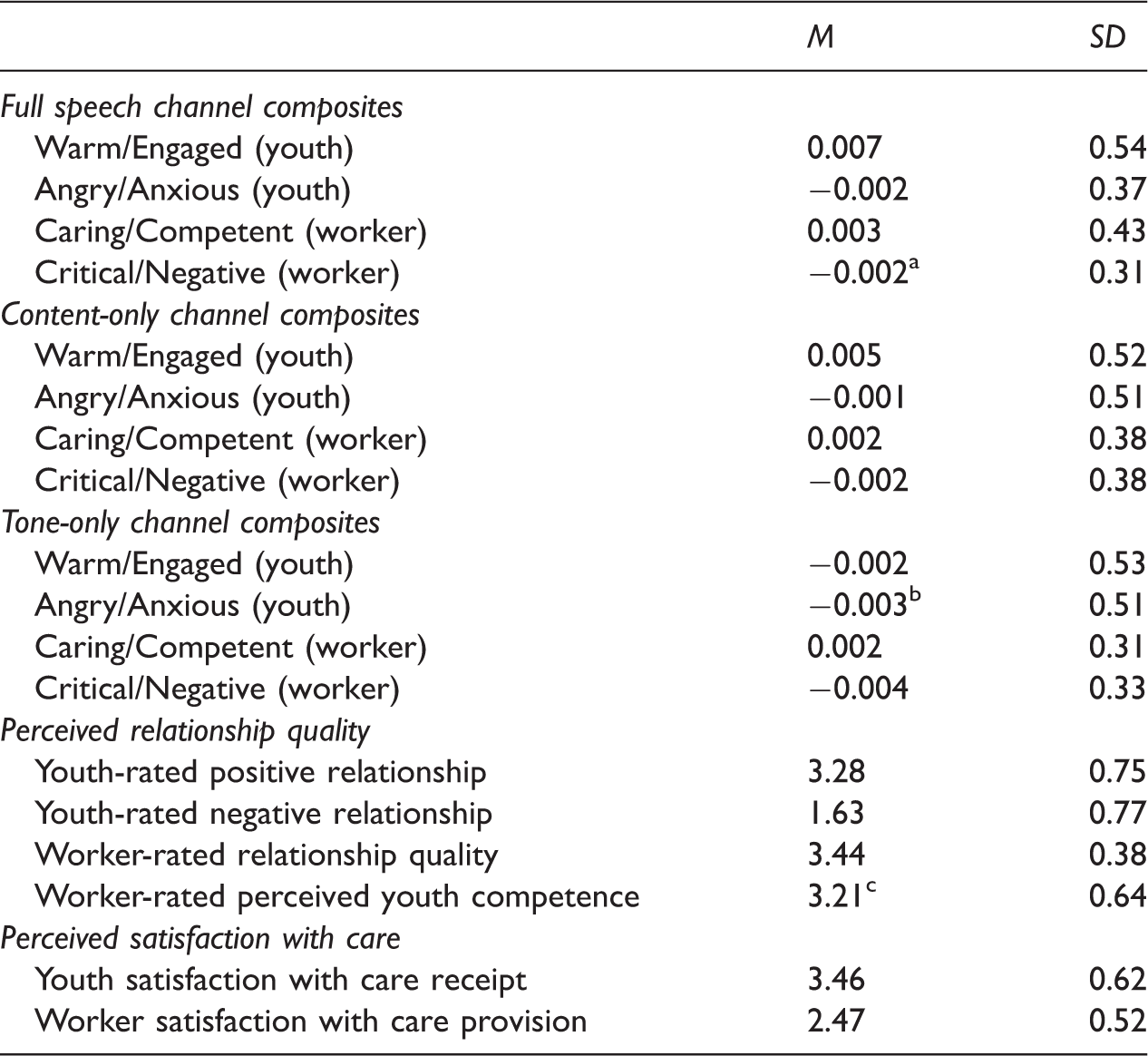
Note. Dyadic n = 51. Youth included 29 females and 22 males. Workers included 42 females and nine males.
Worker gender difference; Mfemales = −.05, Mmales =.23; t(49) = 2.73, p=.009.
Youth gender difference; Mfemales = .18, Mmales = −.24; t(49) = 3.15, p=.003.
Worker gender difference; Mfemales = 3.29, Mmales = 2.81; t(49) = 2.11, p=.040.
Note that the channel composites are created from standardized ratings yielding means close to zero.
Bivariate relations
Bivariate relations among speech rating composites
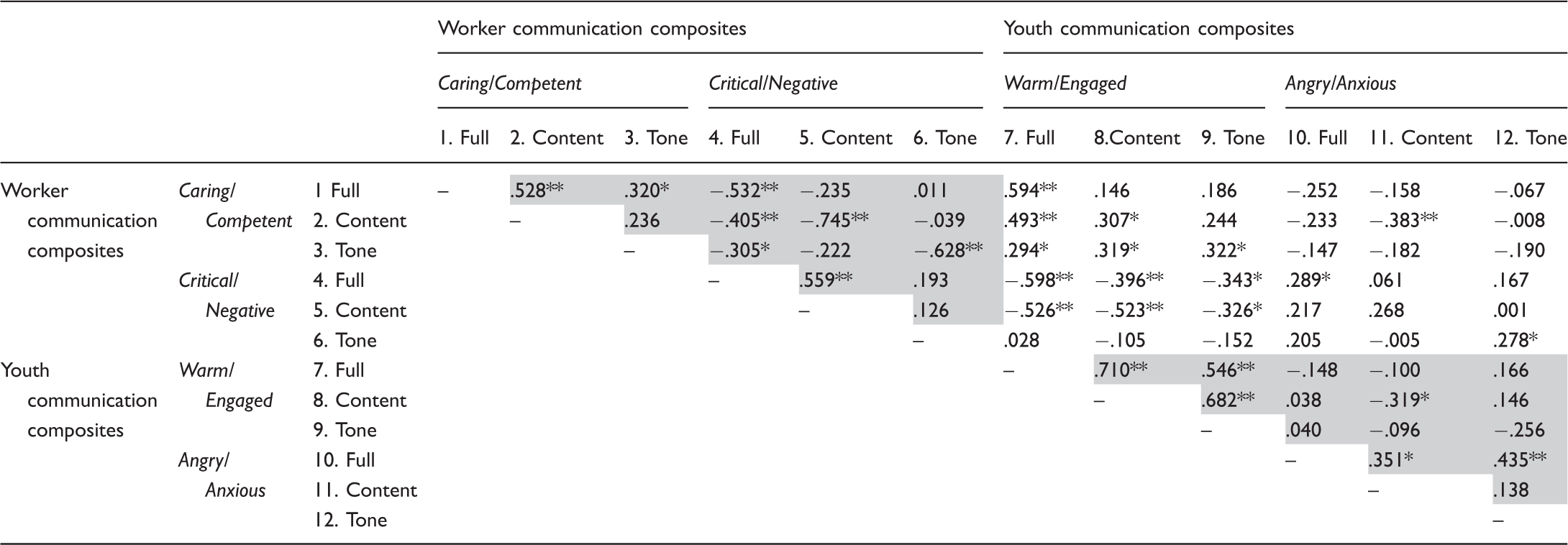
Note. Dyadic n = 51. Shaded areas indicate within-speaker correlations. Nonshaded areas indicate cross-speaker relations within each communication component. Bolded numbers on the diagonal indicate cross-speaker relations within each communication channel. * p<.05. ** p<.01.
Cross-dyad relations revealed that workers and youth generally mirrored one another in positive and negative expressed communication, and these relations were particularly robust within channel. For example, when workers communicated more caring/competence in their full speech, youth communicated more warm/engaged in their full speech, but relations with youth’s content-only and tone-only ratings did not attain significance. Likewise, the critical/negative component of workers’ full speech ratings was positively related to ratings of youth’s anger/anxiety in full speech, but relations with youth’s content-only and tone-only ratings did not attain significance. Similar patterns were seen across the content and tone channels, such that content-based ratings were correlated between speakers, and tone-based ratings were correlated between speakers, but cross-channel ratings (e.g. content with tone) were not significantly correlated between speakers. Concordant communication was also evident across positive and negative communication components within channels such that, for example, higher ratings of caring/competence in workers’ speech content were related to lower ratings of anger/anxiety in youth’s speech content, but relations with youth’s full speech or content-filtered tone did not attain significance. Likewise, workers’ critical/negative communication qualities were consistently related to lower ratings of youth’s warm/engaged communication qualities, and these associations tended to be most pronounced within channels.
Bivariate relations among relationship quality and satisfaction variables.
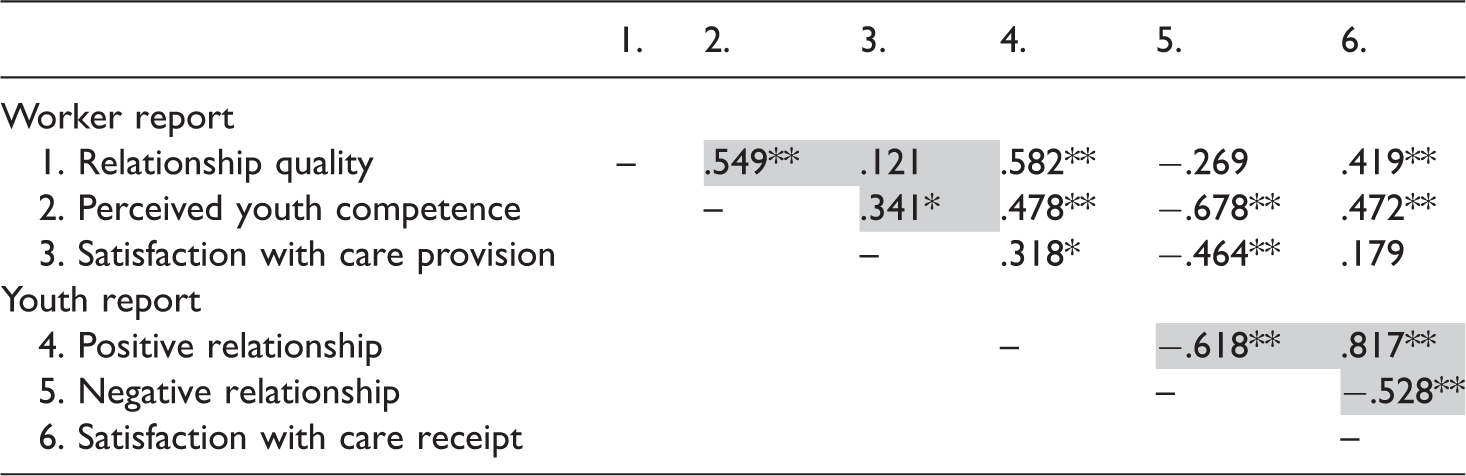
Note. Dyadic n = 51. Shaded areas indicate within-speaker correlations. Nonshaded areas indicate cross-speaker relations. * p<.05. ** p<.01.
Cross-dyad relations indicated that workers’ perceptions of a close relationship with youth were positively related to youth’s perceptions of a positive relationship with workers, as well as to their satisfaction with the care they received. The workers’ perceptions of youth’s competence were related to youth’s reports in expected ways, including higher positivity, lower negativity, and greater satisfaction with care receipt. Interestingly, workers’ reports of satisfaction with care provision were not significantly related to youth’s reported satisfaction with care receipt, even though they were correlated with youth’s positive and negative perceptions of the worker relationship in expected ways.
Bivariate relations of workers’ communication ratings with workers’ and youth’s perceptions of the social service relationship and satisfaction with care.
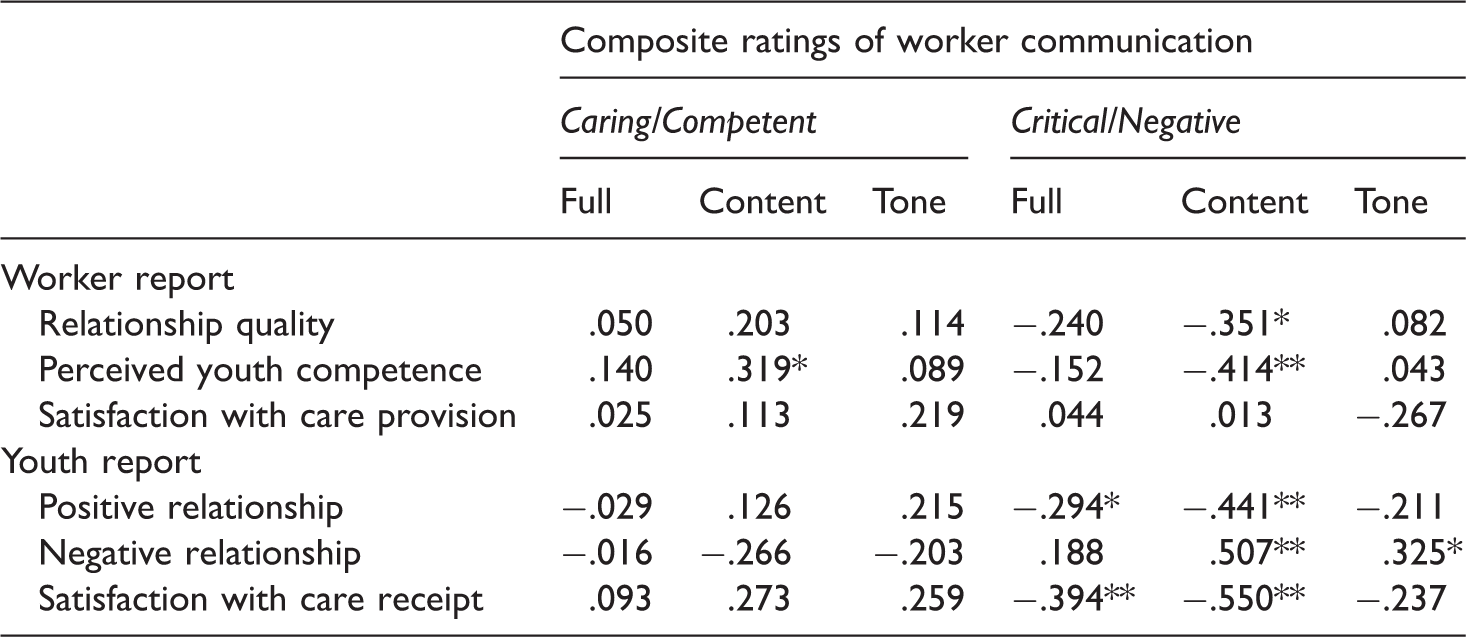
Note. Dyadic n = 51. * p<.05. ** p<.01.
Correlations of youth’s communication features with their own and with workers’ perceived relationship quality and satisfaction with care are shown in Table 5. Youth’s expressions of warm/engaged communication in either full speech or transcribed content were related to more positive perceptions of workers and greater satisfaction with care. Likewise, youth’s expressions of anger/anxiety in full speech were negatively related to youth’s reports of a positive relationship with the worker and to youth’s satisfaction with care receipt, but relations of anger/anxiety expressed in either content or tone were not significantly related to youth’s perceptions.
Bivariate relations of youth’s communication ratings with youth’s and workers’ perceptions of the social service relationship and satisfaction with care.
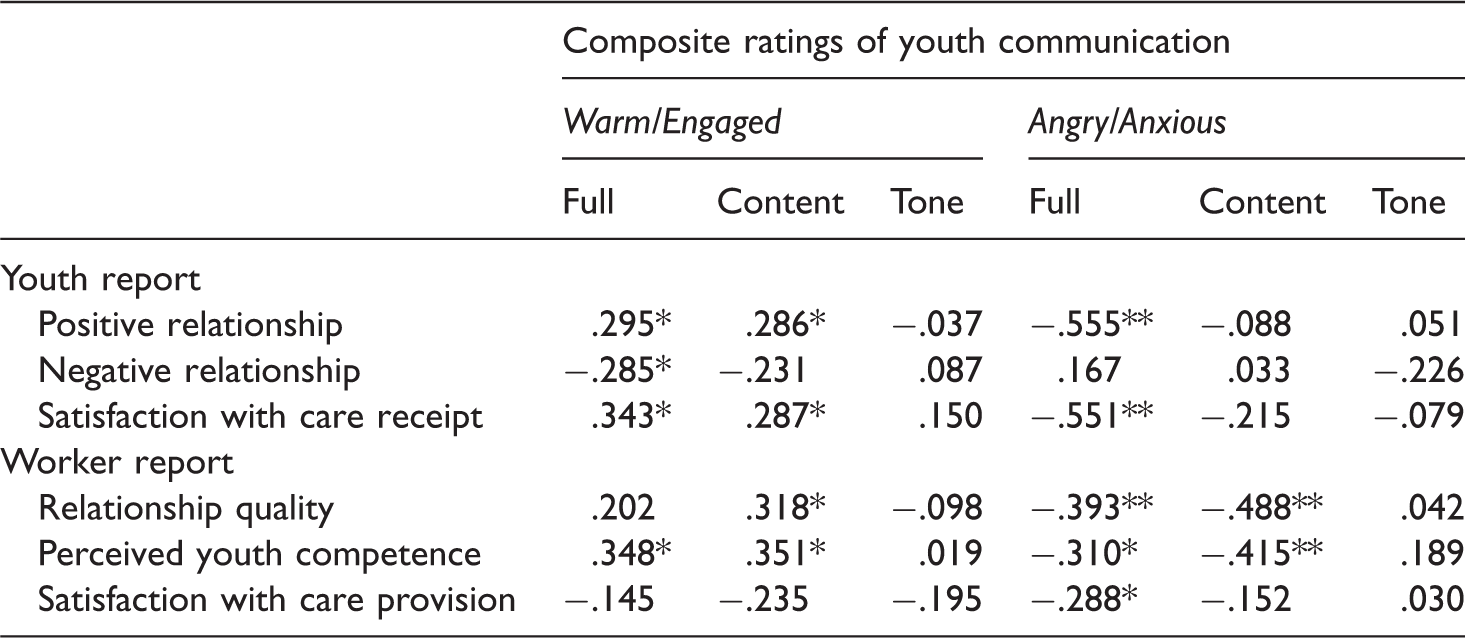
Note. Dyadic n = 51. * p<.05. ** p<.01.
Youth’s warm/engaged content was positively related to workers’ perceived relationship quality with the youth, whereas youth’s warm/engaged communication in both full speech and content ratings were positively related to workers’ perceptions of youth competence. Across all channels, youth’s warm/engaged communication qualities were not related to workers’ satisfaction with providing care. Youth’s expressions of anger/anxiety in either full speech or transcribed content were negatively related to workers’ ratings of relationship quality with youth and to perceptions of youth’s competence. Likewise, youth’s full speech ratings of anger/anxiety were associated with lower levels of workers’ satisfaction with care provision.
Discussion
This study was the first to analyze communication patterns between social service providers and foster youth in the child welfare system. The findings revealed a high degree of concordance between workers’ and youth’s communication features, between workers’ and youth’s perceptions of the social service relationship, and between workers’ and youth’s satisfaction with care in the social service setting. Significant relations between communication processes and perceptions of relationship quality and care satisfaction within and between members of the dyad suggest that communication qualities likely influence and reflect both workers’ and youth’s current relationship quality and service satisfaction. Moreover, multiple facets of the communicative system, including full speech, transcribed content, and content-filtered tone, emerged as meaningful sources of information and as promising sites for interventions to enhance social service provision and engagement.
As expected, the principal components of each speaker’s communication evidenced significant concordance within each speaker, particularly with regard to associations between full speech ratings and either content or tone ratings. More modest relations between content and tone ratings suggest instances of mismatched or mixed communication between what speakers say (i.e. content) and how they say what they say (i.e. tone). These types of mixed messages have been explored in medical settings (LaPlante & Ambady, 2002), but may be especially prominent among social workers who may be trained to mask or buffer their true feelings, particularly negative feelings, when working with foster youth. Indeed, the relatively low inter-rater reliability for ratings of workers’ content-filtered tone, as compared to ratings of youth’s content-filtered tone, suggests that naïve judges, and potentially foster youth as well, struggled to evaluate workers’ tone.
Paralleling intraspeaker relations, interspeaker communicative concordance was particularly robust within channel. Expressions of positive communication from one member of the dyad were associated with more positive communication from the other member, and, similarly, negative communication by one member of the dyad was related to more negative communication from the other member. This pattern was also evident between positive and negative components, such that more positive communications by either workers or youth were related to less negative communications on the part of the other speaker, and, likewise, more negative communication from one speaker was related to less positive communication from the other speaker.
As with communication features, workers and youth evidenced a high degree of concordance across their reported perceptions of the relationship and their satisfaction with child welfare services. Workers’ positive relationship perceptions of the foster youth were positively related to their perception of youth competence. Workers’ satisfaction with service provision and their perception of youth’s competence were also positively related. Likewise, youth who reported higher satisfaction with care receipt endorsed more positive and less negative relationships with workers. At the level of the dyad, significant correlations between workers’ and youth’s perceptions of the social service relationship and satisfaction with care suggest that workers and youth generally perceive (and may be influenced by) the quality of the social service relationship accurately, and these relationship qualities are related to their satisfaction with child welfare services.
It is interesting to note that, although workers’ satisfaction with providing care was not related to workers’ reported relationship quality with youth, youth did seem responsive to workers’ satisfaction as evidenced by significant relations with youth’s perceptions of the relationship. This suggests that promoting social workers’ satisfaction with the provision of services may support positive engagement and outcomes for foster youth, perhaps because workers have a greater capacity to care for youth when they are not dissatisfied. In support of this interpretation, prior studies have shown that workers with lighter caseloads are more likely to have clients with improved adaptive trajectories over time (Godfrey & Yoshikawa, 2012). However, given that workers’ satisfaction with providing care was not significantly related to their expressed communication, there is a need to elucidate mechanisms by which a decline in worker’s satisfaction with care may carry over to negatively influence youth’s perceptions of the quality of the worker–youth relationship.
Robust relations of communication features with perceived relationship quality and service satisfaction were evident for both transition-aged foster youth and the social workers who serve them. In addition to associations between each speaker’s communicative features and their own perceptions of the relationship and service satisfaction, cross-speaker relations revealed that both youth and workers may be attuned to the most authentic channels of communication expressed by each partner. The strong association between worker’s communicative content and their reported relationship qualities with the youth could explain why the youth appeared more attuned to worker’s communicative content, particularly negative content, since this emerged as the channel and valence that were most closely related to worker’s reports about the youth. These data suggest that, even though workers may try to soften or mask negative messages in content with neutral or positive tone, foster youth do pick up on (and perhaps focus on) the negative content that workers are communicating. Similarly, foster youth appeared to convey their perceived relationship quality with workers and their satisfaction with care receipt in full speech and content channels, rather than in tone. In a complementary fashion, workers appeared to be particularly attuned to youth’s authentic communication features as expressed in the full speech and content channels.
In contrast to our predictions, foster youth did not evidence greater sensitivity to nonverbal tone, particularly negative tone, than did social workers. Foster youth in this study were responsive to content filtered-tone tone as indicated by a significant relation between workers’ negative tone and youth’s negative relationship perceptions. However, workers were similarly sensitive, such that relations of workers’ reported perceptions of the relationship and their satisfaction with care with youth’s full speech (representing content and tone together) were greater than associations of workers’ perceptions and satisfaction with either youth’s content or content-filtered tone alone. Likewise, although we had predicted that youth would be more sensitive to negative communication features as compared to positive communication features, and workers’ negativity was most strongly related to youth’s perceptions of their relationship with workers and their satisfaction with care, workers were similarly influenced by youth’s negativity more than by expressions of positivity.
Although youth in this study did not appear disproportionately sensitive to nonverbal indications of negativity in workers’ content-filtered tone, it is possible that other nonverbal communication indices not studied here (e.g. body language, facial expressions; Pollak & Sinha, 2002) may be more likely to demonstrate these differences. Indeed, Lehky (2000) has shown that conversational partners can rapidly and accurately apprehend meaningful changes in facial expression within 100 milliseconds. The current study highlights the complexity and applied impact of communication processes within the child welfare setting, while suggesting that future studies would benefit from more nuanced metrics of nonverbal communication via audio and visual data collection mediums.
Limitations
This investigation contributes to the broader literature on interpersonal communication by offering a rare look into the social service setting of child welfare relationships between social workers and transition-aged foster youth. The current findings benefited from a rigorous design that drew on a random sample of audio-recorded worker–youth conversations coded across multiple channels of communication by separate teams of independent raters. However, several limitations in this study necessarily qualify the interpretation of the obtained findings.
First, our lower than expected response rates yielded a small sample size that constrained our statistical power to test more complex relations outside this correlative design. Likewise, the potential influence of worker–youth gender and racial/ethnic (mis)match in the communicative context remain open questions for future research with larger samples. Consistent with transactional models of development (Sameroff, 2009), it is likely that communicative features are both reflective and evocative of individuals’ relationship experiences and service satisfaction. However, in the absence of a longitudinal design with a larger sample, the obtained associations should be interpreted as suggestive, rather than directionally definitive.
Second, despite our best efforts to recruit a random sample of transition-aged foster youth, the actual sample likely overrepresented youth who were predisposed to stay in care, and workers who were sufficiently engaged and competent to follow through with the study. At the time of participant recruitment, nearly 30% of the youth in selected dyads had already exited foster care and/or opted out of extended care supports. Thus, the remaining participants were positively biased toward higher service engagement.
Third, the validity of these data for predicting germane outcomes, such as service engagement, has not been established. Despite offering exceptionally high ecological validity as workers and youth were recorded in their natural real-world environment, reactivity effects must be acknowledged. We cannot be sure that these recorded conversations fully captured the dynamics that may have occurred in the absence of observation. Furthermore, although audios were clipped to yield a standard 5-minute speech sample, the amount of communicative content (i.e. words/utterances) offered by workers versus youth varied across dyads. However, as noted earlier, research on “thin slices” of communication encompassing even smaller time frames (e.g. 30 seconds) has shown that raters can reliability evaluate communicative meaning in short excerpts of provider–consumer conversation (Ambady & Rosenthal, 1993). Indeed, in the provider–patient literature, effects are found even in the context of short office visits (i.e. ∼8–15 minutes; Block et al., 2013b; Tai-Seale, McGuire, & Zhang, 2007), for varied health and adherence outcomes (DiMatteo et al., 1994; Haskard et al., 2008a). These data suggest that the brief segments of conversation examined in this study are useful for understanding provider–client relationships, particularly given that, in actuality, meetings between providers and clients may be quite brief.
Fourth, although the obtained inter-rater reliabilities were higher on average than those in prior publications using similar methods (Blanck et al., 1990; Haskard et al., 2009, 2008a), the inter-rater reliability for some items was low, and, in a few instances, sufficiently poor as to warrant the exclusion of the rating item from these analyses. The particularly low reliability for workers’ content-filtered ratings of nonverbal tone may indicate that workers are masking their meaning in tone. Support for this interpretation stems from the fact that ratings of youth’s tone did not evidence particularly poor reliability. In future work, it will be important to examine episodes of incongruence or mixed messages among workers who may say one thing (e.g. express positive content to youth) but convey something entirely different in tone (e.g. hostility, sarcasm).
Conclusions
Informed by the broader literature on patient–provider communication (DiMatteo et al., 1980; Haskard et al., 2008a; LaPlante & Ambady, 2003), this study was the first to evaluate communication dynamics in the child welfare setting. Although many facets of communication may translate across medical, educational, and therapeutic settings, the social service setting features unique elements that heighten the need and the value of investigative efforts centered on this specific context. For example, while one must see a doctor intermittently in the case of illness, youth in foster care are not required by the demands of life to continue to see a social worker past age 18. In addition, because foster youth have often grown up in a system where they lack access to consistent supports, social workers have the potential to play an important protective function by providing compensatory relationship connections. These results demonstrate that communication matters greatly for youth in care, which highlights a novel avenue for future investigation and intervention.
Future studies would profit from longitudinal investigative designs, wherein temporal associations of communication and satisfaction could be more clearly delineated. Likewise, longitudinal work would clarify whether transition-aged youth who report higher rates of satisfaction with care are actually more likely to avail themselves of the resources associated with extended foster care. This connection is important to investigate in light of some evidence that service satisfaction does not necessarily predict good service outcomes (Fenton, Jerant, Bertakis, & Franks, 2012).
In addition to extended research designs, future intervention work that aims to manipulate and teach communication skills to workers and youth would provide novel opportunities to evaluate the causal relations suggested here. Just as the current study sought to translate empirical research to practice, practice can inform research and theory development. For example, Haskard et al. (2008b) conducted an intervention study wherein doctors and/or patients were randomly assigned to receive training in doctor–patient communication skills, such as showing compassion with patients, recognizing tension in doctor–patient interactions, acknowledging patient problems (for doctors), and (for patients) organizing questions and making a treatment plan. Results indicated that communication training increased patient and doctor satisfaction and involvement, as well as increasing physician counseling about key topics such as diet and exercise.
Promoting a positive worker–youth relationship, and the communication processes therein, is of the utmost importance to maximize the positive impact of limited resources (Courtney et al., 2009). Although this study focused on a single worker–youth exchange, a voluminous amount of information passes between foster youth and their workers over time. Thus, it is important that we equip workers and youth with the necessary tools to engage in successful communications and forge productive relationships. As a corollary, these data suggest that positive worker–youth relationships should be protected, rather than undermined by the pressures of convenience, turnover, or other organizational demands in the child welfare setting. Such disruptions may hinder service continuity and satisfaction, with particularly strong effects in cases where the worker and youth have already bonded. In cases where workers and youth have struggled to develop a high quality relationship, case planning goals should support efforts to restore or substitute positive worker–youth relationships, perhaps via communicative coaching as has been done in other settings.
Footnotes
Ethics
Ethical approval for this project was given by University of California, Riverside Institutional Review Board for the protection of human subjects in Riverside, California, under the case number HS #09-014.
Funding
The authors disclosed receipt of the following financial support for the research, authorship, and/or publication of this article: This research was supported by a dissertation award to the first author provided by the University of California, Riverside, and a scholar’s award to the second author provided by the William T. Grant Foundation.
Acknowledgements
We would like to thank the outstanding research assistants in the University of California, Riverside, Adversity and Adaptation Laboratory, as well as those in Dr Sara Berzenski’s Researching Emotion across Childhood Laboratory at California State University, Northridge, for their many hours of careful audio preparation, content filtering, and communication rating. We thank Drs Robin DiMatteo and Tricia Brodbeck for their expert advising on this project. Finally, we thank Dr Mark Courtney’s CalYOUTH study and the Southern California counties who supported this research alongside the social workers and youth who made this study possible.