







Abstract
Summary
The objectives of this study were to estimate the prevalence of burnout syndrome in a sample of Spanish social workers and analyse the influence of a series of socio-demographic variables that may potentially be related to the appearance and development of one of the three dimensions of burnout. A total of 947 Spanish social workers participated in the study.
Findings
33.2% and 22.1 of Spanish social workers experienced high levels of emotional exhaustion and depersonalisation, and 54.2% experienced low personal accomplishment at work. The hierarchical regression analysis showed that having been on sick leave in the preceding year was the most important predictor of emotional exhaustion. Moreover, full-time employment status was the most robust predictor of depersonalisation, and professional activity in specialised social services was the main predictor of personal accomplishment. The low percentages of total variance explained imply that although certain socio-demographic characteristics are significant predictors, their effects are very small.
Applications
Public and private organisations devoted to social services should be aware of the need to prevent this type of psychosocial risk to which social workers are exposed every day. This would help improve the health and quality of their lives as well as reduce the high costs which frequent worker turnover and sick leave entail, and would also enhance the effectiveness of the services provided.
Keywords
Introduction
Burnout syndrome has been conceptualised as a response to chronic work stress, which develops in those individuals whose work objective is people in any type of caregiving activity; for example, nurses, doctors, social workers, etc. (Leiter, Bakker, & Maslach, 2014). The results of numerous studies on burnout syndrome reveal its high presence among workers in human services (Guy, Newman, Mastracci, & Maynard-Moody, 2010). Studies carried out in the United Kingdom (Evans et al., 1996), United States (Kim, 2011; Travis, Lizano, & Mor Barak, 2016), Canada (Crowder & Sears, 2017), Israel (Finzi-Dottan & Kormosh, 2016) and other countries reveal how social workers suffer high rates of stress and burnout. Nevertheless, the majority of these studies have been conducted in the English-speaking world, while in Spain there is a scarcity of information on burnout in social workers as a group (Sánchez-Moreno, de La Fuente Roldán, Gallardo-Peralta, & de Roda, 2015).
Freudenberger and Richelson (1980) defined burnout as a feeling of failure and exhaustion or weariness resulting from excess demands on energy, personal resources or workers’ spiritual strength.
One of the main obstacles to understanding and evaluating burnout is that there is no single universally accepted definition, although there does seem to be agreement that it emerges as a response to chronic stress. When delimiting burnout conceptually, a distinction may be drawn between two different perspectives: the clinical and the psychosocial (Gil-Monte & Peiró, 1997). From the clinical standpoint (Freudenberger & Richelson, 1980), it is perceived as a state resulting from work-related stress and is characterised by the feeling of exhaustion, disenchantment and lack of interest in one’s job. It mainly arises among workers whose job involves close contact with others and emerges as a consequence of weariness due to their seeking to achieve a job satisfaction that proves unattainable.
From the psychosocial perspective, burnout is seen as a process that results from the interaction between individual and workplace features in a series of stages or phases, which display different symptoms. Predominant in this approach is the definition of Maslach and Jackson (1982), who described it as a state of emotional weariness or physical exhaustion caused by prolonged exposure to stressful or difficult situations. According to this multidimensional model, burnout is a three-dimensional syndrome involving emotional exhaustion, depersonalisation and poor personal accomplishment (personal accomplishment).
Exploring burnout in social work is by no means new, and has been the subject of research for some time, particularly in English-speaking countries. Lázaro (2004) states that the link between burnout and social workers dates back to the early research into the topic (Jayaratne & Chess, 1984). Zamanillo (1999) considers that all the phenomena associated with the psychosocial distress of individuals, arranged according to their social-structural origin and personal experience, constitute the formal objective of social work. Grau and Suñer (2008) noted that this psychosocial distress, the objective of the social workers’ profession, implies that social work is an occupational activity that is high risk for burnout syndrome. In their daily job, social workers are faced with a lack of resources, complex social situations, ambiguity of role, huge amounts of paperwork and scant social recognition.
There is a gamut of literature on the risk factors that favour the appearance and subsequent development of burnout syndrome. Prior study has principally focused on environmental/organisational factors and individual factors (McFadden, Campbell, & Taylor, 2015).
According to Antonopoulou, Killian and Forrester (2017), the environmental/organisational factors would include three domains: organisational climate, organisational culture and work attitudes.
According to Webb and Carpenter (2012), the individual factors refer to the personal characteristics of workers and include demographic data, levels of education/training, levels of experience, degree of satisfaction and job dedication, levels of self-efficacy, and the degree of support from friends, relatives and other people.
Public and private organisations devoted to social services must become aware of the need to prevent this type of psychosocial risk to which social workers are exposed every day. This would help improve their health and quality of life as well as reduce the high costs which frequent worker turnover and sick leave entail, and would also enhance the effectiveness of the services provided (Manassero, Vázquez, Ferrer, Fornes, & Fernández, 1994).
The role that socio-demographic factors play in the development of burnout syndrome is important for several reasons: first, it is important to check if these factors have a direct influence on levels of burnout and its significance. This will allow the elaboration of a risk profile of social workers for suffering burnout; second, the identification of several risk factors that may define a risk profile would facilitate the development of primary and secondary intervention programmes. These programmes focus their actions on preventing the syndrome in general or on a risk population, and so, they are generally preferable to tertiary programmes that are centred on helping workers to recover from poor health. Third, explicative models can be tested and elaborated for this specific population relating to the relations of socio-demographic factors with the three dimensions of burnout (Aguayo, Vargas, Cañadas, & Fuente, 2017).
In relation to social workers, the analysis of these socio-demographic variables has led to results that are inconclusive and often contradictory. As a result, at present there is no consensus on which of these variables are conducive to the development of burnout syndrome.
Thus, some studies have not tended to consider gender a reliable predictor of burnout, although different cross-cultural and cross-occupational studies do seem to point to a higher depersonalisation among men (Grau, Flichtentrei, Suñer, & Prats, 2007; Soler et al., 2008). In studies carried out by Evans et al. (1996), among social workers, men scored higher than women in depersonalisation. The justification for these differences would be the contrasting socialisation processes of the roles played by men and women. The belief is that whereas women are socially conditioned to raise and look after children, see to the housework, tend to their spouse or partner as well as to the elderly on occasions, for men the emphasis is on toughness and a focus on achievement as opposed to interdependence and personal relationship skills.
A large number of studies have shown the relevance of age in the study of burnout. Gold (1985) and Williams (1989) reported that age is inversely related to depersonalisation. Gil-Monte (2002) found that the older people are the less likelihood there is of them presenting high depersonalisation values. Hadziolova (1988) considers that older workers evidence a series of characteristics, such as their greater professional experience and knowledge, a sense of responsibility and an ability to deal with problems. He further contends that this is why, in certain professions, older workers can continue doing their job without added stress or overload. Poulin and Walter (1993) observed the same phenomenon among social workers, finding that age is inversely related to emotional exhaustion and depersonalisation. Jayaratne, Vinokur-Kaplan and Chess (1995) reported that younger social workers experienced lower personal accomplishment and higher depersonalisation than older social workers. Finally, De la Fuente and Sánchez (2012) found statistical significance for the age variable and low personal accomplishment.
The incidence of health status on burnout has not yet been addressed in the scientific literature. However, it has been pointed out as an important stressor for many of the workers affected by it. Grau et al. (2007) found that those who suffered from a chronic illness and who had been on sick leave for whatever reason in the preceding year scored higher in emotional exhaustion. With regard to the consequences of burnout syndrome, various studies have highlighted the fact that there is a significant link between the latter and people’s perceived health problems. An analysis of all symptoms that appear in the literature related to burnout provides evidence that all the systems of the organism are involved. According to Gil-Monte (2002), the most intense correlations emerge between emotional exhaustion and health problems. Correlations between health problems and depersonalisation are less intense, and the weakest correlations appear for the personal accomplishment in work scale. Soler et al. (2008) also found that those who had become disabled or who had been on sick leave displayed high emotional exhaustion scores.
Rather than discussing the role of marital status in relation to burnout, it is preferable to refer to the type of cohabitation, with a partner or without a partner, maintained by the subject. On the other hand, when considering this relationship, it is necessary to pay specific attention to the quality of this relationship, as well as to the level of socio-emotional support provided by the partner (Maslach & Jackson, 1985). In a series of studies conducted in Israel (Bargal & Guterman, 1996) and the United States (Siefert, Jayaratne, & Chess, 1991), single female social workers reported higher rates of burnout than those who were married.
There are a smaller number of studies that have focused on the relationship between having children and burnout. In general, the results support the existence of lower levels of burnout in people who have children compared to those who do not. Fuqua and Couture (1986), using the Maslach Burnout Inventory (MBI), conclude that married, older subjects with children experience less burnout than those who are not married, younger and without children. Grigsby and McKnew (1988) conclude that there is a positive and significant relationship between the number of children of the subject and the level of burnout experienced.
There is scarce scientific literature on the incidence of part-time or full-time employment status and burnout. However, it has been indicated that full-time employment is an important stressor for the majority of workers affected by work stress (Peiró, 1992). Mor and Laliberte (1984), when examining the components of burnout among those who work with the terminally ill, discovered a higher burnout rate than the average among employees with high levels of education and full-time employment status.
The work sector is a fundamental element in the development of burnout. Shinn, Rosario, Morch and Chestnut (1984) and Schwartz, Tiamiyu and Dwyer (2007) found that social workers employed in private centres had lower burnout syndrome scores than those engaged in public centres. According to Acker (2010), social workers working in institutions under public administration obtained higher levels in emotional exhaustion and depersonalisation, and lower levels of personal accomplishment compared to those working in private institutions.
All of this may cause stress and give rise to burnout (Söderfeldt, Söderfeldt, & Warg, 1995). Certain studies have focused specifically on exhaustion in this group (Abdallah, 2009). Such exhaustion may have serious consequences for social workers, their clients and service agencies. It leads to deterioration in the quality of the service provided by social workers (Maslach & Jackson, 1981) and may have an impact on the solutions given to clients’ problems as well as negatively affecting the outcome of the treatment. Finally, problems of exhaustion exacerbate the mental and physical problems suffered by workers and lead to increased staff turnover (Toppinen-Tanner, Kalimo, & Mutanen, 2002).
The objective of this study was to estimate the prevalence of burnout syndrome in a sample of Spanish social workers and analyse the influence of a series of socio-demographic variables on the variance of the classic dimensions of burnout (emotional exhaustion, depersonalisation and lack of personal accomplishment by means of hierarchical regression.
To do this, the following hypotheses were tested: Hypothesis 1: Spanish social workers have high levels of burnout. Hypothesis 2: The experience of burnout will be correlated with biological, social and professional features as follows:
Younger social workers who have been off work and are suffering from a chronic illness have higher levels of burnout compared to older social workers who have not been off work and do not have chronic illness.
Social workers without a regular partner and without children have a greater feeling of burnout compared to social workers who have a regular partner and children.
Social workers who conduct their professional activity in community social services, in full-time employment, and in public administration have higher levels of burnout in comparison with social workers who work in specialised social services, in part-time employment, and in the private sector.
Method
Sample
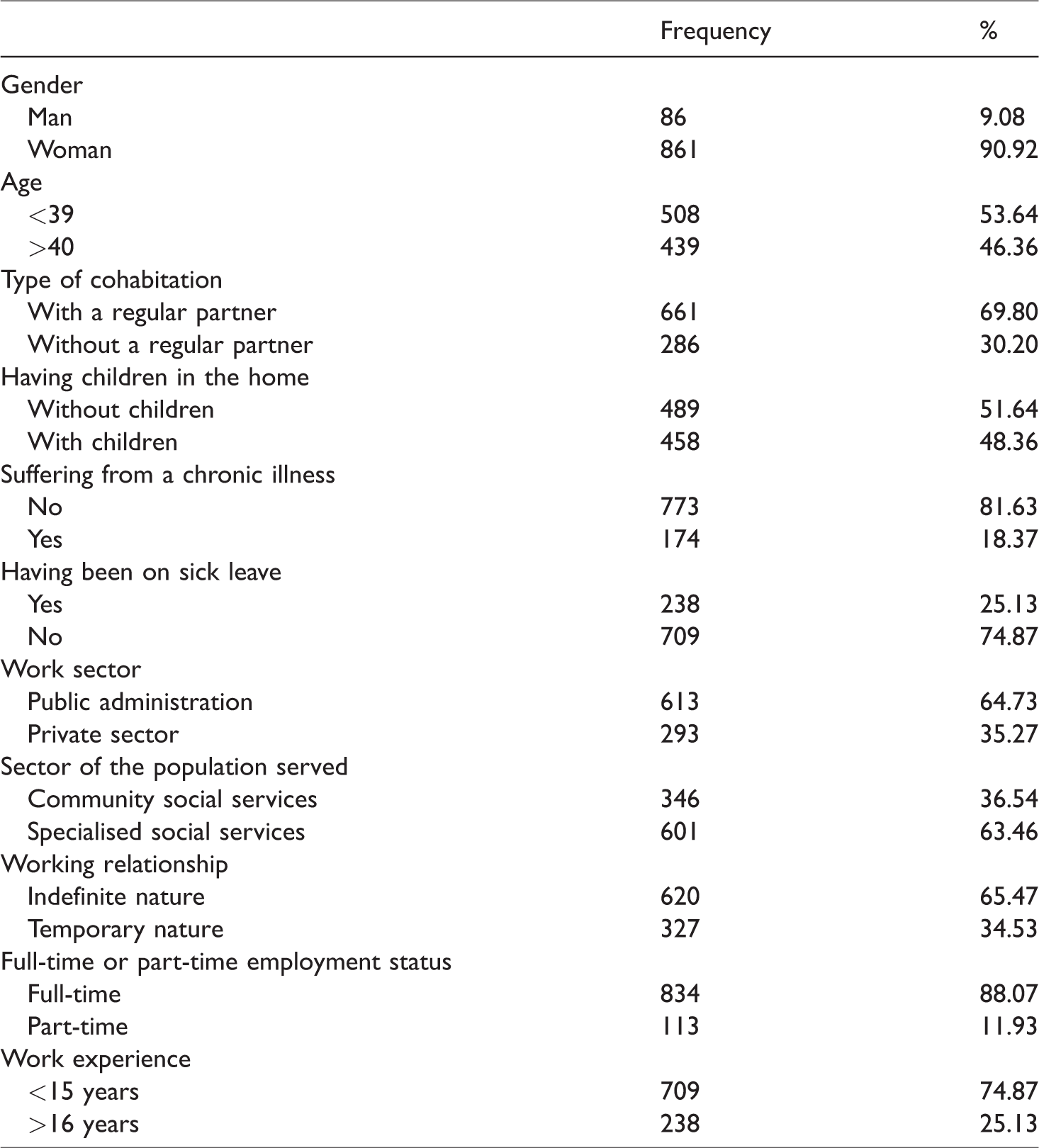
The participants of this study were a convenience sample composed of 947 social workers belonging to the 36 Professional Bodies 1 in Spain. Of those 947 professionals, 861 were women (90.92%) and 86 men (9.08%). The average age was 39.45 years (SD = 8.9; range: 21–63). The average age of the women was 39.55 years (SD = 8.77) and that of the men was 39.34 (SD = 8.92). Significant differences were not seen in the variable age (t = 0.319; p = 0.575), taking into account the gender of the participants. Table 1 shows the socio-demographic characteristics of the study sample. The results obtained indicate that the study sample is similar to that of the general population of social workers in Spain, in terms of the variables of gender, age and professional experience, according to reports by Viscarret, Ballestero, Idareta and Úriz (2016). All the participants were volunteers and gave their informed consent.
Characteristics of the sample (N = 947).
Measures
For the collection of information, a survey was developed comprised of questions relating to socio-demographic information and the MBI.
Demographic questionnaire
The socio-demographic survey included the following variables: (a) gender (man versus woman), (b) age (<39 versus >40), (c) type of cohabitation (with a regular partner versus without a regular partner), (d) having children in the home (without children versus with children), (e) suffering from a chronic illness – organic or functional disorders that require lifestyle changes and have or probably will persist long term (yes versus no), (f) having been on sick leave during the last year (yes versus no), (g) work sector (public versus private), (h) sector of the population served (community social services versus specialised social services 2 ) and (i) work experience (<15 versus >16).
Burnout questionnaire
Burnout syndrome
Burnout syndrome was estimated through the ‘Maslach Burnout Inventory’, in its version for professionals in ‘human services’ MBI-HSS (Maslach & Jackson, 1986), for two main reasons. First, the MBI-HSS was developed based on the conceptualisation of burnout given by Maslach and Jackson (1982), which has become one of the most widely accepted definitions of the term (García, 1990). Second, this inventory has been used for many years and has evidenced acceptable levels of validity and reliability in all the professional groups in which it has been applied (principally professions and services) that are deemed to be at risk of burnout (Oliver, Pastor, Aragoneses, & Moreno, 1990). The instrument used to measure burnout was the Spanish version of the Seisdedos MBI (Seisdedos, 1997). It consists of 22 items that contain three subscales, each of which evaluates one of the constructs of burnout: emotional exhaustion (nine items, e.g. Due to my work I feel emotionally exhausted), depersonalisation (five items, e.g. I think I treat some clients as if they were objects) and personal accomplishment (eight items, e.g. I feel like I am positively influencing the lives of others through my work). Each subscale is comprised of various items, each of which describes a particular feeling/attitude towards work, and the respondent rates them on a 7-point Likert scale according to how frequently they have experienced the emotion/attitude (ranging from 0 = ‘Never’ to 6 = ‘Every Day’). The emotional exhaustion subscale evaluates the feeling of having exhausted the emotional resources needed to contend with the situations that arise in one’s work. The depersonalisation subscale quantifies the attitude of detachment from others. Finally, the personal accomplishment subscale reflects the extent to which one recognises the value of one’s work. The ratings of each element are added in order to calculate the score of each subscale. As suggested by its authors, burnout is a multidimensional phenomenon, and the scores of the three dimensions should not be combined into a total score. For the emotional exhaustion and depersonalisation subscales, higher scores imply a greater level of burnout, whereas for the personal accomplishment subscale, a lower score indicates a greater level of burnout.
Although, as previously mentioned, the MBI-HSS has been shown to function adequately in different populations, a considerable variability of scores has been noted between populations, which leads to the recommendation to avoid using cut-off points derived from foreign populations (Schaufeli & Van Dierendonck, 1995). Therefore, the reference values published for the Spanish adaptation were used (Seisdedos, 1997).
Finally, although some evidence suggests that personal accomplishment is not a dimension of burnout (Schaufeli, Bakker, Hoogduin, Schaap, & Kladler, 2001), this point of view is still controversial; therefore, we have evaluated the socio-demographic factors associated with the three dimensions of burnout. The authors provided reliability data with a Cronbach’s alpha of 0.90 for emotional exhaustion, 0.71 for personal accomplishment and 0.79 for depersonalisation (Maslach & Jackson, 1986).
Procedure
A cross-sectional study was conducted. After selecting and devising the previously described evaluation instruments, the survey was drawn up. This also contained an explanation of the goals of the research, an assurance that confidentiality concerning individual data and results would be maintained, and instructions on how to correctly complete the questionnaire. One copy of the survey was sent by email to the 36 professional social work bodies in Spain, whose cooperation was requested to ensure that the information reached social workers who were members of these professional bodies. In addition, workers who so requested were given a more detailed explanation of the research and the reasons underlying it. Once the study had been approved by the Spanish Professional Bodies Ethics and Research Commission, the next step was to send the proposal to the social workers themselves. The invitation to participate was sent from each Professional Body by different methods: email, newsletter and the professional body webpage. The invitation contained a request for their cooperation and described how they could access a hyperlink through the internet to a self-administered survey (https://es.surveymonkey.com/). In addition, the documents provided to each participant contained a request for their consent to take part in the study (in order to complete the survey, it is first necessary to double-click the INFORMED CONSENT icon), together with an assurance that their personal details would be kept confidential. In order to deal with any possible doubts which might arise concerning the aims of the research as well as the use to which the findings would be put or with regard to how to fill in the survey, a telephone number was provided for contacting members of the research team with any enquiries.
Given the fact that those surveyed took part voluntarily and that the sample is based on those who chose to participate, the sampling error cannot be estimated. Findings are based solely on the responses given and are not generalisable to all social workers.
Surveys were completed between 28 February and 31 May 2013.
Data analysis
The statistical analyses were conducted with SPSS Version 22.0. Reliability tests were performed on each of the scales in order to determine alpha coefficients for the study sample. For the descriptive analysis, we calculated the central tendency and the statistical dispersion for each variable. Correlation coefficients were calculated between all variables of the study.
Finally, hierarchical linear regression analysis was used, and the socio-demographic characteristics were introduced as predictor variables, while the three dimensions of burnout (emotional exhaustion, depersonalisation and personal accomplishment) were introduced as dependent variables.
The increase in R2 (R2 changes) was calculated to determine the relative contributions of each set of variables. The standardised coefficients (β) were calculated in order to compare the relative importance of each variable in the model.
The data was verified for multicollinearity, using a tolerance and variance inflation factor. There were no signs of multicollinearity in any of the three regression models. All statistical tests were two-sided, and a significance level of 0.05 was considered relevant.
Results
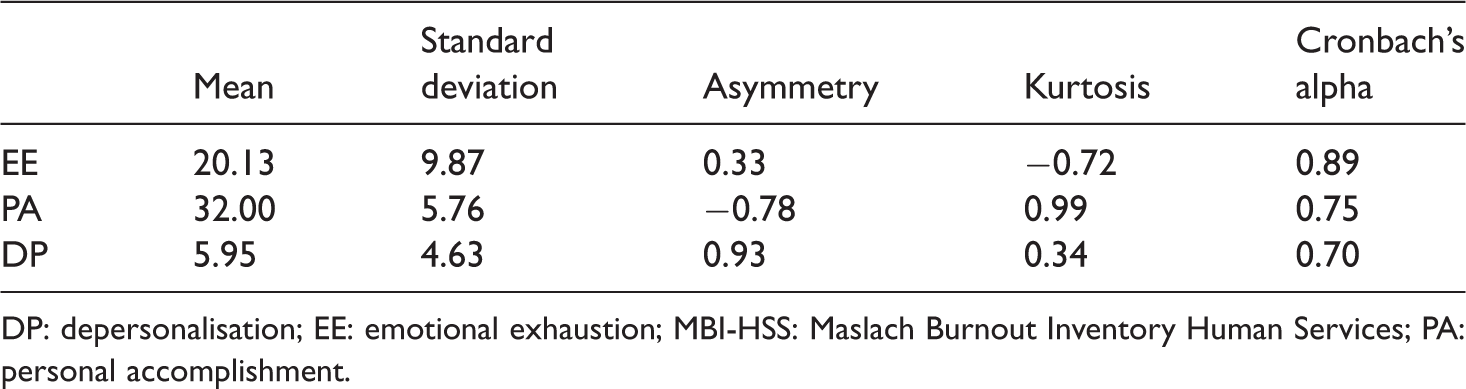
In order to describe the characteristics of the MBI-HSS distribution, the descriptive statistics of the scales, the means, the standard deviations, the asymmetry and the kurtosis of the variables were estimated (Table 2). The value of the asymmetry shows that the three subscales of the MBI-HSS have values between 0.33 and 0.93. None of the scales exceeds the range ± 1. Similar results are observed in the Kurtosis measurements. The distribution of each subscale is contrasted after performing the Z test of Kolmogorov–Smirnov and rejecting the normality hypothesis (ZK-S = 2.33, p = 0.001 (emotional exhaustion); ZK-S = 4.13, p = 0.001 (depersonalisation); ZK-S = 2.61, p = 0.001 (personal accomplishment)).
Descriptive statistics for the three subscales of the MBI-HSS.
DP: depersonalisation; EE: emotional exhaustion; MBI-HSS: Maslach Burnout Inventory Human Services; PA: personal accomplishment.
Although the scores of the subscales of the MBI were not distributed normally, it has been demonstrated that multiple linear regression is robust at moderate/severe deviations from normality in the context of moderate samples (that is to say, samples which are not very small) (Lumley, Diehr, Emerson, & Chen, 2002), which was the case for this study.
The internal reliability analyses, calculating the value of Cronbach’s alpha, presented high values on the scales of emotional exhaustion (emotional exhaustion, α = 0.89) and personal accomplishment (personal accomplishment, α = 0.75), and lower values on the scale of depersonalisation (depersonalisation, α = 0.70). This result is to be expected, given that it is systematically the scale that presents a lower level of internal consistency. Gil-Monte and Peiró (1999) emphasise that it is one of the psychometric limitations of the MBI, and the reliability values obtained in the studies cited by these authors lie between 0.42 and 0.62. In the validation of the MBI in Spanish, Seisdedos (1997) reported, for his general validation sample (comprised of 1138 elements of diverse caregiving professions), the following levels: emotional exhaustion, α = 0.82; depersonalisation, α = 0.79; and personal accomplishment, α = 0.71.
Taking the reference values published for the Spanish adaptation (Seisdedos, 1997), the scores of the participants in the MBI-HSS were recorded in low, moderate and high levels of emotional exhaustion, depersonalisation and personal accomplishment, respectively.
The average score of the social workers is similar to the average score of the normative sample (Seisdedos, 1997) for the dimension of emotional exhaustion (20.13 – study sample versus 20.36 – normative sample). However, there is a difference regarding the dimensions of depersonalisation (5.95 versus 7.62) and personal accomplishment (31.30 versus 35.71), where the sample showed lower scores than the normative sample.
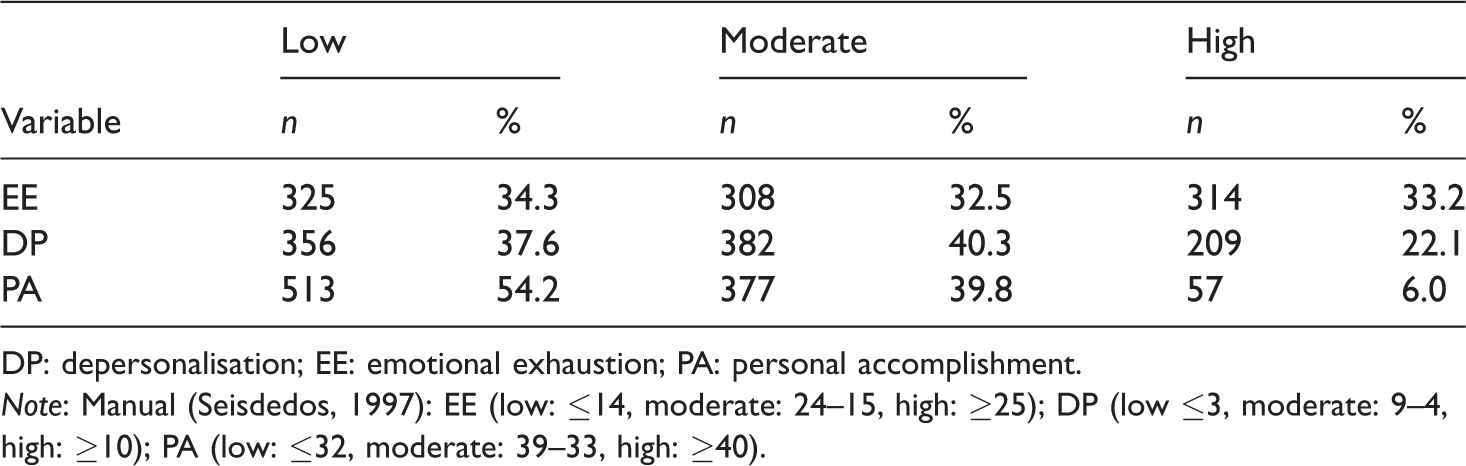
As can be seen in Table 3, the mean score of social workers is similar to the mean score of the normative sample (Seisdedos, 1997) for emotional exhaustion. Nevertheless, there is a difference with regard to depersonalisation and personal accomplishment, where the sample showed scores lower than the normative sample.
Incidence of low, moderate and high levels of burnout dimensions.
DP: depersonalisation; EE: emotional exhaustion; PA: personal accomplishment.
Note: Manual (Seisdedos, 1997): EE (low: ≤14, moderate: 24–15, high: ≥25); DP (low ≤3, moderate: 9–4, high: ≥10); PA (low: ≤32, moderate: 39–33, high: ≥40).
Table 3 presents the frequencies obtained in each of the dimensions of burnout. The high presence of burnout in the sample studied can be seen. Specifically, 33.2% of the sample evidence high levels of emotional exhaustion, 22.1% display a high depersonalisation and 54.2% display low personal accomplishment. Only 6.0% of social workers experienced positive feelings towards the work they were doing.
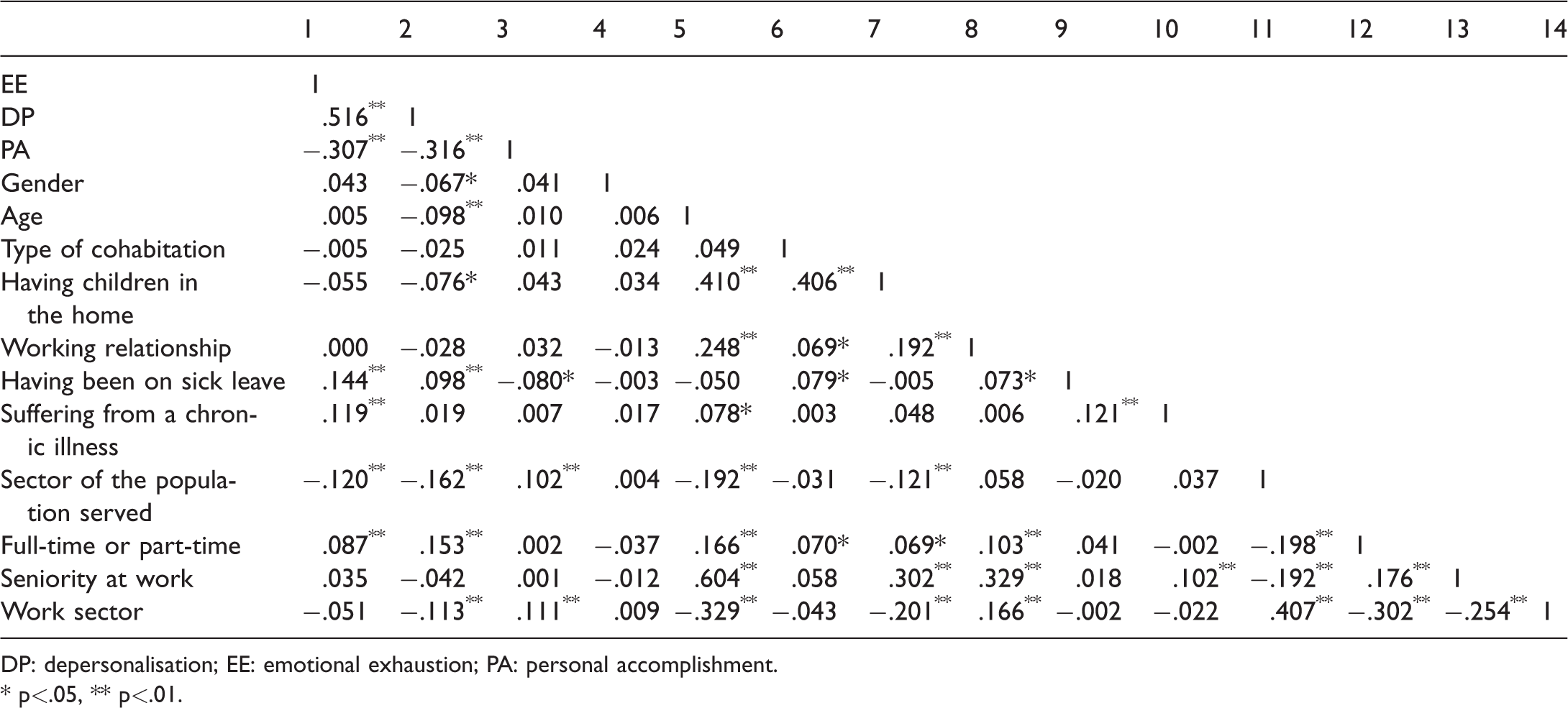
Bivariate correlations were calculated between the 11 socio-demographic characteristics with the three components of burnout (Table 4). Next, in order to determine the predictor value of the socio-demographic variables on the dimensions of the MBI, three hierarchical regression equations were performed for each dimension of burnout: emotional exhaustion, depersonalisation and personal accomplishment (Table 5). The eight socio-demographic characteristics that are bivariate in correlations with at least one component of burnout have been included as predictors of hierarchical regression.
Descriptive statistics and correlation results among major variables.
DP: depersonalisation; EE: emotional exhaustion; PA: personal accomplishment.
* p<.05, ** p<.01.
Hierarchical regression analysis for exploring the socio-demographic characteristics on the three dimensions of burnout.
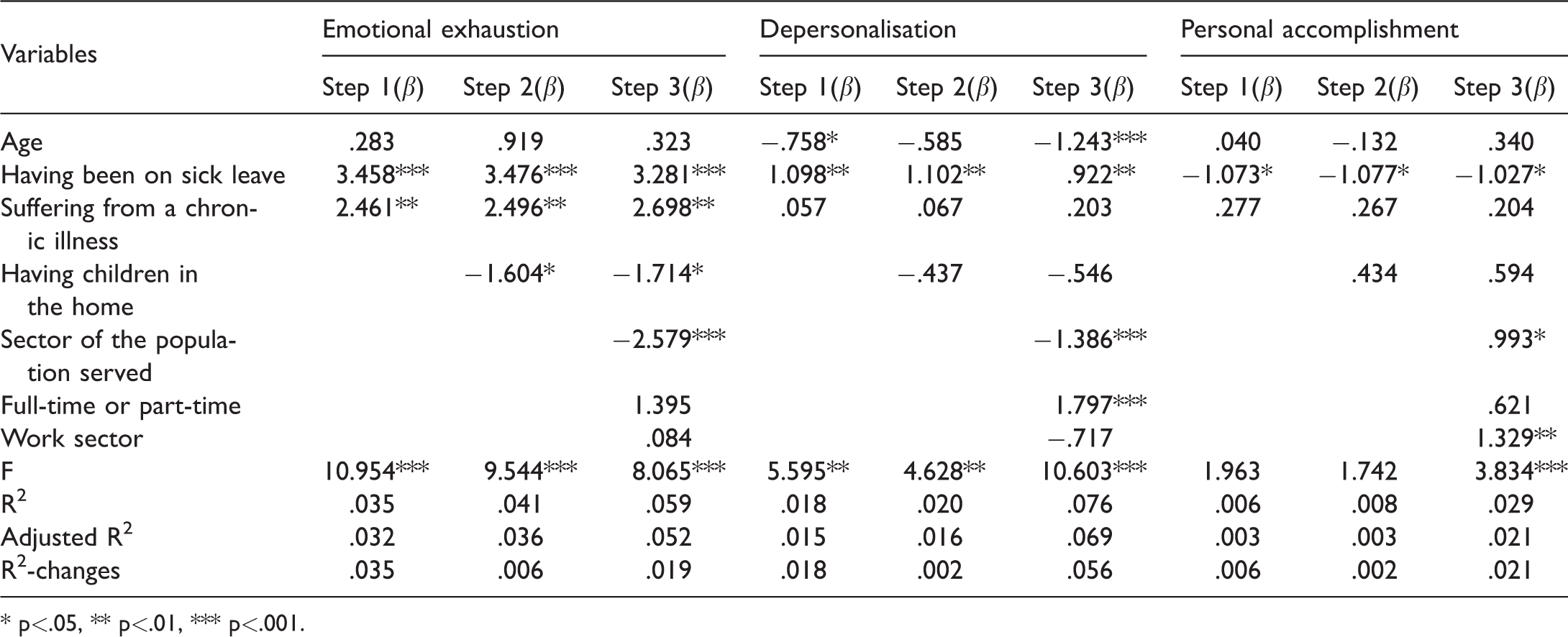
* p<.05, ** p<.01, *** p<.001.
In the first step of the regression analysis, the effect of the biological variables was examined (gender were not introduced due to the predominance of women versus men in our sample); in the second step, the social variables (having children) were added and, in the third step, the professional variables were added (work sector, population sector served and part-time or full-time employment).
In the first regression equation, taking emotional exhaustion as the dependent variable, having been off work, suffering from chronic disease, having children and population sector served appear as significant predictors, explaining 5.9% of the variance. For emotional exhaustion, the most important predictor variable was having been on sick leave (β = 3.47).
For the second regression equation, depersonalisation has been taken as the dependent variable. Age, having been out of work, sector of population served and part-time or full-time employment were found to be significant variables, explaining 7.6% of the variance. Part-time or full-time employment is the most important variable to explain depersonalisation (β = 1.79).
In the third regression equation taking personal accomplishment as the dependent variable, the following were found to be significant predictors: the fact of being out of work, the population sector served and public or private sector, explaining 2.9% of the variance. Public or private sector is the most important variable to explain the lack of personal fulfilment (β = 1.32).
Discussion
The objective of this study was to estimate the prevalence of burnout syndrome in a sample of Spanish social workers and to explore the impact of socio-demographic characteristics on the different dimensions of burnout. In relation to the first hypothesis of the study, the results present a worrying picture regarding the levels of burnout among Spanish social workers. The main concern is the finding that 33.2 and 22.1% of Spanish social workers experience high levels of emotional exhaustion and depersonalisation. At the same time, 54.2% experience low personal accomplishment at work.
It was found that health status (Hypothesis 2a) was associated with burnout. The results revealed that social workers who had been off work had a greater degree of emotional exhaustion and depersonalisation, as well as a lower personal accomplishment. Suffering chronic disease was associated with higher emotional exhaustion.
The presence of children in the home (Hypothesis 2b) was associated with a lower emotional exhaustion risk.
Finally, the population sector served, employment status (part-time or full-time) and public or private sector (Hypothesis 2c) were also associated with different levels of burnout. Developing professional activity in specialised social services (elderly, mental health, education, children and family, etc.) was associated with a lower risk of emotional exhaustion and PD and with a higher degree of personal accomplishment than workers who worked in community social services. Full-time employment was associated with higher depersonalisation values than those in part-time employment. Working in private organisations was associated with higher values of personal accomplishment than those in public administration.
Implications
Burnout is a problem with wide-ranging implications. Both private and public organisations that employ social workers should be interested in reducing employee stress and burnout, both for ethical and practical reasons. Ethically, organisations are obligated to protect employees from harm that results from their occupational activities. In practice, burnout is linked to higher turnover, absenteeism and poor job performance representing a significant cost (Taris, 2006).
Burnout impacts the level of care social workers can provide and harms the client–provider relationship, particularly in the areas of empathy and building rapport (Lizano & Mor Barak, 2015). Not only are social workers who are less stressed and burned out able to provide better care, but they are also more productive and better able to emotionally connect with clients (Maslach & Goldberg, 1998).
Organisationally, there have been some successful policies that corporations have been able to enact to reduce burnout, namely employee assistance programmes and employee health programmes, which have had some success in reducing burnout and employee stress (Ybema, Evers, & Van Scheppingen, 2011). Data are lacking in many important areas, but one of the more glaring gaps in knowledge is the lack of data concerning general scores of burnout for social workers and what might be considered a high score (Morse, Salyers, Rollins, Monroe-Devita, & Pfahler, 2012).
Limitations and recommendations
Given its exploratory nature, this study has certain limitations that should be taken into account when interpreting its results. First, due to the fact that there are no cut-off points to reference for the subscales of the MBI for Spanish social workers, the reference values published for a general sample (comprised of diverse caregiving professions) were taken (Seisdedos, 1997). Second, the sample was not randomly selected, and so may not be balanced to be representative of the population. Another limitation is that the researcher does not have information on those who did not respond. Within the context of these limitations, this research contributes to knowledge of the incidence of burnout in Spain, a country in which previous research is scarce.
Although this study answered questions about the relationships between socio-demographic characteristics of social workers and burnout, it is clear that there are many more variables that must be explored in relationship to the experiences and attitudes of workers towards their work. It is important to re-examine the relationships between service groups and burnout, considering that the characteristics of specialised social services, which appear to protect them against burnout, still have not been identified by empirical literature. The second suggestion is to improve the understanding of social workers who perform their function in public administration and in private organisations in order to clarify the similarities and differences between the two subgroups in relation to the components of burnout. The results of the study also showed that younger and inexperienced social workers were more prone to burnout than those who were older. Therefore, orientation programmes are needed that provide realistic information about this type of work to new social workers.
Longitudinal studies and/or statistically representative samples would be of great use to understand the development of burnout in the course of professional careers. Finally, it would be useful to perform studies through the development of qualitative designs. This strategy would be particularly important in order to understand the experience that the professionals themselves have of burnout.
Conclusion
This study confirms the high presence of burnout syndrome in Spanish social workers. In the same vein, it was found that gender, age, the presence of children in the home, having been on sick leave, suffering from a chronic illness, the sector of the population served, full-time or part-time employment status, and the type of organisation worked for are variables that are significantly associated with one of the three dimensions of the MBI-HSS. Nevertheless, the explained low percentages of total variance imply that although certain socio-demographic characteristics of social workers are significant predictors, their effects on each of the dimensions of burnout of social workers may not be as emphasised.
Footnotes
Ethics
This study conformed to the Code of Practice for Research at the University of Valladolid (Spain) and was approved by the ethics committee of this University.
Funding
The authors received no financial support for the research, authorship, and/or publication of this article.
Acknowledgements
The authors would like to express their gratitude to all the professionals who have collaborated in completing the surveys and extend their thanks to all the Official Associations of Social Workers who provided the necessary assistance to carry out the study.