







Abstract
Summary
An evolution of thought and practice regarding the relationship of racism to well-being, healing, and trauma continues within social work and the helping professions. Additionally, empirical research on colorism as a key dimension of racism suggests that colorism negatively impacts the psychological and physical well-being of African Americans. However, few studies have examined well-being among African Americans in the context of historical trauma, through the lens of colorism. In this paper, the intersectionality of colorism and historical trauma is explored to inform culturally responsive social work education, practice, and research regarding African American well-being. It is the first step toward developing a colorist-historical trauma framework. The impact of colorism as a function of historical trauma response transmission among African Americans is presented.
Findings
Advances in culturally responsive practice in social work address the impact of social determinants of health, such as racism. However, the impact of colorism within systemic racism is often unacknowledged. The authors assert that social work practice must attune to the differentiated socioemotional, political, and economic needs that exist among African Americans due to the impact of colorism and historical trauma. An intersectional lens, such as the colorist-historical trauma framework, is essential for culturally responsive practice.
Applications
The colorist-historical trauma framework contributes to the professional social work discourse aimed at strengthening effective micro-, meso-, and macro-level practice with African Americans for well-being. Implications for social work practice, research, and education are presented.
Keywords
Introduction
The understanding of racism as a social determinant of health and source of trauma is expanding across disciplines such as social work, psychology, and public health (Carter et al., 2013). Institutions such as the Department of Health and Mental Hygiene in New York City have made a strong critique of racialized trends in mortality and morbidity and identified structural racism as a factor for early death and disease (Stoelker, 2016). An evolution of thought and practice regarding the relationship of racism to well-being, healing, and trauma continues within social work and the helping professions (Carter et al., 2013; Pinderhughes, 1989; Robinson, 2001). Additionally, empirical research on colorism as a key dimension of racism suggests that colorism negatively impacts the psychological and physical well-being of African Americans (Hall & Crutchfield, 2018; McBride-Murry, Heflinger, Suiter, & Brody, 2011). However, few studies have examined well-being among African Americans in the context of historical trauma, through the lens of colorism. In this paper, the intersectionality of colorism and historical trauma, in a colorist-historical trauma framework, is explored to inform culturally responsive social work education, practice, and research regarding African American well-being. The term African American will be used interchangeably with the term Black, to reflect the variance in the literature referenced throughout the study. Additionally, when referring to color to represent race, it will be intentionally capitalized, also reflective of the literature.
Colorism, well-being, and African Americans
Colorism, an international system of oppression, has its roots in colonialism (Hamilton, Goldsmith, & Darity, 2009; Hunter, 2007). Broadly understood as preferential treatment of people with what is generalized as more “European” features including skin color, eye color, hair texture, nose and lip width, and body shape, colorism manifests both within and between racial groups (Hunter, 2007). Whether in Southeast Asia, West Africa, or North America, individuals whose phenotypic features are closer in proximity to Whites, experience better biopsychosocial outcomes. Although beyond the scope of this paper, colorism is well documented among many racial and ethnic groups; for example, in pre-War Germany there was a preference for Aryan-appearing versus darker-skinned Jews (Scales-Trent, 2001), in South Africa among Indian and Diasporic African women who use skin lightening products (Dlova, Hamed, Tsoka-Gwengweni, & Gobler, 2015), and Latinx/HIspanics who earn more when they are lighter-skinned (Hersch, 2006). These color-based disparities exist systemically, for example in housing access, school discipline practices, sentencing within the criminal justice system, and health care (Hamilton et al., 2009; Hill, 2002; Hunter, 2007). In research comparing skin color, there is evidence which suggests that individuals who present with what is generalized as having more “African” features encounter discrimination which impacts multiple dimensions of well-being (Hannon, DeFina, & Burch, 2013; Perreira & Telles, 2014; Viglione, Hannon, & DeFina, 2011).
Colorism and slavery
During the transatlantic slave trade, the devaluation of Africans by White colonialists served as the underpinning of colorism for African Americans. Enslaved African people were exploited not only for their manual labor but also reproductive labor; sexual exploitation, rape, and selling children born to enslaved women were pervasive (Jacobs, 1861/2011). As enslaved Black women bore children after being raped by White masters, a “caste” of lighter-skinned and White-appearing Black enslaved people emerged (Jacobs, 1861/2011). Additionally, in some Southern states in the antebellum period, different laws and customs existed regarding race and colorism (Aslakson, 2012). In Louisiana for example, influenced by French and Spanish rule, quadroon and octoroon women and White men formed many types of common-law unions, which included at times increased access to land, financial support, and freedom for their children (Aslakson, 2012). Some quadroons and octoroons who were able to purchase their freedom in Louisiana formed a merchant class that even at times enslaved darker-skinned people (Aslakson, 2012).
White-appearing enslaved Black people also attested to experiences of persistent psychological torture, sexual violence, and isolation when removed from the general population of enslaved Black people to a White plantation owner’s house (Jacobs, 1861/2011). However, the overall phenomenon of White-appearing and lighter-skinned Blacks having access to more resources, such as money to purchase their freedom or encounter less physical violence in the field, is well documented (Hunter, 2005; Mullane, 1993). Throughout American slavery, Whites privileged lighter-skin Blacks with access to apprenticeships and other resources of working in the home, while darker-skin enslaved people were often relegated to harsher work conditions (Mullane, 1993). The same families that were privileged during slavery were also privileged in the post-bellum South; lighter-skinned Blacks tried to assimilate more into White society by inter-marrying within families and creating special societies of lighter-skinned people (Ryabov, 2013). Historically, colorism was also reinforced in social groups, such as sororities and fraternities; lighter-skinned Blacks discriminated against darker-skinned Blacks and prioritized lighter skin for membership (Kerr, 2007). Differential treatment based on color hoarded resources among those with lighter skin tones, which impacted employment and opportunities for career advancement (Kerr, 2007).
Differential treatment of White-appearing and lighter-skinned Blacks, compared to their darker relatives, reinforced colorism as an essential function of racist social control (Ryabov, 2013). Post-slavery, White-appearing Blacks were sometimes afforded opportunities for schooling and jobs that were not available to browner-skinned Blacks (Kerr, 2007). This eventually led to a lighter-skinned or White-appearing middle class of African Americans who were able to excel economically in part due to the advantages conferred to them by a racist colorist society (Ryabov, 2013). The wealth and well-being legacies of colorism are still present today.
Contemporary impact of colorism on African Americans
In any metric of well-being, including physical, mental, and social, colorism has manifested for African Americans. In schools, colorism manifests in disparate negative outcomes for African American children with darker skin tones (Hannon et al., 2013). Research demonstrates that skin complexion is linked to socioeconomic status which enables lighter-skinned parents to ensure their lighter-skinned children are attending schools that are more resourced (Kao & Thompson, 2003; Keith & Monroe, 2016).
In areas of school discipline, not only are darker-skinned children more likely to be suspended from school at a rate of three times higher than those with the lightest skin tone (Hannon et al., 2013), but in some cases they also complete fewer years of schooling than their lighter-skinned counterparts (Monroe, 2013). Disparities in school discipline translate to other social systems in the United States. Colorism can be seen operating along the same metrics as race. Where social systems create racial disparities, we can also see color disparities. Regarding the criminal justice system, for example, Viglione, Hannon, and DeFina (2011) found that lighter-skinned inmates received less harsh sentences and spent less time in jail than darker-skinned inmates. Crutchfield, Fisher, and Webb (2017a) also found that having darker skin is a risk factor that increases the likelihood that African Americans are victims of a police killing.
The literature documents how skin color and other phenotypic features influence the emotional well-being of adolescents. Young girls who are forming their identity and facing the challenges of self-esteem building are reported to have a more positive self-identity if they are satisfied with their skin color (Breland-Noble, 2013). While adolescents of any skin color struggle with low self-esteem if they are not satisfied with their physical characteristics, African American adolescents who experience the discriminatory impacts of colorism face an increased risk of substance abuse and being labeled as aggressive in comparison to lighter-skinned African Americans (Smith-Bynum, Best, Barnes, & Burton, 2008). In some studies, darker-skinned clients reported higher rates of depression and were more likely to withdraw from mental health treatment (Hunter, 2007).
Colorist microaggressions
Beyond these overt instances of colorism, recent literature has identified how colorism manifests as colorist microaggressions (Hall & Crutchfield, 2018). Like racial microaggressions as described in the literature, colorist microaggressions are subtle often unconscious put downs toward a group of people or individuals. Unlike racial microaggressions, however, colorist microaggressions are based on skin color and phenotypic features. In their study of colorist microaggressions experienced by African American women, Hall and Crutchfield (2018) document how a sample of African American women experienced being told they are “pretty for a dark girl,” or that they “better focus on sports as opposed to academics” due to possessing what is considered more typical African features. While these do not result in an immediate detrimental outcome like extended prison sentences or substance abuse, they have the potential to impact long-term emotional distress (Huynh, 2012; Nadal, Griffin, Wong, Hamit, & Rasmus, 2014). Another point of concern regarding colorist microaggressions is that unlike racial microaggressions, colorist microaggressions come from outer group members, but also can be experienced within families, kinship groups, as well as communities of the same race (Hall & Crutchfield, 2018). Colorism, as a function of racism, is a social determinant of health and plays a role in the transmission of historical trauma among African Americans.
Historical trauma and African American well-being
Historical trauma framework (HT)
Historical patterns of social injustice, as well as collective acts of resistance to such violence, have been conceptually linked to wellness. HT asserts that massive group-level trauma, inflicted through intentional genocide, exploitation, and purposeful cultural disruption of a people for the benefit of another racial/ethnic group, causes harm intergenerationally through a historical trauma response (Brave Heart, 1998). Historical trauma is defined as cumulative trauma, unresolved grief and compounded loss from a people’s initial subjugation, and continued experience of systemic violence (Brave Heart, 1998). Historical trauma is conceptualized to be a negative social determinant of health resulting in psychological, spiritual, physical, and behavioral health disparities (Brave Heart, 1998; Brave Heart, Chase, Elkins, & Altschul, 2011). HT scholars purport that a historical trauma response is transmitted intergenerationally to those who did not experience the initial massive group trauma, but still endure the denial of its import and connection to current-day related injustices (Brave Heart, 1998; Sotero, 2006; Walls & Whitbeck, 2012; Walters & Simoni, 2002). Empirical evidence of the presence and impact of historical trauma exists, qualitatively as well as quantitatively when controlling for present day individual-level traumas (Brave Heart, 1998; Chae & Walters, 2009; Gone, 2013; Schultz, Walters, Beltrán, Stroud, & Johnson-Jennings, 2016b; Whitbeck, Adams, Hoyt, & Chen, 2004).
Brave Heart (1998), a Lakota social worker, integrated Jewish Holocaust survivor research, psychodynamic theory, and indigenous healing practices and wisdom to develop the framework of HT. Brave Heart (1998) used HT to better understand, and respond to, what she conceived of as the origin of mental and behavioral health disparities among her people. Historical traumas exist in non-indigenous racial and ethnic groups as well that have experienced pervasive historical, political, economic, and social oppression, such as racial subjugation and colonization (Lopez-Levers & Hyatt-Burkhart, 2012; Ortega-Williams, 2017; Williams-Washington & Mills, 2018). In the HT framework, historical trauma exists at the level of group identity and is passed on socially (DeGruy-Leary, 2005; Sotero, 2006).
Development and utility of HT
Sotero (2006, p. 98) expanded upon Brave Heart’s conceptualization of historical trauma by postulating four primary pathways of subjugation resulting in historical trauma: segregation, systematic physical and psychological violence, economic destruction, and cultural dispossession. Additionally, Sotero (2006, p. 98) created a model demonstrating how the first generation to survive subjugation experiences a historical trauma response, a cascade of physical, psychological, and social reactions resulting in contemporary population health disparities. In research on the physical and psychological health of American Indian/Alaska Native people using the HT framework, an additional layer of assessment and intervention is available to support recovery (Schultz et al., 2016a). Similarly, the theoretical lens of HT applied to social work with African Americans can support culturally responsive interventions (Ortega-Williams, 2017).
HT as a lens to interpreting contemporary well-being among African Americans shifts an individualistic or pathological view of health disparities and indicts oppressive racist policies (Ginwright, 2015; Ortega-Williams, 2017; Richards, 1994). Deficit-oriented approaches to health assessments and interventions among African Americans that are ahistorical could mislabel behavioral health patterns as maladaptive or intrinsically-driven (Ginwright, 2010). Accounting for the impact of historical trauma expands options for wellness which can engage strengths that existed before, during, and after mass group-level injury (Schultz et al., 2016b). In Sotero’s (2006) model, the impact of colorism as a part of subjugation was not incorporated. In the case of African Americans, colorism is a relevant mechanism of White settler colonialism. An expansion of Sotero’s (2006) model is needed to explain the historical trauma response among African Americans whose subjugation persisted through the brutal intergenerational enslavement of African people and descendants for the direct profit of the White upper class (Williams, 1987; Zinn, 2003).
The colorist-historical trauma framework: Colorism as a function of subjugation
The colorist-historical trauma framework introduced here is a conceptual model that extends the understanding of colorism’s role in the intergenerational transmission of a historical trauma response among African Americans. There is emerging research about the strengths and posttraumatic growth that African Americans also experience in the context of historical trauma and systemic violence (Ortega-Williams, 2017). However, for the purposes of this paper the aspect of the historical trauma response that is linked to harm and disproportionate negative health disparities will be the focus.
Social epidemiological research suggests that distal and proximal social factors can impact well-being (Krieger, 2016). HT, conceptualized as a distal social determinant of health, identifies mass group subjugation by a dominant social group as a contemporary influence on the health disparities of an oppressed group (Sotero, 2006; Walters & Simoni, 2002). However, research explaining the mechanisms of historical trauma and their differential impact within a population are scant (Schultz et al., 2016b; Sotero, 2006). Additionally, although colorism is well documented as linked to well-being, conceptual models of historical trauma have not accounted for its function as a dimension of subjugation or the historical trauma response (Brave Heart, 1998; Sotero, 2006; Williams-Washington & Mills, 2018). Table 1 outlines the impact of colorism on the physiological, environmental, psychosocial, socioeconomic and political, and legal pathways initiating and maintaining a historical trauma response.
Colorist-historical trauma framework.
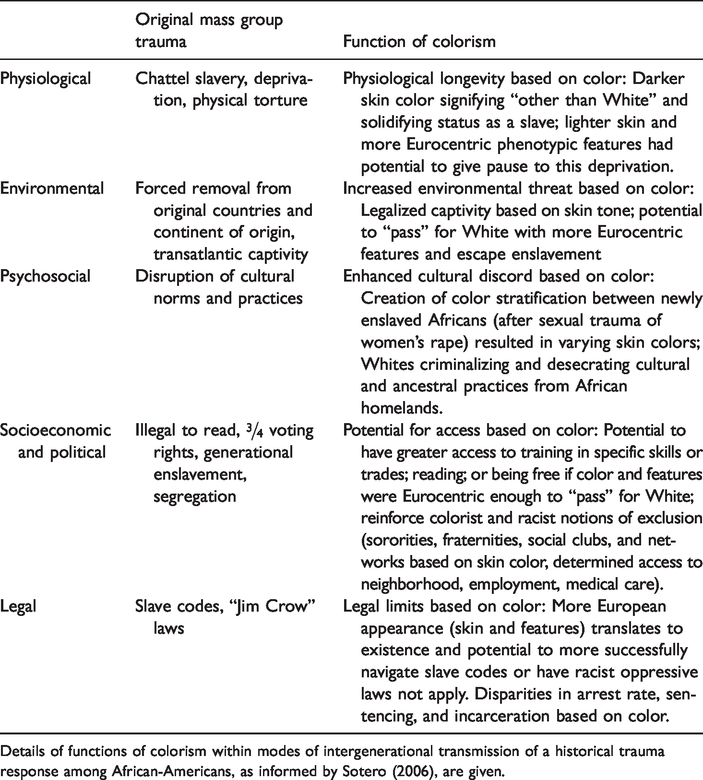
Details of functions of colorism within modes of intergenerational transmission of a historical trauma response among African-Americans, as informed by Sotero (2006), are given.
As demonstrated in Table 1, colorism has been a key dimension of White supremacy shaping the subjugation of African Americans. White supremacy enacted against African Americans at the mass group-level hinged upon phenotypical markers, like skin color, facial features, and hair texture. Therefore, color mitigated exposure to historical trauma within a colorist and racially stratified society; it functioned as the explicit gateway of social control against African Americans. Colorism is historically State sanctioned and is based on imposed external definitions of group membership that are codified into law; visible body markers and descent have been used to impose social control and justify exploitation (Scales-Trent, 2001). Phenotypical markers are still relevant in navigating systemic violence. For example, in the workplace, those who portray what are thought to be African features are more likely to experience hiring discrimination than those with what are thought to be European features (Goldsmith, Hamilton, & Darity, 2007). According to Allen, Telles, and Hunter (2000), in the National Study of Black Americans with 2107 respondents, African Americans who are lighter-skinned were found to earn $777 dollars more annually, per level of skin tone lightness, as compared to darker-skinned African Americans of similar social economic status. Additionally, lighter-skinned Blacks are 14% more likely to be married by age 29 (Hamilton et al., 2009) and have 10–12% higher incomes (Hunter, 2007).
This type of social control is also demonstrated in the increased likelihood of darker-skinned African Americans being overpoliced, over-incarcerated, and over-referred for school suspensions, and overidentified for the most restrictive school settings, including special education (Blake et al., 2017; Hunter, 2016; Shedd, 2015).
Additionally, as a dimension of the historical trauma response, colorism has functioned as internalized oppression that continues to contemporarily impact self-esteem and community-wellness (Damon, 2011; Hall & Crutchfield, 2018). Wallace, Townsend, Glasgow, and Ojie (2011) found that Black adolescent girls in their sample who accepted a standard of beauty that affirmed what was commonly thought of as African features engaged in less risky behaviors like substance abuse. The perpetuation of colorist microaggressions maintains the historical trauma response in African Americans, impacting mental health and well-being (Hall & Crutchfield, 2018). Nadal et al. (2014) documented an increase in anxiety and depression for those experiencing racialized microaggressions. In addition, these microaggressions may influence how African Americans view the world and perceive a sense of safety (Nadal et al., 2014).
Colorism has therefore been essential in maintaining the historical trauma response among African Americans through increasing exposure to persistent and interlocking systemic violence, especially those considered darker-skinned (Crutchfield et al., 2017a, 2017b; Kahn & Davies, 2010). Additionally, colorist privilege within these systems generates unearned advantage for more White-appearing African Americans in society. Expanding models of historical trauma (Brave Heart, 1998; Sotero, 2006; Walters & Simoni, 2002) to incorporate colorism as a dimension of how historical trauma responses were initiated and maintained at the mass group-level can advance culturally responsive social work practice, education, and research promoting African American well-being.
Implications for social work practice, education, and research
The colorist-historical trauma framework has implications for social work practitioners, educators, researchers, and scholars interested in well-being among African Americans (Harrison & Thomas, 2009). Social work educators are charged with preparing social workers to respond to diverse practice needs at micro-, meso-, and macro-levels, especially with populations that are racial and ethnic minorities (Hall & Rammell, 2016). Incorporating an understanding of colorism as a function of historical trauma and systemic violence against African Americans would expand the compendium of scholarship used in diversity and leadership training and anti-oppressive social work professional development.
The colorist-historical trauma framework proposed here could extend current priorities within trauma recovery workforce education. Educating students about collective mass group-level historical trauma experienced by African Americans, enacted through colorism, could support the development of more robust analyses and interventions to support collective well-being and trauma recovery (Henderson, 2019; Ortega-Williams, 2017). Well-being among African Americans has been defined in some studies as related to life satisfaction or meaning in life (Ajibade, Hook, Utsey, Davis, & Van Tongeren, 2016). However, mass group-level wellness approaches, which incorporate a colorist-historical trauma frame would expand interventions, including action-oriented coping strategies and narratives of historical resistance could make trauma recovery efforts more responsive to social determinants of health like social injustice (Franklin, 2014; Henderson, Stephens, Walton, & Ortega-Williams, 2019; Hobfoll et al., 2007; Krieger, 2016; Ortega-Williams, 2017; Schultz et al., 2016a).
Colorism and historical trauma addressed in social work education would extend the advances made in culturally responsive pedagogy, critical race Black feminist theory, and deinstitutionalized wellness care (Page, 2010; Pinderhughes, 1989; Rodgers, 2017). Black feminist scholarship created a paradigm shift in 20th century social work, notably through the creation of intersectionality theory by Kimberlé Crenshaw (1991). Social work education began to center identity, culture, and well-being in the context of confronting structural racism. In adopting a colorist-historical trauma framework, social work educators could replace the vestiges of multicultural perspectives that still emphasize color blindness. Students can be prepared to notice and articulate how race and color are viewed in an institutionally racist and colorist society and trained to interrupt colorist microaggressions within their own practice with African Americans (Hall & Crutchfield, 2018).
Trauma-informed practice perspectives in social work practice continue to expand in scope and depth at the micro-, meso-, and macro-levels. Clinical practitioners aware of the colorist-historical trauma framework could incorporate awareness of mass group-level trauma as well as individual-level traumatic experiences with colorism as part of client’s background assessment (Hall, 2009, 1992). By acknowledging African American clients’ experiences of colorism and colorist microaggressions, practitioners could establish rapport and trauma recovery (Nadal et al., 2014; Reece, 2018).
In addition, expanding beyond a deficit-oriented model of those surviving historical and individual-level trauma is necessary to offer culturally responsive, healing-centered engagement in social work practice with African Americans (Ginwright, 2018; Henderson et al., 2019). In the context of harm and wellness, social work clinical practitioners can also consider mass group-level historical resistance as a part of trauma recovery (Ortega-Williams, 2017). Historical trauma interventions have been primarily approached at the small group-level (Brave Heart, 1998). Theoretically, future interventions could include mass group-level approaches as well because conceptually, its where historical trauma originates. There is emerging evidence that suggests mass group-level social action against racial injustice, which includes a focus on the transmission of narratives of resistance, supports collective well-being among Black youth, including African Americans (Jemal, 2018; Ortega-Williams et al., 2018).
Social work practitioners at the meso-level in community-based organizations could implement policies that address color as a part of their racial equity professional development and as a lens to analyze internal policies. Macro-level practitioners could advocate for social justice within systems and institutions that address colorist and racial oppression in ensuring equitable policies, social program implementation, and allocation of resources, especially where there is persistent community loss (Abramovitz & Albrecht, 2013).
Social work research and the colorist-historical trauma framework
Social work researchers, in light of the colorist-historical trauma framework, have new avenues to explore color-based outcomes of interventions and biopsychosocial well-being of populations within studies on trauma recovery and well-being (Wilder, 2010). The colorist-historical trauma framework can support with the conceptual foundation needed for culturally responsive research designs. For example, it could inform program evaluation, translational research of evidence-informed and evidence-based interventions focused upon population health and racial health disparities. Research is not a value neutral enterprise; it has competing agendas and priorities (Shields, 2012; Upshur, VanDenKerkhof, & Goel, 2000). Therefore, positioning research questions within a colorist-historical trauma framework could support the development of evidence-informed interventions able to respond to client and community needs existing at the intersection of colorism and historical trauma (Banton, 2012; Brown, 2003).
Conclusion
Researchers have documented the legal, social, cultural, economic, and political impact of colorism in the lives of African Americans and other ethnic/racial minorities (Hall & Crutchfield, 2018; Hannon et al., 2013; Hunter, 2007, Scales-Trent, 2001). The colorist-historical trauma framework offers a theoretical foundation for understanding the social, political, economic, and health disparities, including painful emotional experiences, of African Americans. The authors assert that it is important for social work educators, practitioners, and researchers to distinguish the specific effects of colorist-historical trauma to support culturally responsive practice. Moreover, culturally responsive approaches that attend to the impact of colorism upon African American’s lives can inform all levels of social work practice to help survivors overcome traumatic consequences. Ultimately, a commitment to pursuing a deeper understanding of the impact of colorist-historical trauma upon African Americans will support not only the different needs and strengths within group, but also the well-being of racial/ethnic communities that share related histories of oppression and resistance.
Footnotes
Funding
The authors received no financial support for the research, authorship, and/or publication of this article.
Acknowledgements
The authors would like to thank the reviewers for their comments on an earlier version of this article as well as our universities for support.
