






Abstract
Summary
High turnover rate among Chinese social work practitioners is a big challenge facing the nation’s social work profession. Turnover intention, the determinant predictor of actual turnover, has been widely used instead of the actual turnover. Among many predictors, burnout (exhaustion, cynicism, and professional efficacy) was recognized as a key predictor of turnover intention. In addition, recently, organizational justice is getting more and more attention by social work scholars in affecting employees’ intention to leave the organization. This article aims to empirically test how different dimensions of organizational justice influence social workers’ turnover intention, regarding burnout as a mediator, and including the development and validation of a new organizational justice scale in Chinese context.
Findings
In total, 616 social workers (223 from Beijing for Study 1 and 393 from Jiangmen for Study 2) participated in the study. The results revealed that interpersonal justice is the most important dimension for predicting social workers’ turnover intention, whereas cynicism plays a mediator role in that relationship.
Application
Turnover is an organizational behavior. Therefore, it is more important for organization managers and policy makers to consider the factors from organizational conditions that are influencing turnover. This study provides the field of social work in China with solid evidence that more attention should be paid to management issues in solving the challenge of a high turnover rate.
Introduction
High staff turnover is a tough challenge for the social work profession all over the world. On one hand, a high turnover rate among social workers affects the quality, consistency, and stability of the services delivered by social work organizations. On the other hand, high workforce turnover also has a negative effect on the overall professional level of social work. Turnover has therefore interested social work scholars for a long time (Tham, 2007).
In a meta-analysis conducted in 2001, Mor Barak et al. (2001) concluded that there are four categories of organizational conditions which are antecedents of turnover among social service employees: (a) stress; (b) social support; (c) fairness-management; and (d) physical comfort. Organizational justice is a core concept for studying organizations’ fairness management (Colquitt et al., 2005), which is negatively related to turnover (Hendrix et al., 1998). Turnover is also considered to be the primary negative consequence of organizational justice (Conlon et al., 2005). Even so, there are few studies in the social work literature that examine the relation between organizational justice and turnover. The reasons may be that (a) because of their professional ethics, social workers usually react differently to organizational justice compared to employees in other fields; (b) for social workers, organizational justice affects turnover with profession perception as mediator. The first reason above shows the necessity of validating an organizational justice measure in the context of social work organizations, especially in China. The second reason indicates that organizational justice might not affect social workers’ turnover directly, but rather, there are certain mediators that should be introduced between them.
High turnover rate is also a serious problem in the social work field in China. Although nationwide statistics are unavailable, we can still get a hint from city data. For example, in Shenzhen, one of leading cities in social work development in China, the turnover rate climbed from 8.2% in 2008 to 22.2% in 2014, and in Shanghai, the annual turnover rate of social workers has reached 20% to 30% (Du, 2015). Although no official figures have been released, local government officials have suggested that approximately 25% of Beijing social workers had left their positions in 2014 (Jiang & Wang, 2016).
Factors that trigger Chinese social workers’ turnover or turnover intention (TI) are most commonly identified as hard-to-change, work-related characteristics such as low pay, although recently a different perspective has emerged that investigates turnover antecedents from the perspective of professional perceptions, and considers the impact of professional identity, job satisfaction (Jiang et al., 2019), and burnout (Wang et al., 2019). Therefore, an awareness of factors that constitute organizational conditions will be necessary to understand how these conditions affect social workers’ turnover or TI in China. The relationship remains unclear (Xu, 2017). Organizational justice is one of the most important predictor variables in various organizational conditions to be researched.
This study focuses on organizational justice and turnover of social workers in China. The first purpose for writing this article is to validate an organizational justice scale for Chinese social workers. The second aim of writing this article is to examine the effects of organizational justice on TI of social workers with job burnout as mediator. Selecting burnout as mediator is based on the authors’ previous research that confirmed that burnout is a main factor of profession perception in predicting the TI of social workers in China (Wang et al., 2019).
Literature review
Turnover and TI
Studies on what factors influence social workers’ decisions to leave their jobs have been conducted for a long time. Turnover, defined as actually leaving a workplace, is considered to be a process rather than a sudden action (Hopkins et al., 2010; Tham, 2007). Among all cognitions that form the turnover process, the intention to leave, which is defined as the desire of a person to leave an institution (Tett & Meyer, 1993), is reported to be the single strongest and best predictor of actual turnover (Alexander et al., 1998). Therefore, most empirical studies use TI rather than, or in addition to, actual turnover as the outcome variable (Knudsen et al., 2006). There are various factors that affect employees’ intention to leave, and the antecedents of social workers’ TI are usually divided into three categories: (a) demographic factors, both personal and work-related; (b) professional perceptions; and (c) organizational conditions (Mor Barak et al., 2001).
Burnout and TI
Empirical evidence has shown that as a chronic and pervasive problem in the social service fields (Geurts et al., 1998), burnout is a major contributor to practitioners’ intention to leave their organization (Cordes & Dougherty, 1993; Jackson et al., 1986). According to Maslach and Jackson (1986), there are three factors that constitute the syndrome of burnout: exhaustion (EX), cynicism (CY), and professional efficacy (PE). EX refers to feelings of being overextended and depleted of emotional and physical resources, PE means feelings of incompetence and a lack of achievement at work, and CY is defined as negative or excessively detached responses toward one’s employing organization, specifically due to the belief that the organization lacks integrity (Maslach & Jackson, 1986).
Studies have resulted in different findings on how the three burnout components affect employees’ TI in social service organizations (Nuallaong, 2013). Jackson et al. (1986) indicated that all three burnout components were significantly associated with teachers’ thoughts about leaving their jobs, whereas EX was the one that was significantly associated with their actual turnover. Van Bogaert et al. (2010) found EX was a predictor of TI for nurses. Zhang and Feng (2011) also found that among the three burnout components, only EX was a significant predictor of TI for Chinese physicians. In another study about nurses’ turnover in Britain, Firth and Britton (1989) came to a slightly different conclusion which suggests that actual turnover of nurses was associated only moderately with depersonalization but that there was no significant relationship between their turnover and the other two components. Moreover, one study conducted in China found that CY plays the main mediator role in the relationship of social workers’ professional identity and TI, compared with the other two components (Wang et al., 2019).
Organizational justice and TI
The theory of organizational justice (organizational justice) has been applied to study perceptions of fairness in an organizational context (Colquitt et al., 2005). The theory establishes how individuals perceive what is fair or unfair within an organization and how they react accordingly. Therefore, “what is fair” is derived from past research linking objective facets of decision-making to subjective perceptions of fairness (Colquitt & Shaw, 2005). In particular, justice in organizational settings can be described as focusing on the antecedents and consequences of subjective perceptions: distributive justice (DJ), procedural justice (PJ), and interactional justice. DJ, which assesses individuals’ perceived fairness of decision outcomes (Cropanzano, Byrne, et al., 2001), was the key concern for early studies. Following the inability of DJ models to completely explain and predict individuals’ reactions to perceived unfairness, the focus of research shifted to PJ, which focuses on the procedures used to determine outcome distributions or allocations (Cohen-Charash & Spector, 2002). Bies and Moag (1986) first coined the term “interactional justice” and defined it as the quality of interpersonal treatment people receive when procedures are implemented. Further, Greenberg (1993) introduced a four-factor structure from which in addition to DJ and PJ, interactional justice has been split into interpersonal justice (IPJ) and informational justice (IMJ). IPJ reflects the degree to which people are treated with politeness, dignity, and respect by authorities or third parties involved in executing procedures or determining outcomes, while IMJ focuses on the explanations provided to people that convey information about why procedures were used in a certain way or why outcomes were distributed in a certain fashion (Colquitt et al., 2001).
When employees perceive fairness in an organizational context, observed positive outcomes include increased trust and commitment, improved job performance and customer satisfaction, and reduced conflict (Cropanzano et al., 2007). In contrast, individuals’ perceptions of unfairness will lead to negative consequences such as a series of withdrawal behaviors, with turnover being squarely considered as the primary one (Conlon et al., 2005). Although it has been widely proved that organizational justice plays an important role in predicting employees’ TI, the literature linking different justice dimensions to TI is somewhat muddied, possibly because the reaction to organizational justice may vary among different segments of the population. Although it has been reported in certain studies that higher organizational justice perceived by social service workers corresponded to decreased TI (Kim et al., 2012), no studies empirically explore how each dimension of organizational justice affects social workers’ intention to leave. In China, social workers’ turnover is still widely explained by researchers using common factors like non-competitive salary and high workload (Lu, 2014; Nie & Song, 2009). It suggests that DJ is the most important dimension from the perspective of organizational justice to influence social workers’ TI.
Organizational justice measures
Organizational justice measures come in a variety of shapes and sizes. DJ scales focus on the fairness of decision outcomes (Leventhal, 1976). Price and Mueller (1986) created the DJ index, which examines DJ in a single event context—compensation. PJ scales focus on the fairness of decision-making procedures (Leventhal, 1980). Then there is the justice judgment model which focuses on six criteria of PJ: that it is applied consistently across people and time, is free from bias, uses accurate information in making decisions, is able to correct flawed decisions, and conforms to ethics (Leventhal et al., 1980). Interactional justice scales focus on the fairness of the treatment received when authorities enact procedures (Bies & Moag, 1986). Moorman (1991) developed a measure of organizational justice in three dimensions (distributive, procedural, and interactional justice), which became one of the most well-developed measures of organizational justice that appear frequently in the research literature. Moreover, Colquitt (2001) have proved the validity of a four-factor structure. In addition to DJ and PJ, Colquitt and colleagues have separated the respect and truthfulness aspects of interactional justice and termed them as IPJ and IMJ. Colquitt has empirically proved that organizational justice is best conceptualized as four distinct dimensions, including DJ, PJ, IPJ, and IMJ. However, the reliability of each dimension’s measurement has never been validated within the field of social work.
Although organizational justice could be measured in various ways based on different theories, it has always been questioned whether advances in measurement have kept pace with advances in theory (Colquitt & Shaw, 2005). The construct discrimination of organizational justice has been one of the most discussed questions in the literature, in terms of the oldest debate that concerns the independence of PJ and DJ. Moreover, the construct discrimination between procedural and interactional justice concerns social scientists to an even higher degree. In the meta-analysis conducted by Colquitt et al. (2001), the literature was reviewed and they reported that some scholars viewed interactional justice as a sub-component of PJ (Cropanzano & Greenberg, 1997; Tyler and Blader, 2003), or have operationalized PJ by measuring PJ criteria along with interactional justice (Brocker et al., 1997; Mansour-Cole & Scott, 1998; Skarlicki & Latham, 1997). Justice scholars have never stopped calling for better measurement (Colquitt & Shaw, 2005; Greenberg, 1990, 2001). During years of development, the debates over the constituent dimensions of organizational justice were further focused on whether organizational justice is best conceptualized as one, two, three, or four factors. Therefore, there is a wide variety of different theoretical approaches that attempt to explain the complexity of people’s perceived justice within organizations. The choice of justice type is often salient to the researcher because it is usually relevant to the specific hypotheses being tested in the study (Colquitt & Shaw, 2005). In this study, we aim to examine the perceived justice of Chinese social workers. Although we are consistent with Colquitt’s four-factor structure of organizational justice, we believe that to conduct the study in the Chinese context, a new scale needs to be developed. In addition, considering the different values held by social workers in comparison to other non-human-service occupations, a new scale measuring social workers’ perceived justice in the Chinese context is being called for.
Research hypothesis
Many previous scholars have developed various organizational justice measures and examined how organizational justice affects TI, but in the field of social work, neither of these two subjects has been sufficiently studied. When considering the value of altruism, that is the fundamental difference between social work and other professions, it is necessary to validate an organizational justice measure for social workers. Moreover, it still remains unclear as to how organizational justice works within the field of social work and how different dimensions of organizational justice affect TI in the context of social work. On the basis of results from Wang et al. (2019), burnout was also set as mediator between organizational justice and TI in the current study.
In this study, we will first validate an organizational justice scale that is specifically adapted to social workers, by creating an items pool that is based on previous organizational justice measures in general and adding the specific items that emerge from the Chinese context. Second, we will examine the relationships between different types of organizational justice and social workers’ TI, and we will investigate burnout as a mediator. Accordingly, we arrive at the following hypothesis: Hypothesis: There is a positive correlation between four dimensions of organizational justice (distributive justice, procedural justice, interpersonal justice, and informational justice) and turnover intention (TI), with three dimensions of burnout (exhaustion, cynicism, and professional efficacy) serving as mediators in the relationship of organizational justice and TI for social workers in China.
Methods
The current study first validated the use of the Organizational Justice Scale for Social Workers, using two Chinese social worker samples in two studies. The Organizational Justice Scale for Social Workers was prepared in two stages. First, 25 items were selected from various organizational justice scales to form an indicator pool that might be appropriate for assessing perceived justice as viewed by social workers in mainland China. Second, the Organizational Justice Scale for Social Workers was translated into Chinese, and members of an expert panel evaluated its cultural relevance and content validity. Then, a self-determinative questionnaire was sent out to invite social workers to participate in the research in two cities (Beijing and Jiangmen), thereby forming Study 1 (Beijing data) for exploratory factor analysis and Study 2 (Jiangmen data) for confirmative factor analysis and structural equation modeling.
Scale construction
The initial items of the Organizational Justice Scale for Social Workers were validated using scale construction methods in two steps. First, a review of the literature on organizational justice and related constructs was conducted. This provided descriptions of organizational justice that formed a pool of terms. Second, items from existing general justice scales were reviewed, and phraseology related to the concept of organizational justice was incorporated into the construction of the scale items. On the basis of measuring items of organizational justice (Colquitt & Shaw, 2005; Zhang & Ren, 2014), the Organizational Justice Scale for Social Workers consisted of 25 items divided into four subscales: (1) DJ; (2) IPJ; (3) IMJ; and (4) PJ. The items generated for the justice measure are listed in the online Appendix. In order to keep the face and content valid, 23 items for the Organizational Justice Scale for Social Workers were translated into Chinese, the other two were extracted from interviews in a Chinese context (Zhang & Ren, 2014), and nine experts were invited to evaluate the items’ content validity, cultural relevance, and specification for the social work profession. Most of the experts accepted the overall coherence of the test indicators, the cultural relevance, and the representativeness of the Organizational Justice Scale for Social Workers in relation to its suitability for assessing social workers’ organizational justice in mainland China. Following a suggestion by four-panel members, a pilot study was conducted and it was confirmed that social workers could comprehend it and that the language level was suitable. The social workers were asked to indicate how strongly they perceived their situation regarding organizational justice in their work setting. All items ranged from 1 (to a small extent) to 5 (to a large extent).
Questionnaire, procedure, and two samples
The questionnaire comprised of 50 items: four background or socio-demographic questions (regarding the respondents’ gender, age, social work education background, and marriage status), burnout, TI, and Organizational Justice Scale for Social Workers. The 16-item Chinese version of the burnout scale (Wang et al., 2019) is a self-reporting scale consisting of three subscales: six items on EX, four on CY, and six on PE. The 16-item questionnaire was scored on a seven-point Likert scale, ranging from 0 = never to 6 = daily. High scores on EX and CY and low scores on PE are indicative of burnout. Auerbach et al. (2014) suggested that in order to obtain a strong prediction of actual turnover, the TI scale should be made up of three subscales: thinking, looking, and acting. Three items in this study (“thoughts of leaving,” “feeling of having no future,” and “looking for information”) were adapted from Auerbach et al.’s (2014) scale. The other two items (“leaving this organization” and “leaving this profession”) were newly developed (Jiang et al., 2019) in order to reveal whether social workers’ intention to leave the social work profession could be associated with the status of the profession in China. All five items used a five-point Likert response scale (1 = strongly disagree; 5 = strongly agree). The survey questionnaire took the social workers 10 to 15 minutes to complete.
All the social workers in Study 1 and Study 2 were informed of their right to voluntary participation and the confidentiality of the information collected from them, and they were invited to sign a consent form that specified the aims and objectives of the study. A preliminary paper-based survey was conducted in April 2017 with the aim of recruiting social workers for Study 1. Another paper-based survey was conducted in May 2017 with the aim of recruiting a group of social workers for Study 2. Because of privacy concerns and the lack of a sampling frame, the researchers adopted non-probability methods—chain-referral methods, such as snowball and respondent-driven sampling (Heckathorn, 2002).
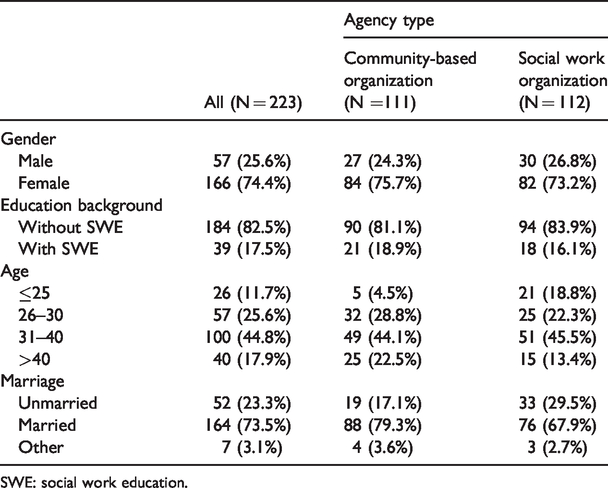
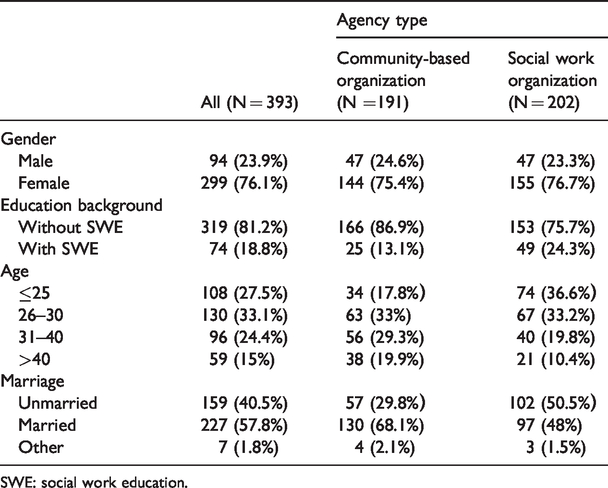
In total, 616 social workers participated in the two surveys. The participants were 223 social workers from Beijing for Study 1 and 393 social workers from Jiangmen for Study 2. The characteristics of the 223 social workers from Beijing were: 166 were female social workers (74.4%), 37 were social workers with a social work education background (16.6%), their mean age was 33, and 52 were married (23.3%). The characteristics of the 393 social workers from Jiangmen were: 299 were female social workers (76.1%), 74 were social workers with a social work education background (18.8%), their mean age was 30, and 159 were unmarried (40.5%), as shown in Tables 1 and 2. In addition, it is meaningful to further differentiate the profile of social workers into different organizations (Jiang et al., 2019).
Sample (Beijing) characteristics (N = 223).
SWE: social work education.
Sample (Jiangmen) characteristics (N = 393).
SWE: social work education.
We verified the internal reliabilities for each latent variable by calculating Cronbach’s alpha coefficient and found values of .88 for TI, .94 for IPJ, .94 for DJ, .89 for IMJ, .85 for PJ, .92 for EX, .83 for CY, and .87 for PE. All are good for further analysis.
Results
In order to understand Chinese social workers’ burnout and their TI from an organizational justice perspective, we first validated the four-factor 18 items for the Organizational Justice Scale for Social Workers. Then, we conducted the measurement model and structural equation model to further investigate the relationships among the four factors of organizational justice, the three factors of burnout, and TI.
Exploratory factor analysis of organizational justice scale (N = 223)
The exploratory factor analysis showed the data set was adequate (KMO = 0.908, p < .001) and identified four components: (1) six items in IPJ; (2) five items in DJ; (3) four items in IMJ; and (4) three items in PJ. The four factors, comprising 18 items, explained 85.36% of the total variance in the structure matrix, and the cumulative explanations were IPJ (50.35%), DJ (72.22%), IMJ (80.06%), and PJ (85.36%).
Confirmatory factor analysis of organizational justice scale (N = 393)
The four-factor structure model confirmatory factor analysis, with 18 indicators, was conducted on a sample collected in Study 2 to test the stability of the extracted model.
The original model with a low-error covariance yielded an unsatisfactory chi-square degree of freedom ratio (CMIN/df) (3.139) and root mean square errorof approximation (RMSEA) (.074, with low .066 and high .082) but a satisfactory comparative fit index (CFI) (.956) and standardized root mean square residual (SRMR) (.0446). Large modification indices were calculated in three pairs of error covariance. A closer examination of these pairs revealed that their contents were very similar in meaning in Chinese. The model fit was better: CMIN/df = 2.271, CFI = .974, RMSEA = .057, and SRMR = .043. In this model, the indicator loadings were all significant (p < .001) and higher than .56, as shown in Table 3. In addition, it is suggested that the unstandardized regression weight (URW), the p values (< .001), the standardized regression weight (SRW), the standardized errors (SE), and the square multiple correlations (SMC) should be reported in confirmatory factor analysis (CFA) (Jackson et al., 2009); therefore, the URW, SRW, SE, p values, and SMC are all reported in this study.
Unstandardized and standardized values for 18 items.
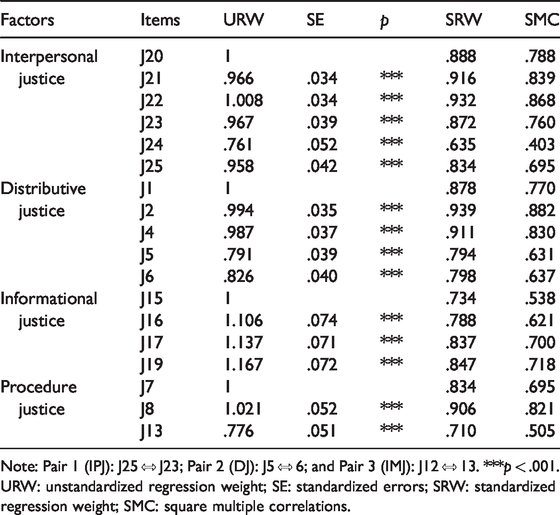
Note: Pair 1 (IPJ): J25J23; Pair 2 (DJ): J56; and Pair 3 (IMJ): J1213. ***p < .001. URW: unstandardized regression weight; SE: standardized errors; SRW: standardized regression weight; SMC: square multiple correlations.
Structural model (N = 393)
The four-factor 18 items for the Organizational Justice Scale for Social Workers have been validated via exploratory factor analyses and confirmatory factor analyses among Chinese social workers. It is also very important to further investigate the predictive power of organizational justice on social workers’ TI via the mediation effect of burnout.
Measurement model
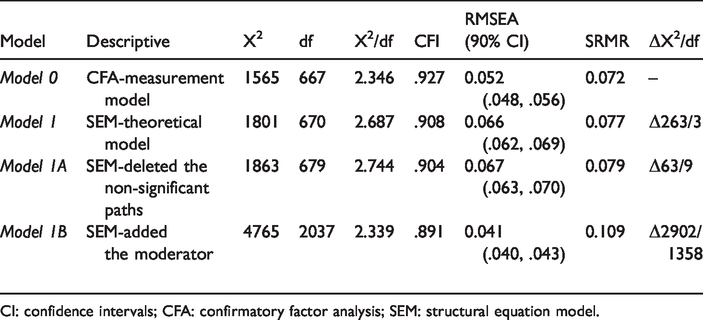
It is generally recommended that before conducting SEM, the measurement model be evaluated in order to check whether the measured variables accurately reflect the desired constructs. Guided by the hypothesized model, there were eight latent variables: four variables of organizational justice—IPJ, DJ, IMJ, and PJ; three variables of burnout—EX, CY, and PE; and TI. The indexes of fit for the measurement model (Model 0 in Table 4) showed adequate model fit.
Goodness of fit indexes of measurement model and structural models.
CI: confidence intervals; CFA: confirmatory factor analysis; SEM: structural equation model.
There was no factor loading lower than 0.48. However, it was necessary to confirm the validity and reliability of eight latent variables together. As indicated by CR, the reliability of the four constructs was good (.853 > 0.7), as shown in Table 5. However, the MSV of IMJ, EX, and CY were higher than the AVE, respectively, which indicated that there were problems of discriminant validity with the constructs. In addition, the square roots of the AVE for IMJ, EX, and CY were less than one, the absolute value of the correlations with another factor, which also indicates problems with discriminant validity. However, it should be pointed out that the problematic constructs are acceptable.
Correlation table.
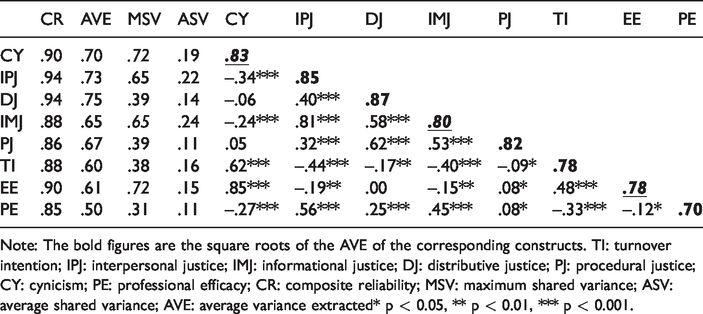
Note: The bold figures are the square roots of the AVE of the corresponding constructs. TI: turnover intention; IPJ: interpersonal justice; IMJ: informational justice; DJ: distributive justice; PJ: procedural justice; CY: cynicism; PE: professional efficacy; CR: composite reliability; MSV: maximum shared variance; ASV: average shared variance; AVE: average variance extracted* p < 0.05, ** p < 0.01, *** p < 0.001.
Structural equation modeling
An initial structural model was tested for the direct effect of IPJ, DJ, IMJ, and PJ on TI. The results show that IPJ (β = –0.30**) and IMJ (β = –0.23*) were significantly and negatively associated with social workers’ TI (R2 = 21%). However, no statistically significant relationship was found between DJ and TI or between PJ and TI. The model fit was good (X2/df = 2.15; RMSEA = 0.054; CFI = 0.966; SRMR = 0.045).
At the second stage, we tested the theoretical model (Model 1) about the direct and indirect effects among organizational justice (IP, DJ, IMJ, PJ), burnout (EX, CY, PE), and TI. The model fit for Model 1 was good (R2 = 0.39), as shown in Table 5. However, many paths were demonstrated to be insignificant to TI, such as IPJ, DJ, and PJ. In addition, justice in some dimensions could not predict burnout. For example, DJ showed no relationship with EX and CY, and IMJ showed no relationship with EX, CY, and PE. Thus, the non-significant paths were deleted and formed Model 1A. The model fit of Model 1A was good, as shown in Table 5.
At the third stage, a structural model (Model 1B) was tested by adding the area of social workers working as a moderator. Multiple-group analysis was conducted to examine the potential group difference—comparing social workers working in a social work organization with those working in a community. The model fit of Model 1B is shown in Table 5. The results show that there is no difference between the two groups in all the paths, which indicated that no matter where the social workers were working, there is no significant difference in the relationship of organizational justice and burnout with TI. Therefore, we adopted Model 1A as our final report model, as shown in Figure 1.
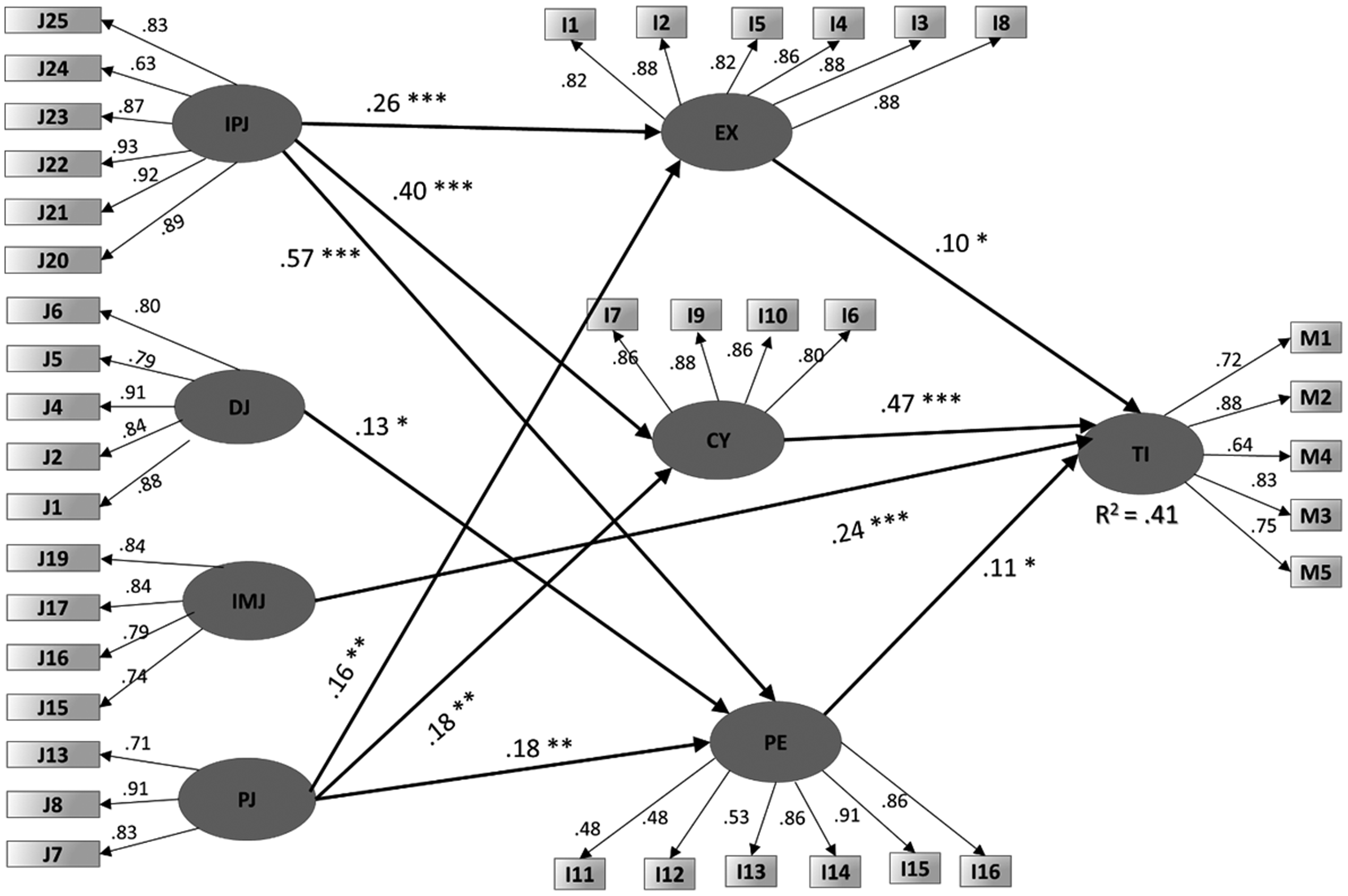
Structural equation: Model 1A.
Discussion
Organizational justice is an important concept in understanding and predicting employees’ behavior. However, it is seldom applied to social workers. In China, turnover is a tough challenge in the field of social work, just as it is in many other countries. In this article, we have (1) tested how organizational justice influences employees’ TI among social workers, including burnout as a mediator; and (2) validated an organizational justice measure for social workers in order to accomplish the first purpose.
The most important dimension for social workers is IPJ. It is distinct, with the distributive dominance model showing that DJ has the greatest explanatory power for individuals’ behaviors (Conlon, 1993; Leventhal et al., 1980), and the two-factor model also emphasizes the influence of PJ on organizational outcomes (Greenberg, 1990; McFarlin & Sweeney, 1992). Although the agent-system model points out that interactional justice could predict behaviors with the agent (Masterson et al., 2000), the results of our study show that the influence of IPJ on employee behaviors is greater for social workers. The measured items of four dimensions are also different from those of Colquitt and Shaw (2005) and Zhang and Ren (2014). The items of IPJ are the same as in the items pool. The items of DJ and IMJ are expurgated, one and two, separately. However, the items of PJ are only three after removing four items. Thus, the pay-distribution procedure is not very important for the organizational justice of social workers. The reasons for that may be that (a) social work organizations have few employees and often have non-institutionalized management compared with enterprises and/or (b) the overall pay level is low and/or more average in social work organizations. In total, the findings demonstrate that the Organizational Justice Scale for Social Workers provides a reliable and valid research structure in the Chinese context. Further, IPJ was found to be a key component for social workers’ organizational justice.
The hypothesis of this study is supported in that there is a high positive correlation between four dimensions of organizational justice and TI with three dimensions of burnout serving as mediators for social workers in China. More specifically, (a) EX, CY, and PE act as full mediators between IPJ, PJ, and TI; (b) PE acts as full mediator between DJ and TI; and (c) IMJ has a direct significant impact on TI. These results suggest that organizational justice is also an important antecedent of social workers’ TI in China, though organizational justice’s influences are achieved through three dimensions of burnout. The influences of four dimensions of organizational justice are different. IPJ and IMJ have the most significant impact on TI, with IPJ having an indirect effect and accounting for 43.47% of the total organizational justice influence on TI, while IMJ has a direct impact, accounting for 36.84% of the total organizational justice influence. PJ also plays an important role in affecting individuals’ TI, while DJ’s influence on TI can be ignored when comparing it to the other three dimensions. This result is consistent with the organizational justice measurement tool structure that was validated for social workers. It also verified that interactional justice is the most important dimension for social workers. Social workers are more likely to perceive unfairness from leaders’ or managers’ improper actions or ways of communication, and eventually leave the organization. Burnout’s three dimensions have played the mediating role unevenly as well. CY has the greatest impact, close to 70% of the total influence, while the impacts of EX and PE, which are relatively small, remain similar. This result is consistent with the author’s previous research findings (Wang et al., 2019). Generally speaking, if leaders’ improper words or actions caused the social worker to feel unfairly treated, the social worker would not only have reduced trust in the leader and organization themselves, but would also doubt the meaning and value of working in the organization, and even in the social work profession. It damaged the social worker’s passion for the work and led to the intention to leave the organization. This study gives a clearer mechanism to explain how organizational management affects social workers’ TI (Fang, 2015; Peng & Yang, 2016; Qin, 2014).
The high turnover rate in China is a serious challenge in social work. Most scholars attribute the high turnover rate of social workers to low pay or heavy workload (Lu, 2014; Nie & Song, 2009). However, through our studies, we provided a different explanation. The unfair interpersonal environment faced by social workers in their work, especially the unfairness perceived to be coming from leaders or managers, caused their suspicions towards the meaning and value of their work, which had the bigger influence on social workers’ intentions to leave. The weak influence that DJ has on TI indicates that lower wage cannot sufficiently explain the reasons why social workers leave. EX and PE have limited impact on TI, showing that high workload and low work efficiency are not the main factors in explaining social workers’ turnover.
Practical and managerial implications
The study raises important practical and managerial implications. In general, turnover is considered as an organizational behavior. Therefore, it is more important for organization managers and policy makers to consider the factors that affect turnover from the organizational perspective. We suggest that organizational justice should be given more attention in all organizational situations in order to solve the challenge of social workers’ high turnover rate. We also show, through this study, that IPJ is most important in all four dimensions of organizational justice when considering social workers’ TI, while in past research it was suggested that procedural and DJ mostly related to TIs (Hendrix et al., 1998; Lum et al., 1998). It means that a fair interpersonal relationship between organization leaders or managers and social workers has a more important influence on the social workers’ TI. The values of social work impel social workers to pay more attention to interpersonal communication than material welfare.
The leading role of IPJ in affecting social workers’ TI indicates the importance of management style, which means that employees’ perception of IPJ may, to a large extent, be transmitted through management styles. The fact that there was no difference in results between social workers working for a social work organization and those working for a community further suggests that changing management style is more important and more widely applicable in dealing with social workers’ turnover in China. Considering the mechanism of how organizational justice impacts social workers’ TI, another implication of this research is that more attention should be paid to CY. CY is more crucial to social workers’ burnout in China (Wang et al., 2019). It is the work of organizational leaders or managers to enhance social workers’ professional identity and encourage them to recognize the significance and value of their work.
Limitations
Two limitations of this study should be addressed in the future. First, the generalizability of the findings to all social workers in China is limited. The sample for Study 2 was limited to social workers in Jiangmen. However, Jiangmen is a city in the western part of the Pearl River Delta, and the Pearl River Delta is one of the most developed areas for social work in China. Therefore, the findings have great implications for the overall development of social work in China. Future research may target a more representative sample to test the relationship of organizational justice and TI. Second, there are other factors of organizational conditions, such as social support and organizational climate, that may affect workers’ TI (Mor Barak et al., 2001). However, organizational justice is a rich concept. The four dimensions of organizational justice encompass many aspects of organizational management. Future research based on updated scales can extend this literature and delineate the pattern of organizational conditions and their relation to social workers’ TI in China.
Supplemental Material
JSW911347 Supplemental Material - Supplemental material for Organizational justice, burnout, and turnover intention of social workers in China
Supplemental material, JSW911347 Supplemental Material for Organizational justice, burnout, and turnover intention of social workers in China by Yean Wang, Nan Jiang, Huan Zhang and Ziyu Liu in Journal of Social Work
Footnotes
Ethics
The research was approved by the Ethics Committee of the School of Social Development and Public Policy, Beijing Normal University.
Funding
The authors disclosed receipt of the following financial support for the research, authorship, and/or publication of this article: This work was supported by the Youth Funds of Research for Humanities and Social Sciences by the Ministry of Education, China, under grant no. 17YJC840039 and the National Social Science Foundation of China under grant no. 18BSH154.
Acknowledgements
We would like to thank the anonymous reviews for their constructive feedback on this article and Dr Jie Lei and Ms Hong Zhu for helping in the two surveys.

Supplemental Material
Supplemental material is available for this article online.
References
Supplementary Material
Please find the following supplemental material available below.
For Open Access articles published under a Creative Commons License, all supplemental material carries the same license as the article it is associated with.
For non-Open Access articles published, all supplemental material carries a non-exclusive license, and permission requests for re-use of supplemental material or any part of supplemental material shall be sent directly to the copyright owner as specified in the copyright notice associated with the article.
