







Abstract
Summary
The phenomenon of the social withdrawal of youth has been increasingly identified in some developed Asian and Western countries. There is also evidence to suggest that it is an emerging problem among the youth of China. To assess the current status of this youth problem in China, an exploratory mixed-methods study was conducted to collect the views through survey from 364 social workers in Shanghai and five focus group interviews were then conducted.
Findings
Social workers in Shanghai began to identify cases of social withdrawal among youth as early as in 2004. Social workers’ perceptions and intervention approaches were influenced by the extent of their experience in working with the identified youth group. They believed family relationships were a key causal factor in the social withdrawal of youth. The majority of family members of socially withdrawn youth tended to see social workers as the first line of help. Social workers also reported that the fragmentation of existing social services in Shanghai was a significant barrier, with respect to the rendering of timely assistance to this youth population.
Applications
This study can be considered to be the first attempt to explore the extent and nature of youth social withdrawal behaviour in China, from the perspectives of Chinese social workers. It is hoped that the study provides insights into the capacity of the existing youth social services in China to deal with this emerging youth issue.
Introduction
The number of socially and culturally marginalized young people appears to be growing in many high-income countries (Li & Wong, 2015a). This conclusion is partly based on the high percentage of youth, in the same age groups, who are not involved in education, employment or training (NEET), in most member countries of The Organization for Economic Co-operation and Development (2017). Among the NEET population, there are capable, young people, who are not seeking jobs or education, as well as those, who are pursuing asocial lifestyles. The former group of young people were classified, in 2012, as the “disengaged” in 2012. In 2016, the latter were classified as “other NEETS” in 2016 (Eurofound, 2012, 2016). A very similar group of young people, who have eschewed social interactions and secluded themselves for over six months (Suwa & Suzuki, 2013), was first identified among Japanese youth in the early 1990s. They are referred to as “hikikomori” or “socially withdrawn youth” and were first identified among Japanese youth in the early 1990s. Since the mid-2000s, socially withdrawn youth have become an issue in such urbanized East-Asian societies as Hong Kong, Taiwan, and Korea (Krysinska, 2007; Li & Wong, 2015b; Wong, 2012; Li et al., 2018), and believed to exist in high-income Western countries as Australia, Canada, and the USA since the early 2010s (Kato et al., 2012). These youth are at higher risk of experiencing mental health problems and substance abuse (Baggio et al., 2015; Goldman-Mellor et al., 2016). Young people, who are socially withdrawn, give cause for societal and professional concern and intervention.
Different theoretical perspectives have emerged to account for the development of youth social withdrawal behaviours. Some scholars have attributed it to psychopathology and advocated the development of specific diagnostic criteria, in order to identify and “treat” youth in social withdrawal (i.e. Teo, 2010; Teo & Gaw, 2010); other scholars focus more on the psychosocial or the social–cultural–economic factors (i.e. Furlong, 2008; Toivonen et al., 2011). From this perspective, young people are caught between the rapidly transforming labour market and a rigid social expectation on them to achieve adulthood. Based on a review of the existing studies on the population of socially withdrawn youth, we argue that multi-dimensional factors (Li & Wong, 2015b) have contributed to this issue, including an increasingly atomized society that places all responsibility on individuals (Thompson, 2011), a single-track educational system that favours academic achievement and deprives youth of alternative success paths (Borovoy, 2008; Furlong, 2008; Uchida, 2010; Wong, 2009), poor or over-parenting, as well as inadequate family communication (Li & Wong, 2015b; Suwa et al., 2003; Umeda & Kawakami, 2012). It is also noteworthy that, although youth social withdrawal behaviour is increasingly common in many countries, cultural factors can shape both the ways, in which it manifests itself, and determine the nature and efficacy of services provided to withdrawn youth.
Youth social services in China
In China, young people, aged from 16 to 25, are entitled to youth services provided by the local governments and non-governmental organizations. Before the age of 16, most young people undertake nine years of compulsory education. In line with the national initiative of “innovating social management” in 2002, which includes the development of professional social work, non-governmental organizations, and the purchase of services by the government (Leung & Xu, 2015), the provision of youth services was generally transferred to social work organizations funded by local governments (Fei, 2005). Cosmopolitan cities such as Shanghai, Beijing, and Guangzhou were pioneers in the development of social work organizations and government-subsidized social welfare services (Fei, 2005; Leung & Xu, 2015). The social services can largely be categorized into general services, with the purpose of life enrichment, and special services that aim to support young people, who are “out of school, unemployed and at-risk of delinquency” (sanshi qingnian). This terminology resonates with the definition used by NEET (Li & Wu, 2010). Service for NEETs aims to enhance social support structures for youth and to develop their social skills. It seeks to provide youth with education and/or employment opportunities, through case social work, growth group, and community activities.
Aim of the study
Due to Hong Kong’s cultural and geographical proximity to urbanized China cities, scholars in mainland China have raised concerns about this emerging youth problem. Several articles in Chinese academic journals have commented upon this situation in Hong Kong and discussed its implications for young people’s mental health in mainland China (Liu, 2007; Yang, 2012). This suggests youth social withdrawal may have already emerged in urbanized areas of mainland China; however, few, if any, empirical studies have examined the phenomenon in this particular context. Hence, the major aim of this sequential quantitative–qualitative study is to explore the presence, severity, and characteristics of youth social withdrawal behaviour in Shanghai, China (PRC).
Methods
Research site and participants
Due to the reclusive nature of youth in social withdrawal, and the underdeveloped status of this research field in mainland China, instead of directly reaching out to potentially at-risk young people, this study recruited social workers providing youth social services in Shanghai as participants, in order to provide quantitative and qualitative information. Similar designs have been adopted in previous studies (Wong, 2009; Tateno et al., 2012), in which psychiatric professionals or social workers were surveyed and/or interviewed, in order to gather information on the possible cases of youth social withdrawal in various countries.
Shanghai was chosen as the research site for this exploratory study, because of its well-developed social service system, relative to other urbanized cities in mainland China. In 2003, Shanghai became the first PRC city to provide professional social work service (Xiong, 2013). By 2016, it has some 14,000 social workers in such different settings as child and youth services, elderly care, and correctional and rehabilitation services, among others (Wang, 2016). This study was conducted in collaboration with one of Shanghai’s largest non-government organizations, the Shanghai Sunshine Community-Youth Affairs Centre (SCYC), which offers specialized youth service in 14 Shanghai districts.
Data collection
This exploratory study adopted a sequential quantitative–qualitative design to enable us to gain a complete overview of the issue under investigation. To understand trends in the potential population of socially withdrawn youth, quantitative data were collected from social workers. However, although the questionnaire was carefully designed, based on the international literature of the population of socially withdrawn youth, personal bias and presumption might possibly influence the way, in which we asked the questions. If this was the case, it might well militate against the efficacy of our attempt to construct an accurate, holistic snapshot of the population of socially withdrawn youth in China. Therefore, the data from the focus group interviews further helped to clarify, verify, and contextualize the responses of the social workers. This was deemed crucial, as it was argued earlier that cultural factors and social contexts are likely to influence the observation and interpretation of social withdrawal behaviours of young people (Creswell, 2011; Henn et al., 2009). The study was conducted from August to November 2015.
Stage one – Quantitative procedure
During the study period, two research assistants were recruited to coordinate the data collection process – one trained social worker from a local university, who acted as project coordinator and liaised with SCYC, and another from the same institution assisting with logistics and qualitative research during the second stage. All social workers, who served in SCYC, were invited to complete the questionnaire with the assistance of the SCYC leadership.
It is noteworthy that, with the concern related to the release of data that was not yet endorsed by local government, SCYC has made suggestions to revise questions pertinent to the Centre’s exact youth caseload. These suggestions were accepted, after discussion within the research team. Other than that, the overall structure and content of the questionnaire remained unchanged. The SCYC headquarter sent study invitations to the centre-in-charges of 14 social services stations in early September, in order to facilitate their social workers’ participation. Research assistants then administered the questionnaires and finally collected all the completed ones by the end of September. Of the 377 social workers approached, 370 (98.14%) gave written, informed consent to participate in the study and have completed the questionnaire.
Measures
(1) Social withdrawal behaviour is defined as displaying reclusive behaviours and an inability to function – at work, school, or interpersonally – for months or years (Li & Wong, 2015b). This study adopted criteria developed by the Japanese Ministry of Health Labour and Welfare, which conducted its first epidemiological study of this phenomenon among Japanese population in 2003, in order to identify socially withdrawn youth. Minor revisions were made, in order to more closely align the survey with the context of mainland China. The original criteria include (Suwa & Suzuki, 2013):
Mainly stays at home; Cannot or does not engage in social activities, such as going to school or working; Has continued in this state for more than six months; Has neither a psychotic pathology, nor medium to lower level of mental retardation (IQ <55–50); Has no close friends.
Following the practices and findings of Hong Kong scholars (Wong, 2009; Wong et al., 2015), the duration criterion (#3) was adjusted to three months, to match more closely the contextual situation in Hong Kong and Chinese societies due to the more congested living environment in Hong Kong and China. Typical cases of socially withdrawn youth in Hong Kong will be offered, in order to illustrate the above criteria.
There were three major sections in the questionnaire:
Sociodemographics. Social workers were asked to indicate their own gender, age cohort, and years of engagement in social work profession. Vignettes analysis. Our initial communication with frontline social workers in mainland China revealed that none had heard of the terms, hikikomori/socially withdrawn youth. Accordingly, to help them identify similar cases among the youth they had encountered, we provided them with an international definition of socially withdrawn youth, and a brief introduction to the background studies conducted on socially withdrawn youth in Hong Kong. Two case vignettes of socially withdrawn youth were presented to participants (see Table 1) – one adopted from an international investigation of psychiatrists’ views on the phenomenon (Kato et al., 2012), and the other based on a real case identified by the Chinese Evangelical Zion Church Social Service Division, a Hong Kong NGO (Li et al., 2018). Both vignettes represented the typical situation of socially withdrawn youth, and the loci, in which they are normally identified (i.e. psychiatric clinics and social service organizations). After reading each vignette, social workers were asked to express opinions on: (i) the incidence of withdrawn youth in mainland China; (ii) perceived contributing factors to the phenomenon of withdrawn youth (including mind, brain, social factors, cultural factors, family relationship with mother and father, school environment, economic environment, factors of psychosis, factors of mood, factors of personality); and (iii) suicide risk assessment, and possible treatment strategies (including psychotherapy, pharmacotherapy, non-pharmacologic biological treatment, environmental intervention, alternative treatment, and self-help) (Kato et al., 2012). Five-point Likert scales were utilized. A higher score indicates a more favourable attitude toward a statement. Their responses afforded us a preliminary understanding of the existence of socially withdrawn youth and their situation. They would also shed light on how social workers in Shanghai perceived this phenomenon, and the factors that might influence that perception, such as their age, prior youth work experience, and exposure to possible cases. It was anticipated that their participation in the survey might influence them to consider novel (to them) ways of supporting socially withdrawn youth. Social workers’ experiences and attitudes towards helping socially withdrawn youths in Shanghai. Participants were asked to reveal their understanding of the situation of socially withdrawn youth in Shanghai, based on their frontline experience. They were also asked when they first identified a case of socially withdrawn youth, the engagement methods they used (including home visit, communication on phone, communication on the internet and inviting youths to attend activities arranged by the agency), their assessment of the factors, which contributed to their withdrawal behaviours (including personality, mental illness, physical illness, problem with study, problem with career, problem with interpersonal relationship, family environment and parenting, and social environment), and which professionals were best positioned to help socially withdrawn youth (including school teacher, social worker, school social worker, clinical psychologist, and psychiatrist). Five-point Likert scales were utilized. A higher score indicates a more favourable attitude toward a statement.
Case vignettes.
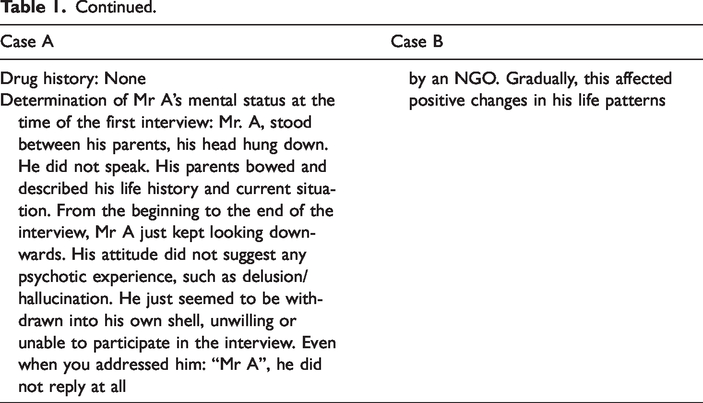
Statistical analysis
Descriptive statistics for continuous variables were illustrated by means and standard deviations, while categorical variables were shown by numbers and percentages. For participants’ demographic information, the Student’s t-test and the Chi-square test were used to compare the continuous and categorical variables, respectively, between participants who had and had not dealt with socially withdrawn youth case(s). Linear regression was used to examine whether participants who had and had not dealt with socially withdrawn youth case(s) (predictor) would affect their opinions of the two case vignettes of socially withdrawn youth (outcome). The analyses were adjusted by gender, age cohort, and years of engagement in social work profession. The coefficients and 95% confidence intervals of significant relationships were presented. All statistical computations were performed using statistical software R (R for Windows, V.3.4.3).
Stage two – Qualitative procedure
Based on the finding of the quantitative study, we have conducted the focus group interviews in the middle of November in Shanghai, in order to collect social workers’ in-depth accounts on the situations they reported. The qualitative data enabled us to check the accuracy of the information provided by participants, as the number of cases that matched the criteria for socially withdrawn youth was unexpectedly high; also, interviewing the participants facilitated our general understanding of the reported situation of socially withdrawn youth in their contexts, shedding further light on and deepening our understanding of the quantitative data. Out of 370 social workers, who responded to the questionnaire, 81 of them gave further consent to be contacted for focus group interviews and thus filled in the reply slip to leave their phone number/email address came along with the questionnaire. The research team then contacted all the 81 participants and among whom, 47 eventually accepted the focus group interview invitation. They were from across all the 14 service stations of the NGO which covers almost all the administrative districts of Shanghai (14 out of 16).
The reason of the 34 participants who eventually rejected the focus group invitation was mostly due to the clash of interview schedule with their work duty. Based on the information they provided in the questionnaire, the 47 social workers included 11 social workers, who had not yet encountered socially withdrawn youth in their practice, but perceived the issue as relevant and worthy of further attention (Focus Group 1); 36 social workers, who had had direct contact with socially withdrawn youths, 13 of whom had up to three cases of socially withdrawn youths (Group 2), and 23 of whom had more than three cases (Groups 3–5). Eleven interview participants were male (23.4%), which reflects overall male participation (22%). Table 2 summarizes the participants’ profiles, and the arrangement of each focus group.
Profile and grouping of interview participants.
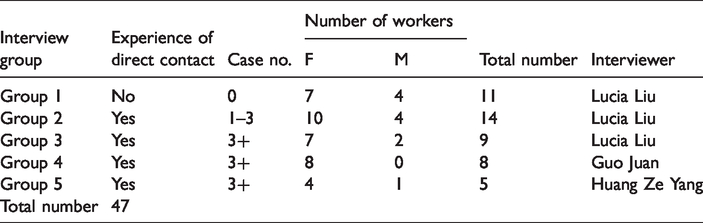
Five focus group interview sessions were conducted by LL and two research assistants, who had received social work training from a local university in Shanghai. Before the interview, the two research assistants attended a briefing session, led by LL. At this briefing, the preliminary questionnaire findings were shared and discussed. LL explained the objectives of the focus group interview and introduced the interview procedures and scripts. Two interview scripts, corresponding to participants’ frontline experiences, were developed to elicit opinions on relevant questions. Each group sessions began with the invitation for social workers to introduce their work setting. Questions and statements for comment were then put to the group members. Group 1 participants were asked to respond to such questions and statements such as: “Please describe the situations of the youths you are working with”; “Which aspect of the issue of socially withdrawn youth draws your attention?”, and “Did you find any individual among your clients, who may be at risk of becoming socially withdrawal? If yes, please describe the condition of the youth”. Questions and statements put forward for the consideration of individuals in the rest of the groups included: “Please describe the situation of the socially withdrawn youth(s), with whom you are working”; “Compared to other young people you are working with, what characteristics do you think these young people have exhibited”; and “What difficulties have you encountered when trying to help these young people?” Each interview lasted for around one hour. Interviews were conducted in Mandarin, and transcribed verbatim. Each participant was given a code, according to the number of focus group and the order of speaking during the first round of questions. For example, the first social worker, who spoke at the G1 interview, was coded as G1A. Thematic analysis was adopted to identify commonalities, relationships, and differences (Gibson & Brown, 2009) in participants’ responses. LL was the sole coder to perform the data analysis, aided by NVIVO 10.
Results
Stage one – The quantitative data from the survey
Participants
Most participants were females between 30 and 39 years of age (Table 3). Of the 364 participants, who completed the questionnaire, 257 had dealt with case(s) of socially withdrawn youth(s), while 107 had not; the former had significantly longer average years of youth service experience than the latter.
Participants’ sociodemographic information.
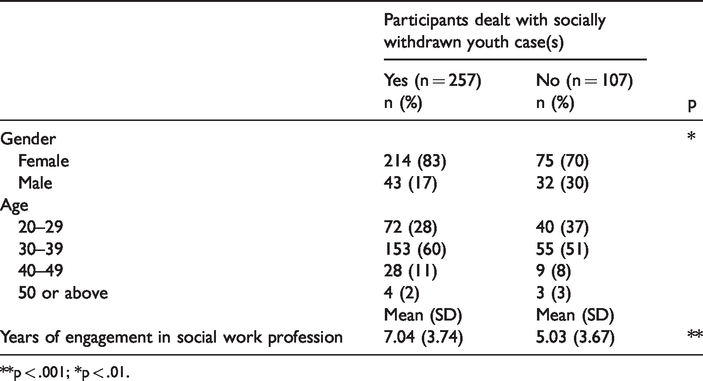
**p < .001; *p < .01.
Differences among participants who had/had not dealt with socially withdrawn youth case(s) in examining Case A
Participants who had dealt with socially withdrawn youth case(s) were more likely to regard Case A as common in both urban (β = 0.52, 95% confidence intervals – CI (0.31, 0.72), p < .001) and rural China (β = 0.36, 95% CI (0.14, 0.59), p < .01), compared to those without experience of socially withdrawn youth case(s).
Participants who had dealt with socially withdrawn youths, attributed the causes of Case A more to social (β = 0.18, 95% CI (0.01, 0.35), p < .05), school environment (β = 0.17, 95% CI (0.01, 0.33), p < .05), mood (β = 0.24, 95% CI (0.07, 0.40), p < .01), and personality factors (β = 0.17, 95% CI (0.01, 0.33), p < .05) compared to those without experience of socially withdrawn youth case(s). There were no other significant differences in the cause of withdrawal.
Participants who had dealt with socially withdrawn youths were more likely to regard Case A as at risk for suicide (β = 0.21, 95% CI (0.01, 0.42), p < .05) and believed he should be treated through psychotherapy (β = 0.19, 95% CI (0.02, 0.35), p < .05) and environmental interventions (β = 0.38, 95% CI (0.22, 0.54), p < .001) compared to those without experience of socially withdrawn youth case(s). There were no other significant differences in the suggested interventions.
Differences between participants who had/had not dealt with socially withdrawn youth case(s) in examining Case B
Participants who had dealt with socially withdrawn youth case(s) were more likely to regard Case B as common, in both urban (β = 0.66, 95% CI (0.47, 0.85), p < .001) and rural China (β = 0.29, 95% CI (0.07, 0.51), p < .05), compared to those without socially withdrawn youth case(s).
Participants who had dealt with socially withdrawn youths attributed the causes of Case B more to mind issues (β = 0.25, 95% CI (0.04, 0.46), p < .05), a poor family relationship with both his mother (β = 0.23, 95% CI (0.08, 0.38), p < .01) and father (β = 0.27, 95% CI (0.13, 0.40), p < .001), school environment (β = 0.39, 95% CI (0.09, 0.69), p < .05), and mood factors (β = 0.22, 95% CI (0.04, 0.40), p < .05) compared to those without experience of socially withdrawn youth case(s). There were no other significant differences in the cause of withdrawal.
Participants who had dealt with socially withdrawn youths were also more likely to believe that Case B would be best treated through environmental intervention (β = 0.31, 95% CI (0.14, 0.47), p < .001) compared to those without experience of socially withdrawn youth case(s). There were no other significant differences in the suggested interventions.
Participants’ general opinions of Cases A and B
Participants who had and had not dealt with socially withdrawn youths, rated poor relationship with father as the major trigger of Cases A and B’s withdrawal and rated factors of psychosis as the least likely associated with onset of withdrawal.
For Case A, both categories of participant rated psychotherapy as the most appropriate intervention strategy. For Case B, participants with socially withdrawn youth case(s) rated environmental intervention as the most appropriate intervention, whereas those without socially withdrawn youth cases, rated self-help as the most appropriate intervention. Both categories of participants rated non-pharmacologic biological treatment as the least appropriate intervention for both Cases A and B.
Participants’ experiences with and attitudes towards helping socially withdrawn youths in Shanghai
Among those 257 participants, who had dealt with socially withdrawn youth(s), their case(s) of socially withdrawn youth(s) accounted for, on average, 20.12% (SD = 27.80%) of their total youth cases. Twenty-six participants first identified socially withdrawn youths in 2004. The trend peaked in 2014, with 36 participants identifying socially withdrawn youths (Figure 1). All 257 participants agreed that socially withdrawn youths could return to social life, and 180 claimed they had successfully helped their socially withdrawn youth cases (mean of cases = 2.33, SD = 2.75). In a series of multiple select questions regarding participants’ understanding of their youth cases situations, most participants (n = 223, 89%) chose, as their primary approach, to engage socially withdrawn youths through home visits. The three principal factors, which most participants identified as causal factors in young people’s social withdrawal, were family environment and parenting (n = 233, 91%), personality (n = 208, 82%), and problem with interpersonal relationships (n = 204, 80%). Most participants also suggested that community social workers (n = 247, 96%), school social workers (n = 184, 72%), and clinical psychologists (n = 177, 70%) were best positioned to help socially withdrawn youths in China.
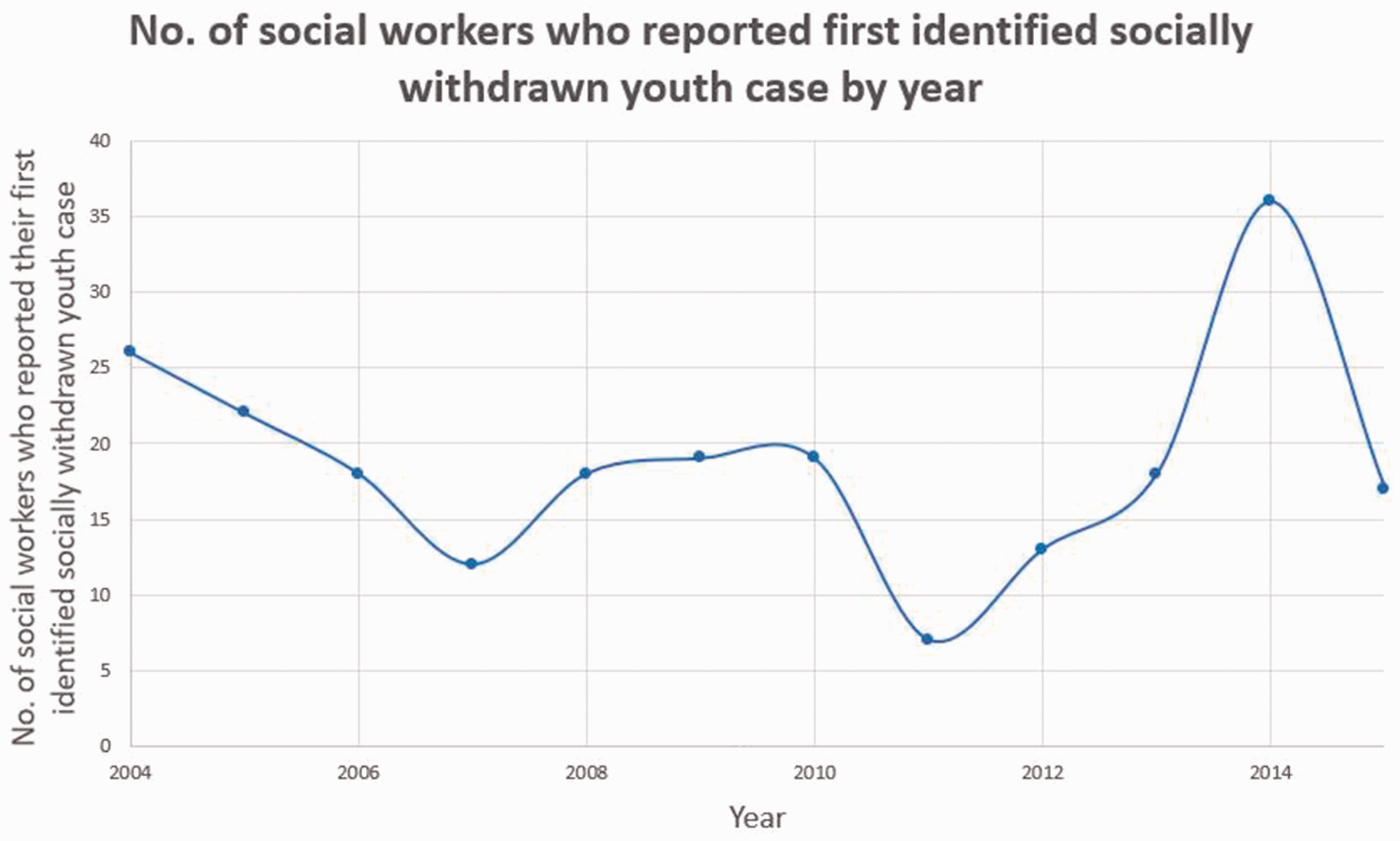
Year of the first case of socially withdrawn youth.
Stage two – The qualitative findings from the focus groups
Perceptions of the phenomenon of socially withdrawn youth
Focus group participants reported that the young people, with whom they worked, ranged in age from 16 to 25, and that most were young people, who are not in education, employment, or training. They had been identified through various sources, such as schools’ lists of disengaged students, referrals from local resident committees, and lists from municipal Human Resource and Social Security Bureaus, which record residents, who fail to make monthly social security contributions. With the lists of names in hand, social workers made cold calls on the households, approaching both the young people and their families.
For most participants, this was the first time that participants had become aware of the global phenomenon of socially withdrawn youth, during the course of their frontline work. It was only after they had compared their youth cases to the definition and criteria offered in the questionnaire that they realized that some of the youth, with whom they were dealing, were, indeed, socially withdrawn. Prior to this realization, the social workers had tended to define such young people in terms of their social status, and used the term NEET (shuangshi qingnian) to describe the phenomenon. Most of the participants believed youths in social withdrawal were the most serious examples of NEETs. They considered social-withdrawal as a transitional or non-permanent stage for young people, who had encountered problems in their study, work, or family relationships. To participants, who had no direct contact with such young people, the term “socially withdrawn youth” sounded strange; some even considered it as a negative label attached to young people, who were no different to any other NEETs. One participant’s comment was widely accepted in the focus group: I think their withdrawal behaviour is transitory and it is understandable that they see their homes as safe havens. this stage won’t last long, unless they are, also, inflicted with certain mental illness such as depression. (G1F, Female) There were cases when the kids felt at loss for a certain period. They felt ashamed of themselves; hence, they confined themselves to their homes. (G1F, Female)
Family influence
Consistent with the quantitative finding, and despite their different experiences with youths in social withdrawal, most participants foregrounded the negative contribution of family to this phenomenon: When I worked with young people, I paid special attention to their family. I found most of their problems can be attributed to their parents. (G4F, Female) Very often, if you want to solve the problem, you need to start with their parents. It is actually not the problem of the young people, but their parents. (G5E, Male)
Secondly, parents’ high tolerance of their children’s inertia and other social withdrawal behaviour hindered social workers’ identification of cases, and their ability to offer timely interventions to help the afflicted youths. Some parents tended to cover up their children’s problem for fear of disclosure of what they perceived to be a family disgrace. Others tended to be overprotective of their children, a response which, to some extent, made the young people over-dependent on their parents, and lacking in affirmative social skills: The parents did not consider our help as being necessary. In a few cases, the family is a great barrier with respect to the effectiveness of our interventions. (G1G, Female) Parents sometimes made up excuses with respect to their children staying at home for long periods. For example, they may explain that the kid was engaged in stock investment at home. (G1D, Male) There was a kid who did not go out for a long time, because his parents did not want him to do so. They felt that his son is safer at home. However, eventually, the child’s need for social interaction was suppressed. (G4I, Male)
Social worker as the first source of help
As shown in the questionnaire responses, most participants believed that social workers were best positioned to help socially withdrawn youths. Participants further elaborated on their role in helping youngsters in need. Due to the reluctance of most families to seek help from professionals, most socially withdrawn youths were identified by social workers via a “blanket search” conducted through their own connections within government institutions. However, it is noteworthy that, while some parents were reluctant to accept help from social workers, others considered social workers to be miracle-makers, who could conjure up immediate solutions to the problems faced by their children. Therefore, regardless of the family’s attitude, social workers were most often the first source of help for socially withdrawn youths and their families, and, also, the means to access further professional intervention and community resources, whose existence were previously unknown to families. For example, some participants mentioned helping families to access certified counsellors: We tried to find a counsellor to help a young person who stayed at home. Initially, the counsellor preferred to see the kid in his office, but after persistent entreaties, he finally agreed to make a home visit. (G3A, Female) I believe the most important approach is to accompany them, to walk them through the most difficult stages and they will gradually get back on the right track. (G3F, Female)
Institutional barriers
Despite their empathy for the situations of young people in social withdrawal, social workers in Shanghai have encountered various institutional barriers that hinder their efforts to render necessary and appropriate support to young people in need.
Firstly, the age boundaries of youth service (16–25) prevented social workers from offering help to young people, who were over 25 years of age and suffering from social withdrawal. Given the trend of young people staying in education for prolonged periods, it is very likely that there might be delays in young people being identified as socially withdrawn and receiving appropriate, professional intervention. One participant commented: Usually the parents would not see it as a problem to allow one or two years for their children to adjust to life outside educational institutions when they are about 22 or 23 years old. However, by the time that they realize something is wrong and seek professional help, the young people are already 25 years old and are not eligible to access our service. (G2H, Male)
Secondly, the lack of coordination among social institutions in relation to young people has impeded social workers’ efforts to identify at-risk young people in the early stages of social withdrawal, and, thus, limits the prospects of young people and their family accessing appropriate and timely services. Participants shared their perceptions that there is very little connection between the school system and the social welfare system in Shanghai. Schools have no obligation, and little inclination, to refer dropout students to social workers. Only if the family seeks help from the local resident committee can cases of socially withdrawn youth be identified and appropriate interventions put in place. However, it is very likely that, by the time the family reaches out for help, the young people have already developed severe social withdrawal behaviours.
Discussion
This study has revealed that the phenomenon of socially withdrawn youth has been a youth issue in Shanghai from as early as 2004. Some social workers recognized that the youth, whom they were supporting but not called as socially withdrawn or hikikomori, exhibited markedly similar behaviours which were symptomatic of social withdrawal of youth in Shanghai. However, as the purpose of youth services in Shanghai, since their inception, has been to serve the government’s overarching goal of crime prevention and reduction (Hong & Fei, 2014), the focus of youth work has been on ensuring social control and stability by helping young, unemployed people, who are not enrolled in educational or training institutions, secure employment. The participants in the focus groups verified the fact that, most cases of socially withdrawn youth were identified from lists of unemployed residents, lists which were acquired from local residents’ committees. Unfortunately, the youth identified in this manner have been categorized as “unemployed and disengaged youth” (shixue shiye qingshaonian), in line with the definition of NEET (Eurofound, 2012). This categorization can well be constructed in terms of a stigma. Thus, although frontline social workers have been encountering cases of socially withdrawn youth, this population has never been treated as an identifiable group, with specific problems, needing specific, professional interventions. If being socially withdrawn is considered to be a form of stigma, then it is not surprising that many parents are in a sense of denial with respect to their socially withdrawn children and only seek professional intervention when the seriousness of the problem can no longer be denied.
Our quantitative findings suggest that social workers’ perceptions of the problem and the factors, which contribute to the onset of youth social withdrawal behaviours, were influenced and modified by their engagement with this population. Social workers, who had direct contact with socially withdrawn youth, tended to understand their clients from a socio-cultural perspective that paid more attention to the youths’ societal and family backgrounds, whereas social workers, who had not engaged with any socially withdrawn youth, tended to adopt psychopathological explanations of the issue, and mainly attributed it to personal or family deficiencies. This difference in perception influenced social workers’ views on who can best help these young people, and what intervention approaches should be employed. Although the effectiveness of different intervention approaches is unknown (and is not the focus of this study), the robust difference in attitudes and beliefs among social workers suggests the importance of raising social workers’ awareness of this new youth issue, so they can be more sensitive with respect to the identification of youth suffering from social withdrawal and be more conversant with the range of interventions, which may be put into effect, in order to affect positive changes in the behaviours and outlooks on life of sufferers.
As shown in the qualitative findings, social workers unanimously pointed out that family played a critical, causal role in most cases of socially withdrawn youth in Shanghai. This echoes findings from investigation of this issue in other Asian countries, where Confucian principles prevail (Furlong, 2008; Li et al., 2018). In these societies, families assume the principal responsibility for supporting their offspring until they become full-fledged adults, in hopes their adult children will offer them similar care in their old age. In addition, families place great emphasis on their offspring’s success as a manifestation of family grace. These cultural traditions, coupled with the one-child policy in place in China since the 1980s, have caused families to place even higher expectations on young people. High, sometimes unreasonably high, family expectations is almost certainly a major stressor in the lives of young people, a stressor which, unless moderated, can lead individuals into a spiral of social withdrawal (Ng et al., 2014; Wuyts et al., 2015). Conversely, there is evidence that families are becoming more acquiescing in their relationships with their sole off-springs, as they are the only chances of carrying on the family name and shouldering future family duties (Fong, 2004, 2007). As such, young people’s social withdrawal behaviour is much more likely to be accommodated by parents regardless of their socio-economic status or education level, and thus, this behaviour is less likely to be identified and addressed while still in its early stages.
Finally, the revealed issue of socially withdrawn youth and the current service situation in Shanghai identify a need for system-level cooperation among institutions, including schools, resident committees, and youth service centres. An improved referral system among the three is a cornerstone of this improved communication. Specifically, after exhausting all measures to re-engage continuously truant students, schools should be responsible for referring cases of concern to social workers for follow-up. An information-sharing mechanism between resident committees and youth service centres should also be set up, in order to facilitate social workers’ outreach to young people at risk of social withdrawal.
Limitations
This exploratory mixed-methods study has one main limitation. Due to the difficulties in reaching the target youth population, it has had to rely on social workers to serve as proxies and shed light on the phenomenon of youth social withdrawal. However, given that the social service system in Shanghai is one of the most extensive and developed systems in China, encompassing every community in Shanghai, we are confident that the data collected from social worker is a reliable and valid reflection of the situation in Shanghai, with respect to the identification of socially withdrawn youth and the processes and strategies, which are employed by social workers to affect positive change, as a result of their interventions. Nevertheless, future studies should reflect multiple perspectives on the population and situation of youth in the state of social withdrawal: first, in-depth interviews with individual social workers should be carried out to understand the change trajectories of the socially withdrawn youth and the role of social workers in facilitating these changes; second, it is important to explore other effective and unobtrusive means of reaching socially withdrawn youth, directly; for example, given the omni-presence of the Internet and social media, it might be possible to use online platforms to connect with socially withdrawn youth. Evidence has also shown that cyber youth work may successfully identify and service difficult-to-reach youth (Leung et al., 2017). Furthermore, given the important role that the family and parents play during the whole process of the evolvement of young people’s social withdrawal behaviour, family factors and narratives from the parents certainly warrant further investigation.
Conclusion
To the best of our knowledge, this study is the first attempt to explore the situation of socially withdrawn youth through professionals in one of China’s major cities. The information gathered from social workers regarding the population of socially withdrawn youth points to the need for further studies to explore the situation of at-risk youth. Furthermore, insights gained from social workers regarding current practices in Shanghai also have the potential to inform the development of future services, designed to identify socially withdrawn youth and facilitate their reintegration into mainstream society.
Footnotes
Ethics
The study was approved by HKU Human Research Ethics Committee for Non-Clinical Faculties (Ref. No.: EA1506041).
Funding
The authors disclosed receipt of the following financial support for the research, authorship, and/or publication of this article: This study was funded by Small Project Funding at The University of Hong Kong.
Acknowledgements
The authors would like to thank Dr Takahiro Kato, from Kyushu University, Japan, and the Chinese Evangelical Zion Church, Hong Kong SAR, for their permission to use the case vignettes in the questionnaire. A special thanks is extended to Prof Han Xiaoyan and her colleagues from the School of Social Development, East China Normal University, for their support in the facilitation of data collection. We also wish to thank Mr Terry Bell for his comments and editing the drafts of our manuscript.
