







Abstract
Summary
In contemporary welfare states, the non-take-up of rights is a pervasive and considerable problem. Yet, our empirical and theoretical understanding of this phenomenon is still rather limited. In this context, the historical role of social work practice in bridging between citizens and the welfare state cannot be overlooked. To adequately tackle non-take-up, there is an urgency for usable knowledge that is oriented towards practice. In this article, we address this issue by studying Integrated Rights-Practices that focus on overcoming non-take-up through proactive, outreaching, generalist and relation-based interventions. We conducted a qualitative realist evaluation (n = 18) with the intention to explain how and why these interventions provide an answer to the determinants of non-take-up.
Findings
We argue that the aforementioned guidelines – referring to the ‘who’, ‘where’, ‘what’ and ‘how’ of social interventions – are not to be considered separate strategies, but should rather be understood as synergistic, jointly activating 10 generative mechanisms that overcome the information, process and social costs associated to non-take-up.
Applications
This article makes both a methodological and theoretical contribution. First, the potential of realist evaluation has convincingly been advocated for by different authors in social work academia, but empirical examples have been lacking hitherto. Second, the identified mechanisms and interventions can provide inspiration to develop similar practices to tackle non-take-up in other welfare regimes and contexts.
Keywords
Introduction
Welfare states are built on the idea of social rights related to social security, employment protection, housing, education, health and social care (Dean, 2015). By safeguarding these aspects of human life, an acceptable standard of living is considered non-negotiable and should be guaranteed through social policies and social services (Hasenfeld & Garrow, 2012). In reality, however, there is a clear discrepancy between the promise of social rights and the degree to which these are realized for everyone. The situation where individuals do not receive the rights they are entitled to is defined as non-take-up (Van Oorschot, 1998) and often affects over half of the eligible population across different European countries (Eurofound, 2015). This creates unjustifiable disparities between citizens and strongly undermines the ambition to provide a safety net for those in need (Van Oorschot, 1998). Yet, our empirical and theoretical understanding of this phenomenon is still rather limited (Reijnders et al., 2018). As a result, the current literature is often restricted to measuring non-take-up and describing its causes. Moreover, the vast majority of suggested solutions are oriented at policy redesigns, simplifying procedures and automatically detecting and enrolling beneficiaries (Eurofound, 2015). Although these strategies are important, we should not overlook the role of social work practice in bridging between citizens and the welfare state and effectuating the rights of vulnerable communities (Weiss-Gal & Gal, 2009). Given that policies are dependent on how they are implemented by social workers (Morgen, 2001), we agree that there is an urgency for usable knowledge oriented towards practice (Daigneault et al., 2012). In this article, we explicitly address this issue and focus on the question how and why social work interventions can contribute to overcoming the non-take-up of rights. Through our study of Integrated Rights-Practices, we pursue a threefold scientific contribution to the current body of knowledge.
First, although different authors have stressed the necessity of proactively bringing information to citizens (Chetty & Saez, 2013), reaching out to vulnerable communities (Daigneault et al., 2012), adopting generalist approaches (Reijnders et al., 2018) and developing non-stigmatising relations with beneficiaries (Baumberg, 2016), there is a lack of empirical evidence showing how these strategies tackle the determinants of non-take-up. Our study combines these previously separated ideas in both theory and practice. Second, by focussing on street-level interventions, we provide the needed evidence-based resources that ‘inform how providers can better reach, engage and effectively assists the people who stand to benefit from interventions, but who are most marginalized’ (Cortis, 2012, p. 352). Moreover, we include citizens in our study, a voice seldomly heard in non-take-up research. Third, we conducted a realist evaluation focussing on explaining how interventions work rather than solely assessing their effectiveness in terms of success or failure (Pawson, 2013). Through the development of middle-range theories, this approach balances between specificity and abstraction, allowing for the transfer of ideas to other contexts and, thus, increasing the external validity of research (Van Belle et al., 2017). Despite middle-range theories have played a pivotal role in the professional advancement of social work practice (Lub, 2019) and the potential of realist evaluation has convincingly been advocated for by different authors in social work academia (Blom & Morén, 2010; Houston, 2010; Kazi, 2003), there is a lack of empirical examples adopting this approach. With this article, we redress this imbalance.
Explaining non-take-up
Although research has been drawing attention to non-take-up since the early 1990s (Van Oorschot, 1991, 1996, 1998) and safeguarding rights has always been fundamental to social work practice and social policy, take-up is still often low among disadvantaged groups (Weiss-Gal & Gal, 2009). Moreover, under the neoliberal turn in contemporary welfare states, the rights and obligations of citizenship are transforming from non-contractual reciprocities based on equal inclusion into conditional exchanges based on market participation (Somers & Wright, 2008). This recommodification brought forth a shift from the traditional citizenship-based model of public services towards a consumerist approach that views citizens as rational consumers (Clarke, 2006). This can deprive vulnerable communities of their already precarious social rights, because citizens are increasingly expected to take responsibility and independently approach the ‘right’ social services for their problems (Hasenfeld & Garrow, 2012). These ideas are reflected in the dominant explanations for non-take-up based on rational choice theory and behavioural economics. Non-take-up is considered the result of the trade-off between the potential benefit of rights and the information, process and social costs associated to claiming them (Hernanz et al., 2004). These costs are mediated by and through both the demand- and supply-side of the welfare state (Van Oorschot, 1996). In what follows, we will summarize the explanations from both perspectives.
The demand-side
Before citizens can consider claiming their rights, the issue has to become salient (Van Oorschot, 1996). People need to acknowledge their situation as a welfare problem and should be informed about their entitlements. Knowledge is therefore considered the most fundamental prerequisite for take-up (Daigneault et al., 2012). Yet, it is widely recognized that disadvantaged individuals often lack this knowledge or have misperceptions about welfare provisions (Eurofound, 2015). When the precondition of awareness is fulfilled, people weigh the perceived benefit of welfare programmes against the information, process and social costs (Hernanz et al., 2004). Information costs entail that, even when people are aware of certain rights, their help-seeking behaviour can still be impeded by imperfect information about public services, the eligibility criteria, the claiming process and the consequences. Process costs are the time and effort that goes into the claiming itself. This includes physical and administrative thresholds, but also uncertainties regarding the outcome of the process (Van Mechelen & Janssens, 2017). These costs are further determined by individual characteristics such as digital and linguistic proficiencies, health literacy and social skills (Reijnders et al., 2018). Lastly, social costs are the negative feelings that are induced by help-seeking behaviour. The literature mainly focusses on the concepts of stigma, losing independence and harmed self-esteem that prevent people for seeking support (Baumberg, 2016; Reijnders et al., 2018).
The supply-side
When enrolment is not automatic and social workers are involved in the claiming process, explanations for non-take-up need to take account of the bureaucratic barriers that induce the aforementioned costs (Van Oorschot, 1998). First, governments and social services have a crucial task in making sure that information about public programmes, eligibility rules and application procedures reaches the beneficiaries (Van Mechelen & Janssens, 2017). Next, process costs are upheld by waiting lists, entry conditions, rules and complicated procedures that impede an individual’s ability to find and utilize social services (Reijnders et al., 2018). Lastly, the social costs citizens encounter can be explained by uneven power relations between claimants and welfare agents (Hasenfeld, 1985; Lipsky, 1971). As gatekeepers to support, social workers are in a hierarchical position with power over the situation. Take-up is negatively affected where this hierarchy leads to impersonal treatment, passive attitudes, unrealistic expectations, misunderstandings and prejudices (Reijnders et al., 2018).
The research context
The concept of Integrated Rights-Practices was introduced by the Decree on Local Social Policy and focusses on the two-fold task of improving the access to social services and guaranteeing social rights for everyone through interorganizational collaboration (Flemish Government, 2018). This decision was based on the principle of proportionate universalism and the observation that the local welfare regime is not performing adequately, requiring extra initiatives to reach and support vulnerable communities. The idea of Integrated Rights-Practices, thus, acknowledges the dynamic causes of non-take-up, challenges the focus on individual responsibility and seeks solutions through reorganizing the supply-side of the welfare state. This shift coincides with and is relevant for two international trends. On the one hand, to better adapt to local challenges, the responsibilities of social policy are increasingly transferred to the lower scales of government (Kazepov, 2010). On the other hand, there is an increasing emphasis on collaboration between public and non-profit organizations to provide more holistic answers to complex needs (Allen, 2003). The Integrated Rights-Practices are, thus, a critical case to examine how social work can contribute to overcoming non-take-up in this changing context.
In practice, three actors are appointed to realize this ambition: the Public Centre for Social Welfare, the Centre for General Wellbeing and the Health Insurance agencies. These organizations are directly accessible for citizens but foster a different expertise. By sharing responsibilities among these actors, the Flemish Government wants to combine their respective financial, psychological and health-related focus into more holistic practices. Finding inspiration in earlier studies on social work, the policy makers expect the Integrated Rights-Practices to be proactive, outreaching, generalist and relation-based in nature. Although these strategies have previously been advocated for in the non-take-up literature (Baumberg, 2016; Chetty & Saez, 2013; Daigneault et al., 2012; Reijnders et al., 2018), they have hitherto so been separated from each other in both theory and practice. Between September 2016 and May 2018, 11 pilot projects experimented with implementing this framework and developing interventions to tackle non-take-up. We were commissioned to study these projects, gain insight on how and why the Integrated Rights-Practices tackle non-take-up and formulate recommendations to revise the Decree on Local Social Policy to further implement this framework in all municipalities. In this article, we base ourselves on the qualitative phase of our research which focussed on the street-level interventions of social workers and the experience of citizens. Before turning to the results, we first resume the central tenets of realist evaluation and describe our methods.
Realist evaluation, more than ‘does it work?’
Realist evaluation is a theory-based approach to evaluation that finds inspiration in the ontological and epistemological underpinnings of critical realism, which argue that the social world is a complex and stratified open-system that cannot be fully understood through direct empirical observations (Bhaskar, 1978). As a result, the focus is broadened from empirical observations to theorizing the underlying and often invisible causes or generative mechanisms that give rise to certain events. For social work, this understanding of reality – which emphasizes ‘deep structure’ – has been praised in the context of evidence-based practice (Blom & Morén, 2010; Houston, 2005). 1 Applying these principles to hands-on research, realist evaluation aims to unearth generative mechanisms and unravel how social programmes work by seeking an answer to some or all of the questions: ‘what works, for whom, under what circumstances, why and how?’ (Jagosh et al., 2015). To achieve this, realist inquiry develops, tests and refines so-called programme theories that explicate the underlying assumptions of how change is brought about (Pawson, 2013; Weiss, 1998). The idea of explicating the underlying assumptions of interventions is based on the premise that social programmes are theories incarnate which ‘begin in the heads of policy architects, pass into the hands of practitioners and, sometimes, into the hearts and minds of programme subjects’ (Pawson, 2006, p. 28). In this study, we explicitly combine these different perspectives and engage in two steps of theory development, testing and refinement. As with every realist evaluation, we start with theory and end with a more advanced theoretical position (Blamey & Mackenzie, 2007).
Step 1: Formulating preliminary programme theories
Realist research starts with formulating preliminary programme theories that explicate the underlying assumptions of how the interventions are expected to achieve their objectives (Marchal et al., 2018). We articulate these preliminary programme theories as if-then-statements that link between interventions and outcomes based on a mix between stakeholder’s mental models and the available literature (Funnell & Rogers, 2011; Tan & Harvey, 2016). In other words, the preliminary programme theories are a set of causal assumptions that provide hypotheses for later empirical testing. As discussed in Boost, Elloukmani, Hermans and Raeymaeckers (2018) and Boost, Raeymaeckers and Hermans (2018), we invested heavily in this first step with the ambition to clarify the goals, guidelines, interventions and possible mechanisms underpinning the idea of Integrated Rights-Practices to the pilot projects and local implementers. First, we analysed the policy documents and organized a focus group with the policy designers to validate, refute, supplement and alter the causal claims we distilled from their texts. Given the rather limited conceptualization of proactivity, outreaching, generalist and relation-based social work, we then strengthened these assumptions by conducting a scoping review of the social work literature on these subjects. Lastly, we connected these claims to the determinants of non-take-up as discussed earlier. This way, we combined two strands of literature that have previously been separated from each other.
Step 2: Constructing CMO configurations
The next step consisted of scrutinizing the if-then-statements, testing how the idea of Integrated Rights-Practices was implemented by the pilot projects and explaining whether, how and why the interventions provided an answer to the determinants of non-take-up. To develop this deeper understanding, realist evaluation hinges on the CMO-heuristic to unravel how outcomes (O) are produced by generative mechanisms (M) which are triggered under specific contexts (C) (Pawson, 2013). These mechanisms are not directly observable at the empirical level but are rather understood as analytical constructs that link between observable events (Morén & Blom, 2003). For evidence-based social work, uncovering mechanisms have the potential to underpin practice with a theoretical language that explains how and why change comes about (Houston, 2010). The focus is, thus, on developing a configurational explanation by placing nuggets of information – both theoretical and empirical – in this heuristic framework (Manzano, 2016).
Case selection
In realist inquiry, cases are purposively chosen for their potential to test, refine and elaborate theories (Emmel, 2013). We selected three pilot projects based on three criteria. First, the interventions needed to focus on overcoming non-take-up in practice. Second, the projects needed to affect citizens directly through social workers’ interventions. Last, the interventions needed to provide specific insights on how proactive, outreaching, generalist and relation-based approaches can counteract the determinants of non-take-up. Given that focussing on mechanisms instead of particular interventions has been called our best hope to learn cumulatively from one programme to another and from one evaluation to the next (Astbury, 2018), we only describe the specifics of the pilot project’s interventions where necessary for building explanatory arguments. By focussing on overarching conclusions and mechanisms, we seek the needed balance between specificity and abstraction that allows for analytical generalization (Marchal et al., 2018). For those interested in a detailed account of the pilot projects, we refer to Boost, Elloukmani, Hermans and Raeymaeckers (2018).
Data collection
Studies of social programmes require the consultation of those with a lived experience of the interventions to adequately explain their effects (Blom & Morén, 2019; Jackson & Kolla, 2012). Although those who are difficult to engage in services can be similarly challenging to involve in research (Emmel et al., 2007), we managed to include the often overlooked perspective of citizens (Cortis, 2012). We organized semi-structured interviews with all street-level professionals implementing the interventions (n = 11) and a selection of citizens making use of them (n = 7). Citizens were asked to participate by the social workers and were selected based on their availability, willingness and potential to provide relevant insights on the pilot projects. The semi-structured questionnaires were adapted to each pilot project, but each conversation focussed on collecting data on the interventions, contexts and outcomes, and scoped for mechanisms by reflecting on possible explanations on how the Integrated Rights-Practices achieved their results. Our realist interviews were, thus, oriented at inspiring, validating, falsifying and modifying the preliminary programmes theories (Manzano, 2016). The interviews were audio recorded, transcribed ad-verbatim and analysed with QSR NVivo.
Analysis
The data were assessed in terms of relevance, rigour and the potential to develop a more refined theoretical position (Pawson, 2006) and analysed through a deductive thematic analysis (Sobh & Perry, 2006). This process involved retroductive thinking to advance from the empirically observed events to a conceptualization of mechanisms that explain how non-take-up was overcome (Danermark et al., 2005). In other words, the focus was always on inferences like ‘what is fundamentally constitutive for the studied interventions to have these effects?’. To construct these explanatory arguments, our data were coded based on the preliminary programme theories (proactivity, outreaching, generalist and relation-based) and the CMO-heuristic (context, mechanism and outcome). The thought process of unearthing generative mechanisms was further supported through triangulation and discussing our data and analysis with the authors, the policy designers and the social workers of the Integrated Rights-Practices. The insights presented in this article, thus, were iteratively developed throughout the whole research project and build on reflections from the interaction between academic, policy and practice stakeholders. To find a suitable structure for our findings, we found inspiration in Jagosh et al. (2015) and the RAMESES reporting standards for realist evaluation (Wong et al., 2016). Where applicable, we present direct quotes of respondents to illustrate the trends in our data which inspired the analysis.
Findings
Step 1: Explicating the underlying assumptions of Integrated Rights-Practices
Proactivity
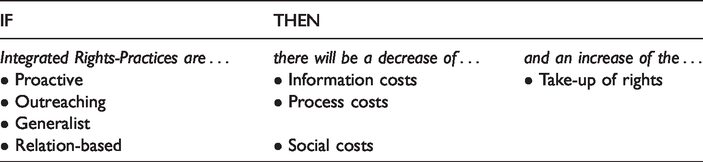
Proactivity entails the idea of ‘seamlessly delivering just-in-time information and services to citizens based on their needs, circumstance, personal preferences, life events, and location’ (Linders et al., 2015, p. 69). Given that vulnerable communities are often ill-informed, and knowledge is the most important determinant of non-take-up, reactive approaches – which expect citizens to know and approach social services independently – are insufficient to guarantee the access to socials rights. The literature therefore advocates for raising general awareness about public programmes, eligibility rules, conditions and application procedures (Van Mechelen & Janssens, 2017). Proactivity can be organized by contacting people through phone, letter or in person to inform them of the support they are entitled to (Daigneault et al., 2012). This has previously proven to increase participation rates and programme take-up (Chetty & Saez, 2013). The policy makers therefore expect that if the interventions are proactive in nature, then information and process costs will be decreased, and take-up will be increased.
Outreaching
In the context of non-take-up, outreaching is often seen as synonymous with proactively informing citizens. In social work, however, outreaching entails more than informing people and is about seeking contact with hard to reach individuals, identifying their needs, building trust and (re)connecting them to helpful resources (Andersson, 2013). This encounter takes place in people’s own environment and, thus, outside of social services and institutions. Meeting citizens in places they feel comfortable at, building trust and linking them to social services have previously proven to overcome barriers associated to non-take-up (Cortis, 2012). By referring or even accompanying people, outreach workers have an important task in increasing the accessibility of social services (Grymonprez et al., 2017). The policy makers therefore expect that if the Integrated Rights-Practices adopt an outreach approach, then information and process costs will be decreased, and take-up will be increased.
Generalist
Generalist social work is about adopting a holistic perspective that is not limited to specific problems or target groups but seeks solutions for difficulties people experience with different aspects of their life (Blom, 2004). To prevent vulnerable citizens from falling through the cracks of the welfare system, generalist and specialist service providers must collaborate. In such service delivery networks, generalist workers contextualize the situation of citizens, guide or accompany citizens to the right services and mediate where necessary (Raeymaeckers, 2016). The literature on non-take-up sees promising solutions in holistic practices where welfare agents explore more rights and services than they offer from within their own organization (Reijnders et al., 2018). For a comparable effort in time, this strategy can potentially provide claimants with more benefits, services and knowledge (Daigneault et al., 2012). The policy makers therefore expect that if Integrated Rights-Practices adopt a generalist approach, then information and process costs will be decreased, and take-up will be increased.
Relation-based
Previous research shows that relations which are characterized by dedication, trust, commitment, empathy, acceptance and sincerity are crucial for social interventions to realize their full potential (Blom, 2002). These characteristics or common factors have often proven to be more decisive than the specific methods social workers employ (Lambert & Barley, 2001). The importance of being there for citizens in a respectful and appreciative way should not be underestimated (Perlinski et al., 2013). The literature on non-take-up agrees that such relation-based approaches can level the hierarchy between care givers and care takers (Reijnders et al., 2018). The policy makers therefore expect that if Integrated Rights-Practices develop positive relations with citizens, then social costs will be decreased, and take-up will be increased.
We summarize the preliminary programme theories in Table 1. As the if-then-statements show, proactive, outreaching and generalist strategies are expected to decrease both the information and process costs associated to non-take-up. To address the social costs, the idea of Integrated Rights-Practices emphasizes the importance of relation-based interventions.
Preliminary programme theories.
Step 2: Unearthing the generative mechanisms of Integrated Rights-Practices
In the remainder of the article, we scrutinize the preliminary programme theories based on qualitative findings and explain how and why proactive, outreaching, generalist and relation-based interventions provide an answer to the determinants of non-take-up. We argue that the underlying mechanisms of these guidelines refer to the ‘who’, ‘where’, ‘what’ and ‘how’ of social interventions.
Proactivity: ‘Who' takes the initiative to realize rights?
Proactivity is about ‘who’ takes the responsibility to realize rights and prescribes that services should not wait until citizens approach them with questions but should inform and support people on their own initiative. This was considered an important guideline to overcome information and process costs. Each intervention we studied adopted proactive strategies.
CMO configuration The fact that citizens are often ill-informed about their own entitlements was confirmed by all users of the Integrated Rights-Practices with statements like ‘there are so many laws and regulations, that people like me are sometimes entitled and sometimes not. The most important help I received was information’ (citizen). To limit information costs (context1) social workers utilized a predefined list of rights to systematically explore the situation of citizens. The checklist in itself, off course, was not the mechanism that explained the effectiveness of this strategy. Rather, literally naming rights in the interaction with citizens confronted them with the existence of measures they had never heard about before (mechanism1). This way, citizens became more aware of their own situation and were convinced that participation to the programme could be beneficial (outcome1). When we received a welfare minimal income, I thought “great, this is what they can assist us with”. And then I came here [Integrated Rights-Practice] and realized: “ah, there is more?”. [. .]. If he would not have made contact with us and would not have asked those questions himself, I would never have called, e-mailed or asked him. (citizen) After we came here [regular practice] for the first time, we went home and just waited until we had to get our kid from school. We really worried at night. I remember lying awake until five in the morning thinking about our encounter with these services. I thought that we were going to be thrown out of our house and were going to have to live outside. I got many stupid thoughts in my head and that was really . . I found that really hard. And when I came here [Integrated Rights-Practice], the next day my partner immediately went to an employment agency to find a new job. And I said: “what did he do to you? Give you a magical potion?”. I made these stupid jokes and he answered: “I do not know; I look different at our situation now”. (citizen) I felt ashamed to say, “I am struggling, can you help me?”. He came to me with his checklist and asked, “do you already receive these benefits?”. So, we went through a list and I sat there like: “no, yes, no, yes”. I do not like asking for help, so it was really good that he came to me. (citizen) I felt more relaxed and dared to ask things I did not feel comfortable with in the regular practice. For example, we had nothing left to eat by the end of the month. And here I asked: “could we be helped somewhere?”. (citizen)
Outreaching: ‘Where' does the interaction take place?
As a proactive strategy, outreaching is not only about ‘who’ takes the initiative to realize rights, but also about ‘where’ the encounter between social workers and citizens takes place. The Integrated Rights-Practices translated the idea of working with people in their own environment into home visits. This was expected to decrease information and process costs.
CMO configuration The fact that citizens were approached in their homes created an added value compared to other proactive strategies. Social workers emphasized an information-deficit in terms of their knowledge about the lives of their clients (context1). In their day-to-day environment, social workers were exposed to more information by observing the social dynamics and the physical surroundings (mechanism1). This enabled them to develop a more holistic view and explore more needs and rights than in an office where they are dependent on the vocal input of citizens (outcome1). This is strongly supported by earlier research which stresses the necessity of adopting an environmental perspective to succeed in social work’s mission of alleviating human suffering (Probst, 2013). Even without saying a word, you get so much information by visiting their homes. You see how the family members interact with each other and how they organize their lives. [. .] Sometimes I come in a living room with two mattresses on the ground and then you immediately know that there is not enough room in the house. It does not even have to be pronounced. Is there moisture? Is it cold? Is the heating on or off? (social worker) You are much more equal in their environment and adapt to them. They are the host and open their homes to you. [. .] In your office, you are in your safe haven, surrounded by colleagues. So, it is far easier to say, “I would like this or this”. You are in the dominant position and that is also how you are seen. (social worker)
Generalist: ‘What' is the focus?
Generalist social work dictates ‘what’ the focus should be and stresses the necessity of adopting a holistic perspective on the situation of citizens. Because different social services are entitled to fulfil different rights, generalist approaches recognize the importance of networks between organizations. This collaboration was expected to decrease information and process costs.
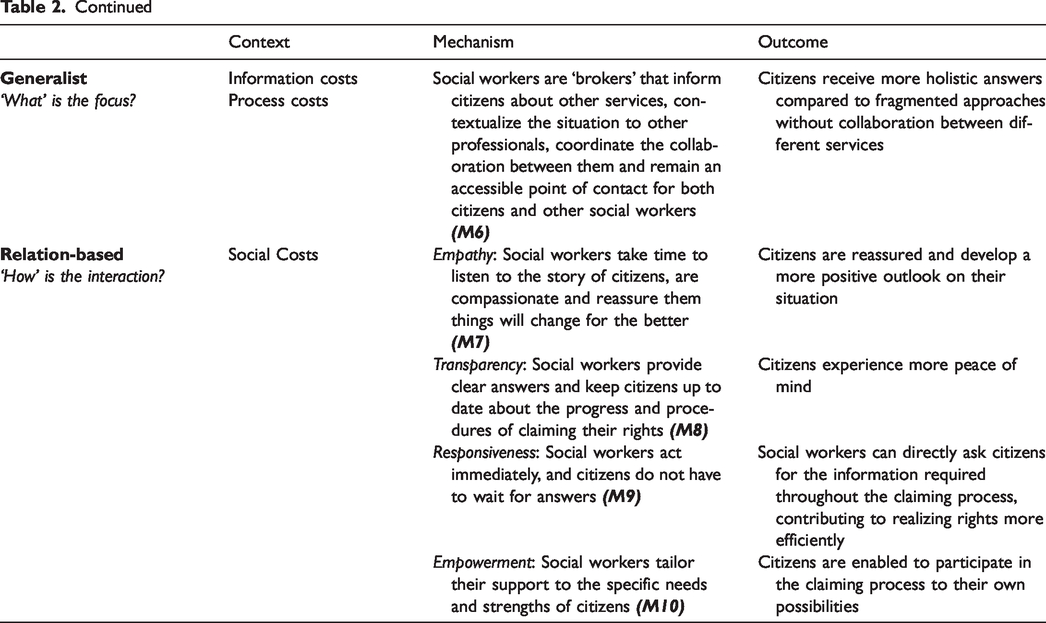
CMO configuration The field of social services is characterized by complexity and fragmentation (Carey, 2014), which increases the information and process costs for people navigating through them. This poses a direct challenge for citizens, but also explains why social workers are not always aware of the services other organizations offer (context1). Based on the proactive assessment of needs and rights, the social workers of the Integrated Rights-Practices made the effort to find and connect citizens to other relevant actors. Throughout this collaboration, the generalist social workers had a fourfold role of informing citizens about services, contextualizing the situation to other professionals, coordinating the interaction and remaining an accessible point of contact (mechanism1). Put differently, the social workers often acted as a broker that bridges structural holes between local service providers based on the needs of citizens (Burt, 2004; Naessens & Raeymaeckers, 2020; Raeymaeckers, 2016; Wholey & Huonker, 1993). By doing so, not only information and process costs were reduced, but citizens also received more holistic answers in comparison to fragmented approaches (outcome1). There are multiple sides to every problem and organization X, Y and Z all focussed on a part of it. It is important that they work together and take initiative. [. .] I did not have to go to each organization individually, wait there or make appointments. They all knew what my problem was and he [social worker of the Integrated Rights-Practice] coordinated it. This really helped me. (citizen)
Positive relations: ‘How' is the interaction?
From the perspective of citizens, the effectiveness of Integrated Rights-Practices could not solely be explained by the ‘who’, ‘where’ and ‘what’, but oftentimes rather by ‘how’ social workers approached them. Positive relations were considered a fundamental prerequisite for proactive, outreaching and generalist interventions to obtain their full potential.
CMO configuration Social costs are not solely induced by the act of seeking help in the present but can also be amplified by previous negative experiences with social services (context1). Citizens often compared the Integrated Rights-Practice to earlier encounters with social workers. They experienced the collaboration with the Integrated Rights-Practice more positively due to their empathic (mechanism1a), transparent (mechanism1b), responsive (mechanism1c) and empowering (mechanism1d) nature. Empathy was understood as taking time to listen to citizens’ stories, reassuring them things would change for the better and being compassionate. As citizens argued, this showed important in developing a more positive outlook on the situation (outcome1a): ‘it is such a big difference when someone ensures you that things will change. Here I felt like he is really going to help me. He understands me and my situation’ (citizen). Transparency was about receiving clear answers and being kept up to date about the progress and procedures. This limited information and process costs, but also gave citizens peace of mind (outcome1b). In regular practice, I never received a clear yes or no and I do not like that. [. .] I constantly needed to ask for answers. After a while I just stopped. Here, I always received an answer, a yes or a no, and that was such a big difference. (citizen) When I said: “this is my problem”, he started making phone calls and looking up how the situation could be solved. In the regular practice, they were like: “I will look it up and let you know”. Here they always acted immediately. [. .] When he was calling to other agencies and needed information, he could directly ask me. Everything went so much smoother. (citizen)
We summarize our findings in Table 2 and add an explanatory dimension to the preliminary programme theories constructed earlier. Based on the CMO-heuristic, the table presents from left to right how proactive, outreaching, generalist and relation-based strategies decrease specific determinants of non-take-up through 10 mechanisms and give rise to the outcomes discussed in this article.
Refined programme theories.
Conclusion
In contribution to the current body of knowledge, which mainly sheds light on the magnitude and determinants of non-take-up, our aim was to find an answer to the question how and why social work practice can help overcome this phenomenon. We studied Integrated Rights-Practices which explicitly focus on realizing the entitlements of citizens through proactive, outreaching, generalist and relation-based interventions. Although these strategies have previously been advocated for in the non-take-up literature, they have hitherto been separated from each other in both theory and practice. With the objective of developing the needed usable knowledge, we conducted a realist evaluation that explains how and why such interventions counteract the determinants of non-take-up through 10 mechanisms (summarized in Table 2). We argued that proactivity refers to ‘who’ takes the initiative to realize rights, outreaching to ‘where’ the encounter takes place, generalist social work dictates to ‘what’ the focus is and positive relations to ‘how’ the interaction is characterized. These guidelines are not to be considered separate strategies, but should rather be understood as synergistic, jointly providing an answer to the causes of non-take-up.
The realization of rights, however, is not the sole responsibility of social work practice and requires social policies on multiple levels that enable citizens to obtain an acceptable standard of living. In other words, different strategies are required to tackle the problem of non-take-up and street-level practice is only one – albeit important – part of a more complex puzzle. Moreover, all social workers in this study expressed a strong belief in adopting proactive, outreaching, generalist and relation-based strategies, but often felt limited by their organizational context in terms of time and possibilities. Considering the towering workloads in social services and the increasing focus on performance under the flag of New Public Management (Van Berkel & Knies, 2016), it is hardly a surprise that social workers are often restricted to reactive approaches and being available for the questions of citizens. Institutionalizing the identified mechanisms, thus, requires enabling conditions and an active investment in street-level practice that shifts the responsibility to realize rights from the demand-side to the supply-side of the welfare state. This follows earlier suggestions to effectuate rights through early interventions, because this prevents higher public costs in the long run (Eurofound, 2015).
In conclusion, we briefly reflect on the process of conducting a realist evaluation. We experienced the ontological and epistemological tenets of critical realism and realist evaluation as highly compatible with the complex, context-dependent and process-oriented nature of social work practice. Applying these principles to empirical research, however, can be rather daunting. On a theoretical level, this requires a philosophical understanding of the nature of reality, a generative stance on causation and a conceptualization of mechanisms. On a practical level, especially compared to other qualitative and quantitative strategies, there is a lack of clear methodological guidelines and empirical examples. As a result, our process was characterized by pragmatism, iteration and countless discussions on the interpretation of our data and ways to report findings. Because of this, we strongly support the further advancement of critical realism and realist evaluation in social work based on theoretical reflections, empirical examples and methodological guidelines. 2 Although we consider our efforts a contribution to this cause, we are aware of our limitations.
Limitations
Even though our respondents referred to the Integrated Rights-Practices as actively increasing the take-up of rights, measuring which rights were realized to what degree was beyond our focus. Our findings require further testing and future research could consider more quantitative ways to assess the impact of similar interventions. Next, realist evaluation explicitly stresses the importance of context and given our ambition to discover more general mechanisms which can inspire an international audience of practitioners, policy makers and researchers, we have approached context as the underlying causes for non-take-up. A more detailed account of the influence of different contexts – such as the welfare system, location, types of rights and their regulations, involved actors and the circumstances of citizens – is warranted to advance our understanding of how non-take-up is tackled best in specific situations. Similar to defining contexts, a particular challenging issue concerns the articulation of mechanisms. Although we have considered the structure suggested by Blom and Morén (2019) and the resource-response definition discussed by Dalkin et al. (2015), we decided to present our study as it was conducted in practice, thus, utilizing a more open and general conception of mechanisms. We recommend that further studies explore, compare and adopt different frameworks to unearth mechanisms and explain ‘what works, for whom, under what circumstances, why and how?’. Lastly, our evaluation of Integrated Rights-Practices during their pilot phase can be considered both a strength and a weakness. On the one hand, this allowed us to analyse the experiences during the early stages and directly inform the renewal of the Decree on Local Social Policy with our research. On the other hand, this restricted us in terms of possible cases and respondents. As previously stated, many of the pilot projects required a considerable period of time to become operational and directly impact the lives of citizens. Combined with the fact that the interventions were developed on a small scale, the number of social workers and citizens with a lived experience of the Integrated Rights-Practices was limited. Although we have pursued analytical rather than statistical generalizability, we acknowledge that a more diverse, extensive and in-depth study of practices oriented at overcoming non-take-up is necessary.
Ethics
All respondents provided verbal consents to participate in the research commissioned by the Flemish Government’s Policy Research Centre for Welfare, Health and Family. This study meets the standards of this institution’s ethical guidelines.
Footnotes
Funding
The authors disclosed receipt of the following financial support for the research, authorship, and/or publication of this article: This study was funded by the Flemish Government’s Policy Research Centre for Welfare, Health and Family. Grant number: EF02.
Acknowledgements
The authors would like to thank everyone who contributed to this study, particularly the social workers dedicating themselves to realizing rights for vulnerable communities and citizens trusting us with their stories.
