







Abstract
Summary
Despite the importance of self-care to social work practice, misnomers about the construct persist. One misperception is that millennials are overly focused on self-care and engage in high-levels of self-care, to the detriment of performing work duties. This study examined the self-care practices of social work practitioners (N = 3079) in the United States. Researcher investigated self-care practices across five domains: Professional Support, Professional Development, Life Support, Cognitive Awareness, and Daily Balance.
Findings
Overall, data suggest that social workers in all generations engaged in moderate amounts of self-care. Analyses revealed that millennials engaged in significantly fewer self-care practices related to Professional Support and Daily Balance, when compared to Generation X and Baby-boomer participants. While not statistically significant, millennials scored lower across all other self-care domains.
Applications
This is the first known study to explicitly investigate generational differences in self-care within any professional discipline. Within the next five years, millennials will make up nearly 75% of the world’s workforce. Findings from this research suggest the need to reshape prevailing anecdotes about self-care and millennials. Further, data offer insights to organizations looking to better support social workers of all generations in engaging in self-care.
Self-care has become somewhat of a sociocultural phenomenon. The International Federation of Social Workers and International Association of Schools of Social Work (2004) and the National Association of Social Workers (2008) proclaimed self-care as an integral part of professional practice. Popular media outlets, such as Slate, The Atlantic, and The Guardian, have covered the topic extensively. Special issues of juried academic journals, such as Social Work, have been wholly dedicated to the topic. Award winning musicians Mac Miller and Lizzo have lauded the importance of self-care through their artistry. Indeed, self-care has permeated nearly every area of society.
Attention aside, a plethora of misconceptions about self-care persist. One misperception is that self-care is a new, generational phenomenon. This notion is perpetuated by some of the same media outlets previously noted. In a 2017 article about self-care, Silva postulated that millennials have been “consistently defined” by their self-care obsession (para 1). A 2015 report released by the Pew Research Center concluded that millennials invest double the amount of financial resources when compared to Baby-boomers on “self-care” activities. Valenti (2018) went so far as to dub millennials as the “self-care generation” (para 1).
This article examined the self-care practices of social work practitioners (N = 3079) in the United States (U.S.). Specifically, this study sought to investigate generational differences in self-care practices. To collect primary data for this study, researchers deployed the Professional Self-Care Scale (PSCS; Dorociak et al., 2017). After a brief review of pertinent literature, this article will explicate results and discuss salient implications derived from the findings, to include future areas of research.
Background
Challenging contexts
Without question, social work practice can be challenging. Systemic factors related to cumbersome regulatory and bureaucratic processes, limited community resources, sensitive political environments, and poor perceptions of practitioners’ work can greatly impact practice (e.g. Grise-Owens et al., 2016; Whitaker et al., 2006). What is more, social workers are often held to very difficult, and somewhat unrealistic, expectations (e.g. caseload expectations, etc.) associated with the impact and outcomes (Bower, 2003; Gibson, 2018).
Much has been written about the consequences emanating from these circumstances. In summary, authors have suggested that social workers may be at increased risks for occupational stress, vicarious trauma, and professional burnout, among others (e.g. Badger et al., 2008; Bloomquist et al., 2015; Clemans, 2008; Dunkley & Whelan, 2006; Griffiths & Royse, 2016; Newell & MacNeil, 2010). These consequences may greatly impact service provisions afforded to clients. Unfortunately, as Miller et al. (2016) aptly summarized, these problematic consequences have “become all too commonplace” for social workers” (p. 12).
Defining self-care
Historically, self-care has been viewed through a medical lens. That is, literature has viewed self-care as a physical activity (e.g. exercise) used to addressing medical ailments (Miller et al., 2016). However, more recently, authors have conceptualized self-care in a more wholistic, multidimensional way. For example, several authors have put forth binary conceptions of self-care. Bush (2015) demarcated micro and macro self-care. This author explained that macro self-care refers to “big stuff” such as vacations, exercise, healthy social interactions, etc. On the other hand, according to Bush, micro self-care refers to practices that can be integrated into existing daily professional practices. Lee and Miller (2013) delineated professional and personal self-care as distinct, yet, complementary arenas of self-care. These authors defined personal self-care as “a process of purposeful engagement in practices that promote holistic health and well-being of the self,” while they described professional self-care as “the process of purposeful engagement in practices that promote effective and appropriate use of the self in the professional role within the context of sustaining holistic health and well-being” (p. 98). Cox and Steiner (2013) delineated two universal categories of self-care: “lifestyle choices and workplace adaptations” (p. 33).
Others have offered multi-domain definitions of self-care. Dorociak et al. (2017) described self-care as a “multidimensional, multifaceted process of purposeful engagement in strategies that promote healthy functioning and enhance well-being” (p. 326). Grise-Owens et al. (2016) offered a self-care plan template that identified physical, spiritual, psychological, and professional as complementary facets of holistic attention to self-care. Newell (2017) put forth an ecological perspective of self-care that entails “using skills and strategies to maintain … personal, familial, emotional, physical, and spiritual needs to actively and consciously promote holistic well-being… ” (p. 93). Central to all definitions of self-care is the notion that self-care entails holistic attention to all multiple domains associated with overall well-being.
Importance of self-care
There is consensus that self-care can assuage some of the afore-mentioned problematic employment circumstances (Miller & Grise-Owens, 2020). Brucato and Neimeyer (2009) suggested that self-care can address professional burnout and workplace turnover. Others have made similar assertions (Bamonti et al., 2014; Bloomquist et al., 2015; Lee & Miller, 2013; Norcross & Guy, 2007; Sansó et al., 2015). In a study of child welfare workers, Salloum et al. (2015) concluded that practitioners engaging in self-care experience higher levels of job satisfaction. Engaging in self-care may also address issues associated with stress, vicarious trauma, and emotional exhaustion, among other negative effects (e.g. Abreu et al., 2015; Bressi & Vaden, 2017; Lee et al., 2020; Miller et al., 2018). In discussing the benefits of self-care, Kanter and Sherman (2017) asserted, “Self-care gives you the sustainable energy you need to do your mission-driven work” (p. 28).
Self-care research
To be clear, empirical research that explicitly examines self-care is relatively sparse (e.g. Lee et al., 2020; Miller & Grise-Owens, 2020). A handful of studies examined self-care practices among social work practitioners in the U.S. (e.g. Bloomquist et al., 2015; Miller et al., 2017) and Europe (Miller et al., 2019). These studies concluded that participants only engaged in moderate amounts of self-care.
Generational divides
Despite broad-ranging assertions about generational distinctions and self-care, particularly between millennials and other groups, no published studies have examined this concept in social workers. An exhaustive literature review yielded no studies on the topic. However, a host of authors have discussed generational distinctions in areas of work.
Jenkins (2007) examined generational conflicts within the workplace. He asserted that millennials are often viewed as lazy and unmotivated by their coworkers. This view may also be held within social work agencies and organizations. A systematic review by Lyons and Kuron (2014) documented that work values, ethics, and behaviors may be dictated by generational distinctions.
Against this backdrop, it is imperative that researchers examine generational characteristics related to desirable workplace behaviors (Kapoor & Solomon, 2011). That said, despite prevailing anecdotal assertions about millennials being pre-occupied with self-care, this notion has not been tested in the literature. This work uniquely addresses that limitation in the current literature.
Purpose, theoretical foundation, and research queries
The overarching purpose of this study was to examine generational differences in self-care among a sample of social workers. The approach for this study was informed by several theories related to generational phenomena, namely Mannheim’s Theory of Generations (1952) and Strauss and Howe’s Cohort Theory (1997). Both theories suggest that people are shaped by occurrences related to the time of and space of their coming to maturity. Similar to social work’s Person-In-Environment perspective, these theorists, in essence, suggest that people shape, and are shaped by, their environments.
This study sought to address limitations in the current literature and was guided by two distinct exploratory research questions: Research Question (RQ) 1: How frequently do social workers in the sample engage in self-care practices? Research Question (RQ) 2: Is there a difference in frequency of self-care practices, by generational designation?
Methods and materials
Sampling approach
For this cross-sectional study, primary data were collected during Fall/Winter 2019–20. Responses were collected online from self-identified social workers in the U.S. A survey invitation was sent to potential participants via a professional social work membership listserv. Additionally, the survey invitation was posted to several social media outlets. Participants were asked to forward the survey invitation to other potential participants. As such, it is not possible to calculate a response rate.
The survey was hosted via an online survey software. Social workers who participated in the survey were offered a chance to enter a $500 incentive drawing for their participation. The software employed features that disabled IP and email address tracking. Because the primary survey link and the incentive link were disconnected, survey responses were anonymous. All participants self-identified as a social worker for the purpose of this study. Protocols deployed for this study were approved by a University Institutional Review Board (IRB).
Instrumentation
To collect primary data from participants in this study, researchers utilized the PSCS (Dorociak et al., 2017). PSCS includes a total of 21 items divided over five subscales. Each item was measured via a Likert-type scale anchored at 1 with “Never” and 7 with “Always.” Scores were computed as a mean rating for each of the self-care domain, with higher scores indicating higher levels of self-care.
The subscales, number of items, and sample items are included in Table 1.
PSCS domain, number of items, and sample item.
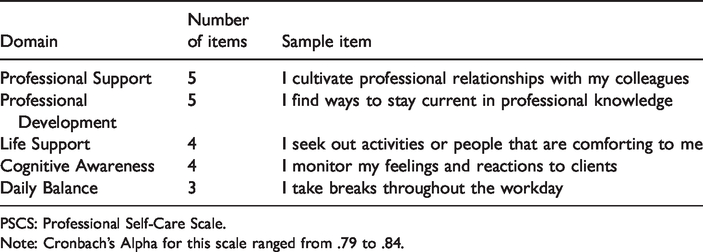
PSCS: Professional Self-Care Scale.
Note: Cronbach’s Alpha for this scale ranged from .79 to .84.
Findings
Participants
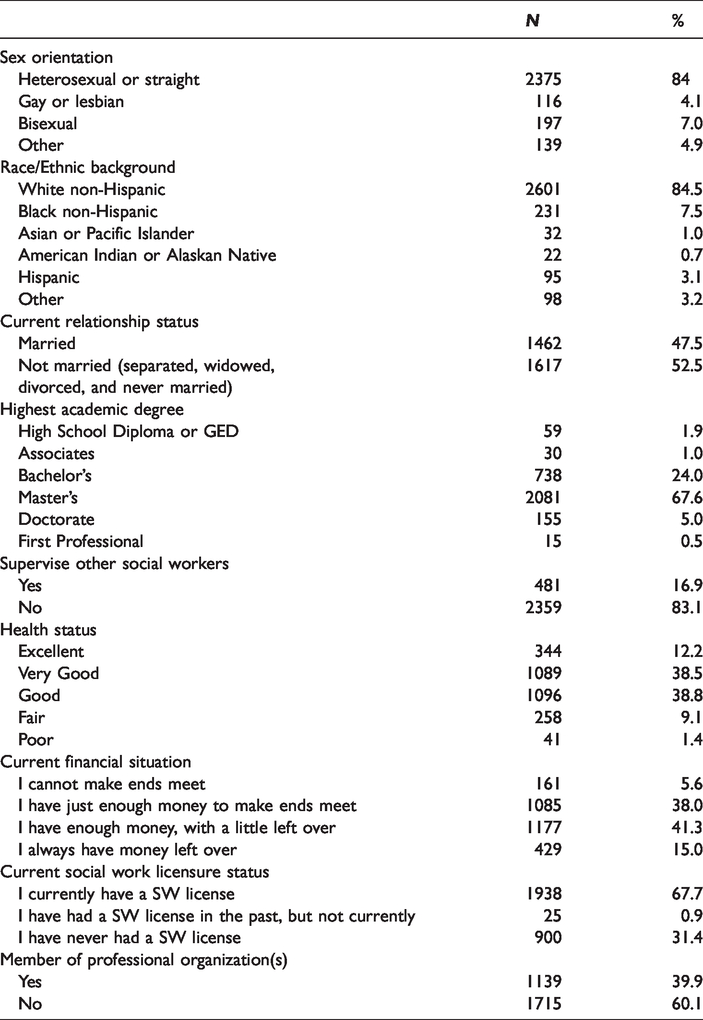
A total of 3079 (N = 3079) social workers participated in the study. The typical participant identified as female (83.9%), male (13.0%), or another (3.1%), white, non-Hispanic (84.5%) racial/ethnic background, and in their early 40s (M = 41.28; SD = 13.51). On average, participants reported being in practice for 11.99 (SD = 11.52) years. See Table 2 for additional demographic and professional information.
Description of sample.
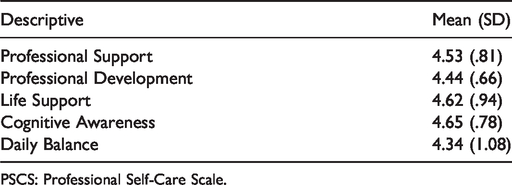
PSCS scores are included in Table 3. Cognitive Awareness yielded the highest mean scores, whereas Daily Balance was rated lowest.
Participant PSCS scores.
PSCS: Professional Self-Care Scale.
To answer the research queries posited above, participants were coded by generation. Generation was operationalized using guidance from existing literature and was delineated as follows: millennials (born between 1980 and 1994), Generation X (born between 1965 and 1979), and baby-boomers (born between 1946 and 1964). Domain scores by generational distinction are included in Table 4.
Group comparison results for the sample’s self-care scores by generation.
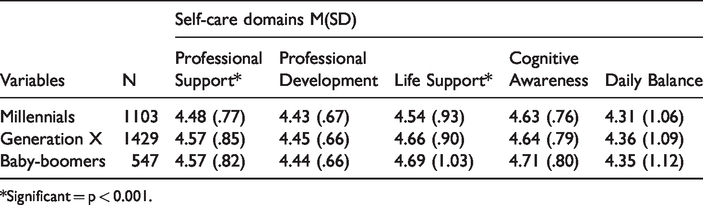
*Significant = p < 0.001.
Brown-Forsythe analyses revealed a series of between-subjects effects comparing mean self-care scores on two out of five domains, by generational distinction: F(2, 3078)=3.92, p = .020, η2 = 0.003 for Professional Support; and, F(2, 3078)=6.81, p = .001, η2 = 0.005 for Life Support. A post-hoc test (e.g. Tukey HSD) indicated that Generation X reported significantly higher Professional Support than did millennials (M diff =.08, p = .032). Millennials scored significantly lower than Generation X (M diff =.12, p = .003) and Baby-boomers (M diff =.15, p = .005) on Life Support.
Based on previous research that identified financial status as a variable impacting self-care (Miller et al., 2018), researchers initiated analyses to PSCS differences, by generation, controlling for the covariance of financial status. Because of equal variance violations (Levene’s test F = 8.27, p < .001), Quade’s Rank Analysis, a nonparametric alternative to the ANCOVA, was performed. Results indicate significant millennials scored significantly lower in Professional Support, when compared to Generation X (F(2, 2851)=5.87, p = .003, η2 = 0.004).
To take into account differences between the groups on binary/nominal variables, a series of chi-square tests were initiated. Significant generational differences were present across several demographic variables (i.e. gender, race, and so forth). Based on the results from the chi-square tests, researchers performed a series of partial correlation analyses between generation and self-care scores, controlling for the effects of all the demographic variables on both generation (IV of the key interest) and the five self-care domain scores (DVs). Results yielded significant differences in Daily Balance (r = .080, p = .001), whereby millennials scored significantly lower (M = 4.31, SD = 1.06) than Generation X (M = 4.36, SD = 1.09) and Baby-boomers (M = 4.35, SD = 1.12), respectively.
Discussion
This study examined the self-care practices of self-identified social workers in the U.S. Specifically, this work examined commonly held assumptions associated with self-care and general distinctions. In so doing, this work addresses a significant dearth in the current literature. The following paragraphs briefly outline discussion points derived from the data.
Mean self-care scores ranged from 4.34 to 4.65 (see Table 3). These data indicate that participants in the sample engaged in moderate amounts of self-care. Based on the mean scores, and in context with the Likert rating categories, these data indicate that participants only sometimes engage in self-care.
These findings are consistent with other research studies that have examined self-care among social workers. Bloomquist et al.’s (2015) study, which included a sample of nearly 800 practitioners, found that social workers engaged in moderate amounts of self-care. Miller et al. (2018) made similar assertions. Given the contemporary challenges facing social workers, these data indicate that self-care may be an area of needed improvement for social work practitioners.
In terms of addressing RQ2, analyses revealed that millennials engaged in significantly fewer self-care practices related to two of five self-care domains, when compared to other generations. While not statistically significant, millennials scored lower across all other domains. When controlling for other variables, millennials scored significantly lower on Professional Support and Daily Balance.
Overall, these findings are an interesting juxtaposition with prevailing anecdotes about self-care. As indicated, common perceptions persist that millennials are pre-occupied with self-care, which shapes a dominant narrative that this population is doing well in the area. In fact, these data suggest that, while millennials may desire to engage in self-care practices, these desires may not be pragmatically actualized. Even more so, these findings suggest that commonly held perceptions about self-care—particularly in relation to the “millennial obsession”—may be misguided, over-blown, and/or simply inaccurate. As such, these perceptions can have particularly deleterious impact for this category of social workers.
Misnomers associated with generational differences related to workplace issues are not new or unique. In fact, the theoretical suppositions offered by Mannheim (1952) and Strauss and Howe (1997) suggest that employment related variables would differ by generation. However, the interesting notion evident in these data may be that the differences are in direct conflict with generally held assumptions about millennial self-care.
Several plausible explanations for these differences in self-care practice can be posited. In discussing millennials in the social work workforce, Moore (2012) explained that millennials are unfairly poorly perceived in relation to their sense of “entitlement” related to work behaviors. Moore went on to suggest that millennials may also be perceived as “selfish.” Assumptions related to self-care may be an extension of these perspectives.
Another plausible reason associated with the differences is that these generations conceptualize self-care differently. For example, popular media commonly misrepresents self-care with a consumeristic framing—as contrasted with an emerging wholistic conceptualization (Miller et al., 2016). Torrico Meruvia (2013) purported that each generation shares common experiences that shape their positionality, particularly related to the workplace. These differences may be evident in concepts associated with self-care, which would veritably impact findings.
Specifically, millennials engaged in significantly fewer self-care practices related to Professional Supports and Daily Balance. In regards to professional supports, this finding may be connected to several factors. For example, because of the lack of empirical research about millennials in the context of social work agencies/organizations, formal professional supports may not match the needs of millennials. This finding may be linked with broader cultural phenomena regarding millennials’ styles and forms of connection, which revolve around technology in a way that may be different than other generations. These findings merit further exploration to discern the factors contributing to this discrepancy.
Differences in Daily Balance may also be attributable to several factors that merit further exploration. For instance, this study did not take into account family constellation. Younger workers may be grappling with child rearing duties, and other considerations of their life phase, that impact balancing personal and professional tasks. Another factor may be a generational difference in “availability,” and thus, clear boundaries between work and home life-spheres (e.g. Grise-Owens et al. (2016). With constant availability through technology, millennials may experience particular dissonance in balancing work and personal life-spheres.
On the surface, findings from this study seem to uncover discrepancies with the popular perceptions of millennials as obsessed with self-care. Yet, in one respect, the study may be critically complementary, rather than contradictory. That is, perhaps millennials are “obsessed” with self-care because they recognize the need for it, but are struggling with how to actualize it. The hashtag included in this article’s title may summarize millennials’ relationship with self-care: #NotSoMuch. This study offers some direction for what is needed to help with that struggle.
Study strengths and limitations
As with any research effort, this study includes strengths and limitations. In terms of strengths, this study uniquely examines commonly held (mis)perceptions about self-care and millennials. As such, it may provide valuable insight for addressing employment related issues about self-care. To date, the literature is absent of such examinations.
There are several limitations to this effort. For instance, though appropriate for an exploratory study, a larger sample of social workers may have included additional perspectives that would have impacted the findings. Participants self-selected into the study. While somewhat reflective of the profession, the sample was overwhelmingly white and female. Future research should look to address these, and other, limitations. Broad generalizations emanating from this study should be considered within the context of these limitations.
Implications
Several salient implications stem from these findings. First, and perhaps most importantly, data indicate the need for all practitioners to engage in more self-care. As discussed in the afore-referenced literature, self-care can assuage inimical conditions of practitioner depletion (e.g. stress, burnout, and so forth). The present data indicate that this need may be specifically related to areas of conceptualizing professional supports and life-balance.
There are several ways to improve self-care among social work practitioners. For instance, self-care trainings can be beneficial (Miller et al., 2016). Additionally, social work education programs may look to provide educational offerings to students. Grise-Owens et al. (2018) discussed the importance of these types of offerings and promulgated a model for such offerings.
Second, these data affirm the need to be mindful of potential generational differences in workplace issues related to self-care. Though other forms of difference and diversity are often discussed (e.g. race, gender, etc.), generational differences among practitioners are seldom addressed. A host of authors have issued clarion calls to examine generational differences (e.g. Parry & Urwin, 2017). In social work, Torrico Meruvia (2013) asserted that unaddressed generational differences can increase stressors and decrease job satisfaction.
These findings in mind, social work employers (e.g. agencies and organizations) should implement and evaluate broad-based wellness initiatives. It is imperative that these initiatives be conceptualized via participatory processes that take into account a diverse array of generational perspectives. Other initiatives, such as formal mentorship and apprentice programs, may help to expose cross-generational groups of employees. These initiatives need to be informed by millennials, themselves, and further research on best practices in providing professional supports for millennials.
Lastly, research implications abound. Certainly, studies should continue to explore generational differences in other areas of overall wellness. While examinations of self-care interventions are needed, perhaps these examinations should look for varying effects across generations. This study did not compare and contrast social workers with other professions or their peers in the general population. Future studies might examine questions, such as: Do social workers engage in self-care less than other helping professionals or the general population? Likewise, do millennials in the general population differ from those millennials in the social work profession? As well, studies might investigate potential reasons for differences in self-care practices across generations, including qualitative or mixed-methodological approaches. Furthermore, to build best practice resources, studies should examine efforts and initiatives that focus on promoting self-care, with specific attention to generational considerations. This study could be the foundation for these studies.
Toward more “obsession” with self-care
Within the next five years, millennials will make up nearly 75% of the world’s workforce (The Center for Generational Kinetics, 2016). Thus, it is imperative that employers understand generational dynamics associated with supporting that workforce. Indubitably, failing to do so will not only impact social work practitioners but it will also impact the clients they serve and the viability of the profession.
This exploratory study offers critical insights about self-care, in general, and across generational differences, in particular. The study also elicits possible directions for future study and practice initiatives. Social work already has a high rate of burnout. These findings about the current and future workforce, i.e. millennials, do not bode well for decreasing that rate, as their self-care practices are #NotSoMuch. Given this constellation of considerations, perhaps more (not less) informed and impactful “obsession” with self-care is needed.
