







Abstract
Summary
School social workers and school counselors play an important role in providing support to the parents of children with attention deficit hyperactivity disorder (ADHD). Issues regarding the barriers to parental involvement have not been well-explored empirically in social work. By means of semistructured interviews, this study explored the perspectives of 20 Mainland Chinese parents about parental involvement in their children’s education and in schools, parent–teacher relationships, the social factors that affect individual families, and the cultural and contextual factors that hinder parental involvement in children’s education.
Findings
Using thematic analysis, the researchers identified major themes: (a) emotional overinvolvement of parents in children’s education; (b) withdrawal of fathers; (c) positive and negative teacher–parent relationships; (d) contextual factors: school culture, system, and policies; and (e) parents’ preferred sources of support.
Applications
This research provides insight for school social workers and school counselors to develop supportive measures for parents of children with ADHD. Furthermore, it is recommended that social workers mediate tensions that arise from conflicts between teachers and parents. Social workers need to be sensitive to the power and cultural issues embedded in a parent–teacher relationship to facilitate parental involvement in school mental health services for children with ADHD. In particular, the cultural beliefs that affect parents and teachers relationships should not be ignored.
Introduction
According to the National Association of Social Workers’ (NASW, 2012) Standards for School Social Work Services, school social workers perform an important role in a school setting. First, they act as a critical link between parents, teachers, and community members. Second, they consistently promote cooperation between schools and families. Third, they promote dignity and rights for all students in the school environment. An increasing focus has been placed on the role of school social workers to provide mental health services for students with emotional and behavioral problems (O’Brien et al., 2011). For instance, children with attention deficit hyperactivity disorder (ADHD) generally exhibit difficulties in terms of academic development and peer relationships (Hoza, 2007). These difficulties are related to the exhibition of features, such as hyperactivity, inattention, impulsivity, and distractibility (Daley & Birchwood, 2010). School-based mental health programs provided for these children involve partnerships with various mental health professionals, such as school counselors, psychologists, and school social workers (Cohen & Angeles, 2006). Moreover, the partnership between teachers and parents can facilitate the planning and operation of mental health services for the children (Johnsen & Bele, 2013; Reio & Forines, 2011). In light of the concern raised by the need to involve parents in school-based mental health programs, school social workers need to pay particular attention to the issues related to parental involvement in schools.
The traditional definition of parental involvement in children's education emphasizes parental participation in school events in terms of meetings with teachers and joining regular school activities (Jeynes, 2013). Jigyel et al. (2019) also include volunteering at children's schools and integrating children into the community as types of parental involvement. Nowadays, parental involvement exists in many forms. For example, parents are involved in children's home-based activities (Ball et al., 2017; Tran, 2014). Stevenson and Baker (1987) reveal that more highly educated parents with a younger child will tend to be more involved in the child's school activities, as a result of which the child performs better in school. There is a growing trend to integrate children with special learning needs into a normal school environment and meeting their needs in terms of school structures, teaching materials, and pedagogical methods (Reindal, 2016).
However, Berkant et al. (2019) report that parents consider that teachers are not equipped with the knowledge and skills necessary for teaching children with special education needs. Additionally, teachers may not embrace the value of inclusive education and may not modify their teaching methods to meet the needs of these children (Freedman, 2016). Many researchers have commented that the medical label “ADHD” may reduce stakeholders’ understanding of the problems to individual pathology, rather than looking at the complex social and educational problems that cause or intensify the problems of ADHD (Thomas & Loxley, 2007). Due to this narrow labelling and understanding of ADHD, teachers and school leaders seldom pay attention to social and school practices that may influence the well-being of children with ADHD (Brunila, 2012; Vehmas, 2010). This can impact on parental involvement in children's education and, in particular, on parent's participation in their children's schooling. Parents may encounter negative school experiences, feel that they are being discriminated against and not welcomed at school. A study conducted by El Shourbagi (2017) also indicates that while parental involvement is important, in practice, there is a lack of motivation and opportunities for parents to participate.
Previous research indicates that stress is an extremely common experience for parents of children with ADHD (Theule et al., 2013). Additionally, insufficient social, family, or spousal support, and a lack of coping resources all have an impact on parental stress (Theule et al., 2011). Podolski and Nigg (2001) suggest that positive thinking can help parents enjoy greater role satisfaction. In fact, parents require additional family, social, and school support. Generally, mental health professionals in schools, such as school social workers and school counselors, are best placed to support these families. In particular, they are able to share information and discuss children's behavioral and treatment plans with their parents. A deeper understanding of the social, cultural, and institutional factors that generate parental stress is needed (Kotchick & Forehand, 2002).
In recent years, Chinese education literature has generally advocated the practice of targeted education strategies, especially for students with learning difficulties. Effective education interventions should be carried out according to their psychology and learning characteristics and education that is suitable for their development should be provided. However, school support measures provided for students with learning difficulties vary among schools. In general, students are studying in a highly competitive and examination-oriented academic environment (Feng, 2010). Chinese schools are characterized by a culture of compliance and obedience and teacher comparison of student performance (Xu, et al., 2018).
In China, there is a trend to promote mental health services for students by school mental health professionals (Whitman et al., 2008). Owing to the development of school social work, school social workers act as one of the members of the school mental health team. For example, school social workers organize activities such as experiential games, art, and sports for students with learning disabilities to supplement school resources to meet the needs of students at multiple levels of development (Yan & Deng, 2018).
The extent of partnership between teachers, school mental health professionals, and parents in the area of student support in Mainland China is unknown because of the lack of relevant empirical research. Consequently, school social workers and other school mental health professionals do not know how to involve parents in school mental health programs or how to provide support for the families of children with ADHD. This study aimed to address this research gap by investigating the current involvement of parents of children with ADHD in their children's education and schools living in two cities in Guangdong province (in southern Mainland China) using a qualitative research approach.
Literature review
Existing literature reveals that barriers to parental involvement in their child's education are generally related to social factors that affect individual families. For example, migrant ethnic-minority and single-parent families cannot realistically participate in their child's school affairs on a regular basis (Auerbach, 1995). Additionally, low-income families are less able to afford the time to contribute to daily activities within the school as are middle-class parents. Another barrier to parental involvement relates to relational factors such as a negative relationship between parents and teachers (Paseka & Schwab, 2019). However, active school leadership by teachers contributes to successful parental involvement. A friendly school culture, initiatives and efforts to involve parents, and the effective use of various communication methods facilitate parental involvement. These are contextual factors and motivators that encourage parental participation (Reynolds et al., 2015). Additionally, some parents complain about schools’ failure to formulate policies from the perspective of parents (Blackmore & Hutchison, 2010). The power imbalance between parents and the school can become a barrier to parental involvement.
Studies focused on parents of children with ADHD reveal two extreme parental perspectives (Brown & Medway, 2007), a welcoming and positive perspective, and a negative one that indicates withdrawal. Generally, parents express dissatisfaction with the parent–teacher relationship (Spann et al., 2003). In a study by Šukys et al. (2015), only one-third of parents claimed to be equal partners in the communication process with teachers. Some parents also feel that teachers are not well prepared to cope with children with special education needs (Swick & Hooks, 2005). The parent–teacher relationship is associated with children's academic performance and adaptive behavior in school (Thijs & Eilbracht, 2012). Teachers’ expectations with regard to parental behavior are affected by their perceptions of what it means to be “good” parents (Lasky, 2000). Parents of children with ADHD are often blamed by teachers for their child's academic problems and disruptive behavior (Tan & Goldberg, 2009). Thus, these parents have lower self-confidence when it comes to communicating with teachers (Reio & Forines, 2011).
The literature also indicates that cultural beliefs and perceptions about disabilities affect the relationship between parents and school professionals. As indicated by Kayama (2010), Japanese parents prefer building emotional connections with teachers while American parents are more likely to advocate for the rights of their children. In Mainland China, there is a lack of research about parental beliefs, perceptions, and involvement in inclusive education. Little is known about the effects of Chinese culture on parental involvement in inclusive education. Currently, the development of inclusive education in Mainland China is guided by educational policies issued by the government (Xu et al., 2018). Teachers generally lack the relevant professional knowledge and skills needed for meeting the needs of these students (Yan & Deng, 2018).
Little is known about the perceptions and experiences of parents in dealing with mental health professionals in school, such as counselors or social workers. Since the families of children with ADHD are considered as a marginalized group in school, the support offered by school social workers and school counselors is extremely important. This study aims to strengthen the support provided by social workers and school counselors since they are important team members in school mental health programs (Howe, 2010).
Methods
This study applied a qualitative approach. As indicated by Hammarberg et al. (2016), qualitative methods are good for exploring attitudes, beliefs, concepts, and viewpoints regarding a particular topic. More specifically, the study explored the contextual factors that influence parental stress. Data were collected by semistructured interviews. Sample interview questions included: “How would you describe your involvement, meaning the amount of participation you have in your child's schooling and daily life?,” “Are you involved in your child's school activities?,” “How would you describe your relationship with teachers in your child's school?,” “Have you communicated with teachers about your child?” and “How do you communicate with your child's teacher?” Parents were recruited with the support of two children's training centers in city 1 and city 2, which are both located in Guangdong province in southern China.
Parents who participated in the study shared a similar Guangdong culture, language, and tradition. Homogeneous sampling was used to recruit informants who met the specified criteria (Cohen, Manion & Morrison, 2007). Their children were aged between 9 and 12 years and studying in primary school. In China, children commence primary school at the age of 6 or 7 years and primary schooling lasts for 6 years (see Table 1). All families were two-parent nuclear families, and nearly half of the mothers were housewives. The economic circumstances of all families were generally satisfactory, and none reported experiencing financial problems. The marital relationship in these families ranged from fair to satisfactory and all reported marital conflicts were related to difficulties associated with raising children with ADHD.
Profile of participants.
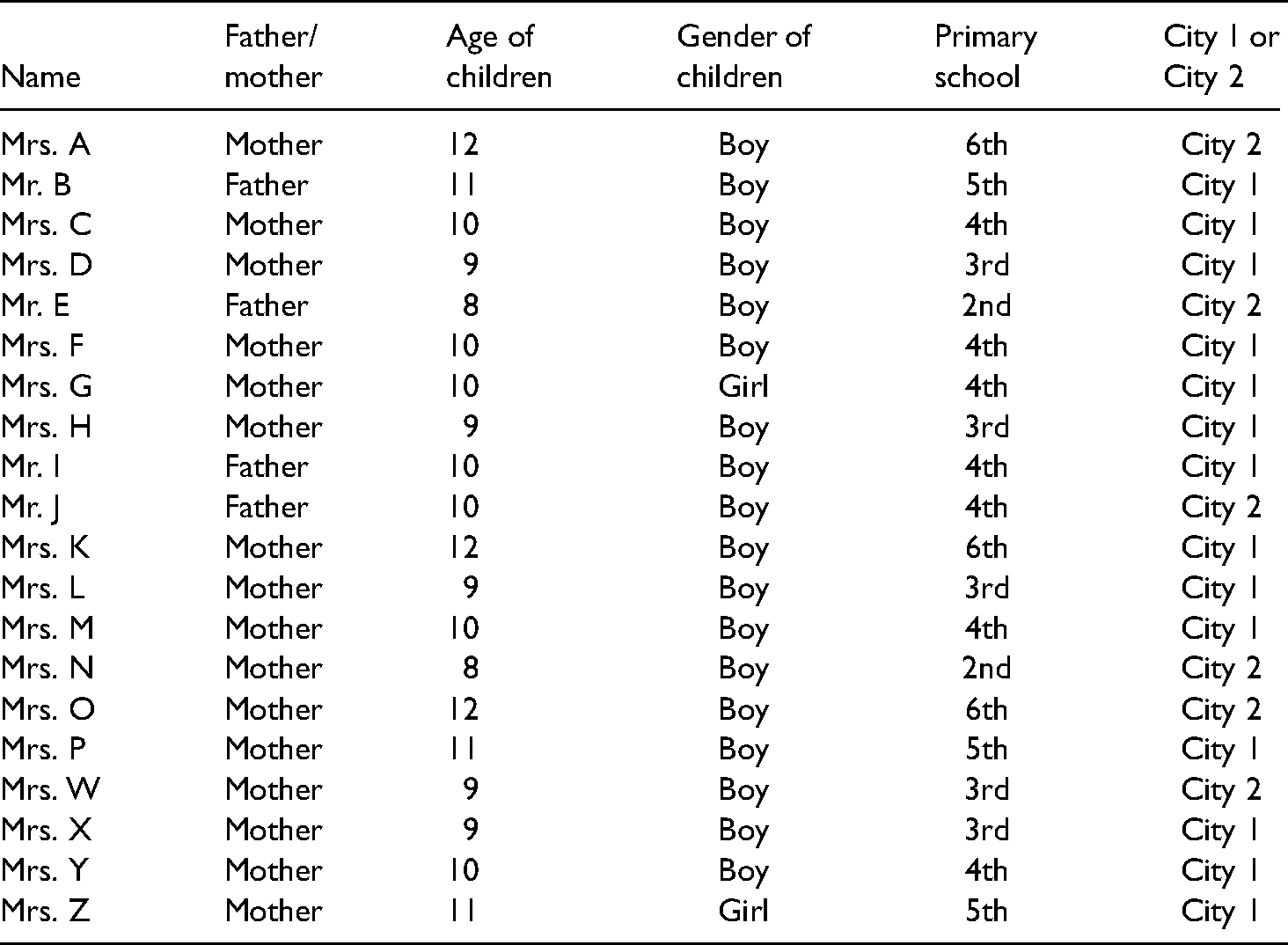
Ethical approval for the study was obtained from Caritas Institute of Higher Education. A sample of 20 parents (16 mothers and 4 fathers) was recruited. The existence of ADHD in most children was discovered by teachers or parents during their early primary school years. Some children displayed attention deficit only, while others evidenced both attention deficit and hyperactivity. As reported by parents, children with attention deficit had problems paying attention in class and doing homework. They disliked lengthy tasks, following instructions, quickly lost focus, and were easily distracted. They had problems organizing and keeping materials in order. Additionally, children with symptoms of hyperactivity had problems staying seated in the classroom. They were unable to control impulsive behaviors and interrupted the class. Some children were on medication under a doctor's supervision.
For analysis of the data, a thematic analysis was used to identify themes, categories, and patterns across the data set (Braun & Clarke, 2012). Several themes emerged from analysis, and the interrelations between them were explored. Similar themes were grouped together and a label was used to describe the connections between them. For example, regarding parents’ perceptions of their experiences of school, parents were asked about their expectations with regard to school involvement and the pros and cons of participating in school activities. Additionally, teacher–parent interaction patterns were investigated. Both semantic and latent themes were discovered. For example, some parents explicitly said that they had no interest in participating in activities at their child's school. However, when the researchers started to examine the underlying factors, parents would further explain that they felt embarrassed and ashamed for having a child with ADHD. The researchers then further explored the reasons for their feelings of embarrassment. They found that some parents were embarrassed because of concerns about what the teachers said and thought about them.
Findings
Emotional overinvolvement of parents in children's education
Parental overinvolvement reflected a set of emotions and behaviors on the part of parents towards their child. Examples included excessive self-sacrifice in terms of time and resources in their child's education and excessive worries over their child's future. For example, Mrs. Y said that she had sacrificed all her time and tried her very best to support her son. Another mother Mrs. X said she was too busy to take care of her son's homework. She felt lonely and tired. Her worries stem from concern about her son's future. Her husband could not give her support because he worked in another city.
Excessive parental involvement in their child's education might lead to burnout and emotional exhaustion. Participants experienced emotions such as guilt and anxiety. For example, Mr. I said that his wife had pervasive feeling of not doing enough or not making the right decision for their son.
Parental overinvolvement also reflected parents’ social expectations. Teachers tend to blame parents for poor parenting. Parents were expected to discipline their children to ensure their best behavior. It seems that all the responsibilities fall on the parent's shoulders. The concept of power manifested itself in the relationship between parents and teachers. For example, Mrs. L was very stressed and frustrated because the class teacher complained frequently. She said that her son was hyperactive and easily distracted. The class teacher complained frequently and blamed her for having poor parenting skills. In addition, Mrs. Y said that the class teacher knew little about her son's symptoms. It seems that all the responsibilities fell on the parents’ shoulders. The class teacher told her that it was her responsibility to help the son achieve a better score.
Withdrawal of fathers
Participants revealed tissues of gender role inequality and withdrawal of fathers. As regards gender inequality in household chores and childcare Mrs. X, for example, described herself as being the sole responsible child carer at home. Mrs. M also complained that her husband was unable to give her support because he had very little involvement in child-related matters. She said that she seldom talked to her husband about her anxiety because he was unable to give her support. She needed to consult a doctor and take medication.
Participants attributed various reasons for fathers’ withdrawal. First, the father was the sole breadwinner and did not have time to deal with childcare issues. Second, mothers were frequently involved in their child's education and they seldom encouraged fathers to participate in issues relating to their child. For example, Mrs. F said that she rarely talked to her husband about issues relating to their son or his academic performance because he was busy at work and he needed rest when he returned home.
Mothers were asked when they discussed issues relating to their child with the husbands. Mrs. D said that she asked husband's opinion whenever she needed to make some important decision, for example, to find and choose a school for studying.
Generally, fathers seldom participated in any parental activity in school or in other children's service centers since they lacked information and knowledge about their child's situation. They wanted to avoid situations that would cause them to lose “face.” Of the 20 participants, only four were fathers. Mr. B said that it was not easy for fathers to communicate with teachers because they did not know what was happening to their children.
Positive and negative teacher–parent relationships
Positive relationships
Some parents stated that class teachers had a positive attitude toward their child. These teachers were able see the child's strengths as well as their weaknesses. They appreciated the attitude of those teachers who reacted to them with an open mind. Thus, these parents developed a positive relationship with their child's teachers. Both Mrs. H and Mr. J appreciated the positive attitude of their child's teacher. They said that the teachers had a positive influence on their children. Mrs. H said that the class teacher was very patient and had a positive attitude toward her son. The teacher showed an understanding of her son's difficulties in learning.
Some parents, for example, Mrs. G and Mrs. C, were representatives on the parents’ committee (In Chinese: Jiāzhǎng wěiyuánhuì). These parents actively participated in school management, provided opinions and suggestions on school decisions, and organized parents’ and students’ events. Since they assisted teachers in implementing student activities, they often communicated directly with the teachers and were respected and trusted by the teachers. Mrs. C said that she previously worked as the representative on the parents’ committee. She was familiar with the teachers and communicated with the class teacher frequently. The teachers believed that she had worked hard on her child's problems. Sometimes the teachers encourage her to relax.
Negative relationships
Some parents said that teachers did not consider their child's difficulties and gave them more homework. Furthermore, some schools did not have special policies or measures to deal with students with special educational needs. The parents felt helpless and there was no way for them to reflect their concerns. Mrs. O said that her son had attention deficit and he could not pay attention to his homework. He disliked lengthy tasks and language exercises. She asked the class teacher to give him less homework but the teacher turned down her request. Mrs. W complained that no special assistance was provided for her son. She felt helpless and could find no way to express her opinion.
Due to large class sizes and limited resources, teachers had insufficient time and resources to handle students with special learning needs. Children with ADHD generally were not accepted by either their classmates or teachers because of their distracting behavior.
Our research identified poor relationships between teachers and parents. For example, Mrs. K said that she disliked the class teachers and her relationship with the teachers was poor. Mrs. A also said that the maths teacher was strict and she disagreed with his comments and suggestions. She did not publicly dispute his ideas but she would not follow them.
Contextual factors: school culture, system, and policies
Some parents stated that their child's school adopted a more ADHD-friendly culture, system, and policies. For example, one school used “suí bān jiùdú” which means learning in the regular classroom and provision of special lessons for students with ADHD. Mrs. Z said that her daughter attended the special interest courses arranged by the school that were conducted by external teachers, and payment for the courses was supported by the Department of Education. Moreover, the attitude of the teachers in these schools was friendly and their acceptance of children with ADHD was higher than that of the teachers in other schools. Mrs. K shared a similar experience and said that she moved her son from one school to another, and she considered it as the best option for him. The teachers in the new school adopted a more friendly attitude to her son.
However, some schools did not have any special inclusive policies or accommodations for children with ADHD; accommodations such as immediate prompting and praise for appropriate behavior, seating arrangements, allowance of extra time to finish homework, or shortened written assignments. These measures were suggested by parents. Both Mr. E and Mrs. N complained that their child's school provided them with no assistance. Mr. E said that she thought it was impossible to expect children with ADHD to fulfill the same requirements as other students. Her son's school did not offer any appropriate accommodation such as shortening written assignments or allowing children extra time to finish their homework. Mrs. N said that the school did not provide any accommodation for her son, such as an alteration of curriculum format or written assignment to allow her son to complete his learning tasks.
Parents’ preferred sources of support
Parents expressed a preference for seeking help from school counselors or school social workers where they felt that it was difficult to talk to teachers who demonstrated a judgmental or unfriendly attitude. Some parents, such as Mrs. G, said that she personally received counseling from a private counselor because she felt stressed and depressed. In addition, she sought help from the school counselor because she gave her daughter psychological support. The counselor was patient and nice.
Parents revealed that school counselors could act as a bridge between the school system and the parents. They were trained school social workers who could assist with classroom support and consultation with teachers and parents. They served as a link between the home and school. For example, Mrs. H said that the school counselor acted as a bridge between the school, the teacher, the parents, and the children. The counselor was approachable and helpful. She hoped to receive advice and support from the school counselor.
Discussion
The research data reveal that parental involvement in their child's education is related to social factors that affect individual families. Working parents have less time to devote to their child's education. Additionally, a father who is the sole breadwinner also has less time to spend with his child. Children with ADHD exhibit a lot of impulsive and inappropriate behavior that causes their parents stress and anxiety. Furthermore, some parents were overinvolved in their children's issues while other parents were too withdrawn. These two extreme reactions reflect their difficulties in accepting their child's difficulties and the challenges they face in daily family life.
Additionally, the barriers to parental involvement, especially in the child's school, are closely related to cultural and contextual factors. The study revealed the existence of a balanced situation where some schools create a welcoming environment for students with ADHD where teachers are willing to offer support and make accommodations. However, realistically, mainstream schools in Mainland China are by no means ADHD friendly. Some schools expect all students to follow the general rules in terms of completing homework assignments. Moreover, children with ADHD are generally not welcomed by classmates or teachers. Therefore, parents expressed difficulty communicating with teachers and preferred to seek help from school counselors or social workers.
The findings indicate a growing demand from parents for counseling services. Additionally, parents believed that school social workers and counselors play a role in parental involvement. Parents suggested that school social workers can mediate tensions that arise from conflicts between teachers and parents. Social workers must be sensitive to the power and cultural issues embedded in a parent–teacher relationship. The existence of hierarchy, authority, and “face culture” in Chinese school culture and environment seem to be barriers to parental involvement in schools. Hierarchy in the school structure and “face culture” in Chinese societies are explained in more detail below.
Hierarchy in the school structure
A rigid hierarchy in the school structure is reinforced by rigid school rules and regulations. The relationship between teachers and parents is formal and distant. The nature and style of communication and interaction is formal and hierarchical. Many parents in this study expressed an inability to deal with a teacher's complaints about their child with ADHD. Teachers attributed the child's problem to poor parenting that made the child more prone to impulsive or inattentive behavior. This situation shows that on the one hand, teachers had no knowledge of the features of ADHD or how to handle children with ADHD. On the other hand, they use their power to educate and force parents to take responsibility for the child's behavior. However, schools and teachers failed to make appropriate accommodations such as seating arrangements, allowance of extra time to finish homework, or shortened written assignments.
“
Chinese people are concerned about losing “face” where the meaning of “face” in this context is in respect of others and self-image. As indicated by Ting-Toomey (2005), people in some cultures are concerned with protecting their own image and that of others. “Face” refers to a person's image and people will consider “face protection,” meaning “image protection,” when they are dealing with mutual conflict. This study highlighted different situations with regard to protecting “face.” For example, some parents avoided communicating with teachers because they wanted to circumvent embarrassing situations. In particular, fathers avoided participating in any parental activities because they lacked information and knowledge about their child's situation and thus, they sidestepped situations that might cause them to lose “face.” As another example, parents wishing to protect the teacher's “face” would not challenge the teacher's authority, even though they disagreed with the teacher's comments and suggestions. This was because parents were conscious of the teacher's status in school. In Mainland China, teachers are highly respected and hence parents are expected to protect the teacher's “face.” During interviews, parents expressed views that they did not think the teacher's suggestions were workable because the teacher had insufficient knowledge about ADHD. The teacher simply required the parents to monitor their child's homework, without suggesting any practical methods to deal with the child's inattentiveness.
The last example is that parents disliked being viewed as “losers” because this made them feel ashamed or embarrassed. During interviews, parents stated that they seldom talked to friends or relatives about their children's problems. They shared with other parents of children with ADHD only. Moreover, they did not like to talk to teachers about their child's problems since teachers only tended to praise and recognize students with good academic results. Therefore, since their children always performed badly in school, they felt ashamed to contact the teachers. This kind of reaction is quite different from that of parents in western societies. Western literature reveals that parents are advocates for the rights of their child (Earey, 2013). Parents want a platform to voice their needs, whereas Chinese parents seldom talk to teachers directly or advocate for the rights of their child.
Implications for school social work practice
Since school social workers play an important role in creating a link between schools, teachers, parents, and children, it is essential that they are aware of the social factors that affect individual families and cultural and contextual factors that hinder parental involvement in their child's education. In a Chinese school setting, school social workers are expected to play the role of school counselors as well. In this study, special attention was paid to parental involvement in the school environment. The factors associated with parent–teacher relationships were explored, revealing the power and cultural issue embedded in the relationship. The pervasiveness of hierarchy, authority, and “face culture,” seems to erect a wall between parents and teachers.
The findings of this study suggest that it is a mistake to attribute problems associated with ADHD to the child's parents. Social workers and service providers must be sensitive to teachers’ blaming attitudes and the impact of these on parents’ self-confidence and self-worth. As a result, parents felt ashamed and avoided communicating with teachers. Parents expressed they were not respected by teachers and did not know how to communicate their difficulties and hardships. Therefore, the parents suggested that the school social workers might act as an intermediary between the child, teachers, and parents. Since both teachers and parents may have different views about the child's behavior, school social workers can help both parties communicate and work toward creating a collaborative plan.
Moreover, social workers should develop an understanding that parents prioritize “face,” which reflects a strong desire to avoid embarrassing situations. Parents care a great deal about being accepted by teachers and hence, did not speak out, thus developing a strong sense of helplessness in relation to the school system. Social workers can bridge the communication gap between parents and teachers. Attention should be paid to the role of social workers in reaching out to parents and reflecting their voices in communicating with school leaders. Social workers can assist teachers with students’ behavior management and communicate solutions to parents who struggle with their child's behavioral problems. Parents may feel more comfortable talking to social workers since they are considered as school staff with less authority than teachers or school leaders.
Social workers act as team members in a school and help build a supportive and friendly school culture for the parents of children with ADHD. They can motivate teachers to adopt a more positive attitude toward parental involvement and initiate effective communication methods in their interaction with parents. Moreover, social workers can help teachers gain a better understanding of students’ characteristics, family background, or parenting style. In the long run, social workers can assist school leaders to identify positive measures as perceived by the parents. For example, Ball et al. (2017) have developed a “Parent Perceptions of Overall School Experiences Scale” to measure parents’ overall experiences regarding their child's school. This provides important information for schools to determine what kinds of services are identified as being effective and useful for parents.
Finally, the power issue involved in parent–teacher relationships must not be neglected. Teachers may not be sensitive to parents’ needs and current school policies may not be favorable for children with special learning needs. Here, social workers can facilitate the involvement of parents in school policy formulation, such as organizing parents’ meetings to generate feedback. Parents must clearly understand their role at the school. Social workers and counselors must work with parents directly to empower them in taking initiative in effective school management.
Study limitations
This study is subject to several limitations. A key limitation is that only parents of children with ADHD were interviewed. Therefore, the findings are limited to the subjective views of these parents. The perspective of teachers, school leaders, school social workers, or even the students themselves could be explored in future research. School social workers’ beliefs about parental involvement in schools can be explored further. It is recommended that cultural barriers in a wider group of stakeholders are investigated where the cultural perspective can also be used to explore parental involvement in other Asian countries with similar cultures. In addition, this study only involves a relatively small number of participants, particularly very few fathers have been involved. It is particularly difficult to recruit fathers for a study. Therefore, special efforts should be made to try recruiting fathers in future research.
Conclusion
This study has explored the involvement of parents of children with ADHD in their child's education, in particular, in terms of their child's school education. The Chinese culture of hierarchy and “face,” which impact teacher–parent relationships and parental involvement, has been discussed. Based on the findings, this article explains the social factors that affect individual families, relational factors and contextual factors that create barriers to parental involvement. In light of future social work practices in schools, this study offers insights regarding culturally sensitive counseling and school support practices. School social workers and counselors can play a positive role as team members in a school and facilitate a supportive and friendly school culture for parents of children with ADHD.
Footnotes
Ethics
Ethical approval for this research was granted by Caritas Institute of Higher Education, Hong Kong.
Funding
The authors disclosed receipt of the following financial support for the research, authorship, and/or publication of this article: The authors received a research grant from Caritas Institute of Higher Education, Hong Kong for the research.
Acknowledgement
The authors thank the parents who took part in this study.
