







Abstract
Summary
Social work has an intimate and complex relationship with the systems that shape the social, political, economic, and environmental fabric of the United States. System justification theory helps explain why people are motivated to accept the status quo of systems and unequal social arrangements. This study examined the system-justifying beliefs of a national sample (N = 516) of master’s-level social workers to better understand how beliefs about the status quo may shape job outcomes (e.g., burnout and satisfaction) and practice outcomes (e.g., goals, motivations, perceptions of clients, and endorsement of practice behaviors).
Findings
Ordinary least squares regression analyses adjusting for demographic characteristics indicated significant relationships with both practice outcomes and job outcomes. Higher system-justifying beliefs were associated with less social justice motivation, more practical motivation, less transformative practice goals, and less understanding of clients’ needs as symptoms of structural failures. However, higher system-justifying beliefs were also associated with more compassion satisfaction, less secondary trauma, and less emotional exhaustion.
Applications
Key interventions into the structural conditions of social work practice so that social workers rely less on system-justifying beliefs to cope with burnout and increase satisfaction are discussed. Examples include investments in support resources, workplace empowerment, increased discretion, and workload reduction. Cognitive and psychological interventions, specifically the development of critical consciousness and critical thinking, are also suggested.
The social work profession has long concerned itself with meeting the basic needs of marginalized communities and advocating for policies that reduce social, political, economic, and environmental injustices. Throughout history, social workers have organized around challenging systems that exploit, marginalize, and dispossess poor, racialized, immigrant, and other populations. Social workers challenge these systems through direct action, lobbying, protest, awareness campaigns, social movement building, mutual aid, research, and other methods now generally considered “macro” social work practice (Reisch, 2017; Rothman & Mizrahi, 2014). However, the social work profession is predominantly comprised of practitioners committed to filling the gaps left by broken systems and meeting basic needs, primarily at the individual and family levels. Much of the workforce is dedicated to supporting clients and client systems as they interface with major institutions and systems (e.g., health, education, criminal justice, employment, and entitlements) rather than engaging in fundamental transformative change of those very institutions and systems.
There are enduring arguments in the field around whether social work has lost its social justice mission, moved too far away from its social action roots, aligned too closely with medical models and clinical interventions, and why. Reasons for this shift have included neoliberal pressures, professionalization, and professional territorialism, all pushing the field toward aligning with systems/structures rather than challenging them (Hudson, 2017; Reisch, 2017). However, as some have suggested, micro and macro practices are bound by common commitments to a socially just society, serving marginalized communities, and building meaningful, effective relationships with other people (Austin et al., 2016; Burghardt, 2013).
Indeed, social work has an intimate and complex relationship with the systems that shape the social, political, economic, and environmental fabric of the country. Social workers, like all people, have varying motivations and beliefs about the social world, including fairness, equality, and justice, that shape their practice and professional identity. Reasons why people, particularly in certain contexts, are motivated to accept the status quo of unequal social, political, and economic arrangements have been examined through the lens of system justification theory. System justification theory is a social psychological theory that seeks to explain why people tend to accept, and even justify, the status quo and unequal arrangements—even when these arrangements undermine their own individual and collective interests.
Coined by Jost and Banaji (1994), system justification theory has been developed, critiqued, refined, applied, and extended for more than 25 years (Jost, 2019). Inspired by the work of socialist feminists and the theory of “false consciousness,” system justification theory was originally developed with the purpose of explaining (and empirically examining) why marginalized people would participate in negative stereotypes about their own group. It establishes that individuals experience a core psychological tendency to justify and rationalize existing social arrangements and systems that operate alongside motives to feel good about oneself (ego justification) and one's group (group justification) (Jost et al., 2004). With its intellectual genealogy linked to theorists like Marx, Lewin, and Gramsci, over the past nearly three decades, system justification has given way to an expansive body of literature seeking to better understand social and political dynamics across context and scale, including psychological appraisals of “fairness, justice, legitimacy, deservingness, and entitlement,” attributions for poverty, inequality and other sociopolitical conditions and outcomes, as well as political and religious ideologies (see Jost, 2019, p. 265). System justification theory gives insight into why we not only accept the status quo, but why we will actively defend it by denying or rationalizing injustices, even at the expense of our own self-interest. System justification involves the motivations to implicitly legitimize social, economic, and political systems through such mechanisms as ideologies of meritocracy and equality of opportunity, endorsement of stereotypes about marginalized groups, denial of injustice and exploitation, rationalization of social roles and status quo, and false attribution of blame.
In short, system justification theory suggests that people are often motivated to see unequal and unjust arrangements as fair, legitimate, and even desirable simply because they exist despite the negative consequences (Godfrey & Wolf, 2016; Jost & Banaji, 1994). Believing this to be the case satisfies fundamental existential, epistemic, and relational needs for order, safety, and connection (Jost et al., 2008). System justification theory also suggests that individuals are intrinsically motivated to avoid disruption, chaos, and the uncertainty involved in more radical or transformative change (Hennes et al., 2012). In this sense, system justification serves a palliative function: it makes people feel good to justify and rationalize the status quo.
Certain contexts motivate system justification. Literature suggests four situational contexts in which people are more motivated to engage in system-justifying processes: (a) when the legitimacy or stability of the system is threatened; (b) when they are dependent on the system; (c) when the system is hard to leave; and (d) when they are low in personal control and/or cognitive resources (Kay & Friesen, 2011). These contexts are particularly relevant to social workers. For example, social workers may perceive that their professional authority/legitimacy is threatened when the legitimacy of the system is threatened. Social workers may also have dual or competing interests in challenging current arrangements of inequality due to dependence on the system for employment. This suggestion is mirrored in a limited body of literature concerned with the career motivations of social workers, particularly the examination of practical versus moral/idealistic drivers to enter the profession (Stevens et al., 2012). Social workers may perceive the system as the only option, that it is “natural” or “inevitable,” especially if they lack training and experience in macro-level work or have had limited opportunities to develop critical consciousness. For instance, when you are not aware of the system or its history, you assume that there is a good, inherent reason for it (Cimpian, 2015). Furthermore, given the palliative function system justification can serve, it also likely has implications for managing burnout. For example, social workers may have low cognitive resources due to burnout, limiting their capacity to challenge systems, and low personal ability to control the complex systems and structures they serve and help clients navigate. System justification may serve to ameliorate feelings of low self-efficacy, control, and compassion fatigue.
Finally, system justification theory suggests that people perform the same justifying processes for massive systems, like the welfare state and capitalist economies, as they do for smaller systems, like those of organizations (Proudfoot & Kay, 2014). How supportive social workers are of large and small systems alike has implications for engaging with those systems (the extent to which we accept or reject injustices within the system) and how social workers advise or otherwise support clients to navigate them. In one study, for example, researchers found that social workers were significantly less likely than service users to assign importance to the social-structural factors that contribute to poverty (Weiss-Gal et al., 2009). Studies have also suggested that social workers’ beliefs about social issues are associated with views on how those issues should be best addressed (Bullock et al., 2003; Mattocks, 2018; Weiss-Gal et al., 2009).
These tensions open empirical opportunities to better understand social workers’ beliefs about the systems that contribute to some of the most immutable disparities documented in education, health, and wealth. In this study, we examine a national sample of social workers’ system-justifying beliefs to understand the impact of those beliefs on social workers themselves as well as their perceptions of clients. We first examined how system-justifying beliefs vary by sociodemographic and professional characteristics. We then considered whether system-justifying beliefs serve a palliative function for social workers’ own job outcomes, examining whether system justification was associated with experiences of burnout and job satisfaction. Finally, we explored whether these beliefs might have ramifications for how social workers think about their roles as social workers, how they perceive their clients and the issues clients face, and their endorsement of specific practice behaviors.
Method
Participants and procedures
The study sample was comprised of direct practice social workers associated with the National Association of Social Work (NASW) who lived in major metropolitan areas in the United States. Email addresses of NASW members in select geographic locations were rented from the NASW marketing group Infocus Marketing. We selected the largest metropolitan area in each of the 10 Council on Social Work Education membership regions across the United States and emailed invitations to participate in an online survey to each NASW member who reported engaging in direct practice in those regions (N = 3,261). Participation in the survey was capped per region in proportion to the total number of NASW members in each region. In total, 592 direct practice social workers opened the survey and consented to complete the survey. However, 76 of these did not respond to any further questions. Thus, our effective sample size is 516. All participants who made it to the end of the survey received a $30 Amazon gift card as remuneration for their time. All data collection took place in April 2017. This study was approved by the Institutional Review Board at New York University.
Measures
System justification
Social workers’ system-justifying beliefs were assessed using a system justification scale adapted from Kay and Jost (2003). The scale included 10 items measuring the fairness, legitimacy, and justifiability of the U.S. social system (α = .90). Sample items include: “In the U.S., you have an equal chance no matter where you came from or who you are” and “In the United States, society is set up so that people usually get what they deserve” on a 6-point scale from 1 (strongly disagree) to 6 (strongly agree).
Job satisfaction and burnout
We measured social workers’ job satisfaction and three aspects of job burnout. Job satisfaction was assessed using the 10-item compassion satisfaction subscale of Stamm's (2010) Professional Quality of Life (ProQOL) instrument captured on a scale of 1 (never) to 5 (very often) (α = .90). Sample items include: “My work makes me feel satisfied” and “I like my work as a helper.” Feelings of vicarious trauma were measured via the 10-item secondary trauma subscale of the ProQOL (α = .85) on a scale of 1 (never) to 5 (very often). Sample items include: “I find it difficult to separate my personal life from my life as a helper” and “I feel as though I am experiencing the trauma of someone I have helped.” Emotional exhaustion was measured using the three-item emotional exhaustion subscale of Maslach's Burnout Inventory (MBI; Maslach et al., 1996) captured on a scale of 1 (never) to 5 (very often) (α = .78). A sample item is “I feel emotionally drained from my work.” Finally, depersonalization was measured using the three-item depersonalization subscale of the MBI on a scale of 1 (never) to 5 (very often) (α = .67). A sample item is “I don’t really care what happens to some patients.”
Motivations and goals for social work practice
We measured participants’ motivations for their social work practice by adapting two subscales of Stevens et al.'s (2012) measure of motivations to be a social worker. Social justice motivation consisted of three items on a 1 (strongly disagree) to 6 (strongly agree) scale measuring social justice-oriented motivations for practice (α = .64). A sample item is: “Wish to tackle injustice and inequalities in society.” Practical motivation consisted of three items on a 1 (strongly disagree) to 6 (strongly agree) scale measuring practically oriented motivations for practice (α = .63). A sample item is: “Personal ability to get along with people.” We measured practice goals using a single question: “What is your primary goal as a social worker?” Using Dominelli's (2009) role framework, four response options were developed and ordered from more conservative of the status quo (e.g., “Meet people's basic needs”) to more transformative (e.g., “Fundamentally change society to be more just”).
Client attributions and practice behaviors
We assessed social workers’ attributions for their client's behavior and their responses through a series of scenarios we developed based on conceptual work on the social construction of “non-compliance,” reframed here as “non-consenting” (Fineman, 1991). Participants were asked to imagine a client had engaged in problematic behavior in the social work relationship and asked to (1) attribute that behavior to internal/individual characteristics of the client or external/structural factors outside of the client's control and (2) indicate whether they would respond in a rigid or flexible way to this client behavior. An example scenario asked participants to “Imagine a client is breaking a guideline related to your contract” and then indicate (1) whether this was likely because “this client was just being difficult” or “had a valid reason for doing this” and (2) what their likely response would be, either to “let the client know this behavior is unacceptable” or “bend the rules and allow of behavior.” Six scenarios were assessed in this way for each part of the question, ranging from clients missing multiple appointments to being dishonest with their social worker. The scenarios were generated and reviewed by experts in social work practice and designed to represent common experiences with clients. Client attribution responses were summed across a subset of three of these scenarios to create a count of how often social workers attributed client non-consenting behavior to more external/structural factors (vs. internal/individual characteristics) and how often practice responses were more flexible (vs. more rigid).
We examined the psychometric features of these items using the exploratory factor analysis function in Mplus, generating solutions for 1–4 factor structures using the geomin (oblique) rotation method. Results suggested that a one-factor solution was best for both client attributions (comparative fit index [CFI] = 1.00; Tucker–Lewis index [TLI] = 1.19; standardized root-mean-square residual [SRMR] = .085, and root-mean-square error of approximation [RMSEA] = .000 (confidence interval [CI]: [0.000–0.037]) and practice behaviors (CFI = 0.93; TLI = 0.89; SRMR = .066 and RMSEA = .015 (CI: [0.000–0.051]), but that only three items for each loaded highly onto that factor (>.4) and these differed for client attributions versus practice behaviors. Thus, the client attribution scale was created using the three items capturing structural versus individual attributions for clients: missing an appointment, breaking contract guidelines, and being dishonest. The practice behaviors scale was created using the three items capturing flexible (vs. rigid) practice responses to clients: breaking contract guidelines, making no progress toward goals, and being unreceptive to feedback.
Background characteristics
We collected demographic and practice information to use as covariates in our analyses. These included self-reported: age (reported in 5-year bands and included as a continuous covariate), racial/ethnic background (coded as White/non-White), gender (coded as woman/not woman), sexual orientation (coded as straight/not straight), primary work setting (coded as non-profit vs. other settings, years in social work practice (included as a continuous covariate), and subjective social status (included as a continuous covariate). Subjective social status was measured using a 10-point ladder where respondents marked their position from 1 (the least well-off Americans) to 10 (most well-off Americans; Adler et al., 2000). We also included the U.S. geographic region (dummy codes for each region with the Northeast as the reference).
Results
Sample characteristics and descriptive statistics
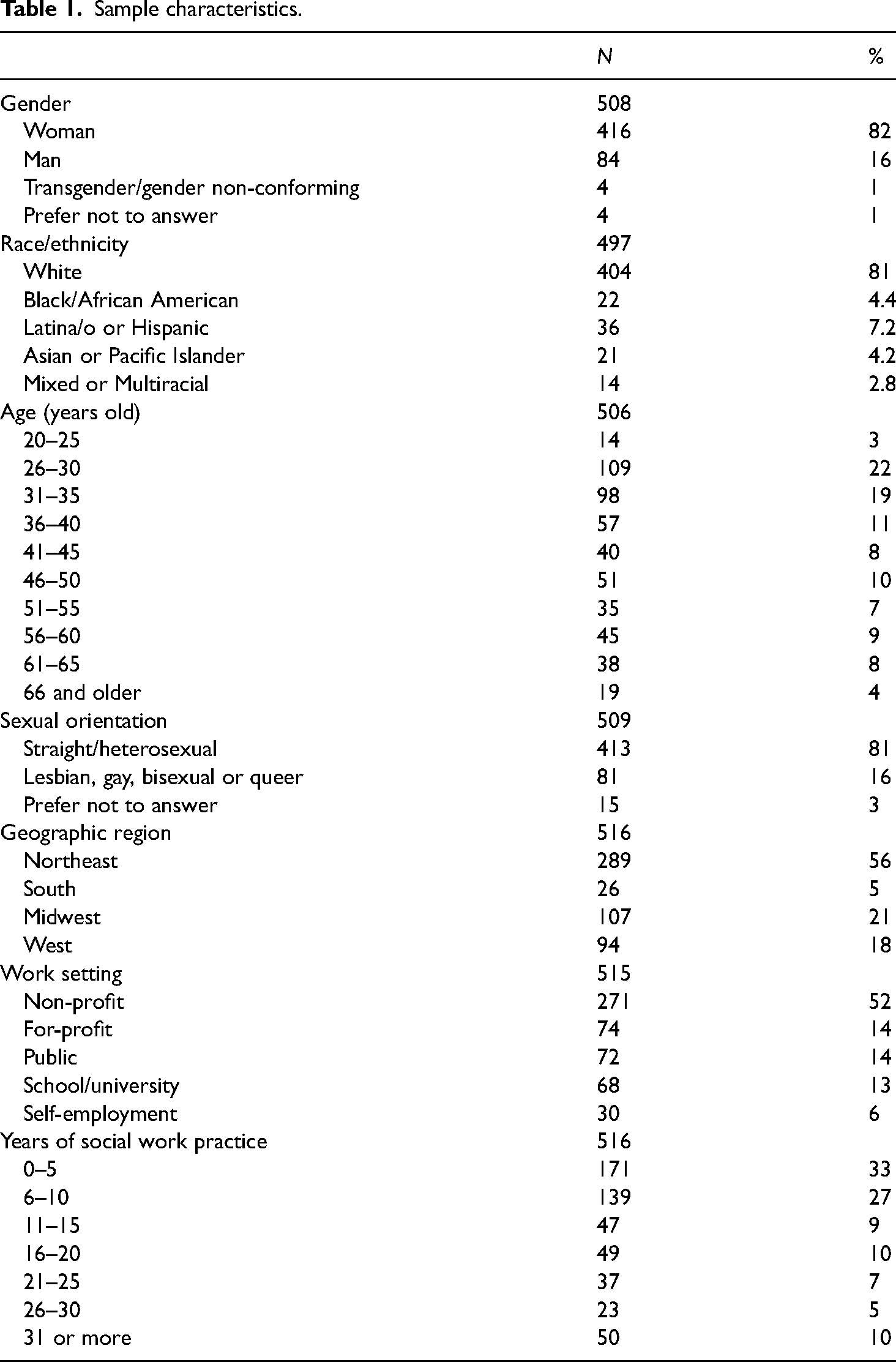
A total of 592 direct practice social workers opened the survey and consented to complete the survey, and 516 actually completed the survey. A full depiction of sample characteristics is presented in Table 1. Survey respondents were largely White (81%), female-identified (82%), and heterosexual (81%). They were also relatively young and earlier on in their social work careers: slightly over half of respondents were aged 26–40 years old (52%), and almost two-thirds had been practicing social work for 10 years or less (60%). Roughly half indicated they worked in non-profit settings (52%), and about half lived in the Northeast (56%). The most common practice areas were “mental health” (26%), “psychotherapy services” (11%), “school social work” (10%), and “health (9%). Other areas of practice (e.g., addiction, aging, palliative care, etc.) were selected by less than 5% of respondents.
Sample characteristics.
Means, standard deviations, and correlations for all substantive variables are presented in Table 2. On average, respondents reported system-justifying beliefs at the lower end of the scale, and the lower end compared to other samples more representative of the general population. On average, social workers in our sample indicated they somewhat disagreed that U.S. society is fair and set up so that anyone can get ahead. System justification was higher among: respondents who reported greater years in practice, r(524) = .20, p < .001, and heterosexual (M = 2.12, SD = .91) versus LGBTQ (M = 1.76, SD = .76) respondents, t(491) = −3.34, p = .001, Cohen's d = 0.43. There were no other significant differences in levels of system justification by background characteristics. Respondents also reported medium-to-high compassion satisfaction, on average, reporting that they sometimes or often feel satisfied with their practice. On average, respondents had medium levels of secondary trauma and emotional exhaustion, reporting that they rarely or sometimes had feelings of vicarious trauma and emotional exhaustion, and low levels of depersonalization, reporting never or rarely having these feelings.
Means, standard deviations, and correlations between study variables.
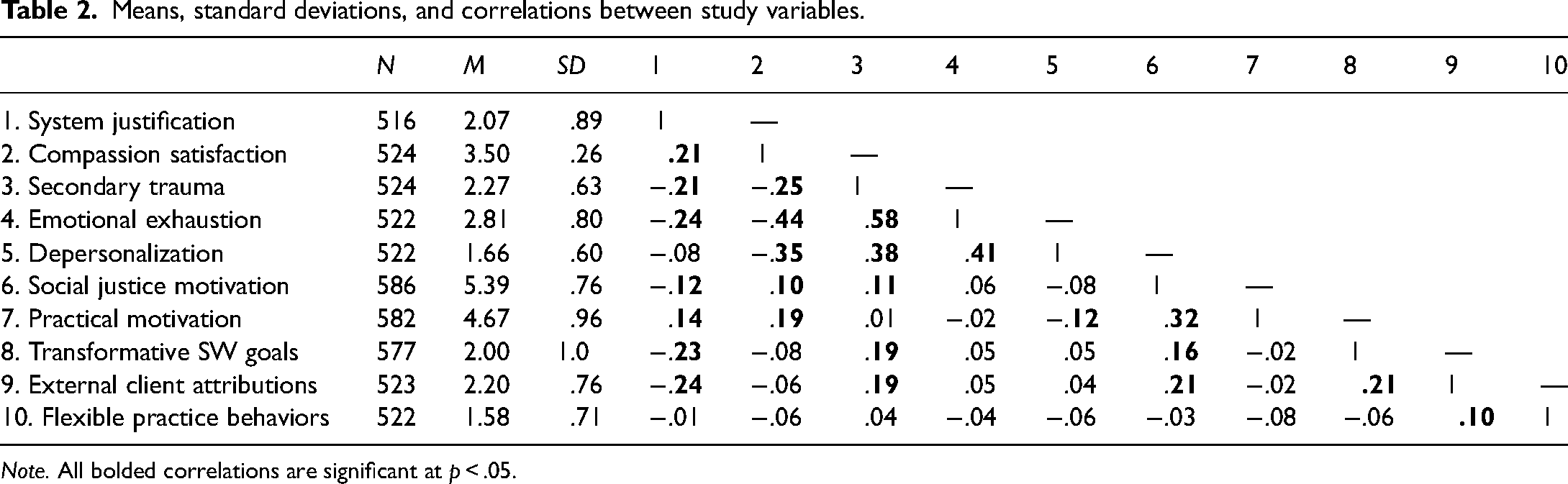
Note. All bolded correlations are significant at p < .05.
Associations between system justification and job satisfaction and burnout
We conducted a power analysis to determine the minimally detectable effect size given our analysis strategy and sample size. It yielded a minimum detectable effect size of .04, which is considered a very small effect size. Thus, our study is powered to detect even very small associations. Ordinary least squares regression was used to examine associations between respondents’ system-justifying beliefs and each measure of job satisfaction and burnout, adjusting for the set of background characteristics noted above. Since age and years in practice were highly correlated (.80, p < .001), we only included years in practice as a covariate in each regression model. The full results of these analyses are presented in Table 3. Higher system justification beliefs were associated with significantly more job satisfaction (as measured by compassion satisfaction) and less burnout (less secondary trauma and less emotional exhaustion). System justification was not significantly associated with our third measure of burnout, client depersonalization.
Associations between system justification and job outcomes.

* p < .05. ** p < .01. *** p < .001.
In addition, several background characteristics were significantly associated with these measures of job satisfaction and burnout. The most consistent association was with years of social work practice. The more years respondents had practiced, the more they reported higher compassion satisfaction and lower secondary trauma, emotional exhaustion, and depersonalization. Respondents with higher subjective assessment of their social status reported less secondary trauma and emotional exhaustion. In addition, White respondents reported higher secondary trauma, and straight respondents reported less depersonalization.
Associations between system justification and social work motivations and practice
Ordinary least squares regression was used to examine associations between respondents’ system-justifying beliefs and their social work motivations, client attributions, and practice behaviors (see Table 4 for a full presentation of results). We again adjusted for all background characteristics, including years in practice rather than age given their high correlation. System justification was significantly associated with respondents’ motivations for engaging in social work practice. Specifically, higher system-justifying beliefs were associated with lower social justice motivation for social work practice, higher practical motivation for social work practice, and less transformative social work goals. System justification was also significantly associated with less external/structural attributions for clients’ noncompliant behavior in the social worker–client relationship, but not social workers’ endorsements of practices in response to the behavior.
Associations between system justification and social work motivations and practice.
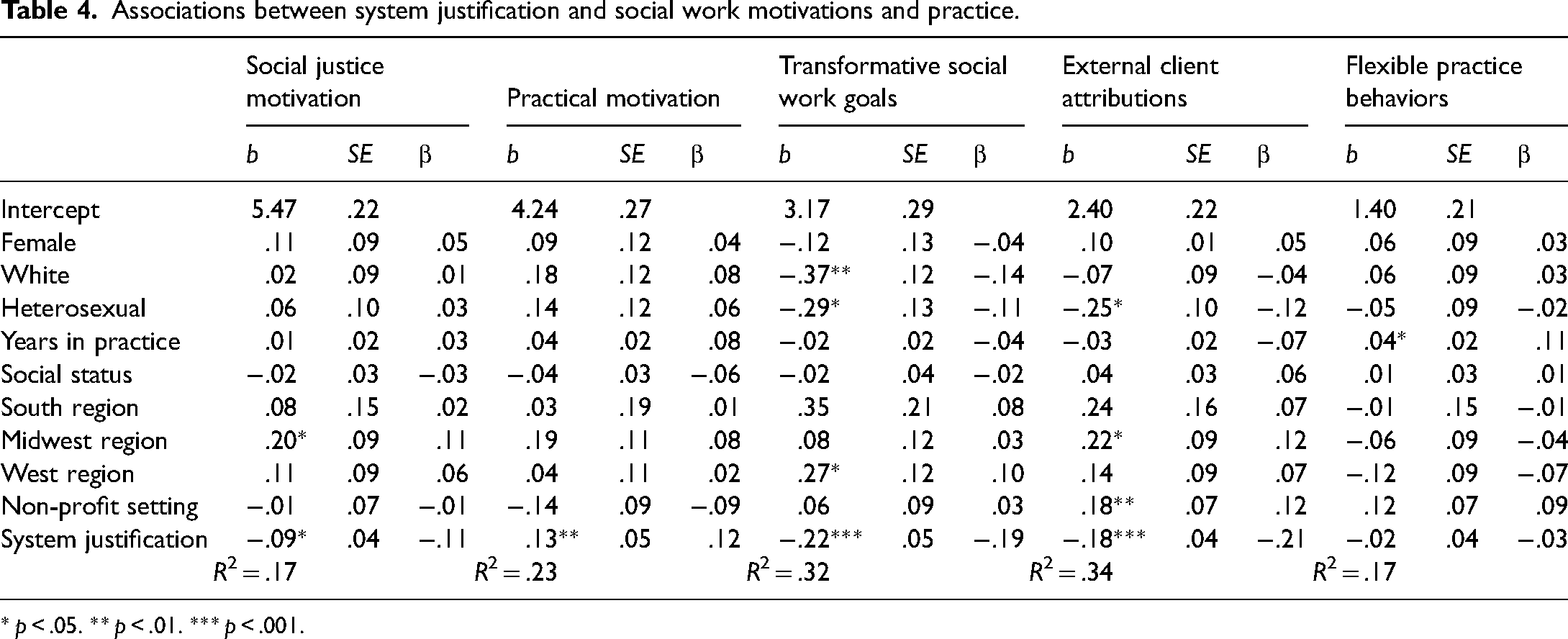
* p < .05. ** p < .01. *** p < .001.
In addition, several background characteristics were significantly associated with these motivational and practice measures. The more years in practice respondents reported the more flexibly they responded to client behavior. White respondents also reported less transformative social work goals (compared to respondents of color). Heterosexual respondents had less transformative social work goals and fewer external attributions for clients’ behaviors (compared to LGBQ-identified respondents). Respondents in the Midwest (compared to the Northeast) had higher social justice motivation and more external attributions for client behavior, and respondents in the West (compared to the Northeast) had more transformative social work goals. Finally, respondents working in a non-profit setting (vs. other types of work settings) had more external attributions for client behavior.
Discussion
This study is the first of its kind to explore patterns in system-justifying beliefs among social workers and the extent to which these beliefs predict certain perceptions of clients, practice behaviors, and job outcomes. Other studies have examined similar psychological processes, for example, critical consciousness and attributions for poverty (see O’Neill, 2015 and Weiss-Gal et al., 2009, respectively) to better understand how social workers’ beliefs inform their practice and the ways and extent to which these beliefs are shaped during their social work education and can be applied in real-world practice contexts. Our findings were consistent with this limited body of research suggesting that, in fact, social workers’ perceptions of structural relations and causal attributions for social problems may shape their practice approaches and behaviors. Results similarly support previous suggestions that raising the critical consciousness (the ability to identify and attend to power dynamics in relationships and the structural environment) of social workers through education should be a primary focus of interventions into individualistic, inflexible orientations toward clients and client systems. However, system justification, as a motivated process that typically operates outside of our awareness or consciousness, lends a unique lens for exploring links between the beliefs and behaviors of social workers, particularly as it concerns the profession's complex relationship to system-level change and the status quo.
Consistent with theory, our findings suggest that system justification has a palliative effect: social workers who justified the status quo had higher satisfaction, lower secondary trauma, and lower emotional exhaustion. Even though our sample overall had relatively low system justification scores, increases in system justification were associated with higher job satisfaction and less burnout. It is reasonable that a social worker might feel better about their job if they feel that the system is fair, as they gain satisfaction from helping people access and navigate those systems. Indeed, believing the system to be fair and just might be a coping mechanism to help social workers with the distress that comes from navigating oppressive social conditions and marginalization on behalf of their clients. However, this may cost social work as a field, as we also find that higher system justification was associated with less social justice motivation, more practical motivation, and less transformative professional goals. In other words, social workers who perceived systems as inherently fair and endorsed the status quo named fewer transformative motivations for being a social worker and were less likely to have practice goals related to transforming those same systems.
While system justification may protect a social worker from a difficult job, such upkeep of the status quo may be at the expense of the profession's social justice and social change mission and, in fact, accentuate its alignment with unequal and unjust systems. In a study of service users, Chermyak-Hai et al. (2014) found that higher system-justifying beliefs were associated with seeking and accepting services that bolstered the status quo rather than services that challenged existing social arrangements. Results from this study, when considered in conjunction with Chermyak-Hai et al.'s findings, suggest that higher system justifiers prefer to both receive and provide services that do not disrupt the status quo. In some cases, this might be appropriate to the presenting issue and course of action to address it; however, maintaining the status quo will not always serve the broader social work goals of upstream system-level intervention. While, surprisingly, we detected no relationship between system-justifying beliefs and endorsement of practice behaviors, our findings did indicate that the same system-justifying beliefs that protected social workers’ well-being were associated with less understanding of clients’ behaviors and needs as symptoms of structural failures. Specifically, those respondents with higher system justification scores were more likely to understand clients’ non-consenting behavior as an unwillingness to comply with expectations rather than an inability to do so within unequal structural arrangements and unjust systems, which might inform how social workers respond to, advocate for, and advise their clients.
Implications
So, how do we balance clients’ and social workers’ well-being that seem to be at odds with one another? Results suggest key interventions into the structural conditions of social work practice so that social workers do not rely on system-justifying beliefs in order to cope with the injustices clients face and the burnout social workers are at risk of experiencing. First, investments must be made to support resources for increased personal control and cognitive resources. Social workers can resist motivations of low personal control through workplace empowerment, discretion, and workload reduction. These would allow social workers opportunities to critically examine the unjust systems they may implicitly support. Second, social workers should move to and/or stay working outside of systems. Take, for example, current debates around social work and policing and whether a deeper integration of social workers into the policing system serves structurally vulnerable populations. Incremental change from within is only sufficient for a certain kind of change and certainly not for the transformative systemic changes that are required. In fact, history tells us there is a role for social workers in creating and defending more just systems. This would serve to resist system-justifying contexts.
Furthermore, strategies for preventing social workers’ motivations to uphold unjust systems should center on social work education that builds capacity for critical thinking and critical consciousness-raising. Social work literature on critical consciousness articulates the cognitive, reflective, and empowerment processes involved in social workers’ integration of awareness of structural oppression and one's own social positionality, specifically privileged social identities, into social work practice (Bransford, 2011; Sakamoto & Pitner, 2005). Critical consciousness is more of a cognitive, learned set of characteristics, processes, and behaviors consisting of reflection, efficacy, and action, whereas system justification is a more basic, implicit, and primal set of belief responses to motivating forces (Godfrey & Wolf, 2016). In other words, system justification is a motivated process that (usually) happens outside of awareness that reveals tendencies to perceive, understand, and appraise the status quo of social, political, and economic arrangements as fair.
Can we learn our way out of system-justifying beliefs? Cognitive interventions into the psychological motivations to support the status quo through educating social workers about social change and radical/transformative possibilities may serve to resist motivations of system justification. Interventions to raise critical consciousness must include critical self-reflection but also always be paired with opportunities for action and building self-efficacy, whether the scope of action be large (e.g., systems-change) or small (e.g., case advocacy). Through the pairing of consciousness-raising with opportunities for action and change, we can support both clients’ and social workers’ well-being. Raising consciousness about system justification and centering the idea that system justification serves the privileged, not the marginalized, might be one entry point for social work students to unlearn to system-justify, as it connects with the professional ethical imperative to challenge injustice.
Limitations and suggestions for future research
This study has limitations that should be taken into account when considering the generalizability and applicability of the findings to the social work workforce overall, and for guiding future research. First, while our sample is somewhat representative of current Master of Social Work-level workforce estimates in terms of race (72% White) and gender (85% women; see Salsberg et al., 2017), it does not reflect trends in the profession around increasing racial/ethnic diversity. Realtime data from the NASW (Infocus Marketing, 2021) suggest that NASW membership, our sampling pool, has a somewhat higher representation of White social workers (82%) than the national figures (72%), and the racial/ethnic demographics of our sample (81% White) reflect that. For these reasons, we were unable to detect patterns across social positionalities like race, gender, sexuality, and socioeconomic background. Future research should ensure race-stratified data to better understand the extent to which differences in social workers’ beliefs, behaviors, and job outcomes are informed by such positionalities. In addition, with this cross-sectional survey design, we were unable to test causal or even longitudinal associations between system justification and job and practice outcomes. While there is strong theoretical reason to believe that system justification influences both sets of outcomes, longitudinal research is needed to better account for the possibility of reverse associations between these constructs or a third factor driving observed associations. Finally, although we utilized validated measures of many of our constructs, measures of social work practice behaviors with clients were developed for this study and may have limited validity.
Further research into beliefs, behaviors, and outcomes across professional domains and in various settings and systems might lead to more specific implications for system-level and educational-level changes. Experimental evaluations of interventions to change the structural conditions of social work practice or better educate social workers on their own system-justifying tendencies could be conducted to further test these ideas. Examining such interventions will lend insight into how and where social workers learn strategies to advocate for system-level change and disrupt the status quo, the setting-level conditions that facilitate such action, and the range of motivations to engage in advocacy practice. This will allow for protecting and enhancing clients’ well-being in the short term while working toward changing the structural conditions of inequality and injustice.
Conclusion
This study showed that psychological beliefs about the status quo are important for understanding social workers’ professional motivations and goals, perceptions of client behavior, and job outcomes. While system-justifying beliefs among social workers may serve as a buffer for burnout, they may also negatively impact clients, inhibit structural change, and contribute to tensions and contradictions around the social control function of a profession touting a social justice and social change mission. Interesting avenues for practice, education, and future research center both (re)shaping social workers’ beliefs about the social world as well as structural and educational strategies for developing advocacy practices that disrupt the patterning of unfair and unequal social conditions.
Footnotes
Ethical approval
Ethical approval for this project was given by the New York University Institutional Review Board [ID: FY2017-101] and the Fordham University Institutional Review Board [ID: 1501].
Funding
The authors disclosed receipt of the following financial support for the research, authorship, and/or publication of this article: This work was supported by the New York University Silver School of Social Work Seed Grant.
Declarations of conflict of interests
The authors declared no potential conflicts of interest with respect to the research, authorship, and/or publication of this article.
