






Abstract
Summary
Incited by the United Nations adoption and ratification of the UN Convention on the Rights of Persons with Disabilities, social workers are prompted to increasingly pursue an inclusion-focused approach. Our research was carried out in the Netherlands and sought to identify social work practices conducive to fostering social inclusion, in this case with respect to adults with mild intellectual disabilities. For 2½ years, a responsive methodology was employed in a combined action and social design research. Sixteen social workers and five people with intellectual disabilities were involved. The study was conducted in three different settings across the Netherlands, both rural and urban.
Findings
Three social work practices were captured that generate social inclusion: agency, advocacy, and intrapreneurship.
Applications
Identification of generative practices provides guidance to social workers in shaping the promotion of social inclusion. It provides guidance in reflecting on past and current inclusion-focused social work performance, it may encourage social workers to adopt inclusion-focused pathways inspired by agency, advocacy and intrapreneurship, and knowledge of generative practices toward social inclusion can help to specify social workers’ competencies.
Keywords
Background
Spurred by the United Nations adoption (2006) and the relatively recent ratification of the UN Convention on the Rights of Persons with Disabilities (CRPD) in The Netherlands (2016), social work practice—service providers, social workers, and advocacy—is facing a demand to professional transformation toward an inclusion-focused approach. The CRPD contains innovative components such as a new understanding of equality, that is, transformative equality, an extended notion of discrimination, and a further conceptualization of disability deeming disabled people as rights holders and human rights subjects (Degener, 2016).
Implementation and realization of the convention requires changes in legislation, policy, and practice thus also presenting major challenges for social work supporting adults with mild intellectual disabilities (Schippers et al., 2018; Schuurman, 2018). In the realm of social work, it calls for what is termed as a “new professionalism,” encompassing a value orientation toward equivalence, a positive interpretation of human difference, an optimistic view of human capabilities and community resources, and being equipped with person-centered and community-centered approaches (Kröber & Verdonschot, 2012).
However, research on such reorientation has revealed discrepancies between theory, policy, and practice, which impede the realization of social inclusion in the practice of supporting people with mild intellectual disabilities (Wilken & Knevel, 2016). Examples are found in social workers’ personal and professional orientation and contextual frameworks. In the field of intellectual disability, studies point at individual factors such as the social workers’ adherence to institutional thinking, social workers’ doubts about their role and competence in promoting inclusion, how they deal with bureaucracy and new service models, and the ability to see and dare to use discretionary space (Boland & Guerin, 2023; Davelaar et al., 2018; Kröber, 2008; Kröber & Verdonschot, 2012; Overmars-Marx et al., 2014). Contextual factors encompass behaviors of community members such as unwittingly identifying people with intellectual disabilities with the role of client rather than neighborhood resident or citizen, negative personal experiences in the living environment such as being ignored on the street or facing negative expressions, and the (limited) availability of facilities (Bigby & Wiesel, 2019; Bredewold, 2014; Davelaar et al., 2018; Moonen, 2015; Overmars-Marx et al., 2014). Brummel and Smits (2021) and Brummel (2017) draw attention to social infrastructure, that is, how social spaces shape the establishment of social connections, asserting that the neighborhood itself can act as a barrier to achieving social inclusion.
To date, most research has been concerned with identifying individual and contextual factors (Cobigo et al., 2012; Meys et al., 2021; Moonen, 2015; Simplican et al., 2015). This usually remains with the identification of distinct factors. This is remarkable, as it is the interplay between the factors that particularly affect the pursuit of inclusion. In that case, reference is typically made to generative mechanisms (Blom & Morén, 2011; Mingers, 2014). In this study, we sought mechanisms that foster the social inclusion of people with mild intellectual disabilities and to understand the conditions needed.
Generative mechanisms or generative practices
In social sciences, the concept of mechanism is much disputed and amounts to its ontology and epistemology (Delgado, 2022; Moghadam-Saman, 2019). Definitions of mechanisms are formed based on different premises and encompass varieties of causality claims—causal chains, causal packages, intersections of causal chains—implicit and explicit constant conjunctions, patterns, the ensemble of powers, structures and relation, capacities, social regularities, constitutive rules, or tendencies (Befani, 2012; Bhaskar, 1975; Danermark et al., 2019; Iannacci & Resca, 2021; Pawson & Tilley, 1997).
Examples of generative mechanisms are countless. In the literature, generative mechanisms are exemplified such as attention, heedful interrelation of actions, mindfulness, sense-making, self-fulfilling prophecy, outcompeting mechanism, double benefit mechanism, and so on (Denyer et al., 2008).
An elucidating yet simplified social work-relevant example of a mechanism is provided by Bool et al. (2019) focusing on reducing discrimination: personal story (sharing); appeals to empathy for the other; leads to empathy for the other; results in less discrimination. A similar example of a mechanism to effectively reduce discrimination is presented: seeing or hearing that others disapprove of discrimination; leads to a change in perception of what the social norm is; and leads to trying to discriminate less.
Both examples highlight features of a mechanism such as the process that generates social events, social interactions, and causal actions. However, the critical realist objection is not countered, that is, the premise of sequentiality leading to an intended outcome. Moreover, the consideration of unseen or invisible powers such as motives and choices is missing. Critical realism is averse to looking for causal chains and laws. It champions a perspective on mechanisms underlying the occurrence of and the processes that generate social events (Mingers, 2014). It posits that there are real, unseen mechanisms in the social world (Houston, 2010). Stressing that one cannot escape thinking of social interaction as part of (social) mechanisms, Blom and Morén (2011) put forward a helpful definition for social work practice and social work research, saying that mechanisms relate to “powers consisting of causes, motives, considerations, choices, and social interaction.” This should lead to a desired outcome, for instance, the promotion of social inclusion (Blom & Morén, 2011). Despite attempts to capture generative mechanisms in a conclusive definition, its comprehensiveness and relative elusiveness remain, resulting in such abstraction that it risks being dissociated from the concrete activities and meaning of social work. In fact, what matters is what happens in practice and how the interplay of powers and tendencies contributes to achieving the desired goal. Besides, social work practice itself is equally comprehensive, at times elusive, and where many powers intertwine. For our study, the notion of generative mechanism has provided crucial impetus, which we have turned into practical relevance. Rather than using a terminology that conveys mechanistic connotations, and in that respect is detached from social work practice, we refer to practices that are inclusion-focused and, in that pursuit, appear generative.
Research aim
Our research intends to deepen and nuance conceptual and professional knowledge (of social workers) on how to promote the social inclusion of adults with mild intellectual disabilities. Our study focused on practices conducive to fostering this endeavor and to the understanding of conditions needed. Hence, the question centered on what constitutes generative practices in social work seeking social inclusion of adults with mild intellectual disabilities.
Methods
For 2½ years (2018–2021), a responsive methodology was employed in a combined action and social design research conducted in three Dutch cities: Amsterdam, Amersfoort, and Wageningen (Knevel et al., 2022). In each setting, a community of development (CoD), which is equivalent to a community of practice, but adds a research component (Wilken et al., 2021), was set up. The first author acted as participatory action researcher. The rationale behind combined action and social design research consists of the emancipatory nature of the subject matter, its context, and practice (Anderson & Herr, 2015). In addition to (scientific) knowledge validation, action research aims to improve (social work) practice through the active involvement of those sharing concerns. Integrating social design research into action research is prompted by the design objective, namely collectively designing solutions (Joore et al., 2021; Knevel et al., 2022; Margolin & Margolin, 2002; Van Aken & Andriessen, 2011).
A responsive approach to evaluation was integrated into the action and social design research.
Instead of seeking for alleged objective reality, responsive methodologies embrace constructivism holding the idea that reality can be known only as socially constructed (Guba & Lincoln, 1989). Key concepts of responsive methodology include collecting and articulating shared issues, co-creation and co-learning with stakeholders, emergent design, and a hermeneutic process (Abma, 2006; Abma et al., 2011; Guba & Lincoln, 1989).
Each CoD was composed of approximately 6–10 social workers and adults with mild intellectual disabilities who were educated experts by experience. Selection of the settings of the communities of development was based on: (1) the service providers are specialized and focused on providing services to people with intellectual disabilities, (2) the service provider holds a vision and mission statement on inclusion and inclusion-focused social work, (3) geographic distribution, that is, both urban and rural environment, (4) variation in the type of service, that is, both community social work and daycare services.
The selection criteria for the recruitment of service users and experts by experience included being interested in the subject matter of social inclusion, being motivated to participate in the project, willingness to and capable of sharing life experiences, and being prepared to act as a “critical friend” to the other participants. As far as the social workers were concerned, selection criteria for the recruitment were: (a) being employed as a social worker working with people with mild intellectual disability, (b) having an interest in the subject matter “inclusion” and (c) motivation to bring about change in the social work field aimed at promoting inclusion.
Snowball sampling was used for participant enrollment. We were able to draw on a broad regional network of social workers and people with moderate-to-mild intellectual disabilities, including people trained as experts by experience. The researcher arranged physical meetings with key figures, that is, social workers and experts by experience to explain the project and discover the motivations and potential contributions of the participants. These meetings were one-on-one, sometimes with two potential participants, and on occasion, a social worker accompanied persons with an intellectual disability. A visual representation was designed based on information from the research project and discussed with the participants to be recruited.
In total, 47 meetings were held with the communities of development, of which 28 were audio recorded. To answer the research sub-question on generative practices, not all audio-recordings delivered the relevant data. For example, the initial phase of the project focused on getting to know each other and creating a safe group atmosphere. These activities are imperative to the participatory research process but do not directly collect data to answer the research sub-question that is central to this article (Table 1).
Community of development: meetings and participants.
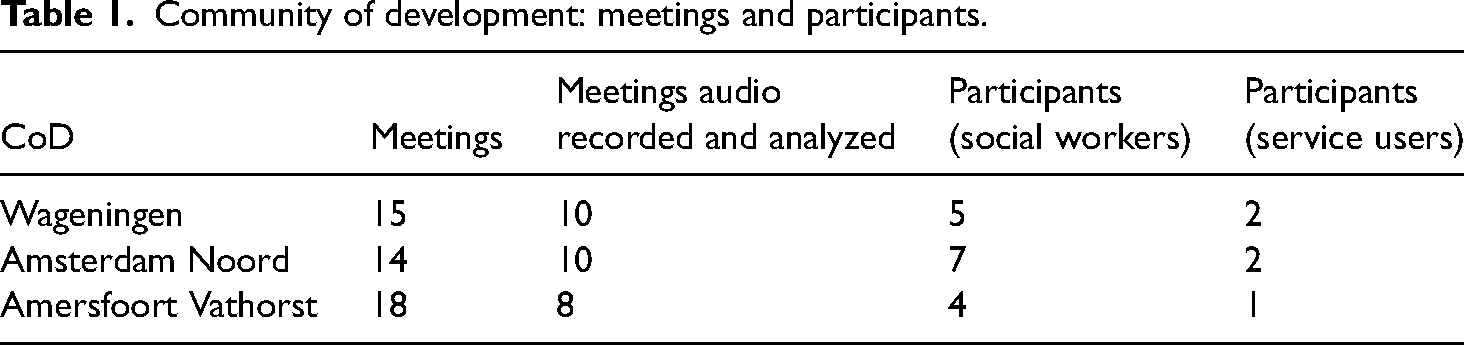
The CoD process was evaluated by the participants on several occasions. At the request of the experts by experience, additional support was facilitated to enhance their participation in the CoD meetings. In addition to the CoD meetings, sounding board meetings were organized to collect feedback for further improvement of the developed answers (prototypes). These sounding board groups were composed of experts by experience who did not participate in the CoD meetings.
Content, design, and proceedings of our research project were largely shaped by the participants and were achieved in the preparations and execution of the project. Preparations entailed recruitment of participants by personally meeting (getting acquainted, learning each other's motivations, discussing mutual expectations) and collection of issues around inclusion and exclusion raised by them. The meetings were conducted with social workers performing their roles and responsibilities in micro-practices, management staff concerned with decisions at tactical and operational levels, and experts by experience. In some cases, experts by experience wished the support of a social worker in these meetings. In the CoD meetings, the issues were further explored and clarified collectively. This enhanced the articulation and support of the research question.
Both action research and social design research lend themselves to emergent processes, rather it is characteristic, and for responsive methodology, the imperative of emergence is equally valid. Such process implies a plurality of visions, experiences, and perspectives from stakeholders as well as ownership by the participants of the content and depth found, the process of the research project (steps to be followed, direction and pace, safeguarding the collective interest and undertaking) and finding answers. Emergence was interwoven with a hermeneutic and dialogical process where induction and deduction alternated. Personal experiences were shared and reflected upon; meaning was made collectively. Both the experiences and meanings were assembled and clustered into more general concepts. Occasionally theoretical constructs were inserted to interpret the unique personal experiences in order to gain new insights for the participants as well as the researcher. In this process, we found tendencies recognizable in the social work practices that seem to be conducive to social change. In the incremental process of identifying tendencies, we consulted theoretical concepts and sought connections to stakeholders’ own experiences. The emergent process that occurred involved intermediate and retrospective interpretation by the researcher and participants.
Data collection and analysis
The communities of development separately ran for 2½ years with a meeting cadence of 6–8 weeks. Besides recordings and AI-generated transcriptions of the meetings, data collection consisted of a variety of materials such as drawings, drafts, brainstorms, prototypes, field notes produced during the CoD meetings, and visual reports of each meeting, which also served as member check. The aforementioned materials prompted the sharing of experiences, sparked discussion on issues brought up by the stakeholders, and aided to meaning making of social inclusion and related topics such as discrimination, stigma, and dignity. All data collected were thus compiled and provided an initial rough structure of main themes. These were presented to the CoD participants and discussed.
In addition to the audio-recordings, transcriptions, and materials, a comprehensive case description of the local social work practices was produced. The descriptions were based on the experiences shared in the CoD meetings. Subsequently, the descriptions were presented to the participants and discussed in the meetings. The purpose of this approach was to supplement, refine, and verify the description. Its focus was on whether participants recognize the findings from the experiences that have been shared, the meanings that have been given, and the actions in practice. This resulted in minor adjustments and confirmation from the participants with regard to recognizability of what was discussed in the meetings and what the experiences were in social work practice.
The audio-recordings and AI-generated transcriptions were subjected to open, axial, and selective coding. From this analysis, we inductively discovered key labels that characterize generative practices. Key labels described social workers’ behaviors, knowledge of factors that either promote or hinder inclusion, skills needed to achieve inclusion, and values that drive social workers to engage in inclusion-oriented work. These core themes were confirmed as highly prevalent in social work practice.
In addition to this thematic analysis, comprehensive case descriptions were produced. After a member check, these descriptions were analyzed using the CIMO framework in which the data were organized and connections were sought between the various variables. The CIMO framework stands for context, intervention, mechanism, and outcome (Denyer et al., 2008). Context included an account of the local CoD setting, micro, meso, and macro factors that made up and affected the context, interventions included social worker actions performed to promote social inclusion, mechanisms comprised interrelated powers and tendencies, and outcomes included tangible results, empirical data and impact from the process (Pain et al., 2016). A cross-analysis was then applied between the thematic analysis and CIMO analysis. This resulted in a clustering of overall insights converted into meaningful categories. We report these in the Findings section.
Findings
We now describe inclusion-focused practices in the social work field that we were able to qualify as generative, that is, conducive to the social inclusion of adults with mild intellectual disabilities. Generative practices are in keeping with the notion of generative mechanisms. Since a multitude of factors (such as social workers’ competencies, organizational conditions, laws, and policies) will influence practice, we capture generative practices in umbrella terms.
Practicing agency
A first social work practice observed centers around agency and is explained as “the ability to take action […] to achieve the result [he or she] desires or aims for. A productive actor is one who achieves this” (Gewirth, 1996, pp. 132–133). Action here means voluntary, uncoerced, and purposeful behavior that is fueled by our knowledge of the relevant circumstances. Agency is about being the person who develops and deploys one's own resources—personal, political, and environmental resources—such as skills, funds, status, authority, rules, protocols, and social network. This results in personal responsibility (Gewirth, 1996).
In our research, we identified two dimensions of agency in the social work practice: professional agency and empowering agency. The former addresses the agency of the social worker and focuses on the social workers’ own work performance. The latter is aimed at supporting and, if appropriate, enhancing the agency of the person with mild intellectual disability.
Professional agency
Professional agency is demonstrated in reflective behaviors such as being aware of social workers’ own biases toward people with intellectual disabilities and the community's presumed attitudes toward people with intellectual disabilities. This was echoed by social workers with the perception that people with intellectual disabilities perform tasks slower and deliver lower quality. Professional agency further concerns awareness of one's own routines and the ability to detach from them. In the relationship with the service user, the social worker builds up patterns that in time may have adverse impact to the service user's well-being. From the social worker, this requires vigilance not to get caught in routines and the ability to convert routines into effective support. In understanding professional agency, it was quoted, that “you do not act from your own frame of reference (female social worker)” and that “you ask yourself critical questions such as, does the service user need this support or do I think he needs the support (male social worker)” and “do I think it should be this way or are there alternatives? (female social worker).”
Empowering agency
Empowering agency targets executive functioning of people with intellectual disabilities, encompasses social and emotional well-being, and stresses the value of interactions between the social worker and service users. Fostering executive functioning such as task initiation consists of mobilizing a person through invitation and encouragement to participate in local community activities, utilizing the social and cultural infrastructure of the neighborhood, such as clubs for leisure or recreation, venues for socializing such as community centers, churches, mosques and so on. This requires knowing what motivates the person with an intellectual disability.
Inspired by the Solution Focused Approach, the not-knowing stance by the social worker and the “don’t do it for, but let it be done by (female social worker)” stance are conducive in strengthening agency as it allows space for having choice, being one of the essential components of social inclusion. With a not-knowing attitude, the social worker allows room to the person with intellectual disability to engage in finding an answer to simple or more complex everyday issues that arise. For example, this may take the form of not speaking for a while and not reciting the solution. In doing so, their knowledge is addressed, the service user is involved, and there is room for people with intellectual disabilities to solve issues by themselves or collaboratively instead of the social workers. Social workers exemplified this with experiences of encouraging service users to initiate and perform actions themselves, and having the social worker seemingly stand back and take a following stance: “then you see that the seed has been planted and is growing, then I’m not helping solve everything myself (female social worker).” Such supportive relationships nurture the agency of the persons with an intellectual disability.
It was stressed not to convey a sense of obligation, an underlying “you have to (female social worker)” message, as this conflicts with intrinsic motivation and deprives the autonomy of having choices. Social workers repeatedly indicated that they must be aware that people with mild intellectual disabilities “also think, if I participate in it [e.g., political café, community barbecue], what's in it for me (male social worker).” Social work practices that recognize such approaches foster social recognition.
Pivotal in supporting and strengthening agency is the consideration for identification matters. Generally, people with mild intellectual disabilities are aware of society's stereotypical, biased, often negative, unflattering image of people with intellectual disabilities. First, they do not identify themselves as such, and second, they do not want to be associated with that image, but rather with people who exude competence and authority. An inclusive approach takes this into account and is part of connecting with people's perceptions and providing cues to match a person's motivation. An inclusive approach takes into account such sensitivity in identification issues. It is part of connecting with the individual's and collective perceptions and provides cues to match a person's motivation.
Practicing advocacy
The essence of advocacy in social work practices comes down to a process of working toward social justice, in particular epistemic justice in the endeavor to safeguard recognition (cultural) and interests (political). It is taking action “to help people say what they want, secure their rights, represent their interests and obtain services they need” (National Development Team for Inclusion, 2016, p. 4). Advocacy can be either individual or collective, shaped in self-advocacy and partnership with the people that are supported, but always take their side. In the social work field, advocacy as a process promotes social inclusion by definition (Bigby & Frawley, 2010). In the research, we discovered a variety of aspects that are part of an advocacy practice performed by social workers.
First, the community's perception of people with intellectual disability and interaction with the community is occasionally referred to as the “outside world (male social worker).” Social workers and people with intellectual disabilities regularly encounter behavior of community members—including members of profit and non-profit organizations, and government officials—that is fueled by stereotypes and prejudice and could be marked as dignity breaches. Ignorance about people with intellectual disabilities causes, both intentionally and unintentionally, paternalistic and exclusionary behavior. Participants who were involved in the research pointed out that counteracting such perceptions and behaviors was crucial to social work remit. Raising public awareness through information campaigns was not deemed a primary social workers strategy, however, participants argued for actions in their micro and mezzo practice particularly “through encounters (male and female social worker)” with the community, be it individual or in small groups, be it a one-time encounter, a convivial or organized encounter, occasional, or more sequential.
This requires social workers to keep awareness raising on the agenda in their contacts with society. In this way, the image can be edited toward more realistic, less stereotyped, and biased images. In the reflective dialogue, a social worker coined the term “destigmatizer (female social worker)” and destigmatizing work as if it were part of inclusion-focused social work.
Social work frequently has to deal with the rigidity of agencies that adhere to bureaucratic inaccessible procedures and the tendency of officials to address the supervising social worker instead of the person with an intellectual disability. In such instances, the social worker has to stand up for the person with an intellectual disability, for example by saying “have you asked him yet? (female social worker).”
Advocacy here lies in the vigilance of the social worker to avoid ignoring the person with an intellectual disability. The social worker is initially there as a “backup (female social worker)” in case the person with an intellectual disability fails to get things arranged, such as registration. Promoting some understanding and flexibility from service providers, for instance, with regard to inaccessible procedures, toward service users with an intellectual disability is part of a social worker's advocacy. In that respect, the advocacy work of the social worker includes tasks such as being an observer, a “signaller (male social worker)” and an advisor to the community thus giving a voice against exclusion.
Awareness raising works successfully where social work induces collective expressions and actively finds connections with the community by focusing on what connects people and stressing that “we are all a neighborhood after all (female social worker).” It is the appeal to the common interests of a neighborhood and relegates the differences between people to the background.
This was referred to as “mainstreaming the relationships between neighborhood residents with and without intellectual disabilities (male social worker)” and avoiding “making the intellectual disability special or less (female person with mild intellectual disability).” In doing so, social work “facilitates new encounters and relationships by letting them experience it [and] giving space to sharing and demonstrating competences (male social worker).” This is achieved by playing football matches against teams from local profit and non-profit companies and government agencies. This occurred at the CoD in Wageningen, a community-based daycare setting at a local football club. The social workers and adults with mild intellectual disabilities market themselves as the Football Workshop and perform the role of “Football Worker.” It was noted that in facilitating encounters and establishing connections between the community and people with disabilities it should go beyond charity.
Language has the vigorous potential to have a discriminatory and oppressive impact on people, and to a large extent determines and perpetuates stereotyped and biased images among the community as well as among people with disabilities (Charlton, 2000; Thompson, 2021). There is a latent cultural injustice in language because it can govern a different unfriendly world. Part of social workers’ advocacy actions, therefore, is knowing “injustice language,” demonstrating sensitivity to how social work and community communicate about people with intellectual disabilities.
It was recognized that among social workers this requires particular attention and a collective search for how to speak about people with intellectual disabilities in the organization and in public. Research participants repeatedly affirmed the importance of language and expressed a desire to use inclusive language, to find a “targetless (female social worker)” language, as one social worker suggested, that does not differentiate people into target groups. Instead of a person with an intellectual disability and terms such as client, caretaker, or care recipient, the suggestion was put forward by a social worker, and endorsed by other social workers and experts by experience to replace such labels with “people with instructions for use (female social worker)” with the argument that being human is universal and consequently every person needs instructions for use.
Practicing intrapreneurship
A third inclusion-promoting practice that we have been able to identify in the social work field concerns intrapreneurship. It can be defined as entrepreneurship within an existing organization where the intentions and behavior of the organization and employees are such that there are ambitions and room to deviate from the usual (Antoncic & Hisrich, 2003). In our context, it entails all kinds of social work-related innovative activities and orientations such as the development of new or renewed products, services, methods, ways of thinking, events, and strategies. Practicing intrapreneurship includes behaviors such as goal orientation, initiative, and related behaviors such as proactivity, creativity (problem-solving ability), actions aimed at social networking and leveraging existing social networks, and negotiating with internal and external actors to achieve the intended goal.
Being goal-oriented implies knowing clearly what you want, which way you want to go, and being able to communicate the message clearly to others. In relationships with stakeholders such as local government officials and funding agencies, a results-oriented approach is needed, where planned work goes hand in hand with spontaneity and serendipity, in the sense of creating or exploiting unexpected opportunities. An example of this in the social work field was provided by the Football Workshop where unplanned meetings led to ideas to organize football matches against teams from the police or a local political party; a snowball effect of “positive meetings create new meetings (male social worker).” Goal-oriented behavior entails the belief in the contribution to social inclusion, persistence in the mission, and an understanding that social change is incremental.
Associated with being goal-oriented is proactivity, which covers behaviors such as reaching out to and establishing connections with community members, local agencies, neighborhood initiatives, commercial organizations and exploring how mutual engagement can be generated, and thus harnessing collective assets. In the social work practices we investigated, this was exemplified by setting up meetings between local residents, participating in a neighborhood committee, and jointly organizing neighborhood projects such as a collective barbecue or an outdoor games afternoon in the park or on the square. Being proactive includes the ability to discover small niches and seize the opportunities to create something new or not previously common or provided for, be it an event, activity, a service, or product.
Pivotal in intrapreneurship appears to be social networking. It was illustrated by social workers being able to find and meet actors with wide social networks, and the ability to build relationships so that at some point other social networks become accessible and to engage in. Networking further includes joining neighborhood apps where local people and organizations can find matches of shared interests and concerns. These do not have to be self-developed apps but rather using such infrastructures that already exist. Networking proves to be essential to create support within the organization as well, and therefore it ought to be aimed at both internal networks and external networks.
In this respect, intrapreneurship entails being mindful of bridging and linking social capital and the different interests involved. It was indicated by social workers that knowing about SROI (social return on investment) and CSR (corporate social responsibility), for example, can contribute greatly to successfully engaging with external profit and non-profit parties. It gives insight into the motivations of such actors and nourishes the social worker in how to engage in collaborations. An illustrative quote by a social worker is “prioritizing care over collaboration with companies is disastrous” (male social worker), implying that community and civil society are assigned a secondary, insignificant role. Inclusion-focused social work calls for an understanding of the interests and motivations of parties external to care and support, but that also play a role in bringing about social inclusion. A social worker referred to this as achieving mutual win–win outcomes which demands negotiation skills and “having mental muscles” (male social worker), that is the ability to cope with the challenges intrapreneurial social workers face in networking in the community (Figure 1).
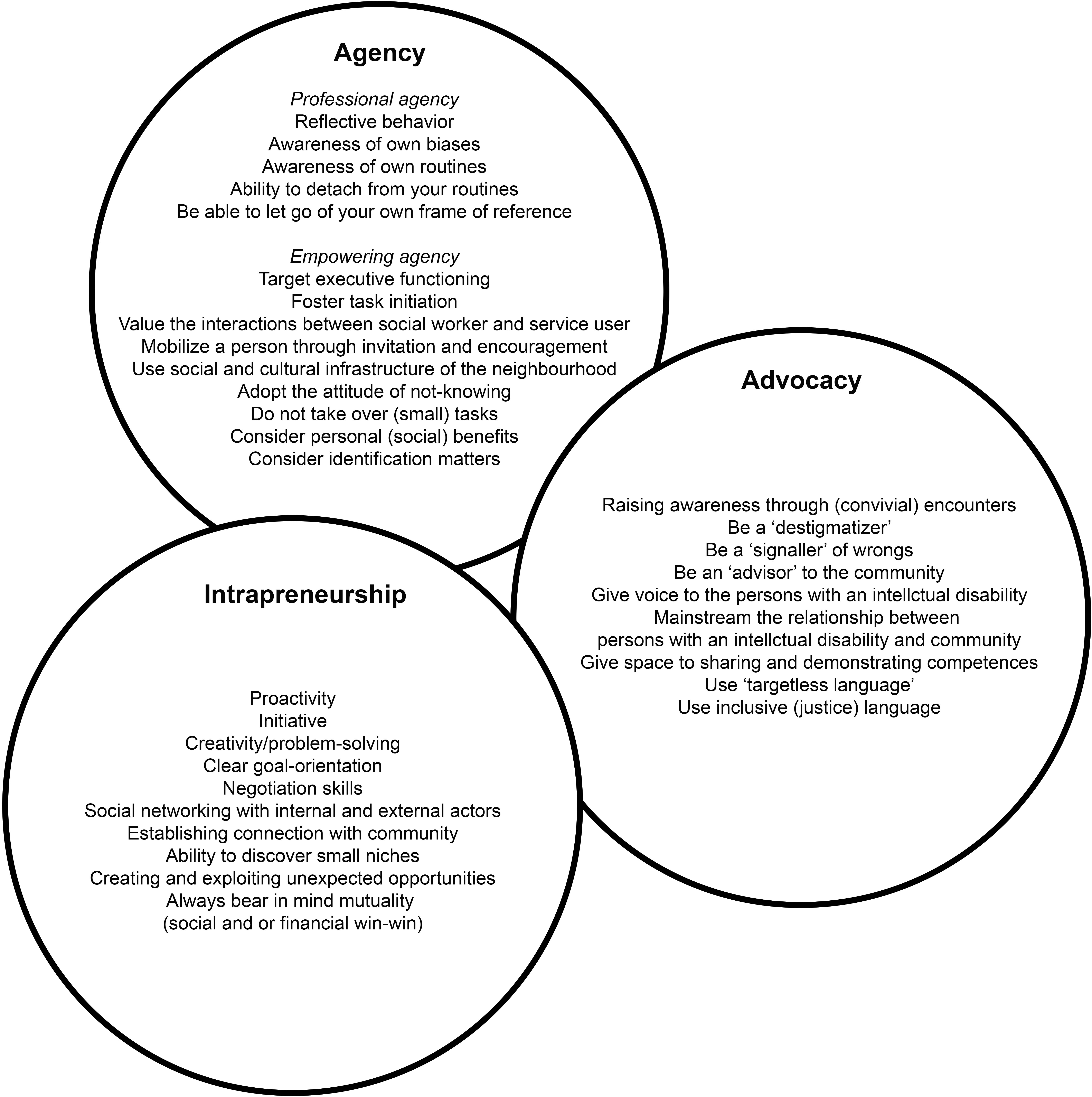
Generative practices: key points.
Discussion
In our study, we investigated social work practices that foster social inclusion of people with mild intellectual disabilities. Our participants discussed concrete experiences of being included and excluded. These were not just feelings, but also real events. Participants with mild intellectual disabilities were able to share stories of exclusion and thus clearly put the notion and importance of social inclusion on the agenda. Social workers too shared their experiences about how colleagues (often do not) think about the social inclusion of persons with intellectual disabilities and what responsibility social work has in fostering social inclusion. This approach was adopted to tackle epistemic injustice in scientific knowledge creation (Dübgen, 2020; Fricker, 2007). It revolves around the unjust exclusion or distrust of forms of knowledge, in this case, knowledge of social workers and persons with mild intellectual disabilities, by which individuals or groups are sidelined because their knowledge would not matter. Therefore, an attempt was made to make the research process democratic and inclusive.
The participants in this study often appear to be front runners who are interested in the subject of social inclusion and see the importance of changing the current situation in their micro and mezzo practices where exclusion persists. In doing so, we have involved a selected group of social workers with whom we consciously allow a bias in the research. This raises the question of what happens in social work practices where there is less, little earnest and sustained, or even no attention to the social inclusion of people with intellectual disabilities.
The qualities displayed by the social workers demonstrated agency, advocacy, and intrapreneurship, albeit to varying degrees. This abstract terminology was not readily recognizable to those involved, but its concrete interpretation and explanation, on the other hand, was. The behaviors, knowledge, skills, attitudes, and actions taking place in the social work practices and especially their interplay made the concepts recognizable as practices that could be labeled “generative.” During the research, which had a collective content due to the research form, namely the CoD, these qualities were further fueled and enhanced. Participants mutually inspired and encouraged each other in the conversation about social inclusion, its pursuit or promotion, and how to do so as social workers. The research design facilitated cross-pollination of knowledge, ideas, and understandings and acted as a catalyst. It thus contributed to the advancement of social work practices as well as the professional development of the social workers and persons with mild intellectual disabilities involved. This is precisely one of the goals of a responsive methodology in the shape of combined action and social design research (Anderson & Herr, 2015; Van Aken & Andriessen, 2011).
By and large, research, policy, and practice are keen to learn about the effectiveness of interventions. However, the effectiveness of social work interventions comes in degrees (Hoekman, 2013; Veerman & Van Yperen, 2008). In the past decades, scholarly discussion on the idea of mechanisms in the social world and what makes them generative has led to a distancing from the positivist approach and introduced the term generative as an adjective for mechanisms to replace and avoid the pretension of effectiveness. Our study started with the belief that we were able to determine generative mechanisms. Soon the complexity of this notion became clear containing a variety of definitions replete with abstractions such as “ensembles of powers, structures, and relations,” implicit and explicit constant conjunctions, social regularities, and tendencies. Added to this, the elusiveness and invisibility of these abstractions, the multi-layering and conjunction of multiple mechanisms and sub-mechanisms merely amplify vagueness.
Another concern is the identification of the mechanism and whether it is generative. There are a multitude of fluctuating, inconsistent factors that make up a mechanism, which raises uncertainties as to how it should be identified, as some stable consistent entity, and how to deal with the many varieties of a certain mechanism, which in turn can be defined as sub-mechanisms, the impracticality, and imminent futility of establishing a single exclusive social generative mechanism given the complexity and fluidity of social reality. The question is on what basis can be concluded that a mechanism is generative? By mere narratives, observation, or measurable data? May we consider a mechanism generative when someone or something has changed or appears to have changed in a single person, or should a positive change be occurring in multiple people? Or when positive change has occurred for one person but not for the other even though both were involved in same the study. Validity is at stake here.
Even though unilateral, bilateral, or multilateral causality in social phenomena is unlikely to be established without bias, powers, and tendencies are perceptible in myriad manifestations, some observable, some unobservable. For research on social work practice and complex social reality, it is recommended to align with the social constructivist concept, abolish the notion of mechanisms, and concentrate on rich practices through observation, questioning, and description. This also brings about valuable insights into how social work can contribute to the social inclusion of people with intellectual disabilities. Although such practices are context-dependent and therefore not generally applicable, research findings are recognizable in and transferable to other social work practices, and thus inspiring to learn from.
Implications for practice and research
Promoting social inclusion and human rights are core tasks of social work (Mapp et al., 2019; Reichert, 2011; Reynaert et al., 2022, 2023). This implies emphatic and sustained commitment to fostering professional and empowering agency, embracing advocacy in its broadest sense, and exercising intrapreneurship. The practices investigated all demonstrate a focus on achieving rights and entitlements as enshrined in the CRPD.
To grasp these comprehensive practices and the contribution to social inclusion and quality of life an obvious approach is to provide training to (future) social workers as well as to people with intellectual disabilities, government officials, and service providers’ management staff. Such training aims at accomplishing generative practices where its components provide practical guidance.
It additionally implies that government and service providers must be willing to accommodate risk—induced by failing initiatives—and share power with social workers and people with an intellectual disability allowing substantive input and accepting significant adjustments to policy. It requires flexibility in handling procedures, less rigid policies, and financial structuring of money flows.
The comprehensive dynamic arising from a complex of interactions appeals to the competencies of the relevant agents such as the social worker and supporting management staff, which is marked by adaptability, versatility, awareness of the causes of and perpetuating mechanisms of social inequality, and the position and responsibility of the social worker (Reynaert et al., 2023; Staub-Bernasconi, 2011, 2016). This calls for a social work that not only centers on individual professional agency but also on collective agency, that is, social workers standing up for injustice together and striving for social inclusion, which is in line with the international definition of social work.
Limitations of the study
To value our research findings, some limitations must be considered. The first limitation concerns the context where the research was undertaken; three local social work practices, in a Western, high-income country with a fairly well-organized and resourced social work system—The Netherlands. Nonetheless, the generative practices that we identified may have global relevance. This leads to a second limitation of the research. The findings merely comprise shared experiences, which provide qualitative evidence and can be construed as qualitative measurability. Third, the sample size was relatively small, compromising generalizability. Nevertheless, the findings do provide identifiable and transferable knowledge that deserves further substantiation and elaboration. In addition, there was an imbalance in the ratio of research participants. The majority were social workers. People with mild intellectual disabilities were underrepresented in terms of numbers. Despite the involvement and extra support of people with mild intellectual disabilities, we should take into account that their voices may still be obscured compared to the voices of the social workers who participated.
Conclusion
This study attempted to identify generative social mechanisms that advance the inclusion of adults with mild intellectual disabilities. Since such mechanisms comprise many intersecting observable and invisible sub-mechanisms and lack evident causality, the study shifted its focus to generative practices. As such, it provides insights into what conditions and behaviors contribute to translating human rights set forth in the CRPD into the social work field. These practices are broadly defined and placed under the umbrella of interrelated concepts of agency, advocacy, and intrapreneurship. Each of these concepts proves a potential to facilitate the inclusion of persons with intellectual disabilities, provided that these concepts are converted into actions and so become practices. It is of great importance to accept that each of these concepts cannot be cast in one particular mold, but must be understood as constantly changing socially constructed constellations.
The identification of generative practices provides guidance to social workers in shaping the promotion of social inclusion. First, it helps reflect on past and current inclusion-focused social work performance. Second, it may encourage social workers to adopt inclusion-focused pathways inspired by agency, advocacy, and intrapreneurship. Third, knowledge of generative practices toward social inclusion can help to specify social workers’ competencies. Social work education can draw from this by, for example, tailoring curricula accordingly and social work agencies may be urged to pursue inclusion-focused practices and better facilitate social workers in doing so. Nonetheless, describing practices and discovering linkages and efficacious elements requires further research.
Footnotes
Ethical approval
Ethical approval for this project was given by the Ethics Committee Social Domain of Utrecht University of Applied Sciences, reference ECO-SD: 2022-6, and by the Ethical Review Committee (ETC) of the University of Humanistic Studies, Utrecht.
Funding
The authors disclosed receipt of the following financial support for the research, authorship, and/or publication of this article: The research was funded by the Utrecht University of Applied Sciences. Funding was obtained through an internal PhD scholarship, reference DHR/PD-KV/2017-374. This research received no external funding.
Declaration of conflict of interests
The authors declared no potential conflicts of interest with respect to the research, authorship, and/or publication of this article.
