







Abstract
Summary
Through a representative survey of front-line professionals from three social programs in Chile (N = 1,694)—a country marker by the implementation neoliberal policies—we use latent class analysis (LCA) to build typologies of front-line professionals, according to the resistance actions that develop in their professional intervention practices. In this way, we explore the prevalence of each typology and the relationship between these typologies and sociodemographic and work characteristics.
Findings
The results show the existence of four typologies: (a) an adaptive focused professionals (38.3%), who mainly perform subtle and individual forms of resistance; (b) an organization focused professionals (21.6%) are professionals who frequently carried out resistance actions focused on the collective organization of demands; (c) multifocal resistant professionals (2.0%), who perform most of the resistance actions and; (d) complaint professionals (38.0%), who tend not to develop actions of professional resistance. Additionally, the analysis shows that the typologies vary according to gender, years of experience, place of work and the political institutional context of the intervention.
Applications
These results inform contemporary social work-practice in two ways. On the one hand, understanding the configurations, differences, and prevalences of professional resistance to front-line professionals (a very little explored field) and, on the other, helping to comprehend the relationship between professional resistance, sociodemographic characteristics, and working conditions. Both axes constitute central aspects of insight the implementation of social intervention, with important consequences for the development of contemporary social policies.
Introduction
In recent years, several research studies have focused on understanding the characteristics, roles, and actions of professionals who implement social programs. Characterized as “front-line professionals” (Muñoz-Arce, 2018), “street-level bureaucrats” (Lipsky, 1980) or the “left hand of the state” (Bourdieu, 2006), studies have been consistent in showing that these actors do not simply reproduce policies. Instead, they translate, interpret, and adapt policies through processes of enactment and continuous redesign (Ball et al., 2012; Zacka, 2017). This understanding has led to the incorporation of professional action as a key element in policy implementation (Dubois, 2010; Lipsky, 1980; Maynard-Moody & Musheno, 2003; Zacka, 2017).
Many of the adaptations frontline professionals make during the implementation process are linked to “more or less hidden agendas of subversion” due to policy design (Barnes & Prior, 2009), as well as on the ability to exercise “moral agency” (Zacka, 2017) and engage in “critical self-observation” (Muñoz-Arce, 2020). Both moral agency and critical professional judgment, are at the core of the resistances exercised by frontline professionals in challenging or contesting what they feel is inappropriate or unjust about the policy they are implementing (Weinberg & Banks, 2019).
Understanding the meaning, orientation, and logic of front-line professional resistance is important for several reasons. On the one hand, in a world where risks are increasingly collective and shared (Beck, 1998), professional resistances emerge as actions of discontent to increasing precariousness, precarity, and technification (Castel, 1995). Secondly, understanding the professional resistances of frontline workers allows us to delve into the tensions faced by those who intervene in increasingly wicked problems, that is, multidimensional problems that seem impossible to solve (Thomas et al., 2018). Lastly, front-line professionals exercise resistance in a complex social space where they must navigate multiple “flanks.” These include issues of territorial legitimacy, the numerous demands of funding entities, the organizational pressures from their institutions, and the material, affective, symbolic, and social needs of service users (Schöngut-Grollmus, 2017).
Over the last decades, several studies have described the types and actions of professional resistance strategies in diverse countries such as Brazil, Greece, Finland, Israel, and the United States. In most cases, the research has been qualitative case studies, exploring forms of resistances through interviews with professionals or ethnographic observations (Alcadipani et al., 2018; Alvesson & Szkudlarek, 2021; Bathini & Kandathil, 2020; Deline, 2019; McCabe et al., 2020; Timor-Shlevin, 2021). Furthermore, theoretical typologies of resistance have been proposed, highlighting the complex and dynamic nature of these actions, which include public and private acts, subtle and direct forms, and institutional and noninstitutional mechanisms, among other distinctions (Barnes & Prior, 2009; Dobson, 2017; Mumby et al., 2017; Strier & Breshtling, 2016). Although these studies have broadened and deepened the discussion on professional resistance, they have not comprehensively explored how these actions coexist within the same individual, or how these actions are subjectively constructed. Exploring professional resistances from the point of view of the individual is relevant for two reasons: first, there is limited insight in regards to the multiple acts of resistance individual frontline professionals exercise and the manner in which these actions are understood as complementary or contradictory; second, it is not clear how variables such as ethnicity, gender, or age impact the subjective construction of professional resistance and how these relate to the political-institutional context in which professionals operate.
Using a representative survey of first-line professionals implementing three different social programs in Chile and applying a “person-based approach,” which generates profiles based on multiple response patterns (Masyn, 2013), this article explores the typologies of first-line professionals according to the resistance actions they exercise in their interventions, their prevalence in Chile, and how these profiles are distributed according to sociodemographic and labor characteristics.
Professional resistance actions
As mentioned previously, professional resistance actions can take different forms, dynamics, and levels of visibility (Strier & Bershtling, 2016). Thus, resistance actions are configured multifocally (Muñoz-Arce et al., 2022), encompassing a diverse range of forms and dynamics that depend on the institutional political context and the processes of professional subjectivation. Considering this multifocality, different studies have sought to organize professional resistance actions conceptually. Perhaps the most influential conceptual study focused on frontline professionals is that of Mumby et al. (2017). The authors propose that resistance actions are structured around two axes: intensity (ranging from subtle to explicit resistances) and scale (ranging from individual to collective resistances). Based on these axes, the authors construct four types of resistance: (a) individual infrapolitical resistances, which include actions like omitting information, changing deadlines, feigning ignorance, rushing processes to benefit users; (b) collective infrapolitical resistances, which involve promoting collaborative spaces or generating spaces for reflection; (c) explicit micro-resistance or insubordination, such as denouncing discriminatory institutional practices or lobbying authorities; and (d) macro-resistance or insurrectionary actions, such as participating in protests, organizing occupations, or engaging in civil disobedience against policies, among others.
A second typology of professional resistance, originally proposed by Hoy (2005) and later applied by Weinberg and Banks (2019) to frontline professionals, explores the ethical implications of resistances utilizing data from Canada and the United Kingdom. Specifically, the authors distinguish between three levels and types of resistance: (a) social resistance, which includes acts of opposition to social norms expressed through social movements that challenge institutions (examples given by the authors include the recent Black Lives Matter movement); (b) political resistance, which involves actions of opposition to regimes considered unjust, such as resistance to capitalism and globalization; and (c) ethical resistance, exercised by individuals considered “powerless” and which emerges due to the individuals’ “ethos.” This typology offers valuable insight by focusing on the interaction between subjective-personal, social, and political levels from which frontline professional resistance emerges.
Alcadipani et al. (2018) also developed an interesting typology of professional resistances, although this typology was not limited to professionals implementing social programs. Through an ethnographic study in companies implementing post-Fordist management techniques, the authors describe three main forms of resistances and their consequent forms of domination: sociotechnical, ideological, and fantastical. Sociotechnical resistances refer to direct, practical opposition, promoting productive resistances that seek to “work to rule.” Ideological resistance practices are more associated to irony, questioning the true nature of work. Finally, fantastical resistance manifests in actions such as mockery, contempt, and disdain toward those who want to impose authority. This last form of resistance focuses on the oppositional action, centered on the subject and not only on the discourse.
Finally, the intersection between professional resistance and feminist studies emphasizes the importance of the body and affect as fundamental elements of resistance, thus eliminating the traditional distinction between public and private actions. Along these lines, Fotaki and Daskalaki (2021) argue how affect has helped mobilize community support and forge stable, collaborative alliances. These actions can be considered as “new” forms of professional resistance. Along similar lines, Jones et al. (2020) explore resistances based on collective care, generosity, and vulnerability, promoting reflexive collectivities rarely recognized as professional resistances. Similarly, Duboy-Luengo and Muñoz-Arce (2022) have analyzed professional resistance in caregiving contexts, relating these to the sustainability of life, highlighting actions such as co-care and protecting one another in interventions with program users, which can also be understood as feminized forms of professional resistances.
Although these typologies and analyses have served to show the diversity of resistance practices thus expanding the very concept of professional resistance, they have primarily focused on understanding the actions themselves and less on the types of individuals undertaking these actions. One notable exception to this approach is Gill's (2018) study. Focusing on subjectivization processes, Gill constructs personal profiles of professionals, their compatibility with institutional control mechanisms, and the resistance actions associated with each profile, distinguishing four distinct forms of action. These include (a) coexisting, where workers generate cooperation and build bridges, identifying ambiguities and uncertainties regarding changes, developing resistances of low to moderate intensity; (b) complementing, in which workers generate strong levels of commitment and consent to their work, leading to low intensity resistance; (c) competing, which describes an expression of contradictory demands through a distancing from the work process, including actions such as humor and cynicism; and (d) clashing, which is a separation between work and worker, where workers seek to distance themselves from the workplace, explicitly challenging the system through actions such as strikes or significant direct opposition of great magnitude.
Professional resistance in Chile
Since the 1980s, neoliberalism has been present in Chile, having drastic and long-lasting social, cultural, and political impacts. Specifically, in regard to labor, neoliberalism has led to the decline of the industrial sector, a retraction of the State's economic and social role, and the expansion of precarious organizational practices, such as underemployment, subcontracting, and temporary employment (Frei et al., 2022).
With respect to social welfare, neoliberalism has resulted in the tertiarization of health, education, and social intervention programs (Fuentes & Martínez, 2018), causing social organizations to compete for State funding, thus exacerbating labor precarization and institutionalizing high levels of inequality in employment conditions. Thus, the application of neoliberalism in the labor sector and the expansion of outsourcing of social programs have produced a double precariousness for front-line professionals. On the one hand, precarious working conditions, including low wages, high turnover rates, and low job stability (Iturrieta, 2017) have been exacerbated by the COVID-19 pandemic (Muñoz-Arce et al., 2021; Villalobos et al., 2020). On the other hand, front-line professionals experience job precariousness due to highly flexible and uncertain contexts with few tools to cope with these scenarios (Villavicencio, 2019). Furthermore, the feminization of front-line social intervention work adds another dimension to the precariousness these professionals experience (Zárate, 2021).
In Chile, various studies have sought to understand how frontline workers resist in order to survive the political and institutional frameworks imposed by neoliberalism. These studies are varied and explore diverse areas such as education, health, childhood, and social vulnerability. In line with labor resistance studies of other professional groups (Arancibia-Bustos, 2022; Cueva & Hughes, 2009; Frei et al., 2022), the results show that, in general, the resistances of frontline professionals tend to be low intensity, without direct confrontation, and performed on an individual scale (Fardella, 2013; Fardella et al., 2015; Galaz & Rubilar, 2019; Inostroza, 2020; Muñoz-Arce, 2020; Ortega-Senet et al., 2020; Ramírez-Casas et al., 2022; Reininger, Muñoz-Arce et al., 2022).
Although most of the studies reach similar conclusions regarding the types of resistances, there are nuances depending on the type of social intervention, institution, and characteristics of the frontline workers studied. Thus, for example, in a study on Chile's National Service for Minors (SENAME), which is responsible for children whose rights have been violated or who have broken the law, Guglielmetti and Schöngut-Grollmus (2019) analyze the opinions of professionals working in the Specialized Foster Family program. The results reveal a high administrative workload that limits the time professionals can dedicate to interventions; a prioritization of task fulfillment over results and processes; and a governance system that seeks to regulate the actions of front-line professionals. In another study on SENAME, but focused on child exploitation protection programs, Ortega-Senet et al. (2020) complement these findings, demonstrating how the institutionalization of a rights-based approach has restricted professional action, leading to the emergence of “productive” resistances, in which professionals create support networks or adapt interventions, without directly challenging the institutional frameworks that have led to these restrictions.
Focusing on another area of intervention, Rain (2020) analyzes the oppressions and resistance strategies of 20 professional Mapuche women through a multisite ethnography and in-depth interviews. The results show that, in an environment of inequalities where raciality, care, and gender intersect, Mapuche professionals develop resistance actions that allow them to challenge colonialism, patriarchy, and classism embedded in the structures in which they operate. At another level, Ramírez-Casasas et al. (2022) show how teachers’ professional resistance tends to translate into micropolitical practices—such as reducing work pace, promoting gossip, or not following instructions—rather than collective action. One possible explanation for such resistances is the individual accountability and evaluation models prevalent in Chile's educational system. Finally, qualitative interviews conducted during the COVID-19 pandemic with front-line professionals employed in health, education, and poverty programs revealed that these professionals have little margin for professional action, leading to individual, subtle, and productive forms of resistances (Reininger, Muñoz-Arce et al., 2022; Reininger, Arce et al., 2022).
In spite of their differences, all the studies conducted in Chile have tended to focus on specific services (education, health, child protection, among others), describing resistance practices rather than categorizing the individuals carrying them out. These studies and the use of qualitative approaches describe resistance practices without aspiring to understand the distribution of these practices in the population as a whole. To address this gap in the research, this study seeks to identify the types of front-line professionals and their resistance actions in three social programs, exploring their prevalence and characteristics in Chile.
Research questions and hypotheses
Considering both the international literature and existing national studies, our research questions can be summarized as follows: What profiles of front-line professionals can be identified with respect to resistance actions in the implementation of social programs in Chile? What characterizes these profiles, how do they differ, and how prevalent are they in the population? What sociodemographic, occupational, or contextual variables could explain the ascription to each type of front-line professional resistance?
To answer these questions, we structure the article around four hypotheses. First, as previous studies have demonstrated (Mumby et al., 2017; Strier & Bershtling, 2016), professional resistances always develop situationally and contextually, unfolding within defined political-institutional frameworks. In Chile, the political-institutional framework is characterized by neoliberalism (Reininger, Arce et al., 2022), which has promoted the tertiarization and privatization of social services (Fuentes & Martínez, 2018) and led to the labor precarization of front-line professionals (Muñoz-Arce, 2020). Additionally, over the last few decades, Chile has been described as a society that tends to avoid direct conflicts, and eludes conflicts with authority (Araujo, 2016). Both aspects—labor precariousness and conflict avoidance—lead us to hypothesize that front-line professionals, regardless of their workplace, will most likely develop subtle forms of resistance, avoiding direct confrontation. Thus, our first hypothesis is:
H1: Despite the existence of diverse front-line professional resistance types, in Chile, the predominant resistance profile will be one characterized by subtle acts of resistance and low levels of direct confrontation.
This general tendency does not mean that individual characteristics are irrelevant in explaining individuals’ tendencies toward certain forms of resistance. As international research has highlighted (García-Lorenzo et al., 2022; Ghaffari et al., 2019), the development of resistance is influenced by sociodemographic aspects, employment conditions, and life trajectories. The following hypotheses focus precisely on these aspects, positing that resistance actions may be mediated by an individual's life trajectory and social position. In the case of front-line professionals, gender is considered a critical variable since women in capitalist societies are “expected” to exercise their opposition subtly, while men are “authorized” to carry out more public and confrontational actions (Aldossari & Calvard, 2021). Likewise, work experience can be considered a form of moral authority, allowing individuals with more consolidated positions within the institution to exercise more explicit resistance actions (Aeon & Lamertz, 2021; Ortlieb & Sieben, 2019). Thus, our second hypothesis is:
H2: Front-line professionals who are male (compared to females) and who have more years of work experience (compared to those with less) will be more present in profiles that engage in explicit and confrontational resistance actions.
Second, resistance actions can also vary depending on the specific areas in which they are carried out, even within similar institutional frameworks. For example, Moreno-Mulet (2018), as well as Duboy-Luengo and Muñoz-Arce (2020), have shown that resistance actions by frontline professionals employed in the health sector tend to be direct, while those undertaken by professionals working in child protection tend to be more subtle and less confrontational (Ortega-Senet et al., 2020). Based on this, we hypothesize that individuals working in more structured institutions (such as schools) are more likely to exercise direct resistance actions, while those professionals in less structured settings—specifically professionals whose interventions primarily involve home visits outside an institutional setting—will tend to develop more productive and subtle acts of resistance since they have fewer possibilities of confronting the institution directly. Thus, our third hypothesis is:
H3: Front-line professionals working in institutional settings (schools) will tend to have profiles that privilege more direct and confrontational resistance actions, while those working in homes with families will tend to develop more productive and subtle resistance actions.
Finally, research has confirmed that resistance actions may also vary due to workers’ employment conditions. Thus, workers facing more precarious working conditions and those responsible for others in their households (children, older adults, etc.) will tend to develop more subtle and less direct resistance actions due to the fear of losing their job and the personal costs this could imply (Mumby et al., 2017; Reininger, Muñoz-Arce et al., 2022). These workers assess the cost/benefit of their actions and their possible consequences, either consciously or subconsciously. Our last hypothesis is therefore:
H4: Frontline professionals who are exposed to job insecurity and have dependents will tend to carry out more subtle and less direct professional resistance actions.
Method
Data
The total population of the study consisted of 4,868 individuals, including all professionals who worked as first-line implementers in three social programs in Chile in 2020. The program areas were health (Program 1, N = 851); poverty (Program 2, N = 2,044), and education (Program 3, N = 1,973). From this universe, a probability sample was constructed stratified by two variables: geographic distribution (region) and the type of program in which the participants worked. The sample generated included 1,256 cases, with a 95% confidence level and an error of 3%. A link to the online survey was sent to front-line professionals through institutional mailings and was available for responses for 8 weeks (August and September 2021). The survey was approved by the authorities of the programs involved, as well as by the Ethics Committee of the institution sponsoring the research.
Participants
A total of 1,784 responses, with 1,694 considered valid responses. 1 After the application of the survey, weightings were calculated to correct the population sample weights, thus obtaining representative results for the three selected programs. The study participants were mostly women (81.1%) and, on average 36.5 years old (SD = 0.195). 15.45% of the respondents reported being Indigenous, and only 13.03% reported having a postgraduate degree. Regarding education, 66.98% of the respondents reported having a degree in social work, while 16.7% reported having a degree in psychology. The rest (19.09%) declared professional degrees in education (3.12%), engineering (2.51%), or sociology (2.41%), among others. Finally, in terms of territorial distribution, participants were concentrated in the Metropolitan Region (25.96%), the Bio-Bio Region (10.9%), and Valparaíso (9.3%). In general, these characteristics coincide with recent studies that have sought to characterize frontline professionals in Chile (Villalobos et al., 2020).
Variables
In the present article, we focused on analyzing the professional resistance actions of frontline workers. These resistance actions were captured through the following question: “From the following list of actions, which ones have you performed in your work as a social program implementer?.” The literal statement of each action, the percentage distribution for each response, and the typological characteristics of each action are presented in Table 1. As can be seen, we incorporated 23 professional resistance actions based on the available academic literature, including individual and collective, subtle, confrontational, and nonconfrontational resistance actions. This approach allowed us to capture the multifocality of resistance actions.
Percentage of responses on professional actions.
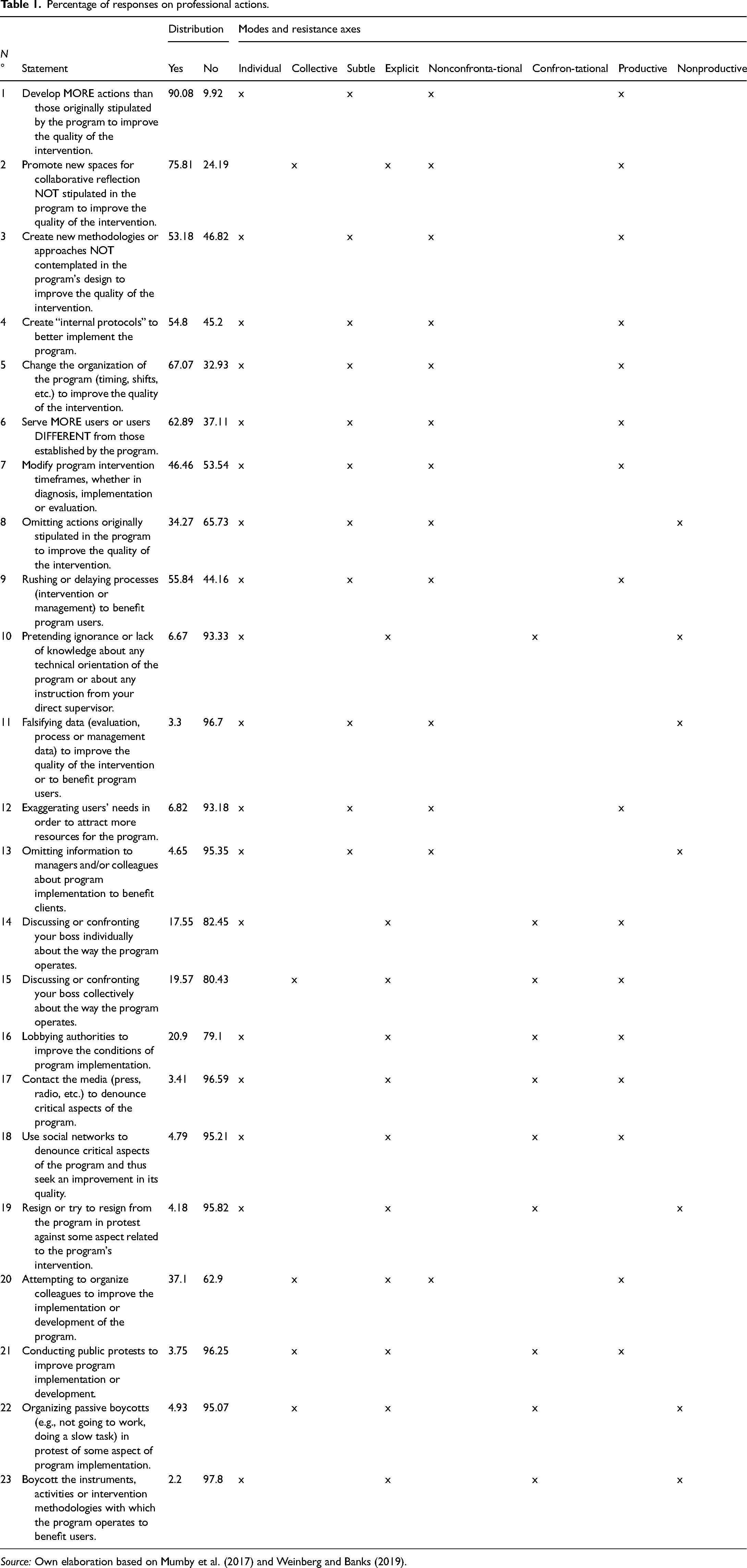
Source: Own elaboration based on Mumby et al. (2017) and Weinberg and Banks (2019).
In addition to resistance actions, the survey included a series of questions to characterize front-line professionals. These questions included sociodemographic variables (gender, age, belonging to Indigenous peoples), working conditions (level of autonomy, hierarchy levels), and employment conditions (type of labor contract, salary, economic situation, years of experience in the program), among other aspects.
Analysis plan
In order to generate profiles of front-line professionals based on their acts of resistance, we conducted a latent class analysis (LCA). LCA is a technique that allows, through a set of observed items, to establish latent categories and thus generate profiles (Colin & Lanza, 2010). For this study, we applied an LCA with a “person-oriented approach,” thus seeking to identify patterns of similar (or different) characteristics among a specific group of individuals (Masyn, 2013). A fundamental step in LCA is determining the number of latent classes. In our case, we considered three criteria to select the model and determine the number of classes.
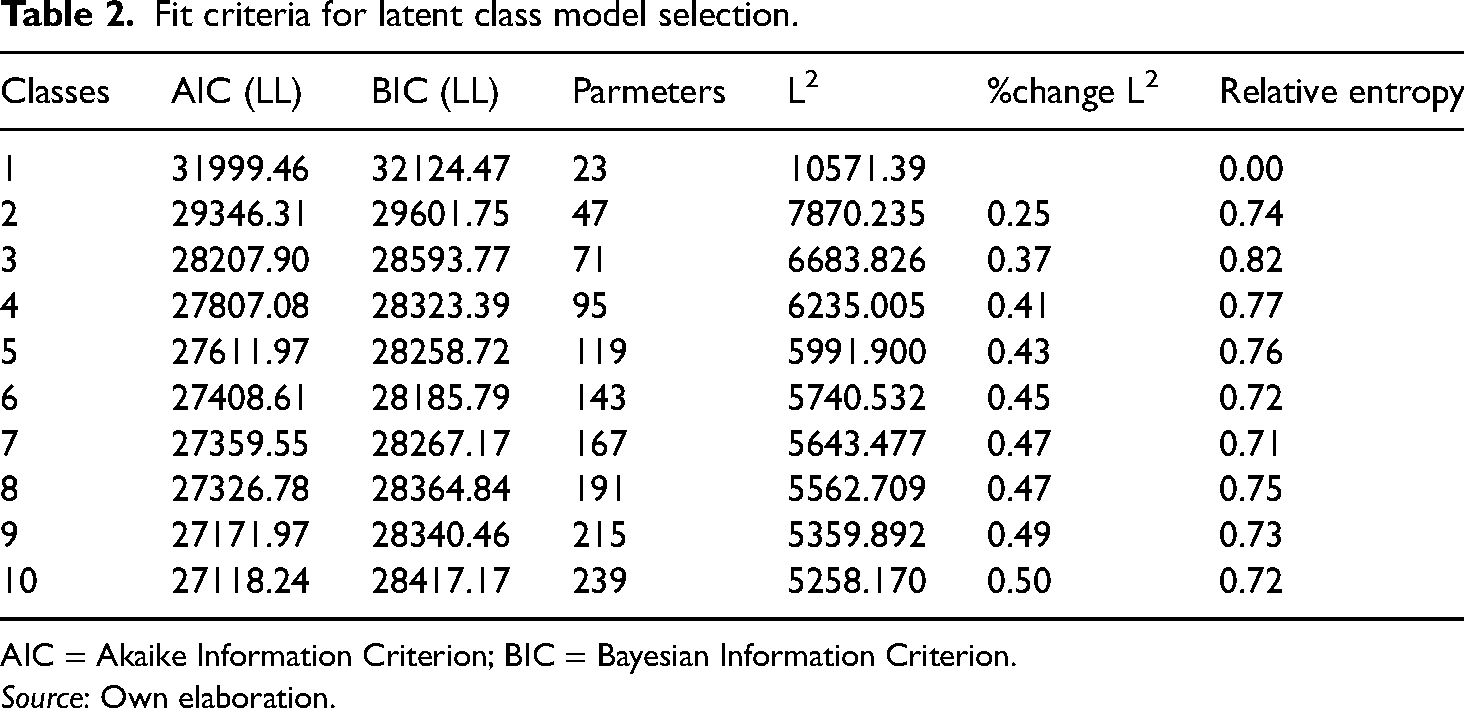
The first criterion was the absolute fit, represented by the Likelihood Ratio Chi-Square Statistic (L2). This indicator compares the representation of the data with the actual data, accounting for the consistency between the model and the data (Masyn, 2013). When the L2 increases, the model fit is considered to be improved. The second criterion was the relative fits of Bayesian Information Criterion (BIC) and Akaike Information Criterion (AIC), which compare the representation of the data between the estimated latent class models. 2 For both indicators, a smaller value is an improvement in fit, as parameters are added, but it makes the interpretation of the models more complex. Finally, we used classification diagnostics based on relative entropy, which allows us to assess the usefulness of LCA for grouping individuals (Masyn, 2013). In all cases, the fit criteria were estimated for solutions from 1 class to 10 classes, as shown in Table 2.
Fit criteria for latent class model selection.
AIC = Akaike Information Criterion; BIC = Bayesian Information Criterion.
Source: Own elaboration.
As can be seen, the results are not unequivocal and show that the best fits for each criterion do not always occur with the same number of classes. Thus, the results of the AIC and BIC statistics show that the 10-class model and the six-class model, respectively, would be optimal. On the other hand, when observing the change of the L2 statistic, we found that the improvement of the fit is marginal between the solution with four classes and the following solutions, which would suggest that the four-class model is the one that provides more information in relation to the complexity of the data structure. Finally, the relative entropy index is high and with little variability in the different solutions, although the three- and four-class models are the best fit.
Following Widdop and Cutts (2013), it is essential to apply an additional criterion in these cases: parsimony. The parsimony criterion seeks to prioritize simple models that are theoretically interpretable over complex models, which expose a difficult interpretation and do not allow for an easy understanding of the phenomenon being studied (Collins & Lanza, 2010). Considering this, we decided to select the four-class model for three reasons. First, because compared to the three-class model, the four-class model allows us to specify an intermediate group of people who combine different types of resistance. Second, because in the five- and six-class models it is not possible to observe the generation of theoretically relevant classes compared to the four-class model. Finally, because the four-class model showed positive (although not fully optimal) results in the three estimated fit criteria, and is therefore an interpretable model with high analytical capacity and a good fit to the data.
Once the four-class model was selected, the probability of each individual belonging to each class was estimated. This analysis was carried out in two stages. First, we proceeded to estimate the latent class model and its expected probabilities, accounting for their relationship with each of the 23 forms of professional resistance analyzed. This made it possible to describe the profiles around the different resistance actions, understand their configuration and account for their population distribution, thus responding to H1. Secondly, we sought to understand the relationship between these profiles and a series of sociodemographic and labor variables, thus seeking to respond to H2, H3, and H4. For this, the mean and confidence intervals were estimated for each profile with respect to the variables of interest (incorporating the statistical error), developing a comparison that would allow us to account for the statistically significant differences between the profiles and these variables.
Results
Figure 1 shows the distribution of the four estimated profiles according to the 23 resistance actions. As can be seen, each of the profiles constitutes a particular and differentiated typological configuration, with a high prevalence in some actions and a low prevalence in others.
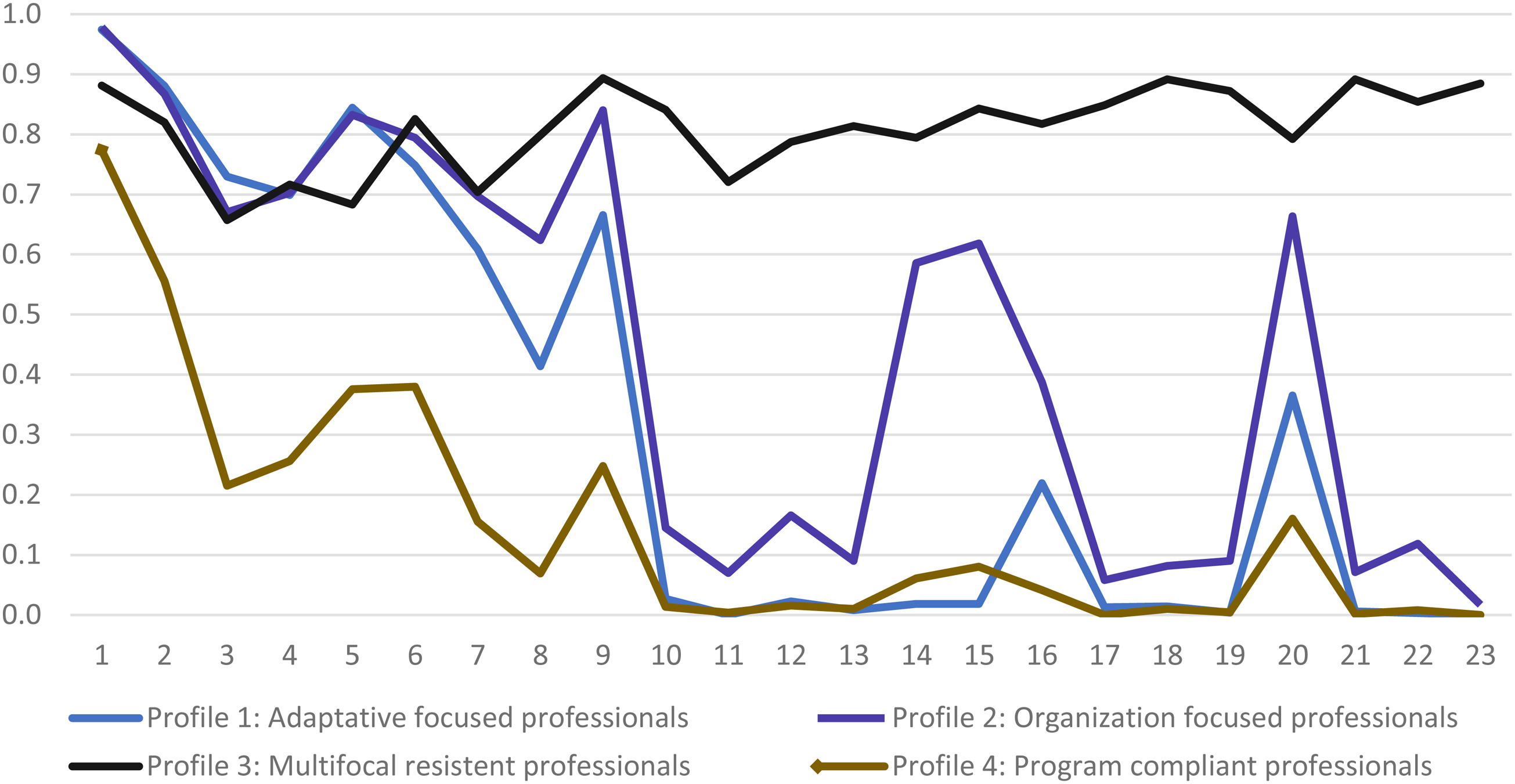
Professional resilience profiles for three social programs in Chile.
Profile 1—which accounts for 38.3% of the sample—concentrates professionals who indicate that they carry out a limited series of professional resistance actions. Nearly all the individuals in this profile indicate that they carry out more actions than those stipulated by the program (Action 1), while 85% report that they have changed the organization of the program to improve the quality of the intervention (Action 5) and nearly 90% indicate that they have developed collaborative spaces not promoted by the program (Action 2). Additionally, about 70% report that they have rushed or delayed processes to benefit program users (Action 9). In contrast, these professionals do not engage in actions such as feigning ignorance, falsifying data, exaggerating users’ needs, or omitting information (Actions 10 to 14), nor collective resistance actions, such as organizing passive boycotts (Action 22) or instrument boycotts (Action 23). Therefore, this group primarily exercises subtle and individual forms of resistance. These actions seek to expand the professionals’ margin of action without confronting authorities or the program. For these reasons, we characterize this profile as adaptive-focused professionals.
Profile 2 represents 21.6% of the sample. This second group shares similarities to that of the adaptive-focused professionals since they also report carrying out more actions than those stipulated in the program (Action 1), creating new methodologies not contemplated in the program (Action 3), creating internal protocols (Action 4), and changing the organization of the program (Action 5). However, they differ significantly from the adaptive-focused professionals because they indicate three actions not declared by the previous group: discussing or confronting managers individually (Action 14), discussing or confronting managers collectively (Action 15), and trying to organize colleagues to improve the implementation or development of the program (Action 20). Thus, in addition to the adaptive dimension of resistance, these professionals report that they have frequently carried out collective organization resistance actions, which is why we could characterize them as organization-focused professionals.
In contrast to the previous profiles, Profiles 3 and 4 present distributions that are more extreme and with a lower combination of resistance actions. On the one hand, Profile 3, which corresponds to only 2.0% of the sample, consists of professionals who have carried out various forms of professional resistance. For example, almost 90% of these professionals indicate speeding up or delaying processes to benefit program users (Action 9), but they also show a high proportion of having created new methodologies or approaches not contemplated in the program design (Action 3), while more than 70% indicated falsifying data (Action 11). Likewise, these professionals also presented high engagement in actions not exercised by other profiles, such as exaggerating the needs of users (Action 12), lobbying authorities (Action 16), using social networks to denounce aspects of the program (Action 18), or holding public protests (Action 21). The central difference between this profile and adaptive or organization-focused professionals is that they reported utilizing multiple resistance actions. Thus, we could classify them as multifocal-resistant professionals.
Finally, and in clear contrast to the multifocal resistant professionals, Profile 4, which concentrates the majority of the population (38% of the sample), includes individuals who declare that they do not engage in resistance actions. The one exception is that almost 80% of the professionals in this profile reported that they carry out more actions than those stipulated by the program (Action 1). The rest of the actions are either carried out only with a medium probability (e.g., less than 40% would change the organization of the program, as is the case with Action 5) or the vast majority directly declare that they do not carry out other actions. For this reason, we characterize these professionals as program-compliant professionals.
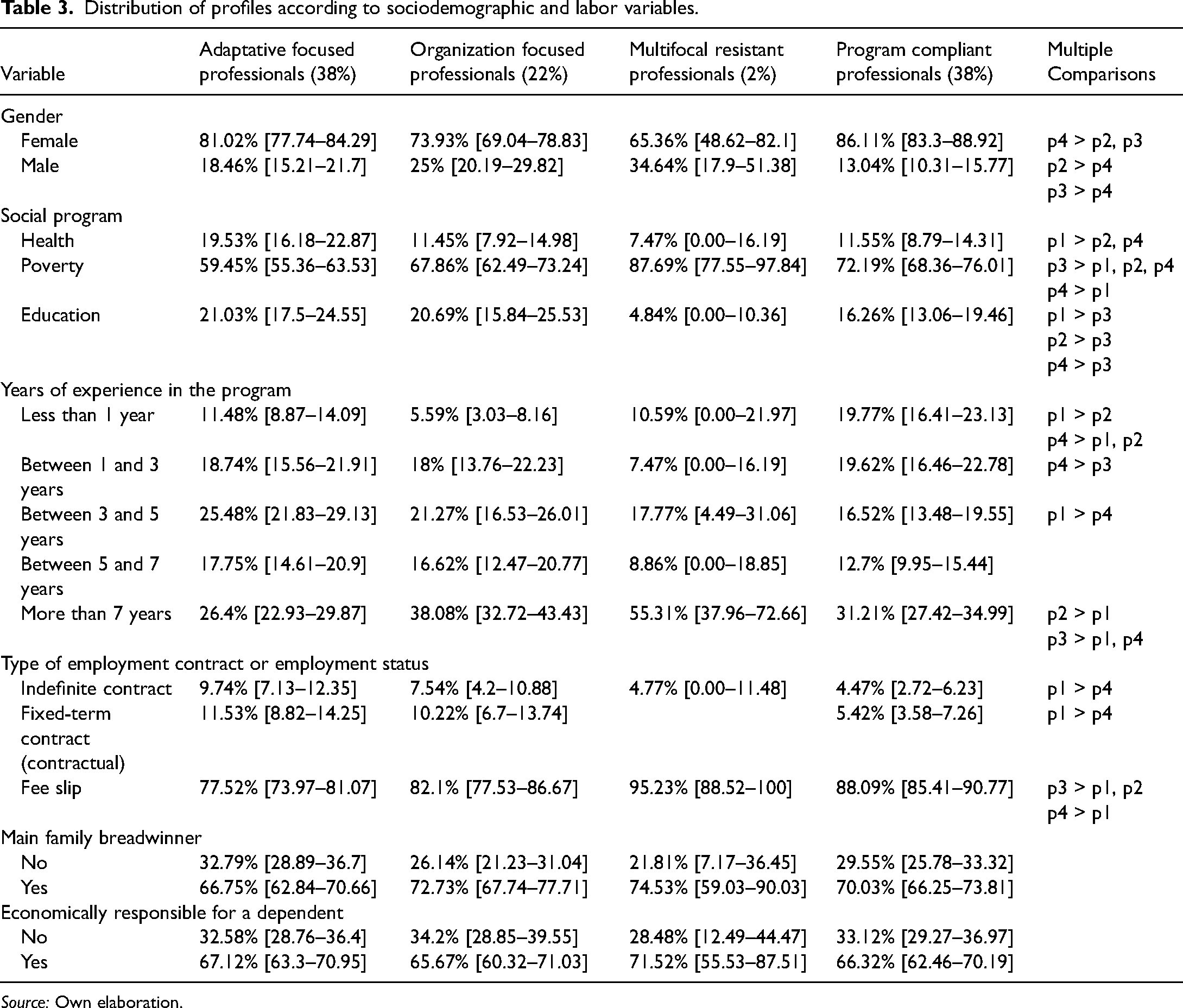
In addition to examining the distribution and characterization of professional profiles in terms of the resistances they engaged in (H1), we were also interested in understanding how these profiles could be related to gender and work history (H2), the types of social programs in which they worked (H3), and employment conditions (H4). To explore these hypotheses, Table 3 presents the mean of each profile with respect to six frontline worker's variables: gender, social program in which they work, years of experience, type of employment contract, being a main family breadwinner, and being economically responsible for a dependent. The final column of the table presents the statistically significant comparison between profiles at a 95% confidence level.
Distribution of profiles according to sociodemographic and labor variables.
Source: Own elaboration.
Five key elements can be highlighted from Table 3. First, women are proportionally more present among program-compliant professionals than in multifocal-resistant professionals and organization-focused professionals, while men are proportionally more present among organization-focused professionals and multifocal-resistant professionals than in program-compliant professionals. Along with confirming H2, this result supports the idea that contemporary societies generate differentiated work roles that determine different levels of professional resistance between men and women (Aldossari & Calvard, 2021), attributing (and thus naturalizing) ways of being and behaving at work depending on gender.
Second, years of experience appears to be a relevant variable for distinguishing between profiles. As can be seen, professionals with few years of experience (three or less) tend to be categorized as program-compliant professionals to a greater extent than multifocal-resistant professionals. In contrast, there are proportionally more individuals with more than seven years of experience in the multifocal-resistant professionals than in the other typologies. These results would support H2, although the results for the intermediate years (between 3 and 5 years) show few differences in distribution between groups, which could indicate that there is a nonlinear process of “learning” the mechanisms of professional resistance.
Third, with respect to the social programs front-line professionals implement, the results show that those in the health sector tend to have a higher proportion of adaptive-focused professionals than organization-focused professionals and program-compliant professionals. In contrast, multifocal-resistant professionals tend to be more present in the poverty program than in the other three profiles, while in the education program, multifocal-resistant professionals are less represented than in the other profiles. These results partially contrast with our H3, because although the poverty program is the one that concentrates more professionals willing to exercise all types of resistance actions, in the health program, professionals were more adaptive-focused. The levels of internal cohesion of the program, the working conditions, or the implementation forms could be hypothetical factors that explain this result. However, more evidence is still needed to understand these relationships better.
Fourth, professionals with permanent and fixed-term contracts are more present in the adaptive-focused professional's typology than in the program-compliant professional's typology, while in the case of professionals with temporary contracts, the relationship is reversed: program-compliant professionals are more present than adaptive-focused professionals. This would confirm H4, since temporary, flexible contracts could be read as a form of precariousness that inhibits the development of professional resistance. However, the results also show that multifocal-resistant professionals are more present than adaptive-focused professionals and organization-focused professionals, which could be indicative of a group of precarious workers who exercise direct resistance, probably because “they have nothing to lose.” Thus, workers with less job stability would concentrate both professionals who exercise more and less resistance actions, showing that working conditions do not act unequivocally on resistance profiles.
Finally, neither being the main breadwinner in the household nor having dependents are determining variables that allow us to distinguish between resistance profiles. This suggests that care responsibilities do not directly determine the type of professional resistance. When considered alongside the findings on employment conditions, we could hypothesize that professional resistance is linked more to direct working conditions than to socioeconomic factors. This indicates the need for further research, as the results suggest H4 is only partially fulfilled.
Limitations of the study
As with all research, this analysis has a series of limitations. First, although the quantitative nature of the study allows us to capture trends and map the distribution of resistance profiles at the national level, it does not allow for an in-depth understanding of the mechanisms, tensions, and contradictions involved in undertaking (or refraining from) resistance actions. Second, the set of resistances included in the analysis, although diverse, is not completely exhaustive. It does not include, for example, resistances based on irony or mockery, nor does it include resistance actions directly related to leadership or coworkers. Third, although adaptive-focused professionals, organization-focused professionals, and complaint professionals constitute relatively numerous groups, multifocal-resistant professionals represent a small portion of the sample (2.0%). Therefore, analyses of this group should be considered preliminary, and further research is needed to explore their qualitative characteristics in greater depth. Finally, because the study is limited to Chile, the findings do not allow for generalizing or comparing results with the institutional and political contexts of other countries. Despite these limitations, the study contributes to the discussion on the construction of professional subjectivities and the production of resistance, which are key aspects of the implementation processes of contemporary social intervention programs.
Conclusions
Using a representative survey of professionals employed in three social programs, this article sought to create a typology of resistance profiles of front-line professionals in Chile. The results of the analyses show that professional profiles (and not only of actions) are consistent and defined, representing different dispositions among front-line professionals in exercising different forms of resistance. These profiles vary according to gender, years of experience, place of work, and the political-institutional context in which interventions are implemented. The results thus confirm our initial working hypothesis: that front-line workers develop different combinations (not random or haphazard) forms of professional resistance practices.
Focusing on the Chilean case, the results reveal the importance of the country's political and social context in explaining the distribution of resistance profiles. In Chile, a country characterized by a low cultural disposition to conflict and high levels of precariousness (Araujo, 2016; Villavicencio, 2019), particularly in social programs (Bilbao et al., 2018; Muñoz-Arce et al., 2022), it is not surprising that the most prevalent resistance profiles are program-compliant and adaptive-focused professionals, representing almost 70% of the total distribution. Although different, both profiles scarcely exercise resistance, and when resistance actions are taken, these do not oppose institutional guidelines or program authorities. Although further comparative research is needed to explore this finding further, the preliminary results of this article confirm the idea that national contexts (cultural, political, economic) influence and, to some extent, condition the dynamics of resistance. As proposed in another article (Muñoz-Arce et al., 2022), this implies that professional resistance does not depend solely on personal will or professional training but is structured within an institutional context linked to power. In countries such as Chile, professional resistance is configured as a way of “opposing without risking one's job,” and is a form of everyday critical action exercised by those implementing social policies (Muñoz-Arce et al., 2022).
Moreover, the results indicate that these national contexts do not determine the agency and resistance capacity of professionals, as program characteristics, employment conditions, and sociodemographic characteristics also play central roles. Three specific findings are particularly relevant to highlight. First, there is a clear distinction between the resistance profiles of men and women. Although historically, the implementation of social programs is traditionally considered a feminized occupation (Hall, 2010), resistance actions vary by gender, likely due to an institutional framework that penalizes women culturally, politically, and economically. Exploring “feminist-professional resistance,” resistance rooted in care and solidarity (Duboy-Luengo & Muñoz-Arce, 2020, 2022), in greater depth are critical aspects for future research.
Second, years of experience appear to influence resistance profiles. Professionals with fewer years in the institution are more likely to pertain to subtle resistance profiles, while those with more years tend to develop more multifocal resistance profiles. This finding raises questions about the learning processes and cultures (both formal and informal) of resistance, as well as the relationships professionals develop with institutions (and managers) over time, aspects that could influence resistance tactics. These results highlight the importance of delving deeper into organizational social work (Gouldy & Baldwin, 2004), especially through a critical management framework (Adler et al., 2007), thus seeking to empower implementers in understanding and using different forms of professional resistance.
Finally, the results on precariousness indicate not all precariousness translates into resistance; rather, labor precariousness may trigger more direct and confrontational resistance actions, which, at the same time, may also inhibit such actions, thus revealing that labor conditions do not unequivocally impact resistance profiles. As Butler et al. (2016) indicate, precariousness is not solely a material condition but is experienced as a subjective process that may involve resistance but also maintenance of the established order. Exploring these aspects in future research is essential to deepen our understanding of the connections between professional resistance, implementation of social programs, and working conditions.
Footnotes
Ethical approval
Ethical approval for this project was given by: The study was approved by the Ethics Committee of the sponsoring institution Universidad, de Chile.
Funding
The authors disclosed receipt of the following financial support for the research, authorship, and/or publication of this article: This work was supported by the Agencia Nacional de Investigación y Desarrollo (ANID), Fondo de Fomento al Desarrollo Científico y Tecnológico (FONDECYT Regular Grant No. 1201685) Chilean Government.
Declaration of conflict of interest
The Authors declare that there is no conflict of interest.
Author’s contributions
CV and MDL contribute to the conceptualization, investigation, writing (original draft and review versions). CM contributes to formal analysis, data curation, and visualization. TR and GMA contribute to investigation and writing (review versions). GMA contributes to project administration and funding acquisition. CV contributes to methodology and validation. All authors read and approved the final version of the manuscript.
