







Abstract
Summary
Places, architecture, and materiality matter for social work. We aim to start a conversation between critical geographical and actor-network theory perspectives through an empirical analysis of two Danish job center sites to get a better understanding of the agency of social work architecture. Critical geographical perspectives offer conceptualizations of how place is produced and how this production is shaped by changing relations of dominance and power. However, they risk ending in a somewhat unsatisfying totalizing perspective when attempting to understand interventions performed and acted out by social workers. Actor network theory concepts of connections, scripts, and plug-ins are useful for understanding the enactment of social work practice in particular architectures, but they lose sight of how connections are molded by relations of power and political rationalities.
Findings
We explore the silent politics of an enabling and welcoming environment and the loud politics of interdictory spaces in two job center locations. We show that the social work architecture shapes professional roles, induce forms of conduct and interactions between social workers and young unemployed people. We highlight how the enactment of social work architecture is filled with ambivalences when social workers navigate political place production. We argue that taking into account the complementarity of critical geographical perspectives and actor-network theory might succumb the limitations of both.
Applications
We lack conceptualizations of the role of social work architecture in social work. The article aims to start a reflection on this in social work research and professional social work practice.
Introduction
Social work takes place in particular localities and material environments, which both loudly and silently perform politics by molding and conditioning social work. Just as social work aims at orchestrating the environments and places to be conducive for social change (Fallov, 2023; Jørgensen, 2023). Architectural design and materiality condition interaction between social workers and citizens and become agents in the possible relations of care (Stanley et al., 2016). In this article, we want to explore how we are to understand the configuration between social work, architecture, places, spaces, and material environment, what we term social work architecture in the following, and how these relations shape the roles of and interaction between social workers and citizens in need of assistance or in positions of marginality.
Attention to social work architecture in social work literature
Attention to place and environment has roots in the early social work, exemplified by the mapping of the community workers at Jane Addams House and the attention to environment in Richmond (Akesson et al., 2017; Bryant & Williams, 2020). It has been argued that until recently attention to space and place in social work research has been scant or has focused on the psychosocial relation between place and individual and tended to prioritize the individual in the relation between environment and people (Akesson et al., 2017; Kemp, 2011; Ratliff et al., 2023). Others have argued for a re-turn to geographical imagination, space, and place in social work research since 2018 (Andrews, 2020, Bryant & Williams, 2020; Saravia et al., 2024). Saravia et al. (2024) evidence in their literature review of social work research a “spatial turn.” They map out how attention to spatial terms differs between regions, and that environment and place has received most attention within the last 5 years, while space and territory have received less attention. Differences in the present debate in social work research are thus not only related to the relative weight given to different spatial dimensions; environment, place (community), and territory, but also in terms of the theoretical concepts and traditions used to investigate how space matters.
A German branch of social work research (Sozial räume) integrates critical geographical concepts from Harvey and Lefebvre, community work approaches, and critical social psychology from Vygotsky (Spatscheck, 2019). The strength is here the focus on how space becomes active part of both everyday activities, organizations, and planning, and that people come to acquire place and environment through their activities, tools, and actions when coping with its conditioning of life. Understanding the spatial expressions of advanced marginality is pregnant in the body of work relying on the trialectic of Bourdieu (Cummins, 2016; Wacquant, 2022). In focus here is the analysis of how urban neighborhoods are relationally constructed, how structurally informed marginalization results in practices of relegation, sustained by political tools. Despite highlighting interrelations and interdependencies between the symbolic, social, and physical space this body of work tends to focus on hierarchizing space and controlling elements of nearness and distance. Attempts to root social work in spatial justice and thus challenge existing systems has been based on Foucault's notion of heterotopia (Ratliff et al., 2023) and in Foucault's notions of disciplining and normalizing relations of power (Gilbert & Powell, 2010; Parton, 2008). This perspective is useful in highlighting the discursive constructions of social work architecture, and the diffuse conduct of power through social work architecture constituting both professionals and citizens. However, analyses of how things never work out as planned—not even attempts to mold materiality, places, and architecture—are few. Thus, it is in our view important to highlight the historical role of social work practice beyond surveillance and control and promote a proactive and critical approach for social work practice (Fallov, 2023; Fallov et al., 2017).
Building on mobile methods, Ferguson (2016) has analyzed the importance of non-human actors when analyzing social work practices in the home, and how social workers navigate and have a part in producing atmospheres. Similarly, Andrews (2020) and Andrews and Duff (2019) argue for the importance of applying post-humanist approaches to gain a better understanding of the assemblages involved in social work, their outcomes, and the enabling spaces important to both social work and health research. In social work literature, actor network theory is mostly recognized as offering an analytical framework for understanding complex social changes associated with the introduction of technological innovations (see, e.g., Aasback, 2022; Ballantyne, 2015; Jørgensen & Nissen, 2022). Tørrisplass and Breimo (2019) combine institutional ethnography and actor network theory in a study of deinstitutionalization processes and policies of residential care facilities for unaccompanied refugee minors. This combination, they argue, enable analytical focus on the significance of materiality starting with people's experiences and everyday life. Jeyasingham (2018, 2020) has combined Lefebvre with actor network theory perspectives to analyze how social workers contribute to neighborhood production through the symbolic constructions of the places they work, and more recently analyzing how agile social work in office spaces are influenced by new public management.
Taking point of departure in this promising work and the current debates on how to conceptualize the role of social work architecture, we want in the present article to engage in a dialogue between critical geography and actor network theory. Despite their internal differences, we believe this dialogue affords a conceptualization of social work architecture that approach human experience as important but does not give it privilege. It allows us to move beyond questions of nearness and distance, mere locality, and beyond an understanding of space and place as mere containers in which social work takes place. This dialogue, we believe, move toward a framework that includes the relational, historical, material, symbolic, discursive, affective, and political dimensions of social work architecture. We agree with critical geographical perspectives highlighting how structural powers produce social work architecture and that social work has an active role in this production (Harvey, 2013; Lefebvre, 1991, 1996). Hence, we approach social work as a practice that constantly aim to proactively change and mediate in these structural powers. We want to understand how social work architecture becomes agents (Latour, 2005) in webs of relations performing and contesting politics and social work. Thus, the aim of this conversation between critical geographical and pragmatic perspectives is to highlight the silent and sometimes loud political work performed by places, localities, and architecture of social workspaces where the social worker meets the citizen.
We engage the two perspectives in dialogue via an analysis of two empirical examples from the Danish context of social work. The examples are from two different job center departments specialized in young people with no employment, education, or training, and who experience additional problems such as a criminal history and verdicts, various diagnoses, and drug addiction. The young people are in contact with many and different institutions and hence spaces, places, and architectural settings such as criminal courts and prisons, psychiatric ward, and rehab facilities. Their primary and first contact, however, is with the job centers. This attests to a continuation of a Danish offensive workfare strategy rearticulated with the social-democratic and universalistic welfare model (Torfing, 1999) emphasizing activation and the role of job centers. The idea of activation can be defined as the principle that benefit entitlement depends on one's participation in some kind of activity such as unpaid work, job training, upskilling, and job search activities (Andersen & Larsen, 2024). While the content of the activation idea has endured and remained the same during the last 30 years, it has changed from a neo-liberal ideological and hence politically contestable claim to a seemingly unquestionable technical objective spanning the political ideological spectrum and sheltered from substantial critique. We suggest that workfare and the activation idea work through very different practices and in very different places, spaces, and architectural environments, which we argue are part and parcel of the governance and implementation structures.
Our analysis is structured around two main observations. The first empirical example illustrates an architectural design meant to generate an atmosphere of openness and approachability. The second empirical example illustrates how concerns with security and establishing authority are shaped by architectural design and how social workers negotiate such concerns when interacting with young unemployed and vulnerable citizens. Thus, the two examples cover very different architectural designs directed by the same overall rationality related to the active labor market policies. Social work architecture, in other words, frames interaction and shapes roles by fostering employability as well as educational and labor market activity among unemployed young people.
We start by outlining how the role of social work architecture has been understood theoretically pinpointing what we see as potentials and shortcomings in both critical geographical perspectives’ focus on structures and relationships of power and actor network theory's disdain for research guided by morals or political principles. Then we shortly outline our methodology, followed by the two main empirical sections. An exploration is not a set path. We do not claim in this article to come up with a unified model of the role of social work architecture in social work practice, but to start a discussion in social work research of the importance of reflecting on how it matters.
The production and enactment of social work architecture according to critical geography and actor network theory
According to critical political economic geography, places and the design of urban (and rural) spaces are not a result of neutral naturally emergent processes and phenomena (Harvey, 2013; Lefebvre, 1991). Places and the architectural design of the welfare state is a result of the struggle between different groups and by their relations to the ever changing and variant forms of capitalism. For Harvey, spatial barriers are overcome not only to gain competitive advantage for growth. Spaces are important in organizing social relations; shaping access/barring access, the appropriation of spaces and places institutionalizing particular forms of use, spatial dominance by particular groups and classes excluding other representations and appropriations of spaces and places (Harvey, 1990). Harvey argues, for example, how the uneven development of cities is shaped by the creative destruction left in the wake of the reinvestment of surplus and the facilitating state aiming to attract investments and entrepreneurs, which either displace the less powerful, or capitalize on their authentic branding of place (Harvey, 2006, 2013). Social work architecture is thus the historical product of how different groups and classes have differential access to promote their idea of order, strategies, and codifications of the good life which condition and are in constant struggle with the lived life in places (Lefebvre, 1996). Lefebvre argues, moreover, that welfare planners and professionals decide, plan, and act in relation to governmental rationalities forgetting the human factor. He sees, for example, big social housing estates as shaped by ideas of habitat that are conducive to the reproduction of labor, but which overlooks the importance of the plasticity of how people inhabit and thus habiting as everyday activity (Lefebvre, 1996). While there is a tendency in the critical geographical perspectives to stay with how totalizing capitalist structures condition, shape, and produce places, there is with Lefebvre an attention to how lived spaces always will escape orderings and the representations and codifications of place by those in power (Lefebvre, 2003). It is a perspective that allows us to insist on the dialectical relation between, on the one hand, the production and codification of social work spaces by the contemporary relations of capitalism and, on the other hand, social work's role in promoting the right to the city for the displaced, excluded, and marginalized and in supporting spatial representations by citizens challenging rationalist or entrepreneurial visions and promoting a more just city.
Here actor network theory provides interesting, promising, and at times difficult routes for our exploration. Law (2008, p. 141) gives a succinct introductory description of actor network theory, which we restructure and paraphrase here for the sake of elaboration and clarity. First, actor network theory treats everything in the social and natural worlds as continuously generated effects of the webs of relations within which they are located. It assumes that nothing has reality or form outside the enactment of those relations. This is sometimes called relationism designating a departure from relativism, constructivism, and essentialism and implying a flat ontology in which everything belongs to the same ontological realm. The consequences are profound. Instead of assuming that space, safety, community, and trusting relations exist in themselves and somehow interact and impact one another, actor network theory holds that all these entities are network effects. Space, politics, community, and so forth emerge as possible results from networks in action and none have an a priori upper hand (Latour, 2005). Spaces of social work are swarming with logics. Sometimes they struggle bitterly, but at other times differences co-exist. Reception counters can be simultaneously friendly, welcoming, and suspicious and controlling (Jensen, 2001). Residential care facilities can be a home and an institution at the same time (Tørrisplass & Breimo, 2019). Second, since everything has reality and form due to the enactment of the web of relations, actor network theory's main objective is to study, explore, and characterize the webs of relations, how they are enacted in practice and how they are stabilized or destabilized. Given the treacherousness and indeterminacy of any relation, actor network theory is interested in how networks consolidate through continuous network ordering, often referred to also as processes of translation (Law, 1992). As Latour and Yaneva (2017) remind us, buildings too are moving modulators. They are not static but always on the move, in flight, transformed by its users, modified by what goes on inside and outside, as well as by renovations adulterating and transforming them beyond recognition. Simultaneously, they regulate engagement, redirect users’ attention, concentrate and distribute flows of actors. Third, actor network theory is a disparate family of sensibilities and methods of analysis. Rather than offering a coherent theory, it provides an open conceptual repository that have been deployed and developed by various scholars conducting empirical studies of the enactment of such things as electric vehicles, music, anemia, organizations, cheese, childbirth, and blood pressure in the brain (Mol, 2010). This means that actor network theory not only provides a rich and empirically sensitive vocabulary but also that it is open for new conceptual elaborations. To sum up, actor network theory provides a perspective of and a vocabulary for exploring how subjects, roles, materiality, architecture, and politics co-constitutively are enacted in relational networks. This perspective considers materials, technologies, and things, which have become “reified in a series of sedimented enactments” (Law, 2002, p. 96) and hence invisible to us, as full-blown actors that are both enacted and enacting at the same time.
In what follows, we operationalize the critical geographical and actor network theory perspectives as complementary despite their internal disputes (see, e.g., the disputes between Brenner and the assembling perspectives; Brenner, 2009; Farias & Blok, 2016). These disputes revolve around the question of what critique and the political are and how to understand structures or predetermined social relations, such as class. With political work here, we signify the oeuvre that goes into inhabiting the architectural designs and materiality of social workspaces, and how such an oeuvre builds on conflictual relations—albeit often displaced out of sight (Lefebvre, 2003). Moreover, by engaging in dialogue with the actor network theory perspective we highlight how politics is also about drawing out the emergent character and ambivalences that stem from connections and relations between social work practice and architectural design, emphasizing how they might lead to other practices, roles, and interactions with citizens than intended (Farias & Blok, 2016). However, we have found both perspectives to have both potentials and shortcomings.
To get the grips of how social work architecture matters for social work, we need to understand the nestedness of social work practices in capitalist relations and approach them as result and part of power struggles and structural conditions. Social workers are conditioned in their everyday practices, deliberations, and decisions by political rationales (the workfare and activation ideology) and their materialization in places and in architecture (part of the governance and implementation structures that condition how these ideas are put into practice). The difference between the critical geographical and the actor network theory perspectives comes down to how we should explain and approach this nestedness. The critical geographical approach focusses on and explores the consequences of totalizing ideologies, social structures, and discourses encroaching and enveloping local practices. According to Latour (2005), the critical approach presumes a rift between the local and the global or the micro and the macro. While we do not see this as a necessary consequence or prerequisite for the critical approach, we do share the concern that the global or the macro tend to reign supreme and that the critical geographical perspective risks neglecting the nuances, agency, performance, and variance of how place matters. While not denying the existence of capitalism or neo-liberalism, actor network theory reverses the explanation and shows us the dynamics of conflict, dilemmas in practice, disagreement, and all the painstaking work it takes to reach order and stability—if they materializes at all (Latour, 2005). However, actor network theory offers no judgment on what it all means. We risk losing our bearings, since actor network theory lacks and even disdains anything resembling moral or political principles from which to make sense of it all (Winner, 1993). In a pragmatic spirit, we argue that the two perspectives can be deployed together in an exploration of how structural relations and conditions are destabilized and filled with ambiguities when we follow actually ongoing social work.
An explorative methodology
This article does not stem from a project designed for investigating the role of social work architecture in social work, but rather from a common interest in exploring this relationship. We have drawn on data from the research project “Views on Human Beings in Social Work—Welfare Policies, Technologies and Knowledge of Human Beings” (2014–2018) in which both authors were involved. The research project spanned unemployment services, psychiatric services, community work, and child and family services. Data were created through extensive field studies and on-site observations as well as interviews with practitioners and managers. Finally, documents such as methodological guidelines, political and organizational strategies, and visions were collected. For this article, we draw on two on-site observations from unemployment services. These cases were chosen as they illustrate how seemingly similar activation objectives are enacted differently in different spaces. Analytically, we approach the data from the theoretical combination of critical geography and actor network theory. Data are re-analyzed to exemplify and rethink how social work architecture plays a role in social work interventions and as conditions for establishing relationships to people in positions of marginality. The examples are, although collected some years ago, still pregnant for the type of social work interventions they represent. Our data set is limited in terms of accounts on people's experience of social work architecture. People's experiences are significant, but neither critical geography nor actor network theory grant them privilege over social work architecture or social relations. People's experiences are approached as network entities performing spaces or as enmeshed in and contingent upon contemporary capitalist relations.
An enabling environment and welcoming atmosphere framing equal worth and normalization
In this example, the social workers emphasize the importance of the physical layout and design of the offices for establishing relationships with the young people (Figures 1 to 3). However, there are rarely young people here. In the three days I’ve been here, no one is using the facilities or playing table football. In general, it is very quiet in the house. It looks like a place to hang out and relax, but no one does. One of the social workers has told me that the layout and design primarily has a symbolic function. The social workers, much like the building, seem open minded. Considering the stories that they tell about the young people, I would have expected a closed-door-politics both for safety reasons and to ensure confidentiality. I have been told that they often visit the young people two-by-two for safety reasons. Inside of the building, safety is less of a concern. (Observation notes)
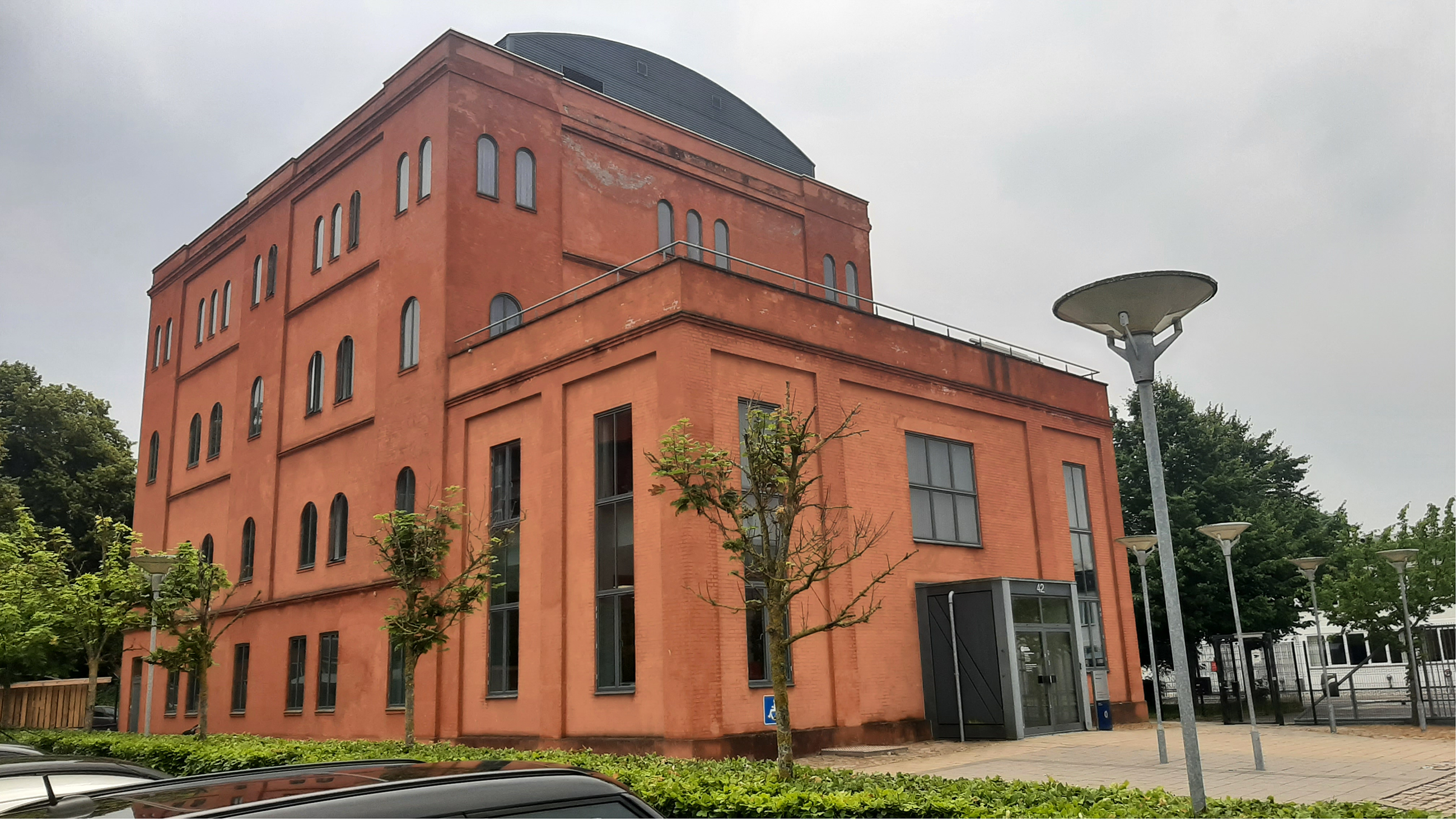
Building 1 (picture taken by Author 2).
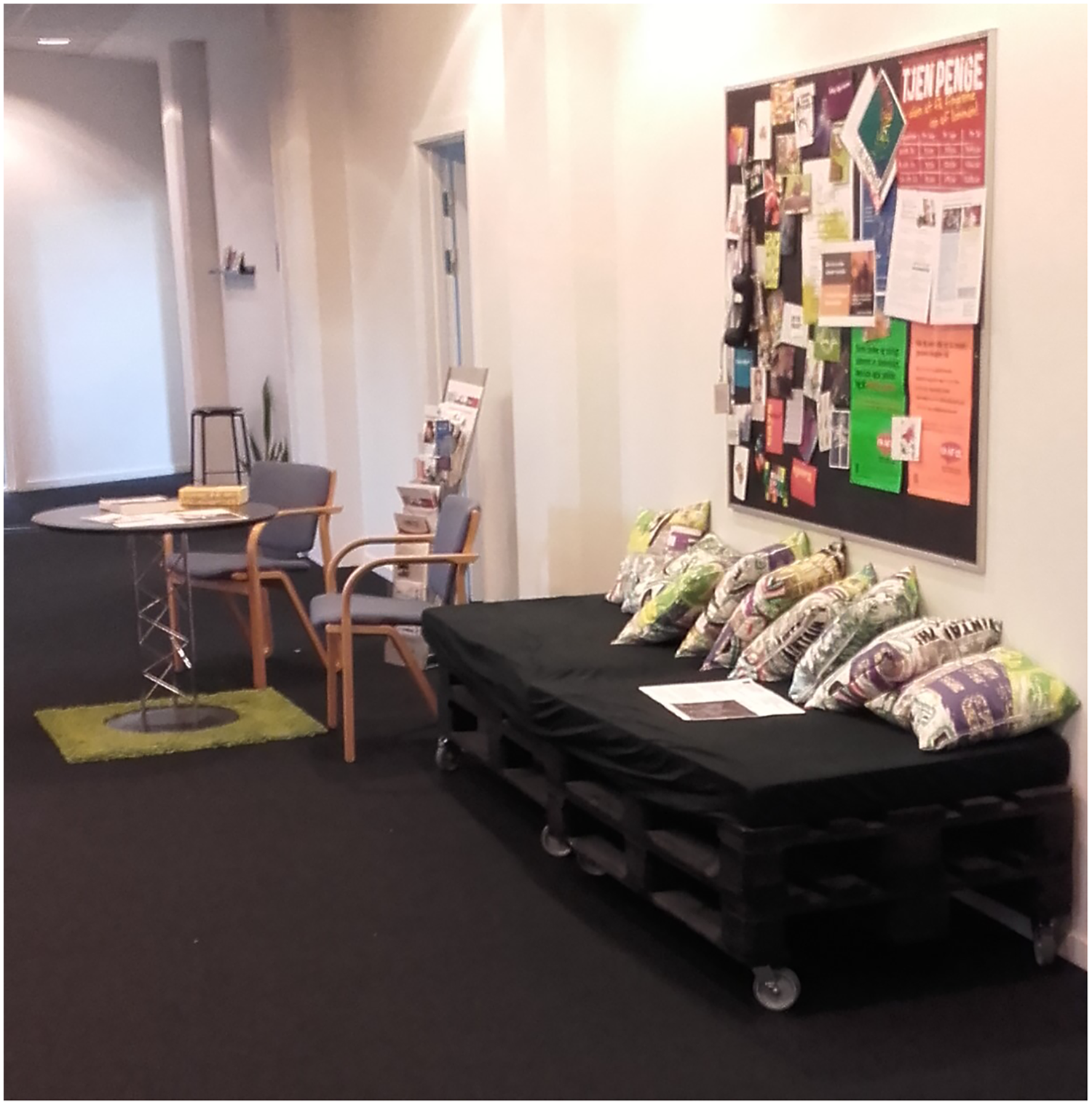
Interior design (picture taken by Author 2).
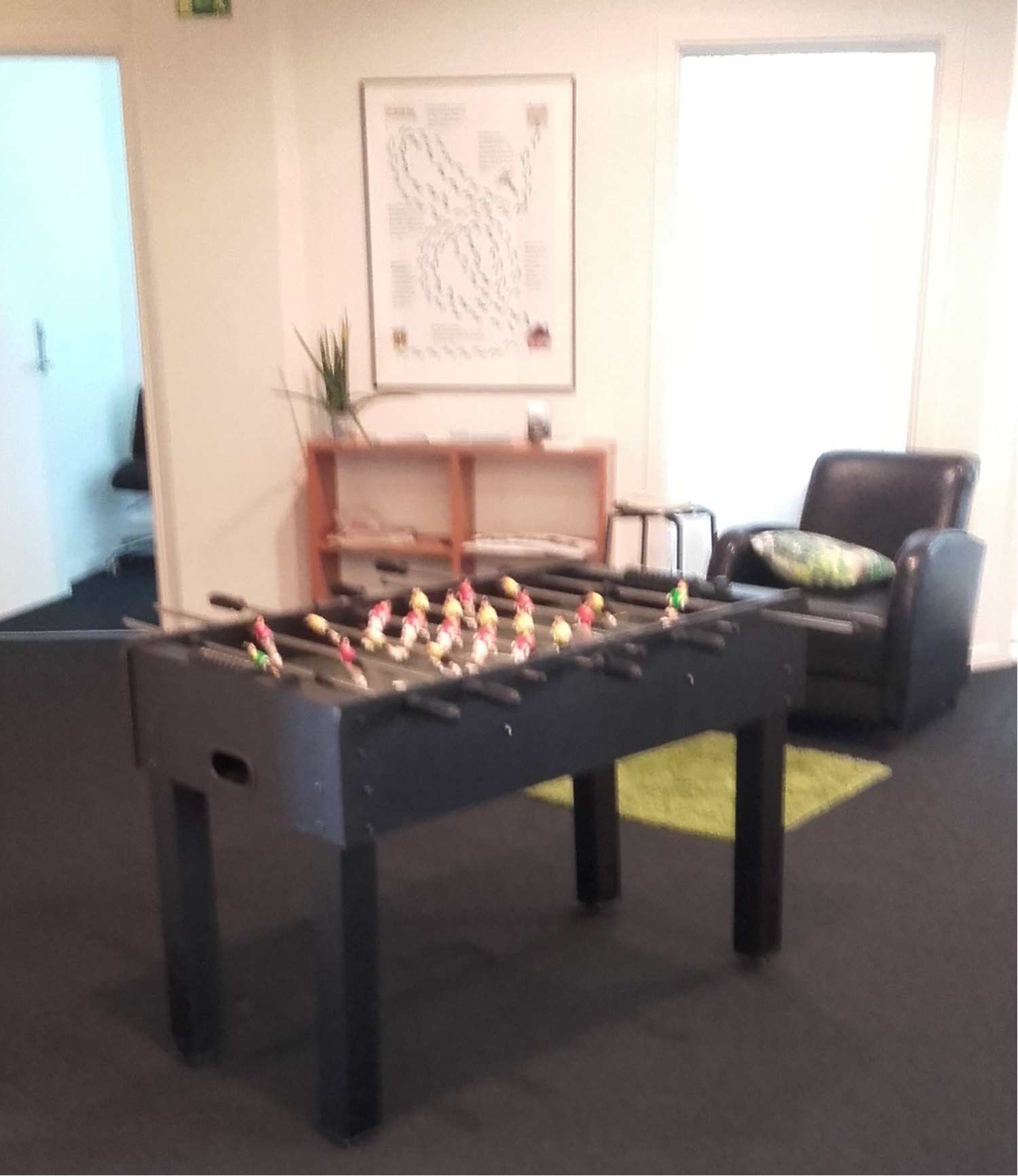
Table soccer table (picture taken by Author 2).
The open doors, sofa, and table soccer is part of a deliberate design to generate the job center department as an enabling place that facilitate particular forms of agency and capacities of the unemployed young people (Duff, 2011). It is an enabling place because the welcoming design allows for trustful associations with the social workers that potentially enhance the social resources of the young unemployed people. Moreover, the welcoming atmosphere is designed to transmit the dynamic power of affective resources to interaction between social workers and young unemployed instilling feelings of playfulness and action.
Like artifacts and technologies, architecture is designed for specific purposes, and it prescribes action through its design. It prescribes a certain usage, define users and usage, the space in which users move, the ways in which users interact, and it provide a key with which users may interpret usage (Akrich, 1992). Architecture allows or incites social workers and clients to do some things while it disallows or makes other actions less probable and, by shaping practice, it structures what it means to be a social worker and client as well as the relations in between. Designers and architects—in this example, one of the social workers—define actors with specific tastes, competences, qualities, motives, and aspirations and inscribe these visions into the architectural design. In turn, the design provides a script for the social workers and the young people; a framework for interpretation and action within the context in which they are supposed to act. As such, architecture actively shapes subjectivity and objectivity and the ways in which we are present in the world (Verbeek, 2005). In the above example, the design is intended to support and materialize certain staff–client relations and values including equal worth, engagement, proximity, and confidentiality. Moreover, it provides a script and a framework for interpreting the room as well as one's place in it. The soccer table, the lounge area with the home-made sofa, and the lockers associate this place with hip youth culture rather than social problems. It provides the young clients with an interpretative scheme in which they can understand and frame themselves as any other cool youngster. It allows the young people to think of themselves as normal kids rather than clients subject to workfare measures and it supports the social workers relating to the young people as such, helping them focusing on their resources and motives for changes rather than their problems. This is also supported by posts on a bulletin board and posters. For example, a poster reads “See me as a regular person with problems that need fixing.” Another post quotes Nietzsche “In every real man, a child is hidden that wants to play” emphasizing the common human potential for transforming ourselves by overcoming the barriers imposed upon us and finding our true selves. As such, the architecture and designs support a hegemonic activation discourse emphasizing activity over passivity, the future over the past, and potentials over problems (Nissen et al., 2018).
No matter how strong the architectural script is, and no matter how discursively well-founded it is, it is not deterministic. In practice, architectural scripts are always de-scribed (Akrich, 1992). Social workers and the young clients interpret the architecture from different positions and with different lived experiences and always in context. Thus, although it looks like a place to hang out, it is also a place where the young people's future directions are shaped and decided upon, and it is a place where the authority to decide on such matters are unequally distributed among social workers and the young people. The architecturally envisioned and scripted subject may not necessarily align with people's self-perception. Because of limitations in the study, we can only speculate how the young people actually de-scribe this space. Steeped in lived experience and in need of support and help, there is a risk that young people feel marginalized and alienated when faced with an architectural script of the “normal” active and individually responsible young person who, by the very virtue of being a human being, are able to transform oneself. In relation to this, research suggests that intensified normalization, individual responsibilization, and neglecting of problems can fall heavy on young people in need and in vulnerable positions, if they are expected to deliver more than is fair, or they are able to (Nissen et al., 2018). The social workers, on their part, reflect on dilemmas of inclusion and exclusion, normalization and alienation, and how to practice equal worth between unequal positions. One social worker relayed that they should avoid “meeting on our turf” and elaborated “if you peel off the institutional, e.g. by meeting on a bench in the park, it is easier to overcome, ignore, or minimize the fact that the young person and the social worker are not equally positioned and thus focus on their equal worth” (Observation notes).
Interdictory spaces
The architecture exemplified above illustrates a reasoned design attempting to negate unequal power relations, signaling openness, equal worth, and normality. The example which follows illustrates architecture designed to control access, emphasizing security and assuming and reproducing distrustful relations between social workers and clients (Figures 4 to 6).
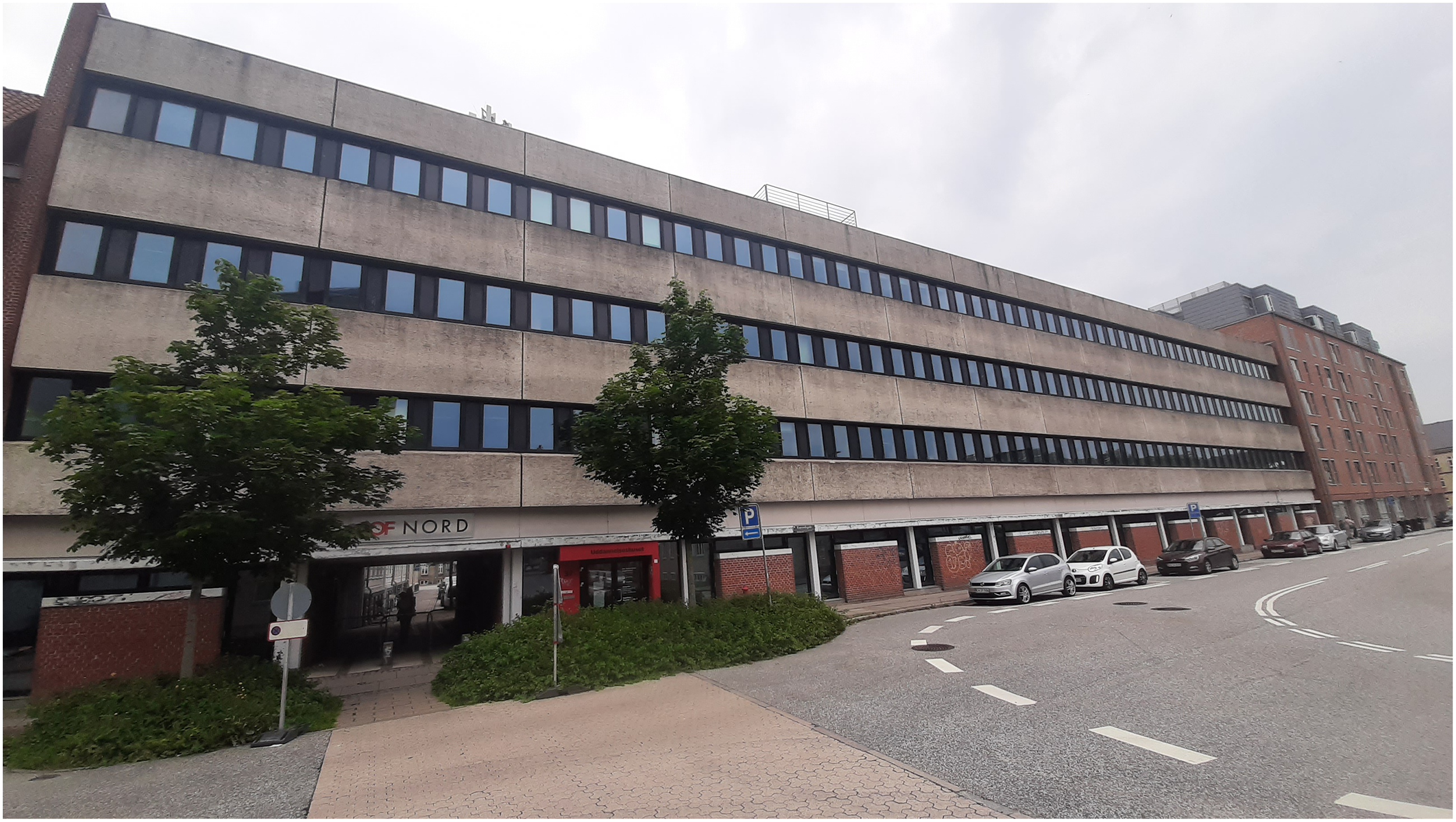
Building 2 (picture taken by Author 2).
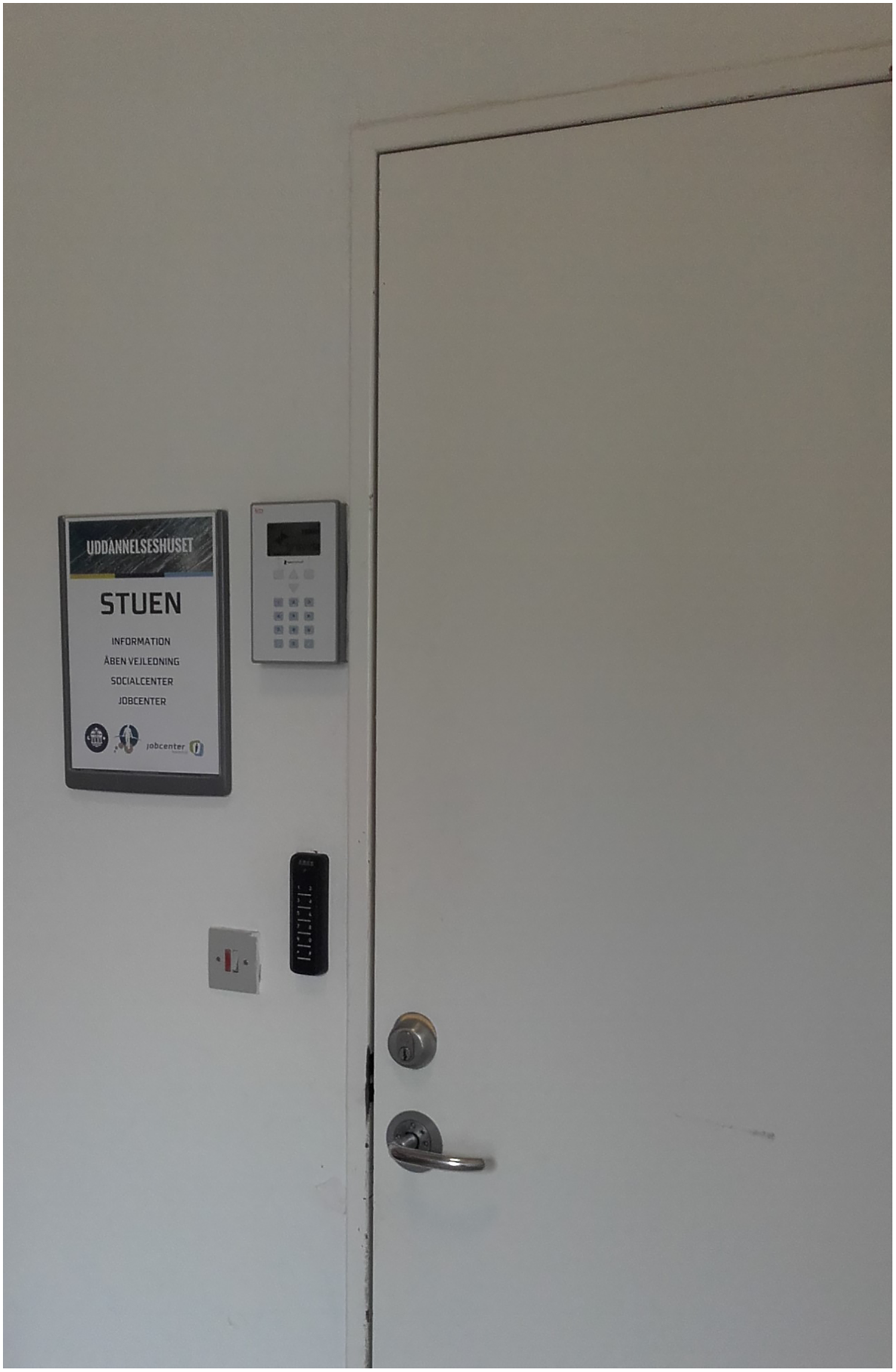
Access secured (picture taken by Author 2).
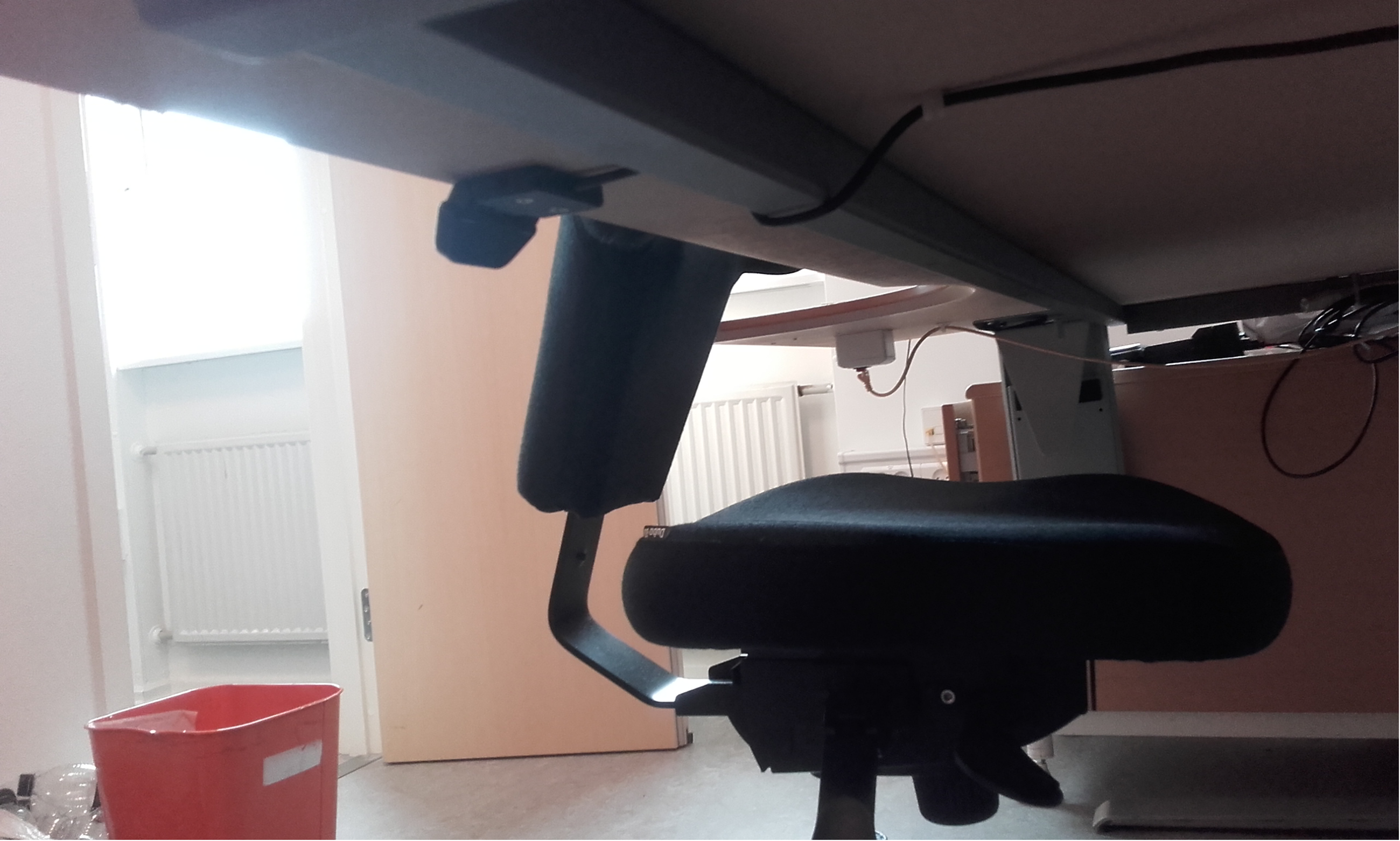
Escape alarm under desk (picture taken by Author 2).
Modern welfare architecture as the one represented in the above observation notes is from a critical geographical perspective a symbol of the institutionalization of space by the welfare state designed with functional purposes in mind (Lefebvre, 2009). In this instance, it is the implementation of elements of active labor market policies in which the state as representative of interests of the ruling classes tackle social problems and build the capacities of the unemployed deemed unable to find their own way into the labor market. At the same time, the example represents the welfare side of the proliferation of what Flusty (2001) have termed “interdictory spaces” meant to filter and repel would be users. Interdictory spaces function to systematically exclude those judged unsuitable or even threatening. They have spread through privatized and consumer spaces to exclude unwanted and threatening others from the privileged consumers. But the interdictory spaces similarly spread in government buildings and administrative complexes. In the example, they work through locked doors and filtering pathways separating employees from the young people needing their assistance. Flusty's point is that interdictory spaces have become a mainstay in the urban environment to an extent that they have become naturalized and unthreatening to our daily lives so that we hardly notice them (Flusty, 2001). Thus, there is nothing new in job center departments filtering users and barring immediate access to social workers. Similar designs are everywhere we encounter the welfare state or want to transgress spaces of authority. We no longer notice the security cameras in the corner, the double doors, and we negotiate the number systems giving us particular slots or mark out waiting time for assistance. Where interdictory spaces in some instances simply bar access, for example in the shape of walls separating neighborhoods or locked gates, interdictory spaces in this type of welfare architecture are meant to facilitate access to authorities—as long as we leave our differences at the door and act in an appropriate manner. Thus, as we learn from Rebecca, security measures can be activated through alarm buttons if citizens that become angry with decisions made by the social workers behave in a threatening way. In that way, interdictory spaces ascribe codes of conduct that are incorporated in our daily practices and navigation of places (McFarlane, 2011) and at the same time proscribe what is deemed inappropriate.
The queue number system, the self-service computers, the waiting chairs, the front desk, and so forth can be understood as plug-ins (Latour, 2005—who on this point is deeply indebted to Foucault) that do not negatively constrain or limit subjectivity, but positively creates the young people as bureaucratic clients. In principle, they can resist this subjectivity by refraining from subscribing to the design, for example by jumping the queue. However, this comes at the price of potential exclusion. If the young people want help, they have little option but to subscribe to the subjectivity of the bureaucratic client. Such designs similarly focus the productiveness of the social workers, as they know help is nearby and do not have to worry about their own bodily safety when performing their bureaucratic functions. The apparent banality and everydayness push the socio-spatial injustices and social dysfunctions of interdictory spaces into the realm of the inconceivable (Flusty, 2001). Thus, we can hardly imagine other ways of designing spaces or making architectural layouts that both perform essential bureaucratic functions while protecting frontline personnel. However, we might need to reflect upon whether the interdictory spaces reinforce unwanted emotional responses by installing inhuman codes of conduct. The loud politics of this kind of architecture exist side by side with the silent politics of the previous example, and this ambivalence in job center rationality expresses itself in the way that Rebecca without noting any contradictions refer to both trust and security as values in her work.
Such ambivalence and contradictions are apparent, moreover, in the way Rebecca and her colleagues use the building and their interconnected offices. On the one hand, Rebecca subscribes to the architecture of security and bureaucracy and adds to the enactment of herself as a professional authority and the young people as clients. Thus, under normal circumstances, she will be accessible only through the bureaucratic process supported by the design of the building. On the other hand, Rebecca and her colleague next door use the connecting door not only as an escape route but also, and even more so, as a means of allowing sparring and collegial reflection in the busy practice of the everyday with heavy caseloads. Thus, escape routes support both safety and collegial teamwork, and the social workers navigate the design in a manner that makes them appear with authority and instill bureaucratic order and at the same time appear in a trustworthy manner for the young unemployed people. From this perspective, the interdictory space is a multi-stable space in a pluriverse (Latour & Yaneva, 2017). It facilitates professional practice, collegial collaboration, bureaucracy, and safety, while offering various subjectivities and subject relations. Sometimes, however, Rebecca and her colleagues unsubscribe, temporarily at least, to the design of the building simply by leaving and meeting with the young people elsewhere. During a wrap-up interview concluding an intense day of fieldwork, Rebecca explains: It [the young people's aspirations, desires, and concerns] sometimes comes quietly in these informal conversations that we actually have a lot… when we meet informally. When it's not here [in the office]. When we meet at home or if we meet out in the city or if we go for a walk or take a drive. (Interview with Rebecca)
Limitations of the study
As stated in the methodological section, data drawn upon in this article was not collated to show how social work architecture matter, but in order to analyze how social work practice builds upon and generates views on human beings. However, we will argue that social work architecture: place, materiality, and designs condition and enact views on human beings in social work. Since neither critical geography nor actor network theory grant people's experiences privilege, we have primarily chosen observation data from the data set to investigate this argument. Where appropriate, we have included interview data to develop the analysis. However, interview data focused on the social workers’ perspectives and allow limited knowledge of how the young people themselves react to or experience the architectural design and materiality of the social work locations they interact with. This is a clear limitation of the study. However, the aim is to start an empirically based theoretical conversation of how to understand the loud and silent politics of social work architecture rather than encapsulating the entirety of possible ways that social work architecture shape social work interactions with vulnerable young people.
Concluding discussion
Where does this conversation between critical geography and actor network theory leave the social worker in relation to the silent and loud political work performed by social work architecture? Our aim with this conversation is to reach a more nuanced understanding of how social work architecture matter by engaging the perspectives in empirical analysis. This combination has enabled an analysis of the configuration between place and social work that neither leave the social worker totally complacent with the way spaces are produced nor ignore the political work performed by modern welfare architecture. We have shown how government employment logics and activation ideologies, from a critical geographical perspective, work through and, from an actor network theory perspective, are enacted through vast arrays of potential places and architectural designs supporting and enacting both bureaucracy, discipline and control, safety, equal worth, trusting relations, confidentiality, as well as passive, compliant, and active citizens. We have shown how the silent and loud politics of social work architecture organize access to and interactions within social work locations. The silent politics work through the enabling environment fostering welcoming atmosphere and negating relationships of authority in the interaction between social workers and vulnerable young unemployed people. While the loud politics of social work architecture of interdictory spaces in the second example organize access through logics of security.
We have shown how social workers aim to straddle the ambivalences inherent in contemporary architecture and designs of Danish labor market policy. Welcoming atmospheres are used to generate relations of trust with young unemployed people coexisting with a proliferation of interdictory spaces that in more inhuman ways aim to ascribe particular forms of conduct to citizens. Social workers negotiate these ambivalences and contradictions by plugging in designs in personalized ways to uphold sense of authority and professionalism, and at the same time unplugging from the scripts of spaces of security when they deem necessary to fulfill professional social relationships and solidarity with young people in need of guidance and assistance.
Returning to the discussions on how to conceptualize how social architecture matters from the start of this article, our analysis has shown that the effects of places are not voluntary nor does power relations disappear when paying attention to connections between social work and architectural design. Rather, social architecture matter by conditioning actions, relations, orientations, and affective dimensions, albeit sometimes in diffuse ways. We have shown that the potential of the actor network theory perspectives lies in their identification of these diffuse consequences. For example, when welcoming and normalizing designs instill values of equal worth and risks reducing the significance of marginal positionality and needs. Moreover, pinpointing ambivalences allows us to see how social workers engage in tactics that allow for socio-spatial actions of resistance. For example, when locks, escape routes, alarm buttons, and so forth produce young people as risky clients and social workers as bureaucratic experts leaving the perimeter for establishing trusting relations. Conversely, without the critical geographical perspectives we are left without conceptualizations of what these tactics are aimed against. The potential here lies in their insistence on problematizing the spatial injustices in the place production of dominant policy discourses and capitalist structures and through this start a discussion of the willing and unwilling role social workers play in the production of place. While social work is largely oriented toward human experience, the potential of the combination of critical geography and actor network theory lies in analyzing how social work architecture matter by lifting it out of individualized experience while refusing to reduce everyday interactions with social work architecture to abstract network effects.
Footnotes
Ethical approval
Ethical approval for this project was given by Danish Data Protection Agency.
Funding
The authors disclosed receipt of the following financial support for the research, authorship, and/or publication of this article: The research leading to the publication of this article was supported by a grant from the Velux Foundation for the research project “Views on Human Beings in Social Work—Welfare Policies, Technologies and Knowledge of Human Beings” (2014–2019) at the Department of Sociology and Social Work, Aalborg University.
Declaration of Conflicting Interests
The Authors declare that there is no conflict of interest.
Acknowledgements
The authors thank colleagues at the research group SCOPAS for valuable comments to previous drafts of this article.
