






Abstract
China’s recent efforts in extending social protection resonate with the goals of the Social Protection Floor, even if Chinese policy-makers have not explicitly incorporated the Floor in the reform process. However, as this review of developments in the fields of social assistance, unemployment insurance, pensions, and health insurance suggests, major challenges persist, namely inadequate and declining benefit levels, funding issues, and fragmentation of the system, which to some degree have perpetuated existing inequalities. These challenges reflect a strong institutional heritage from the pre-reform era, which poses the biggest obstacle to the development of a coherent national social protection system.
Introduction
Over the last three decades, China has made significant economic progress, yet in the face of deepened globalization and an unbalanced pattern of growth reflected in widening regional disparities and income gaps, the country’s challenge now is to address these issues. The Chinese central government appears to have recognized this, as for three consecutive terms its strategic plans have stressed extending social protection. At the core of the 12th Five Year National Economic and Social Development Plan (2011–2015) moreover is ‘a rounded public service system’ that aims to incorporate social insurance and social assistance programs to protect the entire population against economic insecurity and physical infirmity (Xinhuanet, 2011). China’s recent efforts thus resonate with the growing international consensus around the Social Protection Floor (SPF).
This article reflects on recent developments in China’s social protection programs in light of the SPF agenda. We argue that the Chinese efforts to extend social protection are based on the institutional heritage of the pre-reform era and it is the path-dependent nature of the reforms which poses some of the biggest challenges for achieving a coherent and well-functioning system of social protection. Other challenges arise from dealing with large population migration, regional disparities, and improving the adequacy of schemes at the same pace as the growth of the economy.
In the first section, we track the development of a social protection system in China and give an overview of the current policies and programs. The second section goes into greater program detail, focusing on income security programs. The third section is a critical reflection on China’s social protection system from the standpoint of the ambitions laid out in the Social Protection Floor initiatives.
China’s social protection: The past and the present
China’s most well-known social institution is the household registration system (hukou), through which the Chinese government controlled the internal migration of people and organized welfare provision. Introduced in the 1950s, this system created a sharp distinction between urban and rural administrations. In the urban areas, welfare provision was associated with employment and provided through work units. Residual social relief was available for those outside the employment-based system, such as the ‘Three-No’s’. 1 In the rural areas, welfare was limited to local mutual assistance and collective services, such as the ‘Five-Guarantee’ 2 as well as a cooperative medical scheme, in which the state played little role (Cheng and Selden, 1994).
The recent economic reforms did not shake the hukou system except that the restriction on migration has gradually been relaxed in response to an increasing demand for rural labor. Early post-reform social policy initiatives in the 1980s and 1990s largely focused on the urban areas, in response to the phasing out of enterprise-based protection associated with the restructuring of state-owned enterprises (SOEs) (Chan et al., 2008). New pension schemes and health benefits were initially introduced for urban workers while social assistance programs targeted laid-off workers. In the rural areas, attempts to revitalize the cooperative programs proved less successful, in part due to higher population mobility (Zheng, 2009). It should also be noted that China’s social reform was decentralized, such that the central government’s framework policies were no more than guidelines. Therefore, programs were operated at municipal and county levels, resulting in a fragmented social protection system. This dualistic and fragmented system created a large vacuum of protection, leaving rural-to-urban migrant workers 3 out of coverage. Since the hukou identity is inherited from the birth mother, migrant workers of rural origins were usually excluded from urban social protection benefits and public services where they had in fact lived and worked (Chan and Buckingham, 2008).
Since 2000, China has witnessed a rapid expansion of social protection programs in both urban and rural areas, culminating in the Social Insurance Law promulgated in 2010, which enshrined citizens’ rights to social protection at the national level. During this phase of development, urban programs have seen gradual increases in level of benefits and scope of coverage. More importantly, eligibility has begun to be determined by residential rather than hukou status, which means migrant workers, who reside continuously in one place for longer than six months, can be covered by urban programs. In the rural areas, pension and health insurance schemes have been revised and, while administration remains regional, the central government has pledged increased support to local schemes, especially targeting economically backward regions. Furthermore, non-contributory social assistance programs were instituted in both urban and rural areas during this period.
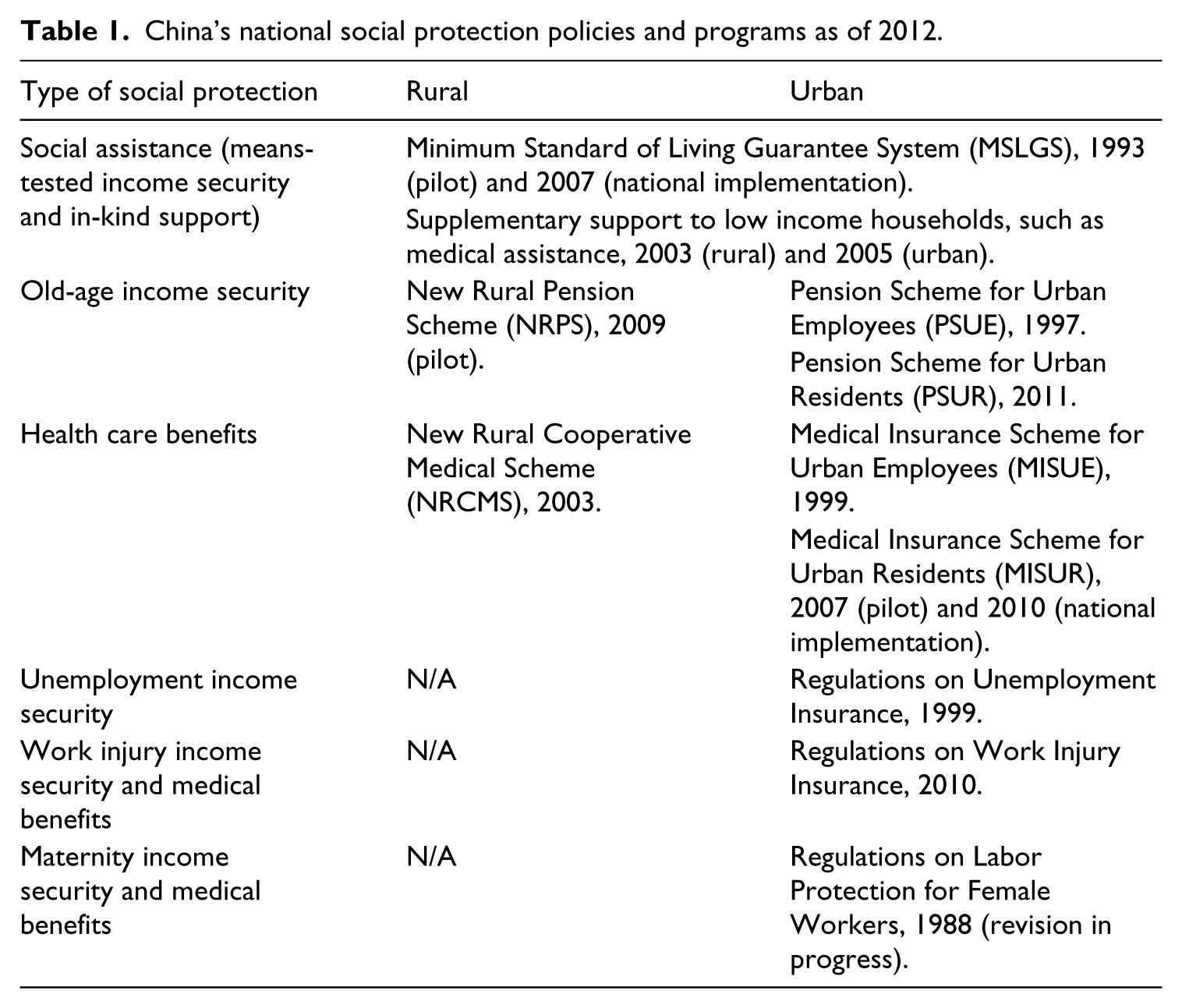
Today in the urban areas, the Chinese social protection system is comprised of social assistance programs and five major social insurance schemes covering old-age security, health care, unemployment, work injury, and maternity. In the rural areas, social protection programs safeguard residents from old age insecurity and provide basic health care coverage. Table 1 summarizes the main features of Chinese social protection policies and programs as of 2012. The following section provides an account of the programs in detail.
China’s national social protection policies and programs as of 2012.
Minimum income security
In this section we focus on income protection for those who are unable to sufficiently support themselves through earned incomes on the labor market, which is one of the key guarantees promoted by the SPF. As noted above, since 2000, China has seen a rapid extension of social assistance through the new Minimum Standard of Living Guarantee System (MSLGS), first in the urban, and later in the rural areas.
As economic reform progressed in the late 1980s and early 1990s, it became clear that increasing numbers of jobless people posed a serious issue (Han and Zhang, 2010). Whereas the ‘Three-No’s’ had previously constituted a majority of the urban poor, 70–90% of the new urban poverty stems from the effects of the market reforms (Lin, 2007).
In response to this new problem, in 1993 Shanghai pioneered the urban MSLGS scheme and was soon followed by other provinces and cities with the support of the Ministry of Civil Affairs (MCA) (Guan and Xu, 2011). The new scheme was not only to cover the former ‘Three-No’s’ group, but the poor in general. However, financing posed a challenge for local governments at the municipal and district levels, which resulted in very low coverage and extremely strict eligibility in many areas. Before 2000, there were only around 4 million recipients, while researchers estimated that the actual number of urban poor was around 30 million by the late 1990s (Zhang, 2012). The central government thus decided to significantly increase its share of total financing, which rose from 0% to 54% from 1998 to 2001 (Xu, 2007). Consequently, the number of recipients increased sharply in the 1999–2002 period from less than 4 million to nearly 21 million, and finally to a stable figure around 23 million (National Bureau of Statistics [NBS], 2012). Urban Chinese who were laid off or unemployed now constituted the majority of recipients, and the scheme had therefore successfully expanded well beyond those afflicted by the ‘Three-No’s’ (Chan, 2010).
In contrast to urban China, the State Council was reluctant to make rural schemes anything more than a local responsibility, despite the fact that the MCA had actively pushed the idea of a nationwide rural scheme (Guan and Xu, 2011; Zhang, 2012). Before it became a national policy in 2007, coverage was patchy, and the number of rural counties with an MSLGS scheme even declined after the turn of the millennium. Coverage climbed from 3 to 16 million in 2003–2006, however, and following nationwide adoption in 2007, it increased to 53 million in 2011 (NBS, 2012).
The picture is less rosy for benefit levels. Here, it is important to note that the income threshold at which point one can start receiving the benefit remains a matter for local governments to decide. In the urban scheme, the average threshold declined from 31% to 16% of local average disposable income in 1999–2010 (Lei, 2012; MCA, 2013; NBS, 2012). To be sure, the average threshold has certainly increased in absolute terms (from 1788 to 2832 yuan/year 4 in the same period), but it failed to keep pace with the rapid rise in Chinese incomes, resulting in higher levels of relative poverty. Moreover these threshold levels do not correspond to actual benefits paid, since it is a top-up scheme, where other income has to be subtracted from the threshold. In rural China, the official poverty line had lagged substantially behind the income development, declining to 19% of the rural mean income in 2007 (World Bank, 2009). In 2011, however, the central government finally raised the line to 2300 yuan/year in 2011 (or about US$1 per day at the time), equal to a 92% raise of the 2009 line (Wall Street Journal, 2011).
The cash benefit is often accompanied by supplementary support, typically including medical care, housing, and education benefits (Lei, 2012). For example, medical assistance was mandated in both urban and rural areas in 2005 and 2003 respectively, providing one-off financial assistance to medical treatment and hospitalization and subsidies for health insurance premiums (International Social Security Association [ISSA], 2013). However, there is still no unified national structure as these supplementary benefits remain subject to local variations.
A concern to avoid misuse also translates into quite strict eligibility criteria and local practices that might seem to go against the SPF goal that ‘basic income security should allow life in dignity’ (ILO, 2012). For example, the 1999 regulation on the urban MSLGS requires that applicants’ details are made public locally (for example on noticeboards) and neighbors are interviewed regarding the eligibility of applicants (Chan, 2010). Individual eligibility assessments are carried out by local Street Offices and Resident Committees, typically untrained social workers who often include informal or unwritten eligibility criteria of their own. Excluding the able-bodied poor without a job has been a widespread practice (Lei, 2012; Solinger, 2011). Possession of certain ‘luxury’ goods such as electrical appliances or even pets constitutes another widespread basis for exclusion.
The result is that many of the poor are still excluded from the scheme. In a survey of 14 cities Wang (2007) found that while 13.6% of all urban households had a pre-transfer income below the local MSLGS thresholds, this figure for post-transfer income only dropped to 12.6%. These data (for 2004) are not very recent, but according to the official data outlined earlier, urban coverage has not really increased since then. In response, the central government has issued several instructions to cover whoever is in need and falls below the income thresholds, but the conclusion is that it is not possible to talk of the MSLGS as a basic, universal entitlement covering all Chinese poor. The historical practice of trying to target only those considered the most deserving is still a prevalent tendency, even if the scheme has become more inclusive in the new millennium.
Unemployment insurance
In China, unemployment insurance functions as a second tier to income security for many unemployed but this insurance is only available in urban China. Unemployment is still not formally recognized as an issue in rural China, or at least it is considered to be ‘hidden unemployment’ as rural people have access to a plot of land and therefore some form of subsistence (Murphy and Tao, 2007). Migrant workers are covered by the insurance, and constituted about 16.7% of the total 143.2 million of insured by the end of 2011 (Ministry of Human Resources and Social Security [MHRSS], 2012). In practice, however, this population still faces participation barriers, not least because many do not have formal work contracts to prove their work history (Gao et al., 2012).
Unemployment insurance in urban China was set up in its present form in 1999, but the scheme had a precursor in the ‘job-waiting insurance’ scheme from 1986, adopted in tandem with an important labor market reform that laid the foundations for labor as a commodity on an actual labor market (Duckett and Hussain, 2008; Xu, 2012). The 1999 scheme expanded eligibility to all urban employees, but also removed the earnings-related element to make it a flat rate. Moreover, the exact benefit level is defined locally, with the stipulation that it must be above the local minimum level of living, but below the local minimum wage. The duration is set at one to two years depending on the individual contribution period. The scheme is financed by employees who contribute 1% of their wage, while employers contribute 2% of the payroll (China Development Research Foundation [CDRF], 2012; Vodopivec and Tong, 2008).
The insurance currently covers around 30–50% of the registered unemployed (CDRF, 2012; NBS, 2012). However, the real coverage rate is much lower, since it is well-known that the real unemployment rate in urban China is much higher than the official rate according to the standard, ILO definition (Giles et al., 2006; Han and Zhang, 2010; Solinger, 2001). The mismatch was highest just after the turn of the millennium, when survey-based estimates of urban unemployment confirmed it was two to three times higher than the official rate of 4% (Dong et al., 2007; Han and Zhang, 2010; OECD, 2010). The main reason is that important groups of de facto unemployed have trouble registering, especially the migrants in urban areas with rural hukou and the group of laid-off workers, not formally considered to be unemployed during economic restructuring. Thus while the official unemployment rate remains at 4%, the effective coverage of unemployment insurance remains quite low if real unemployment is taken into account.
Unemployment insurance provides more generous benefits than the urban MSLGS, but it has also been affected by declining replacement rates in the face of rapidly rising Chinese wages. Although the average benefit per recipient increased from 2700 to 7300 yuan/year in 2001–2011, this corresponded to a drop in the net replacement rate from 33 to 23.5% 5 (CDRF, 2012; NBS, 2012). The scheme thus represents a second tier of slightly more generous basic income compared to the MSLGS, but also one where adequacy remains very low for most wage earners and therefore the insurance element is nearly absent in reality.
Old-age pension schemes
Alongside the MSLGS and unemployment insurance, public pensions operate as a tier of protection against old-age income insecurity. In the urban areas, changes to the pension system became an imperative in the early years of the economic reform. In the early 1980s, a sudden and rapid rise in number of retirees struck the already feeble SOEs, resulting in a ‘pension crisis’ (Xu and Zhang, 2012: 46). Early experiments to reduce SOEs’ pension burden involved introducing individual contribution and social pooling mechanisms at local levels (Salditt et al., 2007). The level of pooling was later raised to provincial and equivalent levels, and the system expanded to include other types of ownership. In 1997, the central government issued a blueprint for the structure of a nationwide system for enterprise employees (State Council, 1997), unifying local experiments that had taken place over the preceding decade. The new statutory Pension Scheme for Urban Employees (PSUE) featured a two-tier plan: a defined benefit pension based on ‘social pooling’ and a defined contribution fully funded individual account. Over the following years, the structure and benefit rates have been adjusted a number of times, and regional variations existed. The following is an account of the national guidelines as of 2012.
The social pool is financed by 20% of an employer’s payroll, and the individual account by 8% of an employee’s insured earning. With a minimum 15 years of contribution, a basic monthly payment to a retiree 6 is calculated as the mean of the local mean wage in the previous year and the individual’s average indexed monthly earnings, multiplied by 1% for each year of contribution. On top of this basic benefit, a retiree receives from the individual account a monthly payment equal to the accumulated funds and interests divided by 139 (actuarial month as per life expectancy). In case a retiree outlives 139 months, this benefit continues to be payable out of the social pool, with the state promising subsidies in case of shortfalls. If the 15-year contribution requirement was not met, savings in the individual account will be paid as a lump sum at retirement.
Since 2005, continuous efforts were made to extend national coverage to the self-employed population and migrant workers (State Council, 2005). Whereas the structure of the scheme for the self-employed remains largely unchanged, a self-employed person contributes 20% of the local mean wage, 8% into a personal saving account and 12% to a social pool. At retirement, one can receive the same two-part benefits as enterprise employees.
Coverage of the PSUE was extended with an average annual growth rate over 7% 7 between 2000 and 2010. By 2011, the scheme covered 215.7 million or 60.1% of active urban employees, including 41.4 million or 26.1% of migrant workers (MHRSS, 2012). In the same year, the scheme was paying pension benefits to 68.3 million retirees (MHRSS, 2012).
Since 2005, the PSUE’s average level of benefit has seen a steady rise at an annual rate of 13.4%, a rate which is believed to outrun the price increase (MHRSS, 2012; Xinhuanet, 2012a). The two tiers of the pension plan have a combined target replacement rate of 59.2%, given a minimum 15 years of contribution (ISSA, 2013: 112). Despite the increase in absolute amount, the replacement rate has been on a decline since 2001 (Xu and Zhang, 2012: 45), and had gone down to 42.9% in 2011 (Xinhuanet, 2012a).
In contrast to the rapid expansion of the urban pension scheme from the 1980s to the late 2000s, development of the rural scheme was sluggish. Local experiments with a voluntary rural pension scheme operated on the county level began in the mid-1980s. Despite being promoted nationally in the early 1990s, this voluntary pension scheme lacked sufficient support, which turned the scheme into poorly managed individual savings (Xinhuanet, 2012b). The New (2009) Rural Pension Scheme (NRPS), designed to succeed the old one (State Council, 2009), is comprised of two tiers, a universal non-contributory pension and an individual account. A notable difference from the old scheme is that the non-contributory tier is entirely funded by the state. The central government pledged 100% subsidies to the economically less developed regions and 50% to the better developed regions for this first tier. For the second tier, yearly contributions to individual accounts can be selected on a scale of 100–500 yuan with increments of 100 yuan. Under the current rates, a person aged 60 and above with a history of more than 15 years of contribution is entitled to a minimum of 55 yuan/month budget-funded universal benefit, and on top of that the accumulated funds in the individual account divided by 139, same as in the PSUE. The basic 55 yuan/month benefit is designed to be a universal entitlement and thus available even to those who have not contributed to the scheme at 60 (ISSA, 2013: 114). Those who are under-age are expected to contribute until they reach 60 and are allowed to buy a few years back in order to reach the 15-year contribution requirement. Enrollees of the old scheme are allowed to convert their old individual accounts into the new one, and continue to contribute until reaching 60. Migrant workers who have participated in the PSUE, yet not met the contribution requirement, can opt to transfer their individual balances from the PSUE to the NRPS, and continue to contribute to the rural one. The NRPS is designed to cover all rural residents aged 16 and above who are not covered by the PSUE. Since its introduction in 2009, its coverage has been extended from 86.9 million or 13% to 326.4 million or 49.7% of rural residents, including 85.3 million pensioners as of 2011 (MHRSS, 2012). The aim is to cover all counties in China by 2020.
The above two pension schemes were intended to cover the majority of Chinese people, but left the urban non-salaried and unemployed population without any guarantee of old-age security. This population has finally been protected under the Pension Scheme for Urban Residents (PSUR) in 2011 (State Council, 2011). This scheme, modeled on the NRPS, features the same two components: a non-contributory defined benefit universal pension and a defined contribution funded individual account. The PSUR’s program configurations are almost identical to those of the NRPS in terms of contribution and benefit rates, entitlement, and government subsidies, except that enrollees in the PSUR may choose out of 10 preset annual contribution rates ranging from 100 to 1000 yuan. Again, there are regional variations in the actual implementation of the national guidelines.
China’s blueprint for a pension system clearly depicted a shared responsibility between individual, employer, and the state (State Council, 1997). This principle has been adopted in all three major pension schemes. The Chinese government has shifted from a residual player to an active sponsor, recognizing older people’s universal rights to old-age income security. For example, the PSUR and the NRPS both stipulated a universal budget-funded component of pension benefit. This can be seen as a notable advance over the old pension schemes, in which old-age security was largely an individual matter. The rapid extension of coverage is another indication of the recognition that access to some form of old-age security is a universal citizen right, regardless of employment status and residential location. However, reliable coverage or participation rates are hard to obtain in China due to nonstandard reporting manners at lower levels of governments (Dorfman et al., 2012: 224–225). Coverage rates therefore should be interpreted with caution. Another grim fact is that the rapid extension has been accompanied by low levels of benefits. The replacement rate of the PSUE has been falling while the new 55 yuan/month benefit, although a universal entitlement, is meager. We thus have reasons to be concerned with increasing relative poverty for the Chinese elderly.
Another concern is the system’s sustainability. For example, despite continuing government subsidies, individual accounts in the PSUE, originally designed as a fully funded scheme, are nearly empty in many localities due to high payments to current pensioners. In 2010, 1.7 trillion yuan worth of fund in individual accounts was yet to be recapitalized (ISSA, 2013: 128). The scheme, thus operated on a de facto Pay-As-You-Go basis, is being put under tremendous pressure by population aging and price increases.
Apart from funding sustainability, China’s pension reform has to cope with a highly fragmented system caused by residential identities, employee classifications, and regional variations. On the national level, rural and urban residents are still segregated by the hukou system. The urban population is then divided into formally employed, informally employed, and non-salaried, each covered by a separate plan. 8 In addition, as we have noted, local adaptations of the national guidelines lead to regional inequalities. System fragmentation has not only created difficulties in management and limited redistributive power of the programs, but has also resulted in hindrance to accessibility, portability, and transferability of the benefits (Zheng, 2009). The 2010 Social Insurance Law took a step to coordinate the PSUR and the NRPS and enhance transferability and portability of the benefits, which can be interpreted as an attempt to gradually unify the fragmented system. As China’s pension reform is concurrent with ongoing large-scale labor mobilization and urbanization, an assessment of the reform cannot ignore the interplay between the reform and these social processes. For instance, enrollment rate for migrant workers is still quite low. Therefore, availability and adequacy of old-age security for migrant workers is an indispensable criterion for judging the reform’s success in the coming decade.
Health insurance
The SPF’s guidelines also emphasize universal basic health care. Three major health care insurance schemes guarantee basic access to medical services in today’s China: the Medical Insurance Scheme for Urban Employees (MISUE) and the Medical Insurance Scheme for Urban Residents (MISUR) for the urban population and the New Rural Cooperative Medical Scheme (NRCMS) for rural residents. As their names suggest, these three programs are parallel to the pension schemes, and indeed their development reveals the same progressive trajectory in response to the economic restructuring and growing social needs.
The MISUE was first introduced as a nationwide mandatory policy to cover urban employees in 1999. Enrollees contribute 2% of wages to an individual account, while employers contribute 6% of total payroll, out of which 30% goes to the individual account and 70% to a social pool. Outpatient care is fully paid for by the individual account. In case of hospitalization, the individual account pays equivalent to 10% of the local mean annual wage, and the pooled fund reimburses costs above 10% and up to 600% of the local mean annual wage according to a locally defined schedule. The average reimbursement rate is targeted at 70–80%, and often higher for the young, the old, and the low income population. The MISUE does not reimburse medical costs beyond 600%, which may be covered by other supplementary systems.
The NRCMS and the MISUR are two voluntary schemes introduced nationally in 2003 and 2010 to cover rural residents and urban non-salaried residents such as children, the elderly, and the long-term unemployed. Both schemes are financed by flat-rate contributions from individuals and government subsidies. Rural residents pay premiums of about 20–50 yuan/year to the NRCMS; whereas urban residents contribute 200–300 yuan (50–100 yuan for children) yearly to the MISUE. Although individual contribution levels vary regionally, government subsidies reached 240 yuan per person per year in both schemes in 2012. The total reimbursement ceiling is set at six times the local mean income, with an average reimbursement rate targeted at about 70% in both schemes in 2011 (ISSA, 2013: 119).
By 2011, the MISUE, the MISUR, and the NRCMS covered 252.3 million, 221.2 million, and 832 million people respectively; that is, as many as 97% 9 of the population were covered by some form of medical benefits. Two caveats however should be mentioned. First, the schemes are administered by different government bodies, for example, the MISUE by the MHRSS and the NRCMS by the Ministry of Health (MOH). Figures released from different sources are sometimes inconsistent. Second, there are overlaps of coverage between the schemes, because migrant workers can be enrolled in both the MISUE and the NRCMS. As a result, an accurate coverage rate is hard to pin down. However, it is fair to say that medical insurance coverage in China has been extended rapidly in the past decade, in particular in the rural areas. For instance, the NRCMS started with merely 80 million participants in 2003, and had extended its coverage over 10-fold by 2011. Nevertheless, the level of benefit is still meager, with an actual average national reimbursement rate of 46.9% in 2011 (Meng et al., 2012), much lower than the targets and especially inadequate to protect enrollees against catastrophic illnesses (Herd, 2013). ‘Universal coverage with shallow benefits’ is an explicit strategy stated by the Chinese government in its health care reform (Yip et al., 2012). As the coverage is now nearly complete, the challenge will lie in pushing forward the reform and making health care services more affordable.
The Chinese case looked at through the Social Protection Floor
As outlined briefly in the introduction, the fundamental goals of the SPF in many ways resonate strongly with current Chinese reforms. In what follows we focus on the policy level, but it is worth beginning with a reflection on what the SPF agenda could mean for the Chinese case.
First and foremost, as an emerging superpower in the process of defining its own global agenda, the goals of China’s welfare reform do resonate with the SPF agenda. However, this is not to suggest that the SPF has actually influenced Chinese thinking. Thus those who would might expect to see the direct influence of international actors and ‘global social policy’ on concrete policy-making will be disappointed. At the same time, if we view global social policy as involving the discursive spread of policy ideas and norms, facilitated by international actors, then there is much more to be said.
It is certainly the case that China is looking abroad to find inspiration and its search is oftentimes mediated by global policy actors. The current pension system closely resembles the recommendations of the World Bank at the time, a fact which some have tracked to connections between World Bank staff and reform-minded Chinese officials (Frazier, 2010; Salditt et al., 2007). Unemployment insurance was set up after a Chinese review of the systems of more than 40 countries (Leung, 2005). The extension of social assistance certainly also falls in line with the global trend to extend assistance-like poverty schemes, as has been identified by, for example, Leisering (2010). Public Employment Service Centers for the unemployed were made nationwide policy in the beginning of the millennium, inspired by ILO recommendations, and supply-side-oriented ideas such as this also dominated the policy-making of industrialized countries (Xu, 2012). Therefore, the set-up of the schemes covered here and the subsequent extension of coverage certainly do owe something to the global diffusion of policy ideas, even if the extent of this influence is difficult to pin down.
More specifically, while not directly influenced by the SPF, China is to some extent drawing on the same influences that also have informed the Floor as a relatively new agenda. For instance, China has ratified some of the Floor’s predecessors such as the International Covenant on Economic, Social and Cultural Rights, and the Rights of the Child (Kilburn and Kozyrev, 2012). Although it is easy to question the implementation of the whole range of international rights treaties signed by China, the international legitimacy gained by being able to point to progress on these accounts is not insignificant, and nor is the tacit influence that the awareness of having signed these treaties might induce. That said, the quest for domestic legitimacy and a simple need to put out the fires lit by the new market economy are by far the most significant driver of change.
As we have shown here, welfare reforms in China in the new millennium have progressed along some of the lines drawn up in the SPF. Of particular importance are the significant steps taken in increasing coverage of pensions, social assistance, and health insurance. The fundamental goal of the Floor, to ensure the ‘specific universal right of everyone to social security and to a standard of living adequate for the health and well-being of themselves’ (ILO, 2011: xxiv), which was also the basic sentiment of the International Covenant of Economic, Social and Cultural Rights, might then appear to largely be secured in the Chinese case.
However, as evident from the above discussion, increasing coverage of schemes does not equal ensuring basic social rights for everyone. For example, in terms of minimum income security for the poor and the unemployed, we have tracked some very significant steps in China, primarily in the expansion of social assistance as a nationwide scheme since 2007, now covering more than 75 million Chinese in total. Nevertheless, despite benefits from supplementary welfare subsidies for health, education, housing, and the like, recipients continue to be relatively poor and they face very stigmatizing assessments and check-ups clearly designed to make the scheme an undesirable solution of last resort. The way the scheme is implemented also clearly entails an exclusion of large groups of poor who actually fall below the local income thresholds, so it cannot in practice be said to constitute a basic, universal right for all poor people. Coverage of unemployment insurance also falls well below the level of actual unemployment because so many of the de facto unemployed find themselves outside registered unemployment. Both the unemployment insurance and MSLGS schemes also have had problems keeping up with the general Chinese income development, resulting in increasing relative poverty for recipients.
The new health insurance schemes for rural and urban citizens outside the established workforce are also difficult to talk about as basic rights for everyone. First, they are insurance schemes dependent on participation and contributions. Second, the design of the new health insurance schemes for those outside the urban workforce is sufficiently ‘cheap’ in terms of funding and contributions to allow rapid extension of coverage, but too cheap to sufficiently deal with health insecurity. Reimbursement rates are very low, and treatments have to be paid up-front before reimbursement, leading to situations where people do not have the means to get treatment, especially in the case of serious and catastrophic illnesses, even if they are formally insured.
It is easier to speak of the pension schemes for rural and urban residents as an effective, basic social right, since there is a flat-rate minimum integrated in these schemes, formally for everyone above the pension age. However, this minimum benefit is still so low (even lower than the social assistance-like MSLGS) that it by itself is not at all sufficient for income security. Although there is now a nationwide minimum pension in place, only the pension system for urban employees can be considered adequate and even here replacement rates have also been declining, as shown previously. Migrant workers still face barriers to participation, as evident in the low coverage rate for this population.
In short, the SPF is a rights-based approach (ILO, 2011: 9), but the degree to which social rights as a core idea have been instilled in China is still questionable, despite the Insurance Law that officially recognizes social rights to protection. The Chinese government has long way to go to achieve the goal of ‘universal coverage with shallow benefits’, and then gradually lift the level of benefits to ensure adequacy.
To be sure, the Chinese government has increased input into social protection programs in all areas, but this raises the problems of financial sustainability and funding fragmentation. The SPF agenda pointed out the importance of sustainability and especially ‘long-term adequacy’ of social protection programs (ILO, 2011: 67). The Chinese case testifies to the crucial role of the national state in creating fiscal spaces and a strong political will to carry out a reform. Although the protection programs aimed to form a policy floor that covers all Chinese citizens, regardless of their residential and hukou identities, this national effort is undermined by the continued existence of a scattered system as social protection programs are still administered and funded at municipal and county levels; program set-ups vary across provinces and regions. Integration and consolidation of the fragmented system must be a priority for the Chinese government, before a national ‘floor’ can be built.
China’s social protection spending underlines the importance of protection policies as part of an economic stimulus package and the role they could play as an automatic stabilizer of the economy (Stiglitz, 2009: 4). During the latest global economic crisis, China’s stimulus package comprised about 24% of the total fund as some kind of social protection expenditure (ILO, 2011: 53). In 2008, the central government launched a supporting policy called ‘Five Deferrals, Four Reductions, Three Subsidies’, a series of measures to subsidize employers’ social insurance contributions and to promote job training for employees. These measures are believed to have supported employers and stabilized the labor market throughout the crisis (Xinhuanet, 2009).
Over the past few years, active labor market policies (ALMPs) have gone hand in hand with unemployment insurance policies and the MSLGS program. The extension of social protection to the migrant population has also seen coordination with employment programs. Although national policies are still lacking, local cases have yielded some promise. For example, in Shanghai, the recent social care reform involved formalization of home care jobs. Social protection policies in this sense can have a positive effect of facilitating labor migration and reducing social exclusion.
As the history of development of China’s social protection institutions has revealed, the current social protection policies evolved out of the dualistic urban–rural system, but reforms have increasingly served to mitigate the barriers to rural-to-urban migration, and contributed to retaining rural migrant workers in urbanized and industrial regions. The Chinese case makes it clear that a national SPF can be gradually built on existing institutions, and be tailored to fit context-specific development priorities to the extent that creating a universal protection floor remains a long-term goal.
Conclusions
The Chinese economic reform era ushered in a period of a near total dismantling of social protection, not least because social protection had been so strongly connected to employment within the old planned economy. The 1990s was characterized by an effort to build up a new welfare system for the urban population, and then subsequently to ensure the coverage of protection schemes for the rest of the population in the new millennium. Viewed from an optimistic perspective, these reforms seem to resonate with the agenda of the SPF, even if the Floor has not directly influenced Chinese policy-making.
The most significant steps ahead are undoubtedly those taken towards making social assistance a nationwide policy since 2007, pension schemes for those outside the urban workforce in 2009 and 2011, and nationwide health insurance beginning in 2003. Health insurance is by all accounts now nearly universal in terms of coverage, while pension coverage has also increased rapidly, if by not as much. However, these policy fields are marred by problems which make it difficult to speak of basic social rights to adequate levels of protection, general well-being, and the possibility of living life in dignity – the ideals that constitute the foundations of the SPF.
First, there are the general problems of inadequate benefits not being able to keep up with rapidly increasing incomes. Even the more generous urban pension system has eroded to such a degree that it becomes increasingly difficult to speak of real income security. On top of that is the issue of financial sustainability of the schemes. Second, the policy fields covered in this article largely reveal how the new superstructure of social policy in reform-era China has been built on the institutional foundations of the pre-reform system. This also represents the biggest barriers to further progress in the spirit of the SPF, namely the hukou segregation and system fragmentation. Notably, the insurance schemes continue to be much more generous for the urban population inside the labor market. This is enforced and exacerbated by the hukou system, which is essentially a system of dual citizenship dividing the population. Therefore, rural residents, rural migrants in urban China, and urban residents with weak connections to the labor market face a welfare system that is very scant. In this respect, the new, mostly insurance-based welfare system still perpetuates inequalities rather than alleviating them.
Nevertheless, it is among the more vulnerable group where we have also seen the most significant improvements in ensuring the availability of protection, as evident by the new pension and health insurance schemes as well as the extension of social assistance to the rural population. Furthermore, the hukou system is not as divisive as it once was and there is a move towards convergence in the new social insurance schemes for rural and urban residents. There remains however a big problem of securing the population floating in a veritable no-man’s land, namely the migrants in urban areas with rural hukou. We have not yet seen any sign of abolishing the hukou system, but a critical discussion about the future of the system is ongoing in China.
In sum, the Chinese progress in terms of social protection is very ambiguous when viewed from the SPF agenda, and much of the more negative ambiguity stems from the institutional heritage of pre-reform China. At the same time, we should remember that high inequalities in terms of social protection availability and social outcomes are, and will continue, to be a simple fact in a country with more than 1.3 billion people and extremely diverse levels of economic development. In that sense, the economics of scale is not an advantage for ensuring greater equality of social rights and social outcomes. Nevertheless, China has taken some big strides ahead in terms of social protection. They might not yet be as formidable as the leaps taken in the new market economy but there have nonetheless been some very noticeable steps in the right direction.