







Abstract
This article compares how the global policy of deinstitutionalisation (DI) of child welfare travelled, was translated and institutionalised in two post-Soviet countries – Russia and Kazakhstan. These countries share a Soviet legacy of child-welfare systems dominated by residential care and have recently introduced similar DI reforms based on the global child rights framework. However, despite similar institutional legacies and post-Soviet conditions, the DI reforms have produced different outcomes in terms of the scope and pace of the institutionalisation of DI policy. In Russia, the DI of child welfare has been a fast-moving and sweeping reform, while in Kazakhstan, the implementation of DI has been an incremental and gradual process. We argue that the institutionalisation of the DI policy in two post-Soviet contexts was an outcome of the interplay between structural factors and the agency of policy actors who translated global DI ideology into domestic policy discourses. Yet, they were ‘sold’ with quite different discursive frames – one nationalist, another one trans-nationalist – in these two countries. We claim that the geopolitical position of a country is also a significant factor for framing and thus, in the end, in how child-welfare systems have been reformed.
Keywords
Introduction
Deinstitutionalisation (DI) of residential care is a global policy which seeks to relocate residents in institutional care, including persons with disabilities or mental illness, the elderly and children left without parental care, as well as criminal offenders and (more recently) the homeless, to community-based housing accompanied by the development of services that support participation in the community (Segal and Jacobs, 2013). We focus on DI of child welfare in Russia and Kazakhstan; namely, the reduction of residential institutions for children left without parental care and development of foster care and community-based support services for families at risk.
DI is internationally affirmed by several binding treaties, including the UN Conventions on the Rights of the Child and of Persons with Disabilities, ratified by both Russia and Kazakhstan. With a heavy legacy of Soviet residential care, Russia and Kazakhstan have been reforming their child-welfare systems to bring them into line with global DI policy. In this article, we explore how global DI policy travelled and was translated and institutionalised in these countries. We are therefore interested in how global ideology settles in national contexts and becomes ‘glocal’ with the co-presence of both universalising and particularising tendencies (Robertson, 1995). Such domestication of a global ideology shapes the policy outcomes, as we show.
Russia and Kazakhstan, which share the legacy of a Soviet child-welfare system, have introduced similar DI reforms based on the global child rights framework. However, our analysis shows that despite similar socioeconomic and institutional conditions, the same global DI ideology produced different outcomes in terms of the scope and pace of the institutionalisation of DI policy. We seek to explain what factors contributed to different outcomes, applying an analytical framework inspired by the ASID (Agency, Structure, Institutions and Discourse) approach developed by Moulaert et al. (2016; also Deacon and Stubbs, 2013).
Our comparative analysis draws on data collected by the authors over the past 7 years for ongoing research on child-welfare reforms in Russia and Kazakhstan. The data include expert interviews, policy documents, statistics and media sources. 1 For this analysis, the DI policy is operationalised as (1) dismantling large residential institutions and creating small family-like units; (2) developing care in families, including adoption and fostering; and (3) strengthening community-based services for families at risk.
In this article, we first outline our theoretical framework on global social policy. Then we turn to describing the conflicting global DI and Soviet child-welfare ideologies, followed by two country cases of the introduction and institutionalisation of global DI policy. We conclude with the ASID comparison of the two country cases, focusing on different outcomes and factors behind those differences.
Post-socialist social policy and global social policy
The disintegration of the Soviet Union and the Eastern Bloc in 1990 has given rise to the study of post-socialist social policy. Post-socialist social policy is also global social policy, because post-socialist transition has been a global project of integrating the former socialist countries into a global capitalist system (Bönker et al., 2002). Post-socialist reforms have been transnational sites within which inter- and supranational state and non-state organisations and actors enter into complex relations of power and negotiation with domestic actors (Deacon and Hulse, 1997; Orenstein, 2008; Stubbs, 2007).
Post-socialist social policy has been shaped by the transnational policies and paradigms that travel globally across nation-state borders, but these must be domesticated in specific social and institutional contexts. There are two dominant perspectives on the transmission of policies: the policy transfer approach, which emphasises the agency of policy actors and the nature of the policy process, and the policy diffusion approach, which concerns itself with general patterns and factors influencing policy adoption (Marsh and Sharman, 2009; Stone, 2012). Both approaches, however, view ideas as fixed constructs and their transmission as a linear process. Alternatively, we draw on the concept of ‘glocalisation’ (Robertson, 1995) to account for the co-presence of universalising (global) and particularising (national) factors, and on a policy translation approach which examines the process through which social actors interpret, transform and adopt new ideas. In addition, concerning this translation process, instead of viewing ideas as nothing but fixed, we draw on the concept of ‘discourse’ deriving from the constructionist worldview, which views ‘meanings’ as modifiable social constructs. Policy translation offers a ‘contextually-rooted understanding of the interactions within and between supranational and national actors’ (Lendvai and Stubbs, 2007: 174).
Following Deacon and Stubbs’s (2013) suggestion of a multidimensional approach to analyse complex global social policy fields, we apply Moulaert et al.’s (2016) ASID framework to structure our comparative analysis of two country cases. To operationalise the ASID model, we approach structure as the macro-level socioeconomic and geopolitical context that is beyond the control of actors and constitutes the environment constraining or enabling their action. Second, we look into competing policy discourses as possible frames, that is, discursive means to construct and shape meaning (Schatz, 2009) in the reform processes. Third, we examine agency by investigating the distinct roles, power relations and interdependencies among policy actors, including global/transnational and domestic state and non-state actors. Finally, we conclude on institutions as child-welfare systems and the institutional outcomes of DI reform in each country.
Global DI policy and Soviet child welfare: two conflicting ideologies
DI refers to the principle underlying the shift in the provision of care to various groups of people in need of support from institutional care to the ‘living in the community’ model. Integral to DI is the replacement of a paternalistic ethic by an interactive ethic, and recognition that the human rights, dignity and autonomy of an individual take precedence over their needs.
While DI has a long history in the Western societies (Liebel, 2013), here we focus on the global context in which DI in child welfare became a global policy ideology that was transmitted to post-socialist policy contexts. Deinstitutionalising children’s residential institutions roots back to the world wars and concerns children after experiencing war. The first attempts to set up a global legal framework resulted in the Geneva Declaration on the Rights of the Child (1924), which later became the non-binding United Nations (UN) Declarations adopted in 1948 and 1959. The 1960s’ civil rights movements in the West shifted the emphasis from children’s needs and child protection to child rights, agency and autonomy. A child rights framework was institutionalised as a binding global policy when the UN Convention on the Rights of the Child (UN CRC) was adopted in 1989. Although it does not specifically call for the dismantling of residential institutions, the Guidelines for the Alternative Care of Children (adopted in 2010) set clear expectations for DI in child welfare and obligations for member states to implement relevant national policies. The UN CRC was ratified by most newly independent post-Soviet states, including Russia in 1990 and Kazakhstan in 1994. The more recent UN Convention on the Rights of Persons with Disabilities (UN CRPD) (2006) explicitly recognises the right of disabled children to family life and requires that states provide services to prevent segregation of people with disabilities. Russia and Kazakhstan ratified the UN CRPD in 2012 and 2015, respectively.
The UN CRC has been integral to human rights and democratisation discourses involving global policy actors in post-socialist reforms. Western child-welfare experts’ long-term consideration of the disadvantages of residential care was reaffirmed by the discovery of the terrible situation of children in institutions in the region (Burke, 1995; Zeanah et al., 2005). It was early in the 1990s that global child rights advocates defined reliance on institutional care as the main challenge in the region and determined DI as a top priority in child-welfare reforms (United Nations Children’s Fund [UNICEF], 2003).
Russia and Kazakhstan both inherited from the Soviet Union vast networks of large, specialised residential institutions for children with various needs, including orphans, abused and neglected children, disabled children, juvenile offenders and so on. The dominance of institutional care in both countries before the reform dates back to the Soviet ideology of collective care and upbringing and the idea of the paternalist state as the primary caregiver. The Soviet child-welfare model prioritised care in state residential facilities regarded as a favourable environment for children to grow up to be good Soviet citizens (Stryker, 2012). Apart from child welfare, other collective forms of education, such as work colonies and pioneer houses, also included living in an institutional setting. Moreover, Soviet child psychology focused on physical and cognitive functioning, in contrast to the attachment and socialisation theories which led to an emphasis on family-type care in the West (Disney, 2015). However, in reality, Soviet institutions provided children with only basic education and care and failed to meet children’s developmental, health and social needs. Institutionalisation led to very poor outcomes for graduates in terms of their social adaptation and accompanying societal stigma (cf. Khlinovskaya Rockhill, 2010).
Thus, the global DI ideology, with its emphasis on the family environment and community-based preventive and supportive services, was in conflict with Soviet child-welfare ideology, which viewed residential institutions as an embodiment of an omnipotent and benevolent state taking care of its children. DI reforms intertwined with the shift of the ideal of care from institutional care to family care in biological, adoptive or foster families (or family-like settings). In the context of the Soviet-rooted dominance of residential institutions in Russia and Kazakhstan, the global DI policy required a paradigm shift in the understanding of good care and in the institutional design of child welfare (Kulmala et al., 2017).
Context: post-Soviet macro socio-economics and geopolitics
Child welfare and DI reforms in Russia and Kazakhstan have been shaped by the wider structural socioeconomic and geopolitical factors. This section maps out three periods in macro-level developments, each shaping the context for DI reforms.
‘Transitional’ economic and social crises, 1990–1999
Following the collapse of the Soviet Union, all former socialist states experienced severe economic depression, the so-called ‘transformation crisis’ (Myant and Drahokoupil, 2010). The drop in gross domestic product (GDP) was particularly harsh in the post-Soviet countries, with Russia and Kazakhstan losing around 40% of their output (World Bank, 2002). In the early 1990s, a set of radical economic reforms, including privatisation and liberalisation were introduced to transition from planned economies to market economies. In response to economic crises, most states made drastic cuts to their welfare provision, including health care and social benefits (Cook, 2013).
This transition was accompanied by dramatic changes in living standards described by the 1999 UN Human Development Report as ‘a human crisis of monumental proportions’. 2 Dramatic increases in poverty and mass unemployment and the erosion of welfare systems caused growing inequality, a sharp decline in income and life expectancy and an increase in crime, suicide and alcohol and drug abuse (Kulmala et al., 2014; World Bank, 2002). These all contributed to the destabilisation of families, resulting in growing numbers of so-called ‘social orphans’, that is, children whose parents have lost their parental rights. In both Russia and Kazakhstan, the number of children in residential care grew drastically after 1990 (Biryukova and Makarentseva, in press; UNICEF, 2001).
After the collapse of the Soviet Union, Russia and Kazakhstan sought integration with the international community. In the 1990s, Russia’s foreign policy, labelled ‘liberal internationalism’ (Lynch, 2002), aimed to build non-confrontational relations with the West. Likewise, Kazakhstan declared a multi-vector foreign policy seeking to build its international reputation (Schatz, 2006). Both countries opened up to international influence, not only from foreign states but from transnational corporations and non-governmental organisations (NGOs). From the perspective of the later child-welfare reforms, such open-door policies created opportunities for emerging civil societies to engage with transnational actors and global child rights and DI (An, 2017; Bindman et al., 2019).
Economic growth and increasing social welfare, 2000–2008
In the 2000s, Russia’s and Kazakhstan’s economies began to recover, primarily thanks to high oil prices in the global market (European Bank for Reconstruction and Development [EBRD], 1999). Both countries enjoyed strong economic growth in 1999–2008, with an average annual increase in GDP of 6.9% in Russia and approximately 9% in Kazakhstan. Both countries significantly increased their foreign trade and diversified their trade partners (World Integrated Trade Solution [WITS], 2019).
This economic growth was accompanied by a shift in Russia’s relations with the world. The official discourse reinstated Russia as a global ‘superpower’ that could counterbalance the dominance of the West in an otherwise ‘unipolar’ world (Mankoff, 2009). During this period, Russia sought to regain its leading position in the Commonwealth of Independent States and strengthen cooperation outside of the West through, for instance, joining the Eurasian Custom Union in 2008 and Shanghai Cooperation Organisation in 2001. Kazakhstan in turn continued to implement a multi-vector foreign policy balancing relations with the West and the East, including Russia and China (Hanks, 2009).
Oil-driven economic growth led to improvements in the living standard of ordinary people and to more governmental emphasis on welfare (Cook, 2013). Russia increasingly invested in social policy, particularly family policy, due to demographic concerns (Kulmala et al., 2014). Kazakhstan also raised social support from 2000, but the investment was modest compared to Russia’s (McCullaugh, 2013).
Sluggish economic recovery and new frames in social policy in the 2010s
When the global financial crisis in 2008 interrupted the aforementioned growth and revealed the vulnerability of oil-driven development, Russia and Kazakhstan set up new goals to modernise and diversify their economies. The ensuing recession was followed by a slow recovery fuelled by public stimulus interventions and domestic consumption (EBRD, 2010). Sluggish recovery in the Russian economy was interrupted again by the Russian–Ukrainian conflict in 2015. The resulting sanctions by the United States and European Union (EU) hit Russia directly and Kazakhstan indirectly (EBRD, 2019). In response, the Russian government adopted more introverted economic policies framed by national security and self-reliance. Importantly, sanctions have had a ‘rally round the flag’ effect on Russian society: they have increased social and political cohesion around the Russian state and negative attitudes towards the West (Connolly, 2016). Also, the ‘morality turn’ in the Russian official discourse emphasised the family and traditional values as integral to national identity (Laruelle, 2014). After 2 years of slow growth in 2015–2016, Kazakhstan’s economy returned to moderate growth (EBRD, 2019). Kazakhstan recently developed a new long-term strategy aiming at modernising its society and increasing its global competitiveness, a strategy that continues to build on discourses of international recognition (Nazarbaev, 2017).
In sum, while the structural factors shaping the context of child-welfare reforms in Russia and Kazakhstan have been similar over the past three decades (apart from the most recent developments), we argue that there is an important distinction in the national discourses, which is crucial for understanding how the global DI ideology was translated and institutionalised in these countries. Now we turn to DI reforms in these two countries.
The Russian family as a core concern of social policy: premises for DI reform in Russia
Demographic crisis and attention to family policy
The turbulent transition in the 1990s led to increasing need for care for children left without parental care. Soviet-type residential care continued to serve as the dominant form until the 2010s – although DI had been somewhat on the policy agenda, thanks to new transnational collaborations of NGOs in the 1990s. This new space for civil society to address new social issues, including child rights, was crucial for the later reforms.
Russia ratified the UN CRC quite early, in 1990. The first Russian Constitution (1993) brought the national legislation in line with the international child’s rights commitments. The constitution was followed by the new Family Code (1995), which in principle prioritised family forms of alternative care, but in practice residential care remained dominant for more than a decade. The UN had repeatedly reminded Russia about the large number of children in institutions and its insufficient efforts to change the situation.
Russian economic growth in the 2000s led to wide investments in social policy, namely family policy (Kulmala et al., 2014), which laid the ground for the later DI reform. Since the early 2000s, the severe decline in population, or ‘demographic crisis’, started to dominate the political agenda as a most severe threat to the Russian nation (Cook, 2013), which created ‘moral panic’ surrounding family values and childhood (Kulmala et al., 2017). Since 2005, a strong family-centred ideology started to characterise policy programmes and a new conservative ‘protection of the family’ became a key task for the Russian government. The most prominent measures were introduced in President Vladimir Putin, 2006 annual address to the nation, in which demographic decline was named as ‘the most acute problem facing our country today’ (Putin, 2006). ‘Love for one’s country starts from love for one’s family’, the president continued, setting Russian family and family policy as the major priority through which the demographic crisis was to be tackled. Aiming at increasing the birth rate – instead of addressing low life expectancy – numerous pronatalist measures were introduced, including increases in family and maternity benefits (Cook, 2013). Finally, in the 2010s, the increasing attention towards Russian families grew to also encompass children left without parental care and rather rapidly led to a paradigm shift in Russian child-welfare policy (Kulmala et al., 2017).
The Dima Yakolev case and new priority of child welfare
As often with paradigm changes (Khmelnitskaya, 2015: 16–17), the Russian reform was triggered by an exogenous crisis. In 2008, a child adopted from a Russian orphanage died as a result of negligence by his American parents. This ‘Dima Yakolev’ case prompted a ban on the adoption of Russian children by US citizens in 2012 and, importantly, drew attention to children living in institutions. A number of abuse scandals in Russian children’s homes furthered media and public interest in the topic, opening a ‘window of opportunity’ for Russian child-welfare NGOs to put forward their proposals at an official level (Bindman et al., 2019).
The issue of children’s institutionalisation was addressed as the government’s top priority by President Dmitry Medvedev in 2010, followed by several policy programmes designed with the involvement of Russian child-welfare NGOs. The ‘National Strategy to promote the interests of children in 2012–2017’ adopted in 2012 recommended children’s homes be reorganised into ‘family support centres’ whose primary task was to return children to their biological families or place them in foster families. This important document articulated key alternatives to residential institutions, and contained frequent references to international treaties. It took, however, several years to develop implementation mechanisms for these proposals, starting with Presidential Decree No. 1688, signed on 28 December 2012, on the same day that the ban on adoptions of Russian children by US citizens was signed into law. It directed officials to work on fostering and adoption, and added a specific criterion for the ‘effectiveness’ of regional governors by measuring the proportion of children placed in family care in their region, thus setting a strong top-down incentive to implement the reform in the non-democratic political environment. Moreover, in 2013, the presidential party, United Russia, established a nationwide programme ‘Russia Needs All Its Children’, which indicates the prioritised position on the issue and the demographic motivation behind the policy.
Finally, Government Decree No. 481 in 2015 fundamentally altered the nature of care in residential institutions. Children’s homes are now ‘family centres’ working with biological and foster families, with family replacement for a child as the ultimate goal. Such centres are designed to resemble a family-style environment: children live in small groups in apartment-type premises and go to local schools (Kulmala et al., 2017).
Thus, the Russian DI reform discursively grew from the demographic crisis, constructed as a threat to the nation, and became intertwined with President Putin’s wider ideological project to revitalise the nation (Bindman et al., 2019). The prioritisation of family care over institutional care fits well into the dominance of ‘family talk’ on the government’s agenda. This family talk was accompanied by painting pictures about various threats to Russian children, from foreign adoptive parents to unregulated Internet spaces and ‘homosexual propaganda’ (Kulmala et al., 2017), making a case for the issue to be solved domestically – in Russian heterosexual nuclear families. Russian NGOs played a crucial role in providing the content for the reform. The context of ‘family talk’ made it easy for Russian child-welfare NGOs to promote key principles of DI.
Role of domestic NGOs
The Dima Yakolev incident was epochal in turning the all-encompassing emphasis on families to include child welfare. With increasing awareness domestically of the inhumanities of institutional care in the country (as well as increasing pressure globally), the Russian government finally acknowledged the necessity of reforming the system. It now had the political will, a precondition for any successful reform in a top-down led political system (Gel’man and Starodubtsev, 2016). Expertise in DI policy reforms came from Russian child-welfare NGOs, developed in the international collaboration that was still possible in the 1990s, while later the government took tight grasp on NGOs, especially those with foreign funding and working in the field of human rights (Bogdanova et al., 2018). Even the UNICEF was asked to leave in 2012. These international NGOs also had tight connections to street-level practitioners in their own countries, where numerous (rather sporadic) experiments on and innovations in alternatives to residential care had taken place locally from the late 1990s, ‘preparing the ground’ (Bindman et al., 2019). Russian domestic NGOs developed their credibility as experts by linking international norms to domestic grassroots experience. This expertise of acknowledged ‘socially oriented NGOs’ was welcomed by the government (Bogdanova et al., 2018), and NGOs had a formative role in writing the key documents of Russian DI reform. They engaged in this process by playing by the ‘rules of the game’: avoiding open confrontation with their state counterparts and speaking in well-fitting and less-confrontational family code instead of (child) rights-based discourse (Johnson et al., 2016) in a political context, which shuts down critical voices and leads to hostility towards foreign influence.
Institutionalisation of DI policy
As a result, the DI policy has been implemented throughout Russia at a considerable scale and speed. While the overall number of children left without parental care has steadily but not dramatically decreased since 2009 (Biryukova and Makarentseva, in press), the reform led to a clear transition from institutional care to care in families. In Russia, children can be placed in guardianship care (usually kinship care), in foster families (and in some regions in ‘patronage families’) or given up for adoption. When none of these family forms are possible, a child is placed in institutional care. As Figure 1 shows, while in 2000 only 2% of children were placed in foster families, in 2017 over 28% of them lived in foster families and only 8% in institutions (compared to 27% in 2000). Guardianship care has been and still is the most common form, showing stable numbers, while the number of adoptions has slightly decreased.
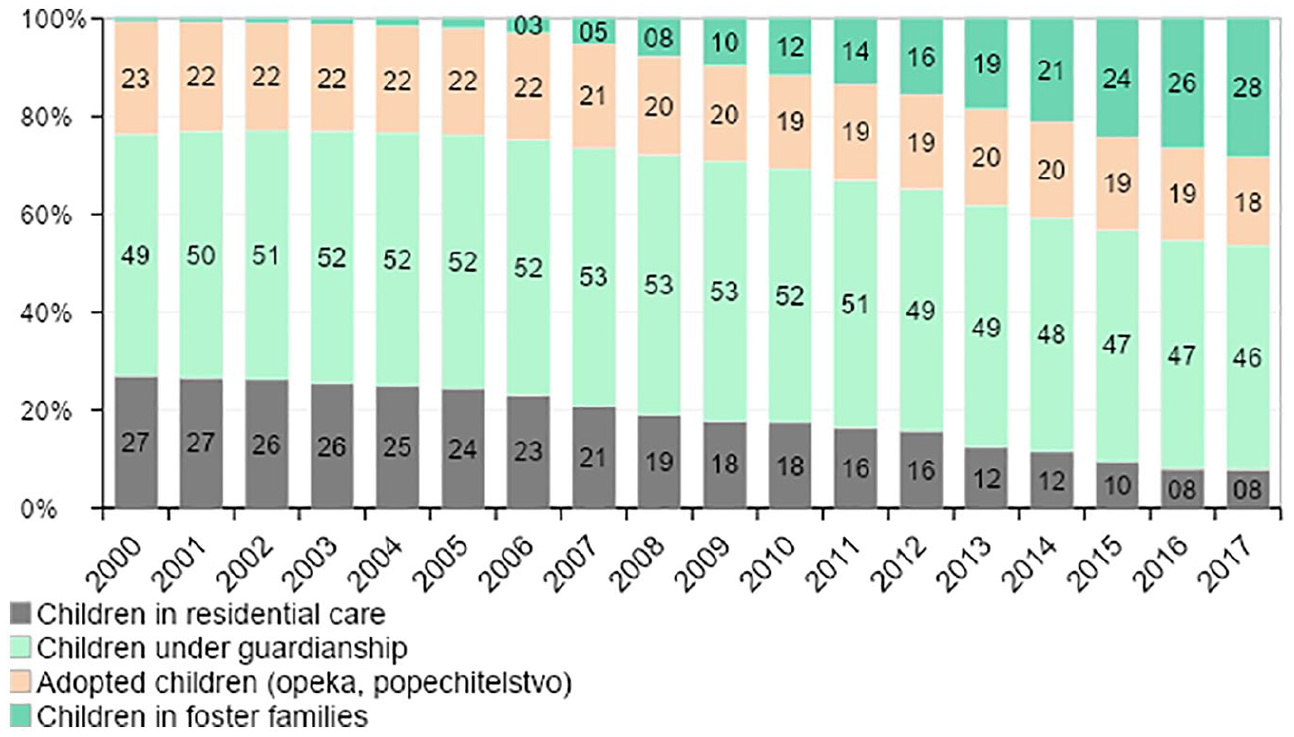
Alternative care placements in Russia, 2000–2017.
The government and NGOs launched large public campaigns on fostering, which fitted well into the nationwide ‘family talk’. Compared with the turbulent 1990s, the economic environment has been more favourable generally for Russian families, and monetary benefits to foster parents have increased. These have contributed to the willingness of ordinary Russians to foster children. One can also witness wide and increasing societal acceptance of the new ideal of care in families and fostering. According to opinion polls in 2013, only 9% of Russians thought that unhealthy children left without parental care (who have a high risk of ending up in institutions, cf. Kulmala et al., in press-b) should be in state institutions (Vorozheikina, 2013). In the same survey, 58% thought these children should be in foster families, Russian ones, as 36% of the respondents stated, while only 4% would allow them to US families, which confirms the official logic of solving the child-welfare problems domestically by Russians themselves.
Fostering is the most developed component of the DI reform so far, while rhetorically strong emphasis on preventive work with birth families remains rather underdeveloped (Kulmala et al., in press-a). The residential institutions have been actively shut down and widely transformed into family-like environments, but there are huge differences in progress among the Russian regions, and the changes have not come without many unintended consequences (Kulmala et al., in press-b).
Compliance with global norms as a core concern of social policy: premises for DI reform in Kazakhstan
National discourses of international recognition
Since declaring independence in 1991, Kazakhstan has built its legitimacy on claims of international recognition (Schatz, 2006). Kazakhstan joined the UN in 1992, became a member of many global and regional multilateral alliances, joined international conventions, and opened its doors to global and transnational governmental and non-governmental organisations. During its first 10 years of independence, Kazakhstan ‘ratified about 350 international agreements and joined another fifty by adopting legal acts’ (Nazarbaev, 2001) and has taken seriously its obligations to meet international norms. Over three decades, the country has maintained its multi-vector foreign policy, and while its development strategies have evolved over time, international recognition has continued to be a central theme. The latest long-term strategy until 2050, which sets modernising the economy, polity and national mentality as the major goals, maintains the importance of the country’s ‘appreciation by the international community’ and its ‘authority in the international arena’ (Nazarbaev, 2017). Thus, since independence the dominant national discourse has built on international recognition of a young state aspiring to be considered a ‘good citizen’ within the global community.
Transnational influence on domestic child-welfare NGOs
After the collapse of the Soviet Union, NGOs started to grow exponentially in number. Child-welfare NGOs founded in the early 1990s and 2000s were generally a grassroots response to increasing vulnerability of families and children during the turbulent transition. NGOs started to work with a range of social issues concerning children, such as lack of parental care, homelessness and violence against children and women (An, 2017). While public funding for NGOs was prohibited and private funding limited, the main source of resources for new NGOs was transnational organisations (TOs) as part of foreign assistance with democratisation and civil society development in the post-Soviet region (Aksartova, 2009). Child-welfare NGOs had access not only to financial resources, but also to new knowledge, including DI (An, 2017). They whole-heartedly adopted children’s rights and other international norms to frame and legitimise their concerns.
In the early 2000s, the scene changed. First, with the economic recovery, governmental priorities moved towards political consolidation and strengthening social welfare. Second, the distant state-NGO relationship shifted towards partnership: NGOs became seen as important actors who ‘play a major role in the protection of rights, realisation of special interests of groups of the population and in the social stabilisation of society’ (Nazarbaev, 2002). Hence, the government recognised ‘socially oriented’ NGOs and started to support their engagement in ‘socially significant issues’ as stated in its ‘Concept of State Support for Nongovernmental Organisations’, which was approved on 23 January 2002. Third, significant child-welfare TOs strengthened their presence in Kazakhstan, UNICEF among the most important.
UNICEF, which had been present in Kazakhstan since 1992, in 2000 opened a country office in the capital Astana. It formulated the priorities of child-welfare reforms in Kazakhstan, including DI, inclusion of children with special needs in education and wider society and combatting violence against children (UNICEF, 2004). While its main partners in Kazakhstan were governmental agencies, UNICEF also communicated with domestic NGOs, and contracted them to conduct research and training and provide innovative services to children and families.
For child-welfare NGOs, engagement with UNICEF, as with other TOs, was crucial to developing as policy actors. The first important step in this process was their involvement in the writing of the first alternative report on the implementation of the UN CRC in 2002. Participation in the UNICEF activities boosted their expertise and reputation. In 2003, UNICEF initiated a task force on the Rights of the Child, recruiting heads of government agencies and child-welfare NGOs as experts. When social partnership was launched as governmental policy, NGOs were invited to law-drafting committees and different consultation councils (Asian Development Bank [ADB], 2007), becoming legitimate experts on global norms for national child-welfare policy.
DI within the context of a child-welfare reform
In the 1990s, the transition crisis was accompanied by large cuts to public child-welfare and care programmes (Falkingham, 1999; United Nations Committee on the Rights of the Child, 2001); these also signalled the diminishing state responsibility over children and an increased responsibility of the family, as seen in several laws adopted in the 1990s, for instance in the Constitution of the Republic of Kazakhstan, adopted in 1995, and in the Law on Marriage and Family, adopted in 1998. Kazakhstan ratified the UN CRC in 1994, but the issue of child rights was not yet seen in domestic legislation at that time.
During the first decade of independence, DI was not on the governmental agenda. The number of residential institutions for children increased by half and the number of children in institutions more than doubled between 1990 and 1999 (UNICEF, 2001). Thus, children’s residential institutions not only survived, but actually expanded as a priority child-welfare modality until the mid-2000s. Throughout the 1990s, residential institutions were not considered problematic by policy actors or the wider public. In Kazakhstan’s first report on the implementation of UN CRC, the government proudly stated that children’s institutions were ‘the only network within the system of primary and secondary education that has not been optimised [cut]’ because ‘the state support for [vulnerable children] is provided through the system of children’s houses and boarding schools’ (United Nations Committee on the Rights of the Child, 2001).
In the 2000s, as the economy recovered, public spending on welfare, including cash transfers for families and children, steadily increased (International Labour Organisation [ILO], 2004). The symbolically significant Law on the Rights of the Child (2002) shows an attempt to incorporate the UN CRC principles into the national legislation. The law, though it continued to see residential institutions as the main form of state care, reframed them as ‘organizations performing functions on the protection of the rights of the child’. Thus, new child rights language was used to legitimise old institutions. The second and third UN CRC reports, however, indicate an important turn: children’s institutions were no longer viewed as beneficial (United Nations Committee on the Rights of the Child, 2006).
Several laws adopted in the 2000s (e.g. laws on Social, Medical, and Pedagogical Correctional Support to Children with Special Needs, 2002; on State Social Contracting, 2005; and on Special Social Services, 2008) created the legal basis for the development of social services for children and families. NGOs received access to public funding to provide services for families and children. Children’s residential institutions were encouraged to open day-care departments, with the purpose of transforming them into community-based centres. Public homecare departments received funding to serve children with disabilities in their homes. However, the development of community-based social services for children has been slow, with multiple obstacles (An, 2017).
The government employed two main strategies to reduce institutional care: (1) supporting family-type care, such as adoption, patronat (contracted foster care) and guardianship (usually kinship) care; and (2) developing community-based support services (United Nations Committee on the Rights of the Child, 2014). Patronat care was introduced in 1999, but only started to be used from 2004 when state funding was allocated for foster parents; 2800 children were placed at this point in patronat families. As in Russia, guardianship care has traditionally been the most common form of alternative care, and remains such (see Table 1 below). A benefit similar to the one provided to foster parents was introduced for guardianship carers in 2011. The state does not provide any financial support for adoptive parents. Overall, the number of adopted or fostered children has been stagnant since 2011 (UNICEF, 2017: 62). As the use of different forms of family care has remained the same over time, they do not seem to serve as a strong alternative to institutions.
Number and share of children left without parental care in different forms of alternative care in Kazakhstan, 2010–2015.
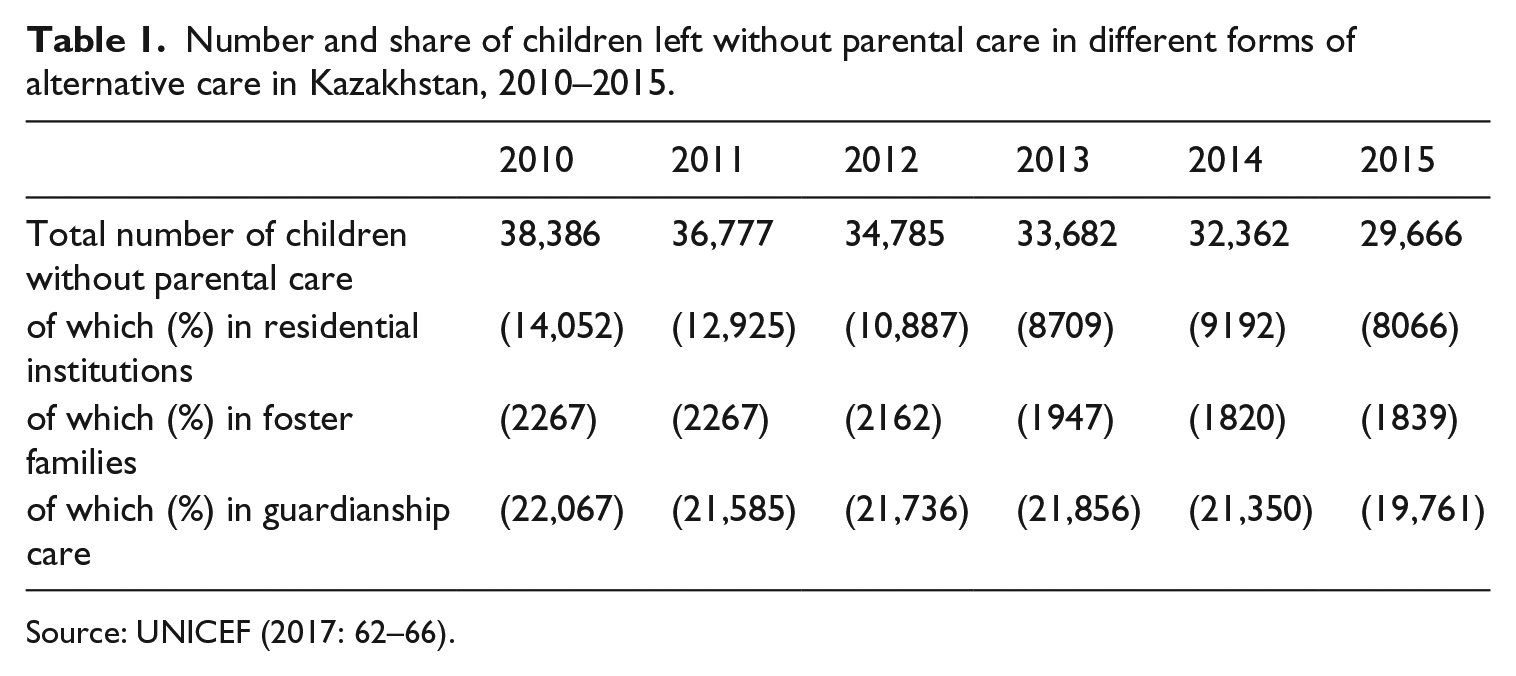
Source: UNICEF (2017: 62–66).
As Table 1 shows, the number of children left without parental care, the number of institutions and the number of children in institutions gradually declined in 2010–2015 (UNICEF, 2017: 62). While the government attributes this development to its DI efforts (United Nations Committee on the Rights of the Child, 2014), this argument needs to be substantiated by a corresponding increase in the use of alternative forms of family care. A more plausible explanation is that the flow of children into residential institutions decreased due to the recovering economy and increasing living standards. Importantly, as the table well shows, unlike in Russia, where the share of children in residential care has drastically shrunk due to their replacement into foster families, in Kazakhstan there has been no such dramatic decline in residential care. Moreover, the share of children replaced in foster families shows no change.
Throughout Soviet history, children’s residential institutions served as a sluice for any cause of children’s deprivation. They continued to play the same role during socioeconomic turmoil in the 1990s. Even if the number of children’s residential institutions seems to be decreasing in the 2010s, from 210 institutions in 2010 to 146 in 2015 (UNICEF, 2017: 65), they are not dying off, and there are no signs that fostering will in the near future replace them.
In sum, DI in Kazakhstan was introduced as part of global children’s rights and integrated into the official domestic discourse of international recognition and compliance with international norms. DI was institutionalised in Kazakhstan as a result of multiple nonlinear interconnected steps: first introduced by TOs, DI was taken up by domestic NGOs which translated global ideology into the domestic context by employing a global norms framework to influence government policy. The institutionalisation of DI has been so far very slow, incremental and gradual. TOs along with domestic NGOs used UN CRC as a broad policy framework to advocate for DI, including downsizing and closing large institutions and providing community-based services to families in need. When the Kazakh government and UNICEF signed the agreement, DI of child welfare was included as a key priority, as was the development of social work and community-based social services for families (UNICEF, 2004). Government agencies sought to comply with international norms, but lacked knowledge on how to implement them. In the policy process that led to DI, domestic child-welfare NGOs occupied a significant role of ‘policy brokers’ or policy mediators (Lendvai and Stubbs, 2007): while having expertise on global policy and international standards, they also understood the domestic ground. Thus, several reputable child-welfare NGOs that have worked in the field and collaborated with TOs since the 1990s developed competency in translating global ideology into the language of domestic policy (An and Chambon, 2017). Yet, the changes in the institutional design remain low.
ASID comparison: the institutionalisation of global DI policy in Russia and Kazakhstan
This study compares the introduction and institutionalisation of global DI policy in the context of post-Soviet child-welfare reforms in Russia and Kazakhstan. While global DI policy and the Soviet child-welfare system represent two conflicting welfare ideologies, we found that global DI policy has been institutionalised in both post-Soviet countries, thus ending the dominance of residential care. Children’s residential institutions, previously seen as the embodiment of the Soviet state caring for its children, are now considered a harmful form of child care that needs to be replaced by family care. Drawing on Hall’s (1993: 279) concept of a policy paradigm as ‘a framework of ideas and standards that specifies not only the goals of policy and kind of instruments that can be used to attain them, but also the very nature of the problems they are meant to be addressing’, we argue that in Russia and Kazakhstan, a paradigm shift has occurred as a result of the institutionalisation of global DI policy. However, there are striking differences in terms of the scale and pace of DI reforms in these two countries, despite similar institutional legacies and macroeconomic conditions. While in Russia the DI reform has been fast-moving and sweeping, in Kazakhstan, the implementation of DI has been an incremental and gradual process. We now proceed to the ASID analysis of the factors that have contributed to the differences in the outcomes of DI reforms in Russia and Kazakhstan.
Structure
Сhild-welfare reforms in Russia and Kazakhstan were shaped by similar structural factors. Both post-Soviet states encountered a decade-long economic crisis and deterioration of living standards, and introduced severe welfare cuts – all increasing the need for care for children left without parental care. Both countries rebuilt their economies and joined the world market, benefitting from the oil-driven economic growth in the 2000s but also being dependent on global market fluctuations in the 2010s. Yet, they chose different legitimacy claims due to different geopolitical factors. Kazakhstan has consistently sought international recognition, which has translated into multi-vector foreign policy, openness to transnational influences and efforts to comply with global norms. Russia, by contrast, shifted from early ‘liberal internationalism’ to the legitimacy claims of a global ‘superpower’ that can manage by itself, a discourse feeding Russia’s growing confrontation with the United States and EU as well as its domestic agenda of political cohesion. Thus, Russia sought self-reliance and turned to more introverted economic policies, while Kazakhstan continued to employ a multilateral policy, trying to balance its relations with superpowers and neighbours.
Rather than viewing geopolitical factors as destiny, we draw on the ‘embedded agency’ concept which views actors’ behaviours as both enabled and restrained by their social and institutional context (Thornton and Ocasio, 2008). As this study shows, differences in geopolitical context shaped the choices of policy actors in how to frame DI within the two national discourses.
Discourses
While the macroeconomy and Soviet welfare legacies shaping child-welfare reforms in Russia and Kazakhstan were similar, we argue that there is an important distinction in how the new global DI policy was integrated into the national policies. First, the DI reforms were framed very differently.
In Russia, DI with the priority of family care fit into the wider national and nationalist ‘family talk’, which brought conservative family values to the centre of the political agenda from 2005. The moral panic around Russian families and family values, and the consequent increases in first pronatalist family policies, grew from the so-called ‘demographic crisis’. In Russia, population decline was constructed as the largest threat to the Russian nation-state, which was to be solved domestically by Russian (heterosexual) families, in line with the official discourse of hostility to Western influences. Thus, family policy and later DI reform became an integral part of the national project to ‘revitalise’ the Russian nation. Instead of drawing on (global) child rights, the Russian discourse around DI drew on Russian families and children and their well-being. The discourse was distinctly different in Kazakhstan, where the DI reform was framed through international child rights. As with other segments of Kazakhstan’s social policy, DI reform became an integral part of the national discourse around modernisation and international recognition. While Russia, as a ‘superpower’, wanted to solve problems on its own, Kazakhstan sought to reform as a modern and legitimate member of the international community.
Thus, DI ideology was integrated into very different national discourses. In Russia, the global ideology became ‘glocalised’ through nationalist discourse, in Kazakhstan, through an internationalist one. While Kazakhstan relied on global and international approaches, appropriate given the national project of claiming legitimacy through international recognition, in Russia global policy became heavily domesticated as a national issue of Russian families – an articulation that perhaps resonates better in the wider public than internationalist framing. In Russia, in addition to the policy-makers and professionals, ordinary citizens also accepted the new discourse of care in families. Thus, in comparison to Kazakhstan, it seems there has been a deeper sense of ownership and emotional resonance of DI reform in Russia, which might well explain the faster and larger scale institutionalisation of global DI policy. It thus seems that nationalist discourse is more appealing and more effective with domestic audiences than internationalist discourse.
Thus, framing served a key role in the process of glocalisation of global DI ideology into the national contexts. In both countries, NGOs and TOs packed their new message into an acceptable form which resonated in the domestic context. As seen above, some frames resonate better than others and, importantly, are inseparable from actions of policy actors (Béland, 2005). Framing is therefore about agency, a conscious strategy of persuasion and agenda-setting (Schatz, 2009), which brings our attention to the third element in the ASID model.
Agency
Our analysis shows the distinct roles that policy actors played in child-welfare reform in each country, and power relations among them. First, the state took the role of setting up the ‘rules of the game’ on the domestic policy scene, which shaped the roles domestic NGOs and TOs played in the reform. In the 1990s, domestic policies in both countries allowed international engagement in social policy, and new domestic NGOs received international funding. Most importantly, they were simultaneously exposed to global approaches to child welfare. TOs played an important role in introducing global norms of child rights and DI. Global policy instruments, such as UN CRC, and later UN CRPD, built on evidence of the harms of institutionalisation on children to help delegitimise Soviet-style residential care and convey DI ideology to domestic actors. TOs had a short period of legitimacy in Russia in the 1990s, but later the shift in Russia’s relations with the West made international collaboration illegitimate, for example, the ‘foreign agent’ law adopted in 2012 (Bogdanova et al., 2018). In Kazakhstan, TOs continued to play an important role on the domestic policy scene. Adherence to international norms has consistently been a major source of legitimacy for the Kazakhstan’s government.
This analysis shows an intrinsic ambiguity of domestic NGOs in both post-Soviet contexts. On the one hand, they were home-grown domestic experts that knew the situation on the ground, the needs of their communities and the politics of the domestic policy process. On the other hand, NGOs as pro-reformers were receptive to transnational policy. The child rights and rights of people with disabilities frameworks along with DI corresponded with the role of reformers and social advocates. The ambiguity of NGOs is evident when comparing the two cases. In Kazakhstan, long-term collaboration with UNICEF and other TOs and transnational expertise in global policy approaches enabled NGOs to become legitimate policy actors and welfare services providers. In Russia, the state turned to domestic child-welfare NGOs as local experts to design the reform as a domestic alternative to international adoption. When the state sought to rapidly reform residential care, the Russian NGOs had an opportunity to push the policies they had long advocated for. In this limited space, NGOs followed the rules of the game: they avoided a critical tone, were ready to accept compromise and framed problems and solutions in suitable ways. In Kazakhstan, DI reforms were promoted as a global policy that the country had to adhere to, while in Russia, they were framed as a domestic family issue. Hence, this ambiguity allowed NGOs to serve as ‘policy brokers’, or intermediaries between the state and global social policy actors. NGOs also served as ‘policy translators’ because of their ability to frame global policy using the language of domestic policy to fit the national project (Lendvai and Stubbs, 2007). This is an important finding which enhances our knowledge of the multiple roles of NGOs in post-Soviet social policy-making (An, 2017; Bindman et al., 2019).
Finally, these findings offer another insight into the concept of ‘embedded agency’, illustrating an interrelationship between structure and agency. Thornton and Ocasio (2008: 101–102) argued that ‘to understand individual and organizational behavior, it must be located in a social and institutional context, and this institutional context both regularizes behavior and provides opportunity for agency and change’. As this study shows, the choices and behaviours of policy actors were shaped by the global constraining and enabling macro-level environment. At the same time, it reveals the ability of policy actors to translate global DI policy into national discourses. In this process, policy actors were able to seize the moment and to compromise. Policy choices were shaped by calculated tactics, as well as by chance.
Institutions
In this study, we view the institutionalisation of DI policy in two post-Soviet contexts as an outcome of interplay between structural factors and the agency of policy actors who translated global policy into domestic policy discourses. After three decades of reforms, in Russia and Kazakhstan, DI has become a mainstream child-welfare policy. At the level of policy and goals, in both countries, children’s residential institutions have lost their legitimacy, and the ideal of care has shifted from state-based institutional care to family-style forms of care, and community-based preventive and supportive services for families at risk.
However, this comparative analysis shows distinctly different patterns of the institutionalisation of global DI policy in Russia and Kazakhstan (Table 2). DI reforms started slowly in both countries as the result of transnational influences. In Kazakhstan, the implementation of DI has been gradual and incremental over the past two decades. There is a trend towards closing children’s institutions and replacing them with community-based services, while the use of family forms of care has stayed stagnant. In Russia, the implementation of DI was rapid and decisive. In the early 2010s, the Dima Yakolev case served as the critical juncture that made DI reform a top governmental priority. The implementation of DI included a range of laws and programmes aimed at restructuring children’s institutions and increasing fostering and adoption from institutions by Russian families. The implementation was accompanied by effective mass-scale national public awareness campaigns encouraging families to adopt or foster. As shown, a drastic change has led to the rise in family placements. While in Kazakhstan the adoption of DI ideology has been limited to policy actors, in Russia, DI ideology extended to the wider public, resulting in growing numbers of foster parents. Thus, while DI ideology has been adopted in both countries, in Russia, it has been implemented at a considerable scale and speed, while in Kazakhstan, the process has been incremental and gradual.
Wider Socio-economic context, frames and outcome of the DI reforms in Russia and Kazakhstan.
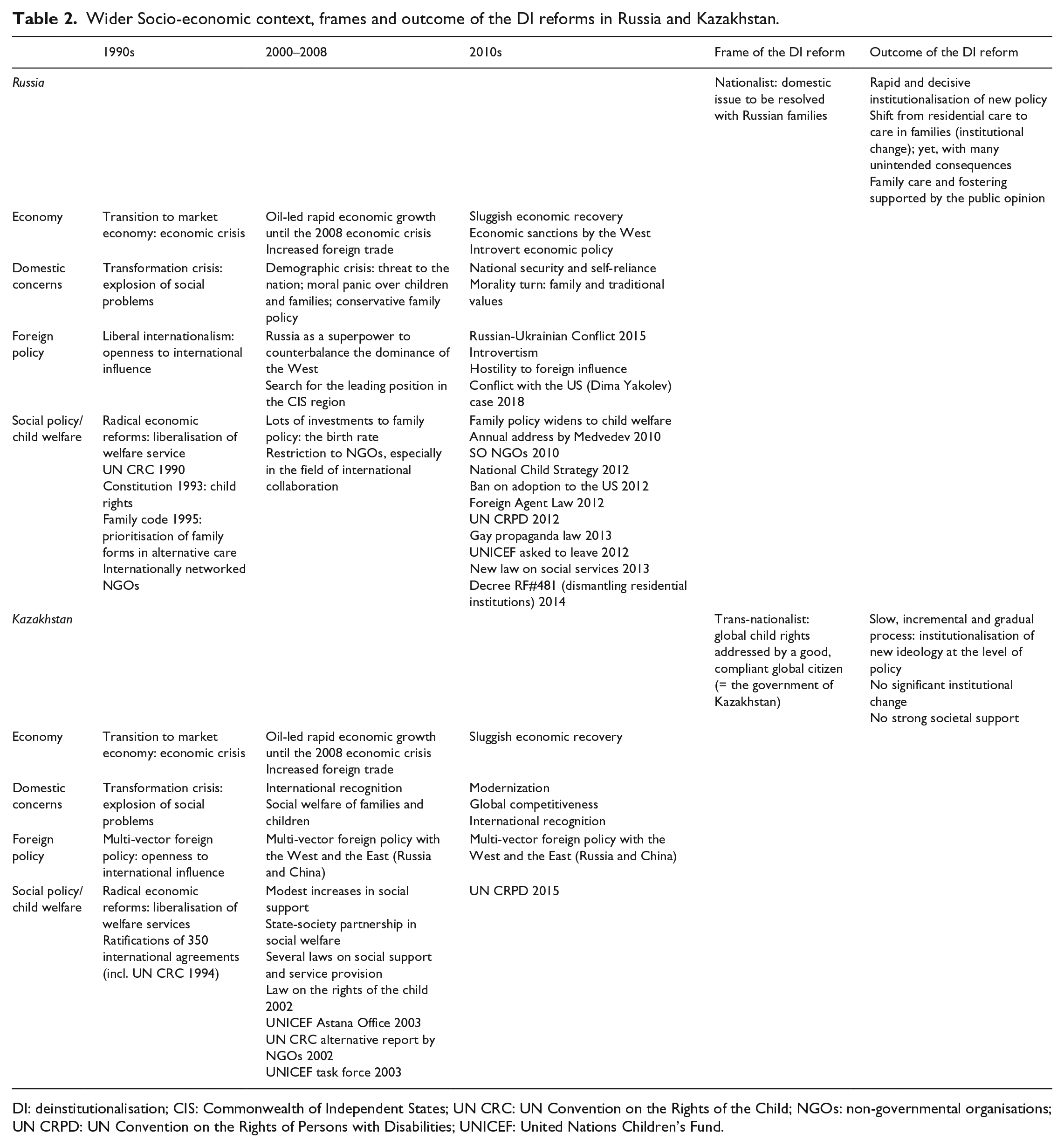
DI: deinstitutionalisation; CIS: Commonwealth of Independent States; UN CRC: UN Convention on the Rights of the Child; NGOs: non-governmental organisations; UN CRPD: UN Convention on the Rights of Persons with Disabilities; UNICEF: United Nations Children’s Fund.
Within the historical institutionalist scholarship, the case of DI reform in Russia fits well the school of thought that views institutional change as a moment of ‘critical conjuncture’ or drastic change that interrupts long periods of institutional self-maintenance and self-reproduction (Capoccia and Kelemen, 2007). The case of Kazakhstan, however, supports the alternative perspective that puts an emphasis on incremental changes in institutions, which over time can result in institutional transformation (Streeck and Thelen, 2005). This analysis thus contributes to these institutional change debates by showing that it is not necessarily an either-or question: as we show, the way in which institutions change depends on a complex combination of structural and agentic factors which are both interlinked with discourses. Thus, as Deacon and Stubbs (2013: 13) anticipated, through the ASID model, each of these concepts – agency, structure, institutions and discourse – finds a holistic home.
Conclusion
The application of the ASID model proved useful for our analysis of the institutionalisation of global social policy. Concentrating on its building blocks – agency, structure, institutions and discourses – revealed significant differences in two post-Soviet states. As a common frame of reference, ASID seems to be open to interpretation in its operationalisation while offering a certain degree of abstraction and structure to allow for comparison and theory-building across borders (cf. Moulaert et al., 2016).
As a result of our comparative investigation, we argue that global DI ideology has undoubtedly travelled to both countries, but through quite different paths, which has resulted in a different scale of institutionalisation of new policy at the levels of national policies, institutional arrangements and wider society. In Russia, the new DI policy has led to a more fast-moving institutionalisation, while in Kazakhstan, the change has been more modest. While in Kazakhstan, the DI reform drew on the internationalist discourse of global child rights, in Russia, it was framed by the nationalist discourse on Russian families, which in the end resulted in stronger resonance and ownership over the issue – and facilitated the larger scale institutionalisation of this global social policy. As we see today all over the globe, nationalist claims by populist movements do resonate.
Thus, our exploration shows how a similar global policy was sold with quite different frames in two different countries, nationalist in one context and trans-nationalist in the other. It provides evidence on how discourses matter and shape the implementation of global policies, demonstrating the power of nationalism – and of transnationalism – and how they may be brought to bear to sell global policies. Importantly, it shows that the discursive frames with which global policies are sold domestically are significant, as they have a very substantial impact on the domestic acceptance and implementation of the policy.
Interestingly, in these at first glance apolitical questions of families and children, we found that geopolitics matter. Through our comparison, we are in a position to argue that the constellations of geopolitical factors might significantly contribute to the selection and application of the domestic discourses, and thus to the speed and scale of how global social policy travels into national contexts. Our comparative analysis brings important insights into the complex processes that are simultaneously transnational and national, universalistic and particular. Thus, the comparison not only contributes to a deeper understanding of post-Soviet social policy, but also of the path of global social policy.
Footnotes
Authors’ note
Both authors made an equal contribution to this manuscript so they are listed in alphabetical order. As sad as it is, Dr Sofia An, however, passed away soon after the submission. Under these very sad circumstances, Dr Meri Kulmala takes the full responsibility for the minor revisions requested by the blind peer-review in the final version. RIP Dr Sofia An, a brilliant and distinguished scholar, an inspiring colleague and a very good friend.
Funding
The author(s) disclosed receipt of the following financial support for the research, authorship, and/or publication of this article: The research project, led by Meri Kulmala, has been funded by the University of Helsinki, Academy of Finland and Kone Foundation.
