







Abstract
The majority of Kosovo’s public social welfare provision is today spent on basic universal programmes, namely, old-age pensions, healthcare services and child benefits. These programmes are tax-financed, citizenship-based and unconditional with regard to other criteria. Such expansive basic universalism is unusual for the Western Balkans and the rest of post-socialist Southeastern Europe. The first two of these programmes emerged through a complex process of policy formation led by powerful international organisations (IOs). The third programme was more recently initiated by the first-ever left-wing majority that came to power after two decades of democratic elections, implementing a manifesto that endorses a progressive policy mix. This outcome is counterintuitive: the IOs would be naturally expected to lean towards means-tested, targeted programmes, and Kosovo to crystallise into a (neo)liberal welfare regime (path-dependency). The article examines the detailed causal mechanisms that intervened in producing the outcome. Basic universalism has already had a significant impact in Kosovo by contributing to poverty reduction, the size of overall social protection expenditure and citizenship-building, and by serving as a good policy standard.
Introduction
Basic universal programmes make up the majority of the public social welfare effort in Kosovo. These citizenship-based, tax-financed programmes are a basic pension for old age, basic healthcare services and a more recently introduced basic child benefit. The rights deriving from them are unconditional to other criteria such as means or income tests, contributions and categorisations. This configuration is atypical for most of the Western Balkan countries that have entered into a contractual relationship with the European Union (EU) and post-communist Southeastern European (SEE) countries that have already joined the EU, and for many core EU countries themselves that organise welfare provision predominantly around social insurance principles (Table 1).
Universal, basic pension, healthcare and child benefit programmes in Europe.
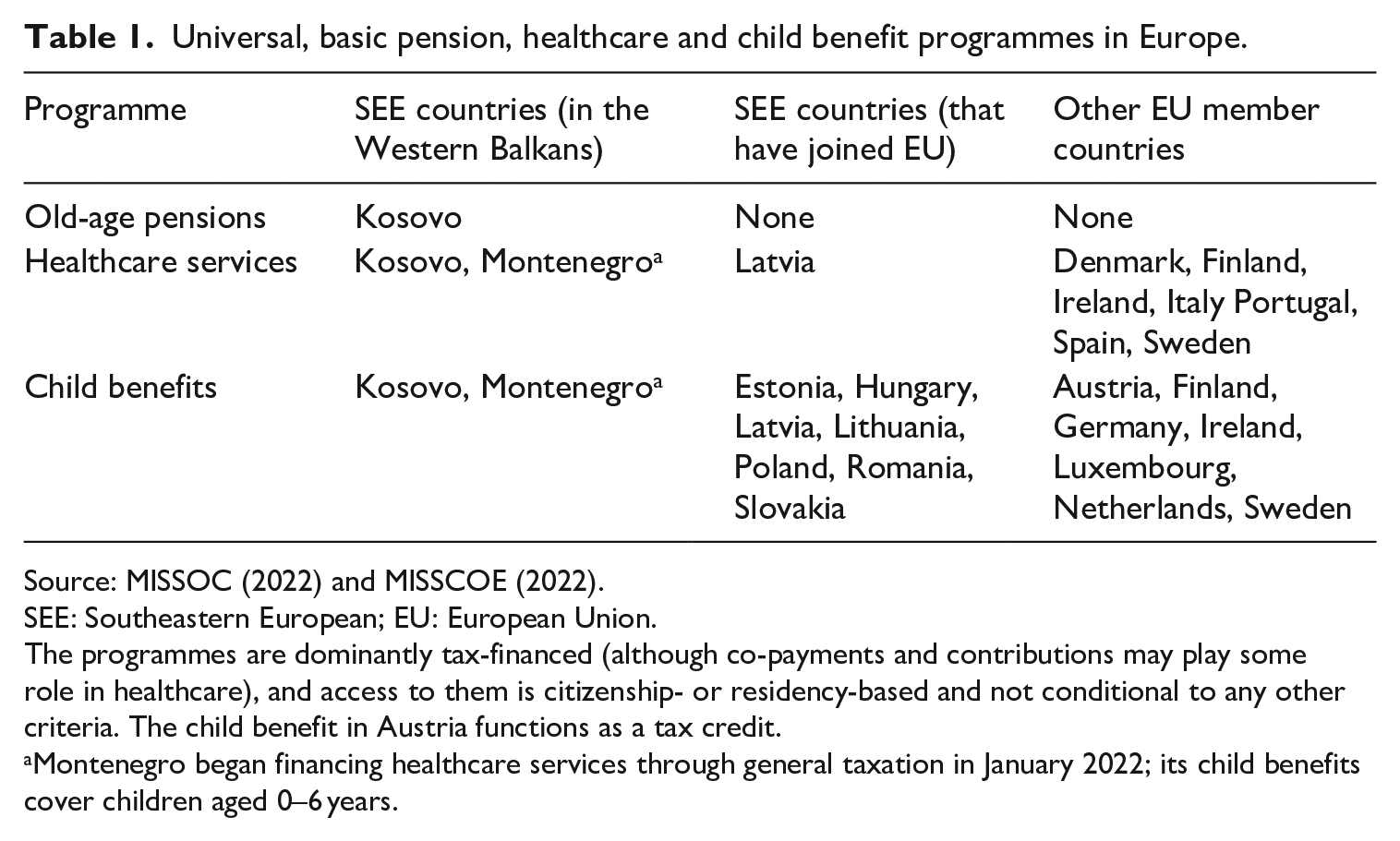
Source: MISSOC (2022) and MISSCOE (2022).
SEE: Southeastern European; EU: European Union.
The programmes are dominantly tax-financed (although co-payments and contributions may play some role in healthcare), and access to them is citizenship- or residency-based and not conditional to any other criteria. The child benefit in Austria functions as a tax credit.
Montenegro began financing healthcare services through general taxation in January 2022; its child benefits cover children aged 0–6 years.
Universality is often a major objective in social policy. In contrast to rights or institutions that target specific social groups based on needs, means or income tests, contributions and categorical principles, universal ones tend to provide large or full coverage of the population with social transfers and services. ‘Basic universalism’ as a term was used by Huber and Stephens (2012) to denote basic rights with broad coverage. In this article, it means what Korpi and Palme (1998) termed ‘basic security’ – namely, it means programmes consisting of basic (minimum), flat-rate and citizenship-based rights that do not exclude anyone. Such rights or institutions may be financed by taxes, contributions and co-payments, and are unconditional and managed by state authorities. They differ as such from earning-related programmes, which may achieve high levels of universality in coverage but still issue substantially different benefits reflecting prior income.
Pioneering basic universal institutions, in the form of pensions and basic public health services according to the National Health Service (NHS) model, appeared soon after the Second World War in Northern Europe. They tended to provide what Marshall (1992: 8) refers to as rights to ‘a modicum of economic welfare and security’, but not necessarily, at the time, rights to fully share and live up to ‘society’s prevailing standards’. As welfare states matured, basic universalism advanced (providing rights of higher quality) and was also often gradually combined or integrated with other social rights. The nature of the combination or integration was shaped by relevant existing legacies, actors, ideas and structures. According to Esping-Andersen (1990), the mature liberal welfare regime often combines means-tested and basic universal rights with more and separate market-based provisions, thus leading to market-based dualities or stratifications. On the other hand, in the social-democratic regime, basic universal pensions were integrated with new benefits for wage-earners by pooling risks (Korpi and Palme, 1998), thus avoiding segmentation and also changing their function from unconditional to guaranteed minimum rights, while the NHS was maintained, expanded and complemented by new universal social services and benefits.
The early forms of basic universalism were not embraced at the time in continental Europe and in the Yugoslav system of self-management socialism (1952–1989), where, despite relevant different nuances, welfare provision was organised mainly according to the social insurance principles that ensured high coverage but with variations in access, benefits and even status. The rest of the socialist SEE had basic universalism in practice, such as in healthcare and pensions. Although in principle financing was made through insurance means, the separation of taxes was not as clear-cut as in western capitalism, and universalism in practice resulted from socialism’s policy of guaranteed employment; rights were also basic in terms of their quality (Deacon, 1983; Kornai, 1992). In post-socialist states, universality declined (Table 1) due to the abandonment of the commitment to full employment and other related policy changes.
The presence of basic universal institutions and the way they are gradually combined, integrated or complemented with other rights, or the absence of universalism, have broader implications for citizenship-building, political coalition trajectories, the legitimacy of social policy and governance, implementation efficiency, size of social expenditure and redistribution and so on (Fischer, 2018; Kangas and Palme, 2009; Korpi and Palme, 1998; Rothstein, 1998).
This article examines the emergence of the unusually expansive basic universalism in Kosovo since the 2000s, led by powerful international organisations (IOs) and later expanded by the emerging left-wing power, by delving into the detailed causal mechanisms that played a role in producing this result. It is organised as follows: The article begins by reviewing the existing literature on the role of IOs in post-communist Southeastern Europe and proposes a complementation to explain the counterintuitive outcome of their influence in Kosovo when it comes to basic universalism; it continues by substantiating this argument through an analysis of the process of setting up Kosovo’s basic universal institutions; it closes with a discussion about the casual mechanisms behind this basic universalism and its effects in relation to the reviewed literature, and with a conclusion.
The influence of IOs in national policies
The main variable behind today’s basic universalism-dominated welfare effort in Kosovo – the role played by IOs – cannot be found in Esping-Andersen’s (1990) classic book. Since the early 1990s, the IOs have been the avant-garde of neoliberalism, especially through their issuing of national policy prescriptions (see, for example, Deacon and Hulse, 1997; Kaasch, 2013). Kosovo is a unique case of IOs’ influence since IOs such as the World Bank, the International Monetary Fund (IMF) and the EU had unprecedented influence via the United Nations Mission in Kosovo (UNMIK). UNMIK directly managed Kosovo between June 1999 and February 2008; it was deployed following a North Atlantic Treaty Organization (NATO) air campaign that put an end to the war (1998–1999) between the majority Albanians and the Government of Yugoslavia (Serbia).
In line with Esping-Andersen’s thesis that welfare regimes come to reflect the ideas of dominating political coalitions in the long run, the first wave of research on the impact of IOs in post-socialist SEE found that the prescriptions advocated by these IOs reflected the outlook advanced by the dominant political actors in their home countries (see, for example, Deacon, 2000; Deacon and Hulse, 1997). Therefore, they were expected to promote and translate into the receiving countries the policies followed in their home countries. This literature describes SEE as a competition ground for influence between organisations such as the World Bank and IMF (promoting targeted, means-testing social policies), on the one hand, and the EU, International Labour Organization (ILO), and the likes (preferring social insurance/rights coupled with employment), on the other hand. From this perspective, due to the paramount influence of the United States in the intervention in Kosovo’s war, Kosovo would be expected to translate US-style policies through the influence of IOs representing the ‘Washington consensus’. In fact, it built what Cocozzelli (2007: 214) has called ‘a caricature’ of the liberal welfare regime. Yet, in addition to other policy differences, Kosovo has universal basic pensions, universal basic healthcare in practice and a universal basic child benefit, while the United States has none of these provisions. All three of these institutions in one country are also usually not found in the majority of other (developed or developing) countries that are typically placed within the liberal welfare regime classifications. In addition, rather than only competing, the IOs worked in cooperation and coordination under UNMIK (see Cocozzelli, 2007, 2009; Gubbels et al., 2007). Finally, the EU itself has been considered a strong, liberalising supranational mechanism rather than a promoter of alternative capitalism (Streeck and Thelen, 2005).
More recent literature has defined the IOs as neutral spaces open to influence by new ideas and policy entrepreneurs rather than as a mere reflection of the balance of power in the origin countries (e.g. Béland and Orenstein, 2013). It is argued that during the 1990s, the policies promoted by IOs were influenced by neoliberal (Chilean model alike) privatisation solutions, but due to new evidence and influences, approaches began shifting (Deacon, 2005), and major IOs increasingly committed to ILO’s ‘social floors’ (Heneghan and Orenstein, 2019). However, there are two reasons why this literature still does not fully explain the IO’s role in Kosovo. First, the first two basic universal institutions – basic pensions and basic healthcare services – were inserted much earlier (between mid-1999 and mid-2002). Second, ILO’s (2012) ‘social floors’ do not prescribe that the floors should be tax-financed and unconditional as they were installed in Kosovo; countries may instead arrive at them according to their chosen policy means. In addition, as Kaasch (2013) and Heneghan and Orenstein (2019) point out, the most influential IOs had no clear preferred choices when it came to healthcare systems.
The early literature (Deacon, 2000; Deacon and Hulse, 1997) argued that the success of IOs’ influence often depended on the power constellations in the receiving countries, with countries having a stronger left and fewer international debts being in a better position to resist change towards privatisation. The later literature (e.g. Appel and Orenstein, 2018) argued that, on the contrary, governments of all persuasions in SEE surprisingly embarked on even more neoliberal solutions than expected by the IOs through engaging in ‘competitive signalling’ in an effort to attract foreign direct investment. Again, none of these hypotheses hold fully for Kosovo. It took more than two decades after the war for Kosovo to elect a left-wing government and its international debt was irrelevant, while major basic security institutions (basic pensions and basic healthcare services) were created early on (weighing much more than targeted ones, namely, social assistance and disability protection schemes). Kosovo was also led by IOs during the first of these two decades, so the need for ‘competitive signalling’ was not as relevant.
Kosovo’s basic universalism: the causal mechanisms
This section explains how Kosovo’s basic universal institutions – basic pensions, basic healthcare services and basic child benefits – came about, from a comparative perspective. The article proposes that to explain the IOs’ driving role towards this counterintuitive outcome, expanded later by left-wing party politics, the literature discussed above can be complemented by analysing decomposed relevant causal mechanisms in the causal chain. Hall (2013: 4) understood causal mechanisms as a ‘statement about why [. . .] intervening variables and [. . .] processes or emergent properties associated with them are important to the outcome’. Given that causality is highly complex (Huber and Stephens, 2012), mechanisms as analytical elements can help ‘explain a particular case when combined with each other’ (Kuhlmann and Nullmeier, 2022: 434) such as by modularisation, where both a complex and more elementary mechanisms are identified and analysed (Kuhlmann and Nullmeier, 2022). The article utilises relevant public documents and statistics, existing literature and original interviews.
The basic pension
Kosovo’s universal basic pension is issued to elderly resident citizens above 65 years of age unconditionally. It is financed by general taxes and managed by the state, and issues flat-rate payments that are not taxed and which by law should reflect the cost of 2100 calories of food intake per day1 (Official Gazette, 2006). In 2022, it issued a monthly €100 payment (excluding COVID-19 top-ups), worth 23.1% of the average monthly net wage (€432) in the country during the previous year (KAS, 2022). Today, no other Western Balkan or EU country has a similar fully unconditional basic pension in place (Table 1). The basic pension was introduced through a 2001 UNMIK regulation on pensions (UNMIK Official Gazette, 2001), which set up Kosovo’s new pension system consisting of basic pensions, mandatory fully funded pensions in the form of individual saving accounts and voluntary pensions in the market.
The former Pay-as-You-Go (PAYG) system was fully discontinued; Kosovo became, in fact, the only country in SEE to completely remove PAYG (Orenstein, 2008). The fact that Kosovo was directly run by IOs, which enjoyed high levels of public support due to NATO’s intervention (Cocozzelli, 2009), was a crucial factor, but it does not suffice to fully explain the path-departing pension policy. Pension legacies were popular elsewhere in the region. For example, IOs had extensive powers in Bosnia and Herzegovina (BiH) as well, but BiH continued with PAYG. Although some of the SEE countries privatised parts of their PAYG pension systems (Orenstein, 2008), most refused privatisation and stuck to popular PAYG legacies (see Arandarenko and Uvalic, 2014; Deacon, 2000; Deacon and Stubbs, 2007). By contrast, in some other policy sectors, as mentioned above, even with less direct IO influence, countries were willing to engage in larger than expected privatisation reforms (Appel and Orenstein, 2018).
It is also clear that, in particular, the World Bank was highly influential through ideas and through its projects in support of the creation of the entire Kosovo’s long-term social protection system under UNMIK (e.g. Cocozzelli, 2007; World Bank, 2001). At that time, the World Bank was endorsing neoliberal policies (Béland and Orenstein, 2013). In pensions, it encouraged the shifting of old-age income risks from public benefit–defined systems towards markets and individuals. Yet, although Kosovo’s new pension system indeed resembled the three-tier World Bank (1994) pension model, the bank’s model did not necessarily insist that the first pillar should be a universal, tax-financed, unconditional basic pension; on the contrary, it proposed that the first tier could also be a means-tested programme, an income-guaranteeing programme or an employment-related one. Furthermore, the World Bank’s model did not propose the full removal of PAYG.
This article argues that the outcome was produced by a complex mechanism, a deeply political and populated process led by IOs and involving conflicting compromises. Decomposing it into more elementary mechanisms, UNMIK had to carefully negotiate various contrasting ideas and interests among: major IOs, donors, and consultants; local politics; new expectations created among the population; and actors’ interpretation of the state of data, institutional capacities and socialism’s legacies.
It is well established that in setting up the new pension system, UNMIK cooperated and coordinated with the consultants financed by the United States Agency for International Development (USAID) and with the World Bank, IMF, EU, donor countries and so on (see Cocozzelli, 2007; Gubbels et al., 2007), whose interests were sometimes conflicting. Some of the actors, such as the development agencies, approached the reform from a long-term policy design perspective. Arguably, a neoliberal ideational outlook dominated the background during the process, and there was more consensus against PAYG; for example, both the World Bank (2001) and USAID (2003) were against its reintroduction. However, the World Bank (2001: 4) spoke for a ‘flat-rate pension scheme with limited eligibility’ rather than a basic universal pension. On the other hand, the donors were also looking to exit from the massive post-war emergency relief (consisting, among others, of clothing and food baskets) that had transitioned to a social assistance or safety-net temporary scheme. Having at some point in 1999 covered up to two-thirds of the population, the emergency relief operation, led by the World Food Programme (WFP), had created constituency interests or expectations among the local population (Cocozzelli, 2009: 70). Both the breadth of the universal basic pension and its reference to the basket of food may have been impacted by these practices and expectancies. Pensioner unions frequently protested and pressed for solutions (Gubbels et al., 2007). The institutional capacities were rudimentary as well, which is what made universal approaches more desirable from an implementation perspective.
The process took place during the same year that a constitutional framework for Kosovo was introduced. At the crucial decision time, UNMIK was led by a former high-ranking social-democrat politician from Denmark, a country known for its pro-universality approach in social policy. Back home, he had worked in the ministry of labour at some point. This background could have played a role, as officials close to policy formulation at the time recall consulting with Scandinavian experts (Interview 3, 2016). Given that UNMIK was a prominent mission, the result of a major international intervention led by Western powers on human rights grounds and given its magnitude, there is every reason to assume that best pension system practices, including highly universal Nordic ones, were taken into account (Interviews 1, 3 and 4).
These choices were further impacted by pragmatic concerns as well as political and ideological considerations of the local politics that originated from the independence movement. Namely, pension contributions were cancelled for many of the employees who had resigned or were forced out of jobs during the 1990s. The PAYG system of the then Socialist Autonomous Province of Kosovo was put under Belgrade’s control after the cancellation of Kosovo’s autonomy status in 1989. Thus, full evidence of past contributions was sometimes damaged or not available (Interview 2, 2016; USAID, 2003). Although proxies for contributions could have been found, local politics was not in support of PAYG and its legacy, under the perception that it would, among other things, reward those who remained in the Serbian-run system and penalise those who engaged in the resistance to it through the Albanian independence movement.
Even prior to 1989, Kosovo’s PAYG system, which issued generous benefits (where benefits existed) according to the principles applied everywhere in the Socialist Federal Republic of Yugoslavia, did not cover more than of the old-age population in Kosovo (Gubbels et al., 2007; Mustafa, 2020). For example, in 1981 (the zenith of the best decade in self-management socialism), PAYG pensions covered 46.1% of the population over 65 years old (Source base: Enti Krahinor i Statistikës [EKS], 1987). Since pension rights were tied to prior employment, this outcome was due to the very small (unusual for socialism) employment rate – never above 23%. Women were also underemployed, comprising only 22% of the total employees in 1981 (EKS, 1987). Within the employment rate, the Serbian-Montenegrin ethnicity was proportionally more employed, reflecting the inner ethnic struggles and power imbalances (despite the fact that after 1966 the ethnic tensions eased and the region thereafter prospered significantly) and the higher birth rates (child population) among ethnic Albanians. In 1981, Albanian employees amounted to only 9.5% of the majority Albanian population, whereas Serbian-Montenegrin employees amounted to 25.7% of the Serbian-Montenegrin population in Kosovo (EKS, 1987). In particular, the benefits of socialism and its industrialisation did not extend significantly to a largely excluded rural Albanian population (Ströhle, 2016). As a result, overall inequality was unusually high and comparable to the most unequal Western capitalist societies of the time. This was also due to unbalanced development within the Federation (Horvat, 1989; Milanovic, 2011). By 1990, Slovenia’s (the richest entity in the Federation) income per capita compared to Kosovo was 8:1, equal to the difference between Spain and Honduras within a country the size of Michigan, as Milanovic (2011: 77) describes it. This level of inequality and exclusion was unusual for socialism in SEE. Although earnings were often low in other SEE countries (outside of Yugoslavia), employment levels were usually higher and social inequalities were much more moderate (Kornai, 1992).
This ethnic, urban-rural and gender stratification legacy was known to UNMIK and other IOs involved (see, for example, several mentions pointing to historical data in Gubbels et al., 2007). It was also highlighted by Kosovo politicians (Assembly of Kosovo, 2002: 7; Interview 3) and was used in selling the new policy to pensioner unions along with the argument that tax-gathering potential was limited (Interview, 2). The basic pensions were implemented in the summer of 2002, after Kosovo’s Assembly, itself created by the first-ever parliamentary elections held in 2001, voted in the law on the formula for setting basic pension benefits. It was Kosovo’s first law passed within a democratic system. Presenting the law in the Assembly, the then Minister of Economy mentioned ‘the discriminatory practices’ of the former pension system and the fact that the basic pension would make it possible for many elderly people ‘from the deep rural areas’ to benefit (Assembly of Kosovo, 2002: 7). The law was passed with the vote of all major Albanian parties. The parties that came out of the former Kosovo Liberation Army (KLA) were more popular in the core rural and former poorer areas of socialism and, constituency-wise, had an interest in a universal pension since a PAYG one would not cover most of the population in such areas. Kosovo’s leading party in the Assembly was the Democratic League of Kosovo (LDK), then the most popular party in the former more affluent municipalities of socialism, but it did not endorse the interests of the urban, former better-off population through PAYG pension policy, as similar parties have done elsewhere in SEE. Due to its non-participation in the armed conflict, it had to rely strongly on the endorsement of international powers to get back on its feet, which weakened its capacity to resist the IOs’ privatisation ideas. However, there is no serious indication it would have chosen to do so: LDK was positioned as a right-wing-oriented party and had also organised the peaceful resistance towards Belgrade during the 1990s, prior to the war, in the form of a nonviolent ‘parallel state’ that had provided education, healthcare and poverty relief to the Albanian population (Peshkopia and Mustafa, 2022). Combined, these mechanisms led to the most radical pension policy change in SEE that included the creation of the universal basic pension.
The basic healthcare service
Kosovo provides a basic public healthcare service which, in practice, has been functioning according to the NHS model. The system consists of municipal-level centres of family medicine, regional hospitals and central-level hospitals, as well as specialised clinics, which are all public facilities. It provides an extensive list of medical services (Official Gazette, 2013a) and an essential list of medicine, financed by general taxation. Although social ties and bribes have played a role, especially in the period after the war (World Bank, 2008), access to services is, in principle, universal and a citizenship right. Since 2013, co-payments have been introduced that exempt only individuals in poverty and related socially endangered situations (Official Gazette, 2013b: article 61). However, the system receives a very small income from co-payments, of under €5 million a year (Office of the Auditor General, 2015, 2020b). The public sector remains the leading healthcare provider and the go-to provider of the most complex services, whereas free medicine is less accessible and, in practice, up to 70.1% of the medicine is purchased through out-of-pocket (OOP) patients’ means in private pharmacies (World Bank, 2018: 22).
Prior to January 2022, when Montenegro cancelled mandatory healthcare contributions and effectively turned into an NHS-like system, Kosovo was again an exception in the Western Balkans. In Southeastern Europe, most states follow the Social Health Insurance (SHI) model. The SHI model that has appeared in post-socialist SEE is different from the Bismarckian health insurance found in continental Europe in that, unlike the latter, it is usually not organised in or by the labour sector but is state-run and cannot be used (with the rare exception of North Macedonia) to purchase services in private practices and private hospitals (see, for example, Kaminska, 2013; Kaminska et al., 2021). Yugoslavia had nearly a similar model in place during self-management socialism prior to 1989, although it was run by the Self-Governing Community for Health Protection and Health Insurance – that is, it was more continental in nature since it was more relevantly placed in the self-managed labour sector. The system was financed by workers’ contributions, whose insurance usually covered family members as well. Kosovo had the same system, but again due to the low employment rate, the exclusion of the rural population, who were dependent on agriculture and were expected to voluntarily enter the insurance system, was high. As an illustration, official publications of The Self-Governing Community of Interest for Health Protection and Health Insurance of Kosovo (1978: 28–29) pointed to the need to ‘adopt health insurance on the basis of reciprocity and solidarity towards making possible better results in health protection of the population and decreasing the differences in the use of health protection [. . .] according to real needs’.
The Kosovo public healthcare system in post-1999 was first organised through local so-called temporary governments until a joint (UNMIK plus local representatives) department of health and welfare took charge of it (March 2000). The first law on health, adopted in 2004, formalised that post-war practice, which has remained in place ever since. Unlike the law on basic pension benefits, the law on health was significantly shaped by the local forces; the MPs (a number of whom were professional doctors) also made about a hundred direct amendments (Assembly of Kosovo, 2004). It regulated the financing of the public healthcare system through tax revenues, mandatory health insurance contributions, co-payments, donations and so on (Official Gazette, 2007, article 57). The law, which was then promulgated by UNMIK, foresaw the creation of a Health Insurance Fund (HIF) through a specific health insurance law. However, UNMIK was ambiguous about it. Although the law on health foresaw HIF, when the Kosovo Assembly discussed a possible law on health insurance in the first reading in 2005, it did not receive UNMIK’s support. UNMIK did not make it clear why it did not support HIF, but the very small employment rate should have played a role in its reservations (Interviews 1 and 3). The Assembly eventually voted for the law in the second reading in 2007 (Assembly of Kosovo, 2007). The law would necessitate financing through health insurance contributions, co-payments and taxes, as well as insurance-based access to healthcare (with the exception of exempted individuals) – thus leading to convergence with the region. However, the law was returned to the Assembly by UNMIK and was not promulgated upon ‘advice from the international donor community’ (World Bank, 2008: 1). Instead, ‘during meetings with the government and donor representatives, it was agreed that the World Bank (2008) would study health financing in Kosovo’ (p. ii). These events show that, unlike in the case of pensions, the local perspective was in favour of convergence with the post-socialist SHI model of the Western Balkans. Unlike PAYG pensions, this did not risk rewarding past (pre-1999) inequalities directly. Yet, this case also shows that without the backing of the IOs, local actors could not advance their preferred choices (as certainly would have been the case also in the pension policy).
In the early 1990s, the World Bank proposed an NHS model in Albania (Kaminska et al., 2021). But Kosovo’s case under UNMIK supports Kaasch’s (2013) argument that the World Bank and similar IOs did not have a consistent health policy preference. When the World Bank produced the healthcare financing study for Kosovo in 2008, it endorsed the SHI model, albeit with a more explicit privatisation emphasis. For example, it recommended a health insurance fund to be organised according to the ‘successful’ model of the Kosovo Pension Savings Trust as an independent autonomous body, including with international staff on its board, that would manage the pooled funds coming from contributions, co-payments and tax revenues (World Bank, 2008). It also said that ‘accredited private and public providers should be considered for contracting’ services (World Bank, 2008: 106). The World Bank’s recommendations were subsequently closely reflected in a health insurance law introduced in 2014, 6 years after Kosovo’s independence (Official Gazette, 2014; Interview 3, 2016). The bank also ran a project, worth €20 million in credit for Kosovo, to help establish HIF and an information system (Office of the Auditor General, 2020a). A small HIF was created in 2018, with some limited functions, while the information system was not established. The project was clearly not as successful as the bank’s projects under UNMIK. Crucially, health contributions were again not implemented. Local parties maintained ambiguous positions towards the transformation to an SHI system, like UNMIK had done before, supporting it in public but not acting to implement it.
As a result of this mechanism – a long period of ambiguity, non-decisions and non-implementations concerning health insurance – Kosovo’s health system has in practice functioned and evolved as an NHS model. It, of course, provides what Kornai (2001: 185) called a ‘respectable minimum package of care-to basic health provision’ rather than high-quality services comparable to NHS systems found in today’s Northern Europe, but it operates with the same logic. With the dramatic change in the political context due to the rise of the left, dislocation from the NHS model has become even more unlikely.
The basic child benefit
Kosovo’s third universal basic programme, the child benefit, was launched in September 2021. It issues a cash child benefit to the value of €20 a month for children aged 0–2 years and €10 for children aged 2–16 years (MFLT, 2021). Children aged 0–7 years were receiving the benefit by the end of December 2021, with the rest of the children gradually covered the following year. As such, Kosovo became the first country in the non-EU integrated Western Balkans to introduce universal, unconditional child benefits. Montenegro reformed the existing means-tested child benefit and made it unconditional to households’ material situation in 2021 as well, but only for the population of children between 0 and 6 years and with the benefit not extending to a possible seventh child in the family – thus, the benefit is virtually universal, but still not in the literal sense (Kaludjerović, 2021). With the exception of Albania, which does not have child benefits in place, the rest of the Western Balkan countries run means-tested child allowances targeted at the worse-off households. In this sense, they narrowed child benefits compared to self-management socialism (prior to 1989), when child benefits were targeted towards the children of low-earning workers.
The programme came after a major change in government power. In February 2021, Kosovo’s main left-leaning party, Lëvizja Vetëvendosje (Self-Determination Movement, LVV), gained a landslide election victory (50.2%) and formed a first-ever left-wing majority in parliament after two decades of domination in democracy by right-wing parties. It cited basic universal policies (in particular the basic pension) as a good standard compared to the particularistic policy choices made after independence by rival parties. LVV’s governing programme furthermore indicates an interest in integrating basic universalism into a more complex policy mix. In comparison with many of the left-leaning parties in the post-socialist Western Balkans, its programme is much more focused on social investment and the working-age population, and it may resemble the European social-democratic parties more in this regard (cf. Castles, 2009). For example, it included a pledge to massively extend public Early Childhood Education and Care (ECEC) facilities (by 160 new ones) and to expand family policy by introducing parental leave (Government of Kosovo, 2021). It has already expanded maternity benefits to unemployed women, issuing six monthly payments at the value of the official minimum wage. Due to a very small female employment rate, 14.1% in 2020 (KAS, 2021a), pre-existing maternity benefits, targeted to employed women, were not enjoyed by the majority of women giving birth. LVV has further engaged in unprecedented efforts for the country in guaranteed employment projects and formalisation incentives. It is an observant member of the Socialist International, a member of the Progressive Alliance of parties and a recurring participant in their international workshops. Coincidentally, this correlates with Huber and Stephens’ (2012) finding from a group of Latin American countries where democracy, by the means of left-wing parties, has begun to impact the content of social expenditure and redistribution through social policy reforms that represent a backlash from neoliberalism.
Beyond implementing its manifesto, a mechanism of action to translate the preferences of its constituency into policy was also noticeable. In the historically better-off urban areas, LVV became the most voted-for party. Since in the past, the majority of the voters in these areas had voted for the LDK, this switch in party allegiance may partly be due to the LDK’s non-representation of the constituency’s interests through redistributive policy. However, LVV also has broader support, especially among youth and women (Peshkopia and Mustafa, 2022). Its reaction to such redistributive preferences with universal policy could strengthen party–voter ties and can reflect positively on democracy (cf. Kangas and Palme, 2009; Rothstein, 1998).
Initially as a grass-root civic movement (since 2005) and then as an opposition party (since 2010), LVV has successfully mobilised against the international administration of Kosovo, corruption and inequality. In the process, it frequently displayed nationalist and populist positions and little interest in constructive dialogue with mainstream parties. However, its ability to continually increase its voter base and, once in government, to push forward important redistributive policies such as the universal child benefit, even amid the COVID-19 pandemic, as well as to curb corruption, is a demonstration of its successful political manoeuvring and of the scale of the political change.
Discussion
IOs were the main driving force behind the path-departing social policy in post-war Kosovo. But contrary to the expectation that if the IOs (or part of them) had the power they would have introduced only targeted, means-tested programmes by leaving the rest of the social welfare provision to markets and families (see, for example, Deacon, 2000; Fischer, 2018), they governed Kosovo for nearly a decade and instead initiated one of the most expansive cases of basic universalism in the region. This counterintuitive outcome was a result of a highly complex policy formation process. Various mechanisms intervened, such as the following: compromises among conflicting ideas and interests of various IOs, donors, consultants and the local independence movement; the background of UNMIK leadership during decisive events; expectancies created among the population following the expansive donor-led emergent international relief in the immediate post-war; ambiguities, non-decisions and non-implementations; and the interpretation of the very unique legacy of socialism in Kosovo, of the state of existing data and institutional capacities. These arguments complement the theory that IOs are subject to new influences (Béland and Orenstein, 2013; Heneghan and Orenstein, 2019) not only by new ideas and entrepreneurs but also by the context in which they share their influence with other organisations, by the background of key individual decision-makers on the ground at the time of decisions and by the ability of IOs to negotiate and align with historical legacies so that the local population embraces rather than opposes the changes.
Basic universalism in Kosovo was further expanded by an emerging strong left-wing political force that came to power after two decades since the first democratic elections were held. The useful model of universal policies implemented by IOs, the preferences of its constituency and the party programme were all important. This backs Huber and Stephens’ (2012) expectations that democracy, through the left parties that take some time to emerge, eventually (after two decades) begins to impact the content of social policy and redistribution in a direction that moves away from neoliberalism. It goes against the prominent path-dependency thesis (e.g. Esping-Andersen, 1990; Pierson, 2004), which would expect Kosovo to still crystallise as a (neo)liberal welfare regime.
The extended basic universalism has had positive effects for Kosovo and could be informative to policy development of the region. As theory expects (e.g. Fischer, 2018), universal programmes often do a better job in terms of efficiency of implementation and even poverty protection than means-tested ones in contexts of weak capacities. As an illustration, the number of families in the means-tested Social Assistance Scheme (SAS) declined significantly since independence (i.e. 32%, between 2008 and 2021) without adjusting stringent eligibility criteria set in the post-war context (KAS, 2021b), and the SAS does not cover the majority of the poor population (World Bank, 2019: 43). By contrast, pensions, being more universal, reduce much more poverty even for the population under 65 years old than SAS (Mustafa and Gerovska-Mitev, 2022). In addition, again as the literature expects (Korpi and Palme, 1998), universal programmes (even if they are basic) are the main contributor to the size of the total social expenditure (Table 2) – which is an unusual expenditure structure for the region.
Allocated expenditure (€) in basic universal and other public social protection programmes (2022) and approximate expenditure through pension savings.
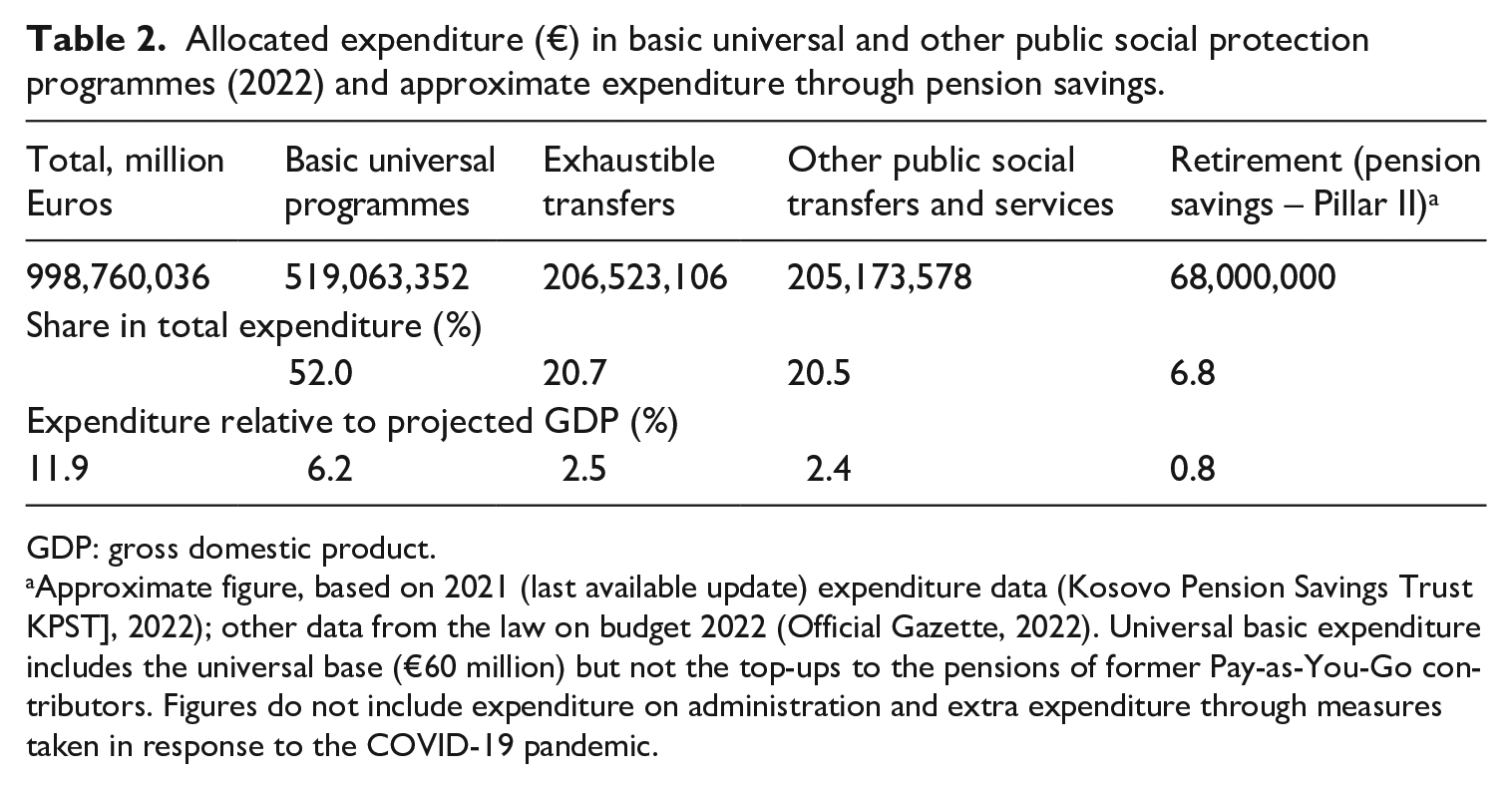
GDP: gross domestic product.
Approximate figure, based on 2021 (last available update) expenditure data (Kosovo Pension Savings Trust KPST], 2022); other data from the law on budget 2022 (Official Gazette, 2022). Universal basic expenditure includes the universal base (€60 million) but not the top-ups to the pensions of former Pay-as-You-Go contributors. Figures do not include expenditure on administration and extra expenditure through measures taken in response to the COVID-19 pandemic.
Basic universalism has also contributed to Kosovo’s citizenship-building through shared standards of living within the dimensions covered by the three programmes. Beyond integrating the former, more excluded rural population, these programmes, being tax-financed and unconditional, reached all minorities, including the Serbian one. By contrast, several exhaustible, particularistic programmes created after the war, such as tax-financed compensations for former PAYG contributors (implemented as flat-rate top-ups in the basic pension), pension top-ups for former teachers of the Albanian ‘parallel state’ during the 1990s, and cash and in-kind benefits for veterans of war and former political prisoners, reached predominantly the ethnic (and male) Albanian population. This further adds to the argument that democratisation does not necessarily lead to redistributive social expenditure; instead, the expenditure can be regressive if the reforming forces have such aims (cf. Huber and Stephens, 2012).
Obviously the main goal of IOs when inserting basic universal programmes in Kosovo was opening the path for radical privatisation and individualisation of rights, such as by privatising former social enterprises, removing social insurance institutions and making labour protection more flexible. Indeed, even with the recent expansion (child benefits), basic security could still serve privatisation and market goals in the form that basic universal income may do and may be supported for (see McDowell, 2021). However, the radical pro-market policy changes in post-war Kosovo have not created hoped-for results; the employment rate – usually around 30% since independence – did not grow when compared to the region or even Kosovo’s past in socialism. Recent evidence from the structure of savings at Kosovo Pension Savings Trust has revealed that about 90% of all people with saving accounts saved less than €10,000 by the end of 2020, and about 50% of them less than €2000 (KPST, 2021). Such figures indicate that extreme privatisation does not necessarily translate into employment growth and that the country is far from well positioned to provide good pension income adequacy without system improvements.
The increase in the number of private health providers in Kosovo between 2011 (634), when such data were collected, and 2020 (1582) was 149.5%, indicating that, as perhaps expected by the IOs, an increasing number of people seek services in the private market due to the basic (minimum) existing public healthcare services. However, only about 15% of the population was privately insured in 2019, which dropped to about 5% in 2020 (KAS, 2021b). This means that these private expenditures are covered predominantly by own means at the point of service, which proved a particularly harsh burden on the population during the first years of the COVID-19 pandemic, and could now inspire reforms to consolidate the NHS system.
By contrast, some incentives towards employment initiated by the LVV, as well as top-ups in basic security and poverty protection programmes, in response to the COVID-19 pandemic, began to reduce informal employment, which is believed to amount to around 35% of total employees (Cojocaru, 2017) and to strengthen poverty protection. This indicates that more active public policy and a more progressive mix of social rights, as advanced by the left-wing government, could provide better results.
Conclusion
Liberalisation under IOs’ influence in Southeastern Europe has led to many undesirable outcomes, such as rampant rising inequalities and outmigration (Ghodsee and Orenstein, 2021). Even in some advanced welfare states, globalisation has resulted in a decline in the quality of rights and universalism (Béland et al., 2014). Yet, in Kosovo, where they had unprecedented power, due to a multitude of intervening causal mechanisms, IOs created universal programmes that were unprecedented for the region and have been hugely beneficial for the population. These programmes improved poverty protection and social inclusion compared to socialism, which had created a deeply segmented society.
Universal basic security accounts for more than half of the social expenditure in Kosovo today and, without changes, may do so even in the future when the role of the market increases, but at the same time, numerous particularistic rights will exhaust themselves and end. The IOs committed to this policy by matching choices to the context, but were still seeking to create a pathbreaking policy configuration that would favour marketisation. Therefore, Kosovo was rightfully portrayed as a ‘caricature’ of the liberal welfare regime. After all, it still remains among the smallest social protection spenders in the region. However, after two decades of democracy, the political situation changed dramatically, opening the path for the universal, social investment and working-age-focused policy ideas of the first-ever left-leaning majority. In this way, the IOs may have counterintuitively left behind a fertile ground for social-democratic-inspired ideas rather than a marketisation akin to the neoliberalism of the 2000s.
Interviews
With: (1) a former Minister of Labour and Social Welfare – 18 February 2016, Prishtina.
(2) a leader of The League of Pensioners of Kosovo – 18 April 2016, Prishtina.
(3) a member of the Parliamentary Committee on Health, Labour and Social Welfare – 19 April 2016, Prishtina.
(4) an analyst at World Bank Group (Kosovo) – 20 April 2016, Prishtina.
Footnotes
Acknowledgements
The author is very thankful to the anonymous reviewers and editors of the journal for their helpful feedback, to Aidan Hehir for reading this article as a native English speaker, and to Paul Stubbs for his kind encouragement and a very informative body of work on the Balkans.
Funding
The author(s) received no financial support for the research, authorship and/or publication of this article.
