







Abstract
How can countries successfully extend social insurance coverage to self-employed workers in pursuit of their fundamental human right to social security? As the global policy spotlight is increasingly being trained on protecting workers in all forms of employment in a changing world of work (see, for example, Council of the European Union, 2023; European Parliament and European Council and European Commission, 2017; ILO, 2025), this question is of central importance.
Over the course of 2022–2023, we reviewed 10 national experiences to better understand how governments in different contexts were leveraging policy and administrative tools to address the significant barriers to coverage for self-employed workers (see McClanahan et al., Forthcoming). The forthcoming study, commissioned by Women in Informal Employment Globalizing and Organizing (WIEGO) and the Inernational Labour Organization (ILO), covered the following experiences:
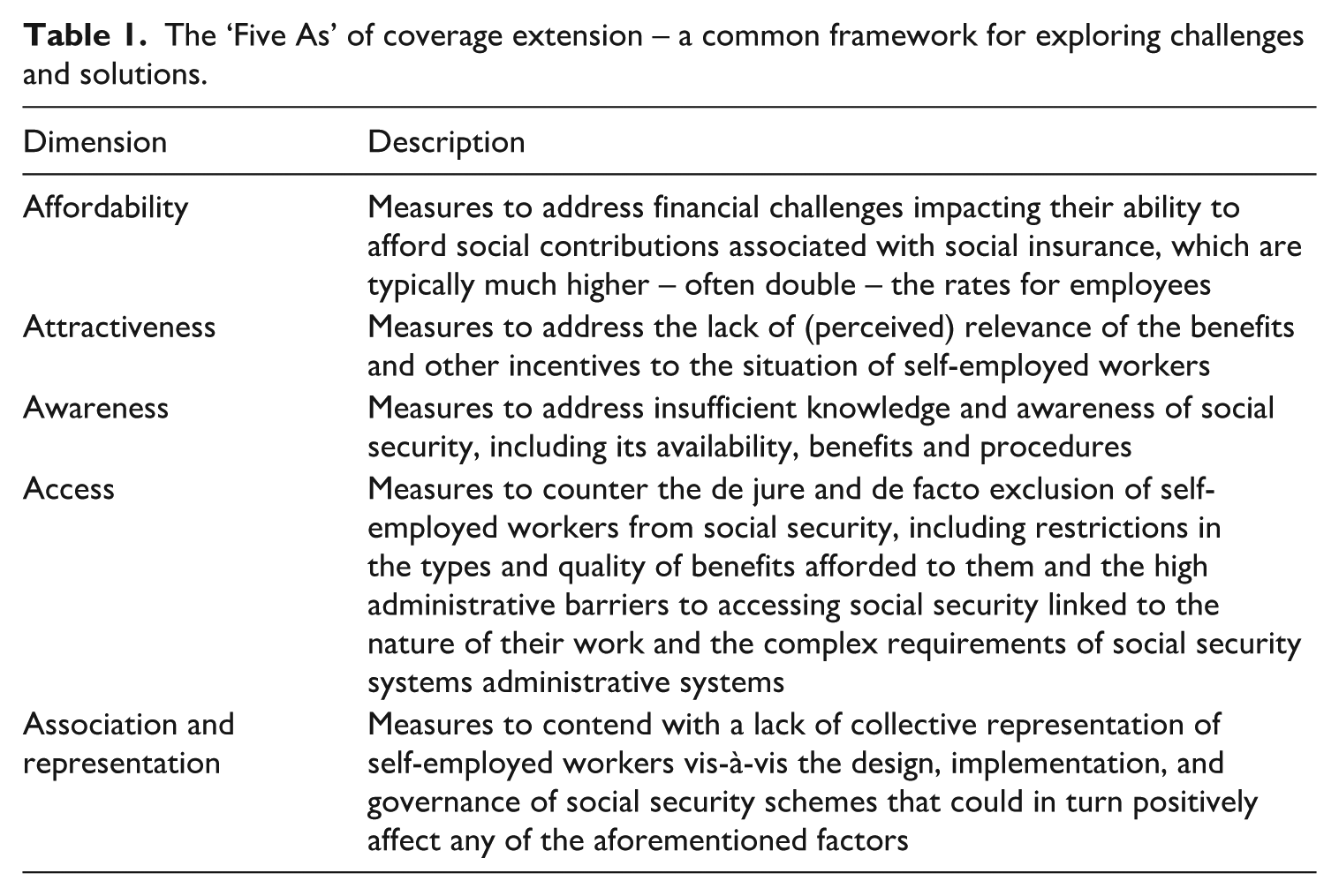
We explored how policy and administrative solutions in the different cases addressed key challenges to coverage extension to self-employed workers along five dimensions, namely, affordability, attractiveness, awareness, access and association – a common framework we dubbed the ‘Five As’ (Table 1).
The ‘Five As’ of coverage extension – a common framework for exploring challenges and solutions.
While not mutually exclusive, the dimensions provided a useful comparative framework that allowed us to gain important leverage on key policy choices and debates related to covering the self-employed. Some of the findings are highlighted briefly here, with a view to opening future lines of research.
General schemes or special schemes – or something in between?
A central policy question concerns whether to create separate schemes or to incorporate the target group under a general scheme, often framed as a dichotomous choice. In the cases reviewed, incorporating self-employed workers into the general scheme but devising specific mechanisms to encourage their participation, as in Cabo Verde, Costa Rica, Mongolia and Portugal, was the most common approach. At the other extreme, in Algeria and, broadly speaking, Tunisia, special schemes for self-employed or even defined groups of self-employed were created. But the review showed that many cases fall somewhere in the middle: Brazil, Uruguay, Thailand, as well as Zambia’s pilots, are administered within the institutional framework of the general scheme, while providing dedicated parameters for self-employed workers. Thus, the debate is far more complex and nuanced than is typically appreciated.
Several examples of ‘schemes within a scheme’ – notably, the ‘monotax’ arrangements in Uruguay and Brazil – underscored important questions about the overall objectives of special schemes, and especially whether they should be transitory or permanent and how best to align incentives and adequacy. In Uruguay, beneficiaries and policymakers questioned whether the Monotax should seek more deliberately to transition registrants from a low-contribution–low-value situation into higher quality benefits with higher contributions. In Brazil, prioritizing comprehensiveness and coverage extension (by providing essentially equal benefits to registrants paying lower contributions) introduced risks of under-declaration, disguised employment, and illicit registration.
Voluntary versus mandatory participation
The quintessential choice between voluntary and mandatory participation involves important and widely documented trade-offs. Notably, many of cases that exhibited noteworthy coverage gains for self-employed workers involved compulsory coverage for a comprehensive set of benefits, as was the case in Cabo Verde, Brazil, Costa Rica and Uruguay. While evidence on enforcement was lacking, Costa Rica’s investments were noted as instrumental in increasing coverage and evidence from Uruguay suggests registrants were responsive to the ‘negative incentive’ of being subjected to inspections.
In contrast, coverage gains were more modest, even disappointing, in cases where participation was voluntary, including in Mongolia and Thailand. Instituting voluntary participation, as in Mongolia and Thailand, which places a premium on pull factors – subsidies, benefits tailored to the needs of self-employed workers – and communication campaigns, while relieving the state of the need to invest in push factors like compliance enforcement.
Improving the attractiveness of social insurance – prioritize short- or long-term risks?
Arguably, systems are more attractive if they offer a more comprehensive range of benefits – especially as regards offering key working age provisions, such as sickness, maternity/paternity, employment injury or unemployment benefits (often called ‘short-term benefits’) thought to be more directly relevant to workers’ current circumstances.
In most cases reviewed, particularly where participation was mandatory, self-employed workers were given access to the general scheme with comparable levels of rights and entitlements to employees. Brazil, Cabo Verde and Uruguay also experimented with additional incentives aimed at micro- and small businesses, and in Uruguay, registrants reported that these additional incentives were among their primary motivations for joining the Monotax regime.
Here again, evidence on beneficiaries’ perspectives on the value of specific benefits, services and incentives is noticeably thin. However, while the literature has suggested that short-term benefits are more likely to attract workers with benefits they could access earlier in their lives, beneficiaries expressed a preference for retirement benefits in two of the cases (Uruguay and Zambia), suggesting that while attention to filling gaps in working age is critical, the attractiveness of long-term benefits should not be discounted.
Tackling affordability without undermining adequacy
In most cases where the self-employed are legally included, statutory contribution rates are higher for self-employed workers than for employees; of the cases reviewed, Costa Rica and Uruguay are exceptions. To address affordability challenges, a range of strategies were pursued, such as enabling a gradual scale up of contributions, providing matching subsidies, adjusting contributions to income levels and facilitating the settlement of arrears.
Algeria and Uruguay allow new self-employed contributors to begin contributing at a lower rate and then gradually increase to the full level over time, allowing contributors to adjust. Portugal sets a low minimum contribution and allows flexible payment whereby contributors can adjust their payments, which are based on earnings in the previous quarter, by up to 25% to account for fluctuations in earnings. Mongolia and Costa Rica provided matching subsidies, including those that are related to income levels, and in both of these cases, government programmes designed to help self-employed workers settle social security arrears are likely to have helped bring back former contributors who had accumulated debt from periods without paying.
The case studies also illustrated how reducing contributions – or keeping them low – to address affordability challenges can have unintended implications for adequacy. In Brazil and Uruguay –tension emerge between the prioritization of coverage extension and adequacy of social security benefits, on one hand, and the promotion of other policy goals such encouraging participants to seek higher degrees of formalization. Clearly, there are complex interactions and potential trade-offs between addressing affordability and improving attractiveness.
Improving access and awareness by lowering administrative barriers and leveraging workers’ associations
While policy solutions were central components of most countries extension efforts, administrative innovations were also critical. Offering some degree of flexibility with respect to the administrative requirements, the access points for interfacing with social security or tax authorities, the levels and timing of contributions, and the scope and level of benefits provided opened up pathways to increase coverage in several cases.
Efforts were made to reduce administrative barriers by simplifying registration procedures in Algeria, Brazil, Cabo Verde, Mongolia and Tunisia. Online portals and one-stop shops have been introduced with relative success in Algeria, Brazil, Cabo Verde, Mongolia and Tunisia. Other countries, notably Brazil, have reduced documentation requirements, and in several cases, notably Tunisia, innovative technology was successfully employed to improve access and facilitate contribution collection, specifically among disadvantaged groups who would otherwise risk exclusion.
Equally, raising awareness about social security often requires the active engagement of community members, and vice versa, but both factors are often lacking for self-employed workers. Several cases, notably Cabo Verde, facilitated awareness raising through carefully designed and targeted communications campaigns. Government actors have engaged with workers’ organizations in Zambia, Mongolia and Tunisia; while in Costa Rica, the use of collective insurance agreements stands out as perhaps one of the most distinctive and wide-ranging approaches to engaging self-employed workers and their representatives in the management of their schemes.
Enabling factors and enduring challenges
The cases reflect a great diversity of experiences, but common drivers of success emerged. No single factor was sufficient to explain or enable success on its own, but rather worked in tandem with other factors, namely the strategies employed by governments and the idiosyncrasies of the unique historical, political, economic and institutional contexts and legacies. Strong institutional and governance framework were cited in Algeria, Brazil, Mongolia, Costa Rica, Uruguay and Tunisia; they were also significant factors in Cabo Verde and Portugal. After strong institutions, the legal and policy environment was highlighted as an important enabling factor in Brazil, Cabo Verde, Costa Rica, Uruguay and Tunisia. Several of the case studies – Brazil, Costa Rica, Mongolia, Portugal and Uruguay – indicated high administrative capacity as a key enabler of success. Less frequently, but not less importantly, the cases pointed to the importance of high levels of trust in government or expressed willingness to contribute (Algeria and Zambia), the involvement of international actors (Mongolia, Zambia) and the strength of workers’ movements and organizations (Costa Rica).
In all cases, enduring challenges were identified that will continue to constrain efforts to extend coverage to self-employed workers. Chief among them is affordability, reflecting widespread trends of low earnings and contributory capacity among informally workers worldwide (OECD, 2024). Consequently, and given broader fiscal constraints, maintaining and improving the attractiveness of schemes remains a long-standing challenge, especially given tensions between the two objectives that complicate the task of aligning financial incentives with benefits. Administrative and Information and Commuication Technologies (ICT) capacity constraints are also cited as enduring challenges that constrain improvements to access in certain contexts. Meanwhile, barriers to enhancing awareness and engagement remain, especially where trust issues and concerns about mismanagement further complicate uptake.
Conclusion
Governments around the world grappling with how to extend coverage to self-employed workers are finding their way to diverse solutions, and the review reflected this. The solutions do not readily lend themselves to easy classification, but they speak to some of the key debates identified in the literature. Importantly, they reveal that the most effective solutions are typically those that take a system-wide perspective and tend towards greater integration and policy coordination, aligning (a) tax-financed and contributory components of the social protection system, (b) all contributory schemes, (c) tax and social security systems and (d) benefits and incentives to encourage social insurance and formalization. Social insurance is here to stay in the vast majority of countries around the world and self-employed workers deserve to have a stake in its future.
Footnotes
Acknowledgements
The author would like to thank Sebastián Aguiar, Mauricio Coitiño, Kanokporn Deeburee, Ana García, Wichaya Komin, Cecilia Matonte, Boonsom Namsomboon, Martín Sanguinetti, Holly A. Seglah, Anasuya Sengupta, Daisy Sibun and Borvorn Subsing for their contributions to the study discussed here.
Funding
The author disclosed receipt of the following financial support for the research, authorship, and/or publication of this article: The research presented here was supported through a WIEGO project funded by the Swedish International Development Cooperation Agency (Sida).
Declaration of conflicting interests
The author declared no potential conflicts of interest with respect to the research, authorship, and/or publication of this article.