







Abstract
Research that ‘grows apart’ from its original design and proposal is not uncommon, especially when involving participatory and creative methods. However, the disconnect between research intentions and research realization is seldom probed for the insights offered; this paper addresses this gap. Taking up the conceptual lens of research imaginaries, this paper dives into the tensions and discoveries experienced in between the design and the practice of a multi-site participatory research project. The study involved two groups of young people, in two cities in two countries, with a focus on digital lives. In a commitment to collaboration with artists, senior researchers, research assistants, and young people in community spaces, a complex project emerged. This paper describes the tensions and possibilities of an emergent methodology and in doing so argues for increased attention to the movement of research designs; rather than the adherence to them.
Keywords
This paper recounts research we (two lead researchers) carried out with two groups of young people (13–20 years old) in two cities in two countries about their digital lives. Each group engaged with visual arts in a local community space while inquiring about digital divides (Braverman, 2016; Chen, 2015), digital practices and digital lives (Livingstone and Sefton-Green, 2016; Price-Dennis and Carrion, 2017; Thomson et al., 2018). A lead researcher in each site worked with research assistants (Metka Manfreda and Stephanie Gumieniak in Canada and Elizabeth Nelson in Glasgow), a senior academic collaborator (Jennifer Rowsell, Theresa Rogers), community partners, a professional artist (Vanessa Crosbie Ramsey, Beth Shapeero) and young people. 1 This paper, written by the lead researchers—one in each site—provides rarely offered insights into the complex unfolding of research, and the distance between our intentions for the research, and what materialized, framed in relation to imaginaries. We describe the arts-informed collaborative methodological practices that emerged. Two vignettes are provided at the outset to characterize the complex factors at play in the inquiry.
In Hamilton, Canada . . .
Young people, artists, and researchers painted circles in a bull’s eye pattern, while thinking about the various communities of which we were part (see Figure 1). Young people in friend groups of two or three painted, some talking about their communities as they painted concentric circles, others using plates to trace circles, and some adding images (an eye, some figures). Vanessa Crosbie Ramsey is a media artist, filmmaker and arts-educator. Vanessa wanted the young people to put all their bull’s eye paintings together in a group mural. She hoped they would start to think about other collaboratively produced arts pieces they might make, while exploring their digital practices, spaces, and connections across offline and online worlds. During the break, the young people ate shawarma pizza (a staple for all sessions going forward) and chatted. In this collaborative project, as in others, young people engaged intensively with the art materials and tools, entering an almost meditative state, and engaging to some degree with the intentions of the project but also following their own immediate responses to the colours and shapes that paint allowed them to produce. The young peoples’ preference for working with physical materials (rather than digital tools and devices) was one of the first things the researchers and artist noticed, and the kind of calm that material engagement seemed to offer.
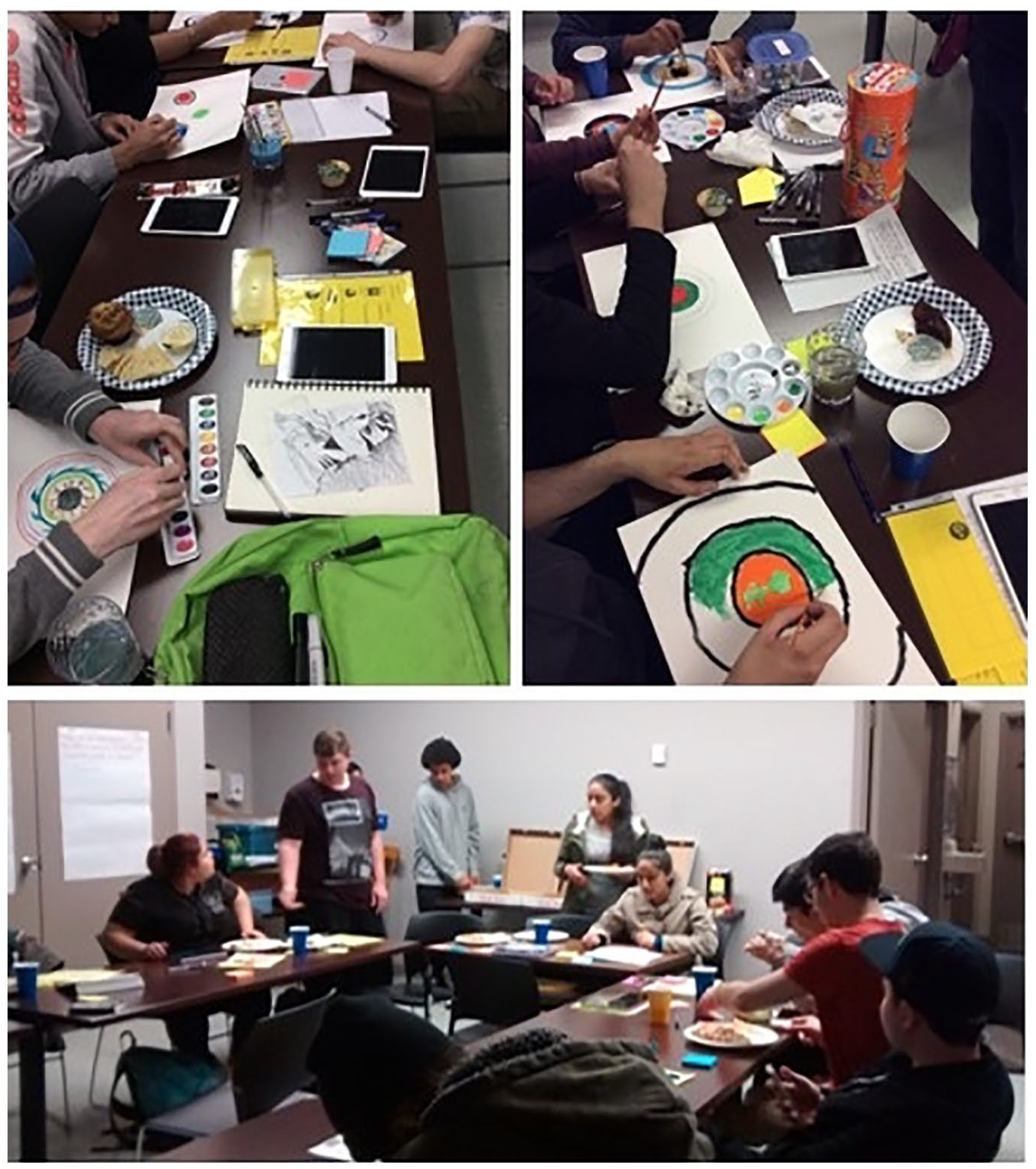
Young people in Hamilton making community circles, and eating.
Meanwhile in Glasgow, Scotland, engaging in a different activity. . .
As they wandered in at the beginning of the third session—mainly in the twos and threes of pre-existing affiliations and relationships—researchers and artist chatted with the young people individually and asked them to sit with one of various options of digital and social platforms that the researchers and artist had set up—or to look up their own, and determine whether it might be suitable for us to use for the project (see Figure 2). They worked quite quietly and productively, creating ‘pros and cons’ lists with post-its, of Facebook, Pinterest, Tumblr, Google, and so on. In the end, there was no obvious decision or consensus, but no debate or negotiation either. The group seemed neither surprised nor bothered that there was no clear digital space for us to occupy as a group. As a response, researchers painstakingly Facebooked some, e-mailed others, called, and texted others weekly. The project team eventually put together a WordPress blog site with a record of curated outputs, but this was hardly visited by the young people. This diversity of digital tools and interests followed us throughout our communication with the young people and also in their responses to queries about their digital lives and sources of expression. Beth Shapeero is a 3D artist and youth arts facilitator.

Young people in Glasgow responding about digital tools, and eating.
The methodological approach is of primary concern in this paper, in particular the insights found in the spaces in between the intentions and outcomes of the research. Important components, however, are the research objectives and questions. The overarching objective was to understand the digital practices of today’s young people in relation to common assumptions about access to digital and global mobilities. Assumptions and inequities in access to digital tools, capacities, and practices have become even more evident and in need of attention in light of the COVID-19 pandemic, not least due to the changes in ways that young people are engaging in learning remotely. The potential for digital cultural production through the arts (Cahnmann-Taylor and Siegesmund, 2018; Renold, 2018; Rowsell, 2017) to bridge young people’s geographic, social, and economic boundaries was also central to this inquiry at its inception. The findings that emerged from the project offer insights into young people’s digital practices (Perry et al., 2019). Despite compelling findings, the evidence of the divide embedded in our process between on the one hand, researcher intentions, assumptions, and discourses about the young people and digital space and on the other hand, the experiences encountered in actual engagement together was cause for further analysis. This often overlooked or underplayed aspect of research is the subject of this paper.
Our decision to invite artists, senior and junior colleagues, and youth into a common space of enquiry was based on a recognition that we were embarking on research contexts that exceeded our own experience. We were interested in seeing what we could learn, beyond existing frameworks or predictable trajectories for qualitative research (Brinkmann, 2015; St. Pierre, 2019) and wondered what obstacles (in ourselves and in the world) we might encounter. Collective imaginaries, as described by C. Medina and Wohlwend (2014), involve the coming together of multiple cultural practices, identities, and identity performances. They describe this coming together as convergence. Medina and Wohlwend draw on Anderson’s (1983) concept, the multi-sited imaginary. Perry (2020) suggests that convergence, as a concept, allows us to think and learn across difference as we bring diverse imaginaries into contrast, in contexts like those that emerged in our collaboration. Also, drawing on Appadurai’s (1996) description of social imaginaries and self-imagining, and Greene’s (1995) call to educators to use imagination to see otherwise or in new ways as the potential for transformation in education, we looked to the potential of imagined futures and imaginaries to allow us to produce and see something new.
Our imaginaries as researchers and teacher-educators (we are both academics in schools of education), the imaginaries of diverse young people, and of their adult community allies and mentors, as well as the imaginaries of the artists we worked with, merged in this endeavor. Parents and teachers expressed their enthusiasm for this project based on their concerns for young ‘screen obsessed’ people; youth expressed their assumptions of their parents’ attitudes to computers and social media; as researchers we re-evaluated our questions almost continually as we came to better understand the space that we had previously imagined. In a way, for everyone involved, this newness involved a kind of rescripting of lives across difference (Collier, 2014). By sharing our imaginaries, our frames of reference—as described by Nowak (2013)—we could work toward creating a collective space that ultimately creates new ways to communicate and work together.
Using imaginaries as an overarching frame and analytic concept, this paper dives into the discoveries, mistakes, and opportunities we experienced while using exploratory arts-informed and collaborative methods. These fields and histories are elaborated more fully in a discussion of influential theories and methodologies later in this paper. In this process, we have struggled with our imagined audiences as well as how to represent multiple voices. The first section of this paper outlines the three phases of the research, our practical objectives, and the overall emergent design. Second, we outline our theoretical influences and methodological intentions, which include consideration of digital/post-digital literacies and ways of generating data. Also, we consider how the arts or arts-informed research allows for an exploratory approach to research, and then, the limits and potentials of collaborative approaches when working with others. The third section is an analysis of the unfolding methodology or what happened. Finally, we take a detailed look at the implications of what is possible in international, interdisciplinary, and inter-generational research using the arts.
Project/context/players
The project was a co-investigation into the nature of cultural and digital literacies of two samples of low-income young people in two cities—Hamilton in Canada and Glasgow in the UK. These two cities exemplify areas across the Global North with shared industrial histories yet presently home to significantly depressed socioeconomic conditions. Their histories share disquieting comparisons with current globally serving workforces across the Global South (countries with low human development index [HDI]) (e.g., technology, manufacturing). Hamilton is a highly industrialized port city, and as the ‘Steel Capital of Canada,’ has a long history of trade unionism, striking works, and local pride in resistance to government and steel mill owners. Glasgow is the largest city in Scotland and the industrial revolution transformed the city into one of the world’s largest centers of engineering, specifically with shipbuilding and marine engineering. Today, both cities are characterized in part by high degrees of unemployment, poverty, and declining populations.
The first phase of the project focused on building partnerships with local organizations and community groups, mapping and learning about the communities, and recruiting participants. The second phase involved artmaking sessions with young people over a two-month period, and the third phase consisted of community engagement and public dissemination. Here, we focus on the first and second phases.
Phase 1: Working together
To begin with, we (Diane and Mia) engaged in reading and grant-writing, we had dreams and plans for what might happen and what we might learn. We also were required to develop research questions and foci that positioned us differently from the artists and young people with whom we would work and that challenge the collaborations we hoped to develop. We were struck by the parallels between our two cities and their industrial histories as well as their reputations as places of unemployment and high poverty. We had worked together before and had been inspired by some of the same mentors and thinkers. Coming from different theoretical positionings and academic foci (Diane from sociocultural literacies and research in children’s multimodal and visual making; Mia from affect theory and arts education), we found our shared approach to overlapping interests an important and productive space. For six months, we read and talked together in public pedagogies, mobilities, and media/digital literacies. We examined assumptions and movements in our fields about young people’s digital engagement and wondered how a transdisciplinary methodology might enable us. We worked with senior mentors who helped us to map the research and integrate our disciplinary knowledge.
Mapping the research spaces was an important and foundational step in the research project and indicated the first of many crevices in our (funder approved) research design (see Table 1). A multilayered understanding of the physical contexts of the research was developed through a process of iterative mapping (Dovey, 2017; Powell, 2010). Through a combination of desk research, walking, photography, and informal conversations, maps were created that layered geographical dimensions with visual documentation with locations of resources, facilities, and infrastructure, along with demographic research.
Community mapping in Hamilton and Glasgow.
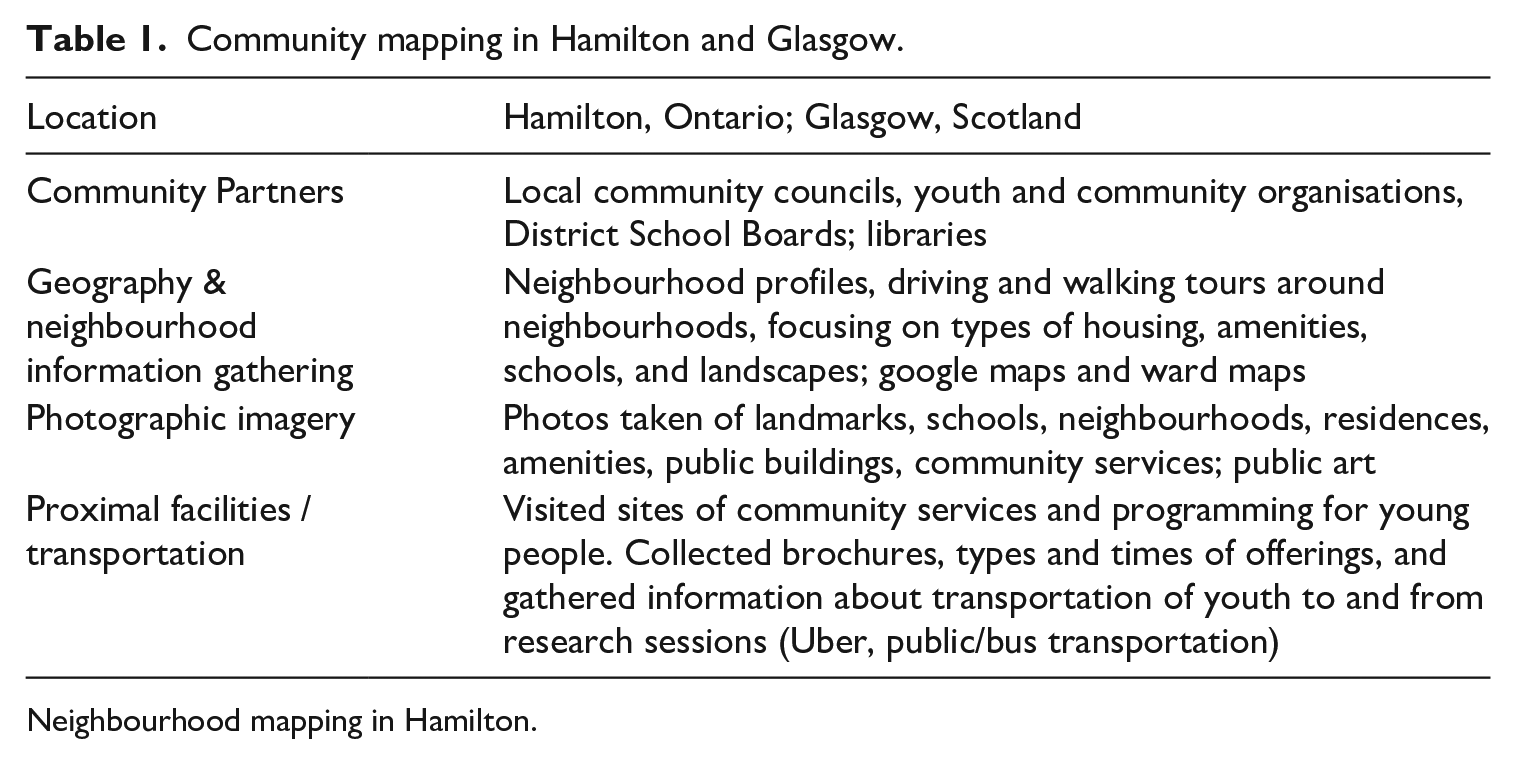
Neighbourhood mapping in Hamilton.
In Hamilton, Diane met with the local social and planning research council and consulted with afterschool and newcomer 2 organizations, public libraries, and local school boards, about the best ways to recruit young people. The perspectives on recruitment were diverse and ideas about who would benefit, who might represent organizations (such as schools) came into play. A site for working together in our sessions was chosen in the middle of three neighbourhoods, a public library. At the same time, Diane consulted with arts leaders in the local school boards and the city arts council to hire an artist. The Hamilton Art Council coordinated the distribution of the Call for Artists and supported the selection process. We hired an artist with a great deal of experience working with young people, externally funded projects, and other community organizations. These details help to explain how artists were not part of the planning from the beginning.
Meanwhile in Glasgow. . .
Mia contacted arts centre, with which she had previous connections. Her contact recommended a local sculptor who was also experienced in arts programs with young people. Mia’s doctoral student co-organized sessions, the site, and helped to recruit participants. A nearby cooperative run cafe became the location and provided catering. The Glasgow team recruited participants through presentations at community council meetings, introductions in community centres, and word of mouth. Interested people were invited to a welcome session with food, activities, and a presentation. Already, rich context was emerging about adults’ versus young people’s perspectives on their digital engagement, as well as ideas about what arts research sessions with young people might be like.
In both cities the young people came together with the promise of good food, fun, choice of technologies activities, and digital media. In Hamilton, some of them attended with the promise of volunteer hours—required for high school graduation. In Glasgow, some of the kids were ‘volun-told’ by their parents who felt sure this would be a good project for their sons or daughters. The parents’ reasons varied slightly, but all hinged on the consensus that young people, including theirs, were screen obsessed, and living out lives unconnected to their own. In Hamilton, where the young people were slightly older on average, there was minimal parent involvement. However, we (researchers) deduced from conversations with young people that some parents encouraged their children because of the perceived value of association with a university. The young people were diverse, as all groups of young people are. They came from different racialized groups, some had parents who had immigrated to the country and they came from a range of social class backgrounds. What they held in common is that they were local to the community hubs where we met, and it was in the local community that we recruited. Among the Glasgow group, like the Hamilton parents, some young people expressed concerns about their own screen obsessions and engagement in online spaces. At each encounter, we sensed the building constellation of voices and perspectives and assumptions, and vacillated and shifted in how we responded to and felt responsible for keeping all these elements in play. In the section that follows, we provide a glimpse of how the research unfolded in each context.
Phase 2: Sessions with young people and artists on digital lives
In both contexts, between ten and fifteen young people (aged 13–20 years) met once a week over a two-month period and worked with a professional multimedia artist. During two- to three-hour sessions young people explored and created digital and material responses to prompts about their engagement with digital practices and tools. In between sessions, young people gathered ideas, experiences, and representations of their peers’, families’, and friends’ digital practices. The sessions were characterized by a shared attention to the nature of research and data generation in the case of this project, and the nature of the digital aspects of the young peoples’ lives.
Because we worked with different artists, and different young people, in different time zones, and with different pulls on our workdays, the sessions looked different but not entirely distinct. In Hamilton, at the neighbourhood public library we were able to rent large flexible space. Practicalities such as the carting of materials, carpooling, catering, and Ubers for the young people led to a certain amount of intensity and feats of organization. Working in the project room in the local library, and later, in a modern glass space in the central library, young people who went to school nearby came directly after and helped set up and ate snacks. Sometimes they took selfies or pictures of each other with the iPads. The boys who came early from the closest school often took a Jenga game from library shelves to play with while they were waiting. There was a sense of camaraderie between researchers, artists, and young people that developed over sessions, a jokey repartee, and a feeling of indulgence in a space where there were materials and possibilities and choices and a sense of openness.
Phase 3: Reflecting, sharing, feedback, and dissemination
Nearing the end of our fieldwork, various activities were taken up to encourage feedback and collective analysis with the participants. In Glasgow, individual interviews were held with young people; in Hamilton, we ran an online survey. In Hamilton, the artist created a video that represented her experience of the research sessions. Each site held a celebratory session where community and family members were invited to experience and engage with what the young people had done.
In Hamilton, six months later, while heading for coffee at the university library, two of the researchers spotted two of the young men from the study (who were enrolled at our university, which we did not realize), working with a group of friends at a study table. We were excited, and rushed over, not really thinking about what would be comfortable for the students and expressed our excitement at seeing them. They were friendly and told about their studies. We told how we had presented some of the research in the United Kingdom the past summer. Immediately we could see that they were surprised, and it brought to minds our different viewpoints, engagements, and memories of the research we had done together. The research time together was front and center for us, but had faded for them, and the convergence of our perspectives seemed to have dissipated.
Theoretical influences and methodological intentions
We designed the study as a collaborative (Dahya, 2016; Warin, 2011), arts-informed (Chilton & Leavy, 2014; Pahl, 2014), and multi-site ethnographic (Hannerz, 2019; Heath and Street, 2008) study. The hyper-connectivity of academic communities offered new possibilities and challenges in research practice and partnership. Conceptually as well as practically, the digital dependence of our research collaboration and methodological design became interwoven with the digital focus of our inquiry with young people.
Digital and post-digital framing
Working in—and connected across—different continents, the research engaged young people and community partners to research how and why young people engage with digital and creative practices in and out-of-school. The role of imagined audiences as well as imagined identities influences what young people do (Collier, 2017). The implications of these practices in terms of social and cultural mobility were of primary interest (Sheller and Urry, 2006, 2016). While digital technologies are given an increasing role of importance in social and civic spaces, a quickly growing body of research shows that digital technologies increasingly play a part in exacerbating achievement gaps and socioeconomic divides (Braverman, 2016; Chen, 2015; Dolan, 2016). These gaps and divides have become more visible at this moment, when learning methods and delivery around the globe have shifted dramatically. Inequity is apparent in youth engagement with digital and global literacies (Rogers et al., 2018). We asked how research in digital and cultural literacy practices might bridge young people’s geographic, social, and economic boundaries, and to what end.
Others have started to frame what digital engagement or practices might look like in a post-digital age (Jandrić et al., 2019). In this research, we started to see what post-digital lives might look like, as youth moved across and in and out of spaces easily. We realized that for the young people there was no offline or online and some of us have written about this elsewhere (Nelson et al., 2020). In a post-digital age, people (at least those with digital access) are not really online or offline either (Jandrić, 2019), at least in the sense conceived in the late 20th/early 21st century in discussions of digital natives and digital immigrants. Nelson, Perry and Rogers (2020) have conceived of this as degrees of offlineness. This blurring of the digital/non-digital binary is particularly evident in game play (Apperley et al., 2016) but was also prominent in our discussions with young people. What is most relevant for us here is how our positions, our histories, and our assumptions influenced what we expected from young people, and what they expected we expected from them.
Arts-informed research
Working with young people alongside a local multimedia artist, opportunities for embodied, affective, unexpected, and non-representational inquiries and interactions around our research questions were incorporated (Cahnmann-Taylor and Siegesmund, 2018; Thiel, 2015). How digital engagement could be influenced and mediated through creative and cultural production, building on the more familiar assertion of cultural production being mediated by digital tools, was central to the inquiry (Kember and Zylinska, 2012).
Unlike much arts-informed or art-based research, we did not take up arts practices to represent information, nor did it serve to ‘enliven and rupture’ otherwise traditional qualitative research as Cole and Knowles propose (2008, p. 51). Cole and Knowles (2008) suggest that working with the arts in qualitative research can combine ‘systematic and rigorous qualities of conventional qualitative methodologies with the artistic, disciplined, and imaginative qualities of the arts’ (p. 59). Jewitt et al. (2017) similarly propose the arts as new and disruptive ways of doing qualitative research. These conceptions of the arts in research spaces provided a formal justification for our approach; however, in practice, the arts practices in this project were a more fundamental driver.
Coming from backgrounds in the arts, we did not perceive a clear distinction between the work of an artist and the work of research. As academics however, we held the question of how these practices might be reconciled and brought into complementarity in existing research structures. Not seeing the arts as a kind of savior or an end in itself (Gaztambide-Fernandez, 2013), or a benign pedagogical tool (Perry and Collier, 2018), we wondered how collaborations with artists, and research that involves art making as inquiry, might engage our collective imaginaries on young people’s digital lives. In order to push the limits of this relationship, between arts practice and formal research inquiry, we worked with highly qualified artists and co-constructed the workshop sessions with them. In both sites, the arts were taken up as a tool of inquiry, but also a mode of expression, a medium of play, and an intervention into young peoples’ digital lives. We molded research questions around artist-led provocations and practices, as often as art making was developed in response to researcher-led questions. To this day, we still sit with files full of artifacts from our workshops, considering how these outputs relate to our conceptions of data.
Collaborative research with young people and communities
In line with our collaborative goals, we asked the young people to generate data with us by exploring digital engagements in their own lives and networks. This desire was born out of an interest in the potential for ethical research with rather than on young people (James, 2007). One of the key concerns, then, was to think through what ethical research with young people looks like, while at the same time resisting claims that responsibility for analysis is equally shared. We acknowledge that researchers hold power and insights that are not equally available to young people or to research participants (Dahya, 2016; Holland et al., 2010).
The term collaborative situates that framing within participatory traditions of research. There are two participatory threads that are particularly relevant; one is children’s voice research and children’s rights initiatives that began in the United Kingdom and have come to permeate much qualitative research with young children, where some name young people as co-researchers and also express a desire to include or elevate young people’s voices (Bucknall, 2012; Rogers et al., 2016; Soto, 2005). Inclusion of young people in research has been accomplished variously—in the conceptualization of research questions, data generation, analysis, and dissemination of findings (Ford et al., 2007; Graue and Walsh, 1998; Lyon and Carabelli, 2016; Warin, 2011).
The second thread relates to community-based research, personified particularly in photovoice initiatives, that often focus on marginalized populations, grounded in emancipatory discourses (Guillemin & Drew, 2010; Malka et al., 2018; Mitchell et al., 2019). We are concerned with issues of equity and reciprocity but are also wary of claims to represent the voices of others (Loutzenheiser, 2007) and overstating the relations we can build in short-term interventions such as ours. Our use of the term collaborative, then, emphasizes our desire to work together, with arts, and with the young people, and to unsettle the tendency of a singular voice or practiced point of view.
What happened (or the methodology that grew)
In the context of the site and participant descriptions, theoretical and methodological frameworks detailed thus far, we discuss next the reconciliation between the research proposed and the research that happened. We suggest that this kind of disconnect (between intentions and realization) is common in much research but is less often discussed and probed for the insights and possibilities it can offer.
In the section that follows, three methodological findings and implications for practice when engaging in this kind of arts-informed literacy research are highlighted. The first methodological finding outlines the complexity of doing research that attempts to follow participant interests and probes the assumptions underlying these attempts. The second focuses on the assumptions about creativity that we brought into the research and the alignment and discordances between researcher work and artist work. Finally, we discuss how our attempts to research alongside artists and young people, and removing ourselves from the center of events, challenged our training and positions as qualitative researchers.
Following young people’s interests: Young people as collaborators
Our research questions were structured and well-rehearsed by the time we, as researchers, met our research participants. The kinds of media and arts practices with which the young people would work however were not predetermined. The youth came from various places in the community and were recruited in ways that resulted in diverse groups, with many kinds of experiences. Our desire to follow the lead of young people relied on assumptions about their experiences, their interests, and how they engage. We assumed that young people would come with defined notions about what they liked to do or were already good at.
Time was spent at the beginning getting to know the young people, sharing our intentions, and always offering choice (paints, clay, drawing pencils, digital video) in their responses to provocations. Very quickly, our preconceptions, both implied in our research questions and our planned modes of engagement, were turned on their head. Fortunately, the artists were both familiar with and comfortable working in a wide range of media and techniques and used to responding to what young people wanted to do. Digital devices were abandoned in many cases, as clay and paint were preferred; a cross-site Skype call fizzled out anti-climatically as a game of Clash Royale took over. As researchers, we were less equipped to find that our well-intentioned questions were of little interest to our participants. Our planning, sessions, and debriefs therefore relied on a level of observation, reflection, improvisation, and adaptation that ultimately transformed the research.
We assumed that the young people would have digital interests in common. To the contrary, their interests and participation in digital platforms were widely varied and individualistic (see Figure 3). They were highly specialized in their interests, for example, focusing primarily on Instagram or console play or YouTube videos or sometimes a combination of two. The research team accordingly adopted a multiplicity of digital tools to work with. There was not one tool with which to communicate, and each week involved a mashup of ways to connect that included texting, Facebook messenger, email, telephoning a parent or sibling. Additionally, the youth did not see digital tools, devices, and modes as holding potential for artistic expression in the ways we imagined, and consistently preferred working with materials and with their hands. The discrepancies or distances between our attempts at collaboration and their experiences and desires were brought into relief.
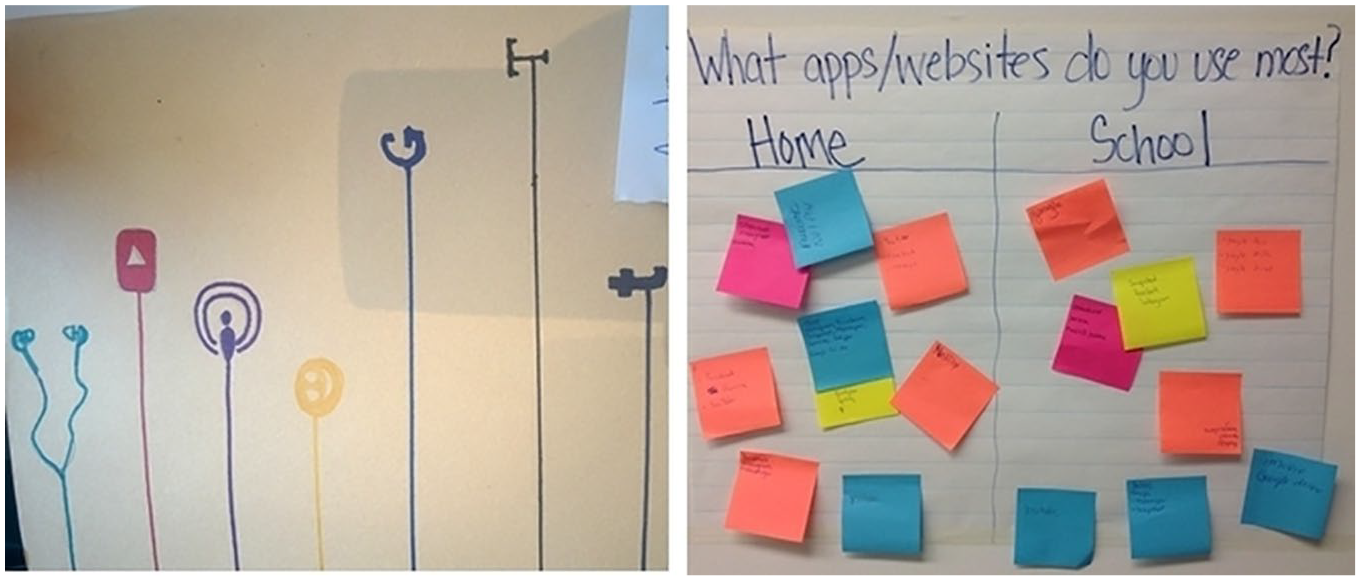
Representations of digital tools used.
The nature of young people’s engagement with digital space seemed a very open, inclusive, and engaging question to us, as a research team. In collaboration with the youth, and in co-design of their own research practices in between sessions, this question fell away from us as researchers; the concept of digital space was too abstract for the young people and the lived experiences and interactions with digital platforms was more compelling for them. Our participants wanted to know why some people preferred spending time with people in person and others preferred staying at home; why some people relied so heavily on digital platforms for entertainment, and some for self-assurance. In this way, our collective research endeavor moved from a specific line of inquiry to a broad web of interconnected interests and insights.
Limited by the time we had to work with the young people, and the complexity of engaging a diverse group of individuals—somewhere in limbo between childhood and adulthood— the project could only work as a short intervention. Overall, the work emerged according to the young people’s intuitions and preferences, and perhaps unsurprisingly, the most interesting things happened (conversations and art made) when both they and we least expected.
What art can do in research: Assumptions about creativity, processes, and co-planning
One of the aims was to try to work alongside the artists and the young people to allow for new insights into young people’s digital practices. In both sites, there was excitement about working with artists, who also had a great deal of experience working in informal settings with young people, and who were intentionally responsive to the needs of young people in public pedagogical spaces. Vanessa and Beth both were intrigued by the project. Through discussion across sites and with the artists, a possible way of working with arts responses was devised, which included working with materials (such as clay and paint) and digital forms (photography, video, audio, various apps). In Figure 4, young people in Glasgow are working in clay with Beth.
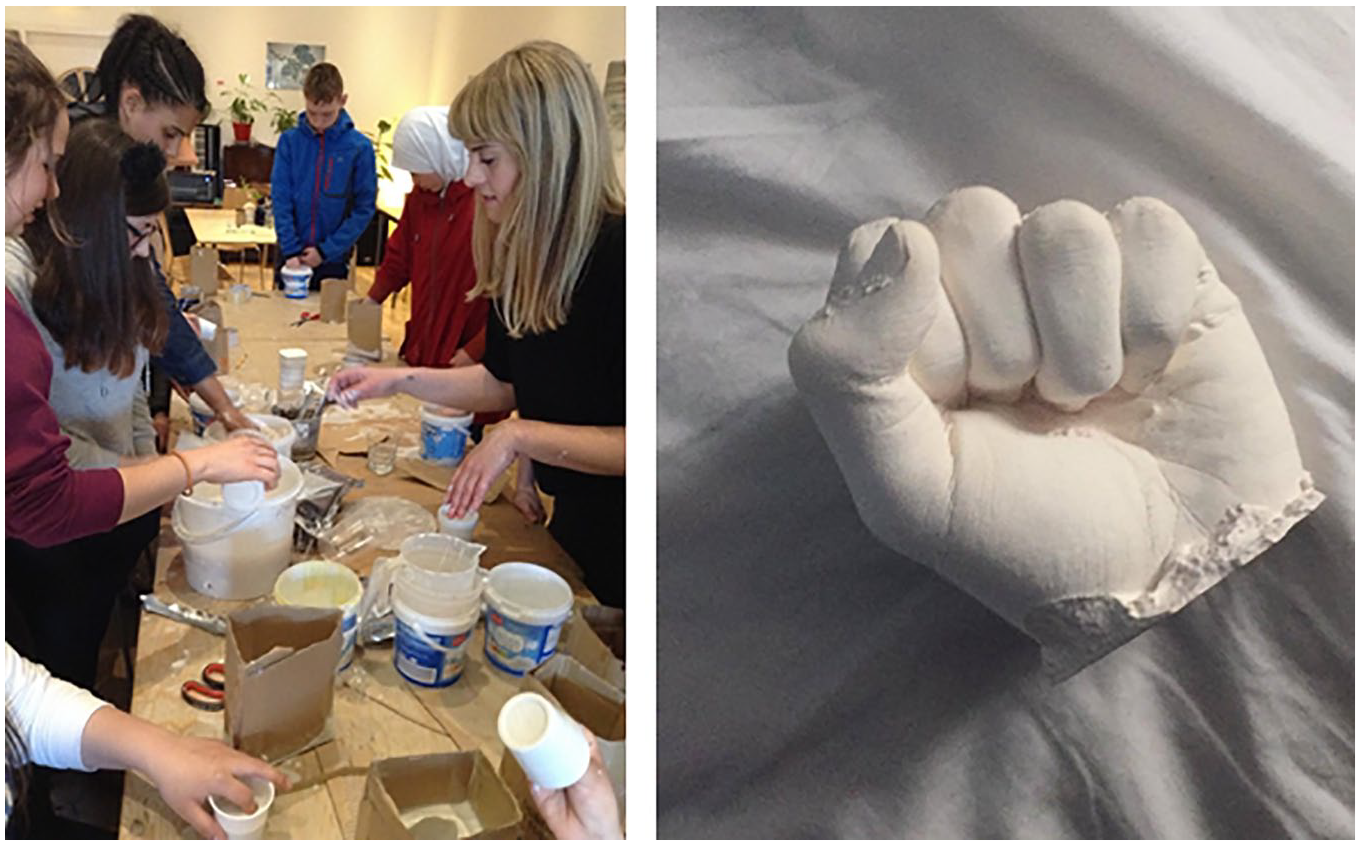
Making clay hands with artist, Beth, Glasgow.
As mentioned above, young people did not see digital tools and modes as holding potential for artistic expression in the ways that we imagined and consistently preferred working with materials and with their hands. On occasion, the artists would nudge young people toward digital creative exploration, but this only happened in a sustained way when young people in Hamilton were immersed in a library makerspace that also was less amenable to making with concrete materials.
This approach to research was unconventional, but the researchers felt that maybe it was not too different from what artists do, at least artists who work in conceptual ways, with social and political intentions. When enacting the sessions, and working with young people and artists, there was a constant and intense exchange of ideas and planning, that was both new for the artists and for the researchers. This exchange of ideas, and checking in with each other, occurred both within each locale as well as across the sites. As the project was always in motion, there was a sense of unease on the part of both artists and researchers, about whether the project was meeting the needs and expectations of the other.
In a later conversation, the artist in Hamilton wondered if it might have better to have a more prescribed plan from the beginning with flexibility within sessions, a way she was more used to working. Diane and Mia, the lead researchers, had resisted doing that, perhaps wary of what might be pre-empted or not see. This difference in imagined ways of working was something we tried to embrace. Sometimes, the challenges or wonder about what would happen next, or what activities would be happening that day, or how they connected to our questions, led us to check in with each other and wonder how we were communicating and what our roles were and should be.
The limitations of time and space, and the experiences of individuals involved, also influenced what was possible. Although there were key overlapping concerns and practices for artists and researchers alike, there were moments where the differences in perspective, practice, and overall aims seemed vast. We wondered whether artistic processes are always creative processes, whereby something new is produced, or whether the respective routines and practices of the artists and researchers predetermined what happened. Vanessa, for example, talked in terms of provocations and catalysts in her own work and these were terms the researchers could relate to. At the same time researchers’ expectations of creativity in the process and how these might connect to questions in the research were sometimes subsumed in a focus on materials and products. In both sites, the artists were quite focused on the anticipated products and how these might be shared in the community, and these intentions also sometimes shaped what happened in sessions.
For the researchers, the products were almost inconsequential, and it was the possibility for digital and material arts explorations to uncover insights into how digital spaces and engagements might play out and be valued in the young peoples’ lives. For the artists and young people, the final products were more salient. In retrospect, there was a tension—a productive tension—between learning art skills and using materials and creativity to inquire that required ongoing conversations, negotiations, and new thinking.
Working with and around the ‘edges’ as researchers: How far could/did we go?
In the design and process of collaboration with partners, young people, and artists, we were gradually positioned in a dynamic relationship with equally influential forces of artists, youth, language, and materials. In our design, and indeed many traditional data generation designs, we intended to translate our guiding questions into a series of sub questions, to be explored through arts-informed methods. In practice, our research questions were provided and explained to our artist partners. In their roles, these questions were taken up as provocations. The provocations led them to a range of activities with the youth participants, ranging from plaster cast modelling to painting, from poetry, to video making. As the young people took up these facilitations, materials, and spaces and created, played, invented, we watched, and these activities unfold in delight but also fear as we lost the thread of our carefully crafted questions and preconceptions of inquiry methods. The model below (Figure 5) attempts to capture this recursive, imprecise, and unpredictable process as research questions were taken up by artists; their work and facilitation was taken up by participants; and the practice took myriad directions—not all of which could be captured, not all of which can be understood.
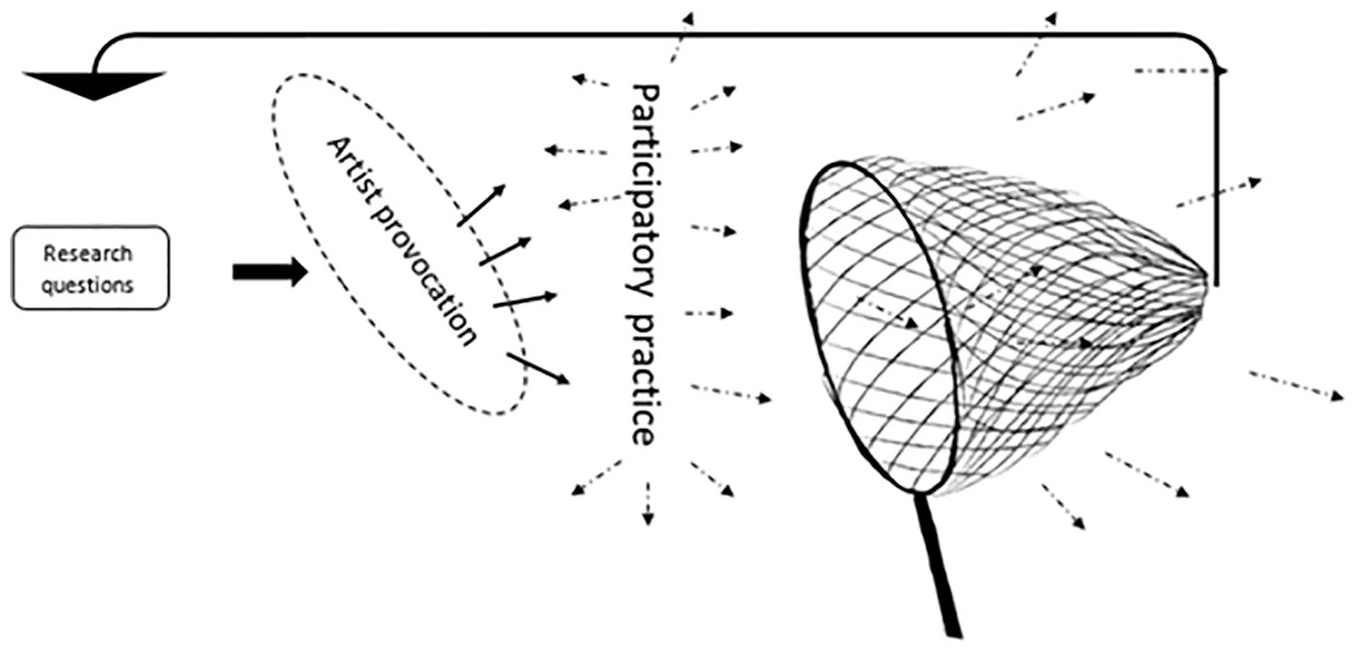
Model of recursive research process—from questions to actions and back again.
In this way, there was a loss of linear narrative in our research project as we wrote it, designed it, planned it, imagined in. It was as if we began each chapter of the narrative, but it was then taken up by the artist who then transformed it according to her own understandings, practices, and modes of inquiry. They did not ask research questions in their practice, they facilitated arts. The story was then taken up by the young people who made things, things out of paper and paint, clay.
In Hamilton, a recurrent interest of the arts was circles. She asked the young people to sit in a horseshoe to work; we all stood in circles to build community in our sessions, and in her own work she has documented the work cycles of artists. Diane also wondered about the nature of circles, their constraint, and their symmetry, and so on to represent the work with young people and digital lives. The young people connected well to the idea of circles as community, and in sitting together in semicircles they were visually connected although also distinct in their small groups. Group collages had resonances, but the elements were quite individual and not always connected to digital lives either (see Figure 6).
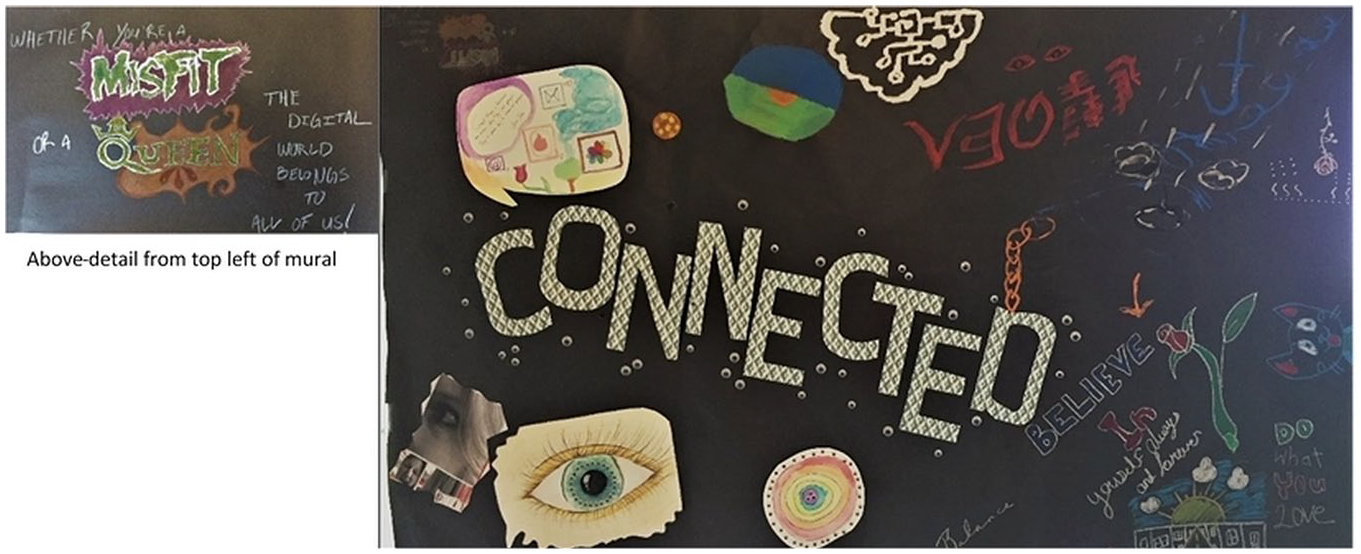
Connected mural in Hamilton.
In the piece created here and displayed in our final session, you can see the idiosyncratic nature of the gathering and the work. Devon (pseudonym) displays his identity as different/distinct in his drawing (detail) in the top left, Veerjot practices writing in Japanese an excerpt from the Manga series, Attack on Titan. Sue draws roses and cats, reminiscent of doodles made on the margins of pages and common online memes and GIFs. The artist brought googly eyes because she thought the young people would connect them to the idea of eyes on the internet ‘watching us’ but she was the only person who used them. She made the words Connected to inspire and frame the working together.
Through this process the researchers moved from a specific starting position, to another that highlighted our assumptions, and provided a way to work with others who bring experiences and perspectives that challenge and enhance our own. Behind any inquiry are layers of context, history, and imaginaries. Some of this we can uncover, explore, and take account of, but much of it will remain elusive and become known or felt through the minute details of the relationships built or the accidents or surprises or confounded intentions.
In support of ‘moving methodologies’
Beyond our findings about digital practices and engagement, this study, and this paper particularly, attempts to forefront, extend, and redirect what might be possible when researchers embrace a fluid engagement with research design. In other words, to loosen an allegiance to the ‘map’ that we pre-prepare and to follow the ‘story’ that is told by the research process itself. Building from Nowak’s (2013) ‘ontological imagination’, our engagement across multiple imaginaries, or frames of reference, in our research led to destabilized, but thereby new, possibilities. Working in research collaborations that decenter us allows for shifts away from often predictable qualitative and controlled investigations to research that is unexpected; emergent.
There are two primary implications for collaborative arts-informed methodologies. First, something new was produced in these spaces. Both the products and the processes are different from what anyone involved would have done by themselves if they had had control. In other words, the artist would likely have had a show, researchers would have a clear data set, and the young people would have a party. This research, and what was done, collaborated on, said, and made, represents all the players, their backgrounds, their investments, and their aspirations. Through arts engagements—the common driver that mediated our inquiry, our expressions, our play, and our interventions—we generated new understandings and new questions. Rather than bringing us to a ‘collective deep understanding’ (Perry, 2020: 6), the research unraveled assumptions and exposed a plurality of engagements and implications of the post-digital age for young people.
Second, the ways in which this research was accomplished, in messy and unexpected ways, kept everyone engaged, challenged and working to draw insights and understanding. There are many elements that could be done differently, but it is not our intention to describe a method or recipe that can be replicated by others or perfected by us. With practice (in research and in other areas of life) comes predictability. In some ways, the more practiced you get, the more contained and restricted methods and methodologies become, as researchers get very good at managing elements, predicting actions, problems, processes, and then, making things turn out in anticipated—and perhaps satisfying—ways (reflecting expectations). By engaging in spaces of the imaginary and the emergent, the research resists mastery or dependence in any singular epistemological path. This research process, accomplished with young people, artists, and other researchers, though uncomfortable, kept us thinking and moving and questioning our assumptions about collaborative and art-informed research about (post) digital and current and future imagined lives.
Footnotes
Acknowledgements
We would like to acknowledge the SSHRC - Insight Development Grant program - and also the support and mentorship of Drs. Jennifer Rowsell and Theresa Rogers through our academic work and in this paper. Research assistants Elizabeth Nelson, Stephanie Gumieniak, and Metka Manfreda were invaluable in the daily planning, execution and thinking. The youth with whom we worked, artists Beth Shapeero and Vanessa Crosbie Ramsey, and Viviana Checchia at The Centre for Contemporary Arts, as well as many other community organizations, were integral to the project and the insights that led to this paper.
Funding
The author(s) disclosed receipt of the following financial support for the research, authorship, and/or publication of this article: This research was supported by the Social Sciences and Humanities Research Council of Canada, Insight Development Grant 430-2016-1166.
