







Abstract
This paper reflects on the value of diary methods in the context of a qualitative, longitudinal narrative inquiry exploring the higher education decision-making of further education students in England. Event-based diaries were used alongside interviews and focus groups over a 14-month period to gain in-depth insights into the reasons and influences informing their decision-making trajectories. I explore the challenges, successful approaches and advantages of employing diary methods with young people in this context. Challenges consisted of maintaining participant engagement, which was overcome by combining methods and incorporating a reactive co-participatory element. Yet, a number of advantages emerged from participants' engagement with diary keeping which enhanced the richness of the data; this inspired deeper reflections on decision-making and influences and provided a private space for participants to disclose personal difficulties that could not be obtained via interviews.
Keywords
Introduction
This paper critically evaluates the use of event-based diaries with young people in the context of educational decision-making. To accomplish this, the paper draws on data from an Economic and Social Research Council–funded study which aimed to gain in-depth insights into the higher education (HE) decision-making of students studying in further education colleges 1 (FECs) in England between April 2014 and October 2015. The study adopted a multi-method approach, employing a combination of interviews and focus groups alongside paper and audio event-based diaries with 13 further education (FE) students over a 14-month period.
The use of qualitative diaries in educational research, particularly in relation to educational decision-making, is uncommon. Instead, diaries are often employed in health (Elliott, 1997) and psychological research (Bolger et al., 2003; Day and Thatcher, 2009). In such fields, diaries have been used to explore patients’ experiences in medical contexts; gain insights into health-related behaviours; and to establish deeper understandings of patients’ thoughts, attitudes and perspectives.
Their use in educational research, however, is far less common; when diaries have been used in this field, these tend to be highly structured ‘logs’ collecting quantitative data as opposed to qualitative reflections on thoughts and experiences (see Beckers et al., 2016). Moreover, while there has been a wealth of qualitative studies on the HE decision-making of young people in England (Ball et al., 2002; Reay et al., 2005), none have employed diary methods. The use of diaries in the present study therefore provides a contribution to knowledge.
The study
The study aimed to explore the reasons, experiences and influences informing FE students’ HE decision-making and choices over the duration of their post-16 studies. A total of 15 participants were recruited from two FECs in the Yorkshire and Humber region of England, using a purposeful sample to select participants in line with pre-defined criteria ‘from which the most can be learned’ (Merriam 2009: 77). The purposeful sampling characteristics consisted of (1) those who were studying in FECs, (2) those studying a qualification that would enable entry to HE and (3) students who were at least one year away from the completion of their FE studies (due to the longitudinal nature of the inquiry). To access potential participants for recruitment, tutors at a number of FECs were contacted. They then acted as gatekeepers, providing me with access to their students to share the details of the study with them directly; students who were interested in participating then underwent an informed consent process. Tutors continued to act as gatekeepers throughout the duration of the study, liaising with me to schedule my visits to their FECs. Of the original 15 participants recruited, 13 participated until the study’s completion with two withdrawing within the first three months.
The FECs from which participants were recruited were located in low-participation neighbourhoods (LPNs) 2 and in areas with high levels of socioeconomic deprivation 3 . The motivation for targeting FECs in these areas was connected to a theoretical aim of the study, which was to understand if and how HE decision-making was mediated by structural factors (see Baker, 2019a, for more details). Students from a variety of post-16 courses within Advanced Levels (A-levels) and Level 3 Business and Technology Education Council courses (BTEC L3) 4 were recruited. Both of these qualifications result in a ‘level 3’ qualification which provide entry to HE. Yet A-levels are often considered a more ‘traditional’ route into HE, with comparably more students gaining entry with these qualifications than BTEC L3s (HEFCE, 2015) in the UK. Moreover, those studying BTEC L3 qualifications are more likely to be from socioeconomically disadvantaged backgrounds, be from minority ethnic groups, or have a disability (Kelly, 2017) – groups that are traditionally ‘underrepresented’ in UK HE. The final participant composition included five A-level students studying a variety of subjects, one BTEC L3 Health and Social Care student and seven students studying BTEC L3 Performing Arts.
Methodology and methods
Fieldwork took place between April 2014 and October 2015. I adopted a narrative inquiry approach (Clandinin and Connelly, 1990) as a way of accessing accounts of FE students’ choices and decision-making over time, as well as the experiences that influenced these. Elliott (2005) explains that the reoccurring themes in narrative research consist of time, temporality and change. Hence, utilising narrative inquiry and a qualitative longitudinal approach are mutually reinforcing.
Various methods including individual semi-structured interviews, focus groups as well as written and audio diaries were employed. Interviews and focus groups were carried out, on average, once every two months to gain understandings of participants' planned educational trajectories, experiences that were influential in formulating their plans, and their thoughts about the future. Participants were provided with a choice of taking part in an interview or focus group, depending on their comfort and preference.
Diaries were completed by participants over the research period, and returned following the completion of the final interviews and focus groups. All participants were also provided the option of completing either a written diary, audio diary or a combination of the two. However, the article focuses specifically on written diaries, as just one single audio diary was completed (alongside a written diary). Of the 13 participants, 12 completed and returned a diary for analysis. The majority of participants made diary entries frequently (a minimum of one per month), with an average of 12 entries per participant. Diaries varied in length, with the shortest diary consisting of just five pages and the longest 36; the average length across the sample was 16 pages. Of course, a variety of factors influenced this, such as handwriting size, and whether participants had included illustrations and/or mind-maps to represent their thoughts and reflections.
Interview and diary data were transcribed before commencing with open coding using NVivo 10 software to identify the initial or ‘substantive’ codes (Punch, 2009: 183). Following this, axial coding was undertaken (Cottrell and McKenzie, 2011: 234). Numerous substantive codes were drawn from the data during analysis, before being axial coded into 10 broad themes.
Diaries as a research tool
A number of reasons informed the decision to use diaries as a tool for data collection. They were fitting with the research aims and logistically appropriate. In considering the aims of the research – to explore the reasons and influences informing students’ choice and decision-making processes over time – diaries were an ideal tool to document insights longitudinally. This is particularly apt in the case of educational trajectories where there is a particular time frame during the length of participants’ post-16 education in which they are expected to be deciding upon their future plans. It is therefore possible to track such decisions in this context.
As the diaries were concerned with capturing participants’ thoughts and experiences about their HE decision-making and choices, these are aligned to an event-based schedule. Bolger et al. (2003: 590) explain that an event-based schedule requires ‘participants to provide reports at every instance that meets the researcher’s pre-established definition’. The authors clarify that ‘events’ can be thought-dependent, such as ‘feelings of intimacy’, or interaction-based. Therefore, event-based diaries can be sufficient in exploring thoughts, feelings and reflections connected to particular experiences. Unlike activities though, ‘thoughts’ may be difficult to remember. One may be accurately able to recall an activity or experience that occurred in recent weeks, but not necessarily the thoughts, attitudes and emotions that accompanied these. I posit that diaries can allow the immediacy of thoughts to be captured in the same way as activities and experiences (Symon, 2004: 98). This is a demonstrable strength of the diary method; errors in recall can be avoided (Coxon, 1996; Cucu-Oancea, 2013) which in turn reduces the likelihood of self-justification.
Diaries provide an excellent means of accessing individuals’ subjective accounts of the social world as they experience it (Burgess, 2006). This is clearly advantageous when using an interpretivist paradigm, where ontology is considered to be socially constructed (Cohen et al., 2011), as formed and sustained by meanings that individuals or social groups apply to various phenomenon (Hinchley, 2008) and where epistemological positions consider there to be multiple ‘truths’ which all hold equal validity (Lyons, 2010). Diaries are therefore well-suited for accessing research participants’ own constructions of reality through their experiences and interpretations of the social world situated in specific contexts. This was especially applicable to the longitudinal narrative inquiry approach taken in this research, as participants’ diary entries were able to capture the temporal nature of individual lived experiences over time (Elliott, 2005).
However, it is worth noting that the notion of ‘access’ to participants’ daily lives can be problematic. Clearly, participants will be selective over what they disclose in their diaries, especially with the awareness that they would be read by me, the researcher. Consequently, participants may have a propensity to withhold certain details of their day-to-day lives in their diaries; this may include thoughts or events that they regard as too personal to share, or experiences that would be considered relevant to the research aims, but they may not judge them as so.
Even though we cannot assume complete, unabridged ‘access’ to participants’ lives, I took steps during the planning stages of the research to help them feel more comfortable in disclosing such information in their diaries. For instance, rather than conducting an elicitation interview using the diary as a basis for discussion, participants were not required to hand over their diaries until the end of the data collection period. Participants were then aware that, when I saw their entries for the first time, they would not see me again. This was intended to minimise the chance that participants would withhold relevant information when completing their diaries; they would not be concerned that I would later confront them with the content of their entries, as there would be no opportunity to do so.
Understandably, taking this approach does pose some limitations concerning the depth of data collected. Elicitation interviews may, for example, have been beneficial in gaining deeper insights into the more visual elements of participants’ diaries (Mannay et al., 2018). As will be discussed later, one participant (Juliette) 5 included a ‘motivation page’ which consisted of inspirational quotes and song lyrics. Conducting an elicitation interview would have provided an opportunity to explore what situation(s) or experiences had led her to create this resource for herself which, in turn, could have resulted in relevant data concerning the impact of HE decision-making to be captured. Conversely, knowing that I would be using their diaries in an elicitation interview might have led participants to avoid including such entries, potentially regarding them as too personal to discuss face-to-face.
Finally, diaries provide opportunities for participants to pursue alternative ways of expressing their subjective experiences, which may not possible during face-to-face methods. Alaszewski (2006: 42) suggests that diaries can harbour data that are not easily articulated in interviews, such as ‘taken-for-granted assumptions about the nature of the world’. This is particularly important when aiming to understand participants’ thoughts and experiences about their decision-making; such thoughts may be ‘taken-for-granted’ contemplations about the future that have not previously been considered in-depth. Day and Thatcher (2009) also comment in their reflections of using qualitative diaries that participants may disclose thoughts that they would not mention in interviews. This is likely to be a result of the diaries offering a more personal space away from the researcher.
Diary design
To maximise the flexibility in how participants expressed their thoughts and experiences in their diaries, I allowed a degree of freedom in their entries so as to not limit them to only written responses. I encouraged them to be creative with their diary, adding pictures or creating mind-maps if they wished to do so. This freedom in the presentation of participants’ entries intended to cater for different interests, and consequently, assist in maintaining engagement with the research. Subsequently, I felt that this could work in decreasing the likelihood of attrition which is a documented weakness of longitudinal research (Cohen et al., 2011).
The diaries were not completely unstructured however; they included two pre-printed templates of ‘timelines’ (Figure 1) to allow participants to represent their perceived future trajectories visually if they chose to do so, capturing considerations of their ‘possible selves’ (King and Hicks, 2007). This provided a way for participants to orientate their thinking in line with the purpose of the research. Furthermore, guidelines were pre-printed in the diaries which requested reflections of their thoughts, perspectives, attitudes, influences and experiences related to their future decisions and plans. This intended to mitigate the risk of accumulating large amounts of irrelevant data. Providing guidelines to encourage participants to consider and record entries related to the research purposes whilst simultaneously encouraging an open approach as to how this information is recorded is useful in avoiding an ‘imposing structure’ (Radcliffe, 2013). Example of visual timeline.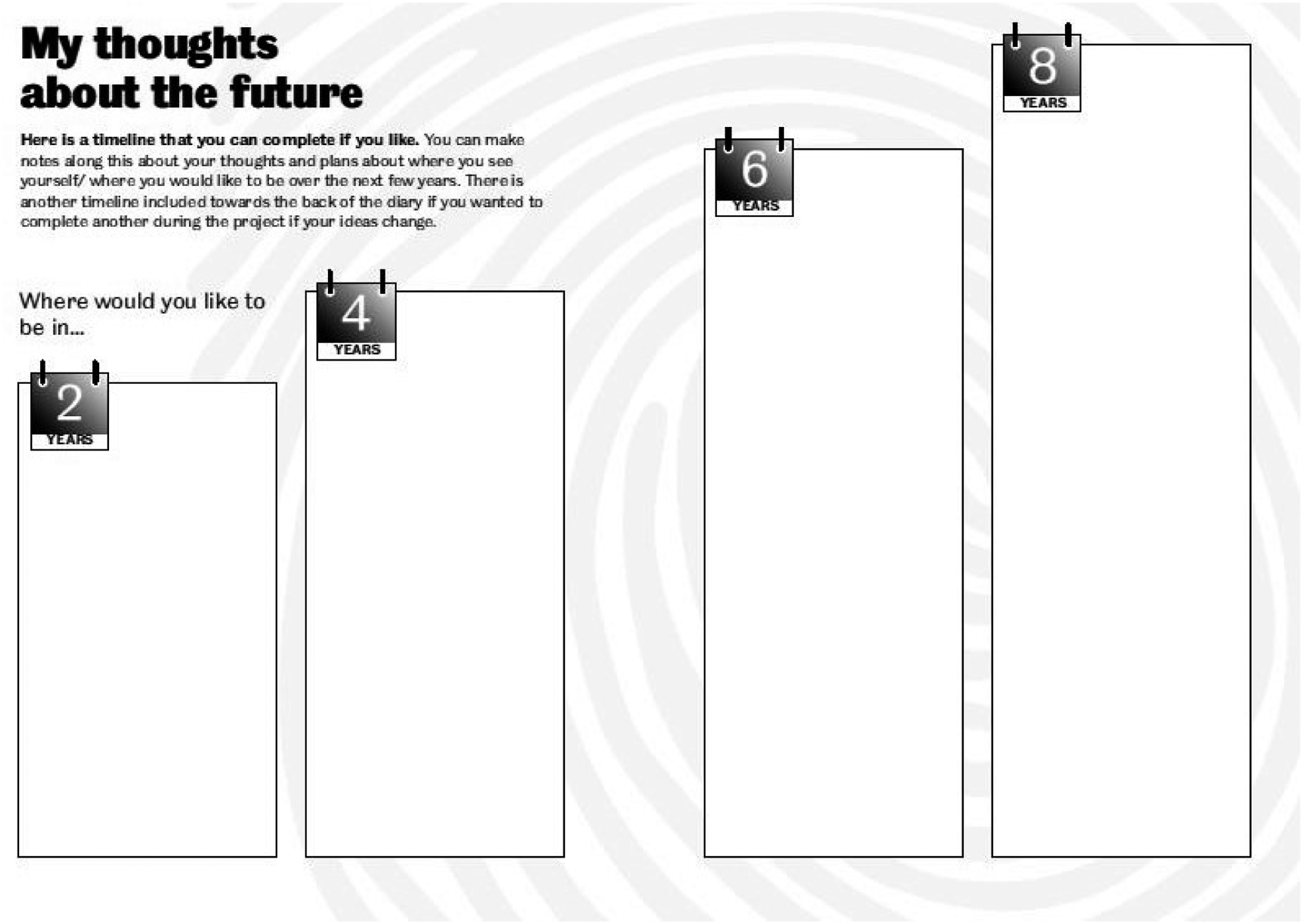
Young people engaging in event-based diaries: A critical evaluation
Engagement and attrition
In the early stages of the research, a minority of participants found the prospect of keeping a diary daunting. Some attrition occurred during this time, with two participants from the original 15 recruited deciding not to continue with the study; as participants were not required to provide a reason for their withdrawal in line with ethical guidelines, it cannot be determined with certainty if the diary was the cause of this. However, the participants that withdrew cited difficulties with diary completion prior to withdrawal, and therefore I speculate that this played a role. I dedicate the focus here to outlining such occurrences; the actions taken in an attempt to resolve emerging issues with diary keeping are considered more fully later.
The key concerns voiced by a small number of participants were worries over writing the ‘wrong thing’ and ‘not writing enough’ in their diaries. When diaries were provided to participants, I would draw their attention to the pre-printed guidelines within the diaries which explained that there are no ‘right’ or ‘wrong’ answers, that participants could write as little or as much as they pleased, and that they could express themselves in ways beyond simply writing. Yet, such reassurances had little effect on the participants who subsequently withdrew. One reason that might have caused such apprehensions to prevail was that participants were expected to keep various assessed reflective diaries or ‘learning logs’ as part of their FE courses. This experience of reflections being academically assessed may have therefore contributed to such anxieties.
One participant who left the study asserted that she did not enjoy writing which subsequently decreased her motivation. As this emerged within the first month of the research (and prior to all participants being recruited), I incorporated audio diaries as an option early on. I supplied participants with digital Dictaphones so that they had a range of different media with which to make entries; this is promoted as a means of facilitating participation in the diary method among those who are less familiar with ‘recording one’s daily existence’ (Elliott 1997: para 4.3). Therefore, using audio diaries was intended to allow those who may not be pre-disposed to writing, or that found this unenjoyable, to make contributions.
Participants were recommended to make a diary entry once per week. Although I placed a high degree of importance on not overwhelming participants – which concurrently formed one of the reasons as to why diaries were employed, as opposed to intense periods of conducting interviews and focus groups – I wanted to ensure that they were engaging with their diaries as often as possible to prevent them being neglected. It is worth reiterating that despite the frequency of entries being recommended, the length of these were not. Despite attempts to minimise the demands of written diaries, weekly entries can still be a challenging commitment for participants, and this contributed to the remaining case of attrition in the research.
Maintaining engagement in diary completion
Combining methods
As noted earlier, periodic focus groups and interviews were conducted on average once every two months in addition to the diary method. These were undertaken at the participant’s FECs. Contact with the participants in person was of upmost importance in maintaining engagement; visiting participants on a regular basis to conduct interviews and focus groups provided numerous opportunities to ‘check in’ and take note of any difficulties that they were experiencing. This enabled a better understanding of any difficulties that participants were experiencing with the diary method and concurrently informed the production of additional guidance. This consisted of frequently asked questions which depicted the concerns that had been raised, such as: ‘What if I write/record the wrong thing?’, ‘I am interested in taking part but I don’t like writing’ and ‘How often should I make entries?’ The answers to such questions aimed to be reassuring; they informed potential participants that there are no ‘right’ or ‘wrong’ answers, that audio diaries were available should they prefer to use these, and that an entry of any length each week would be sufficient. Such amendments to the guidance would not have been undertaken had I not been made aware of such issues during face-to-face exchanges with participants.
Establishing between method triangulation (Denzin, 1970) when employing diaries as a research tool is also crucial in terms of obtaining enough information to satisfy the aims of the inquiry. Williamson et al. (2015: 31) advise against solely depending upon the diary method due to this not providing the ability to probe participants’ accounts, and the probability of receiving some ‘thin’ entries. The interview and focus group schedules prompted students to reflect on events, experiences and thoughts that they had encountered during the intervals between meetings. This data helped clarify any discontinuities in the participants’ diary keeping, which in turn contributed to a fuller narrative picture.
A further advantage of conducting interviews and focus groups were the opportunities that this provided for rapport building. Scholars writing about the ethical dilemmas of conducting research with young people have noted how researcher characteristics can impact participant perceptions (Brooks and te Riele, 2013). I had a similar background to the participants which helped them relate to me. As mentioned earlier, the participants were recruited from LPNs and areas regarded as being socioeconomically disadvantaged. I, myself, had a similar personal and educational history; I had grown up in and attended an FEC in a town well known for its high levels of socioeconomic deprivation in the same region of England. Participants were aware of this as I had disclosed my educational history verbally in our discussions. In some cases, participants were able to accurately guess this as a result of my accent. As Mellor et al. (2014: 140) explain in their reflections of the impact of social class in research interviews, there are ‘powerful, complex and unspoken ways that the body is marked by class distinctions’ including ‘accents and vocabulary, dress, mannerisms and so on’. Participants may well have made conclusions regarding my class background (which was similar to theirs) due to my accent, vocabulary and mannerisms. In turn, this could have made participants feel more at ease when disclosing aspects of their backgrounds to me, especially stories related to living in low-income households, or in socioeconomically disadvantaged areas.
While interviews and focus groups enabled participants to observe my characteristics and learn about my own background, using the diary method helped to safeguard against the complications that can arise from ‘overfamiliarity’. For instance, being a ‘transient insider’ (Roberts, 2018) can lead to difficulties in ‘recognising patterns due to familiarity with the community’ (Chavez, 2008: 485) and result in assumptions being made based on ‘taken-for-granted’ knowledge (Mannay, 2010). As diaries afforded participants a ‘separate’ space away from interviews and focus groups, I was able to access data via these that was not potentially overshadowed by my own experiences and perceptions.
Being a co-participant: Reflections on a researcher’s diary
Over the course of the research, informal conversations with participants before and after interviews and focus groups were fairly commonplace. During such conversations, participants often asked me what I planned to pursue upon completion of my PhD studies. This inspired me to complete a diary alongside them to detail my own experiences, decisions and choices regarding my future plans; I began this during the first month of data collection.
In keeping my own diary, participants were able to partially take on the role of the researcher in that, they had access to my own thoughts, choices, experiences and plans. After each interview and focus group, I offered participants the opportunity to view the hard copy of my diary; I also provided 'update' documents which included scanned entries from my own diary for them to take away and read. Additionally, I invited participants to ask me questions about my own decision-making if they wished to do so, which contributed to equalising the power distribution of the researcher and ‘researched’ to some degree (Heath et al., 2009). Similar approaches have been used elsewhere, with researchers participating in creative tasks alongside participants to enable the process to be more ‘participant-led’ (see Mannay et al., 2018).
This does demonstrate some slight similarities with a participatory approach to research (Lansdown, 2005). However, Groundwater-Smith et al. (2015: 13) suggest that a participatory approach is accomplished when ‘opportunities for children and young people to shape the project, both in terms of the processes and the outcomes’ are provided. This is not applicable here in that the design, focus and outcomes of the project were defined by me. Yet, as I participated in diary keeping (which participants regularly read), and in answering questions about my own educational decision-making posed by the participants, I regarded my role as being a partial co-participant of sorts. I felt that completing a copy of the same paper diary would present this as a shared exercise rather than a ‘task’ which participants were obligated to undertake.
Participants would often spend additional time after interviews to read my diary and ask me questions related to my entries. These questions often consisted of requests for further elaboration on events and experiences that I had written about. Other times, participants commented on how I had presented my entries, complimenting my drawings and prompting discussions about the varying lengths of my entries. Openly sharing my diary with participants in this way provided a ‘working example in situ’ (Mannay et al., 2018: 771), which acted as a useful way of reassuring participants if they were uncertain about the content and presentation of their own diaries. I made a conscious effort to present each entry in different formats; I included some entries in paragraphs, whilst in others, I bullet pointed my thoughts, created mind-maps of my plans and annotated them with illustrations. This was especially motivating for participants when experiencing concerns over the length or content of their own diaries. The following conversation with one participant (Erin) conveys her reassurance after seeing my own diary following experiencing apprehension over the length of her own: Erin: Is there some people that have like, filled the book? ZB: No … not even me Erin: Oh good, I was quite impressed cos I think I’ve like got half way [checks diary] yeah, I got that far, I thought that were quite impressive! (laughs) ZB: Wow that’s really good! Here’s mine and I haven’t finished the book. (Interview, May 2015)
The process of completing my own diary allowed me to walk in the participants’ shoes; I occasionally experienced issues with diary completion first-hand, such as finding the time to write, and encountering moments when I felt I had little to write about. This inspired me to create ‘top tips’ for maintaining diary keeping, which I included in the ‘update’ documents provided to participants (Figure 2). These experiences also allowed me to relate to participants’ difficulties in remaining engaged with their diary, and openly and honestly discuss these before proposing potential solutions. Example of ‘top tips’ for diary completion.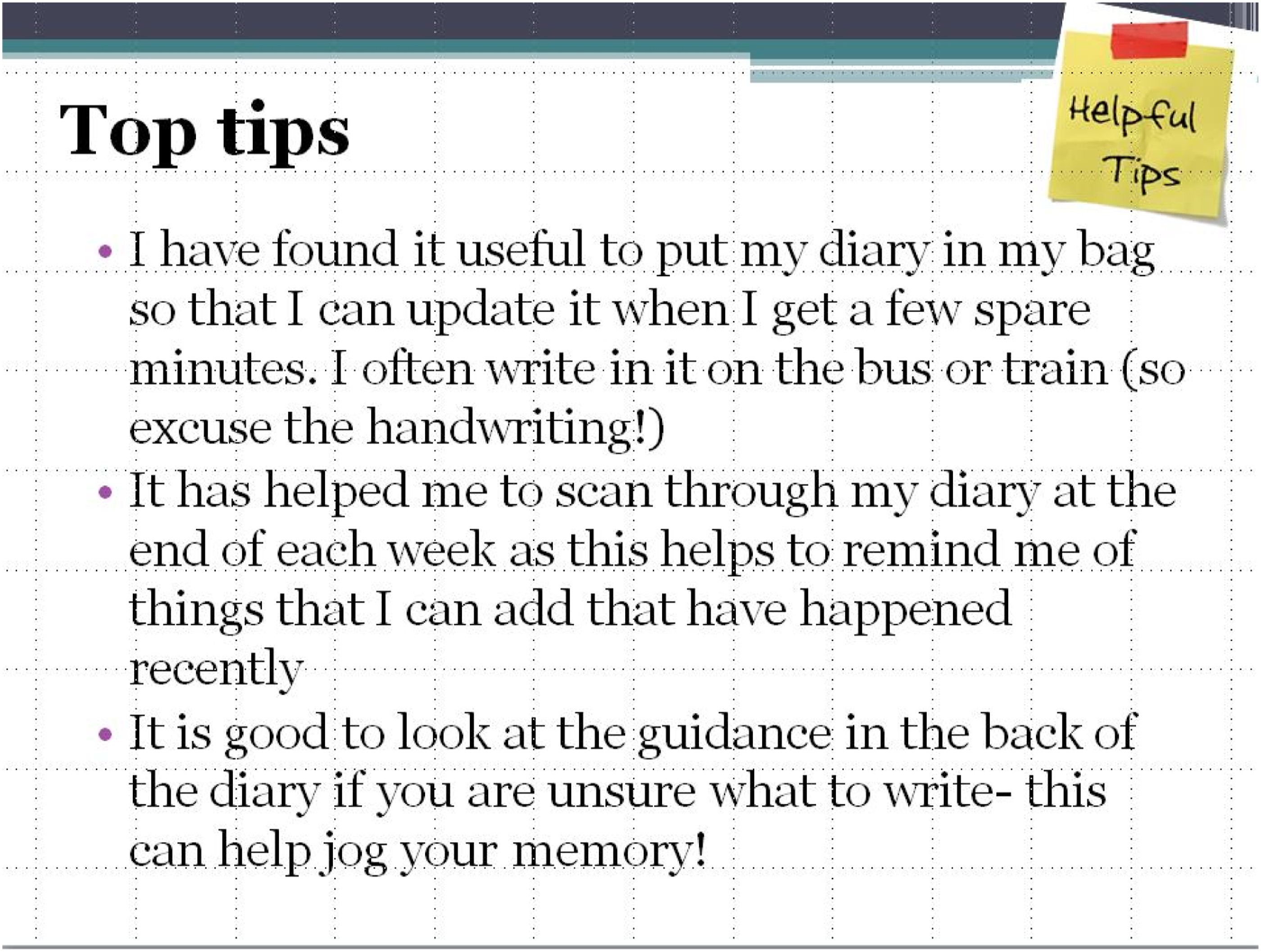
The impact of diary keeping: Participants’ perspectives.
Upon completion of the study, a number of positive impacts emerged in using event-based diaries with young people. These were recognised upon the retrieval of the completed diaries and also during the final interviews and focus groups where evaluative questions were posed. The content of the diaries and participant responses to evaluative questions indicated that the diaries not only provided participants with a means of recording their thoughts and experiences, but also acted as a tool to aid and enhance their decision-making. Upon analysis of the diaries, it also became apparent that these provided a private space away from interviews and focus groups to disclose and reflect upon personal issues and difficulties.
Diaries as a decision-making aid
The various ways in which participants used their diaries were particularly interesting. Participants typically disclosed the same information as to what was provided in interviews and focus groups. For instance, the key thoughts, events and experiences could be traced in diary entries made during the months prior to each of their interviews. One participant referred to this during the final stage of the research. He explained that without the diary, he would have found it difficult to recall what decisions he had made, along with the timing of these: Every time you make a decision in your mind, you just think “Oh I’ll write that down!” ‘Cos I wouldn’t remember when I’d made a decision if I didn’t have this… if I had to recite every decision that I’d made to you and on the date without having this, I’d be lost. (John, interview, May 2015)
For some then, the diary appeared to be used as a memory tool to keep track of experiences, influences and thoughts that they felt to be important in their educational decision-making. In turn, this provided the opportunity for these to be elaborated upon during interview. As John indicates in the above, if the diary method was absent, it may have been difficult for him to recall relevant information accurately, which would then limit the depth of the interviews and focus groups.
Around half (seven) of the participants appeared to use the diary as a way of keeping a record of institutional and course choices. These participants would list potential institutions they wished to apply to, reflections on open day events, dates of upcoming interviews for course selection processes and the outcomes of their applications. It was common for participants to elaborate upon their institutional choices by disclosing what aspects of these had resulted in their decision on whether to apply or not. Yet, a minority of participants provided little explanation within their diaries, but did articulate their reasons, experiences and influences informing their decisions during interviews and focus groups. Such outcomes certainly support the benefits cited in the literature concerning the reduction of errors in recall (Coxon, 1996; Cucu-Oancea, 2013) and adds further weight to the importance of employing interviews alongside the diary method to allow for elaboration.
Participants’ responses to the evaluative questions suggested that the diary method led to an increased sense of confidence; for instance, their engagement with the diaries reassured them that they had made informed and well-considered HE decisions: It’s made me have second thoughts about my university thing, and I think had I not done this, I still would have gone to university, but I don’t think it would have been as educated as I would have wanted it to be, and I think I would have been in the position where, you know, at the end of the first year I’d be saying “I made a pretty big mess out of this”. (Daryl, interview, May 2015) Writing the diary and the steps I’d seen you in… it’s made me understand where I want to be and what I want to do. So I understand what I want to do and where I want to be and, I don’t know. If I wouldn’t have done it, I think I would have been a bit more confused. (Mae, interview, April 2015)
Other participants referred to the diary as a tool which facilitated them in employing heightened levels of reflexivity in their decision-making: I know people that have literally kept changing their mind, and I was looking at my diary the other day, and I’ve been very much like “If I don’t get in I’ll just go travelling” but I know that I want to go (to university). And then it was like “No I definitely want to go”. I don’t want to go travelling … I am very headstrong; it’s made me realise that I do know what I want to do. (Bessy, interview, April 2015)
The above responses from participants collectively illustrate the advantages of being able to revisit and reflect upon previous diary entries. For Bessy, this provoked her to summarise her previous considerations between two potential options and conclude with certainty that she wanted to pursue HE instead of her alternative intention to travel. It is also evident in Bessy’s narrative that the diary not only aided her decision-making but also led her to reflect on her own attributes, realising that she is a ‘headstrong’ person. The way that diary keeping provided access to the participants’ previous thoughts, experiences and considerations appeared to be advantageous in helping them gain a deeper understanding of their own decision-making. Accordingly, this provided the capacity for participants to feel confident in their plans and also resulted in a deeper process of personal reflection.
A window to the personal
The flexibility that was hoped to be achieved in the design of the diaries and accompanying guidance appeared to be successful; this allowed participants to develop their own personal approach to the diary in a way which was useful for them, whilst still addressing the research aims. Noting potential and realised choices, reflections of open days and outcomes of applications did not constitute the entirety of participants’ diary entries. For some, this constructed the foundation of their entries, whereas for others, this was not as prevalent. The range of diary content overall was extensive; participants included details of interactions with friends, family, college tutors, general thoughts about the future, ‘bucket lists’ on what they wished to accomplish, thoughts regarding moving away from the family home, considerations of future employment and financial concerns.
Whilst within the scope of the typical content of the diaries noted above, a minority of these presented deeply personal experiences. Participants that opted to take part in focus groups as opposed to individual interviews demonstrated the most personal reflections in their diaries about the difficulties they were facing whilst making decisions about their futures. For instance, one participant (Sofia) divulged past issues with depression and another (Juliette) described problems taking place within the family home concerning her mother’s dependence on her to carry out domestic and childcare responsibilities: A good thing has happened is that I am officially not clinically depressed but I still have low moods and all of my anxieties (severe). However it is a massive good thing that has happened as it was the one thing holding me back and I have had it for 5 years and I am so happy that I am on step to full recovery. (Sofia, diary entry, January 2015). My mother wants me to study closer to home so I can still help out around the house – coming from a single parent family with 3 siblings has proven a tad bit difficult ... I don’t wanna cook, clean and wash/iron for 5 people anymore- I kinda need a life. (Juliette, diary entry, July 2014).
Both Sofia and Juliette had not disclosed such issues during focus group discussions. Yet, this is likely to be a result of them being just two of three participants that never opted to attend an individual interview. Hence, they may have felt uncomfortable disclosing such issues in the presence of their peers. This supports Day and Thatcher’s (2009) suggestion that diaries may capture data that is not able to be articulated in interviews.
This is further confirmed by the diary content of participants who chose to attend individual interviews as opposed to focus groups. The entries for such participants would often contain much more ‘matter of fact’ information regarding their decisions and experiences and were devoid of evocative reflections; instead, these were expressed during interviews. For instance, one participant (John) wrote, on average, one entry per month consisting of two sentences. In these, he would recite events in a very factual tone absent of any emotion: ‘(University) offered me health + social care and denied nursing so I denied this offer, also (another university) offered myself an interview’ (John, March 2015). Yet, the personal depth of John’s interviews contrasted significantly with his diary entries; he would speak of past struggles with mental illness and self-harm (see Baker, 2019b), relationship break ups and frustrations with his college tutors.
I suggest then that diaries can serve as a worthwhile tool in allowing participants who may not be as comfortable in verbally acknowledging personal difficulties in the presence of others to still contribute such experiences and reflections to the data. Their willingness to write about these personal experiences in their diaries may have also been an outcome of the manner in which diaries were returned to me; as explained when discussing ‘access’ to participants’ experiences earlier, they were aware that I would only read these after our last meeting. Hence, they had an understanding that there was no opportunity for me to confront, or question them, about the content of their entries. This may have subsequently led Sofia, Juliette and possibly other participants to perceive less ‘risk’ in disclosing personal issues.
Just as some participants had used the diary as a decision-making aid, Sofia and Juliette dedicated specific pages to assist them through their personal difficulties. Upon writing about her history of depression, Sofia devoted an entry to ‘positive things/people that have an impact on me’ (Figure 3), where she referred to people and activities that gave her a sense of happiness. Although Sofia did not explain the purpose of this entry, the way in which it immediately followed her disclosure of her depression may have been intended as a way of maintaining positivity during the decision-making process. Sofia’s ‘positivity’ diary entry.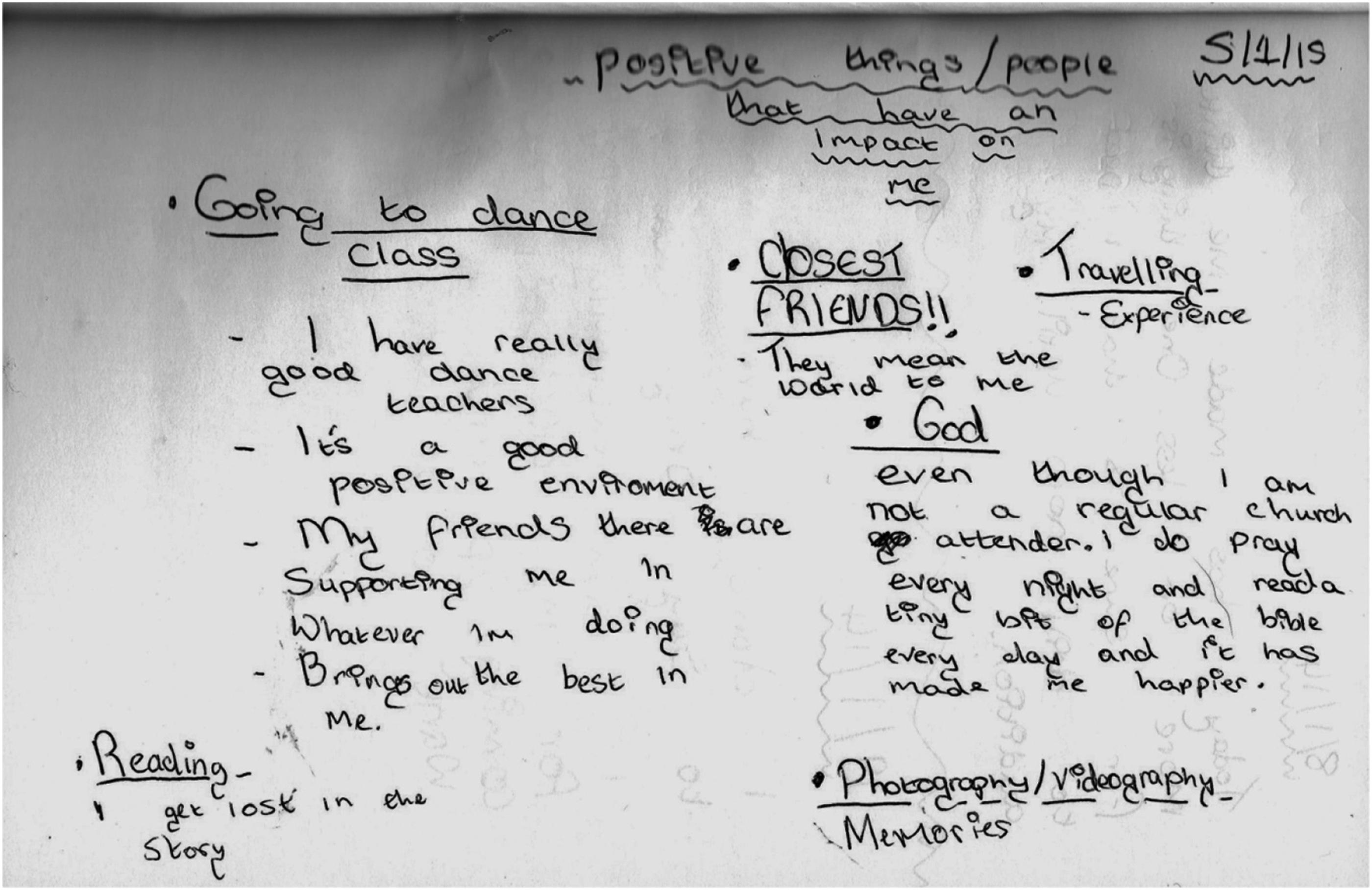
In the case of Juliette, she designed a two-page spread of inspirational quotes and song lyrics titled ‘Motivation Page’ (Figure 4). In addition to the entry cited earlier, Juliette frequently spoke of her mother’s disapproval of her desire to leave home which led her to be discouraged at the prospect. However, she writes in her entry just prior to the ‘Motivation Page’ that this disapproval ‘makes me even more determined to ace my A-levels, boss my degree then become a good teacher’ (July 2015). I regard this as a positive outcome of encouraging participants to be creative in their entries – to complete their diaries in a way that suited them. Juliette’s ‘Motivation Page’.
Conclusion
I have discussed the advantages and also difficulties encountered in adopting event-based diaries with young people to obtain accounts of their educational decision-making and choices. The successful outcomes that emerged from the participants’ use of their diaries were dependent upon maintaining engagement throughout the duration of the research. This was achieved through employing a combination of methods, and importantly, incorporating a partial co-participatory approach.
Using event-based diaries assisted participants in navigating their way through their HE decision-making and choice journeys by providing them with a source of reflection, and a space to record their personal difficulties. Given the sensitivity of this information, this potentially made it difficult to divulge in focus groups and therefore this data may not have been captured without the diary method. Those taking part in individual interviews, however, felt comfortable in discussing such issues face-to-face. This may imply that individual interviews could be conducted solely without the incorporation of diaries. Though, it is more likely the case that there was a synergistic effect from the participants’ perspective between diary entries and the interviews which strengthened triangulation. Still, not all young people will respond well to being interviewed individually, and some prefer the sense of security of being amongst peers (Eder and Fingerson, 2003). Furthermore, accessing participants in educational institutions brings its own set of challenges, with time for individual interviews being limited as a result.
While discussing triangulation, it is worth reflecting on the advice of Williamson et al. (2015) who warns against solely depending upon the diary method, as this risks gathering insufficient data in terms of depth and volume. In the context of my own research, expecting to gain a satisfactory amount of data from the diary method alone would have led to disappointment. Although some participant diaries were very rich and thorough in terms of the quantity and quality of research data, there were, of course, others that were ‘thin’. There is also a very real possibility that participants may not return their diaries to the researcher for analysis. Fortunately, all but one participant returned their diaries, and the majority made diary entries frequently. Yet, caution should be practiced when considering this method; the completion of diaries is outside of the researcher’s control, and there are no guarantees of obtaining the amount of data needed to meet their research aims. This uncertainty associated with the diary method provides further support for combining this with other methods of data collection.
Since diaries are, by their very nature, completed privately away from the gaze of the researcher, possible issues in terms of the truthfulness and trustworthiness of the data recorded also need to be contemplated (Sikes, 2000). This is not so much concerned with what is written, but how experiences have been recorded; there is no way of establishing, for instance, whether the participants have actually recorded their experiences as they occurred, or if multiple entries were made retrospectively. This would overshadow the advantages of using diaries, such as providing a means of gaining insights into experiences over time without inaccuracies in recall, and as a way to access participants’ subjective, temporal and context bound experiences. In the case of this research though, cross referencing the focus group/interview data with diary entries increased the trustworthiness of participants’ accounts. It is possible, albeit unlikely, that participants could have been intentionally dishonest in their diary entries and maintained such accounts during interviews/focus groups. The only indication of anything of this nature occurring was that participants occasionally withheld details of specific experiences and thoughts before elaborating upon them in more detail later in the research when they had become more familiar with me. I contend though that this is not an indication of intentional dishonesty, but rather an example of the strengths associated with rapport building facilitated by the longitudinal approach; unsurprisingly, participants became more ‘open’ in their disclosures after conversing with me on a number of occasions.
Creating opportunities where experiences could be reciprocally shared between the participants and myself was particularly effective in maintaining engagement. In having regular opportunities to read my diary entries, participants were reassured in their own abilities to successfully complete their own, where verbal assurances in the early stages of the research proved less effective. For instance, simply informing participants that they cannot write the ‘wrong thing’, that their entries could be any length and that they may use their diary creatively still led to concerns and in some cases, attrition. Yet, being able to witness this through my own diary appeared to have a reassuring influence on participants; they were able to see, first-hand, entries that varied greatly in length, entries that contained errors and the different ways that I had presented my thoughts. Moreover, having open and honest conversations with participants about the challenges I myself encountered with diary completion, and how I resolved this, indicated that this was a shared process rather than a ‘task’. Hence, the partial co-participatory approach created the space for, and supported negotiations of, the expectations of diary keeping between the participants and myself.
Whilst utilising event-based diaries with young people was successful, a balance needs to be achieved in encouraging the participants’ engagement whilst not overwhelming them with overly rigorous guidelines. The diary method worked well when presented as an uncomplicated activity, as this helped participants to overcome fears related to writing the ‘wrong thing’; this is particularly important when young people are engaged in the education system, and therefore have developed an expectation that their writing will be scrutinised. Additionally, a flexible and reactive approach was essential in sustaining the participants’ motivation to complete their diaries. In establishing an open dialogue with participants to discuss any issues encountered in diary keeping, worries or concerns could be addressed as they arose.
This leads me to present a recommendation concerning participatory approaches. As explained, I employed a partial co-participatory approach in this research to attempt to establish a more equal power balance between myself and the participants, as well as to increase their confidence in completing their diaries. Yet, enabling participants to have some control in the planning of the event-based diaries could have proven even more fruitful. For instance, participants could select their preferred diary ‘tools’, be they paper, audio, video or online diaries (see Hyers, 2018). They could then set their own expectations regarding the frequency of recordings and collaboratively concoct their own guidelines for completion. Of course, issues of time and ease of access need to be contemplated, particularly when recruiting participants from educational institutions; in this research for instance, accessing participants for interviews and focus groups alone was challenging due to the limited time available for the FE sites to accommodate my visits.
Footnotes
Declaration of conflicting interests
The author(s) declared no potential conflicts of interest with respect to the research, authorship, and/or publication of this article.
Funding
The author(s) disclosed receipt of the following financial support for the research, authorship, and/or publication of this article: This study was carried out thanks to the financial support of the Economic and Social Research Council (grant reference: ES/J500215/1).

Notes
Author biography
Zoe Baker is a British Academy Postdoctoral Research Fellow in the Department of Education at the University of York. She completed her PhD at The University of Sheffield which explored the higher education decision-making and choices of further education students in England. Zoe’s research interests include the sociology of education, educational inequalities, social justice and care-experienced students’ transitions.