







Abstract
One-on-one interviews are often a rich source of qualitative data. This article examines the incorporation of a text message interviewing mode in research studies to enhance study accessibility, diversity, and respect for participant preferences. Drawing from our experience using multi-modal interviewing (phone, text, and Zoom) in a sociological study with young adults about suicidal ideation and crisis services, we present practical considerations and recommendations for offering a text messaging interviewing mode. These considerations include fostering engagement, accounting for interview length, and analyzing multi-modal data. Recommendations provide guidance on selecting the data collection mode, preparing for, and conducting text message interviews. By incorporating a text message interview option, researchers can expand the reach of studies to participants who might not have otherwise participated and increase participants’ comfort within the study. This approach may be especially beneficial for groups that prefer text communication or studies that address stigmatized topics.
Introduction
As younger cohorts increasingly live their lives online, researchers may need to offer online interview modalities within research studies to match the expectations and preferences of young study participants. Text message interviewing is a practical, accessible mode of data collection. Nonetheless, practical guidance on using text message-based remote interviewing within qualitative research is lacking. Drawing on a qualitative study of mental health help-seeking that employed three interview modes—including text messaging—we outline practical considerations and provide research recommendations.
The use of remote interviewing—encompassing methods conducted at a distance, such as Zoom, phone, email, or text—has increased over the past decade. Regarded positively among researchers (Thunberg and Arnell, 2021), remote interviewing is advantageous in increasing study accessibility, making it easier to include participants across geographic distances (Pearce et al., 2014; Thunberg and Arnell, 2021), enabling participation among those with disabilities or communication impairments (Ison, 2009), and increasing participant convenience (Barratt, 2012; Heath et al., 2018; Pearce et al., 2014; Thunberg and Arnell, 2021). Within remote interviewing, methods that rely on text-only (i.e. text message, WhatsApp, e-mail) enable more time to craft and edit responses (James, 2016) and increase feelings of anonymity (Anderdal Bakken, 2022; Hinchcliffe and Gavin, 2009; Pearce et al., 2014).
While researchers have expressed concern regarding the quality of data collected remotely using text-only methods, comparative studies have found that although text-only interviews produce less data volume than verbal interviews, they often share thematic content (Oates et al., 2022; Shapka et al., 2016). Nonetheless, disadvantages exist; a recent review has highlighted challenges, including rapport building, technical difficulties, or ethical concerns regarding data management (Thunberg and Arnell, 2021), and many have cited concerns regarding a lack of visual cues (Kazmer and Xie, 2008).
Among text-only methods, text message interviewing, which includes interviewing participants via text message exchange via SMS or iMessage, is an attractive option. Text message interviews offer a familiar form of remote communication, requiring only a cell phone without the need for additional app downloads, and allow for rapid or gradual exchanges.
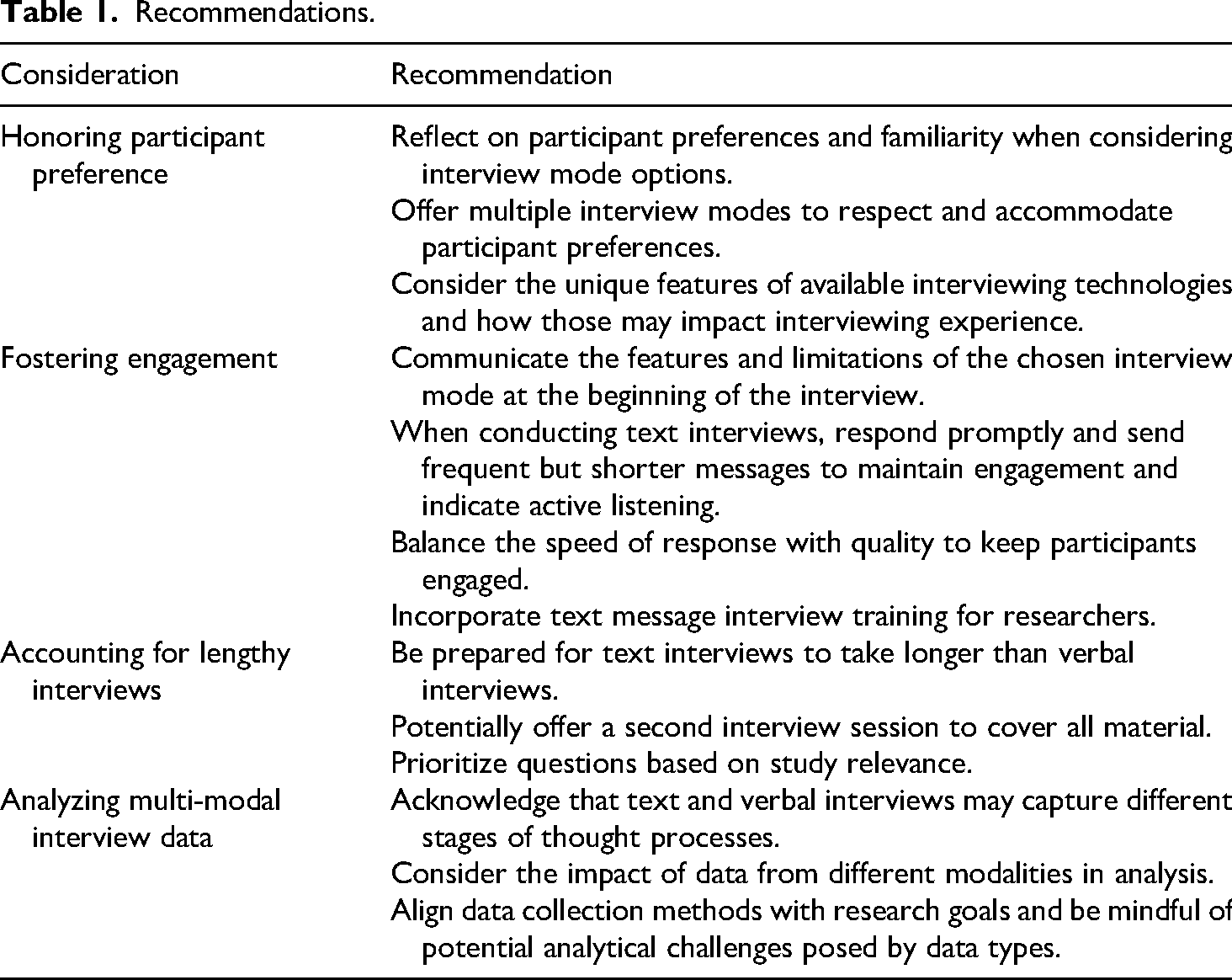
Although accounts describe interviewing via text-only interviewing forms like email (James, 2016; Oates et al., 2022; Saarijärvi and Bratt, 2021), web-based applications (Anderdal Bakken, 2022; Tomás and Bidet, 2024; Twis et al., 2020), and instant messenger or chat (Barratt, 2012; Hinchcliffe and Gavin, 2009; Oates et al., 2022; Pearce et al., 2014; Saarijärvi and Bratt, 2021), few accounts are available for text message (SMS or iMessage) interviews. This paper fills a gap in the literature by offering insights for researchers considering including a text message interview option for participants within qualitative research studies. We draw from our experience offering three interview modes to young adult research participants to offer four considerations and corresponding recommendations (Table 1) for researchers.
Recommendations.
Example of application
To explore the inclusion of text message interviewing in interview studies, we draw from our research on mental health-related resource navigation among young adults (n = 39). This study included one-on-one interviews with 39 American adults aged 18–25 from January to July 2024, recruited using social media. Participants chose to be interviewed by phone (n = 12), Zoom (n = 8), or text message (n = 19). Text message interviews were conducted using Google Voice or iMessage. The interview guide was semi-structured, and interview topics included mental health history, health service perceptions, and experiences with suicidal ideation, crisis lines, and help-seeking. The interview guide included required questions (asked of all participants) and, in line with grounded theory, ad-hoc prompts and probes used depending on participants’ responses. This study was approved by the University of California San Francisco Review Board. Informed consent was obtained via digital signature before each interview.
In this paper, we draw from two data sources: (1) our experiences recruiting participants, conducting interviews, and analyzing study data and (2) participant reflections among text-based interviewees (n = 18) to develop five essential elements of consideration for researchers considering these methods. These considerations include honoring participant preference, fostering engagement, accounting for lengthy interviews, analyzing multi-modal data, and securing data.
Key elements of consideration
Consideration 1: Honoring participant preference
Sixteen of the eighteen text interviewees spoke positively about being interviewed by text message. The most common reasons for liking text-based interviews included the ability to think about and review responses (61%) or feeling like texting facilitated better communication (44%). Participants shared (taken verbatim from text message interviews): I feel like it makes it a lot more accessible for me, I appreciate it being an option because I probably would've passed the opportunity otherwise I liked this method a lot. I think it's a great idea for accessibility, especially when discussing possibly difficult topics ! It was great and having that option available for participants is truly a game-changer, I think! It allowed me to think about the question and be able to include all the information I want to in my answer
Overall, the positive feedback from participants underscores how the research participation experience was improved by including a text message interviewing option that met interviewees’ diverse needs and preferences.
Consideration 2: Fostering engagement
Fostering engagement during text interviews is essential but can be challenging.
As participants are likely new to text interviews, setting expectations regarding interview conduct is vital. Each technology used has unique features, which we discussed at the outset of the interviews. For example, when using Google Voice, the ellipses (…) indicating the researcher was typing (typical in iMessage) weren’t visible to the interviewee; thus, we informed participants not to expect ellipses. We also could not use the tap-back feature or access emojis. Alongside others who’ve cited technical problems as a disadvantage of remote interviewing (Tomás and Bidet, 2024), we faced issues with message delivery using Google Voice and advised participants to type “Hello!” if they didn’t hear from us. Because of these issues, we switched to iMessage, which was advantageous because the interviewer could see read receipts and ellipses indicating a participant was typing, providing better communication cues. Although we can’t be sure, we believe the availability of read receipts and ellipses was equally advantageous on the participant's side.
Finally, low engagement throughout, which took the form of long pauses between answers or brief answers, was an issue in some interviews. To increase engagement, we (1) responded promptly to participants’ answers and (2) sent more frequent but shorter text messages (e.g. “I hear what you’re saying,” “That makes a ton of sense”) to indicate “listening” while composing the next question. Others have recommended sending multiple short lines of text when asking questions to diminish the “silence” experienced by interviewees (Girvan and Savage, 2013). Responding quickly as a strategy to foster engagement was validated by a participant who, when asked about the text interview, shared, “Your responses were also prompt, so that made it engaging!” Nonetheless, interviewers must work to maintain a balanced approach between quick responses and quality prompts to steer the interview. Consistent with most qualitative work, the interviewer found it easier to properly balance responding quickly and with quality prompts and probes as the interviews progressed.
Consideration 3: Accounting for interview length
Consistent with other comparative methods studies (Oates et al., 2022; Shapka et al., 2016), text message interviews took longer but produced fewer words than verbal interviews. Text-based interviews averaged 103 min (range: 75–136 min), while verbal interviews (conducted via Zoom or phone) averaged 54 min (range: 25–70 min), a statistically significant difference (95% CI, 41.7–58.7). Similarly, text-based interviews produced an average of 2681 words (range: 1263–4082), while verbal interviews produced an average of 8028 words (range: 3762–11,452), also a statistically significant difference (95% CI, 4692–7801).
Text message interviews were set up like phone and Zoom interviews; the interviewer scheduled a time and provided an estimated length, noting that a second interview could be requested. During four text interviews, when the interviewer could not ask sufficient questions within 90 min, the interviewer asked if the participant would like to keep going or schedule a second session.
Differences in interview modes shaped the interviewer's speech. Given the longer time to receive a response in text interviews, questions felt more costly in terms of time on the part of the interviewer (KL). In this study, this changed the interviewer's behavior. In verbal interviews, the interviewer felt less rushed and, as a result, asked more questions and spoke more informally (i.e. “Oh really, weird how?”), and covered a broader range (i.e. “People are talking about the mental health crisis. What's it like to see that?”). In this way, the interview mode influenced the content by shaping the participants’ and the interviewer's speech. Allowing interview content to vary was a choice made by the research team. Alternatively, a study protocol could stipulate a structured guide where all questions are asked verbatim, regardless of how long it takes to complete them. Different choices produce different data; thus, we recommend recognizing that interviews may proceed differently based on mode. Since text interviews differ from the verbal methods in which qualitative researchers are typically trained, specific training for conducting text interviews may be required, and practice interviews are recommended.
Consideration 4: Analyzing multi-modal interview data
The nature of text interview data has analytical implications. The data show that participants valued the ability to think about and edit their responses. Two quotations, coded as “Acknowledging ambivalence,” highlight a syntactic contrast: Text interview excerpt I definitely want to be able to have control over my treatment. I don't want to be medicated or held anywhere against my will. However, I recognize that sometimes I become a danger to myself, and control may need to be taken from me. Zoom interview excerpt You know, what does this person need versus … yeah, I don't exactly know … Because it's, I mean, it's got to be super, as you know, you've spent some time doing this, I can only imagine it's tricky to try and balance being able to support them, but also, just safety.
Jamie expresses a belief in concrete form, while Silas is working out his beliefs during the interview. Verbal interviews may reveal thoughts and emotions as they unfold. In contrast, text interviews allow participants time to think and self-edit, potentially masking the thought formation process and allowing the participant to verbalize a more developed thought. While these two participants may simply have divergent speech styles or personalities, these quotations, although brief, do reflect typical syntactic differences observed throughout this dataset.
Any technology will impact the way participants communicate (Anderdal Bakken, 2022), and this impact should not be overlooked. Thus, various interview modes may provide insights into participants’ cognitive processes at different stages, potentially enhancing data diversity. Analytically, the two quotations were treated similarly; although they vary in language and tone, they were coded with the same code and used in a manuscript to reinforce the same point. Thus, while text and verbal interviews may share thematic similarities, they capture distinct phases of thought progression, impacting study data and outcomes.
Moreover, data collection options, including offering a text option, should align with research goals and plans. Our results align with studies indicating that text data, despite its brevity, is often thematically aligned with verbal data (Woodyatt et al., 2016). Because text interview data tends to be less detailed (including fewer illustrative narratives, ancillary details, etc.), it can pose challenges for specific analytical methods. Techniques favoring thick description and relying on in-depth accounts of processes and thought formation (e.g. grounded theory and phenomenology) might be less suitable than those emphasizing thematic content (e.g. some types of thematic analysis and content analysis).
Discussion
This study advances qualitative methods literature by providing a practical example of incorporating a text message interview option into qualitative research projects, along with practical recommendations (Table 1) for researchers.
In alignment with previous research describing the increased accessibility afforded by remote interviews (Ison, 2009), our findings demonstrate how a text message-based interview option likely increased the accessibility of our study by including those who, in the words of one participant, “would’ve passed the opportunity otherwise.” Text message interviews may uniquely increase study accessibility relative to other text mediums because iMessage or SMS communications are highly available globally and, in not requiring an application download, the most accessible. They may be a more accessible option to get around the exclusionary risks of other remote interviewing technologies, which typically rely on the Internet (i.e. WhatsApp or Zoom) (Tomás and Bidet, 2024). Nonetheless, given the ubiquity of wireless internet, technologies such as WhatsApp similarly support one-on-one exchanges, are widely used and potentially preferred among younger populations, and thus may warrant consideration to enhance study accessibility.
Offering multiple interview modes honors the reality that study populations are heterogeneous in many ways, including communication preferences. While many participants may be willing to participate in verbal interviewing, they may prefer to speak via text. For example, popular discourse holds that young people dislike talking on the phone, yet half of the study participants aged 18–25 chose Zoom or telephone. Others offering multiple modes have found that members of the same population prioritized different values when offered interview mode options, including comfort, convenience, rapport, or the ability to provide in-depth responses (Heath et al., 2018; Tomás and Bidet, 2024). Multiple modes allow participants to choose what to prioritize within the research encounter. Further, participants’ choices may surprise you; one participant disclosed that she had a stutter (which one may assume would preference a participant toward a text-based option), yet chose a phone interview. Similarly, although some participants disclosed preferring to text a crisis line, they preferred to communicate via phone for the research interview. These examples exemplify how communication preferences are contextual and have positive value in providing participants with a choice.
Nonetheless, our experience suggests engagement may be more challenging to foster within text-only methods. While many have expressed concern regarding building rapport in remote interviews (Oates et al., 2022), interview engagement (i.e. responses with detail) is a precursor to rapport. In our study, low engagement was a problem within some text message interviews. In alignment with previous research (Heath et al., 2018), in our study, the interviewer, given the lack of visual and audio cues within the interview, had to work harder to maintain interest and engagement in text message interviews. In line with previous findings, data from low engagement interviews was thematically aligned with other interviews but lacked the nuance and depth of audio-only interviews. Findings suggest that more research is needed to develop strategies to foster engagement using text message interviews.
The choice of interview modality is crucial when engaging with historically marginalized populations (Neville et al., 2016), particularly those who have experienced harm through research and academic institutions. Due to convenience and cost efficiency, researchers may utilize specific modes, such as Zoom. While exclusively offering Zoom interviews may be appropriate for interviewing providers or other professionals who regularly use Zoom, it may be less suitable for other populations unfamiliar with these technologies. This practice can inadvertently reinforce traditional power hierarchies between “researchers” and the “researched” by prioritizing the researchers’ comfort over that of participants (James, 2016). Offering multiple modalities and respecting participants’ preferences can move toward an inversion of these traditional hierarchies by allowing participants more control over their engagement. Offering multiple meaningfully differentiated options may empower participants and enable a sense of agency within qualitative research studies.
Our experience further suggests that the appropriateness of remote interviews for sensitive topics is context-dependent. Some scholars argue that remote interviews on sensitive topics are inappropriate due to limited ability to detect distress. In contrast, others highlight their lower emotional burden, ease of exit, and increased participant control as key advantages (Thunberg and Arnell, 2021). We viewed text message interviews as appropriate within this study for four reasons: (1) we spoke with adults aged 18–25, who are accustomed to remote text-based communication, (2) many young adults live with others, so we offered an option that reduced concerns about being overheard, (3) despite common preconceptions, asking about suicide and suicide-related behaviors does not elevate suicide risk (Dazzi et al., 2014), and (4) some interview content focused on crisis text services; thus, many participants had experience communicating via text about mental health and suicidal ideation, achieving what others have referred to as contextual naturalness (Kazmer and Xie, 2008) whereby the interview medium aligns with study content (see Anderdal Bakken, 2022; Barratt, 2012). As a result, we recommend careful consideration of the study population and content to determine the appropriateness of various interviewing modes.
Finally, despite the appropriateness of text message interviews for this study, participant distress would have been difficult to detect in text message interviews. As such, our team developed IRB-approved safety protocols to reduce the likelihood of within-interview participant distress and manage it, should it arise. For researchers considering remote methods on sensitive topics, we recommend careful consideration of population, technology, and content, as well as designing protocols should a participant become distressed. Including remote and anonymous interview options may inevitably involve a trade-off between anonymity and the ability to intervene in participant distress, a reality worth considering and planning for.
Conclusion
This paper provides an example of including a text message interview option for research on a sensitive topic. As study participants increasingly expect, and possibly prefer, digital interviewing options, it will be increasingly crucial that researchers are prepared to offer them. Our findings suggest that although including a text message interview option has drawbacks, it may be a feasible mode for increasing accessibility of research studies. Future research is needed to understand text message interviewing, including the participant perspective, and to develop strategies to overcome this method's specific challenges, like fostering engagement.
Footnotes

Ethical approval and informed consent
The University of California Institutional Review Board approved this study. All participants provided their consent to participate in this study. This data was collected while the lead author was a doctoral student at the University of California, San Francisco. The views expressed in this article are those of the authors and do not necessarily reflect the position or policy of the Department of Veterans Affairs or the United States government.
Author contributions
Funding
This project was funded by the Agency for Healthcare Research & Quality (1R36HS029568-01). This material is based upon work supported (or supported in part) by the Office of Academic Affiliations and the Office of Research and Development (ORD) Health Systems Research (HSR) Service, US Department of Veterans Affairs.
Declaration of conflicting interests
The authors declared no potential conflicts of interest with respect to the research, authorship, and/or publication of this article.
Data availability statement
Due to the sensitive nature of this study, data is not publicly available.