






Abstract
This note advances the integration of critical realism and social constructionism in qualitative research, drawing on Foucault's analysis of power, knowledge, and discourse to explicate how social realities are shaped, maintained, and contested. While critical realism posits an objective, stratified reality that can be approached through inquiry, social constructionism emphasizes the contingent, socially constructed nature of knowledge and meaning. Foucault's work offers a critical bridge between these paradigms, illuminating the ways material structures and discursive practices co-constitute subjectivity, agency, and social phenomena. Despite persistent philosophical tensions and critiques regarding integration, this note argues for a theoretically and methodologically pluralistic framework, one that recognizes both the causal power of material structures and the constitutive force of discourse. By elaborating the conceptual, epistemological, and methodological dimensions of this integration, and illustrating its practical implications for mental health research, this note aims to enrich qualitative inquiry and promote more robust, reflexive, and socially just research practices. In doing so, it responds to the gap in the literature on philosophical integration and demonstrates the necessity of pluralist frameworks for addressing the complexities of contemporary society.
Keywords
Introduction
The rationale for this note arises from the ongoing challenge within qualitative research of adequately theorizing the complex interplay between social structures, discursive practices, and individual agency. This challenge is particularly acute in fields such as mental healthcare, where subjectivities are deeply entwined with broader socio-material and cultural dynamics. My own research in this domain has grappled with the tension between critical realism's commitment to an objective reality and social constructionism's insistence on the multiplicity and contingency of realities. Further, recent scholarship, including Elder-Vass (2012), who advocates integration from a social ontology perspective, and Hardy (2019), who explores the compatibility of Margaret Archer's morphogenetic critical realism with Foucauldian discourse, signals a growing recognition of the need for philosophical pluralism.
Yet, the literature continues to reflect significant skepticism regarding the feasibility and coherence of such integration, with critics such as Joseph (2003, 2004), Parker (1992), and Hammersley (1992) arguing that combining critical realism and social constructionism risks epistemological incoherence or a dilution of theoretical rigor. Even proponents of integration, such as Elder-Vass (2012), acknowledge the profound challenges and persistent objections raised by scholars committed to the integrity of each paradigm. Moreover, some have charged that such integration contradicts Foucault's antirealist or anti-materialist commitments, with scholars such as Willig (1999), Parker (1992), Wetherell (2001), and Joseph (2004) arguing that Foucault's emphasis on discourse and the constructed nature of knowledge resists or even opposes the ontological realism and materialist assumptions central to critical realism. Others contend that Foucault's attention to the materiality of power relations and institutional practices is in fact underappreciated (Hardy, 2015; Joseph, 2004; Jessop, 2007; Sayer, 2010).
In line with this discussion, the current note pursues three aims. First, it provides a systematic and critical account of the philosophical foundations of critical realism, social constructionism, and Foucauldian theory, elucidating both their convergences and tensions. Second, it offers a robust, theoretically grounded, and methodologically actionable framework for their integration, addressing both the conceptual and methodological consequences of pluralism. Third, it demonstrates through a concrete example how this integration can advance qualitative research in mental health, with implications for both knowledge production and social justice.
In doing so, this note responds directly to calls for greater methodological clarity and philosophical rigor in pluralist research (Elder-Vass, 2012; Parra, 2023; Sims-Schouten et al., 2007). It further situates its contribution within a broader feminist tradition that has long insisted on the need to theorize both subjective experience and material conditions (Harding, 2004; Hartsock, 2019). Ultimately, I argue that by embracing a principled philosophical pluralism, qualitative research can more adequately capture the multi-layered, dynamic, and power-saturated realities of contemporary social life.
Philosophical foundations of critical realism
Critical realism, as pioneered by Roy Bhaskar (1979, 2009), asserts the existence of a reality that is independent of human cognition, interpretation, or discourse. This reality is not monolithic or static but is instead stratified, encompassing multiple ontological levels. Bhaskar's triadic model distinguishes between the “real” (generative mechanisms and causal powers), the “actual” (events that unfold when mechanisms are activated), and the “empirical” (the domain of human experience and observation). This stratification allows critical realism to reject both naïve empiricism (which collapses reality into observation) and radical relativism (which denies the existence of reality independent of interpretation).
The epistemological commitments of critical realism are equally nuanced. While reality exists independently, our knowledge of it is always mediated, partial, and fallible (Bhaskar, 1979, 2009; Sayer, 2010). Thus, critical realism is neither positivist nor constructivist; it holds that scientific inquiry is a process of fallible approximation, in which researchers seek to identify and explain the underlying mechanisms that generate observed phenomena. Archer (1995), building on Bhaskar, further develops the idea of morphogenesis—the recursive interplay between structure and agency over time, thus providing a dynamic account of social change.
Central to critical realism is the notion of “causal powers,” properties inherent in structures or entities that enable them to produce effects under certain conditions. These causal mechanisms are often unobservable, but their reality is inferred through systematic inquiry and retroduction, a mode of reasoning that moves from observed patterns to hypothesized underlying causes (Danermark et al., 2019).
This ontological and epistemological architecture has profound methodological implications. Critical realism calls for analytic strategies that move beyond mere description or correlation to the identification of deep, generative mechanisms. It invites researchers to triangulate empirical data with theoretical reasoning and to remain reflexive about the provisional nature of their knowledge claims. The ontological framework is summarized in Figure 1.
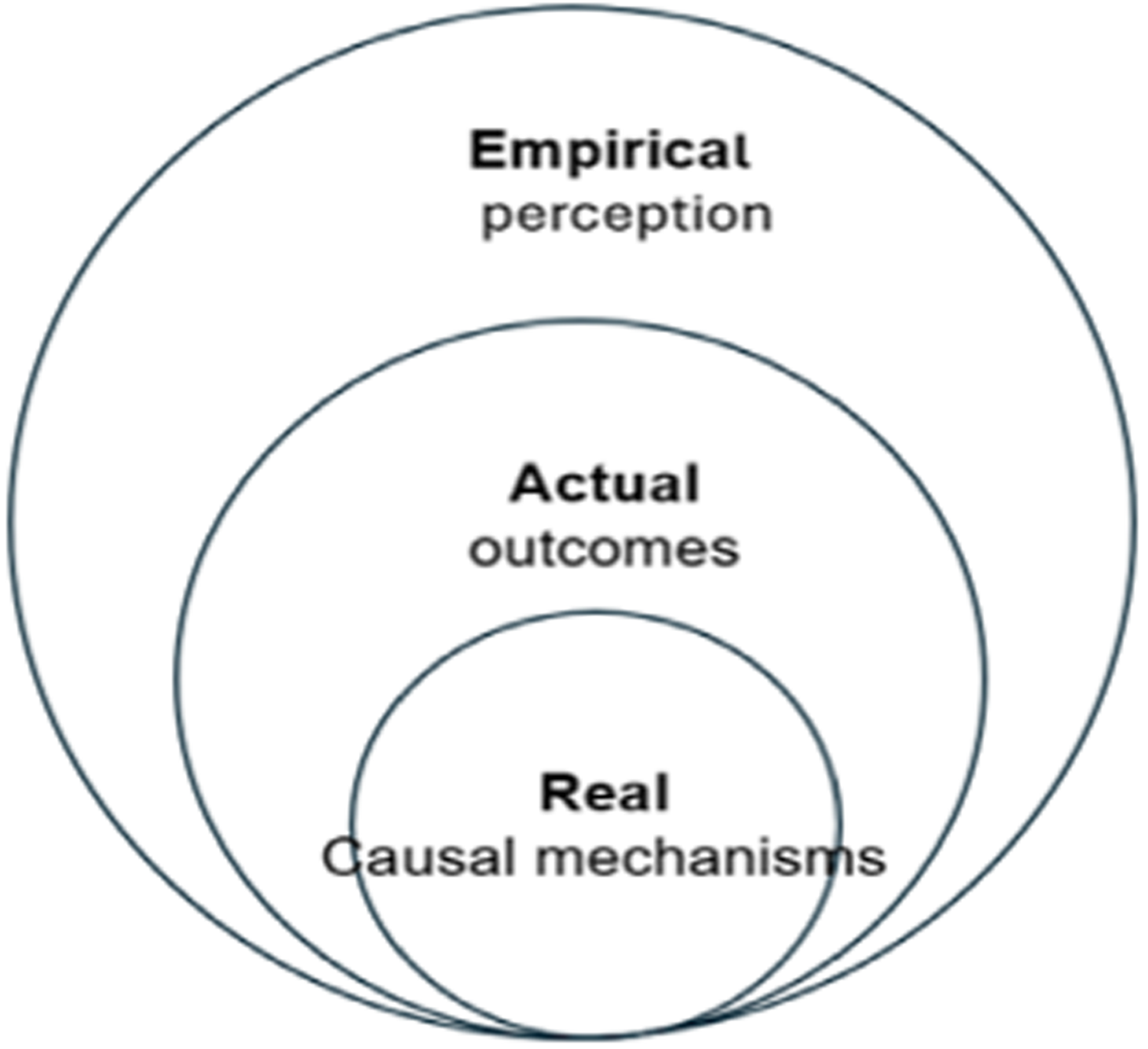
Bhaskar's ontological framework.
Despite its strengths, critical realism has been critiqued for its tendency to privilege macro-level structures at the expense of micro-level interaction and meaning-making (Parra, 2023). Critics have also noted that while critical realism highlights emancipation as a normative goal (Bhaskar, 2009), it often leaves underdeveloped the question of how knowledge of mechanisms translates into transformative practice (Archer, 1995; Jessop, 2007).
Philosophical foundations of social constructionism
In contrast, social constructionism is defined by its skepticism toward claims of objective, value-free knowledge. Pioneered by Berger and Luckmann (2016) and further developed by Burr (2015) and Gergen (2015), social constructionism maintains that reality is always constructed through social processes, language, and historical context. Knowledge is produced, negotiated, and contested within communities, and the “facts” we take for granted are always situated and provisional.
A central tenet of social constructionism is the constitutive power of language and discourse. As Foucault (1972, 1980) famously argued, discourses are not merely systems of representation but are productive; they bring into being the very objects and subjects about which they speak. Meaning is thus not a matter of correspondence between language and reality, but of negotiation, struggle, and power.
This epistemological orientation leads to a methodological emphasis on qualitative, interpretive, and participatory methods, such as discourse analysis, narrative inquiry, and ethnography, which seek to uncover the ways in which realities are constructed and maintained in everyday practice (Gubrium and Holstein, 2012; Willig, 2012).
Yet, social constructionism has its own limitations. Critics argue that in emphasizing language and meaning, it risks neglecting the material and structural conditions that shape, enable, and constrain social life (Joseph, 2004; Sayer, 2000). Moreover, radical forms of constructionism have been accused of collapsing into relativism, making it difficult to adjudicate between competing truth claims or to justify interventions aimed at social justice (Hacking, 1999; Hammersley, 1992).
Foucauldian constructionism, or post-structuralism, further complicates the picture by focusing on power and insisting that it is not simply repressive but productive, diffused through networks of discourse, institution, and subjectivity (Foucault, 1977, 1980). This perspective highlights the “micro-physics” of power—the subtle, everyday practices through which norms and truths are established and contested. Foucault's analysis of power/knowledge is illustrated in Figure 2.
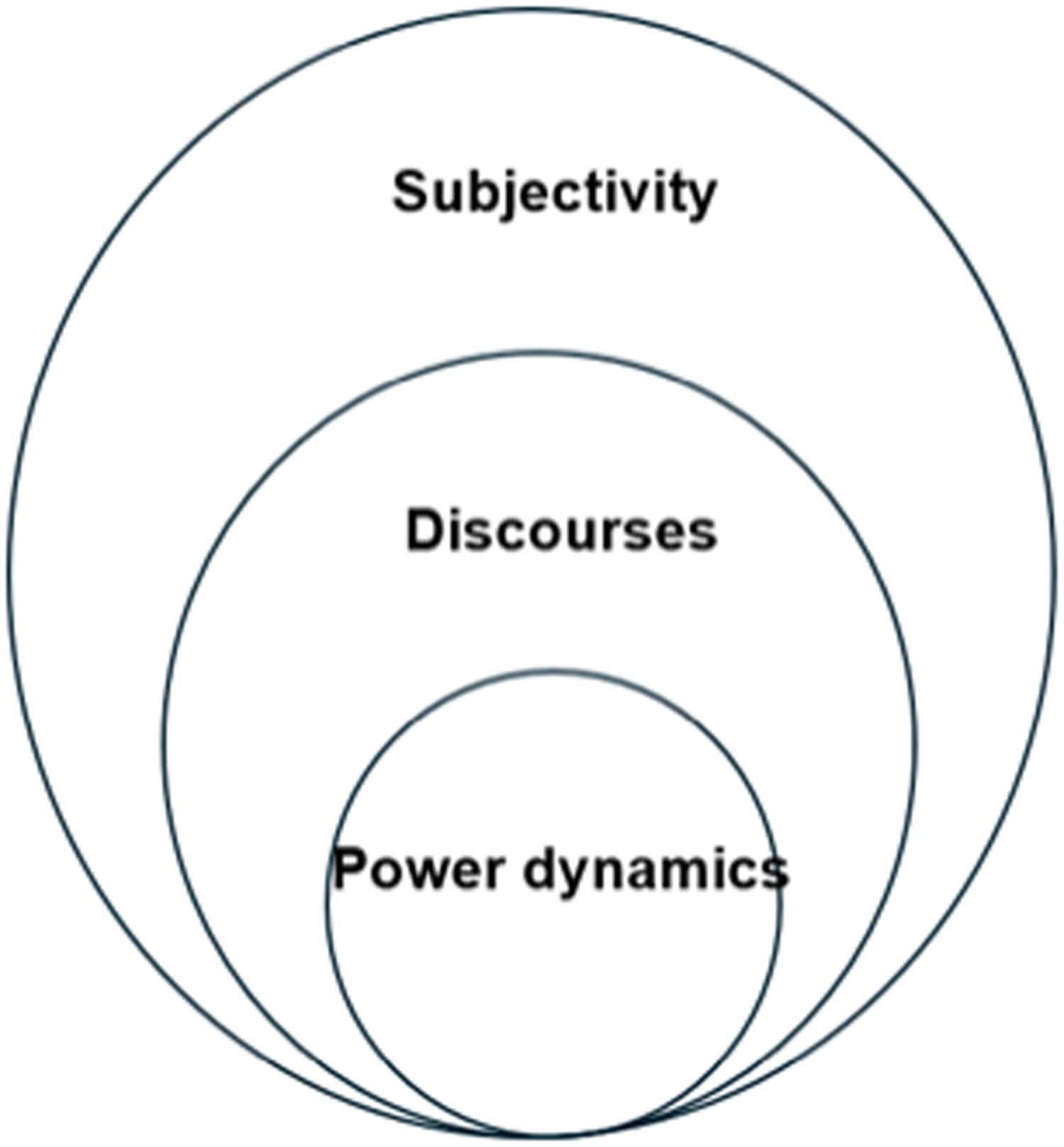
Foucault's theory of power.
Foucault, agency, and the question of materiality
A recurring critique of Foucault's work is its perceived under-theorization of agency. Scholars such as Amy Allen (2016), Lois McNay (1994, 2000), and Nancy Fraser (1989) have argued that Foucault's focus on the ways subjects are constituted by discourse and power leaves insufficient room for resistance, reflexivity, and creative agency. While Foucault (1982) himself insisted that power always entails the possibility of resistance, he offered less concrete guidance on the mechanisms of agency and change.
Similarly, some critics have argued that Foucault's work is anti-realist or anti-materialist, emphasizing discourse at the expense of material structures (Willig, 2021). Yet, as Hardy (2019), Joseph (2004), and Jessop (2007) have shown, this reading is at best partial. Foucault's genealogies of madness, sexuality, and punishment, for example, are deeply attentive to the material practices, institutional arrangements, and technologies through which power operates.
Thus, integrating Foucault with critical realism is not simply a matter of bridging discourse and structure, but of recognizing the co-implication of materiality and meaning, power and knowledge, agency and constraint. This is the theoretical horizon toward which this note gestures.
Integration of Bhaskar's critical realism and social constructionism: A pluralist framework
The integration of critical realism and social constructionism is not straightforward. At the most basic level, the two paradigms are defined by incompatible ontological and epistemological commitments, one positing a reality independent of observation, the other insisting on the constitutive power of social processes. Yet, as Elder-Vass (2012), Sayer (2010), and Sims-Schouten et al. (2007) have argued, this dichotomy is overstated. Both paradigms are concerned with the complexities of structure, agency, and context; both recognize the importance of reflexivity and the socially situated character of knowledge.
A pluralist framework does not collapse these differences but seeks to work productively with them. I propose an integrated model that draws on the stratified ontology of critical realism, recognizing the reality of mechanisms, structures, and causal powers, while embracing the relational epistemology of social constructionism, which highlights the contingent, negotiated character of meaning and practice.
In this model, social phenomena are understood as manifestations of underlying structures that are continually reproduced, contested, and transformed through discursive and practical activity. Structures possess real causal powers, but their effects are always mediated by human agency, interpretation, and struggle. Discourse is not reducible to language alone, but is embedded in and constitutive of material practices, institutions, and subjectivities. This framework is illustrated in Figure 3.
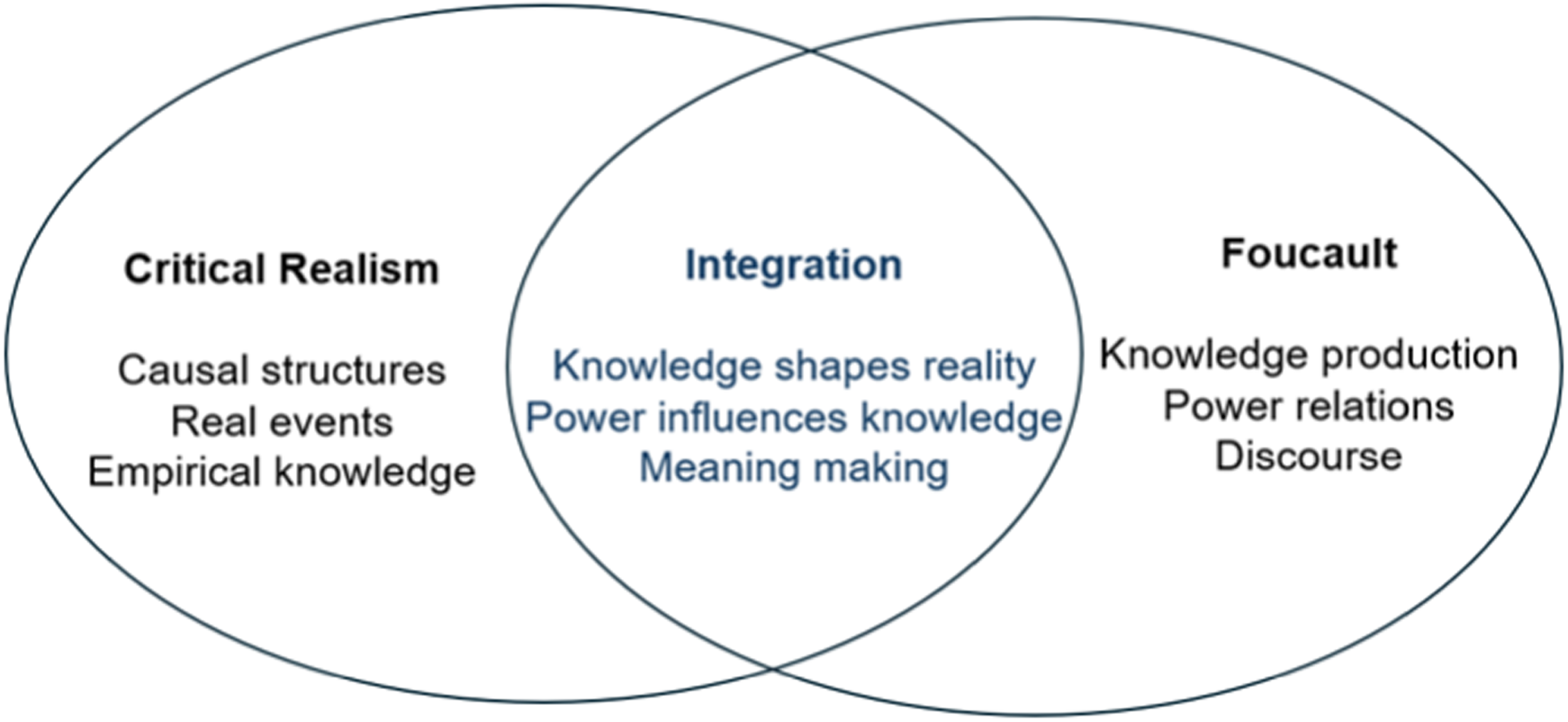
Integrated framework of critical realism and social constructionism.
This integration is more than an eclectic combination of perspectives. It is a principled philosophical stance that recognizes the ontological depth of social reality while maintaining epistemological humility and reflexivity. It seeks to move beyond the relativism/objectivism impasse, enabling researchers to investigate both the structural conditions of possibility for social phenomena and the emergent realities enacted by social actors.
Methodological consequences: Designing qualitative research under philosophical pluralism
The integration of critical realism and social constructionism, mediated by Foucault's insights, has significant methodological implications for qualitative research. This section explicates how this pluralist framework shapes research design, data collection, and analysis, distinguishing it from both monist and pragmatically mixed-method approaches.
Research design
A pluralist framework encourages researchers to formulate layered and dynamic research questions. Rather than focusing solely on individual experience (as in some constructionist approaches) or macro-structural mechanisms (as in some realist approaches), research questions are designed to probe the interplay between structures, discourses, and agency. For example, in mental health research, one might ask: What are the underlying social, economic, and institutional mechanisms that shape mental health outcomes? How are these mechanisms mediated, resisted, or reinforced through discursive practices and subjectivities? How do power relations operate at multiple levels to enable or constrain agency?
The design process thus involves mapping the domains of the real, the actual, and the empirical (Bhaskar, 1979), while simultaneously attending to the discursive fields and power/knowledge regimes (Foucault, 1980) that constitute subjectivity and meaning. This often entails iterative refinement of research aims as the inquiry unfolds, a hallmark of abductive and retroductive reasoning (Danermark et al., 2019; Fletcher, 2017).
Data collection
In practice, methodological pluralism entails drawing on a range of qualitative methods to capture both material and discursive dimensions. This may include in-depth interviews (to access subjective experiences and narratives), participant observation (to observe practices and interactions), document and policy analysis (to interrogate institutional discourses and power), and focus groups (to explore collective sense-making).
Importantly, data collection is guided by the principle of theoretical sampling—not only to achieve representativeness, but to ensure that data illuminate the multiple levels and mechanisms posited in the framework. For instance, researchers may deliberately seek out participants who occupy different positions within power/knowledge regimes (e.g. service users, clinicians, and policymakers) to uncover how structures and discourses operate across contexts.
Reflexivity is paramount. Researchers must remain attentive to their own positionality and the ways in which their interpretations are situated within broader discursive and material fields (Alvesson and Sköldberg, 2017; Finlay, 2002).
Data analysis
Analysis under this framework proceeds through a combination of thematic, discourse, and critical realist analysis. Initial coding may identify surface-level themes and patterns, but subsequent analytic cycles seek to uncover the deeper mechanisms and discursive formations at work.
A retroductive approach guides the researcher to move from observed phenomena (empirical) to hypothesized causal powers (real), while discourse analysis (following Foucault, 1972; Parker, 1992; Willig, 2012) interrogates the ways in which meanings, identities, and truths are constructed, contested, and stabilized. Crucially, the analysis does not treat material and discursive factors as mutually exclusive, but as co-constitutive. For example, policy discourses around mental health may be analyzed both for their material effects (who gets access to services, which diagnoses are legitimized) and their discursive constructions (how illness and normality are defined, who is authorized to speak).
This approach to analysis, treating material and discursive factors as co-constitutive, finds a compelling precedent in the work of Sims-Schouten et al. (2007). In their study of women's talk about motherhood, childcare, and female employment, the authors operationalize a systematic method that draws on both critical realism and discourse analysis. Their analytic process begins by identifying and mapping discursive themes within the data, such as constructions of “good motherhood,” “maternal guilt,” and “work–life balance.” These discursive patterns are then situated within the broader socio-material and institutional mechanisms, such as welfare policies, workplace expectations, and access to childcare, that shape and constrain women's daily practices. Rather than treating discourse as merely reflective or as wholly detached from material reality, Sims-Schouten et al. demonstrate that women's articulations of choice, constraint, and agency are deeply rooted in, but not reducible to, the real structures that organize social life. This pluralist approach enables researchers to move iteratively between surface-level meanings and the underlying mechanisms that generate and sustain them, thereby enriching both empirical insight and theoretical explanation (Sims-Schouten et al., 2007).
To illustrate the application of this framework, I draw on data from my recent qualitative study (2025, unpublished). This involved 18 participants who had accessed an Improving Access to Psychological Therapies (IAPT) service in England. Using ethically approved, anonymized semi-structured interviews, the study explored how service users constructed recovery. Many participants framed recovery in terms of personal responsibility, echoing dominant discourses of self-management and resilience, while others resisted this view, pointing to structural factors such as insecure work, debt, or social isolation. From a Foucauldian perspective, these discourses reflect how power/knowledge discourses shape subjectivity, constructing the “ideal” mental health subject as autonomous and compliant. However, a critical realist lens reveals how these discourses are also shaped by deeper causal mechanisms, including economic precarity and institutional pressures that materially constrain agency. This example demonstrates how a pluralist framework captures the co-constitution of discourse and structure in shaping recovery, and how qualitative inquiry can engage both meaning-making and materiality to produce socially attuned analysis.
Following this model, research in mental health can similarly benefit from a pluralist analytic strategy. For instance, in a study examining discourses of service users and clinicians, initial analysis might identify how discourses of “resilience,” “risk,” or “recovery” are constructed and mobilized in talk. The next analytic step, inspired by Sims-Schouten et al., would be to theorize the institutional, policy, and structural conditions, such as service accessibility, funding regimes, and diagnostic frameworks, that both shape these discourses and are themselves shaped by them. Through this layered approach, researchers are able to trace how material constraints and discursive constructions work together to shape subjectivity, agency, and mental health practices and outcomes. This not only reflects the co-implication of meaning and materiality but also provides a robust basis for identifying possibilities for social transformation.
This approach differs from pragmatic mixed methods in that it is grounded in a coherent philosophical rationale for pluralism, rather than simply combining methods for convenience or triangulation (Creswell and Plano Clark, 2017; Greene, 2007). While the integration of Critical Realism and Foucault offers a promising methodological approach, it is important to recognize that various other realist frameworks also engage with multiple levels of reality and social constructions. For example, Pawson's (2013) mechanistic realism emphasizes causal mechanisms (Pawson, 2013); local realism focuses on context-dependent understandings (Little, 2012; Mäki, 2009); and complex realism explicitly incorporates social constructions as shared, socially produced phenomena (Castellani and Hafferty, 2009). These approaches serve as valuable contextual references, demonstrating that integrating social constructions within a realist perspective is already acknowledged across different traditions. However, my proposed integration differs in that it explicitly combines Critical Realism's ontological depth, its recognition of underlying structures, causal powers, and stratified reality, with Foucault's focus on power relations, discourses, and social practices. While approaches like mechanistic, local, and complex realism recognize multiple levels of reality and social constructions, they tend to do so within frameworks that prioritize causality, contextual explanation, or the coexistence of different levels without emphasizing the active role of power in producing and sustaining social realities. In contrast, this synthesis aims to offer a more comprehensive understanding that not only acknowledges multiple layers of reality but also highlights the ways in which power dynamics and discourse shape and produce social phenomena. Recognizing this broader landscape of realist thought can thus strengthen the argument that integrating Critical Realism with Foucault's insights provides a nuanced and feasible methodological contribution.
Reflexivity and social justice
A key advantage of this framework is its capacity to promote reflexive, socially engaged research. By uncovering both the deep structures that generate inequality and the discursive practices that naturalize or challenge those structures, researchers are better equipped to identify sites of intervention and transformation (Harding, 2004; Hartsock, 2019).
Social justice is not treated as an external normative add-on, but as an integral aspect of the research process. The framework enables researchers to interrogate whose voices are heard or silenced, how power operates in the production of knowledge, and how alternative realities might be enacted (Allen, 2016; Fraser, 1989). In mental health research, this might mean analyzing how service users’ narratives are marginalized by institutional discourses, or how policy changes can open up new possibilities for agency and care.
Illustration: Applying the framework in mental health research
To concretize the value of this integrated approach, consider its application in a study of mental health service provision. Traditional realist approaches might focus on identifying the causal impact of socioeconomic deprivation on mental illness rates, while constructionist approaches might analyze how mental health is talked about in media or clinical contexts. A pluralist framework, by contrast, would begin by mapping the material mechanisms (e.g. poverty, access to care, and institutional policy) that shape mental health outcomes, while simultaneously analyzing how discourses of “resilience,” “risk,” or “vulnerability” are mobilized by different actors.
The researcher would collect data from multiple sources: interviews with service users and clinicians (to access discourse and daily practices), policy documents (to trace institutional mechanisms), and ethnographic observation (to witness practices in situ). Analysis would proceed by identifying both the material constraints (e.g. funding cuts and bureaucratic procedures) and the discursive framings (e.g. pathologization and narratives of recovery) that shape outcomes.
Importantly, the researcher would remain reflexive about their own role in constructing knowledge, recognizing the ways in which their interpretations are shaped by their positionality and the broader discursive field. The ultimate aim would not only be to explain mental health phenomena, but to identify possibilities for transformation, whether by amplifying marginalized voices, challenging dominant discourses, or advocating for policy change.
Discussion: Contributions to current research and debates
This note makes several contributions to current debates in qualitative methodology and social theory. First, it provides a robust, systematically articulated framework for integrating critical realism and social constructionism, responding to persistent calls in the literature for greater philosophical clarity and methodological guidance (Elder-Vass, 2012; Parra, 2023; Sims-Schouten et al., 2007). By engaging deeply with both the ontological and epistemological dimensions of these paradigms, and by situating Foucault's theory of power/knowledge as a critical mediating term, the note moves beyond superficial eclecticism to offer a principled basis for pluralism.
Second, the note advances the methodological conversation by spelling out the concrete implications of this integration for research design, data collection, and analysis. In so doing, it differentiates its approach from both pragmatic mixed methods and alternative realisms (e.g. Castellani and Hafferty, 2009; Pawson and Tilley, 1997), arguing for the necessity of explicitly theorizing the relationship between structure, discourse, and agency.
Third, by highlighting the ethical and political stakes of qualitative research, the note aligns itself with a broader feminist and critical tradition that insists on the inseparability of knowledge and justice (Fraser, 1989; Harding, 2004). In mental health research, this means not only uncovering the mechanisms that produce suffering but also amplifying the voices and knowledges of those most affected.
Finally, the note contributes to ongoing debates about the limits and possibilities of philosophical pluralism. It acknowledges the risks of incoherence or dilution but argues that these can be mitigated by sustained reflexivity, theoretical rigor, and methodological transparency. Rather than a retreat from philosophical commitment, pluralism is here presented as a necessary response to the complexity and dynamism of contemporary social life.
Conclusion
The integration of critical realism and social constructionism, mediated by Foucault's analysis of power/knowledge, offers a powerful and necessary framework for qualitative research in complex fields such as mental health. By recognizing both the reality of material structures and the constitutive force of discourse, this pluralist approach enables researchers to move beyond the sterile opposition of objectivism and relativism. It provides a principled basis for methodological pluralism, guides the design and analysis of multi-level, reflexive inquiry, and highlights the ethical and political stakes of research.
This note addresses enduring challenges identified in the literature and offers a clear trajectory for future scholarly inquiry. It encourages researchers to engage with the inherent complexity of social phenomena through research that is both analytically robust and attentive to questions of social engagement. In a context characterized by persistent inequalities, contested knowledges, and ongoing social transformation, the adoption of philosophical pluralism emerges not as a discretionary option, but as an essential foundation for meaningful and impactful research.
Footnotes
Acknowledgements
The author would like to acknowledge the support and guidance of Dr Julianna Challenor, senior academic and research advisor at City St George's, University of London.

Ethics approval and informed consent statements
Not required.
Funding
The author received no financial support for the research, authorship, and/or publication of this article.
Declaration of conflicting interests
The author declared no potential conflicts of interest with respect to the research, authorship, and/or publication of this article.