






Abstract
This article offers a reflexive methodological account of incorporating sequential art narrative as an analytic adaptation within hermeneutic phenomenology. Developed during a phenomenological study of acute care nurses’ experiences of providing existential support to patients facing life-limiting illness, sequential art emerged as a response to meanings that exceeded straightforward linguistic articulation. Rather than functioning as data or illustration, drawing operated as a reflexive analytic practice embedded within writing and rewriting, foregrounding temporality, spatiality, relational positioning, and affect. This article presents an adapted hermeneutic spiral to illustrate how sequential art narrative functioned alongside textual analysis and epistemic reflexivity, rendering interpretive decisions visible and accountable. The findings demonstrate that attending to researchers’ epistemic orientations, including visual ways of knowing, can strengthen rigor by enhancing transparency in how interpretation unfolds. Sequential art narrative is proposed not as a method, but as a disciplined reflexive heuristic responsive to hermeneutic phenomenological inquiry.
Keywords
Introduction
Rigor in hermeneutic phenomenology develops through sustained responsiveness to how phenomena disclose themselves and through transparency in how interpretation unfolds; not through rigid adherence to fixed procedures (Gadamer, 1984; van Manen, 2016a). For novice phenomenological researchers, the work of phenomenology can feel particularly nebulous. Therefore, this article offers a reflexive methodological account of how I, as the study's primary investigator and novice phenomenological researcher, incorporated sequential art narratives as a reflexive analytic adaptation within hermeneutic phenomenology. The purpose of this article is to (a) present this study's adapted hermeneutic spiral as a guide for future phenomenological research, (b) outline my work incorporating sequential art narratives into hermeneutic phenomenology as a methodological case study, and (c) discuss my use of epistemic reflexivity to ensure rigorous qualitative research.
The incorporation of sequential art narratives into my data analysis emerged in response to a phenomenon that repeatedly exceeded straightforward linguistic articulation. Sequential art narratives, commonly referred to as comic strips, graphic novels, and manga, are visual narratives composed of illustrated panels presented in sequence that convey a single story (Duffy, 2009; Eisner, 2008a). Will Eisner coined the terms sequential art and visual narratives to describe texts that communicate meaning through the interplay of images and words (Eisner, 2008a, 2008b). While sequential art has been widely examined as a representational, pedagogical, or communicative form of aesthetic inquiry, its use as an analytic practice within hermeneutic phenomenology has received relatively limited theoretical attention.
The methodological adaptation described here emerged during a hermeneutic phenomenological study exploring how acute care nurses experience providing existential support to patients facing life-limiting illness (Grant, 2025). As my interviews progressed, participants’ language frequently evoked images of time slowing, rooms becoming heavy or quiet, bodies orienting toward one another, and moments unfolding incrementally rather than decisively. Simultaneously, my reflexive memos became increasingly visual, filled with sketches, spatial metaphors, and notations about what occurred between spoken words. These visual impulses, which began with many haphazard sketches, were neither planned nor initially conceptualized as an analytic practice. Instead, they emerged from my interpretive struggle to remain faithful to the ongoing, interactive movement between participant accounts, analytic engagement, and phenomenological understanding. While our parent study is grounded in nursing, this article does not advance a clinical or disciplinary argument. Findings from the parent study are selectively and illustratively drawn on, not to generate nursing practice recommendations, but to anchor the methodological discussion.
Background
Study context
Acute care nurses spend substantial time at the bedside, yet limited research examines how they experience and enact existential support for patients facing life-limiting illness. Patients’ concerns often extend beyond medical treatment options to existential questions about uncertainty, meaning, and mortality. Despite the substantial time acute care nurses and patients spend together, research focusing on how these nurses perceive and navigate existential dimensions of care is limited. Therefore, the parent study employed hermeneutic phenomenology to explore acute care nurses’ lived experiences of existential support within nurse–patient communicative relationships (Grant, 2025).
Hermeneutic phenomenology
In reviewing literature on acute care nursing and palliative communication, the relative absence of the acute care nurse's experiential perspectives highlighted the value of an approach attentive to lived meaning (Husserl, 2001; van Manen, 1975, 2014). We selected hermeneutic phenomenology as a methodology because it facilitates inquiry into experiences that may be obscured or taken for granted within institutional contexts. Hermeneutic phenomenology, as articulated by van Manen (2016a, 2016b), is not a method but a mode of inquiry oriented toward understanding lived experience. Rooted in the philosophical traditions of Heidegger and Gadamer, it foregrounds interpretation as situated, dialogical, and unavoidable (Gadamer, 1984; van Manen, 2016a). Therefore, through hermeneutic phenomenology, meaning emerges through sustained engagement between the researcher, participants, text, and phenomenon.
Van Manen describes phenomenological research as involving six intertwined undertakings: turning to a phenomenon of interest; investigating experience as lived; reflecting on essential themes; describing the phenomenon through writing and rewriting; maintaining a strong ontological relation to the phenomenon; and balancing parts and whole (van Manen, 2016a, 2016b). These undertakings function not as procedural steps but as recursive movements that continually inform one another.
Also central to hermeneutic phenomenology is the primacy of writing. Writing is a means of reporting findings and a method for generating phenomenological insight. Through writing and rewriting, researchers linger with experience, test interpretations, and refine language to evoke meaning rather than explain it (van Manen and van Manen, 2021). Any methodological adaptation must therefore remain accountable to writing's epistemic role rather than bypass it.
Researcher worldview
Although Unitary Caring Science did not function as a guiding analytic framework for the parent study, its ontological commitments informed my interpretive stance as a nurse-researcher. Hermeneutic phenomenology resists theoretical imposition, yet, as van Manen emphasizes, researchers cannot and should not bracket themselves out of inquiry (van Manen, 2016a). Making explicit this worldview shaped how I attended to participants’ experiences supports methodological transparency rather than theoretical direction.
Unitary Caring Science situates nursing within a moral–ethical ontology that foregrounds relationality, personhood, and meaning, particularly in contexts where cure is uncertain (Watson, 2008, 2018). This orientation aligns with hermeneutic phenomenology's emphasis on lived meaning unfolding through relationship, context, and time. Importantly, Caring Science did not structure analytic procedures or theme development. Instead, it sensitized me to the moral, relational, and existential dimensions of nurses’ communicative experiences, functioning as an orienting worldview rather than a framework imposed on the data
Methodology
Method
The parent study employed van Manen's hermeneutic phenomenology to explore acute care nurses’ lived experiences of providing existential support to patients facing life-limiting illness. Seventeen acute care nurses participated in semi-structured interviews lasting approximately 60 to 75 minutes. Participants were asked to bring a visual artifact representing a meaningful nurse–patient relationship; these artifacts served as prompts for reflection rather than as discrete units of analysis. All interviews were audio-recorded, transcribed verbatim, and verified by the primary investigator. Reflexive journaling, analytic memoing, and heuristic writing occurred throughout data collection and analysis. The methodological focus of this article is the analytic adaptation that emerged during analysis: the incorporation of sequential art narrative as a reflexive heuristic within hermeneutic phenomenology.
Analysis: adapting the hermeneutic spiral
Data analysis in hermeneutic phenomenology is primarily achieved through the art of writing and rewriting (van Manen, 2016a; van Manen and van Manen, 2021). Grant Osborne (1991) popularized the hermeneutic spiral as a visual metaphor for hermeneutic analysis in his biblical works (Osborne, 1991). This spiral has since been adopted across various research disciplines to illustrate that hermeneutic analysis does not proceed as a linear sequence of discrete steps (Dibley et al., 2020). Subsequently, the hermeneutic spiral created for this study symbolizes the recursive movements between experience-as-lived, interpretation-as-written, and the researcher's self-as-instrument in continuous dialogue with participants’ narratives. Within this spiral, van Manen's six methodological undertakings functioned as orienting movements rather than procedural instructions (van Manen, 2016a). Each return to the data occurred from a different analytic position: after another interview, as patterns began to crystallize, or following periods of analytic distance. Meaning did not accumulate through addition but deepened through revisitation.
Self-as-instrument
The hermeneutic spiral developed for this study (Figure 1) represents the iterative process through which understanding and meaning were cultivated. The black spiral represents the researcher's self-as-instrument, explicitly acknowledging that the researcher's lifeworld, clinical background, interpretive orientation, and worldviews cannot be bracketed out of the research process. Rather than treating subjectivity as bias to be eliminated, this approach required sustained reflexive engagement with how interpretation was unfolding (van Manen, 2016a).
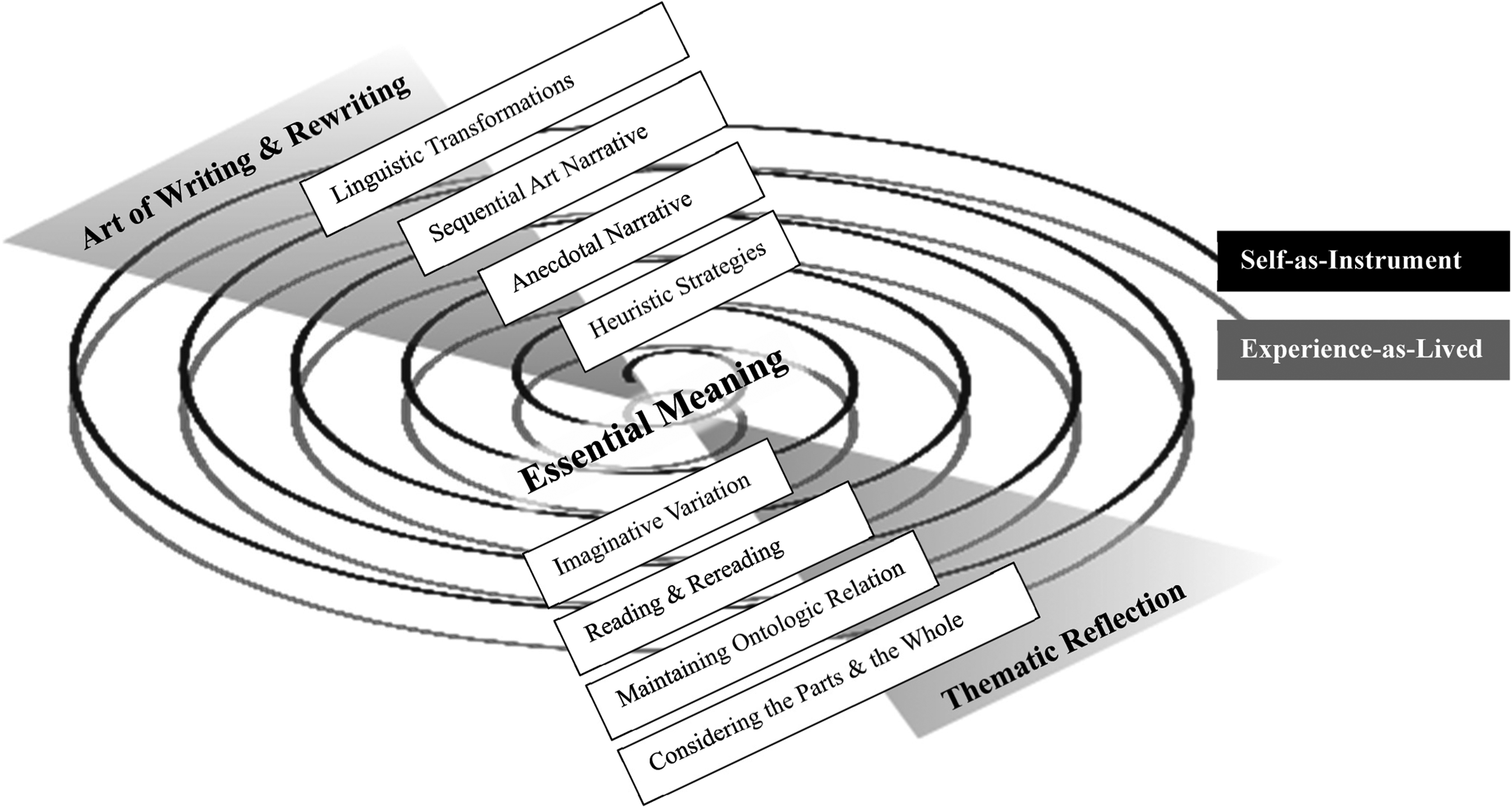
Hermeneutic spiral of data analysis and writing. Note: Author-developed figure illustrating the recursive movement of a hermeneutic spiral, integrating van Manen's phenomenological undertakings with art-based reflexivity through sequential art narratives.
Experiences-as-lived
The grey spiral represents participants’ experiences-as-lived. These experiences-as-lived represent the experiential descriptions of participants developed throughout our semi-structured interviews. Additionally, experience-as-lived has a spiral that mirrors self-as-instrument, representing the constant interaction of myself as investigator with the participants throughout the interviews, in transcript analysis after the interviews, and in my interpretive and reflective writings.
Art of writing and rewriting
The upper triangle represents Writing and Rewriting, which occurred in tandem with Thematic Reflection. Writing began with reflexive journaling, using personal experiences with the phenomenon under study as a starting point, and continued throughout the analysis in multiple forms: linguistic transformations, anecdotal narratives, analytic memos, informal reflections, and sequential art narratives.
Sequential art narrative entered the hermeneutic spiral as a reflexive extension of the writing–rewriting process rather than as a separate analytic phase or substitute for textual interpretation. In van Manen's approach, writing is itself analysis; phenomenological insight is crafted, tested, and refined through language (van Manen, 2016a). Sequential art did not displace this claim. Instead, it functioned as another disciplined mode of attentiveness that foregrounded temporality, relational positioning, affective tone, and spatiality.
Thematic reflection
The lower triangle in Figure 1, labeled Thematic Reflection, represents the ongoing analytic work of engaging with participants’ language and emerging patterns. This conscientious engagement entailed Reading and Re-reading the transcripts and my own writings while considering how the Parts (line-by-line interpretation) interact with and relate to the Whole (emerging patterns and themes). As themes began to crystallize, free imaginative variation allowed me to test their essentiality by asking whether the phenomenon remained intelligible without that particular theme (van Manen, 2016a). Sketching sequential art initially emerged as a way of holding visual and spatial dimensions of meaning that had not yet found linguistic form but were nevertheless integral to thematic reflection.
Essential meaning
Essential Meaning, as articulated in this study, represents an interpretive understanding of what it is like to be an acute care nurse providing existential support to patients facing life-limiting illness. Writing and rewriting deepened and refined this understanding rather than aggregating or summarizing experiences. Each return in the writing–rewriting process constituted a new interpretive act situated at a different moment in the hermeneutic spiral, allowing further analytic connection toward essential meaning (van Manen, 2016a).
The hermeneutic spiral in Figure 1 provides a visual way of holding the recursive movement between experience, interpretation, and self-as-instrument without reducing phenomenological analysis to procedural steps. For novice researchers, the figure can support attentiveness to how meaning deepens through revisitation rather than linear progression.
Examples: sequential art as reflexive analysis
To illustrate how sequential art narrative functioned within the hermeneutic spiral, two examples are presented here. The first provides a detailed account of how drawing operated as a reflexive analysis alongside writing and rewriting. The second offers a brief illustration of how this analytic practice supported interpretation across a different thematic domain. Together, these examples demonstrate how sequential art narrative functioned as a heuristic practice rather than as a singular piece of data, product, or illustration.
Example 1: the elephant in the room
An illustrative example of sequential arts analytic progression is seen in the development of my elephant-in-the-room narrative. During an early interview, Participant 1 chose an elephant as a visual representation of her experience caring for patients with life-limiting illness (Figure 2). In participant 1's words, the elephant symbolized the shared yet unspoken reality that “someone might be dying,” alongside the frustration that “no one really wants to talk about the reality” or “have those kind of blunt conversations.”

Participant 1 elephant in the room aesthetic. Note: This is a participant-generated image created using an AI image-generation tool in response to a study prompt. Image is reproduced with participant consent.
Participant 1 emphasized the importance of early, honest communication about prognosis and goals of care, while simultaneously describing her reluctance to initiate these conversations before patients or families were ready. What stood out in this account was not simply the picture or metaphor itself, but the tension embedded within it: the elephant was visible to everyone, yet collectively avoided; its presence was undeniable, yet discussion of it was deferred.
My initial analytic engagement took the form of writing. Early memos returned repeatedly to Participant 1's language, including “elephant in the room,” “not quite time,” and “unlocking the door but not pushing it open,” and began to situate these phrases within broader patterns across interviews related to timing, moral responsibility, and relational attunement. At this stage, the picture and metaphor functioned primarily as a linguistic anchor.
However, as my analysis progressed, I found myself sketching the elephant almost reflexively. The initial drawing was rough and exploratory, produced alongside written notes rather than as a standalone artifact (Figure 3). In this sketch, the elephant grows to dominate the space, filling the room to the point that movement around it becomes impossible. This visual act prompted analytic questions that had not emerged through writing alone: Who is orienting toward the elephant, and who is turning away? How is space reorganized around what is not spoken? What does it mean to “unlock the door” without opening it?
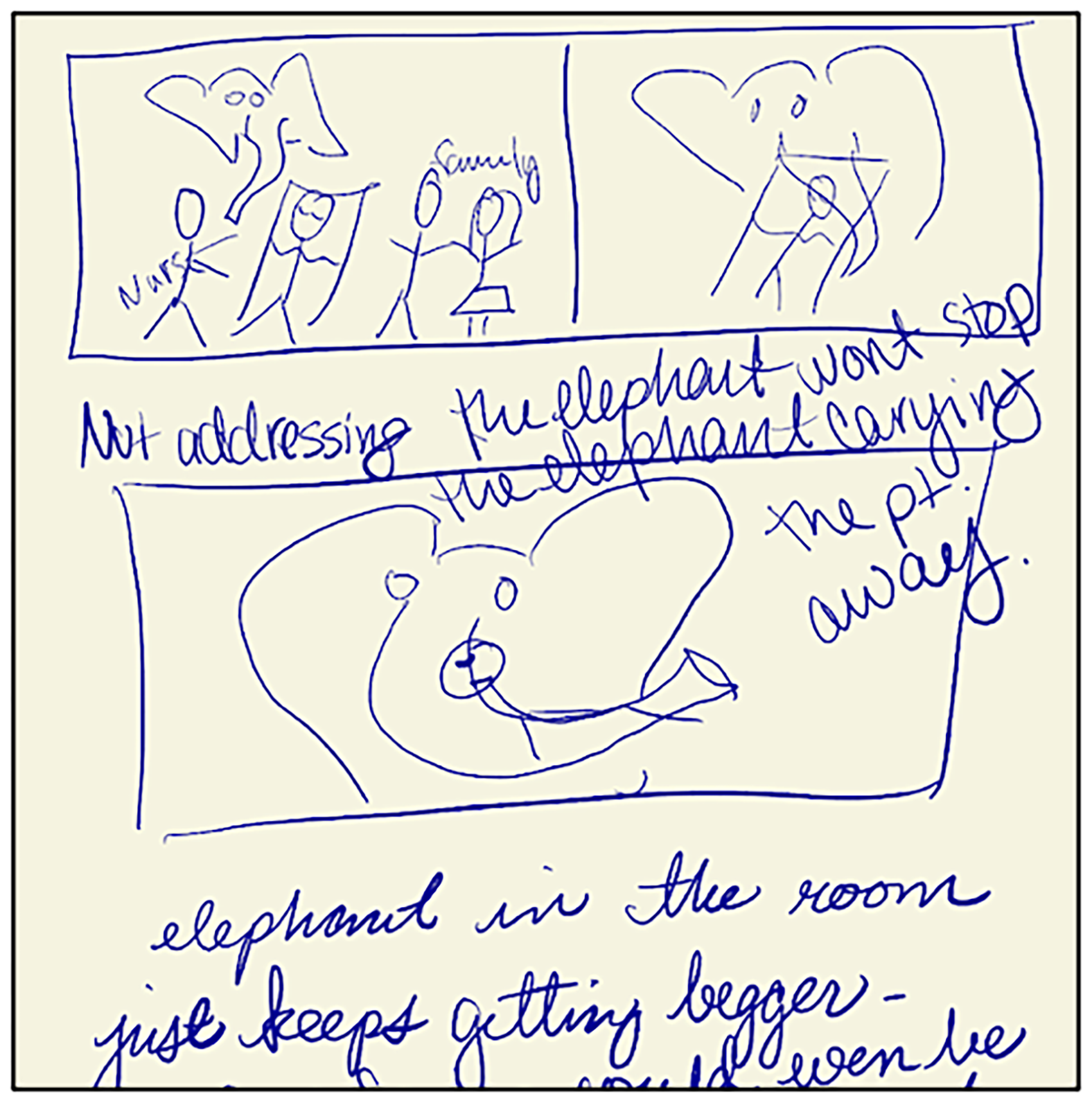
Post-interview note: elephant in the room.
Returning to the transcript after drawing shifted my attention back to participants’ descriptions of timing and relational positioning. Participant 1 did not describe herself as someone who names the elephant outright, but as someone who waits, listens, and gauges whether acknowledgment would be experienced as supportive or harmful. This insight led to revisions in both writing and sketching. In subsequent iterations, the elephant remained present, but its positioning changed. Figures were placed at varying distances, suggesting awareness without direct confrontation.
As additional interviews accumulated, the metaphorical meaning of the elephant deepened. Other participants described painful life-sustaining interventions continuing despite obvious trajectories toward death, often because “no one would have the conversation” (Participant 7). Returning to the earlier drawing after these interviews revealed its insufficiency. The elephant now needed to convey not only avoidance but also the moral weight of deferring acknowledgment of death. This prompted further cycles of sketching, writing, revising, and returning to transcripts (Figure 4).
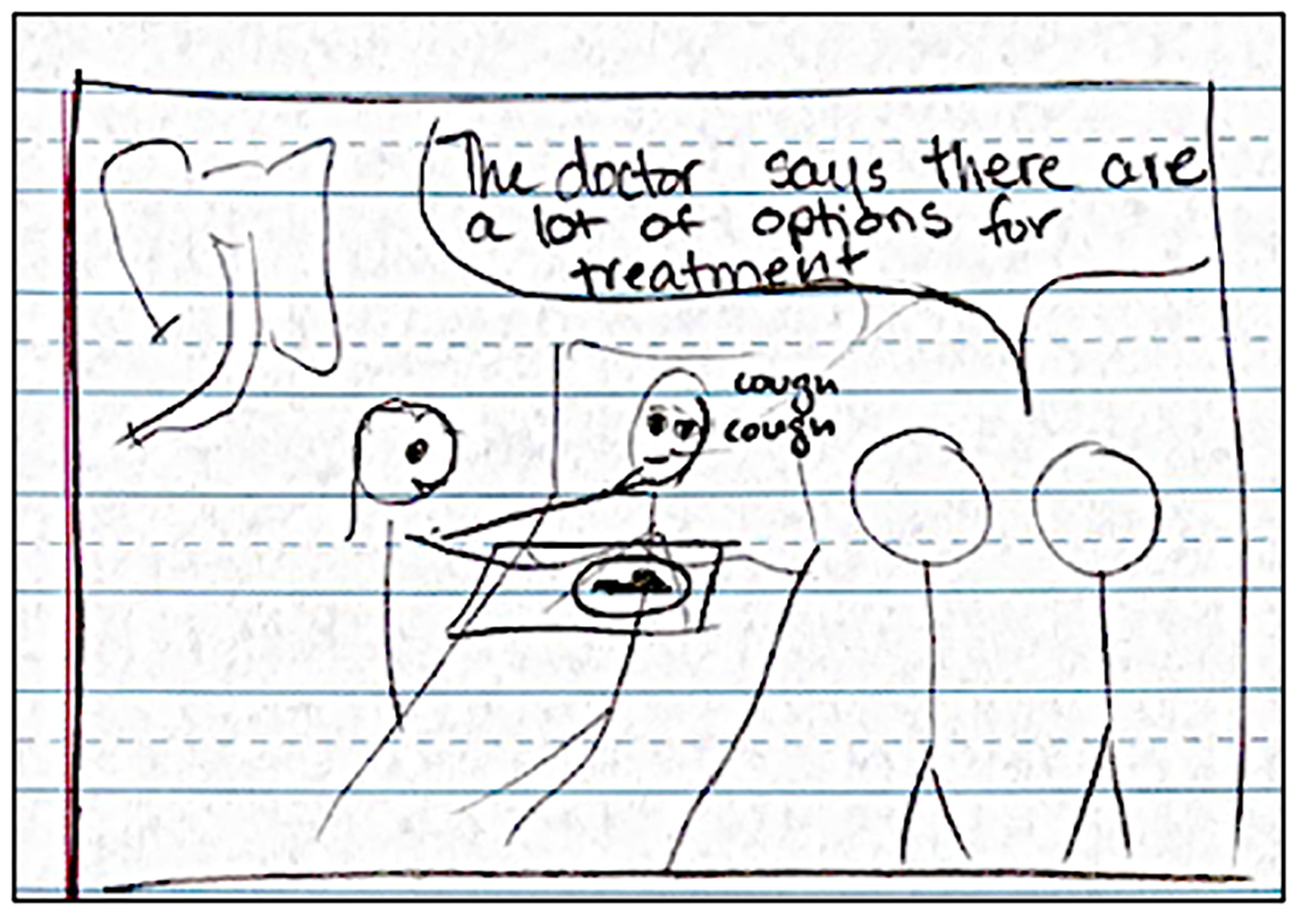
Researcher sequential art sketch: elephant watching care.
Importantly, I discarded many sketches that felt visually compelling but could not be grounded in participants’ language. Drawing did not authorize interpretation; it demanded accountability. Only later, after thematic interpretations had stabilized, were select narratives refined for presentation (Figure 5). These refined sequential art narratives served as integrative artifacts for communication rather than as sites of analysis. Maintaining this distinction was methodologically essential: analytic sketching supported interpretation, while refined sequential art narratives supported dissemination.
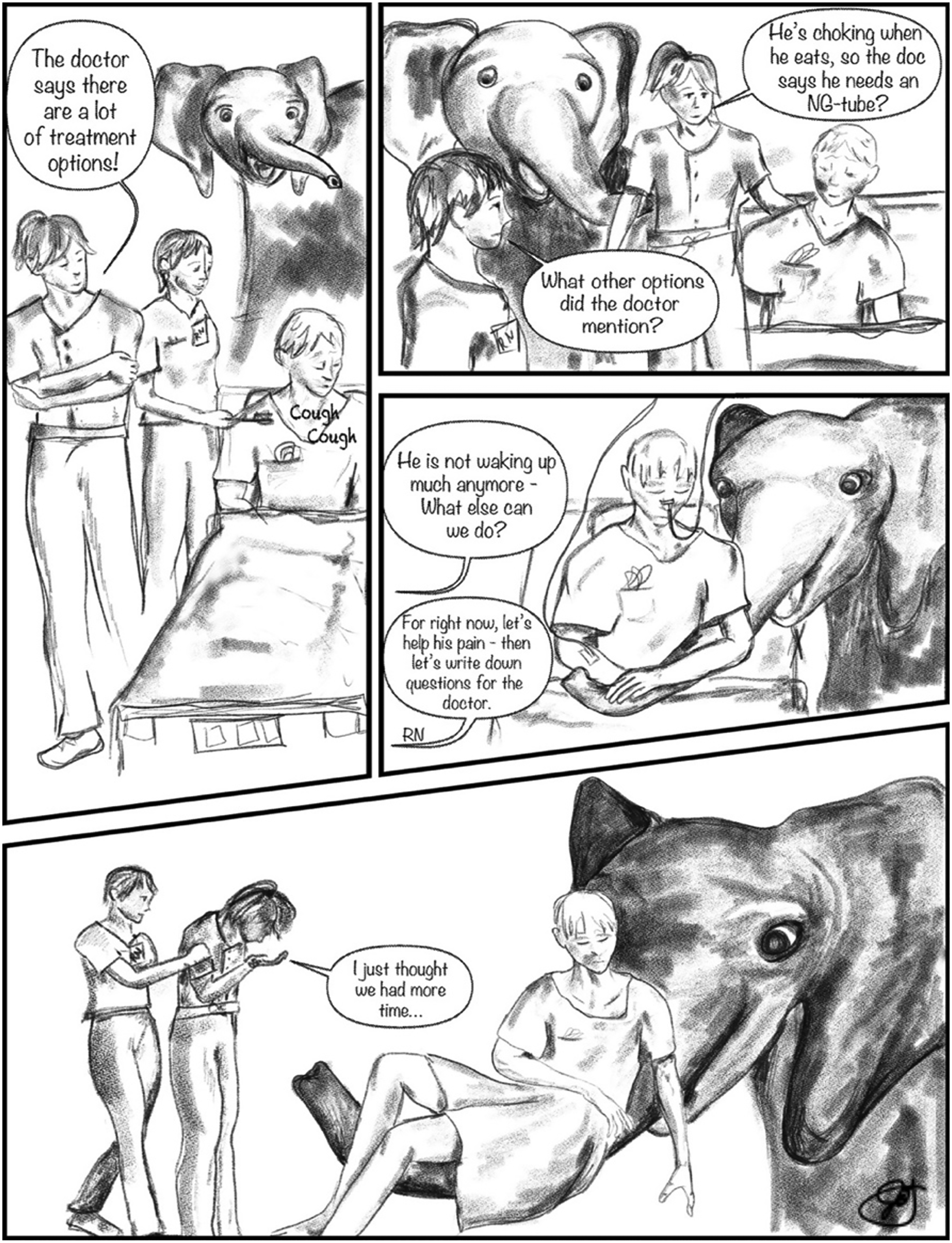
Final sequential art narrative: elephant in the room.
Example 2: giving time
A second illustration is exemplified in the development of the theme Giving Time. Across interviews, nurses repeatedly described care occurring in moments that were not easily categorized as medical intervention: waiting with patients after difficult conversations, returning to rooms without new information, and remaining present during prolonged uncertainty. Early writing captured these descriptions but struggled to sustain their temporal density; the way meaning unfolded through repetition rather than through singular events.
Rough sketches organically emerged alongside memos: a nurse cleaning their patient's room (Figure 6) and a patient awake after bad news as the unit continued its routines (Figure 7). Functioning as analytic prompts, these sketches elicited questions that writing alone did not fully capture during my analysis: What does care look like when nothing changes? How does time itself become a form of care (Figure 8)?
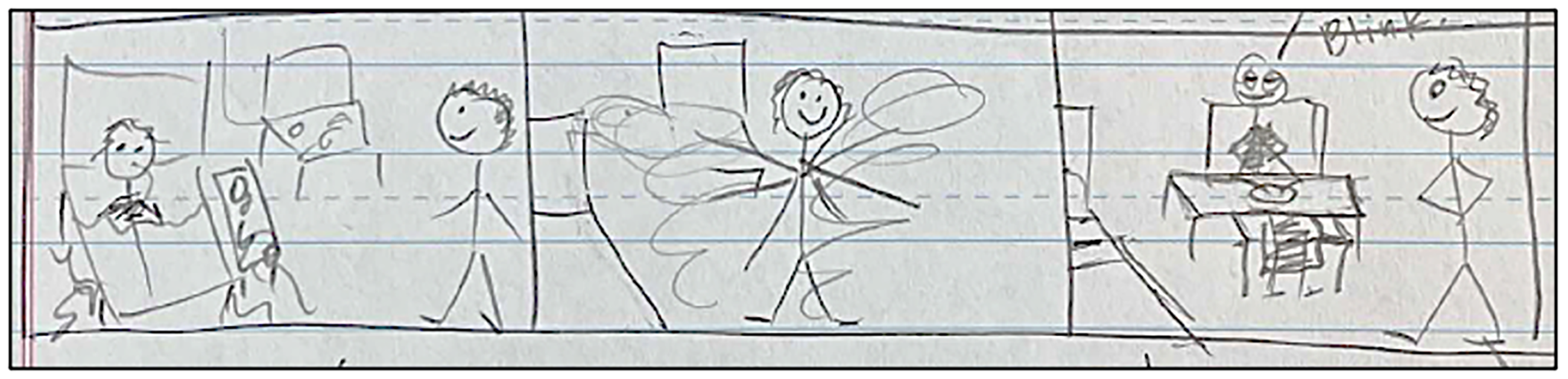
Researcher sequential art sketch: room cleaning.
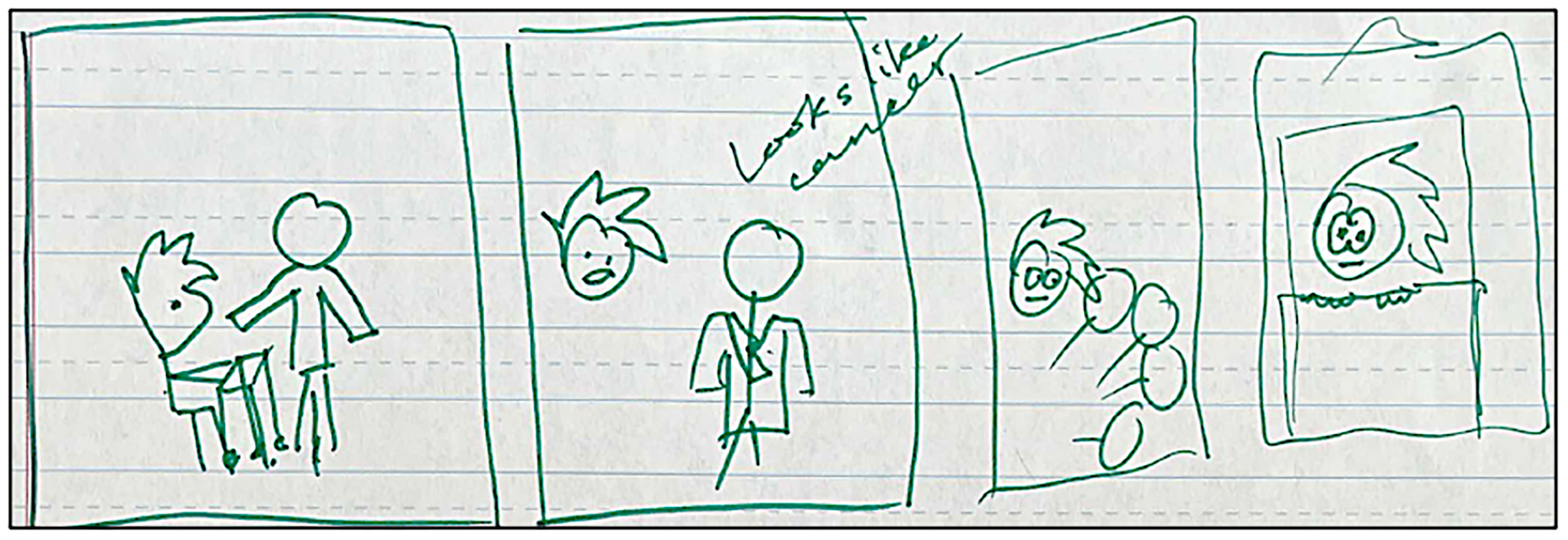
Researcher sequential art sketch: after bad news.
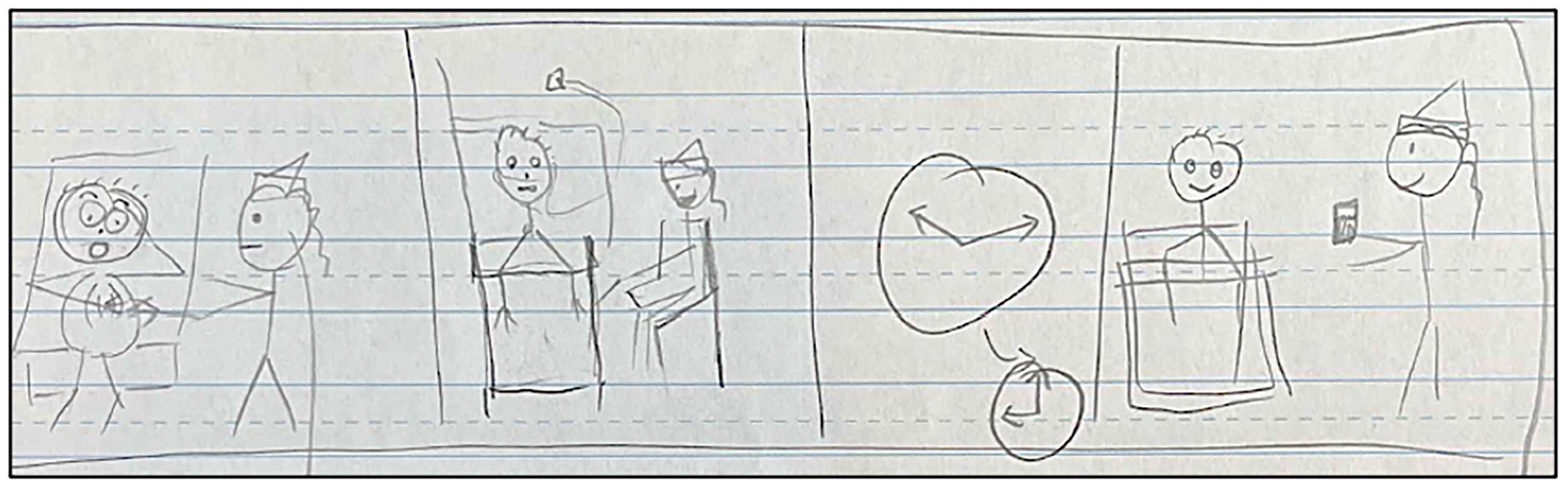
Researcher sequential art sketch: time with patients.
Returning to transcripts after sketching sharpened my attention to participants’ language about pacing, waiting, and incremental communication. Through repeated cycles of writing, sketching, and returning to data, Giving Time crystallized as both allowing patients and families time to come to understanding and giving one's own time through sustained nursing presence. Only after this interpretation stabilized was a single sequential art narrative refined to hold temporality, silence, and relational continuity in an integrative form (Figure 9).

Final sequential art narrative: giving time.
Together, these examples demonstrate that sequential art narratives do not function solely as data nor as illustration, but as a reflexive analytic practice embedded within the hermeneutic spiral. Its value lay in its provisional use: slowing interpretation, surfacing assumptions, and reorienting attention to temporality and relational movement, while remaining accountable to participants’ language and to writing as the primary site of phenomenological insight.
Methodological discussion
This discussion examines how sequential narratives emerged as a reflexive analytic practice within hermeneutic phenomenology and what their use suggests for rigor, reflexivity, and interpretive accountability in qualitative inquiry. Although the parent study is situated within nursing, the discussion here is methodological in focus. Therefore, this discussion proceeds by examining why sequential art emerged during the analysis, how this adaptation prompted insight into the researcher's epistemic orientation, and how rigor was maintained throughout this methodological adaptation.
Why sequential art emerged
The incorporation of art-based reflexivity and sequential art into this study was not intentional at the outset. I did not set out to conduct arts-based research, nor did I initially conceptualize my analytic process in those terms. Rather, sequential art emerged as an analytic response to a phenomenon that repeatedly exceeded straightforward linguistic articulation. Across interviews, participants’ language evoked temporality, spatial orientation, silence, and relational movement; moments of waiting, incremental conversations, and the felt texture of being with another person whose reality was changing. As the primary investigator, I struggled to analytically articulate these experiences using solely linguistic description.
As I wrote and rewrote, my reflexive thinking increasingly took visual form. Moments appeared spatially, interactions unfolded sequentially, and silences prompted visual representation alongside words. Drawing did not introduce anything foreign to the inquiry; it emerged as a way for me to hold onto the impressions and meanings I was taking away from my participants and to remain faithful to the phenomenon. In this sense, sequential art was not an innovation imposed upon the methodology, but a response to the analytic demands of the phenomenon. The emergence of sequential art during analysis thus prompted a broader methodological question about how meaning was being apprehended through the researcher's epistemic orientation.
Situating art-based reflexivity
Visual reasoning and art-based approaches have previously been theorized across the humanities and social sciences but are often discussed within disciplinary silos (Cross, 2025; Leavy, 2020). Within hermeneutic phenomenology in particular, images are more commonly positioned as objects of study or as illustrative supplements rather than as analytic acts of reflexivity (Leavy, 2020; van Manen, 2016a). In this study, sequential art narrative functioned as a form of art-based reflexivity embedded within analysis itself. Analytic work occurred in the interplay between sketching and writing, rather than in the production of visually refined images for dissemination. In this way, sequential art narrative operated as a reflexive analysis grounded in epistemic orientation, without displacing language as the primary site of meaning-making.
My engagement with sequential art narrative did not arise from artistic training or creative expertise, nor was it oriented toward aesthetic production. Instead, this analytic turn was grounded in my epistemic orientation as a highly visual thinker and learner, for whom drawing supported the apprehension, organization, and interrogation of meaning as interpretation unfolded. Ho et al. (2021) also demonstrate how researcher-generated drawings can function as analytic prompts within a Gadamerian hermeneutic framework, rendering interpretive decisions visible and open to scrutiny. Sequential art narrative was therefore not adopted as an arts-based method per se, but as a reflexive analytic practice aligned with how understanding was taking shape.
Learning style as epistemic reflexivity
My instinctual use of sketching and sequential art surfaces an under-theorized dimension of qualitative rigor: researcher epistemic learning styles as part of reflexivity. Reflexivity is often framed as researchers’ ongoing self-reflections on positionality, identity, worldview, and power in relation to their research and participants (Dibley et al., 2020; Jamieson et al., 2023; Spence, 2017). While the previous definition of reflexivity is essential, it does not account for how each researcher's unique brain learns and apprehends meaning. Jamieson et al. (2023) offer valuable examples of how beginner researchers can foster greater reflexivity in their research, yet leave unexamined how patterns are noticed, experiences are mentally organized, and how interpretation unfolds through a researcher's particular ways of processing information. In this study, analytic understanding consistently emerged through visual reasoning alongside textual interpretation. Attending to epistemic learning styles as part of reflexivity, therefore, extends qualitative rigor beyond positionality alone, toward greater transparency in how interpretation comes into being.
Naming this visual epistemic orientation as part of self-as-instrument did not legitimate unchecked subjectivity. On the contrary, it increased analytic responsibility by rendering interpretive tendencies visible and interrogable. Recurrent visuals sketched by me demanded questioning: Why these elements? Are they grounded in the participants’ language? What meanings are foregrounded? In this way, visual reflexivity functioned as an ethical analytic practice. Rather than concealing the researcher's role in meaning-making, I have exposed my analytic process and data for scrutiny by myself (the researcher) and, ultimately, by readers. Attending to epistemic reflexivity thus shifted reflexive practice from descriptive positioning to rigorous methodological accountability.
Rigor as interpretive accountability
While epistemic reflexivity makes visible how interpretation emerges, rigor depends on how those interpretive conditions are disciplined and held to account. From a hermeneutic phenomenological perspective, rigor is not secured through procedural conformity but through ontological and interpretive accountability: whether the inquiry remains responsive to the phenomenon and whether interpretive movements are transparent and defensible (van Manen, 2016a). Within this frame, making epistemic orientation explicit did not function as a claim to authority, but as a condition for scrutiny. The disciplined use of drawing, therefore, strengthened rather than weakened rigor.
Introducing visual practices into analysis also raises legitimate concerns, particularly the risk that visual coherence or emotional resonance might authorize interpretation prematurely (Wang et al., 2023). This study addressed that risk by treating all drawings as provisional until they could withstand repeated return to participants’ language. Sequential art narratives were not coded, analyzed as discrete objects, or treated as evidentiary support for themes; instead, they functioned as analytic tests: could an emerging interpretation be sustained when rendered spatially and temporally, and could it be justified in participants’ words?
Rigor, then, was enacted through the refusal to allow aesthetic appeal to stand in for interpretive warrant. Analytic sketches remained provisional and accountable to transcripts, memos, and thematic writing, while refined narratives were developed only after interpretive patterns had stabilized. Maintaining a clear distinction between analytic sketching and later refinement was therefore not a matter of presentation, but a methodological safeguard. Rigor emerged not from reflexivity alone, but from the disciplined use of reflexive practices that subjected interpretation to ongoing scrutiny rather than personal or aesthetic authority
Implications and ethical considerations
The implications of this work are methodological rather than procedural, and they extend beyond the sequential art narratives themselves. Furthermore, this study does not suggest that sequential art narrative is universally applicable or inherently generative. Used uncritically, visual coherence may obscure interpretive weakness (Sicurella and Tuzza, 2025). While drawing requires time, humility, and a willingness to interrogate one's own interpretive habits, arts-based reflexivity's value lies not in artistic skill, but in disciplined use within an accountable analytic process that remains grounded in participants’ language.
Although sequential art entered this study as a reflexive analysis rather than a dissemination strategy, subsequent refinement raised ethical concerns about data representation and interpretation. Maintaining a clear separation between analytic and presentational uses of sequential art narrative was therefore essential to preserving methodological and ethical integrity (Cardwell, 2025).
Conclusion
This article advances a pragmatic methodological claim: rigor in hermeneutic phenomenology is sustained not through adherence to fixed procedures, but through sustained responsiveness to how phenomena disclose themselves and through transparency in how interpretation unfolds. In this study, sequential art narrative functioned as one disciplined way of remaining faithful to that task when lived experience exceeded straightforward linguistic capture. Its contribution lies not in artistic innovation, but in what it made possible: a mode of analytic attentiveness that slowed interpretation, rendered interpretive decisions visible, and resisted flattening lived experience and the person, within methodological discourse.
Footnotes
Acknowledgments
The author thanks Carey Candrian, PhD, for her expertise in health communication and for her thoughtful guidance throughout the study.

Ethics considerations
This study was reviewed and approved by the Colorado Multiple Institutional Review Board (COMIRB) and received a Certificate of Exemption (COMIRB Protocol ID #24-1640).
Consent to participate
Written informed consent was obtained from all participants prior to participation and verbal consent was obtained before starting each interview.
Consent for publication
Informed consent for publication of the participant-provided image included in this manuscript was obtained from the participant. Non-essential identifying information has been omitted to protect confidentiality.
Funding
The authors disclosed receipt of the following financial support for the research, authorship, and/or publication of this article: This work was supported by the Doris Kemp Smith Faculty and PhD Student Research Award.
Declaration of conflicting interests
The authors declared no potential conflicts of interest with respect to the research, authorship, and/or publication of this article.
Data availability statement
The data generated and analyzed during this study are not publicly available due to ethical restrictions and the sensitive nature of the interview data, which could compromise participant confidentiality. De-identified excerpts supporting the findings are included within the article.