






Abstract
The Causes of World War Three by C. Wright Mills advances an organizational theory of nuclear crises that is no less relevant today than when it was published in 1958. Drawing on Mills’s concepts of military metaphysics and crackpot realism, I develop the notion of a nuclear weapons crisis cycle or recurring inflection points characterized by ascending militarization, distrust, reckless technological innovation, near-catastrophe, institutionalized restraint in the form of arms control, and then renewed expansion. The risks of overt but particularly inadvertent nuclear war rise with each precipice. In turn, nuclear crises are not exceptional breakdowns, but the predictable outcome of bureaucratic systems committed to the continual preparedness for war. This framework is buttressed through the middle-range theoretical insights of Charles Perrow and William Freudenburg. Mills sketched out the broader expansionary logic of the nuclear weapons crisis cycle, Perrow illustrates why expansion is so dangerous, and Freudenburg accounts for its recurrence. The Cuban missile crisis was the first precipice of the nuclear age. The Able Archer war scare of 1983 comprised the second precipice. Today, we are approaching a third inflection point as the United States and Russia abandon arms control agreements amid the development of new technologies for the more efficient and unorthodox delivery of nuclear payloads. Mills’s framework challenges core assumptions of deterrence theory while advancing concern with the bureaucratic centralization of power untethered to democratic or moral reasoning but devoted to continual development of the most dangerous technology ever invented.
Keywords
Introduction
In September of 1983 the Soviet early-warning system detected an in-bound missile, and then another, and another. Soon 5 lit up the monitors. Each could contain multiple warheads with distinct targets. Lieutenant Colonel Stanislav Petrov had just minutes to sort through a barrage of conflicting information. He informed his superiors that it was a false alarm—a hunch more than a conviction (Ambinder, 2018; Downing, 2018). Petrov made the right decision even though a first-strike was a reasonable inference. Tension between the Soviet bloc and the West was higher than it had been in years. His frantic dilemma is portrayed in the documentary The Man Who Saved the World. It was later determined a satellite had mistaken sunlight glancing off high-altitude clouds for the contrails of missiles in-flight.
Six weeks later the North Atlantic Treaty Organization (NATO) countries embarked on the Able Archer military exercise simulating escalation from a conventional conflict with the Warsaw Pact to a rehearsal of NATO nuclear launch procedures. U.S. President Ronald Reagan and the Joint Chiefs of Staff did not know beforehand that some Soviet leaders feared it was a ruse for a first-strike. It came on the heels of Reagan’s speech insisting the Soviet Union was an “evil empire” and the downing of Korean Air Lines flight 007 which strayed into Soviet airspace and was erroneously identified as a U.S. spy plane. As Able Archer progressed over the course of 5 days Soviet nuclear command transitioned to its highest alert level, and there was discussion whether to engage in a preemptive strike on the U.S. and its NATO allies (Adamsky, 2013; Jones, 2016). If the malfunction arising in September reoccurred during Able Archer—an anomaly that had not yet been diagnosed—the world may have plunged into nuclear war. And it would have occurred entirely by accident.
C. Wright Mills (1916–1962) would not find this surprising. In The Causes of World War Three he described a military metaphysics or dominant worldview underlying the continual preparation for nuclear war as a rational, necessary, and unquestionable priority. Rather than mobilizing in response to dangerous geopolitical conditions, the generals, corporate executives, and members of Congress sustain a dangerous geopolitical context through their commitment to a permanent war economy. This “cast of mind” imposes upon the public a crackpot realism or plans, policies, and technological development derived of a biased depiction of natural security demands (Mills, 1958: 42). Military metaphysics thus defines what counts as rational in society, while crackpot realism denotes policies putting into practice an insular worldview detached from moral and democratic reasoning. “Accordingly, the viewpoints these elites hold, the definitions of reality they accept and act upon, the policies they espouse and attempt to realize—these are among the immediate causes of the thrust toward World War III,” he argued (Mills, 1958: 47).
In turn, Mills feared the lapse into inadvertent nuclear war due to the bureaucratic centralization of power devoted to a “doctrine of violence,” derived of a confluence of elite interests benefiting from military technological development, a dearth of higher order values beyond military prowess, and a tightening bind in which opposing state actors are distrustful of the other (Mills, 1958: 5). “In the balance of terror, mechanical error and human misjudgment are unknown statistical probabilities. And the danger of miscalculation increases as the weapons become greater in power, speed, and range,” he stressed (Mills, 1958: 44–45). Mills’s warning, published 4 years earlier, nearly proved prophetic during the Cuban missile crisis.
Recurring inflection points or moments of decisive risk—from the Cuban missile crisis to Able Archer and the present—are not episodic breakdowns in an otherwise stable system of deterrence but an expression of military metaphysics and attendant crackpot realism. It drives a nuclear weapons crisis cycle that rises, declines, and then ascends again. It rose to a crescendo in 1962, eased with détente and the advent of arms control, approached another crowning with the death of détente by the late 1970s and Able Archer in 1983, slackened with the reinvention of arms control in the late 1980s, and now approaches yet another inflection point.
Deterrence theory stipulates that if the costs of aggression are high, then a rational actor will forego such consideration. In this regard, Kenneth Waltz argues that nuclear weapons “have been given a bad name” as they compel countries to seek reconciliation in dealing with other nuclear armed states (Waltz, 1990: 83). “Those who like peace should love nuclear weapons,” Waltz (2010) argues. However, a key weakness of deterrence theory is that overt nuclear war is but one side of the existential coin, and deterrence in practice reveals a history of reckless geopolitical posturing, technological development, and near-catastrophe.
In 1961 John F. Kennedy entered office positioning himself as a staunch cold warrior. Amid Kennedy’s bellicose rhetoric and the placement of missiles in Turkey, which could reach Russia in less time than it takes to drink a cup of coffee, the Soviets placed missiles in Cuba. Kennedy viewed aerial reconnaissance photos of their emplacement on October 16, 1962, and over the next 13 days he and Soviet Premiere Nikita Khrushchev struggled to find a politically acceptable resolution while events on the ground repeatedly threatened to spin out of control (Sagan, 1993). In the aftermath, both were shaken by the experience (Douglass, 2010), as were many others within and outside the U.S. and Soviet state apparatus. Several landmark arms control agreements were negotiated over the next decade.
In 1981 President Reagan came into office riding a tide of anti-Soviet rhetoric. Domestic audiences found it entertaining. Soviet leadership took it seriously. Reagan was committed to increasing the defense budget and placing Pershing II missiles in West Germany. The time from launch to detonation over Moscow was far less than it takes to watch an episode of one’s favorite television show. In his private diary Reagan confided he was shaken by the Soviet misinterpretation amid Able Archer (DiCicco, 2011; Downing, 2018; Jones, 2016). In tandem with Mikhail Gorbachev, significant arms control agreements were negotiated over the next decade.
The years 1962 and 1983 may seem an historical curiosity, but the United States and Russia have abandoned hard-won arms control treaties. In 2019 President Trump pulled the United States out of the Intermediate-Range Nuclear Forces (INF) treaty, originally signed by Reagan and Gorbachev in 1987. The INF eliminated all intermediate range ground-based missiles. The New Strategic Arms Reduction Treaty (New START), originally signed in 2010, limited the strategic warheads each country could deploy. New Start lapsed in February of 2026.
Even as Russia and the United States are leaving arms control agreements, they, along with China and North Korea, are pursuing “emerging technologies.” This includes hypersonic missiles and glide vehicles that exhibit a flight trajectory distinct from ballistic missiles (Fetter and Sankaran, 2025). They are harder to detect by ground-based radar, evade most missile defense systems, and shorten the window of time in which to make an informed decision. That they are harder to detect by radar is troubling. Early warning systems rely upon the juxtaposition of radar and satellite data in assessing whether a threat is valid. Moreover, if artificial intelligence confers an asymmetric advantage, it may be integrated into the command, control, and communications structure of nuclear armed states (Johnson, 2020, 2023). Incorporated in a piecemeal manner, it may not be apparent that functional control has been ceded to technological decision-making until a false alarm erupts and the intercontinental ballistic missiles (ICBMs) are already airborne (Johnson, 2020, 2023).
While Mills sketched out the broader dynamics of the nuclear crisis cycle, Charles Perrow’s middle-range theoretical framework illustrates why expansion is so dangerous. Perrow argued anomalies are “normal” within exotic socio-technical systems (Perrow, 1999). Innovation, systemic complexity, and uncertainty advance in lockstep. This is particularly challenging when socio-technical operations are also prone to quickly escalating or tightly coupled sequences of events (Perrow, 1999). “The dangerous accidents lie in the system, not in the components,” Perrow (1999: 351) insisted.
William Freudenburg, another organizational theorist, fills in the missing piece with his concept of the atrophy of vigilance or the tendency for success to foreshadow failure (Freudenburg, 1992). Ameliorating the risks of socio-technical operations can contribute to a more relaxed posture over time that may not be discernable until crisis arises, once more. This then highlights the need for more robust oversight—which evolves into the inverse as success breeds complacency. The atrophy of vigilance is more prominent when there are powerful interest groups pushing for parochial objectives. The interest groups underlying U.S. militarism, and nuclear weapons production in particular, are powerful, indeed.
The Causes of World War Three is one of Mills’s least remembered books, but it articulates a theory of nuclear risk that is no less relevant today than in 1958. I outline this framework and the tacit critique of deterrence theory that it advances. In this regard, Mills sketched out a predominant military worldview and distorted policies that, over time, underlie a nuclear weapons crisis cycle. These inflection points emerge not simply from deliberate aggression but devotion to the continual preparation for war. Moreover, Perrow explains why expansionary periods are so perilous, and Freudenburg accounts for their recurrence. This framework is illustrated by the Cuban missile crisis and the Able Archer war scare. Both are expressions of the same underlying dynamics postulated by Mills in 1958. Both illustrate that near-catastrophe is not a failure of the system of deterrence, but the predictable outcome of expansionary pressures generated by a military metaphysics, bureaucratic centralization of power, and exaggerated, indeed crackpot, national security demands. In turn, the risks of accidental nuclear war are endogenous to the normal operation of militarized systems even in the absence of hostile intent or irrational leadership decisions. The conclusion argues the world is approaching a third precipice of the nuclear age as the U.S. and Russia abandon arms control agreements while developing technologies exacerbating systemic complexity and tight-coupling.
C. Wright Mills and the cyclical dynamics of nuclear crisis
The Causes of World War Three begins with a query: “In what sense may it be said that men make history?” (Mills, 1958: 10). Is history akin to fate as it is the expression of innumerable, uncoordinated decisions and thus guided by no identifiable thread, or is it molded by thought and choice? Mills points to the ascendance of corporate and governmental bureaucracies and the centralization of power in arguing that history is now shaped by the “politics of explicit decision” (Mills, 1958: 16). We possess the capacity to engage in actions of widespread consequence due to the rise of bureaucratic organization and technological innovation.
This is consistent with Max Weber’s concerns regarding the forward-march of instrumental (formal) rationality or the conscious, methodical calculation of the most efficacious and efficient procedures in the accomplishment of a particular end (Weber, 1978[1920]). But Mills goes further. He argues American society is less characterized by a “moving balance of many competing interests” then the aligned interests of corporate, political, and military officials comprising a “power elite” and making crucial decisions shaping the structural conditions under which the individual, the family, and the community are situated (Mills, 1956, 1958: 25, 21). Society is not simply populated by large bureaucracies, but large bureaucracies pursuing parochial ends generating unintended and unreasonable outcomes.
Mills’s concern with bureaucratic rationalization is nowhere more crucial than in reference to the armed services and the defense industry. By 1958 the U.S. and the Soviet Union possessed thermonuclear weapons, long-range bombers, and were rapidly developing intercontinental land-based and submarine launched ballistic missile systems. For the first time in history the capacity for widespread annihilation was a glaring threat. In The Power Elite, published 2 years prior, Mills highlighted the insular decision-making of corporate, military, and political leaders, but The Causes of World War Three goes further—arguing elite decision-making unwittingly produced that which it so earnestly anticipated. Nuclear war could emerge from the very process of incessantly preparing for it.
Mills urged scholars to “take it big” (Aronowitz, 2012; Wakefield, 1971). They should wrestle not with abstract theoretical ideas untethered to real-world concerns, “grand theory,” or “abstracted empiricism” employing sophisticated quantitative techniques unconnected to practical issues of the day (Mills, 1959). There are few issues with a greater impact upon the public than nuclear war. In turn, The Causes of World War Three built upon his analysis of the power elite while illustrating the potential real-world consequences of the contemporary concentration of power. Further, Mills stressed engaging with the public about key historical trends. In this regard, The Causes of World War Three began as a series of lectures that evolved into a pamphlet, and extracts were published in mass circulation magazines (Brewer, 2013). It is illustrative of what would later be denoted as public sociology (Brewer, 2013).
The Causes of World War Three has been criticized for its polemic tone and ostensible lack of sophisticated sociological analysis (Brewer, 2013; Goertzel, 1989). Arguably, it is a prescient book when one considers it was intended as an application of the trends outlined in The Power Elite, an effort to grapple with the pace of technological development, and an example of Mills’s imperative that sociology reach beyond the confines of academia. Moreover, the sophistication of The Causes of World War Three becomes more apparent over time as the military worldview and attendant biased plans and policies exhibit institutional momentum, decline in prominence, and then institutional momentum, yet again.
Mills was not alone in his concern over bureaucratically entrenched militarism. In his startling farewell address to the nation in November of 1961, President Dwight D. Eisenhower lamented the “unwarranted influence” of the military-industrial complex, or the confluence of the armed services and defense corporations (Eisenhower, 1961). He reiterated the classic guns versus butter argument. Building bombers and submarines meant fewer schools and hospitals. The threat was not just fiscal, however. He feared the corrosive effect upon democracy itself (Eisenhower, 1961). Eisenhower and Mills had little in common in terms of their political orientation, but they articulated a strikingly congruent unease. The incessant preparation for war becomes a centrifugal force expanding outwards and shaping all other institutional arenas in society and, per Mills (1958), may bring about the very thing it is purported to thwart.
The nuclear crisis cycle illustrates periods of ascending militarization, distrust, and reckless technological innovation. This momentum is confronted by a turn to arms control and restraint in the wake of crisis. Over time the expansionary forces derived of a military metaphysics re-assert themselves and the sequence begins anew. Periodic nuclear crises are not a reflection of deterrence failures or malicious intent but the predictable outcome of a militarized rationality resistant to social control. They are points in time when the instability of deterrence in practice becomes acutely visible. Moving beyond a crisis cycle necessitates sustained democratic and moral push-back against powerful vested interests spanning corporate America, the armed services, and the upper-echelons of the federal government. Those outside the power elite must intervene in the “politics of explicit decision” (Mills, 1958: 16).
Figure 1 depicts the momentum derived of an ascendent military metaphysics. 1 In 1950 the U.S. had 300 nuclear weapons while the Soviet Union possessed just five. By 1955 the U.S. had more than 2,400 in its stockpile while the Soviets had approximately 200. By 1960 the U.S. held over 18,000 nuclear weapons, the Soviets counted around 1,627. Just 5 years later, the U.S possessed over 31,000 nuclear weapons. The upward arc beginning around 1955 is the zeitgeist that Mills sought to elucidate in his most confrontational book (Mills, 1958). This arc was not a reflection of national security demands but Mills’s “triangle of power” (Mills, 1958: 21). Defense corporations, the armed services, the executive branch, and many members of congress were pushing for the undisciplined preparation for nuclear war while assuring the public of its unquestioned necessity. 2
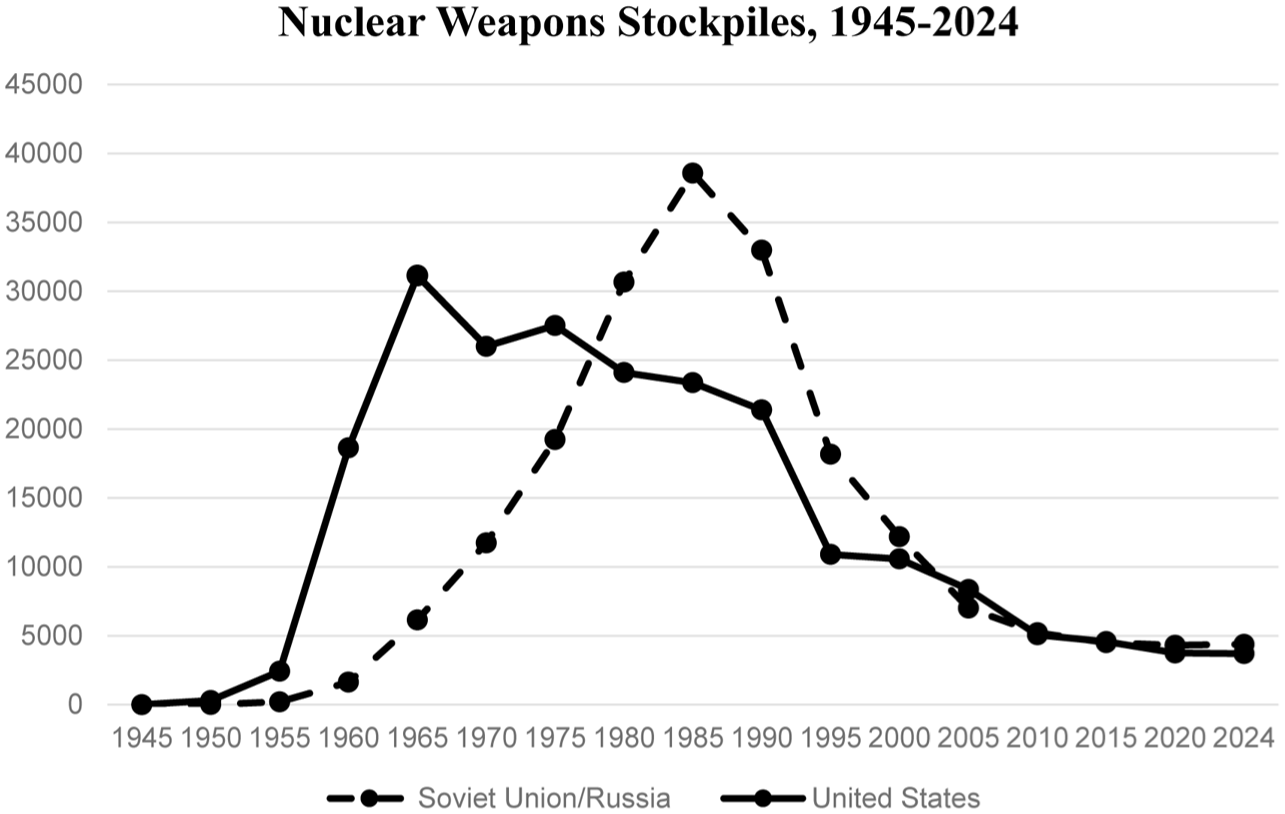
Nuclear weapons stockpiles, 1945–2024.
A burgeoning weapons stockpile is unaccounted for by deterrence logic. It is not necessary to accrue armaments beyond an assured second-strike capability (Brodie, 1946; Waltz, 1990). It makes little sense to possess 10,000 warheads when 3,000 are more than enough to decimate any country contemplating a first strike. And yet—as illustrated in Figure 1—by the mid-1960s the United States had over 31,000, and by the mid-1980s the Soviet Union possessed more than 38,000. In 1985 both countries jointly possessed nearly 62,000 nuclear weapons. Something beyond national security and deterrence imperatives were at play and, indeed, still are.
Figure 1 is a testament to bi-polar, over-arching military metaphysics and attendant crackpot realism. It illustrates that large, complex bureaucracies are adept at calculation, the formulation of rules and procedures, cultivating technical expertise, and accomplishing over-arching tasks. But there is often scarce reflection upon whether these actions are consistent with broader societal values or the potential long-term impact. Concern with means overshadows the ultimate purpose of purposive action.
Weber endeavored to articulate this lesson amid the carnage of World War I. In 1917, he spoke at Munich University. “Science as a Vocation” focused on science and technology as forces epitomizing the forward march of instrumental rationality but, he argued, they cannot articulate a coherent overall meaning of the world (Shapin, 2019; Weber, 1946). Weber confronted his audience: “Science is meaningless because it gives no answer to our question, the only question important for us: ‘What shall we do and how shall we live?’” (Shapin, 2019; Weber, 1946: 143). C. Wright Mills again raises this question in 1958, but he goes further in arguing it underscores another query: will we survive the things we have created?
Table 1 highlights the core processes, their analytical function, and empirical indicators of the nuclear weapons crisis cycle. Military metaphysics refers to a definition of reality prioritizing militarized solutions to geopolitical competition as well as domestic social and economic concerns (Mills, 1958). Continual preparation for war is defined as an unquestioned priority at the expense of alternative courses of action. It is an ideological and structural dynamic arising with mobilization for World War II and expanding with the advent of nuclear weapons. Diplomacy, negotiation, and compromise garner less weight as they are antithetical to the incessant preparation for war. “For the professional warlords, this metaphysic is a natural assumption. It is in line with their training and in line with their professional interests and their personal careers,” Mills (1958: 83) notes.
The nuclear weapons crisis cycle.
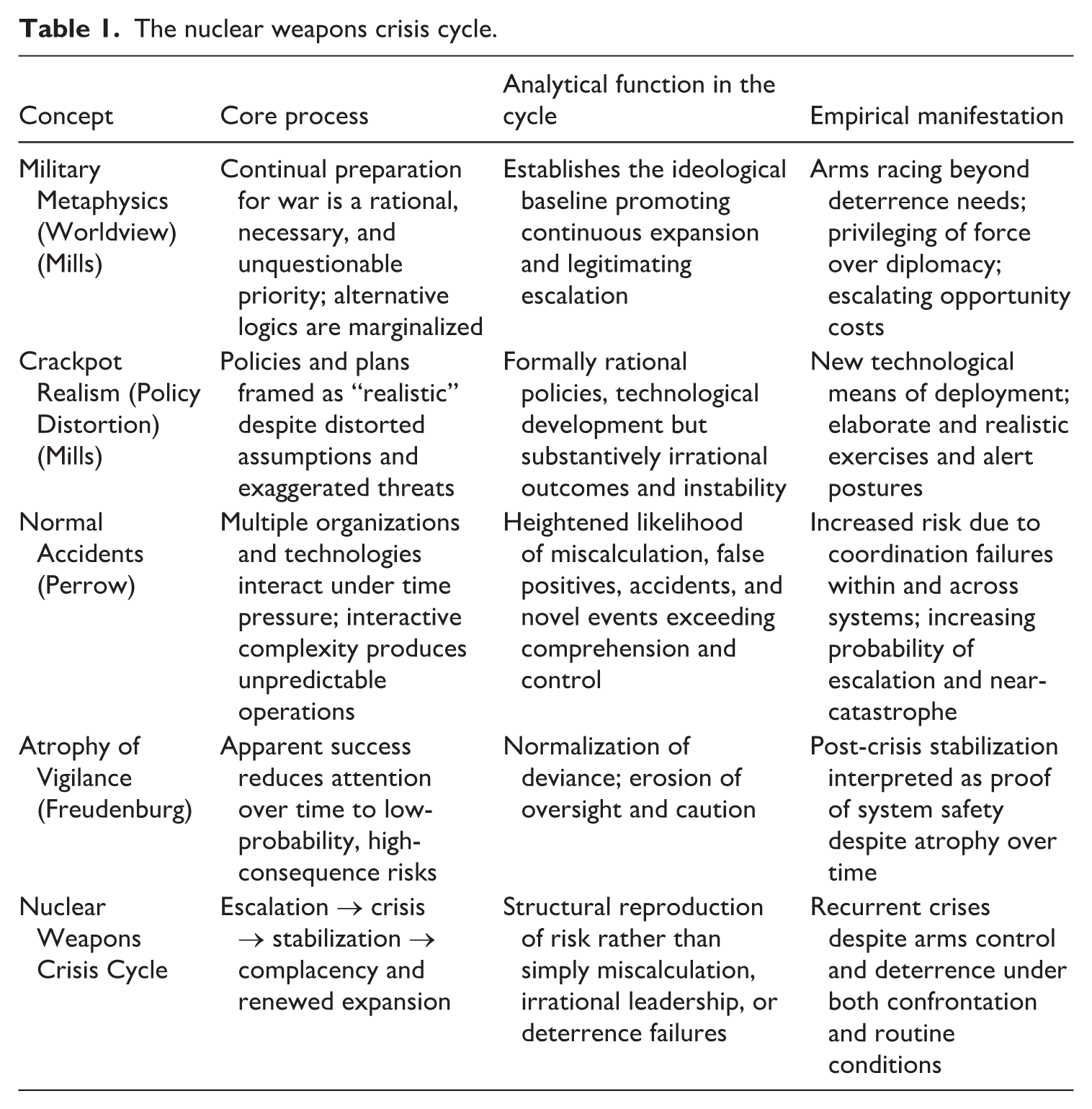
A key dimension of the military metaphysics is corporate profitability, a “capitalist subsidy,” by way of defense spending (Mills, 1958: 60). However, Mills argues the military does not serve the capitalist order so much as it bends the economy in its own furtherance. Militarism is an end unto itself even as leading corporations profit through their participation (Hooks, 1991).
Crackpot realism refers to the plans and policies derived of an ascendant military metaphysics and imposed upon the public as national security requirements. Realism refers to hard facts, but crackpot denotes distorted thinking. The “drift and thrust” toward war is not an expression of some subversive plot on behalf of elite actors, Mills stressed, but the unwitting outcome of a militarized definition of reality and attendant policies and budgetary allotments divorced from reason and prudence (Mills, 1958). War is not simply a consequence of the ebb and flow of geopolitical rivalries but the configuration of power that is internal to the nuclear armed states.
Military metaphysics and crackpot realism comprise a reciprocal dynamic enacted across the nuclear armed states. Deterrence theory and its corollary of mutually assured destruction, what Mills termed the “balance of terror,” stipulates that peace is promoted through a robust capacity to respond to military threats (Mills, 1958: 44). But deterrence is inherently unstable. “What one side considers a defense the other considers a threat. In the vortex of struggle, each is trapped by his own fearful outlook and by his fear of the other,” Mills (1958: 4) observed. It is not just profitable but open-ended. “The success of the war party in one nation interacts with the success of the war party in the other. When such cliques win in Russia, their counterparts are strengthened in the United States, and vice versa” (Mills, 1958: 88). 3
Of note, Mills did not sketch out the more specific details. Middle-range organizational theorists such as Charles Perrow are invaluable, in this regard. Military metaphysics defines what counts as rational in society, and crackpot realism refers to the distorted policies of this worldview, but Perrow’s normal accidents theory elucidates the consequences once embedded in exotic socio-technical systems. His central example of a normal accident is the 1979 partial core meltdown at the Three Mile Island nuclear plant (Perrow, 1999). The essence of a normal accident is interaction between components that are unanticipated and reverberate outward in dangerous ways such that trivial occurrences can produce non-trivial outcomes in systems exhibiting complexity and tight coupling (Perrow, 1999). Complexity denotes novelty and thus emergent and non-linear interactions. This is contrasted with component failure accidents in which the constituent parts or units are tied together in a direct operational sequence (Perrow, 1999). Moreover, novelty amid rapidity can easily overwhelm prudent management. A change in one unit or part produces a change in something else, which immediately induces change elsewhere. When things go wrong it can be difficult to comprehend let alone stop an escalating sequence of occurrences. In a loosely coupled system there is room for trial-and-error measures. Tightly coupled systems can be mercilessly unforgiving.
Perrow’s argument is not that normal accidents occur frequently but that they are inherent to intricate and inflexible assemblages, and the thread connecting Mills and Perrow is the irrational outcomes born of rational bureaucratic organization. It is a thread picked by William Freudenburg who observed that success often foreshadows failure (Freudenburg, 1992). Ameliorating the risks of socio-technical operations can contribute to an atrophy of vigilance that may not be discernable until crisis arises, once more. This then highlights the need for more robust oversight—evolving into the inverse as success breeds complacency. Moreover, Freudenburg argues, “Problems are likely to be especially severe for the accidents that are the ‘least routine’ or most rare” (Freudenburg, 1992: 25). It is challenging to focus attention over an extended period on a risk with a low probability—even if the consequences of breakdown are especially significant.
An atrophy of vigilance can contribute to normal accidents. Breakdown is often an expression of how organizational actors choose to manage the interweaving of organizational structure and technological artifice (Perrow, 1999). Normal accidents are endemic to complex and tightly-coupled systems such that non-routine processes occur quickly, but the propensity for emergent unintended sequences is shaped by decisions made or those abandoned—both within a given socio-technical system and amid the confrontation of socio-technical systems. In turn, complacency may unwittingly promote operations that are less attentive to the potential occurrence of unintended sequences of events or undercut the capacity to respond when they do occur.
The nuclear weapons crisis cycle reflects recurrent inflection points generated by militarized rationality, organizational complexity, and the atrophy of vigilance surrounding the most dangerous technology ever created. Arms control agreements periodically moderate the immediate risks, but the underlying dynamics identified by Mills—military metaphysics, expansionary pressures, and institutional inertia—persist. This raises a fundamental tension within deterrence theory: if stability depends on recurring interventions to avert catastrophe, then the system itself is inherently unstable. As Mills suggests, a disconnect exists between national security imperatives and weapons development. Deterrence in practice is prone to rupture. In this light, arms control functions less as a pathway to disarmament than as a temporary mechanism for managing the systemic pressures that reproduce crisis.
The Cuban missile crisis and Able Archer represent distinct contexts—overt confrontation versus routine preparedness—but both illustrate the nuclear crisis cycle. Both illustrate that the normalization of war planning is beset by expansionary pressures, distorted policies, reckless technological development, mis-communication, and interactive complexity. In turn, risk is endogenous to the normal operation of militarized systems, and deterrence in practice obscures self-reinforcing dynamics driving periodic near-catastrophe.
The Cuban missile crisis: The first precipice of the nuclear age 4
Despite an overwhelming nuclear superiority, the U.S. began placing missiles in Turkey in 1961, and the Soviets were feeling backed into a corner. They responded by installing missiles on the island of Cuba in 1962. From a Soviet perspective, this restored a strategic balance consistent with the system of deterrence between the two countries (Allison and Zelikow, 1999; Kahan and Long, 1972). Instead, it comprised the first precipice of the nuclear age and an early expression of the nuclear crisis cycle driven by a military metaphysics on both sides but particularly entrenched among American war planners (see Figure 1). The crisis was the logical culmination of a militarized definition of reality enacted through elaborate technological development divorced from moral reasoning. It was a moment in which the operations of an unstable system became overwhelmingly obvious and confirming Mills’s argument that permanent war preparedness generates crisis as a normal outcome.
On October 16, President John F. Kennedy met with foreign policy and Defense Department officials to review aerial reconnaissance photos of Soviet missiles in Cuba. He was presented with several courses of action: diplomatic pressure through the United Nations, air strikes, a full-scale invasion of Cuba, and/or a naval blockade in tandem with the threat of military action (Allison and Zelikow, 1999). Troops and equipment began mobilizing along the southeastern U.S. should Kennedy elect to conduct airstrikes and then invade—which the Joint Chiefs of Staff, including Air Force Chief of Staff Curtis LeMay, urged Kennedy to do before the missiles were operational (May and Zelikow, 2002; Stern, 2003). What LeMay did not know is that tactical nuclear weapons were already on the island to repel an invasion and likely serving as the opening salvo of a wider confrontation (Allison and Zelikow, 1999; Stern, 2003). In this regard, the recommendations of the Joint Chiefs of Staff epitomized crackpot realism. It was internally coherent among a bounded set of participants but formulated without complete information and privileging escalation when one misstep could trigger nuclear war. Cuban President Fidel Castro went further—urging Nikita Khrushchev to conduct a preemptive nuclear strike on the United States (Bayard de Volo, 2025). Despite their different political orientations, LeMay and Castro illustrated a congruent predilection. Speaking of the military metaphysics, Mills noted, “The only seriously accepted plan for ‘peace’ is the fully loaded pistol” (Mills, 1956: 184).
Over the next 13 days the U.S. and the Soviets successively transitioned to heightened nuclear alert levels consistent with an over-arching military metaphysics and signaling their determination to respond to aggression and, thus, to deter such consideration. 5 It necessitated the movement of troops and military equipment from near and far. Additional bombers and interceptor aircraft were armed and airborne, missile silo personnel poised for in-coming launch orders, and submarines with nuclear-tipped ballistic missiles moved into position. However, this increased complexity and tight coupling and the potential for unexpected interactions that promptly overwhelm decision makers (Sagan, 1993). Standard operating procedures ensured the confrontation became increasingly dangerous the longer it persisted as each side signaled their respective resolve and capacity to inflict mutually assured ruin.
On October 20, Kennedy opted for a quarantine and naval blockade of Cuba. Two days later, he informed the public in a nationally televised speech. Over the ensuing days the world waited as a flotilla of 22 ships sailed south toward the quarantine line as U.S. reconnaissance watched from above (Stern, 2003). Underneath the ships were escorted by submarines. On paper, ships nearing the demarcation point would be stopped and searched for additional missiles and their supporting infrastructure. If offensive weapons were discovered, the vessel would be turned back. In practice the naval quarantine illustrated the gap between formal planning and real-time operations within a complex and tightly coupled inter-organizational system. And it diverged from deterrence theory’s optimism regarding centralized, rational control amid a crisis.
Indeed, it was not entirely clear what the U.S. Navy would do if Soviet vessels refused to stop, and Kennedy elected not to delegate decision-making authority to the commander in charge (Allison and Zelikow, 1999; Stern, 2003). The advantage of delegating authority to lower-level military commanders is that they can react to events in a flexible manner. The disadvantages are legion: emotion, incomplete information, self-fulfilling prophecy, psychosis. Speed and rational choice are often incompatible, and, in this sense, deterrence theory is predicated upon conditions rarely attainable in practice. Kennedy monitored the situation by telephone as information was haphazardly relayed to him as the convoy sailed ever-closer to confrontation. He did not trust his own military officials in the Atlantic, or elsewhere. He feared someone might unilaterally plunge the world into a war the armed services had been rehearsing for well over a decade (Allison and Zelikow, 1999; Stern, 2003). As Mills noted (Mills, 1958), an over-arching military worldview and attendant policy and plans can unwittingly produce what is so earnestly anticipated.
On October 26, a rocket launched from Vandenburg Air Force Base in California arched out over the Pacific Ocean (Munton and Welch, 2011; Sagan, 1993). The world was on the brink of war and officials had not canceled a test scheduled before the crisis arose. Although it carried a dummy warhead, days earlier the real thing had been installed on ICBMs stationed at Vandenburg as the crisis intensified (Munton and Welch, 2011; Sagan, 1993). The Soviets could have misinterpreted the test as an aggressive provocation if not the opening salvo of a nuclear exchange. It was the type of trivial occurrence that can prompt a non-trivial outcome.
October 27, or “Black Saturday,” is widely regarded as the closest humanity has come to the nuclear precipice. That afternoon a U2 spy plane was shot down over Cuba. With tensions running high, Kennedy and the Joint Chiefs of Staff presumed that it signaled the commencement of war, and they debated how to respond militarily (Douglass, 2010; May and Zelikow, 2002). What they did not know is that Khrushchev was equally surprised. A Soviet general in Cuba had given the order despite instructions not to do so without approval from Moscow (Allison and Zelikow, 1999; Stern, 2003). It had the potential to trigger a cascading sequence of interactions consistent with Perrow’s normal accidents scenario (Sagan, 1993). Notwithstanding their rational veneer, large organizations are typically riddled with personnel occupying distinct roles and embracing divergent preferences from those above them (Allison and Zelikow, 1999; Sagan, 1993, 1994). Kennedy and Khrushchev struggled to maintain a centralized chain of command amid a situation in which any number of individuals dispersed across a vast geographic area could intentionally or unwittingly invite catastrophe.
U.S. Atomic Energy Commission (AEC) officials conducted an atmospheric nuclear test in the south Pacific codenamed “Calamity” (unironically) on the morning of Black Saturday (U.S. Department of Energy, 2000). During the era of open-air atomic testing, between 1951 and 1962, AEC officials frequently engaged in actions that were formally rational among insulated civilian and military elite actors but remarkably irrational, indeed crackpot, from a broader perspective (Rice, 2023). Not to be outdone, the Soviets detonated a nuclear device over the uninhabited island of Novaya Zemlya in the Arctic Ocean. In turn, as Kennedy was trying to make sense of the downing of an unarmed U2 over Cuba he learned of a U2 that had strayed several hundred miles into Soviet airspace while sampling atmospheric radioactive material from Novaya Zemlya. The pilot only recognized his mistake as Soviet MiG fighters were dispatched to shoot him down (Sagan, 1993). U.S. fighter jets equipped with air-to-air nuclear missiles were dispatched to intercept the MiGs (Sagan, 1993). Fortunately, the U2 pilot was able to navigate eastward in time to avoid a military confrontation. As Kennedy infamously observed upon hearing of this new problem, “There is always some son of a bitch who doesn’t get the message” (May and Zelikow, 2002). The real issue was that of prudence. The world was on the brink of war and AEC officials opted not to suspend testing of a device with an explosive yield 50 times greater than the bomb decimating Hiroshima, Japan in August of 1945 nor curtail sampling flights over the arctic.
The problems arising in the atmosphere on Black Saturday occurred alongside intricate games of cat and mouse in the Atlantic exacerbating complexity and tight-coupling. To locate Soviet submarines and force them to the surface, the U.S. Navy dropped depth charges around them. Doing so disabled the communications link of the Soviet submarine B-59 to the outside world. With no way to communicate with upper command and unsure whether war was already in progress, the captain began preparations for the firing of a nuclear tipped torpedo (Lebow and Pelopidas, 2023; Paché, 2025). The second in command gave his approval. Given that the commander of the fleet was aboard, the order necessitated the additional approval of Vasily Arkhipov. But Arkhipov refused to give his consent (Lebow and Pelopidas, 2023; Paché, 2025). If he were aboard another submarine, then the B-59 likely would have fired upon U.S. vessels. Doing so would have triggered a counter-response reverberating far beyond the Atlantic. System-level breakdown hinged upon the contingent restraint of a single organizational actor—as it did with Stanislav Petrov just prior to the Able Archer exercise of 1983—and highlighting the fragility of deterrence in practice.
Soviet naval vessels did not breach the quarantine line, and on October 28—in part due to the events occurring 1 day earlier—Kennedy and Khrushchev crafted a resolution effectively ending the crisis. The Soviets agreed to remove their missiles and the U.S. promised not to invade Cuba. The Kennedy administration also agreed to remove missiles from Turkey; a concession the president endeavored to conceal from the American public (Bernstein, 1980).
Advanced military technology, distrust, and a lack of effective communication between adversaries embodies a military metaphysics untethered to reason and prudence. It can contribute to mistakes, happenstance, and misinterpretation—and all propagating faster than the actors involved can comprehend in a manner consistent with the dictates of deterrence theory. The emergent unintended events that nearly culminated in overt or accidental war, at differing times, reflected not simply the complexity of U.S. nuclear command but its interaction with the Soviet command structure. Neither Kennedy nor Khrushchev opted for a nuclear exchange, but a fuller examination illustrates that coherent rational behavior is not assured in a crisis while unanticipated and bewildering sequences of events are virtually inevitable.
Deterrence theory assumes a level of control that is difficult to maintain amid overt confrontation. The Cuban missile crisis illustrates this tension. Over the course of 13 days, there was a very real possibility of an untoward decision, mistake, or misinterpretation eliciting an uncontrolled chain reaction not dissimilar to the successive collision of neutrons and nuclei upon which the nuclear age is founded. Over the course of 13 days the U.S. and Soviet states struggled to act as a singular, rational actor (Allison and Zelikow, 1999; Sagan, 1993). Both Kennedy and Khrushchev later confided that they feared events would take on a life of their own due to factors they could neither foresee nor control (Douglass, 2010). As Perrow (1999) notes, normal accidents begin with human or technological failures that, unto themselves, are minor but under a given set of circumstances reverberate outward violently. And it is consistent with Mills’s warning 4 years prior: resolute militarism embodied in complex organizations operating beyond the dictates of moral and democratic reasoning can produce widespread, substantively irrational outcomes.
Nuclear brinksmanship in October of 1962 was a “wake-up signal” demonstrating the need for greater vigilance and restraint (Neuneck, 2019: 433). The first step was simple but significant. A dedicated communications link was established between the White House and the Kremlin to allow for unimpeded contact in the event of future crises (Allison and Zelikow, 1999). Moreover, the two superpowers were more amenable to addressing the momentum of the arms race over the next decade. This included negotiation of the Limited Test Ban Treaty of 1963, the Nuclear Non-Proliferation Treaty of 1968, and the Strategic Arms Limitation Talks Agreement (SALT) of 1972.
Mills did not witness the Cuban missile crisis occurring soon after he died of a heart attack in March of 1962. He would not have been surprised by the military metaphysics pushing the U.S. and Soviet Union to the brink of mutually assured destruction. Moreover, he did not live to witness the invention of arms control, but he likely would have suggested it is a notable but insufficient managerial response by the power elite to a crisis of their own making. Absent concerted public mobilization against over-arching military metaphysics, expressed through crackpot realism, instability and crises, are bound to recur. Indeed, the Cuban missile crisis was the first precipice of the nuclear era and highlighted the perils of escalation in the context of overt confrontation. The Able Archer exercise of 1983 was the second precipice and depicted the perils of deterrence in practice absent moral or democratic control of ascendant military metaphysics in the U.S. and the Soviet Union.
Able Archer 83: The second precipice of the nuclear age
Mills’s concerns in 1958 were echoed by E.P. Thompson two decades later. What Mills defined as a military metaphysics, Thompson (1980) labeled a nuclear “exterminism.” Both described a rational ordering of affairs dedicated to the continual preparation for war, even if it unwittingly created what it so resolutely anticipated. Thompson (1980: 24) argued: At a certain point, the ruling groups come to need perpetual war crisis, to legitimize their rule, their privileges and their priorities, to silence dissent, to exercise social discipline, and to divert attention from the manifest irrationality of their operation. They have become so habituated to this mode that they know no other way to govern.
Three years after Thompson’s warning, NATO forces conducted a command-post military exercise designated Able Archer. It simulated the outbreak of conventional war with the Warsaw Pact and then NATO procedures for the launch of nuclear weapons, but it threatened to provoke a mistaken counter-response as many Soviet leaders feared it was the pretext for a surprise attack (Pry, 1999). Able Archer personifies crackpot realism. It was intended to be as realistic as possible, and it was rational within the distorted worldview of military planners. But it threatened to produce deeply irrational outcomes. Able Archer is distinct from the overt brinksmanship of the Cuban missile crisis but illustrates the same underlying dynamics. It was not a breakdown of the system of deterrence between quarreling superpowers but a moment wherein the dangerous underpinnings of deterrence in practice became starkly visible.
Deterrence theory stipulates that peace is maintained by demonstrating the capacity and resolve to counter aggression with an unacceptably punishing response (Brodie, 1946; Waltz, 1990). It has kept the nuclear powers from going to war, directly, but it is dependent upon the signaling of credible readiness that is prone to misinterpretation, mistrust, complexity, and tight-coupling. Able Archer highlights this tension. Indeed, if nuclear war occurs it will almost surely happen accidentally. Sifting through the ruination, the root cause will be a military metaphysics untethered to democratic and moral reasoning, instantiated through realistic planning reflecting distorted assumptions and exaggerated threats, and complexity that quickly overtakes prudent human decision-making. Mills (1958: 49) argued: Never before has there been an arms race of this sort—a scientific arms race, with a series of ultimate weapons, dominated by the strategy of obliteration. At every turn of this “competition” each side becomes more edgy and the chances become greater that accidents of character or of technology. . .will trigger the sudden ending.
An atrophy of vigilance characterized U.S.-Soviet relations by the late 1970s. In December of 1979, the Soviets invaded Afghanistan, and Détente was effectively over (Ambinder, 2018). That same month, the U.S. announced plans to install Pershing II missiles in Western Europe in response to the Soviet deployment of SS-20 mobile missile launchers in Eastern Europe. Pershing II missiles arrived in West Germany in November of 1983, but in the preceding 4 years their anticipated emplacement contributed to a reverberating series of events culminating in a “war scare.” The missiles were mobile, difficult to destroy, and could reach Moscow in about 8 minutes to potentially inflict a “decapitation strike” targeting senior leadership and rendering a counter-strike ineffective (Adamsky, 2013; Downing, 2018). “KGB analysts saw Pershing II as the Cuban missile crisis in reverse,” Pry (1999: 5) argues.
Positioning himself as a safeguard against the Soviet threat, Reagan embraced the death of détente and a dramatic increase in defense spending (Ambinder, 2018). Sworn into office in January of 1981, he began his presidency uttering strikingly anti-Soviet statements. Arguably, he knew “no other way to govern” than the prevailing military metaphysics. In part due to the misinterpretations surrounding Able Archer, however, Reagan sought a more moderate approach during the last years of his presidency (DiCicco, 2011).
What Reagan did not envision, and deterrence theory has long overlooked, is the power of culture and the vestiges of historical memory. Deterrence theory assumes that actors will be able to read a situation, regardless of cultural and historical context, in a sufficient manner to avert unacceptable retaliation (Garfinkle, 2006; Lantis, 2009). It presumes a universal rationality. The theory underpinning mutually assured destruction as the path to peace suggests culture and historical memory are ultimately background considerations. The failure of the Reagan Administration and U.S. intelligence agencies to anticipate the over-sized Soviet reaction to Able Archer illustrates this is a perilous over-simplification. One of the key lessons of Able Archer is the culturally and historically mediated perceptions of what constitutes a threat. It is the type of nuance that too often evades a narrow, self-referential military cast of mind.
The decision to place Pershing II missiles in Western Europe contributed to the founding of Operation RYAN in May 1981 by the KGB (Soviet foreign intelligence) and GRU (Soviet military intelligence). It amounted to institutionally embedded confirmation bias as it presumed a NATO first strike was a pressing reality (Ambinder, 2018; Downing, 2018; Pry, 1999). Data gathering under Operation RYAN sought not to assess but buttress this expectation. Analysts collected information on command-and-control changes to nuclear weapons systems, shifts in political leadership, even unusual blood bank activity in American cities in charting preparations for a surprise attack (Pry, 1999). Filtered through the distorted, crackpot lens of Operation RYAN, what looked like credible deterrence behavior to American war planners appeared instead as preparations for imminent war to the Soviet intelligence agencies.
Figure 1 illustrates that by 1985 the Soviets amassed over 38,000 nuclear weapons. As noted in Table 1, arms racing well-beyond deterrence requirements is an empirical expression of an entrenched military metaphysics. However, to fully understand this upward arc and the founding of Operation RYAN it is necessary to go back further in time. In June of 1941 Nazi Germany launched a surprise attack upon the Soviet Union. Operation Barbarossa inflicted abrupt and devastating damage due to Soviet unpreparedness. It left a deep imprint on Soviet military and intelligence analysis and shaping threat perceptions during the Cold War (Adamsky, 2013; Pry, 1999). It became an aspect of Soviet military metaphysics, and it made worst-case assumptions appear prudent amid the over-heated rhetoric of the Reagan Administration.
In March of 1983, Reagan labeled the USSR an “evil empire” in a speech before the National Association of Evangelicals. It shocked Soviet leaders, including General Secretary Yuri Andropov, who feared it may be a pretext to aggression (Ambinder, 2018; Downing, 2018). Two weeks later Reagan unveiled the Strategic Defense Initiative (SDI) in a nationally televised address. SDI is a paradigmatic example of crackpot realism. It was formally rational within cloistered, elite circles but substantively irrational and destabilizing at a broader register. The plan was to employ space-based lasers to intercept in-coming ICBMs, but it was so technologically ambitious as to border on science fiction. Soviet officials were uncertain as to the feasibility of SDI, however, and feared the Americans might know something they did not (Gaddis, 2005). Despite Reagan’s insistence that it was a purely defensive measure, Soviet leaders feared that it made an American first strike more likely as it could be employed to limit a counterstrike (Adamsky, 2013; Ambinder, 2018).
Placing missiles in West Germany, announcement of the SDI, and Reagan’s bellicose posture undercut a fragile balance as deterrence is predicated upon the assurance of reciprocity. It illustrates the expansionary pressures derived of a resolute military worldview and a narrowing of alternative policy options. As Mills noted two decades earlier, “In short, war or a high state of war preparedness is felt to be the normal and seemingly permanent condition of the United States” (Mills, 1956: 184).
On September 1, 1983, Russian air defenses detected an aircraft heading toward a sensitive naval installation. Over the previous 2 years American and NATO pilots periodically raced toward Soviet air space and then turned away at the last moment or made “probing” incursions to gather intelligence and test air defense readiness (Jones, 2016). Routine airspace violations exemplified a crackpot realism without regard for the longer-term implications and perpetuation of mistrust. This time, however, the aircraft maintained its errant flight path even after being intercepted by Russian fighter jets which, after attempting to contact the flight crew, shot it down. Korean Air Lines (KAL) flight 007 veered off course traveling from Anchorage, Alaska to Seoul, South Korea. Two hundred sixty-nine people died. In a nationally televised address Reagan insisted it was an intentional “act of barbarism” (Reagan, 1983), even though U.S. intelligence quickly concluded it was a tragic mistake and he was briefed on this assessment (Dallin, 1985; Downing, 2018). Given Reagan’s response, Soviet leadership feared the incident may serve as the pre-text for military aggression (Pry, 1999).
Three weeks after the KAL disaster, on September 26, 1983, the Soviet early warning system detected in-bound missiles. Lieutenant Colonel Stanislav Petrov confronted a classic normal accident scenario in which trivial anomalies within a complex system threatened to trigger a reverberating sequence of events. He “saved the world” when he notified his superiors it was a malfunction in a system that Soviet dogma dictated was glitch-free (Downing, 2018). Inadvertent escalation is more probable within a context of heightened tensions among adversaries, and Reagan’s aggressive stance toward the Soviet Union laid the foundation for a normal accident, although neither he nor officials in his administration understood this at the time (Adamsky, 2013; Jones, 2016). By September of 1983, the confrontation between the U.S. and Soviet state apparatus was complex and tightly coupled such that further novelty and surprise could generate a cascading sequence of events propagating quickly.
On October 23, 1983, suicide bombers tied to Iranian-backed Islamist militants killed 241 Marines in Beirut, Lebanon, and U.S. military bases worldwide adopted a heightened state of alert. Soviet leadership did not make the connection between the bombing and the alert—anticipating the latter was a prelude to military engagement (Adamsky, 2013; Downing, 2018). Two days later, U.S. military personnel landed on the island of Grenada to overturn the fledgling communist government. British Prime Minister Margaret Thatcher had not been advised beforehand, and the invasion was met with a flurry of communication between the Reagan and Thatcher administrations. Soviet political and military leaders did not make the connection—suspecting increased communications may be a prelude to NATO aggression (Downing, 2018).
Seemingly unconnected events over the preceding months contributed to an exceptional Soviet response to a NATO military exercise between November 7 and 11, 1983. Able Archer tested communication systems among NATO countries. Messages were relayed according to a script in which conflict intensified before culminating in the rehearsal of procedures necessary for the launch of nuclear weapons against the Warsaw pact. Able Archer did not entail troop mobilization, but many Soviet political and military leaders nonetheless anticipated it was a ruse (Jones, 2016; Pry, 1999). In Eastern Europe, tanks and troops adopted battlefield positions, bombers were placed on stand-by, naval vessels prepared for an attack, and submarines with nuclear-tipped ballistic missiles sought cover under the arctic ice (Adamsky, 2013; Pry, 1999).
November 8–9, 1983, is an analog to Black Saturday on October 27, 1962, except only one side was poised for war. So convinced were some Soviet leaders that a preemptive strike was considered (Jones, 2016; Pry, 1999). Soviet intelligence agencies intercepted NATO communications signaling escalation toward the release of nuclear weapons. And then—nothing. The real danger lay in misinterpretation, malfunction, or unauthorized operations within the Soviet command-and-control system. If the false alarm confronting Stanislav Petrov weeks earlier had reoccurred during Able Archer the world may, indeed, have been plunged into nuclear war. And it would have occurred entirely by accident.
U.S. intelligence agencies detected the heightened nuclear posture of the Soviet Union as Able Archer progressed, but they were unaware of how seriously they anticipated war foisted upon them. There is diverse opinion regarding how seriously Soviet leaders contemplated a preemptive first strike (Adamsky, 2013; Fraise and Egeland, 2023; Miles, 2020). What is clear is that Able Archer had an impact on Ronald Reagan. In his private diary, he was astonished that the Soviets would seriously anticipate a NATO first strike (DiCicco, 2011; Downing, 2018; Jones, 2016). And yet it was consistent with the biased data gathering under Operation RYAN and an illustration of the tenuousness of deterrence in practice. The rational, calculative assumptions of deterrence theory scarcely describe the events unfolding over the course of 1983.
Able Archer was the logical expression of military metaphysics, crackpot realism, and a normal accident in the making. Successive events, building one upon the other, contributed to a situation riddled with interactive complexity and tight coupling. “Here we have the essence of the normal accident: the interaction of multiple failures that are not in a direct operational sequence,” Perrow (1999: 23) argues. Indeed, Able Archer depicted the militarized rationality underpinning the Cuban missile crisis evolved to the point where practicing for nuclear war could trigger the real thing. It was not a breakdown in the system of deterrence but a reflection of the contradictions of deterrence in practice. Mutually assured destruction has kept the nuclear powers from direct conflict, but underneath is a history of mistakes, misinterpretation, technological malfunctions, and tightly coupled systems.
Able Archer contributed to a renewed emphasis on arms control. The Intermediate Range Nuclear Forces (INF) treaty of 1987 stipulated the U.S. and the Soviet Union abandon all ground-launched ballistic and cruise missiles with ranges between 500 and 5,500 km, including the Pershing II missiles that so worried Soviet leaders. It is the first agreement eliminating a class of weapons rather than simply reducing the number of deployed weapons (Wolfsthal, 2020). The year prior, NATO and the Warsaw Pact signed the Stockholm Document advancing political and security measures aimed at reducing the risks of surprise attack.
The nuclear age illustrates a recurring crisis cycle: expansion, near catastrophe, temporary restraint, and renewed expansion. It reflects the centralization of bureaucratic power around militarism as an end in itself, detached from democratic and moral constraints. The Cuban missile crisis and Able Archer depict the expansionary pressures and dangerous instability lying underneath a system in which preparedness and credible readiness are presumed to promote peace. Deterrence theory insists stability is predicated upon rational actors, reliable signaling of intent, and controllable escalation. Rational thought and behavior as defined by deterrence theory—amid a lack of sufficient information, good will, and invested in complex systems of nuclear aggression—may be untenable over the long term. This is the tension that the Cuban missile crisis and Able Archer make visible.
Conclusion: Toward a third precipice of the nuclear age?
On November 9, 1979, computer monitors at the North American Aerospace Defense Command (NORAD) in Colorado, the National Command Center at the Pentagon, and the Pacific Headquarters in Hawaii all detected missiles launched from submarines off the West Coast of the United States (Sagan, 1993; Schlosser, 2013). Then they depicted ICBMs launched from sites throughout the Soviet Union. The pattern was consistent with what American war planners anticipated in the event of a surprise attack. It was shocking but not unimaginable. Relations between the two superpowers were increasingly belligerent at the time. And there was little time to waste as the first volley would soon arrive on American soil. U.S. bombers took to the sky, missile silo personnel began their launch preparations, and the president’s “doomsday” plane, without the president aboard, lifted off the tarmac (Schlosser, 2013).
As Schlosser (2013) notes, a conference was hastily assembled within NORAD to parse the data. Then another which included a broader array of participants, including the chairman of the Joint Chiefs of Staff. The last step was to advise President Carter of his retaliatory options. Just prior to contacting the president, however, it was determined that it was a false alarm. Although the monitors were projecting a realistic scenario that was more dire with each passing second, ground-based radar stations were not detecting in-bound missiles. Something was desperately wrong, but it was not a Soviet first-strike. It was later discovered that a technician had inadvertently loaded a training tape into a NORAD computer. It began with human error, but the false information propagated because of complex and inter-connected computer systems such that the tape was displayed as if it were real-time data.
The United States has approximately 400 ICBMs perched in underground silos spanning five states. Each is armed with a nuclear warhead and ready to launch within minutes. They are immobile and vulnerable to attack and, thus, are on a “launch on warning” posture. 6 They must be airborne before they can be destroyed where they stand and, potentially, before conclusive evidence of a first strike has been confirmed. Their destination is preprogrammed, cannot be changed after lift-off, nor can they be recalled or destroyed in-flight. Once aloft—there is no turning back. The space in which to make an informed decision is unnervingly compressed. Upon detecting missiles launched from Russia there is less than 30 minutes to assess the validity of the data and pass this information up the chain of command (Wright et al., 2020). By the time it reaches the president, he or she has approximately 10 of these minutes to consult with military advisors before deciding on a response. If launched by submarine, the window from detection to decision is 10–15 minutes (Wright et al., 2020).
C. Wright Mills articulated a theory of nuclear risk in The Causes of World War Three. He argued a military metaphysics or dominant worldview underlies the continual preparation for nuclear war as a rational, necessary, and unquestionable organizational principle in society. This is further expressed in persistent crackpot realism or plans, policies, and technological development derived from a biased depiction of natural security demands. Massive stockpiles of weapons, more efficient and time-compressed means of delivering armaments, and accumulating opportunity costs are a testament to the enduring relevance of Mills’s least remembered book.
The Cuban missile crisis was the first precipice of the nuclear age. Able Archer was the second. They embody a nuclear weapons crisis cycle characterized by an expansionary phase, near-catastrophe, institutionalized restraint, and continued expansion as elite interest groups exert pressure once more. Both underscore that the stability postulated by deterrence theory regarding the avoidance of overt nuclear war obscures instability underneath the surface. Deterrence theory focuses on outcomes (Elbahtimy et al., 2024). The absence of nuclear war is evidence of the validity of deterrence in practice (Schelling, 2008(1966); Waltz, 1981, 1990). But it is a contingent, unstable success story.
The Cuban missile crisis and Able Archer highlight that if a nuclear exchange occurs it will likely do so due to exceptional events born of dynamics that are remarkably routine. Mills observes, “Just now, the chance of a deliberately planned war is perhaps not as great as the ‘accidental’ precipitation of war. But the prime conditions of the ‘accident’ are not themselves accidental; they are planned and deliberate” (Mills, 1958: 45). Indeed, if nuclear war occurs it will likely commence with a full-throated counterstrike in response to a first strike that only occurred digitally. A broader context of tension, mistrust, and uncertainty only compounds the risk. The most fundamental danger of the nuclear age lies not in deliberate aggression or irrational leadership, in turn, but the routine operations of militarized bureaucracies untethered to mechanisms of sufficient restraint.
Mills articulated the over-arching “drift and thrust” toward World War Three (Mills, 1958: 42), but Charles Perrow’s theory of normal accidents illustrates why relentless technological development is so dangerous (Perrow, 1999). Multiple organizations and complex socio-technical systems interacting under time-compressed scenarios produce unpredictable operational conduct. This is a central lesson of the Cuban missile crisis and Able Archer, but it is a lesson eroding over time as an atrophy of vigilance underlies organizational conduct, particularly when socio-technical operations are isolated from meaningful public scrutiny (Freudenburg, 1992).
Today, the arms control architecture put into place after the Cuban missile crisis and the war scare of 1983 is decaying. Hard-won arms agreements have been abandoned amid the development of technologies increasing the risks of accidental nuclear war. This opens the door to expanded stockpiles and deployed weapons that can be launched promptly while eliminating the verification mechanisms promoting greater certainty among the nuclear armed states (Brooks, 2020; Neuneck, 2019; Wolfsthal, 2020).
The New Strategic Arms Reduction Treaty (New START) has expired. It limited the number of strategic warheads the U.S. and Russia could deploy, and it contained verification measures promoting transparency including on-site inspections, data exchange on deployed warheads, and notification of missile tests and nuclear force alterations. New START reduced not only the number of installed warheads but the ambiguity contributing to inadvertent escalation (Brooks, 2020; Neuneck, 2019). The U.S. and Russia have withdrawn from the Intermediate-Range Nuclear Forces (INF) treaty eliminating deployed ground-launched intermediate range missiles. The INF was a landmark agreement signed by Reagan and Gorbachev in the aftermath of Able Archer. In 2002, the U.S. withdrew from the Anti-Ballistic Missile Treaty limiting missile defense systems. This potentially undermines strategic stability with Russia. Further, there are no bilateral or multilateral arms control treaties between the U.S., Russia, and China, limiting broader accountability. While the U.S. and Russia are abandoning agreements encouraging restraint, much of the rest of the world is moving in the opposite direction by embracing The Treaty on the Prohibition of Nuclear Weapons (TPNW; Pantoliano, 2023). It has been ratified by 74 countries and became legally binding in 2021. The TPNW makes it illegal to develop, test, produce, or acquire nuclear weapons. None of the nuclear armed states have signed, and they are not constrained by its provisions.
Arms control agreements have atrophied alongside increasingly bellicose rhetoric. Russian President Vladimir Putin has repeatedly threatened to use tactical nuclear weapons amid the invasion of Ukraine as a warning to the NATO countries (Bollfrass and Herzog, 2022; Budjeryn, 2022). In April of 2026, U.S. President Donald Trump appeared to signal a strategic nuclear strike against Iran in a message posted on social media stating, “A whole civilization will die tonight, never to be brought back again. I don’t want that to happen, but it probably will” (Nichols, 2026). This coincided with the conventional arms war against Iran and U.S. demands that they reopen the Strait of Hormuz to cargo ships, including oil shipments. Such rhetoric further destabilizes the global nuclear order by undercutting long-standing norms regarding the non-use of nuclear weapons as an extension of conventional conflict (Bollfrass and Herzog, 2022; Budjeryn, 2022). And it normalizes nuclear threats as a tool of manipulation.
Alongside the lapse of arms control and rise of nuclear threats, emerging technologies increase the complexity and tight-coupling inherent to the confrontation of nuclear command and control systems and compressing the time to make informed decisions during a crisis. Indeed, a key dimension of a renewed arms race is not simply the number of stockpiled and deployed weapons but the exotic means of delivering nuclear payloads (Smith, 2025). “In this context, the old largely numerical formulas of arms control will no longer suffice,” Smith (2025) observes. Hypersonic glide vehicles, launched by ballistic missiles, do not exhibit a predictable parabola as do ICBMS, are more difficult to detect by ground-based radar and can deliver a conventional or nuclear payload—complicating threat assessment and promoting tight coupling (Fetter and Sankaran, 2025). Of note, Russia has employed hypersonic missiles during the invasion of Ukraine to deliver conventional arms (Mittal, 2024). Further, autonomous vehicles (air, sea, or undersea) can behave in ways that defy the conventional signaling routines promoting deterrence stability (Fetter and Sankaran, 2025; Johnson, 2020). Then there is the ever-present and evolving risk of cyber-attack (Lin, 2021). Cyber-attacks can be directed at each leg of the triad—land-based missiles, submarine ballistic missiles, and bombers—as well as communications infrastructure. “The effects of such cyber-attacks tend to be nonlinear and unpredictable,” Fetter and Sankaran (2025: 278–279) note.
Artificial intelligence integrated into command-and-control systems and their supporting communications infrastructure may confer advantages in detection and the processing of information but may also misinterpret data or otherwise behave in an unpredictable manner, signaling a threat where one does not exist (Johnson, 2020, 2023). The advantage of AI is that of speed, but the disadvantage is technological decision-making and automated sequences occurring faster than anyone can comprehend let alone mediate. In turn, AI holds the potential to introduce an unprecedented degree of complexity into nuclear command, control, and communications systems. As advanced as AI and machine learning may be, there is always the possibility of miscalculation leading to a “perfect storm” or abrupt and unanticipated instability of tightly coupled, high-stakes systems in which there is scarce room for error (Johnson, 2023).
In January of 2026, the Science and Security Board of the Bulletin of the Atomic Scientists moved the Doomsday Clock from 89 to 85 seconds to midnight. Eighty-five seconds is the closest it has ever been set to midnight—the point demarcating civilization-ending disaster. It is a symbolic gesture pointing to a rising precipice. The clock was created in 1947 in the wake of the bombing of Hiroshima and Nagasaki, Japan, to depict the perils of atomic weaponry and, in time, the thermonuclear arms race between the U.S. and the Soviet Union. In publicizing the unprecedented move, the Science and Security Board considered the implications of climate change, biological weapons, and the disruptive consequences of AI—but of central concern is the deteriorating relationship between the nuclear armed states (Bulletin of the Atomic Scientists, 2026). Consistent with Freudenburg’s conception of the atrophy of vigilance (Freudenburg, 1992), they note the “complacent and indifferent” attitude of leaders to the breakdown of arms control agreements amid the development of emerging technologies and argue a “full-blown arms race” is afoot (Bulletin of the Atomic Scientists, 2026: 2). This is compounded by an “increasingly aggressive, adversarial, and nationalistic” posture between Russia, China, and the U.S. (Bulletin of the Atomic Scientists, 2026: 2). The warning is clear: the nuclear armed states have forgotten the lessons of the past.
“The immediate cause of World War III is the military preparation of it,” Mills argued (Mills, 1958: 82). In this regard, renewed arms control is a necessary though insufficient step to halting the nuclear weapons crisis cycle as the centralization of decision-making power in government and corporate bureaucracies remains a structural reality. The challenge is to impose upon the power elite a rationality informed by democratic and moral reasoning. For Mills, this entails scholars, the public, journalists, and the clergy challenging the dominant worldview and crackpot realist plans and policies. Doing so requires reimagining prevailing definitions of peace and international security while demanding broader transparency, political participation, and accountability. It is an enduring challenge that is both ideological and structural. “It requires the rehabilitation of political life, making politics again central to decision-making and responsible to broader publics,” Mills argues (Mills, 1958: 118). Failure to do so ensures that the nuclear crisis cycle will continue to march forward. The enduring lesson of The Causes of World War Three is that the gravest dangers of the nuclear age arise not from the absence of instrumental rationality but from its insulation within bureaucracies powerful enough to evade the very forms of judgment meant to restrain them.
Footnotes

Ethical considerations
There are no human participants in this article and informed consent is not required.
Consent to participate
Not applicable.
Consent for publication
Not applicable.
Funding
The author received no financial support for the research, authorship, and/or publication of this article.
Declaration of conflicting interests
The author declared no potential conflicts of interest with respect to the research, authorship, and/or publication of this article.