






Abstract
This article engages with the systematic analysis of two main dimensions of political opportunities—namely institutional opportunities and discursive opportunities—so as to appraise their impact upon claim-making in the field of Islam. We account for cross-national variations of claim-making in terms of (1) visibility of Muslims, (2) use of collective action, and (3) salience of cultural issues in five main European countries of Muslim settlement, that is Britain, France, Germany, the Netherlands, and Switzerland. In addition, we propose a conceptual framework that tackles a crucial conundrum that one finds in the scholarly literature, namely the variable (dis)alignment that may exist between the restrictive/expansionist stance of institutions and policy actors on the one hand and the restrictive/expansionist discursive position that prevails in the public domain on the other hand. Emphasis is also placed on a number of unexpected findings, such as the divergence between Britain and the Netherlands, the not so universalistic approach of French republicanism, and the small steps that Germany has walked towards multiculturalism.
Keywords
Introduction
Scholars of social movements and contentious politics have argued at length that the political context has a crucial impact upon political participation and mobilization (see Eisinger, 1973; Kriesi, et al. 1995; McAdam, 1999; Tarrow, 2011; Tilly, 1978). The same argument has been stated amongst scholars in the field of migration and ethnic relations (Bloemraad, 2006; Koopmans et al., 2005; Vermeulen, 2006). However, previous work has stressed the impact of the institutionalized political system, largely overlooking more symbolic and discursive contextual aspects (Cinalli and Giugni, 2011). Following on from previous work on variations in claim-making in the field of migration and ethnic relations politics (Giugni and Passy, 2004, 2006; Koopmans et al., 2005; Koopmans and Statham, 1999a), this article engages with the systematic analysis of two main sets of opportunity structures, namely institutional opportunities and discursive opportunities. The main aim is to explain cross-national variations of claim-making over Islam in five main European countries of Muslim settlement, namely Britain, France, Germany, the Netherlands, and Switzerland. At the same time we construct a conceptual framework that combines the variation of institutional opportunities and discursive opportunities along the continuum restrictive/expansionist so as to assess their variable (dis)alignment.
In particular, we look at the impact of institutional and discursive opportunities on (1) the variable presence of Muslim organizations accessing the public space, that is, Muslims as actors of claim-making, (2) variations of collective mobilization, that is, the recourse to collective forms of action, and (3) the salience of cultural issues of Muslim concern, that is, those which are centered on their religious demands. We can thus access the extent to which the stance of institutions and policy-makers as well as the public interventions of organized publics—the latter referring to the plurality of actors that mobilize within the public domain, for example non-governmental organizations (NGOs), unions, pressure groups, and social movements—provide opportunities for the direct claim-making of Muslim actors, the use of a richer repertoire of action that also includes the capacity to make recourse to collective action, and the development of a more extensive debate about the role and position of Islam within the broader polity (beyond the specific interest in cultural aspects, for example in terms of Muslims’ dressing and eating).
Data from the analysis of a large number of political indicators and from the systematic coding of national newspapers are employed so as to examine institutions and discourse. On the one hand, the analysis of institutional opportunities allows for engaging with the main laws and policies that Muslims face—both as individuals and as a whole group—in the five countries of our analysis. That is, attention is focused not only on policies that deal with individual rights, but also on legal arrangements that refer to cultural pluralism and group rights (Kymlicka, 1995; Taylor, 1994). This first step of analysis at the policy level is then combined with the analysis of the discursive strand of the political context. We can thus assess the extent to which the political mobilization of Muslims, the recourse to collective action in the field, and the salience of cultural issues also depend upon discursive opportunities and constraints as shaped by the interventions of both policy actors and organized publics in the public space.
In what follows, we first put our conceptual framework in the context of the extant scholarship in the field of migration and ethnic relations. We show how we have approached methodologically the measurement of the two dimensions of political opportunities and the three dependent variables. We then test whether cross-national differences in terms of institutional and discursive opportunities are linked to variations in terms of our three dependent variables. Finally, we deal with the explanatory power as well as the limits of the theoretical framework, and we discuss the potential space that our approach opens for future research.
Institutional and discursive opportunities for claim-making over Islam in Europe
Political opportunities have been shown to play a major role in explaining the levels, forms, and outcomes of the mobilization of social movements (see Kriesi, 2004, and Meyer, 2004, for reviews). Recent works have also tackled the most usual criticism of the concept (e.g., Armstrong and Bernstein, 2008; Goodwin and Jasper, 2004), with a view to linking the traditional analysis of general opportunities to more recent studies of specific opportunities that influence only certain collective actors in a given political field (Berclaz and Giugni, 2005; Cinalli, 2004; Cinalli and Giugni, 2010; Giugni et al., 2009). For example, migrants often lack basic citizenship rights allowing them to exert some leverage on the host society institutions. In this case, the aspects of the political context that affect their mobilization are to be found not primarily in the overall institutionalized political system or in elite alignments, but rather in the citizenship rights that open up or close down their access to the national community.
However, many studies of policies and institutional provisions over Islam have simply relied on abstract or anecdotal operationalizations of political opportunities. Koopmans et al. (2005) have provided a comparative set of citizenship indicators, ranging from the legal-institutional framework for obtaining citizenship rights to national immigration and integration policies, but their attention is focused on ethnic minorities and migrants. Here we pick up from where these authors have left off, so as to extend the number, scope, and level of indicators referring specifically to laws and policies targeting Muslims as individuals and as a group.
We also bring to the center of our analysis the notion of discursive opportunities, thus tackling a major shortcoming of standard studies of political opportunities. While the political context is often approached as having only an institutional dimension, the body of works on framing processes in the field of social movement studies has shown that discourse matters as well (see Benford and Snow, 2000 and Snow, 2004 for reviews). Opportunities for political mobilization and participation stem not only from the openness or closeness of the institutional setting or the policies enacted by political authorities, but also from the discourses that are prevalent in the public domain through the interventions of policy actors and organized publics. These discourses, in turn, determine which collective identities and substantive demands have a high likelihood of gaining visibility in the mass media, of resonating with the claims of other collective actors, and of achieving legitimacy in the public discourse (Koopmans et al., 2005).
Having tackled the distinction between institutional and discursive opportunities, we can deal with the different combinations of these opportunities at the intersection of the policy and the public domain so as to broaden the explanatory scope of our analysis (Cinalli, 2004). The crucial point here is that the variable combinations of institutional and discursive opportunities are valuable to identify a bi-dimensional space within which our five countries can be placed. This bi-dimensional space is represented in Figure 1. Emphasis can first be put on the opposition between a fully inclusive corner on the one hand, whereby claim-making over Islam is under the impact of a political context that is open both institutionally and discursively, and an exclusive corner on the other hand, whereby restrictive policies and institutional arrangements combine with the prevalence of a negative discourse in the public domain.
Specific opportunities for claim-making over Islam.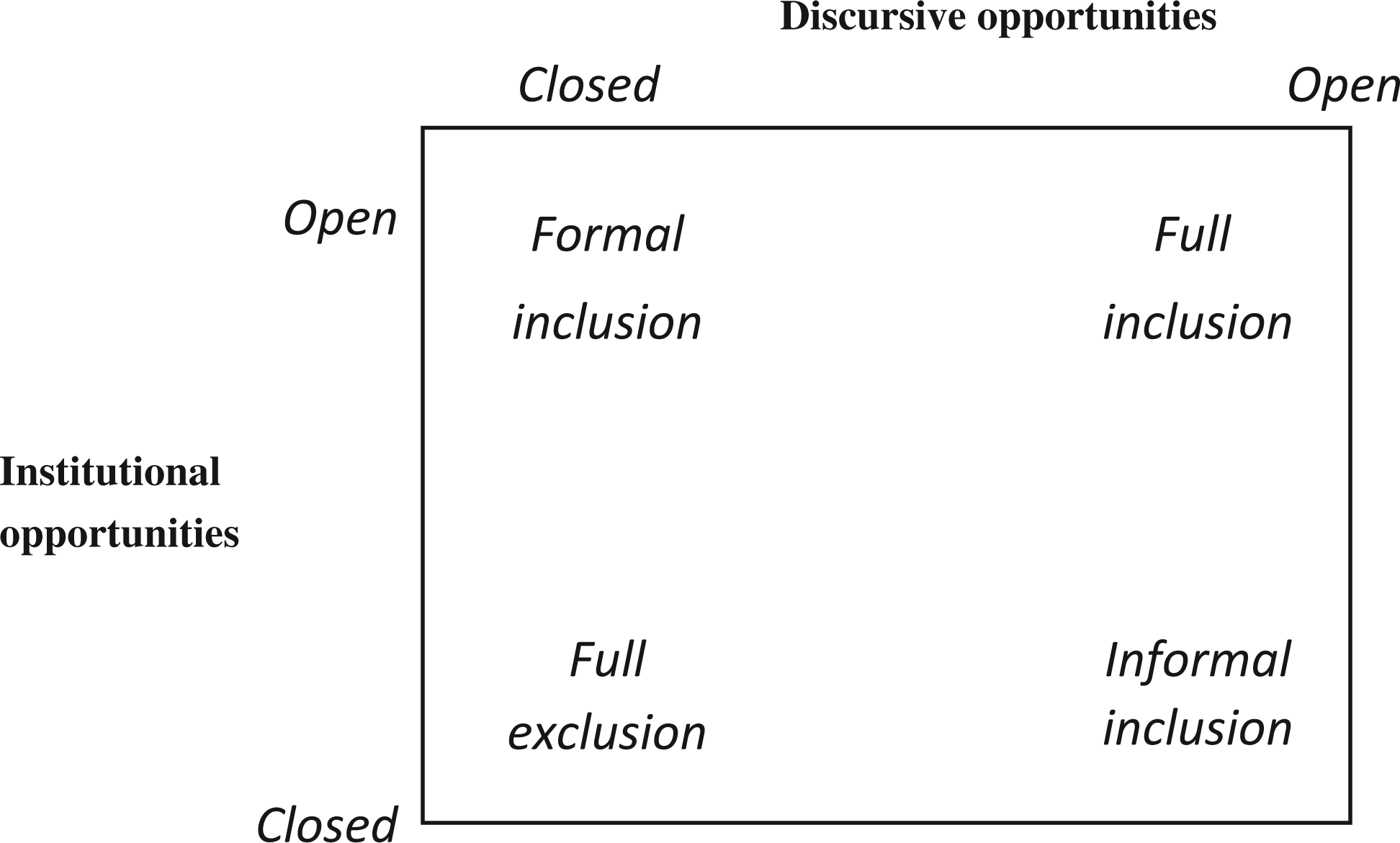
The other two corners of the bi-dimensional space allow for assessing two different intermediate situations between full inclusion and exclusion. On the one hand, the combination of open discursive opportunities and closed institutional opportunities translates into a situation of informal inclusion. In this case, a plurality of actors intervene in favor of Muslims in the public space, while Muslims themselves benefit from only a few formal channels to access institutions and the policy process. On the other hand, the combination of open institutional opportunities and negative interventions in the public domain translates into formal inclusion, that is, easy access to institutions and policy processes within a constraining discursive milieu.
These four ideal-typical situations of full inclusion, exclusion, informal inclusion, and formal inclusion lead to some main expectations when thinking about their interactions with the three dependent variables at the core of our analysis. Full inclusion is thought to foster the protagonist role of Muslim leaders and organizations, since these latter have the highest legitimacy—in terms of institutional access and public discourse—to speak on behalf of their communities. Full inclusion is also expected to lead to a richer repertoire of political mobilization, which also includes forms of collective action (Tarrow, 2011; Tilly, 1978). Furthermore, claim-making is expected to deal with broader political issues, well beyond the discussion of simple cultural demands.
By contrast, Muslim leaders and their organizations find it hard to be visible in situations of exclusion, that is, when lacking key access points to policy making and a sufficient degree of legitimacy in the public domain. Exclusion is also expected to decrease the recourse to collective action by Muslims and the other actors in the field (though recourse to collective mobilization may become more radicalized in relative terms). At the same time, the discussion over cultural demands become hegemonic in the field, since claim-making has to deal with basic rights of religious freedom that have already been granted in other non-exclusionary contexts.
Formal inclusion is expected to increase the presence of Muslim actors owing to the establishment of political arrangements that involve Muslims’ representatives in the policy process. In this case, however, the involvement is likely to be limited to cultural issues, owing to the institutionalized inclusion of stakeholders who will withdraw when no longer holding any stake. Formal inclusion also implies a lower recourse to collective mobilization. On the one hand, Muslim stakeholders act in their quality of cultural representatives within formalized policy processes. On the other hand, all the other actors in the field are also likely to adapt their political behavior to the same dynamics of formalized politics.
Finally, informal inclusion is expected to lead to the bottom-up incorporation of Muslims and their concerns in the absence of institutional openness. In this case, Muslim stakeholders have fewer opportunities to be directly visible in the public space. However, overall recourse to bottom-up collective mobilization is expected to increase when extensive support for Muslims’ demands in the public domain contrasts with the political closeness of the institutional dimension. The growing mismatch between institutional closeness and discursive openness is also expected to sustain reference to cultural issues. Broader political concerns can be discussed more extensively if the accommodation of basic cultural demands has been acknowledged.
To sum up, the two dimensions of institutions and discourse are consistent with each other when one looks at their expected impact on the three dependent variables of this study. Both institutional openness and discursive openness will increase Muslims’ visibility, the recourse to collective action, and references to broader political issues. Institutional and discursive closeness will both have an opposed impact. As a consequence, the ideal-types of full inclusion and exclusion can be taken as two extreme poles that are in opposition with each other. By contrast, formal inclusion and informal inclusion stand out as more complex situations, whereby the impact of one dimension of opportunities is in contrast with the impact of the other. Accordingly, cross-dimensional interactions become crucial. Under formal inclusion, the increasing visibility of Muslim stakeholders will go hand in hand with a reduction in collective action and more limited references to broader political issues. Under informal inclusion, the decreasing visibility of Muslim stakeholders will go hand in hand with growing collective mobilization and stronger references to cultural issues.
Emphasis should be put on the original twist of our framework vis-à-vis the standard approaches that one finds in the scholarly literature. In particular, the strong impact of seminal works shedding light on different types of citizenship models (Brubaker, 1992), policy challenges (Ireland, 1994), and national philosophies of integration (Favell, 1998) has translated into a fashionable diatribe amongst scholars of political integration between those who favor multiculturalism and those who oppose it (see Koopmans, 2010, and Parekh, 2008, for an example of opposite viewpoints). This diatribe, however, hides the common agreement that is in fact shared across conflicting camps, that is, the idea that the most salient distinction informing the political context is that which one can draw between individual rights and group rights. Taking a critical stance, in what follows we show that the impact of individual rights (for example, citizenship rights) often goes hand in hand with that of group rights (for example, cultural rights). Thus, far from standing against each other in an irreconcilable opposition, individual rights and group rights are more likely to develop along the same direction than otherwise.
Besides showing that individual and group rights can be summed up together under the dimension of institutional opportunities, we also deal with the discursive position of Muslim actors and other organized publics in the public domain. We can thus engage, to some extent, with one of the most prominent research challenges in the scholarly field of migration and ethnic relations, namely the analysis of the complex readjustments between the decisions that policy makers take on the one hand and, on the other, the prevailing stance of various other actors (beyond institutions and policy makers) that access the public space. Drawing upon the most prominent answers to this conundrum (Freeman, 1995, 1998, 2002), scholars have already called for further research to be conducted at the intersection between the public domain and the policy domain (Cinalli, 2004, 2007). Here we move on accordingly, by putting under a stronger empirical scrutiny the expected role which different actors play in the shaping of institutions and discourse. For example, the idea that policy makers follow the preferences of organized publics (Freeman, 2002), or intervene in the public domain in line with dominant anti-immigration and xenophobic positions (Faist, 1994; Thränhardt, 1995), calls for further research and analysis.
Ultimately, our framework serves a number of theoretical and empirical purposes. By complementing the institutional dimension with the discursive dimension, it tackles major shortcomings in the scholarly tradition of political opportunities. In particular, we run a test that can assess the variable impact of different political opportunities (at least concerning who makes the claim, how, and about what). Our framework is useful to further the reflection over different combinations of institutional and discursive opportunities in a way to challenge standard conceptualizations that one finds in the scholarly literature. Our focus on policy makers and organized publics is valuable to assess the extent to which they do stand against each other. We can also look better into the common assumption that Islamophobia (Kayaoğlu, 2012) is almost ubiquitous in the public domain. Finally, the analysis of (mis)matching between institutions and discourse allows for further scrutinizing the arguments of those who consider that the policy agenda is likely to adapt to the prevailing stance in the public domain so as to secure political gains for the elites (Freeman, 2002).
Data and operationalization
Our study of institutions, discourse, and claim-making is based on a number of key methodological decisions. First, the measures of institutional opportunities draw upon extensive data collection that has taken place within the framework of the Eurislam project (Carol et al., 2009; see also Koopmans et al., 2012 for the use of same type of data in a larger number of countries). We focus our attention on both directions of inquiry that one finds in the literature, that is, the individual access of Muslims to the community of nationals and the availability of opportunities for the acknowledgement of their demands as a group. The first step of analysis of individual rights has been operationalized through a set of indicators to be measured along a five-point scale, but also more qualitatively through the production of extensive commentaries that discuss each assigned score. It can be useful to provide some further details about the indicators that we have examined (see Carol et al., 2009, for a full analysis of both individual and group rights). Under citizenship rights we have gathered a number of indicators that shed light on potential restrictions of rights for those Muslims whose acquisition of citizenship is recent or not concluded yet. We have thus looked at conditions for family reunification, conditions for expulsion (both for long-term residents and for members of 1.5 and 2.0 generations), voting rights, and restrictions for non-citizens to work in government or civil service. Afterwards, we have assessed the extent to which the principle of anti-discrimination is effectively implemented in civil law, dealing with the various spheres that may be covered (education, access to goods/services, employment, social benefits, housing) as well as appraising which types of discrimination count (religion, race/ethnicity, nationality). We have also looked at the existence and functioning of state-established anti-discrimination bodies and their legal mandate. As regards cultural rights, we have focused on a number of indicators that cover the analysis of state funding of Muslim schools, Islamic teaching in state schools as an alternative to Christian religion, the right of female teachers and students to wear the headscarf in schools, the broadcasting of Islamic religious programs, and the existence of state-paid imams in prisons and the army. Finally, political representation refers to the analysis of the existence, composition, and functioning of Muslim and immigrant consultative bodies, both at the national and at the sub-national levels. All measures were computed by attributing a score to each indicator: −1 corresponds to restrictive provisions (and therefore closed opportunities for Muslims) and +1 to liberal provisions (and therefore open opportunities), with −0.5, 0, and +0.5 reflecting different degrees of intermediate situations. We then summed the scores of various indicators and calculated averages for each national case so as to use them for regression analysis. Data refer to the situation of policies and institutional arrangements in each country for the year 2002. We then select claims happening in each national case between 2002 and 2008 so as to enhance conditions for studying the impact of institutional opportunities upon claims.
Second, teachings of claim-making (Koopmans and Statham, 1999b) have been crucial for dealing with the analysis of actors’ interventions across the five selected countries. Claim-making builds on protest event analysis as developed in the field of social movements and collective action (see Koopmans and Rucht, 2002), but extends the method to include speech acts and political decisions. In particular, we have focused on a wide range of actors and their interventions over Islam, including policy makers, governmental and other state actors, as well as the organized publics at large. As said, this latter category refers to the usual suspects of protest event analysis (social movement organizations, NGOs, etc.) but also to an additional number of various stakeholders (employers’ and employees’ associations, professional associations, etc.) who are capable of accessing the public space through the insertion of their claims in the media. We have thus analyzed all forms of public interventions in the field, including purely discursive forms (such as public statements, press releases, publications, and interviews), conventional forms of political action (such as litigation and petitioning), and protest forms (such as demonstrations and political violence). In so doing, we have acknowledged the plurality of modes of political communication that different actors use, especially when focusing on claim-making of Muslims, other religious minorities, and, in general, all other groups at risk of exclusion (Sanders, 1997; Young, 2000; see also Bohman, 1995).
Finally, our operationalization of discursive opportunities has relied on the use of a distinct variable, namely the position towards the object. This latter variable, is useful to evaluate whether claims in the public domain stand in favor of, or otherwise against, Muslims. It thus allows for a comprehensive understanding of interventions of institutions, policy actors, and organized publics in the public domain. Hence, our analysis of discursive opportunities considers the average position of all these actors except Muslims themselves. In so doing, we isolate the impact of the discursive milieu within which claim-making takes place, excluding interventions by Muslims from the sample so as to reduce risks for the blurring of the independent and dependent variables. As in the case of institutional opportunities, our scores for discursive opportunities range from −1 to +1 (the closer the score is to −1 the less favorable are the discursive opportunities, and vice versa) in order to have suitable data for regression analysis.
Testing the impact of institutional and discursive opportunities
Specific setting for claim-making over Islam in five countries.

Coefficients from logistic regressions of dimensions of political opportunity structures on three aspects of claim-making (odds ratios).
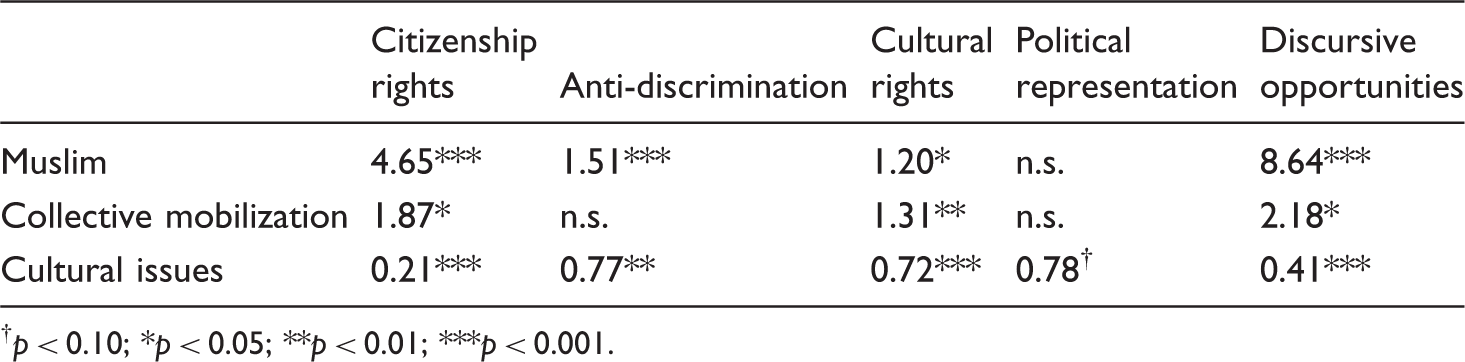
p < 0.10; *p < 0.05; **p < 0.01; ***p < 0.001.
Overall, findings in Table 2 show that all these categories of legal arrangements and policy making, whether they are individual- or group-based, are linked to clear political outcomes in terms of our three dependent variables. Thus, the protagonist role of Muslims is in a significant relation with three of the four categories of institutional opportunities, while the salience of cultural issues is in a significant relation with all the four categories. Results are less straightforward when focusing on collective mobilization, yet citizenship rights and cultural rights do stand out for their significant impact.
It is also interesting to notice that individual-based laws and policies are accountable for the most crucial consequences. That is, a situation of more inclusive individual rights allows for (1) a much greater participation by Muslims themselves, (2) a greater recourse to forms of collective mobilization, and (3) decreasing references to cultural issues. In other words, the countries that are willing to enlarge the traditional borders of citizenship (without engaging necessarily in multiculturalism by granting group rights at the same time) are also those countries where Muslims have gained greater room for a protagonist role, and where a richer variety of issues (beyond basic cultural demands of Muslims) has been brought to the core of the public domain.
At the same time, our data show that the impact of citizenship rights (i.e., the type of individual rights par excellence) goes hand in hand with that of cultural rights (i.e., the type of collective rights par excellence). This means that, far from standing against each other in irreconcilable opposition, individual rights and group rights are more likely to balance each other than otherwise. While it is certainly plausible to combine a high degree of individual rights together with a low degree of collective rights, or alternatively a high degree of collective rights together with a low degree of individual rights, one may find it hard to have these combinations when looking into the empirical world (see the empty category of ‘segregationism’ in Koopmans et al., 2005, as well as the discussion over the potential oxymoronic nature of French republicanism in Schor, 2001).
Finally, as regards discursive opportunities, Table 2 confirms the idea that they deserve a more central place of analysis (Cinalli and Giugni, 2011). In fact, scores reveal that for two aspects of claim-making, namely Muslims’ visibility and the recourse to collective mobilization, the impact of discourse is even stronger than that of institutions. As a consequence, space is open for the next step of analysis, whereby variations of institutional and discursive opportunities, as well as their variable combinations, can be linked more systematically to variations of claim-making.
Cross-national variations in claim-making over Islam
Having dealt with the explanans of our theoretical framework in terms of the bi-dimensional conceptualization and the testing of the impact of institutional and discursive opportunities, we can now further the discussion about cross-national variations of our three dependent variables vis-à-vis cross-national differences of institutions and discourse.
Cross-national variations in three aspects of claim-making (percentages).
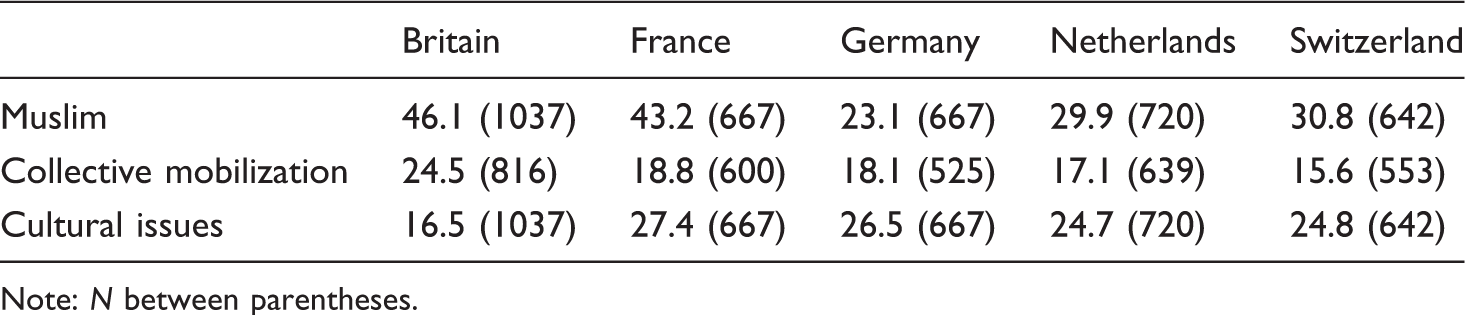
Note: N between parentheses.
In particular, emphasis can be put on the main contrast that the data show between the British case, characterized by institutional and discursive openness, and the exclusive model to which Germany and Switzerland conform. 2 In line with their traditional treatment of minorities as migrant guest-workers, Germany and Switzerland stand out as places of high barriers to citizenship acquisition and limited room for the acknowledgement of group rights for Muslims (as most recently confirmed by the ban on minarets in occasion of the 2010 Swiss referendum, and by the ongoing exclusion of Muslim schools from public funding in Germany in spite of its system of official recognition of religious groups). 3 Moreover, in these two countries the overall discourse in the public domain reinforces the restrictive stance of policies and institutions.
By empirically establishing that the most salient distinction is that between the inclusive British model on the one hand and the exclusionary model of Germany and Switzerland on the other hand, our results are in line with previous findings by other scholars who have focused on the civic/ethnic dichotomy (Brubaker, 1992), or otherwise on the opposition between the two poles of assimilationism and multiculturalism. That is, our decision to merge individual and group rights together, so as to combine them with discursive opportunities, yields to results that are consistent with the main scholarly fundamentals in the literature. Nevertheless, the fact that most of the time an increment of discursive opportunities goes hand in hand with an increment of institutional opportunities (and vice versa) is a quite counter-intuitive finding. After all, a common argument in the literature is that pro-minorities policies are expected to lead to a backlash in the public space (and, for this reason, are risky and unpopular for political leaders). Most crucially, our findings show that top-down institutional arrangements in the policy domain are often consistent with bottom-up interventions in the public domain. Put simply, expansionist policies may well go side by side with an expansionist discourse in the public domain, and vice versa; further restrictions in the policy domain are likely to be matched by a restrictive discursive twist in the public space.
The analysis of the French case also confirms the idea that institutions and discourse can develop symbiotically, most likely through continuous mutual readjustments. Whereas Britain on the one hand and Germany and Switzerland on the other hand stand out as cases where scores are either high or low along both the institutional and the discursive dimension, France shows consistent intermediate scores in terms of opportunities across the institutional and the public domain. From this perspective, our findings fit with the argument of those who have shed light on the crossroads at which France stands in terms of integration of Muslims and other minorities—with continuous political readjustments that have rebalanced citizenship rights across the civic–ethnic spectrum (Weil, 2008), crucial renegotiations of republicanism vis-à-vis the growing demands for pluralism (Safran, 2003), and the increasing acknowledgement that equality has to respect difference (Khosrokhavar, 1997; Touraine, 1997).
Finally, our findings for the Dutch case show an opposition between the two dimensions of institutional and discursive opportunities. In contrast with our results for the British, French, German, and Swiss cases, expansionist policies in the Netherlands take place within a discursive milieu of relative opposite sign owing to the increasingly restrictive stance in the public domain throughout the mid- and late 2000s. 4 Hence, the thesis of growing xenophobia in the public space—which would influence the position of institutions and elites in the policy domain—proves to be applicable only to the Netherlands. By showing that closed discursive opportunities are not necessarily linked to restrictive institutional interventions in the policy domain, the findings for the Dutch case also confirm the sound fundamentals of our conceptual space combining the two independent dimensions of institutions and discourse. That is, the Netherlands provides a critical case of analysis, for which one cannot find the more usual logics of mutual balance between institutional and discursive opportunities.
Crucially, the Dutch case also shows that an anti-Islamic stance within the public space can combine with inclusive institutional arrangements, shedding light on the danger of a potential multicultural backlash. Even within a political context where the intrinsic desirability of multiculturalism is not contested—not even by the most extreme right-wing forces within the public domain—claim-making over Islam may not imply a key role for Muslims themselves, may not include forms of action that are available across other political fields, and may find it hard to mobilize a broader political debate of general interest that goes beyond a parochial concern for cultural issues.
Conclusion
The main argument of this article was that claim-making over Islam needs to be studied by putting more emphasis on the characteristics of the political context within which Muslims have settled. At a conceptual level, following previous work in the field of migration and ethnic relations politics, we have argued that this political context is made of an institutional and a discursive dimension, the variations of which can be seized cross-nationally. At a descriptive level, our findings have shown that both dimensions vary in important ways across Britain, France, Germany, the Netherlands, and Switzerland, with some countries offering a more favorable context than others. At an explanatory level, we have proven that variations of institutions and discourse are indeed linked to a number of dependent variables, namely variations of Muslims’ visibility, overall recourse to contentious action, and salience of cultural issues. In particular, we have discussed cross-national differences in terms of combinations of institutional and discursive opportunities within a conceptual space that is built on the four corners of full inclusion, formal inclusion, informal inclusion, and exclusion.
Our overall results are quite straightforward. The political context stands out as a crucial explanans that requires further scholarly research. Too often claim-making of and over Muslims is explained with very little or no systematic analysis of their own political milieu. In particular, we have found that an exhaustive evaluation of the political context requires more research at the intersection of the policy and the public domains, thus bringing the study of political provisions, laws, and institutional reforms side by side with the study of discursive interventions. Of course, some limits can certainly be found in our approach. After all, the list of indicators to assess the institutional dimension could be expanded, while further information about the discourse of actors—for example, distinguishing between the specific position of organized publics and policy makers—could be used to say more about the restrictive/expansionist discursive stance which Muslims face. Yet it is also clear that we have dealt with a long list of crucial institutional variables, and that the position of discursive interventions on which we have focused—whether improving or constraining the position of Muslims—stands out as a major predictor of variations of claim-making even when simply treated at an aggregated level.
Along the way, we have also engaged with a series of more circumscribed, yet very interesting, findings. First, our analysis shows that, overall, individual rights and group rights tend to follow each other rather than mixing into combinations where one type of rights goes in the opposition direction of the other type. Without stepping into a normative discussion, which is beyond the scope of this article, this result seems to weaken the strong opposition that normative theorists, within and outside the multiculturalist camp, have seen between individual rights and group rights. In fact, these two types of rights most of the time conform consistently to the same restrictive or expansionist logics that prevail in the policy domain, thereby accounting for similar political dynamics.
Second, our analysis has dealt to some extent with the scholarly debate over client politics, assessing the (mis)matching between opportunities that are available at the intersection of the public and the policy domains. In this case, we have found that anti-immigration and xenophobic positions are not necessarily widespread, and that policy elites, in their quest for political advantages, do not have to align necessarily with the discursive position that prevails in the public domain. However, most often than not, readjustments do take place according to a logic of compensation of unbalances across institutions and discourse. Thus, Britain provides the case where open opportunities consistently prevail along the institutional and the discursive dimension of opportunities. Germany and Switzerland have reached their equilibrium by consistent restrictions on both dimensions, while France stands out for its consistent midway scoring in terms of institutions and discourse.
As stated, however, our analysis opens space for further research to be conducted on the specific intervention of distinct actors. After all, our measures draw heavily upon average scores. Regardless of their access to the public space, some publics may be more organized than others, endowed with more bottom-up influence on policy making. It would also be interesting to assess the extent to which policy actors have a discourse in the public domain that is consistent with their decision making in the policy domain. And in the policy domain, some provisions may be more politically charged than others owing to the electoral left/right contest, the constitutional position of religion within the state, the kind of Islam that is prevalent amongst Muslims, etc.
Last, we have added up some further knowledge about the contentious politics of Islam in our five countries. In spite of recent cries of failed multiculturalism, 5 Germany seems to be the least multicultural amongst all countries of our analysis, in terms of both political input of opportunities and political output of claim-making. Institutions and discourse are as closed in Germany as they are in Switzerland, while German Muslims have the least visibility (even less than Swiss Muslims) and mobilize within a field where discussion of mere cultural issues is dominant. In spite of recent cries of failed multiculturalism, 6 Britain does not seem to be such a failure after all. In fact, favorable opportunities across the policy and the public domains have enabled British Muslims to acquire a role as full protagonists within a field that is characterized by the use of a large repertoire of action and by the discussion of a large number of issues that are not just parochial in nature. As regards France and the Netherlands, they have emerged as two intermediate cases of complex interpretation. This was even more surprising for the Dutch case, which has been found to depart substantially from the British case, and where the noticeable mismatch across the public and the policy domains fits with recent warnings of a potential multicultural backlash.
Footnotes
Funding
This research was funded by the European Commission under the Seventh Framework Programme (Grant Agreement Number 215863).