







Abstract
Contrary to the widespread opinion that hatred and mutual dislike among various ethnic groups was a chief characteristic of Yugoslavia and was at the bottom of the country’s destruction, the ethnic distance survey conducted in 1990 indicates that Yugoslav society was a community with a generally low level of ethnic animosities. The results demonstrate the huge discrepancy between what most Yugoslav citizens felt and needed, and what political elites and nationalist intellectuals claimed “their people” wanted and needed in the 1990s. Many scholars have not incorporated or noticed the difference.
If the most basic elements of any system of belief are those that ‘go without saying because they come without saying’…, it is the truths that are held to be self-evident that are most revealing. Robert M Hayden (1993)
Introduction
Why did Yugoslavia disappear? Did the country’s disintegration and destruction happen because of its history, its economic crisis, its politicians like Milosevic, its constitution, its mutually hating people, various foreign forces, or its multi-ethnic composition? In my work I question the view that widespread hatred and deep mutual dislike existed among various nations in Yugoslavia before the 1990s civil war and reject the notion that the multi-cultural structure of Yugoslav society was at the root of that war. My argument utilizes empirical data collected in the survey on ethnic distance taken immediately before the war, in 1990.
It is a great irony that the popular but incorrect assumption that ethnic hatred in Yugoslavia ran deep has been one of the prevailing postulations among social scientists in explaining the 1990s wars and subsequent breakup of Yugoslavia. Only a relatively small group of scholars resisted the spell of the nationalists’ views about nation, history, and past inter-ethnic relationships. It was often overlooked that such views not only served particular political interests but also promoted an understanding of nationalists as representatives of the nation’s interests. The resulting distorted image of Yugoslavia, as presented in much scholarship since the 1990s, reminds us that, to paraphrase Samuel Butler, although God cannot alter the past, social scientists can.
Despite academic writings and personal testimonies to the contrary by people who lived in Yugoslavia, many scholars have simply assumed that the country disappeared because its citizens, riven by ethnic hatred, never or no longer wanted it to exist. Typical reasoning included beliefs that: a) widespread ethnic hatred was always there but was kicked under the carpet by the heavy boot of Yugoslav dictator Tito; and b) the disintegration of Yugoslavia was an expression of the desire for independence of several repressed and exploited Yugoslav nations. It is often in studies about Yugoslavia that these explanations of the late 20th century Yugoslav crisis are commonly taken as self-evident rather than something that needs to be examined (Hayden, 1993).
My intention is to add some empirical considerations to the complex question of the demise of Yugoslavia. After a brief overview of the empirical data about ethnic distance in Yugoslavia, I examine some results of the 1990 survey related to the commonly held views about inter-ethnic relations in Yugoslavia. Then I look at the question of the monolithic nature of (Yugoslav) nations/ethnic groups by analyzing the 1990 data along with an article by a renowned scholar. (I use the name Yugoslavia for post-1945 Yugoslavia; I use the terms ‘nation’ and ‘ethnic group’ interchangeably.)
Background
The 2004 book by VP Gagnon, The Myth of Ethnic War, contains this notable contention, ‘One of the most striking aspects of the wars in Yugoslavia is the extent to which the images purveyed in the Western press and in much of the academic literature are so at odds with evidence from on the ground.’ Indeed, although the age-old-hatred argument is now rather obsolete and is rejected by many, for instance, the (often implicit) assumption that Yugoslav people must have severely disliked each other persists.
Gagnon is one of a growing number of scholars who, in the way established in the classical work Ethnic Groups and Boundaries by Frederic Barth (1969), question the notion of ethnic war itself. Bruce Gilley (2004: 1155) points out that, despite a boom in studies of ethnic conflict, the empirical and conceptual justifications for this field remain weak. Charles King (2001: 167) asks whether talking about a distinct category of violence called ‘ethnic war’ is as useful as some scholars think. In his remarks King expresses his hope of injecting some hesitation into the use of the concept of ethnic conflict (2001: 170). Stefan Wolff, who touches upon a related issue including nationalism, argues that ethnicity in itself does not cause ethnic conflict (2010: 5). Rogers Brubaker and David D Laitin (1998) plea ‘for the disaggregated analysis of the heterogeneous phenomena we too casually lump together as “ethnic violence”’
Wilmer (2002: 84) alerts that scholars are ‘too eager to use the term “ethnic conflict” uncritically, as if its meaning were self-evident’. Also, he stresses that ‘[P]erhaps the problem of “ethnic conflict” can more usefully be conceived as conflict mobilized around identity discourse’ Wilmer (2002: 88). These scholars all point toward deeper explorations of the causes of conflicts we customarily call ethnic.
The concept of a nation plays an important part in understanding the Yugoslav crisis. Drawing on Smith’s theory (1986), for instance, sometimes scholars uphold a view about an ineffable essence of a nation, and among the major factors of the Yugoslavia breakdown include the fact that the republics were complete nations who necessarily aimed for distinctiveness (Flere and Pavkovic, 2013: 72). However, empirical studies such as the 1991a ‘Nacionalna distanca gradjana Jugoslavije’ (‘National Distance of Yugoslav Citizens’) by Dragomir Pantić, and the 2011 study done by Sergej Flere in collaboration with Rudi Klanjšek, reveal a huge discrepancy between the attitudes of Yugoslav citizens and the behavior of the republics’ leadership, indicating that there is no consistent proof for such a claim about a nation’s unavoidable desire for distinctiveness in a form of an independent state. The differences between political elites and citizens also point to the dubious concept of a nation as an entity with some innate or essential core, ever at work dominating and overpowering social actors. In the same way, the dissimilarity between Yugoslav citizens’ ethnic attitudes and those of nationalist groups in the Yugoslav republics is often ignored under the perception of a nation as a monolith (this will be touched upon in more detail later in my discussion of the ‘Serbian and Croatian historical narratives’). It is a puzzling argument (based on a view of a nation as an entity almost detached from people), that Yugoslavia never had, and was unable to have, a strong foundation as a state because ‘particular nations had already been established in 1918 when Yugoslavia was founded and therefore the possibility for a strong, parallel Yugoslav identification which would give legitimacy to the state could not exist’ (Flere and Pavkovic, 2013: 71). It is puzzling especially because it is coming from an author who stressed that a majority of the people of Yugoslavia ‘did not support the destruction of the country’, and that the Yugoslav state broke down in face of the will of its citizens (Flere and Pavkovic, 2013: 71–72). One must question what should possibly be a stronger foundation of a state than the desire of its citizens. Only if some extraordinary power is assigned to a nation (assigned in both senses: as part of an ideology and as a methodical concept), does the force of the people (consisting of individuals who think, feel, and act in a very specific historical circumstance) become insignificant.
There is much to learn from empirical studies on inter-ethnic relations in Yugoslavia (Babić, 2004; Bačević et al., 1991; Flere, 2003; Jović, 2001, 2008, 2009; Klanjšek and Flere, 2011; Pantić, 1967, 1991; Sekulić et al., 2004; Šiber, 1992). The studies present a source both for investigating in a new way a particular case and for contributing to the wider academic discourse on ethnicity. They cast a new light on the Yugoslav crisis, inter-ethnic relationships and the opinions, and feelings of Yugoslav citizens on the matters of ethnicity and nationalism.
In my paper I discuss some results of the comprehensive 1990 Yugoslav survey, carried out just before the dissolution of the country. That was a time when new nationalist parties had already gained momentum, and whatever the Yugoslav population’s ethnic attitudes were, the survey provided an opportunity for them to express themselves freely. Unexpectedly to many, the 1990 data corroborate a range of social distance surveys done during the existence of the Yugoslav federation, indicating generally good inter-ethnic relations.
Empirical data—Brief overview
At the time of the country’s breakup, the investigation of social distance among ethnic groups in Yugoslavia had been going on for some 30 years. According to Vjeran Katunarić (1991), a sociologist from Croatia, most results demonstrated that a majority of citizens did not manifest any ethnic distance (p.129).
When particular population segments and related issues were investigated, similar results were found. For instance, in the study ‘National Awareness of Youth,’ published in 1990, Liljana Bačević, a sociologist from Serbia, reports among other things that, as late as 1989, a significant majority of young Yugoslavs identified themselves with Yugoslavia, choosing that identification over that of Europe or the local republic and province (Bačević, 1990).
In 2011, Rudi Klanjšek and Sergej Flere, two sociologists from Slovenia, published a study (based on their analysis of surveys done before the war), with the title ‘Exit Yugoslavia: longing for mononational states or entrepreneurial manipulation?’ The study, as the authors observe, “‘indicates very limited support for “longing” for national emancipation in the form of national states.” In fact, ‘a great majority of Yugoslav citizens did not support such a cause, although they had no cognizance of the war and atrocities that would follow dissolution’ (Klanjšek and Flere, 2011: 804–805). The authors conclude, ‘The breakup of Yugoslavia and the establishment of post-Yugoslav states should not be attributed to a longing on the part of the masses’ (Klanjšek and Flere, 2011: 806).
Empirical data vs. popular interpretations about 1990s Yugoslav crises
Let us see what the 1990 data documenting Yugoslavs’ attitudes say about their inter-ethnic relations, in more details. Do they corroborate claims about the existence of animosities and hatred? Do they give proof to the claim about antipathy between, for instance, Croats and Serbs, the most populous nations in Yugoslavia? What do data say about the dislike of (the rest of) Yugoslavs toward Croats and Slovenians, which caused these two nations to leave the federation? Do the members of those nations, Slovenians and Croats, widely presented as more democratically oriented, show more openness toward and acceptance of others? What were the various nations’ attitudes toward Albanians? Was ethnic acceptance or rejection always reciprocal among various ethnic groups? The data often contest popular views about Yugoslavs’ inter-ethnic relations.
Yugoslav Public Opinion Survey in 1990
The Yugoslav Public Opinion Survey was carried out in 1990 by the Consortium of Institutions for Public Opinion Research, consisting of the institutions from Belgrade, Serbia; Sarajevo, Bosnia, and Herzegovina; Ljubljana, Slovenia; Zagreb, Croatia; and Skopje, Macedonia. (The institutions are: Centar za politikološka istraživanja i javno mnenje Instituta društvenih nauka, Univerziteta u Beogradu; Centar za ispitivanje javnog mnijenja Instituta za društvena istraživanja Fakulteta političkih nauka ‘Veljko Vlahović’ Univerziteta u Sarajevu; Center za raziskovanje javnega mnenja in množičnih komunikcij, Univerza v Ljubljani; Institut za društvena istraživanja Sveucilista u Zagrebu; Institut za sociološka i političko-pravna istraživanja Univerziteta „
Method
The research was conducted in May–June 1990. It was based on a randomly selected sample of 4230 adults 18 years and older, which was representative, regarding age, sex, professional categories, etc. of the population of the whole country and of each republic and autonomous region. The data were obtained by face-to-face interviews using a standardized questionnaire. The database included calculations of statistical indicators and elaboration of synthetic variables, indices, and scales.
Ethnic distance was measured by a modified Bogardus social distance scale. The scale was modified to relate only to a primary intimate relationship, a hypothetical marriage, between members of Yugoslav ethnic groups. Ethnic distance was examined among the six most populous nations in Yugoslavia (Croats, Macedonians. Montenegrins, Muslims/Bosniaks/Bosnians, Serbs, and Slovenes); the two most numerous minority groups/nationalities (Albanians and Hungarians), and individuals self-declared as Yugoslavs (Pantić, 1991a: 173–174).
Ethnic distance
The level of acceptance ranged from accepting a potential marriage partner from all nine ethnic groups to accepting a potential spouse only from one’s own ethnic group or even none (Pantić, 1991a).
No distance or minimal ethnic distance
– nine or eight ethnic groups were acceptable to 33% of respondents,
Low distance
– seven or six ethnic groups were acceptable to 12%,
Medium distance
– five or four ethnic groups were acceptable to 14%,
Strong distance
– three or two ethnic groups were acceptable to 19%,
Maximal distance
– one ethnic group was acceptable to 22% (of whom 18% would accept only their own ethnic group, and the remaining 4% would not accept anyone as a marriage partner, including members of their own nationality).
As one might expect, between the 1960s and 1990s, ethnic distance changed. A similar study conducted in 1966 (Pantić, 1967a), also using a representative sample of the citizens of Yugoslavia, indicated that three-fifths of the respondents did not manifest any ethnic distance (Pantić, 1991a: 171). Although significant changes occurred by 1990, the results demonstrate that a substantial proportion of respondents (33%) still expressed minimal or no ethnic distance and an additional 12 percent expressed low ethnic distance. This is particularly noteworthy since the results relate to a social relationship, hypothetical marriage, for which rejection is usually highest among various measures of ethnic distance.
Distribution of social distance changed from “J” to “U”
The transformation in distribution of social distance from a J-shaped distribution in 1966 to a U-shaped one in 1990 graphically demonstrates the change of attitude among citizens of Yugoslavia. This means that, while in 1966 the responses range from the highest percentage of those without ethnic distance toward a gradual decrease of respondents in categories with considerable distance, in 1990 most respondents were on the extremes: either they expressed the greatest or the least level of distance from other ethnic groups. The presence of still relatively low ethnic distance in 1990 documents not only the condition of inter-ethnic relationships at the time of the survey but also good inter-ethnic relations among Yugoslav nations in the past. It indicates resistance to the mighty nationalist propaganda that had been taking place for some time in all parts of the country. Nor does it support the hidden-ethnic-hatred argument, according to which Yugoslavia was riven with hatred that had to explode when its peoples could finally display their animosity against each other.
Ethnic distance with highest and lowest increases
Not surprisingly, the 1991 study demonstrates a certain increase of national distance, compared to the results from 25 years before (Pantić, 1991a: 175). The republics where ethnic distance increased most and least are as follows:
The highest increase in level:
Croatia: ethnic distance increased from low to medium Macedonia: stayed at medium
The least increase in level:
Slovenia: stayed at high Montenegro: stayed at low Serbia: stayed at medium
In some rather rare cases ethnic distance decreased. In Montenegro, ethnic distance decreased towards Serbs and Hungarians; it decreased among Slovenians toward Croats, and among Serbs toward Macedonians, Montenegrins, and Hungarians (Pantić, 1991a: 175). On the other hand, there was significant increase of ethnic distance among Serbs and Montenegrins toward Croats and Slovenians, as well as among members of these groups toward Serbs and Montenegrins.
It is hard not to observe a certain parallel between the relationships of groups displaying decreased ethnic distance and the political coalitions among the leaders of their respective republics. Thus, when Montenegrin political leaders were close to the Milosevic regime, their relationship likely influenced the way Serbs were viewed by Montenegro’s political elite and were portrayed in their media. One might similarly explain the positive change towards Croats in Slovenia, where ethnic distance was high in 1966 and, though still high in 1990, was a bit smaller, at 45% vs. 36%, respectively. Cooperation between the leaders of those two republics had gradually been developing, particularly when Slovenian leaders sought backing among the politicians of Croatia for their secessionist plans. This corroborates what many authors claim, that such partnerships among the republican political leaders in Yugoslavia had a substantial role in generating ethnic animosity (or tolerance). Pantić (1991a) asserts that political passions, political struggles among regional politicians, media wars, and other factors influenced the level of ethnic distance among Yugoslav citizens (pp.175–6). As many surveys have demonstrated, ethnic distance is not invariable but fluctuates, depending on various factors, among which dominant political views in matters of ethnicity ranks high.
Feeling of affiliation to Yugoslavia
How strong were feelings of affiliation with Yugoslavia compared to such feelings toward a local area, republic/province, Europe, or the World when Yugoslavs were asked to rank their personal feelings for each one as very or sufficiently important (Table 2)?
Of all respondents, 62% said that their affiliation with Yugoslavia is very important to them. The percentages of respondents reporting similar feelings of affiliation were, for Europe 53%, republic/province 52%, the World 44%, and local area 39%.
There are variations in regard to the respondents’ nationality. For Slovenian and Croatian respondents their republic/province affiliation is more often designated as very important than their affiliation to Yugoslavia. The proportion between the two kinds of affiliation differs considerably among these two groups, though. Among persons of Slovenian nationality, there are significantly more for whom their republican affiliation is very important (66%) than who expressed the same for Yugoslav affiliation (26%), as compared to Croats, for whom these percentages are 51 and 48, respectively. In addition, a slightly bigger proportion of Croats expressed their affiliation with Europe as very important to them (53%) than with their republic (51%).
The proportion of Albanian respondents for whom affiliation to Yugoslavia is defined as more important than their affiliation to their province (49% and 47%, respectively) is not as big as it is for all other respondents (except, as we have seen, for respondents of Slovenian and Croatian nationality).
In various studies it is often claimed that Serbs, unlike other nations, were strongly attached to Yugoslavia and virtually the only ones who wanted to keep the country. The 1990 data do not support such a conclusion. The members of the following nations indicated their greater affiliation with Yugoslavia in the same or larger percentages than the 71% of those of Serbian nationality, listed here in alphabetical order, as presented in the original text by Pantić (1991b: 236): Montenegrins 80%, Yugoslavs 71%, Hungarians 79% and Muslims 84%. Also, similarly to Croats, there were slightly more Serbs who expressed a deeper affiliation with Europe than those who expressed a deeper affiliation with their republic (52% and 51%, respectively).
Although it is far from being a dominant trend in the scholarship about Yugoslavia, researchers have been using opinion polls’ results in their analyses of Yugoslavia crises. Kaufman (2001: 183) cites the 1997 Leonard Cohen’s Broken Bonds which reports on the differences among Slovenes between attachment to Yugoslavia and the desire for secession. Among Slovenes, for instance, only 26% reported feeling a strong attachment to Yugoslavia, but 58% wanted autonomy within Yugoslavia rather than secession. Referring to a 1991 book by the political scientist from Zagreb, Ivan Grdešić, about the 1990 elections in Croatia, Kaufman reports that about a third (34%) of Croats felt ethnically disadvantaged and ‘most Croats wanted to stay in Yugoslavia and were not inclined to make the Serbs their scapegoats’ (Kaufman, 2001: 183). Writing about Bosnia and Herzegovina, Woodward (1995: 228) noted that ‘public opinion polls in May and June 1990, and again in November 1991, also showed overwhelming majorities (in the range of 70–90%) against separation from Yugoslavia and against an ethnically divided republic’. This might help to explain the astonishment many felt in the 1990s concerning the eruption of war and the final disintegration of the Yugoslav state.
Results of various opinion polls done for magazines and newspapers, although not carried out with methodological rigor as scientific surveys, are indicative of citizens’ attitudes at the time. The examination of results of a poll conducted for the Croatian magazine Danas in spring 1990 led D Jović to conclude: “Therefore, at the moment of the first Croatian multiparty elections in 1990, the Hrvatska Demokratska Zajednica (HDZ) had yet to secure a majority for its preferred option: the full independence of Croatia” (Jović, 2008: 263). At the time, the effects of the Croatian Democratic Union (HDZ) propaganda had already been showing substantial results. Together with the fear of Milosevic’s vision of Yugoslav state, it made an idea of confederation becoming very popular. Undoubtedly, an intensive process of de-Yugoslavisation of the population became the development of the day.
Similarities and differences
Croats and Serbs
Manifest and latent distance and acceptance of members of other nationalities, in regard to the potential relations depending on nationality of respondent.
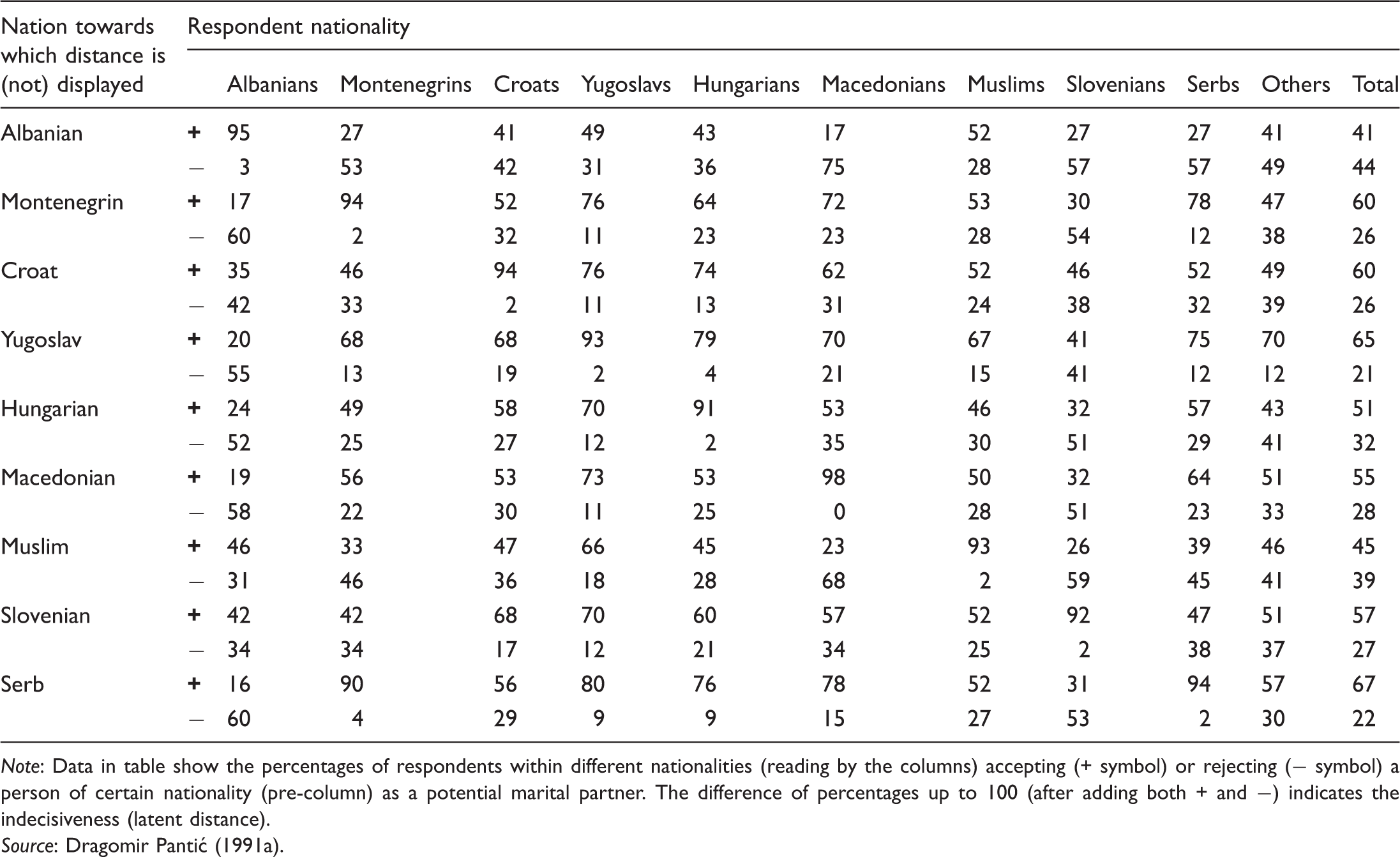
Note: Data in table show the percentages of respondents within different nationalities (reading by the columns) accepting (+ symbol) or rejecting (− symbol) a person of certain nationality (pre-column) as a potential marital partner. The difference of percentages up to 100 (after adding both + and −) indicates the indecisiveness (latent distance).
Source: Dragomir Pantić (1991a).
The importance of territorial affiliation to the respondents depending on their nationality (in percentages).
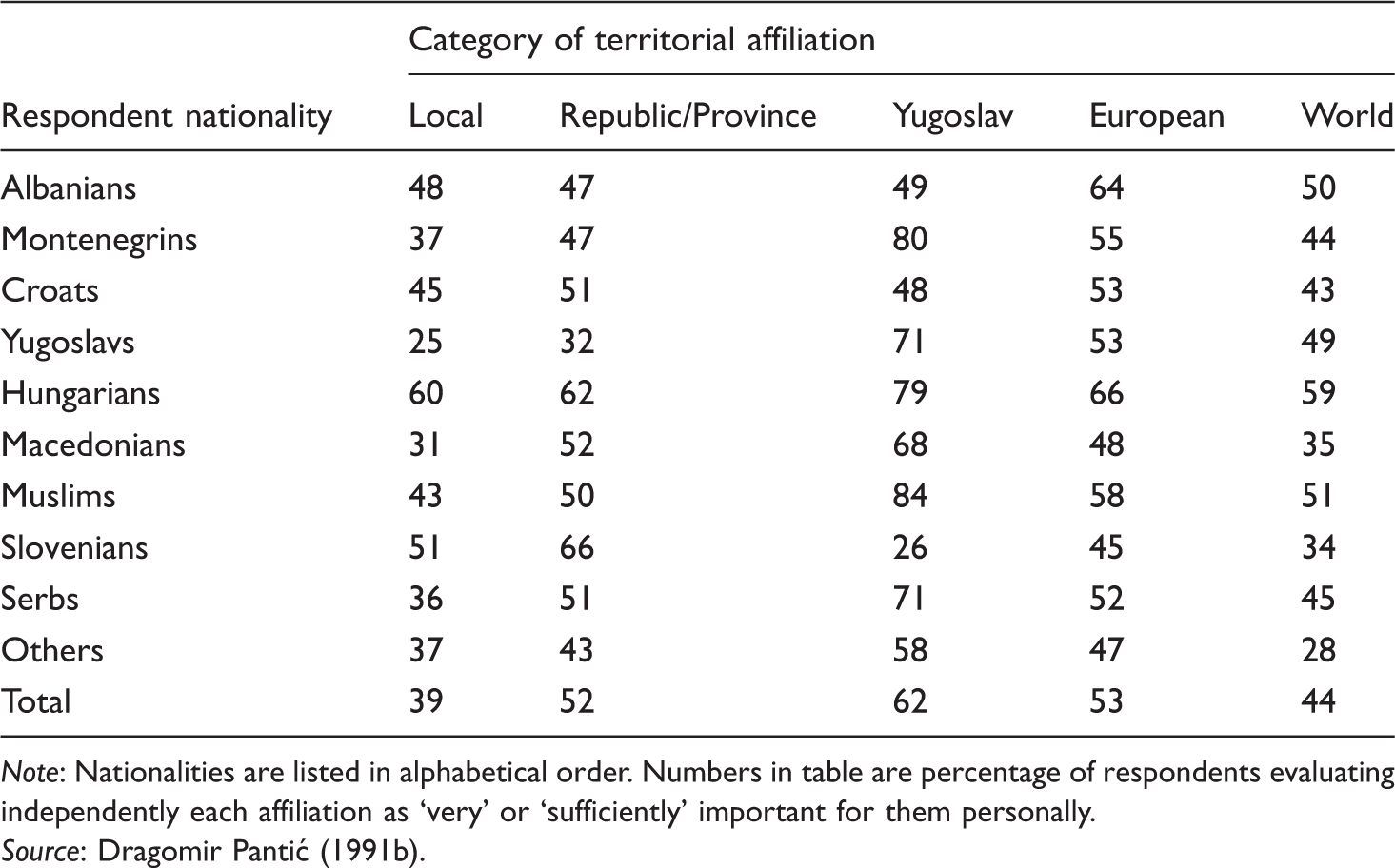
Note: Nationalities are listed in alphabetical order. Numbers in table are percentage of respondents evaluating independently each affiliation as ‘very’ or ‘sufficiently’ important for them personally.
Source: Dragomir Pantić (1991b).
Croats and Slovenians
Survey results do not confirm a distinct mutual acceptance between respondents of Slovenian and Croatian origin implied in some studies. Less than half (46%) of Slovenians accept, and 38% reject Croats as a possible marriage partner. On average Croatian respondents prove to be more open to accepting persons of Slovenian nationality in higher percentages (68% accept and 17% reject) (Table 1).
Serbs as ‘black sheep’ among Yugoslavs
Based on the survey results, one cannot assume the existence of widespread hatred against Serbs in spring 1990—Serbs were generally accepted as a hypothetical marriage partner by many respondents. The exceptions are found among persons of Slovenian and Albanian origin who accept Serbs in 31% of instances and 16%, respectively (Table 1).
Groups with high ethnic distance
Acceptance of members of other nationalities as potential marital partners, depending on nationality and territorial affiliation of respondents.

Note: Combinations with + symbol are based on numbers of respondents insufficient for reliable statistical conclusions.
Source: Dragomir Pantić (1991a).
Who rejected/accepted others (Yugoslav nations)?
Respondents of Slovenian and Albanian nationality are similar in rejecting members of other ethnic groups as their hypothetical marriage partner in higher percentages than is found among other groups. For Slovenians it is 51%, and for Albanians 49% while, for the remaining Yugoslav groups, percentages of rejection of others run from 14% among Yugoslavs to 38% among Macedonians (Pantić, 1991a: 181).
Correspondingly, a relatively small segment of Slovenians and Albanians accept others (Slovenians 33%, and Albanians 27%). Their mutual rejection is also high: 57% of respondents of Slovenian nationality reject a person of Albanian nationality, and only 27% accept them as a hypothetical marriage partner; among Albanian respondents 42% accept and 34% reject a person of Slovenian nationality. Among Slovenians, a slightly higher percentage accepts Serbs than accept Albanians as a hypothetical marriage partner (31% vs. 27%) (Pantić, 1991a: 181).
It is interesting to note that citizens of Slovenia, one of the republics which separated first from the Yugoslav federation because ‘they were driven out of Yugoslavia’, as its politicians and nationalist intellectuals claimed, were in fact largely accepted by members of other Yugoslav nations (Table1). It is also worthwhile recognizing that Croats and Slovenians’ ethnic attitudes are less similar than the similarity of actions of the political leaders of these two republics in 1990–1991 would suggest. On the other hand, it is obvious that utilization of nationalist politics and national homogenization stimulated by republican leaders in both republics (as well as in others, especially Serbia) had an enormous impact on citizens’ attitudes.
In some studies it is taken as a truism that Croats or Serbs nurtured animosity and hatred of other Yugoslav nations. The survey demonstrates, however, that comparatively high percentages of these groups (Croats and Serbs) accept members of different nationality (55% in both cases). Similar percentages are found for Macedonians, Muslims, and Montenegrins (54%, 53% and 51%, respectively). High percentages of acceptance of other nations distinguish Yugoslavs and Hungarians; they accept others as hypothetical marriage partners on average 70% and 62%, respectively (Pantić, 1991a: 181).
Nationalists from Croatia: “Croats were disliked in Yugoslavia”
Among the strongest arguments put forth by the nationalists for secession from Yugoslavia by, for instance, Croatia was the alleged endangerment to Croatian identity and Croatian culture if it remained in the state. Franjo Tuđman’s statement in his ceremonial speech of 15 June 1991, proclaiming Croatia's independence, included the following claim, indicative of the dominant discourse in Croatia since the HDZ had arrived on the political stage: ‘We cannot remain in this joint state…where pathological hatred and wickedness toward anything Croatian exists….’ (Tudjman, 1991). Earlier, in May 1990, in an interview with the New York Times (Sudetic, 1990), Tudjman even more clearly stated the HDZ major political goal as the Croats’ desire “to build on the legitimate right of Croats to have their own sovereign state’. The nationalist claim that ‘above all, Croatia wants its statehood’ (Plevnik, 1993) was rather broadly understood by academics as a longing of the people of Croatia for some independent state.
Thus, the survey from as late as May 1990 demonstrates the claim about animosity against Croats to be a gross misinterpretation of reality: even at the time. Croats were accepted by the majority of respondents of five ethnic groups, including 52% of Serbs (Table 1). At the same time, although the proportion of Croats who expressed ethnic distance in 1990 rose considerably, still, less than a third (29%) of Croats did not accept others (Pantić, 1991a: 181). In other words, there was no indication of mutual hatred among Croats and the rest of the Yugoslavs. Tudjman used the pronoun ‘we’ to refer to Croats, but clearly he was not representing the opinion of most Croats. It was he and his extreme right-wing party (HDZ) who construed reality this way. Unfortunately, their rhetoric has been all too easily adopted by many others.
Among the many examples of the welcome given to creative Croatian intellectuals in all parts of Yugoslavia, two instances in Serbia might do. In an interview conducted in 1971, Miroslav Krleza, one of the greatest Croatian writers, referring to the fact that his several plays had their premieres in Serbia and that as a writer he was well received there, said that ‘between the Belgrade audience and me as an author there is a rather good relationship; even more, it could be said, there are actually ideal inter-ethnic relationships between us’ (Ostojić, 1975: 32–33).
Last year, another Croatian writer and journalist, Igor Mandić, known as a controversial polemicist, remembers how, at some point during the existence of Yugoslavia, while facing serious obstacles to publishing in Croatia, he was able to publish in Serbia. Namely, at the time, in the 1970s, one of his texts was misunderstood in Zagreb (Croatia) as supporting a certain nationalist, and as a result Mandić (2014) had problems publishing his books in his own republic but was able to do so elsewhere. It is difficult to believe that this could have happened if Yugoslavia was a state where ‘pathological hatred toward anything Croatian existed’. Rather, the examples indicate an atmosphere of ethnic openness and point to the existence of various forms of personal and group partnerships across republic borders.
Ethnic groups are not monoliths
The original sin of ethnic studies is treating an ethnic group as a monolith. It also taints many analyses of the 1990 Yugoslav tragedy. Such misapprehension of reality unavoidably directs toward misleading conclusions, as in many writings about the Croats, Serbs, Slovenians, Muslims, etc. without acknowledging within-group differences (Dragović-Soso, 2008; Perunovic, 2011; Wilmer, 2002).
The 1991 study results will surprise everyone who presumes a uniformity of attitudes among members of the same nation. Data clearly demonstrate differences within the same ethnic groups.
Within-group differences
Attitudes of the nations are not homogeneous; rather they, among other things, depend on the region where the nation’s members live (Goati, 1991: 128). In 1990, for instance, Croats from Vojvodina and Croatia are similarly accepting of others, with the following percentages of those without ethnic distance among them: 42% Croats from Vojvodina and 44% Croats from Croatia (Pantić, 1991a: 178). At the time, Croats from Bosnia and Herzegovina, however, significantly differed from their fellows in other parts of Yugoslavia. On average, 50% of them express strong distance (in two modalities), making them significantly less accepting a group than are Croats from other Yugoslav regions (Pantić, 1991a: 178). Perhaps, this could be accounted for by the activity of the HDZ extremists in Bosnia and Herzegovina in the years immediately before the crisis. In the same way, Serbs from Kosovo express on average significantly more ethnic distance than Serbs from other parts of the country. While 26% Serbs from Croatia express strong distance (in two modalities), and 35% Serbs from Serbia, 63% of Serbs from Kosovo show strong ethnic distance, making them one of the most closed groups of the time. This is in sharp contrast to their fellow Serbs from Bosnia and Herzegovina who are among the most open groups (47% of them do not express any ethnic distance), after Yugoslavs from Bosnia and Herzegovina (58% without ethnic distance), and Muslims from Bosnia and Herzegovina (51% without ethnic distance) in the year before violent conflict started.
Albanians who, as we have seen, are among the least accepting of others, also differ among themselves. A significantly higher percentage of Albanians from Kosovo accept only a person of their own nationality or none as a hypothetical marriage partner (maximal ethnic distance) than do Albanians from Macedonia (44% and 28%, respectively), for instance. However, a high percentage of Albanians from Macedonia still express strong ethnic distance (42%) in comparison to 26% of Albanians from Kosovo.
Every so often, scholars are explicit about the intra-group variations. In their analysis of the war in Croatia, Bjelajac and Žunec (2009: 265) stress differences and disagreements within ethnic groups there. They state, for instance, ’In the case of Serb–Serb controversies it is important to remember that the Serbs in Croatia held different views than the Serbs in Serbia proper from the very beginning of the Yugoslav crises, throughout the war, and after.’ They also report that, ‘Although some representatives of the Serb people in Croatia—including Orthodox bishops—had warned that any repetition of 1941–1945 was highly unlikely and in fact impossible, Serbian propaganda pounded its audience in Croatia with horrifying pictures from the past, stressing that Croats were genocidal killers by nature and that nothing could change that’ (Bjelajac and Žunec, 2009: 237).
One of the significant dissimilarities, frequently ignored by academics, was a disagreement among Croatian politicians in 1990–1991, in particular, the disagreement between a member of the Croatian Parliament, Stipe Šuvar, and the Croatian president Tudjman and HDZ. Šuvar, an outspoken critic of nationalism, became a Croatian representative in the Yugoslav Presidency in 1990 and as such was designated to become the president of the country’s highest body in the year when Croatia was lined up to designate a person for the office based on the federal national key. Because of his opposition to the Croatian ruling party’s nationalist policies and its tendency to apply aggressive, militant methods in dealing with the Yugoslav crisis, the governing Tudjman and HDZ removed Šuvar from the position and replaced him with one of their own, a HDZ member, Stipe Mesić (Plevnik, 1993: 12). Certainly, Mesić is controversial for taking many flip-flop stances during his political career, but in the 1990s he served the HDZ devotedly, writing about that period in his 1992 biography Kako smo Srušili Jugoslaviju—Politički Memoari (How We Torn Down Yugoslavia—Political Memoir), whose title was later changed to How Yugoslavia Was Torn Down—Political Memoir (Mesić, 1992).
The results of 1990 multiparty elections plainly confirmed the division among the citizens of, for instance, Croatia. At the elections where the HDZ got less than 42% of the popular vote but two-thirds of the seats in Croatia’s parliament, Croatia got ‘a government much more nationalistic than its population’ (Kaufman, 2001: 183). The new nationalist government profoundly altered the politics of the republic by introducing chauvinistic extremism as its dominant policy, affecting the fate of both republic and the federation. Despite the importance of such intra-group divisions they are hardly a focus in writings about 1990s’ Yugoslavia. Sometimes, even when intra-group differences are acknowledged, they are not dealt with in any consistent way.
This indicates, as Flere argues, ‘that social distance, though increasing in the '80s, could not be considered a factor in the dismembering of the former state and particularly not as cause of war, as the latter came about particularly in areas of low social distance (Croatia and Bosnia and Herzegovina)’ (Flere, 2003: 251). Perhaps an account of what happened in (to) Yugoslavia should begin here—by realizing that the war and dissolution of the country did not happen because of animosities among its peoples; then, as some scholars have already demonstrated, the real investigation could begin.
Illustration
The demise of Yugoslavia seems like clear proof that Yugoslav nations wanted the federation to dissolve. Yet, as Peter Berger says, things are not what they seem, and the country’s dissolution is but one piece of a complex reality. Experts and journalists often used overgeneralizations when writing about Yugoslav ethnic groups, downplaying or leaving out complexities and discord within the same group, which led to errors. To illustrate this, I will discuss an article by Sabrina Ramet. Ramet is a widely quoted, influential author who has published numerous articles and books about Yugoslavia. The article ‘Srpska i hrvatska povijesna naracija’ (The Serbian and Croatian Historical Narratives) was published in 2007 in the journal Anali Hrvatskog Politološkog Društva (Annals of the Croatian Society of Political Science), and also in English on the web under the title ‘The Dissolution of Yugoslavia: Competing Narratives of Resentment & Blame’ (Ramet, 2007).
Naming three factors that the Yugoslav meltdown involved, Ramet includes ‘the presence and persistence of irreconcilable national historical narratives in which Yugoslavia’s constituent peoples cast each other as “the Enemy” (usually across the Serb-non-Serb cleavage)’. This point presents the core of many studies that adopted an ‘enemy which hates’ argument rooted in ethnic differences, and presumed the monolithic character of Yugoslav nations. The article assumes that ethnic animosities are evident in what the author calls the ‘national historical narratives’ of the Serbs and Croats, groups she presents as homogeneous in thinking and feeling about others.
Although Ramet acknowledges that ‘the agenda of historical determinists may be suspect (Daniele Conversi)’ and stresses that ‘a nation’s historical narrative is not static’, the very concept she uses (‘the Serbian and Croatian historical narratives’) remains unclear throughout the article. She declares, for instance ‘at least some Serbs have believed (and continue to believe) the Serb historical narrative; the equivalent qualification applies where the Croatian (nationalist) historical narrative is concerned’ (all quotes are from the web version in English). The question is how the narrative could be considered Serbian if only ‘some Serbs’ believe it.
Just as she uses the questionable concept of ‘Serbian and Croatian historical narratives’, she makes a similar mistake regarding attitudes toward the NDH (a fascist state established in Croatia during World War Two) which presumably divided the two nations. ‘In accounting for the collapse of the federation and the outbreak of war, the Serb historical narrative, to which at least some Serbs subscribe, blames Croatian President Tudjman for having allegedly rehabilitated the NDH, for having dismissed Serbs from their jobs only because they were Serbs, and for having revived the checkerboard coat of arms which Serbs associated with the NDH.’ Here, again, she seems to claim something stronger than ‘at least some …’ Also, fundamentally wrong is the claim, suggested in the preceding quote, that there is no difference between (in her terms) the ‘Croatian historical narrative’ and the ‘Croatian nationalist narrative’.
In other places Ramet uses the ethnonyms ‘Serb’ and ‘Croat’ without any qualifications, as in the following statement: ‘The problem of legitimacy was also filtered through the lenses of the historical narrative, so that the system bequeathed by Tito was not just “the communist system”, but (for Serbs) “the anti-Serb federal system created by the Croat Tito,” or (for Croats) “the anti-Croat communist system, dominated by Serbs at the expense of Croats”…’ Ramet does not offer any empirical evidence for these generalizations about the Croats and Serbs.
Appropriation of nationalist viewpoints
Why did experts on Yugoslavia adopt so many faulty ideas and uncritically embrace the claims and vocabulary of the nationalists? One reason is that nationalists supplied them with a near-mandatory and readymade national/ethnic lens for examining actions, people, and events. Subsequently, the use of such a lens came to characterize writings about Yugoslavia, even before major ethnic divisions actually erupted. Local extremists fanned inter-ethnic tensions by telling the public of alleged ethnic oppression, discrimination, and deep irreconcilable differences based on old hatreds among the Balkan nations.
Ramet’s (2007) article about Croatian and Serbian historical narratives is but one example of nationalists’ universalizing of the viewpoints of Croats and Serbs echoed in her writing, but it is a model of errors in writings about Yugoslavia. Two points are important here. First, it implies a uniformity of attitudes within Serbian and Croatian nations, and, second, it imputes a deep divide and wide-ranging mutual enmity between these groups.
Even when Ramet sometimes, fleetingly, seems to acknowledge inconsistencies in her argument, she nevertheless clings to her thesis. For instance, such subtitles as ‘the Serbian (nationalist) historical narrative’, and ‘the Croatian (nationalist) historical narrative’ acknowledge differences between nationalists’ views and the views of the rest of the population of these two nations. But because throughout the article the author insists that the mutually hostile narratives of these ethnic groups contributed to the violent fighting and dissolution of the country, the message possibly implied by the subtitles is lost.
As evidence that national historical narratives of the Serbs and Croats contributed to the 1990 Yugoslav crisis, Ramet (2007) cites textbooks. For this she gives the following reason: ‘Since school textbooks are the most significant vehicles for conveying the historical narrative, state supervision of textbooks affords a direct way for the state to shape and maintain its preferred historical narrative.’ The problem is that the textbooks she quotes in her article are from the 1990s, a time when nationalist governments were in power in Croatia and Serbia, and not from the period prior to the crisis, when the Yugoslav federation existed. Without such documentation and stronger evidence, Ramet’s thesis remains highly questionable.
Ramet’s (2007) recommendation that ‘historical narratives be purged of mutual resentment, mutual recrimination, and mutual blame’ underscores her thesis that, over time, Serbs and Croats accumulated such attitudes against each other. However, as we have seen, she provides no evidence that this resentment, recrimination and blame were characteristic of the entire nations in question, or that these attitudes were long-standing views, enshrined in textbooks. Ramet’s undertaking, which started with the goal of contributing to a deeper understanding of the 1990 Yugoslav drama, by legitimizing ‘national historical narratives’, actually perpetuates the very hostile viewpoints she challenged.
In her conclusion, Ramet (2007) stresses the necessity ‘that the constituent peoples [in a multi-ethnic state] [do] not subscribe to narratives in which they define each other as “the Enemy”.’ As we have seen, the 1990 survey demonstrated that considering other nations the enemy was not a problem of the Yugoslav peoples. That position was, however, an indispensable element of the rhetoric of a circle consisting of the nationalist intellectuals and the republics’ political leaderships. It is crucial to distinguish these social groups and examine how their views differed from those of the majority of citizens.
Nationality: Not important and beside the point
Another regular flaw of many of the studies about Yugoslavia was the assumption of extremely intense ethnic attachments among its citizens. Such an assumption led scholars to use ethnic/national lens even when such approach went against strong indications coming from the ordinary citizens’ testimonies, for instance. The truth is that most of the time, until the 1990s, the nationality (ethnic identification) of people with whom we, in Yugoslavia, lived and interacted was of no great concern and was inconsequential for our mutual relations. Indeed, a person’s nationality was beside the point for many people. Discourse relying on ethnic labels was what differentiated the extremists from the majority of Yugoslav citizens. Many scholars have not noted the difference. In general, the use of an ethnic lens typically presumes extreme ethnic division and often discounts the possibility that ethnic attachments may not necessarily be of a high level of intensity for all people. It also tends to foster an erroneous view of ethnic attitudes as firm, inflexible, persistent ingredients of an ethnic group.
Places to look
The ethnic/national distance survey(s) offer a very different story about Yugoslav inter-ethnic relationships from that in the nationalists’ rhetoric. The fact that numerous studies about 1990s’ Yugoslavia emphasize alleged hostilities among peoples indicates that nationalist viewpoints have also been widely adopted by students in the field. Predictably, as the study by Pantić (1991a) reveals, social distance increased in the 1990s. Even then, however, as the data indicate, ethnic bitterness was not as high as commonly perceived. As Noel Malcolm (1996) found for Bosnia and Herzegovina (the republic in which the harshest violence occurred during the 1990s’ war), ethnic hatred was not a powerful force in Yugoslavia in general. Yugoslavia was a case of a nationalism suddenly rediscovered, not of an inbuilt nationalism (Hayden, 2003; Beširević, 2010), where ‘the problem was not that different people could not live together, but that they were not given a chance’ (Bennett, 1995). The explanation offered by the authors of the 1991 study, Pantić (1991a) and Goati (1991) cautioned that the abysmal political and ethnic divide which was pushing the country into a huge, dangerous crisis was, to a large extent, attributable to the republics’ political leadership. In a recent interview, the German historian Holm Sundhaussen (2014) similarly observes that nationalism and hatred were not the cause but the consequence of the war, for which the chief responsibility falls on politicians and intellectual elites. The Bosnian student magazine Valter had already seen this in 1990 (Spaskovska, 2014): ‘We should not have any doubts that this is a period where we’ll see a formal change of government, accompanied by strong disillusionment of manipulated voters. Because exclusive anti-communism does not imply automatic creativity; on the contrary, the motives are quite banal and easily recognizable—taking power.’
Conclusion
Contrary to the widespread opinion that hatred and mutual dislike among various ethnic groups was a chief characteristic of Yugoslavia and was at the bottom of the country’s destruction, the ethnic distance survey conducted in 1990 indicates that Yugoslav society was a community with a generally low level of ethnic animosities. Thus, the data testify against popular notions of deep ethnic hostilities. The 1990 survey reveals certain similarities and differences that go against popular interpretations. It demonstrates, for instance, considerable similarity in ethnic attitudes between persons of Slovenian and Albanian nationality and not so much between Croats and Slovenians. On the other hand, it shows considerable mutual acceptance—not deep animosity—between Croats and Serbs. Generally, the results demonstrate the huge discrepancy between what most Yugoslav citizens felt and needed, and what political elites and nationalist intellectuals claimed ‘their people’ wanted in the 1990s. Many scholars have not incorporated or noticed the difference.
Footnotes
Declaration of conflicting interests
The author(s) declared no potential conflicts of interest with respect to the research, authorship, and/or publication of this article.
Funding
The author(s) disclosed receipt of the following financial support for the research, authorship, and/or publication of this article: This research has been supported by the PSC-CUNY Research Award #63744-00 41.